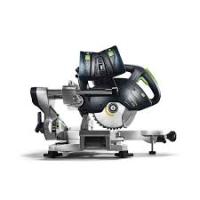
KAPEX KSC 60 EB-Basic - Miter saw FESTOOL - Free user manual and instructions
Find the device manual for free KAPEX KSC 60 EB-Basic FESTOOL in PDF.

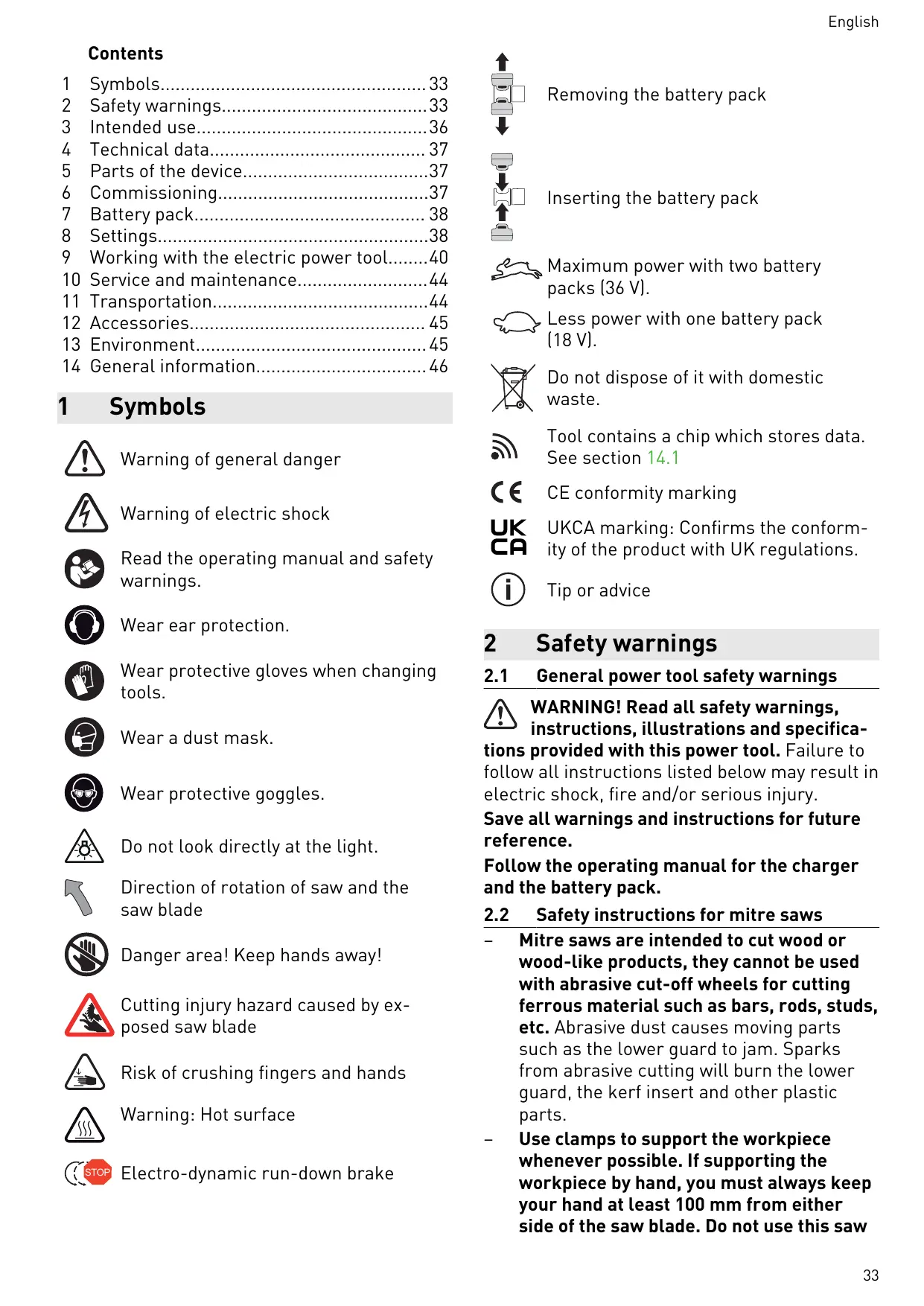


| Product Type | Cordless Compound Miter Saw |
| Brand | Festool |
| Model | KAPEX KSC 60 EB-Basic |
| Rated Voltage | 18 - 2 x 18 V= |
| No-load speed (1 battery pack) | 1300 - 1800 rpm |
| No-load speed (2 battery packs) | 1300 - 3500 rpm |
| Blade Diameter | 216 mm |
| Blade Bore | 30 mm |
| Cut Width | 2.3 mm |
| Blade Thickness | 1.6 mm |
| Max. Miter Angle | 60° left / right |
| Max. Bevel Angle | 47° left / 46° right |
| Weight (without battery) | 17.1 kg |
| Compatible Batteries | Festool BP 18 ≥ 4 Ah |
| Brake | Electrodynamic brake (stop in ~2 s) |
| Work Light | Integrated, with switch |
| Dust Extraction | Vacuum connection (diam. 27/32/36 mm) |
| Intended Use | Wood, plastics, non-ferrous metals |
| Max. workpiece dimensions (0°/0°) | 60 x 305 x 720 mm |
| Maintenance | Regular cleaning, blade replacement, emptying dust bag |
Frequently Asked Questions - KAPEX KSC 60 EB-Basic FESTOOL
User questions about KAPEX KSC 60 EB-Basic FESTOOL
0 question about this device. Answer the ones you know or ask your own.
Ask a new question about this device
Download the instructions for your Miter saw in PDF format for free! Find your manual KAPEX KSC 60 EB-Basic - FESTOOL and take your electronic device back in hand. On this page are published all the documents necessary for the use of your device. KAPEX KSC 60 EB-Basic by FESTOOL.
USER MANUAL KAPEX KSC 60 EB-Basic FESTOOL
en: EU Declaration of Conformity. We declare under sole responsibility that this product complies with all the relevant requirements in the following EU Directives, and following standards or normative documents were applied:
We as the manufacturer declare under our sole responsibility that the product(s) fulfill(s) all the relevant provisions of the following UK Regulations and are manufactured in accordance with the following designated standards:
S.I. 2008/1597 Supply of Machinery [Safety] Regulations 2008
S.I. 2017/1206 Radio Equipment Regulations 2017
S.I. 2016/1091 Electromagnetic Compatibility Regulations 2016
S.I. 2021/422 Restriction of the Use of Certain Hazardous Substances in Electrical and Electronic Equipment Regulations 2012
BS EN 62841-1:2015 + A11:2022,
BS EN IEC 62841-3-9:2020 + A11:2020,
BS EN 55014-1:2017 + A11:2020,
BS EN 55014-2:1997 + A1:2001 + A2:2008 + AC:1997,
BS EN 300 328 V2.2.2,
BS EN 303 446-1 V1.2.1,
BS EN 301 489-1 V1.9.2,
BS EN 301 489-17 V3.2.4,
BS EN IEC 63000:2018
Head of Research & Development Products
Tim Weber
Head of Product Compliance
Inhaltsverzeichnis
1 Symbols 33
2 Safety warnings. 33
3 Intended use 36
4 Technical data. 37
5 Parts of the device. 37
6 Commissioning. 37
7 Battery pack. 38
8 Settings. 38
9 Working with the electric power tool. 40
10 Service and maintenance. 44
11 Transportation 44
12 Accessories. 45
13 Environment. 45
14 General information. 46
1 Symbols

Warning of general danger

Warning of electric shock

Read the operating manual and safety warnings.

Wear ear protection.

Wear protective gloves when changing tools.

Wear a dust mask.

Wear protective goggles.

Do not look directly at the light.

Direction of rotation of saw and the saw blade

Danger area! Keep hands away!

Cutting injury hazard caused by exposed saw blade

Risk of crushing fingers and hands

Warning: Hot surface

Electro-dynamic run-down brake
Removing the battery pack

Inserting the battery pack

Maximum power with two battery packs (36 V).

Less power with one battery pack (18 V).

Do not dispose of it with domestic waste.

Tool contains a chip which stores data. See section 14.1

CE conformity marking

UKCA marking: Confirms the conformity of the product with UK regulations.

Tip or advice
2 Safety warnings
2.1 General power tool safety warnings
WARNING! Read all safety warnings, instructions, illustrations and specifications provided with this power tool. Failure to follow all instructions listed below may result in electric shock, fire and/or serious injury.
Save all warnings and instructions for future reference.
Follow the operating manual for the charger and the battery pack.
2.2 Safety instructions for litre saws
-
Mitre saws are intended to cut wood or wood-like products, they cannot be used with abrasive cut-off wheels for cutting ferrous material such as bars, rods, studs, etc. Abrasive dust causes moving parts such as the lower guard to jam. Sparks from abrasive cutting will burn the lower guard, the kerf insert and other plastic parts.
-
Use clamps to support the workpiece whenever possible. If supporting the workpiece by hand, you must always keep your hand at least 100 ~mm from either side of the saw blade. Do not use this saw
English
to cut pieces that are too small to be securely clamped or held by hand. If your hand is placed too close to the saw blade, there is an increased risk of injury from blade contact.
- The workpiece must be stationary and clamped or held against both the fence and the table. Do not feed the workpiece into the blade or cut "freehand" in any way. Unrestrained or moving workpieces could be thrown at high speeds, causing injury.
Push the saw through the workpiece. Do not pull the saw through the workpiece. To make a cut, raise the saw head and pull it out over the workpiece without cutting start the motor, press the saw head down and push the saw through the workpiece. Cutting on the pull stroke is likely to cause the saw blade to climb on top of the workpiece and violently throw the blade assembly towards the operator. - Never cross your hand over the intended line of cutting either in front or behind the saw blade. Supporting the workpiece "cross handed" i.e. holding the workpiece to the right of the saw blade with your left hand or vice versa is very dangerous.
- Do not reach behind the fence with either hand closer than 100 ~mm from either side of the saw blade, to remove wood scraps, or for any other reason while the blade is spinning. The proximity of the spinning saw blade to your hand may not be obvious and you may be seriously injured.
- Inspect your workpiece before cutting. If the workpiece is bowed or warped, clamp it with the outside bowed face toward the fence. Always make certain that there is no gap between the workpiece, fence and table along the line of the cut. Bent or warped workpieces can twist or shift and may cause binding on the spinning saw blade while cutting. There should be no nails or foreign objects in the workpiece.
- Do not use the saw until the table is clear of all tools, wood scraps, etc., except for the workpiece. Small debris or loose pieces of wood or other objects that contact the revolving blade can be thrown with high speed.
- Cut only one workpiece at a time. Stacked multiple workpieces cannot be adequately
clamped or braced and may bind on the blade or shift during cutting.
- Ensure the litre saw is mounted or placed on a level, firm work surface before use. A level and firm work surface reduces the risk of the litre saw becoming unstable.
Plan your work. Every time you change the bevel or litre angle setting, make sure the adjustable fence is set correctly to support the workpiece and will not interfere with the blade or the guarding system. Without turning the tool "ON" and with no workpiece on the table, move the saw blade through a complete simulated cut to assure there will be no interference or danger of cutting the fence. - Provide adequate support such as table extensions, saw horses, etc. for a workpiece that is wider or longer than the table top. Workpieces longer or wider than the metre saw table can tip if not securely supported. If the cut-off piece or workpiece tips, it can lift the lower guard or be thrown by the spinning blade.
- Do not use another person as a substitute for a table extension or as additional support. Unstable support for the workpiece can cause the blade to bind or the workpiece to shift during the cutting operation pulling you and the helper into the spinning blade.
- The cut-off piece must not be jammed or pressed by any means against the spinning saw blade. If confined, i.e. using length stops, the cut-off piece could get wedged against the blade and thrown violently.
- Always use a clamp or a fixture designed to properly support round material such as rods or tubing. Rods have a tendency to roll while being cut, causing the blade to "bite" and pull the work with your hand into the blade.
- Let the blade reach full speed before contacting the workpiece. This will reduce the risk of the workpiece being thrown.
- If the workpiece or blade becomes jammed, turn the litre saw off. Wait for all moving parts to stop and disconnect the plug from the power source and/or remove the battery pack. Then work to free the jammed material. Continued sawing
with a jammed workpiece could cause loss of control or damage to the metre saw.
After finishing the cut, release the switch, hold the saw head down and wait for the blade to stop before removing the cut-off piece. Reaching with your hand near the coasting blade is dangerous.
Hold the handle firmly when making an incomplete cut or when releasing the switch before the saw head is completely in the down position. The braking action of the saw may cause the saw head to be suddenly pulled downward, causing a risk of injury.
2.3 Safety instructions for the pre-assembled saw blade
Usage
- The maximum speed specified on the saw blade must not be exceeded and the speed range must be adhered to.
- The pre-installed saw blade is only designed for use in circular saws.
- Proceed with extreme care when unpacking, packing and handling the tool (e.g. installing it in the machine). There is a risk of injury from extremely sharp cutting edges!
- When handling the tool, wearing safety gloves provides a more secure hold of the tool and further reduces the risk of injury.
- Circular saw blades with cracked bodies must be replaced. Repair is not permitted.
- Circular saw blades with a combination design (soldered saw teeth) with saw tooth thickness smaller than 1mm must no longer be used.
- WARNING! Do not use tools with visible cracks or blunt or damaged cutting edges.
Installation and mounting
- Tools must be clamped in such a way that they cannot come loose during operation.
- When assembling the tools, it must be ensured that the clamping takes place on the tool hub or the clamping surface of the tool, and that the cutting edges do not come into contact with other components.
- Do not lengthen the key or tighten by hitting with a hammer.
- The clamping surfaces must be cleaned to remove contamination, grease, oil and water.
-
Clamping screws must be tightened according to the manufacturer's instructions.
-
Only securely installed rings, e.g. rings that have been pressed in or those that are held in position by an adhesive bond, may be used to adjust the hole diameter of circular saw blades to the spindle diameter of the machine. The use of loose rings is not permitted.
Service and maintenance
- Repairs or resanding work must only be carried out by Festool customer service workshops or experts.
- The tool design must not be changed.
- Deresinify and clean the tool regularly (cleaning agent with pH between 4.5 and 8).
- Blunt edges can be resharpened on the clamping surface to a minimum cutting edge thickness of 1 ~mm .
- Only transport the tool in suitable packaging - risk of injury!
2.4 Further safety instructions
- Only use saw blades that correspond to the specifications for intended use. Saw blades that do not fit correctly with the assembly parts will run unevenly and may cause fragments to break off from the material and be ejected. These fragments may hit the eyes of the user or any persons standing in the vicinity.
- Only use saw blades with a chip angle ≤slant 0^ . A chip angle >0^ will pull the saw into the workpiece. There is a risk of injury caused by saw kickback and the rotating workpiece.
Before each use, check that the pendulum guard is working correctly. Only use this power tool when it is in perfect working order. - Never reach into the chip ejector with your hands. Rotating parts may injure your hands.
- Dust that is harmful to your health may be produced as you work (e.g. paint products containing lead and some types of wood). Contact with or inhalation of this dust may pose a risk for the operating personnel or persons in the vicinity. Observe the safety regulations that apply in your country.
Use suitable breathing protection to protect your health. In enclosed spaces, ensure that there is sufficient ventilation and connect a mobile dust extractor. - Replace any sawn-off or damaged limit stops. Damaged limit stops may be ejected
English
when you work with the saw. Any persons standing in the vicinity of the saw may be injured.
- Only use original Festool accessories and consumables. Only accessories tested and approved by Festool are safe and perfectly adapted to the machine and application.
- The power tool should only be used indoors and in a dry environment.
- Do not use power supply units to operate cordless power tools. Only use the intended battery packs. Do not use third-party chargers to charge the battery packs. The use of accessories not expressly authorised by the manufacturer can result in electric shocks and/or serious accidents.
- Check whether there are any signs of damage to the housing components, such as cracks or stress whitening. Have any damaged components repaired before using the power tool.

Do not look directly at the light. Optical radiation can damage the eyes.
- Only for AS/NZS: The tool shall always be supplied via residual current device with a rated residual current of 30 ~mA or less.
2.5 Other risks
In spite of compliance with all relevant design regulations, dangers may still present themselves when the machine is operated, e.g.:
- Touching rotating parts from the side: Saw blade, clamping flange, flange screw,
- Touching live parts when the housing is open and the mains plug is still plugged in,
Workpiece parts being thrown off, - Parts of damaged tools being thrown off,
- Noise emissions,
- Dust emissions.
2.6 Aluminium processing
When processing aluminium, the following measures must be taken for safety reasons:

Wear protective goggles.
- Connect the power tool to a suitable dust extractor with an antistatic suction hose.
- Regularly clean dust deposits from the motor housing on the power tool.
- Use a saw blade suitable for cutting aluminium.
- When sawing panels, they must be lubricated with petroleum, but thin-walled profiles
(up to 3mm ) can be sawed without lubrication.
- Do not use water cooling. This can cause a short-circuit.
2.7 Emission levels
The levels determined in accordance with EN 62841 are typically:
Sound pressure level
$$ L _ {P A} = 8 8 \mathrm {d B (A)} $$
Sound power level
$$ L _ {W A} = 1 0 1 \mathrm {d B (A)} $$
Uncertainty
$$ K = 3 \mathrm {d B} $$

CAUTION
Noise emissions created while working with the power tool may damage your hearing.
Always use ear protection.
The specified noise emission values
have been measured in accordance with a standardised test procedure, can be used to compare one power tool with another,
and can also be used for a provisional assessment of the load.

CAUTION
Depending on how the power tool is used, particularly which type of workpiece is being machined, the noise emitted by the power tool during use may deviate from the specified values.
To protect the operator, safety measures should be defined based on load estimates obtained under real conditions of use. (All parts of the operating cycle must be taken into account here, including, for example, times in which the power tool is switched off or when it is switched on but idling.)
3 Intended use
The power tool is a stationary unit designed for sawing blocks of wood, plastic, non-ferrous metals and similar materials. Do not use it to process other materials, in particular steel, concrete and mineral materials.
Materials containing asbestos must NOT be processed.
Do not use cutting or abrasive wheels.

The user is liable for improper or non-intended use.
3.1 Saw blades
Only use saw blades with the following dimensions:
- Saw blades according to EN 847-1
- Saw blade diameter 216 mm
Cutting width 2.3 mm - Locating bore 30 ~mm
- Standard blade thickness 1.6 ~mm
- Suitable for speeds of 3500 rpm or above
Festool saw blades comply with EN 847-1.
Only saw materials for which the saw blade in question has been designed.
4 Technical data
| Cordless compound litre saw | KSC 60 EB |
| Motor voltage | 18 - 2 x 18 V== |
| Speed (idle) 1 x 18 V | 1300-1800 rpm |
| Speed (idle) 2 x 18 V | 1300-3500 rpm |
| Suitable battery packs | Festool series BP 18 ≥ 4 Ah |
| Max. litre angle | 60° left/right |
| Max. bevel angle | 47/46° left/right |
| Weight excl. battery pack | 17.1 kg |
5 Parts of the device
[1-1] On/off switch
[1-2] Switch-on lock
[1-3] Handle
[1-4] Lever for groove depth limit
[1-5] Rotary knob for slide locking device
[1-6] Lever for transport locking device
[1-7] Spindle stop
[1-8] Stop ruler (both sides)
[1-9] Extension table (both sides)
[1-10] Rotary knobs for securing the extension table (both sides)
[1-11] Angle display for litre cuts
[1-12] Lever for locking the metre angle
[1-13] Rotary knob for securing the rotary base
[1-14] Rotary base
[1-15] Pendulum guard
[2-1] On/off switch for spot lighting
[2-2] Button to remove battery pack
[2-3] FSZ120 fastening clamp
[2-4] Bevel holder for clamping the bevel
[2-5] Bevel angle display
[2-6] Star handle for securing the bevel angle
[2-7] Carrying handle
[2-8] Key storage box for the hex key
[2-9] Extractor connector
[2-10] Battery pack capacity indicator
[2-11] Adjusting wheel for setting the speed
The specified illustrations appear at the beginning of the Operating Instructions.
Accessories shown or described are not always included in the scope of delivery.
6 Commissioning
6.1 Initial commissioning

CAUTION
Risk of tilting!
-
Ensure that the power tool is securely positioned.
If required, observe the installation instructions for the MFT multifunction table or underframe UG-KAPEX KS 60. -
Remove the transport safety device [3].
Remove the protective sleeve from the left-hand pulling rail ①.
Push the saw unit down and cut through the cable ties that are securing it in place ②.
Remove the clamp from around the tilt locking device ③.
Set up the machine and move it into the working position.
6.2 Setting up and securing [4]
![FESTOOL KAPEX KSC 60 EB-Basic - Setting up and securing [4] - 1](/content/2024/12/326158/images/af74f42c131db073221a60819935156d3484d9b9bd13fa291037245391c7354d.jpg)
WARNING
Risk of injury
- Remove both battery packs from the power tool before performing any work on the power tool.
English
Secure the power tool in such a way that it cannot slip when you are working on it.
Support feet [4A]
Before securing, if required, install the A-SYS-KS60 support feet. Thanks to these support feet, the work surface on the rotary base is at the same height as a Systainer 1 and Systainer ^3 SYS3 M 112. These Systainers mean that long workpieces can then be supported.
You have the following options for securing:
- Screws [4B]: Use four screws to secure the machine to the work surface. Use the holes [4B-1] at the four support points on the saw table to do this.
- Fastening clamps [4C]: Use fastening clamps [4C-1] to secure the machine to the work surface. The support points are used to firmly secure the machine while taking the centre of gravity into consideration.
- Clamping set (for MFT) [4D]: Use the clamping set [4D-2] to secure the machine onto the Festool MFT 3 or MFT/Kapex (SZ-KS) multifunction table. The hexagonal holes [4D-1] close to the extension table on both sides are used for this.
- Underframe UG-KAPEX KS 60 [4E]: Observe the installation instructions that are enclosed with the underframe.
6.3 Working position

CAUTION
When the lever for the transport locking device [1-6] is pulled, the saw unit moves upwards quickly.
Always hold on to the handle [1-3] when pulling the lever for the transport safety device.
Unlocking the machine (working position)
- Swivel the saw unit into a vertical position (saw blade is vertical) [12].
- Move the saw unit downwards as far as the limit stop and hold it there.
Pull the lever for the transport locking device [1-6].
Slowly guide the saw unit upwards.
Insert the battery pack (see section 7).
The machine is ready for operation.
6.4 Switching on/off
Switching on
- Move the machine into the working position or release the lock on the saw unit.
Press and hold the switch-on lock [1-2].
Press and hold the on/off switch [1-1].
(i) The on/off switch cannot be locked.
Switching off
- Release on/off switch [1-1].
7 Battery pack
Before using the battery pack, check that the battery interface is clean. Any contamination of the battery interface may impair correct contact and lead to the contacts being damaged.
A faulty contact may result in the machine overheating or being damaged.
[5A]
Remove the battery pack.
[5B]

Insert the battery pack - until it clicks into place.
(i) Please note: The machine can only be operated under the following conditions [5C]:
Both battery packs are used. Maximum power with two battery packs (36 V).

Only the front battery pack is used. Less power with one battery pack (18 V).
Further information about the charger and battery pack with capacity indicator can be found in the corresponding operating manual.
8 Settings

WARNING
Risk of injury
- Remove both battery packs from the power tool before performing any work on the power tool.
8.1 Speed control
You can continuously adjust the speed within the speed range using the adjusting wheel [2-10] (see "Technical data"). This enables you to optimise the cutting speed to suit each surface.
Speed range per material
| Solid wood (hard, soft) | 6 |
| Chipboard and hardboard | 3-6 |
| Laminated wood, blockboard, veneered and laminated panels | 6 |
| Laminate, mineral materials | 4-6 |
Speed range per material
Aluminium panels and profiles up to 4-6 15 mm
Plastics, fibre-reinforced plastics, paper 3-5 and fabric
Acrylic glass 4-5
Current limiting
Current limiting prevents excessive current consumption under extreme overload, which can lead to a decrease in the motor speed. The motor immediately restarts after the load is removed.
Temperature cut-out
The power supply is restricted and the speed reduced if the motor exceeds a certain temperature. The power tool continues operating at reduced power to allow the ventilator to cool the motor quickly. The power tool starts up again automatically once the motor has cooled sufficiently.
8.2 Brake
The saw KSC 60 EB comes with an electronic brake. The saw blade is stopped electronically within approximately two seconds of switching off the machine.
8.3 Dust extraction

WARNING
Health hazard posed by dust
Always work with an extractor.
Comply with national regulations.
- When sawing carcinogenic materials, always connect a suitable extraction mobile in accordance with national regulations. Do not use the chip collection bag.
Blockages in the guard may impair safety features. To avoid blockages, it is therefore better to work with a mobile dust extractor at full suction power.
Static charge may occur when sawing (e.g. MDF). If this is the case, work with a mobile dust extractor and an antistatic suction hose.
Festool mobile dust extractor
A Festool mobile dust extractor with a suction hose diameter of 27/32 ~mm or 36 ~mm (36 mm recommended due to the reduced risk of clogging) can be connected to the extractor connector [6-1].
The adapter on a 27 diameter suction hose is inserted into the adapter [6-4]. The adapter on a 36 diameter suction hose is inserted over the adapter [6-4].
CAUTION! A static charge may build up if no antistatic suction hose is used. The user may receive an electric shock and the power tool's electronics may be damaged.
8.4 Independent extraction
- Secure the connection piece [6-2] of the dust collection bag [6-3] at the extractor connector [6-1] with a clockwise rotation.
To empty, remove the connection piece of the dust collection bag from the extractor connector with an anti-clockwise rotation.
8.5 Adjusting the table extension
- Open the rotary knob [7-2].
Pull out the table extension [7-1] far enough that the workpiece is laid out fully.
Close the rotary knob.
i If, despite the table extension being extended as far as possible, the workpiece protrudes over the table, the workpiece must be supported by other means.
8.6 Setting the stop rulers [8]
For litre cuts, you must adjust the stop rulers [8A-1] so that they do not impede the functionality of the pendulum guard or come into contact with the saw blade.
WARNING! Replace damaged stop rulers before using the saw.
- Open the rotary knobs (on both sides) [8A-2].
- Move the stop rulers [8A-1] in such a way that there is a maximum clearance of 8 ~mm from the saw blade.
While the machine is switched off, lower the saw unit in a trial run to check whether the saw blade comes into contact with the stop rulers.
Close the rotary knobs.
The contact surface of the stop rulers can be individually adjusted by screwing in suitable tap blocks [8B]. When doing so, ensure that the functionality of the saw is not restricted in any way.
8.7 Selecting the saw blade
Festool saw blades are identified by a coloured ring. The colour of the ring represents the material for which the saw blade is suited.
Refer to the necessary saw blade data (see section).
| Colour | Material | Symbol |
| Yellow | Wood | |
| Red | Laminate, mineral material | |
| Green | Plaster- and cement-bonded chipboard and fibreboard | |
| Blue | Aluminium, plastic |
8.8 Changing the saw blade

WARNING
Risk of injury
- Remove both battery packs from the power tool before performing any work on the power tool.


CAUTION
Risk of injury from hot and sharp tool.
- Do not use any blunt or faulty tools.
Wear protective gloves when handling a tool.
Preparing the machine
- Move the saw unit into the rear position and lock it in place using the rotary knob [9-3].
- Move the saw unit upwards until it reaches the limit stop.
Pull the lever for the transport locking device [9-2].
Remove the hex key [9-8] from the holder in the key storage box [9-10].
Removing the saw blade
Press and hold the spindle stop [9-1].
Use the hex key [9-8] to turn the saw blade until the spindle stop clicks into place.
Use the hex key to undo the screw [9-7] (left-hand thread, turn in the direction of the arrow).
Remove the screw and flange [9-6].
Release the spindle stop.
- Lift and hold the pendulum guard [9-4] with one hand.
Remove the saw blade [9-5].
Inserting the saw blade
WARNING! Check the screws and flange for contamination and only use clean and undamaged parts.
Insert the new saw blade [9-5].
WARNING! The writing on the saw blade must be visible. The saw blade's direction of rotation must correspond to the direction of the arrow [9-9].
Insert the flange [9-6] in such a way that the flange, holding thread and saw blade all interlock perfectly with each other.
Press and hold the spindle stop [9-1].
Use the hex key [9-8] to turn the saw blade until the spindle stop clicks into place.
Insert the screw [9-7] and tighten it against the direction of the arrow.

Risk of injury! Whenever you replace a saw blade, always check that it is secure-
ly in place. If a screw is loose, the saw blade may become detached.
9 Working with the electric power tool


WARNING
Flying tool parts/workpiece parts Risk of injury
Wear protective goggles.
- Ensure that no other persons are close to the machine while it is being used.
Always clamp workpieces tightly.
The clamps must be fully laid out.

WARNING
The pendulum guard does not close Risk of injury
- Stop the sawing process.
- Remove the battery pack, remove offcuts. In the event of damage, remove the pendulum guard.
9.1 Safe working

When working on the machine, observe all of the safety warnings that are listed
at the start as well as the following rules:
Before starting
-
Ensure that the star handle [2-6] and the rotary knob [1-13] have been tightened.
-
CAUTION! Risk of overheating. Before use, make sure that the battery pack is securely clicked into place.
- Do not work on the power tool if its electronics are defective as this may lead to excessive speeds. You can tell if the electronics are defective if there is no smooth start-up, if it is not possible to regulate the speed and in the event of generation of smoke or the smell of burning from the machine.
- Check that the saw blade is securely in place.
- Always secure the workpiece in such a way that it cannot move during machining.
Position the workpiece so that it is stress-free and level.
During work
-
Correct working position:
-
At the front on the side of the operator;
- Head-on to the saw;
-
Beside the line of cut.
-
During operation, always hold the power tool tightly by the handle [1-3] in your operating hand. Always keep your free hand outside of the hazardous area.
- Adapt the infeed speed to prevent the cutters on the saw blade from overheating and prevent plastic materials from melting during cutting. The harder the material to be sawn, the lower the feed speed needs to be.
- Only guide the power tool towards the workpiece when it is switched on.
Checking that the pendulum guard can move
WARNING! The pendulum guard must always be able to move freely and close independently.
Remove the battery pack.
Take hold of the pendulum guard and, as a trial run, slide it into the saw unit.
The pendulum guard must be easy to move and must be almost fully lowered into the pendulum hood.
Cleaning the area of the saw blade
Always keep the area around the pendulum guard clean.
- Clear dust and chippings by blowing out with compressed air or using a brush.
9.2 Acoustic warning signal
Acoustic warning signals sound and the machine switches off in the following operating states:

peep — —
Battery flat or machine
overloaded:
Change the battery
Reduce the machine load
9.3 Clamping the workpiece [10]
![FESTOOL KAPEX KSC 60 EB-Basic - Clamping the workpiece [10] - 1](/content/2024/12/326158/images/605f0d8b7f608e84d6e9893cb0f20cf46fad5a718aa9e406abf9c6df8b5fb80e.jpg)
WARNING
Risk of injury
Note the workpiece's properties.
Securely in place - Place the workpieces on the stop ruler. Do not machine any workpieces that have not been securely clamped.
Size - Do not machine workpieces that are too small. In the interests of safety, the cut piece remaining should be at least 30 ~mm long. Small workpieces may be pulled backwards by the saw blade and into the gap between the saw blade and the stop ruler.
Correct support - Observe the maximum workpiece dimensions. Always use and secure extensions to the workpiece support. Otherwise, the workpiece may be subjected to internal stresses, which may lead to sudden deformations. Observe the information for workpiece dimensions (see section 9.4).
Proceed as follows to clamp the workpiece
Push the saw unit downwards until it reaches the limit stop.
Pull the lever for the transport locking device [10-1].
Slowly guide the saw unit upwards.
- Place the workpiece so that it is flush with the stop ruler [10-3].
Use the fastening clamp [10-2] to secure the workpiece in place.
- Check that the workpiece is securely in place.
9.4 Observe the workpiece dimensions
Maximum workpiece dimensions without extension using accessory parts
| Mitre/bevel angle, to scale | Height x width x length |
| 0°/0° | 60 x 305 x 720 mm |
| 45°/0° | 60 x 215 x 720 mm |
| 0°/45° right | 20 x 305 x 720 mm |
| 0°/45° left | 40 x 305 x 720 mm |
| 45°/45° right | 20 x 215 x 720 mm |
| 45°/45° left | 40 x 215 x 720 mm |
Maximum workpiece dimensions when installing together with UG-KS60 and KA-KS60
The maximum height and width of the workpiece do not change if accessory parts are installed. The contact surface when installing the underframe must be the same as the contact surface when the extension table is extended.
| Accessory part used | Length |
| UG-AD-KS60 | 720 mm |
| KA-KS60 (one side) | 1880–2800 mm |
| KA-KS60 (both sides) | 3360–5200 mm |
Long workpieces
Provide extra support for any workpieces that protrude over the sawing surface:
- Provide extra support for any workpieces that protrude over the sawing surface:
Adjust the extension table, see section 8.5.
If the workpiece still protrudes, retract the extension table and install a KA-KS60 trimming attachment, or raise the compound litre saw using A-SYS-KS60 screw-in feet and then support the workpieces using T-LOC SYS-MFT Systainers that are Systainer size 1.
Use additional fastening clamps to secure the workpiece.
Thin workpieces
During sawing, thin workpieces may wobble or break.
During sawing, thin workpieces may wobble or break.
- Reinforce the workpiece: Clamp it together with wood offcuts.
Heavy workpieces
To guarantee the stability of the machine, even when sawing heavy workpieces, adjust the support foot [10-4] so that it is flush with the base.
9.5 Compound litre saws
The basic function of the compound litre saw is to saw using a fixed saw unit with no inclination. Recommended: Workpieces up to a width of 70~mm .
The rotary knob [1-5] locks the saw unit so that it can no longer be moved forwards or backwards.
- Tighten the rotary knob for slide locking device [1-5].
Switch on compound mitre saw.
Slowly guide saw unit downwards at the handle, holding down the ON/OFF switch [1-1].
Only guide the saw unit towards the workpiece once the set speed has been reached.
Cut the workpiece.
Once the cut is complete, guide the saw unit back to its upwards position. The pendulum guard closes automatically.
Release the on/off switch.
Spot lighting
The spot lighting casts a shadow over the saw blade and onto the workpiece.
Use the on/off switch [2-1] to activate this function.
The cutting line becomes visible when the saw unit is lowered.
The spot lighting switches off automatically after one hour.
9.6 Slide-sawing
When slide-sawing, the saw blade is guided to the workpiece from the front, which means the sawing is controlled and requires less effort. Recommended for workpieces wider than 70~mm .
Correct sawing process when slide-sawing
Avoid reverse cutting. When sawing, do not pull the lowered saw unit up to the body. The saw blade could hook in and the saw unit could accelerate towards the operator.
- Release the rotary knob for the slide locking device [1-5].
Pull the saw unit to the limit stop.
Switch on compound mitre saw.
Slowly guide saw unit downwards at the handle, holding down the ON/OFF switch [1-1].
Only guide the saw unit towards the workpiece once the set speed has been reached.
Cut the workpiece; slide the saw unit through the workpiece until the limit stop.
Once the cut is complete, guide the saw unit back to its upwards position.
The pendulum guard closes automatically.
- Release the on/off switch. Close the rotary knob.
9.7 Sawing the mitre angle [11]
Setting the standard litre angle
The following metre angles (left and right) automatically engage: 0^, 15^, 22.5^, 30^, 45^, 60^
Release the rotary knob 1
Press the detent lever but do not hook it into place ②.
- Rotate the rotary base into the required position ③ ; release the detent lever shortly before the required angle has been reached.
The rotary base easily clicks into place at the intended metre angles.
- Close the rotary knob 4.
Setting individual metre angles
Release the rotary knob 1
Press the detent lever 2 and let it click into place by pressing on it at the left.
- Continuously swivel the rotary base into the required position ③.
- Close the rotary knob 4.
9.8 Sawing inclined cuts [12]
![FESTOOL KAPEX KSC 60 EB-Basic - Sawing inclined cuts [12] - 1](/content/2024/12/326158/images/fda503bb3fc6de4781602d5139b158af568a9829a2cf06efa9797fba8abab03d.jpg)
Moving or removing the stop rulers 1
may make it necessary to implement special settings for inclined cutting, see section 8.6.
Inclination to the left between 0^ and 45^
- Loosen the star handle ② .
Tilt the saw unit to the required cutting angle 4. - Tighten the star handle 5.
Inclination to the right between 0^ and 45^ :
Loosen the star handle 2
Press the release button 3 ; if required, relieve the tension by slightly tilting it in the opposite direction.
Tilt the saw unit to the required cutting angle 4.
- Tighten the star handle 5.
46-47° inclination to the right/left (undercutting)
Loosen the star handle 2
Press the release button 3 ; if required, relieve the tension by slightly tilting it in the opposite direction.
Tilt the saw unit to the limit stop 4
Press the release button again ③.
Tilt the saw unit again 4
- Tighten the star handle ⑤.
9.9 Sawing grooves
The continuously adjustable groove depth limit can be used to individually define groove areas using the total cutting depth. Grooving or facing is therefore possible at any height for any workpiece size.
The round shape of the saw blade means that, when grooving, a slight cutting curve upwards is required. For grooving that is precisely horizontal, a tap block must be clamped between the workpiece and the stop ruler so that a clearance of 1-9/16" (4cm) can be guaranteed.
Move the machine into the working position.
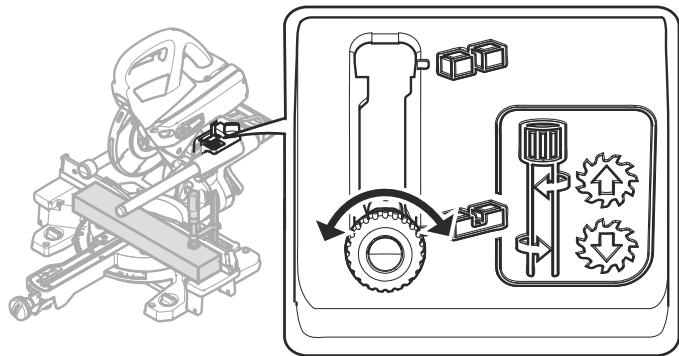
(i) Only turn down the lever for the groove depth limit [1-4] if the saw unit is in the upper position (= working position).
Pull the lever for the groove depth limit [1-4] all the way to the front. The saw unit can now be pushed down only as far as the preset cutting depth.
Turn the lever for the groove depth limit to set the required depth (turn to the left = increase the groove depth, turn to the right = decrease the groove depth)
Push down the saw unit as a trial run to check whether the groove depth limit is set to the required groove depth.
i Only push the saw unit down when the lever for the groove depth limit has engaged in one of the two end positions. Risk of damage to the power tool.
Make the cuts.
To deactivate the groove depth limit, reset the lever [1-4].
10 Service and maintenance

WARNING
Risk of injury, electric shock
- Remove both battery packs from the power tool before performing any work on the power tool.
- All maintenance and repair work which requires the motor housing to be opened should always be carried out by an authorised service workshop.
Customer service and repairs must only be carried out by the manufacturer or service workshops. You must only use original Festool spare parts.
Further information: www.festool.co.uk/service
Observe the following instructions:
Damaged safety devices and components must be repaired or replaced in a recognised specialist workshop, unless otherwise indicated in the operating instructions.
Use an extractor on all openings of the power tool to remove wood chips and splinters. Sawing chips and small parts that get caught up in the sawing channel can be gently pulled out through the opening [13-4].
To ensure constant air circulation, always keep the cooling air openings in the housing clean and free of blockages.
- Keep the contacts on the power tool, charger and battery pack clean.
- When working with plaster- and cement-bonded fibreboards, clean the tool particu-arily thoroughly. Clean the vents of the power tool and on/off switch using dry, oil-free compressed air. Otherwise, gypsum dust deposits may build up inside the power tool's housing and on the on/off switch and harden when exposed to humidity. This may impair the switching mechanism.
! Cleaning the machine regularly, especially the adjusting devices and guides, is an important safety factor.
10.1 Replacing the chip deflector [13]
(i) To ensure that dust and chips are collected properly, you must only work if a chip deflector is installed.
- Undo the screws [13-1] on the guard, remove the chip deflector and clamp.
- Attach the clamp [13-2] to the new chip deflector.
Screw the chip deflector [13-3], along with the clamp, onto the guard.
10.2 Replacing the table top insert [14]
Always replace worn table top inserts. Never use the machine without table top inserts.
Unscrew the position marking [14-3] for the bevel.
- Undo the screws [14-1] in the table top insert.
Replace the table top insert [14-2] and position marking [14-3].
Reattach the screws.
Check that the position markings lie on a line that, at the same time, must run at a right angle to the stop rulers.
10.3 Cleaning/replacing the spotlight window
The spot lighting lights up the cutting edge on the workpiece. Dust-intensive work may affect the power of the light. Proceed as follows to clean the spotlight [15]:
- Move the machine into the working position.
Pull out the spotlight window [15-1] by hand, and clean/replace it. - Reinsert the spotlight window. The spotlight window audibly clicks into place.
11 Transportation

CAUTION
Risk of crushing
The saw unit may swing out/extend
The machine must always be transported in the transport position that has been provided for this purpose.

CAUTION
Risk of injury!
The power tool may slip out of your hands when you are carrying it.
Always carry the power tool with both hands, using the carrying handles [16] provided on both sides of the power tool.
11.1 Securing the power tool (transport position)
-
Remove both battery packs from the power tool.
-
Move the saw unit into the rear position and lock it in place using the rotary knob [1-5].
- Swivel the saw unit into a vertical position.
Loosen the star handle [2-6].
Move the saw unit into a vertical position.
Tightenthastharshandle.
Lock the saw unit in place.
Move the saw unit downwards until it reaches the fence.
Pull the lever for the transport locking device [1-6].
The saw unit remains in the lower position.
- Swivel the rotary base into the right-hand position.
Release the rotary knob [1-13].
Press and hold the detent lever [1-12].
Swivel the rotary base [1-14] as far to the right as it will go.
Release the detent lever, close the rotary knob.
The machine is in the transport position [16].
11.2 Carrying handles provided
- Handle on the saw unit [16-1]
- Handle on the key storage box [16-3]
- Extension tables [16-2] (when fixed in place)
12 Accessories
You can find the PO numbers for accessories and tools under www.festool.co.uk.
In addition to the accessories described, Festool also provides a comprehensive range of system accessories that allow you to use your saw more effectively and in diverse applications, e.g.:
KA-KS60 trimming attachment
UG-KAPEX KS 60 underframe
UG-KS UNI underframe
A-SYS-KS60 screw-in feet
- Clamping connection for MFT SZ-KS
SM-KS60 bevel
12.1 Bevel SM-KS60 (available as an accessory depending on the model)
The bevel can be used to gauge any angle (e.g. between two walls). The bevel therefore forms the angle bisection.
Gauging the interior angle [17A]
- Open the locking device [17-2].
-
Swivel the router [17-1] out in order to gauge the interior angle.
-
Close the locking device.
The dashed mark [17-4] provides the angle bisection. The angle bisection can be transferred via the outside edges of the bevel to
the position markings on the rotary base.
Gauging the exterior angle [17B]
- Open the locking device [17-2].
▶ Slide the aluminium profiles [17-3] on the router forwards. - Swivel the router [17-1] out so that the aluminium profiles are at the exterior angle.
Close the locking device. - Slide the aluminium profiles for the two routers back again.
Transferring the angle [18]
- Place the bevel perfectly in place on one of the stop rulers ① and press down with your thumb.
Release the rotary knob 2
Hook in the detent lever ③. - Swivel the rotary base 4, until the outside edge of the bevel is congruent with the marking 5.
(i) To do so, the bevel must be positioned so that it is parallel to the stop of the compound litre saw. At the same time, apply pressure to the stop ruler by pressing in the recessed grip with your thumb.
- Close the rotary knob ⑥ , remove the bevel.
The angle is transferred, the sawing process can be started.
12.2 Saw blades, other accessories
In order to saw different materials quickly and cleanly, Festool offers saw blades for all applications and these are specially designed for your Festool saw.
13 Environment

Do not dispose of electrical devices, used batteries and battery packs in the household waste. Recycle devices, accessories and packaging. Observe applicable regulations.
Before disposing of used batteries, battery packs and lamps, separate them from the electrical device without destroying them. This means they can be recycled efficiently.
In accordance with the European Directive on waste electrical and electronic equipment and
English
implementation in national law, used electrical devices must be collected separately and handled in for environmentally friendly recycling.
Information on the collection points can be viewed at www.festool.com/environment.
Information on critical materials:
www.festool.co.uk/reach
14 General information
Imported into the UK by
Festool UK Ltd
1 Anglo Saxon Way
Bury St Edmunds
IP30 9XH
Great Britain
14.1 Information on data privacy
The power tool contains a chip which automatically stores machine and operating data. The data saved cannot be traced back directly to an individual.
The data can be read in a contactless manner using special devices and shall only be used by Festool for fault diagnosis, repair and warranty processing and for quality improvement or enhancement of the power tool. The data shall not be used in any other way without the express consent of the customer.
14.2 Bluetooth®
The Bluetooth® word mark and the logos are registered trademarks of Bluetooth SIG, Inc.; they are used by TTS Tooltechnic Systems AG & Co. KG, and therefore by Festool, under licence.
Sommaire
9.9 Sciage de rainures

- Tim Weber
- Inhaltsverzeichnis
- Symbols
- Safety warnings
- General power tool safety warnings
- Safety instructions for litre saws
- Safety instructions for the pre-assembled saw blade
- Usage
- Installation and mounting
- Service and maintenance
- Further safety instructions
- Other risks
- Aluminium processing
- Emission levels
- CAUTION
- Intended use
- Saw blades
- Technical data
- Parts of the device
- Commissioning
- Initial commissioning
- Risk of tilting!
- Setting up and securing [4]
- WARNING
- Risk of injury
- Support feet [4A]
- You have the following options for securing:
- Working position
- When the lever for the transport locking device [1-6] is pulled, the saw unit moves upwards quickly.
- Unlocking the machine (working position)
- Switching on/off
- Switching on
- Switching off
- Battery pack
- Settings
- Speed control
- Speed range per material
- Current limiting
- Temperature cut-out
- Brake
- Dust extraction
- Health hazard posed by dust
- Festool mobile dust extractor
- Independent extraction
- Adjusting the table extension
- Setting the stop rulers [8]
- Selecting the saw blade
- Changing the saw blade
- Risk of injury from hot and sharp tool.
- Preparing the machine
- Removing the saw blade
- Inserting the saw blade
- Working with the electric power tool
- Flying tool parts/workpiece parts Risk of injury
- The pendulum guard does not close Risk of injury
- Safe working
- Before starting
- During work
- Checking that the pendulum guard can move
- Cleaning the area of the saw blade
- Acoustic warning signal
- Clamping the workpiece [10]
- Proceed as follows to clamp the workpiece
- Observe the workpiece dimensions
- Maximum workpiece dimensions without extension using accessory parts
- Maximum workpiece dimensions when installing together with UG-KS60 and KA-KS60
- Long workpieces
- Thin workpieces
- Heavy workpieces
- Compound litre saws
- Spot lighting
- Slide-sawing
- Correct sawing process when slide-sawing
- Sawing the mitre angle [11]
- Setting the standard litre angle
- Setting individual metre angles
- Sawing inclined cuts [12]
- Inclination to the left between 0° and 45°
- Inclination to the right between 0° and 45° :
- 46-47° inclination to the right/left (undercutting)
- Sawing grooves
- Service and maintenance
- Risk of injury, electric shock
- Observe the following instructions:
- Replacing the chip deflector [13]
- Replacing the table top insert [14]
- Cleaning/replacing the spotlight window
- Transportation
- Risk of crushing
- The saw unit may swing out/extend
- Risk of injury!
- The power tool may slip out of your hands when you are carrying it.
- Securing the power tool (transport position)
- Carrying handles provided
- Accessories
- Bevel SM-KS60 (available as an accessory depending on the model)
- Gauging the interior angle [17A]
- Gauging the exterior angle [17B]
- Transferring the angle [18]
- Saw blades, other accessories
- Environment
- General information
- Imported into the UK by
- Information on data privacy
- Bluetooth®
- Sommaire
- Sciage de rainures
Brand : FESTOOL
Model : KAPEX KSC 60 EB-Basic
Category : Miter saw