USER MANUAL RO 150 FEQ FESTOOL
Gear-drive eccentric sander
| Technical data | RO 150 FAQ/RO 150 FE |
| Power | 720 W |
| Speed | 3300 - 6800 rpm |
| Sanding stroke | 5 mm |
| Weight (excluding cable) | 2.3 kg |
| Degree of protection | 回/II |
The specified illustrations can be found at the beginning of the operating instructions.
Graphical symbols

Caution. Danger!

Read the operating instructions/notes

Wear ear protection!

Wear protective goggles!

Wear a protective mask!
1 Intended use
As specified, the machines are designed for sand- ing and polishing wood, plastic, metal, composite materials, paint/varnish, filler and similar materi- rials.
Materials containing asbestos must not be processed.
For reasons of electrical safety the machine must not be damp nor operated in a humid environment. The machine may only be used for dry sanding.

The user is liable for damage and injury resulting from incorrect usage!
2 Before starting up, please observe the following
2.1 Safety instructions

WARNING! Read all safety warnings and all
instructions. Failure to follow the warnings and instructions may result in electric shock, fire and/ or serious injury.
Save all warnings and instructions for future reference.
The term „power tool" in the warnings refers to your mains-operated (corded) power tool or battery-operated (cordless) power tool.
- Harmful/toxic dusts can occur during your work (e.g. lead-containing paint, some types of wood and metal). Contact with these dusts, especially inhaling them, can represent a hazard for operating personnel or persons in the vicinity.
Comply with the safety regulations that apply in your country. Connect the electric power tool to a suitable extraction system.

To protect your health, wear a P2 protective mask.

Always wear protective goggles because of possible dangers when sanding.
- The manufacturer's handling and processing instructions must be observed without fail if explosive or self-igniting dusts are likely to occur during sanding.
- Prevent the penetration of liquid polish into the tool. The penetration of liquid polish into the power tool increases the risk of an electric shock.
The typical values determined in accordance with EN 60745 are:
$$
\text {S o u n d} \quad 8 2 \mathrm {d B (A)}
$$
$$
\text {S o u n d - p o w e r l e v e l} \quad 9 3 \mathrm {d B (A)}
$$
$$
\text {M e a s u r i n g} \quad K = 3 \mathrm {d B}
$$

Wear ear protection!
Vibration emission value a_h (vector sum for three directions) and uncertainty K measured in accordance with EN 60745:
$$
\begin{array}{l l} \text {F i n e s a n d i n g} & a _ {h} = 4, 0 m / s ^ {2} \ \text {A u x i a l i r y h a l l e} & a _ {h} = 6, 5 m / s ^ {2} \ & K = 2, 0 m / s ^ {2} \end{array}
$$
$$
\begin{array}{l l} \text {C o a r s e s a n d i n g} & a _ {h} = 3, 5 m / s ^ {2} \ \text {A u x i a l i y h a l l e} & a _ {h} = 5, 0 m / s ^ {2} \ & K = 2, 0 m / s ^ {2} \end{array}
$$
$$
\begin{array}{l l} \text {P o l i s h i n g} & a _ {h} = 5, 0 m / s ^ {2} \ \text {A u x i a l y h a l l e} & a _ {h} = 8, 5 m / s ^ {2} \ & K = 2, 5 m / s ^ {2} \end{array}
$$
The emission values specified (vibration, noise) were measured in accordance with the test conditions stipulated in EN 60745 and are intended for machine comparisons. They are also used for making preliminary estimates regarding vibration and noise loads during operation.
The emission values specified refer to the main applications for which the power tool is used. If the electric power tool is used for other applications, with other tools or is not maintained sufficiently prior to operation, however, the vibration and noise load may be higher when the tool is used. Take into account any machine idling times and downtimes to estimate these values more accurately for a specified time period. This may significantly reduce the load during the machine operating period.
3 Power supply and start-up

The mains voltage must correspond to the specification on the rating plate.
The slide switch (1.2) serves as an On/Off switch (I = ON, 0 = OFF) .
Only RO 150 FAQ: See Fig. 2 for connection and disconnection of the power cable.

Always switch the machine off before connecting or disconnecting the mains lead!
4 Electronics

The machine has full-wave electronics with the following features:
Smooth start-up
The smooth start-up ensures the machine starts up jolt-free.
Speed adjustment
You can regulate the speed steplessly between 3300 and 6800 rpm using the adjusting wheel (1.4). This enables you to optimise the cutting speed to suit the material.
Constant speed
The pre-selected speed remains constant whether the machine is in operation or in neutral position.
Temperature control
If the motor temperature becomes too high, the power supply and speed are reduced. The tool then only runs with reduced power to enable rapid cooling by means of the motor ventilation. After cooling down, the tool accelerates again automatically.
5 Machine settings

Always remove the power supply plug from the socket before carrying out any work on the machine.
5.1 Sanding motion
You can use the switch (1.1) to set two different sanding motions.

The change can only be made when the sanding pad is stationary, as the switch is locked in place during operation for reasons of safety.
Rotex rotary motion (coarse sanding, polishing)

The Rotex rotary motion is a combination of rotary and eccentric motions. This position is selected for sanding with high output (coarse sanding) and polishing.
Slide the switch (1.1) into the right position.
Eccentric motion (fine sanding)
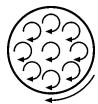
This position is selected for sanding with low output for a scratch-free surface (fine sanding).
Press the switch (1.1) downwards and push it into the left-hand position.
5.2 Sanding pad brake
The rubber collar (3.1) prevents the sanding pad from revving up to maximum speed in an uncontrolled manner during eccentric motion (fine sanding). Because the collar wears down in the course of time, it has to be replaced by a new one (order no. 465 472) as soon as there is any reduction in the braking effect. When fitting a new rubber collar (3.1), make sure it is in the correct position.
5.3 Choice and installation of the sanding disks
Choice of sanding disk
The appliance can be fitted with three sanding disks of different hardness depending on the surface to be treated.
Hard: coarse and fine sanding on surfaces. Sanding at edges.
Soft: universal for coarse and fine sanding for flat and curved surfaces.
Super-soft: fine sanding on formed parts, curves, radii. Do not use on edges!
Assembly
The FastFix system enables tool-free replacement of the sanding pad:
- Set the switch (1.1) to the right, to the Rotex rotary motion
- Press spindle stop (1.6),
- Turn the fitted sanding pad from the spindle (right-handed thread)
- Keep the spindle stop pressed down and screw on the new sanding pad up to the stop (until it can be turned no more). Make sure that the rubber collar (3.1) is fitted correctly when doing this.
- let go of the spindle stop
Actuate the spindle stop only when the drive spindle is stationary. Do not switch on the motor when the spindle stop is pressed in.
5.4 Attaching sanding material
The appropriate Stickfix sanding paper and Stickfix sanding felt can be fastened quickly and easily onto the Stickfix sanding base.
The self-adhesive sanding material is simply pressed onto the sanding base (1.7) and held
safely in place by the Stickfix sanding base velcro surface. After use, the StickFix sandpaper is simply pulled off.
5.5 Securing polishing attachments
To prevent damage, PoliStick polishing attachments (sponges, felt, lambswool bonnets) may only be used on the special polishing pad that is fitted on the machine instead of a sanding pad. In the same way as the StickFix abrasives, the Poli- Stick polishing attachments are simply pressed onto the polishing pad and pulled off after use.

Always connect the machine to a dust extractor when performing work that generates dust.
You can connect a Festool extractor with an extractor hose diameter of 27mm to the extractor connector (1.5). The extraction adapter (4.1) can be removed for polishing work. To do this, press the locking button (4.2), draw the extraction adapter backwards and pull off. To reattach the extraction adapter, insert it as shown in Fig. 4 and slide it towards the sanding pad until the locking button (4.2) latches into place.
5.7 Edge protector
The edge protector (5.1) prevents the sanding pad from touching the edge perpendicular to a surface (e.g. when sanding along a wall), thereby preventing the machine from rebounding.
Assembly
Slide the edge protector onto the guide groove (5.3) on the machine until it latches into place.
5.8 Auxiliary handle
The auxiliary handle (Accessories, 5.2) can be screwed onto either the right or left of the gear head.
5.9 Ball grip
The ball grip (partly as an accessory, 5.4) reduces stress during demanding polishing and sanding applications.
Assembly:
Slide the ball grip into the guide slot (5.3) on the machine until it engages in position.
6 Working with the machine

Always secure the workpiece in such a manner that it cannot move while being sawed.
For safe guidance, hold the machine with both hands on the motor housing (1.3) and on the gear head (1.8) and/or the auxiliary handle (Accesso-
ries, 5.2).
Never overload the tool by using too much pressure! The best sanding results are achieved when applying moderate pressure. The sanding performance and quality depend mainly on the choice of the right sanding material.
Tables A and B show the settings we recommend for different sanding and polishing work.

The following precautions are to be taken when processing metals for safety reasons:
- Pre-connect a residual current circuit-breaker (FI, PRCD).
- Connect the machine to a suitable dust extractor.
- Clean tool regularly of dust accumulations in the motor housing.

Wear protective goggles.

For your own safety, use only original Festool accessories and spare parts.
Festool offers the appropriate accessories, sanding and polishing attachments for every application.
The accessory and tool order number can be found in the Festool catalogue or on the Internet under "www.festool.com".
8 Maintenance and care

Always remove the power supply plug from the socket before carrying out any work on the machine.

All maintenance and repair work which requires the motor casing to be opened may only be carried out by an authorised service centre.
The cool air openings in the motor casing must always be kept clean and unobstructed to ensure air circulation. The tool is fitted with special motor brushes with an automatic cut-out. When the brushes become worn the power supply is shut off automatically and the tool comes to a standstill.
9 Disposal
Do not throw the power tool in your household waste! Dispose of the machine, accessories and packaging at an environmentally-responsible recycling centre! Observe the valid national regulations.
EU only: European Directive 2002/96/EC stipulate
that used electric power tools must be collected separately and disposed of at an environmentally responsible recycling centre.
10 Warranty
For our tools, we give warranty for material and production defects in accordance with the locally applicable legal provisions, but in any case for at least 12 months. Within the EU member states, the warranty period is 24 months (verification through invoice or delivery note). Damage caused by, in particular, natural wear, overloading, incorrect handling, or damage caused by the operator, or damage caused through use of the equipment contrary that specified in the Operating Instructions, or damage which was known at the time of purchase, is not covered by the warranty.
Furthermore, damage caused by the use of nonoriginal Festool accessories and consumable material (e.g. sanding pads) is also excluded.
Complaints can only be recognised if the tool is
returned while still assembled to the supplier or an authorised Festool Customer Service workshop. Keep the Operating Instructions, Safety Instructions, Spare Parts List and purchase receipt in a safe place. Otherwise the respective, current warranty conditions of the manufacturer shall apply.
Note
Due to continuous research and development work, we reserve the right to make changes to the technical content of this documentation.
REACH is a European Chemical Directive that came into effect in 2007. As "downstream users" and product manufacturers, we are aware of our duty to provide our customers with information. We have set up the following website to keep you updated with all the latest news and provide you with information on all the materials used in our existing products: www.festool.com/reach
| Table A: Sanding | Coarse sanding | Fine sanding |
| ELECTRIC | | | ELECTRIC | | |
| Paintwork, filler | X | 5-6 | soft | X | 1-3 | super soft |
| Paintwork, paint | X | 5-6 | hard | X | 3-6 | hard |
| Wood, veneered surface | X | 5-6 | hard | X | 3-6 | soft |
| Plastics | X X | 4-6 | soft | X | 1-4 | soft |
| Steel, copper, aluminium | X | 6 | soft | X | 3-6 | soft |
| Table B:Polishing | | Polishing | Sealing | High-gloss polishing |
| Paintwork | ELECTRONIC | 6 | 3 | 4 - 6 |
| Sponge, coarse/fine | Sponge, fine, honeycombed | Sheepskin |
| Polishing paste | Hard wax | - |
| Plastics | ELECTRONIC | 6 | 3 | 6 |
| Felt, hard | Felt, soft | Sheepskin |
| Polishing paste | Hard wax | - |
Ponceuse roto-excentrique

7 Accessoires, outfits

Bcerda ykpeplnayTe o6pa6aTbI BaemyIO DeTalb TaK, UTo6bI OHa He DBrIraIacb PpN o6pa60tKe.
Дя уBEReHnO BeDEHnY uDEpXnBaIte MaunHky DByM pyKamn 3a KOpNyc DBrIaTeJy (1.3) n Koxyx peDyKTopa (1.8) nIiN 3a DoNoJIHnTeJbHyO pyKoTky (ocHaCTka, 5.2).
He neperpykaTe MaunHky cInuKOM cnIbHbIM haxaTneM Ha Hee! Bby DoCTnHete Lyuuxpe3yIb- TaTOB,ecn6ydeTe pa6oTaB cyMepeHHbIM ycINNeM. PpOu3BOJNTeJIbHOCTb N KaueCTBO IJNIOOBAHnpe7aIoUm 6pa30M 3aBvCrt OT npabUNbHoro NOb-6opa a6pa3NBHOrMaTePnAna.
B Ta6nuax A n B npedctaBneHbI peKoMeHdyemble yCTaHOBKn dJa pa3JNUHbIX NOpINOBaJIbHbIX N JIINΦOBAJIbHbIX pa60T.
Пи obpa6oTke MeTaJIInuYeCKnX NOBepxHocTei N3 coO6paXeHn 6e3OpacHoCTn Heo6xoJIMo co6IIO-daTb cIeNyUOuNe yKa3aHnY:
-Подключnte ВьКлючateль 3aцNTы OT пpeВы-шени.ToKa (Fl-,PRCD-).
-ПодключITE MaшинКу K подхоршему nbileya-lяюшему annapaty.
- Peryjaryno ouuzaa Te Maunnky ot oceBwe Ha Kopnyce DBrataTeI pyIIN.

Pa60TaIe B 3aunTHbIX ouKax.

Ochactka, HhCTpyMeHtbl

Дя co6cTBeHHo 6e30nacHocTи nCpOJIb-3yIteToJIbKO opuHaJIbHbIe npncno6JeHnI y3aNaChbIe qactn fnpMbI Festool.