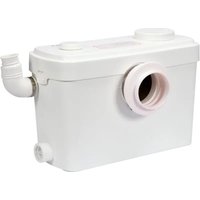
75953 - Toilet Fala - Free user manual and instructions
Find the device manual for free 75953 Fala in PDF.


| Product type | Sanitary grinder pump for toilets and washbasins |
| Brand | Fala |
| Model | 75953 |
| Rated voltage | 220-240 V~ |
| Rated frequency | 50 Hz |
| Rated power | 600 W |
| Rotation speed | 2850 min⁻¹ |
| Max flow rate | 150 l/min |
| Max pumping height | 9.5 m |
| Max water temperature | 45 °C |
| Electrical insulation class | I |
| Protection rating | IP55 |
| Connection diameters | 2 x ∅40 mm; 1 x ∅100 mm |
| Weight | 6.5 kg |
| Check valve included | Yes |
| Grinder function | Yes |
| Intended use | Domestic only |
| Installation | By a professional plumber |
| Routine maintenance | Regular leak check; drain in case of frost |
| Recommended electrical protection | 30 mA residual current circuit breaker |
| Repairs | Authorized service center only |
Frequently Asked Questions - 75953 Fala
User questions about 75953 Fala
0 question about this device. Answer the ones you know or ask your own.
Ask a new question about this device
Download the instructions for your Toilet in PDF format for free! Find your manual 75953 - Fala and take your electronic device back in hand. On this page are published all the documents necessary for the use of your device. 75953 by Fala.
USER MANUAL 75953 Fala
natural_image
White plastic water pump housing with inlet and outlet pipes (no text or symbols visible)CE
PL EN DE RU UA LT LV CZ SK HU RO ES FR IT NL GR
natural_image
Three-panel black-and-white photo showing a hand holding a white plastic connector, with no visible text or symbols.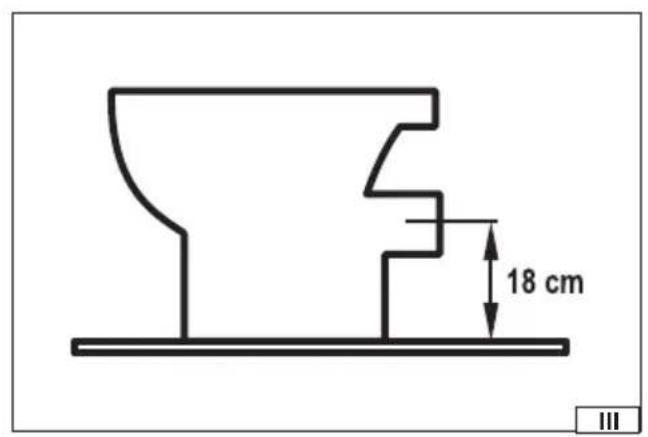
natural_image
Pure mechanical diagram showing a piston and spring assembly without any text or symbols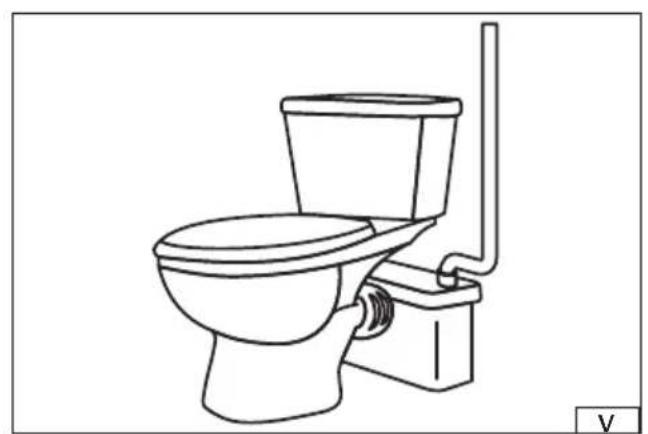
natural_image
Line drawing of a standard toilet with a side-mounted sink and toilet, no text or symbols present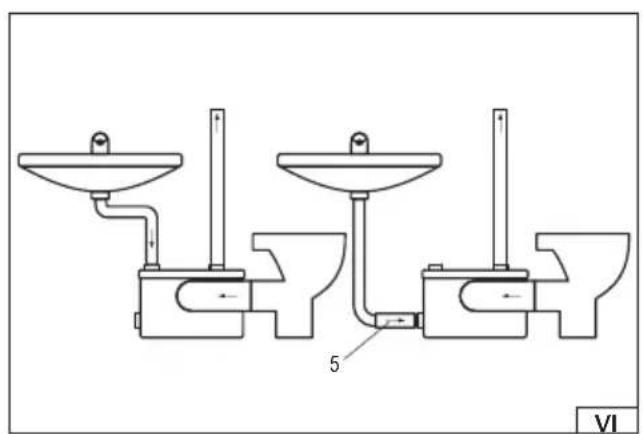
natural_image
Technical line drawing of a three-way bathroom sink assembly with funnel and vented outlets (no text or labels)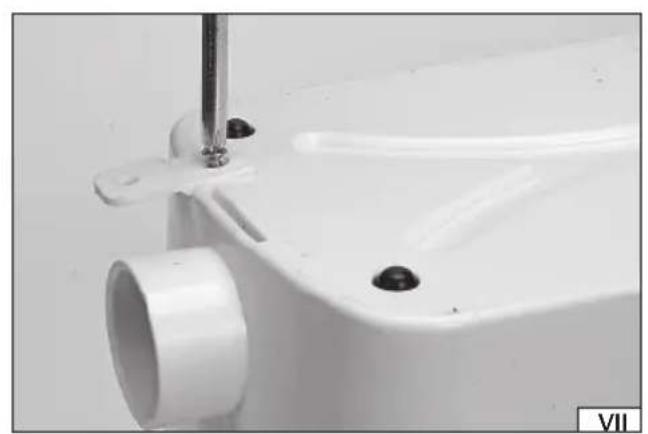
natural_image
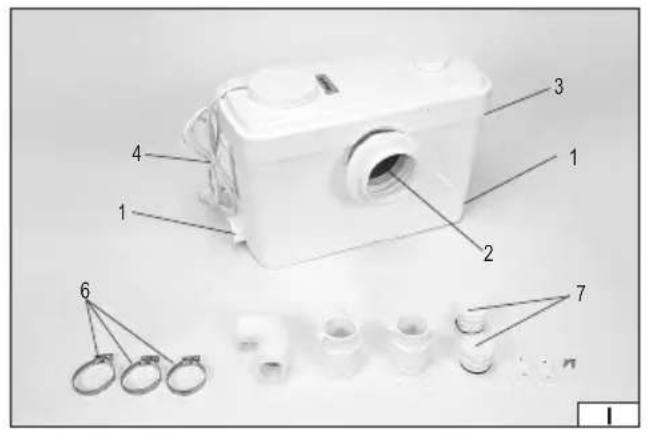
Close-up of a white plastic bottle with a metal rod inserted, showing internal tubing and a small black bolt (no text or symbols visible)- pump small inlet
- pump large inlet
- pump outlet
- power cord with plug
- non-return valve
- band clip
- stopper of the pump inlet
DE
Read the operating instruction
Max. height of delivery
Max. Förderhöhe
Mains voltage and frequency
The temperature of the water supply
This symbol indicates that waste electrical and electronic equipment (including batteries and storage cells) cannot be disposed of with other types of waste. Waste equipment should be collected and handed over separately to a collection point for recycling and recovery, in order to reduce the amount of waste and the use of natural resources. Uncontrolled release of hazardous components contained in electrical and electronic equipment may pose a risk to human health and have adverse effects for the environment. The household plays an important role in contributing to reuse and recovery, including recycling of waste equipment. For more information about the appropriate recycling methods, contact your local authority or retailer.
The sanitary pump with shredder is used to connect sanitary devices such as lavatories and washbasins for sanitary sewage network. If can be installed for pumping with impurities in places where sewerage infrastructure requires forced circulation e.g. in places below the connector or places, which are significantly distant from the intake. Shredding function allows the pump to intermittently pump waste water containing fecal matter. The device is designed for use only in households and may not be used professionally, ie. in the workplace and for work to earn money. Correct, reliable, and safe operation of the tool is dependent on proper use, therefore:
Prior to working with the device, you should read all the instruction and keep it around.
Attention! The device is intended only for pumping water containing fecal matters. It is prohibited to throw hygienic articles such as: paper towels, sanitary towels, tampons and other similar products to toilets connected to the pump,
For any damage caused by failure to comply with safety regulations and instructions of this manual, the supplier is not responsible.
MACHINE EQUIPMENT
The pump is supplied in a complete state and requires no assembly. Correct assembly is required for the proper operation of pump. It is required that the installation of water connections will be carried out by the qualified plumber. Non-return valve nd band clips are supplied with the pump.
TECHNICAL PARAMETERS
| Parameter Unit Value | ||
| Catalogue No 75953 | ||
| Rated voltage [V~] 220 - 240 | ||
| Rated frequency [Hz] 50 | ||
| Electric insulation class I | ||
| Degree of protection IP55 | ||
| Rated power [W] 600 | ||
| Rotational speed [min] | ^-1 2850 | |
| Maximum capacity | [l/min] | 150 |
| Maximum water temperature | [°C] 45 | |
| Maximum height of pumping | [m] | 9,5 |
| Diameter of the water connection | [mm] | 2 x ∅40; 1 x ∅100 |
| Weight | [kg] | 6,5 |
GENERAL SAFETY CONDITIONS
NOTE! Get acquainted with all the instructions below. Failure to observe them may lead to an electric shock, fire or injuries. The notion of electric tool used in the instructions applies to all the tools which are powered with electric current, both wire tools and wireless ones.
OBSERVE THE FOLLOWING INSTRUCTIONS
Place of work
The place of work must be properly illuminated and clean. Disorder and poor illumination may be a cause of accidents.
Do not work with electric tools in explosive environments, or those which contain inflammable liquids, gases or vapours. Electric tools generate sparks, which may cause a fire in case of contact with inflammable gases or vapours.
Do not allow children and outsiders to the place of work. A lack of concentration may result in a loss of control over the tool.
Electric safety
The plug of the power supply cable must fit the mains socket. Do not modify the plug. Do not use any adapters whatsoever in order to adapt the plug to the socket. Unmodified plug which fits the socket reduces the risk of an electric shock.
Avoid contact with grounded surfaces, such as pipes, heaters and refrigerators. Grounding of the body increases the risk of an electric shock.
Do not expose electric tools to precipitation or humidity. Water and humidity which gets into the electric tool increases the risk of an electric shock.
Do not overload the power supply cable. Do not use the power supply cable in order to carry the tool or to connect and disconnect the plug from the mains socket. Avoid contact of the power supply cable with heat, oils, sharp tools and moving elements. Damage to the power supply cable increases the risk of an electric shock.
EN
In case work is realised outside closed areas, it is necessary to use extension cords designed for applications outside closed areas. Using a correct extension cord permits to reduce the risk of an electric shock.
If operating a power tool in a damp location is unavoidable, use a residual current device (RDC) protected supply. Use of an RCD reduces the risk of electric shock.
Personal safety
Commence work in good physical and psychological conditions. Pay attention to what you do. Do not work if you are tired or under effects of medicines or alcohol. Even a moment's inattention during work may lead to serious injuries.
Always use individual means of protection. Always wear goggles. Using individual means of protection, such as dust-masks, protective shoes, helmets and hearing protections permits to reduce the risk of serious injuries.
Avoid accidental activation of the tool. Make sure the switch is in the OFF position, before you connect the tool to the mains. Holding the tool with a finger on the switch or connecting an electric tool when the switch is in the ON position may lead to serious injuries.
Before you turn an electric tool on remove all the spanners and other tools, which have been used for adjustments. A spanner left on rotating elements of the tool may lead to serious injuries.
Keep your balance. Maintain an appropriate position. It will permit to control the electric tool in case of unpredicted situations during its operation.
Use protective clothes. Do not wear loose clothes or jewellery. Keep your hair, clothes and gloves away from moving elements of the electric tool. Loose clothes, jewellery or long hair may get caught on moving elements of the tool.
Use dust extractors or dust containers, if the tool is equipped with any. Make sure they are properly connected. Using of dust extractors permits to reduce the risk of serious injuries.
Operation of the electric tool
Do not overload the electric tool. Use a proper tool for the given purpose. A correct selection of the tool for the given work will result in a more efficient and safer work.
Do not use the electric tool if the switch is not functioning properly. A tool which may not be controlled by means of a switch is dangerous and must be repaired.
Disconnect the plug from the mains socket before any adjustment, replacement of accessories or storage of the tool. It will permit to avoid accidental activation of the electric tool.
Store the tool away from children. Do not allow untrained persons to operate the tool. An electric tool may be dangerous in hands of an untrained person.
Make sure the tool is properly maintained. Check the tool in order to detect any unfitting or loose moving elements. Check whether the elements of the tool are not damaged. In case any damaged elements of the tool are detected, they must be repaired before the electric tool is operated. Many accidents are caused by improper maintenance of tools.
Cutting tools must be sharp and clean. Properly maintained cutting tools are easier to control during work.
Use electric tools and accessories in accordance with the aforementioned instructions. Use the tool in accordance with its purpose, taking into account the kind and conditions of work. Should the tool be used for other applications than the ones it has been designed for, the risk of a dangerous situation increases.
Repairs
The tool may be repaired only by authorised service centres, which must use solely original spare parts. It will guarantee a proper level of safety of operation of the electric tool.
PARTICULAR SAFETY CONDITIONS
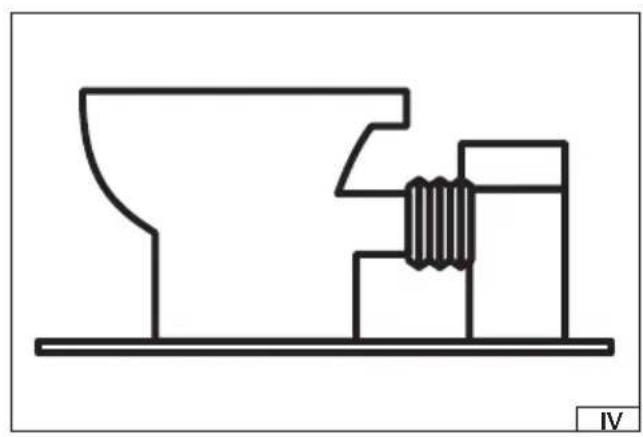
The pump is intended only to shell toilet with the horizontal drainage of water and upper tank. The outflow axle should be located at a height of 18 cm above the ground (III). It is not acceptable to install the pump, where pump inlet is located above the lavatory pen outlet (IV).
In any situation it is not permitted to allow for the operation of pump with faulty mains cable, or faulty cable plug. In the event of such damage, the plug or cable must be replaced with a new one by authorized personnel, and after this replacement there have to be performed the effectiveness measurements of protection against electrical shock.
The pump should be connected to the mains 230V/50Hz A. C. with a RCB (RCBO) rated at min. 6A and differential current rated at max. 30mA.
Before pump maintenance or its current operational service it is necessary to pull the plug from mains.
PUMP ASSEMBLY
Attention! Because of the risk of electric shock, it is required that the pump assembly will be carried out by a qualified plumber.
The pump must be placed as close to the exhaust as possible. Pump performance decreases with height on which the pump must
EN
operate. Nominal pump efficiency is given for zero the height.
Tubes and pipes, which are used for connecting the pump, may not have smaller diameter than pump inlets and outlets.
Pump connection to the lavatory pan (V)
Outlet of the lavatory pan should be connected to the large pump inlet using a flexible coupling. You should make sure, that the pump inlet is not placed higher than the lavatory pan outlet. Litter should flow by gravity toward the pump.
Secure the connections by using band clips. If necessary, use additional seals.
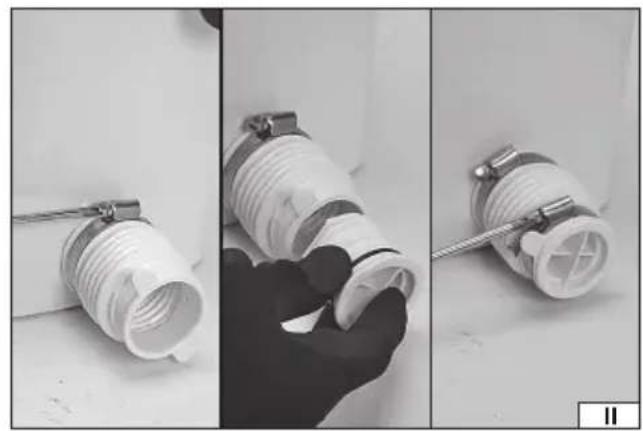
On other pump inlets the stoppers should be installed and protected by the band clips.(II).
Connected the pump outlet to a drain. Secure all connections by using band clips. If necessary, use additional seals. The clips should be tighten with a force sufficient to ensure sealing. Too much tightness can destroy the rubber.
The pump is equipped with an internal check valves and there is no need to install an external check valve at the outlet of the pump. The attachment of an additional check valve may cause slow performance of the pump.
After you have finished hydraulic installation of the pump, the pump should be connected to the electrical outlet and the connections should be checked for leaks by using clean water. When the leak is detected, you should immediately disconnect the power cable from wall socket and remove the cause of leak.
Pump connection to the wash basin (VI)
The water outlet of wash basin should be connected to the pump small inlet using additional coupling, which is not supplied with pump. You can choose any of the two inlets, but you should be guided by the principle, that the pump inlet may not be placed higher than the outlet of wash basin. Litter should flow by gravity toward the pump.
Secure the connections by using band clips. If necessary, use additional seals.
On other pump inlets the stoppers should be installed and protected by the band clips.(II, III).
Connected the pump outlet to a drain. Secure all connections by using band clips. If necessary, use additional seals. The clips should be tighten with a force sufficient to ensure sealing. Too much tightness can destroy the rubber.
The pump is equipped with an internal check valves and there is no need to install an external check valve at the outlet of the pump. The attachment of an additional check valve may cause slow performance of the pump.
After you have finished hydraulic installation of the pump, the pump should be connected to the electrical outlet and the connections should be checked for leaks by using clean water. When the leak is detected, you should immediately disconnect the power cable from wall socket and remove the cause of leak.
It is possible to connect pump to a toilet and wash basin (VI), but in this case, using the lower water inlet for water drain from the wash basin, you should secure it with a check valve. Do not allow for impurities, which outflow from the lavatory pan, reach the wash basin through sewage system. While using more than one pump inlet you should be aware of the maximum continuous time of pump operation.
After all hydraulic connections have been installed; the pump may be affixed to ground. First, mount the connectors with holes (VII), and then affix the connectors to ground using bolts or screws.
USING THE PUMP
Pump starts automatically after filling with the dross and ceases to operate after they are emptied.
Do not throw paper, hygiene articles (e.g. sanitary towels, tampons, etc.) and cigarette butts to the devices, which are connected to the pump. This can lock the operation of pump motor, causing it to overheat and damage. It may also cause the unsealing of hydraulic installation. It also increases the risk of electrical shock.
PUMP MAINTENANCE
During its normal operation the pump does not require any special maintenance. You should periodically inspect the hydraulic system, whether the hydraulic system is sealed. During pump operation you should pay attention to changes in the way of work and / or operational efficiency. When the pump is left in places where the temperature may drop below zero degrees, the pump and the entire hydraulic installations should be drained of water. Water, during its freezing, increases its volume and may result in damage to the pump and hydraulic system.
Attention! When a fault is detected, the pump should be immediately disconnected from power supply and only then you should start searching for causes of the fault.
If pump fault will require to forward it to the manufacturer service, the pump should be first thoroughly cleaned of impurities. Manufacturer reserves the right to not accept the pump, which is with fecal matter. It should be noted that transport of fecal matter may be subject to a separate legal regulations.
Below there are listed the most common causes and possible solutions to problems that may be encountered during service life of the pump.
EN
| The device is running but: Possible cause Solution | ||
| - insufficiently, or too slow, | Outflow tube is too long.Outflow pipe diameter is too small.Outflow pipe is partially blocked. | Check the outflow pipe.Start pump with the external switch. |
| - does not pump despite the noise of the operating engine | The pump is blocked.Non-return valve mounted in the wrong direction. | Check the pump.Check the direction the non-return valve. |
| - it starts accidentally,- works continuously, | Valve failure in the tank of lavatory panLeakage. | Check whether the water is not coming out of lavatory pan.Check whether the water tap of wash basin is not leaking. |
| Pump is not running. | Power supply failure.Pressure switch failure.Engine failure. | Return pump to the authorized service. |
| Water leak from the pump. | Terminals are unsealed.Mechanical damage to the body.Overflow of the internal pump tank resulting from the exceeding of limit of device acceptable flow capacity or failure of the pressure valve. | Check the tightness of connections and body.Check whether the amount of water at pump inlet does not exceed maximum pump capacity.Return pump to the authorized service. |
CHARAKTERISTIK DER ANLAGE
- DE
- MACHINE EQUIPMENT
- TECHNICAL PARAMETERS
- GENERAL SAFETY CONDITIONS
- Place of work
- Electric safety
- EN
- Personal safety
- Operation of the electric tool
- Repairs
- PARTICULAR SAFETY CONDITIONS
- PUMP ASSEMBLY
- Pump connection to the lavatory pan (V)
- Pump connection to the wash basin (VI)
- USING THE PUMP
- PUMP MAINTENANCE
- CHARAKTERISTIK DER ANLAGE
Brand : Fala
Model : 75953
Category : Toilet