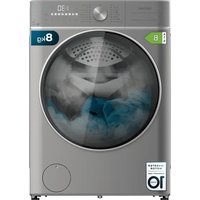
Bolero Wash&Dry 8580 Inverter - Washing machine CECOTEC - Free user manual and instructions
Find the device manual for free Bolero Wash&Dry 8580 Inverter CECOTEC in PDF.


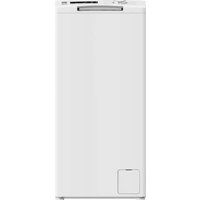
| Product Type | Washer-dryer (combined washer-dryer) |
| Brand | Cecotec |
| Model | Bolero Wash&Dry 8580 Inverter |
| Washing capacity | 8 kg |
| Drying capacity | 5 kg |
| Dimensions (W x D x H) | 600 x 520 x 847 mm |
| Net weight | 65 kg |
| Power supply | 220-240 V~, 50 Hz |
| Rated washing power | 2000 W |
| Rated drying power | 1600 W |
| Water pressure | 0.03 MPa - 1 MPa |
| Maximum spin speed | 1400 rpm |
| Wash programs | Universal, Cotton, Anti-allergy, Wool, Baby clothes, Shirts, Bed linen, Quick wash, Eco 40-60, 20 °C, Night wash, Duvets, Rinse+Spin, Spin, Drum clean, M-Smart |
| Special functions | Steam, Automatic and timed drying, Delayed start (up to 24 h), Child lock, Stain removal, One Touch (M-Smart) |
| Inverter type | Inverter motor (quiet and efficient) |
| Routine maintenance | Cleaning of pump filter, detergent drawer, door gasket, drum, and mesh filter of water inlet hose |
| Safety | Door lock, child safety, automatic stop in case of anomaly |
| Protection class | IP X4 |
| Repairability / After-sales service | Cecotec After-Sales Service (tel. +34 9 63 2107 28) |
| General information | Product manufactured in China, designed in Spain. Warranty in accordance with applicable regulations. Recycling at end of life. |
Frequently Asked Questions - Bolero Wash&Dry 8580 Inverter CECOTEC
User questions about Bolero Wash&Dry 8580 Inverter CECOTEC
0 question about this device. Answer the ones you know or ask your own.
Ask a new question about this device
Download the instructions for your Washing machine in PDF format for free! Find your manual Bolero Wash&Dry 8580 Inverter - CECOTEC and take your electronic device back in hand. On this page are published all the documents necessary for the use of your device. Bolero Wash&Dry 8580 Inverter by CECOTEC.
USER MANUAL Bolero Wash&Dry 8580 Inverter CECOTEC
Safety instructions T1
- Parts and components
2.Before use
-
Product installation
-
Operation
-
Cleaning and maintenance
-
Troubleshooting
-
Technical specifications 129
Technical sheets
- Disposal of old electrical and electronic
appliances
- Technical support and warranty
T. Copyright
SOMMAIRE
Read these instructions thoroughly before using the device. Keep this instruction manual for future reference or new users.
- Ensure that the mains voltage matches the voltage specified on the device rating label and that the plug is earthed.
- If the power cord is damaged, it must be replaced by the official Cecotec Technical Support Service or by a similarly qualified person to prevent hazards.
- This appliance is for indoor use only.
- The device is not designed for built-in installation.
- Use the hose set supplied with the appliance. Do not reuse old hoses.
- Check hose connections regularly to ensure that no water leaks out.
- Do not use the appliance if parts are missing or defective or if the power cord or plug is damaged.
- Do not use the appliance until you are sure that it is installed in accordance with the instructions provided in this manual and all water, drain, electrical and grounding connections comply with all applicable local regulations and/or other requirements.
- Before carrying out any maintenance or cleaning in the device, unplug the appliance from the mains.
- As a safety measure, we advise you to unplug the appliance and cut the water supply after every use. Maximum water-inlet pressure: 1 MPa. Minimum water-inlet pressure: 0.03 MPa.
- Never unplug the appliance with wet hands.
-
For safety, be sure to connect the plug to a 3-pin socket. Check carefully and make sure that your socket is properly and reliably earthed.
-
It must be possible to disconnect the appliance from the power supply by unplugging it if the plug is accessible, or by means of an all-pole switch upstream of the plug, in accordance with national electrical safety regulations.
- The maximum current of the device is 10 A, make sure that the power supply system (voltage, current and cable) is applicable to the load of the device.
- Make sure that the socket outlet is capable of supporting the Maximum Power rating of the appliance as indicated on the rating plate.
Water and electrical devices must be connected by a qualified technician in accordance with the manufacturer's instructions and local safety regulations. - The glass door may reach high temperatures during operation. Keep children and pets away from the glass door. Never open the door during the drying stage.
- Do not operate the device in very wet rooms or in rooms with explosive or caustic gas.
- Do not dry unwashed items in the appliance.
- Do not wash items that have been soiled with substances such as cooking oil, acetone, alcohol, petrol, kerosene, spot removers, turpentine, waxes, and wax removers. These should be washed in hot with an extra amount of detergent before being dried in the appliance.
- Items such as foam rubber (latex foam), shower caps, waterproof textiles, rubber backed articles and clothes, or pillows fitted with foam rubber pads should not be dried in the machine.
- Do not wash articles that have been cleaned in, washed in, soaked in, or stained with flammable or explosive substances, like wax, oil, paint, petrol, degreasers, dry-cleaning solvents, kerosene, etc., which may result in
fire or explosion.
Fabric softeners or similar products should be used as specified by manufacturer.
- Don't wash or dry articles that have been cleaned in, washed in, soaked in, or dabbed with combustible or explosive substances (such as wax, oil, paint, petrol, degreasers, dry-cleaning solvents, kerosene, etc.). This may result in fire or explosion.
- When washing fabrics that contain vegetable or cooking oil or have been contaminated by hair care products, they should first be washed in hot water with extra detergent. This will reduce, but not eliminate, the hazard.
- The exhaust air must not be discharged into a flue which is for exhausting fumes from appliances burning gas or other fuels.
- The air openings must not be obstructed by a carpet.
- Appliances with a single inlet valve can only be connected to a cold water supply. Appliances with a double inlet valve must be correctly connected to a hot water and cold water supply (depending on the washing machine model).
- The plug must be accessible after installation.
- The appliance must not be installed behind a lockable door, a sliding door, or a door with a hinge on the opposite side to that of the device.
- The appliance shall not be installed in a humid place.
- Do not place other items or appliances (such as microwaves) or objects under pressure on the device.
- The product is only for home use and is only designed for the textiles suitable for machine washing and drying.
- The product cannot be used for commercial or industrial purposes. Do not use the appliance outdoors, even if the area is protected, as it may be exposed to moisture, rain, or thunderstorms.
- Do not insert more laundry load than the allowed load (maximum allowed load indicated in the product data tables).
- The device is not designed to be operated by external switching devices such as timers or remote control systems.
- Do not use an extension lead or multiple sockets.
- Do not wash garments containing glass fibre, such as certain curtains or blinds, as particles may remain in the washing machine and adhere to other types of garments, causing skin irritation.
- Do not stand or sit on the appliance.
- Do not lean against appliance door.
- Flammable and explosive or toxic solvents are forbidden. Do not use detergents containing petrol, alcohol, etc. Use only detergents suitable for machine washing, especially for the drum.
- Garments containing oil may catch fire spontaneously, especially when exposed to heat sources such as a washer-dryer. The garments are heated, causing an oxidation reaction in the oil. Oxidation generates heat. If heat cannot escape, garments may become hot enough to catch fire Piling, stacking, or storing garments containing oil retains heat and therefore creates a fire hazard.
- Garments containing vegetable cooking oil or hair care products should first be washed in hot water with extra detergent, this will reduce the hazard, but will not completely eliminate it.
- Make sure that no objects such as lighters, matches, etc. are introduced.
- Close the door properly, if it is difficult to close, check that clothing does not prevent proper closing.
- Never stop the device before the end of the drying cycle
unless all items are quickly removed and spread out so that the heat is dissipated.
- In the final part of the tumble dryer cycle, the cooling part, no heat is provided to ensure that the garments are not damaged due to high temperature.
- Make sure that there is no water in the drum before opening the door.
- Once the washing cycle has finished, we recommend removing the laundry as soon as possible to prevent creas
- This appliance can be used by children aged 8 and above and people with reduced physical, sensory, or mental capabilities or lack of experience and knowledge, as long as they have been given supervision or instruction concerning the use of the appliance in a safe way and understand the hazards involved. Do not allow children to play with the device. The cleaning and maintenance of the appliance should not be carried out by children without supervision.
- Children of less than 3 years should be supervised to ensure that they do not play with appliance.
- Children should be supervised to make sure that they do not play with the device.
- Cleaning and maintenance should not be carried out by children without supervision.
- Be sure to use the child lock functions and to switch off the appliance when not in use.
- Keep the cleaning products out of the reach of children.
Cautions during the handling of the appliance
-
If you wish to change the location of the washing machine, make sure you install the transport bolts again in the device, as they will ensure the interior of the product is not damaged during transport.
-
Water accumulated inside the appliance must be drained out.
- Handle the machine carefully. Never hold each protruded part on the machine while lifting. Do not use the door of the device as a handle during transport.
The device is heavy. Transport it with care. - Secure the drain and water-supply hose correctly.
- Do not insert hands into the running water extracting tub.
- Do not close the door with excessive force. If it is found difficult to close the door, please check if the clothes are put in or distributed well.
- It is forbidden to wash carpets.
- Never refill the water by hand during washing.
Installation
- The appliance must be handled and installed by 2 or more people to avoid risk of injury. Wear protective gloves when unpacking and installing the product to avoid cutting hazards.
- Keep children away during installation process.
- During installation, make sure that the power cable is not damaged to avoid possible risk of fire or electric shock.
- Before using the device, it is imperative to remove the transport screws.
- Keep the room dry and ventilated.
- Never place the appliance over the opening of an uncovered drain.
- Do not expose the device to temperatures below 5^ or above 35^ .
- Do not install in bathrooms or very damp rooms.
-
Check that it is correctly levelled on the floor by means of the feet.
-
WARNING! Cecotec accepts no liability for incidents caused by improper use outside the rules set out in this instruction manual.
INSTRUCTIONS DE SECURITÉ
- Water supply hose
- Doo
- Drain hose
- Main body
- Power cable
- Detergent/fabric softener drawer
- Control panel
8.Drum - Drain filter
- Adjustable feet
Accessories
Fig.
- Instruction manual
- Cold water supply hose
- Fixed spanner
- Transport hole plug
2. BEFORE USE
Unpack the appliance and keep the original packaging and materials in a safe place. It will help prevent any damage if the appliance needs to be transported in the future. In case the original packaging is disposed of, make sure all packaging materials are recycled accordingly.
To remove the lower part of the packaging, do not tilt the appliance on its front side. Carefully tilt to the side. Never place the appliance directly on the floor on its back or front part.
Make sure all parts and accessories are present and in good conditions. If there is any piece missing or not in good condition, immediately contact the official Cecotec Technical Support Service.
Keep all packaging materials away from children.
Before using the appliance, it shall be calibrated.
Before the first wash, you must perform a complete washing cycle without laundry (i.e. with an empty drum).
Make sure that all pockets are empty. Sharp and rigid items such as coins, brooches, nails, screws, or stones may cause serious damage to this appliance.
ENGLISHENGLISH
3.PRODUCT INSTALLATION
- Place the device on a flat, stable and dry surface. Make sure the product does not stand on the power cord.
- Never Install it on a soft carpet or wooden floor, or on any kind of mezzanine.
- The washer dryer may move a little during operation due to overload factors.
- Avoid direct sunlight and ensure sufficient ventilation.
- Keep the room environment dry and avoid humidity.
- Remove the cardboard box and the extruded polystyrene packaging
- Free the power cable and the drain hose from the rear
- Remove any accessories that may be inside the drum, such as the water supply hose, instruction manual, etc.
- The washer-dryer should be used in places where the temperature is between 5^ and 35 ^ C . If used under 0^ , the inlet valve and draining system may be damaged.
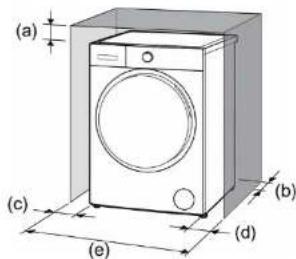
- Install the appliance ensuring sufficient space around it (Fig. 3):
a: minimum 3 cm.
b:minimum 5 cm.
c: minimum 5 cm on the left side.
d: minimum 5 cm on the right side.
e: minimum 70 cm.
CAUTION: do not allow metal parts of the appliance to come into contact with metal sinks or other appliances.
Removing the transport screws (Fig.4)
The transport screws must be removed from the backside of the device before installing it.
IMPORTANT: It is Imperative to remove the transport screws before the first use, otherwise they may damage the drum during the operation of the device.
The transport screws will be necessary again when moving the product, so make sure they are kept in a safe place.
In order to remove the screws:
- Loosen 4 screws with a spanner and then remove them (A).
- Remove the 4 tube spacers (depending on model) (S).
NOTE: during removal of the transport screws, occasionally the pipe spacers may fall into the machine, if this happens, they can be accessed by tilting the machine forward and picking them up from the floor or inside the base of the machine.
Cover the transport screw holes with the 4 supplied plugs (C).
- Keep the transport screws properly for future use. You will need them again if the washer-dryer needs to be moved to another location.
If it is necessary to transport it to another location:
- Reinstall the transport screws.
- Secure the power cable to the rear of the appliance.
Levelling the washer dryer
The appliance reaches high spin speeds to remove water at the end of the washing cycle. Therefore, it is important that it is level and that all 4 legs press against the floor with the same pressure.
This will help to ensure quieter operation and less vibration.
Carry out the following steps:
Install the appliance on a solid, level surface. Preferably in a corner of the room.
If the floor is uneven, adjust the legs as necessary to level the device. Do not place any objects under the legs in an attempt to level it.
Do not extend the legs more than necessary. The more extended, the more vibrations the device will suffer. Start with the legs all the way in and adjust each one as necessary.
You can use a spirit level (not included) to check that the appliance is level.
- Press down on each corner of the top of the equipment to ensure that it does not "wobble".
- All legs must press equally against the floor.
- When the device is level and does not wobble, lock the legs by tightening the lock nuts against the bottom of the equipment. Be sure to do this without changing the height of the leg (hold the leg while tightening the lock nut). Fig. 5
Connection of the supplied hoses
Water supply hose connection
- Connect one end of the water supply hose to a cold water tap and tighten by hand (Fig. 6). Before making the connection, allow the water to run freely until it runs completely clear.
- Connect the other end of the water supply hose to the water inlet valve at the rear by turning clockwise (Fig. 7).
- Open the tap slowly and make sure there are no water leaks.
Warning
Do not kink, crush, modify or sever the water inlet hose.
Squeeze the end of the hose firmly by hand.
- The water supply pressure must be within a range between 0.03 and 1MPa . If the pressure exceeds this value, a pressure reducing valve (not included) must be installed.
- If the hose is not long enough, please contact a specialised retailer, an authorised technician, or the official Cecotec Technical Support Service.
- Never use a second-hand or used hose. Always use the hose supplied with the equipment.
ENGLISHENGLISH
Drain hose connection
Drainage point height (Fig. 8)
Height difference between the floor and the drain:
Minimum 60 cm (24 inches)
Maximum 100 cm (39 inches)
Drainage connection types:
- To the vertical drainage pipe
Connect the drain hose to the elbow (not included) of the drain pipe. Place the elbow on the hose 4 inches (100 mm) from the end of the hose. Insert this section of hose into the pipe, if the hose is pushed down too far. It can cause the washer dryer to self-siphon, i.e. to continuously empty as it fills with water. Secure the elbow and hose with a hose clamp (not included) to prevent the hose from slipping out of the tube during use.
Fig.9
- Drainage pipe
-
Cold water
-
To the sink trap
Secure the drain hose to the sink trap using a 0.9-1.6 inch (20-44 mm) hose clamp. Not Included.
Available in hardware or specialised shops. Fig. 10
- To a sink/washbasin
WARNING: DANGER OF BURNS
When washing at high temperatures, there is a risk of burns when touching hot soapy water, e.g. when draining hot water with foam into the sink/washbin. Do not touch hot soapy water.
Note:
Damage to the appliance / damage to textiles.
If the end of the drain hose touches the water drained by the washer dryer, water can be sucked back into the washer and damage the appliance or the laundry inside the drum.
To ensure that this does not happen, make sure that:
No plug in the sink/washbasin drain.
The end of the drain hose does not touch the drained water.
Water flows freely through the sink/washbasin drain and there are no blockages.
The hose is securely connected.
Note:
Do not twist, pull, or bend the drain hose.
Fix the hose with a hose clamp to the drainpipe, sink/washbasin, etc., so that the hose will
not be forced out by the force of the water.
For added safety, you can also use a drain hose holder (not included) and install the hose over a sink/washbasin or tank, as shown in Figure 11.
The use of hose extensions is not recommended. If absolutely necessary, the extension should have the same diameter as the original hose and should not exceed 250 cm in length (Fig. 12).
If drain hose is too long, do not force it into the washer dryer as it will cause abnormal noises.
After installation, wait a few hours before operating the appliance to allow it to acclimatise to the ambient conditions in the room.
Only connect the device when the installation has been completed
4. OPERATION
Note
Before washing the clothes for the first time, the product shall be operated in one round of the whole procedures without the clothes inside.
Control panel (Fig. 13)
A: Washing cycle knob
Used to programme the desired washing cycle.
OFF position turn the washing cycle knob, when the indicator light below the symbol on the machine will stop running and turn off. If the machine is switched off during a washing cycle, the washing cycle will be cancelled.

Press the button to change the water temperature of the selected cycle, the temperature value will appear on the display.

Press the button to change the spin speed of the selected cycle, the speed value will appear on the display.

CHLEDCKTONFONN When a washing cycle is running, if you want to activate the child lock, press, and hold the SPEED button for about 3 seconds.
Sound cancellation (buzzer)
Press and hold the SPEED button and the ONE TOUCH button at the same time for at least 3 seconds.
ENGLISHENGLISH
Perform the same operation to restore the sound.
D:STEAM
Press the button to add a steam wash process after the last water draining step of the selected washing programme.
Some washing cycles cannot select the steam wash function. It can only be selected if there is a steam icon in front of the programme name on the control panel or in the washing cycle table.
E: DRYING
Press the button to set the drying type according to your needs and the drying type or drying time will appear on the digital display.
Some programmes do not have a drying function.
F: DELAY END
Press the button to set the end time of the washing programme.
G:ONE TOUCH OC
Press the button to set the M-Smart washing cycle.
H: START/PAUSE
Press and hold the button to start or pause a washing cycle.
Adding laundry during the execution of a washing programme
Once the washing cycle has started, press, and hold the START/PAUSE button again. If the DOOR LOCK indicator Light is off, the door can be opened, and laundry can be taken in or out of the drum.
To resume the washing cycle from the point where it was interrupted, close the door, and press the button again.
WARNING: If the water level or water temperature in the drum is too high, the door lock indicator light will come on and the door could not be opened.
1:STAINS
Press the button to select the type of soiling of the laundry, the washer dryer will automatically adjust the most optimal way to remove the soiling. Up to 8 types of soiling can be selected.
M:Display (Fig.14)
- Temperature indicator light
When a washing cycle is selected, the default temperature value of this programme will appear on the display, with the temperature indicator light illuminated.
You can change the temperature value by pressing the TEMP button. If "..." is shown on the display, it means that the washer dryer uses cold water only (the internal heating element for heating water would not be available in this programme).
1. Rotational speed indicator rpm
When a washing cycle is selected, the default spin speed of this programme will appear on the display, with the spin speed indicator light illuminated.
You can change the spin speed value by pressing the SPEED button. If "--" is shown on the display, it means that the washer dryer does not spin after the final draining process in this programme.
2. Door lock indicator
The lit symbol indicates that the door is locked. To avoid any damage, wait until the icon turns off before opening the door.
To open the door while a washing cycle is in progress, press the START/PAUSE button, if the Door Lock Indicator light is off, the door can be opened.
NOTE: for safety reasons it is not always possible to open the door once the washing cycle has started.
3.Child-lock indicator light
The lit icon means that the function is activated, the buttons on the control panel will be locked (except the OFF position of the knob).
4. Delay end indicator light
The lit icon means that the function is activated. The countdown to the end of the selected washing cycle will appear on the digital display.
5. One touch indicator
The lit icon means that the M-Smart washing programme has been selected.
There are 3 ways to set this washing programme.
6. Drying function indicator
When the icon lights up, it means that the drying function has been set or the drying cycle is running.
7. Type of stains indicator
The stain type icon lit means that a stain type has been selected, the device will automatically set the most optimal cycle to remove the stains.
Types of stains (Fig. 15)
a. Oil
b. Juices
ENGLISHENGLISH
c. Pigments, paint
d. Blood
e.Milk
F Wine
g.Mud,sludge
h. Grass
8. Digital display, shows the following values:
- Remaining washing cycle time (e.g. 1:28)
- Delay end time (e.g. 12 H)
3.Temperature (e.g. 30oC) - Spin speedd (e.g. 1200 rpm)
5.Drying time (e.g. 1:20) - Error code (e.g. E03)
Before each washing
- Check the label on each garment.
Empty the pockets of the clothes to be washed. Make sure that there are no metal objects such as coins or paper clips, papers, etc. in the pockets.
Tie a knot with straps or cords, close zips and fasten buttons on covers, cushions, etc.
Remove the sliders from the curtains.
Place small or particularly delicate garments such as stockings, lace, socks, or handkerchiefs inside a net ball.
Turn garments like trousers, T-shirts, and sweatshirts upside down.
Ensure that wire cup bras are machine washable and place them inside a net ball that can be securely closed with a zip or buttons. If the wire slips out of the cup, it can fall through the holes in the drum and cause major damage.
Before each drying
Use the tumble dryer only for laundry that has been previously washed, rinsed and spun dried.
- Remove as much water as possible from the clothes. Do not reduce the spin speed.
To ensure uniform drying, sort the laundry according to the type of fabric and the degree of drying required.
Garments that require ironing do not have to be ironed immediately after drying, but it is advisable to fold them and store them for a while to allow the remaining moisture to evaporate.
- When washing laundry for tumble drying, use the correct amount of detergent and fabric softener, as specified by the manufacturer. Some detergents may deposit on the moisture sensors and negatively affect the operation of the equipment and the drying results.
The following garments should not be tumble dried:
Clothing marked with the following symbol on its label.
o Woollen articles. Risk of shrinkage!
Delicate fabrics such as silk or synthetic net curtains. Risk of creasing!
Articles containing foam rubber or similar materials
Articles that have been treated with flammable solvents such as stain removers, gasoline, paint thinners. Danger of fire
Articles containing hairspray or similar substances. Hazardous vapours!
Dripping wet clothes. Waste of energy!
Classification of clothing according to colour and soiling degree
Sort the laundry according to colour, soiling degree, and recommended washing temperature
range
Garments may discolour.
- Never wash new multicoloured garments together with other garments.
- Wash white garments separately from coloured garments. Otherwise, white items may tend to turn grey.
Degree of soiling
Light soiling
No visible dirt or stains but may have absorbed some odour.
Light summer clothing such as T-shirts or blouses worn only once.
Also to "freshen" bed linen or towels.
Normal silling
Visible soiling and/or some light staining.
Light summer clothing such as T - shirts or blouses that have been worn several times
Kitchen towels, towels or bed linen used for a week or more.
Stain-free curtains.
Heavy soiling
Visible dirt and stains.
Kitchen towels, cloth napkins, baby bibs, children's clothing, sports shirts.
Work clothes.
Classification of clothing according to the specifications of its care label
The symbols on the garment labels will help you to choose the right washing programme.
temperature, washing cycles and ironing methods
Don't forget to take a look at these tips!
ENGLISH ENGLISH
Washing cycle table
| Washing cycle Temperature ™C (MAX) | Maximum load (Kg) | Specifications | Type of detergent | ||||
| Washing | Drying | Detergent | Softener | ||||
| Universal Specific | |||||||
| Mix 60 & 5 | For washing mixed loads of cotton and synthetic fabrics with light to normal soiling, white and coloured garments together. | L/P | O | ||||
| Cotton 60 & 5 For daily wear of cotton. linen, and cotton blends L/P - | O | ||||||
| Anti-allergy 853 | For garments in need of dust mite and allergen removal. | L/P - | O | ||||
| Wool | 40 | 1 | - | For machine washable woollen and wool-blend garments | - | L | O |
| Baby Care | 85 5 | 5 For baby clothes | L/P | O | |||
| Shirts | 60 | 3 | - | For shirts and blouses | L/P | L | O |
| Bedding | 60 6 | - | For large bedding such as blankets and bedspreads. Also for curtains. | L/P - | O | ||
| Quick Wash | 40 | 1 | 1 | For lightly soiled or lightly soiled garments | L/P | - | O |
| ECO 40 - 60 | 40 | 8 | 5 | Energy efficiency programme | L/P | - | O |
| 20 °C | 20 2 | - | For small quantities of easily discoloured garments | L/P - | O | ||
| Night Wash | 60 8 | - | A cycle used at night, with a lower noise level | L/P - | O | ||
| Drying | 5 | For drying wet cotton fabrics | |||||
| Down jacket | 40 | 2 | 2 | For machine-washable down jackets | - | L/P | O |
| Rinse+Spin | - | 8 5 | Combines a rinse and spin for loads that require an additional rinse cycle. Also for loads that only require rinsing | - | O | ||
ENGLISHENGLISH
| Spin | 85 | This cycle uses a spin cycle to shorten drying times for heavy fabrics or special care items washed by hand | - | - | |||
| Drum Clean | 85 | - | - | Cleans the drum by removing dirt and bacteria. Make sure the drum is empty. | - | - | |
| M-Smart | 40 | 5 | - | Special cycle that can be started by simply pressing the ON SMART button. | L/P | - | ○ |
L= gel/liquid detergent
P=powder detergent
-optional
If you use liquid detergent, it is not recommended to activate the delay end. We recommend the use of powder detergent for clothes from 20 to 80^ and specific detergent for wool from 20 to 40^ .
Follow the detergent / softener manufacturer's recommended dosage.
Washing cycles
M-Smart washing cycle
The M-SMART washing cycle can intelligently detect the weight of the laundry and combine different wash times and temperatures for a smart wash.
It is shown on the display in the detection stage after the cycle starts, and the M-SMOTE washing cycle can be activated by the following 3 methods:
- When the device is OFF, press and hold the ONE-TOUCH button for at least 3 seconds, the device will run the M-SMOTE cycle directly with the M-Smart indicator light illuminated.
- When the device is ON, press and hold the ONE TOUCH button for at least 3 seconds, the device will run the M-SMOTE cycle directly with the M-SMOTE indicator light illuminated.
- When the appliance is on, press the ONE-TOUCH button lightly, the M-Smart indicator light will turn on, then press the START/PAUSE button, the appliance will run the M-Smart washing cycle.
Drying programme
How to set the drying programme?
- To set the Washing+Drying programme
Only some of the washing programmes can add the drying function.
First, load the laundry into the drum, close the door, turn the washing cycle knob to select the desired washing programme (except the drying programme) and press the Drying button to select the two drying modes as follows:
Auto Drying: press the Drying button continuously to adjust the drying time shown on the display, and when flubio is displayed, the Auto Drying mode is activated. The drying time can
be adjusted automatically according to the amount and humidity of the laundry. Timed drying (scheduled drying): press the Drying button to set the drying time. Press the drying button, the digital display will show the drying time (30-60-90-120-150-180-210-240 minutes). Select a suitable drying time and activate the Time drying mode (scheduled drying). Then, press the button START/PAUSE The machine will start to run the Wash + Dry programme, with the drying programme automatically activated at the end of the washing programme.
- To set the Drying only programme WITHOUT PREWASHING
This dry-only programme is suitable for drying cotton laundry. Do not dry clothes prone to deformation or shrinkage. When the programme is set, before drying, it is recommended to run a single spin cycle to dry the laundry.
First load the laundry into the drum, close the door, turn the programme knob to select the Drying programme and then press the Drying button continuously, to select the Auto Drying or Time Drying mode, as described above.
-
Then press the START/PAUSE button to start the Drying only programme.
-
To set the Down Jacket drying programme
The Washing-Drying programme should be used to dry the jackets. Select Down Jacket programme + Automatic Drying mode 10 Do not choose drying only mode to dry the down jacket. For best drying effect, it is recommended to dry only one down jacket at a time.
Precautions for the drying programme
- If there is too much moisture in the laundry, the machine will automatically extend the drying time and it is normal that "It" is played for a long time.
- When running the drying programme, the tap must be open, as water is required for cooling and dehumidifying.
- The longest drying time is set according to the different models
- To avoid wrinkles in the laundry caused by over-drying, the drying time can be set a little shorter at first and then increased according to the results obtained.
ENGLISHENGLISH
- Before running the Drying only programme, it is recommended to run a spin cycle first.
- If necessary, untie any knots in the laundry that may have formed after spinning and then place them in the drum to dry.
- For larger or thicker laundry, drying may be uneven in some areas of the garments. Select the drying time according to the result obtained after the end of the drying cycle.
- Woollen fabrics are not suitable for drying.
-
Do not dry clothes that may warp or shrink.
-
Some programmes do not have the drying function.
Steam function
Press the STEAM button to add a steam wash process after the last water drain stage of the selected (or ongoing) washing cycle and before the last spin. In the steam washing process, the machine generates a large amount of high temperature steam which penetrates deep into the fabrics, improving their softness and elasticity and, at the same time, eliminating unpleasant odours and refreshing the laundry. After the steam washing process, the machine enters the final stage of rinsing and spinning.
Special washing cycles
Baby Care
Cycle designed for the typical soiling of children's garments, effectively removing residual detergent residues.
Down Jacket
Cycle for washing down jackets (weighing no more than 2.0kg ), cushions or garments padded with goose down. We recommend that the jacket is placed in the drum with the edges folded inwards (Fig. 16) and that no more than 3/4 of the total drum volume is used. For best results, we recommend using a liquid detergent.
Wool
Cycle designed for woollen garments.
IMPORTANT: after use, confirm that the garments have not been damaged or shrunk.
Delay end
Press the Delay end button to set the programme end time, which is incremented in one hour intervals, up to a maximum of 24 hours. After selecting the desired washing programme, but before pressing the START/PAUSE button, press the Delay end button until the desired time is displayed, e.g. 8h, with the Delay end indicator light on.
NOTE: the cycle time is included in the set deferred end time.
Example of a cycle time of 1 hour and 30 minutes and a delay end time of 8 hours.
8 h is shown on the display and a countdown (approx. 6 hours and 30 minutes) until the washing cycle starts, then the cycle duration 1:30 is shown and starts. The total time is approximately 8 hours.
The way to cancel the deferred termination function is as follows:
- Turn the washing cycle knob to reset the washing cycle. The Delay end indicator light will go out.
NOTE:
The delay end function cannot be set in some washing cycles.
- The actual end time of the washing cycle may be different from the set delay end time, depending on multiple factors such as water supply pressure, drainage, type of laundry, water temperature, as well as other conditions.
Child Lock
- The setting of the child lock function can prevent malfunctions or unwanted incidents.
- During operation, press and hold the SPEED button for approximately 3 seconds to set or cancel the child lock function.
- After setting the child lock function, its indicator light comes on, the door cannot be opened and the control panel is locked, the buttons remain inactive, as well as the washing cycle knob (the indicator light below the power symbol is of). The machine can only be switched off by turning the washing cycle knob to its OFF position, the indicator light below the power symbol will go out and the device will stop operating. If the machine is switched off, the child lock function will be cancelled.
- When the machine is switched on again, it will directly run the selected programme before it was switched off.
Stalin removal
This option allows you to select the type of stains on the laundry for better efficiency during washing.
The appliance adjusts the average wash temperature, drum movement and soaking time to the specific type of stain. Hot or cold water, gentle or intensive washing and long or short soaking ensure that the washing sequences are specially adapted to each type of stain. Selecting this option ensures that the stains are treated in the best possible way. NOTICE: pressing and holding the STAINS button automatically runs through the set type of stains.
The duration of the washing cycle varies according to the type of soiling selected.
Before the first wash
All washer dryers are tested before leaving the factory under strict quality control. This process involves running several washing cycles. As a result, a small amount of water may remain in the drum and drainage system. Run a Drum Clean cycle without laundry to clean the system before your first load of laundry.
First add 1 or 2 tablespoons of detergent to compartment I of the detergent drawer. Then run the Drum Clean cycle.
Wait for the cycle to finish.
ENGLISHENGLISH
How to use the washer dryer
- Load the laundry
Open the door and insert the laundry into the drum. Load the items one at a time without squeezing them or overfilling the drum, place them evenly. Please note the load sizes indicated in the "Washing cycle table". Overloading of the machine will result in non-optimal washing and wrinkled laundry.
- Close the door
Make sure that there are no dirty clothes between the door glass and the rubber seal. Close the door, make sure you hear the "click" as it closes.
- Open the tap
Make sure that the appliance is connected to the water mains. Open the tap.
- Set the desired programme
Select the required programme with the washing programme knob. The duration of the washing cycle is shown on the display. The machine automatically displays the default temperature and possible spin speed settings for the selected programme. Adjust the temperature and/or spin speed settings, if necessary, with the corresponding buttons.
- Change the temperature, If necessary
Press the TEMP (Temperature) button to progressively decrease the temperature setting until cold wash is reached ("--" will be displayed on the digital display). Pressing the button again sets the highest possible setting.
- Change the spin speed, if necessary
Press the SPEED button to progressively decrease the spin speed until the spin cycle is switched off ("--" will be shown on the digital display). Pressing the button again sets the highest possible setting.
- Select options, if necessary
Press the buttons to select the desired option; the indicator light of the corresponding option will turn on.
Press the button(s) again to cancel the option, the indicator light of the corresponding option will go out.
If the selected option is incompatible with the configured programme, the incompatibility will be signalled by a beep of the buzzer and the indicator light of the corresponding option will flash.
If the selected option is incompatible with a previously configured option, only the most recent selection shall remain active.
5.Add detergent
Remove the detergent dispenser and add detergent and fabric softener (If applicable) into the corresponding compartments as described in figure 17.
Compartment 1: detergent powder
Compartment 2: liquid detergent (must not exceed the level marked MAX).
Compartment 3: additives such as softener (must not exceed the level marked MAX).
Observe the dosage recommendations of the detergent/softener manufacturer.
The correct dosage of detergent/softener is important because:
- Optimises the cleaning result.
- Avoid excess detergent residues in your laundry, which can cause skin irritations.
Saves money by avoiding waste of leftover detergent.
- Protects the washer dryer, preventing calcification of the components.
- It respects the environment by avoiding unnecessary environmental burdens.
Do not use detergents for hand washing as they create too much foam!
Use powder detergent for cotton whites, for pre-wash and for washing at a temperature above 50^ .
When using concentrated, stringy, or additive detergent, before pouring it into the detergent drawer, it is recommended to use water to dilute it slightly in order to avoid clogging the detergent drawer inlet or water leaking out when filling the drawer.
- Delay end
If desired, use this function to end a programme at the programmed time.
-
Programme start
-
Press the START/PAUSE button. The corresponding indicator light will illuminate, the door will lock, and the DOOR LOCK Indicator light will illuminate.
- To avoid water spillage, do not open the detergent drawer during a running programme.
-
The remaining duration of the programme may vary. Factors such as imbalance in the wash load or foam formation may affect the programme duration.
-
Change the configuration of a running programme, if necessary.
You can change the settings while a programme is running. The changes shall be implemented as long as the respective programme phase has not been completed yet.
To change the configuration of a running programme: - Press the START/PAUSE button to pause the running programme.
Change your settings. - Press the START/PAUSE button again to continue the programme.
If you have changed the programme, do not add detergent for the new programme.
To prevent a running program from being accidentally changed (e.g. by children), use the Child Lock function.
ENGLISHENGLISH
Pausing a running programme and opening the door
Press the START/PAUSE button to pause the running programme.
If the water level and/or temperature in the drum is/are not high, the DOOR LOCK indicator light will go out. You can open the door, for example, to add more laundry or to remove laundry that was loaded by mistake. Press the START/PAUSE button again to continue the programme.
9. Change the configuration of a running programme, if necessary.
-
Cancellation of a running programme
-
Turn the washing cycle knob to turn off the machine while the light under the "Symbol" is on.
If the water level and/or temperature is low enough, the door will unlock and can be opened.
The door will remain locked if there is a higher water level in the drum. To unlock the door, first turn the washing cycle knob to select the SPIN programme, then turn off the SPIN option by pressing the SPEED button to set the spin speed to ·^+ (should be displayed on the digital display). -
Press the START/PAUSE button to run the SPIN programme. Water will drain from the drum during the washing cycle. The door unlocks at the end of the programme.
-
Switching off the device after the end of a washing programme
- At the end of the cycle, the message END is shown on the digital display.
The door can only be opened when the DOOR LOCK Indicator light switches off. - Check that the DOOR LOCK indicator light is off, then open the door and remove the laundry.
- Turn the washing cycle knob to switch off the machine to the OFF position
Leave the door ajar to allow the inside of the drum to dry out and prevent odours and mould growth.
5. CLEANING AND MAINTENANCE
Warning
Before cleaning or maintaining, unplug the appliance and close the tap.
- Proper maintenance on the washing machine can extend its working life. The surface can be cleaned with diluted non-abrasive neutral detergents when necessary. If there is any water overflow, use a cloth to wipe it off immediately.
- Do not use abrasive cleaners or scouring pads to clean the device.
- Do not use pressurised water to clean the equipment.
Cleaning the drum
- The rusts left inside the drum by the metal articles shall be removed immediately with chlorine-free detergents.
Do not use steel wool.
Note
Do not put laundry in the washing machine during the drum cleaning.
Cleaning the door seals and glass
- Wipe the glass and seal after each wash to remove lint and stains. If lint builds up it can cause leaks.
Remove any coins, buttons, and other objects from the seal after each wash.
Descending of the machine
- As long as you use the correct amounts of detergent with the wash loads, descaling is not necessary. If it is necessary to descale the drum of the appliance, follow the instructions of the manufacturer of the descaling product.
- Small amounts of decalging agent can be used to remove white stains on the washing machine drum caused by timescale or mineral deposits or small amounts of rust caused by metal objects left in the drum.
NOTE: descending agents contain acids which can attack parts of the appliance and discolour the laundry.
Checking the water supply hose
Check the water supply hose at least once a year. If there are cracks, it should be replaced immediately, curing the washing cycle, the water pressure is very strong, and a cracked water supply hose could easily open.
Cleaning the detergent dispenser tank
If there is a build-up of residual detergent or additives, or if the softener compartment is not rinsed well enough, the drawer must be cleaned to avoid water overflows due to blockages.
Fig. 18
- Open the detergent dispenser. Press down the tab (1) and pull the dispenser (2) completely out of the washer-dryer housing.
- Remove the liquid detergent cap (3) by holding it and pulling it upwards from the detergent dispenser.
- Clean the lid and the drawer itself under running water. Lightly wipe off any remaining detergent residue.
- Replace the cap and reinsert the drawer back into place.
ENGLISHENGLISH
Tip: do not operate the appliance without the detergent drawer in place. If the appliance is not in use, always keep the drawer closed.
Warning
- Do not use alcohol, solvents, or chemical products.
- You can use a soft brush to remove detergent residues adhering to the drawer.
Cleaning the mesh filter in the water supply hose and the water inlet valve
- Close the tap (stopcock) and unscrew the water supply hose (Fig. 19).
- Carefully clean the mesh filter at the end of the hose with a fine brush (Fig 20).
- Now unscrew the water supply hose at the back of the appliance by hand. Remove the mesh filter from the water inlet valve at the back of the appliance with needle-nose pliers (be careful not to damage it) and clean it carefully (Fig. 21).
- Reinsert the mesh filter back into the back of the washer dryer. Reconnect the water supply hose to the tap and to the appliance. Do not use a tool to connect the inlet hose. Open the water tap and check that all connections are tight (Fig 22).
Cleaning the drain pump filter
WARNING: DANGER OF BURNS. Danger of skin injury from hot water!
Take special care when draining water from the appliance and opening the lid.
It is advisable to clean the filter of the drain pump from time to time to ensure that there are no problems.
The pump of the appliance may become blocked with loose debris (remember to check the drum and remove visible debris after each load). Fabrics that shed large amounts of lint can also cause blockages.
To access the drain pump filter, you must first open the cover on the bottom right-hand side. Press lightly to open the lid (Fig. 23). With the lid open, proceed as follows:
- If the appliance has not been drained, try draining it now. First, turn the washing cycle knob to select the SPIN programme. press the SPEED button until the display shows 一 ^ then press the START/PAUSE button. Wait a moment for the pump to drain the water from the drum, if the pump is totally blocked, the water will not be able to drain, and the cycle will end.
- Turn off the top so that no more water enters. Switch off the appliance. Disconnect the power cord from the plug.
- Use the removable drain hose (depending on the models) located on the filter access opening to drain the remaining water into a suitable container (up to 20 litres of water can be drained). Remove the plug from the hose and place it over the side of a suitable
container and allow the water to drain out of the drum. When finished, replace the sealing plug on the end of the hose and return the hose to its storage location. Be careful not to spill the drained water on the floor (Fig. 24).
- Turn the filter cover counterclockwise to remove the filter. A small amount of residual water may flow out when the lid is removed. Clean the inside, as well as the filter itself, removing any debris or foreign objects. Remove any lint, dirt or detergent residue from the filter thread. You can use water, a cloth or a soft brush. Reinstall it in its original position (Fig. 25).
-
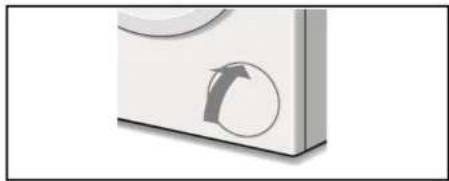
Close the lld and wipe up any water spillage (Fig. 26).
-
TROUBLESHOOTING
| Problem Cause and possible solution | |
| There are coloured stains and oil stains on the drum. | The appliance requires a service wash. Run a DRUM CLEAN washing cycle without detergent and laundry. |
| Bad smells Due to the use of rubber parts, the machine will have a rubber smell at the beginning of use, but the rubber smell will gradually disappear during use.Leave the door alar after each washing cycle. | |
| The door cannot be opened | The safety protection function is in operation and the water temperature and/or water level are too high.If the programme has finished normally, but there is a power failure.Is the CHILD LOCK function activated? Deactivate the child lock function.Turn off the delay end function. |
| Water spillage from detergent drawer | The drawer is blocked with detergent and requires cleaning.The water pressure is too high and needs to be lowered; close the tap on the water supply pipe slightly and try again.The appliance is tilted forward - It must be level when in its final position. |
ENGLISH ENGLISH
| Water leaks Water supply hose is loose, check connections. Water supply hose is tight but still leaks; if so, replace the rubber washers, or the water supply hose does not have the rubber washer. The drain hose is not positioned correctly. In case of water leakage inside the machine, turn off the power supply and contact Cecotec Technical Support. |
| Does not turn on Appliance is not fully plugged in or not plugged in enough to make contact. No power is reaching the socket. Check the fuses and control and protection elements of the electrical installation. |
| Washing cycle does not start The door is not closed properly. The START/PAUSE button has not been pressed. The water tap has not been turned on to allow water to flow into the appliance. A delay end function has been configured. |
| No water or detergent enters the drum. Error "EOZ" appears on the display Water supply hose is kinked or bent. The water supply hose is not connected to the water supply. The water pressure is too low. The water tap has not been opened to allow water to flow into the machine. There is no water supply in the dwelling. The mesh filter in the water supply hose and/or the water inlet valve is/are blocked. Tap and/or water supply pipe is/are frozen. The START/PAUSE button has not been pressed. There is already enough water in the drum. |
| Water discharge when the programme starts This is not an issue. Do not open the door to pour water directly into the drum before the programme is run, otherwise the machine may discharge the water that was poured into the drum when the programme was started. |
| The water level is too low when the machine is washing | This is not an issue. The water consumption in the washing cycle of this appliance is relatively small, the water level in the washing cycle is lower than that of other types of washer dryers. |
| Overfilling of water during operation of the washing cycle | If the water level drops, the machine will automatically recover the water. When the amount of laundry to be washed is too large, the appliance can automatically fill the water several times during the operation of the washing cycle. |
| Too much foam in the drum or foam overflows from the detergent drawer | The detergent is not suitable for machine washing (must show the text "for washing machines" or "hand and machine wash" or similar). Too much detergent was used; less detergent is required in soft water. |
| The high speed spin must be repeated many times (spinning) | Due to different types and materials of laundry, the load balancing system of the appliance may wobble and scatter the laundry many times to extend the spin time. This is a normal phenomenon, not an incidence of the machine. |
| Machine does not spin | No spin speed has been selected. The control panel displays "—" |
| The machine vibrates a lot during the spin cycle | The legs have not been adjusted, causing the machine to rock. New installation: the transport screws, including the plastic spacer, or the polystyrene packaging, has not been removed when installing the machine. The appliance is trapped between furniture and/or walls. The load is slightly unbalanced, and the device is rotating, but at a slower speed. |
ENGLISH ENGLISH
| Spinning result is not optimal | When you wash less laundry, such as a pair of jeans, a jumper, a bath towel, etc., the machine may not complete the spin process due to balance protection. If the load is slightly unbalanced, the appliance will spin, but at a lower speed, not at the cycle's default spin speed or the spin speed setting for the cycle. |
| Machine does not drain, drains slowly or "E03" appears on the display | The top of the drain hose is too high. It should be installed at a height of 65-100 cm from the ground. The draining pump filter is blocked. Drain hose is kinked or bent. Drain hose is blocked or frozen. |
| The washing programme time stops counting before entering the high-speed spin process. | This is not an issue. The load balancing system of the appliance tumbles and scatters the laundry in the drum for a long time to achieve balance and complete the high speed spin. In the process of tumbling and scattering, the programme time stops counting before the appliance reaches the high speed spin process. |
| Washing programme lasts too long | Programme times will vary due to water pressure, incoming water, temperature, etc. If the wash load becomes unbalanced, the time will increase. |
| Excessive noise There will always be some noise from the motor, pump, and drum during spinning. The washer dryer touches other objects. Foreign objects, such as hairpins or metal objects, fall into the drum. | |
| The machine is continuously filled with water and continuously emptied | The top of the drain hose is too low. It should be installed at a height of 65-100 cm from the floor. The end of the drain hose has been pushed too far down into the standpipe; the hose elbow must be installed 100 mm from the end of the drain hose. The end of the drain hose is submerged in the discharged water. |
| The drained water returns to the appliance | If the end of the drain hose touches (the discharged water (water drained from the washing machine), it (the discharged water) may be sucked back into the appliance and damage the appliance or garments. |
| Control panel gets hot | This is a slight heating effect of the electronic components on the PCB board installed on the back of the control panel. |
| After drying, there are drops of water on the door and drum | During drying, the door may be stained with water droplets, wipe off the water droplets. Do you wear too much or too thick clothing? |
| The drying effect is poor and uneven | Do clothes that are not easy to dry (such as thick cotton fabrics) and fabrics that are easy to dry (such as synthetic fabrics) dry together? Do you put too many laundrries to dry? When only running the Drying programme, do you separate the tangled laundry to place it in the drum? Due to different types and quantities of laundry, uneven drying may occur. λIs the tap closed during drying? Is the drain pump filter blocked during drying? Is the drain hose bent, kinked, or blocked during drying? |
| General issues Your appliance | contains sensors that monitor progress during the washing cycle (e.g. water level, temperature, unbalanced loads, wash time/progress). Normally, if your appliance completes the cycle successfully, it is unlikely that there will be a problem. |
- Do not repair or replace any part of the appliance unless specifically instructed to do so in this instruction manual. It may lead to a dangerous incident that endangers your health and/or damages property.
- In the event of a malfunction, pigtase contact the official Cecotec Technical Support Service.
Use original spare parts. - IMPORANT: do not come into contact with the following internal components while the appliance is connected: inlet valve(s), drain pump, motor controller heat sink, PCE.
ENGLISHENGLISH
Errors
| Error Cause Solution | ||
| E02 No water in Check if the tap is open. | If the water supply is cut off. Are the mesh filter in the water supply hose and the water inlet valve blocked? What if the water supply hose of the appliance is frozen? Eliminate the above causes of failure. If the fault code still exists, please contact the Cecotec Technical Support. | |
| E03 Drain failure Clean the pump filter. | Check if the drain hose is bent, kinked, or blocked. Eliminate the above causes of failure. If the fault code still exists, please contact the Cecotec Technical Support. | |
| U4 Door lock fault The door is not closed | properly and the door lock does not function normally. Close the door again, turn the washing cycle knob to the OFF position to turn off the power supply, and then turn the knob to select any washing programme and press the START/PAUSE button to restart the programme. Eliminate the causes of this failure. If the fault code still exists, please contact the official Cecotec Technical Support Service. If the fault code appears and you cannot open the door, the door lock may be faulty, please contact the official Cecotec Technical Support Service. | |
| H | Drum temperature is high | Press the START/PAUSE button to suspend operation of the appliance and wait a few minutes. When the temperature in the drum drops to a safe range and the fault code on the display is cleared, press the START/ PAUSE button to continue with the rest of the programme. If the fault code still exists, please contact the official Cecotec Technical Support Service. |
| FXXX (depending on model) | The concentration of negative ions in the drum is high. | Press the START/PAUSE button to suspend operation of the appliance and wait a few minutes. When the negative ion concentration in the drum drops to a safe range and the fault code on the display disappears, press the START/PAUSE button to continue with the rest of the programme. |
| EXX Other errors Turn the knob to turn off the appliance, unplug the power cord and contact Cecotec Technical Support. | ||
Note: be sure to check the cause of the fault and clear the fault before pressing the START/PAUSE button again. If the fault code is cleared, the appliance will continue to operate, and if the fault code still exists, unplug the power cord, and call our Technical Support Service for assistance as soon as possible.
Failure to empty the contents of the pockets may cause blockages in the pump or drain hose or may damage the machine.
Do not wash items that do not have a laundry label, nor wash items that are not designed to be machine washed.
7. TECHNICAL SPECIFICATIONS
You can find more information on this model by scanning the QR code (and the energy label as well).
ENGLISHENGLISH
| Reference | 02770 | 02771 | 02403 |
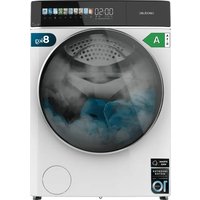
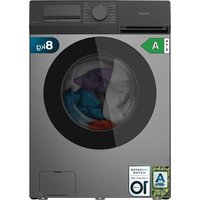
| Model | Bolero Wash&Dry 8580 Inverter B | Bolero Wash&Dry 8580 Inverter Steel B | Bolero Wash&Dry 8580 Inverter Ice Blue B |
| QR code | |||
| Voltage | 220-240V - | ||
| Rated frequency | 50 Hz | ||
| Washing capacity | 8.0 kg | ||
| Drying capacity | 5.0 kg | ||
| Rated Washing Power | 2000 W | ||
| Rated Drying Power | 1600 W | ||
| Standard water pressure: | 0.03 MPa-1 MPa | ||
| Net weight | 65 kg | ||
| Dimensions | 600 x 520 x 847 cm (width x depth x height) | ||
| Protection rating | IP X4 | ||
Technical specifications may change without prior notice to improve product quality. Made in China | Designed in Spain
B. TECHNICAL SHEETS
Input method for the new energy efficiency standard (EN60456:2016 + FprAA:2020) Eco 40-60. (parameters are not set by default)
| 20 °C Cotton Wool Quick Wash | ||||
| Rated capacity / Kg 2811 | ||||
| Programme length (h/min) | 0.39 | 0.57 | 0.50 | 0.15 |
| Energy consumption (Kw/cycle) | 0.24 | 1.25 | 0.20 | |
| Water consumption (L/cycle) | 65 | 80 | 70 | |
| Temperature MAX /°C | 20 55 | 35 | 35 | |
| Remaining moisture content | 75% | 70% | 85% | 75% |
| Spin speed / (rpm) | 700 | 900 | 500 | |
The Eco 40-60 programme can wash cotton laundry with normal soiling declared washable at 40^ or 60^ , together in the same cycle, and this programme is used to assess compliance with EU eco-design legislation.
The most energy efficient programmes are generally those that operate at lower temperatures and for longer durations.
- Noise and remaining moisture content are influenced by the spin speed: the higher the spin speed in the spin phase, the higher the noise and the lower the remaining moisture content.
The values given for programmes other than the Eco40-50 programme and the washing and drying cycle are only indicative.
ENGLISH ENGLISH
| SETTING | UNIT | VALUE |
| Rated capacity for the washing cycle, at 0.5 kg(c) intervals | kg | 8.0 |
| Rated capacity for the wash and dry cycle, at 0.5 kg(c) intervals | kg | 5.0 |
| Power consumption for ECO programme 40-60 at rated capacity (E100) | kWh/cycle | 0.878 |
| Power consumption for ECO programme 40-60 at half capacity (E100) | kWh/cycle | 0.521 |
| Power consumption for ECO programme 40-60 at one-quarter of rated capacity (E100) | kWh/cycle | 0.204 |
| Weighted energy consumption of ECO 40-60 programme (E100) kWh cycle | cycle 0.545 | |
| Standard energy consumption of ECO programme 40-60 (SCE100) | kWh/cycle | 0.909 |
| Energy efficiency index of the washing cycle (EE100) | -60.0 | |
| Washing and drying cycle energy consumption at rated capacity (E100) | kWh/cycle | 3.971 |
| Washing and drying cycle energy consumption at half rated capacity (E100) | kWh/cycle | 2.185 |
| Weighted energy consumption of washing and drying cycle (E100) | kWh/cycle | 3.257 |
| Standard energy consumption of the washing and drying cycle (SCE100) | kWh/cycle | 3.972 |
| Energy efficiency index of the washing and drying cycle (EEL100) | -82.0 | |
| Water consumption of ECO programme 40-60 at rated capacity (W100) | L/cycle | 65.0 |
| Water consumption of ECO 40-60 programme at half of rated capacity (W100) | L/cycle | 40.0 |
| Water consumption of ECO 40-60 programme at one quarter of the rated capacity (W100) | L/cycle | 32.0 |
| Washing cycle weighted water consumption (W100) | L/cycle | 47.0 |
| Water consumption of the washing and drying cycle at rated capacity (W100) | L/cycle | 91.5 |
| Washing and drying cycle water consumption at half rated capacity (W100) | L/cycle | 60 |
| Weighted water consumption of washing and drying cycle (W100) | L/cycle | 79 |
| Washing efficiency rating of ECO 40-60 programme at rated capacity (I) | -1.031 | |
| ECO 40-60 programme wash efficiency rate at half rated capacity (I) | -1.031 |
| ECO 40-60 programme wash efficiency rating at one quarter of the rated capacity (L) | -1.031 | |
| Washing efficiency index of the wash and dry cycle at rated capacity (L) | -1.031 | |
| Washing efficiency rate of the wash and dry cycle at half rated capacity (L) | -1.031 | |
| Rinsing efficiency of ECO 40-60 programme at rated capacity (L), g/kg 5.0 | g/kg 5.0 | |
| Rinsing efficiency of ECO 40-60 programme at half the rated capacity (L) | g/kg 5.0 | |
| Rinsing efficiency of ECO 40-60 programme at one quarter of the rated capacity (L) | g/kg 5.0 | |
| Rinsing efficiency of the wash and dry cycle at rated capacity (L), g/kg 5.0 | g/kg 5.0 | |
| Rinsing efficiency of the wash and dry cycle at half the rated capacity (L) | g/kg 5.0 | |
| ECO programme duration 40-60 at rated capacity (t), (h:min) 3:35 | ||
| ECO programme duration 40-60 at half rated capacity (t), (h:min) 2:48 | 2:48 | |
| ECO programme duration 40-60 at one quarter of rated capacity (t) | (h:min) 2:48 | |
| Washing and drying cycle time at rated capacity (t), (h:min) 7:00 | ||
| Washing and drying cycle time at half rated capacity (t), (h:min) 5:00 | 5:00 | |
| Temperature reached for at least 5 min within the load during ECO 40-60 programme at rated capacity (T) | °C 35 | |
| Temperature reached for at least 5 min inside the load during ECO 40-60 programme at half rated capacity (T) | °C 30 | |
| Temperature reached for at least 5 min within the load during ECO 40-60 programme at one quarter of the rated capacity (T) | °C 20 | |
| Temperature reached for at least 5 min inside the load during the wash and dry cycle at rated capacity (T) | °C 30 | |
| Temperature reached for at least 5 min inside the load during the wash and dry cycle at half rated capacity (T) | °C 20 | |
| Spin speed in the spin phase of the ECO programme 40-60 at rated capacity (S) | rpm | 1400 |
| Spin speed in the spin phase of the ECO programme 40-60 at half rated capacity (S) | rpm | 1400 |
| Spin speed in the spin phase of the ECO programme 40-60 at one quarter of the nominal capacity (S) | rpm | 1400 |
| Weighted residual moisture content after washing (D) % 59.9 | ||
| Final residual moisture content after drying % 2.8 | ||
| Airborne acoustic noise emissions during ECO 40-60 programme (spin phase) | dB(A) re 1 Pw | 76 |
| Power consumption in off mode (P.) (if applicable) W 0.50 | ||
| Standby power consumption (P.) (if applicable) W - - - | ||
| Is information displayed in standby mode? - No | ||
| Standby power consumption (P.) in mains standby conditions (if applicable) | W - - - | |
| Power consumption in Delay Start (P.) (if applicable) W 4.00 |
9. DISPOSAL OF OLD ELECTRICAL AND ELECTRONIC APPLIANCES

This symbol indicates that, according to the applicable regulations, the product and/or batteries must be disposed of separately from household waste. When this product reaches the end of its shelf life, you should dispose of the cells/batteries/accumulators and take them to a collection point designated by the local authorities.
Consumers must contact their local authorities or retailer for information concerning the correct disposal of old appliances and/or their batteries.
Compliance with the above guidelines will help protecting the environment.
10. TECHNICAL SUPPORT AND WARRANTY
Cecotec shall be liable to the end user or consumer for any lack of conformity that exists at the time of delivery of the product under the terms, conditions, and deadlines established by the applicable regulations.
It is recommended that repairs are carried out by qualified personnel.
If at any moment you detect any problem with your product or have any doubt, do not hesitate to contact the official Cerceter Technical Support Service at +34 98 321 07 28.
11. Copyright
The intellectual property rights over the texts in this manual belong to CECOTEC INNOVACIONES, S.L. All rights reserved. The contents of this publication may not, in whole or in part, be reproduced, stored in a retrieval system, transmitted, or distributed by any means (electronic, mechanical, photocopying, recording or similar) without the prior authorization of CECOTEC INNOVACIONES, S.L.
FRANÇAISENGLISH
1. PIECES ET COMPOSANTS
Img.1.
3. INSTALLATION DU PRODUIT
c. Pigments, painture
n Sang
一
5
- 2018
g. Boue, vase
Heras
3. INSTALLATIE VAN HET APPARAAT
Ovladacipanel (Obr:13)
Fig/Img/Abb/Afb/Rys/Obr.3
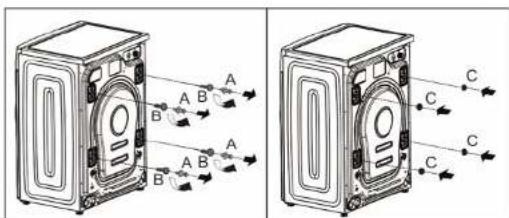
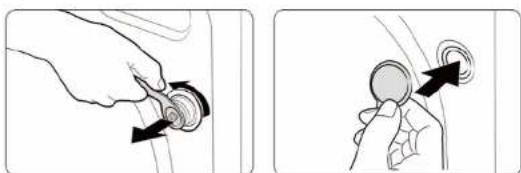
Fig./Img./Abb./Afb./Rys./Obr.4
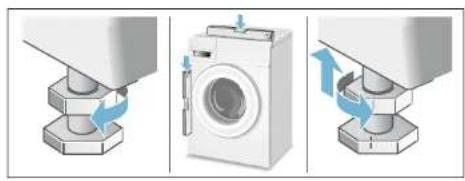
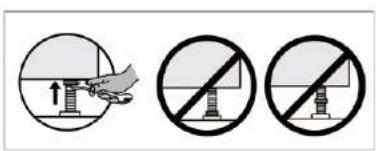
Fig./Img./Abb./Afb./Rys./Obr.5
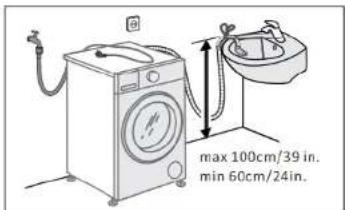
Fig./Img./Abb./Afb/Rys./Obr.8
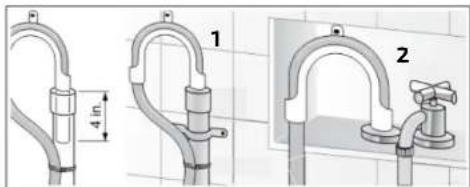
Fig./Img./Abb./Afb./Rys./Obr.9
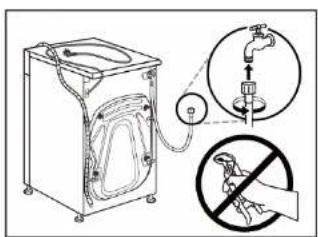
Fig./Img./Abb./Afb/Rys./Obr.5
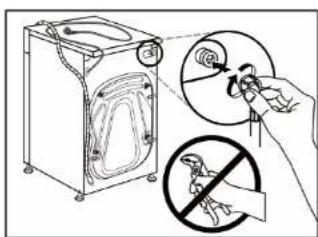
Fig./Img./Abb./Afb./Rys./Obr.7
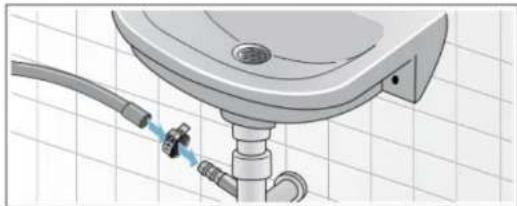
Fig./Img/Abb./Afb./Bys./Obr.10
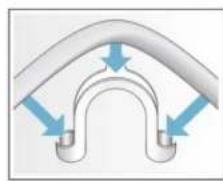
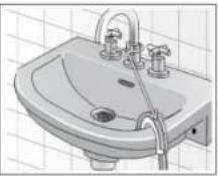
Fig./Img./Abb./Afb/Rys/Obr.11
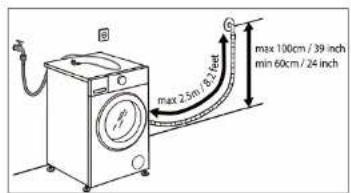
Fig./Img./Abb./Afb./Rys./Obr.12
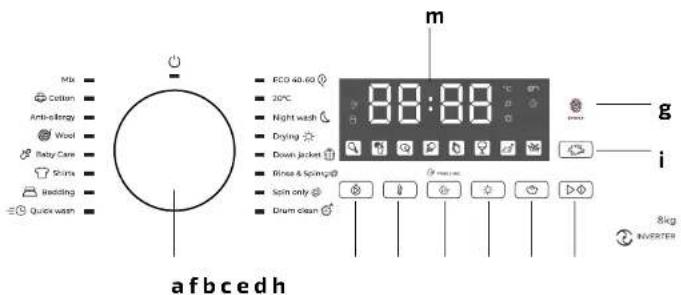
Fig./Img./Abb./Afo./Rys./Obr.13 Fig./Img./Abb./Afo./Rys./Obr.16
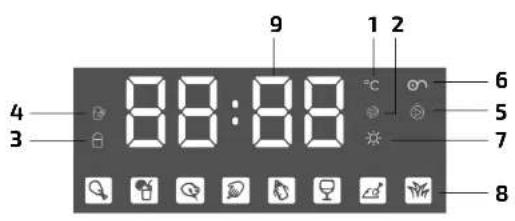
Fig./img./Abb./Afb./Rys./Obr.14
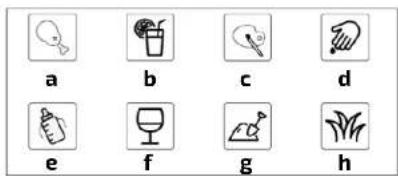
Fig./mg./Abb./Afb./Rys./Obr.15
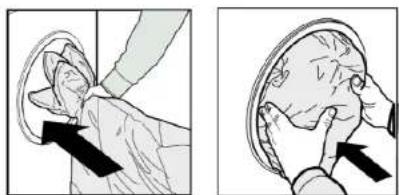
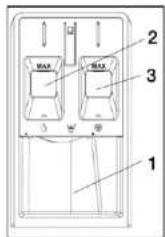
Fig./Img/Abb/Afn./Rys/Obr.17 Fig./Img/Abb/Afn./Rys/Obr.20
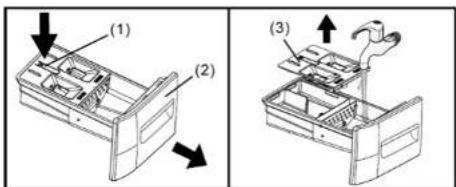
Fig./Img./Abb./Afo./Rys./Obr.18
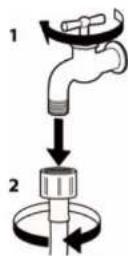
Fig./Img./Abb./Afb/Rys/Obr.19
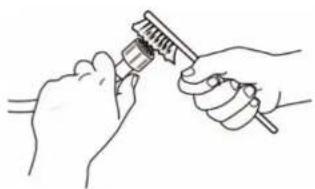
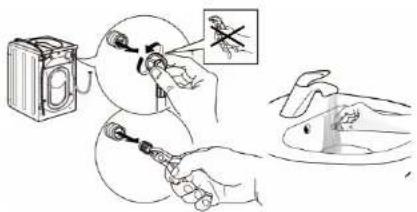
Fig./Img./Abb./Afb./Rys./Obr.21
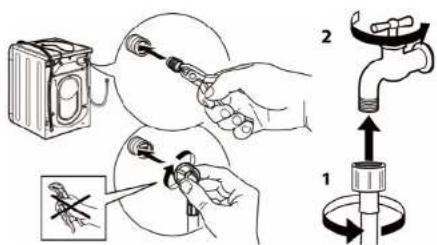
Fig./Img./Abb./Afb./Rys./Obr.22
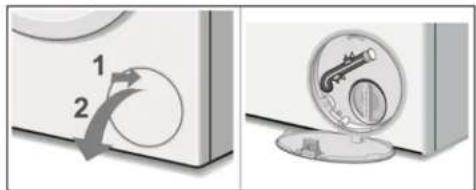
Fig./Img./Abb./Afb./Rys/Obr.23 Fig./Img./Abb./Afb./Rys/Obr.25
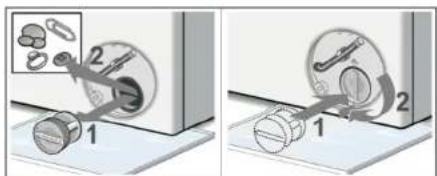
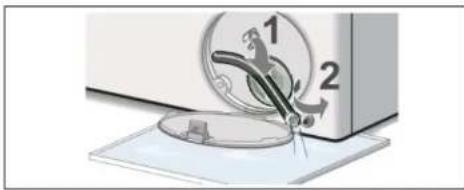
Fig./Img./Abb./Afb./Rys/Obr.24 Fig./Img./Abb./Afb/Rys/Obr.26
www.ceotec.es
- SOMMAIRE
- Cautions during the handling of the appliance
- Installation
- INSTRUCTIONS DE SECURITÉ
- BEFORE USE
- ENGLISHENGLISH
- 3.PRODUCT INSTALLATION
- Removing the transport screws (Fig.4)
- Levelling the washer dryer
- Carry out the following steps:
- Connection of the supplied hoses
- Water supply hose connection
- Warning
- Drain hose connection
- Drainage connection types:
- Fig.9
- WARNING: DANGER OF BURNS
- Note:
- OPERATION
- Control panel (Fig. 13)
- A: Washing cycle knob
- Sound cancellation (buzzer)
- D:STEAM
- E: DRYING
- F: DELAY END
- G:ONE TOUCH OC
- H: START/PAUSE
- Adding laundry during the execution of a washing programme
- 1:STAINS
- M:Display (Fig.14)
- Rotational speed indicator rpm
- Door lock indicator
- 3.Child-lock indicator light
- Delay end indicator light
- One touch indicator
- Drying function indicator
- Type of stains indicator
- Digital display, shows the following values:
- Before each washing
- Before each drying
- Degree of soiling
- Light soiling
- Normal silling
- Visible soiling and/or some light staining.
- Heavy soiling
- Classification of clothing according to the specifications of its care label
- ENGLISH ENGLISH
- Washing cycle table
- Washing cycles
- M-Smart washing cycle
- Drying programme
- Precautions for the drying programme
- Steam function
- Special washing cycles
- Baby Care
- Down Jacket
- Wool
- Delay end
- Child Lock
- Stalin removal
- Before the first wash
- How to use the washer dryer
- CLEANING AND MAINTENANCE
- Cleaning the drum
- Cleaning the door seals and glass
- Descending of the machine
- Checking the water supply hose
- Cleaning the detergent dispenser tank
- Cleaning the mesh filter in the water supply hose and the water inlet valve
- Cleaning the drain pump filter
- Errors
- TECHNICAL SPECIFICATIONS
- TECHNICAL SHEETS
- DISPOSAL OF OLD ELECTRICAL AND ELECTRONIC APPLIANCES
- TECHNICAL SUPPORT AND WARRANTY
- Copyright
- PIECES ET COMPOSANTS
- INSTALLATION DU PRODUIT
- INSTALLATIE VAN HET APPARAAT
Brand : CECOTEC
Model : Bolero Wash&Dry 8580 Inverter
Category : Washing machine