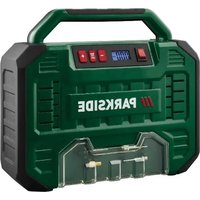
PMK 150 A1 - Compressor PARKSIDE - Free user manual and instructions
Find the device manual for free PMK 150 A1 PARKSIDE in PDF.


| Brand | Parkside |
| Model | PMK 150 A1 |
| Product type | Portable digital compressor |
| Power supply | 220-240 V~, 50 Hz (AC) / 12 V (DC, cigarette lighter) |
| Motor power | 150 W max / 120 W (AC) / 100 W (DC) |
| Operating pressure | approx. 8 bar |
| Rated pressure | 2.1 bar |
| Adjustable pressure range | 0.2 – 8 bar (3 – 116 PSI) |
| Theoretical suction capacity | approx. 36.5 l/min |
| Effective flow rate at 1 bar | approx. 18 l/min |
| Weight | 1.6 kg |
| AC cord length | 2.0 m |
| DC cord length | 4.0 m |
| Hose length | 0.6 m |
| Protection rating | IP30 |
| Protection class | II |
| Operating mode | S3 25% (2.5 min/10 min) |
| Sound power level (LWA) | 85.5 dB (uncertainty 3.38 dB) |
| Sound pressure level (LpA) | 73.4 dB (uncertainty 3 dB) |
| Ambient temperature | +5 °C to +40 °C |
| Main functions | Inflating tires (car, motorcycle, bicycle), balls, mattresses, beach accessories; digital display; pressure and unit adjustment (bar/PSI/kPa) |
| Maintenance and cleaning | Clean with a damp cloth and mild detergent; do not use abrasive chemicals; allow to cool before cleaning |
| Safety | Wear hearing, eye, and respiratory protection; do not expose to rain; use a 30 mA residual current device for outdoor use |
| Spare parts and repairability | Spare parts available via Lidl after-sales service (IAN number 472141_2407); repairs by qualified electrician |
| Warranty | 3 years from date of purchase |
| General information | Intended use: inflation of pneumatic objects, not truck tires; package contents: compressor, 3 adapters, hose, instruction manual |
Frequently Asked Questions - PMK 150 A1 PARKSIDE
User questions about PMK 150 A1 PARKSIDE
0 question about this device. Answer the ones you know or ask your own.
Ask a new question about this device
Download the instructions for your Compressor in PDF format for free! Find your manual PMK 150 A1 - PARKSIDE and take your electronic device back in hand. On this page are published all the documents necessary for the use of your device. PMK 150 A1 by PARKSIDE.
USER MANUAL PMK 150 A1 PARKSIDE
KOMPRESSOR MIT DIGITALER ANZEIGE TRAGBAR 12 V/230 V/PORTABLE COMPRESSOR 12V/230V/ COMPRESSEUR NUMÉRIQUE PORTATIF 12 V/230 V PMK 150 A1
DE AT CH
KOMPRESSOR MIT DIGITALER ANZEIGE TRAGBAR 12 V/230 V
Operation and safety notes Translation of the original instructions
FR BE
COMPRESSEUR NUMÉRIQUE PORTATIF 12 V/230 V
BÆRBAR KOMPRESSOR MED DIGITALT DISPLAY 12 V/230 V
GB/IE Operation and safety notes Page 43
natural_image
Diagram showing a bundle of cylindrical rods connected to a device labeled '7' (no text or symbols on the devices themselves)E
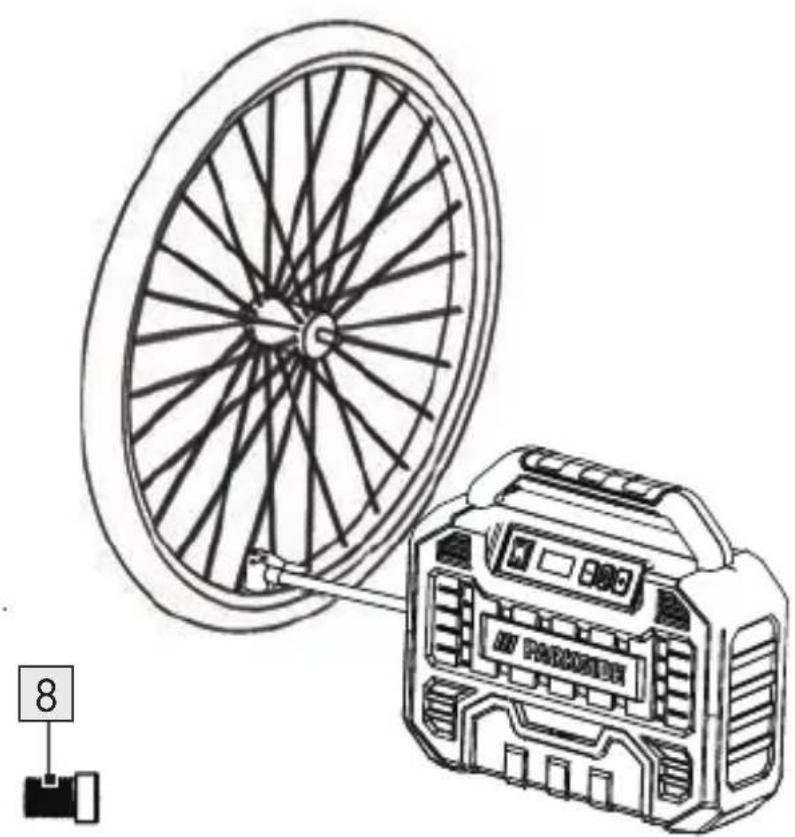
natural_image
Line drawing of a bicycle wheel connected to a radio device with a numbered label (8), no text or symbols present.F
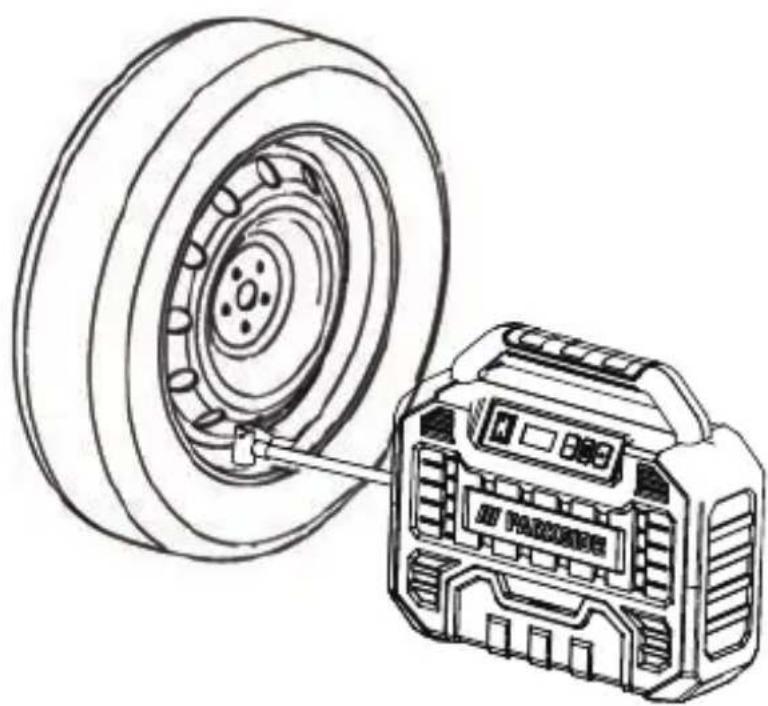
natural_image
Technical line drawing of a tire and its internal components, no text or symbols presentList of pictograms used ...... Page 45
Introduction Page 47
Intended use. Page 47
Scope of delivery ...... Page 48
Parts list Page 48
Technical data.... Page 49
General safety instructions .... Page 52
General power tool safety warnings ..... Page 52
Compressors safety warnings .... Page 56
Residual risks Page 62
First set-up of the product..... Page 63
Unpacking the product..... Page 63
Operation...... Page 64
Selecting the adapter.... Page 64
Electrical connection.... Page 65
Setting the unit and pressure.... Page 66
Switching the product on/off .... Page 67
Removing the adapter from the product ..... Page 67
Troubleshooting Page 68
Cleaning and maintenance ...... Page 69
Cleaning Page 69
Storage Page 70
Transportation. Page 70
Disposal Page 71
Warranty Page 72
Warranty claim procedure. Page 73
Service Page 74
EU declaration of conformity ..... Page 75
| List of pictograms used | |
 | Read the instruction manual. |
 | DANGER! This symbol in combination with the signal word “Danger” marks a high-risk hazard that if not prevented could result in death or serious injury. |
 | WARNING! This symbol in combination with the signal word “Warning” marks a medium-risk hazard that if not prevented could result in death or serious injury. |
 | CAUTION! This symbol in combination with the signal word “Caution” marks a low-risk hazard that if not prevented could result in minor or moderate injury. |
 | NOTICE! – Warns of possible damage to property/the product if not avoided (e.g. risk of short circuit) |
 | Sound power level in dB |
 | Alternating current/voltage |
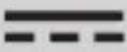 | Direct current/voltage |
 | Wear a dust mask! |
 | Wear eye protection! |
 | Wear hearing protection! |
 | Warning – hot surface! |
 | Danger – risk of electric shock! |
 | Warning – the product is equipped with an automatic start control. Keep others away from the work area of the product! |
 | Do not expose the product to rain. The product may only be stationed, stored and operated in dry ambient conditions. |
 | The product can be used for pumping up tyres. |
 | Symbol for a Protection Class II product |
 | Safety informationInstructions for use |
| [8KSA] | CE mark indicates conformity with relevant EU directives applicable for this product. |
PORTABLE COMPRESSOR 12V/230V
● Introduction
We congratulate you on the purchase of your new product. You have chosen a high quality product. The instructions for use are part of the product. They contain important information concerning safety, use and disposal. Before using the product, please familiarise yourself with all of the safety information and instructions for use. Only use the product as described and for the specified applications. If you pass the product on to anyone else, please ensure that you also pass on all the documentation with it.
Intended use
This product is intended for inflating car, motorcycle and bicycle tyres as well as sports balls, water balls, air mattresses and other similar items.
The product can be used by connecting the mains cord ^16 to a mains socket or by connecting the 12 V plug ^12 to a car cigarette lighter socket.
This product is not suitable for tyres with very large volumes, e.g. truck or tractor tyres.
- Only operate the product in a dry and well ventilated indoor space.
- Only use the product for its prescribed purpose. Any other use is deemed to be a case of misuse. The user/operator and not the manufacturer will be liable for any damage or injuries of any kind caused as a result of this.
- The product is not designed for use in commercial, trade or industrial applications.
The warranty will be voided if the product is used in commercial, trade or industrial businesses or for equivalent purposes.
- Scope of delivery
1 Portable Compressor
2 Ball needle
1 Conical adapter
1 Adapter for tyre valves
1 User manual
Parts list
Before reading, unfold the pages containing the illustrations and familiarise yourself with all functions of the product.
(Fig. A)
1 On/off switch
2 Handle
3 Display
4 - button (Button to decrease the value)
5 BAR/PSI/kPA button (Unit button)
6 + button (Button to increase the value)
7 Conical adapter
8 Adapter for tyre valves
9 Ball needle
10Adapter storage compartment
(Fig. B)
11 Storage compartment for 12 V plug with cord
12 V plug with cord
13 Compressed air hose with valve adapter and clamping lever
14 Storage compartment for compressed air hose
15 Storage compartment for mains cord
16 Mains cord with mains plug
- Technical data
| Portable Compressor PMK 150 A1 | |
| Model numbers: | |
| -VDE plug: HG10976 | |
| -BS plug: HG10976-BS | |
| AC mains power connection: 220–240 V~, 50 Hz | |
| DC connection: 12 V | --- |
| Motor rating: max. 150 W | |
| Rated power: 120 W (AC) | 100 W (DC) |
| Operating mode*: S3 25 % | |
| Operating pressure: approx. 8 bar | |
| Rated pressure: 2.1 bar | |
| Pressure levels:-Min. pressure: 3 PSI/0.2 bar-Max. pressure: 116 PSI/8 bar | |
| Theroretical intake capacity: approx. 36.5 l/min | |
| Effective output rate at 1 bar: approx. 18 l/min | |
| Protection type: IP30 | |
| Protection class: II | |
| Weight: 1.6 kg | |
| AC cable length: 2.0 m | |
| DC cable length: 4.0 m | |
| Hose length: 0.6 m | |
| Ambient temperature: +5 °C to +40 °C | |
| * S3 25 % = periodical intermediate duty with a duty cycle of 25 % (2.5 min based on a 10 min period) | |
Noise emission value
The measured values were measured in accordance with EN 1012-1.
| Sound pressure level L_pA : 73.4 dB | |
| Uncertainty K_pA : 3 dB | |
| Sound power level L_WA : 85.5 dB | |
| Uncertainty K_WA : | 3.38 dB |
NOTE
The declared vibration total value and the declared noise emission value have been measured in accordance with a standard test method and may be used for comparing one tool with another.
The declared total vibration value and the declared noise emission value may also be used for a preliminary assessment of exposure.

WARNING!
The vibration and noise emissions during actual use of the power tool can differ from the declared values depending on the manner in which the tool is used, especially what kind of workpiece is processed.
It is necessary to identify safety measures to protect the operator that are based on an estimation of exposure in the actual conditions of use (taking account of all parts of the operating cycle such as the times when the tool is switched off and when it is running idle in addition to the trigger time).

WARNING!

Wear hearing protection!

General safety instructions
● General power tool safety warnings

WARNING!
Read all safety warnings, instructions, illustrations and specifications provided with this power tool. Failure to follow the warnings and instructions may result in electric shock, fire and/or serious injury.
Save all warnings and instructions for future reference.
The term “power tool” in the warnings refers to your mains-operated (corded) power tool or battery-operated (cordless) power tool.
Work area safety
1) Keep work area clean and well lit. Cluttered or dark areas invite accidents.
2) Do not operate power tools in explosive atmospheres, such as in the presence of flammable liquids, gases or dust. Power tools create sparks which may ignite the dust or fumes.
3) Keep children and bystanders away while operating a power tool. Distractions can cause you to lose control.
Electrical safety
1) The mains plug of the power tool must fit into the socket. Never modify the plug in any way. Do not use any adapter plugs with earthed (grounded) power tools. Unmodified plugs and matching outlets will reduce risk of electric shock.
2) Avoid body contact with earthed or grounded surfaces, such as pipes, radiators, ranges and refrigerators. There is an increased risk of electric shock if your body is earthed or grounded.
3) Do not expose power tools to rain or wet conditions. Water entering a power tool will increase the risk of electric shock.
4) Do not abuse the cord. Never use the cord for carrying, pulling or unplugging the power tool. Keep cord away from heat, oil, sharp edges or moving parts. Damaged or entangled cords increase the risk of electric shock.
5) When operating a power tool outdoors, use an extension cord suitable for outdoor use. Use of a cord suitable for outdoor use reduces the risk of electric shock.
6) If operating a power tool in a damp location is unavoidable, use a residual current device (RCD) protected supply. Use of an RCD reduces the risk of electric shock.
Personal safety
1) Stay alert, watch what you are doing and use common sense when operating a power tool. Do not use a power tool while you are tired or under the influence of drugs, alcohol or medication. A moment of inattention while operating power tools may result in serious personal injury.
2) Use personal protective equipment. Always wear eye protection. Protective equipment such as dust mask, non-skid safety shoes, hard hat, or hearing protection used for appropriate conditions will reduce personal injuries.
3) Prevent unintentional starting. Ensure the switch is in the off-position before connecting to power source and/or battery pack, picking up or carrying the tool. Carrying power tools with your finger on the switch or energising power tools that have the switch on invites accidents.
4) Remove any adjusting key or wrench before turning the power tool on. A wrench or a key left attached to a rotating part of the power tool may result in personal injury.
5) Do not overreach. Keep proper footing and balance at all times. This enables better control of the power tool in unexpected situations.
6) Dress properly. Do not wear loose clothing or jewellery. Keep your hair, clothing and gloves away from moving parts. Loose clothes, jewellery or long hair can be caught in moving parts.
7) If devices are provided for the connection of dust extraction and collection facilities, ensure these are connected and properly used. Use of dust collection can reduce dust-related hazards.
8) Do not let familiarity gained from frequent use of tools allow you to become complacent and ignore tool safety principles. A careless action can cause severe injury within a fraction of a second.
Power tool use and care
1) Do not force the power tool. Use the correct power tool for your application. The correct power tool will do the job better and safer at the rate for which it was designed.
2) Do not use the power tool if the switch does not turn it on and off. Any power tool that cannot be controlled with the switch is dangerous and must be repaired.
3) Disconnect the plug from the power source and/or remove the battery pack, if detachable, from the power tool before making any adjustments, changing accessories, or storing power tools. Such preventive safety measures reduce the risk of starting the power tool accidentally.
4) Store idle power tools out of the reach of children and do not allow persons unfamiliar with the power tool or these instructions to operate the power tool. Power tools are dangerous in the hands of untrained users.
5) Maintain power tools and accessories. Check for misalignment or binding of moving parts, breakage of parts and any other condition that may affect the power tool's operation. If damaged, have the power tool repaired before use. Many accidents are caused by poorly maintained power tools.
6) Keep cutting tools sharp and clean. Properly maintained cutting tools with sharp cutting edges are less likely to bind and are easier to control.
7) Use the power tool, accessories and tool bits etc. in accordance with these instructions, taking into account the working conditions and the work to be performed. Use of the power tool for operations different from those intended could result in a hazardous situation.
8) Keep handles and grasping surfaces dry, clean and free from oil and grease. Slippery handles and grasping surfaces do not allow for safe handling and control of the tool in unexpected situations.
Service
1) Have your power tool serviced by a qualified repair person using only identical replacement parts. This will ensure that the safety of the power tool is maintained.
- Compressors safety warnings
⚠️ CAUTION! The following basic safety actions must be taken when using this product in order to protect the user from electric shocks and the risk of injury and fire. Read and follow these instructions before using the product.
-
Keep the work area orderly. Disorder in the work area can lead to accidents.
Take environmental influences into account. Do not expose the product to rain. Do not use the product in a damp or wet environment. There is a risk of electric shock!
■ Make sure that the work area is well illuminated. -
Do not use the product where there is a risk of fire or explosion.
- Avoid physical contact with earthed parts (e.g. pipes, radiators, electric ranges, cooling units) to protect yourself from electric shock.
- Keep away from children! Do not allow children to touch the product or mains cord. Keep children away from your work area.
■ Store the product in a dry, elevated or closed location out of the reach of children. -
Do not overload the product. The product works better and more safely in the specified output range.
■ Dress properly. Do not wear wide clothing or jewellery, which can become entangled in moving parts.
■ Rubber gloves and anti-slip footwear are recommended when working outdoors.
■ Tie long hair back in a hair net. -
Do not use the mains cord to pull the mains plug out of the mains socket.
Protect the mains cord from heat, oil and sharp edges. - Keep the product clean in order to work well and safely.
Follow the maintenance instructions. - Check the mains cord of the product regularly and have it replaced by a recognised specialist when damaged.
- Check extension cords regularly and replace them when damaged.
■ Remove the mains plug from the mains socket when the product is not in use, prior to maintenance or when replacing parts.
■ Make sure that the product is switched off when connecting the mains plug to a mains socket. -
Only use approved and appropriately identified extension cords for use outdoors. Only use cable reels in the unrolled state.
-
Pay attention to what you are doing. Remain sensible when working. Do not use the product when you are distracted.
■ Protective devices or other parts with minor damage must be carefully inspected to ensure that they function correctly and as intended prior to continued use of the product.
■ Damaged switches must be replaced at a customer service workshop. - Do not use any faulty or damaged connection cables.
- Do not use any product on which the switch cannot be switched on and off.
This product conforms to the applicable safety regulations. Repairs may only be performed by an electrician using original spare parts. Otherwise accidents can occur.
For your own safety, only use accessories and additional equipment that are indicated in the user manual (see “Replacement parts”) or have been recommended or indicated by the manufacturer.
■ Wear hearing protection when using the product.
If the connection line is damaged, it must be replaced by the manufacturer or an electrician to avoid danger. There is a risk of electric shock.
■ Directly after inflating tyres, check the pressure with a suitable pressure gauge, for example at your filling station.
■ Ensure that all hoses and fixtures are suitable for the maximum permissible working pressure of the product.
■ Only set up the product on a flat surface.
In case of pressures above 7 bar, it is recommended to equip supply hoses with a safety cable (e. g. a wire rope).
- Avoid over-stressing the piping system by using flexible hose connections to prevent kinking.
Use a residual current circuit breaker with a trigger current of 30 mA or less. Using a residual current circuit breaker reduces the risk of an electric shock. - Check that the data on the rating plate is identical to the mains data before you connect the product to the mains socket.
-
Avoid long air lines and supply lines of the extension cord.
■ Make sure that the intake air is dry and dustfree.
The product may only be used in suitable rooms with good ventilation and an ambient temperature from +5 °C to +40 °C. There must be no dust, acids, vapours, explosive gases or inflammable gases in the room. -
Only use the product in dry rooms. It is prohibited to use the product in areas where work is conducted with sprayed water. Do not install the product in a damp or wet room.
The product may only be used outdoor briefly when the ambient conditions are dry.
Long supply cables, extension cords, cable reels etc. cause a drop in voltage and can impede motor start-up.
Residual risks
Even if you are operating this product in accordance with all the safety requirements, potential risks of injury and damage remain. The following dangers can arise in connection with the structure and design of this product:
■ Unintentional starting up of the product.
■ Damage to hearing if the stipulated hearing protection is not worn.
- Dirt particles, dust etc. can get into the eyes or face despite wearing safety goggles.
■ Inhaling swirled up particles.
NOTE
This product produces an electromagnetic field during operation! This field may under some circumstances interfere with active or passive medical implants! To reduce the risk of serious or fatal injury, we recommend persons with medical implants to consult their doctor and the medical implant manufacturer before operating this product!
● First set-up of the product
- Unpacking the product
WARNING!
The product and packaging materials are not toys! Children must not be allowed to play with plastic bags, film and small parts. There is a risk of swallowing and suffocation.
- Take the product out of the packaging and remove all packaging materials and plastic wrappings.
- Check to make sure that all listed parts are included (see "Scope of delivery").
- Check whether the product and all parts are in good condition, if any damage or defect is detected, do not use the product, but follow the procedure described in chapter "Warranty".
Operation

WARNING!

Wear a dust mask!

Wear eye protection!

Wear hearing protection!
- Selecting the adapter
(Fig. C, D, E, F)
- Place the product on a stable and flat surface.
- Select the desired adapter 7/8/9 depending on the object you want to inflate:
| Adapter Object to be inflated | |
 | Inflate swimming accessories, e.g.: □ Paddling pools □ Air mattresses □ Boats |
 | □ Bicycle tyres |
 | □ Balls |
- Remove the compressed air hose 13 from the storage compartment for compressed air hose 14.
- Connect the adapter 7/8/9 to the compressed air hose 13.
- Fold up the clamping lever on the compressed air hose 13.
- Connect the compressed air hose 13 with the adapter 7/8/9 to the object you wish to inflate.
- Fold down the clamping lever on the compressed air hose 13 to lock it in place.
Electrical connection
NOTE
During temporary use outdoors: If connected via mains cord 16, the product must be connected to a residual current circuit breaker with a trigger current of 30 mA or less.
▶ Verify the socket of the cigarette lighter in your vehicle has an adequately sized fuse.
AC Connection
-
Remove the mains cord with mains plug 16 from the storage compartment for mains cord 15.
-
Connect the mains plug 16 to the mains socket.
DC Connection
- Remove the 12 V plug with cord 12 from the storage compartment for 12 V plug with cord 11 .
- Connect the 12 V plug 12 to a 12 V cigarette lighter socket.
- Setting the unit and pressure
NOTE
The pressure can be displayed in units of bar, PSI or kPa:
-bar: 100 Kilopascal
-PSI: Pounds per square inch
-kPa: Kilopascal
The pressure value can be changed in 0.05 increments.
The objects you plan to use with the product must be compatible with the air pressure and flow rate of the product. Using objects that require higher pressure or flow than the product can deliver may result in poor performance or damage to the objects.
Recommended tyre pressure: Observe the information supplied by the tyre manufacturer and the vehicle manufacturer. Do not exceed the maximum pressure rating.
This product is not calibrated! For a calibrated measurement value, check the actual tyre pressure using a calibrated meter after you have inflated the tyres yourself, e.g. at a petrol station.
- Set the desired unit: Press the BAR/PSI/kPA button 5.
- Set the desired pressure:
-Press the + button 6 to increase the value.
-Press the - button 4 to decrease the value.
The set pressure value is shown on the display 3.
After a few seconds 0.00 is shown on the display.
- Switching the product on/off
Switching on
□ Move the on/off switch 1 to position I.
The display 3 shows the current pressure value.
The product pumps until the set pressure is reached.
Switching off
□ Move the on/off switch 1 to position O.
The product stops pumping.
- Removing the adapter from the product
NOTE
Air may escape from the valve of the inflatable object when removing the compressed air hose 13.
- Remove the compressed air hose 13 from the object.
- Fold up the clamping lever on the compressed air hose 13. Remove the adapter 7/8/9. Store the adapter in the adapter storage compartment 10.
- Let the product cool down completely.
● Troubleshooting
| Problem Possible cause Solution | ||
| The product does not start. | There is no supply voltage. | |
| ☐ AC Connection:Check the mains cord with mains plug 16, the fuse and the mains socket.☐ DC Connection:Check the 12 V plug with cord 12 and the cigarette lighter socket. | ||
| There is insufficient supply voltage. | ||
| Avoid extension cords that are too long. Use extension cords with sufficient wire cross-section. | ||
| Do not operate the product below +5 °C outside temperature. | ||
| Allow the motor to cool down. If necessary, eliminate the cause of overheating. | ||
| Problem Possible cause Solution | ||
| The product does not start. | The pressure sensor cannot detect the correct pressure of the object. | Deflate the object and try to start the product again. |
● Cleaning and maintenance
Cleaning
⚠ WARNING! Risk of electric shock!
Remove the mains plug16 from the mains socket before cleaning or maintenance.
Do not let water get into the interior of the product.
⚠ WARNING! Risk of burns!
Let the product cool down completely before cleaning.
NOTICE!
Do not use chemical, alkaline, abrasive or other aggressive detergents or disinfectants to clean this product as they might be harmful to its surfaces.
NOTE
Keep the product free of dirt and dust.
□ Clean the product regularly with a damp cloth and some mild soap.
Replacement parts
□ Customers can obtain compatible replacement parts by contacting the Lidl Service Hotline (see “Service”). Mention the IAN number, which is shown on the first page of this user manual, when contacting the Lidl Service Hotline.
Storage
- Switch off the product. Let the product cool down.
- Clean the product (see "Cleaning").
- Store the mains cord with mains plug 16 in the storage compartment for the mains cord 15.
- Store the 12 V plug with cord 12 in the storage compartment for the 12 V plug with cord 11 .
- Store the compressed air hose 13 in the storage compartment for compressed air hose 14.
- Store the product in a dark, dry, frost-free, dust-protected and well-ventilated place.
- Always store the product in a place inaccessible to children.
- Transportation
- Carry the product on the handle 2.
- Protect the product against shocks and strong vibrations that occur especially during transport in vehicles.
- During the transport in vehicles, secure the product against slipping and falling over.
- Disposal
The packaging is made entirely of recyclable materials, which you may dispose of at local recycling facilities.
Observe the marking of the packaging materials for waste separation, which are marked with abbreviations (a) and numbers (b) with following meaning: 1–7: plastics/20–22: paper and fibreboard/80–98: composite materials.
Product:


The product incl. accessories and packaging materials are recyclable and are subject to extended producer responsibility. Dispose them separately, following the illustrated Info-tri (sorting information), for better waste treatment.
The Triman logo is valid in France only.

Contact your local refuse disposal authority for more details of how to dispose of your worn-out product.
To help protect the environment, please dispose of the product properly when it has reached the end of its useful life and not in the household waste. Information on collection points and their opening hours can be obtained from your local authority.
Warranty
The product has been manufactured to strict quality guidelines and meticulously examined before delivery. In the event of material or manufacturing defects you have legal rights against the retailer of this product. Your legal rights are not limited in any way by our warranty detailed below.
The warranty for this product is 3 years from the date of purchase. The warranty period begins on the date of purchase. Keep the original sales receipt in a safe location as this document is required as proof of purchase.
Any damage or defects already present at the time of purchase must be reported without delay after unpacking the product.
Should the product show any fault in materials or manufacture within 3 years from the date of purchase, we will repair or replace it – at our choice – free of charge to you. The warranty period is not extended as a result of a claim being granted. This also applies to replaced and repaired parts.
This warranty becomes void if the product has been damaged, or used or maintained improperly.
The warranty covers material or manufacturing defects. This warranty does not cover product parts subject to normal wear and tear, thus considered consumables (e.g. batteries, rechargeable batteries, tubes, cartridges), nor damage to fragile parts, e.g. switches or glass parts.
● Warranty claim procedure
So that your request can be processed quickly, please observe the following instructions:
For all inquiries, please have the receipt and item number (IAN 472141_2407) ready as proof of purchase.
The article number can be taken from the identification label on the product, engraving on the product, the front cover of your manual (at the bottom left), or the sticker on the back or bottom of the product.
If malfunctions or other defects arise, first contact the service department indicated below by phone or email.
You can then send a product recorded as defective to the communicated service address postage-free, making sure to enclose proof of purchase (receipt) and information on the details of the defect and when it occurred.
You can download and view this and numerous other manuals at parkside-diy.com. This QR code takes you directly to parkside-diy.com. Choose your country and use the search screen to search for the operating instructions. Entering the item number (IAN) 472141_2407 takes you to the operating instructions for your item.
Service
GB Service Great Britain
Tel.: 0800 0569216
E-Mail: owim@lidl.co.uk
IE Service Ireland
Tel.: 1800 200736
E-Mail: owim@lidl.ie
CE

EU declaration of conformity
EU DECLARATION OF CONFORMITY (472141\_2407)
IAN:
472141_2407
Produ ct identification:
The object of the declaration described above is in conformity with the relevant Union harmonisation legislation:
| Directive 2006/42/EC |
| Directive 2014/30/EC |
| Directive 2000/14/EC |
| Directive 2005/88/EC |
| Directive 2009/125/EC |
| Directive 2011/65/EU and all related amendments |
References to the relevant harmonised standards used or references to the other technical specifications in relation to which conformity is declared:
| N° / Parts |
| Directive 2006/42/EC |
| EN 62841-1: 2015/A11: 2022 |
| EN 1012-1: 2010 |
| Directive 2014/42/EC |
| EN 55014-1:2017/A11:2020 |
| EN IEC 55014-1:2021 |
| EN 55014-2:1997/A2:2008 |
| EN IEC 55014-2:2021 |
| EN 61000-3-2: 2014 |
| EN IEC 61000-3-2:2019/A1:2021 |
| EN 61000-3-3:2013/A2:2021 |
| EN 50498:2010 |
The object of the declaration described above is in conformity with Directive 2011/65/EU of the European Parliament and of the Council of 8 June 2011 on the restriction of the use of certain hazardous substances in electrical and electronic equipment:
| N° / Parts |
| Directive 2011/65/EU |
| EN IEC 63000:2018 |
Conformity Assessment procedure / name&adress notified body where appropriate:
Directive 2000/14/EC Annex VI, TÜV SÜD Industrie Service GmbH, Westendstraße 199, 80686 München, Germany
Measured sound power level on an equipment representative for this type: 85.5 dB(A)
Guaranteed sound power level for this equipment: 90 dB(A)
Keeper of the technical documentation: OWIM GmbH & Co.KG
Signed for and on behalf of:
This declaration of conformity is issued under the sole responsibility of the manufacturer.
Translation of the original declaration of conformity
Neckarsulm 20.09.2024
Place
Date
EN