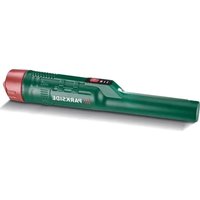
PTMD A1 - Metal detector PARKSIDE - Free user manual and instructions
Find the device manual for free PTMD A1 PARKSIDE in PDF.


| Product Type | Handheld Metal Detector |
| Brand | Parkside |
| Model | PTMD A1 |
| Power Supply | 1 9V battery |
| Protection Rating | IP68 |
| Detectable Metals | Ferrous and non-ferrous metals |
| Operating Temperature | -10 °C to +50 °C |
| Package Contents | 1 detector, 1 9V battery, 1 spiral wrist strap, 1 belt pouch, 1 instruction manual |
| Main Functions | Metal detection, LED bar (3 LEDs), audible signal, vibration, flashlight, auto-off (10 min), sensitivity adjustment (3 levels), auto-calibration |
| Cleaning and Maintenance | Slightly damp cloth, avoid internal liquids, dry completely |
| Safety | Do not use for archaeological research without permission, follow local laws, risk of explosion if batteries are recharged, keep out of reach of children |
| Warranty | 3 years, spare parts available during warranty period |
| Weight | Approximately 250 g (estimate) |
Frequently Asked Questions - PTMD A1 PARKSIDE
User questions about PTMD A1 PARKSIDE
0 question about this device. Answer the ones you know or ask your own.
Ask a new question about this device
Download the instructions for your Metal detector in PDF format for free! Find your manual PTMD A1 - PARKSIDE and take your electronic device back in hand. On this page are published all the documents necessary for the use of your device. PTMD A1 by PARKSIDE.
USER MANUAL PTMD A1 PARKSIDE
Operation and safety notes
FR BE
DETECTEUR DE MÉTAUX PORTABLE
List of pictograms used. Page 23
Introduction. Page 23
Intended use. Page 24
Scope of delivery . Page 24
Parts list. Page 24
Technical data. Page 25
General safety instructions... Page 25
Safety instructions for
batteries/rechargeable
batteries . Page 27
General information
about using metal detectors.. Page 28
Before first use. Page 28
Unpacking the product. Page 28
Inserting/exchanging
the battery . Page 29
Operation. Page 29
Switching the product on.... Page 29
Switching the product off . . . Page 29
Detecting metallic objects . . . Page 29
Tips on measurement. Page 30
Flashlight . Page 31
Low battery. Page 31
Automatic switch-off Page 31
Adjusting detection
sensibility/Calibrating the
product. Page 31
Lanyard. Page 32
Belt pouch . Page 32
Cleaning and maintenance... Page 32
Disposal. Page 32
Warranty . Page 33
Warranty claim procedure . . . Page 34
Service. Page 35
| List of pictograms used | |
| DANGER! - Designating a hazard with high risk, which will result in death or severe injury if not avoided (e.g. risk of suffocation) | |
| NOTICE! - Warns of possible damage to property/the product if not avoided (e.g. risk of short circuit) | |
| INFO: This symbol with the “Info” signal word offers additional useful information. | |
| Direct current/voltage | |
| Battery included | |
| CE mark indicates conformity with relevant EU directives applicable for this product. | |
| Safety information Instructions for use | |
PORTABLE METAL DETECTOR
Introduction
We congratulate you on the purchase of your new product. You have chosen a high quality product. The instructions for use are part of the product. They contain important information concerning safety, use and disposal. Before using the product, please familiarise yourself with all of the safety information and instructions for use. Only use the product as described and for the specified applications. If you pass the product on to anyone else, please ensure that you also pass on all the documentation with it.
Intended use
The product is intended to detect ferrous and non-ferrous metals.
The use of metal detectors in connection with the search for historical objects, art, coins and archaeology is prohibited by law.
The use and transport of unlicensed metal detectors to carry out any search in monuments or classified archaeological zones is also prohibited.
Before using this product: Familiarise yourself with federal, regional and local regulations and laws.
This product is only intended for private use, not for commercial purposes.
The manufacturer accepts no liability for damages caused by improper use.
Scope of delivery
1 Portable metal detector
1 9 V block battery
1 Lanyard
1 Belt pouch
1 User manual
Parts list
Before reading, unfold the pages containing the illustrations and familiarise yourself with all functions of the product.
(Fig. A)
Hanger (for lanyard)
2 Battery compartment lid
9V block battery
4 Handle
5 button
LED bar (with 3 red LEDs)
7 Flashlight
8 Detection rod
9 Belt pouch
10 Lanyard
Technical data
| Power supply: 1×9 V block battery | |
| Ingress protection: IP68 | |
| Detected metals: Ferrous and non-ferrous metals | |
| Operating temperature: -10 °C to +50 °C | |

General safety instructions
BEFORE USING THE PRODUCT, FAMILIARISE YOURSELF WITH ALL OF THE SAFETY INFORMATION AND INSTRUCTIONS FOR USE! WHEN PASSING THIS PRODUCT ON TO OTHERS, ALSO INCLUDE ALL THE DOCUMENTS!
In the case of damage resulting from non-compliance with these operating instructions the warranty claim becomes invalid! No liability is accepted for consequential damage! In the case of material damage or personal injury caused by incorrect handling or non-compliance with the safety instructions, no liability is accepted!
DANGER! Risk of suffocation!
Never leave children unsupervised with the packaging material. The packaging material represents a danger of suffocation. Children frequently underestimate the dangers. Always keep children away from the packaging material.
This product can be used by children aged from 8 years and above and persons with reduced physical, sensory or mental capabilities, or lack of experience and knowledge if they have been given supervision or instruction concerning use of the product in a safe way and understand the hazards involved.
Cleaning and user maintenance shall not be made by children without supervision. Children shall not play with the product.

Safety instructions for batteries/rechargeable batteries

DANGER TO LIFE! Keep batteries/ rechargeable batteries out of reach of children. If accidentally swallowed seek immediate medical attention.

DANGER OF EXPLOSION!
Never recharge nonrechargeable batteries. Do not short-circuit batteries/rechargeable batteries and/or open them. Overheating, fire or bursting can be the result.
Never throw batteries/rechargeable batteries into fire or water.
Do not exert mechanical loads to batteries/rechargeable batteries.
Risk of leakage of batteries/ rechargeable batteries
Avoid extreme environmental conditions and temperatures, which could affect batteries/ rechargeable batteries, e.g. radiators/direct sunlight.
If batteries/rechargeable batteries have leaked, avoid contact with skin, eyes and mucous membranes with the chemicals! Flush immediately the affected areas with fresh water and seek medical attention!

WEAR PROTECTIVE
GLOVES! Leaked or damaged batteries/ rechargeable batteries can cause burns on contact with the skin. Wear suitable protective gloves at all times if such an event occurs.
In the event of a leakage of batteries/rechargeable batteries, immediately remove them from the product to prevent damage.
Remove batteries/rechargeable batteries if the product will not be used for a longer period.
Risk of damage of the product
Only use the specified type of battery/rechargeable battery!
Insert batteries/rechargeable batteries according to polarity marks (+) and (-) on the battery/ rechargeable battery and the product.
Use a dry lint-free cloth or cotton swab to clean the contacts on the battery/rechargeable battery and in the battery compartment before inserting!
Remove exhausted batteries/ rechargeable batteries from the product immediately.
- General information about using metal detectors
On private property, you need to obtain approval from the owner.
If you detect and dig up unexploded bombs or other explosives, stop digging immediately. Mark the area and contact the police or your local authorities. Wait at a safe distance until experts arrive at the scene and warn other passers-by about the imminent danger.
Bombs or other explosives are sometimes not recognisable as such. In case of doubt, proceed as described above.
We recommend contacting a responsible authority (e.g. local historic monuments protection authority) to obtain approval and a specific training about the legal requirements. If you damage or remove archaeological or historic artefacts, you can become criminally liable.
Detecting metallic objects is allowed on many publicly accessible beaches without prior approval, unless the beach is a protected landscape or a classified archaeological zone. In certain countries or states, using metal detectors on beaches and dunes might be prohibited nonetheless. In case of doubt, contact your local authorities.
Always leave the area unscathed and without any open holes.
Before first use
Unpacking the product
- Take the product out of the packaging and remove all packaging materials and plastic wrappings.
-
Check to make sure that all listed parts are included (see "Scope of delivery").
-
Check whether the product and all parts are in good condition, if any damage or defect is detected, do not use the product, but follow the procedure described in chapter "Warranty".
- Inserting/exchanging the battery
- Unscrew the battery compartment lid 2.
- Remove the foil from the 9 V block battery 3.
- Insert the 9 V block battery with the + / - poles facing downwards into the battery compartment. Fit the + / - poles in the moulds of the battery compartment (Fig. B).
- Screw the battery compartment lid 2 onto the product.
Operation
- Switching the product on
① INFO: Keep the product away from metallic objects while switching it on. This is necessary so that the product can calibrate itself.
-
Press 5 .
-
The product calibrates itself for about 2 seconds. During this time, the LED bar goes on and then off again. The product emits a single sound-and-vibration alert.
-
The flashlight goes on.
-
The product is ready for use.
-
1 LE[6] flashes every 3 seconds.
- Switching the product off
Press and hold 5 for 2 seconds.
The product emits a sound-andvibration alert twice.
- Detecting metallic objects
- Switch the product on and wait until the product is ready for use (see "Switching the product on")
- Hold the product by the handle 4
- Point the detection rod in a direction where you expect to find metallic objects. The closer the detection rod is to metallic objects, the higher the frequency of LED and sound-and-vibration alerts:
| Metallic objects in the detection area | ||
| 1 LED 6 flashes every 3 seconds | ||
| Metallic objects: none | ||
| Alerts*: none | ||
| 1 LED 6 on | ||
| Metallic objects: | in detection range | |
| Alerts*: slow | ||
| 2 LEDs 6 on | ||
| Metallic objects: getting closer | ||
| Alerts*: medium | ||
| 3 LEDs 6 on | ||
| Metallic objects: close | ||
| Alerts*: frequent | ||
| 3 LEDs 6 flashing quickly | ||
| Metallic objects: very close | ||
| Alerts*: continuous | ||
| *Sound-and-vibration alerts | ||
- Tips on measurement
Incorrect measurements can occur depending on the nature of the examined wall. Therefore, check the position of a known metal beam or a known power line before every measurement. If these are not detected by the product, the substrate is not suitable for a search with this product.
Metal objects can be located all the better the easier they can be magnetised. This means that iron is detected at a significantly greater distance than copper for example.
Depending on the wall thickness and material, it is possible that the product may signal a finding, before it is over the material. In this case mark the start and end of the signalled area. The middle of the sought object lies in the middle between the two markings.
Always guide the detection rod in a straight line (left/right and up/down) across the surface.
Repeat the process several times to ensure the detection accuracy.
- Flashlight
-
When the product is switched on, press 5 to turn the flashlight 7 on or off.
-
Each time 5 is pressed, the product emits a sound-and-vibration alert.
Low battery
- When the battery is running low, the flashlight 7 flashes quickly.
The product emits a sound-andvibration alert thrice.
The product switches off automatically.
Automatic switch-off
The product switches off automatically if 5 is not pressed for 10 minutes.
The flashlight 7 starts flashing slowly 1 minute before the product switches off automatically.
Press 5 when the flashlight 7 is flashing if you want to continue using the product. If you do not press , the product switches off after 1 minute.
Adjusting detection sensibility/Calibrating the product
- Make sure the product is switched off.
- Press and hold 05 until the LED bar 6 flashes.
- Short press 5 repeatedly to adjust the detection sensibility:
Level 1: 1 LE6 flashes (low sensibility)
Level 2: 2 LED 6 flash (medium sensibility)
- Level 3: 3 LED 6 flash (high sensibility)
- Press and hold 5 for 2 seconds or wait for 5 seconds without pressing the button to enter auto-calibration mode.
- Auto-calibration takes approx. 2 seconds. After that, the product enters normal detection mode again.
Lanyard
(Fig. C)
-
Attach the clip on one end of the lanyard to the hanger 1.
-
Attach the clip on the other end of the lanyard to your belt loop, for example.
Belt pouch
(Fig. D)
-
Fix the belt pouch to your belt.
-
Insert the product into the belt pouch 9.
- Cleaning and maintenance
NOTICE! Risk of property damage!
Do not allow water or other liquids to get inside the product.
- Do not use abrasive, aggressive cleaning materials or hard brushes for cleaning.
Clean the product with a slightly damp cloth. For stubborn soiling, add a mild cleaning agent on the cloth.
After cleaning: Allow the product to dry completely.
Disposal
The packaging is made of environmentally friendly materials, which may be disposed of through your local recycling facilities.

Observe the marking of the packaging materials for waste separation, which are marked with abbreviations (a) and numbers (b) with following meaning: 1-7: plastics/20-22: paper and fibreboard/80-98: composite materials.
Product:
The product incl. accessories, manual and packaging materials are recyclable and are subject to extended producer responsibility. Dispose them separately, following the illustrated Info-tri (sorting information), for better waste treatment. The Triman logo is valid in France only.

Contact your local refuse disposal authority for more details of how to dispose of your wornout product.

To help protect the environment, please dispose of the product properly when it has reached the end of its useful life and not in the household waste. Information on collection points and their opening hours can be obtained from your local authority.
Faulty or used batteries/rechargeable batteries must be recycled. Return the batteries/rechargeable batteries and the product to the available collection points.

Environmental damage through incorrect disposal of the batteries / rechargeable batteries!
Remove the batteries / battery pack from the product before disposal.
Batteries / rechargeable batteries may not be disposed of with the usual domestic waste. They may contain toxic heavy metals and are subject to hazardous waste treatment rules and regulations. The chemical symbols for heavy metals are as follows: Cd = cadmium, Hg = mercury, Pb = lead. That is why you should dispose of used batteries / rechargeable batteries at a local collection point.
Warranty
The product has been manufactured to strict quality guidelines and meticulously examined before delivery. In the event of material or manufacturing defects you have legal rights against the retailer of this product. Your legal rights are not limited in any way by our warranty detailed below.
The warranty for this product is 3 years from the date of purchase. The warranty period begins on the date of purchase. Keep the original sales receipt in a safe location as this document is required as proof of purchase.
Any damage or defects already present at the time of purchase must be reported without delay after unpacking the product.
Should the product show any fault in materials or manufacture within 3 years from the date of purchase, we will repair or replace it - at our choice - free of charge to you. The warranty period is not extended as a result of a claim being granted. This also applies to replaced and repaired parts.
This warranty becomes void if the product has been damaged, or used or maintained improperly.
The warranty covers material or manufacturing defects. This warranty does not cover product parts subject to normal wear and tear, thus considered consumables (e.g. batteries, rechargeable batteries, tubes, cartridges), nor damage to fragile parts, e.g. switches or glass parts.
Warranty claim procedure
So that your request can be processed quickly, please observe the following instructions:
For all inquiries, please have the receipt and item number (e.g., IAN 483709_2407) ready as proof of purchase.
The article number can be taken from the identification label on the product, engraving on the product, the front cover of your manual (at the bottom left), or the sticker on the back or bottom of the product.
If malfunctions or other defects arise, first contact the service department indicated below by phone or email.
You can then send a product recorded as defective to the communicated service address postage-free, making sure to enclose proof of purchase (receipt) and information on the details of the defect and when it occurred.
You can download and view this and numerous other manuals at parkside-diy.com. This QR code takes you directly to parkside-diy.com. Choose your country and use the search screen to search for the operating instructions. Entering the item number (IAN) 483709_2407 takes you to the operating instructions for your item.

Service
GB Service Great Britain
Tel.:08000569216
E-Mail: owim@lidl.co.uk
IE Service Ireland
Tel.:1800200736
E-Mail:owim@lidl.ie
C
Listedes pictogrammes/
Introduction. Page 37
prescriptions. Page 38
s balicimi materialy.
Balící material