
BRM4615-22A E-Start - Lawn mower Grizzly - Free user manual and instructions
Find the device manual for free BRM4615-22A E-Start Grizzly in PDF.


| Product type | Petrol walk-behind lawn mower |
| Brand | Grizzly |
| Model | BRM4615-22A E-Start |
| Engine | RATO RV145, 4-stroke, 144.3 cm³ |
| Power | 2.2 kW (3 HP) |
| Cutting diameter | 460 mm |
| Cutting height | 6 positions, 25 - 75 mm |
| Grass bag volume | 50 L |
| Fuel tank | 800 ml |
| Engine oil tank | 500 ml |
| Battery | 12 V, 2.0 Ah (JY112070) |
| Charger | DSS12-1261000-B, input 100-240 V~, output 12.6 V== 1.0 A |
| Charging time | Approx. 3 h |
| Weight | 24.1 kg |
| Sound pressure level (LpA) | 83.8 dB(A) ; K=3 dB |
| Guaranteed sound power level (LWA) | 96 dB(A) |
| Handle vibrations (ah) | 3.590 m/s² ; K=1.5 m/s² |
| Starting system | Manual (pull cord) and electric (E-Start) |
| Drive | Rear-wheel drive (self-propelled) |
| Additional functions | Mulching, side discharge, foldable handlebar |
| Maintenance | Oil change every 50 h, washable air filter, spark plug |
| Warranty | 2 years |
Frequently Asked Questions - BRM4615-22A E-Start Grizzly
User questions about BRM4615-22A E-Start Grizzly
0 question about this device. Answer the ones you know or ask your own.
Ask a new question about this device
Download the instructions for your Lawn mower in PDF format for free! Find your manual BRM4615-22A E-Start - Grizzly and take your electronic device back in hand. On this page are published all the documents necessary for the use of your device. BRM4615-22A E-Start by Grizzly.
USER MANUAL BRM4615-22A E-Start Grizzly
BRM 4615-22 A E-Start

Originalbetriebsanleitung Traduction de la notice d’utilisation originale Vertaling van de originele gebruiksaanwijzing Traduzione delle istruzioni per l’uso in originale Tłumaczenie oryginalnej instrukcji obsługi Translation of the original instructions for use Překlad originálního návodu k obsluze Originalios eksploatavimo instrukcijos vertimas Traducción del manual de instrucciones original Preklad originálneho návodu na obsluhu

DE Originalbetriebsanleitung 7
FR Traduction de la notice d'utilisation originale 29
NL Vertaling van de originele gebruiksaanwijzing 52
Traduzione delle istruzioni per l'uso in originale ....74
PL Tłumaczenie oryginalnej instrukcji obsługi....96
GB Translation of the original instructions for use....118
CZ Překlad originálního návodu k obsluze 138
Originalios eksploatavimo instrukcijos vertimas....159
ES
Educción del manual de instrucciones original ....180
SK Preklad originálneho návodu na obsluhu....202
Inhalt
Einleitung ....7
Introduction......29
42 Cache (transparent)

21 Protection anti-choc
Bougies.....TORCH F5RTC
General Description ......119
Delivery Contents....119
Summary......119
Functional Description....120
Safety Equipment....120
Technical Specifications....120
Symbols and icons....121
Symbols on the device....121
Graphical symbols on the charger ...122
Symbols on the battery: 122
Symbols in the manual....122
Safety Instructions ....122
Initial Operation 127
Mounting grip rod 127
Installing the Grass Collection Box.....128
Level gauge....128
Mulch kit....128
Lateral grass ejection....129
Filling with Engine Oil and
Checking the Oil Level 129
Filling with Petrol 129
Charging....130
Removing/
inserting the battery....130
Charge the battery 130
Used batteries....130
Operation....130
Starting and Stopping the Engine ....131
Mowing....131
Working Instructions....132
General Working Instructions......132
Setting the Cutting Height .....132
Cleaning and Maintenance ....132
Cleaning and
General Maintenance Work ......132
Cleaning/Replacing the Air Filter.....133
Maintaining the Spark Plug ....133
Changing the Engine Oil ....133
Adjusting the Bowden cable......134
Checking/Sharpening/
Replacing the Blade....134
Adjusting the Carburettor ....134
Storage 134
General Storage Instructions .....134
Maintenance Intervals....135
Storage during the winter break.....135
Disposal/Environmental Protection..136
Replacement parts/Accessories .....136
Guarantee....136
Troubleshooting 137
Translation of the original EC declaration of conformity .....229
Exploded Drawing 234
Service Center 235
Introduction
Congratulations on the purchase of your new device. With it, you have chosen a high quality product.
During production, this equipment has been checked for quality and subjected to a final inspection. The functionality of your equipment is therefore guaranteed.

The operating instructions constitute part of this product. They contain important information on safety, use and disposal. Before initial use, please read these operating instructions carefully in order to avoid incorrect handling.
Use the product only as described and for the applications specified.
Keep this manual safely and in the event that the product is passed on, hand over all documents to the third party.
Intended Use
The equipment is intended only for mowing lawns and grass areas in domestic use.
This equipment is not suitable for commercial use. Commercial use will invalidate the guarantee.
Any use other than specifically permitted in these instructions may result in damage to the equipment and represent a serious risk to the user.
The equipment is intended for use by adults. Children or other people who are unfamiliar with the operating instructions must not use the equipment.
The operator or user is responsible for accidents or damage to other persons or their property.
General Description

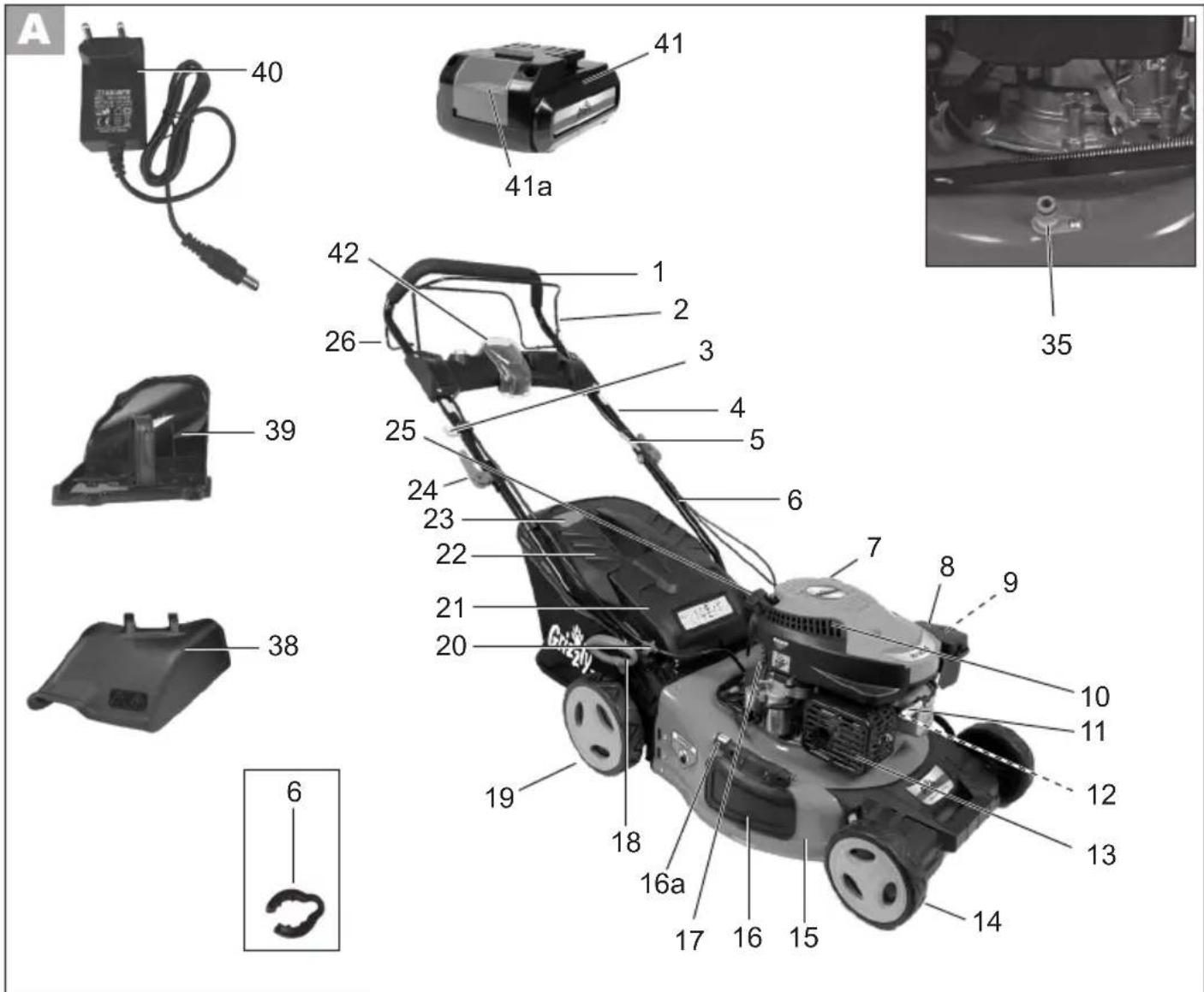
The illustration of the principal functioning parts can be found on pages 2 - 5.
Delivery Contents
Carefully unpack the appliance and check that it is complete. Dispose of the packaging material correctly.
- Petrol lawn mower
- Upper handle bar
- Bottom handle (2x)
- Spark Plug Wrench
- Grass collection box
- Mulch kit
- Lateral ejection chute
- Charger
- Rechargeable battery
- Cable clamp
- Quick guide
- Instruction manual
Summary

1 Upper handle bar Safety catch
3 Starter cord guide
4 Bottom handle
5 Bowden cable
6 Cable clamp
7 Filler cap
8 Air filter box
9 Air filter (no illustration)
10 Engine cover with ventilation holes (finger protection)
11 Spark plug connector
12 Spark plug (no illustration)
13 Exhaust guard
14 2 front wheels
15 Steel plate housing
16 Lateral ejection chute with impact protection
16a Locking element
17 Oil filler cap with dipstick
18 Lever for cutting height adjustment
19 2 rear wheels
20 2 star grip screws to fasten the handlebar
21 Rear impact protection
22 Grass collection box
22a Grass collection box carrying handle
23 Fill level indicator
24 2 quick clamping levers on upper grip handle
25 Starter handle with starter cord
26 Drive bracket
35 Hose connection
38 Lateral ejection chute
39 Mulch kit
40 Charger
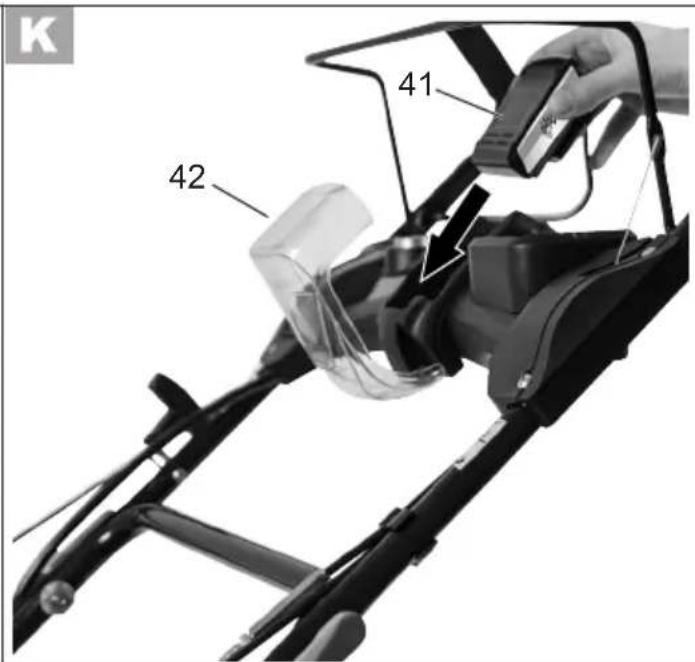
41 Rechargeable battery
41a Release button
42 Cover (transparent)
36 Bowden cable locking nut
37 Bowden cable adjusting nut
27 Plastic straps catcher
28 Grass catcher rod
29 Rod screw
30 Carry handle screw
F 31 Grass collection box suspension bracket
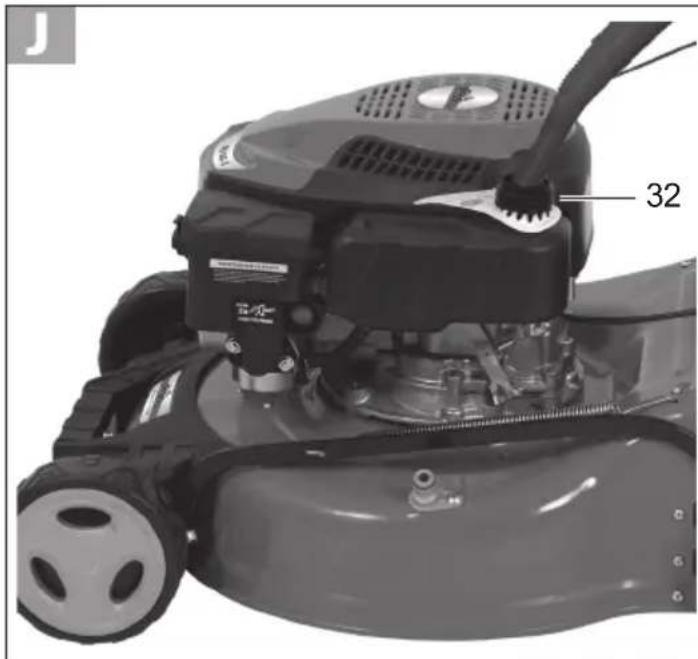
J 32 Filler plugs
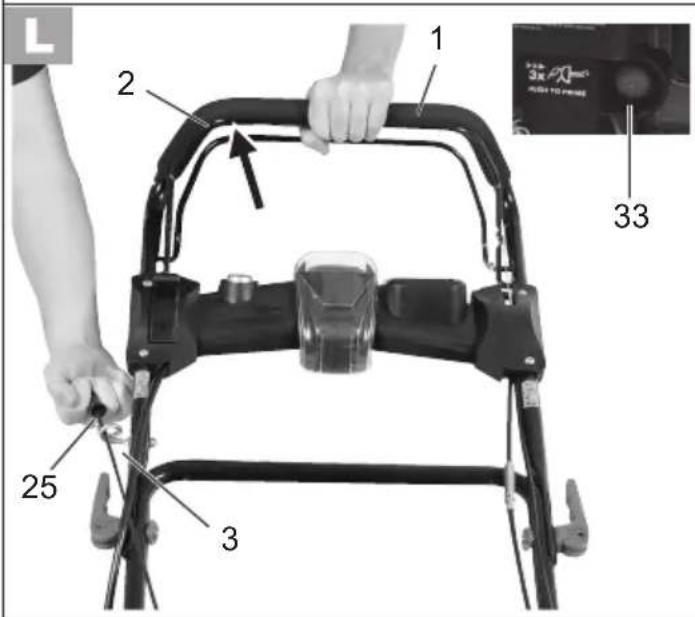
L 33 Fuel pump
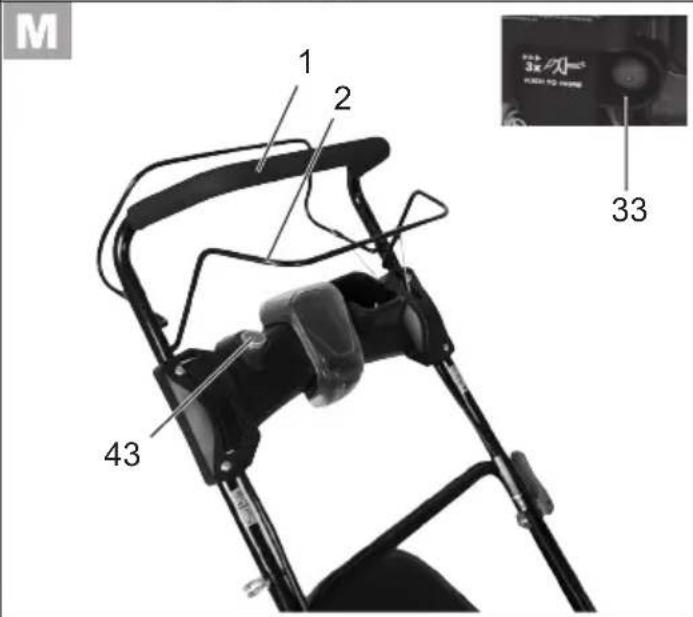
M 43 Start button
34 Cut height position
Functional Description
The equipment is driven by a powerful four-stroke engine (Rato RV145-S).
The device is equipped with a high quality steel plate housing, a grass catcher and a foldable grip handle.
Refer to the following descriptions for a functional description of the controls.
Safety Equipment
2 Safety catch
The equipment stops when the safety catch is released.
13 Exhaust guard
prevents hands or combustible materials from coming into contact with a hot exhaust.
21 Rear and side impact protection
protect the operator from parts that are flung out and from accidentally touching the blades when mowing with no grass collection box.
Technical Specifications
Petrol lawnmower
BRM 4615-22 A E-Start
Engine ......RATO RV145-S
Engine size 144,3 cm 3 (cc)
Power input.... 2,2 kW (3 PS)
Blade rotation speed (n0) .max. 2900min-1
Blade torque max. 45 Nm
Petrol tank volume....800 ml
Octane rating....95-98
Engine oil tank volume ....500 ml
Motoroil......HD SAE 30 or 10W-30
Spark plug TORCH F5RTC
Cutting circle....Ø 460 mm
Cutting height ......6-stage, 25-75 mm
Grass collection box volume....50 l
Weight 24.1 kg
Sound pressure level
(LpA) 83.8 dB(A); KpA = 3 dB
Sound power level (L WA )
measured .... 94,40 dB(A); KWA = 1.17 dB
guaranteed....96 dB(A)
Vibration at the handle
(ah) 3.590 m/s 2 ; K= 1.5 m/s 2
Charger......DSS12-1261000-B
Input voltage/
Input...... 100-240 V\~, 50-60 Hz, 0,5 A
Output voltage/
Output 12,6 V=; 1,0 A
Schutzklasse ....☐
Rechargeable battery .....JY112070
Voltage....12 V==
Capacity....2,0 Ah
Charging time ....approx. 1 h
Noise and vibration values have been determined according to the standards and regulations mentioned in the declaration of conformity.
The stated vibration emission value was measured in accordance with a standard testing procedure and may be used to compare one power tool to another. The stated vibration emission value may also be used for a preliminary exposure assessment.

Warning: The vibration emission value may differ during actual use of the power tool from the stated value depending on the manner in which the power tool is used.
Try to keep the exposure to vibrations as low as possible. Examples of measures to reduce vibration exposure are the wearing of gloves when using the tool and limiting the working hours. For this purpose all parts of the operating cycle have to be considered (for example, times when the electric tool is switched off and times when it is switched on but running without any load).
Symbols and icons
Symbols on the device

Attention!
Read the instruction manual.

Risk of injury from parts being flung out.

b bystanders away from the equipment.

Caution – toxic fumes!

not operate the equipment in enclosed areas.

Caution – petrol is flammable! ot smoke and keep away from heat sources.

Caution – petrol is flammable! ot smoke and keep away from heat sources.
Risk of injury from sharp blades. Keep feet and hands away. Before maintenance work, switch off the engine and take out the spark plug connector.

Do not expose the unit to rain.
awnmower blade continues to run after switching off.
There is a risk of injury!

on – hot surfaces!
Risk of burning.
Caution – risk of injury! Wear eye and ear protection.

Switch off the engine when you leave the device.

r mow if there are people, particularly children or animals near by.

Information of the acoustic power level LWA in dB.

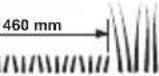
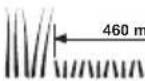
Cutting circle
Danger!
Keep hands and feet away.

Caution! Check the oil level before starting.

Symbols on the filler cap:

Note on the petrol filler Do not fuel any E85-mixtures
Symbol on petrol pump:

Press petrol pump (primer) 3x before the start.
GB
Symbol on grip handle:
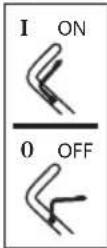
Switch device on (ON): Pull up safety loop.
Switch device off (OFF): Release safety loop.
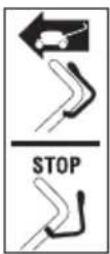
Switching the wheel drive on
Graphical symbol on the lateral ejection chute with impact protection:

Lateral ejection chute release button
Symbols on grass collection box:
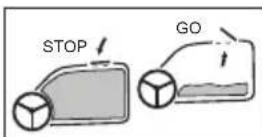
Level gauge
Graphical symbols on the charger

The charger is only suitable for use indoors.

Protection class II
Electrical devices must not be disposed of with domestic waste.

⊕ Polarity

Safety transformer – short-circuit proof
Symbols on the battery:
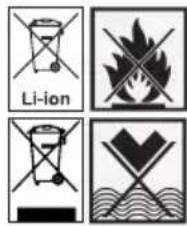
Do not dispose of batteries in household waste, fire or water.

Do not subject the battery to strong sunlight over long periods and do not leave it on a heater (max. 45°C).

Read the operating instructions!

Take batteries to an old battery collection point where they will be recycled in an environmentally friendly manner.
Symbols in the manual

Warning symbols with information on damage and injury prevention.

Instruction symbols (the instruction is explained at the place of the exclamation mark) with information on preventing damage.

Help symbols with information on improving tool handling.
Safety Instructions
This section deals with the basic safety procedures when working with the equipment.

WARNING! Read all of the safety instructions and directions. Failure to observe the safety instructions
and directions may result in electric shock, fire and/or serious injury.
Instructions:
- Read the operating instructions carefully. Familiarise yourself with the controls and with the correct use of the equipment.
- In case of uncertainties, allow yourself to be given instruction concerning the use of the device and prohibited operations.
- Pay attention, be aware of what you are doing and take the utmost care when working. Do not use the device if you are tired or ill or you are under the influence of drugs, alcohol or other medication. A moment of inattention whilst using the device can result in serious injuries.
- This appliance is not intended for use by persons with reduced physical, sensory or mental capabilities, or lack of experience and knowledge, unless they have been given supervision or instruction concerning use of the appliance by a person responsible for their safety.
- Children should be supervised to ensure that they do not play with the appliance.
- Do not allow children or other people who are unfamiliar with the operating instructions to use the equipment. Local regulations may set a minimum age for the user.
- Do not mow whilst people – especially children – or animals are nearby. If distracted, you may lose control of the equipment.
- The operator or user is responsible for accidents or damage to other persons or their property.
- Observe noise control and local regulations.
Preparatory Measures:
- When mowing, always wear slip resistant shoes and long trousers. Do not mow barefoot or in light sandals. Loose clothing, jewellery or long hair can become caught in moving parts. Wearing suitable clothing reduces the risk of injury.
- Check the area on which the equipment is to be used and remove all objects (stones, sticks, wires, toy) that could be caught and flung out.
-
Warning: Petrol is highly flammable. Fire or explosions can result in serious burns:
-
Keep petrol only in containers intended for this purpose;
- Only refuel outdoors and do not smoke whilst refuelling;
- Fill with petrol before starting the engine. Do not open the filler cap or refill with petrol whilst the engine is running or the equipment is hot:
- If petrol is spilled, do not attempt to start the engine. Instead, remove the equipment from the surface on which the petrol has been spilled. Avoid any ignition attempt until the petrol fumes have evaporated;
-
For reasons of safety, replace petrol and other filler caps in the event of damage.
-
Replace defective silencers.
- Before use, always carry out a visual inspection to check whether the cutting tools, mounting bolts and entire cutting unit are worn or damaged. To avoid imbalance, only replace worn or damaged tools and bolts in sets.
• Take care with equipment that has several cutting tools, as the movement
GB
of one blade may result in rotation of other blades.
- Use only replacement parts and accessories supplied and recommended by the manufacturer. The use of parts from other manufacturers may result in injuries and will result in immediate invalidation of the guarantee.
Handling:
- Do not run the combustion engine in enclosed spaces, in which dangerous carbon monoxide can collect. - Mow only in daylight or with good artificial lighting. An unlit working area can result in accidents. - If possible, avoid using the equipment on wet grass. - Always ensure secure positioning, particularly on hillsides, landfills, ditches or dykes. This will give you better control of the equipment in unexpected situations.
- Always work across the slope, never upwards or downwards. - Take particular care when changing the direction of travel on the slope. - Do not mow on excessively steep slopes (max. 10°).
- Run the equipment only at walking speed.
• Take particular care when turning the equipment around or pulling it towards you.
- Stop the cutting tool if the equipment has to be tipped up for transportation over a surface other than grass and when moving the equipment from and to the surface to be mown.
- Do not use the equipment with damaged safety equipment or guards or with no safety equipment attached, e.g. impact protection and/or grass
catchers. This ensures that the equipment remains safe.
- Do not change the engine regulator setting and do not over-rev it. This may damage the equipment.
- Before starting, the engine, disengage all cutting tools and drives.
- Start or operate the start switch with care and in accordance with the manufacturer's instructions. Ensure sufficient space between feet and the cutting tool. Risk of injury.
- When starting or activating the engine, do not tip the equipment unless the equipment has to be lifted for this procedure. In this case, tip the equipment only as far as is absolutely necessary and lift only the side that is away from the user.
- Do not start the engine when standing in front of the ejection channel.
- Switch on the engine in accordance with the instructions and only if your feet are a safe distance away from the cutting tools.
- Do not place hands or feet under rotating parts. Always keep away from the ejection opening. A moment of carelessness when using the equipment may result in serious injury.
- Do not leave or carry the equipment when the engine is running.
- Switch off the engine, take out the spark plug connector and ensure that all moving parts are still:
- Before releasing blockages or removing obstructions in the ejection channel;
- Before checking, cleaning or working on the equipment;
- If a foreign body is struck. Look for damage to the equipment and carry out the necessary repairs before re-
starting and working with the equipment;
- If the equipment starts to vibrate unusually strongly, an immediate check is required.
- Switch off the engine, take out the spark plug connector and ensure that all moving parts are still:
- When leaving the equipment;
- Before refuelling;
- Close the throttle valve when stopping the engine.
- Do not leave the equipment unattended in the workplace.
- Do not work with equipment that is damaged or incomplete or has been converted without the approval of the manufacturer.
Using machines for applications other than those intended may result in dangerous situations.
- Do not work with the device if there is a risk of lightning strike. Danger of electric shock.
Maintenance and Storage:
- Ensure that all nuts, bolts and screws are tightened firmly and the equipment is in safe working condition. Many accidents are caused by poorly maintained equipment.
- Do not keep the equipment with petrol in the tank inside a building in which petrol fumes could potentially come into contact with open fire or sparks.
- Allow the engine to cool before placing the equipment in enclosed spaces. Risk of fire.
- To avoid the risk of fire, keep the engine, exhaust and area around the fuel tank free of grass, leaves or leaking grease (oil).
- Check the grass catcher regularly for wear or loss of function.
- For reasons of safety, replace worn or damaged parts. Replace defective silencers.
- If the fuel tank is to be drained, do this outdoors.
- Handle your equipment with care. Keep the tools sharp and clean to enable you to work better and more safely. Follow the maintenance directions.
- Do not attempt to repair the equipment yourself unless you are trained to do so. Any work not specified in these instructions is to be carried out only by customer service centres authorised by us.
- Keep the equipment in a dry place and out of reach of children. Machines are dangerous if used by inexperienced people.
Careful handling an use of battery devices:
a) Charge the batteries only in chargers that are recommended by the manufacturer. Risk of fire if a charger that is suitable for a specific type of battery is used with other batteries.
b) In the power tools, use only the batteries designed for the purpose. The use of other batteries may result in injuries and risk of fire.
c) Keep the unused battery away from paper clips, coins, keys, nails, screws and other small metal objects, which could cause bridging of the contacts. A short circuit between the battery contacts may cause burns or fire.
GB
d) If used incorrectly, liquid may leak from the battery. Avoid contact with this. In the event of accidental contact, rinse off with water. If the liquid gets into eyes, seek medical assistance. Leaking battery fluid may cause skin irritations or burns
Special safety directions for batteryoperated tools:
- Ensure that the device is switched off before inserting the battery. Inserting a battery into a power tool that is switched on may result in accidents.
- Recharge the batteries indoors only because the battery charger is designed for indoor use only. Risk of electric shock
- To reduce the electric shock hazard, unplug the battery charger from the mains before cleaning the charger.
- Do not subject the battery to strong sunlight over long periods and do not leave it on a heater. Heat damages the battery and there is a risk of explosion.
- Allow a hot battery to cool before charging.
- Do not open up the battery and avoid mechanical damage to the battery. Risk of short circuit and fumes may be emitted that irritate the respiratory tract. Ensure fresh air and seek medical assistance in the event of discomfort.
- Do not use nonrechargeable batteries. This could damage the appliance.
Correct handling of the battery charger:
- This appliance can be used by children aged from 8 years and above and persons with reduced physical, sensory or mental capabilities or lack of experience and knowledge if they have been given supervision or instruction concerning use of the appliance in a safe way and understand the hazards involved. Children shall not play with the appliance. Cleaning and user maintenance shall not be made by children without supervision.
- To charge the battery, use only the charger supplied. Risk of fire and explosion. This ensures that the safety of the device is maintained.
- Before each use, check the charger, cable and plug and have them repaired by qualified professionals and only with original parts. Do not use a defective charger and do not open it up yourself. This ensures that the safety of the device is maintained.
- Connect the charger only to a socket with an earth. Ensure that the mains voltage matches the specifications on the charger rating plate. Risk of electric shock.
- Disconnect the charger from the mains before closing or
opening connection to the battery / power tool / device.
This ensures that the battery and charger are not damaged.
- Keep the charger clean and away from wet and rain. Do not use the charger outdoors. Dirt and the entry of water increase the risk of electric shock.
- Operate the charger only with the appropriate original batteries. Charging other batteries may result in injuries and risk of fire.
- Avoid mechanical damage to the charger. This can result in internal short circuits.
- The charger must not be operated on or in the immediate vicinity of flammable surfaces (e.g. paper, textiles).
Risk of fire due to heating caused by charging.
- If the power cable for this equipment is damaged, it must be replaced by the manufacturer, a customer service agent of the same or a similarly qualified person in order to prevent hazards.
The battery of your lawnmower is only partially precharged upon delivery and must be fully charged up before being used for the first time. For the first charge, we recommend charging the battery for about 2 to 3 hours. Insert the battery into the base and connect the charger to the mains.
- Remove the mains plug when the battery is fully charged and disconnect the charger from the device. The charging time is around 3 hours.
- Do not allow your battery to charge continuously. Continuously recharging small capacities may damage the battery cells.
- Do not charge nonrechargeable batteries in the charger. This could damage the appliance.
Initial Operation

Caution! Risk of injury from rotating blades. Carry out work on the equipment only when the blade is switched off and stationary.
Before starting the device, you must
- mount the grip rod,
- fill in motor oil,
- fill in petrol,
- mount the grass catcher if necessary,
- set the cutting height if necessary.
Mounting grip rod

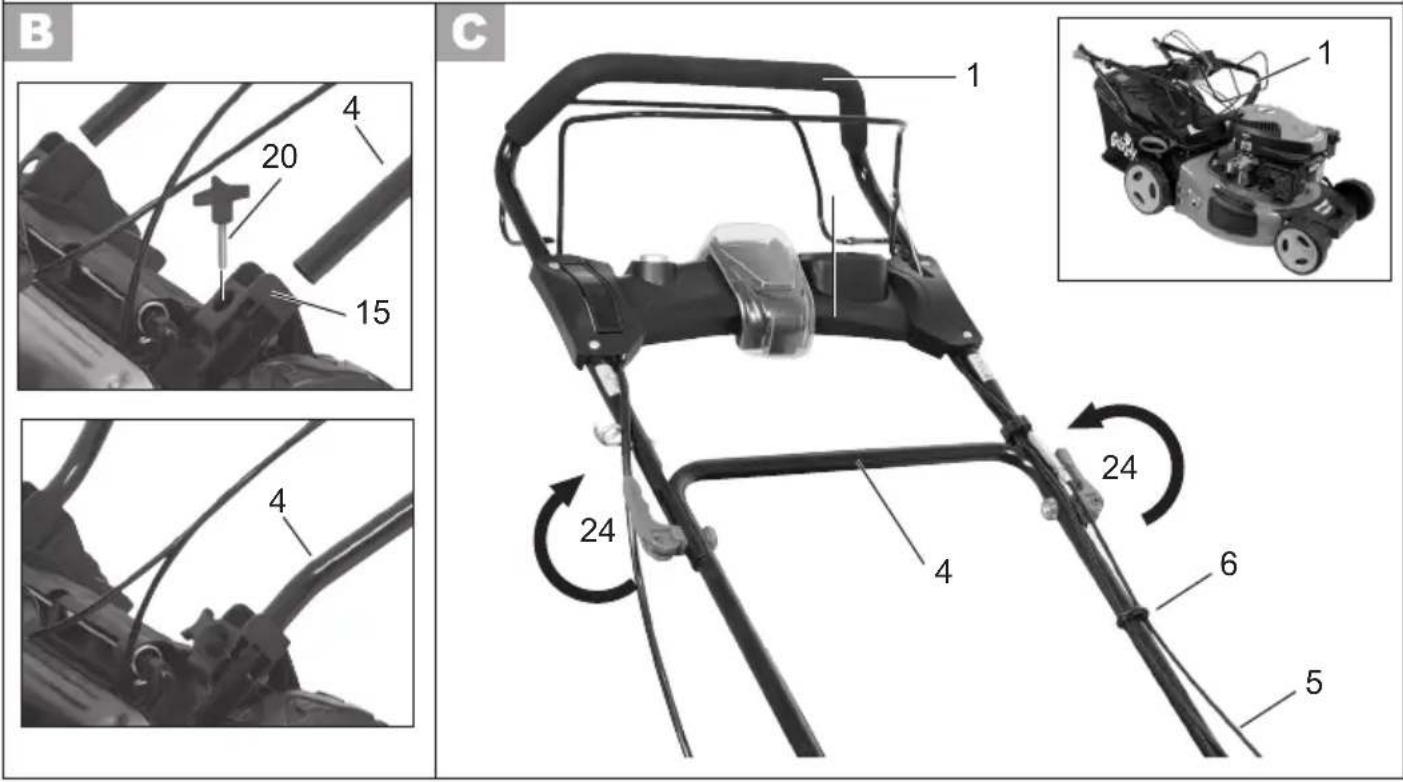
Make sure that the Bowden cable (5) is not crushed during the assembly of the grip handle.

Mounting the lower bars:
-
Remove the two star grip screws (20) from the machine housing (15).
-
Attach the ends of the lower handlebars (4) to the machine housing (15).
- Screw the two lower handlebars (4) tight with the enclosed star grip screws (20) on the right and left of the mounting on the machine housing (15).
C
Mounting the upper grip:
-
Screw the upper grip (1) to the right and left of the lower handlebars (4) using the included quick-release levers and nuts (24).
-
Fold out the upper grip (1) (small picture) and press the locking lever (24) towards the handlebar.
D
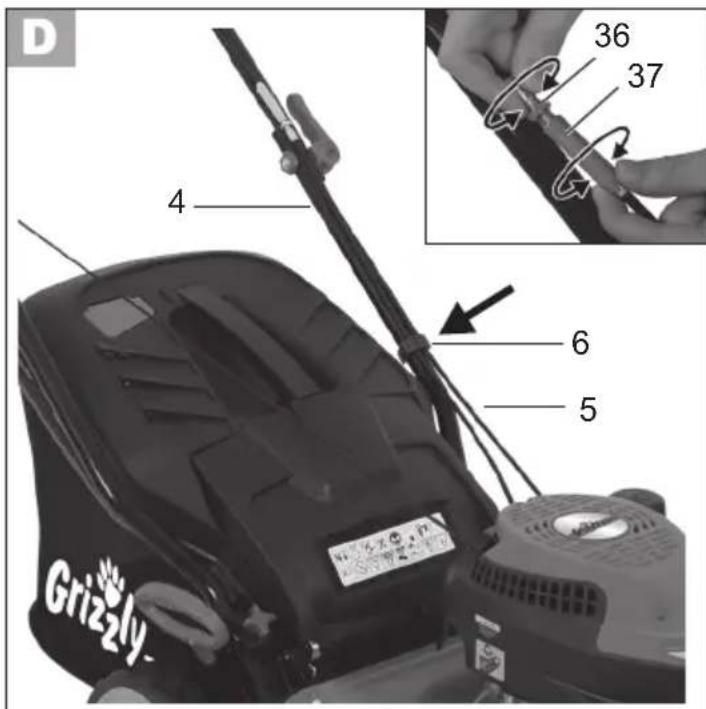
- Fasten the Bowden cable (5) using a cable clamp (6) to the bottom handle (4).
Installing the Grass Collection Box

Caution: Do not operate the equipment with the grass collection box or impact protection installed incompletely. Risk of injury!
E
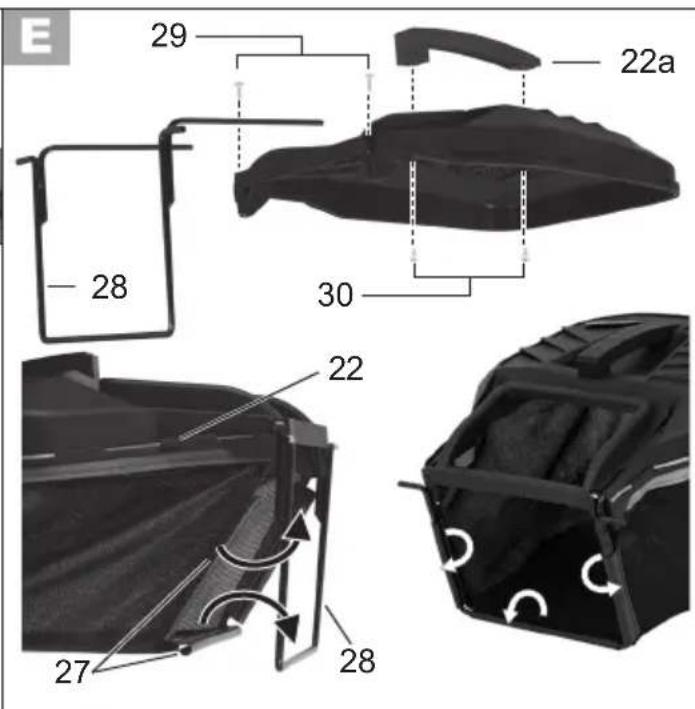
Assemble grass catchment basket:
-
Loosen the Phillips screw (30) on the carrying handle (22a).
-
Place the carrying handle (22a) on the upper side of the grass collector (22) and screw it tight with a Philips screw (30) from below.
-
Push the grass collection box rod (28) into the upper side of the grass collection box (19) and screw it tight with the two Philips screws (29) from above.
-
Place the net of the grass collection box into the groove on the upper side of the grass collection box (22). It will lock into place.
-
Pull plastic loops (27) over basket rods.
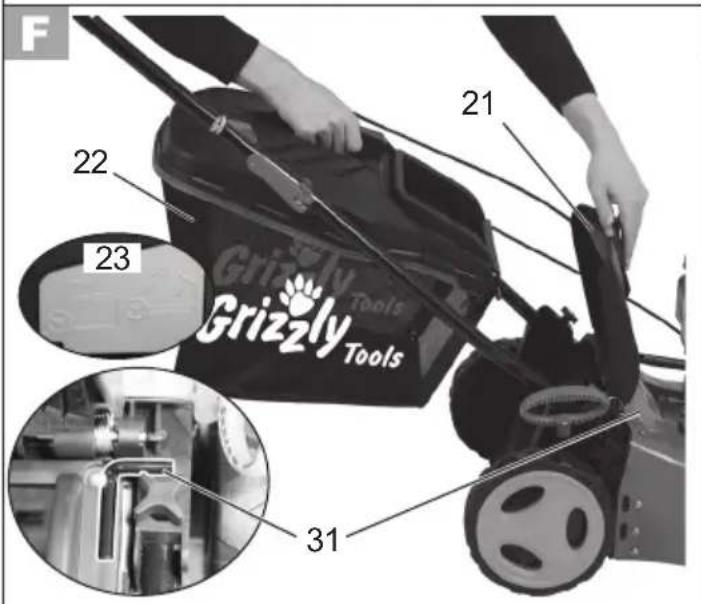
F
Fixing the Grass Collection Box onto the Equipment:
- Lift up shock protection (21).
- Hook the grass collection box (22) into the mounting provided for this (31) on the rear of the equipment.
- Release the impact protection (21). It holds the grass collection box in position.
Dismantling/Empty out the Grass Collection Box:
- Lift the impact protection (21) and remove the grass collection box (22).
- Empty catchment basket (see chapter „Disposal / Environmental Protection“) and re-install it.
Level gauge
The level gauge (23) is located on the side of the grass catcher (22). The aerodynamic air guidance provided by the flap also optimises the filling.
GO Flap open: grass catcher empty STOP Flap closed: grass catcher full
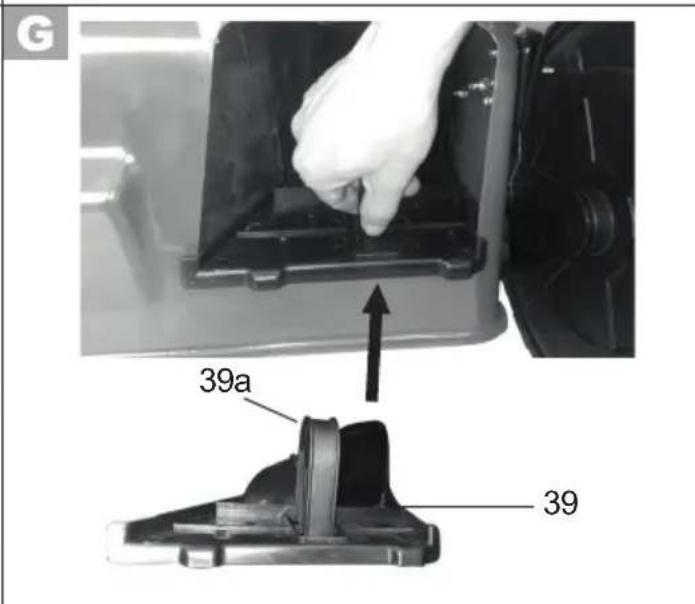
G
Mulch kit
i
Prior to using the mulch kit, the lateral ejection canal has to be removed (see ).
Attaching mulch kit
- Remove the collection box (22), if used.
- Lift the impact protection (21).
- Push in the mulch kit (39). The bracket (23a) snaps into place.
Remove mulch kit
- Lift the impact protection (21).
- Push in the bracket (39a) and remove the mulch kit (39).

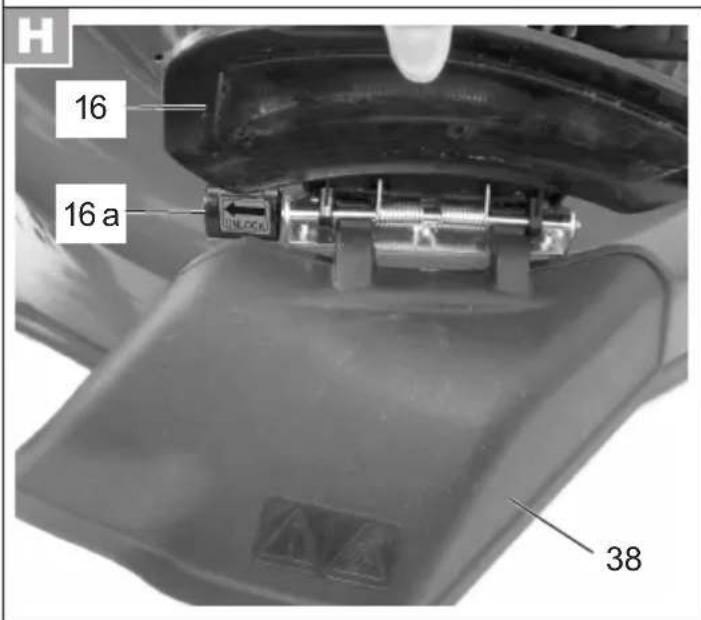
Lateral grass ejection

Before using the lateral grass ejection, the mulch kit (39) has to be inserted and the grass collection box (22) has to be removed.
Install lateral ejection canal
- Unlock the lateral impact protection (16) by pulling the locking element (16a) to the left and opening the lateral impact protection (16).
- Mount the lateral ejection channel (38) and remove the lateral impact protection (16). It holds the side ejection channel (38) in position.

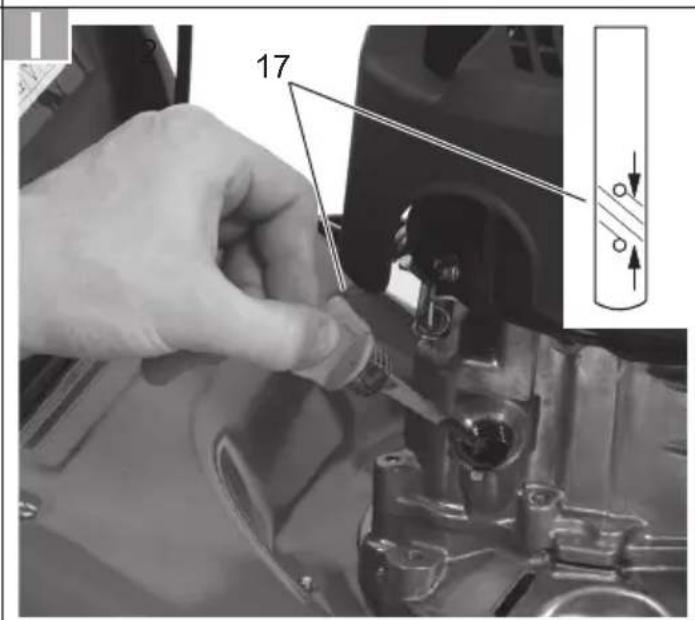
Filling with Engine Oil and Checking the Oil Level

Place the equipment on a level base.
- Unscrew the oil roller cap and dipstick (17) and pour oil into the tank. Use brand oil (e.g. HD SAE 30 or 10W-30).
- To check the oil level, wipe the dipstick (17) on a clean cloth and replace it in the tank until it stops.
- After pulling it out, read the oil level on the dipstick. The oil level should be in the marked area between the minimum and maximum marks.
- Wipeoanyspiltoilandclose theoilllercap(17).


Check the oil level every time before mowing and add oil before the lower marking point is reached.
Filling with Petrol


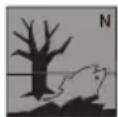
Warning! Petrol is lammable and hazardous to health:
- Keep petrol in containers intended for this purpose;
- Only refuel outdoors and never with the engine running or when the machine is hot;
-
Open the roller cap carefully to allow excess pressure to escape;
-
Do not smoke whilst refuelling;
- Avoid skin contact and inhalation of the fumes;
- Remove spilt petrol;
- Keep petrol away from sparks, open james and other ignition sources;
- Dispose of leftover petrol in an environmentally friendly way (see “Disposal / Environmental Protection”).

- Do not use petrol/oil mixtures; e normal or super unleaded petrol;
- Only use clean, fresh petrol;
- Do not store petrol for longer than one month, as its quality deteriorates.

-
Unscrew theller cap (7) and pour in the petrol to theiller plugs (32). Do not the tank entirely, to allow the petrol room to expand.
-
Wipe away petrol residues around theller cap and close theller cap.
Charging

Do not expose the battery to extreme conditions such as heat and shocks. There is a risk of injury caused by leaking electrolyte solution! In case of contact with eyes or skin, rinse the affected sites with water or a neutralising agent and seek medical attention.

The battery must only be charged up in dry areas.
There is a risk of personal injuries from an electric shock.

Only charge the battery with the enclosed charger
- Charge the battery before using it for the first time. Do not briefly recharge the battery several times in a row.
- If the operating time is considerably shortened despite charging, this shows that the rechargeable battery is depleted and must be replaced. Only use an original battery purchased from customer service.
- Always comply with the latest safety instructions, as well as the regulations and information relating to environmental protection.
- Defects resulting from improper handling are not covered by the guarantee.

Removing/ inserting the battery
- Lift the transparent cover (42).
-
To insert the battery (41) into the device, push the battery along the guide rail into the device. You will hear it click into place.
-
To remove the battery (41) from the device, press the release button (A 41a) on the battery and pull the battery out.
Charge the battery

Allow a freshly discharged battery to cool down for approx. 15 minutes before charging it with the battery charger (40).
- Connect the charger cable to the battery (41).
- Plug the charger's power adapter (40) into a socket.
- Once charging is complete, remove the charger (40) from the socket.
- Disconnect the charger (40) from the battery (41).
Used batteries
- If the operating time is considerably shortened despite charging, this shows that the rechargeable battery is depleted and must be replaced. Only use replacement batteries purchased from customer service.
- Always observe the currently applicable safety information in addition to the regulations and information about environmental protection (see „Disposal/environmental protection“).
Operation

A certain level of noise exposure caused by this device is unavoidable. Rearrange noise-intensive works to times approved and specified for this purpose. Comply with the rest periods and reduce the work period down to the minimum.
For your personal protection and the protection of people near by, suitable hearing protection must be worn.
Starting and Stopping the Engine

Warning! Petrol is flammable. Start the engine at least 3 m away from the filling location. There is a risk of fire.

Start the equipment on a sturdy, level base, if possible not in long grass. Ensure that the cutting tool is touching neither objects nor the ground.
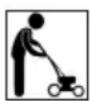
For your safety: Stand behind the device when starting it.

Check the petrol and oil levels regularly (see “initial operation”) and refill in time.

Starting the engine with starter handle (manual)
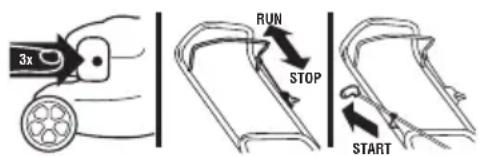
- When performing a cold start, press the fuel pump (33) (red button)
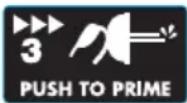
3 times. When performing a warm start, begin as described in section 2.
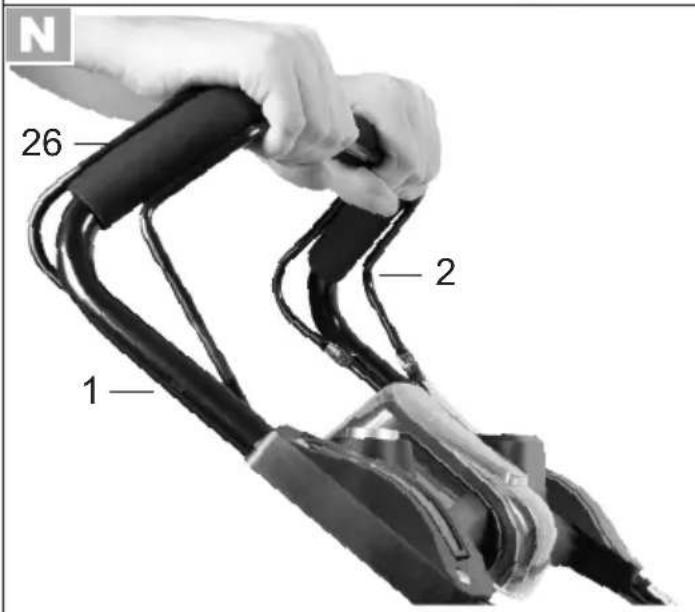
- Pull the safety loop (2) towards the grip handle (1) and hold it.
- Pull the starter handle (25).
- If the motor starts slowly, release the starter handle into the starter rope-guide (3).

Starting the engine with electric starter (E-Start)
- When performing a cold start, press the fuel pump (33) (red button)

3 times. When performing a warm start, begin as described in section 2.
- Pull the safety bracket (3) towards the handlebar (1) and hold it.
- Press the start button (43). The motor starts.
Motor stop:
- Release the safety loop (2). The motor switches off and the knife is braked.

For a warm start it is not necessary to press the primer (33).

If the primer is pressed too often, too much petrol will enter the carburettor and the motor is difficult to start.
Knife stopping device:
Regularly examine the knife stopping device: Release the safety loop (2). The motor switches off and the knife is braked. The knife must stop within 7 seconds.

Mowing
- Start the engine (see

- Hold the grip handle (1) and the safety loop (2) with both hands while mowing.
- Wheel drive:
In: Pull the drive bracket (26) towards the grip handle; the device moves forward.
Out: Release the drive bracket (26). The device stops.
Working Instructions
General Working Instructions
- As far as possible, mow the lawn when it is dry in order to protect the turf.
- Set the cutting height such that the equipment is not overloaded.
- Run the equipment at walking speed in lines that are as straight as possible. For uninterrupted mowing, the lines should always overlap by a few centimetres.
- Do not move backwards.
- On slopes, always work across the slope.
- If the blade comes into contact with a foreign body, switch off the engine immediately. Wait until the blade is stationary and check the equipment for damage. Restart work only if the equipment is undamaged.
- Switch off the equipment during longer breaks and for transportation and wait until the blade is stationary.
- Clean the equipment after each use, as described in the “cleaning and maintenance” chapter.

Setting the Cutting Height
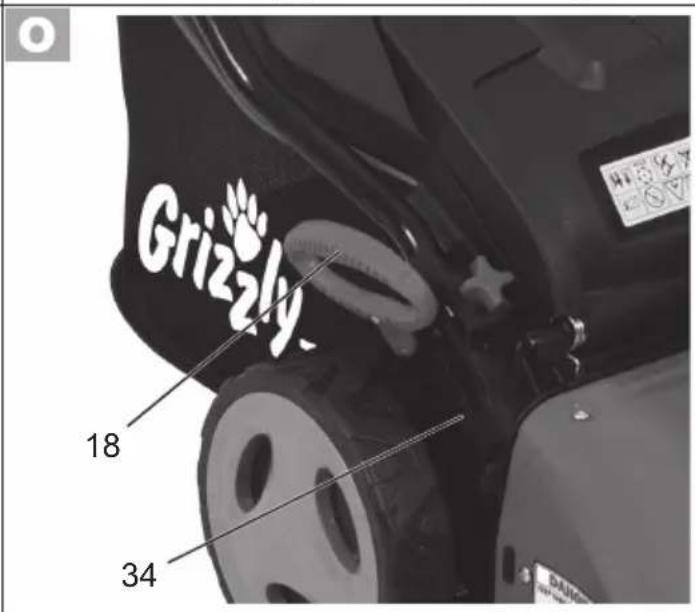
The equipment has 6 positions for setting the cutting height (25-75 mm):
- Pull the lever (18) outwards and push it to the desired position (34).
- Push the lever (18) back in.
The correct cutting height is around 30 – 45 mm for an ornamental lawn and around 40 – 65 mm for a utility lawn.

Select a greater cutting height for the first cut of the season.
Cleaning and Maintenance

Have any repair and maintenance work not described in these instructions carried out by a specialist workshop. Use only original parts. Risk of accidents!
Carry out maintenance and cleaning work strictly with the engine switched off and spark plug connectors removed. Risk of injury!
Allow the equipment to cool before any maintenance and cleaning work. Elements of the engine are hot. Risk of burning!

Wear gloves when handling the blade.
Cleaning and General Maintenance Work
Tilt the device back for cleaning and maintenance jobs at the bottom side so that the spark plug faces upwards.
Make sure that a second person holds the device because there is a danger of tipping backwards.

Do not tilt the equipment sideways or forwards. Operating fluids could leak out and the engine could be damaged.
- Always keep the equipment clean. To clean, use a toothbrush or cloth but no corrosive cleaning agents or solvents. Do not use water to clean the engine as it could contaminate the fuel system.
- To clean the blade housing, it is possible to connection a hose to the upper side of the housing (15) (see 35).
- After mowing, remove plant remains that are stuck to the equipment by using a piece of wood or plastic. Clean the vent holes (11), ejection hole and blade area especially. Do not use hard or pointed objects, which could damage the equipment.
- Oil the wheels from time to time.
- Before each use, check the lawnmower for obvious defects such as loose, worn or damaged parts. Check that all nuts bolts and screws are sitting firmly.
- Check covers and guards (2, 1, 13, 21) for damage and that they are sitting correctly. Replace if necessary.

Cleaning/Replacing the Air Filter

Do not operate the equipment without the air filter otherwise dust and dirt will get into the engine and result in damage to the machine.
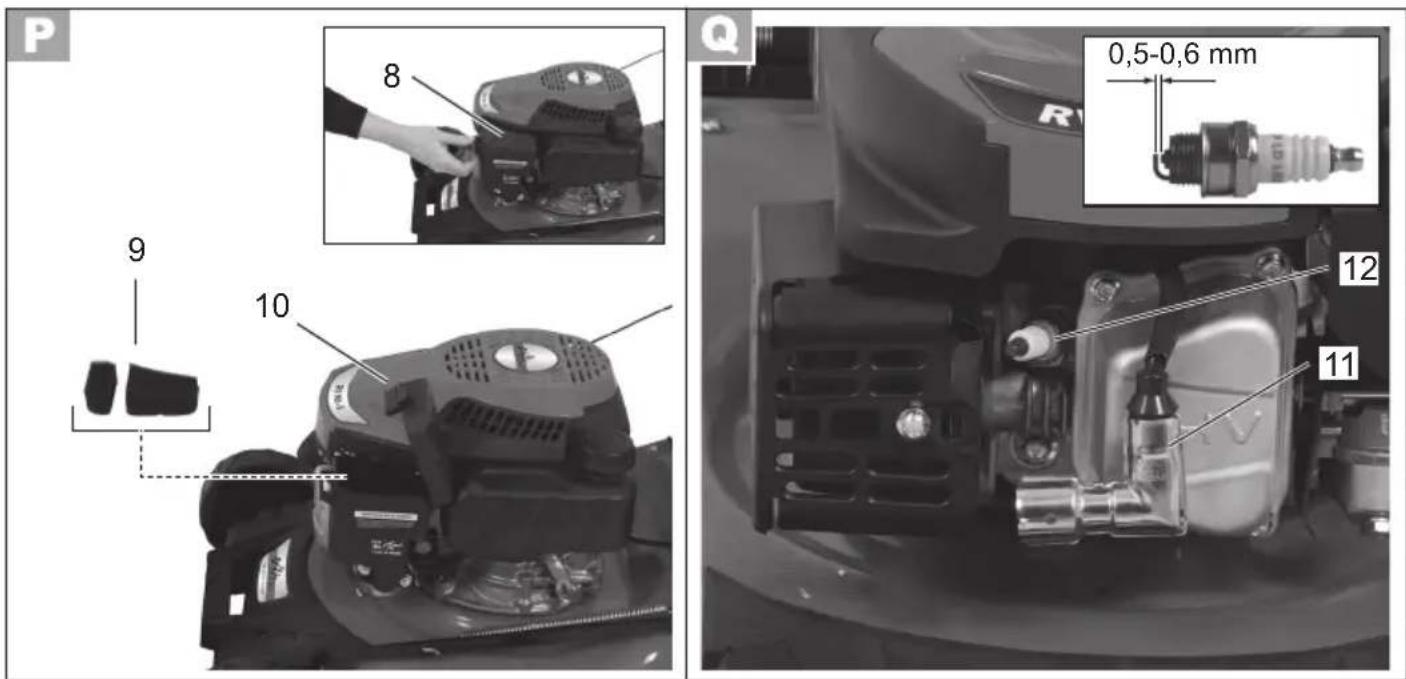
- Remove the spark plugs connector (11) (see "Maintaining the Spark Plug").
- Open the air filter box (8) and take out the air filter (9).
- Clean the air filter (9) with soap solution and let it dry. Put a few drops of fresh engine oil into the air filter.
- To install, place the air filter (9) in the air filter box (8) and reclose it.

Maintaining the Spark Plug

A worn spark plug or a spark gap that is too large will result in a reduction of engine performance.
- Disconnect the spark plug connector (11) from the spark plug (12) by simultaneously pulling and turning.
- Unscrew the spark plug (12) anti-clockwise.
- Check the spark gap using a feeler gauge (available from specialist shops). The spark gap must be at least 0.5-0.6 mm.
- If necessary, adjust the gap by carefully bending the ground electrode on the spark plug.
- Clean the spark plug with a wire brush.
- Insert the cleaned and adjusted spark plug or replace a damaged spark plug with a new one (recommended torque 20 Nm, determined with a torque wrench) (see "Replacement parts/Accessories").
Changing the Engine Oil

Change the engine oil with the petrol tank empty and the engine warm.

- Change the engine oil for the first time after around 5 operating hours then every 50 operating hours or annually.
- Dispose of the used oil in an ecofriendly manner (see “Disposal/Environmental protection”).
- Remove the spark plug connector (11) (see "Maintaining the Spark Plug").
- Open the oil tank cover (1.7) and pump out the motor oil with an oil pump.
- Refill with engine oil (see "Initial Operation").

Adjusting the Bowden cable
If the Bowden cables go out of adjustment, you can adjust them.
- Loosen the small locking nut (36).
-
- Turn the adjusting nut (37) counterclockwise:
The Bowden cable shortens.
- Turn the adjusting nut (37) counterclockwise:
- Turn the adjusting nut (37)
clockwise:
The Bowden cable extends.
Checking/Sharpening/Replacing the Blade

Only allow specialist companies to install and dismantle the knife.

Wear gloves when handling the blade.
- Take off the spark plug connector (11) and check the blade for wear and damage.
- Always have a blunt blade resharpened by a specialist company, as an imbalance check can be carried out there.
• Always have a specialist workshop change a damaged or imbalanced blade.

Incorrect installation can result in serious injury.
Adjusting the Carburettor
The carburettor has been preset in the factory for optimum performance. If readjustments are required, have the adjustments made by a specialist workshop.
Storage
General Storage Instructions

Do not store the equipment with a full collection box. In hot weather, the grass begins to ferment when heat is generated. Risk of fire.
- Clean and service the equipment before storage.
- Allow the engine to cool before storing the equipment in enclosed areas.
- Use suitable and authorised containers for storing fuel.
- Keep the equipment in a dry place that is protected from dust and out of reach of children.
- Do not wrap the equipment in nylon bags as damp and mould could form.
Maintenance Intervals
Regularly carry out the maintenance work listed in the “maintenance intervals” table. Regular maintenance prolongs the life of the equipment. It also gives optimum cutting performance and avoids accidents.
| Maintenance Work(See “cleaning and maintenance“) | Before | After | After 1 st 5 Hrs. | After8 Hrs. | After50 Hrs. | Annual |
| Work | ||||||
| Check and tighten screws, nuts and bolts | √ | |||||
| Check the engine oil level/petrol level and refill with engine oil/ petrol if required | √ | √ | ||||
| Clean operating elements / the area around the silencer | √ | √ | ||||
| Change the engine oil | √ √ | √ | ||||
| Replace the air filtera | √ | |||||
| Clean/adjust the spark plugReplace the spark plug | √ | √ | ||||
| Clean the air cooling systema | √ | |||||
a Replace more often if there is a high level of dust or heavy dirt
Storage during the winter break

Non-observance of the storage instructions may cause starting problems or permanent damage as a result of fuel residues in the carburettor.
- Start the engine and allow it to run until it stops due to running out of petrol.
- Change the oil (see “changing the engine oil”).
- Preserve the engine:
-
Unscrew the spark plug (12) (see "cleaning and maintenance");
-
Pour a tablespoon of engine oil through the spark plug hole into the engine compartment;
- Pull the starter cord (25) slowly several times with the safety catch (2) pulled in order to distribute the oil inside the engine;
- Screw the spark plug (12) tight.
- Dispose of used oil and petrol residues in an ecofriendly manner (see "Disposal/Environmental protection").

There is no need to drain the petrol tank if a fuel stabiliser is added to the petrol (see “Replacement parts/Accessories”).
Disposal/Environmental Protection
- Return the tool, accessories and packaging to a recycling centre when you have finished with them.
- Carefully drain the petrol and oil tanks and take your equipment to a recycling centre. The plastic and metal parts that are used can be separated by type and thus recycled.
- Take used oil and petrol residues to a disposal point and do not pour them into the sewer system or down the drain.
- Please contact our service centre for more information.
- Defective units returned to us will be disposed of for free.
- Do not throw cut grass in the dustbin but rather compost it or spread it under bushes and trees as a mulch layer.
Replacement parts/Accessories
Spare parts and accessories can be obtained at www.grizzly-service.eu
If you have any other questions, contact the "Service-Center" (see "Service-Center").
Guarantee
- The guarantee period for this equipment is 2 years from the date of purchase and it is applicable only for the initial buyer. This equipment is not suitable for commercial use. Commercial use will invalidate the guarantee.
- The guarantee does not include:
-
Damage caused by natural wear, overloading or improper use.
-
Equipment employed for commercial use.
- Damages arising as the result of non-compliance with the operating instructions or if the cleaning intervals have not been observed.
-
Equipment on which technical interventions have been undertaken.
-
Other damages excluded from the warranty are motor damages caused by using the wrong fuel or a wrongly mixed fuel as well as all damage to the machine caused by insufficient lubrication.
- The following parts are subject to normal wear and therefore not covered by the guarantee: cutter, spark plugs, air filter, fuel filter, starter cord, grass collection box.
- Please do not send equipment to our service points without prior agreement by telephone, as you could otherwise incur costs for non-acceptance.
- Attention: Please do not hand in defective appliances with fuel or oil still in the tanks. Always empty the tanks beforehand. Material damage (oil/fuel escaping when the appliance is put on the side or held upside down!) or fire damage during transport will be at the sender's expense.
- The repair or replacement of the equipment will neither result in extension of the guarantee period nor the commencement of a new guarantee period for the equipment or any replacement parts installed as a result of this work. This also applies if on-site service is used.
- Defective units returned to us will be disposed of for free.
Troubleshooting
| Problem Possible Cause Fault Correction | ||
| Engine does not start | Too little petrol in the tank Fill with petrol | |
| Incorrect starting sequence | Follow the instructions for starting the engine (see "operation") | |
| Spark plug connector (11) not put on correctly Sooted spark plug (12) | Attach the spark plug connector Clean, adjust or replace the spark plug (see "cleaning and maintenance") | |
| Incorrectly adjusted carburettor mix | Have the carburettor adjusted by a specialist workshop | |
| Battery (41) empty | Charge battery | |
| Bowden cables (5) not properly set | Set Bowden cable (see "Setting the Bowden cable") or have a specialist workshop set it | |
| The motor will stop with even the slight-est give on the safety bar (2) | Bowden cables (5) not properly set | Set Bowden cable (see "Setting the Bowden cable") or have a specialist workshop set it |
| Engine starts but equipment does not run at full power | Dirty air filter (9) | Replace the air filter (see "cleaning and maintenance") |
| Incorrectly adjusted carburettor mix | Have the carburettor adjusted by a specialist workshop | |
| Engine splutters, stops | Incorrectly adjusted carburettor mix | Have the carburettor adjusted by a specialist workshop |
| Sooted spark plug (12) | Clean, adjust or replace the spark plugs (see "cleaning and maintenance") | |
| Engine overheats | Ventilation holes blocked Clean the ventilation slot | |
| Incorrect spark plug (12) | Change the spark plug | |
| Too little engine oil in the engine | Fill with engine oil (see "initial operation") | |
| Drive does not switch on | Bowden cables (5) misadjusted | Adjust the Bowden cables or have them adjusted by a specialist workshop |
| Output unsatisfactory or engine labouring | Grass too short or too long | Change the cutting height (see "setting the cutting height") |
| Blade blunt | Have the blade sharpened or replaced by a specialist workshop | |
| Blade blocked with grass, grass collection box full, ejection channel blocked | Remove the grass (see "cleaning and maintenance") | |
| Blade does not turn | Blade blocked with grass Remove the grass | |
| Blade not installed correctly | Have the blade installed by a specialist workshop | |
| Abnormal noises, rattling or vibrations | Blade not installed correctly | Have the blade installed by a specialist workshop |
| Blade damaged | ||
Obsah
Úvod....138
| GB | Translation of the original EC declaration of conformity | |
| We confirm, that the Petrol mowerBRM 4615-22 A E-Start seriesBatch number: B-49396conforms with the following applicable relevant version of the EU guidelines: | ||
| 2006/42/EC • 2014/30/EU • 2000/14/EG • 2005/88/EC • 2011/65/EU* | ||
| In order to guarantee consistency, the following harmonised standards as well as national standards and stipulations have been applied: | ||
| EN ISO 5395-2:2013+A1:2016+A2:2017 • IEC 62321-3-1:2013EN ISO 5395-1:2013+A1:2018 • EN ISO 14982:2009 | ||
| We additionally confirm the following in accordance with the 2000/14/EC emissions guideline:Sound power levelguaranteed: 96 dB(A)measured: 94,40 dB(A)Compliance evaluation process carried out in accordance with Appendix VI / 2000/14/EC + 2005/88/ECRegistered Office: TÜV Rheinland, NB 0197 | ||
| This declaration of conformity is issued under the sole responsibility of the manufacturer: | ||
 | Grizzly Tools GmbH & Co. KGStockstädter Straße 2063762 GroßostheimGermany26.03.2021 |  Christian FrankDocumentation Representative Christian FrankDocumentation Representative |
* The object of the declaration described above satisfies the provisions of Directive 2011/65/EU of the European Parliament and the Council of 8 June 2011 on limiting the use of certain harmful substances in electrical and electronic appliances.
informativ • informative • informatief • informatif pouczający • informační • informatyvus informativo • informatívny
Service-Center

Unit 3, Beldray Park

Beldray Road, Mount Pleasant
Bilston, West Midlands WV14 7NH
Tel.: 0845 683 2672
e-mail: care@novoserv.co.uk
I.T.S. Winschoten bv




- Inhalt
- Protection anti-choc
- Introduction
- Intended Use
- General Description
- Delivery Contents
- Summary
- Functional Description
- Safety Equipment
- Technical Specifications
- Symbols and icons
- Symbols on the device
- Symbols on the filler cap:
- Symbol on petrol pump:
- GB
- Symbol on grip handle:
- Graphical symbol on the lateral ejection chute with impact protection:
- Symbols on grass collection box:
- Graphical symbols on the charger
- Symbols on the battery:
- Symbols in the manual
- Safety Instructions
- Instructions:
- Preparatory Measures:
- Handling:
- Maintenance and Storage:
- Careful handling an use of battery devices:
- Special safety directions for batteryoperated tools:
- Correct handling of the battery charger:
- Initial Operation
- Mounting grip rod
- Mounting the lower bars:
- C
- Mounting the upper grip:
- D
- Installing the Grass Collection Box
- E
- Assemble grass catchment basket:
- F
- Fixing the Grass Collection Box onto the Equipment:
- Dismantling/Empty out the Grass Collection Box:
- Level gauge
- G
- Mulch kit
- i
- Attaching mulch kit
- Lateral grass ejection
- Install lateral ejection canal
- Filling with Engine Oil and Checking the Oil Level
- Filling with Petrol
- Charging
- Removing/ inserting the battery
- Charge the battery
- Used batteries
- Operation
- Starting and Stopping the Engine
- Starting the engine with starter handle (manual)
- Starting the engine with electric starter (E-Start)
- Motor stop:
- Knife stopping device:
- Mowing
- Working Instructions
- General Working Instructions
- Setting the Cutting Height
- Cleaning and Maintenance
- Cleaning and General Maintenance Work
- Cleaning/Replacing the Air Filter
- Maintaining the Spark Plug
- Changing the Engine Oil
- Adjusting the Bowden cable
- Checking/Sharpening/Replacing the Blade
- Adjusting the Carburettor
- Storage
- General Storage Instructions
- Maintenance Intervals
- Storage during the winter break
- Disposal/Environmental Protection
- Replacement parts/Accessories
- Spare parts and accessories can be obtained at www.grizzly-service.eu
- Guarantee
- Obsah
- Service-Center
- I.T.S. Winschoten bv
Brand : Grizzly
Model : BRM4615-22A E-Start
Category : Lawn mower