
GAL-E 40 Li OA - Blower Gardol - Free user manual and instructions
Find the device manual for free GAL-E 40 Li OA Gardol in PDF.



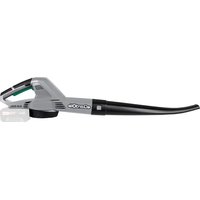
| Product type | Cordless leaf blower/vacuum |
| Brand | Gardol |
| Model | GAL-E 40 Li OA |
| Weight | 3.3 kg |
| No-load speed | 8000 - 13000 rpm |
| Air speed | 210 km/h |
| Suction power | 720 m³/h |
| Collection bag volume | approx. 45 L |
| Sound power level (LWA) | 92.68 dB(A) |
| Sound pressure level (LPA) | 83.1 dB(A) |
| Vibration (ahv) | 2.354 m/s² |
| Power supply | Li-Ion battery Power-X-Change series (20 V, 1.5 / 3.0 / 4.0 Ah) – not included |
| Delivery contents | Front suction tube, rear suction tube, auxiliary handle, carrying belt, collection bag, wheels, screws, instruction manual, safety instructions |
| Functions | Vacuum and blow mode, electronic speed control |
| Assembly required | Yes: tubes, wheels, collection bag, handles, belt |
| Maintenance and cleaning | Regular cleaning of collection bag (water and soap), tube and switch |
| Safety | Wear eye and hearing protection; do not use in rain or snow; keep people away from danger zone |
| Wear parts | Battery |
| Warranty | 84 months (except professional use) |
| Storage temperature | Between 5 °C and 30 °C |
Frequently Asked Questions - GAL-E 40 Li OA Gardol
User questions about GAL-E 40 Li OA Gardol
0 question about this device. Answer the ones you know or ask your own.
Ask a new question about this device
Download the instructions for your Blower in PDF format for free! Find your manual GAL-E 40 Li OA - Gardol and take your electronic device back in hand. On this page are published all the documents necessary for the use of your device. GAL-E 40 Li OA by Gardol.
USER MANUAL GAL-E 40 Li OA Gardol
GB Original operating instructions Cordless blower vac
natural_image
Close-up of a metallic pipe joint with a labeled component '12' (no other text or symbols visible)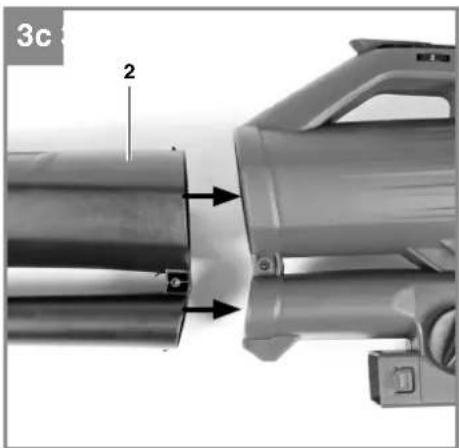
natural_image
Close-up of a mechanical device with two metallic components and directional arrows indicating movement or force (no text or symbols visible)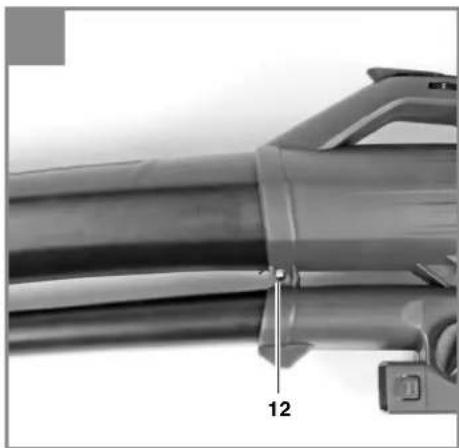
natural_image
Close-up of a mechanical component with labeled part '12' (no readable text or symbols beyond label)
natural_image
Close-up of a black metal pipe joint with a hook and attached clasp (no text or symbols visible)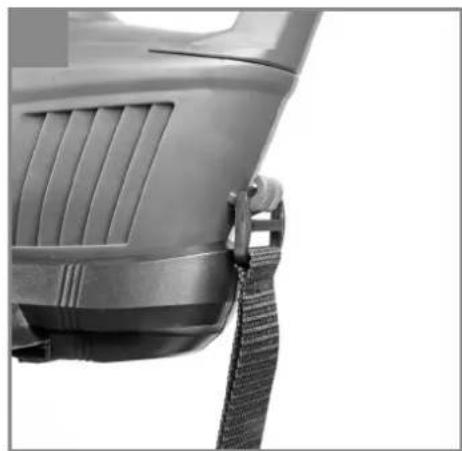
natural_image
Close-up of a car seatbelt buckle and side panel (no text or symbols visible)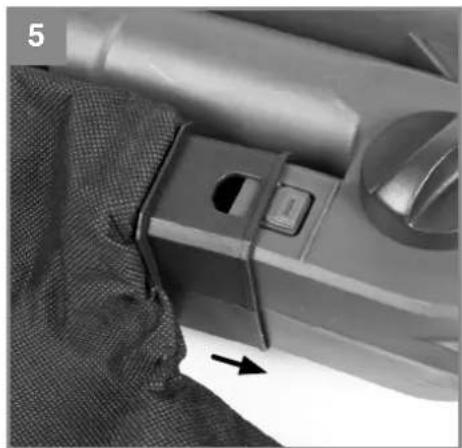
natural_image
Close-up of a car seatbelt buckle with a black arrow pointing to the side panel (no text or symbols visible)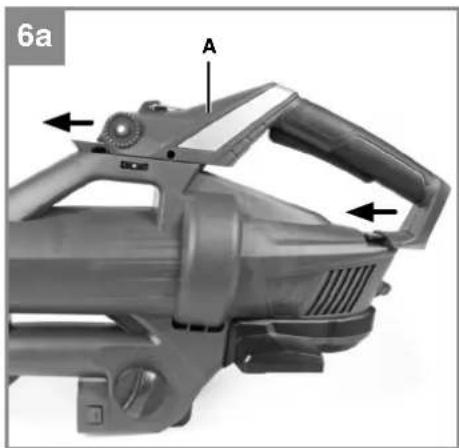
natural_image
Close-up of a mechanical device with labeled components (A and B) and directional arrows, no readable text or symbols beyond labels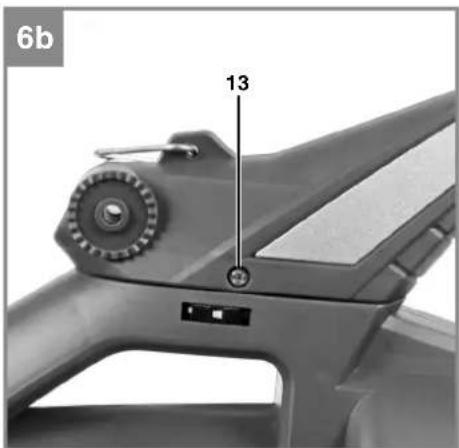
natural_image
Close-up of a mechanical device with labeled parts (13 and 6b), no readable text or symbols beyond labels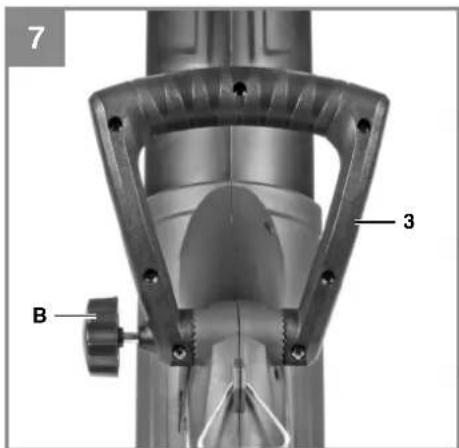
DE
Gefahr!
When using the equipment, a few safety precautions must be observed to avoid injuries and damage. Please read the complete operating instructions and safety regulations with due care. Keep this manual in a safe place, so that the information is available at all times. If you give the equipment to any other person, hand over these operating instructions and safety regulations as well. We cannot accept any liability for damage or accidents which arise due to a failure to follow these instructions and the safety instructions.
1. Safety information
The corresponding safety information can be found in the enclosed booklet.
Danger!
Read all safety regulations and instructions. Any errors made in following the safety regulations and instructions may result in an electric shock, fire and/or serious injury.
Keep all safety regulations and instructions in a safe place for future use.
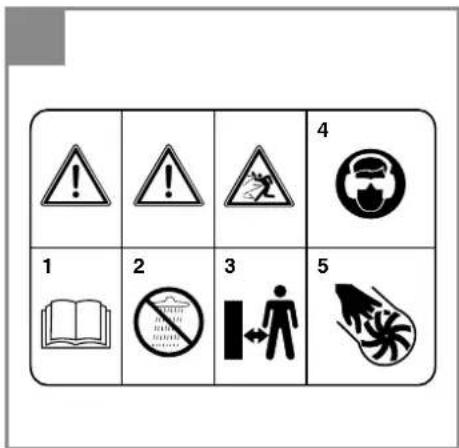
Explanation of the warning signs on the equipment (see Fig. 11)
- Read the directions for use before operating the tool.
- Do not use the tool in rain or snow. Do not expose the tool to wet conditions.
- Keep all other persons away from the danger zone.
- Wear goggles and earmuffs.
- Rotating parts. Keep your hands and feet away from all openings.
2. Layout and items supplied
2.1 Layout (Fig. 1/2)
- Front suction tube
- Rear suction tube
- Additional handle
- Harness
- On/Off switch
- Battery mount
- Catch bag
- Selector switch for blower/vac
- Castors
- Speed controller
- Wheel support
- 2x long screw
13. 3x short screw
2.2 Items supplied
Please check that the article is complete as specified in the scope of delivery. If parts are missing, please contact our service center or the sales outlet where you made your purchase at the latest within 5 working days after purchasing the product and upon presentation of a valid bill of purchase. Also, refer to the warranty table in the service information at the end of the operating instructions.
- Open the packaging and take out the equipment with care.
- Remove the packaging material and any packaging and/or transportation braces (if available).
• Check to see if all items are supplied. - Inspect the equipment and accessories for transport damage.
- If possible, please keep the packaging until the end of the guarantee period.
Danger!
The equipment and packaging material are not toys. Do not let children play with plastic bags, foils or small parts. There is a danger of swallowing or suff oating!
• Original operating instructions
- Safetyinstructions
3. Intended use
The leaf blower vac is designed to handle only foliage and garden refuse such as grass and small branches. Any other use is prohibited.
The equipment is to be used only for its prescribed purpose. Any other use is deemed to be a case of misuse. The user / operator and not the manufacturer will be liable for any damage or injuries of any kind caused as a result of this.
Please note that our equipment has not been designed for use in commercial, trade or industrial applications. Our warranty will be voided if the machine is used in commercial, trade or industrial businesses or for equivalent purposes.
GB
4. Technical data
Idling speed n_0 8,000-13,000 rpm Air speed 210 kph Suction power 720 m³/h Volume of catch bag approx. 45 liters Sound volume level L_WA 92.68 dB(A) Uncertainty K 3 dB (A) Sound pressure level L_pA 83.1 dB(A) Vibration ahv 2.354 m/s² Uncertainty K 1.5 m/s² Weight 3.3 kg
Important!
The equipment is supplied without batteries and without a charger is allowed to be used only with the lithium-ion batteries of the Power-X-Change series!
Power-X-Change
20 V, 1.5 Ah .... 5 lithium-ion cells 20 V, 3.0 Ah .... 10 lithium-ion cells 20 V, 4.0 Ah .... 10 lithium-ion cells
The lithium-ion batteries of the Power-X-Change series are allowed to be charged only with the Power-X charger.
Charger
Mains voltage ....200-250 V \~ 50-60 Hz
Output
Rated voltage .... 21 V d. c. Rated current .... 3,000 mA
Keep the noise emissions and vibrations to a minimum.
• Only use appliances which are in perfect working order.
• Service and clean the appliance regularly.
• Adapt your working style to suit the appliance.
• Do not overload the appliance.
- Have the appliance serviced whenever necessary.
- Switch the appliance off when it is not in use.
• Wear protective gloves.
Caution!
Residual risks
Even if you use this electric power tool in accordance with instructions, certain residual risks cannot be rules out. The following hazards may arise in connection with the equipment's construction and layout:
- Lung damage if no suitable protective dust mask is used.
- Damage to hearing if no suitable ear protection is used.
- Health damage caused by hand-arm vibrations if the equipment is used over a prolonged period or is not properly guided and maintained.
5. Before starting the equipment
The equipment is supplied without batteries and without a charger.
Warning!
Always remove the batteries before making adjustments to the equipment.
5.1. Mounting the suction tube (Fig. 3a-3f)
- Plug together the front and rear suction tube (Fig. 3a) and secure with the screw (Fig. 3b/Item 12).
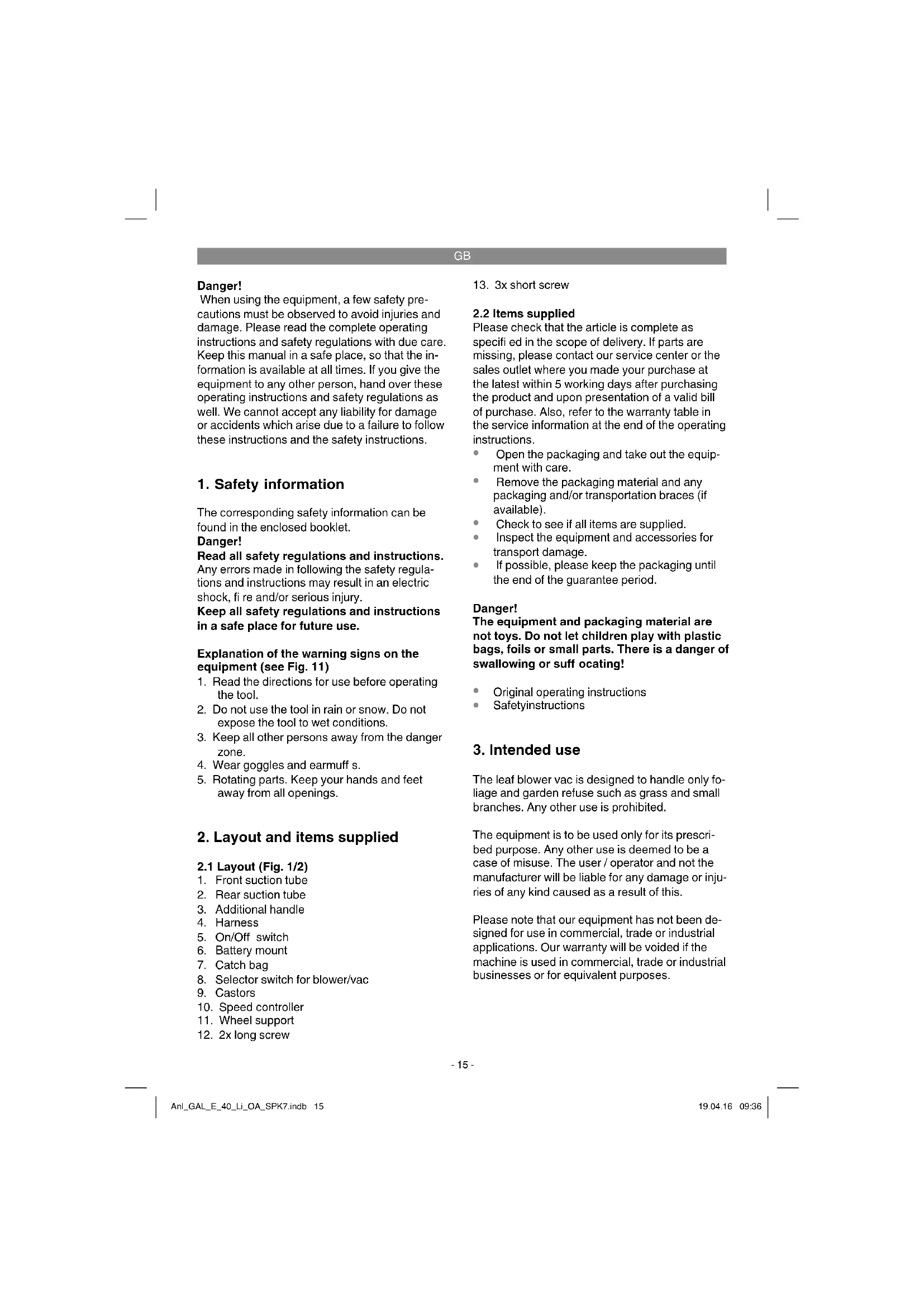
- Now slide the complete suction tube into the motor housing (Fig. 3c) and secure with the screws (Fig. 3d/ Item 12).
- Fit the two wheels (Fig. 3e/Item 9) into the wheel support (Fig. 3e/Item 11). Make sure that there is an audible click when they engage.
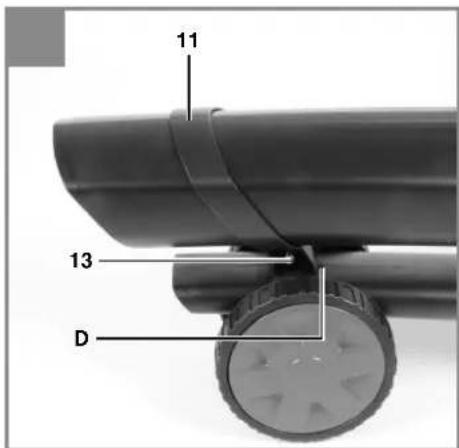
- Slide the wheel support (Fig. 3f/Item 11) onto the front suction tube as far as the stop (Fig. 3f/Item D) and secure with the screw (Fig. 3f/Item 13).
Note: Please note that the two vacuum tubes must always be joined together before they are mounted on the motor housing, and that they must never be taken apart when mounted!
5.2. Mounting the catch bag (Figs. 4-5)
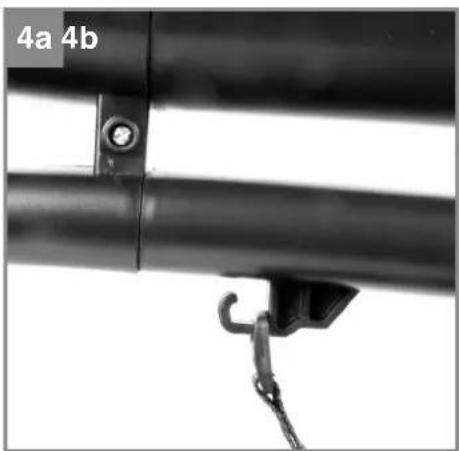
Hang the hook on the suction tube (Fig. 4A) and on the housing (Fig. 4b). Then slip the catch bag over the socket on the motor housing; it engages correctly when it makes an audible click (Fig. 5).
GB
5.3. Fitting the handle
Slide the handle (Fig. 6a/Item A) onto the mounts in the housing as far as the stop. Then fasten the handle on both sides with one screw on each side (Fig. 6b/Item 13).
5.4. Fitting the additional handle
Remove the star screw (Fig. 7/Item B), fit the handle (Fig. 7/Item 3) to the mount and secure the handle in the required position with the star screw.
5.5. Fitting the harness
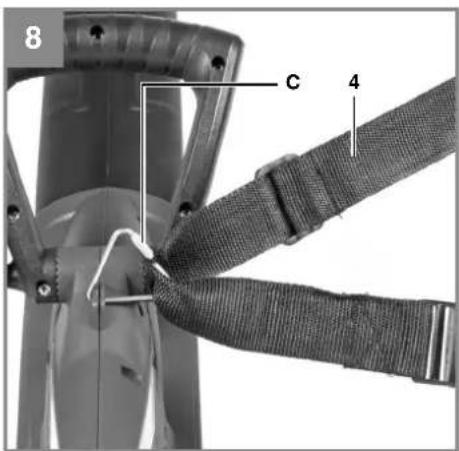
Open the knurled screw (Fig. 8/Item C), feed the belt strap (Fig. 8/Item 4) through the opening and close the knurled screw again.
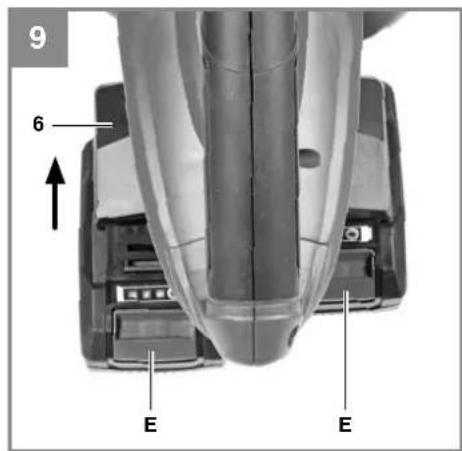
5.6 Fitting the battery (Fig. 9)
Press the pushlock button (Fig. 9/Item E) of the battery as shown in Fig. 9 and push the battery into the battery mount provided. When the battery is positioned as in Fig. 9, make sure that the pushlock button latches in place! To remove the battery pack, proceed in reverse order.
Important!
Use only batteries which are charged to the same level. Never combine full and half-full batteries. Always charge the two batteries simultaneously. The equipment's operating time depends on the battery with the lower charge level. The two batteries must always be fully charged before use.
5.7 Charging the battery
- Take the battery pack out of the equipment. Do this by pressing the side pushlock buttons.
- Check that your mains voltage is the same as that marked on the rating plate of the battery charger. Insert the power plug of the charger into the socket outlet. The green LED will then begin to fl ash.
- Insert the battery pack into the charger.
- In the section entitled „Charger indicator“ you will find a table with an explanation of the LED indicator on the charger.
The battery pack can become a little warm during the charging. This is normal.
If the battery pack fails to charge, check:
• whether there is voltage at the socket outlet
- whether there is good contact at the charging contacts
If the battery pack still fails to charge, send
• the charging unit
• and the battery pack
to our customer service center.
To ensure that the battery pack provides long service, you should take care to recharge it promptly. You must recharge the battery pack when you notice that the power of the cordless leaf blower drops. Never allow the battery pack to become fully discharged. This will cause it to develop a defect.
Start up the equipment only when fully assembled.
6. Operation
6.1. Sizing the strap (Fig. 1)
Size the length of the carrying strap (4) so that the vacuum tube just clears the ground. The guide rollers (9) at the bottom end of the suction tube will help you to maneuver the suction tube on the ground.
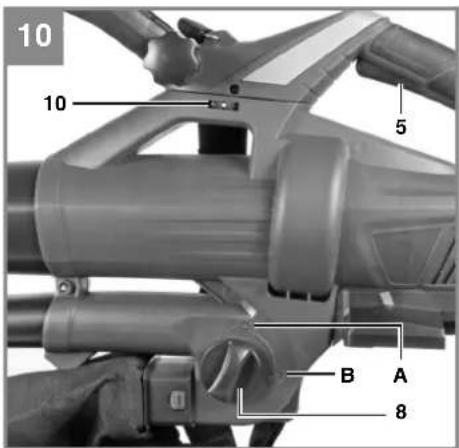
6.2. Switching on the equipment (Fig. 10)
• To switch on, press the On/Off switch (5).
- To switch off, let go of the On/Off switch (5) again.
6.3 Selecting the mode of operation
6.3.1 Suctioning (Fig. 10)
Turn the lever (Fig. 10/Item 8) to position A. You can do this both when the equipment is at a standstill and while it is running.
6.3.2 Blowing (Fig. 10)
- Turn the lever (Fig. 10/Item 8) to position B. You can do this both when the equipment is at a standstill and while it is running.
- Channel the air stream forward and walk slowly to blow foliage or garden refuse into a pile or to clear out hard-to-reach places.
- Important! Empty the catch bag before blowing. Otherwise, the material that has been vacuumed up could drop out.
6.4 Emptying the catch bag (Fig. 1)
Empty the catch bag (7) in good time. With a nearly full bag, the suction power drops notably. Organic waste should be composted.
- Switch off the equipment and remove the
GB
batteries.
- Open the zipper on the catch bag (7) and shake out the material.
- Close the zip on the catch bag (7) again.
6.5 Speed control (Fig. 1)
The device is fitted with an electronic speed controller. To use it, turn the speed controller (Fig. 1/Item 10) into the required position. Use the device only with the speed which is actually required and do not let it run at a speed which is faster than necessary.
7. Cleaning, maintenance and ordering of spare parts
Hazard!
Always remove the batteries before starting any cleaning work.
7.1 Cleaning
- After shaking out the catch bag, turn it inside out and thoroughly clean it in order to prevent mould and unpleasant odours from forming.
- You can use soap and water to clean out a heavily soiled catch bag.
- Rub a bar of dry soap across the zipper teeth if the zipper becomes difficult to pull.
- Clean the vacuum/blower tube with a brush upon evidence of dirt and grime.
- Dirt and grime can make the switch (blower/vacuum) more difficult to operate as a result of the material that swirls up off the ground. When this occurs, simply flip the switch back and forth a few times, which should bring it back to the normal feel.
7.2 Maintenance
- Should the tool experience problems beyond those mentioned above, let only an authorised professional or a customer service shop perform an inspection.
- There are no other parts inside the equipment which require maintenance.
7.3 Ordering replacement parts:
Please quote the following data when ordering replacement parts:
• Type of machine
• Article number of the machine
• Identification number of the machine
• Replacement part number of the part required
For our latest prices and information please go to www.isc-gmbh.info
8. Faults
The equipment does not work:
Check that the battery is charged and whether the charging unit is working. If the equipment will not work in spite of the voltage supply being OK, please send it to the customer service address-below.
9. Disposal and recycling
The equipment is supplied in packaging to prevent it from being damaged in transit. The raw materials in this packaging can be reused or recycled. The equipment and its accessories are made of various types of material, such as metal and plastic. Never place defective equipment in your household refuse. The equipment should be taken to a suitable collection center for proper disposal. If you do not know the whereabouts of such a collection point, you should ask in your local council offices.
10. Storage
Store the equipment and accessories in a dark and dry place at above freezing temperature. The ideal storage temperature is between 5 and 30 °C. Store the electric tool in its original packaging.
11. Charger indicator
| Indicator status | Explanations and actions | |
| Red LED Green LED | ||
| Off | Flashing | Ready for useThe charger is connected to the mains and is ready for use; there is no battery pack in the charger |
| On Off Charging | The charger is charging the battery pack in quick charge mode. | |
| Off On The battery is 85% charged and ready for use.(Charging time for 1.5 Ah battery: 30 min)(Charging time for 3.0 Ah battery: 60 min)(Charging time for 4.0 Ah battery: 80 min)The unit then changes over to gentle charging mode until the battery is fully charged.(Total charging time for 1.5 Ah battery: approx. 40 min)(Total charging time for 3.0 Ah battery: approx. 75 min)(Total charging time for 4.0 Ah battery: approx. 100 min)Action:Take the battery pack out of the charger. Disconnect the charger from the mains supply. | ||
| Flashing Off | Adapted charging | The charger is in gentle charging mode.For safety reasons the charging is performed less quickly and takes more than 1 hour. The reasons can be:- The battery pack has not been used for a very long time or an already fl at battery was further discharged (exhaustive discharge).- The battery pack temperature is outside the ideal range (between 25°C and 45°C).Action:Wait for the charging to be completed; you can still continue to charge the battery pack. |
| Flashing Flashing Fault | Charging is no longer possible. The battery pack is defective.Action:Never charge a defective battery pack.Take the battery pack out of the charger. | |
| On On Temperature fault | The battery pack is too hot (e.g. due to direct sunshine) or too cold (below 0°C).Action:Remove the battery pack and keep it at room temperature (approx. 20°C) for one day . | |
GB

For EU countries only
Never place any electric power tools in your household refuse.
To comply with European Directive 2012/19/EC concerning old electric and electronic equipment and its implementation in national laws, old electric power tools have to be separated from other waste and disposed of in an environment-friendly fashion, e.g. by taking to a recycling depot.
Recycling alternative to the return request:
As an alternative to returning the equipment to the manufacturer, the owner of the electrical equipment must make sure that the equipment is properly disposed of if he no longer wants to keep the equipment. The old equipment can be returned to a suitable collection point that will dispose of the equipment in accordance with the national recycling and waste disposal regulations. This does not apply to any accessories or aids without electrical components supplied with the old equipment.
The reprinting or reproduction by any other means, in whole or in part, of documentation and papers accompanying products is permitted only with the express consent of the iSC GmbH.
Subject to technical changes
GB
Service information
We have competent service partners in all countries named on the guarantee certificate whose contact details can also be found on the guarantee certificate. These partners will help you with all service requests such as repairs, spare and wearing part orders or the purchase of consumables.
Please note that the following parts of this product are subject to normal or natural wear and that the following parts are therefore also required for use as consumables.
| Category Example | |
| Wear parts* Battery | |
| Consumables* | |
| Missing parts |
* Not necessarily included in the scope of delivery!
In the effect of defects or faults, please register the problem on the internet at www.isc-gmbh.info. Please ensure that you provide a precise description of the problem and answer the following questions in all cases:
• Did the equipment work at all or was it defective from the beginning?
• Did you notice anything (symptom or defect) prior to the failure?
• What malfunction does the equipment have in your opinion (main symptom)?
Describe this malfunction.
GB
Warranty certifi cate
Dear Customer,
All of our products undergo strict quality checks to ensure that they reach you in perfect condition. In the unlikely event that your device develops a fault, please contact our service department at the address shown on this guarantee card or the sales outlet from where you bought the device. Please note the following terms under which guarantee claims can be made:
- These guarantee terms apply to consumers only, i.e. natural persons intending to use this product neither for their commercial activities nor for any other self-employed activities. These warranty terms regulate additional warranty services, which the manufacturer mentioned below promises to buyers of its new products in addition to their statutory rights of guarantee. Your statutory guarantee claims are not affected by this guarantee. Our guarantee is free of charge to you.
- The warranty services cover only defects due to material or manufacturing faults on a product which you have bought from the manufacturer mentioned below and are limited to either the rectification of said defects on the product or the replacement of the product, whichever we prefer. Please note that our devices are not designed for use in commercial, trade or professional applications. A guarantee contract will not be created if the device has been used by commercial, trade or industrial business or has been exposed to similar stresses during the guarantee period.
-
The following are not covered by our guarantee:
-
Damage to the device caused by a failure to follow the assembly instructions or due to incorrect installation, a failure to follow the operating instructions (for example connecting it to an incorrect mains voltage or current type) or a failure to follow the maintenance and safety instructions or by exposing the device to abnormal environmental conditions or by lack of care and maintenance.
- Damage to the device caused by abuse or incorrect use (for example overloading the device or the use or unapproved tools or accessories), ingress of foreign bodies into the device (such as sand, stones or dust, transport damage), the use of force or damage caused by external forces (for example by dropping it).
-
Damage to the device or parts of the device caused by normal or natural wear or tear or by normal use of the device.
-
The guarantee is valid for a period of 84 months starting from the purchase date of the device. Guarantee claims should be submitted before the end of the guarantee period within two weeks of the defect being noticed. No guarantee claims will be accepted after the end of the guarantee period. The original guarantee period remains applicable to the device even if repairs are carried out or parts are replaced. In such cases, the work performed or parts fitted will not result in an extension of the guarantee period, and no new guarantee will become active for the work performed or parts fitted. This also applies if an on-site service is used.
-
To make a claim under the guarantee, please register the defective device at: www.isc-gmbh.info. Please keep your bill of purchase or other proof of purchase for the new device. Devices that are returned without proof of purchase or without a rating plate shall not be covered by the guarantee, because appropriate identification will not be possible. If the defect is covered by our guarantee, then the item in question will either be repaired immediately and returned to you or we will send you a new replacement.
Also refer to the restrictions of this warranty concerning wear parts, consumables and missing parts as set out in the service information in these operating instructions.
FR
Danger!
X 2006/42/EC
Annex IV
Notified Body:
Notified Body No.:
Reg. No.
X Annex V
□Annex VI
P = kW; L/∅ = cm
Notified Body:
Emission No.:
X 2000/14/EC\_2005/88/EC
Noise: measured L_ = 92,99 dB (A); guaranteed L_w = 98 dB (A)
2004/26/EC
Standard references: EN 60335-1; EN 50636-2-100; EN 55014-1; EN 55014-2
Subject to change without notice
Archive-File/Record: NAPR013987
Documents registrar: Alexander Scheifl
Wiesenweg 22, D-94405 Landau/Isar
EH 04/2016 (01)

- DE
- Gefahr!
- Safety information
- Danger!
- Explanation of the warning signs on the equipment (see Fig. 11)
- Layout and items supplied
- Layout (Fig. 1/2)
- 3x short screw
- Items supplied
- Intended use
- GB
- Technical data
- Important!
- Power-X-Change
- Charger
- Output
- Keep the noise emissions and vibrations to a minimum.
- Caution!
- Residual risks
- Before starting the equipment
- Warning!
- Mounting the suction tube (Fig. 3a-3f)
- Mounting the catch bag (Figs. 4-5)
- Fitting the handle
- Fitting the additional handle
- Fitting the harness
- Fitting the battery (Fig. 9)
- Charging the battery
- Operation
- Sizing the strap (Fig. 1)
- Switching on the equipment (Fig. 10)
- Selecting the mode of operation
- Suctioning (Fig. 10)
- Blowing (Fig. 10)
- Emptying the catch bag (Fig. 1)
- batteries.
- Speed control (Fig. 1)
- Cleaning, maintenance and ordering of spare parts
- Hazard!
- Cleaning
- Maintenance
- Ordering replacement parts:
- Faults
- The equipment does not work:
- Disposal and recycling
- Storage
- Charger indicator
- Service information
- Warranty certifi cate
- FR
- X 2000/14/EC\_2005/88/EC
- 2004/26/EC
Brand : Gardol
Model : GAL-E 40 Li OA
Category : Blower