ManualGo.com
DWE349 - Saw DEWALT - Free user manual and instructions
Find the device manual for free DWE349 DEWALT in PDF.



Download the instructions for your Saw in PDF format for free! Find your manual DWE349 - DEWALT and take your electronic device back in hand. On this page are published all the documents necessary for the use of your device. DWE349 by DEWALT.
USER MANUAL DWE349 DEWALT
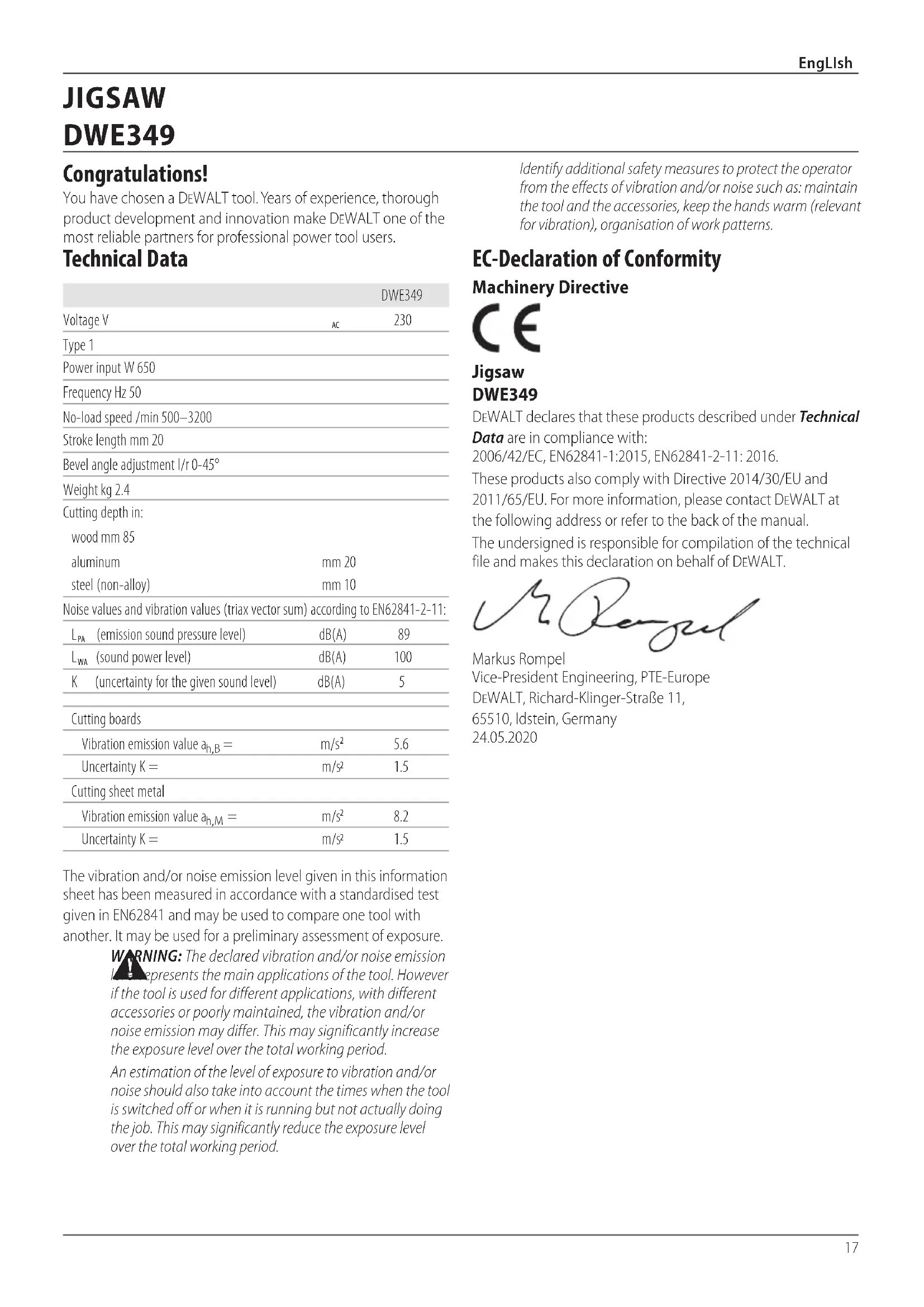
Identify additional safety measures to protect the operator from the effects of vibration and/or noise such as: maintain the tool and the accessories, keep the hands warm (relevant for vibration), organisation of workpatterns. The vibration and/or noise emission level given in this information sheet has been measured in accordance with a standardised test given in EN62841 and may be used to compare one tool with another. It may be used for a preliminary assessment ofexposure.
WARNING: The declared vibration and/or noise emission
level represents the main applications of the tool. However if the tool is used for different applications, with different accessories or poorly maintained, the vibration and/or noise emission may differ. This may significantly increase the exposure level over the total workingperiod. An estimation of the level of exposure to vibration and/or noise should also take into account the times when the tool is switched off or when it is running but not actually doing the job. This may significantly reduce the exposure level over the total workingperiod. DWE349 Voltage V
(emission sound pressure level) dB(A) 89
(sound power level) dB(A) 100 K (uncertainty for the given sound level) dB(A) 5 Cutting boards Vibration emission value a h,B = m/s
Congratulations! You have chosen a DeWALT tool. Years of experience, thorough product development and innovation make DeWALT one of the most reliable partners for professional power toolusers. Technical Data English (original instructions) JIGSAW DWE34918 EngLIsh
WARNING: Read all safety warnings, instructions,
illustrations and specifications provided with this power tool. Failure to follow all instructions listed below may result in electric shock, fire and/or seriousinjury.
SAVE ALL WARNINGS AND INSTRUCTIONS
FOR FUTUREREFERENCE The term “power tool” in the warnings refers to your mains-operated (corded) power tool or battery-operated (cordless) powertool.
a ) Keep work area clean and well lit. Cluttered or dark areas inviteaccidents. b ) Do not operate power tools in explosive atmospheres, such as in the presence of flammable liquids, gases or dust. Power tools create sparks which may ignite the dust orfumes. c ) Keep children and bystanders away while operating a power tool. Distractions can cause you to losecontrol.
2) Electrical Safety
a ) Power tool plugs must match the outlet. Never modify the plug in any way. Do not use any adapter plugs with earthed (grounded) power tools. Unmodified plugs and matching outlets will reduce risk of electricshock. b ) Avoid body contact with earthed or grounded surfaces, such as pipes, radiators, ranges and refrigerators. There is an increased risk of electric shock if your body is earthed orgrounded. c ) Do not expose power tools to rain or wet conditions. Water entering a power tool will increase the risk of electricshock. d ) Do not abuse the cord. Never use the cord for carrying, pulling or unplugging the power tool. Keep cord away from heat, oil, sharp edges or moving parts. Damaged or entangled cords increase the risk of electricshock. e ) When operating a power tool outdoors, use an extension cord suitable for outdoor use. Use of a cord suitable for outdoor use reduces the risk of electricshock. f ) If operating a power tool in a damp location is unavoidable, use a residual current device (RCD) protected supply. Use of an RCD reduces the risk of electricshock.
a ) Stay alert, watch what you are doing and use common sense when operating a power tool. Do not use a power tool while you are tired or under the influence of drugs, alcohol or medication. A moment of inattention while operating power tools may result in serious personalinjury.
WARNING: To reduce the risk of injury, read the
instructionmanual. Definitions: Safety Guidelines The definitions below describe the level of severity for each signal word. Please read the manual and pay attention to thesesymbols.
DANGER: Indicates an imminently hazardous
situation which, if not avoided, will result in death or seriousinjury.
WARNING: Indicates a potentially hazardous situation
which, if not avoided, could result in death or seriousinjury.
CAUTION: Indicates a potentially hazardous situation which, if not avoided, may result in minor or moderateinjury. NOTICE: Indicates a practice not related to personal injury which, if not avoided, may result in propertydamage.
DECLARATION OF CONFORMITY
THE SUPPLY OF MACHINERY (SAFETY) REGULATIONS 2008 Jigsaw DWE349 DeWALT declares that these products described under “technical data” are in compliance with: The Supply of Machinery (Safety) Regulations, 2008, S.I. 2008/1597 (as amended, EN62841‑1:2015, EN62841‑2‑11:2016. These products conform to the following UK Regulations: Electromagnetic Compatibility Regulations, 2016, S.I.2016/1091 (as amended). The Restriction of the Use of Certain Hazardous Substances in Electrical and Electronic Equipment Regulations 2012, S.I. 2012/3032 (as amended). For more information, please contact DeWALT at the following address or refer to the back of the manual. The undersigned is responsible for compilation of the technical file and makes this declaration on behalf of DeWALT. Karl Evans Vice President Professional Power Tools EANZ GTS 270 Bath Road, Slough SL1 4DX England
Denotes risk of electricshock.
Denotes risk offire.19 EngLIsh Residual Risks In spite of the application of the relevant safety regulations and the implementation of safety devices, certain residual risks cannot be avoided. These are:
- Impairment ofhearing.
- Risk of accidents caused by the uncovered parts of the sawblade. Additional Safety Warnings for Jigsaws
- Hold the power tool by insulated gripping surfaces, when performing an operation where the cutting accessory may contact hidden wiring or its own cord. Cutting accessory contacting a “live” wire may make exposed metal parts of the power tool “live” and could give the operator an electricshock.
- Use clamps or another practical way to secure and support the workpiece to a stable platform. Holding the workpiece by hand or against your body leaves it unstable and may lead to loss ofcontrol.
- Keep hands away from cutting area. Never reach underneath the workpiece for any reason. Do not insert fingers or thumb into the vicinity of the reciprocating blade and blade clamp. Do not stabilize the saw by gripping theshoe.
- Keep blades sharp. Dull or damaged blades may cause the saw to swerve or stall under pressure. Always use the appropriate type of saw blade for the workpiece material and type ofcut.
- When cutting pipe or conduit, make sure that they are free from water, electrical wiring,etc.
- Do not touch the workpiece or the blade immediately after operating the tool. They can become veryhot.
- Be aware of hidden hazards, before cutting into walls, floors or ceilings, check for the location of wiring andpipes.
- The blade will continue to move after releasing the switch. Always switch the tool off and wait for the saw blade to come to a complete standstill before putting the tooldown.
WARNING: We recommend the use of a residual current
device with a residual current rating of 30mA orless. b ) Use personal protective equipment. Always wear eye protection. Protective equipment such as a dust mask, non-skid safety shoes, hard hat or hearing protection used for appropriate conditions will reduce personalinjuries. c ) Prevent unintentional starting. Ensure the switch is in the off‑position before connecting to power source and/or battery pack, picking up or carrying the tool. Carrying power tools with your finger on the switch or energising power tools that have the switch on invitesaccidents. d ) Remove any adjusting key or wrench before turning the power tool on. A wrench or a key left attached to a rotating part of the power tool may result in personalinjury. e ) Do not overreach. Keep proper footing and balance at all times. This enables better control of the power tool in unexpectedsituations. f ) Dress properly. Do not wear loose clothing or jewellery. Keep your hair and clothing away from moving parts. Loose clothes, jewellery or long hair can be caught in movingparts. g ) If devices are provided for the connection of dust extraction and collection facilities, ensure these are connected and properly used. Use of dust collection can reduce dust-relatedhazards. h ) Do not let familiarity gained from frequent use of tools allow you to become complacent and ignore tool safety principles. A careless action can cause severe injury within a fraction of asecond.
4) Power Tool Use and Care
a ) Do not force the power tool. Use the correct power tool for your application. The correct power tool will do the job better and safer at the rate for which it wasdesigned. b ) Do not use the power tool if the switch does not turn it on and off. Any power tool that cannot be controlled with the switch is dangerous and must berepaired. c ) Disconnect the plug from the power source and/ or remove the battery pack, if detachable, from the power tool before making any adjustments, changing accessories, or storing power tools. Such preventive safety measures reduce the risk of starting the power toolaccidentally. d ) Store idle power tools out of the reach of children and do not allow persons unfamiliar with the power tool or these instructions to operate the power tool. Power tools are dangerous in the hands of untrainedusers. e ) Maintain power tools and accessories. Check for misalignment or binding of moving parts, breakage of parts and any other condition that may affect the power tool’s operation. If damaged, have the power tool repaired before use. Many accidents are caused by poorly maintained powertools. f ) Keep cutting tools sharp and clean. Properly maintained cutting tools with sharp cutting edges are less likely to bind and are easier tocontrol. g ) Use the power tool, accessories and tool bits etc. in accordance with these instructions, taking into account the working conditions and the work to be performed. Use of the power tool for operations different from those intended could result in a hazardoussituation. h ) Keep handles and grasping surfaces dry, clean and free from oil and grease. Slippery handles and grasping surfaces do not allow for safe handling and control of the tool in unexpectedsituations.
a ) Have your power tool serviced by a qualified repair person using only identical replacement parts. This will ensure that the safety of the power tool ismaintained.20 ENGLISH Blade Installation (Fig.B)
WARNING: When mounting the saw blade wear protective gloves. danger of injury when touching the sawblade.
WARNING: Use only T type blades. Using blades other than T type blades cause insufficient tightening of the blade, resulting in a serious personalinjury.
ASSEMBLY AND ADJUSTMENTS
WARNING: To reduce the risk of serious personal injury, turn tool off and disconnect tool from power source before making any adjustments or removing/installing attachments or accessories. An accidental start-up can causeinjury. Description (Fig.A)
WARNING: Never modify the power tool or any part of it. Damage or personal injury couldresult.
Shoe beveling lever Speed control dial Pendulum stroke selector Blade holder Intended Use Your jig saw has been designed for professional sawingapplications. Your DeWALT jig saw, DWE349, has been designed for sawing wood, plastics, metal, rubber and ceramicplatesDO NOT use under wet conditions or in the presence of flammable liquids orgases.These jigsaws are professional powertools.DO NOT let children come into contact with the tool. Supervision is required when inexperienced operators use thistool.• Young children and the infirm. This appliance is not intended for use by young children or infirm persons without supervision. • This product is not intended for use by persons (including children) suffering from diminished physical, sensory or mental abilities; lack of experience, knowledge or skills unless they are supervised by a person responsible for their safety. Children should never be left alone with thisproduct. Date Code Position (Fig.A) The date code , which also includes the year of manufacture, is printed into thehousing.Example:2021XX XXYear and Week of Manufacture Markings on Tool The following pictograms are shown on the tool: Read instruction manual beforeuse. Wear earprotection. Wear eyeprotection. Package Contents The package contains:1 Jigsaw1 Jig saw blade1 Anti‑scratch shoe cover1 Instruction manual• Check for damage to the tool, parts or accessories which may have occurred duringtransport.• Take the time to thoroughly read and understand this manual prior tooperation. Electrical Safety The electric motor has been designed for one voltage only. Always check that the power supply corresponds to the voltage on the ratingplate.
Your DeWALT tool is double insulated in accordance with EN62841; therefore no earth wire isrequired.If the supply cord is damaged, it must be replaced only by DeWALT or an authorised serviceorganisation. Mains Plug Replacement (U.K.& Ireland Only) If a new mains plug needs to be fitted:• Safely dispose of the oldplug.• Connect the brown lead t o the live terminal in theplug.• Connect the blue lead to the neutralterminal. WARNING: No connection is to be made to the earthterminal.Follow the fitting instructions supplied with good quality plugs. Recommended fuse: 13A. Using an Extension Cable If an extension cable is required, use an approved 3–core extension cable suitable for the power input of this tool (see Technical Data).The minimum conductor size is 1.5mm ; the maximum length is 30m.When using a cable reel, always unwind the cablecompletely.• Health hazards caused by breathing dust developed when sawing wood, especially oak, beech andMDF.• Risk of personal injury due to flyingparticles.• Risk of burns due to accessories becoming hot duringoperation.• Risk of personal injury due to prolongeduse.21 EngLIsh Cutting Action – Orbital or Straight (Fig.A)
WARNING: Check that the tool is not locked ON before
connecting it to a power supply. If the trigger switch is locked on when the tool is connected to the power supply, it will start immediately. Damage to your tool or personal injury mayresult. Variable Speed Control (Fig.E)
WARNING: If the tool is operated continuously at low
speeds for a long time, the motor will get overload and heatedup. A speed control dial
is located on the top of the saw. The speed increases as the dial is turned from a low speed setting of 1to a high speed setting of6. Refer to the table to select the proper speed for the workpiece to be cut. However, the appropriate speed may differ with the type or thickness of the workpiece. In general, higher speeds will allow you to cut workpieces faster but the service life of the blade will bereduced. Material Variable Speed Control Setting Wood 5‑6 Stainless steel 3‑4 Mild steel 3‑6 Aluminum 3‑6 Plastics 1‑4 Switching On and Off (Fig.A)
- To switch the tool on, squeeze the trigger switch
- For continuous operation, squeeze the trigger switch then depress the lock‑on button
. Once lock‑on button is depressed, release the triggerswitch.
- To switch the tool off, release the trigger switch. To switch the tool off, when in continuous operation, squeeze the trigger and the lock willdisengage. Proper Hand Position (Fig.D)
WARNING: To reduce the risk of serious personal injury,
WARNING: To reduce the risk of serious personal
injury, ALWAYS hold securely in anticipation of a suddenreaction. Proper hand position requires one hand on the front handle
with the other hand on the main handle
- Make sure your workpiece is well secured. Remove nails, screws and other fasteners that may damage theblade.
- Check that there is sufficient space for the blade underneath the workpiece.
- Do not cut materials that exceed the maximum cutting depth of theblade.
- Use sharp saw blades only. Damaged or bent saw blades must be removedimmediately.
- Do not use the tool for sawing pipes ortubes.
- Never run your tool without a sawblade. OPERATION Instructions for Use
WARNING: Always observe the safety instructions and
applicableregulations.
WARNING: To reduce the risk of serious personal
injury, turn tool off and disconnect tool from power source before making any adjustments or removing/ installing attachments or accessories. An accidental start-up can causeinjury. Adjusting the Shoe for Bevel Cuts (Fig.C)
WARNING: Never use the tool when the shoe is loose or
removed. The shoe plate can be set to a left or right bevel angle of up to 45°. To Set the Bevel Angle
out and away from the saw to unlock the shoe
as shown in FigureC.
2. Slide the shoe forward to release it from the 0° positive
3. The shoe can be beveled to the left or to the right and has
detents at 15°, 30° and 45°.
4. Set the shoe to the desired bevel angle. Use a protractor to
verify angleaccuracy.
5. Push the shoe beveling lever back towards the saw to lock
out and away from the saw to unlock the shoe
as shown in FigureC.
2. Rotate shoe to an angle of approximately 0° and then pull
shoe backwards to engage the 0° positivestop.
3. Push the shoe beveling lever back towards the saw to lock
1. Push the saw blade locking lever
2. With teeth facing forward, insert the shank of the saw blade
into the blade holder as far as it willgo.
3. Release thelever.
4. Check to ensure blade is secure before cutting. A loose saw
blade can fall out an lead toinjury.
- For optimal results, move the tool smoothly and constantly over the workpiece. Do not exert lateral pressure on the saw blade. Keep the shoe flat on the workpiece and lead the cord away in line with the tool. When sawing curves, circles or other round shapes, push the tool gentlyforward.
- Wait until the tool has come to a standstill before removing the saw blade from the workpiece. After sawing the blade may be very hot. Do nottouch.22 EngLIsh Rip/Circle Cutting (Fig.G, H) Ripping and circle cutting without a pencil line is easily done with the rip fence / circle guide (not included; available at extracost). Hints for Optimum Use Sawing laminates
- As the saw blade cuts on the upward stroke, splintering may occur on the surface closest to the shoeplate.
- Use a fine‑tooth sawblade.
- Saw from the back surface of theworkpiece.
- To minimize splintering, clamp a piece of scrap wood or hardboard to both sides of the workpiece and saw through thissandwich. Sawing metal
- Be aware that sawing metal takes much more time than sawingwood.
- Use a saw blade suitable for sawingmetal.
- When cutting thin metal, clamp a piece of scrap wood to the back surface of the workpiece and cut through thissandwich.
- Spread a film of oil along the intended line of cut for easier operation and longer blade life. For cutting aluminum, kerosene ispreferred. Removable Anti‑Scratch Shoe Cover (Fig.F) The non‑marring anti‑scratch shoe cover
should be used when cutting surfaces that scratch easily, such as laminate, veneer, or paint. It can also be used to protect the shoe surface during transportation andstorage. To attach anti‑scratch shoe cover, place the front of the shoe
into the front of the anti‑scratch shoe cover and lower the jig saw as shown in FigureF. The anti‑scratch shoe cover will click securely onto the rear of theshoe. To remove anti‑scratch shoe cover, grasp the cover from the bottom at the two rear tabs and pull down and away from theshoe. This jig saw is equipped with four cutting actions, three orbital and one straight. Orbital action has a more aggressive blade motion and is designed for cutting in soft materials like wood or plastic. Orbital action provides a faster cut, but with a less smooth cut across the material. In orbital action, the blade moves forward during the cutting stroke in addition to the up and downmotion. nOtE: Metal or hardwoods should never be cut in orbitalaction. Setting the Pendulum Stroke
between the four cutting positions: 0, 1, 2, and3.
2. Position 0is straightcutting.
3. Positions 1, 2, and 3are orbitalcutting.
The aggressiveness of the cut increases as the lever is adjusted from one to three, with three being the most aggressivecut. Optional Accessories
WARNING: Since accessories, other than those offered
by DeWALT, have not been tested with this product, use of such accessories with this tool could be hazardous. To reduce the risk of injury, only DeWALT recommended accessories should be used with thisproduct. Consult your dealer for further information on the appropriateaccessories.
WARNING: Blow dirt and dust out of the main housing
with dry air as often as dirt is seen collecting in and around the air vents. Wear approved eye protection and approved dust mask when performing thisprocedure.
WARNING: Never use solvents or other harsh chemicals
for cleaning the non-metallic parts of the tool. These chemicals may weaken the materials used in these parts. Use a cloth dampened only with water and mild soap. Never let any liquid get inside the tool; never immerse any part of the tool into aliquid.
Lubrication Your power tool requires no additionallubrication. MAINTENANCE Your power tool has been designed to operate over a long period of time with a minimum of maintenance. Continuous satisfactory operation depends upon proper tool care and regularcleaning.
WARNING: To reduce the risk of serious personal
injury, turn tool off and disconnect tool from power source before making any adjustments or removing/ installing attachments or accessories. An accidental start-up can causeinjury. Using the screw supplied with the accessory guide, position and thread the screw into the shoe to clamp the fencesecurely. When ripping, slide the rip fence under the screw from either side of the saw. Set the cross bar at desired distance from blade and tighten screw. For ripping, the cross bar should be down and against the straight edge of theworkpiece. When circle cutting, adjust rip fence so that distance from blade to hole in fence arm is at the desired radius and tighten screw. Place saw so that hole in fence arm is over centre of circle to be cut (drill hole for blade or cut inward from edge of material to get blade into position). When saw is properly positioned, drive a small nail through hole in fence arm. Using rip fence as a pivot arm, begin cutting circle. For circle cutting, the cross bar should beup.23 ENGLISH Protecting the Environment