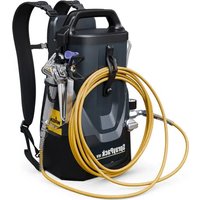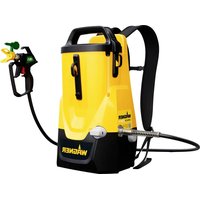
Finish Control 5500 - Paint spray WAGNER - Free user manual and instructions
Find the device manual for free Finish Control 5500 WAGNER in PDF.



User questions about Finish Control 5500 WAGNER
0 question about this device. Answer the ones you know or ask your own.
Ask a new question about this device
Download the instructions for your Paint spray in PDF format for free! Find your manual Finish Control 5500 - WAGNER and take your electronic device back in hand. On this page are published all the documents necessary for the use of your device. Finish Control 5500 by WAGNER.
USER MANUAL Finish Control 5500 WAGNER
natural_image
Line drawing of a spray gun and a flat-screen spray gun with hoses (no text or symbols)FINISH CONTROL 5500
text_image
Technical diagram of a hairdryer with numbered parts and exploded view, including labeled parts and a detailed close-up of the brush.
text_image
Technical diagram illustrating three-step assembly steps of a spray gun, labeled with arrows and numbered components.
text_image
③ A B
natural_image
Technical line drawing of a mechanical assembly with spring-loaded components (no text or symbols)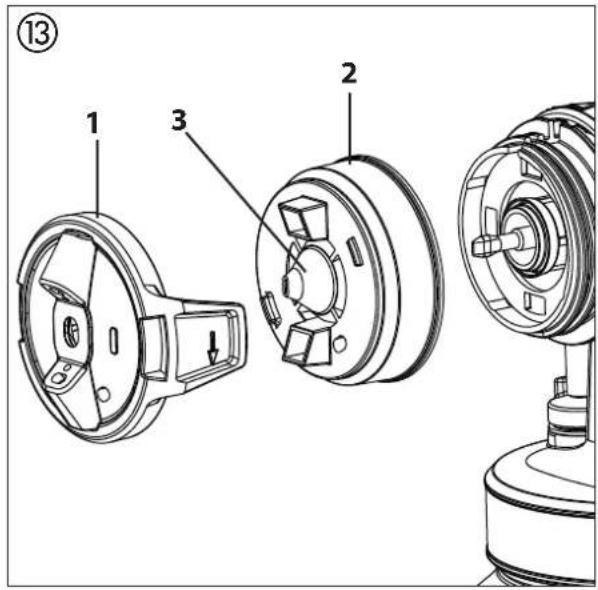
text_image
Technical diagram of a mechanical assembly with numbered components, likely illustrating a gear or cam mechanism.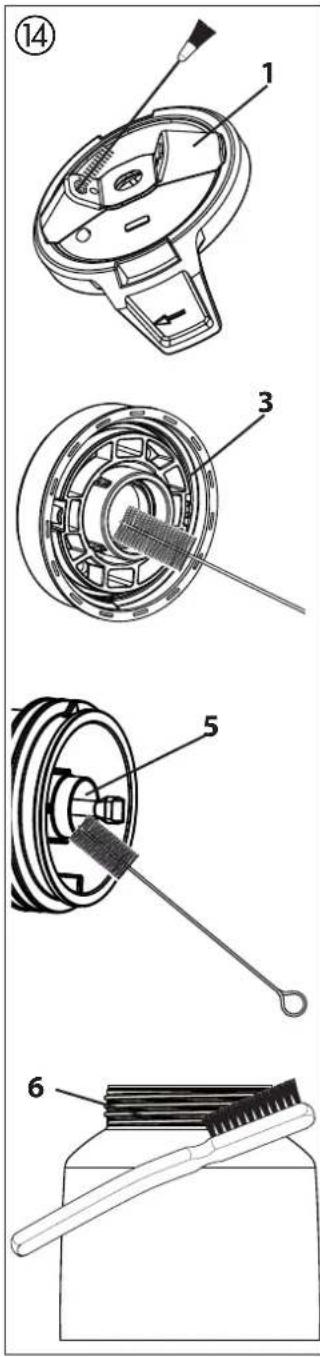
text_image
Technical diagram showing exploded views of a mechanical device with numbered parts, likely for assembly or maintenance instructions.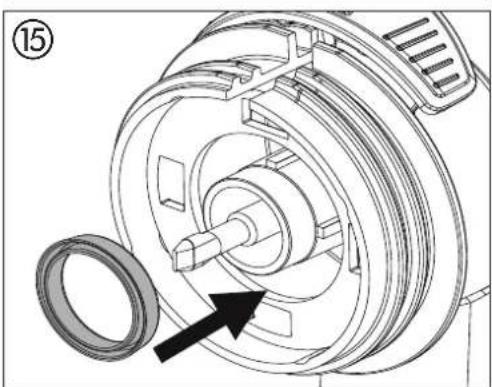
natural_image
Technical diagram of a mechanical assembly with a bearing and housing (no text or symbols)
text_image
⑯ 2
text_image
⑰ 1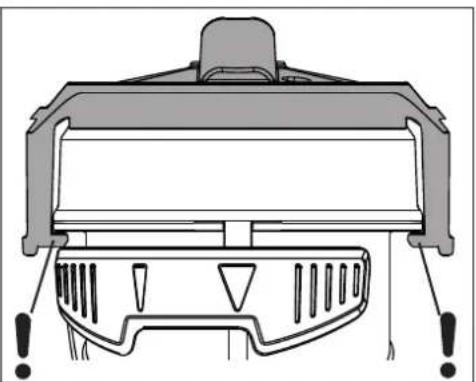
natural_image
Technical line drawing of a mechanical component with mounting brackets and warning symbols (no text or labels)
text_image
Technical diagram of a mechanical device with labeled components and an arrow indicating direction, marked as figure 18.
natural_image
Simple line drawing of a cylindrical object with an arrow pointing to its end (no text or symbols)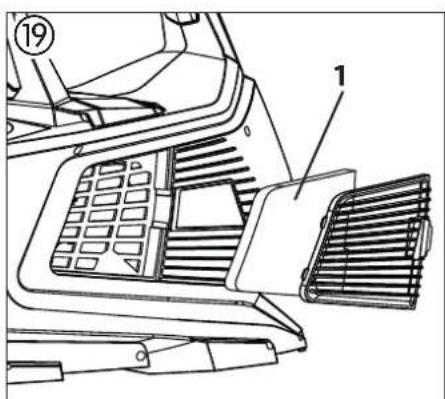
text_image
Technical diagram of a vehicle air intake system with labeled components
text_image
Technical diagram of a sewing machine with labeled parts and warning indicators
text_image
Technical diagram of a hair dryer with labeled parts including comb, brush, and rack components
text_image
Technical diagram of a mechanical device with numbered parts and exploded view, likely for assembly or manufacturing purposes.Inhaltsverzeichnis
natural_image
Cross-sectional diagram of a vehicle showing structural components and a directional arrow (no text or labels)go.wagner-group.com/profi
PRÜFUNG DES GERÄTES
https://go.wagner-group.com/pf-warranty-conditions

Translation of the original operating instructions
Contents
1 SAFETY REGULATIONS 14
2 EXPLANATORY DIAGRAM 16
3 THE WAGNER CLICK&PAINT SYSTEM 16
3.1 Disassembly of the spray gun 16
4 TECHNICAL DATA 17
5 INTRODUCTION TO SPRAYING USING THE XVLP PROCEDURE 17
6 COATING MATERIAL 17
6.1 Coating Materials Suitable for Use 17
6.2 Coating Materials Not Suitable for Use 17
6.3 Coating materials that can only be processed with relevant spray attachment (accessories) ____ 17
6.4 Preparing the coating material 17
7 SETTING THE SPRAY GUN 18
7.1 Setting the required spray pattern ____ 18
7.2 Setting the amount of material 18
7.3 Setting the amount of air 18
7.4 Align the feed tube 18
12 TAKING OUT OF OPERATION AND CLEANING _ 19
12.1 Assembly 19
13 MAINTENANCE 19
13.1 Air filter 19
13.2 Air relief valve 20
14 CORRECTION OF MALFUNCTIONS 21
15 ACCESSORIES AND SPARE PARTS 22
15.1 Accessories 22
15.2 Spare parts FinishControl 22
15.3 Spare Parts StandardSpray spray attachment ____ 22
Testing of the unit 23
Note on disposal 23
Important information on product liability ____ 23
Guarantee declaration 23
CE - declaration 23
European service network 122
Explanation of symbols used
 | This symbol indicates a potential danger for you or for the device.Under this symbol you can find important information on how to avoid injuries and damage to the device. |
 | Indicates tips for use and other particularly useful information. |
 | Wide spray jet setting |
 | Narrow spray jet setting |
1 SAFETY REGULATIONS
All local safety regulations in force must be observed.
Read the operating instructions carefully and follow the instructions laid down in them in order to avoid risks.
1. Safety at the workplace
a) Keep your workplace clean and well lit. Disorder or unlit workplaces may result in accidents.
b) Never use the tool in hazardous areas that contain flammable liquids, gases or dusts. Power tools generate sparks that can ignite the dust or vapors.
c) Keep children and other persons away when using the power tool. You can lose control of the tool if you are distracted.
2. Electrical Safety
a) The tool plug must fit into the socket. The plug may not be modified in any form. Do not use adaptor plugs together with protective-earthed tools. Unmodified plugs and suitable sockets reduce the risk of an electric shock.
b) Avoid physical contact with earthed surfaces such as pipes, heating elements, stoves and refrigerators. The risk through electric shock increases if your body is earthed.
c) Keep the equipment away from rain and moisture. The risk of an electric shock increases if water penetrates electrical equipment.
d) Do not misuse the mains lead by carrying the tool by the lead, hanging it from the lead or by pulling on the lead to remove the plug. Keep the lead away from heat, oil, sharp edges or moving tool parts. Damaged or twisted leads increase the risk of an electric shock.
e) If you work outdoors with a power tool, only use extension cables suitable for outdoor use. The use of an extension lead that is suitable for outdoors reduces the risk of an electric shock.
f) If you cannot avoid using the tool in a damp environment, use a residual current operated circuit-breaker. Using a residual current operated circuit-breaker avoids the risk of electric shock.
3. Safety of Persons
a) Be attentive. Pay attention to what you are doing and work sensibly with a power tool. Do not use the tool if you are tired or under the influence of drugs, alcohol or medication. Just a moment of inattentiveness while using the tool can lead to serious injuries.
b) Wear personal safety equipment and always wear safety goggles. Wearing personal protective equipment, such as dust mask, non-slip safety shoes, safety helmet or ear protection, depending on the type of power tools, reduces the risk of injury.
c) Avoid accidental starting-up. Ensure that the switch is in the "OFF" position before inserting the plug into the socket. Accidents can occur if you carry the power tool while your finger is on the switch or if you connect the power tool to the power supply which it is on.
d) Remove setting tools or wrenches before switching on the power tool. A tool or wrench that is in a rotating tool part can lead to injuries.
e) Avoid an unnatural posture. This ensures that you can control the tool better in unexpected situations.
f) Wear suitable clothing. Do not wear wide clothing or jewellery. Keep your hair, clothes and gloves away from moving parts. Loose clothing, jewellery or long hair can be caught in moving parts.
g) Do not lull yourself into a false sense of security and do not think yourself above the safety rules for electric tools, even if you are familiar with the electric tool following extensive practical experience. Careless use can lead to serious injuries in fractions of a second.
4. Careful Handling and Use of Power Tools
a) Do not overload the tool. Use the power tool designed for the work that you are doing. You work better and safer in the specified performance range if you use the suitable power tool.
b) Do not use power tools whose switch is defective. A power tool that cannot be switched on or off is dangerous and has to be repaired.
c) Remove the plug from the socket before carrying out tool settings, changing accessories or putting the tool away. This precautionary measure prevents unintentional starting of the tool.
d) Store unused power tools so that they are inaccessible to children. Do not let persons use the tool who are not familiar with it or who have not read these instructions. Power tools are dangerous when they are used by inexperienced persons.
e) Take proper care of your tools. Check whether the moving parts function trouble-free and do not jam, whether parts are broken or damaged so that the tool function is impaired. Have damaged parts repaired before using the tool. Many accidents have their origin in power tools that have been maintained badly.
f) Use the power tool, accessories, insert tools, etc. in accordance with these instructions and in a fashion specified for this special tool type. Take the working conditions and the activity to be carried out into consideration. The use of power tools for purposes other than the intended ones can lead to dangerous situations.
g) Keep the handles and grip surfaces dry, clean and free of oil and grease. Slippery handles and grip surfaces hamper safe operation and control of the electric tool in unforeseen situations.
5. Service
a) Have your tool repaired only by qualified specialist
personnel and only with original spare parts. This ensures that the tool safety is maintained.
b) If the supply cord is damaged, it must be replaced by the manufacturer or its service agent or a similarly qualified person in order to avoid a safety hazard.
Safety instructions for colour application devices
1. Risks of Fire and Explosion
Combustible gases develop in the work area when spraying coating substances and due to the autonomous formation of coating substances and solvent vapors (danger zone).
Risk of fire and explosion due to ignition sources in this danger zone.
The electrically operated spray device contains potential ignition sources (spark formation when switching the motor on and off, when inserting and removing the power plug, due to potential static electricity at the spray gun)
-> Device must not be used at operating sites that fall under the explosion protection ordinance.
-> Basic unit and mains connection must be located outside the danger zone.
-> Do not use combustible coating substances and cleaning agents -> observe product data sheets!
->Always seal paint or solvent containers tightly in the vicinity of the device.
-> No ignition sources such as open fire, lit tobacco products, glowing wires, hot surfaces, sparks e.g. due to angle grinders etc. must be present.
-> When cleaning the device with solvent do not spray into a container with a small opening (bung hole).
Danger due to formation of an explosive gas/air mixture.
The container into which you are spraying must be earthed.
2. Warning: Danger of injury!
Never point spray gun at yourself, other persons or animals.
3. Wear breathing equipment when spraying.
The user should be supplied with a breathing mask. In order to avoid occupational diseases, the working instructions provided by the manufacturer of the materials, solvents and cleaning agents used must be complied with during preparation, working with and cleaning the equipment.
Protective clothing, gloves and, if necessary, protective skin cream is required to protect the skin.
- Warning: When working with the paint spraying system, both indoors and outdoors, care should be taken that no solvent vapours are driven to the motor-operated blower or that no solvent containing vapours form in the area around the paint spraying system. Place the motor-operated blower on the opposite side to the object to be sprayed. When working outdoors take wind direction into account. When working in closed places a sufficient ventilation must be ensured to remove the solvent vapours. The distance from the motor – operated blower to the object to be sprayed must be at least 3 m.
- Warning: The device is not splash proof. It should not be used, neither outdoors in the rain nor be sprayed with water nor immersed in liquid. Do not use the device in damp or wet environments.
- The units may only be used with a functional valve. If paints rise in the ventilating hose (Fig. 1, item 4) do not operate the unit further! Dismantle and clean the ventilating hose, valve and diaphragm and replace the diaphragm if necessary (see section13.2).
- Do not lay the filled spray gun down.
- Extraction systems should be installed on-site according to the local regulations.
- The object to be coated must be earthed.
- Caution against dangers that can arise from the sprayed substance and observe the text and information on the containers or the specifications given by the substance manufacturer.
- Do not spray any liquid of unknown hazard potential.
- Before dismounting the spray attachment, relieve pressure by opening the container.
- Before working on the device, remove the power plug from the socket.
- Work or repairs on the electrical equipment should only be carried out by a professional electrician, even if there are instructions regarding such work in the operating instructions. No liability will be accepted for improper installation.
- Do not sit or stand on the device. Danger of tilting/breaking!
- Only use parts approved by the manufacturer. The users bear all risks and liability for using parts that do not meet the minimum technical requirements.
2 EXPLANATORY DIAGRAM (FIG. 1)
POS. DESIGNATION
1 Spray attachment complete
2 Spray jet width adjustment
3 Air cap (to set the working direction)
4 Ventilating hose
5 Valve
6 Container seal
7 Suction tube
8 Container
9 Trigger (actuates turbine starting switch material is conveyed)
10 Material volume regulation
11 Air volume control
12 Air hose
13 Gun handle
14 Carry handle
POS. DESIGNATION
15 ON/OFF switch (I = ON, 0 = OFF)
16 Air filter indicator ((lights up red if the main air filter is blocked))
17 Air hose connection
18 Storage compartment for small parts / accessories
19 Gun mounting
20 Clamp for securing the coiled power cable
21 Power cable
22 Air filter cover (left and right)
23 Fastening strap for binding the rolled-up air hose together
24 Fine feed tube filter (red)
Coarse feed tube filter (white)
25 Cleaning brushes (4 pcs.)
3 THE WAGNER CLICK&PAINT SYSTEM
With the Wagner Click&Paint System, the front part of the gun (spray attachment) can be replaced quickly and easily.
This enables a rapid material change without cleaning, and ensures that the right tool is available for every material and application.
The following spray attachments are available:
| Spray attachment Area of application | |
| StandardSpray (yellow)Order No. 2430386 | Spray attachment with slit nozzle and 1000 ml aluminium container. Processes all standard paints. |
| FineSpray (brown)Order No. 2430385 | Spray attachment with round nozzle and 1000 ml aluminium container. Ideal for low-viscosity paints and glazes. |
| WallSpray (white)Order No. 2430387 | Dispersion spray attachment with slit nozzle and 1400 ml plastic container. Designed for processing dispersions. |
3.1 DISASSEMBLY OF THE SPRAY GUN
For assembly, insert the spray attachment into the gun handle so that the two arrows point at each other. Turn the gun handle 90^ in the arrow direction until it audibly engages. (Fig. 2)
To remove the spray attachment, push the catch (Fig. 2, A) beneath the trigger down and turn the spray attachment by 90^ .
4 TECHNICAL DATA
| Voltage: 230 V~, 50 Hz | |
| Power consumption: 1150 W | |
| Max. current consumption 5 A | |
| Container volume: 1000 ml | |
| Air hose: 5 m | |
| Power cable: 4 m | |
| Protection class: II / | ☐ |
| Sound pressure level:*Uncertainty K: | 80 dB (A)3 dB (A) |
| Sound pressure output:*Uncertainty K: | 91 dB (A)3 dB (A) |
| Oscillation level:Uncertainty K: | <2.5 m/s ^2 1.5 m/s ^2 |
| Weight (motor-operated blower, air hose and spray gun): 6.6 kg |
* The acoustic emission value was ascertained in accordance with EN 62841-1
5 INTRODUCTION TO SPRAYING USING THE XVLP PROCEDURE
XVLP (Extra Volume Low Pressure) is a low pressure spraying technique, which works with a high volume of air and a low air pressure. The greatest advantage of this spraying technique is the low paint mist formation. This reduces the amount required to cover the object to a minimum.
As opposed to conventional application of coatings, this method achieves a highly economical and perfect surface quality and is, at the same time, environmentally friendly.
Function description
The paint spraying system consists of a motor-operated turbo-blower, which provides the spray gun with atomisation air through an air hose.
In the spray gun, a part of the atomisation air is used to pressurise the container. This pressure causes the coating material to be fed through the uptake pipe to the nozzle where it is atomised by the rest of the atomisation air.
All settings necessary for operation (e.g. material volume) can be conveniently made, directly on the gun.
6 COATING MATERIAL
6.1 COATING MATERIALS SUITABLE FOR USE
Solvent-based and water-soluble lacquer paints Mordants, glazes, impregnations, oils, clear varnishes, synthetic enamels, coloured paints, alkyd resin varnishes, primers, radiator paints, hammer effect enamels, anti-rust paints, special-effect paints, textured paints
6.2 COATING MATERIALS NOT SUITABLE FOR USE
Materials that contain highly abrasive components, facade paint, caustic solutions and acidic coating substances.
Flammable materials.
6.3 COATING MATERIALS THAT CAN ONLY BE PROCESSED WITH RELEVANT SPRAY ATTACHMENT (ACCESSORIES)
Interior wall paint (dispersions and latex paint)
6.4 PREPARING THE COATING MATERIAL

Observe the manufacturer's instructions for the use of the coating material on the paint tin or on the technical instruction sheet.
Coating material purity:
An absolute pre-condition for the trouble-free operation of the fine-spray system is that the coating material is uncontaminated. If you have doubts as to the purity of the coating material, we recommend that you first filter it through a fine sieve.
Processing the coating material with the StandardSpray spray attachment (yellow)
| Coating Material | Processing | Comments |
| Solvent-based lacquer paints | observe manufac-turer's instructions | |
| Water-soluble lacquer paints | observe manufac-turer's instructions | |
| Mordants, glazes, im-pregnations, oils | undiluted | FineSpray spray attachment (brown) recommended |
| Clear varnishes, syn-thetic enamels, col-oured paints, alkyd resin varnishes | observe manufac-turer's instructions | |
| Primers, radiator paints, hammer ef-fect enamels | observe manufac-turer's instructions | |
| Anti-rust paints, special-effect paints | observe manufacturer's instructions | |
| Multicolor paints, textured paints | observe manufacturer's instructions | WallSpray spray attachment (white) recommended |
7 SETTING THE SPRAY GUN
7.1 SETTING THE REQUIRED SPRAY PATTERN
| Attention: Never pull trigger while adjusting the air cap settings. |
2 different spray jet shapes can be set by turning the air cap (fig. 3, 1)
| Only turn the air cap in the direction of the arrow, since otherwise the union nut can come loose. |  |
A horizontal flat jet
for vertical surfaces
B vertical flat jet
for horizontal surfaces
The controller (Fig. 4, 1) also allows the user to switch between a wide (and narrow () spray jet.
7.2 SETTING THE AMOUNT OF MATERIAL (FIG. 5)
The material volume can be adjusted incrementally from 1 (minimum) to 12 (maximum) by turning the material volume control (Fig. 5, 1).
7.3 SETTING THE AMOUNT OF AIR (FIG. 6)
Turn the air volume control (Fig. 6, 1) clockwise to increase the air volume or anti-clockwise to reduce the air volume (note arrow on body of gun).
| The correct setting of air and material volume is crucial for atomisation and paint mist formation. |
7.4 ALIGN THE FEED TUBE
If the feed tube is positioned correctly, the container contents can be sprayed without almost any residue.
When working on lying objects:
Turn the feed tube forwards. (Fig. 7 A)
Spraying work when working on overhead objects:
Turn the feed tube rearwards. (Fig. 7 B)
Before connecting to the mains supply make sure that the mains voltage corresponds to the operating voltage on the rating plate. The unit must be connected with a properly earthed shockproof socket.
- Squeeze the side clips together and insert the air hose onto the basic unit. (Fig. 8)
- Unscrew the container from the spray attachment.
- Pour in the prepared coating material.

text_image
Do not overfill the container. MAX- Fit the appropriate filter to the feed tube depending on the coating material used (Fig. 9, 1)
Low-viscosity coating materials → Fine filter (red)
Viscous coating materials → Coarse filter (white)
- Screw the container firmly onto the spray attachment.
- Connect spray attachment and gun handle. (Fig. 2)
- Plug in the power cable.
- Switch on the main switch at the device.
The device is now ready for operation.
9 SPRAYING TECHNIQUE
| The FinishControl has a trigger with 2 pressure points. In the first stage the turbine is started. If the trigger is pressed further, the material is transported. |
Operate trigger on the spray gun.
Test spray a piece of cardboard to ensure correct setting of the spray pattern, spray jet width, material and air volume.
Hold the paint spray gun upright and maintain a constant distance of about 3 - 10 cm to the object being sprayed. (Fig. 10)
Move the paint spray gun evenly either from side to side or up and down. If the gun is moved evenly, it will produce an even surface finish.
Always start spraying away from the object and avoid stop-ping spraying whilst still on the object.
In case of excessive paint mist formation, adjust the air and material flow respectively and alter the distance from the object.
10 BREAKS IN WORK
- Switch device off with main switch on the basic unit.
- Insert spray gun into gun mounting on the device.
In using quick-drying or two-component coating materials, do not fail to rinse unit through with a suitable cleaning agent during the processing period.
Important: The application life of the material can change as a result of heating. Therefore, please consult the material manufacturer.
11 TRANSPORTATION
- Coil power cable around the basic unit.
- Insert spray gun into gun mounting on the device.
- Disconnect air hose by pressing the two side clips (Fig. 8).
- Roll up the air hose and tie it up with the fastening strap.
12 TAKING OUT OF OPERATION AND CLEANING
- Turn the machine off.
- Divide the spray gun. Press catch (Fig. 2, A) down slightly. Twist spray attachment and gun handle towards each other.

ATTENTION! Electrical contacts in gun handle. Never hold the gun handle under water or immerse it into liquids. Clean the housing only with a moistened cloth.
- Unscrew the container.
Empty the remaining coating material into the original container. - Unscrew feed tube with container seal. (Fig. 11)

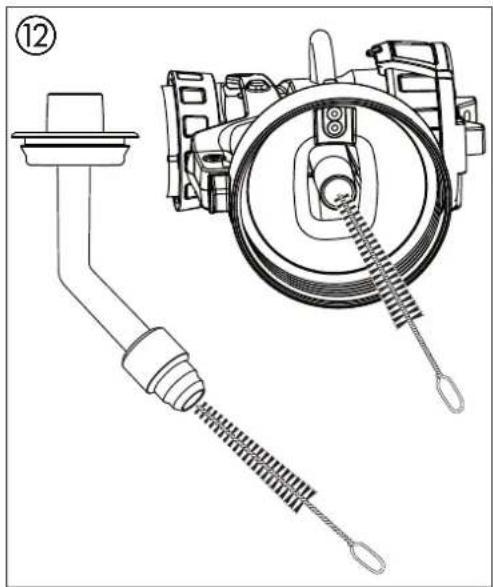
The enclosed brush set can be used for particularly effective cleaning of the spray attachment (examples Fig. 12 and 14).
- Clean feed tube and suction nozzle in spray attachment with cleaning brush. (Fig. 12)
- Clean the ventilating bore. (Fig. 9, 2)

CAUTION! Never clean seals, diaphragm and nozzle or air holes of the spray gun with metal objects. The ventilation hose and diaphragm are only solvent-resistant to a limited extent. Do not immerse in solvent, only wipe.
- Move the air cap (Fig. 13, 1) to the vertical position for easier removal and lift it off.
-
Unscrew the union nut (fig. 13, 2).
-
Clean the air cap (fig. 14, 1) and nozzle (3) with a brush and solvent or water.

Take special care when cleaning the interstices on the needle (Fig. 14, 5)
- Clean the outside of the spray gun and container with a cloth soaked in solvent or water. Use the all-purpose brush for the thread (Fig. 14, 6).
- Assemble the parts again (see "Assembly").
12.1 ASSEMBLY

ATTENTION! Follow the steps described below exactly for assembly. Otherwise the spray attachment may be damaged.
- Push nozzle seal onto the needle so that the groove (slot) points away from the spray attachment. (Fig. 15)
- Screw the union nut (Fig. 16, 2) onto the gun and tighten it.
- Engage the air cap (Fig. 17, 1) with the union nut. Check if the air cap has properly locked into place on both sides.
- Place the container seal from below on the feed tube and slide it over the collar, while turning the container seal slightly.
- Screw the feed tube with the container seal into the body of the gun.

In order to mount the gun more easily apply lubricating grease (enclosed) liberally to the O-ring at the spray attachment and to the O-ring of the plug connection of the air hose (Fig. 18).
13 MAINTENANCE
13.1 AIR FILTER

Attention! Never operate the device with the air filter soiled or missing, as dirt could be sucked up and affect the operation of the device. The air filter indicator lights up red if the air filter needs to be changed.
- Unplug the power plug.
- Open the cover on the air filter compartment (left and right) (Fig. 19).
- Depending on the degree of soiling, clean (blow out) the air filter (Fig. 19, 1) or replace it.
13.2 AIR RELIEF VALVE

If paint has entered the ventilation hose, proceed as follows:
- Pull the ventilating hose (Fig. 20, 1) at the top from the gun body. Screw off the valve cover (2). Remove the diaphragm (3). Clean all the parts carefully.

CAUTION! The ventilation hose and diaphragm are only solvent-resistant to a limited extent. Do not immerse in solvent, only wipe.
- Place the diaphragm in the valve cover with the pin facing forward (Also see the marking on the gun body).
- Turn the body of the gun upside down and screw on the valve cover from underneath.
- Place the ventilating hose on the valve cover and on the nipple at the gun body.
Warning
If the supply cord of this appliance is damaged, it must only be replaced by a repair shop appointed by the manufacturer, because special purpose tools are required.
Warning: Do not connect the blue or brown wire to the earth terminal of the plug! The wires in this mains lead are coloured in accordance with the following code:
$$ \text { blue } = \text { neutral brown } = \text { live } $$
As the colours of the wires in the mains lead of this appliance may not correspond with the coloured markings identifying the terminals in your plug, proceed as follows:
- Should the moulded plug have to be replaced, never re-use the defective plug or attempt to plug it into a different 13 A socket. This could result in an electric shock.
- Should it be necessary to exchange the fuse in the plug only use fuses approved by ASTA in accordance with BS 1362.5 Amp fuses may be used.
◆ To ensure that the fuse and fuse carrier are correctly mounted please observe the provided markings or colour coding in the plug.
◆ After changing the fuse, always make sure that the fuse carrier is correctly inserted. Without the fuse carrier, it is not permissible to use the plug.
◆ The correct fuses and fuse carriers are available from your local electrical supplies stockist.

text_image
Fit a BS 1363A approved plug Blue to be connected to N (neutral) Make sure that the outer sheath of the cable is held firmly by the clamp N L Fit the recommended fuse Brown to be connected to L (live) Never use a light socket14 CORRECTION OF MALFUNCTIONS
| MALFUNCTION CAUSE REMEDY | ||
| The unit will not start | No mains voltageDevice overheated | CheckUnplug the power plug, let the device cool down approx. 30 minutes, do not bend the hose, check the air filter, do not cover the intake slots |
| No coating material emerges from the nozzle | Nozzle cloggedMaterial volume setting too lowPaint container seal damagedNo pressure build-up in containerContainer emptyVentilation hose loose/damagedFeed tube looseFeed tube / feed tube filter cloggedAir vent on feed tube blockedDiaphragm stuck | CleanIncrease volumeReplaceTighten containerRefillInsert or replaceInsertClean or use another filterCleanRemove and clean (see section 13.2) |
| Coating material drips from the nozzle | Air cap, nozzle or needle soiledSpray attachment incorrectly assembledNozzle looseNozzle wornNeedle worn or damaged | CleanAssemble correctly (see section 12.1)Tighten Union nutChangeReplace the needle (service set 2434517) |
| Atomisation too coarse | Material volume too largeNozzle contaminatedViscosity of coating material too highToo little pressure build-up in containerAir filter heavily soiledAmount of air too lowAir hose damagedAir cap assembled incorrectly | Reduce volumeCleanDilute furtherTighten containerChange (see section 13.1)Increase volumeCheck and replace if necessarySnap air cap properly into place (fig. 17) |
| Spray jet pulsates | Coating material in container running outNozzle seal wornAir filter heavily soiledFeed tube looseFeed tube / feed tube filter clogged | RefillReplaceChange (see section 13.1)InsertClean or use another filter |
| Coating material causes "paint tears | Too much coating material appliedDistance too smallIncorrect spray attachment | Reduce volumeIncrease distanceUse another spray attachment |
| Excessive paint mist (overspray) | Distance to the object too largeToo much coating material appliedAmount of air too highCoating substance over-dilutedIncorrect spray attachment | Reduce distanceReduce volumeReduce degree of dilutionUse another spray attachment |
| Paint in the ventilating hose | Diaphragm soiledDiaphragm defective | Clean the diaphragm (see section 13.2)Replace the diaphragm (see section 13.2) |
15 ACCESSORIES AND SPARE PARTS
15.1 ACCESSORIES
| POS. | ORDER NO. | DESIGNATION |
| 1 | 2430386 | StandardSpray spray attachment (yellow) (with 1000 ml container)Processes all standard paints. |
| 2 | 2430385 | FineSpray spray attachment (brown) (with 1000 ml container)Ideal for low-viscosity paints and glazes. |
| 3 | 2430387 | WallSpray spray attachment (white) (with 1400 ml container)Designed for processing dispersions. |
| 4 | 2324 749 | Container (1400 ml) |
| 5 | 2350 692 | Can AdapterWith the Can Adapter, paint cans can be attached directly to a Click&Paint spray attachment.Suitable for: commercially available 750 ml paint tins (maximum dimensions =102 mm, h=119 mm)and 1000 ml paint tins (maximum dimensions =112 mm, h=132 mm). |
15.2 SPARE PARTS FINISHCONTROL 5500 (FIG. 21)
| POS. | ORDER NO. | DESIGNATION |
| 1 | 2434503 | Filter cover set |
| 2 | 2434505 | Air filter (4 pcs.) |
| 3 | 2434506 | Storage compartment cover |
| 4 | 2442011 | Gun handle with air hose |
| 5 | 2430409 | Cleaning brush set |
| 6 | 2442012 | Air hose fixing strap |
15.3 SPARE PARTS STANDARDSPRAY SPRAY ATTACHMENT (YELLOW) (FIG. 22)
| POS. | ORDER NO. | DESIGNATION |
| 1 | 2430386 StandardSpray spray attachment (yellow) (with 1000 ml container) | |
| 2 | 2434514 | Air cap (3 pcs.) |
| 3 | 2323934 Seal | |
| 4 | 2434513 Spray head service set (StandardSpray) | |
| 5 | 2434517 Needle service set (4.1 mm) | |
| 6 | 2434516 | Ventilating hose, valve cover, diaphragm |
| 7 | 2434524 | Suction system service set |
| 8 | 2434523 | Container seal (5 pcs.) |
| 9 | 2324248 | Fine feed tube filter (red, 5 pc.) |
| 2324249 | Coarse feed tube filter (white, 5 pc.) | |
| 10 | 2434525 | Container 1000 ml |
| 2315 539 | Lubricating grease | |
TESTING OF THE UNIT
For safety reasons, we would recommend having the device checked by an expert as required but at least every 12 months to ensure that it can continue to operate safely.
In the case of unused devices, the check can be postponed until they are next started up.
All (potentially deviating) national inspection and maintenance regulations must also be observed.
If you have any questions, please contact the customer service team at Wagner.
IMPORTANT INFORMATION ON PRODUCT LIABILITY
An EU directive valid since 01.01.1990 specifies that the manufacturer is only liable for his products if all the parts originate from the manufactured or are approved by him, and if the units are mounted and operated properly.
If accessories or spare parts from third parties are used, liability can be partially or completely inapplicable. In extreme cases the responsible authorities can prohibit the use of the entire unit (German industrial employer's liability insurance association and factory inspectorate).
With original WAGNER accessories and spare parts, compliance with all safety regulations is guaranteed.
NOTE ON DISPOSAL
In observance of the European Directive 2012/19/EU on waste electrical and electronic equipment and implementation in accordance with national law, this product is not to be disposed of together with household waste material but must be recycled in an environmentally friendly way!

Wagner or one of our dealers will take back your used Wagner waste electrical or electronic equipment and will dispose of it for you in an environmentally friendly way. Please ask your local Wagner service centre or dealer for details or contact us direct.
EU Declaration of conformity
We declare under sole responsibility that this product conforms to the following relevant stipulations:
2006/42/EC, 2014/30/EU, 2011/65/EU, 2012/19/EU
Applied harmonised norms:
EN 62841-1, EN 50580, EN IEC 55014-1, EN IEC 55014-2,
EN IEC 61000-3-2, EN 61000-3-3, EN 62233
The EU declaration of conformity is enclosed with the product.
If required, it can be re-ordered using order number
2434454.
3 + 2 YEAR GUARANTEE ON THIS WAGNER CONTRACTOR PRODUCT
(Status 03.03.2022)
WAGNER exclusively provides the commercial buyer who has purchased the product from an authorised specialist dealer (hereinafter referred to as the „Customer“) with a guarantee for the products listed on the Internet at https://go.wagner-group.com/3plus2-info in addition to the statutory warranty regulations, unless there is a guarantee exclusion.
The guarantee period for WAGNER products (devices) in the contractor's sector is 36 months and begins with the date of purchase of the initial purchase. This guarantee period is extended by a further 24 months if the product is registered within 28 days of purchase on the Internet at https://go.wagner-group.com/3plus2.
In cases of commercial rental, industrial use (e.g. use in shift operation) or equivalent use, the guarantee period is 12 months due to the significantly higher load. We reserve the right to carry out a check in individual cases and refuse the guarantee where necessary.
If any material, machining or performance defects are identified in the device within the guarantee period, then the guarantee claims must be made immediately and within a period of no more than 2 weeks following discovery of the defect.
The detailed guarantee conditions can be obtained on request from our authorised WAGNER partners (see website or operating instructions) or in text form on our website:
https://go.wagner-group.com/pf-warranty-conditions

Subject to modifications
UKCA Declaration of conformity
We declare under sole responsibility that this product conforms to the following relevant regulations:
Supply of Machinery (Safety) Regulations 2018
Electromagnetic Compatibility Regulations 2016
The Restriction of the Use of Certain Hazardous Substances in Electrical and Electronic Equipment Regulations 2012
The Waste Electrical and Electronic Equipment Regulations 2013
Applied harmonised standards
BS EN 62841-1, BS EN 50580, BS EN IEC 55014-1,
BS EN IEC 55014-2, BS EN 61000-3-2, BS EN 61000-3-3,
BS EN 62233
6.1 PRODUITS DE REVÊTEMENT APPLICABLES
natural_image
Cross-sectional diagram of a vehicle showing structural components and an arrow indicating direction (no text or labels)A Jet horizontal plat
14 ELIMINATION DES DÉFAUTS
INDICATION DE MISE AU REBUT
https://go.wagner-group.com/pf-warranty-conditions
15 Aan/uit-schakelaar (I = AAN, 0 = UIT)
5 INTRODUCTIE IN HET SPUITEN VOLGENS HET XVLP-PROCÉDÉ
natural_image
Pure mechanical cross-section diagram without any text, numbers, or symbolsA horizontale vlakke straal
10 ARBEIDSONDERBREKING
https://go.wagner-group.com/pf-warranty-conditions

natural_image
Cross-sectional diagram of a vehicle intake manifold showing internal components and directional arrow (no text or labels)A chorro en abanico horizontal
https://go.wagner-group.com/pf-warranty-conditions

15 ACCESSORI E RICAMBI 70
15.1 Accessori 70
15.2 Ricambi FinishControl 70
natural_image
Cross-sectional diagram of a vehicle intake manifold showing internal components and directional arrow (no text or labels)15 ACCESSORI E RICAMBI
15.1 ACCESSORI
POS. N° ORD. NOME
https://go.wagner-group.com/pf-warranty-conditions

15.2 Reservedele FinishControl 81
15.3 Reservedele pistol StandardSpray 81
2 BESKRIVELSE AF APPARATET (FIG. 1)
POS. BETEGNELSE
1 Pistol
natural_image
Pure mechanical cross-section diagram without any text, numbers, or symbolshttps://go.wagner-group.com/pf-warranty-conditions

5 INTRODUKTION TILL SPRUTNING MED XVLP ____ 87
6 SPRUTMATERIAL 87
5 INTRODUKTION TILL SPRUTNING MED XVLP
natural_image
Cross-sectional diagram of a mechanical component with internal structure and directional arrow (no text or labels)A vägrät flatstråle
https://go.wagner-group.com/pf-warranty-conditions

natural_image
Pure mechanical cross-section diagram without any text, numbers, or symbolsA jacto plano horizontal
https://go.wagner-group.com/pf-warranty-conditions

natural_image
Cross-sectional diagram of a mechanical component with no visible text or symbolsAUS Wagner Spraytech Australia Pty. Ltd. 8 – 10 Dansu Court Hallam, Victoria, 3803 Australia Customer Service 1800 924 637 info@wagneraustralia.com.au