
PSM1035 - Sander Ferm - Free user manual and instructions
Find the device manual for free PSM1035 Ferm in PDF.



| Product type | Triangular sander |
| Brand | Ferm |
| Model | PSM1035 |
| Mains voltage | 230 V~ |
| Mains frequency | 50 Hz |
| Power | 130 W |
| Idle speed | 14 000 min⁻¹ |
| Weight | 0.68 kg |
| Sound pressure level | 76 ± 3 dB(A) |
| Sound power level | 87 ± 3 dB(A) |
| Vibration | 3.017 ± 1.5 m/s² |
| Sanding type | Dry |
| Compatible materials | Wood, plastic, metal |
| Dust box | Yes, removable |
| Switch | On/Off |
| Double insulation | Yes |
| Maintenance | Clean with a soft, slightly damp cloth |
| Spare parts available | Abrasive paper, sanding pad |
| Warranty | Check the provided terms |
Frequently Asked Questions - PSM1035 Ferm
User questions about PSM1035 Ferm
0 question about this device. Answer the ones you know or ask your own.
Ask a new question about this device
Download the instructions for your Sander in PDF format for free! Find your manual PSM1035 - Ferm and take your electronic device back in hand. On this page are published all the documents necessary for the use of your device. PSM1035 by Ferm.
USER MANUAL PSM1035 Ferm
natural_image
Blue FERM power tool with orange light and mechanical components (no text or symbols visible)PSM1035
EN Original instructions 03
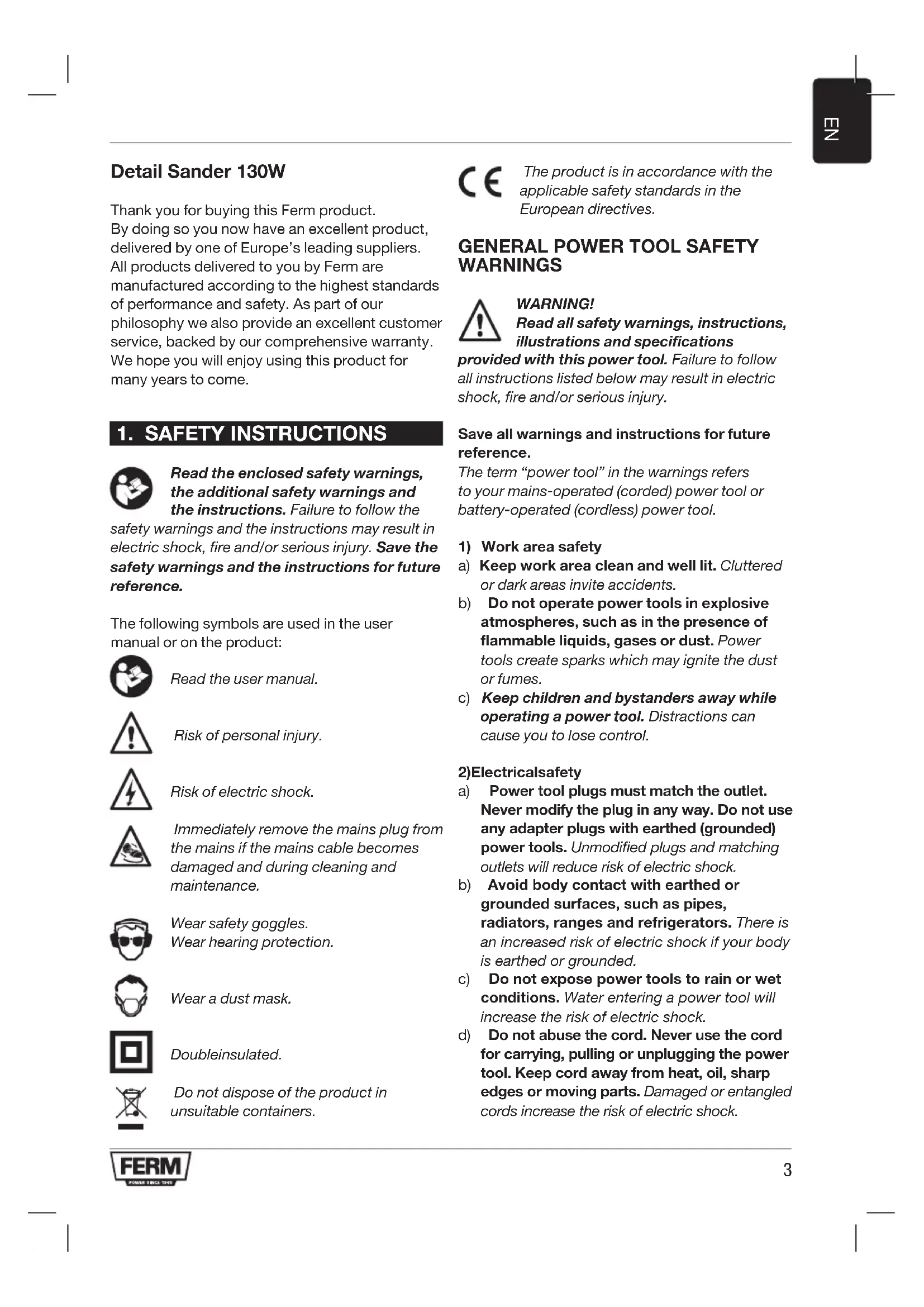
Thank you for buying this Ferm product. By doing so you now have an excellent product, delivered by one of Europe's leading suppliers. All products delivered to you by Ferm are manufactured according to the highest standards of performance and safety. As part of our philosophy we also provide an excellent customer service, backed by our comprehensive warranty. We hope you will enjoy using this product for many years to come.
1. SAFETY INSTRUCTIONS

Read the enclosed safety warnings, the additional safety warnings and the instructions. Failure to follow the
safety warnings and the instructions may result in electric shock, fire and/or serious injury. Save the safety warnings and the instructions for future reference.
The following symbols are used in the user manual or on the product:

Read the user manual.

Risk of personal injury.

Risk of electric shock.

Immediately remove the mains plug from the mains if the mains cable becomes damaged and during cleaning and maintenance.

Wear safety goggles. Wear hearing protection.

Wear a dust mask.

Doubleinsulated.

Do not dispose of the product in unsuitable containers.
CE
The product is in accordance with the applicable safety standards in the European directives.
GENERAL POWER TOOL SAFETY WARNINGS

WARNING!
Read all safety warnings, instructions, illustrations and specifications
provided with this power tool. Failure to follow all instructions listed below may result in electric shock, fire and/or serious injury.
Save all warnings and instructions for future reference.
The term "power tool" in the warnings refers to your mains-operated (corded) power tool or battery-operated (cordless) power tool.
1) Work area safety
a) Keep work area clean and well lit. Cluttered or dark areas invite accidents.
b) Do not operate power tools in explosive atmospheres, such as in the presence of flammable liquids, gases or dust. Power tools create sparks which may ignite the dust or fumes.
c) Keep children and bystanders away while operating a power tool. Distractions can cause you to lose control.
2) Electrical safety
a) Power tool plugs must match the outlet. Never modify the plug in any way. Do not use any adapter plugs with earthed (grounded) power tools. Unmodified plugs and matching outlets will reduce risk of electric shock.
b) Avoid body contact with earthed or grounded surfaces, such as pipes, radiators, ranges and refrigerators. There is an increased risk of electric shock if your body is earthed or grounded.
c) Do not expose power tools to rain or wet conditions. Water entering a power tool will increase the risk of electric shock.
d) Do not abuse the cord. Never use the cord for carrying, pulling or unplugging the power tool. Keep cord away from heat, oil, sharp edges or moving parts. Damaged or entangled cords increase the risk of electric shock.
e) When operating a power tool outdoors, use an extension cord suitable for outdoor use. Use of a cord suitable for outdoor use reduces the risk of electric shock.
f) If operating a power tool in a damp location is unavoidable, use a residual current device (RCD) protected supply. Use of an RCD reduces the risk of electric shock.
3) Personalsafety
a) Stay alert, watch what you are doing and use common sense when operating a power tool. Do not use a power tool while you are tired or under the influence of drugs, alcohol or medication. A moment of inattention while operating power tools may result in serious personal injury.
b) Use personal protective equipment. Always wear eye protection. Protective equipment such as dust mask, non-skid safety shoes, hard hat, or hearing protection used for appropriate conditions will reduce personal injuries.
c) Prevent unintentional starting. Ensure the switch is in the off-position before connecting to power source and/or battery pack, picking up or carrying the tool.
Carrying power tools with your finger on the switch or energising power tools that have the switch on invites accidents.
d) Remove any adjusting key or wrench before turning the power tool on. A wrench or a key left attached to a rotating part of the power tool may result in personal injury.
e) Do not overreach. Keep proper footing and balance at all times. This enables better control of the power tool in unexpected situations.
f) Dress properly. Do not wear loose clothing or jewellery. Keep your hair, clothing and gloves away from moving parts. Loose clothes, jewellery or long hair can be caught in moving parts.
g) If devices are provided for the connection of dust extraction and collection facilities, ensure these are connected and properly used. Use of dust collection can reduce dust related hazards.
h) Do not let familiarity gained from frequent use of tools allow you to become complacent and ignore tool safety
principles. A careless action can cause severe injury within a fraction of a second.
4) Power tool use and care
a) Do not force the power tool. Use the correct power tool for your application. The correct power tool will do the job better and safer at the rate for which it was designed.
b) Do not use the power tool if the switch does not turn it on and off. Any power tool that cannot be controlled with the switch is dangerous and must be repaired.
c) Disconnect the plug from the power source and/or the battery pack from the power tool before making any adjustments, changing accessories, or storing power tools. Such preventive safety measures reduce the risk of starting the power tool accidentally.
d) Store idle power tools out of the reach of children and do not allow persons unfamiliar with the power tool or these instructions to operate the power tool. Power tools are dangerous in the hands of untrained users.
e) Maintain power tools. Check for misalignment or binding of moving parts, breakage of parts and any other condition that may affect the power tool's operation. If damaged, have the power tool repaired before use. Many accidents are caused by poorly maintained power tools.
f) Keep cutting tools sharp and clean.
Properly maintained cutting tools with sharp cutting edges are less likely to bind and are easier to control.
g) Use the power tool, accessories and tool bits etc. in accordance with these instructions, taking into account the working conditions and the work to be performed. Use of the power tool for operations different from those intended could result in a hazardous situation.
h) Keep handles and grasping surfaces dry, clean and free from oil and grease. Slippery handles and grasping surfaces do not allow for safe handling and control of the tool in unexpected situations.
6)Service
a) Have your power tool serviced by a qualified repair person using only identical replacement parts. This will ensure that the safety of the power tool is maintained.
Additional safety warnings for delta sanders

Contact with or inhalation of dust coming free during use (e.g. lead-painted surfaces, wood and metal) can endanger your health and the health of bystanders. Always wear appropriate protective equipment, such as a dust mask. Always use proper dust extraction during use.
- Do not work materials containing asbestos. Asbestos is considered carcinogenic.
- Do not use the machine for sanding magnesium workpieces.
- Wear safety goggles. Wear hearing protection. If necessary, use other protective means, such as safety gloves, safety shoes, etc.
- Hold the machine by the insulated gripping surfaces where the accessory may contact hidden wiring or the mains cable. If the accessory contacts a ,live' wire, the exposed metal parts of the machine can also become ,live'. Risk of electric shock.
- Be very careful when sanding painted surfaces.
- Before use, remove all nails and other metal objects from the workpiece.
- Make sure that the workpiece is properly supported or fixed.
- Only use sanding paper that is suitable for use with the machine.
- Only use sanding paper with the correct dimensions. Make sure that the sanding paper is properly mounted.
- Inspect the sanding paper before each use. Do not use sanding paper that is worn because of prolonged use.
- Never put the machine down on a table or a workbench before it has been switched off.
Electrical safety

Always check that the voltage of the power supply corresponds to the voltage on the rating plate.
- Do not use the machine if the mains cable or
the mains plug is damaged.
- If the replacement of the supply cord is necessary, this has to be done by the manufacturer or his agent in order to avoid a safety hazard.
- Only use extension cables that are suitable for the power rating of the machine with a minimum thickness of 1.5 mm2. If you use a extension cable reel, always fully unroll the cable.
Technical data
Model No. PSM1035
| Mains voltage 230 V~ |
| Mains frequency 50 Hz |
| Power input 130 W |
| No-load speed 14,000 min-1 |
| Weight 0.68 kg |
NOISE AND VIBRATION
| Sound pressure (Lpa) 76 + 3 dB(A) |
| Acoustic power (Lwa) 87 + 3 dB(A) |
| Vibration 3.017 + 1.5 m/s2 |

Wear hearing protection.
Vibration level
The vibration emission level stated in this instruction manual has been measured in accordance with a standardised test given in EN 62841-1, EN 62841-2-4; it may be used to compare one tool with another and as a preliminary assessment of exposure to vibration when using the tool for the applications mentioned:
- the vibration emission during actual use of the power tool can differ from the declared total value depending on the ways in which the tool is used;
- need to identify safety measures to protect the operator that are based on an estimation of exposure in the actual conditions of use (taking account of all parts of the operating cycle such as the times when the tool is switched off and when it is running idle in addition to the trigger time).
Protect yourself against the effects of vibration by maintaining the tool and its accessories, keeping your hands warm, and organizing your work patterns
2. DESCRIPTION (FIG. A)
Intended use
The machine is designed for sanding wood, plastics and metal. This machine is suitable only for dry sanding. The machine is not suitable for processing objects containing asbestos. Improper use may damage the tool.
The numbers in the text refer to the diagrams on page 2.
- On/off switch
- Grip
- Dust box
- Sanding pad
- Sanding paper
- Slot
3. ASSEMBLY

Before assembly, always switch off the machine and remove the mains plug from the mains.
Connecting the dust box (Fig. B)
It is highly recommended to use the machine with the dust box (3), ensuring optimal dust collection.
- Slide the slot in the dust box over the notch on the rear dust outlet.
- To ensure the dust box is inserted securely, push the dust box until a click-noise can be heard.
Note: The dust box should be emptied when the box is half full to maintain optimal dust collection.
Mounting and removing sanding paper (Fig. C)
- Hold the machine on its side or upside down, as shown on Fig. C1.
- Mount sanding paper (5) with the required grain size onto the sanding pad (4). Make sure that the perforation in the sanding paper (5) corresponds to ponds with the perforation on the sanding pad (4), as shown on Fig. C2.
- To remove the sanding paper (5), simply pull the sanding paper from the sanding pad (4).
Note: Use coarse sanding paper for sanding rough, uneven surfaces. Use medium sanding paper for removing the remaining scratches from the coarse sanding paper. Use fine sanding paper for finishing surfaces.
Replacing the sanding pad (fig. D)
In case of wear, the sanding pad must be replaced.
- If necessary, remove the sanding paper.
- Loosen the screws from the sanding pad (4).
- Remove the old sanding pad.
- Mount the new sanding pad.
- Tighten the screws to the sanding pad (4).
4. USE
Switching on and off (fig. A)
- To switch on the machine, set the on/off switch (1) to the 'I' position.
- To switch off the machine, set the on/off switch (1) to the '0' position.
Hints for optimum use
- Firmly hold the machine by the grip.
- Switch on the machine.
- Place the sanding pad with sanding paper on the workpiece.
- Slowly move the machine over the workpiece, firmly pressing the sanding pad against the workpiece.
- Do not apply too much pressure on the machine. Let the machine do the work.
5. MAINTENANCE

Before cleaning and maintenance, always switch off the machine and remove the battery pack from the machine.
Clean the machine casings regularly with a soft cloth, preferably after each use. Make sure that the ventilation openings are free of dust and dirt. Remove very persistent dirt using a soft cloth moistened with soapsuds. Do not use any solvents such as gasoline, alcohol, ammonia, etc. Chemicals such as these will damage the synthetic components.
ENVIRONMENT

Faulty and/or discarded electrical or electronic apparatus have to be collected at the appropriate recycling locations.
Only for EC countries
Do not dispose of power tools into domestic waste. According to the European Guideline 2012/19/EC for Waste Electrical and Electronic Equipment and its implementation into national right, power tools that are no longer usable must be collected separately and disposed of in an environmentally friendly way.
WARRANTY
Consult the enclosed warranty terms.
FEINSCHLEIFER 130W
HANDPALMSCHUURMACHINE 130W
2. BESCHRIJVING (FIG. A)
Bedoeld gebruik
Only for EC countries
Hoidke juhised alles.
CE
DECLARATION OF CONFORMITY PSM1035 - DETAIL SANDER
(EN) We declare under our sole responsibility that this product is in conformity with directive 2011/65/EU of the European parliament and of the council of 8 June on the restriction of the use of certain hazardous substances in electrical and electronic equipment is in conformity and accordance with the following standards and regulations:
(DE) Der Hersteller erklärt eigenverantwortlich, dass dieses Produkt der Direktive 2011/65/EU des Europäischen Parlaments und des Rats vom 8. Juni 2011 über die Einschränkung der Anwendung von bestimmten gefährlichen Stoffen in elektrischen und elektronischen Geräten entspricht, den folgenden Standards und Vorschriften entspricht;
(NL) Wij verklaren onder onze volledige verantwoordelijkheid dat dit product voldoet aan de conform Richtlijn 2011/65/EU van het Europees Parlement en de Raad van 8 juni 2011 betreffende beperking van het gebruik van bepaalde gevaarlijke stoffen in elektrische en elektronische apparatuur en in overeenstem ming is met de volgende standaarden en reguleringen:
(FR) Nous déclarons sous notre seule responsabilité que ce produit est conforme aux standards et directives suivants: est conforme à la Directive 2011/65/EU du Parlement Européen et du Conseil du 8 juin 2011 concernant la limitation d'usage de certaines substances dangereuses dans l'équipement électrique et électronique.
(ES) Declaramos bajo nuestra exclusiva responsabilidad que este producto cumple con las siguientes normas y estándares de funcionamiento: se encuentra conforme con la Directiva 2011/65/UE del Parlamento Europeo y del Consejo de 8 de junio de 2011 sobre la restricción del uso de determinadas sustancias peligrosas en los equipos eléctricos y electrónicos.
(PT) Declaramos por nossa total responsabilidade de que este produto está em conformidade e cumpre as normas e regulamentações que se seguem: está em conformidade com a Directiva 2011/85/EU do Parlamento Europeu e com o Conselho de 8 de Junho de 2011 no que respeita à restrição de utilização de determinadas substâncias porigosas existentes em equipamento eléctrico e electrónico.
(IT) Dichiariamo, sotto la nostra responsabilità, che questo prodotto è conforme alle normative e ai regolamenti seguenti: è conforme alla Direttiva 2011/65/UE del Parlamento Europeo e del Consiglio dell'8 giugno 2011 sulla limitazione dell'uso di determinate sostanze pericolose nelle apparecchiature elettriche ed elettroniche.
(SV) Vi garanterar på eget ansvar att denna produkt uppfyller och följer följande standarder och bestämmelser; uppfyller direktiv 2011/65/EU från Europeiska parlamentet och EG-rådet från den 8 juni 2011 om begränsningen av användning av farliga substanser i elektrisk och elektronisk utrustning.
(FI) Vakuutamme yksinomaan omalla vastuullamme, että tämä tuote täyttää seuraavat standardit ja säädökset: täyttää Euroopan parlamentin ja neuvoston 8. kesäkuuta 2011 päivätyn direktiivin 2011/65/EU vaatimukset koskien vaarallisten aineiden käytön rajoitusta sähkö- je elektronisissa laitteissa.
(NO) Vi erklærer under vårt eget ansvar at dette produktet er i samsvarmed følgende standarder og regler: er i samsvar med EU-direktivet 2011/65/EU fra Europa-parlamentet og Europa-rådot, pr. 8 juni 2011, om begrensning i bruken av visse farlige stoffer i elektrisk og elektronisk utstyr.
(DA) Vierklærer under eget ansvar, at dette produkt er i overensstemmelse med folgende standarder og bestemmelsar: er i overensstemmelse med direktiv 2011/65/EU fra Europa-Parlamentet og Rådet af 8. juni 2011 om begrænsning af anvendelsen af visse farlige stoffer i elektrisk og elektronisk udstyr.
(HU) Felelősségünk teljes tudatában kijelentjük, hogy ez a termék teljes mértékben megfelel az alábbi szabványoknak és elěirásoknak: je v souladu se směmlící 2011/65/EU Evropského parlamentu a Rady EU ze dne 8. čarvna 2011, která se týká omezení použití určitých nebezpečných látek v elektrických a elektronických zařízeních.
(CS) Na naši vlastni zodpovědnost prohlašujeme, že je tento výrobek v souladu s následujicimi standardy a normami: Je v sólade s normou 2011/65/EÚ Európskeho parlamentu a Rady z 8. júna 2011 týkajúcej sa obmedzenia používania určitých nebezpečných látok v elektrickom a elektronickom vybavení.
(SK) Výhlasujeme na našu výhradnú zodpovednosť, že tento výrobok je v zhode a súlade s nasledujúcimí normami a predpísmí: Je v súlade s normou 2011/65/EÚ Európskeho parla mentu a Rady z. júna 2011 týkajúcoj sa obmedzenia používania určitých nebezpečných látok v elektrickom a elektronickom vybavení.
(SL) S polno odgovornostjo izjavljamo, da je taizdelek v skladu in da odgovarja naslednjim standardom terpredpisom: je v skladu z direktivo 2011/65/EU Evropskega parlamenta in Sveta z dne 8. junil 2011 o omejevanju uporabe določenih nevarnih snovi v električni in elektronski opremi.
(PL) Deklarujemy na własną odpowiedzialność, że ten produkt spełnia wymogi zawarte w następujących normach i przepisach: jest zgodny z Dyrektywą 2011/65/UE Parlamentu Europejskiego i Rady w dnia 3 czerwca 2011 rady sowie ograniczenia stosowania niektórych niebezpiecznych substancji w sprzecie elektrycznym i elektronicznym.
(LT) Prisiimdami visą atsakomybę deklaruojame, kad śis gaminys atitinka żemiau paminētus standartus arba nuostatus: atitinka 2011 m. birželio 8 d. Europos Parlamento ir Tarybos direktyvą 2011/65/EB dėl tam tikrų pavojingų medžiagų naudojimo elektros ir elektroninėje jrangoje aprnbojimo.
(LV) Ir atbilstoša Eiropas Parlamenta un Padomes 2011. gada 8. jūnija Direktīvai 2011/65/ES par dažu bīstamu vielu izmantošanas ierobežošanu elektriskās un elektroniskās iekārtās.
(ET) Apgalvojam ar visu atbildību, ka šis produkts ir saskaņā un atbilst sekojošiem standartiem un nolikumiem: ir atbilstoša Eiropas Parlamenta un Padomes 2011. gada 8. jūnija Di rektīvai 2011/65/ES par dažu bīstamu vielu izmantošanas ierobežošanu elektriskās un elektroniskās iekārtās.
(RO) Declarăm prin acaasta cu răspunderea deplină că produsul acesta este în conformitate cu următoarele standarde sau directive: este în conformitate cu Directiva 2011/65/UE a Parlamentului European și a Consiliului din 8 iunie 2011 cu privire la interzicerea utilizării anumitor substanțe periculoase la echipamentele electrice și electronice.
(HR) Izjavljujemo pod vlastitom odgovomoLšu da je strojem ukladan sa slijedešim standardima ili standardiziranim dokumentima i u skladu sa odredbama: usklađeno s Direktivom 2011/65/EU europskog parlamenta i vijeća izdanom 8. lipnja 2011. o ograničenju korištenja određenih opasnih tvani u električnoj i elektroničkoj opremi.
(SR) Pod punom odgovornošću izjavljujemo da je usaglašen sa sledećim standardima ili normama: usaglašen sa direktvom 2011/65/EU Evropskog parlamenta i Saveta od 8. juna.2011. godine za restrikciju upotrebe određenih opasnih materija u električnoj i elektronskoj opremi.
(RU) Под свою ответственность заявляем, что данное изделие соответствует следующим стандартам и нормам: соответствует требованиям Директивы 2011/65/EU
Европейского парламента и совета от 8 июня 2011 г. по ограничению использования определенных опасных веществ в электрическом и электронном оборудовании
(UK) На свою власну відповідальність заявляємо, що дане обладнання відповідає наступним стандартам і нормативам: задовольнає вимоги Директиви 2011/65/ЄС Європейського Парламенту та Ради від 8 червня 2011 року на обмеження використання деяких небезпечних речовин в електричному та електронному обладнанні.
(EL) Δηλώνουμε υπεύθυνα ότι το προϊόν αυτό συμφωνείκαι τρεί τους παρακατω κανονισμούς και πρότυπα: συμφορφάνεται με την Οδηγία 2011/85/ΕΕ του Ευρωπαϊκού Καινοβουλίου και του Συμβουλίου της 8ης Ιουνίου και τον περιορισμό της χρήσης οριομένων επικίνδυνων σουσιών σε ηλεκτρικό και ηλεκτρονικό εξοπλιμό
(BG) Ние декларираме на наша отговорност, че този продукт отоваря на съответствие с Директива 2011/65/EC на Европейския парламент и на Съвета от 8 юни 2011 г. относно ограничението на употребата на определени опасни вещества в електрическото и електронното оборудване, в съответствие следните стандарти и наредби:
(AR) تأسيجروتلاو روياعيلا عم وفراوتي جشجلا اده نا اندجو انستيرىكيم وملع نلعتن
(TR) Tek sorumlusu biz olarak bu ürünün aşağıdaki standart ve yönergelere uygun olduğunu beyan ederiz.
EN 55014-1, EN 55014-2, EN 62841-1, EN 62841-2-4, EN 61000-3-2, EN 61000-3-3
2014/30/EU, 2006/42/EC, 2012/19/EU, 2011/65/EU
Zwolle, 01-12-2021
H.G.F Rosberg
CEO FERM
FERM - Lingenstraat 6 - 8028 PM - Zwolle - The Netherlands


- PSM1035
- SAFETY INSTRUCTIONS
- GENERAL POWER TOOL SAFETY WARNINGS
- Save all warnings and instructions for future reference.
- 3) Personalsafety
- 6)Service
- Additional safety warnings for delta sanders
- Electrical safety
- Technical data
- Model No. PSM1035
- NOISE AND VIBRATION
- Vibration level
- DESCRIPTION (FIG. A)
- Intended use
- ASSEMBLY
- Connecting the dust box (Fig. B)
- Mounting and removing sanding paper (Fig. C)
- Replacing the sanding pad (fig. D)
- USE
- Switching on and off (fig. A)
- Hints for optimum use
- MAINTENANCE
- ENVIRONMENT
- Only for EC countries
- WARRANTY
- FEINSCHLEIFER 130W
- HANDPALMSCHUURMACHINE 130W
- BESCHRIJVING (FIG. A)
- Bedoeld gebruik
- Hoidke juhised alles.
- CE
- DECLARATION OF CONFORMITY PSM1035 - DETAIL SANDER
Brand : Ferm
Model : PSM1035
Category : Sander