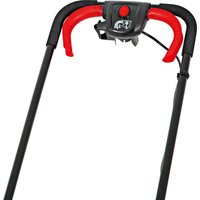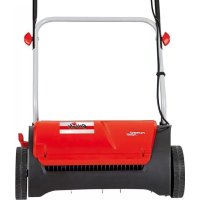
ES 1231 - Lawn mower Grizzly - Free user manual and instructions
Find the device manual for free ES 1231 Grizzly in PDF.


| Product type | Electric lawn scarifier and aerator |
| Brand | Grizzly |
| Model | ES 1231 |
| Motor power | 1200 W |
| Mains voltage | 220-240 V~, 50 Hz |
| Protection class | II |
| Protection type | IPX4 |
| Working width | max. 31 cm |
| Working depth | max. 10 mm (4 adjustment positions) |
| Weight | 8.6 kg |
| Sound pressure level (LpA) | 84 dB(A), uncertainty 3 dB |
| Guaranteed sound level (LWA) | 102 dB(A) |
| Handle vibration (ah) | 4.12 m/s², uncertainty 2.0 m/s² |
| Supplied rollers | Scarifying roller with steel blades (assembled) |
| Optional roller | Aerator roller with flexible teeth (not supplied) |
| Collection bag | Optional (not supplied) |
| Housing material | High-quality plastic |
| Usage | Domestic only (not industrial) |
| Warranty | 24 months |
| Recommended aeration frequency | Every 4 to 6 weeks |
| Recommended scarification frequency | Once a year, in spring after the first mowing |
| Spare parts available | Scarifying roller (91104428), Aerator roller (91104429), Collection bag (91104430) |
| After-sales service | www.grizzly-service.eu |
Frequently Asked Questions - ES 1231 Grizzly
User questions about ES 1231 Grizzly
0 question about this device. Answer the ones you know or ask your own.
Ask a new question about this device
Download the instructions for your Lawn mower in PDF format for free! Find your manual ES 1231 - Grizzly and take your electronic device back in hand. On this page are published all the documents necessary for the use of your device. ES 1231 by Grizzly.
USER MANUAL ES 1231 Grizzly
natural_image
Red and black lawn mower with attached frame (no text or symbols visible)ES 1231

Translation of the original instructions for use
GB Translation of the original instructions for use ....48
Before initial start-up, please read through these operating instructions carefully prior to using the machine. Keep the instructions safe and pass them on to any subsequent user so that the information is always available.
Grizzly Service-Center ....135

Grizzly Service-Center ....135

Safety instructions 48
Symbols / Instructions on the implement .... 49 Symbols in the manual.... 49
Generalnotesonsafety......49
Functionalparts....53
Functionaldescription....54
Assemblinginstructions....54
Extent of the delivery .... 54 Assembling the handle bar .... 54 Mounting and emptying the collection bag .... 54
Operation 55
Setting the working positions....55 Switching on and off....55 Working with the implement....56 Exchanging the cylinder....57
Cleaning, maintenance, storage .....57
General cleaning and maintenance work....57 Storage .... 58
Disposal and protection of the environment 58
Guarantee.... 58
Repair Service.... 58
Replacement parts/Accessories ..... 59
Technical data 59
Trouble shooting 60
Translation of the original EC declaration of conformity ....130
Exploded Drawing 134
Grizzly Service-Center 135

Before first using the machine, please read this instruction manual carefully, for your own safety and for the safety of others. Keep the manual in a safe place and pass it on to any subsequent owner to ensure that the information contained therein is available at all times.
Use
This implement is used: As a verticutor to cultivate the grass sward and thereby regenerate the lawn.
This appliance is not suitable for commercial use. Commercial use will void the warranty.
Any other use that is not specifically approved in these Instructions can result in damage to the implement and could be a serious danger to the user.
The implement must only be operated by adults. Children and people who are not familiar with these Instructions must not be allowed to use this implement. Never operate this implement while it is raining and in a wet environment.
The owner or operator is responsible for accidents or harm to people and their property.
The manufacturer cannot be held liable for damage caused by incorrect operation of the implement or if it is not used in conformity with its intended purpose.
Safety instructions
This section covers the basic safety instructions when working with this implement.
Symbols / Instructions on the implement
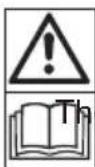
WARNING!
ese Instructions must be read!
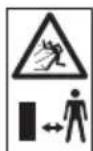
Danger of injury due to flung-out material! Keep bystanders well away from the implement..
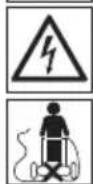
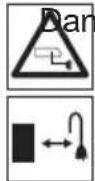
ger of electric shock
if the power cable is damaged! Always ensure that the power cable is kept well away from the implement and its cutting tools!

CAUTION – Sharp tools: Ensure that the hands and feet are kept well away from the cutting tools. The cutting cylinder continues to rotate briefly after the motor has been switched off!
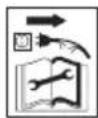
Always disconnect the plug from the mains prior to maintenance work or if the power cable is damaged!
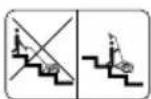
Caution with steps! Turn off the power when the implement is to be carried across steps!

Noise level ratings L_WA in dB(A).

Protection Class II
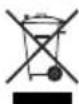
Electrically powered implements must not be disposed of with the domestic waste.
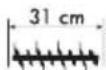
Working width
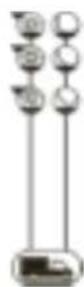
Read the Operating Instructions before setting up for work.
Symbols in the manual

Warning symbols with information on damage and injury prevention.

Instruction symbols (the instruction is explained at the place of the exclamation mark) with information on preventing damage..

Help symbols with information on improving tool handling.
General notes on safety

This implement can cause serious injuries if it is not properly used. Please read these Operating Instructions carefully and familiarize yourself with all the control elements before operating this implement. Keep these Operating Instructions in a readily accessible place so that this information is always at your disposal.
Operating the implement:

WARNING! The implement can cause serious injuries. How to avoid accidents and injuries:
GB
Preparations:
- The implement is not suitable for use by children.
- Never allow children and people who are not familiar with these Operating Instructions to use the implement. Local regulations may stipulate a minimum age for operators.
- Never start up the implement while other people, but especially children and domestic pets, are in the vicinity.
- Check the area on which the implement is to be used. Remove all stones, sticks, wire and other foreign bodies that could be caught up and flung out.
Never use the implement to level out uneven patches.
• Always wear appropriate protective work clothes and firm shoes with non-slip soles, strong long trousers, ear defenders and goggles. Never operate the implement while bare footed or when wearing open sandals. The protective devices and your personal protective equipment will protect yourself and other people and ensure that the equipment can be smoothly operated
- Never operate the implement if it is damaged, incomplete or has been modified without the consent of the manufacturer. Never work with damaged or missing protective devices (e.g. starting lever, unlocking knob, impact protector). Never disengage protective devices (e.g. by tying the starting lever). This ensures that the equipment remains safe.
- Before starting the equipment, ensure that no objects or branches are pushed into the blade opening, that the equipment is standing stably and that the workspace is tidy and not blocked.
Check the condition of your extension cable and the connecting cable of your equipment. Use the necessary protective equipment. There is a risk of injury.
- If your equipment vibrates or emits unusual noises when switched on, disconnect the plug from the socket and check the cutting cylinder. Ensure that no remains of chopped matter are blocking the cutting cylinder or jammed between the blades. If you find no problems, return the equipment to a customer service centre.
- If the blades no longer cut correctly or if the motor is overloaded, check all the parts of your equipment and replace the worn parts. If a more extensive repair is required, contact a customer service centre.
Use:
- CAUTION – A very sharp tool. Avoid cutting your fingers or toes. While working always keep your feet and fingers well away from the cutting cylinder and the ejector opening. There is the danger of serious injury!
- Do not operate the implement while it is raining, in poor weather conditions and when the surrounding area and lawn are wet. Operate the implement only during daylight hours or
with bright lighting. There is a risk of accidents.
- Do not operate the implement if you are tired or are lacking in concentration and after having drunk alcohol or taken medicine. Always take a work break in due time. Approach the work with common sense. A moment of carelessness when using the equipment can result in serious injury.
- Familiarize yourself with the terrain and remain focused on the potential hazards that you could miss on account of the motor noise.
- Always maintain a secure footing while working, especially on a sloping terrain. Always work across slopes - never up and down! Be particularly careful when changing the travelling direction. Do not work on very steep slopes. This enables you to control the equipment better in unexpected situations.
- Always guide the implement at a walking pace with both hands on the handle. Be especially careful when you turn the implement around or draw it towards you. Danger of stumbling!
- Start or actuate the starting lever with care and in conformity with the directions in these Instructions.
- Do not tilt the implement when starting, other than it has to be lifted. In this case tilt the implement only to the extent that is absolutely necessary and always lift the implement on the side that is opposite to the operator.
- Never operate the implement without the attached collection bag or impact protector. Danger of injury! Always keep well away from the ejector opening.
- Do not operate the implement in the vicinity of inflammable liquids or gases as this could give rise to the danger of a fire or explosion.
• Always disconnect the plug from the mains socket before working.
Work intervals:
• After the implement has been turned off, the cutting cylinder will continue to rotate for a few seconds. Keep hands and feet well away.
- Do not touch the spring tines before the implement has been disconnected from the mains and the spring tines have come to a complete standstill. Risk of injury owing to a sharp implement!
- Only remove plant parts when the implement is standing completely still. Ensure that the grass ejector opening is clean and free.
- Switch off the power when the implement is to be transported, lifted or tilted and when traversing other surfaces than grass.
- Never leave the implement unattended at the place of work. Children should be supervised to ensure that they do not play with the appliance.
• Always switch off the implement and disconnect the power plug:
- Whenever you leave the implement
GB
- Before you clean the ejector opening or unblock or unclog the implement
- When the implement is not being used
- During all maintenance and cleaning work
- When the power cable is damaged or has become tangled
- When the implement hits an obstruction during work or when unusual vibrations arise. Establish the cause and see if the implement has been damaged. Do not repair it yourself! Have the implement repaired by an authorised workshop!
- Store the implement in a dry place well out of reach of children.

CAUTION! The following states how to avoid damage to the implement and any resulting harm to people:
Take care of your implement:
- Switch off the power when the implement is to be carried across steps.
- Inspect the implement each time before it is to be used. Never operate the implement if safety devices (e.g. impact protector, parts of the cutting facility or bolts are missing, worn out or damaged. Check especially the power cable and starting lever for damage. To avoid imbalance, all tools and bolts must be exchanged as complete sets.
- Only use spare parts and accessories that have been supplied or recommended by the manufacturer. The use of alien parts results in the immediate loss of all guarantee claims.
- Ensure that all nuts, bolts and screws are firmly tightened and that the implement is in a safe working state.
- Never try to repair the implement yourself, other than you have been trained accordingly. All work that has not been listed in these Instructions must only be carried out by authorised servicing agencies.
- Treat the implement with the greatest care. Always keep the tool clean for better and safer work. Follow the maintenance instructions.
- Never overload the implement. Always work within the specified capacity range. Do not use low-power machines for heavy-duty work. Do not operate the implement for purposes for which it is not intended.
Electrical safety:

CAUTION! The following states how to avoid accidents and injuries due to electric shock:
- Before each use, carry out a visual inspection of the power and extension cables for signs of damage or ageing. Damaged mains power cables increase the risk of electric shock.
- Connect the implement to a power socket with a residual-current circuit breaker that has a rated current of not more than 30 mA.
• Always keep the extension cable well away from the cutting tools.
Should the power cable become damaged during work, then instantly disconnect the power cable from the mains. DO NOT TOUCH THE POWER CABLE BEFORE IT HAS BEEN DISCONNECTED FROM THE MAINS! Risk of electric shock.
- If the power cable for this equipment is damaged, it must be replaced by the manufacturer, a customer service agent of the same or a similarly qualified person in order to prevent hazards.
- Keep the extension cables away from the sprung tines. The tines may damage the cables and result in contact with live parts.
- Check that the mains voltage is the same as indicated on the rating plate.
- Avoid body contact with earthed parts (e.g. metal fences, metal posts). There is an increased risk of electric shock if your body is earthed.
- Only use approved extension cables of the type H05RN-F with a maximum length of 75 m and which have been approved for open-air use. The stranded cord diameter of the extension cable must be at least 2.5 mm ^2 .
Always unreel a cable drum to its full length so that the entire cable can be checked for damage.
- Use the envisaged cable suspension when attaching an extension cable.
- Never pull the cable to disconnect the plug from the socket. Protect the cable from heat, oil and sharp edges.
- If the connecting cable is damaged, first disconnect the extension cable from the socket. You can then disconnect the connecting cable of the equipment.
Functional parts

The illustration how to handle the appliance can be found on page 2-4.

1 Upper handle bar
2 Centre bars
3 Collection bag (sold separately)
4 Impact protector
5 Lower bar
6 2 Phillips screws for mounting the bar
7 2 rear wheels
8 2 wheels
9 Implement case
10 Setting button
11 a/b 2 cable clamps
12 a/b 4 screws and 4 wing nuts for attaching the bar
13 Connector
14 Unlocking button
15 Cable strain relief
16 Starting lever
17 Scarifier drum w/ blade (installed)
18 Aerator cylinder with sprung tines (sold separately)
GB
19 Shaft
20 Mounting bolt for drum
21 Bearing cover

22 Bag rod assembly
23 Plastic links
24 Pins
Functional description
The verticutor and lawn aerator has two easily exchangeable work cylinders: An aerator cylinder made of hard plastic with vertically rotating sprung tines, and a verticutor cylinder with vertically mounted high-grade steel knives.
The implement features a high-quality plastic case with collection bag and a handle bar with a folding function. Please refer to the subsequent descriptions for the actual functions of the individual control elements.
Assembling instructions

Prior to any work on the implement always disconnect the plug from the power socket!
Extent of the delivery
Carefully unpack the implement and check that all the subsequently listed parts are complete:
- Implement case with verticutor cylinder and impact protector
- Complete bar assembly with start lever, power plug, release knob and permanently attached power cord
-
Lower bar
-
2 centre bars
- 2 cable clamps
- Mounting accessories:
- Instruction Manual

Ensure during assembly that the power cable is not squeezed and that it has sufficient play.
Assembling the handle bar

-
Insert the lower bar (5) into the implement case (9) and screw it on with the two Philips screws.
-
Secure the two centre bars (2) to the lower bar (5) with the screws and wing nuts (12a).
- Use the screws and wing nuts (12b) from the package to mount the upper bar (1) on the two cross bars (2).
- Use the two cable clips (11 a/b) to attach the power cord to the bar.
Mounting and emptying the collection bag (sold separately)

WARNING: Never operate the implement without the impact protector. Danger of Injury!
The collection bag is delivered in a folded state and must therefore be assembled before it is mounted on the implement.

Assembling the collection bag:
- Slip the plastic straps (23) over the collection bag rods (22).
Mounting
on
the
the
implement:
- Lift the impact protector (4).
- Push the pins (24) on the collection bag rods (22) into the socket in the implement case (9).
- Release the impact protector so that it holds the collection bag (3) in its position.
Removing
collection
and
bag:
- Lift the impact protector (4) and take out the collection bag (3).
Operation

Please observe local regulations concerning noise protection.
Setting the working positions
natural_image
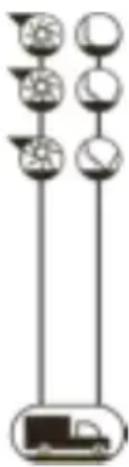
Simple line diagram of a truck with three vertical bars and circular icons above (no text or symbols)The implement has 4 principal position settings:
Transport position:
This position sets the maximum safety spacing between the tool and the floor.
Working position:
Set this position when working with a new implement.
Readjustment positions:
The working position can be lowered with increased knife and sprung tine wear. Wear can be identified from an increasingly poor result.
The readjusting depth amounts to approx. 3 mm per setting.

When the impairment is delivered it is in the Transport Position setting
- Check that the appliance is turned off before adjusting the working position.
- Pull up the adjusting knob (see A, no. 10). Turn the knob as appropriate and push it down to snap in. Use your other hand to hold the appliance.

The setting button is not intended for height adjustment but rather to compensate for wear. Selection of a readjustment position without the corresponding wear can overload the motor and damage the cylinder.
Switching on and off

Before switching on the implement ensure that it is not in contact with any objects. Keep your feet and hands well away from the cylinder and the ejector opening. Danger of injury!

-
Place the implement on a level lawn surface.
-
Form a loop in the end of the power cable and hang it into the strain relief (15).
- Connect the implement to the mains voltage.
- To switch on press the unlocking button on the handle (14) and simultaneously press the starting lever (16). Release the unlocking button (14).
- To switch off release the starting lever (16).

Overload protection: The motor is automatically switched off when the implement is overloaded. Release
GB
the starting lever and reset the implement after a cooling down period of approx. 1 minute.

WARNING! The cylinder continues to run for a brief period after the implement has been switched off. Do not tilt or carry the implement while the motor is still running and do not touch the cylinder while it is still rotating. Danger of injury!
Working with the implement
To maintain a well cared-for lawn it should be aerated every 4 to 6 weeks.
Verticuting is a more intensive intervention than aerating and should only be carried out once a year, the best time being in spring after the lawn has been mown for the first time.

When working on slopes always proceed across the slope. Be particularly careful when walking backwards and pulling the implement. Danger of stumbling!

The shorter the grass, the better the lawn can be treated. Furthermore, the implement is less stressed and the service life of the cylinder is prolonged.
- The implement can be operated with or without the collection bag.
Recommendation: Work with the collection bag for aerating and without the collection bag for verticuting. - To ensure that the collision guard flap closes properly, remove any earth that may have collected on the collision guard springs and/or the housing.
When working without the bag, check that the collision guard flap is tightly closed.
- Mow the lawn to the required grass height.
- Do not use the scarifier in long grass. It may otherwise wind around the scarifier blade and result in damage to the equipment.
- Select the appropriate working or readjustment position (in the event of cylinder wear) so that the implement is not overloaded.
- Commence work in the vicinity of the power socket and proceed away from the socket.
• Always ensure that the extension cable is behind you, and after turning move it to the side that has already been treated. - Guide the implement at a walking pace down lanes that are as straight as possible. To ensure uninterrupted aerating or verticuting the individual lanes should always overlap by a few centimetres. Dwelling too long at the same place while the implement is running can damage the grass sward.
- To ensure that the extension cable is not an impediment, turn the implement in such a manner that the cable strain release on the bar always faces the side that has been treated.

After work and to transport the implement disconnect the power plug and wait until the cylinder is standing still.
- Adjust the transport position setting (see "Setting the Working Position") when transporting the implement.
-
Lift the implement to transport it over steps and sensitive surfaces (e.g. tiles).
-
Always clean the implement after each use (see “Cleaning, Maintenance, Storage”).
- After having treated lawns with dense moss growth, it is advisable to reseed the lawn so that it can regenerate itself quicker.
Exchanging the cylinder

Switch off the implement, disconnect the mains plug and wait until the cylinder is standing still.

Wear gloves when handling the cylinder.

-
Turn the implement over.
-
Release the fastening screw (20) and fold the bearing cover (21) away.
- Tilt the cylinder upwards and pull the shaft (19) out of its seat.
- Insert the new cylinder by reversing the sequence.
Cleaning, maintenance, storage

Work that has not been de- scribed in these Instructions must be carried out by a servic- ing agency authorised by us. Only use original parts.

Wear gloves when handling the cylinder.

Prior to all maintenance and cleaning work always switch off the implement, disconnect the plug from the power socket and wait until the cylinder is standing still.
General cleaning and maintenance work

Do not jet water onto the implement and do not clean it under flowing water. This would result in the danger of an electric shock and the implement could be damaged.
- When work has finished remove plant residues adhering to the wheels, inside the ventilation opening, the grass ejector opening and the cylinder. Do not use hard or pointed objects for this purpose as they could damage the implement.
- To ensure that the collision guard flap closes properly, remove any earth that may have collected on the collision guard springs and/or the housing.
- Completely empty the collection bag.
• Always keep the implement clean. Do not use cleaning agents or solvents.
We cannot be held liable for damage caused by our implements if they were improperly repaired, if non-original parts have been used or if they were used not in keeping with their intended purpose.
Storage
- Store the implement in a dry place well out of reach of children.
- Allow the motor to cool down before placing the implement in a closed room.
- Do not wrap nylon sacks around the implement as this could result in the formation of moisture.

To store the appliance, you can reduce its footprint by loosening the wing nuts (12a/b) and folding down the bar.
Ensure that the cables are not squeezed.
Disposal and protection of the environment
Dispose of the implement, accessories and packaging in an environment-friendly manner.
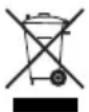
Electrically-powered appliances must not be disposed of with the domestic waste.
Hand in the spent implement to a recycling centre. The plastic and metal parts can then be sorted out and graded for recycling. Our Service Center will be happy to answer any questions in this respect. We will dispose of your implements free of charge
Guarantee
- There is a 24-month warranty on this appliance. This non-transferable warranty applies to the original purchaser only.
- This appliance is not suitable for commercial use. Commercial use will void the warranty.
- This guarantee does not apply to natural wear, overloading or improper use. Certain parts are subject to normal wear and are excluded from the guarantee. This applies especially to the aerator and verticutor cylinders.
- To qualify for any warranty claims, you must also service the appliance at the intervals specified in the operating instructions and comply with the cleaning, maintenance and servicing information.
- Damage caused by material or manufacturer faults will be remedied free of charge by replacement or repair.
- Claim for such damages by returning the non-dismantled unit together with its receipt slip and warranty card to your dealer.
Repair Service
- Repairs that are not subject to this guarantee can be carried out by our Service Center against a corresponding charge. Our Service Center will be happy to submit a cost estimate.
We can only deal with implements that have been adequately packed and carriage paid.
- Implements dispatched by unpaid carriage – as bulky goods, by express or other special freight forms – will not be accepted.
• We will dispose of your implements free of charge
Replacement parts/Accessories
Spare parts and accessories can be obtained at www.grizzly-service.eu.
If you do not have internet access, please contact the Service Centre (see "Grizzly Service-Center"). Please have the order number mentioned below ready.
Scarifier drum 91104428
Aerator drum....91104429
Collection bag....91104430
Technical data
Electric Scarifier ...... ES 1231
Motor input.....1200 W
Rated voltage ...... 220-240 V\~, 50 Hz
Protection Class ....□ II
Degree of protection....IPX4
Working width....max. 31 cm
Working depth ......max. 10 mm
Weight 8.6 kg
Acoustic pressure level
(L_pA) 84 dB(A); K_pA = 3 dB
Sound power level ( L_WA )
measured .....98.6 dB(A); K_WA = 1.54 dB
guaranteed....102 dB(A)
Vibration at the handle
(a_h) 4.12 m/s²; K = 2.0 m/s^2
The stated vibration emission value was measured in accordance with a standard testing procedure and may be used to compare one power tool to another.
The stated vibration emission value may also be used for a preliminary exposure assessment.

Warning: The vibration emission value may differ during actual use of the power tool from the stated value depending on the manner in which the power tool is used.
Safety precautions aimed at pro- tecting the user should be based on estimated exposure under actual usage conditions (all parts of the operating cycle are to be considered, including, for example, times during which the power tool is turned off and times when the tool is turned on but is running idle).
The noise and vibration values have been determined in accordance with the standards and regulations specified in the declaration of conformity.
Technical and visual modifications may be made without notice in the course of further development. All dimensions, information and specifications in these operating instructions are therefore not guaranteed. As such, no assertion of legal claims can be enforced on the basis of the operating instructions.
Trouble shooting
| Problem Possible | cause Remedy | |
| Abnormal noises, clatter or vibrations | Foreign body on cylinder Remove | move foreign body |
| Damaged sprung tines or cylinder knives | Exchange cylinder | |
| Cylinder incorrectly mounted | Install cylinder correctly (see chapter on exchanging the cylinder) | |
| Toothed-belt slip Repair by After-Sales Service | ||
| Implement does not start | No power | Check power socket, cable, line; repair only by qualified electrician |
| Defective start lever or release button | Repair by After-Sales Service | |
| Carbon brushes worn out | ||
| Motor defective | ||
| Motor fails | Blocked by foreign body Remove | move foreign body |
| Grass is too long | Mow beforehand; see chapter “Operation” | |
| Clogged discharge Clean discharge | Charge | |
| Overload protection tripped | Allow implement to cool down for about 1 minute | |
| Work result not satisfactory | Sprung tines of aerator cylinder worn out | Exchange cylinder |
| Knives of verticutor cylinder blunt or damaged | Exchange cylinder | |
| Toothed belt defective Repair | by After-Sales Service | |
| Transport Position or incorrect Working Position selected | Select Working Position or Readjust Position (see chapter “Setting the Working Positions) | |
| Grass is too long | Mow beforehand; see chapter “Operation” | |
Inhoud
Grizzly Service-Center ....135

Grizzly Service-Center ....135

natural_image
Pure diagram of three vertical lines with circular icons and a truck icon, no text or symbols present.natural_image
Simple line diagram of a truck with three vertical bars and circular icons above (no text or symbols)natural_image
Simple line diagram of a truck with three vertical icons above it, no text or symbols present.Prietaisas turi 4 pagrindines nustatymo padètis:
transportavimo padètis
Grizzly Service-Center

Unit 3, Beldray Park
Beldray Road, Mount Pleasant
Bilston, West Midlands WV14 7NH
Tel.: 0845 683 2672
e-mail: care@novoserv.co.uk