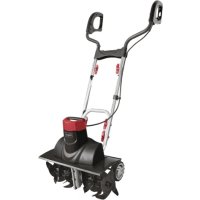
MTE450 - Milling machine SCHEPPACH - Free user manual and instructions
Find the device manual for free MTE450 SCHEPPACH in PDF.



| Product type | Motor hoe (garden tiller) |
| Brand | Scheppach |
| Model | MTE450 |
| Rated power | 1500 W |
| Supply voltage | 230 V ~ 50 Hz |
| Working width | 450 mm |
| Maximum working depth | 180 mm (4 adjustment levels) |
| Sound power level (LwA) | 93 dB(A) |
| Sound pressure level | 82.6 dB(A) |
| Handle vibrations | 1.796 m/s² (uncertainty K=1.5 m/s²) |
| Protection class | II (double insulation) |
| Protection type | IPX4 (protected against water splashes) |
| Weight | 13.1 kg |
| Handlebar | Foldable, with ergonomic handles and accelerator |
| Depth adjustment device | Height adjustable (4 positions) |
| Tine shaft | Right and left mounting |
| Safety switch | On/Off with unlock button |
| Materials | Steel, plastic, aluminum |
| Power cable length | Not specified (recommended extension cable max. 75 m) |
| Wear parts | Carbon brushes and tines (not included in delivery) |
| Included accessories | Handlebar, spacer, depth adjustment device, power cable, assembly tools |
| Intended use | Turning over soil in flower beds and gardens |
| Storage | Dry, dark, frost-free place (5 °C to 30 °C) |
Frequently Asked Questions - MTE450 SCHEPPACH
User questions about MTE450 SCHEPPACH
0 question about this device. Answer the ones you know or ask your own.
Ask a new question about this device
Download the instructions for your Milling machine in PDF format for free! Find your manual MTE450 - SCHEPPACH and take your electronic device back in hand. On this page are published all the documents necessary for the use of your device. MTE450 by SCHEPPACH.
USER MANUAL MTE450 SCHEPPACH
natural_image
Black and white photo of a small manual tiller with visible blades and handle (no text or symbols)MTE450
| DE | Elektro-MotorhackeOriginalbetriebsanleitung | 9 |
| GB | Electric TillerTranslation from the original instruction manual | 20 |
| FR | Motobineuse électriqueTraduction des instructions d'origine | 30 |
| NL | Elektrische tuinhakVertaling van de oorspronkelijke gebruiksaanwijzing | 41 |
| IT | Zappa elettrica da giardinoTraduzioni del manuale d'uso originale | 51 |
| ES | Scarificateur / aerateur électriqueTraducción de las instrucciones originales de funcionamiento | 62 |
| PL | Jednoosiowe elektryczne tłumaczenie z oryginalnej instrukcji | 73 |
| CZ | Elektrický kultivátorPřeklad originálního návodu k obsluze | 84 |
| SK | Elektrická motorová plečkaPreklad originálu návodu na obsluhu | 95 |
| HU | Elektromos motoros kapaAz eredeti használati útmutató fordítása | 106 |


natural_image
Close-up of a mechanical clamp or bracket assembly with hands adjusting parts, labeled 5 and 10 (no text or symbols on the main subject)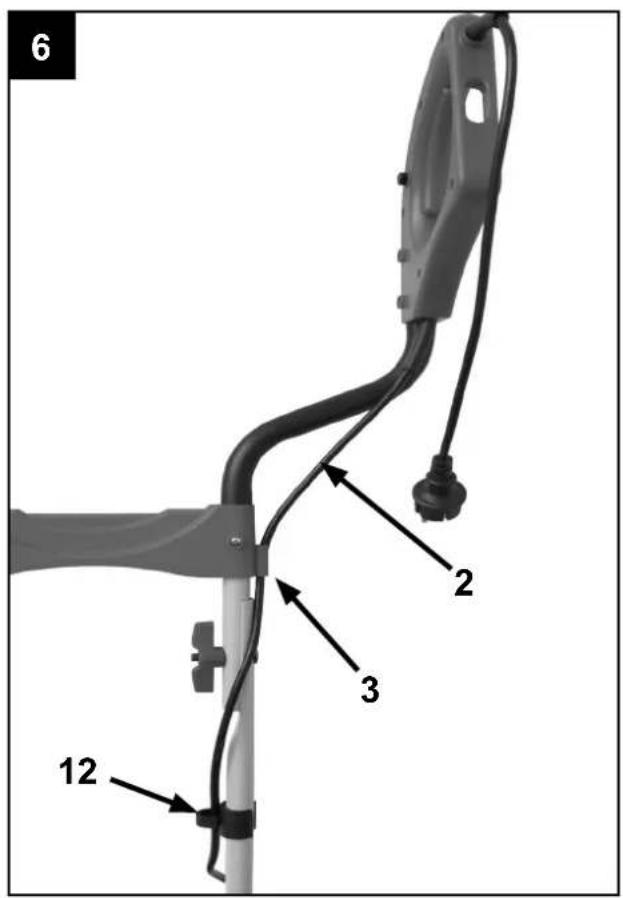



natural_image
Person using a handheld electric power tool, no visible text or symbols on the device or backgroundGünzburger Straße 69
D-89335 Ichenhausen
VEREHRTER KUNDE,
Explanation of the symbols on the equipment









Read instruction manual and safety instructions before starting up and pay attention!
Wear safety goggles!
Wear ear-muffs!
Wear work gloves!
Wear robust footwear when using the device!
Attention! Do not touch rotating parts. There is a serious risk of injury!
m WARNING!
Don't use your device in moisty weather.
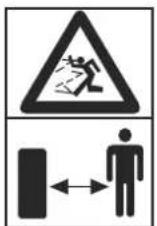
Risk of catapulted parts if the engine is running.
Be sure to keep a safe distance.
Protection class II
Switch off and unplug the device before cleaning or performing maintenance on it.
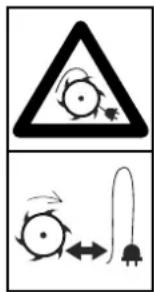
Attention! Power cord can be pulled in. Keep the power cord away from the cutting rollers.

Guaranteed sound power level L_WA 93dB
Table of contents: Page:
- Introduction 23
- Device description 23
- Scope of delivery 23
- Intended use 24
- Safety information 24
- Technical data 26
- Before starting the equipment 26
- Transport 27
- Maintenance 27
-
Storage 28
-
Electrical connection 28
-
Disposal and recycling 28
-
Spare-part ordering 28
-
Troubleshooting 29
-
Declaration of conformity 121
1. Introduction
MANUFACTURER:
scheppach
we hope your new tool brings you much enjoyment and success.
NOTE:
According to the applicable product liability laws, the manufacturer of the device does not assume liability for damages to the product or damages caused by the product that occurs due to:
- Improper handling,
• Non-compliance of the operating instructions, - Repairs by third parties, not by authorized service technicians,
- Installation and replacement of non-original spare parts,
- Application other than specified,
- A breakdown of the electrical system that occurs due to the non-compliance of the electric regulations and VDE regulations 0100, DIN 57113 / VDE0113.
WE RECOMMEND:
Read through the complete text in the operating instructions before installing and commissioning the device. The operating instructions are intended to help the user to become familiar with the machine and take advantage of its application possibilities in accordance with the recommendations. The operating instructions contain important information on how to operate the machine safely, professionally and economically, how to avoid danger, costly repairs, reduce downtimes and how to increase reliability and service life of the machine.
In addition to the safety regulations in the operating instructions, you have to meet the applicable regulations that apply for the operation of the machine in your country. Keep the operating instructions package with the machine at all times and store it in a plastic cover to protect it from dirt and moisture. Read the instruction manual each time before operating the machine and carefully follow its information. The machine can only be operated by persons who were instructed concerning the operation of the machine and who are informed about the associated dangers. The minimum age requirement must be complied with. In addition to the safety notices contained in this operating manual and the particular instructions for your country, the generally recognised technical regulations for the operation of identical devices must be complied with.
We cannot accept any liability for damage or accidents which arise due to a failure to follow these instructions and the safety instructions.
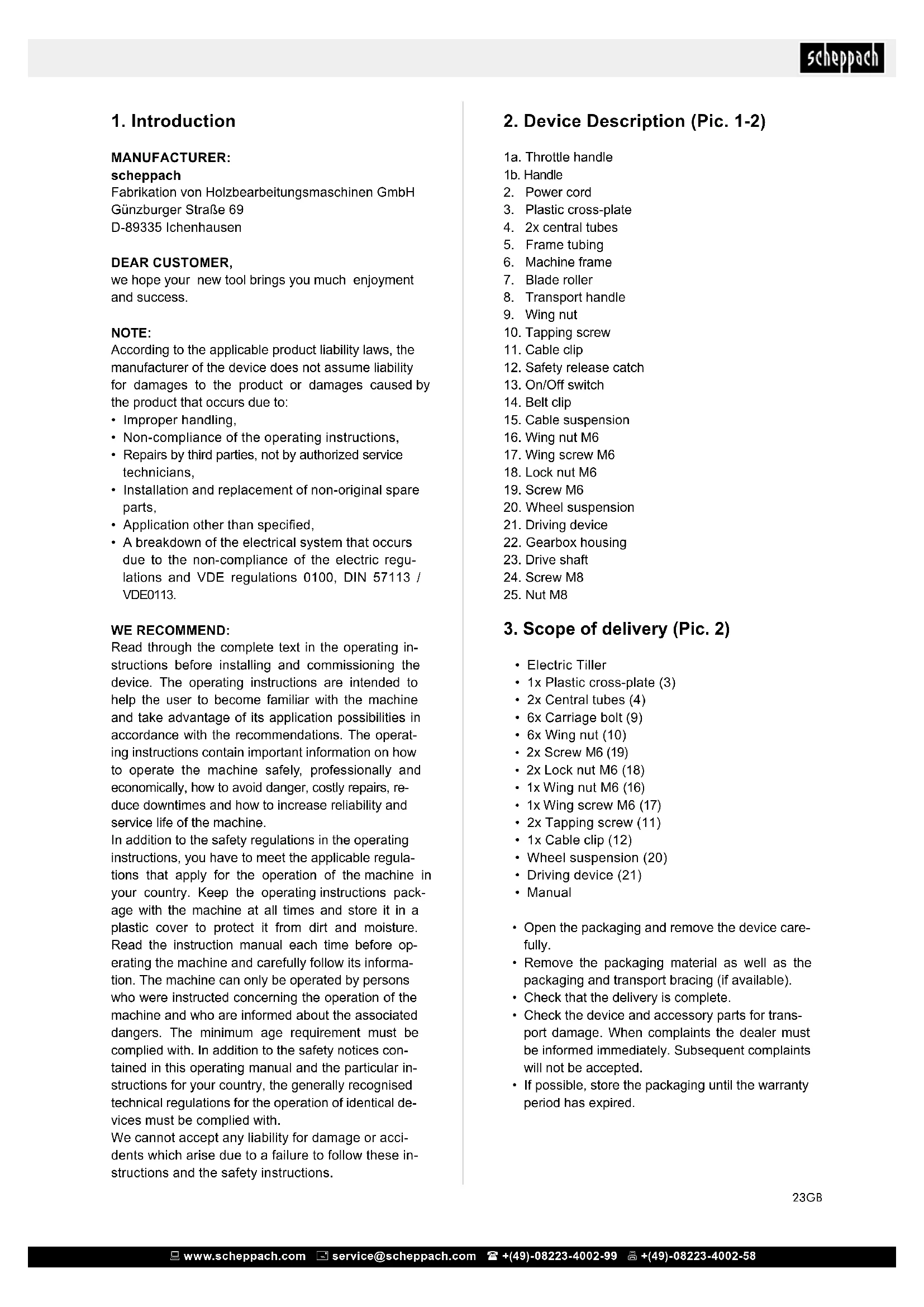
2. Device Description (Pic. 1-2)
1a. Throttle handle
1b. Handle
-
Power cord
-
Plastic cross-plate
-
2x central tubes
-
Frame tubing
-
Machine frame
-
Blade roller
-
Transport handle
-
Wing nut
-
Tapping screw
-
Cable clip
-
Safety release catch
-
On/Off switch
-
Belt clip
-
Cable suspension
-
Wing nut M6
-
Wing screw M6
-
Lock nut M6
-
Screw M6
-
Wheel suspension
-
Driving device
-
Gearbox housing
-
Drive shaft
-
Screw M8
-
Nut M8
3. Scope of delivery (Pic. 2)
- Electric Tiller
• 1x Plastic cross-plate (3) - 2x Central tubes (4)
- 6x Carriage bolt (9)
- 6x Wing nut (10)
- 2x Screw M6 (19)
• 2x Lock nut M6 (18)
• 1x Wing nut M6 (16)
• 1x Wing screw M6 (17)
• 2x Tapping screw (11) - 1x Cable clip (12)
• Wheel suspension (20) - Driving device (21)
-
Manual
-
Open the packaging and remove the device carefully.
- Remove the packaging material as well as the packaging and transport bracing (if available).
- Check that the delivery is complete.
- Check the device and accessory parts for transport damage. When complaints the dealer must be informed immediately. Subsequent complaints will not be accepted.
- If possible, store the packaging until the warranty period has expired.
ATTENTION!
The device and packaging materials are not toys! Children must not be allowed to play with plastic bags, film and small parts! There is a risk of swallowing and suffocation!
4. Intended use
The machine is designed for digging over beds and fields. Be sure to observe the restrictions in the additional safety instructions.
The equipment is allowed to be used only for its prescribed purpose. Any other use is deemed to be a case of misuse. The user/operator and not the manufacturer will be liable for any damage or injuries of any kind resulting from such misuse.
Please note that our equipment has not been designed for use in commercial, trade or industrial applications.
Our warranty will be voided if the equipment is used in commercial, trade or industrial businesses or for equivalent purposes.
5. Safety information
General safety instructions
This implement can cause serious injuries if it is not properly used. Please read these Operating Instructions carefully and familiarize yourself with all the control elements before operating this implement. Keep these Operating Instructions in a readily accessible place so that this information is always at your disposal.
Operating.the.implement:
WARNING! The implement can cause serious injuries. How to avoid accidents and injuries:
Preparations:
- Never allow children and people who are not familiar with these Operating Instructions to use the implement. Local regulations may stipulate a minimum age for operators.
- This appliance is not intended for use by persons (including children) with reduced physical, sensory or mental capabilities, or lack of experience and knowledge, unless they have been given supervision or instruction concerning use of the appliance by a person responsible for their safety.
- Never start up the implement while other people, but especially children and domestic pets, are in the vicinity.
- Check the area on which the implement is to be used. Remove all stones, sticks, wire and other foreign bodies that could be caught up and flung out.
-
Always wear appropriate protective work clothes and firm shoes with nonslip soles, strong long trousers, ear defenders and goggles. Never operate the implement while bare footed or when wearing open sandals.
-
Never operate the implement if it is damaged, incomplete or has been modified without the consent of the manufacturer. Never work with damaged or missing protective devices (e.g. starting lever, unlocking knob, impact protector).
- Never disengage protective devices (e.g. by tying the starting lever).
- Children must be supervised in order to ensure that they do not play with the equipment.
- Before starting the equipment, ensure that no objects or branches are pushed into the blade opening, that the equipment is standing stably and that the workspace is tidy and not blocked. Check the condition of your extension cable and the connecting cable of your equipment. Use the necessary protective equipment.
- If your equipment vibrates or emits unusual noises when switched on, disconnect the plug from the socket and check the cutting cylinder. Ensure that no remains of chopped matter are blocking the cutting cylinder or jammed between the blades. If you find no problems, return the equipment to a customer service centre.
- If the blades no longer dig correctly or if the motor is overloaded, check all the parts of your equipment and replace the worn parts. If a more extensive repair is required, contact a customer service centre.
Use:
- CAUTION – A very sharp tool. Avoid cutting your fingers or toes. While working always keep your feet and fingers well away from the cutting cylinder and the ejector opening. There is the danger of serious injury!
- Do not operate the implement while it is raining, in poor weather conditions and when the surrounding area and lawn are wet. Operate the implement only during daylight hours or with bright lighting.
- Do not operate the implement if you are tired or are lacking in concentration and after having drunk alcohol or taken medicine. Always take a work break in due time. Approach the work with common sense.
- Familiarize yourself with the terrain and remain focused on the potential hazards that you could miss on account of the motor noise.
- Always maintain a secure footing while working, especially on a sloping never up and down! Be particularly careful when changing the travelling direction. Do not work on very steep slopes.
- Always guide the implement at a walking pace with both hands on the handle. Be especially careful when you turn the implement around or draw it towards you. Danger of stumbling!
- Start or actuate the starting lever with care and in conformity with the directions in these Instructions.
- Do not tilt the implement when starting, other than it has to be lifted. In this case tilt the implement only to the extent that is absolutely necessary and always lift the implement on the side that is opposite to the operator.
- Do not operate the implement in the vicinity of inflammable liquids or gases as this could give rise to the danger of a fire or explosion.
Work intervals:
- After the implement has been turned off, the cutting cylinder will continue to rotate for a few seconds. Keep hands and feet well away.
- Only shift working depth when the implement is completely stillstanding.
- Only remove plant parts and soil when the implement is standing completely still.
- Switch off the power when the implement is to be transported, lifted or tilted and when traversing other surfaces than soil.
- Never leave the implement unattended at the place of work.
- Always switch off the implement and disconnect the power plug:
- Whenever you leave the implement
- Before you clean the ejector opening or unblock or unclog the implement
- When the implement is not being used
- During all maintenance and cleaning work
- When the power cable is damaged or has become tangled
- When the implement hits an obstruction during work or when unusual vibrations arise. Establish the cause and see if the implement has been damaged.
- Do not repair it yourself! Have the implement repaired by an authorised workshop!
- Store the implement in a dry place well out of reach of children.
CAUTION! The following states how to avoid damage to the implement and any resulting harm to people:
Take care of your implement
- Switch off the power when the implement is to be carried across steps.
- Inspect the implement each time before it is to be used. Never operate the implement if safety devices (e.g. impact protector, parts of the cutting facility or bolts are missing, worn out or damaged. Check especially the power cable and starting lever for damage. To avoid imbalance, all tools and bolts must be exchanged as complete sets.
- Only use spare parts and accessories that have been supplied or recommended by the manufacturer. The use of alien parts results in the immediate loss of all guarantee claims. Ensure that all nuts, bolts and screws are firmly tightened and that the implement is in a safe working state.
- Never try to repair the implement yourself, other than you have been trained accordingly. All work that has not been listed in these Instructions must only be carried out by authorised servicing agencies.
- Treat the implement with the greatest care. Always keep the tool clean for better and safer work. Follow the maintenance instructions.
- Never overload the implement. Always work within the specified capacity range. Do not use low-power machines for heavy-duty work. Do not operate the implement for purposes for which it is not intended.
Electrical.safety:
CAUTION! The following states how to avoid accidents and injuries due to electric shock:
- Before each use, carry out a visual inspection of the power and extension cables for signs of damage or ageing.
- If the power cable for this equipment is damaged, it must be replaced by the manufacturer, a customer service agent of the same or a similarly qualified person in order to prevent hazards.
- Keep the power cable well away from the cutting tools. Should the power cable become damaged during work, then instantly disconnect the power cable from the mains.
DO NOT touch the power cable before it has been disconnected from the mains.
- Keep the extension cables away from the teeth. The teeth may damage the cables and result in contact with live parts.
- Check that the mains voltage is the same as indicated on the rating plate.
- Wherever possible connect the implement to a power socket with a residual- current circuit breaker that has a rated current of not more than 30 mA.
- Avoid body contact with earthed parts (e.g. metal fences, metal posts).
- Only use approved extension cables of the type H05VV-F or H05RN-F with a maximum length of 75 m and which have been approved for open-air use. The stranded cord diameter of the extension cable must be at least 2.5 mm ^2 . Always unreel a cable drum to its full length so that the entire cable can be checked for damage.
- Use the envisaged cable suspension when attaching an extension cable.
- Never pull the cable to disconnect the plug from the socket. Protect the cable from heat, oil and sharp edges.
- If the connecting cable is damaged, first disconnect the extension cable from the socket. You can then disconnect the connecting cable of the equipment.
- If the power cable for this equipment is damaged, it must be replaced by the manufacturer, a customer service agent of the same or a similarly qualified person in order to prevent hazards.
Residual risks
Even if you use this electric power tool in accordance with instructions, certain residual risks cannot be rules out. The following hazards may arise in connection with the equipment's construction and layout:
1 Damage to hearing if no suitable ear protection is used.
2 Health damage caused by hand-arm vibrations if the equipment is used over a prolonged period or is not properly guided and maintained.
3. Even when all safety measure are taken, some remaining hazards which are not yet evident may still be present.
4. Remaining hazards can be minimized by following the instructions in Safety Precautions, Proper Use and in the entire operating manual.
5. Injuries caused by the rotating blade.
6. Health risks caused by electricity. When incorrect or damaged mains cables are used. Follows instructions in the manual Electrical Connections.
Warning! This electric tool generates an electromagnetic field during operation. This field can impair active or passive medical implants under certain conditions. In order to prevent the risk of serious or deadly injuries, we recommend that persons with medical implants consult with their physician and the manufacturer of the medical implant prior to operating the electric tool.
6. Technical data
| Main Voltage 230V~ 50Hz | |
| Power Input 1500W | |
| Working width | 450 mm |
| Working depth | max. 180 mm |
| LpA sound pressure level | 82,6 dB(A) |
| K uncertainty | 3 dB(A) |
| LwA sound power level | 93dB(A) |
| K uncertainty | 1,02 dB(A) |
| Vibration at the handlebars | 2,96 m/s ^2 |
| K uncertainty | 1.5 m/s ^2 |
| Protection class | II |
| Protection type | IPX4 |
| Weight | 13,1 kg |
Keep the noise emissions and vibrations to a minimum.
- Only use appliances which are in perfect working order.
• Service and clean the appliance regularly. - Adapt your working style to suit the appliance.
- Do not overload the appliance.
- Have the appliance serviced whenever necessary.
- Switch the appliance off when it is not in use.
- Wear protective gloves.
7. Before starting the equipment
Before you connect the equipment to the mains supply make sure that the data on the rating plate are identical to the mains data.
Warning!
Always pull the power plug before making adjustments to the equipment.
The Electric Tiller is delivered unassembled. The handles and the driving device must be assembled and mounted before using the Electric Tiller. Follow the operating instructions step-by-step and use the pictures provided as a visual guide to easily assemble the machine.
Montage
Important!
You must fully assemble the appliance before using it for the first time!
Installing the central tubes (Pic. 3)
The central tubes (4) will be mounted one after another at the frame tubing (5).
Lay down the first central tube (4) on the frame tubing (5) and push the carriage bolt (9) through the intended hole.
Make sure that the square of the carriage bolt (9) fits in the square of the central tube (4).
Subsequently the wing nut (10) will be mounted and get hand-tighted. The same process also applies to the second central tube (4).
Installing the Plastic cross-plate (Pic. 4)
Unscrew the tattping screw (11) from the cross-plate (3)
Push the throttle handle (1a) and the handle (1b) through the holes of the cross plate and align the drill-holes from the handles and the Plastic cross-plate. Subsequently screw in the tapping screw (10).
Installing the handles (Pic. 5)
Slide the handles (1a/b) between the central tubes (4). The throttle handle need to be mounted on the right side (seen in workdirection). The handle (1b) need to be mounted on the left side. The power cord (2) should be guided between the central tubes (4). Now push the carriage bolts (9) through the intended holes of the central tubes (4) and the frame tube (5). Make sure that the square of the carriage bolt (8) fits in the square of the central tube (4). Then screw on the wing nut (10) and tighten it by hand.
Laying the power cord (Pic. 6/7)
Plug on the cable clip (12) on the right central tube (4) (seen in workdirection). Now clip in the power cord (2) into the cable clip (12). Additional clip in the power cord (2) into the intended holder of the plastic cross-plate (3).
Blade roller installing / uninstalling (Pic. 11)
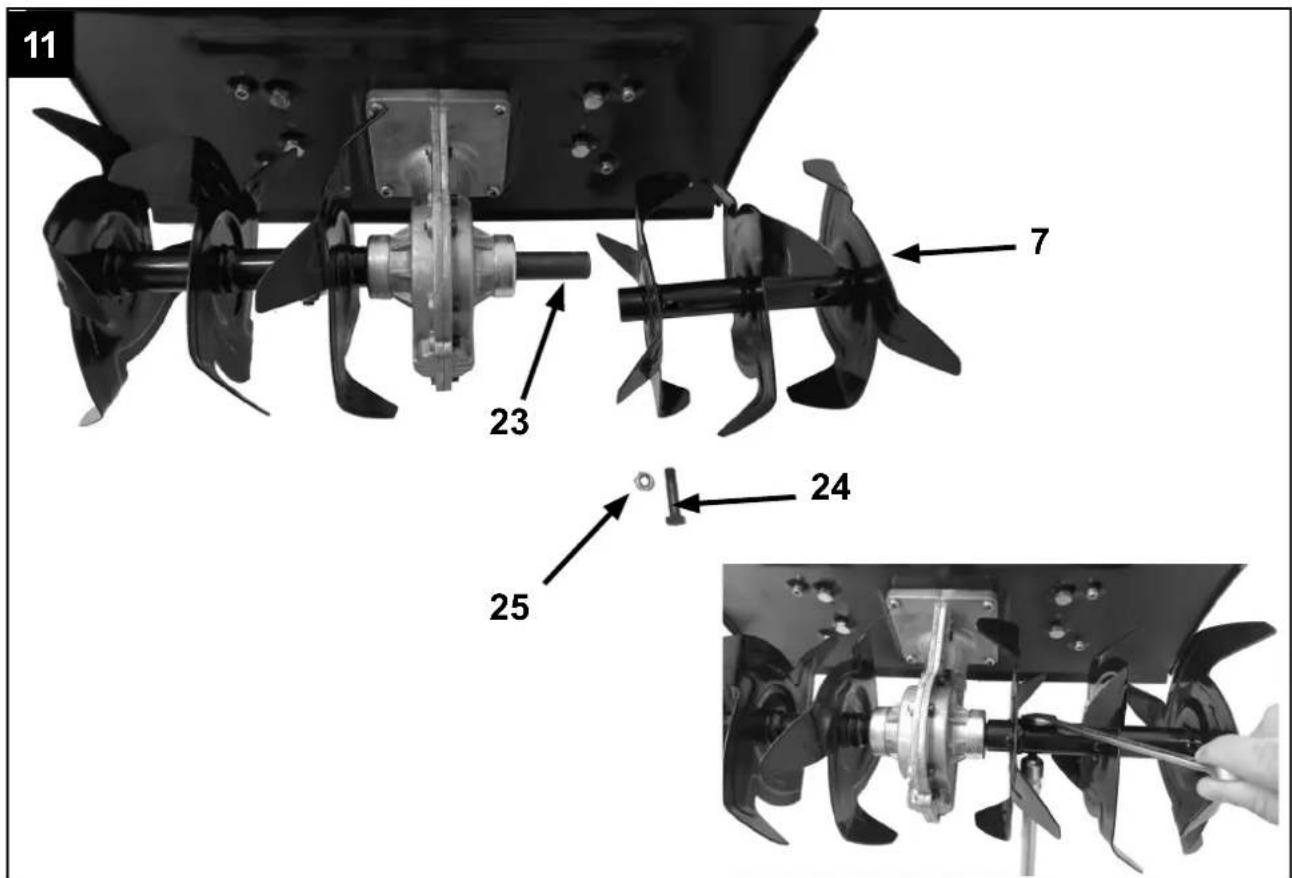
Push the blade roller (7) on the drive shaft (23) of the machine. The blade roller (7) can be mounted left or right side. Be sure that the holes of the blade roller (7) and the drive shaft (23) are aligned. Now push through the Screw M8 (24) and fix it with the nut M8 (25). Lock the nut M8 (25) hand-tighten.
For uninstall: Proceed in reverse order.
8. Operation
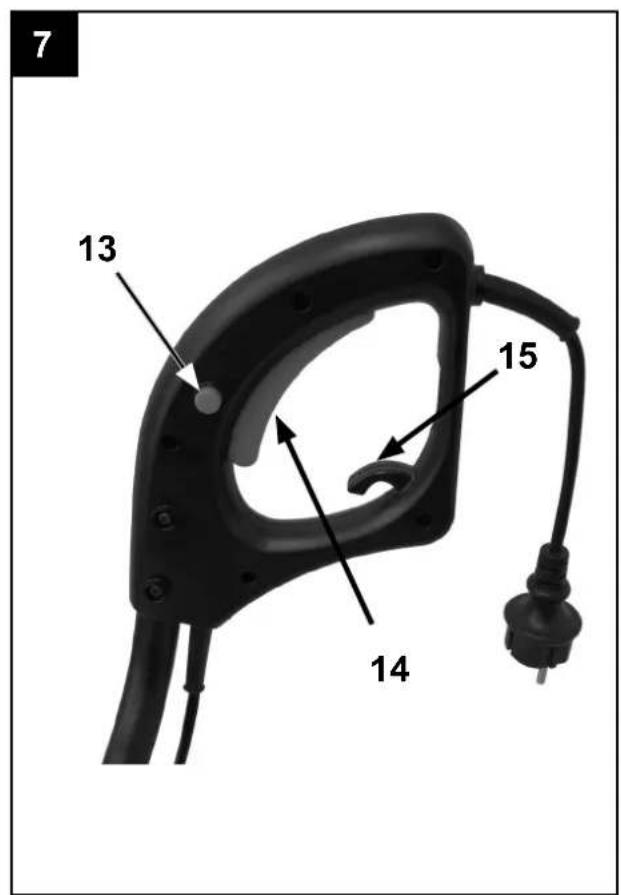
Start and stop the implement (Pic. 7)
To prevent an accidental start-up of the implement, the throttle handle (1a) is equipped with a safety release switch (13) which must be pressed before the On/Off switch (14) can be pressed.
If the On/Off switch is released, the equipment switches off.
Repeat this process several times so that you are sure that the machine functions properly. Before you perform any repair or maintenance work on the machine, ensure that the cutting unit is not rotating and that the power supply is disconnected.
Always ensure that a safe distance (provided by the long handles) is maintained between the user and the housing. Be especially careful when digging and changing direction on slopes and inclines. Maintain a solid footing and wear sturdy, non-slip footwear and long trousers. Always dig along the incline (not up and down).
For safety reasons, the Electric Tiller may not be used to dig up inclines whose gradient exceeds 15 degrees. Use special caution when backing up and pulling the implement (tripping hazard)!
Tips for proper working
Always guide the machine slowly and wisely forward.
Dig up the area in straight lines. Let the tracks overlap slightly to not miss any stripes to dig. Only use the machine to dig up already loosened soil.
Height adjustment (Pic. 9-10)
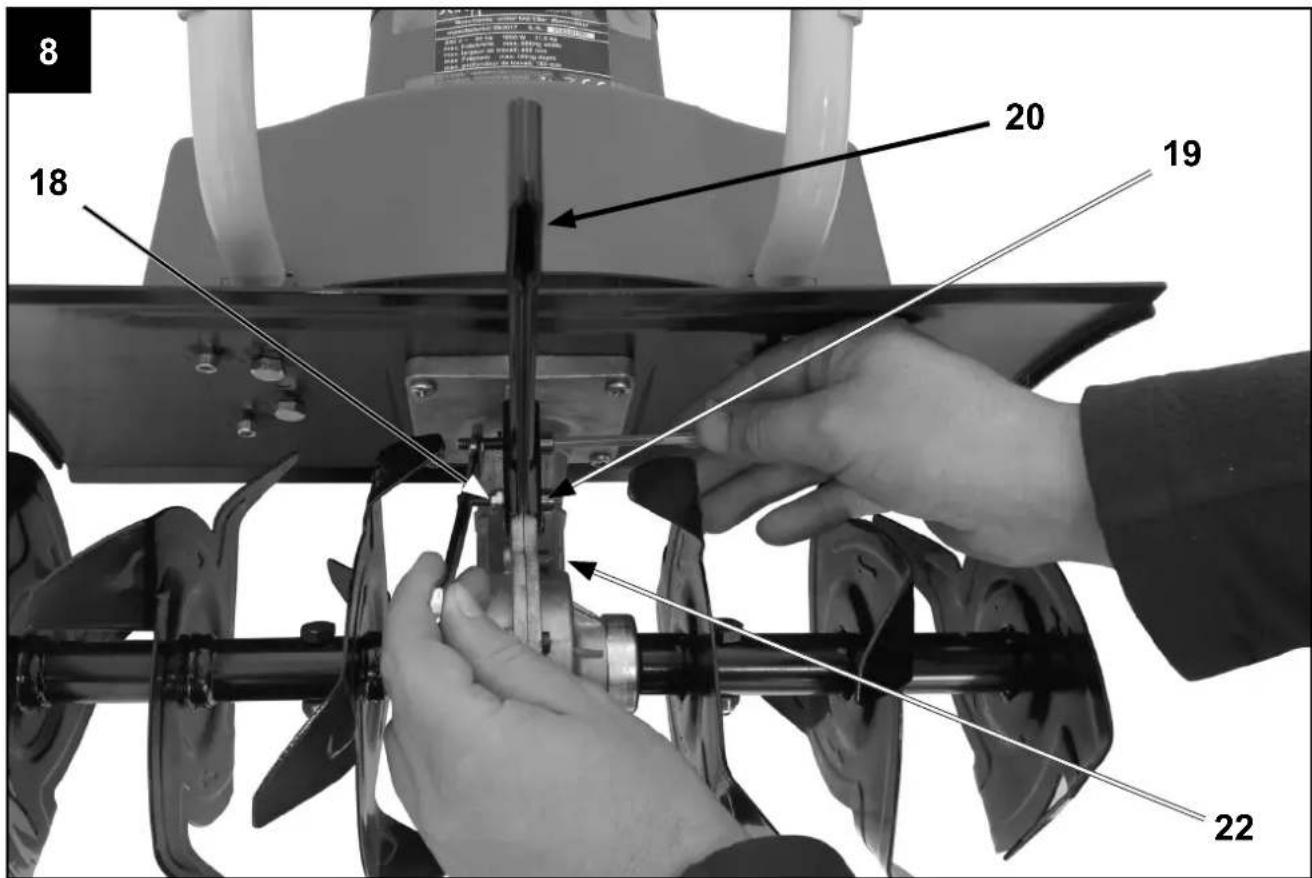
The height will be adjusted by shifting the driving device (21). You can adjust the height in 4-Steps.
- Step \~ 90 mm
- Step \~ 120 mm
- Step \~ 150 mm
- Step \~ 180 mm
At first you have to remove the wing nut M6 (16) and the wing screw M6 (17). Than align the step-hole you want to work with. Now fix the driving device (21) again with the wing screw M6 (17) and the wing nut M6 (16).
Danger!
The roller rotates for a few seconds after the motor is switched off. Never attempt to stop the roller. In the event that the rotating roller strikes an object, immediately switch off the equipment and wait for the roller to come to a complete stop. Then inspect the condition of the roller. Replace any parts that are damaged. Lay the power cord on the ground in loops in front of the power outlet. Work away from the power outlet and cord, making sure that the power cord always trails in the already scarified grass so that the equipment does not travel over the cord.
Transport and storage (Pic. 12)
Always pull out the power cord before transporting! Open the wing nuts (10) until you can fold the handles (1a/b) forward. Attention! Danger of crushing your fingers. Now you can transport your machine with the transport handle (8). So you can storage the machine too.
9. Electrical connection
The electrical motor installed is connected and ready for operation. The connection complies with the applicable VDE and DIN provisions.
The customer's mains connection as well as the extension cable used must also comply with these regulations.
Damaged electrical connection cable
The insulation on electrical connection cables is often damaged.
This may have the following causes:
- Passage points, where connection cables are passed through windows or doors.
- Kinks where the connection cable has been improperly fastened or routed.
- Places where the connection cables have been cut due to being driven over.
- Insulation damage due to being ripped out of the wall outlet.
- Cracks due to the insulation ageing.
Such damaged electrical connection cables must not be used and are life-threatening due to the insulation damage.
Check the electrical connection cables for damage regularly. Make sure that the connection cable does not hang on the power network during the inspection.
Electrical connection cables must comply with the applicable VDE and DIN provisions. Only use connection cables with the marking „H05VV-F“.
The printing of the type designation on the connection cable is mandatory.
AC motor
The mains voltage must be 230 V\~
The mains voltage must comply with the specifications on the motor nameplate.
Extension cables up to 25 m in length must have a cross section of at least 1,5 mm ^4 , above 25 m at least 2,5 mm ^2
Connections and repairs of electrical equipment may only be carried out by an electrician.
Please provide the following information in the event of any enquiries:
• Type of current for the motor
• Machine data - type plate
- Motor data - type plate
10. Cleaning and maintenance
Danger!
Always pull out the mains power plug before starting any cleaning work.
Cleaning
- Keep all safety devices, air vents and the motor housing free of dirt and dust as far as possible. Wipe the equipment with a clean cloth or blow it with compressed air at low pressure.
- We recommend that you clean the device immediately each time you have finished using it.
- Clean the equipment regularly with a moist cloth and some soft soap. Do not use cleaning agents or solvents; these could attack the plastic parts of the equipment. Ensure that no water can seep into the device. The ingress of water into an electric tool increases the risk of an electric shock.
Carbon brushes
In case of excessive sparking, have the carbon brushes checked only by a qualified electrician.
Danger! The carbon brushes should not be replaced by anyone but a qualified electrician.
Maintenance
- A worn out or damaged cutting unit should be replaced by an authorised expert.
- Take care that all fastening elements (screws, nuts, etc.) are firmly tightened, so that you can work safely with the Electric Tiller.
- Store the Electric Tiller in a dry place.
- For longer life, all screw-fastened parts, such as wheels and axles should be cleaned and subsequently oiled.
- Regular servicing of the implement not only secures longer endurance and performance, it also contributes to an accurate and simple dig up of your bed.
- At the end of the season, carry out a general check of the Electric Tiller, and remove all residue collected. Before the start of every season, it is absolutely necessary to check the state of the machine. Contact our Customer Service if repair work is necessary.
11. Storage
Store the device and its accessories in a dark, dry and frost-proof place that is inaccessible to children. The optimum storage temperature is between 5 and 30°C.
Store the electrical tool in its original packaging. Cover the electrical tool in order to protect it from dust and moisture. Store the operating manual with the electrical tool.
12. Disposal and recycling
The equipment is supplied in packaging to prevent it from being damaged in transit. The raw materials in this packaging can be reused or recycled. The equipment and its accessories are made of various types of material, such as metal and plastic. Defective components must be disposed of as special waste. Ask your dealer or your local council.
Old devices must not be disposed of with household waste!

This symbol indicates that this product must not be disposed of together with domestic waste in compliance with the Directive (2012/19/EU) pertaining to waste electrical and electronic equipment (WEEE). This product must be disposed of at a designated collection point. This can occur, for example, by handing it in at an authorised collecting point for the recycling of waste electrical and electronic equipment. Improper handling of waste equipment may have negative consequences for the environment and human health due to potentially hazardous substances that are often contained in electrical and electronic equipment. By properly disposing of this product, you are also contributing to the effective use of natural resources. You can obtain information on collection points for waste equipment from your municipal administration, public waste disposal authority, an authorised body for the disposal of waste electrical and electronic equipment or your waste disposal company.
13. Spare-part ordering
Please quote the following in your order for spare parts:
- Type of device
• Article No. of deviceident. No. of device - Spare Part No. of the required spare part
Service information
Please note that the following parts of this product are subject to normal or natural wear and that the following parts are therefore also required for use as consumables.
Wear parts*: Brush Assemblies, Blade Roller
* Not necessarily included in the scope of delivery!
14. Troubleshooting guide
| Fault Possible causes Rectification | ||
| Motor does not start | a) No electricity in plugb) Cable defectivec) Switch, switch/plug block defectived) Connections to motor or capacitor disconnectede) Blade roller blocked | a) Check line and fuseb) Have machine checked by a customer service centerc) Have machine checked by a customer service centerd) Have machine checked by a customer service centere) If necessary adjust working depth. Clean housing so that the roller can run freely |
| Engine performance drops | a) Soil is too firmb)Carbonbrushes worn outc) Roller badly worn | a) Change working depthb) Check by a customer service centerc)Replace roller |
| The Electric Tiller is difficult to check. | a)rollerwornb) Wrong working depth | a)Replace rollerb) Correct working depth |
| Motor is running, roller is not rotating | a)Gearing defectivea) By customer service workshop | |
Günzburger Straße 69
D-89335 Ichenhausen
CHERS CLIENTS,
Transport et stockage (Fig.12)
Günzburger Straße 69
89335 Ichenhausen / Germany
Geachte klant,
Günzburger Straße 69
D-89335 Ichenhausen
EGREGIO CLIENTE
Günzburger Straße 69
D-89335 Ichenhausen
ESTIMADO CLIENTE,
Günzburger Straße 69
D-89335 Ichenhausen
VÁŽENÝ ZÁKAZNÍK,
Günzburger Straße 69
D-89335 Ichenhausen
TISZTELT VÁSÁRLÓ!
CE - Declaration of Conformity
GB hereby declares the following conformity under the EU Directive and standards for the following article
Standard references:
EN 60335-1; EN 62233; EN 70; EN 55014-1; EN 55014-2; EN 61000-3-2; EN 61000-3-3
This declaration of conformity is issued under the sole responsibility of the manufacturer.
The object of the declaration described above ful is the regulations of the directive 2011/65/EU of the European Parliament and Council from 8th June 2011, on the restriction of the use of certain hazardous substances in electrical and electronic equipment.
Subject to change without notice
Documents registar: Fabian Bücheler
Günzburger Str. 69, D-89335 Ichenhausen
Garantiebedingungen
Revisionsdatum 20. August 2018
Apparent defects must be notified within 8 days from the receipt of the goods. Otherwise, the buyer's rights of claim due to such defects are invalidated. We guarantee for our machines in case of proper treatment for the time of the statutory warranty period from delivery in such a way that we replace any machine part free of charge which provably becomes unusable due to faulty material or defects of fabrication within such period of time. With respect to parts not
manufactured by us we only warrant insofar as we are entitled to warranty claims against the upstream suppliers. The costs for the installation of the new parts shall be borne by the buyer. The cancellation of sale or the reduction of purchase price as well as any other claims for damages shall be excluded.
Garantie FR

- MTE450
- VEREHRTER KUNDE,
- Explanation of the symbols on the equipment
- Table of contents: Page:
- Introduction
- MANUFACTURER:
- scheppach
- NOTE:
- WE RECOMMEND:
- Device Description (Pic. 1-2)
- Scope of delivery (Pic. 2)
- ATTENTION!
- Intended use
- Safety information
- General safety instructions
- Operating.the.implement:
- Preparations:
- Use:
- Work intervals:
- Take care of your implement
- Electrical.safety:
- DO NOT touch the power cable before it has been disconnected from the mains.
- Residual risks
- Technical data
- Before starting the equipment
- Warning!
- Montage
- Important!
- Installing the central tubes (Pic. 3)
- Installing the Plastic cross-plate (Pic. 4)
- Installing the handles (Pic. 5)
- Laying the power cord (Pic. 6/7)
- Blade roller installing / uninstalling (Pic. 11)
- Operation
- Start and stop the implement (Pic. 7)
- Tips for proper working
- Height adjustment (Pic. 9-10)
- Danger!
- Transport and storage (Pic. 12)
- Electrical connection
- Damaged electrical connection cable
- AC motor
- Cleaning and maintenance
- Cleaning
- Carbon brushes
- Maintenance
- Storage
- Disposal and recycling
- Old devices must not be disposed of with household waste!
- Spare-part ordering
- Service information
- Troubleshooting guide
- CHERS CLIENTS,
- Transport et stockage (Fig.12)
- EGREGIO CLIENTE
- ESTIMADO CLIENTE,
- VÁŽENÝ ZÁKAZNÍK,
- TISZTELT VÁSÁRLÓ!
- CE - Declaration of Conformity
- Standard references:
- EN 60335-1; EN 62233; EN 70; EN 55014-1; EN 55014-2; EN 61000-3-2; EN 61000-3-3
- Garantiebedingungen
- Garantie FR
Brand : SCHEPPACH
Model : MTE450
Category : Milling machine