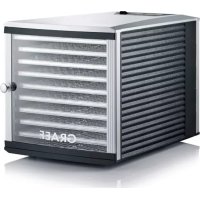
DA 510 - Food Dehydrator GRAEF - Free user manual and instructions
Find the device manual for free DA 510 GRAEF in PDF.



| Brand | GRAEF |
| Model | DA 510 |
| Product type | Food dehydrator |
| Usage | Domestic |
| Adjustable temperature range | 32°C to 70°C |
| Timer | Up to 40 hours |
| Display | Digital (LED) |
| Controls | Buttons SEL, +, -, OK, START/STOP |
| Functions | Temperature and timer adjustment, automatic shut-off at end of cycle |
| Power supply | 220-240 V, 50/60 Hz (estimate) |
| Tray material | Plastic |
| Number of trays | 5 (estimate) |
| Care and cleaning | Clean the trays with hot water; wipe the appliance with a damp cloth. Do not immerse the housing. |
| Safety | Automatic shut-off at end of cycle; overheat protection (not explicit but likely) |
| Warranty | 2 years |
| Included accessories | Dehydration trays (number not specified) |
| Use | Dehydration of fruits, vegetables, meats, and herbs |
| Repairability | Repairs exclusively by GRAEF customer service or an authorized professional |
| Recycling | Device recyclable according to current regulations. Do not dispose of with household waste. |
| Weight | Approximately 3.5 kg (estimate) |
| Dimensions (W × D × H) | Approximately 30 × 30 × 40 cm (estimate) |
Frequently Asked Questions - DA 510 GRAEF
User questions about DA 510 GRAEF
0 question about this device. Answer the ones you know or ask your own.
Ask a new question about this device
Download the instructions for your Food Dehydrator in PDF format for free! Find your manual DA 510 - GRAEF and take your electronic device back in hand. On this page are published all the documents necessary for the use of your device. DA 510 by GRAEF.
USER MANUAL DA 510 GRAEF
EN Operating Instructions
Product description. 18
Preface 19
Information on these operating instructions 19
Warning messages 19
General safety instructions 20
Danger caused by electric current 22
Intended use 22
Limitation of liability 22
After-sales service 23
Unpacking 23
Disposal of the packaging 23
Disposal of the unit 23
Requirements on the installation location 23
Electrical connection 24
Prior to first use 24
Preparing the dried material 24
Operation 24
Using silicone mats or baking paper 26
Storing foodstuffs 26
Preparing foodstuffs 26
Vegetables (52 °C) 27
Fruit (57 °C) 27
Meat (63°C - 70°C) 28
Reprocessing 28
Cleaning 29
Two-year warranty 29
PREFACE
Dear Customer,
You have made a good choice by buying this dehydrator.
You have purchased a recognized quality product. We would like to thank you for
buying this machine and wish you a lot of fun with your new Graef dehydrator.
Information in these operating instructions shall help to achieve the best results with this unit.
Please read these operating instructions carefully.
INFORMATION ON THESE OPERATING INSTRUCTIONS
The operating instructions of the dehydrator (in the following referred to as unit) provides you with important information about its commissioning, security, the intended use and care of the unit.
The operating instructions shall have to be available at the unit at all times. The instructions have to be read and applied by every person who deals with
- initial operation,
- operation,
troubleshooting and/or - cleaning
of the unit.
Store this operating instructions and pass them on to a possible subsequent owner.
These operating instructions cannot take into consideration every conceivable use.
For further information or in case of problems which are not dealt with or not dealt with sufficiently in these instructions, please get in touch with Graef customer service or your specialist dealers.
WARNING MESSAGES
In these operating instructions, the following warning messages and signal words are used:
WARNING
This refers to a potentially dangerous situation. Failure to observe this warning may result in serious injury or even death.
IMPORTANT!
This refers to application tips and other especially important information!
GENERAL SAFETY INSTRUCTIONS
This unit is in conformity with the safety instructions mentioned herein before. However, incorrect handling may lead to injury and damage.
For safe handling of this unit, please observe the following safety instructions:
- Before using the unit check for any external visible damage of the housing, the connection cable and plug. Do not operate a damaged unit.
- Repairs may be carried out only by an expert or by Graef after-sales service. Incorrect repairs may cause considerable hazards for the user. In addition, any claim under guarantee is forfeited.
- Defective parts must be replaced by original spare parts only. It is only with these parts that the safety requirements are met.
- This appliance can also be used by children from 8 years age as well as by persons with limited physical, sensory or mental ability or with a lack of experience and/or knowledge if they are supervised or have been trained in using the appliance and have understood the dangers which may result from it. Cleaning and user maintenance must not be carried out by children, unless they are 8 years or older and are supervised.
- The unit and its connection cable have to be clear of children who are younger than 8 years.
- Children should be supervised in order to make sure that they do not play with this unit.
- The unit is not intended to be used with an external timer or a separate remove control.
- Always disconnect the connection cable by using plug; do not pull the connecting cable.
- Do not use the unit if the mains cable or plug are damaged.
- Prevent that liquids get on the plug.
-
If the connection cable is damaged, it may only be replaced by the manufacturer, the manufacturer's customer service or a similarly qualified person, in order to avoid potential dangers.
-
Do not open the housing under any circumstances. When touching live connections and if the electric and mechanical structure is changed, there is danger of electric shock.
- Never touch live parts. They may cause an electric shock or even may lead to death.
- Before connecting the unit, compare the connecting data (voltage and frequency) on the type plate with those of your energy network. These details must correspond so that no damage occurs to the unit.
- Check to see that the power cable has been safely laid. Due to getting caught on the cable, the unit might fall down from the work surface.
- Packaging materials must not be used for playing. There is a danger of suffocation.
- Never use the unit in the vicinity of a source of heat.
- Never use the appliance outdoors, and always keep it in a dry place.
- Immediately after use, clean all accessories coming into contact with foodstuffs.
- In the event of improper use of the unit and accessories, the unit might be damaged and there is danger of injury.
-
In order to avoid power surges, never use the unit with wet hands or on a damp or wet surface.
-
Do not immerse the unit, power cable and the plug in water or other liquids.
-
Do not use any aggressive or abrasive detergents and no solvents.
-
Do not scratch off stubborn soiling with hard objects.
-
Never clean the unit and the base station under running water and never immerse them into water.
WARNING
Mortal danger is caused by contact with energised cables or components!
Please observe the following safety instructions in order to prevent an exposure to electric current:
- Do not use the unit if the mains cable or plug are damaged.
- In this case, you should let the Graef Customer Service install a new connection cable before using the appliance again. This may be done also by an authorised specialist. Do not open the housing under any circumstances. If live connections are touched or the electrical and mechanical construction are modified, there is the danger of electric shock.
- Never touch live parts. This can cause an electric shock and may cause even death.
INTENDED USE
This unit is not intended for commercial use. Use the unit in closed spaces only. In order to avoid potential dangers, use the unit for drying / dehydrating only.
This appliance is intended for domestic and similar use, such as:
Staff kitchens in shops and office
In agricultural estates
- By guests in hotels, motels and other living quarters
In bed and breakfast boarding houses
IMPORTANT!
Use only for applications akin to households!
Another or any exceeding use shall not be considered intended.
CAUTION
The appliance can cause dangers, if is not used as intended.
Use the unit exclusively as intended.
- Observe the procedures described in these operating instructions.
Claims of any kind caused by damage by unintended use shall be excluded.
The risk shall be borne sole by the operator.
LIMITATION OF LIABILITY
All technical information, data and notes on the installation,
the operation and the care contained in these operating instructions correspond to the latest status before printing, and are rendered under consideration of our previous experience and to the best of knowledge. No claims may be derived from the particulars, illustrations and descriptions in these instructions.
The manufacturer shall not assume any liability for damage caused by:
non-observation of the instructions
- unintended use
incorrect repairs - technical modifications
use of unapproved spare parts
Translations shall be carried out to the best of knowledge. We shall not assume any liability for translation mistakes. The original German text only shall be binding.
AFTER-SALES SERVICE
If your Graef device is damaged, please contact your dealer or the Graef Customer Service at +49 (2932) 9703677 or write an e-mail to service@graef.de.
IMPORTANT!
If possible, keep the original packaging during the guarantee period of the unit in order to be able to pack the unit correctly in case of guarantee.
UNPACKING
When unpacking the unit, proceed as follows:
- Remove the unit from the box.
- Remove the packaging parts.
- Remove any stickers on the unit. Do not remove the type plate!

DISPOSAL OF THE PACKAGING
The packaging protects the unit against transport damage. The packaging materials are selected according to the environmental compatibility and disposal-related aspects and can therefore be recycled.
The return of packaging into the material cycle saves raw material and reduces the waste volume. Dispos of the packaging material no longer needed at collection points for the "Green Dot" recycling system (in Germany).

DISPOSAL OF THE UNIT
At the end of its service life, this product cannot be disposed of in normal domestic waste. The symbol on the product and in the operating instructions point out to this fact. Reuse the materials according to their marking. With the reuse, recycling or other forms of recycling of old equipment, you make an important contribution to the protection of our environment. Please ask your municipal administration for the disposal point.
REQUIREMENTS ON THE INSTALLATION LOCATION
For safe and fault free operation of the unit, the following requirements of the installation location have to be met:
- The unit has to be placed on a solid, flat, horizontal, and non-slipping surface with a sufficient weight-carrying capacity.
-
Make sure that the unit cannot topple over and does not stand directly in front of a wall.
-
Do not place the appliance on hot surfaces, such as hotplates, or near them.
- Never use the appliance outdoors, and always keep it in a dry place.
The unit is not designed for installation in a wall or a built-in cupboard. - Do not set up the unit in a hot, wet or moist environment.
- Do not place the unit on paper / newsprint paper or loose surfaces. They might be drawn in and clog the ventilation slots. Make sure that the ventilation slots are not covered up.
- Place the unit at least 30cm away from a wall.
- The socket has to be easily accessible so that the power cable can be removed easily in case of emergency.
ELECTRICAL CONNECTION
For safe and fault-free operation of the unit, the following requirements have to be met during the electrical connection:
- Before connecting the unit, compare the connecting data (voltage and frequency) on the type plate with those of your energy network. These details must correspond so that no damage occurs to the unit. In case of doubt ask your trained electrician.
The socket has to be protected at least by a 10 amps circuit breaker. - Make sure that the power cable is not damaged and is not laid across hot surfaces or sharp edges.
The connecting cable must not be stretched tightly. - The electric safety of the unit is ensured only when it is connected to a socket with protective conductor installed correctly. Operation on a socket without protective conductor is forbidden. If in doubt, let the house installation checked by a trained electrician. The manufacturer shall not assume responsibility for damage which has been caused by absent or interrupted protective conductor.
PRIOR TO FIRST USE
Prior to first use, wipe out the unit using a damp cloth. Then let the unit run for 45 minutes at 32°C in order to remove the moisture inside the unit. Clean the trays in warm water.
PREPARING THE DRIED MATERIAL
Use fresh and washed foodstuffs only. Do without using overripe fruit or vegetables. Prior to dehydration, remove stems, stones and the core. In order to maintain the colour of the dried material, sprinkle the fruit with lemon juice. Foodstuffs with a high sugar contents, such as apples, pears, peaches and bananas, are prone to darkening due to oxidation of sugar. Vegetables with a firm texture should be blanched for about 2 minutes in hot water before dehydrating them. In a small distance, put the foodstuffs side by side on the slide compartment. Select a distance to allow sufficient air to circulate. Do not place the foodstuffs on top of each other.
OPERATION
Prepare the foodstuffs to be dried.
IMPORTANT!
The thinner the foodstuffs were cut, the better they can dry. We recommend that you cut foodstuffs such as apples, lemons, oranges et cetera using our universal cutter. That way you will get even and thin slices. For smaller and thinner foodstuffs, we additionally recommend that you use the MiniSlice attachment. Using that unit, you can cut open mushrooms, tomatoes, strawberries, cucumbers, carrots et cetera extremely thin and evenly.
Take the trays out of the unit and put the foodstuffs to be dried on the trays.
- Use the entire space of the trays, but make sure that there is sufficient space between the individual foodstuffs for air circulation. Overlapping of the foodstuffs impedes the dehydrating process.
Using both hands, slide the trays back into the unit.
- Switch on the temperature and the timer.
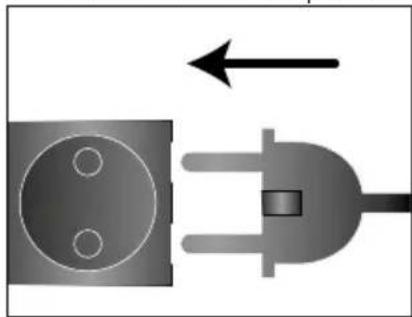
- Insert the plug into the socket.
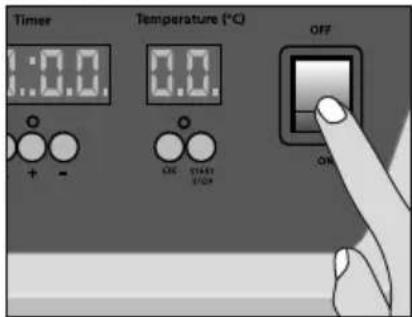
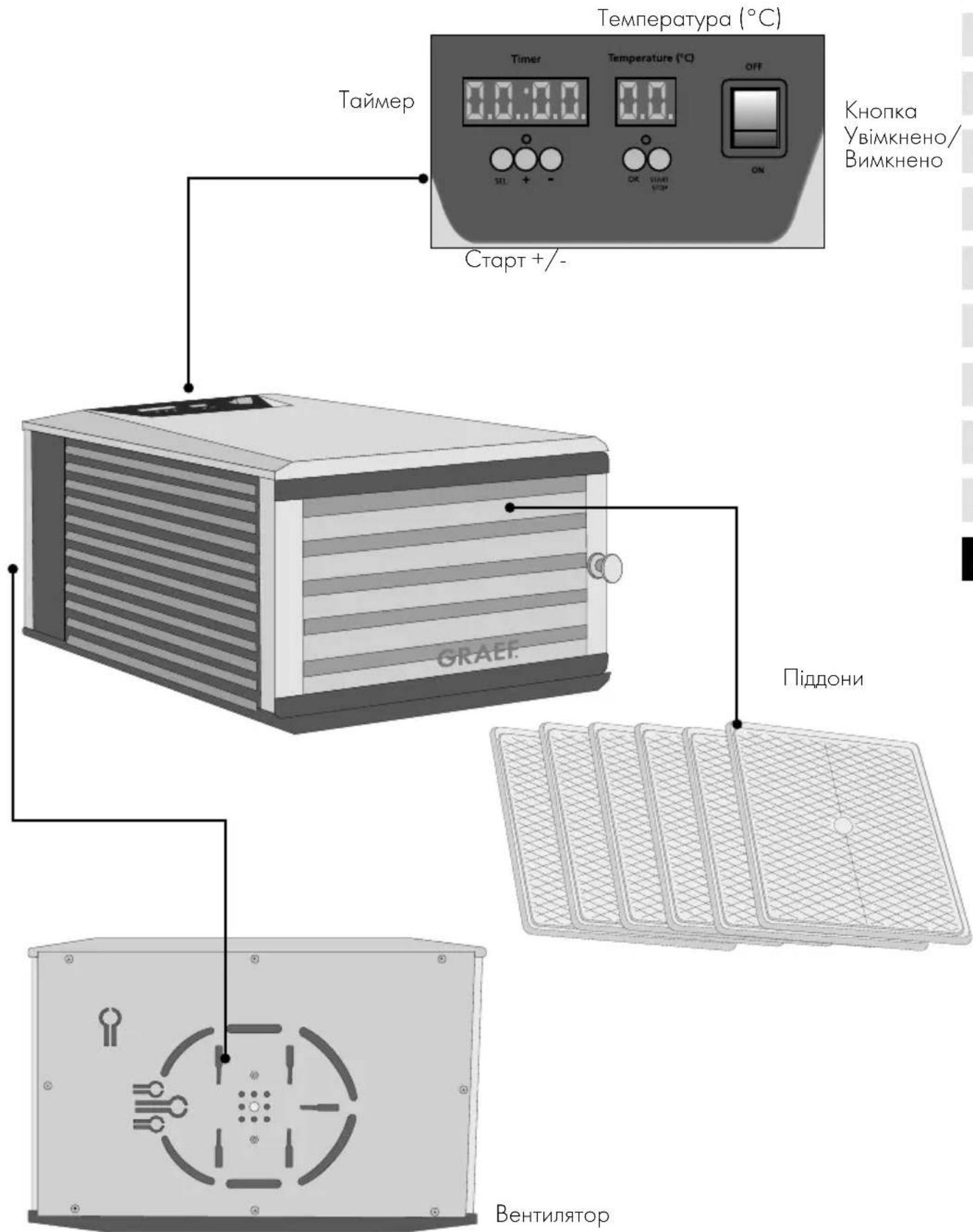
- Switch the unit on. The timer is on 00:00 and the temperature on 50° C .
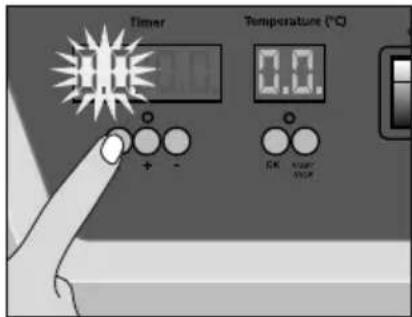
- Keep holding the "SEL" button for approx. 3 seconds until the hour display flashes up.
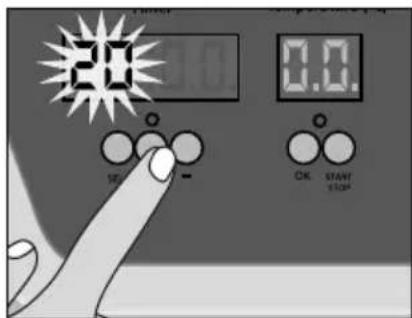
- Press + or - in order to increase or decrease the number of hours. (Maximum 40 hours)
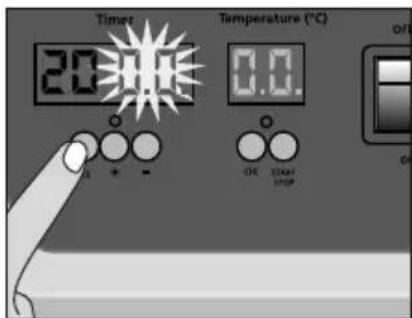
- Then press the "SEL" button, the minute display will then flash.
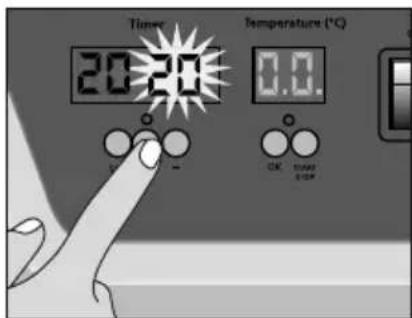
- Press + or - in order to increase or decrease the number of minutes.
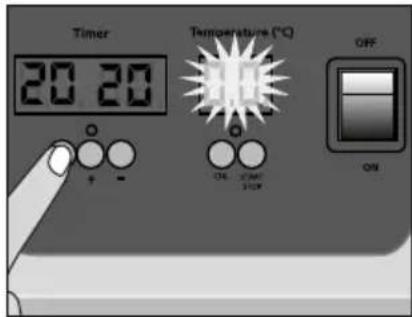
- Then press the "SEL" button, the temperature display will then flash.
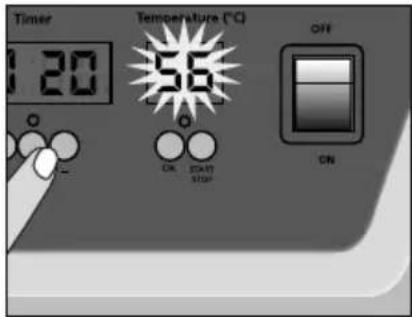
- Press + or - in order to increase or decrease the temperature.
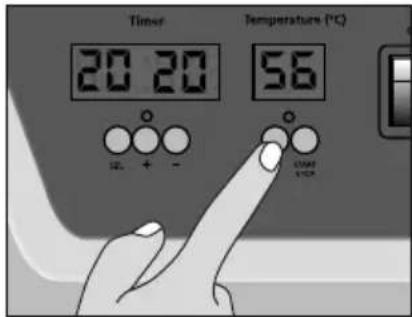
To confirm, press the OK button.
- Having done the settings, press the START / STOP button. The green lamp illuminates and the dehydrating process will start.
After completion of the dehydrating process (timer shows 00.00), switch off the unit. - To cancel the process, press the START / STOP button.
USING SILICONE MATS OR BAKING PAPER
For foodstuffs which are damp or stick easily (e.g. tomatoes) we recommend that you use a silicone mat or baking paper. Put the silicone mat or the baking paper on the tray.
IMPORTANT!
Make sure that the baking paper does not cover the entire space of the tray. It should be easy for the warm air to pass through.
Put the silicone mat or the baking paper on the tray. At mid-term of the dehydrating time, the silicone mat or the baking paper can be removed.
STORING FOODSTUFFS
Before you stow the dried foodstuffs in a vessel, make sure that the foodstuffs are really dry. Moist foodstuffs easily get mouldy. Dispose of mouldy foodstuffs immediately. For storing foodstuffs use clean, dry vessels that can be closed airtight, if possible. Do not fill the dried foodstuffs into the vessel until they have cooled down.
PREPARING FOODSTUFFS
The following tables contain guideline values for the preparation of various fruits, vegetables and meat. The drying times depend on the ambient temperature, the relative air humidity and the moisture content of the foodstuff to be dried. When the moisture content is low, the drying time is at the lower end of the range. When the moisture content is high, however, the drying time is at the upper end of the range.
Please bear in mind that the drying times are also influenced by the number of foodstuffs on the trays. When drying foodstuffs, it is important to check the dryness of the product. When the product has not thoroughly dried, mould can form during storage (see food storage). In order to check the dryness, remove a slice of the foodstuff from the dehydrator and let it cool down to ambient temperature. Bend and divide the slice in order to test it for interior moisture.
VEGETABLES (52°C)
| Dried material Preparation Result Time | |||
| Asparagus Wash and cut into pieces | Crispy 4 - 6 hours | ||
| Beans Wash, remove ends and cut into pieces | Crispy 9 - 12 hours | ||
| Beet Peel and cut into thin slices | Bendable 9 - 12 hours | ||
| Broccoli Trim and cut through. Steam 3 - 5 minutes until soft | Crispy 10 - 14 hours | ||
| Cabbage Wash, trim and cut into 3 mm strips | Crispy 8 - 11 hours | ||
| Carrots | Steam until soft and cut into slices | Bendable 7 - 11 hours | |
| Celery | Cut the stems into 6 mm stripes | Crispy 3 - 10 hours | |
| Cucumber | Wash, trim and cut into approx. 1 cm thick slices | Bendable 4 - 8 hours | |
| Aubergine | Wash, peel and cut into approx. 0.5 cm to 1.0 cm thick slices | Bendable 4 - 8 hours | |
| Mushroom Wash, either cut into pieces or leave whole | Bendable 4 - 7 hours | ||
| Peppers | Wash and remove seeds, cut into stripes or rings approx. 6 mm | Bendable 4 - 8 hours | |
| Potatoes | Cut into slices, blanch for 4 - 6 minutes | Crispy / bendable | 7 - 13 hours |
| Tomatoes | Wash and cut into rings | Bendable | 5 - 9 hours |
| Cherry tomatoes | Cut into halves, cut-off side upward | Bendable 5 - 9 hours | |
| Zucchini | Wash, trim and cut into approx. 6 cm thick slices | Crispy 7 - 11 hours | |
FRUIT (57 °C)
| Dried material Preparation | Result | Time |
MEAT (63°C - 70°C)
| Apples Wash and cut | into thin slices | Bendable 7 - 15 hours | |
| Apricots Wash and cut | into halves, cut off side upward | Bendable 21 - 29 hours | |
| Bananas Peel and cut | into slices Bendable 7 - 10 hours | ||
| Figs Wash, cut into four pieces, cut-off side upward | Bendable 22 - 30 hours | ||
| Kiwi Peel and cut into slices | Crunchy 8 - 15 hours | ||
| Nectarines Wash, cut | into halves, cut-off side upward | Bendable 8 - 17 hours | |
| Peaches Cut into halves, cut-off side upward | Bendable 8 - 16 hours | ||
| Pears Peel and cut into slices | Bendable 8 - 16 hours | ||
| Pineapple Peel and cut into slices | Bendable 11 - 18 hours | ||
| Rhubarb | Peel and cut into stripes | Bendable | 6 - 10 hours |
| Berries | Cut strawberries into slices, leave other berries whole | Crunchy 7 - 15 hours | |
| Watermelon | Cut the crust off, cut into pieces | Bendable and sticky | 8 - 10 hours |
| Tomatoes | Wash and cut into rings | Bendable | 5 - 9 hours |
| Grapes | Leave whole | Bendable | 8 - 38 hours |
| Dried material | Preparation | Result | Time |
| Jerky | Use very lean meat and remove as much fat as possible. Cut the meat into approx. 2 - 3 cm thick slices | Bendable | 3 - 4 hours |
IMPORTANT!
Please note that the above-mentioned particulars are indicative only and thus subject to correction.
REPROCESSING
During drying, water is removed from the foodstuffs. If you want to reprocess your foodstuffs, soak them in unsalted water for 3 - 7 minutes. Then prepare them as usual. If you cook them,
use the same water which you have utilised for soaking in order to preserve the nutrients. If you want to soak foodstuffs more than 1 hour, you should put them into the refrigerator to prevent bacterial growth. One cup of dried vegetable is reprocessed to approx. 2 cups. One cup of dried fruit is reprocessed to approx. 11/2 cups. The reprocessing times vary depending on the thickness of the foodstuff and the water temperature used. Warm water accelerates the reprocessing, but might lead to a certain loss of aroma.
CLEANING
IMPORTANT!
Pull the mains plug before each cleaning process.
Clean the trays in warm water using washing-up liquid, subsequently you can rinse them with clear water. Clean the dehydrator with a damp cloth. Neither put the dehydrator nor the trays into a dishwasher.
TWO-YEAR WARRANTY
For this product, we assume 24 months manufacturer warranty for defects, which are due to production or material defects. Your legal warranty claim in conformity with Section 437 et seq. of the German Civil Code (BGB) shall remain unaffected by this regulation. The warranty does not cover damage caused by improper handling or use as well as defects which only slightly influence the function or the value of the appliance. Transport damages, as far as we are not responsible for it, are excluded from the warranty claims. A warranty claim is excluded for damage caused by a repair which has not been carried out by us or one of our agents. In case of justified complaints, we shall repair the defective product or replace it by a product without defects at our discretion.
Sommaire
Chere cliente, cher client,
Bortskaffelse of emballinging. 90
Bortskaffelse of maskinen 90
PENEI PEPsIM 3ANyCKOM PNJIAUY 157
ПДГOTУBAHHЯ XAPUBOI CINPOBИН.. 157
EKCPIIYATAUIIIPIINJADY 157
BVKOPNCTAHHRCNIIKHOBNX PJIIBOK ABO IANEpy 3APIKAHH..159
36EPIAHHRAOTOBOTOIPOJyKTY. 159
ПИГOTУBAHHЯ СИPOВИН.. 159
OBO41 (52°C) 159
ΦPyKTH (57°C) 161
MRO (63°C - 68°C) 162
BVKOPNCTAHHЯ TOTOBOTO IPOJNYKTY 162
OuHsEHnI PnIaIy. 162
「APAHTI. 162
Pahenb ynpabnHn
BCTYI
UahOBHn NOKyneub,
BncnoBIOeMo noJky 3a 3po6JeHn BAMn Bn6ip N npIb6aHn npInaDy
dny cyuHnB n B'JIiHnX xapOvBX npOdykTIB - derIpatopa. Bn otPmaHn
BVCOKoKicHn npIad, kKn npHece Bam 3aIOBOJeHHn BiD 0oJeHHoro
BVKOpNCtAHn.
IHΦOPMAUJI, HABEDEHA B IHCTPYKUII
Inhopmaia, HabeedeHa B ciin Hctpyku cTocyebcra niroTOBKn Do ekcnnyatauii, 6e3neKn BnKOpNCtAHnHn, HanexHoRo BnKOpNCTAHn H dOrrna 3a deripatopom (dani 3a TeKCTOM - «Ppina). Inctpykuio cnid 36epiratni i3 npinaom ybecb qac noro ekcnnyatauii. 3 Inctpykuieo Mae O3NaHOMNTncs 6yd-ka ocoba, kotpa: 1) rotye npinaad do BnKOpNCTAHn; 2) ekcnnyatye npina; 3) pemontye npina Ta/a6o naorntb HecnpabHocti; 4) BnKOnye nnueHHn I dOrnA 3a npinaDom.
36epiraTe 1HCTpyKciTo Ta nepeaTe II HactynHomy BnacNky npnaNy. Bnpo6nK peKomeHdye IOTpIMyBaTncb HabeJeHnx IHCTpyKciB INHOmy pa3i HeNoTpImaHHI INCTpyKciBnpo6nKa np3BeDe IO BtpaTHIpaBA Ha rapaHTiHe O6cnyroByBaHHra.
OBMEXEA BIDIOBIAJIbHICTb BNPOBHKA
BcraTexnHa iHopmaia n peKoMeHaauii 0do npnaHy, HabeHei B ciHCTpykui, akTuani3OBaHI Ha daty II dpyky N6a3yIObca H aOcbidi N3HaHHx Bnpo6nka.
Bnpo6nK 3aHnAe 3a co6oIO npabo BHocHTn 6e3 nonepdxKeHH 6ydb-aki 3MiHN B KOHCTpykciIO npnaIy 3 MeTOIO yD0CKOHaJIeHH NOrO fYHKcioHaIbHnx, eCTeTNUHx Ta IHnX Oco6nBOcTe. Bnpo6nK He Hece BiIDNoBIAIbHOcTi 3a:
HeDOTpIMaHHIHCtpyKcii;
HeHaJIeXHe BnKOpncTaHH npuJaNy;
HeKopeKTHn peMOHT;
BHeceHH He cAHKIOHOBAHIN 3MiH B KOHCTpyKciO npnnaIy;
BKNOPINCTAHHHey3rOJxKeHX3aPachnx qactnHa6o akceCyapib.
IONEPEKXYBAJIbHI NO3HAUKN
B lnctpykui BnKopnstani taki cHMBOJI, Ha kci cnID 3BepHyTN oco6NBy yBary 3 MeToIO nonepedxehnra pnsIKiB i wKOdi:
BATAI!
I03NaUka Bka3ye Ha noteHuiHy 3aRpo3y, HeoTpMaHnry NyHKTy IhctpyKci 3 ciEIO no3HaQKOIO MoKe npN3BecTI do Cmepti a6o cepNo3HOITpaBMn.
BAKJIINBOI!
No3HaKa dI npaT a doatkoBoi iHopMaui 0do BnKOpncTahn npna.
3AΓΑΙbHI IHCTPYKιI 3 TEXHIΚ ΕE3ΠΕΚΟ
Cen npnctpi BIDNOBidae BCTAHOBHeHm npabnilam texhik 6e3neKn. Odnak HnnpaBnIbHe BnKOpncTahHЯ MOKe Pn3BeCTn Do TpaBMyBaHHa oci6 Ta nozkodxehnMaHa.
Дя 6e3neuHOro BnKOpNCTaHHЯ npNcTpoI OOTpMMyTeCb HABeJeHx Hxue iNcTpYkci 3 texhikn 6e3nekn:
- Pered BnKOpNCTaHnI M npIcTpoI nepeBipTe 3OBHIshI BnIMi NO- shKOJxHnKopnycy, Ka6JIIO XnBJIeHHra Ta WTeNCeJIbHOI BnIKn. He BnKOpNCTOByIte NOnKoJxHnN npIcTpiI.
- Pemont moxe npobodnti tibkn faxibeucb a6o cnyx6a niTpumkn Klientiv Grae (Graef). HenpaBnbln pemont moxe cnpuHHNTI 3NaHy Hebe3neky dIy KopncTyBaay. Kpim TOrO, Tepmin diI rapaHTI 3akInhyETbcra.
- Deфekti KOMHOENTI MOXHa 3amHOBaTI TIlbKN OpnIHAlbHMn 3a-nachmN qactnHaMn. TIlbKn ZI qactHn rapaHTObaHo BiINOBiaIoTB BImOrAm 6e3neKn.
- Zei npictpi TAKoX MoXe BnKOpNCTOBYBATNCa DITbMn BiD 8 pOKiB oco6am3 ObmexEHHMn fI3HnMM, yTTEBMN a6o po3ymOBHm 3di6HOCTaMn a6o 3 BiDCyTHICTO IOCBiNy Ta/a6o 3HaHb, kKIO BOHN 3hAXoJTBcR nIi HaJIaOM a6o 6yIi npOIHCTpyKTOBaHI 0do 6e3neu-Horo BnKOpNCTAHNr npIcTPOU i 3po3ymiIN moXJIbI He6e3neKN, 0o MOxTyB BnHKHTn 3 HbOrO. Pn6HpAHn Ta O6ClyrOByBAHn npIcTPOU He NOBHHI npOBODNTSCa DITbMn, 3a BnHrTKOM BnJaKDIB, KOJI NBOHn E 8 pOKiB a6o cTapWe i nepe6yBAOTb Ni d Hargldom.
- Ппстрий та мого 3' end hybaьн кабел сд Тримати поалi BiД DiTeиdo8 pOKIB.
CiiikyuIte 3a iTbMn, 06 nepekoHaTncs, 0 BOHn He rpaotb i3 npIn-ctpoem. - Ппстрий не пиз nauseю роботи i3 3OBhiшим таймером a60 okремплътOM дисанцiHOrO kepybaHHa.
3abxbnBnraaTe Ka6eIb i3 po3etkn 3a wTeNCelbHy Bnky, a He 3a Ka6eIb XnBneHn.
He BnKopncToBvIte npncTpi, kIoo 3'eHnYBaIbHn Ka6eIb a6o WTeNcIb nOwKOJxEHi.
3anobiraTe noTpannHIO pIDIN Ha wTeNceIbHy BnIKy.
- 3'EDHyBaIbHn Ka6eNb NowKOJxHn, Ioro Moxe 3amHnTn Inwe Bnpo6nK, Ioro cLyX6a NiTpumKn KJIeHTiB a6o KbaiiikOBaHa oc6a, 06 yHnKHyTN He6e3neKn.
Hi B ykomy pa3i He cnid Biikpnbatn Kopnyc npncptpo. Kkto TopKHyTnscr ctpymOBnx 3'edHaHb Ta 3MiHHTn eJeKTpnHy i MexaHuy KOHcTpyKciIO, icHyE He6e3neKa ypaXeHHra eJeKTpnHm cTpyMOM.
Hikon He Topka Tecs 6yNb-akx qactn, k3naXoTbcN iHa npYroIO. Ce moKe np3BecTN Do ypaXeHH eJeKtpuHm cTpymom i HaBITb Do Cmepti.


- PREFACE
- INFORMATION ON THESE OPERATING INSTRUCTIONS
- WARNING MESSAGES
- WARNING
- IMPORTANT
- GENERAL SAFETY INSTRUCTIONS
- INTENDED USE
- CAUTION
- LIMITATION OF LIABILITY
- AFTER-SALES SERVICE
- UNPACKING
- DISPOSAL OF THE PACKAGING
- DISPOSAL OF THE UNIT
- REQUIREMENTS ON THE INSTALLATION LOCATION
- ELECTRICAL CONNECTION
- PRIOR TO FIRST USE
- PREPARING THE DRIED MATERIAL
- OPERATION
- USING SILICONE MATS OR BAKING PAPER
- STORING FOODSTUFFS
- PREPARING FOODSTUFFS
- VEGETABLES (52°C)
- FRUIT (57 °C)
- REPROCESSING
- CLEANING
- TWO-YEAR WARRANTY
- SOMMAIRE
- BCTYI
- IHΦOPMAUJI, HABEDEHA B IHCTPYKUII
- OBMEXEA BIDIOBIAJIBHICTB BNPOBHKA
- IONEPEKXYBAJIBHI NO3HAUKN
- BATAI
- BAKJIINBOI
- 3AΓΑΙBHI IHCTPYKΙI 3 TEXHIΚ ΕE3ΠΕΚΟ
Brand : GRAEF
Model : DA 510
Category : Food Dehydrator