
HSE 2500E5 - Generator Herkules - Free user manual and instructions
Find the device manual for free HSE 2500E5 Herkules in PDF.
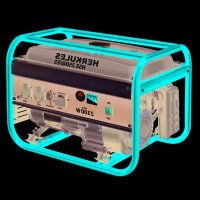



| Product Type | Synchronous Generator |
| Brand | Herkules |
| Model | HSE 2500E5 |
| Weight | 37 kg |
| Continuous Power (S1) | 2100 W |
| Maximum Power (S2 5 min) | 2300 W |
| Output Voltage | 2 x 230 V~ |
| Rated Current | 9.1 A |
| Frequency | 50 Hz |
| Engine Type | 4-stroke air-cooled |
| Displacement | 208 cm³ |
| Max Engine Power | 4.1 kW / 5.6 HP |
| Fuel | Normal unleaded gasoline (E10) |
| Tank Capacity | 15 L |
| Engine Oil | approx. 0.6 L (SAE 10W-30 recommended) |
| Consumption at 2/3 load | approx. 1.1 L/h |
| Sound Pressure Level | 73.1 dB(A) |
| Sound Power Level | 96 dB(A) |
| Protection Type | IP 23M |
| Main Functions | Reversible start, overload protection, automatic low oil shutdown, voltmeter, 2 x 230 V outlets |
| Maintenance and Cleaning | Clean the air filter and spark plug regularly, change the oil every 50 hours |
| Safety | Automatic shutdown in case of low oil, overload protection, grounding possible |
| Spare Parts and Repairability | Wear parts (spark plug, air filter, fuel filter) available; repairs by qualified personnel |
| Warranty | 60 months (5 years) for manufacturing defects |
Frequently Asked Questions - HSE 2500E5 Herkules
User questions about HSE 2500E5 Herkules
0 question about this device. Answer the ones you know or ask your own.
Ask a new question about this device
Download the instructions for your Generator in PDF format for free! Find your manual HSE 2500E5 - Herkules and take your electronic device back in hand. On this page are published all the documents necessary for the use of your device. HSE 2500E5 by Herkules.
USER MANUAL HSE 2500E5 Herkules
GB Original operating instructions Power Generator
When using the equipment, a few safety precautions must be observed to avoid injuries and damage. Please read the complete operating instructions and safety regulations with due care. Keep this manual in a safe place, so that the information is available at all times. If you give the equipment to any other person, hand over these operating instructions and safety regulations as well. We cannot accept any liability for damage or accidents which arise due to a failure to follow these instructions and the safety instructions.
Explanation of the warning signs on the machine (Fig. 8)
- Danger! Read the operating instructions.
- Warning! Hot parts. Keep your distance.
- Danger! Switch off the engine before refueling.
- Danger! The exhaust gases from the generator are toxic. Risk of suffocation.
- Danger! Never operate in non-ventilated rooms.
- Beware of flammable materials.
- Beware of electrical voltage.
1. Safety regulations
Danger!
Read all safety regulations and instructions.
Any errors made in following the safety regulations and instructions may result in an electric shock, fire and/or serious injury.
Keep all safety regulations and instructions in a safe place for future use.
No changes may be made to the generator. - Only original parts may be used for maintenance and accessories. - Important: Danger of poisoning, do not inhale emissions. Children are to be kept away from the generator. - Important: Risk of burns. Do not touch the exhaust system or drive unit. - Wear suitable ear protection when in the vicinity of the equipment. - Important: Petrol and petrol fumes are highly combustible or explosive. - Never operate the generator in non-ventilated rooms or in easily inflammable adjacency. When operating the generator in rooms with good ventilation, the exhaust gases must
be channeled directly outdoors through an exhaust hose. Important: Toxic exhaust gases can escape despite the exhaust hose. Due to the fire hazard, never direct the exhaust hose towards inflammable materials.
- Risk of explosion: Never operate the generator in rooms with combustible materials. The speed preset by the manufacturer is not allowed to be changed. The generator or connected equipment may be damaged.
- Secure the generator against shifting and toppling during transport.
- Place the generator at least 1m away from buildings and the equipment connected to it.
- Place the generator in a secure, level position. Do not turn, tip or change the generator's position while it is working. Always switch off the engine when transporting and refueling the generator. Make sure that when you refuel the generator no fuel is spilt on the engine or exhaust pipe.
- Never operate the generator in rain or snow.
- Never touch the generator with wet hands.
- Guard against electric danger. When working outdoors, use only extension cables that are approved for outdoor use and which are marked accordingly (H07RN..). If you use extension cables or mobile distribution networks, the resistance value must not exceed 1.5Ω .As a reference value,cables with a cross-section of 1.5mm2 should not be any longer than 60 m in length, and cables with a cross-section of 2.5mm2 should not be any longer than 100m No changes may be made to the settings of the motor or generator.
- Repairs and adjustment work may only be carried out by authorized trained personnel.
- Do not refuel or empty the tank near open lights, fire or sparks. Do not smoke!
- Do not touch any mechanically driven or hot parts. Do not remove the safety guards.
- Do not expose the tools to damp or dust. Permissible ambient temperature - 10 to + 40°C , max. altitude above sea level 1000m , relative humidity: 90% (non-condensing) The generator is driven by a combustion engine, which produces heat in the area of the exhaust (on the opposite side of the sockets) and the exhaust outlet. You should therefore keep clear of these surfaces because of risk of skin burns.
- Fuel is combustible and highly flammable. Do not fill up while in operation. Some parts of the reciprocating internal com
Combustion engine are hot and can cause burns. The warnings on the generating set must be observed. If it is installed in ventilated rooms, the additional requirements relating to protection against fire and explosions must be observed. Before use, the generating set and its electrical equipment (including cables and plug connections) need to be checked to ensure that they are not faulty. The generating set must never be connected to any other source of electricity such as the electricity supply from a power supply company. In special cases where a back-up connection to existing electrical systems is intended, this may only be carried out by a qualified electrician who takes account of the differences between the operated equipment used by the public power grid and that used for the operation of the generating set. It is a requirement of this part of ISO 8528 that the differences must be specified in the instructions. - Given the high mechanical loads, only hard-wearing rubber-insulated cables (in accordance with IEC 60245-4) or equivalent equipment should be used. - Warning! Observe the regulations on electrical safety applicable to the area in which the generating sets are used. - Warning! Observe the requirements to be met and precautions to be taken if restoring power to a system using generating sets in dependency on the safety measures for the system and the applicable directives and guidelines. - Generating sets should only be used up to their nominal power rating under the rated ambient conditions. If the generating set is used under conditions which do not meet the reference conditions required by ISO 8528-8 and if this impairs the cooling of the engine or the generator, e.g. as a result of operation in restricted areas, the output must be reduced. Information should be provided to inform the user about the reduction in output required as a consequence of higher temperatures, installation height and air humidity in comparison to the reference conditions. - The values quoted in the technical data for sound power level (LWA) and sound pressure level (LWM) are emission values and not necessarily reliable workplace values. As there is a correlation between emission and immission levels, the values are not a reliable basis for deciding on any additional precautions
which may be needed. Factors influencing the actual user immission level include the properties of the work area, other sound sources etc., the number of machines and other processes in the vicinity, as well as the time span in which the operator is subjected to the noise. Also, the permitted immission level can vary from country to country. Nevertheless, with this information the user is able to make a better assessment of the dangers and risks involved.
- Never use faulty or damaged electrical equipment (this also applies to extension cables and plug connections). Electric supply cables and connected equipment must be in perfect condition. The generator is to be operated only with equipment whose voltage specifications conform with the generator's output voltage.
- Never connect the generator to the power supply (socket-outlet).
- Keep the cable length to the consumer as short as possible.
- Dispose of soiled maintenance material and operating materials at the appropriate collection point. Recycle packaging material, metal and plastics.
2. Layout and items supplied
2.1 Layout (Fig. 1-3)
1 Tank indicator 2 Tank cover 3 2 × 230V -socket-outlets 4 Earth connection 5 Safety tripping element 230 V 6 Voltmeter 7 Oil filler screw 8 Oil drainage screw 9 Oil shortage cut-out 10 On/Off switch 11 Choke lever 12 Reversing starter 13 Petrol cock 14 Spark plug wrench 15 Oil filler funnel
2.2 Items supplied
Please check that the article is complete as specified in the scope of delivery. If parts are missing, please contact our service center or the sales outlet where you made your purchase at
GB
the latest within 5 working days after purchasing the product and upon presentation of a valid bill of purchase. Also, refer to the warranty table in the service information at the end of the operating instructions.
- Open the packaging and take out the equipment with care.
- Remove the packaging material and any packaging and/or transportation braces (if available).
- Check to see if all items are supplied.
- Inspect the equipment and accessories for transport damage. If possible, please keep the packaging until the end of the guarantee period.
Danger!
The equipment and packaging material are not toys. Do not let children play with plastic bags, foils or small parts. There is a danger of swallowing or suffocating!
- Original operating instructions
3. Proper use
The device is designed for applications operated with a 230 V alternating current source. Be sure to observe the restrictions in the safety instructions.
The generator is intended to provide electric tools and light sources with electricity.
When using the device with household appliances, please check their suitability in accordance with the relevant manufacturer's instructions. In case of doubt, ask an authorized dealer of the respective appliance.
The equipment is to be used only for its prescribed purpose. Any other use is deemed to be a case of misuse. The user / operator and not the manufacturer will be liable for any damage or injuries of any kind caused as a result of this.
Please note that our equipment has not been designed for use in commercial, trade or industrial applications. Our warranty will be voided if the machine is used in commercial, trade or industrial businesses or for equivalent purposes.
4. Technical data
Generator.. Synchronous Protection type: IP 23M Continuous rated power P rated (S1): 2100 W/230 V~ Maximum power P max (S2 5 min): .2300 W/230 V~ Rated voltage U rated .. .2 x 230 V~ Rated current I rated ..9.1A(230V~) Frequency F rated . 50 Hz Drive engine design: 4-stroke, air-cooled Displacement: 208 cm3 Max. power: 4.1 kW/5.6 hp Fuel: normal unleaded petrol (E10) Tank capacity: 15 I Engine oil: ca. 0.6 Consumption at 2/3 load: approx. 1.1 l/h Weight: 37 kg Sound pressure level L pA .. 73.1 dB(A) Sound power level L WA /K uncertainty . 96 dB (A)/1.88 dB(A) Power factor cos φ .. 1 Power class: G1 Max. temperature: 40°C Max. altitude (above mean sea level): ... 1000 m Spark plug: LG F7RTC
Operating mode S1 (continuous operation)
The machine can be continuously operated with the quoted power output.
Operating mode S2 (temporary operation)
The machine may be temporarily operated with the quoted power output (5 min.). Afterwards the machine must be stopped for a while to prevent it from overheating (5 min.).
GB
5. Before starting the equipment
5.1 Electrical safety:
Electric supply cables and connected equipment must be in perfect condition. The generator is to be operated only with equipment whose voltage specifications conform with the generator's output voltage. - Never connect the generator to the power supply (socket-outlet). - Keep the cable length to the consumer as short as possible.
5.2 Environmental protection
- Dispose of soiled maintenance material and
- operating materials at the appropriate collection point. Recycle packaging material, metal and plastics.
5.3 Connecting to earth
The housing is allowed to be connected to earth in order to discharge static electricity. To do this, connect one end of a cable to the earth connection on the generator (Fig. 4) and the other end to an external earth (for example an earthing rod).
6. Operation
Important! You must fill up with engine oil and fuel before you can start the engine.
- Check the fuel level and top it up if necessary Make sure that the generator has sufficient ventilation Make sure that the ignition cable is secured to the spark plug
- Inspect the immediate vicinity of the generator
- Disconnect any electrical equipment which may already be connected to the generator
6.1 Starting the engine
- Open the petrol cock (13) by turning it down.
- Move the ON/OFF switch (10) to position "ON" with the key.
- Move the choke lever (11) to position 0.
- Start the engine with the reversing starter (12) by pulling the handle forcefully. If the engine does not start, pull the handle again.
- Push the choke lever (11) back again after the engine has started.
Important!
When starting with the reserve starter, the motor may recoil suddenly as it starts up, resulting in hand injuries. Wear protective gloves when starting the equipment.
6.2 Connecting consumers to the generator
- Connect the equipment you want to use to the 230 V~sockets (3).
Important: These sockets are allowed to be loaded continuously (S1) with 2100W and temporarily (S2) for a maximum of 5 minutes with 2300W.
The generator is suitable for 230V~ AC appliances only. - Do not connect the generator to the household mains system as this may result in damage to the generator itself or to other electrical appliances in your home.
Note: Some electrical appliances (power jigsaws, drills, etc.) may have a higher level of power consumption when used in difficult conditions. Some electrical appliances (for example televisions, computers, etc.) must not be powered by a generator.
If in doubt, consult the manufacturer of your appliance.
6.3 Overload cut-out 2 x 230 V socket-outlets Important! The generator is fitted with an overload cut-out.
This shuts down the sockets (3). You can restart the sockets (3) by pressing the overload cut-out (5).
Important! If this happens, reduce the electric power you are taking from the generator or remove any defective connected appliances.
Important! Defective overload cut-outs must be replaced only by overload cut-outs of identical design and with the same performance data. If repairs are necessary, please contact your customer service center.
6.4 Switching off the engine
Before you switch off the generator, allow it to run briefly with no consumers so that it can "cool down" - Move the ON/OFF switch (10) to position "OFF" with the key. - Close the petrol cock
7. Cleaning, maintenance, storage and ordering of spare parts
Switch off the motor and pull the spark plug boot from the spark plug before doing any cleaning and maintenance work on the equipment.
Notice! Switch off the machine immediately and contact your service station:
In the event of unusual vibrations or noise If the engine appears to be overloaded or misfires
7.1 Cleaning
- Keep all safety devices, air vents and the motor housing free of dirt and dust as far as possible. Wipe the equipment with a clean cloth or blow it with compressed air at low pressure. We recommend that you clean the device immediately each time you have finished using it. Clean the equipment regularly with a moist cloth and some soft soap. Do not use cleaning agents or solvents; these could attack the plastic parts of the equipment. Ensure that no water can seep into the device.
7.2 Air filter
In this connection, please also read the service information.
Clean the air filter at regular intervals, and replace it if necessary. - Open both clips (Fig. 5/A) and remove the air filter cover (Fig. 5/B). - Remove the filter elements (Fig. 6/C) - Do not use abrasive cleaning agents or petrol to clean the elements. Clean the elements by tapping them on a flat surface. In cases of stubborn dirt first clean with soapy water, then rinse with clear water and air-dry. - Assemble in reverse order
7.3. Spark plug
Check the spark plug for dirt and grime after 20 hours of operation and, if necessary, clean it with a copper wire brush. Thereafter, service the spark plug after every 50 hours of operation.
Pull off the spark plug boot with a twist. - Remove the spark plug (Fig. 7/D) with the supplied spark plug wrench. - Assemble in reverse order.
7.4 Changing the oil and checking the oil level (before using the machine)
The motor oil is best changed when the motor is at working temperature.
- Place the generator on a slightly inclined surface so that the oil drain plug is at the lower end.
- Open the oil filler plug.
- Open the oil drain plug and let the hot engine oil drain out into a drip tray. After the old oil has drained out, close the oil drain plug and place the generator on a level surface again.
- Fill in engine oil up to the top mark on the oil dipstick.
- Important: Do not screw the dipstick in to check the oil level; simply insert it up to the thread.
- Dispose of the waste oil properly.
7.5 Automatic oil cut-out
The automatic oil cut-out responds if there is too little oil in the engine. In this case, it will not be possible to start the engine, or it will cut out automatically after a short period of time. It cannot be started again until the engine oil has been topped up (see point 7.4).
7.6 Maintenance
There are no parts inside the equipment which require additional maintenance.
7.7 Storage
- Leave the machine to cool (approx. 5 minutes). Clean the exterior housing of the machine.
- Store the machine in a cold, dry place where it is out of the reach of ignition sources and inflammable substances.
7.8 Ordering replacement parts:
Please quote the following data when ordering replacement parts:
Type of machine, Article number of the machine, Identification number of the machine, Replacement part number of the part required. For our latest prices and information please go to www.isc-gmbh.info
8. Disposal and recycling
The equipment is supplied in packaging to prevent it from being damaged in transit. The raw materials in this packaging can be reused or recycled. The equipment and its accessories are made of various types of material, such as metal and plastic. Never place defective equipment in your household refuse. The equipment should be taken to a suitable collection center for proper disposal. If you do not know the whereabouts of such a collection point, you should ask in your local council offices.
9. Transportation
Use the handle for transporting the generator and use it to move the generator about. - Transport the equipment only by carrying it by the transport handle. - Protect the equipment against unexpected knocks and vibrations.
10. Troubleshooting
| Fault Mögliche Ursache Behebung | ||
| Engine does not start | Automatic oil cut-out has not respon-ded | Check oil level, top up engine oil |
| Spark plug fouled | Clean or replace spark plug | |
| No fuel | Refuel / have the petrol cock checked | |
| Generator has too little or no voltage | Controller or capacitor defective | Contactyourdealer |
| Overcurrent circuit-breaker has triggered | Actuate the circuit-breaker and reduce the consumers | |
| Air fi Iter dirty | Clean or replace the fi Iter | |

For EU countries only
Never place any electric power tools in your household refuse.
To comply with European Directive 2012/19/EC concerning old electric and electronic equipment and its implementation in national laws, old electric power tools have to be separated from other waste and disposed of in an environment-friendly fashion, e.g. by taking to a recycling depot.
Recycling alternative to the return request:
As an alternative to returning the equipment to the manufacturer, the owner of the electrical equipment must make sure that the equipment is properly disposed of if he no longer wants to keep the equipment. The old equipment can be returned to a suitable collection point that will dispose of the equipment in accordance with the national recycling and waste disposal regulations. This does not apply to any accessories or aids without electrical components supplied with the old equipment.
The reprinting or reproduction by any other means, in whole or in part, of documentation and papers accompanying products is permitted only with the express consent of the ISC GmbH.
Subject to technical changes
GB
Service information
We have competent service partners in all countries named on the guarantee certificate whose contact details can also be found on the guarantee certificate. These partners will help you with all service requests such as repairs, spare and wearing part orders or the purchase of consumables.
Please note that the following parts of this product are subject to normal or natural wear and that the following parts are therefore also required for use as consumables.
| Category Example | |
| Wear parts* | spark plug, air filter, petrol filter |
| Consumables* | |
| Missing parts |
- Not necessarily included in the scope of delivery!
In the effect of defects or faults, please register the problem on the internet at www.isc-gmbh.info. Please ensure that you provide a precise description of the problem and answer the following questions in all cases:
Did the equipment work at all or was it defective from the beginning? Did you notice anything (symptom or defect) prior to the failure? What malfunction does the equipment have in your opinion (main symptom)?
Describe this malfunction.
GB
Warranty certificate
Dear Customer,
All of our products undergo strict quality checks to ensure that they reach you in perfect condition. In the unlikely event that your device develops a fault, please contact our service department at the address shown on this guarantee card. You can also contact us by telephone using the service number shown. Please note the following terms under which guarantee claims can be made:
- These guarantee terms apply to consumers only, i.e. natural persons intending to use this product neither for their commercial activities nor for any other self-employed activities. These warranty terms regulate additional warranty services, which the manufacturer mentioned below promises to buyers of its new products in addition to their statutory rights of guarantee. Your statutory guarantee claims are not affected by this guarantee. Our guarantee is free of charge to you.
- The warranty services cover only defects due to material or manufacturing faults on a product which you have bought from the manufacturer mentioned below and are limited to either the rectification of said defects on the product or the replacement of the product, whichever we prefer. Please note that our devices are not designed for use in commercial, trade or professional applications. A guarantee contract will not be created if the device has been used by commercial, trade or industrial business or has been exposed to similar stresses during the guarantee period.
- The following are not covered by our guarantee:
- Damage to the device caused by a failure to follow the assembly instructions or due to incorrect installation, a failure to follow the operating instructions (for example connecting it to an incorrect mains voltage or current type) or a failure to follow the maintenance and safety instructions or by exposing the device to abnormal environmental conditions or by lack of care and maintenance.
- Damage to the device caused by abuse or incorrect use (for example overloading the device or the use or unapproved tools or accessories), ingress of foreign bodies into the device (such as sand, stones or dust, transport damage), the use of force or damage caused by external forces (for example by dropping it).
- Damage to the device or parts of the device caused by normal or natural wear or tear or by normal use of the device.
- The guarantee is valid for a period of 60 months starting from the purchase date of the device. Guarantee claims should be submitted before the end of the guarantee period within two weeks of the defect being noticed. No guarantee claims will be accepted after the end of the guarantee period. The original guarantee period remains applicable to the device even if repairs are carried out or parts are replaced. In such cases, the work performed or parts fitted will not result in an extension of the guarantee period, and no new guarantee will become active for the work performed or parts fitted. This also applies if an on-site service is used.
- To make a claim under the guarantee, please register the defective device at: www.isc-gmbh.info. Please keep your bill of purchase or other proof of purchase for the new device. Devices that are returned without proof of purchase or without a rating plate shall not be covered by the guarantee, because appropriate identification will not be possible. If the defect is covered by our guarantee, then the item in question will either be repaired immediately and returned to you or we will send you a new replacement.
Of course, we are also happy to offer a chargeable repair service for any defects which are not covered by the scope of this guarantee or for units which are no longer covered. To take advantage of this service, please send the device to our service address.
Also refer to the restrictions of this warranty concerning wear parts, consumables and missing parts as set out in the service information in these operating instructions.
Nominal voltage \(\overline{U}_{\mathrm{nom}}\) .. 2x 230 V~
Nominal current \(I_{\mathrm{nom}}\) .. 9.1 A (230V~)
6.3 Protection against overload
Generator: synchronous
Degree of protection: IP23M
Continuous power \(\mathsf{P}_{\mathsf{nom}}\) (S1): 2100 W/230 V~ Maximum power \(\mathsf{P}_{\mathsf{max}}\) (S2 5 min): 2300 W/230 V~ Nominal voltage \(U_{\mathrm{nom}}\) .. 2 x 230 V~ Nominal current \(I_{\mathrm{nom}}\) 9.1 A (230V~)
1. SAFETY INSTRUCTIONS
Warning!
Read all safety instructions, instructions, illustrations and technical data that come with this power tool. Failure to follow the instructions below may result in electric shock, fire and/or serious injury.
Keep all safety instructions and instructions for future use.
- Do not make any modifications to the generator. For servicing and accessories, use only original parts.
Caution: Risk of poisoning, exhaust gases, flammable materials. Do not inhale exhaust gases. Exhaust gases must not be inhaled. - The device must be kept away from the generator. Caution: Risk of fire, do not touch the fuel system of the unit. - Wear hearing protection when near the device. CAUTION: Fuel and fuel vapors are highly flammable and explosive. Do not use the electric generator in poorly ventilated or confined areas or in the presence of flammable materials. If the generator must be used in a well-ventilated area, exhaust gases must be vented through a vent for exhaust gases. Caution: Even when using a vent for exhaust gases, toxic exhaust gases may be emitted. Due to fire hazard, the vent for exhaust gases must never be directed towards flammable substances. - Risk of electric shock. Never use the generator in areas with flammable substances. The pre-set speed from the manufacturer must not be changed. The generator and connected devices may be damaged. - During transport, the generator must be secured before use and covered. Place the generator at a distance of at least 1 m from walls or connected devices. Ensure a safe location for the generator. The top cover and its position during operation are prohibited. During transport and refueling, turn off the engine. Be careful when refueling not to spill fuel on the engine or exhaust. Never use the generator in rain or snow. Never touch the generator with wet hands. - Keep away from electrical hazards.
BG
The generator must be connected in accordance with the cable cross-section values (H07RN..). If flexible cables or extension cords are used, the resistance of the extension must not exceed 1.5Ω. As a guideline, the total cable length for a cross-section of 1.5mm² should not exceed 60m, and for a cross-section of 2.5mm² it should not exceed 100m. Adjustments to the generator must only be made by qualified personnel. Repair and maintenance work may only be carried out by qualified personnel. Do not store fuel near the generator or in the vicinity of open flames, and do not refuel the tank. Do not smoke! Do not mechanically block the moving parts. Do not remove protective covers. The device must not be exposed to moisture or dust. Permissible ambient temperature: -10 to +40°C. Altitude: 1000 m above sea level. Relative humidity: 90% (non-condensing). The generator is protected from the engine by a protective cover, which directs hot air away from the exhaust area (on the opposite side of the exhaust) and the air intake. Avoid proximity to hot surfaces due to the risk of fire. Fuel can ignite easily. Do not smoke during operation. The exhaust parts of the engine with the protective cover are hot and can cause burns. The safety instructions on the generator must be followed. If installed in a ventilated room, the additional requirements for fire and explosion protection must be observed. Before use, the generator and all electrical equipment (including cables and connections) must be checked to ensure there are no defects. The generator must not be connected to other power sources, such as the mains supply. In special cases, when it is provided
Temporary connection to an existing electrical system may only be made by a qualified electrician, who must first check the difference between the equipment used from the electrical grid and the working generator. According to the ISO 8528 standard, the differences must be described in the operating instructions. - For high mechanical loads, only reinforced rubber cables (according to IEC 60245-4) or equivalent equipment may be used. Warning! Follow the electrical safety rules that apply to the location where the generators are used. Warning! Take the necessary precautions and measures in case of repeated supply of installations with generators, depending on the protection measures for these installations and the applicable directives. - The generators must be used only up to the nominal power under the specified ambient conditions. If the use of the generator is carried out under conditions that do not correspond to the reference conditions of ISO 8528-8, such as cooling of the engine or generator externally, e.g., in case of operation in areas with limited ventilation, a reduction in performance is required. Information must be provided to inform the consumer of the required reduction in performance according to higher temperatures, altitude, and humidity compared to the reference conditions. The technical data given at the sound power level (LWA) and the sound pressure level (LpA) represent emission levels and are not necessarily safe working levels. Since there is a relationship between emission levels and exposure levels, this cannot be reliably used to determine possible required additional precautions. Factors influencing the current exposure of workers include the properties of the work space, other sources of noise, etc., such as the number of machines and other related processes.
BG
I. During the time that operators are exposed to noise, the noise level may also vary for different countries. Regardless of this, this information is provided to the operator of the machine with the possibility to make a better assessment of the risks and dangers. Do not use electrical devices (including extension cables and plugs) that are defective. Electrical protective devices and connected devices must be in perfect condition. Only devices with grounding that correspond to the generator's voltage and frequency may be connected. Never connect the generator's grounding to the electrical grid (contact). - The cables to the consumers must be kept as short as possible. Dispose of waste materials and operating materials in the designated collection area. - Recycle packaging materials, metal parts, and plastic parts for recycling.
2. Description of the device and scope of delivery
2.1 Description of the device (Fig. 1-5)
1. Oil level indicator 2. Oil filler cap 3. 2 x 230 V ~ contact 4. Oil drain outlet 5. Protective switch 230 V 6. Voltmeter 7. Plug for oil filling 8. Plug for oil draining 9. Pressure regulator for oil 10. Switch for turning on and off 11. Choke for carburetor adjustment 12. Device for reverse start 13. Fuel tap 14. Spark plug cap 15. Oil filter
2.2 Delivery contents
First, check the completeness of the article with the help of the delivery description. If parts are missing, please contact the nearest service center within 5 working days after purchasing the article, or the point of sale, presenting the purchase document. Keep the purchase document. Please also check the warranty table for information regarding service in the country of use.
Regarding service in the country of use.
- Open the packaging and carefully remove the device from the packaging.
- Remove the packaging material as well.
- Packaging/transport securing devices
- (if any).
- Check whether the delivery contents are complete.
- Check whether the device and accessories have damage from transport. If possible, keep the packaging for the warranty claim.
Danger!
The device and packaging materials are not children's toys and must be kept away from plastic bags! There is a danger that children may suffocate!
Original operating instructions
3. Intended use
The device is suitable for applications that require power from an alternating voltage source of 230 V ~. Observe the safety instructions in the manual. The generator is intended to power electrical tools and to supply lighting sources. For household use, please check the power of the corresponding devices. If in doubt, consult the manufacturer or the dealer of the corresponding device.
The product must be used only for its intended purpose. Any other use is not in accordance with its intended purpose. The manufacturer is not responsible for damage or injuries resulting from any other use.
BG
The user/operator, not the manufacturer, is responsible.
Please read the instructions carefully before using the device according to its intended purpose. The device is not designed for commercial, professional, or industrial use. We do not accept responsibility if the device is used for commercial, professional, or industrial purposes, or if it is used in a manner that does not comply with these instructions.
4. Technical data
Generator: synchronous
Protection class: IP23 M
Rated power Pn (S1): 2100W/230V~ Maximum power Pmax (S25min)
2300W/230V~ Rated voltage Un: 2x230V~ Rated current In: 9.1A (230V~)
Frequency: 50 Hz
Engine type: 4-stroke with air cooling
Displacement: 208 cm3
Max. power: 4.1 kW/5.6 HP
Fuel: petrol (E10)
Fuel tank capacity: 15 L
Motor power: 0.6 kW
Fuel consumption at 2/3 load: ... approx. 1.1 l/h
Weight: 37 kg
Sound power level: 73.1 dB(A)
Sound pressure level: uncertainty to 96 dB (A)/1.88 dB(A)
Power factor cos φ: 1
Power class: G1
Max. temperature: 40°C Max. installation altitude
(above sea level): 1000 m
Spark plug LGF7RTC
Operating mode S1 (continuous operation)
The machine is suitable for continuous operation at rated power.
Operating mode S2
(short-time operation)
The machine can operate at increased power for a short time (5 min.). After that, the machine must rest for a certain time to avoid unacceptable overheating (5 min.).
5. Commissioning
5.1 Electrical safety
Electrical connections and connected devices must be in perfect condition. They may be connected to devices with specified voltage, corresponding to the generator's output voltage. Never connect the generator to the electrical grid (socket). - The connecting cables to the consumer must be kept as short as possible.
5.2 Environmental protection
Collect the used materials for repair and maintenance materials in a designated collection point. - Dispose of the packaging materials, metal and plastic parts for recycling.
5.3 Earthing
According to the standard, earthing of the housing is necessary. For this purpose, connect one end of the cable to the earthing terminal of the generator (Fig.3/pos.4) and the other end to a suitable mass (e.g., earthing rod).
6. Maintenance
Attention! Before starting maintenance, the engine must be stopped and the fuel valve closed.
- Check the fuel level, and if necessary, refuel. Ensure sufficient ventilation of the device.
- Make sure the spark plug cable is connected to the spark plug.
Clean the immediate surroundings of the generator. Remove any connected electrical devices.
6.1 Starting the engine
Open the fuel valve (13); for this, turn the valve handle to the open position. Set the switch for ignition on/off (10) to "ON". Set the throttle for carburetor adjustment (11) to position I. Start the engine with the recoil starter (12); for this, pull the handle firmly. If the engine does not start, pull the handle again. After starting the engine, return the throttle for carburetor adjustment (11) to the idle position.
The generator is designed for sudden power outages, to power household appliances. For this purpose, it is protected.
6.2 Connecting electrical appliances
Connect the devices to the 230V~ sockets (3).
Attention: These sockets can be loaded continuously (S1) with 2100 W and for a short time (S2) for max. 5 minutes with 2300 W.
The electric generator is intended for 230 V~ alternating current devices. Do not connect the generator to the household mains, as this may damage the generator or other devices in the household.
Note: Some electrical devices (motors, pumps, compressors, etc.) may have a higher current consumption when used under difficult conditions. Some electrical devices (e.g. televisions, computers, etc.) cannot work with the generator.
Always read the manufacturer's instructions for your devices.
6.3 Overload protection
The current generators are equipped with overload protection. They disconnect the corresponding contacts in case of overload.
Attention! If this happens, reduce the electrical power you take from the generator, or eliminate the defects of the connected devices.
Attention! Defective connections may only be replaced by qualified electricians with the specified power data. For this, contact your service.
6.4 Switching off the engine
Let the generator run for a short time without load before switching it off, so that the unit can cool down during the idle run. Put the switch for switching on and off (fig.1/pos.10) to the "OFF" position and close the fuel tap.
7. Troubleshooting, technical service, storage and spare parts
The engine is designed for maintenance-free operation. The user is required to perform the specified maintenance.
Warning! Do not forget to disconnect the device from the power supply before performing any maintenance.
- In case of accidental selection or incorrect operation, the device may be damaged. Follow the instructions carefully.
7.1 Cleaning
Clean the device, the ventilation openings, and the housing of the engine with a soft brush or a vacuum cleaner to remove dust and dirt. Clean the device with a dry cloth or a vacuum cleaner. We recommend cleaning the device after every use. Regularly clean the device with a damp cloth and mild soap. Do not use cleaning agents or solvents, as they may damage the plastic parts.
BG
Device. Be careful that water does not enter the interior of the device.
7.2 Air filter
Follow the service instructions.
Regularly clean the air filter, if necessary, remove the two clips (Fig.5/A) and take out the air filter (Fig.5/B). Remove the filter elements (Fig.6/C) for cleaning. The elements can be cleaned with cleaning agents or soapy water. Clean the elements on a flat surface. Rinse with clean water, then rinse with clean water and let them dry in the air. Installation is carried out in the reverse order.
7.3 Spark plug
Check the spark plug for the first 10 working hours for fouling and carbon deposits. If necessary, replace the spark plug. After that, perform technical maintenance of the spark plug every 50 working hours.
Remove the spark plug with a spark plug wrench. Remove the spark plug (Fig.7/D) with the spark plug wrench. Installation is carried out in the reverse order.
7.4 Oil change, oil level check (before each use)
The oil change must be carried out with the engine warm.
Remove the oil filler cap and wipe the surface around it. Open the oil filler cap to add oil. Open the oil drain plug and drain the warm engine oil into a collection container. After draining the old oil, close the oil drain plug and place the generator back in a horizontal position. Fill the engine oil up to the upper mark on the dipstick. Caution: To check the oil level, do not screw in the dipstick,
but only insert it up to the threads.
The old oil must be disposed of properly.
7.5 AUTOMATIC OIL DRAIN
The automatic oil drain system activates if the engine oil level is too low. In this case, the engine cannot be started and the oil is drained automatically after a short time. This occurs after the engine oil has been filled (see section 7.4).
7.6 Maintenance
Inside the device, there are parts that require no other maintenance.
7.7 Storage
Let the machine cool down (about 5 minutes). Then clean the machine. Store the machine in a dry place, away from the reach of children and sources of ignition or corrosive substances.
7.8 Spare parts order:
Spare parts must be ordered according to the following data:
Type, article number, identification number, device number, required spare part, prices and information at www.isc-gmbh.info
8. Environmentally friendly
Disposal and recycling
The device is designed to prevent damage during transport. The packaging is robust and can be reused or recycled. The device and its accessories consist of various materials, such as metal and plastic. Do not dispose of damaged devices with household waste. The device must be handed over to a suitable collection point where it will be recycled in an environmentally friendly manner. If you do not know where such a collection point is, you can obtain information from the local authority.
9. Transport
For transport, use the generator only as intended. Transport the device only for the intended purpose. Protect it from impacts and vibrations.
10. Troubleshooting
2000/14/EC_2005/88/EC
Annex V
Annex VI
Noise: measured LWA = 93.2 dB (A); guaranteed LWA = 96 dB (A) P=4.1 kW; L/Q=cm
Notified Body: TUV SUD Industrie Service GmbH
Westendstr. 199, 80686 München (0036)
2012/46/EU_(EU)2016/1628
Emission No.: e13 2016/1628 2016/1628SRA1/P 0256 00 (V)
Standard references: EN ISO 8528-13; EN 55012; EN 61000-6-1
LuoYong/Product-Management
First CE:20
Art-No.: 41.526.01
I-No.: 21010
Subject to change without notice
Archive-File/Record: NAPR023750
Documents registrar: Markus Jehl, Wiesenweg 22, D-94405 Landau/Isar
EH 02/2021 (01)


- EXPLANATION OF THE WARNING SIGNS ON THE MACHINE (FIG. 8)
- SAFETY REGULATIONS
- DANGER
- LAYOUT AND ITEMS SUPPLIED
- LAYOUT (FIG. 1-3)
- ITEMS SUPPLIED
- GB
- PROPER USE
- TECHNICAL DATA
- OPERATING MODE S1 (CONTINUOUS OPERATION)
- OPERATING MODE S2 (TEMPORARY OPERATION)
- BEFORE STARTING THE EQUIPMENT
- ELECTRICAL SAFETY
- ENVIRONMENTAL PROTECTION
- CONNECTING TO EARTH
- OPERATION
- STARTING THE ENGINE
- IMPORTANT
- CONNECTING CONSUMERS TO THE GENERATOR
- OVERLOAD CUT-OUT 2 X 230 V SOCKET-OUTLETS IMPORTANT! THE GENERATOR IS FITTED WITH AN OVERLOAD CUT-OUT
- SWITCHING OFF THE ENGINE
- CLEANING, MAINTENANCE, STORAGE AND ORDERING OF SPARE PARTS
- CLEANING
- AIR FILTER
- SPARK PLUG
- CHANGING THE OIL AND CHECKING THE OIL LEVEL (BEFORE USING THE MACHINE)
- AUTOMATIC OIL CUT-OUT
- MAINTENANCE
- STORAGE
- ORDERING REPLACEMENT PARTS
- DISPOSAL AND RECYCLING
- TRANSPORTATION
- TROUBLESHOOTING
- SERVICE INFORMATION
- WARRANTY CERTIFICATE
- DEAR CUSTOMER
- PROTECTION AGAINST OVERLOAD
- SAFETY INSTRUCTIONS
- WARNING
- BG
- DESCRIPTION OF THE DEVICE AND SCOPE OF DELIVERY
- DESCRIPTION OF THE DEVICE (FIG. 1-5)
- DELIVERY CONTENTS
- INTENDED USE
- OPERATING MODE S
- (SHORT-TIME OPERATION)
- COMMISSIONING
- EARTHING
- CONNECTING ELECTRICAL APPLIANCES
- OVERLOAD PROTECTION
- TROUBLESHOOTING, TECHNICAL SERVICE, STORAGE AND SPARE PARTS
- OIL CHANGE, OIL LEVEL CHECK (BEFORE EACH USE)
- AUTOMATIC OIL DRAIN
- SPARE PARTS ORDER
- ENVIRONMENTALLY FRIENDLY
- TRANSPORT
Brand : Herkules
Model : HSE 2500E5
Category : Generator