SV 2450 - Food thermometer SEVERIN - Free user manual and instructions
Find the device manual for free SV 2450 SEVERIN in PDF.



| Product type | Immersion sous-vide cooker (immersion circulator) |
| Brand | SEVERIN |
| Model | SV 2450 |
| Use | Sous-vide cooking of food packed in suitable bags |
| Temperature range | Up to 90°C, adjustable in 0.5°C increments |
| Timer | Up to 99 hours (adjustable in hours and minutes) |
| Display | Digital screen with temperature and remaining time |
| Circulation pump | Integrated, with protective cap |
| Heating element | Stainless steel |
| Attachment | Clamp for attaching to container rim |
| Water level | MIN and MAX marks on the sleeve |
| Minimum container depth | 15.5 cm |
| Power supply | Grounded plug, voltage according to rating plate (not specified in manual) |
| Safety instructions | Do not immerse the upper part in water, risk of burns, use under supervision |
| Maintenance | Clean sleeve in dishwasher or soapy water, wipe housing with damp cloth |
| Descaling | Vinegar solution (1:15) at 60°C for about 5 hours |
| Recommended accessories | SEVERIN vacuum bags (available in stores) |
| Warranty | 2 years, excluding normal wear and misuse |
| Country of origin | Not specified, likely manufactured in China or Germany |
| Dimensions (estimated) | Approximately 28 cm height, 7 cm diameter (not specified) |
Frequently Asked Questions - SV 2450 SEVERIN
User questions about SV 2450 SEVERIN
0 question about this device. Answer the ones you know or ask your own.
Ask a new question about this device
Download the instructions for your Food thermometer in PDF format for free! Find your manual SV 2450 - SEVERIN and take your electronic device back in hand. On this page are published all the documents necessary for the use of your device. SV 2450 by SEVERIN.
USER MANUAL SV 2450 SEVERIN
natural_image
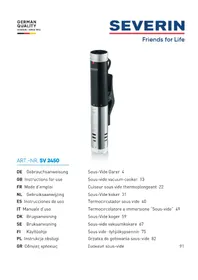
Exterior view of a modern electric vacuum cleaner with black and silver casing (no visible text or symbols)ART.-NR. SV 2450
GB Instructions for use
FR Mode d'emploi
Sous-vide vacuum cooker 13
text_image
Labeled diagram of a soldering iron with numbered parts for identification and assembly reference.DE
Sous-Vide Garer
Sous-vide vacuum cooker
Dear Customer,
Before using the appliance, read the following instructions carefully and keep this manual for future reference. The appliance must only be used by persons familiar with these instructions.
Connection to the mains supply
The appliance should only be connected to an earthed socket installed in accordance with the regulations. Make sure that the supply voltage corresponds with the voltage marked on the rating label of the appliance. This product complies with all relevant CE-labelling directives.
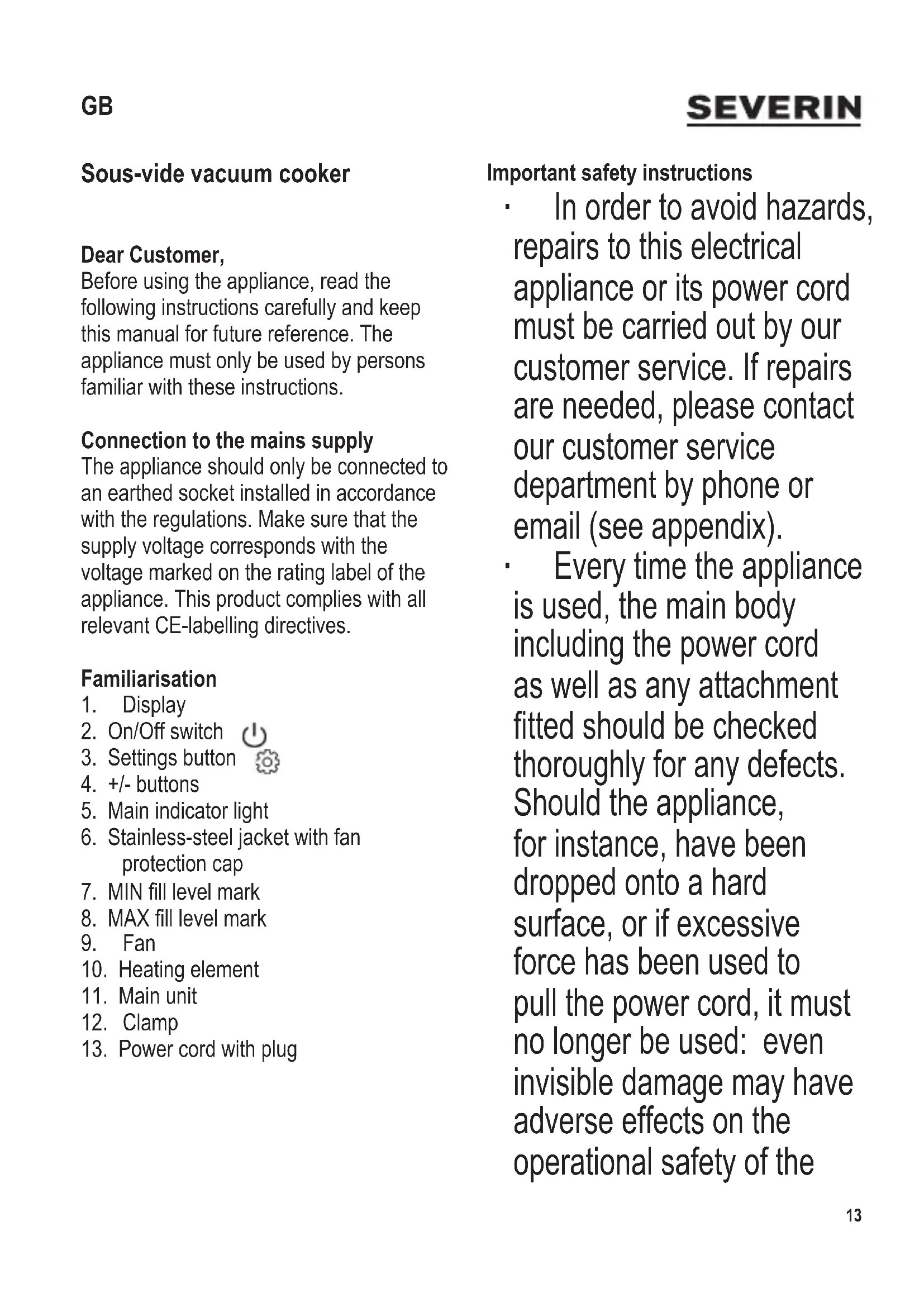
Familiarisation
- Display
- On/Off switch
- Settings button
- +/- buttons
- Main indicator light
- Stainless-steel jacket with fan protection cap
- MIN fill level mark
- MAX fill level mark
- Fan
- Heating element
- Main unit
- Clamp
- Power cord with plug
Important safety instructions
- In order to avoid hazards, repairs to this electrical appliance or its power cord must be carried out by our customer service. If repairs are needed, please contact our customer service department by phone or email (see appendix).
- Every time the appliance is used, the main body including the power cord as well as any attachment fitted should be checked thoroughly for any defects. Should the appliance, for instance, have been dropped onto a hard surface, or if excessive force has been used to pull the power cord, it must no longer be used: even invisible damage may have adverse effects on the operational safety of the
appliance.
- The appliance must only be used in a suitable cooking pot with a minimum depth of 15.5 cm.
- Disconnect the appliance from the mains before removing it from the pot.
- The appliance is not intended to be operated by means of an external timer or separate remote-control system.
- Before cleaning the appliance, ensure it is disconnected from the power supply and has cooled down completely. For detailed information on cleaning the appliance, please refer to the section Cleaning and care.
• To avoid the risk of electric shock, do not clean the top section with water and do not immerse it in water.
- Should the top section be dropped in water, disconnect it from the mains immediately, take out the whole appliance and let it dry. It may be used again once completely dry.
- Caution: Any misuse can cause severe personal injury.
The accessible exterior surfaces, and especially the heating element, become hot during use and will remain so for some time afterwards. Caution: There is a danger of scalding. Touch only the top section, and ensure the appliance is put down only on a heat-resistant and non-inflammable surface.
- This appliance is intended for domestic or similar applications, such as in - staff kitchens in shops,
offices and other similar working environments,
- agricultural working environments,
- by customers in hotels, motels etc. and similar accommodation,
- in bed-and breakfast type environments.
- This appliance may be used by children (at least 8 years of age) and by persons with reduced physical, sensory or mental capabilities, or lacking experience and knowledge, provided they have been given supervision or instruction concerning the use of the appliance and fully understand all dangers and safety precautions involved.
• Children must not be permitted to play with the appliance.
• Children must not be permitted to carry out any cleaning or maintenance work on the appliance unless they are supervised.
- The appliance and its power cord must be kept well away from children under 8 at all times.
- Caution: Keep any packaging materials well away from children – these materials are a potential source of danger, e.g. of suffocation.
- Always remove the plug from the wall socket
- after each cycle of use,
- in case of any malfunction,
-
before cleaning the appliance.
-
When removing the plug from the wall socket, never pull on the power cord; always grip the plug itself.
- Do not allow the power cord to hang free; the cord must be kept well away from hot parts of the appliance.
- Always place the pot on a level surface, resistant to heat and water.
- Do not place the appliance on or near hot surfaces or open flames such as hot-plates or gas flames.
- Do not operate the appliance below wall-cupboards etc. that could be damaged, as steam may be emitted during use.
-
When operating this appliance, ensure that
-
only genuine accessories are used,
- the appliance is under supervision at all times,
- clean tap water has been filled in (not de-ionised or distilled).
- Caution: Do not use the appliance to heat unsealed food.
- Caution: Heat only vacuum-packed food. Should any food come into contact with the water, switch off, clean and fill again with clean water.
- Caution: Do not operate the appliance without its stainless-steel jacket properly fitted. Do not remove the fan protection cap.
- Caution: Always use suitable utensils to remove the cooked food. Beware of escaping steam and drips from hot condensation water: there is a danger of scalding.
- Do not move the appliance or the pot until they have completely cooled down.
- No responsibility is accepted if damage results from improper use, or if these instructions are not complied with.
Vacuum cooking
With vacuum cooking, the food is sealed inside a vacuum bag and cooked at low temperature in a water bath. The ideal temperature range for such cooking is 55^ to 65^ C. Pasteurisation of the food is achieved at a core temperature of 62^ C. Heating food evenly results in the perfect consistency of the entire content, so that the juice and flavour remain largely unaffected.
As vacuum cooking is carried out at low temperatures, hygiene and quick processing of the food are essential. Once vacuum-cooked, the food must be either consumed immediately, or cooled in iced water and then deep-frozen or stored in a refrigerator at a temperature of below 3°C.
Only high-quality vacuum bags suitable for both deep-freezing and heating must be used for vacuum cooking. We therefore recommend using SEVERIN vacuum foil bags (available commercially or via http://www.severin.de under 'Service / Ersatzteile').
Before using for the first time
Remove any stickers and remaining packaging materials, and clean the appliance as described in the Cleaning and care section.
Operation
Preparing the pot
- Select a suitable pot with a minimum depth of 15.5 cm.
- Fill with warm water.
HINT:
The use of warm water shortens the time before the required cooking temperature is reached. Note: it may take several minutes for the built-in sensor to register the current water temperature.
If the selected temperature is below that of the water, the fan will turn, but the appliance does not heat up and the remaining running time does not count down.
- When filling with water, always observe the MIN and MAX markings on the appliance. With the food to be cooked in position, the water level must be between the MIN and MAX markings.
- Keep in mind that the level will rise when the food is put in. We therefore recommend using a smaller amount of water and then, if required, adding more warm water up to the MAX mark after the bags have been put in.
- The appliance will not work if the water level is below the MIN mark. In this case, 3 beep signals are heard and the display shows EE1.
- Should the water level fall below the MIN mark during operation, the appliance switches off, 3 beep signals are heard and the display shows EE1.
• To prevent excessive loss of water
during extended cooking, the pot may be covered with aluminium foil or heat-insulating sous-vide balls.
Placing the sous-vide stick
- Place the prepared pot on a level, water and heat-resistant surface.
- Use the clamp to fit the sous-vide-stick on the pot rim.
Adding the food to be cooked
- Place the vacuum bags containing the food into the pot.
- Ensure that they are covered with water at all times. Should you see a bag floating on the surface, put a suitable heat-resistant weight (eg a plate) on top of it.
Programming the unit
- Connect the mains plug to a suitable mains outlet.
A beep signal is heard, the ⏻ button and the indicator light show red and the display lights up briefly. The appliance is now in stand-by mode. - Press the ⏻ button briefly. The display shows 'C' and the temperature last selected.
- Use the +/- buttons to set the desired cooking temperature in 0.5-degree steps (up to max. 90°C). The temperature settings can be adjusted in small steps by a single push; keeping the button pressed results in rapid scrolling.
- Press the ⚙ button; the display shows the cooking time last selected: 00:01 (hrs : min).
• The cooking time in hours starts
flashing. Set the required cooking time using the +/- buttons (up to 99 hours).
- Pressthe button again to set the minutes (up to 59).
- Start the cooking process by pressing the button.
- The indicator light shows blue and the display gives the current water temperature.
- Once the pre-set temperature is reached, 2 beep signals are heard, and the indicator light starts flashing blue. From now on, the pre-set time starts running, with the time remaining showing in the display.
- Once the programmed cooking time has elapsed, 3 beep signals are heard, the indicator light turns red and the display shows 'END'. The bags can now be removed and used or stored.
- To interrupt cooking, to re-programme or to switch the appliance off, press the On/Off button for more than 2 seconds.
• Always remove the plug from the wall socket after use; allow sufficient time for the appliance to cool down before pouring out the water and starting the cleaning process.
HINT:
During cooking, you may notice small eddies in the water. This is harmless, but may be stopped by briefly inserting a wooden spoon.
Cooking times
| Table for temperatures and cooking timesThe cooking time starts counting once the pre-set temperature is reached.To achieve a ,roast-like‘ aroma, meat can be fried briefly at high heat in a pan after sous- vide cooking is finished.Specialised cook books offer a wide range of recipes. | ||
| Type of food: Cooking time (depending on thickness) | Medium Well done | |
| Beef: 90 - 180 minsFillet ca. 55 - 60°CRoast ca. 80 - 90° | ||
| Pork: 60 - 150 mins ca. 65 - 70°C ca. 70 - 80° | ||
| Poultry: 120 - 210 minsDuck breast ca. 65°Other poultry ca. 80 - 90° | ||
| Fish: 40 - 60 mins ca. 60° | ||
| Potatoes/vegetables: 60 - 180 mins ca. 85° | ||
| Note: Special attention should be paid when processing meat. Should you have concerns regarding germs, pathogens or salmonella (eg in poultry), ensure continuous, thorough heating of meat to over 70°C.Infants, pregnant women, sick or elderly people should eat meat only if a core temperature exceeding 75°C has been reached. | ||
Cleaning and care
- Before cleaning the appliance, ensure it is disconnected from the power supply and has cooled down completely.
- To avoid the risk of electric shock, the main unit should only be wiped with a damp cloth.
- In the case of contact with water, wipe the main unit thoroughly dry. I may not be used again until completely dry.
- Do not use abrasives or harsh cleaning solutions.
- The main unit and heating element may be cleaned with a damp cloth.
- Unlock the stainless-steel jacket by turning it, then take it off and clean it with hot soapy water; dry thoroughly afterwards.
- Once properly dry, re-assemble the appliance as follows:
Fit the stainless-steel jacket onto the main unit, so that the ▲ and symbols are facing each other. Lock by turning clockwise until the ▲ and symbols are aligned.
Descaling
- Depending on the water quality (lime content) in your area as well as the frequency of use, all thermal household appliances using hot water need descaling (i.e. removal of lime deposits) on a regular basis to warrant proper functioning.
- Any warranty claim will be null and void if the appliance malfunctions because of insufficient descaling.
- Excessive lime-scale build-up on the heating tube indicates that descaling has become necessary.
- For descaling, a vinegar solution may be used.
- Mix vinegar essence at a 1:15 ratio with cold water in a pot.
- Insert the appliance with the stainless-steel jacket (observing the Min-/Max markings) and operate at 60°C for approx. 5 hrs.
- Repeat the procedure if necessary.
- During descaling, ensure sufficient ventilation and do not inhale any vinegar vapours.
- After descaling, insert the appliance up to the Max mark in clean tap water and dry thoroughly afterwards.
- Do not pour descalers down enamel sinks.
Disposal

Devices marked with this symbol must be disposed of separately from your household waste, as they contain valuable materials which can be recycled. Proper disposal protects the environment and human health. Your local authority or retailer can provide information on the matter.
Guarantee
This product is guaranteed against defects in materials and workmanship for a period of two years from the date of purchase. Under this guarantee the manufacturer undertakes to repair or replace any parts found to be defective, providing the product is returned to one of our authorised service centres. This guarantee is only valid if the appliance has been used in accordance with the instructions, and provided that it has not been modified, repaired or interfered with by any unauthorised person, or damaged through misuse.
This guarantee naturally does not cover wear and tear, nor breakables such as glass and ceramic items, bulbs etc. This guarantee does not affect your statutory rights, nor any legal rights you may have as a consumer under applicable national legislation governing the purchase of goods. If the product fails to operate and needs to be returned, pack it carefully, enclosing your name and address and the reason for return. If within the guarantee period, please also provide the guarantee card and proof of purchase.
FR
Chère cliente, Cher client,
B4-061/062 NO,181 Exhibition Road,
Jiangdong District, Ningbo
Tel.: +86 400 166 0336
Fax.: +86 0574 55331669
Web: www.nbautin.com.cn
Web: www.autin.com.cn
Tel.: 925 51 34 05
Fax: 925 54 19 40
E-Mail: severin@severin.es
Web: http://www.severin.es
26 Oaktree Business Park
Trim Co., Meath
Tel.: 046 94 83100
Fax: 046 94 83663
Web: www.bluestone.ie
Italia
ASSISTENZA POST-VENDITA
NUMERO VERDE 800224155
E-Mail: assistenza@severinitalia.it
Indonesia
PT. Setai Modern Elektronik
Email.: info@severin.co.id
Web.: www.severin.co.id
Jakarta
Komp. Glodok Plaza Blok F No. 9, Jl.
Al Bahar Building P.O. Box 148
Safat 13002 Kuwait
Tel.: +965 4810855
Latvia
SIA GTCL BALTIC
Piedrujas iela 7
LV - Riga 1073
Tel.: +371 29119989
Fax: +371 67297769
Lebanon
Khoury Home
7th Floor, Cité Dora 3 Building, Dora
P.O.Box 70611
Antelias, Lebanon
Tel.: +961 1 244200
Fax:+966 1 253535
E-Mail: info@khouryhome.com
Internet: www.khouryhome.com
Luxembourg
Ser-Tec
A.A.K & Partners L.L.C.
P.O Box:-1650, Muttrah
Postal Code - 114
Sultanate of Oman
Tel.: +968 24834470
Fax.: +968 24835186
E-Mail: aakpllc@gmail.com
Philippines
COLOMBO MERCHANT PHILIPPINES, INC.
Mezzanine 1, South Center Tower
2206 Venture Street, Madrigal Business Park
Alabang, Muntinlupa City
Tel.: 809 34 41
E-Mail: severinconsumercare@
colombophils.com.ph
Polska
Severin Polska Sp.z o.o.
Al.Jerozolimskie 56 C
00-803 Warszawa
Tel.: +48 882 000 370
6 Tagore Drive, #03-04
Singapore 787623
Tel.: +65 6455 0005
Fax: +65 6455 4010
Web: www.beste.com.sg
E-Mail: info@beste.com.sg
Slovenia
SEVTIS d.o.o.
Smartinska 130
1000 Ljubljana
Tel.: +386 1 542 1927
Fax: +386 1 542 1926
Slowak Republic
BVZ Commerce s.r.o.
Parkerova 618
CZ 25067 Klecany
Tel.: +420 233 55 94 74
Fax: +420 233 55 81 59
South Africa
AL&CD Ashley (PTY) Ltd.
3rd Floor, Grove Exchange
9 Grove Avenue
Claremont
South Africa
7708
Tel: +27 21 674 0294
Fax: +27 21 674 0295
Web: http://www.alcdashley.co.za
Mail: service@alcdashley.co.za
Svenska
Rakspecialisten HS
Möllevångsgatan 34
214 20 Malmö
Tel.: +46 40 12 07 70
Fax: +46 40 6 11 03 35
E-Mail: info@rakspecialisten.se
Switzerland
BLUEPOINT Service Sagl
Via Cantonale 14
CH-6917 Barbengo
Tel.: +41 91 980 49 72
Fax: +41 91 605 37 55
E-Mail: info@bluepoint-service.ch
Thailand
Verasu Ltd. part.
83/7 Wireless Rd., Lumpini,
Patumwan, Bangkok 10330
Tel.: +662 254 81 008
E-Mail: askverasu@verasu.com
United Kingdom
Homespares Centres Limited
Firwood Industrial Estate
Thicketford Road
Bolton, BL2 3TR
Tel.: 01204 558160
Fax: 01204 558169
HO CHI MINH CITY, VIETNAM
Tel.: +84 862 899 648
Fax: +84 862 899 649
E-Mail: info@brandpartner.vn
Stand: 12.2017