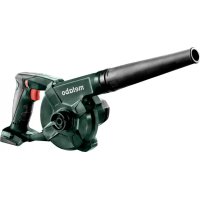
AG 18 - Blower METABO - Free user manual and instructions
Find the device manual for free AG 18 METABO in PDF.

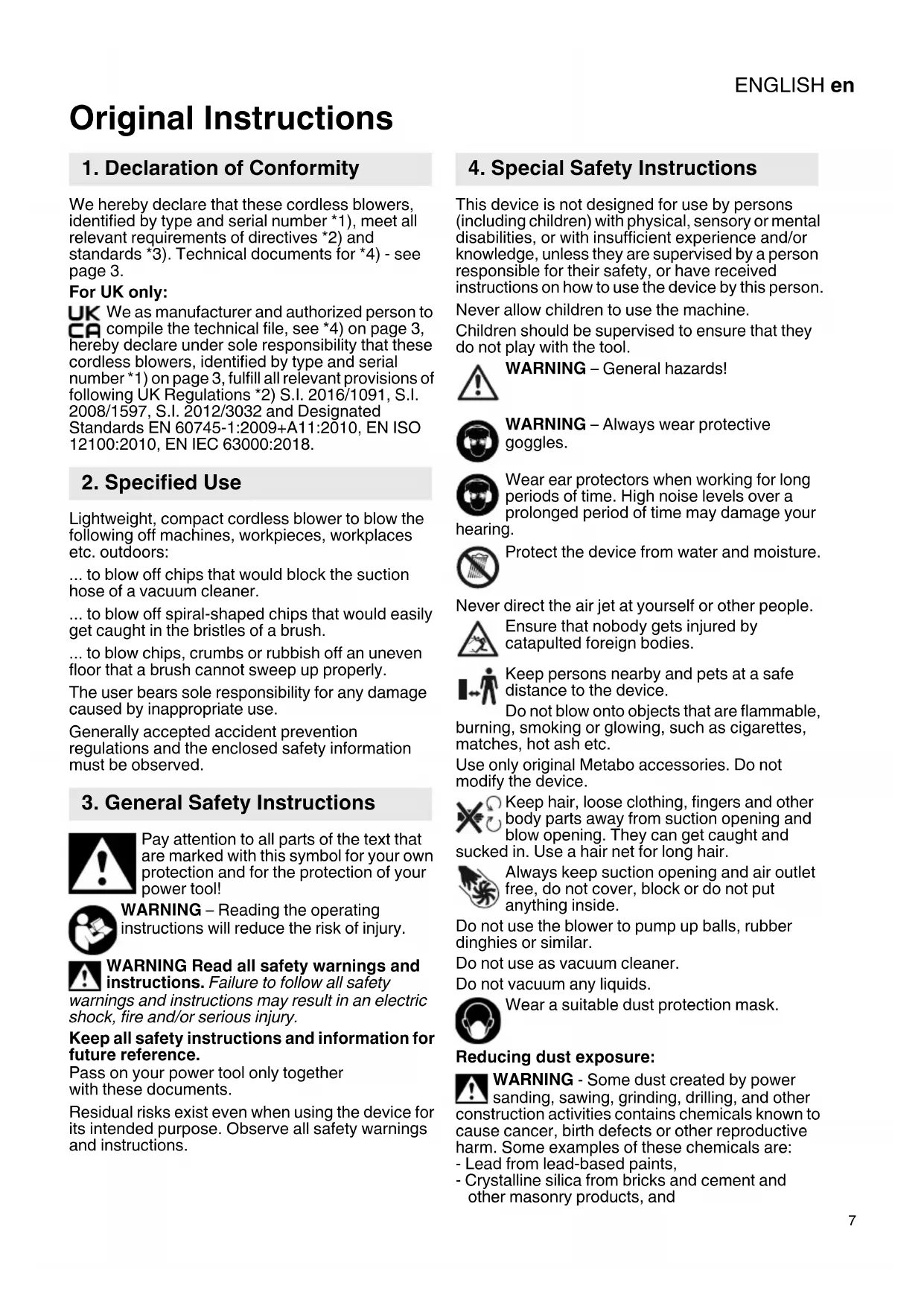


| Product Type | Cordless Blower |
| Brand | Metabo |
| Model | AG 18 |
| Category | Blower |
| Power Supply | 18 V Li-Ion battery (estimated) |
| Max. Air Flow | Adjustable via wheel |
| Max. Air Speed | Variable by trigger |
| Main Functions | Blowing chips, debris, dust outdoors |
| Nozzle and Tube | Bayonet detachable |
| Safety | Safety goggles, ear protection, do not point at people |
| Maintenance | Remove battery before cleaning, do not immerse |
| Battery | Li-Ion with capacity indicator, storage temperature 10-30°C |
| Accessories | Chargers ASC Ultra, ASC 15, ASC 30; batteries of different capacities |
| Repairs | By electrician, contact Metabo |
| Weight | Approx. 1.5 kg (estimated) |
| Sound Level | May exceed 80 dB(A) - wear ear protection |
| Standards | EU compliant, EN 60745 |
| Intended Use | Outdoor blowing, not for inflating or vacuuming |
Frequently Asked Questions - AG 18 METABO
User questions about AG 18 METABO
0 question about this device. Answer the ones you know or ask your own.
Ask a new question about this device
Download the instructions for your Blower in PDF format for free! Find your manual AG 18 - METABO and take your electronic device back in hand. On this page are published all the documents necessary for the use of your device. AG 18 by METABO.
USER MANUAL AG 18 METABO
natural_image
Black metal carbustible brush with a long cylindrical tip, no visible text or symbols on the device body.
Original Instructions
1. Declaration of Conformity
We hereby declare that these cordless blowers, identified by type and serial number *1), meet all relevant requirements of directives *2) and standards *3). Technical documents for *4) - see page 3.
For UK only:
UK CA We as manufacturer and authorized person to compile the technical file, see *4) on page 3, hereby declare under sole responsibility that these cordless blowers, identified by type and serial number *1) on page 3, fulfill all relevant provisions of following UK Regulations *2) S.I. 2016/1091, S.I. 2008/1597, S.I. 2012/3032 and Designated Standards EN 60745-1:2009+A11:2010, EN ISO 12100:2010, EN IEC 63000:2018.
2. Specified Use
Lightweight, compact cordless blower to blow the following off machines, workpieces, workplaces etc. outdoors:
... to blow off chips that would block the suction hose of a vacuum cleaner.
... to blow off spiral-shaped chips that would easily get caught in the bristles of a brush.
... to blow chips, crumbs or rubbish off an uneven floor that a brush cannot sweep up properly.
The user bears sole responsibility for any damage caused by inappropriate use.
Generally accepted accident prevention regulations and the enclosed safety information must be observed.
3. General Safety Instructions

Pay attention to all parts of the text that are marked with this symbol for your own protection and for the protection of your power tool!

WARNING – Reading the operating instructions will reduce the risk of injury.

WARNING Read all safety warnings and instructions. Failure to follow all safety
warnings and instructions may result in an electric shock, fire and/or serious injury.
Keep all safety instructions and information for future reference.
Pass on your power tool only together with these documents.
Residual risks exist even when using the device for its intended purpose. Observe all safety warnings and instructions.
4. Special Safety Instructions
This device is not designed for use by persons (including children) with physical, sensory or mental disabilities, or with insufficient experience and/or knowledge, unless they are supervised by a person responsible for their safety, or have received instructions on how to use the device by this person.
Never allow children to use the machine.
Children should be supervised to ensure that they do not play with the tool.

WARNING – General hazards!

WARNING – Always wear protective goggles.

Wear ear protectors when working for long periods of time. High noise levels over a prolonged period of time may damage your g.

Protect the device from water and moisture.
Never direct the air jet at yourself or other people.

Ensure that nobody gets injured by catapulted foreign bodies.

Keep persons nearby and pets at a safe distance to the device.
Do not blow onto objects that are flammable, burning, smoking or glowing, such as cigarettes, matches, hot ash etc.
Use only original Metabo accessories. Do not modify the device.

Keep hair, loose clothing, fingers and other body parts away from suction opening and blow opening. They can get caught and in. Use a hair net for long hair.

Always keep suction opening and air outlet free, do not cover, block or do not put anything inside.
Do not use the blower to pump up balls, rubber dinghies or similar.
Do not use as vacuum cleaner.
Do not vacuum any liquids.

Wear a suitable dust protection mask.
Reducing dust exposure:

WARNING - Some dust created by power sanding, sawing, grinding, drilling, and other truction activities contains chemicals known to the cancer, birth defects or other reproductive risk. Some examples of these chemicals are:
- Lead from lead-based paints,
- Crystalline silica from bricks and cement and other masonry products, and
ENGLISHen
- Arsenic and chromium from chemically treated lumber.
Your risk from these exposures varies, depending on how often you do this type of work. To reduce your exposure to these chemicals: work in a well ventilated area, and work with approved safety equipment, such as those dust masks that are specially designed to filter out microscopic particles.
This also applies to dust from other materials such as some timber types (like oak or beech dust), metals, asbestos. Other known diseases are e.g. allergic reactions, respiratory diseases. Do not let dust enter the body.
Observe the relevant guidelines and national regulations for your material, staff, application and place of application (e.g. occupational health and safety regulations, disposal).
Collect the particles generated at the source, avoid deposits in the surrounding area.
Use suitable accessories for special work. In this way, fewer particles enter the environment in an uncontrolled manner.
Use a suitable extraction unit.
Reduce dust exposure with the following measures:
- do not direct the escaping particles and the exhaust air stream at yourself or nearby persons or on dust deposits,
- use an extraction unit and/or air purifiers,
- ensure good ventilation of the workplace and keep clean using a vacuum cleaner. Sweeping or blowing stirs up dust.
Vacuum or wash the protective clothing. Do not blow, beat or brush..
4.1 Special safety instructions for cordless tools:
Remove the battery pack from the tool...
- ...before making any adjustments, changing tools, maintenance or cleaning.
- ...if the operator moves away from the tool.
- ...prior to the removal of blockages.
- ...before touching a foreign body to check the machine for damage.
- ...for immediate checking when the machine starts to vibrate excessively.

Protect battery packs from water and moisture!
Do not expose battery packs to naked flame!
Do not use faulty or deformed battery packs!
Do not open battery packs!
Do not touch or short circuit battery pack contacts!

A slightly acidic, flammable fluid may leak from defective Li-ion battery packs!

If battery fluid leaks out and comes into contact with your skin, rinse immediately with plenty of water. If battery fluid leaks out and comes into contact with your eyes, wash them with clean water and seek medical attention immediately!
5. Overview
See page 2.
1 Nozzle
2 Extension pipe
3 Exhaust port
4 Suction opening
5 Battery pack *
6 Thread for attaching the Metabo belt hook *
7 Capacity and signal indicator *
8 Capacity indicator button *
9 Battery pack release button
10 Handle
11 Trigger switch
12 Thumbwheel to set maximum air volume
* depending on equipment/not in scope of delivery
6. Commissioning
Battery pack
Charge the battery pack (5) before use.
Recharge the battery pack if performance diminishes.
The ideal storage temperature is between 10^ C and 30^ C.
"Li-Power" lithium ion battery packs have a capacity and signal indicator (7):
- Press the button (8), the LEDs indicate the charge level.
- The battery pack is almost flat and must be recharged if one LED is flashing.
Removing and inserting the battery pack
Removal: press the battery pack release button (9) and pull the battery pack (5) forwards.
Inserting: slide in the battery pack (5) until it engages.
7. Use
7.1 Attach nozzle and pipe

Prior to any conversion work: remove battery pack from machine.
Attach the pipe (2) and/or the nozzle (1) to the exhaust port (3) and secure by turning it (bayonet catch engages).
7.2 On/Off switch, setting the speed

Avoid switching on the machine accidentally: always switch it off when the battery pack is saved from the machine.
Switching on, speed: press the trigger switch (11).
The air volume can be adjusted by pressing the trigger switch.
Switching off: release the trigger switch (11).
7.3 Setting maximum air volume
Set the maximum air volume using the thumbwheel (12).
8. Accessories
Use only genuine Metabo accessories.
Use only accessories which fulfil the requirements and specifications listed in these operating instructions.
Fit accessories securely. If the machine is operated in a holder: secure the machine well. Loss of control can cause personal injury.
A Chargers: ASC Ultra, ASC 15, ASC 30 and others
B Battery packs with different capacities. Buy battery packs only with voltage suitable for your power tool.
See www.metabo.com or the catalogue for a complete range of accessories.
9. Repairs

Repairs to electrical tools must ONLY be carried out by qualified electricians!
Contact your local Metabo representative if you have Metabo power tools requiring repairs. See www.metabo.com for addresses.
You can download a list of spare parts from www.metabo.com.
10. Environmental Protection
Observe national regulations on environmentally compatible disposal and on the recycling of disused tools, packaging and accessories.
Packaging materials must be disposed of according to their labelling in accordance with municipal guidelines. Further information can be found at www.metabo.com in the “Service” section.

Only for EU countries: never dispose of power tools in your household waste! Used power tools must be collected separately and in for environmentally compatible recycling accordance with European Directive 2002/96/EC ste electrical and electronic equipment and its mentation in national legal systems.
Battery packs may not be disposed of with regular waste. Return faulty or used battery packs to your Metabo dealer!
Do not allow battery packs to come into contact with water!
Discharge the battery pack in the power tool before disposal. Prevent the contacts from short-circuiting (e.g. by protecting them with adhesive tape).
11. Technical Specifications
Explanatory notes on the specifications on page 3. Changes due to technological progress reserved.
U = Battery pack voltage
n_0 =No-load speed
V_air =Max. air volume
v_air,max = Air speed
m = Weight with smallest battery pack
--- Direct current
The technical specifications quoted are subject to tolerances (in compliance with the relevant valid standards).

Emission values
These values make it possible to assess the emissions from the power tool and to compare different power tools. The actual load may be higher or lower depending on the operating conditions, the condition of the power tool or the accessories.
Please allow for breaks and periods when the load is lower for assessment purposes. Arrange protective measures for the user e.g. organisational measures based on the adjusted estimates.
Vibration total value (vector sum of three directions) determined in accordance with EN 60745:
a_h = Vibration emission value
K_n, = Uncertainty (vibration)
Typical A-effective perceived sound levels:
L_pA = Sound-pressure level
L_WA = A c o u s t i c p o w e r l e v e l
K_pA, K_WA = Uncertainty
Measured values determined in conformity with EN 60745.
During operation the noise level can exceed 80 dB(A).

Wear ear protectors!
FRANÇAISfr
Notice originale
K_h, = incertitude (vibration)
--- Corriente continua
2 J at k o p u t k i
natural_image
Icon showing an open book and a recycling bin with a circular arrow (no text or symbols)Metabowerke GmbH
Metabo-Allee 1
72622 Nuertingen
Germany
www.metabo.com
metabo®
PROFESSIONAL POWER TOOL SOLUTIONS
- Original Instructions
- Declaration of Conformity
- For UK only:
- Specified Use
- General Safety Instructions
- Special Safety Instructions
- Reducing dust exposure:
- ENGLISHen
- Special safety instructions for cordless tools:
- Overview
- Commissioning
- Battery pack
- Removing and inserting the battery pack
- Use
- Attach nozzle and pipe
- On/Off switch, setting the speed
- Setting maximum air volume
- Accessories
- Repairs
- Environmental Protection
- Technical Specifications
- Emission values
- FRANÇAISfr
- Notice originale
Brand : METABO
Model : AG 18
Category : Blower