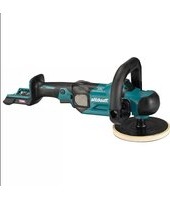
DPV300Z - Polisher MAKITA - Free user manual and instructions
Find the device manual for free DPV300Z MAKITA in PDF.


| Product Type | Cordless Polisher/Sander |
| Brand | Makita |
| Model | DPV300Z |
| Rated voltage | 18 V DC |
| No load speed (high mode) | 0 - 9,500 min⁻¹ |
| No load speed (low mode) | 0 - 2,800 min⁻¹ |
| Pad capacity (sheepskin) | 80 mm |
| Pad capacity (foam) | 80 mm |
| Sanding disc capacity | 50 mm |
| Backing pad diameter (sanding) | 46 mm |
| Backing pad diameter (polishing) | 75 mm |
| Spindle thread (internal) | 5/16\" - 24 UNF |
| Overall length (with BL1860B battery) | 160 mm |
| Net weight | 1.3 - 1.6 kg |
| Sound pressure level (LpA) | 76 dB(A) |
| Vibration level (sanding) | ≤ 2.5 m/s² (uncertainty K=1.5 m/s²) |
| Vibration level (polishing) | ≤ 2.5 m/s² (uncertainty K=1.5 m/s²) |
| Compatible battery type | Lithium-ion Makita 18 V (BL1815N, BL1820B, BL1830B, BL1840B, BL1850B, BL1860B) |
| Compatible charger | DC18RC, DC18RD, DC18RE, DC18SD, DC18SE, DC18SF, DC18SH, DC18WC |
| Main applications | Polishing, smoothing before painting, surface finishing, rust and paint removal |
| Safety features | Switch lock, spindle lock, overload protection, overheating and over-discharge protection, accidental restart prevention |
| Maintenance | Regularly clean the dust covers; all repairs must be carried out by an authorized Makita service center using genuine parts |
| Included accessories | Side handle, backing pad, polishing pad (depending on version) |
| Spare parts availability | Backing pads, abrasive discs, original Makita batteries and chargers |
Frequently Asked Questions - DPV300Z MAKITA
User questions about DPV300Z MAKITA
0 question about this device. Answer the ones you know or ask your own.
Ask a new question about this device
Download the instructions for your Polisher in PDF format for free! Find your manual DPV300Z - MAKITA and take your electronic device back in hand. On this page are published all the documents necessary for the use of your device. DPV300Z by MAKITA.
USER MANUAL DPV300Z MAKITA
| Model: DPV300 | ||
| Maximum capacities Wool pad 80 | mm | |
| Sponge pad 80 mm | ||
| Sanding disc 50 mm | ||
| Backing pad diameter For sanding | 46 mm | |
| For polishing 75 mm | ||
| No load speed (no)/Rated speed (n) | High (2):sanding mode | 0 - 9,500 min-1 |
| Low (1)polishing mode | 0 - 2,800 min-1 | |
| Spindle thread (internal) 5/16" - 24 UNF | ||
| Overall length with BL1860B 160 | mm | |
| Rated voltage D.C. 18 V | ||
| Net weight 1.3 - 1.6 kg | ||
Due to our continuing program of research and development, the specifications herein are subject to change without notice.
Specifications may differ from country to country.
The weight may differ depending on the attachment(s), including the battery cartridge. The lightest and heaviest combinations, according to EPTA-Procedure 01/2014, are shown in the table.
Applicable battery cartridge and charger
| Battery cartridge | BL1815N / BL1820B / BL1830B / BL1840B / BL1850B / BL1860B |
| Charger | DC18RC / DC18RD / DC18RE / DC18SD / DC18SE / DC18SF / DC18SH / DC18WC |
Some of the battery cartridges and chargers listed above may not be available depending on your region of residence.

WARNING: Only use the battery cartridges and chargers listed above. Use of any other battery cartridges and chargers may cause injury and/or fire.
Intended use
The tool is intended for polishing, smoothing before painting, finishing surfaces, and removing rust and paint.
Noise
The typical A-weighted noise level determined according to EN62841-2-3:
| Model | Sound pres-sure level \( \left( {\mathrm{L}}_{\mathrm{{PA}}}\right) : \left( {\mathrm{{dB}}\left( \mathrm{A}\right) }\right) \) | Sound power level \( \left( {\mathrm{L}}_{\mathrm{{WA}}}\right) : \) (dB(A)) | Uncertainty (K) : (dB(A)) |
| DPV300 | 76 | - | 3 |
The noise level under working may exceed 80 dB (A).
NOTE: The declared noise emission value(s) has been measured in accordance with a standard test method and may be used for comparing one tool with another.
NOTE: The declared noise emission value(s) may also be used in a preliminary assessment of exposure.

WARNING: Wear ear protection.

WARNING: The noise emission during actual use of the power tool can differ from the declared value(s) depending on the ways in which the tool is used especially what kind of workpiece is processed.

WARNING: Be sure to identify safety measures to protect the operator that are based on an estimation of exposure in the actual conditions of the (taking account of all parts of the operating cycle such as the times when the tool is switched off and when it is running idle in addition to the trigger time).

WARNING: Set heavy flexible damping mats such to workpieces (thin sheets of metal or her easily vibrating structures with a large surface) to prevent them from emitting sound.
Take the increased noise emission into consideration for both the risk assessment of noise exposure and selecting adequate hearing protection.
Vibration
The vibration total value (tri-axial vector sum) determined according to EN62841-2-3:
Work mode: disc sanding
Vibration emission (ah,DS):2.5m / s^2 or less
Uncertainty (K):1.5m / s^2 Work mode: polishing
Vibration emission (ah,P):2.5m / s^2 or less
Uncertainty (K):1.5m / s^2
NOTE: The declared vibration total value(s) has been measured in accordance with a standard test method and may be used for comparing one tool with another.
NOTE: The declared vibration total value(s) may also be used in a preliminary assessment of exposure.
WARNING: The vibration emission during actual use of the power tool can differ from the declared value(s) depending on the ways in which the tool is used especially what kind of workpiece is processed.
WARNING: Be sure to identify safety measures to protect the operator that are based on an estimation of exposure in the actual conditions of use (taking account of all parts of the operating cycle such as the times when the tool is switched off and when it is running idle in addition to the trigger time).
WARNING: The declared vibration emission value is used for main applications of the power tool. However if the power tool is used for other applications, the vibration emission value may be different.
EC Declaration of Conformity
For European countries only
The EC declaration of conformity is included as Annex A to this instruction manual.
SAFETYWARNINGS
General power tool safety warnings
WARNING Read all safety warnings, instructions, illustrations and specifications provided with this power tool. Failure to follow all instructions listed below may result in electric shock, fire and/or serious injury.
Save all warnings and instructions for future reference.
The term "power tool" in the warnings refers to your mains-operated (corded) power tool or battery-operated (cordless) power tool.
Cordless sander polisher safety warnings
Safety warnings common for sanding or polishing operations:
- This power tool is intended to function as a sander or polisher. Read all safety warnings, instructions, illustrations and specifications provided with this power tool. Failure to follow all instructions listed below may result in electric shock, fire and/or serious injury.
- Operations such as grinding, wire brushing, hole cutting, or cutting-off are not to be performed with this power tool. Operations for which the power tool was not designed may create a hazard and cause personal injury.
- Do not convert this power tool to operate in a way which is not specifically designed and specified by the tool manufacturer. Such a conversion may result in a loss of control and cause serious personal injury.
- Do not use accessories which are not specifically designed and specified by the tool manufacturer. Just because the accessory can be attached to your power tool, it does not assure safe operation.
- The rated speed of the accessory must be at least equal to the maximum speed marked on the power tool. Accessories running faster than their rated speed can break and fly apart.
- The outside diameter and the thickness of your accessory must be within the capacity rating of your power tool. Incorrectly sized accessories cannot be adequately guarded or controlled.
- The dimensions of the accessory mounting must fit the dimensions of the mounting hardware of the power tool. Accessories that do not match the mounting hardware of the power tool will run out of balance, vibrate excessively and may cause loss of control.
- Do not use a damaged accessory. Before each use inspect the accessory such as abrasive wheels for chips and cracks, backing pad for cracks, tear or excess wear, wire brush for loose or cracked wires. If power tool or accessory is dropped, inspect for damage or install an undamaged accessory. After inspecting and installing an accessory, position yourself and bystanders away from the plane of the rotating accessory and run the power tool at maximum no-load speed for one minute. Damaged accessories will normally break apart during this test time.
-
Wear personal protective equipment. Depending on application, use face shield, safety goggles or safety glasses. As appropriate, wear dust mask, hearing protectors, gloves and workshop apron capable of stopping small abrasive or workpiece fragments. The eye protection must be capable of stopping flying debris generated by various applications. The dust mask or respirator must be capable of filtrating particles generated by the particular application. Prolonged exposure to high intensity noise may cause hearing loss.
-
Keep bystanders a safe distance away from work area. Anyone entering the work area must wear personal protective equipment. Fragments of workpiece or of a broken accessory may fly away and cause injury beyond immediate area of operation.
- Hold the power tool by insulated gripping surfaces only, when performing an operation where the cutting tool may contact hidden wiring. Contact with a "live" wire will also make exposed metal parts of the power tool "live" and could give the operator an electric shock.
- Never lay the power tool down until the accessory has come to a complete stop. The spinning accessory may grab the surface and pull the power tool out of your control.
- Do not run the power tool while carrying it at your side. Accidental contact with the spinning accessory could snag your clothing, pulling the accessory into your body.
- Regularly clean the power tool's air vents. The motor's fan will draw the dust inside the housing and excessive accumulation of powdered metal may cause electrical hazards.
- Do not operate the power tool near flammable materials. Sparks could ignite these materials.
- Do not use accessories that require liquid coolants. Using water or other liquid coolants may result in electrocution or shock.
Kickback and related warnings:
Kickback is a sudden reaction to a pinched or snagged rotating wheel, backing pad, brush or any other accessory. Pinching or snagging causes rapid stalling of the rotating accessory which in turn causes the uncontrolled power tool to be forced in the direction opposite of the accessory's rotation at the point of the binding. For example, if an abrasive wheel is snagged or pinched by the workpiece, the edge of the wheel that is entering into the pinch point can dig into the surface of the material causing the wheel to climb out or kick out. The wheel may either jump toward or away from the operator, depending on direction of the wheel's movement at the point of pinching. Abrasive wheels may also break under these conditions.
Kickback is the result of power tool misuse and/or incorrect operating procedures or conditions and can be avoided by taking proper precautions as given below.
- Maintain a firm grip with both hands on the power tool and position your body and arms to allow you to resist kickback forces. Always use auxiliary handle, if provided, for maximum control over kickback or torque reaction during start-up. The operator can control torque reactions or kickback forces, if proper precautions are taken.
- Never place your hand near the rotating accessory. Accessory may kickback over your hand.
- Do not position your body in the area where power tool will move if kickback occurs. Kickback will propel the tool in direction opposite to the wheel's movement at the point of snagging.
-
Use special care when working corners, sharp edges, etc. Avoid bouncing and snagging the accessory. Corners, sharp edges or bouncing have a tendency to snag the rotating accessory and cause loss of control or kickback.
-
Do not attach a saw chain woodcarving blade, segmented diamond wheel with a peripheral gap greater than 10mm or toothed saw blade. Such blades create frequent kickback and loss of control.
Safety warnings specific for sanding operations:
- Use proper sized sanding disc paper. Follow manufacturers recommendations, when selecting sanding paper. Larger sanding paper extending too far beyond the sanding pad presents a laceration hazard and may cause snagging, tearing of the disc or kickback.
Safety warnings specific for polishing operations:
- Do not allow any loose portion of the polishing bonnet or its attachment strings to spin freely. Tuck away or trim any loose attachment strings. Loose and spinning attachment strings can entangle your fingers or snag on the workpiece.
Additional SafetyWarnings:
- Make sure the wheel is not contacting the workpiece before the switch is turned on.
- Before using the tool on an actual workpiece, let it run for a while. Watch for vibration or wobbling that could indicate poor installation or a poorly balanced wheel.
- Use the specified surface of the wheel to perform the sanding or polishing.
- Do not leave the tool running. Operate the tool only when hand-held.
- Do not touch the workpiece immediately after operation; it may be extremely hot and could burn your skin.
- Do not touch accessories immediately after operation; it may be extremely hot and could burn your skin.
- Observe the instructions of the manufacturer for correct mounting and use of wheels. Handle and store wheels with care.
- Check that the workpiece is properly supported.
- Pay attention that the wheel continues to rotate after the tool is switched off.
- Do not use the tool on any materials containing asbestos.
- Do not use cloth work gloves during operation. Fibers from cloth gloves may enter the tool, which causes tool breakage.
SAVE THESE INSTRUCTIONS.
WARNING: DO NOT let comfort or familiarity with product (gained from repeated use) replace strict adherence to safety rules for the subject product. MISUSE or failure to follow the safety rules stated in this instruction manual may cause serious personal injury.
Important safety instructions for battery cartridge
- Before using battery cartridge, read all instructions and cautionary markings on (1) battery charger, (2) battery, and (3) product using battery.
- Do not disassemble or tamper with the battery cartridge. It may result in a fire, excessive heat, or explosion.
- If operating time has become excessively shorter, stop operating immediately. It may result in a risk of overheating, possible burns and even an explosion.
- If electrolyte gets into your eyes, rinse them out with clear water and seek medical attention right away. It may result in loss of your eyesight.
- Do not short the battery cartridge:
(1) Do not touch the terminals with any conductive material.
(2) Avoid storing battery cartridge in a container with other metal objects such as nails, coins, etc.
(3) Do not expose battery cartridge to water or rain. A battery short can cause a large current flow, overheating, possible burns and even a breakdown.
- Do not store and use the tool and battery cartridge in locations where the temperature may reach or exceed 50^ (122^) .
- Do not incinerate the battery cartridge even if it is severely damaged or is completely worn out. The battery cartridge can explode in a fire.
- Do not nail, cut, crush, throw, drop the battery cartridge, or hit against a hard object to the battery cartridge. Such conduct may result in a fire, excessive heat, or explosion.
- Do not use a damaged battery.
- The contained lithium-ion batteries are subject to the Dangerous Goods Legislation requirements.
For commercial transports e.g. by third parties, forwarding agents, special requirement on packaging and labeling must be observed.
For preparation of the item being shipped, consulting an expert for hazardous material is required.
Please also observe possibly more detailed national regulations.
Tape or mask off open contacts and pack up the battery in such a manner that it cannot move around in the packaging.
- When disposing the battery cartridge, remove it from the tool and dispose of it in a safe place. Follow your local regulations relating to disposal of battery.
-
Use the batteries only with the products specified by Makita. Installing the batteries to non-compliant products may result in a fire, excessive heat, explosion, or leak of electrolyte.
-
If the tool is not used for a long period of time, the battery must be removed from the tool.
- During and after use, the battery cartridge may take on heat which can cause burns or low temperature burns. Pay attention to the handling of hot battery cartridges.
- Do not touch the terminal of the tool immediately after use as it may get hot enough to cause burns.
- Do not allow chips, dust, or soil stuck into the terminals, holes, and grooves of the battery cartridge. It may cause heating, catching fire, burst and malfunction of the tool or battery cartridge, resulting in burns or personal injury.
-
Unless the tool supports the use near high-voltage electrical power lines, do not use the battery cartridge near high-voltage electrical power lines. It may result in a malfunction or breakdown of the tool or battery cartridge.
-
Keep the battery away from children.
SAVE THESE INSTRUCTIONS.
CAUTION: Only use genuine Makita batteries. Use of non-genuine Makita batteries, or batteries that have been altered, may result in the battery bursting causing fires, personal injury and damage. It will also void the Makita warranty for the Makita tool and charger.
Tips for maintaining maximum battery life
- Charge the battery cartridge before completely discharged. Always stop tool operation and charge the battery cartridge when you notice less tool power.
- Never recharge a fully charged battery cartridge. Overcharging shortens the battery service life.
- Charge the battery cartridge with room temperature at 10^ - 40^ (50°F - 104°F). Let a hot battery cartridge cool down before charging it.
- When not using the battery cartridge, remove it from the tool or the charger.
- Charge the battery cartridge if you do not use it for a long period (more than six months).
FUNCTIONAL DESCRIPTION
CAUTION: Always be sure that the tool is switched off and the battery cartridge is removed before adjusting or checking function on the tool.
Installing or removing battery cartridge
CAUTION: Always switch off the tool before installing or removing of the battery cartridge.
CAUTION: Hold the tool and the battery cartridge firmly when installing or removing battery cartridge. Failure to hold the tool and the battery cartridge firmly may cause them to slip off your hands and result in damage to the tool and battery cartridge and a personal injury.
Fig.1: 1. Red indicator 2. Button 3. Battery cartridge
To remove the battery cartridge, slide it from the tool while sliding the button on the front of the cartridge.
To install the battery cartridge, align the tongue on the battery cartridge with the groove in the housing and slip it into place. Insert it all the way until it locks in place with a little click. If you can see the red indicator as shown in the figure, it is not locked completely.
CAUTION: Always install the battery cartridge fully until the red indicator cannot be seen. If not, it may accidentally fall out of the tool, causing injury to you or someone around you.
CAUTION: Do not install the battery cartridge forcibly. If the cartridge does not slide in easily, it is not being inserted correctly.
Indicating the remaining battery capacity
Only for battery cartridges with the indicator
Fig.2: 1. Indicator lamps 2. Check button
Press the check button on the battery cartridge to indicate the remaining battery capacity. The indicator lamps light up for a few seconds.
| Indicator lamps Remaining | capacity | ||
| Lighted Off | Blinking | ||
| 75% to 100% | |||
| 50% to 75% | |||
| 25% to 50% | |||
| 0% to 25% | |||
| Charge the battery. | |||
| The battery may have malfunctioned. | |||
NOTE: Depending on the conditions of use and the ambient temperature, the indication may differ slightly from the actual capacity.
NOTE: The first (far left) indicator lamp will blink when the battery protection system works.
Tool / battery protection system
The tool is equipped with a tool/battery protection system. This system automatically cuts off power to the motor to extend tool and battery life. The tool will automatically stop during operation if the tool or battery is placed under one of the following conditions:
Overload protection
When the tool/battery is operated in a manner that causes it to draw an abnormally high current, the tool automatically stops without any indication. In this situation, turn the tool off and stop the application that caused the tool to become overloaded. Then turn the tool on to restart.
Overheat protection
When the tool/battery is overheated, the tool stops automatically. Let the tool cool down before turning the tool on again.
Overdischarge protection
When the battery capacity is not enough, the tool stops automatically. In this case, remove the battery from the tool and charge the battery.
Protections against other causes
Protection system is also designed for other causes that could damage the tool and allows the tool to stop automatically. Take all the following steps to clear the causes, when the tool has been brought to a temporary halt or stop in operation.
- Turn the tool off, and then turn it on again to restart.
- Charge the battery(ies) or replace it/them with recharged battery(ies).
- Let the tool and battery(ies) cool down.
If no improvement can be found by restoring protection system, then contact your local Makita Service Center.
Switch action
CAUTION: Before installing the battery cartridge into the tool, always check to see that the switch trigger actuates properly and returns to the "OFF" position when released.
CAUTION: Switch can be locked in "ON" position for ease of operator comfort during extended use. Apply caution when locking tool in "ON" position and maintain firm grasp on tool.
CAUTION: Do not install the battery cartridge with the lock button engaged.
CAUTION: When not operating the tool, depress the trigger-lock button from side to lock the switch trigger in the OFF position.
To prevent the switch trigger from accidentally pulled, the trigger-lock button is provided. To start the tool, depress the trigger-lock button from A (side and pull the switch trigger. Tool speed is increased by increasing pressure on the switch trigger. Release the switch trigger to stop. After use, depress the trigger-lock button from B (side.
Fig.3: 1. Trigger-lock button
For continuous operation, depress the lock button while pulling the switch trigger, and then release the switch trigger. To stop the tool, pull the switch trigger fully, then release it.
Fig.4: 1. Switch trigger 2. Lock button 3. Trigger-lock button
Speed change lever
CAUTION: Always set the speed change lever fully to the correct position. If you operate the tool with the speed change lever positioned halfway between the "1" side and "2" side, the tool may be damaged.
CAUTION: Do not use the speed change lever while the tool is running. The tool may be damaged.
CAUTION: If the tool is operated continuously at low speeds for a long time, the motor will get overloaded, resulting in tool malfunction.
To change the speed, switch off the tool first. Push the speed change lever to display "2" for high speed or "1" for low speed. Be sure that the speed change lever is set to the correct position before operation. Use the right speed for your job.
Fig.5: 1. Speed change lever
| Displayed number | Symbol | Speed Applicable operation |
| 2 | High Sanding operation | |
| 1 | Low Polishing operation |
Accidental restart preventive function
If you install the battery cartridge while pulling the switch trigger or locking the switch trigger, the tool does not start. To start the tool, release the switch trigger, and then pull the switch trigger.
ASSEMBLY
CAUTION: Always be sure that the tool is switched off and the battery cartridge is removed before carrying out any work on the tool.
Installing side grip
CAUTION: Tighten the caps or side grip firmly. Otherwise, the front cover may fall and cause an injury.
Remove the cap and screw the side grip on the tool securely. The side grip can be installed on either side of the tool.
Fig.6: 1. Cap 2. Side grip
Installing backing pad
CAUTION: Make sure that the backing pad is secured properly. Loose attachment will run out of balance and cause an excessive vibration which may cause loss of control.
CAUTION: Never actuate the shaft lock when the spindle is moving. The tool may be damaged.
NOTE: Regularly clean the accessories and spindle to remove dust and debris. Wipe the components clean with a cloth dampened in soapy water if necessary.
Hook-and-loop system
Press in the shaft lock to prevent spindle rotation, and thread the hook-and-loop pad into the spindle. Hand tighten securely.
Fig.7: 1. Shaft lock 2. Spindle 3. Hook-and-loop pad
To remove the hook-and-loop pad, follow the installation procedure in reverse.
Twist-on/twist-off system
Screw the twist-on/twist-off pad onto the adapter. Then thread the other end of the adapter into the spindle while pressing in the shaft lock. Hand tighten securely.
▶ Fig.8: 1. Twist-on/twist-off pad 2. Adapter 3. Shaft lock 4. Spindle
To remove the twist-on/twist-off pad and adapter, follow the installation procedure in reverse. If it is difficult to remove them, use a wrench.
Installing and removing polishing pad
CAUTION: Only use the hook-and-loop system pads for polishing.
CAUTION: Make sure that the polishing pad and hook-and-loop pad are aligned and securely attached. Otherwise the polishing pad will cause an excessive vibration which may cause loss of control or the polishing pad may be thrown out from the tool.
Remove all dirt and foreign matter from the hook-and-loop system of a polishing pad and hook-and-loop pad. Attach the polishing pad to the hook-and-loop pad so that their centers are aligned. To remove the polishing pad from the hook-and-loop pad, just pull up from its edge.
Fig.9: 1. Polishing pad 2. Hook-and-loop pad
Installing abrasive disc
Optional accessory
CAUTION: Only use the twist-on/twist-off system discs for sanding.
Disc selection
CAUTION: The outside diameter of accessory must be within the capacity rating of the power tool.
CAUTION: The rated speed of accessory must be equal or higher than the maximum speed marked on the power tool.
Always use the correct sized wheel that is made from appropriate abrasive materials with the right grit size for your job.
Abrasive disc materials
| Abrasive materials | Basic features Practical applications | |
| Aluminum Oxide Best for steel,stainless steel and metals. Single crystal abrasive material with high tenacity and durability. | Fast sanding Most metal jobs | |
| Alumina Zirconium Best for INOX and metals. Extremely sharp and hard abrasive material with high durability. | Removing paint from cars and boats, etc. | |
| Ceramic Best for INOX,metals and non-ferrous materials-extremely sharp and high resistant to shock/heat/wear. | General metal work |
Grit size
| Grit Practical applications | |
| 24/36 (coarse) Heavy stock removal | |
| 60/80 Medium stock removal | |
| 120 (fine) Finishing |
Installing and removing abrasive disc
CAUTION: Make sure that the twist-on/twist-off pad is secured properly. Loose attachment will run out of balance and cause an excessive vibration which may cause loss of control.
Remove all dirt and foreign matter from the twist-on/ twist-off pad. Thread an abrasive disc onto the twist-on/ twist-off pad while pressing in the shaft lock. Hand tighten securely.
To remove the abrasive disc from the twist-on/twist-off pad, follow the installation procedure in reverse.
Fig.10: 1. Abrasive disc 2. Twist-on/twist-off pad
OPERATION
CAUTION: Only use Makita genuine pads for polishing.
CAUTION: Only use Makita genuine abrasive disc for sanding (optional accessories).
CAUTION: Make sure the work material is secured and stable. Falling object may cause personal injury.
CAUTION: Hold the tool firmly with one hand on the switch handle and the other hand on the side grip when performing the tool.
CAUTION: Do not run the tool at high load over an extended time period. It may result in tool malfunction which causes electric shock, fire and/or serious injury.
CAUTION: Be careful not to touch the rotating part.
CAUTION: Before operating the tool, make sure that the side grip or caps are not loose. If the side grip or caps are loose, the front cover may fall and cause an injury.
NOTICE: Never force the tool. Excessive pressure may lead to decreased polishing efficiency, damaged pad, or shorten tool life.
NOTICE: Continuous operation at high speed may damage work surface.
General operation
Fig.11
- Make sure that the workpiece is properly supported and both hands are free to control the tool.
- Hold the tool firmly with one hand on the switch handle and the other hand on the side grip.
- Turn the tool on, letting the wheel reach full speed, and then carefully enter into operation moving the tool forward over the workpiece surface.
- Having finished, switch the tool off and wait until the wheel has come to a complete stop before putting the tool down.
Polishing operation
Fig.12
1. Surface treatment
Use a wool pad for rough finishing then use a sponge pad for fine finishing.
2. Applying wax
Use a sponge pad. Apply wax to the sponge pad or work surface. Run the tool at low speed to smooth out wax.
CAUTION: Do not apply excessive wax or polishing agent. It will generate more dust and may cause eye or respiratory diseases.
NOTE: First, perform a test waxing on an inconspicuous portion of the work surface. Make sure that the tool will not scratch the surface or result in uneven waxing.
3. Removing wax
Use a sponge pad. Run the tool to remove wax.
4. Polishing
Apply a sponge pad gently to the work surface.
Sanding operation
CAUTION: Never switch on the tool when it is in contact with the workpiece, it may cause an injury to operator.
CAUTION: Never run the tool without the abrasive disc. You may seriously damage the pad.
CAUTION: Always wear safety goggles or a face shield during operation.
CAUTION: After operation, always switch off the tool and wait until the disc has come to a complete stop before putting the tool down.
Fig.13
ALWAYS hold the tool firmly with one hand on rear handle and the other on the side handle. Turn the tool on and then apply the abrasive disc to the workpiece. In general, keep the abrasive disc at an angle of about 15 degrees to the workpiece surface.
Apply slight pressure only. Excessive pressure will result in poor performance and premature wear to abrasive disc.
MAINTENANCE
CAUTION: Always be sure that the tool is switched off and the battery cartridge is removed before attempting to perform inspection or maintenance.
NOTICE: Never use gasoline, benzine, thinner, alcohol or the like. Discoloration, deformation or cracks may result.
To maintain product SAFETY and RELIABILITY, repairs, any other maintenance or adjustment should be performed by Makita Authorized or Factory Service Centers, always using Makita replacement parts.
Cleaning dust covers
Fig.14: 1. Dust cover
Regularly clean the dust covers on the inhalation vents for smooth air circulation. Remove the dust covers and clean the mesh.
OPTIONAL ACCESSORIES
CAUTION: These accessories or attachments are recommended for use with your Makita tool specified in this manual. The use of any other accessories or attachments might present a risk of injury to persons. Only use accessory or attachment for its stated purpose.
If you need any assistance for more details regarding these accessories, ask your local Makita Service Center.
- Wool pad
- Sponge pad (yellow)
- Sponge pad (white)
- Hook-and-loop pad
- Twist-on/twist-off pad
- Makita genuine battery and charger
NOTE: Some items in the list may be included in the tool package as standard accessories. They may differ from country to country.
SPECIFICATIONS
ACCESSIONS EN OPTION
VEILIGHEIDSWAARSCHUWINGEN
OPTIONELE ACCESSOIRES
Móvo yia xwpe ts Eupwnns
H oumuoppwos EK TepiaubetaTai wS Naapaptna A oTo npov yxεipidio odnyiw.
IPOEIAOIOIHSEI AΦAΛEIA
EvikeC PPOEIDOTIOINoEIG aOgaaeiaq yia to nAektpiKO epyaeeio
A PPOEIOOIH H aIaBaoTe oLeC TIC TPOEI- 00010nOeIc aoPaaEiaC, ONYieC, EIKOVoypaPnoEi KAI TPOBIAYpapcTou TApexovTai ME auto To nKTPiKO epyAAEO. H un Tnpon Oawv Tuv Onyiw Toun avaypavovTai KATWTepw MTopei va kataanNcI e nAe KPTOTAnxi, TUPkayia n/kai Oobapo Tpaumatioo.
ΦuαTe oεc TIG PPOEIOIIN-σει KAI TIG OBye γia μελIoVTIKn TAPaTouπn.
TIC TPOEIOOTIOINeIG, O oPoC T kO epyaieo] aVAPEPETAI OE nKTKPIKO epyaaleio Ttou TpOPODoteiTai aTO TnV KUPIA TAPoxN NkTPIKOU PEUMATOS (eNkTPIKO KAWIO) n OE nKTKPIKO epyaaleio Ttou TpOPODTeiAt aTo μTTatapia (xwpi nKTEPIKO KAWIO).
PpOeIodOtIOInoEic aOΦaλεiαγ YIA TOV φopntó λειavTnρα-σTIλβωTn
Ipoeiodotroinoeic aopaaiaa cokivcs yia epyaos 1eiaovnC n otiaBwns:
- Auto to nλεκτριό εργαλείο προριζεται via λειουργία ως λειαντηρας ἡσιλβωτής. Διαβάστε σλες τις προειδοποιησείς ασφαλείας, obnyies, εικονούραφησείς και προδιαγραφές Tou παρεχονται με auto to nλεκτριό εργαλείο. H μη Πηρηση δλων των έδηγίων Που αυγαρανονται katwτέρω μτορείνα καταλήξει σε nλεκτροπληξία, πιρκayía ἡ/και σοβαρό τραματιόμο.
- PPETEVA EKTELOUVTAEPYAAIEc OTWCSIAiavon, KAtapiooC ME OupuatoBouptoa,diavoIGN OTWV N KOITN ME auto TO nEKTPIKO EpyaAEOH EKTELEON EPyaoiwv ia Tc OTIOEC DEVEXeOxEdiaoTeI auto To nEKTPIKO EpyaAEOI TPOeVA Ekyuovekiivovouc kai va TpokaAeoi TPO-OWTIKO TpaUaTIOo.
- Mny npaymuotmoitee metatpontcse auto tonlektpiko epyaleio me tpoTTOU dev exei EIDiak oxediostei n kaopiotei anToV kataokueaotn tou epyaleiou. Mia teioia etatponnt mtopei va exei wC aTtEeOma Tnv atwAia eEyxou kai va TTPOKAeoi oobapo TPOOWTIKO tpaumatio
-
Mny xpnoiopoioite eapntmuata Tou ev eivai Eioka oxediaoeva kai kathetaovta ato tv Kaataokuaotn Tou epyaieou. AAnw cai mvo ETEIDn TO eaptnma uTopei va npooaptnthe i OTo nAektpiko epyaieio, auto dev egaospaaizla aopaaan Aietoupyia.
-
H ovopaotikn taxutnta tou egaptnmuotc pteTt va eivai toulambdaioitov ion me nvyepyiotn taxutnta Tou eivai onmuevn oto nektpiko epyaieo. Eaptnmuata Tou aeitoupyouv taxutepa atro nvy ovopaotikn taxutnta tou mtopei va otaoouv kai va ektoeueoiv.
- H EgWTEPIKn DIAeTPOs KAI TO Tlaxos Tou EApntNAtOs OAs TPETTEI VA Eivai Meoσa Opa IKAvOTNTOS TU NkEKTPIKOU EpyAeiou Oac. EApntjmuata Lavthetaou MeyeOous Dev MTopoov VA TPOpuLaxOou n va EeYxOouv Etapkws.
- OI diaaTaeic Tns oTepewong Eapntmuos TpETe va taipiazouv ME Tc diaaTaeic Tou EoTnAIOU OTepewons Tou nAekptikou Epyaleiou. Ta eapntma Tous dev taipiazouv ME TO eapntma OTepewong Tou nAekptikou Epyaleiou 0a napouiaOouu UTOBAtouEvn CuyoataHmion, UTEpBoIAKOUC Kpaaoouc kai EvexoeVwC atWLaia Eelyxou.
- Mny xnpoioutie eaptnma Tou exe unootei 1aBn. PIV aTO KAe XpO, VA EETaZTe TO eapTna, OTWc LEIAVTKOUc TPOXouc, YIA PIVIOAATA KAI pwyue, TN BaoN UTOOHTPIGNC YIA PWyue, PnN n UTEPBOALIKN OOpA, TN OUPATOBouptaa VIA XaIAPA n paYIOEVA OUPATA. Av To NkEKTPIKo EPyaleio n To EApTnua TEOEI KATW, EEvETo yia ZnueC n TPOAPUoote EVa KaLO EApTnua. Meta Tov EAEYxo KAI TNV TPOAPUoyn Evoc EApTnatoC, ATOAOKPVBEITE EOEIC KAI OYUPw OAc ATO TEITIPEIOPTPOQns Tou EApTnmuoC KAI apNOTE OE AIEtoupyia To NkEKTPIKO Epyaleio OE MEYOTN TAXuTTa Xwpiq optio yia EaENTO. EApTnata Me ZnueC thaiAUtheta kata Tov xpOvo autnc tsdcokunc
- Na φopáte Εξοπλισόο atομικής προστασίας. Aváloγa με την εφαρμούη, va χρησιμοποίeτε προσωπίδα προστασίας, προστateutíka yua-λία-προσωπίδες ἡ yuaλί απροστασίας. Šθαν αταιτίαι, va φopáte μασκα σκόνης, προστateutíka akonso, γαντία και πόδία συνεργείου ikavá va παρέχουν προστασία ató ta εκτινασόμενα μικρα θραύμata λόγω της λείανόns ἡ tou τεμαχίου εργασίας. Ta προστateutíka ματιών πρεTTEιν ειλι IKAVA VA Σαμatnoouv tuxov ἡκτινασόμενα θραύμATA TOUT Σημιουργουύναι katá την εκτέλεοŋ διαρόμων εφαρμoyw. H μασκα σκόνης ἡ avattveu-σθnpac πρεTTEιν ειλι IKAVN VA φιλτράρει σωμatidia TOUT πρayovtai αnto ηουκεριμένη εφαρμoyn. H πρapatetæνη εκθεοπο οε θόρμο Φηλής ενταόng Μπροpeiν προκαλεσι απιλεία ακόng.
- Kpatate Touc yup oac oe ia aopaln antootaan ato tv xwpo epyaiac. Otoiooohntote ioep- xóevoc sto xwpo epyaia c npetie va opa atoipko pootateutiko esotlaio. Teaxiaatno to Teuxo pyaia c n ato eva ataaevo exaptnua mtopei va ekivaxfouv paia kai va tpokaleouv tpaumatoipneav ts aeeonc peioxnc epyaiac.
- Kpatate To nAekptiko Epyaaleio mOvo aTIO TIC MOvwmeves ETiPavEIEC XeipolaaBnC OTAV EKTEAite MIA Epyaia KA tN VTOIA TO KOITIKO Epyaaleio mTOpE i va epoEi OE eTAPn ME KpumuEv a Kaawbi.Av yivei ETTaPn ME KATOIO nAektpoPoPO Kaawbio, Ta EKTeEmuEv aETAAIAk aepn Tou nAekptkoU Epyaieoi Oa yivouv KAI auta nAektpoPoPa KAI TIOPeVA TPOkAnThe i NkTPOPTANsia OTo xEpiotn.
-
Mny aqnvete TOTe TO nAekptiko epyaaleio kATW, TPIV OTaupnoei NlnpwS n TEpiotpopoTou EapntmuTo TEPiOtpeoEvO EaPTnma TTOpEVA TIAoei TIV ETIpaVcia KAI VA TpaBnEi To nAekptko epyaaleio EeW aTOv EeVxO aC.
-
Mny xeiipieote to nAekptko epyaaleio evw to metaepete oTO pLEUPO OAC.Tuxia eTAPn ETo TEPiOTpeoEvO EApTnma uTIOpei va TpokaAeoei TIAIIO OTA pouXa OAC KAI VA TpaBnEi TO EApTnua Meo aTO Owma OAC.
- Kaθαριζετε TAKIKA τα αυογματα Ελεπρισου tou έκτρικόν έργαλείου. O ανεμισηρας Tou μοτέρ θα αναρροφησει Π Θ Κανήμεδα σΤΟ περβλημα και Μ ἀπερβολικόν Σουγκεντρωπ πρισματων Μεταλου μιθοει εντρολακόν Σουγκεντρωπ κύνουν Λεκτροπληξας.
- Mny xepiEeTe To nAektpiko Epyaaleio kovTa oE uΦAekTa uIka. OI OTIVHnpeC μTOpEi va Tpokaλeouv avapAeGn autwTwv uIkwv.
- Myn xpnoiopoiote Egaptnmu Tnou xpeiaovta yuktiak uypa.Hxpnon vepou n aalwwy uuktkuw uypwuToppei va npokaleo iNkptpntiigia n oK.
Klota nka kai oxetikcs npoeiobtoinoeis:
To klotonja eivai ia faqviikn avtibpaon tou epyaaeiou Aoyw ouaovicngn n okaawatoc tou Tepioppeoevou Tpoxou, Tns baangs utootnpiegs, Tns BOuptaoac n tuxov aalou exaptnmuoc. H ouoovn to oakawma TPOkale taeeia atiwaeia eayxou Tou TEPIOPEOeou Eaptnmuoc TO OTIO AOvEXEA UTOXPEWVEI TO aveEeYKTO NkTPIKO EpyaAio OE TEPIOPTPON ANVITETn ano Eeivn Tou Eaptnmuoc OTO ONeio EMILOKc. Iia napadiyua, av evac aeavtiokc TPOXOC TEPIEAe i OE ouphiyn okaawma OTO TEAPXIO Epyaiaac, n akun Tou TPOXOU TIO EIOEpxetai OTO ONeio OUsOPIGNC MTOpei va OKaapei TIV ENIAPAVEIA TOU UAIKO TPOKAAWVTAC Nv AVATIN-00n n To klotonja Tou Tpoxou. O TPOXOC MTOpEi va avannoaneipoc to poc Tou xepiotn n AVTIeTa v atoaukpuvthei aoTov, avalova e tn qopa TEPIOPTPOPnc Tou TPOXOU 0TO ONeio OUsOPIGNC. YTO autec ts ouvthkecs, oi LEIAVTIKOI TPOXOI MTopei ETIANC VA UTOOTUV POAUON.
To klotona eivai aotéeogaa kakns xponc n/kaeopaal evw diaikaaow n ouvthenkwv xeipioou tou nektpikou epyaleiou kai eivai duvatov va atopoeuxei aubovotac katalnnec TPOPOUAEIG, OTWCTEPiPpOVTaKATWTepw.
- Kpatate Otaepa To nEeKtpiO epyaleio kai e Ta duo xepia kai TOTOnetnoe To oWma kai Touc Bpaixovc oac etoi wote va avbiotavtai otis duvaeiou kLoToanpatoc.Na xpnoiopoite Te nVTA Bonntikn laBn,av npexetai,vi yevio To baMu oElyxou tou kLoToanpatoc nTnc potns avTibpaons katany EKKivnon.O xepiotnc mTIOpei va EeyxieicavTbpaeicpoNTnduvaeic kLoToanpatos,av Exouv AnpthetaiKataaanee TPOpuAeic.
- Noté μη βαλετe TO xépi σaç Kovtá σTO περιστpeφομevo εξαρτημα. To εξαρτημα μπορείνα κλοτοπει σTO xépi σaç.
- Mn toTOnoTe nOeTo oWma Oac Otnv TEPioxn oTou To nAeKtpiKo epyaleio 0a KIVnOei av ouuβei kIoTaNa.To kIoTaNa 0a Obnyoei To epyaleio 0e dieUovon avIeTn Tc KivnOng tou Tpoxou oTo onueio EPTAAoknC.
- PooexTe 1iaitepa otav epyaceote oevwies, aixnpa akpa, kTλ. Na atoapeuyete tnv avatn- dnonkai to okalwaou Eapntmuotc. Twiec, aixnpes akpec n avattnooeic exouv tnv taon va Tpokalov eptlokn oTo TepiotpeoEvO Ea- tma kai npokalov anwlaea eEyxou n KLOTnua.
- Mny npoappozete aauoontpiovo, aeia GuaoyauTTIKns, Tmuatikodiauavotpoxo me Tepipepeiako kevoeayalutepo a10 mm n oovtwn aeiaa Tpioviou. Teoies Auec Tpo Kaouv ouxvo khotma kai antwlaea eEyxou.
PnoeioToiOeIc aoeaiae iikai yepyaoic yuaoxaptouos:
- Na xpnoiopoioite yuaoxapto biokou oawotou ueyébouc.Akoauohtote TIC ouotaceic tou kataoekuaotn, otav etiayetye yuaoxapto.Eva yuaoxapto eyautepu eyebouc Tou ekteivetai nlu nepa ato ta akpa tnc baonc utoantpiqyuaoxaptiauatoc eykuovie kivduvo Tejaxmuou kai mtopei va pokaedei okalwma, oxioiou tou diakou n klotanma.
Ppoeiodoioeic aopaaiea cia epyaoc stiawos
- Mny aqnvete tuxov xaapo tu nua tou kaumuatoC otiaBwOns n ta oKoivia eapntmuatoC va Tepioppeovtai euetheta.pa MaZeYte n koyte onioaHnTote euetheta.pa oKoivia eapntmuatoC Ta euetheta.pa kai Tepioppepoeva oKoivia eapntmuatoC mTopei va pIaeXtouv oTa daxTula aac n va Eumakouv oTo TeApxioEpyaoiaC.
PpOeTEc PPOEIOToINoEiC aΦaλεiα:
- Φροντίσε Οροχός va μήν ερχεται σε επαφή με το τέμαχιο εργασίας πρίν από την ενεργο- troiŋοι του διακόπη.
- Piv aTo Tn xpOnTou tpoXou Tavw oE Tpayatiko Teuxo Epyaoia, apnte Tov eAitoupyia yia mipko xpvikobiaotma. IapatnpnoTe av utapxouv bovnoic n taVTEUON Tou uTobnawovuKKn EYkataoTaon n tpoxo ME KAKI IOppoTia.
- Xpnoiopoioinote TnV Tpoka0epouevn Etnipaveia Tou Tpoxou ia va eKTEAeTe Tn Aieavon n otiaawon.
- Mny apnve To epyaiao avaupevo. Xeiipieote To epyaiao mvo otav to kpatate oTo xepi.
- Mny ayyiTeTo Teuaxio epyaoiaa eouwsceta Ta N eitoupyia.Mtopei va evai utepboikka Kauto kai va Tpokaloei Eykauja.
- Mny ayyiTe Ta eapntnataa eosw meta n Aitoupyia. Mtopeiv a evai unepboia kauo Kai va Tpokaloei Eykauma oTo depma oac.
- MeIeIeTne Tc obnyies Tou katakeuaotyia owtnt ToTOBETnON KAI XpOON TOW TPoXwv. XeiPteTeKai aTIOBKeUOTe Tou TPOXouc ME PovTiBa.
- ELeyTe OTo TEpaxio EpyaiaC UTOOtnpiEeTaI OToepea.
- IpooEeTe oTo tpoXoc ouvexie va Tepiortpe- qetai akoun kai apou To epyaiao exe i 0neoi
- Mn xpnoiomoiéite To epyaaleio oε kaveva uiko Tou Tepiexi αiavto.
- Mn xnpoiopoitee upaouativa yavtia epya
ciac kata tn aeitoupyia. Oivc aio ta upaou
tiva yavta mtopei va ioe thouv oto epyaleio,
yevovc tou pokaie to naoiou tou epyaleiou.
ΦYΛΑΞΕTE AYTEΣ TΙΣ ΕΟΗΓΙΕΣ.
A PPOEIOHOIHs: MHN EITIpeyete Otnv avo n oTnv Egokeiwn oac me To Tpoov (Tou aTOKtNkne aTTO eTaveiAnmuevn xpno) vaavikataotnoe iTv auotnp Tnpon Tuv kavovw aaqaleiaoc tou napovtoc epaaleiou. H ANOAEMENH XPHSH n naeia va akolouh-ote Touc kavovec aoqaleia c Tou diatutuwovta tOTo npov Exyepidio oyniow mTPOei va Tpoka- aeoi oBapop ppoosntko tpaumato.
Eik.6: 1. KaTaki 2. Nλayia λαβη