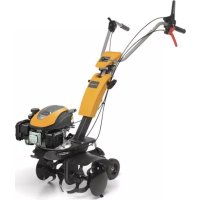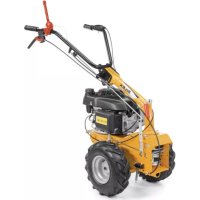
Silex 95 H - Milling machine STIGA - Free user manual and instructions
Find the device manual for free Silex 95 H STIGA in PDF.



| Product type | Tiller (rototiller) |
| Brand | Stiga |
| Model | Silex 95 H |
| Tilling width | 500 mm |
| Cutting width (cutter bar) | 870 mm |
| Length (with tines) | 1400 mm |
| Height | 1000 mm |
| Weight (with tines) | 78 kg |
| Wheel track | 430 mm |
| Tires | 2 pneumatic tires 13x5.00-6 |
| Engine type | 4-stroke, air-cooled |
| Fuel tank capacity | 1.5 liters |
| Fuel | Unleaded gasoline |
| Forward speed (1st) | 1.1 km/h (with tines) |
| Reverse speed (R) | 2.2 km/h (with tines) |
| Tine shaft rotations | 275 rpm |
| Sound level (at operator position) | 77.8 dB(A) (with tines) |
| Handle vibrations | 5.5 m/s² (with tines) |
| Gearbox lubricant | SAE 80 oil, capacity 0.4 L |
| Maintenance (gearbox drain) | Every 150 hours of operation |
| Safety | Emergency stop device, automatic transmission disengagement |
| Warranty | Valid only with original parts |
Frequently Asked Questions - Silex 95 H STIGA
User questions about Silex 95 H STIGA
0 question about this device. Answer the ones you know or ask your own.
Ask a new question about this device
Download the instructions for your Milling machine in PDF format for free! Find your manual Silex 95 H - STIGA and take your electronic device back in hand. On this page are published all the documents necessary for the use of your device. Silex 95 H by STIGA.
USER MANUAL Silex 95 H STIGA
Read the instructions manual before operating on the machine.
IpeepHaayamO3KcNJIyatauM KynbTnBaTopa03HaKOMbTecb C HAcTOUIM pyKOBOCTBOM.
Attention: danger rotation praise
Attention: danger rotation lame
Plaquette acceleration
Aufkleber-Gashebel
Etiket gaspedaal
Etiqueta do acelerador
Etiqueta acelerador
Etikéta Ekkivnons
UnpaBHeHne DpocceIbHO 3acJIOHKoI
Year of construction
Baujahr
Bouwjaar
Ano de fabricacao
Año de construcción
ETOS KATAOKEUN
IaH3rOToBJIeHHa
Rok produkci
Leto izdelave
5
Massa
Masse
Mass
Gewicht
Gewich
Massa
Masa
Bapoc
Bec
Masa
Teža
4
Serial number - Progressive
Instructions for operating
Transport
Assembly
Regulating
Maintenance
Technical Details
Noise
Fault

Serious risk for operator and bystander safety.
Translation of original user instructions
Introduction
Dear customer,
Thank you for your confidence in purchasing our products. We wish you to enjoy using our machines. The following working instructions have been issued to ensure a reliable running from the beginning. If you carefully follow such information the machine will operate with complete satisfaction and have a long service life. Our machines are tested under the most severe conditions before being put into production and are subjected to strict continuous test during manufacturing stages.
The present unit has been tested in the country of origin by independent testing authorities in accordance with strict work norms and safety standards.
When required, only original spare parts must be used to maintain guaranteed functions and a safety levels.
The operator forfeits any claims which may arise if the machine shows to be fitted with components other than original spare parts.
Subject to changes in design and construction without notice. For any question or further information and spare parts orders, we need to be informed of the unit serial number printed on the side of the machine.
IDENTIFICATION DATA (Fig. 1)
The tag plate with the machine data and Serial N^ is on the side of the motor-cultivator under the engine. Please - Always state your motor cultivator serial number when you request Technical Service or Spare Parts.
CONDITIONS AND LIMITATIONS OF USE
The motor- cultivator is designed and built to cultivate the soil or mow grass. The motor- cultivator must only be used with original equipment and spares. Any use other than those here described is prohibited and will involve, in addition to cancellation of the warranty, serious risk for the operator and bystanders.
SAFETY PRECAUTIONS
Attention: Before assembly and putting into operation, please read carefully the operating instructions. Persons not familiar with these instructions should not use the machine.
1 Persons who are not familiar with the operating manual, as well as children, adolescents under the age of 16 and persons under the influence of alcohol, drugs or medication must not operate the mower.
2 The unit was designed in order to be used by 1 trained operator only. The person using the mower is responsible for any accidents involving other persons or their property. When operating the machine, the user should ensure that no others, particularly children, are standing in the area (10 mt.).
3.Before starting to mow,remove any foreign bodies from the field. 4.Do not start the machinet when you are in front of the cultivator and mower.When you pull the starter
cord, the cultivator or mower must not move. (If this happen, adjust with the corresponding register).
- During operations you need to use ear protectors, sturdy footwear and long trousers should be worn.
- When running the machine on its set of wheels on a path, switch off the motor and wait until the cultivator blades stop.
- Maintenance and cleaning work on the machine, as well as adjustment of the brake shoe or set of wheels, must only be carried out with the motor switched off and the cutting tool stopped. Remove the sparkplug .
- When leaving the machine or leaving the guide handles the motor should be switched off.
- The operator must always hold the handlebar when working.
- It is essential to have the machine checked professionally if it comes to a sudden stop, for example, as a result of hitting an obstacle (gear damage, bent blades).
- Machines with an internal combustion engine must never be operated in closed rooms because of poisoning danger.
- WARNING !! The petrol/gasoline is highly inflammable. Store fuel only in containers specifically designed for he storage of such materials. Don't fill the tank neither in closed areas, nor when engine is on, don't smoke and be careful to the petrol/gasoline loss from the tank. In case of leak, don't try to switch the engine on but move the machine away from the area in order to avoid ignition source until the gasoline vapours fade away. Re-place the tank caps and the gasoline box. Never open the cap of the fuel tank, or add fuel, while the engine is running or the unit is hot.
- The exhaust and parts close to it can heat up to 80^ Celsius. Attention: Burnhazard!
- Please note that our company assumes no responsibility for damages due to: a) repairs made by unspecialized personnel or unauthorized after-sales service centers, or b) use of other than ORIGINAL SPARE PARTS. The same conditions apply to the accessories.
INSTRUCTIONS FOR OPERATING
INSTRUCTIONS - MOTOR Please follow the motor manufacturer's operating instructions.
PUTTING INTO OPERATION Make sure, operating levers are in "off" position. Put throttle into "start" position. Pull on the engine starter handle until you feel the resistance due to compression, let the starter rope run back slowly, and then give it a hefty pull (a full arm's length) to start the engine. Keep hold of the starter handle and let the rope run back slowly. To stop: Put the accelerator lever into STOP position.
■ SAFETY FEATURE All motor-cultivators are provided with a safety feature which acts. The device causes the transmission to disconnect automatically anytime the respective control lever is released.
TRANSPORT A forklift truck should be used to move the machine. The forks should be opened as far as possible and inserted into the pallet. The weight of the machine is given on the Manufacturer's data plate together with the other technical information.
HOW TO ASSEMBLE YOUR MOTOR-CULTIVATOR Unless otherwise agreed, the motor-cultivator is delivered disassembled and placed in a packing case. For assembly to be completed, the step by step procedure is as follows.
■ INSTALLING THE HANDLEBARS (Fig. 2) Fix the handlebars (Fig. 2, detail 1) to its mount (2) using screws (3). Important! The larger
HOW TO MOUNT THE ACCELERATOR WIRE (provided with metal sheath) Fig. 3
diameter washers must be installed by the slots. Adjust handlebar height with its fixing screws (3). Position the gear lever (4) putting though its guide (5) and push the tip into the hole on the swivel (6) and clamp it with safety pin (7).
Position the lever (fig. 3, item 1) on the engine at the end of its stroke as shown by arrow "A" in the figure. Move the throttle lever(2) on the handlebar to the end of its stroke as shown by arrow "B" in the figure. Insert wire (3) into hole (4), secure the sheath (5) with retainer (6) and screw (7). The throttle wire must be fixed to the engine at the sparkplug side. ATTENTION: in the position "stop" the throttle lever must stop engine.
BELT STRETCHER DRIVING WIRE (Fig. 4) The driving cable (1) is already linked to the belt stretcher lever of the frame to the lever (2). Please tighten the lever (2) on the handlebar using the screw (3) you can find into the loose parts bag.
ATTACHMENTS ASSEMBLY (Fig. 5) The cultivator has a quick couple for attachments. Assemble the belt on the upper pulley A with the following attachments: grassland mower and rotavator. Assemble the belt on the lower pulley B with the following attachments: brush and cutting bar.
ATTACHING THE POWER BAR (Fig. 6a) The cultivator has a quick couple for attachments. The motor should be shut down and the machine horizontal. Insert the cutter bar pin (1) halfway into its seating (2). Install the belt (3) in its pulley by moving the guide pin all the way to the end of its travel. Position 1 and 2: turn the handle (13) until you are able to couple the spring (14) to the connection (15). Position 2 and 3: to complete the above coupling, rotate the handle (13) in the opposite direction until you are able to tension the spring (14). Replace the cowling (6) with its centering pin (7) and the threaded pin (8). Tighten home the nut with its washer on the cowling.
ATTACHING THE CULTIVATOR (Fig. 6b) The cultivator has a quick couple for attachments. The engine must be switched off and the machine on level ground. Insert the cultivator pin (1) halfway into its seating (2). Install the belt (3) in the appropriate pulley and push the pin (1) all the way in. Position 1 and 2: turn the handle (13) until you are able to couple the spring (14) into the slot (15). Position 2 and 3: to complete the above coupling, rotate the handle (13) in the opposite direction until you are able to tension the spring (14). Install the cover (6) using its centering screw (7). The reverse gear blocking lever (8) will be correctly positioned with the gear lever (9). Tighten home the nut and its washer to fix the cover (6)
REVERSING ROD ASSEMBLING (Fig. 12) Connect the extremity of the rod (2) in the hole of the lever (3), so lock with the R-shape pin.
ATTACHMENT DRIVE BELT REGISTRATION (Fig. 7) To increase belt tensioning between machine and attachment, use the register (2) so that the attachment begins to work only when the control lever has been moved more than halfway its travel (Fig. 7)
If a mower is attached, to increase the tension on the two bottom mower drive belts, slacken off nut (9) and remove the washers between the half-pulleys (Fig. 5).
If a cultivator is attached, check belt tension after two work hours (3, Fig. 6).
HOW TO OPERATE THE DRIVE OF THE CUTTING BLADE (Fig. 7): disconnect the safety lever (3), then push down the lever for the tool insert (4).
■ BELT-STRETCHER CONTROL ADJUSTMENT (Fig. 8) Warning - Tyres should start rotating only when control lever is beyond halftravel. When lever is pulled to full extent (working position), the belt-stretcher load spring (2) should extend by 6 to 8mm approx. For above described conditions be reached, action is to be taken on nut (1) set close to the belt stretcher control assembly.
■ REGULATING THE HANDLEBAR The handlebar can be height or side adjusted. Before beginning any work, it is good standard operating procedure to adjust the handlebar to the needs of the operator so that the machine can be easily manoeuvered at all times. The handlebar can be side adjusted so that the operator can use the machine without treading in the soft ground or damaging the crop.
■ HANDLEBAR SIDE ADJUSTMENT (Fig. 2) There are three positions for the handlebar side adjustment and these can be used either with rear-mounted attachments such as a cultivator or with front-mounted attachments such as a mower. Follow these steps: Turn lever (8) anticlockwise to disengage the clamp. Move the handlebar to the position you want it in. Clamp the handlebar again by turning lever (8) clockwise and check to be sure that the teeth are perfectly meshed.
When turning the handlebar 180^ , do so only clockwise so as not to damage the wires that run along the column. Furthermore, detach the gear change rod (4) and reconnect it when the handlebar is in its new position.
When the handlebar is turned 180^ , the position of the gears will be reversed - in other words, the reverse gear will become the forward gear and vice-versa.
■ HANDLEBAR HEIGHT ADJUSTMENT (Fig. 2) 1) Slacken off screws (3), adjust the handlebar to the required height 2) re-tighten the screws (3).
CUTTING BAR HEIGHT ADJUSTEMENT (Fig. 9) Adjust cut height with the adjusting shoes as needed but bearing in mind the type of terrain being cut. Follow these steps: a) Slacken off nut (1) - b) Move the shoes (2) to the required position - c) Retighten the nuts (1). Repeat on the other shoe.
■ REGULATING THE KNIFE (Fig. 10) After changing knife or after a certain number of work hours, the knife guide should be regulated by means of screws (1) and their locknut. To check the results after each regulation, first remove the cowling and then turn pulley (2) slowly by hand and check to make sure that the knife is moving easily.
■ DEPTH ADJUSTMENT (Fig. 11) To ensure good soil cultivation and smooth machine movement, the attachment/ cultivator has a depth setting device (1) that regulates spade working depth. When the depth control lever (2) is pulled back and moved up or down, spade penetration into the soil is regulated. The cultivator is correctly regulated when the machine moves forward smoothly without lifting out of or digging into the soil. In the first case (lifting out), move the lever to position "B" and in the latter case (digging in) move the lever to position "A". CULTIVATING HARD GROUND: move the depth lever to position "B". This position corresponds to a small soil penetration depth. CULTIVATING SOFT GROUND: move the depth to position "A". This position corresponds to a deep soil penetration depth.
Turn the engine on with the depth lever in position "B" as this enables the spades to break up the top surface.
GARAGING AND SCHEDULED MAINTENANCE Keep attention that all the nuts, screws and bolts are tightened in order to guarantee a good machine working on safety conditions. Leave the machine to cool before garaging anyhow don't room it if the tank still contains some fuel as the vapours could reach some blazes or sparks. The fuel tank is to be drained outdoors only. To lower the fire danger, keep the engine, the silencer and the fuel area free from leaves, grass or greasy substances.
GEARBOX (Fig. 12, 13) Use SAE 80 oil. Oil capacity: 0,40 l. To check the oil level: the machine must be on level ground, Remove filler cap (1, Fig. 12) and check that the oil level with the bottom of the hole. The filler cap acts also as the oil level. Check the oil level every 60 work hours. To change the oil: remove plug (1, Fig. 12) and tip the cultivator.
Drain the oil when the engine is hot.
When the oil has drained out completely, tip the machine back to its horizontal position and fill with new oil the bottom of the level hole. Replace the plug.(1,fig.12). Remove the cap (2, fig. 13), tip the cultivator and fill the gearbox with new oil up to the bottom of the level hole. Replace the plug. Change the oil every 150 work hours.
ATTACHMENT COUPLE (Fig. 14) After use, clean and grease the couple (2) through the grease nipple (1).
CUTTER BAR MAINTENANCE The cutter bar requires good and frequent maintenance. A first and essential operation is to wash and clean the knife after each use. When the machine will not be used for long periods of time, the cutting bar and knife should be protected with corrosion inhibiting products and antioxidants.
CHANGING THE CUTTING KNIFE (Fig. 15) To remove the top knife to change or sharpen it, remove screws (1) and pull the knife out with a pin push into hole (2). We recommend changing the knife after 2 or 3 sharpenings. The bottom knife should be changed after the cutting knife has been changed a coule of times though this will depend on the degree of wear. Always replace the plastic knife guide (3) when knives are changed.
SHARPENING THE CUTTING BLADE (Fig. 16) When the cutting blades are blunt (this will depend on work load) they must be reground. Do not exceed 15 hours of work. In order to do this, the cutting blade is removed from the bar and cleaned. It is essential to check whether the backs and edges of the blades are bent; if so, they must be re-aligned. Only then can sharpening begin. Suitable for this purpose is a hand grinder with about 15000 - 20000 revolutions per minute, in conjunction with a cup-shaped grinding point with a diameter of 25mm and a length of about 35mm . Only the front side (face) of the grinding point is used in grinding in a movement from the back of the blade to the blade's edges. Cutter bar blades need a cutting angle of 35 - 40^ .
CULTIVATOR MAINTENANCE (Fig. 17) Every time the rotary cultivator is used, the operator must check: - if the screws and nuts fixing the right and left spiders to the shaft are tightened all the way home; - if all the screws and nuts fixing the spades are tightened all the way home. Every 60 hours, check the oil in the gearbox by remove plug (1, Fig. 17). The oil must be level with the bottom of the hole. Change the oil every 150 work hours. To drain the oil, remove plug (1) and tip the cultivator over. Use SAE 80 oil.
Drain the oil when the machine is hot.
When the oil has drained out completely, tip the machine back to its horizo, tal position and fill with new oil the bottom of the level hole. Replace the plug.
■ DESCRIPTION (Fig. 18) 1) Start-Stop operating lever 2) Drive operating lever 3) Cutter bar clutching control lever 4) Engine 5) Lever to regulate the handlebar to the side. 6) Gear control rod.
TECHNICAL DETAILS
ROTARY CULTIVATOR WITH MOWER ROTARY CULTIVATOR WITH CULTIVATOR
Mowing width
870 mm
Cultivating width
500 mm
Mower bar length
1500 mm
Max. length with cultivator
1400 mm
Height
1000 mm
Height
1000 mm
Mass
65 Kg.
Mass
78 Kg.
Track
430 mm
Track
430 mm
Tires
2 pnet
tic drive wheels 13x5.00-6 Tires
2 pneumatic drive wheels 13x5.00-6
Mower bar strokes
1300/1
Hoe shaft rotations
275 rpm
Mowing speed:
Cultivating speed:
Forward "1"
2.2 km/h
Forward "1"
1,1 km/h
Reverse "R"
1,1 km/h
Reverse "R"
2,2 km/h
Engine cooling by air - Fuel tank: 1,5 l.
Please consult the relative instruction manual for other technical information and details about the engine
NOISE AND VIBRATION LEVEL
Noise level when working in compliance with document EN 12733 Leq = 80,8 dB (A), with a uncertainty value K = ± 1,1 dB(A).
Handlebar vibration in compliance with document EN 12733 and EN 1033.
Level detected = 7,51m / s^2 with a uncertainty value K = ± 3,76m / s^2
NOISE AND VIBRATION LEVEL
Noise level when working in compliance with EN 709 L A eq = 77,8 dB (A), with a uncertainty value K = ± 1,1 dB(A).
Handlebar vibration in compliance with EN 709 and ISO 5349. Level detected = 5,5 m/s², with a uncertainty value K = ±2,7 m/s².
TROUBLESHOOTING
Before performing any maintenance and clearing work operation , please take the spark- plug cap off !
| FAULT FAULT CLEARANCE | |
| The engine does not start Check the fuel level, if necessary re | uel. |
| Check the throttle to be on START position. | |
| Check the spark-plug connector to be properly attached. | |
| Check the spark-plug condition and if necessary replace it. | |
| Check the fuel valve to be in the opened position( only for the models showing such feature). | |
| The engine power goes down The air filter is dirty - please clear | an it. |
| Check if any stone or soil/vegetation residue is stopping the tines rotation, in case clean them. | |
| The tines are not rotating (just for rotary cultivator with cultivator) | Adjust the transmission cables registers. |
| Check the tines to be fasten to the shaft. | |
| Check the transmission belts position and condition : realign position and/or replace them. | |
| The grass cut is irregular (just for rotary cultivator with mower) | sharpen or replace the cutting bladeadjust the cutting bar clearance |
| The cutting bar does not work or the wheels are not turning ad | ust the cutting bar cable |
| check the wheels to be fasten to the shaft | |
| check the position and the transmission belts position and condition : realign position and/or replace them. | |
| In case you are not able to remedy the defect/damage according to a.m. table, please contact an authorized service center only . | |
STOIXEIA IPOsIOMOY (Fig. 1)
H Etiketae ta Ta oToixia Tou mXavnatoC kai Tov auGovTa apiOo nAoiou eivai nEupa tou Kaaliepyntk Katw atoTov KInnpa. NavaTbOnawveTe Tov auGovTa apiOu Tou mXavnatoC oac otav cntate Tnv texviKn utnpoeia na Ta aVtalaaktkia.
OPOI KAI NEPIOPIEMOI XPHESH
O mvoaoovikoc kaiiepyntns exei oxediaotei kai kataaekuaotei yia nTv kaaipeyeia tou edapouc n to Koiio tnc xlons. O mvoaoovikoc kaiiepyntns pTeTIE va xpnoipotoiite Movo tev authetaviKoEgntiau o Ka i eaptnmuata.
OToiaIbHnTe aAAn xPon EKTOc aTIO autn Tou TEPIypaepTaEdelta eivai aTAYOpUEmuEvn kai TaPeIIaIaBavei, EKTOc aTIO akupwn TcEyyUnOns KAI OoBapo KIVduvo YIA TOV Xeipotn KAI Tou cTAPiotaevouc.
PPOYVAEIEA _i = 1^n AANAEIA
Ppoooxn: Ppiv Tnv ouvapmoIoynon kai piv θeoe Te λeioupyia to mXavnu, napakaw diabaote TPOEKTiKa TiO oyiec λeioupyiac Ta piooWtna u n Egoikeiwéva e autec tic oyviec dev pentei va xpnoipotoiinouov to mXavnu.

YbKaembln nokyNaTeNb,
EnaOapm 3a DoBepne K Hauen npdykunn Hanaeemcra To Bam noHpabntc c Hei pa6oTaTb.
HactoJee pykoBcTBO He6xOIMO dIy OcyueCTBNEHn KoppkTHOH 3Kcnnyataun KybTBnBaTopa. BInonHeHne nepeHCNEHbNpAanr npAHNTpyET ONImalhBhe pa6oune XapaKTepCtNK IN DnITeNBbI cpcK cnkybMnpe. Nepd Cdaey B 3KcnnyatauHIO, a Toke Hae pa3NJHbX 3TaTAP nPOn3BOcTBeHHORo npOecca, Hauin MaunHbB H enpepbHOM pekmne NoDBepraTOC JECKTMN NCblTAHnM.
DAnHHbMOTOKyIbTBAbTOPNCbIbAH BCTpaHne npON3BOIDNTeN He3aBNCIMbIMOpraHAMnTexHueCKORO KOHTPOJI B COOTBETCTBmC XECTKIMN HOPMaM N 3KcNpyatauN N6e30NaCHOCTN.
B cexpaHnra rapaHTnpoBaHHo fynKUHOHaNBocTn 630NaChOCTn 3dennr nCnoB3yTe TOnbKO opunHbIe 3aIacHe yactn. IcNoIb3OBaHne HeopunHaNbHbIX 3aIacHbIX aacte anHyIpye npBO Ha npdeBbJIeHne npTeH3n no rapaHTmHOmy o6cnykBAHIO.
IpoaBIOTeJIb COxpaHReT 3a cOoB I npBaBO BHOCTb N3MeHeHn B TeXHueCKHe XapAKTePNCnIK N KOHCtpyKUHO n3DeHn8 Be3 npEdbapNTeJIbHOrO yBeDOMHeHn.
Pn6paueHm3aDOnoHnTeBHOHnHOpMaueHnnp3aKa3e 3anachbIX qacte ykaxnte cepnhb Homep BaWero KylbTBATopa.
OCHOBHbIE TEXHNueCKNE DAHHbIE (Pnc.1)
3abodckra TaJIuCA c TexHnueckmXapakTepcntkamn H cepHbIM Homepom pacnoIooKeHa Ha CTOpOHe MOTOKyNBtBaTopa Hnke Dbratela. Pnp ObaPeHm B CnyKbY texHnuecko nOdepKKn Hn np 3aka3e 3apancbix YacTeBcerda yka3bBaTc eepnhb Homep KynbTaTopa.
UCIOBNA IOPTAHUHENI PIMMEHENIA
MHorofoyHKUHOHaBbMOTOKyIbTHBaTOp npedHa3HaeH dnn pblXneHn o6pa60TN NOBbI, a TaKKe dIra cKocTa TpaBb. Icnonb3yTe ToIbKO oprHnHaBbIe KOMNKeTKUOuNe H 3aNaChbIe HaCTN. KcKnpyatauny KylbTHBaTopa He No Ha3HaueHIO, yka3aHHOMy BblSe, 3anpeuHa, n, NOMMO OTMeHbI DeiCTBnRA rapAHTIN, MoKet npedctabJIbTy ryp03y dIra onepaTopa INI NOCTOPOHNX NII.
IPABUNA B3ONACHOCTN
BHHMaHHe: npExKe Yem npInctynltb K c6Opke N 3KcNpyaTuIN KyIbTnBaTopa, BHHMaTeIbHO n3yUHTe HactoJee pyKOBOdCTBO. Iuca, He O3HaKOMNBWeecr C HactoUIM pyKOBOdCTBOM, K 3KcNpyaTuIN KyIbTnBaTopa He DonnyckaIoTcR.
1.JIuam,He 03hakommbmcmc c daHHo HnHCTpykUne no 3KcnIpyataun,DeTAM,NOpocTkam,He DOCTnHWM 16-NeTHero BO3pacta, a TAKKe Iuaqam, HaxOJyMmCn oN Bo3deNCTBnEM aNkoRoi, HApKOtIKOB IN CNlbHbIX MeDnKaMeHTOB, NOIb3OBAbTCra3OHOKOINKo He pa3peWaaETCA.
- Ipeep Hauanom pa6oTbI OepaTOp DoJxhen y6eHnTBcB B OTCyTCTBm B pa6OeH 30He NOCTOPOHNX Niu, B OOCbeHHocTN dTei. OepaTop HeCET OTBeTcBEHHocTb 3a 6e3oNaChHy 3KcnNyaTaunIO KyNbTnBaTopa.
- Ppexde Yem npctynntb K ckocy TpaBbl, ydaHnTe H3 pa6oey 30hbl BCE noCtOpHHne npedMeTbI.
4.3anpeaetc3anyckatb KylntBaTOp, HaxoJcB neepH Nm IIN nepeH HOKeBBM 6pycom. Ecnn Notryb UHyp cTApTepa, KylntBaTOp INN KOcNkA He DoJXhI nepeMeaTaC8 (B npOTNBOM Cnyae, CneDyET BInONHtB peRyNPOBky, nONb3y COOTBeTCTBYUOuYnOp).
5.Длгобсесеня ONTIMANbHOn 3auntbBOВрмЯ pa6oTBHaDEBaHTe CneuaIbHyO o6yBb.ОПАСНО!BoВрмЯ pa6oTBkYNbTnBaTopa BbICOKA yrpo3a TpaBMnPoBAHnpyK nIN HOr. - PpexKe Yem BbIOHTb KyIbTnBaTOp Ha DOpOry Ha KonechOH Nape, OTKIOUHTe DBIaTeB N DOxNITcB OCtAHOBKn BpaueHnA ppe3.
- Pa60TbI NO TexHnueckomy 6cnyKnBaHnIO u NCTKe KylbTnBaTopa, a TAKKe IPOryNIpOBKe TOPMO3HO KOLOKn ININ KOJecHO npbl, cJePyEt IPOBOIDtB C BkIIIOeHHBM DBrAteJIem N OCTaHOBJIeHHbIM PexyUmm MExAHImMmN 3BNeKeITe CBevy 3axnraHna.
- EcnH Heo6xOIMO OCTaBtB KybTnBaTOp 6e3 npcMoTpa HN OTNyCtNb pykoarTN ynpaBHeHNA,OTKnIOuHTe DBnraTeB.
9.BoBpempa60TbIonepatOp He DoJxKeH OTnyckaTb pyKoRTy.
10.Bcnyae BHe3aHnO ocTahOBKn, HanpImep, nocne cToKHOBHeNc C npenrTCTBnEM (NOpeJdeHne MExaHn3Ma, deOpMaunr Phe3), KyIbTBAtOp dOnKeH npOBepntb KBaJIphuPobAHhbl CneuaJIACT.
11.3anpeaetcAeknnyatnpoBaTkybntBaTopbICDbraTeMeBHyTpHHeRcTropaHnB3akpbItbIXNOMEeHnXn3-3aYrpo3bOTpaBneHn yrapHbIMIra3AMI.
12.3anpeaaetc BbnoHnTb Do3anpaBky npn BkHoueHHOM DbrarateNe. 3anpeaaetc Kpyntb BO Bpemr 3anpaBkn DbrarateN. Icnonb3yTe NOxOJyU BOPOHKy dI npedOTbPAuEHn nonaHaHn 6eHnHa Ha DBrataJIb N KopnyC. - Bixnonha Tpy6a n npytne 3nemntb KoHCTpykun, HaxoJauuecra paoC Hei, Moryr harpeBaTbcra do 80^ . BHIMAHne: onachoctb oxora!
- Haa KOMnHn He Hecet OTBeTcBHeHocb 3a NOBpeJdeHn B pe3yIbTaTe: a) peMOHTa, PPOIN3BeDEHHORo IuCaMn, He IMeOUsm CneuaHbNOrTOBKn n pa3peSeHn, INI HeAIBOpN3OBaHHbIMn CepBNCbHMn CEHTpAMn, INI 6) NCIOJB3OBaHn DInr peMOHTa HeopunHaNbHbix 3anachbix qactei. AnanorHbte Tpe6oBaHN paCnpocTpaHraHOTc TaKke Ha KOMPNEKToUOue.
YKA3AHNIO 3KCNJYATALUH
■DnRATeB Cneyte yka3aHm npon3bOnteIy DnRatTeI.
3ANYCKy6eHTEcb,yTO pbyar cuenneHnpebeDeH B noLoXeHHe Off [BblKJ].IpebeEHTpeperlyaTOpdpoccehHO 3acnoHKnB noOnKeHne Start [NYCK] (start).Mrkno notraHtne shyp cTapepa Dbratena, noka he nohybCTBye te conpoTMBHe, nocle yero bepHtpe hyp cTapepa Ha MeTo, a 3aTeem cnlbHo nOtaHHe (do ynpa) -Dbratela 6ydt 3anyu. Yto6b3aRnyuHb Dbratena, yCTAHOBte peryIaTOp noOnKeHn daoccehHO 3acNoHKn B noLoXeHne STOP [OCTAHOB].
PNEOXPAHNTEN. KaKbM MOTOKyNbTBATop KOMNKeTyeTcR npeoXpaHtEnem, KOToBn aBTOMaTHeCKN OTKnIOHaET TpaHCMIccNIO, cNN BKNIOUeH COOTBeCTByUOuI pBuAr ynpabNeHn.
TPAHCNOPTNPOBKA IJI na nepeMeueHn KynbTBAToPA nCNoIb3yIe BInOuHb nOrpy3uK. 3aXBaT naIneTa cNeDuYET BblOnHrTBc MAKCMaJIbHbIM pactBOpOM BnL. Bec KynbTBAToPA yka3aHa Ha 3abODcKo TaJInuKe.
C6OPKA MOTOKyIbTnBATOPA Ecn He orOBopeHO Hoe, MOTOKyIbTnBaTOP nocTabnraTecB pa3o6paHOM BnJe. Hxke npINBOITTCn no7arOBoe onncanHe c6OpKn.
YCTAHOBKA PYKOKTOK (pnc. 2) PnKpytnte pykOaTK (Pnc. 2, detaB 1) K pame (2) c nOMoBbBOHTOB uAai6 (3). BaXHO! uAai6bl BoJIbIe IdaMaTe pdoJxHb 6bIb Ha bONTaX, BcTaBIAEmbix B npoe3N. Bicota pykOaTK peyInpyeTc yCTaHOBOHbIM BNHTAMN (3). PnKpeNTe pbUar nepeKIOueHne npedau (4), npoeEraero ueep3 HappaBIAIOUyio (5), 3aTeM c JERKM HaxaTNEM BCTaBBe erO KOHeC B OTBepCTne WApHnPHoro CoedHHeHn (6) n 3akpenite CTOnOpHbIM wTΦTOM (7).
YCTAHOBKA TPOCINKA DPOCEJIbHOH 3ACJIOHKN (c MeTANMuecko oboonoukO, pnc. 3) YCTAHOBtpepbhar (pnc. 3, 3eMeENT 1) Ha DBIRATeNE B KOHcE erpo pa6oeryo XoJa, KAK NOKa3AHO CTpeKoH A HA PNCyHKe. IpeMeCTIte peynrTop nooxehn dPocceBHOI 3acNOHKn (2)Ha pyKoTKE B KOHeHoe nOOnxHeNe, KaK NOKa3AHO CTpeKoH B Ha PNCyHKe. BCTABTe TPOCNK (3) B OTBepCTne (4), 3akpenIte oboonky (5) C NOMUbBOCKobI (6) INBHTA (7). TPOCNK DPOCCEBHOJ 3acNOHKn pRkpeNTe K DBIRATeIO CO cTOPOH CBeyu 3axirraHn. BHIMAHVE: npn nepeBoDE peryIaTOpa nOLOXeHn DPOCCEBHOJ 3acNOHKn B NOIOXeHne STOP [OCTAHOB] DBIRATeN doJIKEN OCTAHOBITbcra.
PnBODHO TPOCNK MEXAHN3MA HATXKEHNA PEMHRA (puc.4) Tpoc (1) yke noDcoeHNHe KpbHary HaTKeTepaHnHa pame n pbuay (2). Ioxanynta, 3akpenite pbuar (2) Ha pyne c nomoubIO BnHTA (3), KOtOpB bXoNTB coCTab 3INPa.
PnncOeHHeHNE PnHADJXHOCTE: (pnc.5) nya yctaHOK KybntBaTOpA nCnoB3yeTc8 6bictpopa3bEmHOe coeHNHeHne. YcTaHOBtpe npBOHOH peMeHb Ha BepxHem WKnBE A» co cJeDyUoUmm npHaDNeKHOCTMa: KocuNka lyroBa n noBoPe3a. YcTaHOBtpe npBOHOH peMeHb Ha HxHem WKnBE B» co cJeDyUoUmm npHaDNeKHOCTMa: UetKa n CTPrHyu 6Iok.
HABEUNBAHNE HOKEBOGO BPYCA (pnc.6a)ДЯ yctahOBKIO OCHACTKN IcNOb3yeTc8 bIcTpopa3bEmHOe coeINHeHne.IpeKJde Yem npCTyNTb K HabeWuBaHIO,OTKIOUHTe DnATeB INOMeCTte KylbTaBAtOp B rOpi3oHTaNbHOe NOIOKeHne.BCTabTe naneu HOeBO 6pyca (1)BrHE3do (2) HanoONBHy. BCTabTe peMeHb (3) B WkN, nepeMeCTNB HAnpaBIAOUI nnue Do ynpa. NoIOKeHne 1 2: OTBeNTe pyKoRTky (13)YTO6bl 3aФнICPobATo pnykIny (14)Ha KpeNIIeHN KPOHtTeHa (15).NoIOKeHne 2 3: JnraZaBepSeHH NaepauN NODcoEINHeHry OTBeNTe pyKoRTky (13)B o6paTHOM HapBaJIeHm, Noka He 6ydt HataHyta pnykHna (14).YCTAHOBITE Ha MeCTo 3aUnTHbIK KOxyx (6), NcNOb3yIeHTpnpuyIOU mIHTF (7)И re3b60BoI TbIpb (8).3aTaNHTe raKy c Wai6oH Na Koxyxe.
HABEUNBAHNE KYNBtNBATOPA (pnc.6b) Iyra YcTaHOKIN KynLTBaTOpa NcNoIb3yETc8bCTpopa3beMHeoe CoeHNHeHne. PpeKDe 4mnpctYnataK HabeWuBaHIO, OTKnIOHTe DBrAtelb INOMecTite KynLTBaTOp Ha POBHy IOOBepXHoCTb. BCTabTe naneu KynLTBaTOpa (1) B rHe3do (2) HanoNobHny. YcTaHOBtpeMeEH (3) B COoTBETCTByOuIN UIKNB, nepeMeCtNB HapPABNIOUIN naneu (1) Do ynpua. NooxHeHne 1 n 2: OTBeNTpe pykortky (13) UTObIz aafikcnpoBAtb npyknhy (14) B rHe3de (15). IonoKeHne 2 n 3: Ina3aBepseHn Opeauin noCoEOHNHeHn O TBeNTe pkoRTky (13) B o6paTHOM HapPABNeHH, noka He 6ydt HATMy npykHa (14). YcTaHOBtkePbIshky (6), nCnoNb3y CEHTPOBOvHb BNHT (7). PbUar 6bnKOBKn 3aDHeRo BXOa (8) 6ydt npabInbHO paONoXeH NO OTHoWeHIO K pbUary nepeKlnOHeHn pepeDauch (9). 3aTaNHTe raKay n Wai6y H kpbIwke (6).
YCTAHOBKA TAYI PEBEPCA (pnc. 12) BcTaBBTe KOHeT TAYI (2) B OTBepCTne pblara (3), 3aTeM 3aФHKCpyIte coeHHeHNE P-06pa3HbIM UTNΦTOM.
YCTAHOBKA YNOPA IPNBODHO RAMH NnIyueero HatakeHHa PemH MEXky KylbTBATopom n OchactKoi, nCNOJIb3yTe ynp (2) nTo rO, TTO6bl oChactka HaunHa a fyHKuOHIOBaTa, ToIbKO KoJa pUcH a npabneHH nepeMeCTtca 6oee yem Ha 1/2 pa6oery XoDa (pnc.7).
Ecn yctahOBlen HOxEBoB 6pyc, nla lyuweho HatakeHn BByx HxKHX npBODhIX peMHeOca6bTe raKy (9) n cHmnte wai6bl noNyuknOB (pnc.5).
Ecn yctaHOBnEH KynbTBAtOp, npOBepaTe HataKeHne pemHryepe3KaKdbie Da Yaca EkCnnyatau (3, pnc.6).
OBCLNYKINBAHNE IPNBODA HOXEBOTO BPYCA (pnc. 7): paueiTe npdoxpaHntbHbI pbuHar (3), aTeMaHaabte Ha pbyar dnyctahOBKn pekyuero nHcTpymeHTa (4).
PEYUNPOBKA BLOKA YNPABJEHN MEXAHN3MA HATXKEH N PEMH (pnc. 8) PpeynpejcknHe! Fpe3bHaunHaiot Bpaatacb, Tolkbko KOrda pbhar ynpabJIeH N epemeCTntc Ha 1/2 CBOero pa6oery XOa. Ecn pbyar BblDnHyT nonHocTbIO (pa6oeeNoIooKeHne), Harpy3OuHna npxJIna (2) MexAHN3Ma HATXKEH N PEMH pactaHTcR npimepHO ha 6 - 8 MM. B 3OM cnUyae 3atAHnTe raKy (1) prdOmC blokom ynpabJIeH N MEXAHN3Ma HATXKEH N PEMH.
PEYNIPOBKA PYKOKT Knykortka mokey peynipobatcno Bbcote n 60kbx hnapaenix. Npeed hauanom pa6ot otperynipynte noIOXeHne pyKOTn Tak, yObI oneapotpy bilo yOboHO nERKO npabTkytibnATopOM. Bo3MOxHOCTb ycTaHOBKn pyKOTN B 60KOBoe noIOXeHne no3BOJrE onepaTOpy ocUeCTBnTb pa6Oy, He 3aTaNbBaMkn rpyHT n He nobpeckd naocBbl.
YCTAHOBKA PYKOKTKN B BOKOBOE NOLOXKEHNE (PNC. 2) PyKOKTKa IMeET TPN 60KObIX NOLOXEHNA, KOtOpble MOxHO nCnOJIb3OBAbT C 3aDHeN OCHACTKOI (KynTBNaBToP) INI NpeDHeN OCHACTKOI (HOKeBOI 6pyc). BbINONHIne CJeDyIOUne DeiCTBIA: NOBepHInTe pbUar (8) npOTNB YACOBON CTpeKN DnA paCueHNHEH NIKCaTopa. YCTAHOBNTe pyKOKTKY B yOoHoe NOLOXEHNE. CHObA 3aФmKcnpyTe pyKOKTKY, NOBepHyB pbUar (8) no YacOB ON CTpeJIke N y6eINTEcb H NaExKHOM CueHNHIN 3y6IOB.
PobopuHbAte pykOaTy Ha 180° ToIbKO no YacOBo CTpeNke, UTo6bI He NoBpeDntb TpOcKN, PPOXoJnue BDoJIb OCHOBaHN. NOMMIO 3TO, OCoEINHHe pUar nepeKnoueHnnepeDaY (4) nOBtropHO yCTaHOBInTe erO nocle 3akpenHeHpyKoTKn B HOBOM NOLOKeHN.
Ipn nobopote pykoartn ha 180 noLooKHe npepaue nepeeknoaetcna o6patoe, t.e.3aHmXoM MeHReTcHa nepeDn,H ao6oPOT.
PEYINPOBKA BbICOTbl PYKOKTKN (pnc. 2) Ocna6te BnHTbl (3), OTpeynpyTe pyKoRTky NO Blicote, CHOBa 3aTnHtE BNHTbl (3).
PEYINPOBKA HOXEBOTO BPYCA NO BBICOTE (pnc. 9) OTperynpyte BbICOTy cpe3a c NOMOsb6aUMKOB, yHTbBA npn 3tOM TnM MeCTHOCTN. BInONHTE CneDyUoIe DeIcTBNA: a) ocna6Be raiky (1); 6) ycTahOBNTe 6aUMK (2) B Heo6xOIMoe NIOJoxHe; B) CHOBa 3aTaNITe raiky (1). NOBTOPTE onepaunio IraI pyrTO 6aUMkA.
PEYNIPOBKA HOXA (pnc. 10) Nocne 3aMeHb HOXA nIIO npoWeCTBn ONpeDeneHHoro paOohero BpeMeHn OTpyNmuTyHOKHeyHO HAnpaBIAHOUc c NOMOeBnHTOB (1) IN KOHTPRAeK. Nocne 3TORO CHMNTe 3aUNTHbIK KOKyx IN 3aTeM BpyHyIO MeDNEHHo NOBepHnTE WKNB (2) IN y6eINTECB H HopMaJIbHOM XOJe HOXA.
PEYINPOBKA TnybHbl (pnc. 11) B cienk KaeeTbeHno o6pa0TK nOoBn I oecneueHn PnabHO XOA KynbTaOpa npedycmpten orpanuHTe bpa0ey rnybHb (1). PerynpoBka pa0oey rnybHb ocyueCTBnEra CNEyoUIM o6pa3OM:OTTHNTe ORPAHHTe bnybHb (2) H3ad, a 3atem CdbHbTe erO BBepx nn Bn3. Nokaatelem npablbHo perynpOBKn RnAETc PnaBHyX OJ KybTaBopA 6e3
BbCKaKbAHnI ppe3 nH, HAObOpT, 3apbBAHnIH N B NOyB. Pn BcCKaKbAHnI yCTaHOBtE orpaHHTeB nIOJoxHe B, a np3apbBAHnI - B nOJOxHeA. O5PABOTKA TBEPONIOUBbl: ycTaHOBtE orpaHHTeB rHy6Nbl B nOJOxHeB. OHO COoTBETCTByet MAnoi pa6Oe rHy6nHe. O5PABOTKA MfIKoN IOUByI: ycTaHOBtE orpaHHTeB rHy6Nbl B nOJOxHeA. OHO COoTBETCTByet BoJbWo pa6Oe rHy6nHe. 3anyckaTe DBratel, kOrda orpaHHTeB rHy6Nbl YCTaHOBHeB nIOJOxHeB, 3TO No3BOJNT npOHKnHYb B cepXn CTo rpyHTa.
PEyKTOP (pnc. 12, 13) NcnoNbayte TpaHCMnCCNOHoe MacNo SAE 80. 3a npabOuHaernkocTb dna Macna: 0,40 n. Dn npOBepKn yPOBn Hmacna noCTabTe KylbTaBAtOp Ha pOBHyo NOBepXHOCTb. OTKpoTe KpbIshky 3aJIbHOrO OTBepCTnra (1, Pnc. 12) n y6eInTeCb, YTO yPOBeH MaCna doCTnraet HxHKe NpOMKn OTBepCTnra. UPOBeH MaCna TAKKE MOxHO hMepTb NO KpbIshke 3aJIbHOrO OTBepCTnra. INTEPBan npOBepKn yPOBn Macna coCTabJeT 60 paOvHex Yacob. 3aMeHa Macna: OTKpoTe KpbIshky 3aJIbHOrO OTBepCTnra (1, Pnc. 12) n HAKIOHnTe KylbTaBAtOp. CneTe Macno B clyueae nepepeBaDbiratEn. Nocne nonHoro cnBa Macna BEPHTe KylbTaBAtOp B rOpzHOtaNbHo eONoxHe n HAnOHnTe 6ak Macmno Do yPOBn HxHKe KpOMKn OTBepCTnra. 3aKpoTe KpbIshky (1, Pnc. 12). OTKpoTe KpbIshky (2, Pnc. 13), HAKIOHnTe KylbTaBAtOp n 3aONHnTe 6ak peDyKTopa HObbim Macnom Do yPOBn HxHKe KpOMKn OTBepCTnra. 3aKpoTe KpbIshky. INTEPBan 3aMeHb Macna coCTabJrEET 150 paOvHex Yacob.
■TEXHNUECKOE OBCJYKUNBAHNE KONECHOI NAPbI (pnc. 14) Io OKOHuaHN pa6ObTbI BbINONHIne YNCTKy IN CMA3KY KOENECHOI napbl (2) nocpeDCTBOM cma3OuHOrO Hnnnne (1).
TEXHNUECKOE OBCJYKUBAHNE HOXEBOI 6PYCA HoxeBoi 6pyc Tpe6yert perynpHoro texnueckoro 06cnjuaBnaHn. Bo-nepbix, nocne kaoDoro icnoJIb3oBAHnHOxN Heo6xOIMNO npOMbIaT b ouuTaB. Bo-TOpbIX, B cnyae dInTeIbHoro npocToR KyltbNaTopa HOxEBoI 6pyc Hox Heo6xOIMIO opa6oTaTb aHTNKOPPO3NOHBIMn CMAkAMn aHTNOKCnDaHTAMn.
3AMEHA PEXKUeTO HOXA (pnc. 15) UTo6bI CHBt BepxHn HOX CcEhBO 3aMeHb IIN 3aTOHK, OTKpyTNE BHTb (1) IN BITRAHNTHOK, BTOKNyB WTHoT B OTBepCTne (2). PeKOMeHNyETC BblONHrB t3aMeHy HOX nocne 2 IN 3 aTOeK. HIXHNI HOX cNeDyET 3aMeHb Tocne DBykpaTHOIN 3aMeHb peKyuEero HOXA B 3aBNCIMOCTN OT CTeneHn ERO n3HOCA. PIn 3aMeHe HOX e CNeDyET MeHb IN x pIACTKOBbI HAnpABJIOUme (3).
3ATOUYKPEKUIEHOHXA(pnc.16)KaTOLbKO HOxN 3aTyININCb (3aBNCNT OT pa6oey Harpy3KN), Heo6XoIMMo BblONHtB IN NOBTOPOHO HHTEPBAI MEXJy 3aTOYkAMn HE ppeBbIaae15 pa6OHX YacOB. JnT OIO N3BNEKITE PEXyIHN HOX I3bpCyA, OHCTNTE ERO INPOBEBTE HOxN HA npEDMeT DEpOpMaun C0PAthOH CTOPoHbI N IO KpA.M. ECLN HOXn COHyTb, IN Ho6XoIMMo BblPMAHb, n TOnbKO Nocne 3TOr TOuHb. JnBaBIOHHeNcTOHKn cNOB3yTe pyHoi 3aTOHbI cTAHOK Ha 15000 - 20000 06/MnC nOnykpyrrno rONoBko DnaMeTpom 25 MM nDInHOH OK. 35 MM. Pn3 aToHKe OT cINNHKn Ie3Bn K pKaRM NcOJIb3yeTc TOLKO HApXhA CTOPoH a ToINbHOr rONoBKn. YOrn 3aTOKn dnn Ne3Bn HOxBeBOrO 6pyCa DoJxHc CoCTaBnTb 35 -40°
■TEXHNUECKOE OBCJNYKBAHNE KJbTUBATOPA (pnc. 17) Nocne kaojdo rno cnoonb3oBaHn KjblTBAToPA Heo6xOIMNO npOBepa, TTO: - 6nokn ppe3 (JeBbI n npabB) HadeXho 3akpenneHb Ha Bany; - ppe3b HadeXho npkpyehb. KaDbie 60 cacob npOBepaTe ypoBHe macna b Kopoeke nepedau. Otkoite KpbuKy 3aJIbHOrO OTBepCTra (1, pnc. 17) u6eDntecb, UTOyPOBeH Macna doctiraet ypoBn HxKHe KpOMKn OTBepCTra. INTEpBan 3ameHb Macna coctaBniet 150 pa6OvHex CAcob. UTO6bI CNtB MacNo, CHMNTe KpbUky (1) n HAKIOHte KjlbTBAToP. CneTe MacNo B clyae neperpeBa DmRaTeR. Nocne nonHO rCnBa Macna BepHnte KjblTBAToP B rOpN3OHTaNb Hoe noLoKeHne H anONHIne 6ak Macnom Do ypoBn HxKHe KpOMKn 3aJIbHOrO OTBepCTra. 3akpoTe KpbUky. Icnpb3yTe TpaHCMnCCNOHHe MaCNo SAE 80.
ONICAHME (pnc.18): 1) pbyar 3anycka-octanoba; 2) pbyar npnboda cuenneHn; 3) pbyar fckcaunn HOxEBoro 6pyca; 4) dbratnlb; 5) pbyar 60kOBorO perynnpoBaHn pykoTkn; 6) pbyar nepeKIOUeHn nepeaH.