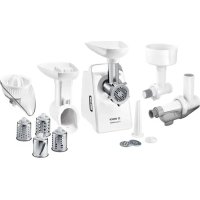
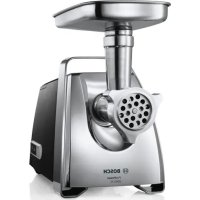
CompactPower MFW3X18W - Meat Grinder BOSCH - Free user manual and instructions
Find the device manual for free CompactPower MFW3X18W BOSCH in PDF.


| Product type | Multifunctional meat grinder |
| Brand | Bosch |
| Model | CompactPower MFW3X18W |
| Uses | Grinding, sausage making, grating/slicing, citrus pressing, grain milling, fruit pressing |
| Speeds | 2 speeds (slow and fast) + reverse |
| Included accessories | Meat grinder (3 discs: fine 2.7 mm, medium 4 mm, coarse 8 mm), sausage attachment, slicing attachment (4 inserts: chopping, coarse slicing, fine slicing, grating), citrus press, grain mill, fruit press, pusher, cleaning brush |
| Material | Metal parts (blade, discs) and plastic |
| Safety | Safety lock, automatic shutdown in case of overload (drive vane with breakaway zone) |
| Maintenance | Manual cleaning of removable parts: hand wash with brush, dry metal parts immediately and oil them |
| Maximum operating time | Grinder: 10 minutes; Grain mill: 15 minutes, then cooling 45 minutes |
| Warranty | See after-sales service or Bosch website |
Frequently Asked Questions - CompactPower MFW3X18W BOSCH
User questions about CompactPower MFW3X18W BOSCH
0 question about this device. Answer the ones you know or ask your own.
Ask a new question about this device
Download the instructions for your Meat Grinder in PDF format for free! Find your manual CompactPower MFW3X18W - BOSCH and take your electronic device back in hand. On this page are published all the documents necessary for the use of your device. CompactPower MFW3X18W by BOSCH.
USER MANUAL CompactPower MFW3X18W BOSCH
CompactPower Meat mincer
MFW39... MFW3X...
[en] Instruction manual Meat mincer 26
natural_image
Simple line drawing of a conical object resembling a bowl or container (no text or symbols)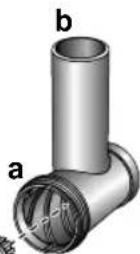
4
3
B
1.2.
natural_image
Mechanical assembly diagram showing a spiral gear and shaft with directional arrows indicating motion (no text or symbols)
PH2
natural_image
3D illustration of a helical screw with internal gear and shaft (no text or symbols)
bosch-home.com
№ 10005188
C
5
6
7
8
flowchart
graph TD
    A["1. Induction device"] --> B["2. Click! press"]
    B --> C["3. Presser with funnel"]
    C --> D["4. Cutting knife on kitchen"]
    D --> E["5. Presser with socket"]
    E --> F["6. Presser with 1:2 rev button"]
    F --> G["7. Display with 1:2 rev component"]
    G --> H["8. Presser with 1:2 rev button"]
G
1.
natural_image
Diagram showing a pipe fitting process with three stages: before, after, and after assembly (no text or symbols)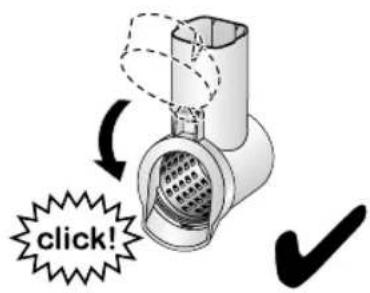
H
1.
natural_image
Diagram of a connector with internal components and directional arrows indicating flow or movement (no text or symbols)2.3.4.
natural_image
Mechanical assembly diagram showing a lever mechanism with downward force arrows (no text or symbols)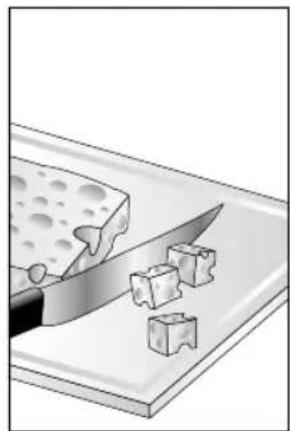
natural_image
Illustration of a knife cutting food items on a cutting board (no text or symbols)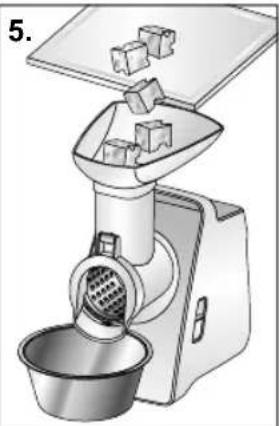
natural_image
Illustration of a food grater machine with a bowl of food being processed (no text or symbols visible)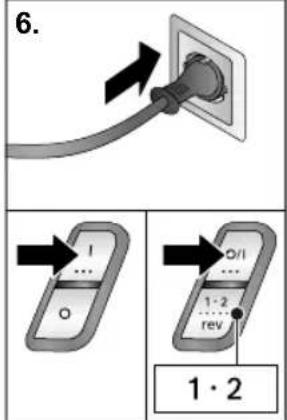

natural_image
Illustration of a manual hand mixer with a bowl of food being inserted (no text or symbols)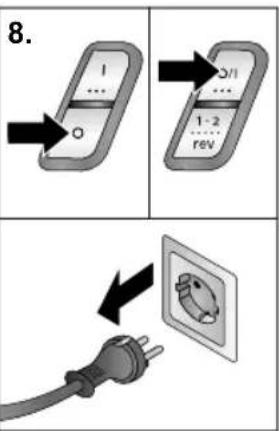
natural_image
Diagram of a device with a rotating button and directional arrow, no text or symbols presentI
natural_image
Illustration of a toilet with a lid and outlet, showing a downward arrow indicating a reduction or change (no text or symbols present)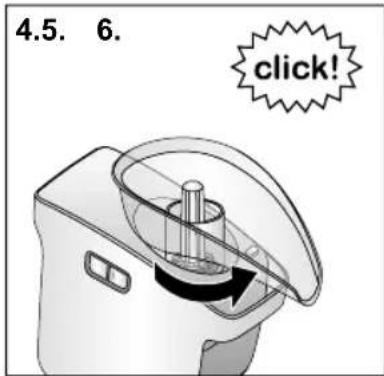
natural_image
Illustration of a kitchen mixer with a bowl pouring into the air (no text or symbols)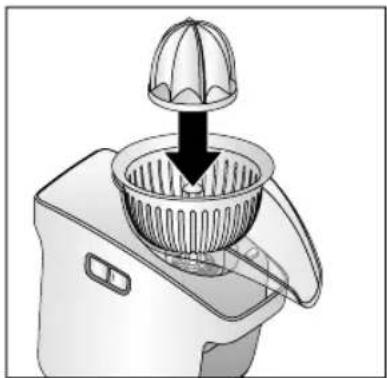
natural_image
Illustration of a hand washing a cup into a kitchen grater (no text or symbols)J
natural_image
Illustration of a knife cutting a piece of bread on a cutting board (no text or symbols)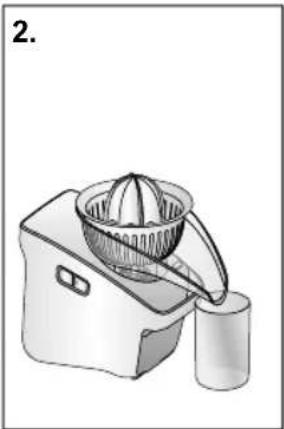
natural_image
Illustration of a hand mixer with a cloth and stand, no text or symbols present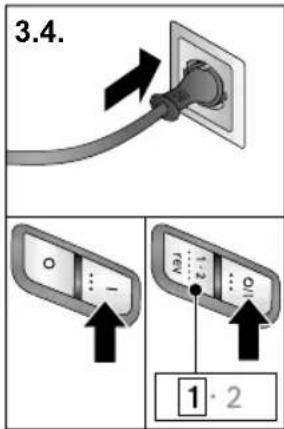
natural_image
Illustration of a hand pouring liquid into a bowl using a stand mixer (no text or symbols)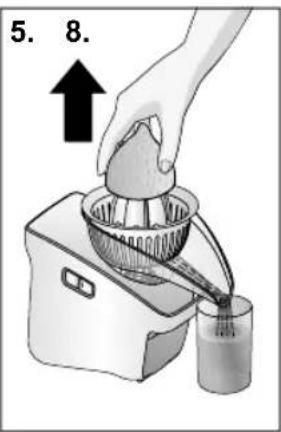
natural_image
Diagram of a kitchen grater with a handle and directional arrow indicating rotation (no text or symbols)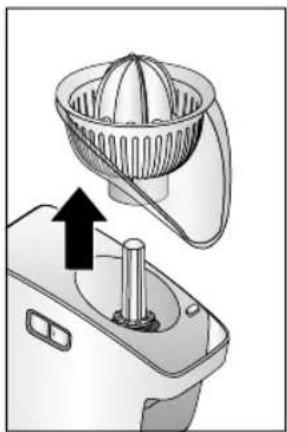
natural_image
Illustration of a hand washing a grater with an arrow indicating the process (no text or symbols present)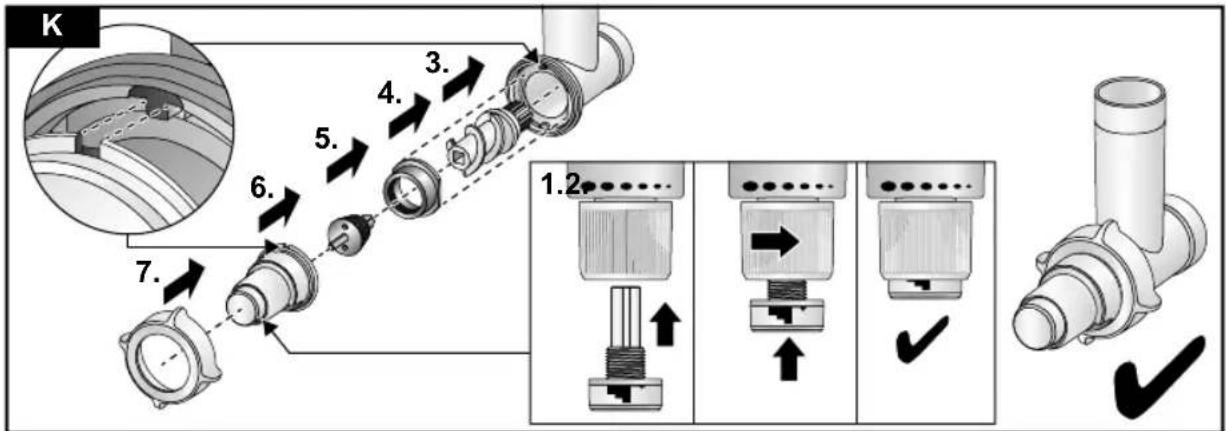
flowchart
graph TD
    A["Valve with Sensor"] --> B["Component 1"]
    B --> C["Component 2"]
    C --> D["Component 3"]
    D --> E["Component 4"]
    E --> F["Component 5"]
    F --> G["Component 6"]
    G --> H["Component 7"]
    H --> I["Terminal"]
    style A fill:#f9f,stroke:#333
    style I fill:#bbf,stroke:#333
flowchart
graph TD
    A["1. Opening"] --> B["2.3.4. Click!"]
    B --> C["3. Cutting into a bowl"]
    C --> D["4. Stopping with a brush and powder"]
    D --> E["5. Washing Machine"]
    E --> F["6. Power switch with plug, 1:2 control, 0/1 reset, 1:2 reverse"]
    F --> G["7. Finishing machine with bowl, 1:2 control, 0/1 reset, 1:2 reverse"]
    G --> H["8. Stop with warning symbol"]
    H --> I["9. Display panel with 0/1 reset, 1:2 reverse"]
    I --> J["10. Finishing machine with bowl, 1:2 control, 0/1 reset, 1:2 reverse"]
    J --> K["11.12. Close-up in front panel"]
flowchart
graph TD
    A["Step 1: Insert pump into kitchen appliance"] --> B["Step 2: Click to press inside machine"]
    B --> C["Step 3: Stopping funnel with lid, lifting leaf or vegetable in tray"]
    C --> D["Step 4: Cover and loose food with curved arrows"]
    D --> E["Step 5: Replace electrical plug with switch"]
    E --> F["Step 6: Pressing a pot with battery, using 1:2 remote control"]
    F --> G["Step 7: Stopping food into kitchen appliance"]
    G --> H["Step 8: Packing food into bowl with dipping sauce"]
    H --> I["Step 9: Replace electrical plug with battery, using 1:2 remote control"]
    I --> J["Step 10: Stopping food into kitchen appliance"]
    J --> K["Step 11: Stopping food into plate with dipping sauce"]
    K --> L["Step 12: Cover and loose food with drop sauce"]
 |  |  | ||||
 | ✓ | X | X | X | ||
 | 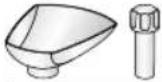 | ✓ | ✓ | ✓ | ✓ | |
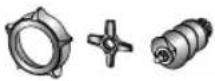 | 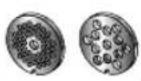 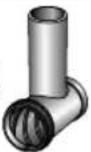 | ✓ | ✓ | ✓ | X | |
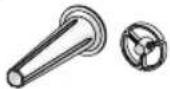 | ✓ | ✓ | ✓ | ✓ | ||
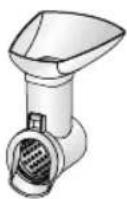 | 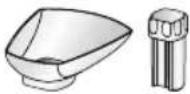 | 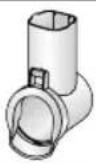 | ✓ | ✓ | ✓ | ✓ |
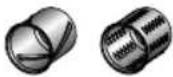 | 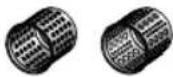 | X | ✓ | ✓ | X | |
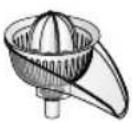 | 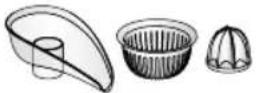 | ✓ | ✓ | ✓ | ✓ | |
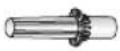 | X | ✓ | ✓ | X | ||
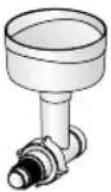 | 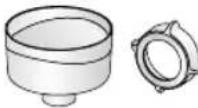 | 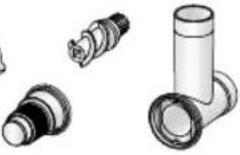 | ✓ | ✓ | ✓ | ✓ |
| X | ✓ | ✓ | X | |||
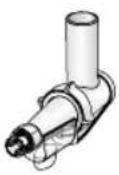 | 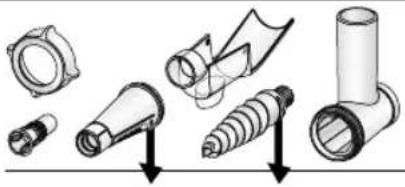 | ✓ | ✓ | ✓ | ✓ | |
| ✓ | X | ✓ | X | |||
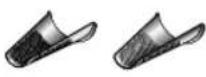 |  | X | ✓ | ✓ | X | |
| MFW3910W | MFW3X10.. | MFW3X13.. | MFW3X14.. | MFW3X15.. | MFW3X17.. | MFW3X18.. | |||
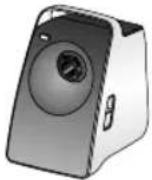 | I | ○ | √ | ||||||
| O/I | 1:2...rev | √ | √ | √ | √ | √ | √ | ||
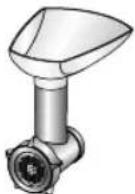 | [D3581] | √1·2 | √1·2 | √1·2 | √1·2 | √1·2 | |||
 | √ | √1·2 | √1·2 | √1·2 | √1·2 | √1·2 | √1·2 | ||
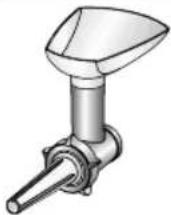 | √ | √1·2 | √1·2 | √1·2 | √1·2 | √1·2 | √1·2 | ||
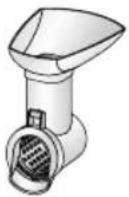 | 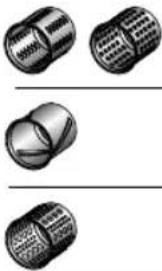 | √1·2 | √1·2 | √1·2 | √1·2 | ||||
| √1·2 | √1·2 | √1·2 | |||||||
| √1·2 | √1·2 | √1·2 | √1·2 | ||||||
 | √1·2 | ||||||||
 | √1·2 | ||||||||
 | √1·2 | √1·2 | √1·2 | ||||||
Read and follow the operating instructions carefully and keep for later reference! Enclose these instructions when you give this appliance to someone else.
If the instructions for correct use of the appliance are not observed, the manufacturer's liability for any resulting damage will be excluded.
This appliance is intended for domestic use only. Use the appliance for processing normal quantities of food for domestic use.
The appliance and accessories (depending on the model) are suitable for the following purposes:
Meat mincer: for cutting and mixing raw and cooked meat, bacon, poultry and fish.
Sausage filler: for making sausages and meat rolls.
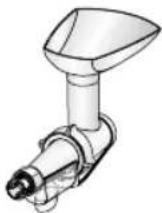
Shredding attachment: for shredding, grating and cutting up food.
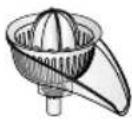
Citrus press: for squeezing juice out of citrus fruits.
Grain mill: for grinding all types of grain (except maize), such as e.g. poppy seeds, linseeds, sesame, buckwheat and also herbs, spices and coffee.
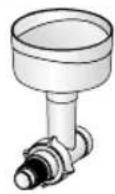
Fruit press: for squeezing juice out of fruits such as e.g.
raspberries, currants, strawberries, gooseberries or grapes and tomatoes.
Food which is to be processed must not contain any hard components (e.g. bones). The appliance should not be used for processing other substances or objects. Additional applications are possible if the accessories approved by the manufacturer are used. Use the appliance only with genuine parts and accessories.
Never use the attachments or slicing / shredding inserts on other appliances. Only use matching parts for the relevant attachments.
Only use the appliance indoors at room temperature and up to 2000 m above sea level. Do not place the appliance on or near hot surfaces, e.g. hobs.
Your work surface should be easily accessible, resistant to moisture, firm, flat, dry and large enough to prevent any harm from splashing and to let you work unhindered.
This appliance can be used by persons with reduced physical, sensory or mental capabilities or lack of experience and knowledge if they have been given supervision or instruction concerning safe use of the appliance and if they understand the hazards involved.
Keep children away from the appliance and connecting cable and do not allow them to use the appliance.
Children must not play with the appliance. Cleaning and user maintenance must not be performed by children.
Safety instructions
⚠️ Danger of electric shock and fire
Connect and operate the appliance only according to the type plate specifications. Do not use if the mains cable or appliance show any signs of damage. To avoid potential hazards, repairs such as replacing a damaged cable must only be carried out by our customer service personnel. Never connect the appliance to timer switches or remote-controllable sockets. Never leave the appliance unattended while it is switched on! We recommend that the appliance is never switched on for longer than is necessary to process the ingredients.
The mains cable must not come into contact with hot parts or be pulled across sharp edges. Never immerse the base unit in water or place it in the dishwasher. Do not steam-clean the appliance. Do not use the appliance with damp hands and do not operate at no load. The appliance must always be disconnected from the mains after each use, whenever the appliance is unattended, prior to assembly, disassembly or cleaning and in the event of a fault.
Risk of injury
Immediately after using the appliance wait for it to stop. Before fitting or replacing attachments, the appliance must be switched off and disconnected from the mains.
Do not grasp the sharp blades and edges of the shredding and slicing inserts.
Keep hands clear of rotating parts. Never reach into the feed chute or outlet opening. Never put the food to be processed into the feed chute with your hands. Only use the pusher provided!
Never clean the sharp blades and edges of the shredding and slicing inserts with your bare hands. Clean them with a brush.
Caution! Risk of damaging the appliance
Check that there are no foreign objects in the feed chute or attachments. Do not poke objects (e.g. knives, spoons) in the feed chute or outlet opening.
Before changing the direction of rotation (reverse), wait until the drive has come to a complete standstill. Only allow the appliance to run uninterrupted for a maximum of 10 minutes. Then switch off and allow to cool down to room temperature.
⚠️ Important!
It is essential to clean the appliance as described after each use or after it has not been used for an extended period. → “Care and daily cleaning” see page 35
Congratulations on the purchase of your new Bosch appliance.
On the following pages of these operating instructions you will find useful information for safe use of this appliance.
We request that you read these operating instructions carefully and observe all instructions. This ensures you will be able to enjoy this appliance for a long time, and the results will confirm your choice of this appliance.
Retain these operating instructions for subsequent use or for the next owner. You can find further information about our products on our website.
Content
Intended use....26
Safety instructions ....27
Overview....28
Before using for the first time....29
Control and display elements....29
Overload protection ....30
Speed setting....30
Reversing function....30
Base unit....31
Base attachment....31
Shredding attachment 32
Citrus press attachment....33
Grain mill attachment....33
Fruit press attachment....34
Care and daily cleaning 35
Recipes....36
Tips....36
Disposal....37
Customer Service....37
Spare parts and accessories....38
Troubleshooting....39
Overview
→ Fig. A
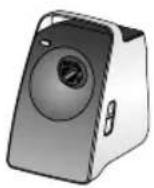
1 Base unit
a Drive for attachments
b Button I or O/I*
c Button O or 1·2 | rev*
d Operation indicator
e Release button
f Carrying handle
g Storage compartment with cover
h Mains cable
i Cable storage compartment
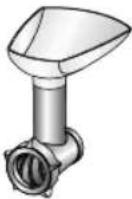
2 Base attachment
a Housing
b Feed chute
c Filling tray
d Pusher
e Worm gear with agitator paddle
f Threaded ring
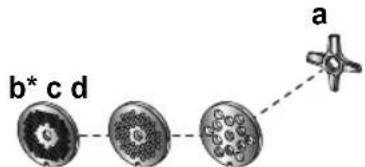
3 Meat mincer insert
a Blade
b Perforated disc, fine (2,7 mm)*
c Perforated disc, medium (4 mm)
d Perforated disc, coarse (8 mm)
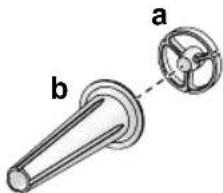
4 Sausage filler insert
a Bearing ring
b Sausage filler nozzle
→ Fig. C
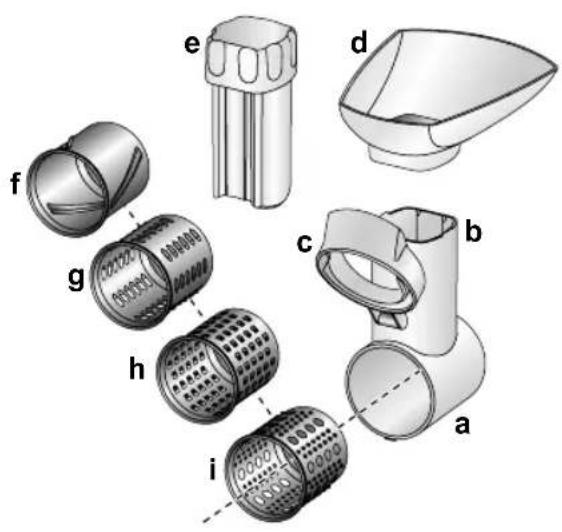
5 Shredding attachment\*
a Housing
b Feed chute
c Cap
d Filling tray
e Pusher
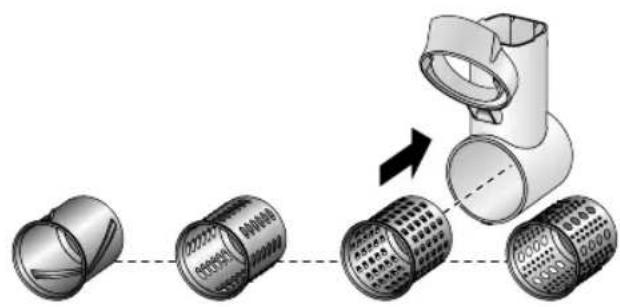
f Slicing insert
g Shredding insert, coarse
h Shredding insert, fine
i Grating insert
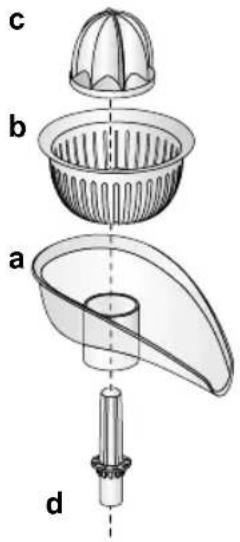
6 Citrus press attachment\*
a Collecting tray
b Filter insert
c Pressing cone
d Driving shaft with spring
Before using for the first time
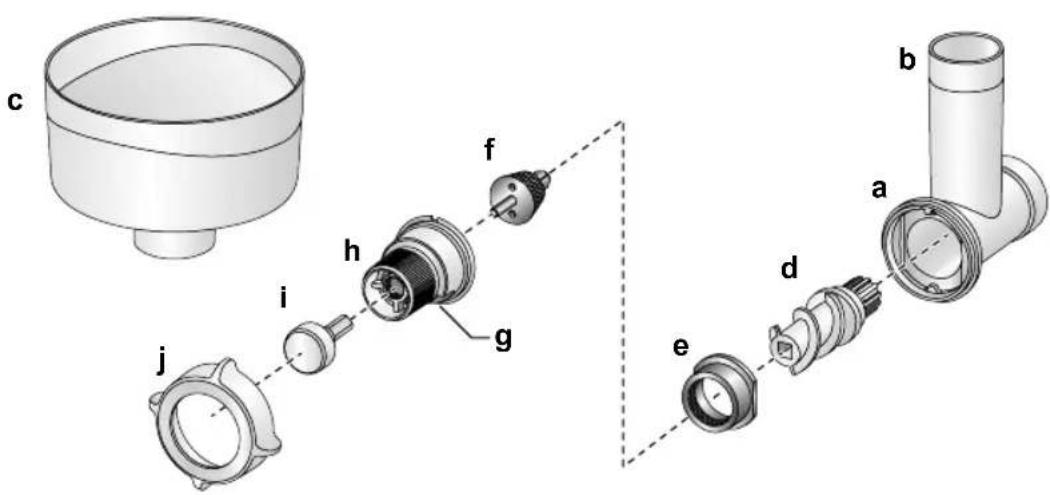
7 Grain mill attachment\*
a Housing
b Feed chute
c Filling tray
d Worm gear
e Grinding ring
f Grinding cone
g Grinding chamber
h Setting ring
i Adjustment screw with scale
j Threaded ring
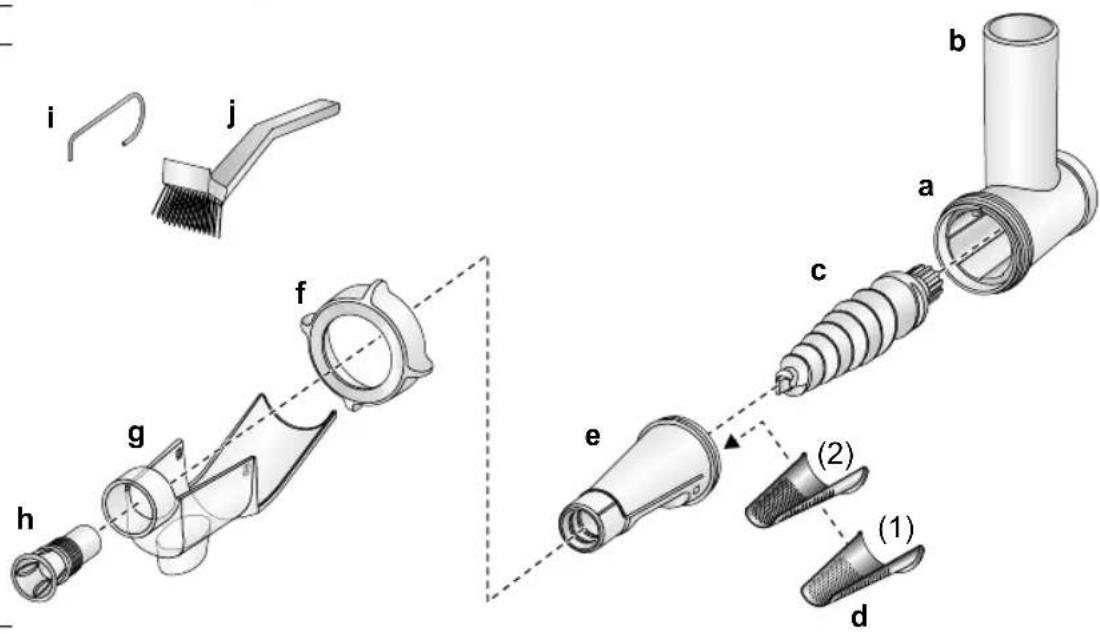
8 Fruit press attachment\*
Use filling tray and pusher from the base attachment.
a Housing
b Feed chute
c Worm gear with sealing ring
d Filter inserts: fine (1) & coarse (2)
e Filter holder with sealing ring
f Threaded ring
g Outlet funnel
h Pulp nozzle (adjustable)
i Hook for removing the filter insert
j Cleaning brush
* depending on the model
The operating instructions refer to different models of the appliance. An overview is provided on the pages that feature the figures. → Fig. P
Spare parts and accessories are available from Customer Service or at www.bosch-home.com. → “Spare parts and accessories” see page 38
Before using for the first time
Before the new appliance can be used, it must be fully unpacked, cleaned and checked.
Caution!
Never operate a damaged appliance!
■ Remove the base unit and all accessories from the packaging.
■ Remove the packaging material that is present.
■ Dismantle any assembled parts into their individual parts. Do this in reverse order, as described under „Preparation“.
■ Check all parts for completeness.
→ Fig. A / C
■ Inspect all parts for visible damage.
■ Thoroughly clean and dry all parts before using for the first time.
→ “Care and daily cleaning” see page 35
Control and display elements
MFW39...
Button I
Press button I to switch on the appliance. The drive will start up at once.
Button O
Press button O to switch off the appliance. The drive stops.
MFW3X...
Button O/I
Press button O/I to switch on the appliance. The drive starts running immediately with speed 2 (fast). Press button O/I again to switch off the appliance. The drive stops.
Button 1·2 | rev
Pressing button 1·2 | rev briefly switches the speed of the appliance between 1 (slow) and 2 (fast). → “Speed setting” see page 30
Pressing and holding button 1·2 | rev starts the reversing function. → “Reversing function” see page 30
All models
Operation indicator
The operation indicator lights up when the appliance is switched on. On models with the reversing function the function indicator flashes for as long as the 1·2 | rev button is pressed.
Release button
Press the release button to unlock an attachment fitted on the appliance. Only when the release button is pressed is it possible to turn the attachment clockwise and remove it from the base unit.
Cable storage compartment
The mains cable can be pulled out of the cable storage compartment or pushed back in again. Only ever pull the cable out as much as is required.
Storage compartment
Unused perforated discs belonging to the meat mincer can be kept in the storage compartment and it closed with the cover.
Overload protection
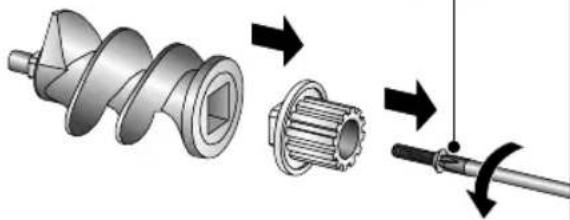
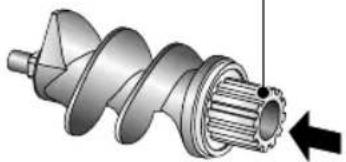
To prevent serious damage to your appliance if the base attachment is overloaded, the agitator paddle has a notch (predetermined breaking point). If overloading occurs, the agitator paddle will break at this point. A new agitator paddle is available from Customer Service (No. 10005188). Spare parts with a predetermined breaking point are not covered by our warranty obligations.
Replace agitator paddle
→ Fig. B
- Release the screw in the agitator paddle with a screwdriver (PH2) and remove the faulty paddle.
- Fit a new agitator paddle and screw tight again.
Speed setting
ONLY MFW3X...
Using the speed setting feature, the speed can be set to 1 (slow) or 2 (fast).
Caution!
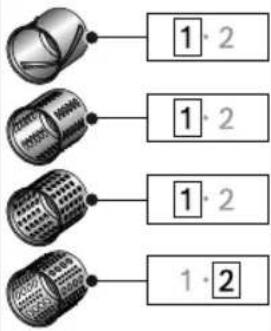
For certain applications, it is imperative to use speed 1 (slow). Take note of the recommended speeds! See table → Fig. P
■ Switch on the appliance with button O/I. The appliance will run at speed 2 (fast).
■ Press button 1·2 | rev briefly. The appliance will switch to speed 1 (slow).
■ Press button 1·2 | rev briefly. The appliance will switch back to speed 2 (fast).
Reversing function
ONLY MFW3X...
The reversing function is designed to release food that has got stuck by briefly running the worm gear in reverse. The reversing function switches off automatically after 15 seconds.
Caution!
- Never use the reverse function with the grain mill attachment or the fruit press attachment!
- Never press and hold button 1·2 | rev continuously while the appliance is switched on. Only press and hold button 1·2 | rev continuously once the appliance has come to a complete stop.
■ Switch the appliance off with button O/I and wait until the drive has stopped.
■ Press and hold button 1·2 | rev.
■ After approx. 5-10 seconds, release button 1·2 | rev and wait for the drive to come to a standstill.
■ Switch the appliance on again with button O/I.
Note: If food that has got stuck is not released by briefly putting the appliance into reverse, switch the appliance off, unplug and clean it. → “Care and daily cleaning” see page 35
Base unit
Preparation
Risk of injury!
Do not insert the mains plug until all preparations for working with the appliance are complete and the required attachments are assembled correctly and connected to the base unit.
■ Place the base unit on a stable and level work surface.
■ Pull the mains cable out of the cable storage compartment to the required length.
The base unit is now prepared.
Base attachment
The base attachment can be used for the following applications:
Meat mincer
For chopping up raw or cooked food. Select the appropriate perforated disc depending on the type and consistency of the food to be processed. → "Tips" see page 36
Sausage filler
For filling artificial and natural casings with sausage meat. For producing meat rolls.
Note: Other applications are possible using the base attachment and appropriate accessories available from Customer Service.
Caution!
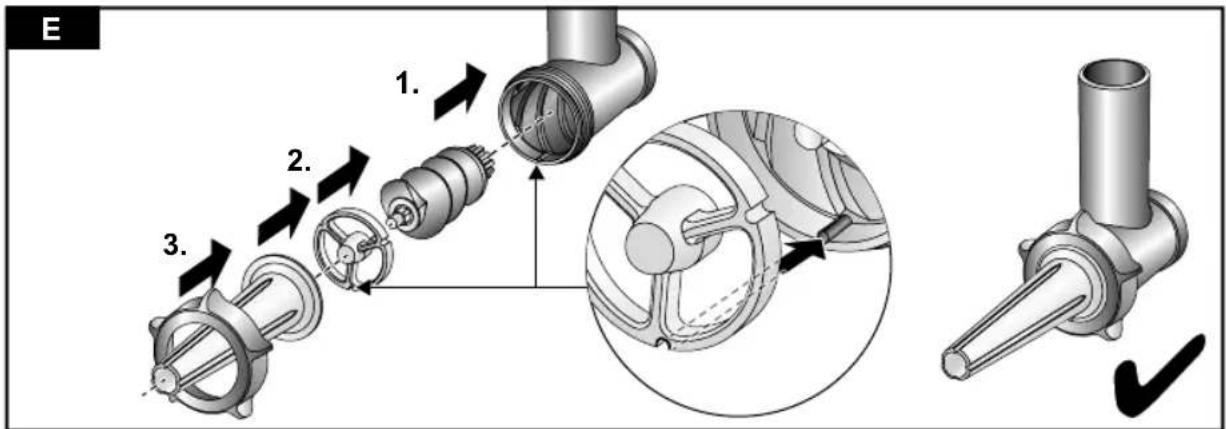
When assembling the different individual parts, make sure that the notched markings on the inserts match up with the relevant one on the housing.
Preparation for meat mincer
Risk of injury!
Do not reach into the sharp knife.
Caution!
Always only use one perforated disc.
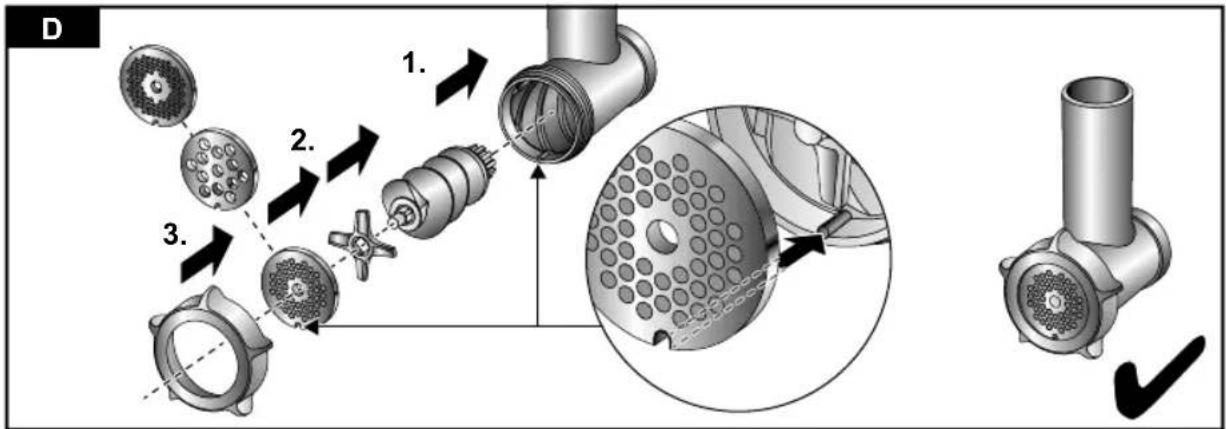
→ Fig. D
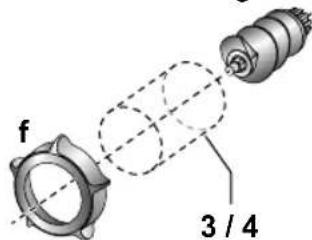
- Insert the worm gear with the agitator paddle at the front in the housing.
-
First fit the knife and then the required perforated disc onto the worm gear.
-
Fit the threaded ring onto the housing and screw tight in a clockwise direction without using force.
The meat mincer is now prepared.
Preparation for sausage filler
→ Fig. 田
- Insert the worm gear with the agitator paddle at the front in the housing.
- First fit the bearing ring onto the worm gear and then the sausage nozzle into the housing.
- Fit the threaded ring onto the housing and screw tight in a clockwise direction without using force.
The sausage filler is now prepared.
Use
Note: The food is processed in different ways depending on the application.
→ "Recipes" see page 36
The following example describes use of the base attachment as a meat mincer:
⚠️ Risk of injury!
- Do not reach into the feed chute with your hands.
- Only use the pusher when adding more food.
Caution!
- Do not process bones, gristle, sinews or other solid components.
- Do not process frozen meat.
- Do not apply great force with the pusher.
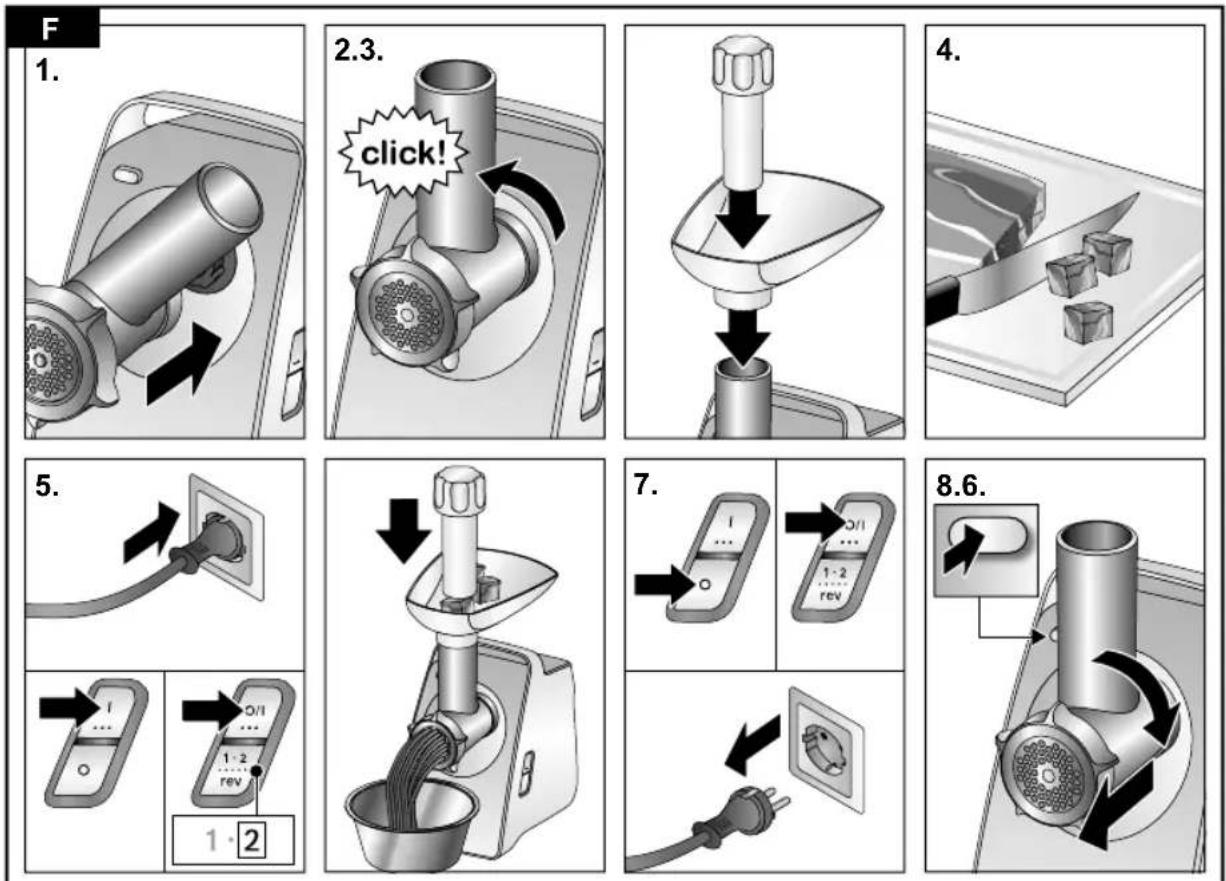
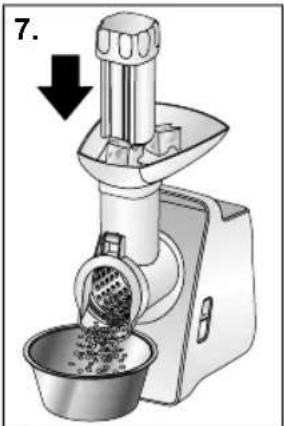
→ Fig. F
- Fit the prepared attachment onto the drive of the base unit, holding it at an angle.
- Turn the attachment anticlockwise until you hear it click into position.
- Fit the filling tray and insert the pusher in the feed chute.
- Prepare your food. Chop up large parts beforehand so they fit into the feed chute without having to press them in.
■ Place a suitable container under the attachment. Add the prepared food to the filling tray. - Connect the mains plug. Switch on the appliance.
Note (MFW3X...):
After switching on, the appliance runs at the ideal speed 2 (fast).
-
Use the pusher to slide the food down the feed chute, applying light pressure.
-
Once you have finished, switch off the appliance and pull out the mains plug.
■ Remove the filling tray and pusher.
- Hold down the release button and turn the attachment clockwise until it disengages.
■ Remove the attachment, take it apart and clean all parts. → “Care and daily cleaning” see page 35
Shredding attachment
For shredding, grating and slicing items such as cheese, fruit, vegetables, nuts, almonds, dried bread rolls and other hard foodstuffs. Select the appropriate insert depending on the type and consistency of the food to be processed. → “Tips” see page 36
Preparation
Risk of injury!
Do not reach into the sharp blades and edges of the shredding, grating and slicing inserts.
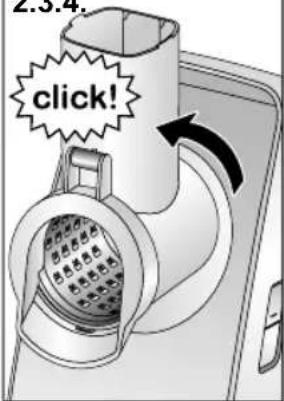
→ Fig. G
-
Open the cap. Fit the required insert into the housing.
-
Close the cap until you hear it click into position.
The shredding attachment is now prepared.
Use
Risk of injury!
- Do not reach into the feed chute with your hands.
- Only use the pusher when adding more food.
Caution!
- The pusher can only be inserted in one direction.
- Remove hard shells (e.g. on nuts).
- Do not apply great force with the pusher.
Caution! (MFW3X...)
- Always use the shredding and cutting inserts at speed 1 (slow).
- Use the grating insert at speed 2 (fast).
→ "Speed setting" see page 30
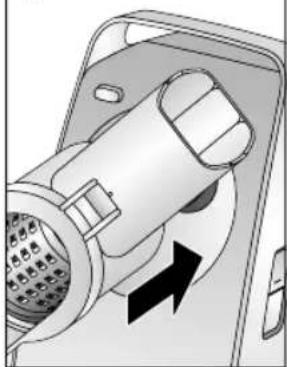
→ Fig. H
- Fit the prepared attachment onto the drive of the base unit, holding it at an angle.
- Turn the attachment anticlockwise until you hear it click into position.
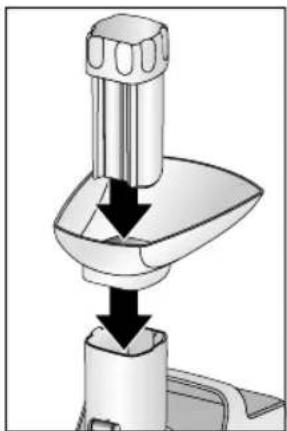
- Fit the filling tray and insert the pusher in the feed chute.
- Prepare your food. Chop up large parts beforehand so they fit into the feed chute without having to press them in.
- Place a suitable container under the attachment. Add the prepared food to the filling tray.
- Connect the mains plug. Switch on the appliance.
Caution! (MFW3X...)
After switching on, the appliance runs at speed 2 (fast). To use the shredding and cutting inserts, you must press button
1·2 | rev once to switch to speed 1 (slow).
→ "Speed setting" see page 30
-
Use the pusher to slide the food down the feed chute, applying light pressure. The food is now cut up or shredded.
-
Once you have finished, switch off the appliance and pull out the mains plug.
-
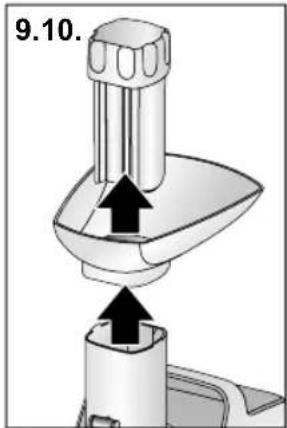
Remove the filling tray and pusher.
-
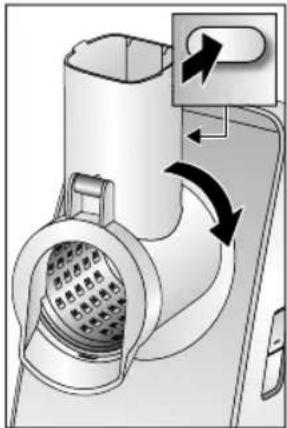
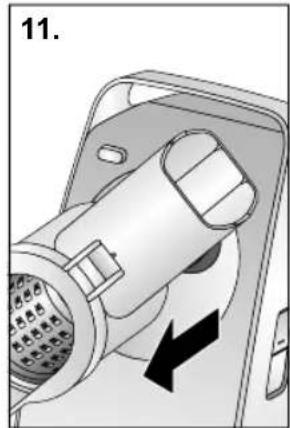
Hold down the release button and turn the attachment clockwise until it disengages.
-
Remove the attachment, take it apart and clean all parts. → “Care and daily cleaning” see page 35
Citrus press attachment
For squeezing juice out of citrus fruits, e.g. lemons, oranges, grapefruits.
Preparation
Risk of injury!
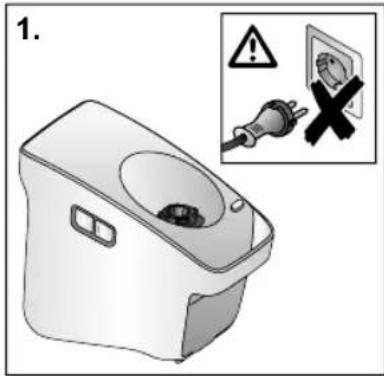
The attachment for the citrus press is directly assembled on the base unit. Do not insert the mains plug until all preparations for working with the appliance are complete.
Caution!
The base unit is moved through 90irc for preparation and use of the citrus press attachment. Never use other attachments in this position.
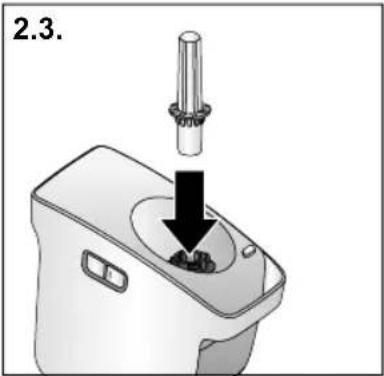
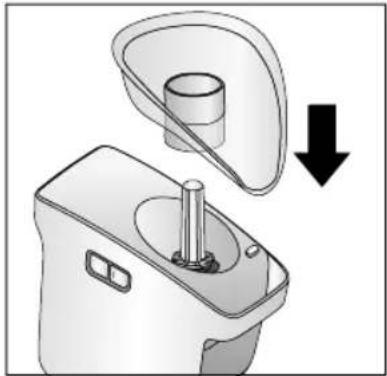
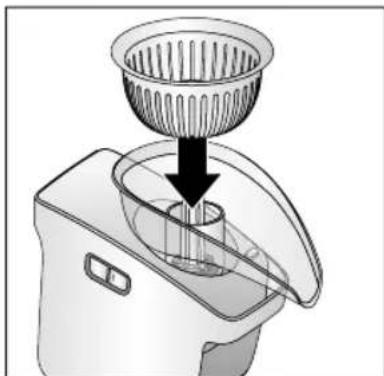
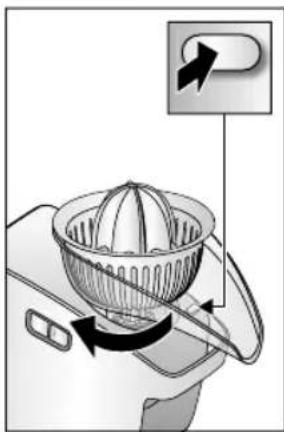
→ Fig. Ⅱ
- Hold the base unit by the carrying handle and carefully tip up so the drive points upwards. Possibly turn the base unit to make the buttons easily accessible.
- Insert the driving shaft with the spring element pointing down in the drive of the base unit.
Caution!
It should be possible to push the driving shaft down lightly with your finger. It must not get sticky with residue from juice or become blocked with pips or foreign bodies.
- Fit the collecting tray onto the drive at an angle.
- Turn the collecting tray anticlockwise until you hear it click into position.
- Fit the filter insert onto the collecting tray.
- Fit the pressing cone onto the driving shaft.
The citrus press attachment is now fitted to the base unit and prepared.
Use
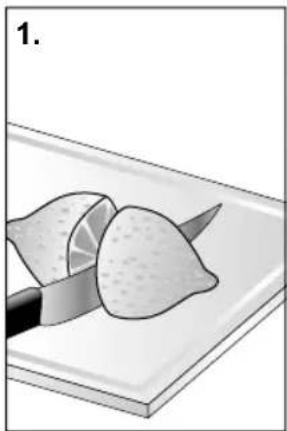
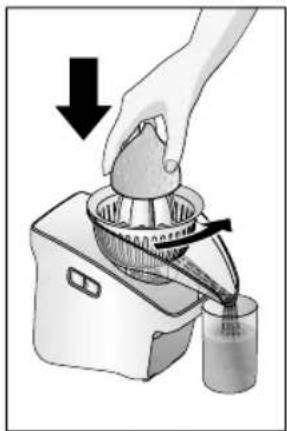
→ Fig. J
- Cut the citrus fruits in half.
- Place a suitable container under the attachment.
- Connect the mains plug. Switch on the appliance. The drive is running.
Caution! (MFW3X...)
After switching on, the appliance runs at speed 2 (fast). To use the citrus press, you must press button 1·2 | rev once to switch to speed 1 (slow). → “Speed setting” see page 30
- Position the halved citrus fruits with the cut surface on the pressing cone and press down. As soon as the fruit is pressed onto the pressing cone, the cone will rotate.
- To finish the process, reduce the pressure on the cone.
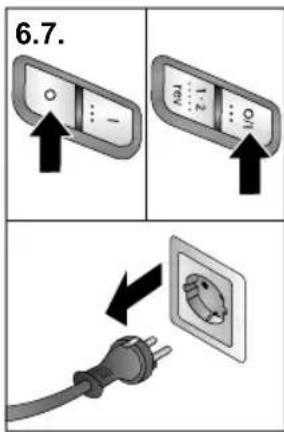
- Once you have finished, switch off the appliance and pull out the mains plug.
- Hold down the release button and turn the attachment clockwise until it disengages.
- Remove the attachment, take it apart and clean all parts. → "Care and daily cleaning" see page 35
Notes:
- To obtain the largest amount of juice, the pressing procedure should be repeated a few times.
- The filter insert with the pulp and pips should be emptied as necessary.
Grain mill attachment
For grinding products such as wheat, oats, rice, coffee beans, peppercorns, wild mustard, walnuts, hazel nuts, dried mushrooms, almonds, soya, linseeds, buckwheat groats, shelled sunflower seeds, etc. The appliance is not intended to be used for grinding very hard products such as dried peas, maize or popcorn. → “Tips” see page 36
Preparation
→ Fig. K
- Place the adjustment screw in the setting ring. Ensure that the scale points upwards.
- Press the adjustment screw towards the grinding chamber and turn the setting ring in a clockwise direction until the scale for the grinding level is reached.
en
Fruit press attachment
- Insert worm gear into the housing.
- Insert grinding ring into the housing. Note shape of the parts!
- Insert grinding cone with the square shaft into the corresponding opening of the worm gear.
- Place grinding chamber on the housing. Recess on the grinding chamber must be situated on the lug on the housing.
- Fit the threaded ring onto the housing and screw tight in the clockwise direction without using force.
Use
Risk of injury!
■ Do not reach into the feed chute with your hands.
■ Do not look into the feed chute during operation, as the bouncing particles can hurt your eye.
Caution!
When the mill is attached, never use reverse function. Attachment may be damaged!

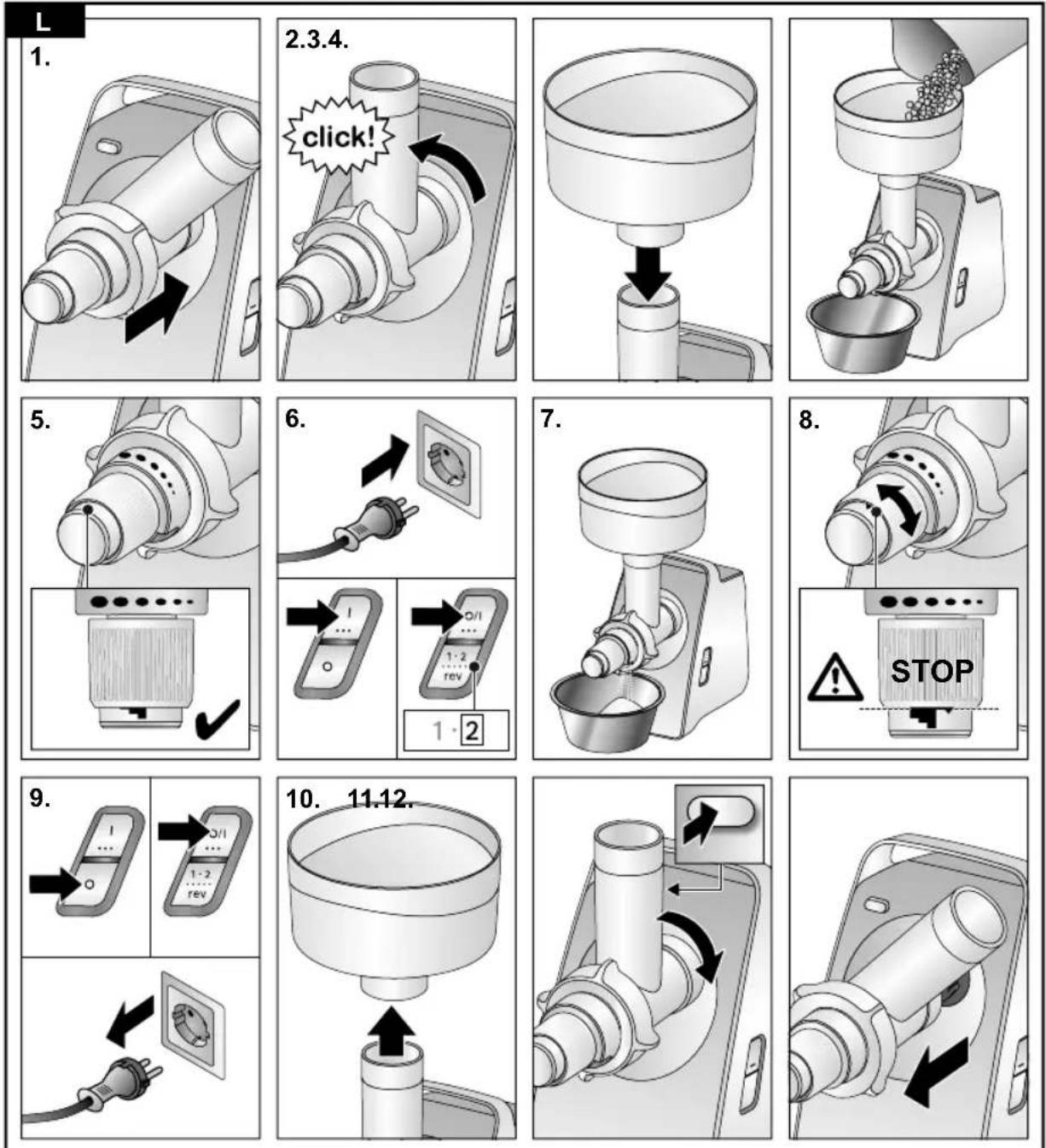
Fig. L
- Fit the prepared attachment onto the drive of the base unit, holding it at an angle.
- Turn the attachment anticlockwise until you hear it click into position. Tighten threaded ring.
- Fit the filling tray.
- Place a suitable container under the attachment. Fill the filling tray. → "Tips" see page 36
Caution!
Never allow the grain mill attachment to run without ingredients.
-
Set the degree of grinding by turning the setting ring:
-
anticlockwise = coarser grain
- clockwise = finer grain
Always select a value between: - STOP = coarsest degree of grinding
- 1 = finest degree of grinding (never use it at the beginning)

- Connect the mains plug. Switch on the appliance.
Caution!
The appliance may be operated continuously for a maximum of 15 minutes. Then leave the appliance to cool down for 45 minutes!
- The flour trickles through the discharge chute.
- Degree of grinding can be re-adjusted in small steps during operation.
Caution!
Setting it beyond the STOP line during operation can damage the appliance.
- Once you have finished, switch off the appliance and pull out the mains plug.
- Remove the filling tray.
- Hold down the release button and turn the attachment clockwise until it disengages.
- Remove the attachment, take it apart and clean all parts. → “Care and daily cleaning” see page 35
Fruit press attachment
For squeezing juice out of fruits such as e.g. raspberries, currants, strawberries, gooseberries or grapes and tomatoes.
Preparation
Note: selection of the filter insert determines the content of fruit pulp in the juice. Do not press fruit whose pips are similar in diameter to the hole diameter in the filter insert (e.g. raspberries).

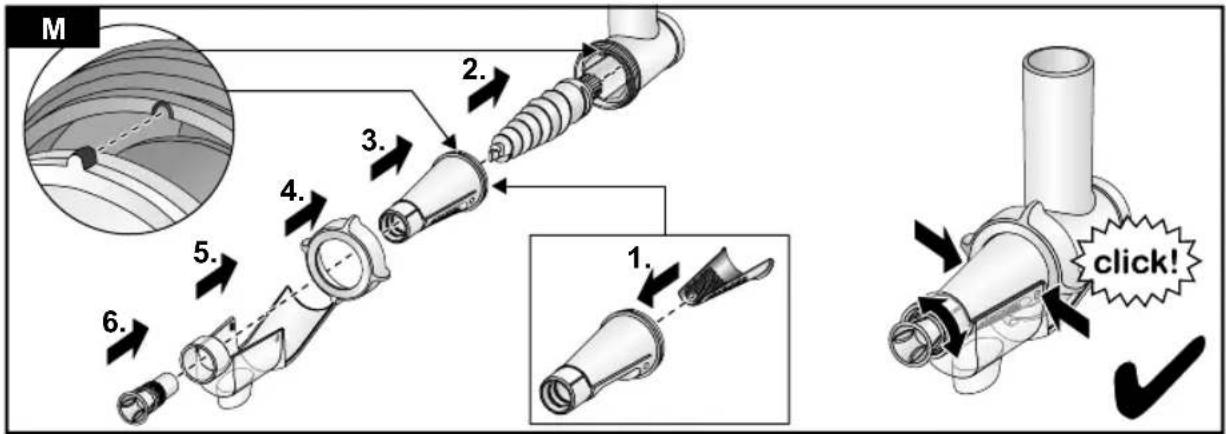
Fig. M
■ Make sure that the sealing rings are fitted onto the filter holder and the worm gear. If not, insert them into the sealing grooves of these parts.
- Insert the filter insert into the filter holder and press it into place.
- Insert the worm gear into the housing.
- Insert the filter holder into the housing. Lug on the filter holder must be situated in the recess on the housing.
Care and daily cleaning
- Fit the threaded ring onto the housing and screw tight in the clockwise direction without using force.
- Place the outlet funnel onto the filter holder until it audibly clicks into place.
- Screw pulp nozzle into the filter holder. The fruit press attachment is now prepared.
Use
Warning
Risk of injury!
Do not reach into the feed chute with your hands.
Caution!
- Remove hard fruit peel, pips and stalks.
- Berries such as e.g. currants can be pressed together with their stalks.
– Fruit with larger pips and stones such as e.g. plums and cherries must have their pips or stones removed before juicing. - Do not process frozen fruit.
- Do not apply great force with the pusher.
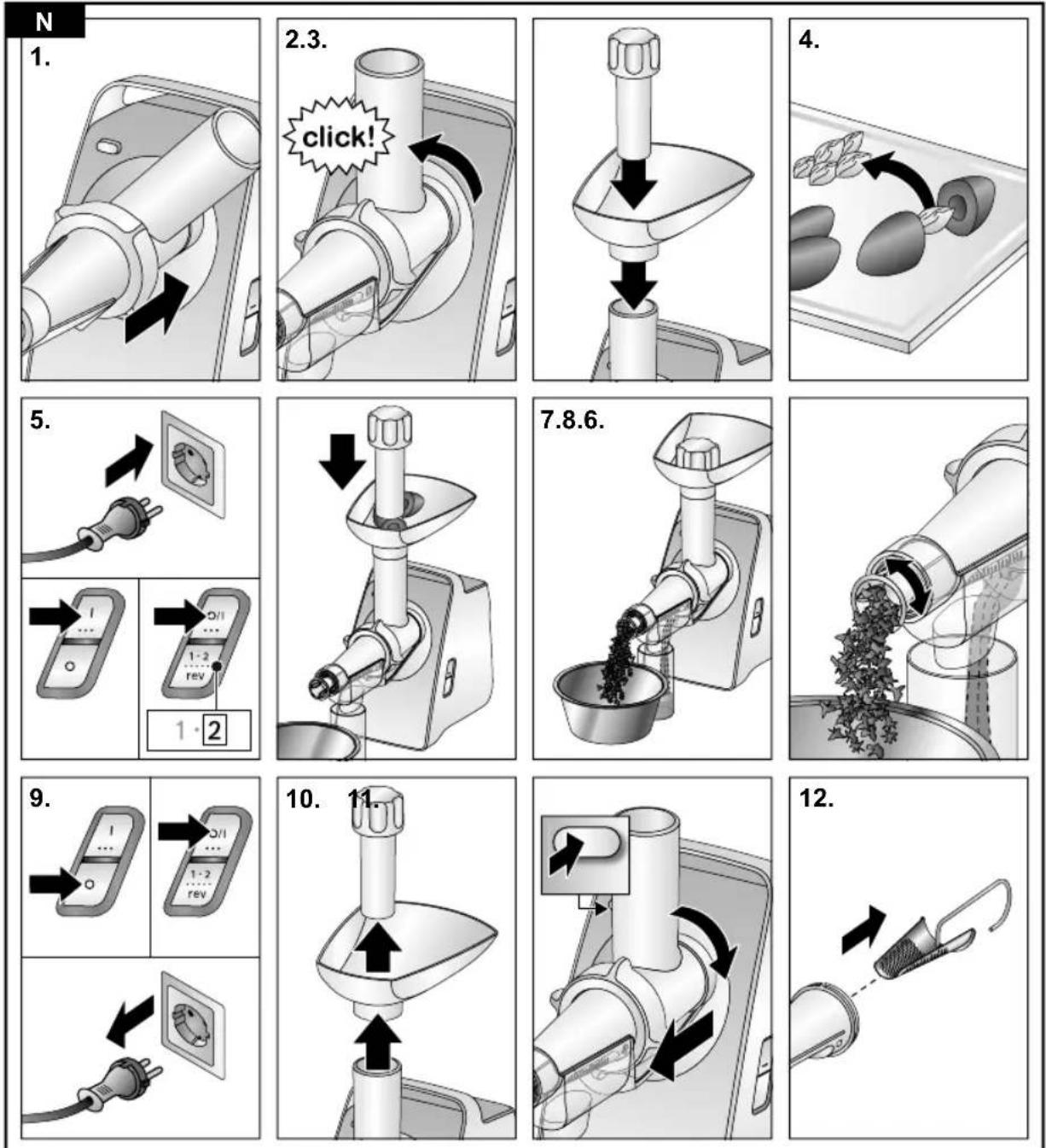
→ Fig. N
- Fit the prepared attachment onto the drive of the base unit, holding it at an angle.
- Turn the attachment anticlockwise until you hear it click into position. Tighten threaded ring.
- Fit the filling tray and insert the pusher in the feed chute.
- Prepare the fruit. Chop up large fruit beforehand so it fits into the feed chute without having to be pressed in. Remove larger pips and stones (e.g. cherries, plums).
■ Place one container under each of the apertures for juice and for the pulp.
■ Add the prepared fruit to the filling tray.
-
Connect the mains plug. Switch on the appliance.
-
Use the pusher to slide the fruit down the feed chute, applying light pressure.
-
The pressed juice flows out from the outlet funnel. The pulp (solid components) is pressed through the pulp nozzle.
-
Adjust the pulp nozzle. Unscrewing makes the pulp more moist; screwing in makes it dryer and more juice flows from the funnel. If the pulp is too dry, unscrew the nozzle, to avoid clogging the appliance with the pulp.
-
Once you have finished, switch off the appliance and pull out the mains plug.
-
Remove the filling tray and pusher.
-
Hold down the release button and turn the attachment clockwise until it disengages.
■ Remove the attachment, take it apart and clean all parts. → “Care and daily cleaning” see page 35
- To remove the filter insert, insert the hook into the hole in the filter insert and carefully extract.
Caution!
Pay special attention to the juice squeezing process. Make sure filter openings are not clogged. Clogging of the housing outlet with the pulp of juicy fruits can cause the flooding of the drive unit.
If the housing outlet becomes clogged, switch off the appliance and pull out the mains plug. Remove the attachment, take it apart and clean all parts. → “Care and daily cleaning” see page 35
Care and daily cleaning
The appliance, all attachments and the relevant accessories must be thoroughly cleaned after each use.
⚠️ Risk of electric shock!
- Disconnect the mains cable from the socket prior to cleaning.
– Never immerse the base unit in liquids and do not clean in the dishwasher.
⚠️ Risk of injury!
Do not reach into the sharp blades and edges of the shredding and slicing inserts. Clean them with a brush.
en Recipes
Caution!
- Do not wash metal parts in the dishwasher!
- Do not use any cleaning agents containing alcohol or spirits.
- Do not use any sharp, pointed or metal objects.
- Do not use abrasive cloths or cleaning agents.
Fig. ☐ gives an overview of how to clean the individual parts.
■ Wipe the outside of the base unit with a soft, damp cloth and dry off.
■ Dismantle the attachments used in reverse order (see „Preparation“ for the relevant attachment).
■ Clean all accessories with a detergent solution and a soft cloth/sponge or with a soft brush.
■ Allow all parts to dry.
Notes:
- Immediately rub metal parts dry and apply a little cooking oil to protect them from rust.
- Discolouration of plastic parts may occur when processing foods such as carrots. This can be removed with a few drops of cooking oil.
Recipes
Note (MFW3X...):
For all operating steps, set the speed to 2 (fast).
Bread dumplings
- 300 g fresh white bread
- 20 ml milk
- 40 g butter or margarine
- 3 eggs
- 1 tbsp finely chopped onions
- Parsley
- A little flour
- Salt and pepper
■ Cut the bread into slices 10 mm thick and halve lengthways. Add 20 ml of milk and soak.
■ Process the moistened bread for approx. 60 secs with the meat mincer (perforated disc, medium).
■ Add the finely chopped onions, parsley and melted butter and mix.
■ Add the whisked eggs, salt and pepper and mix into the bread dough.
■ Leave the dough to prove for several minutes. Then knead again.
■ Shape the dumplings with wet hands. Roll the dumplings in flour.
■ Place dumplings in boiling water and leave to simmer for approx. 20 minutes. Do not bring to the boil!
Tips
Meat mincer
Using the perforated discs
- Perforated disc, fine (2.7 mm) for: cooked chicken / pork / beef, cooked liver, cooked fish for soups; raw pork and beef for meat loaf; raw liver, meat and bacon for liverwurst; pork for Mettwurst
- Perforated disc, medium (4 mm) for: pork and beef for pâté and Cervelat sausage
- Perforated disc, coarse (8 mm) for: roast pork for goulash soup; leftovers (joint, sausage) for bakes
■ If you require a finer consistence to your processed food, process it several times or use different perforated discs one after the other (coarse, medium, fine).
■ You can add other ingredients (e.g. onions, spices) directly during processing. This ensures all ingredients are mixed together thoroughly.
Sausage filler
■ Soak natural casing in lukewarm water for about 10 minutes before processing.
■ Do not stuff casings too full or the sausages may burst during boiling or frying.
Shredding attachment
Caution! (MFW3X...)
- Always use the shredding and cutting inserts at speed 1 (slow).
- Use the grating insert at speed 2 (fast).
→ "Speed setting" see page 30
Using the inserts
- Slicing insert: for carrots, celery, kohlrabi, courgettes
- Shredding insert (coarse): for carrots, nuts, hard cheese (e.g. Emmentaler)
- Shredding insert (fine): for nuts, hard cheese, Parmesan cheese
- Grating insert: for potatoes, Parmesan cheese, nuts
Grain mill attachment
- Do not grind oleaginous products at the smallest degree of grinding. The grinder may jam or become blocked.
- In the case of softer grain, such as oats or linseeds, the coarse setting must be selected for grinding.
- Wash the grinder thoroughly when changing from one product to another. This will prevent odours from impairing each other.
Disposal

Dispose of packaging in an environmentally-friendly manner. This appliance is labelled in accordance with European Directive 2012/19/EU concerning used electrical and electronic appliances (waste electrical and electronic equipment – WEEE). The guideline determines the framework for the return and recycling of used appliances as applicable throughout the EU. Please ask your specialist retailer about current disposal facilities.
Customer Service
Detailed information on the warranty period and terms of warranty in your country is available from our after-sales service, your retailer or on our website.
The contact details for Customer Service can be found in the enclosed Customer Service directory or on our website.
Spare parts and accessories
| Spare parts and accessories | |||
 | 2.7 mm | 10003879 | Perforated disc (fine) for meat mincer |
| [7W6H] | 4 mm | 10003880 | Perforated disc (medium) for meat mincer |
 | 8 mm | 10003881 | Perforated disc (coarse) for meat mincer |
 | 00754389 | Sausage filler: for filling artificial and natural casings with sausage meat. For producing meat rolls. | |
 | 10007189 | ||
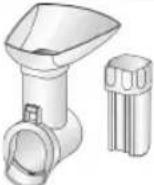 | 12011263 | Shredding attachment: for shredding, grating and slicing | |
 | 798161 | Slicing insert for the shredding attachment | |
 | 798162 | Shredding insert (coarse) for the shredding attachment | |
 | 798160 | Shredding insert (fine) for the shredding attachment | |
 | 798130 | Grating insert for the shredding attachment | |
 | 12013990 | Citrus press attachment: for squeezing oranges, lemons and grapefruits. | |
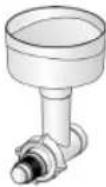 | 17004678 | Grain mill attachment: for grinding products such as wheat, oats, rice, coffee beans, peppercorns, wild mustard, walnuts, hazel nuts, dried mushrooms, almonds, soya, linseeds, buckwheat groats, shelled sunflower seeds, etc. | |
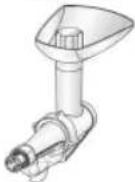 | 17004677 | Fruit press attachment: for squeezing juice out of fruits such as e.g. raspberries, currants, strawberries, gooseberries or grapes and tomatoes. | |
Spare parts and accessories are available from retailers and Customer Service.
Troubleshooting
| Problem Cause Remedy | ||
| The appliance does not start when switched on. | Appliance has no power supply. | Insert the mains plug in the socket. |
| The appliance is running normally, but the food is not being processed. | The appliance was overloaded, and the agitator paddle has broken at the predetermined breaking point. | Switch the appliance off and wait until it has stopped. Unplug the appliance, remove the attachment, take it apart and clean. Replace the agitator paddle. → “Overload protection” see page 30 |
| The food is not being processed or only very slowly. | The attachment or worm gear is blocked. | Appliance without reversing function: Switch appliance off, wait until it has stopped and unplug. Remove the attachment, take it apart and clean to eliminate the blockage. → “Care and daily cleaning” see page 35 |
| Appliances with reversing function: Switch off the appliance with button O/I and wait for the drive to come to a standstill. Press and hold button 1·2 | rev. After approx. 5-10 seconds, release button 1·2 | rev and wait for the drive to come to a standstill. Switch the appliance on again and continue to use it. → “Reversing function” see page 30 | ||
| The pressure on the pusher is too great or the feed chute is too full. | Reduce the pressure on the pusher and fill the feed chute with less food. | |
| The food to be processed still contains hard components. | Remove hard components. Precook/steam vegetables before processing them. | |
| The reversing function does not start. | Button 1·2 | rev was pressed too briefly. | Press and hold button 1·2 | rev until the reversing function starts. |
| The worm gear is blocked right up. | Switch the appliance off, wait until it has stopped and unplug. Remove the attachment, take it apart and clean to eliminate the blockage. → “Care and daily cleaning” see page 35 | |
If you are unable to solve the problem, always call the hotline! You will find the telephone numbers at the back of these instructions.
Sécurité anti-surcharge ....44
Sécurité anti-surcharge
→ Suite de la figure ©
→ Suite de la figure J
g Raspe-innsats, grov
h Raspe-innsats, fin
i Rivjerninnsats
6 Sitruspresse-påsats\*
a Oppsamlingsskål
b Silinnsats
c Presskjegle
Thank you for buying a Bosch Home Appliance!
Register your new device on MyBosch now and profit directly from:
- Expert tips & tricks for your appliance
• Warranty extension options
• Discounts for accessories & spare-parts
• Digital manual and all appliance data at hand - Easy access to Bosch Home Appliances Service
Free and easy registration – also on mobile phones:
www.bosch-home.com/welcome
BOSCH HOME APPLIANCES SERVICE
Looking for help? You'll find it here.
Expert advice for your Bosch home appliances, need help with problems or a repair from Bosch experts.
Find out everything about the many ways Bosch can support you:
www.bosch-home.com/service
Contact data of all countries are listed in the attached service directory.
BSH Hausgeräte GmbH
Carl-Wery-Straße 34
81739 München, GERMANY
www.bosch-home.com
A Bosch Company

8001252225 (020502)
Valid within Great Britain:
Imported to Great Britain by
BSH Home Appliances Ltd.
Grand Union House
Old Wolverton Road
Wolverton, Milton Keynes
MK12 5PT
United Kingdom


- CompactPower Meat mincer
- Safety instructions
- ⚠️ Danger of electric shock and fire
- Risk of injury
- Caution! Risk of damaging the appliance
- ⚠️ Important!
- Congratulations on the purchase of your new Bosch appliance.
- Content
- Overview
- → Fig. A
- Base unit
- Base attachment
- Meat mincer insert
- Sausage filler insert
- → Fig. C
- Shredding attachment\*
- Citrus press attachment\*
- Grain mill attachment\*
- Fruit press attachment\*
- Before using for the first time
- Caution!
- Control and display elements
- MFW39...
- Button I
- Button O
- MFW3X...
- Button O/I
- Button 1·2 | rev
- All models
- Operation indicator
- Release button
- Cable storage compartment
- Storage compartment
- Overload protection
- Replace agitator paddle
- → Fig. B
- Speed setting
- ONLY MFW3X...
- Reversing function
- Base unit
- Preparation
- Risk of injury!
- Base attachment
- Meat mincer
- Sausage filler
- Preparation for meat mincer
- → Fig. D
- Preparation for sausage filler
- → Fig. 田
- Use
- The following example describes use of the base attachment as a meat mincer:
- ⚠️ Risk of injury!
- → Fig. F
- Note (MFW3X...):
- Shredding attachment
- → Fig. G
- Caution! (MFW3X...)
- → Fig. H
- Citrus press attachment
- → Fig. Ⅱ
- → Fig. J
- Notes:
- Grain mill attachment
- → Fig. K
- en
- Fruit press attachment
- Fig. L
- Fig. M
- Care and daily cleaning
- Warning
- → Fig. N
- ⚠️ Risk of electric shock!
- en Recipes
- Recipes
- Bread dumplings
- Tips
- Using the inserts
- Disposal
- Customer Service
- Sécurité anti-surcharge
- → Suite de la figure ©
- → Suite de la figure J
- Sitruspresse-påsats\*
- Thank you for buying a Bosch Home Appliance!
- Looking for help? You'll find it here.
Brand : BOSCH
Model : CompactPower MFW3X18W
Category : Meat Grinder