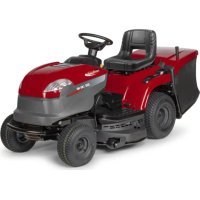
XDC 180 HD - Lawn mower Castelgarden - Free user manual and instructions
Find the device manual for free XDC 180 HD Castelgarden in PDF.


| Product type | Ride-on lawn mower |
| Brand | Castelgarden |
| Model | XDC 180 HD |
| Engine | Internal combustion, petrol |
| Transmission | Mechanical (5 forward speeds + reverse) or hydrostatic depending on version |
| Cutting height | Adjustable by lever (multiple positions) |
| Maximum slope for use | 10° |
| Cutting system | Rotary (blades) |
| Battery | 12 V, rechargeable |
| Parking brake | Yes |
| Safety features | Engine stops if driver leaves seat, cutting lock in reverse |
| Mowing functions | Side discharge, rear collection, mulching (optional kit) |
| Maintenance | Cleaning via integrated water connection |
| Available accessories | Mulching kit, battery charger, snow chains, trailer, etc. |
| Intended use | Grass cutting in gardens and grassy areas |
Frequently Asked Questions - XDC 180 HD Castelgarden
User questions about XDC 180 HD Castelgarden
0 question about this device. Answer the ones you know or ask your own.
Ask a new question about this device
Download the instructions for your Lawn mower in PDF format for free! Find your manual XDC 180 HD - Castelgarden and take your electronic device back in hand. On this page are published all the documents necessary for the use of your device. XDC 180 HD by Castelgarden.
USER MANUAL XDC 180 HD Castelgarden
MP 84 Series
MP 98 Series
SD 98 Series
SD 108 Series

EN Ride-on lawnmower with seated operator QUICK GUIDE FOR USE
WARNING: read thoroughly the instruction booklet before using the machine.
Download full manual stiga.com




REGISTER
YOUR PRODUCT

NOW
stiga.com/int/product-registration
ITALIANO - Istruzioni Originali IT
ČESKY - Překlad původniho námodu k používáni CS
DANSK-Oversaettelse af den originale brugsanvisning DA
DEUTSCH - Übersetzung der Originalbetriebsanleitung
ENGLISH-Translation of the original instruction
ESPANOL-Traduccion del Manual Original
SUOMI - Alkuperäisten ohjeiden käannös FI
FRANCAIS - Traduction de la notice originale
NEDERLANDS - Vertaling van de oorspronkelijke gebruiksaanwijzing NL
NORSK-Oversettelse av den originale bruksanvisningen NO
POLSKI - Tlumaczenie instrukcji oryginalnej PL
PORTUGUES - Traducao do manual original
PUCCKH - IpeBOD opnHaJIbHbIX INCTpyKcI
SLOVENSKY - Preklad pôvodného námodu na použitie
SVENSKA - Oversättning av bruksanvisning i original
1
2
3
0
4
5
8
9


25
[7]Pumpetryk for fordak
[8] Pumpetryk for bagdak
[9] Maskinveegt med tom tank (^*)
[10] Minimumsradius af/DD klippet graes
[11] Klippehogejde
[12] Klippebrede
[42.A1, 42.A2] “Mulching
[42.C] Zugvorrichtung
[42.D] Abdeckung
[4] Electrical system
[5] Front tyres
[6] Rear tyres
[7] Front tyre pressure
[8] Rear tyre pressure
[9] Machine weight with empty tank (*)
[10] Minimum radius of uncut grass
[11] Cutting height
[12] Cutting width
[13] Mechanical transmission Forward speed (approximate) at 3000min^-1
[14] Hydrostatic transmission Forward speed (approximate) at 3000min^-1
[15] Speed limit with snow chains (if available)
[16] Dimensions
[17] Length
[18] Length with grass catcher (length without grass catcher)
[19] Width
[20] Width with side discharge chute (Width without side discharge chute)
[21] Height
[22] Cutting means code
[23] Fuel tank capacity
[24] Admissible load on towing device (maximum vertical weight)
[25] Admissible load for towing device (maximum towing weight)
[26] Maximum admissible tilt
[27] Acoustic pressure level
[28] Measurement uncertainty
[29] Measured acoustic power level
[30] Guaranteed acoustic power level
[31] Operator position vibration level
[32] Steering wheel vibration level
[33] Table for correct accessory combinations
[33.A] Rear accessories
[33.B] Front accessories
[42] Accessories available on request
[42.A1, 42.A2] "Mulching" kit
[42.B] Maintenance battery charger
[42.C] Towing kit
[42.D] Cloth cover
[42.E] Rear discharge guard kit (only for MP series)
[42.F] Snow chains (18")
[42.G] Mud / Snow wheels (18")
[42.H]Trailer
[42.1] Sprinkler
[42.J] Lawn roller
[42.K] Snow shovel
[42.L] Leaf and grass catcher (only for SD series)
- Please refer to the data indicated on the machine's identification plate for the exact figure.
[1] ES - DATOS TECNICOS
[2] Potencia nominal (*)
[1] FI-TEKNISET TIEDOT
[2] Nimellisteho (*)
[42.C] Kit remorquage
[42.D] Housse de protection
[26] Maks. tillatt helling
[27] Lydtrykkniva
[28] Måleusikkerhet
[29] Malt lydeffektniva
[30] Garantert lydeffektniva
[42.A1, 42.A2] Mulching-sett
[42.B] Batterilader
[26]ДOnyuctMbI MaKcHMaJIbHbI HaKIOH
[27] ypoBHeH 3ByKOBOrO daBHeHn
[28] NorpewHOCTb n3MepeHH
[29]ИЗмepeHHbI yPoBeHb 3ByKOBo MOnHOCHTN
[30] TapaHTnpyEmbI ypOBeHb 3ByKOBO MOUHOCTN
[31] YpOBeHb Bn6paunHa MeCTe BoNTeJIa
[32] YpOBeHb Bn6paun Ha pyne
[33] Ta6nIca npabunbHorO coUeTaHn npHaJNeJXHOCTe- HabeChbIX opyDIn
[33.A] 3aHnHe HabeChbIe OpynIa
[33.B]ФpoHTaIbHbIeHaBeChbIeOpyIa
[42] npnHaJneKHOCTN-HaBeCHbIe OpydIn no 3aKa3y
[42.A1, 42.A2] Komnlekt Дяп Mynьчробань.
[42.B] noДернИВaIOUe 3apIdHoe yCTpOIMCTBO
[42.C] PpniueHoe yctpoiCtBO [42.D] 3aunThbIyexoI
[42.E] Komnnekt 3aunTb1 3aHero BbIbpoca (ToIbKO dIra cepnn MP)
[42.1] Pa36paacbIBaTeIb
[42.J] BaIok dIy TpaBbl
[42.K] UHeKopoToPbHbI CHeroOoHcTHTeJIb
[42.L] C6opuNK TpaBbI NlcTbeB (ToIbKO dIa cepHn SD)
- Tochoe 3haeHne CM. Ha HdHTnΦnKaUHOHHom JpIbke MaUNHbI
[1] SK-TECHNICKE PARAMETRE
[2] Menovity vykon (^*)
[3] Otáčky za minútu (*)
[4] Elektroinstalacia
[42.K] Snehová radlca
[42.L] Zberac listia a travy (vylucne pre sériu SD)
[32] Vibrationsniva pa ratten
[42.A1, 42.A2] Sats for "mulching"
[42.B] Batteriladdare for utjänningsladdning
[42.C] Sats for bogsering
[42.D] Presenning
[42.G] Hjul for lera/snö
[42.H] Spridarek
[42.I] Slap
[42.J] Vals for gräs
[42.K] Snorjare med blad
Download full manual
stiga.com
5. USO DELLA MACCHINA
5.1. OPERAZIONI PRELIMINARIO
Download full manual
stiga.com
UPOZORNÉNÍ: PRÉD POUZITÍM STROJE SI POZORNE PRECTÉTE TENTO NÁVOD K POUZITÍ.
Uschovejt se jej kvuli dalsimu pouziti.
Pouze pro modely s hydrostaticickou (^prevodovkou:
Download full manual
stiga.com
ADVARSEL: LAES INSTRUKTIONSBOGEN OMHYGGELIGT IGENNEM, FØR DU TAGER DENNE MASKINE I BRUG. Opbevares til eventuel senere brug.
- Kofanger at typen "I"
Sefigur6-1. - Kofanger at typen "II"
Sefigur6-II.
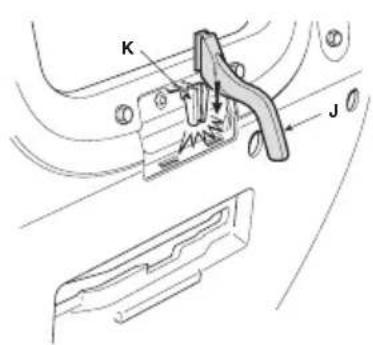
3.6. MONTERING AF SIDEUDKASTSKAERM (om forudset)
Sefigur7.
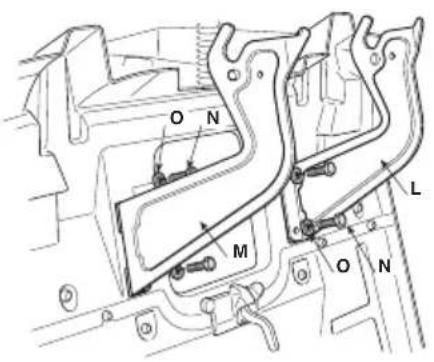
3.7. MONTERING AF ROTORHUSETS SIDEFORSTAERKNINGER (om forudset)
Sefigur8.
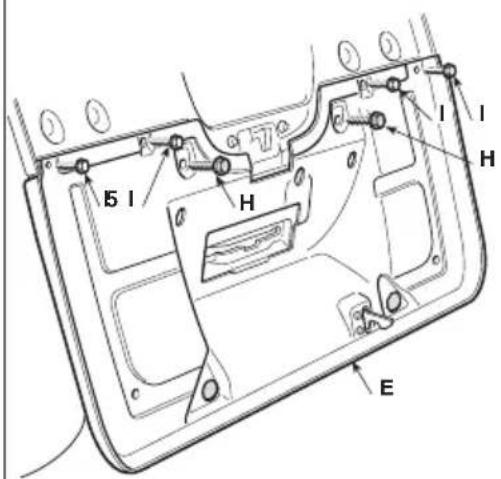
3.8. MONTERING OG FERDIGGÖRELSE AF BAGPLADEN (om forudset)
Sefigur9.
4. BETJENINGSORGANER
- Nogleafbryder (fig. 10.A)
Frakoblet transmission:
VIGTIGT Denne handling mä kun udfores for standset motor, med pedalen (fig. 10.J) i positionen frigear, for at undgå beskadigelser på transmissionsgruppen.
VIGTIGT Indkoblings-/frakoblingsgrebet ma aldrig sta i den midterste position. Dette forhold overopheder og beskadiger transmissionen.
Download full manual
stiga.com
The owner's manuals are available:
on the stiga.com website
by scanning the QR code


Download full manual
stiga.com
ATTENTION: READ THIS MANUAL CAREFULLY BEFORE USING THE MACHINE.
Keep safe for future use.
NOTE The purpose of this document is to provide a simple, paper-based guide for safe operation and maintenance of the machine.
For more detailed information, download the complete digital owner's manuals.
1. SAFETY REGULATIONS
1.1. TRAINING

Become acquainted with the controls and the proper use of the machine. Learn how to stop the engine quickly. Failure to follow the warnings and instructions may result in fire and/or serious injury.
- Never allow the machine to be used by children or individuals who are not familiar with the instructions. Local laws may establish a minimum age for users.
- Never use the machine if the user is tired or unwell, or has taken medication, drugs, alcohol or substances that impair reflexes and concentration.
- Remember that the operator or user is responsible for accidents and unexpected events that can occur to other people or property. It is the user's responsibility to assess the potential risk of the area where work is to be carried out and to take all the necessary precautions to ensure his own safety and that of others, particularly on slopes or rough, slippery and unstable ground.
- If the machine is sold or lent to others, make sure that the operator looks over the user instructions contained in this manual.
1.2. PRELIMINARY OPERATIONS
Personal Protective Equipment (PPE)
- Always wear suitable work attire, hard-wearing safety footwear with non-slip soles and long trousers. Do not operate the machine barefoot or wearing open sandals. Wear hearing protection devices.
- Wear protective gloves whenever your hands are at risk.
- Never wear scarves, shirts, necklaces, bracelets, loose flowing clothing, laces or ties or any hanging or flapping accessory that could catch in the machine or in any objects or materials in the work area.
- Tie your hair back if it is long.
Work / Machine Area
- Thoroughly inspect the entire work area and remove anything that could be thrown by the machine or damage the cutting means/rotating units (stones, branches, iron wire, bones, etc.).
Internal combustion engine: fuel

The fuel is highly flammable.
- Keep the fuel in approved containers, in a safe place, away
from any naked lights or heat sources.
- Do not smoke when filling up with fuel or when handling the fuel.
- Use a funnel to top up with fuel only in the open air.
- Never remove the tank cap or add fuel while the engine is running or when the engine is hot.
- Do not approach the tank opening with a naked flame to check its contents.
- Immediately clean up all traces of fuel spilt on the machine or on the ground.
- Replace caps of all fuel tanks and containers securely.
1.3. DURING OPERATION
- Do not operate the engine in confined spaces where dangerous carbon monoxide fumes can collect. The start-up operations must be carried out outdoors or in a well-ventilated area. Always remember that the exhaust gases are toxic.
- When starting up the machine, do not direct the silencer and therefore the exhaust fumes towards flammable materials.
- Do not use the machine in environments that pose the risk of explosion, in the presence of flammable liquids, gases or powders. Electrical contact or mechanical rubbing can generate sparks that can ignite powder or vapour.
- Work only in daylight or with good artificial light in good visibility conditions.
- Keep people, children and animals away from the work area. Children must be supervised by another adult.
- Avoid working with wet grass, in the rain and when there is a risk of a thunderstorm, especially lightening.
- Pay careful attention to uneven ground (hills, dips), slopes, hidden hazards and obstacles that could limit visibility.
- Always mow across a slope and never up and down it, being very careful when changing direction, making sure you have firm footage and that the wheels do not hit any obstacles (such as stones, branches, roots, etc.) that may cause the machine to slide sideways or make you lose control of it.
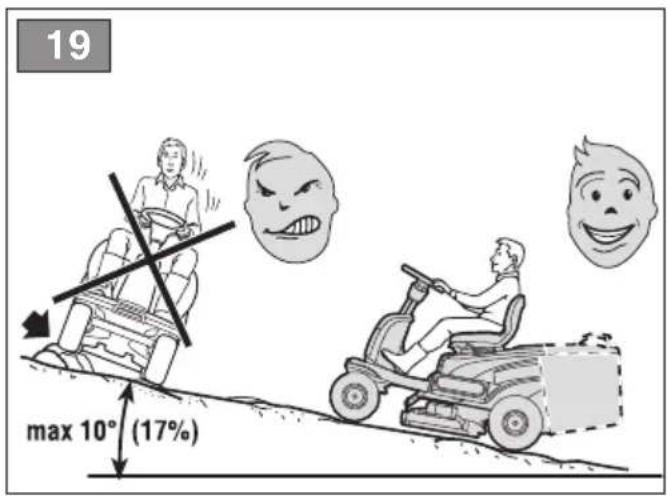
- The machine must not be used on slopes above 10^ , regardless of the mowing direction.
- Stop the cutting means when crossing non-grassy surfaces.
- Always keep hands and feet away from the cutting means, when starting and when using the machine.
- Keep away from the discharge opening.
- Never use the machine with damaged, missing or incorrectly positioned guards (grass catcher, rear unload guard).
- Never disengage, deactivate, remove or tamper with the safety systems/micro switches installed.
-
Pay close attention on sloping ground which requires special care to prevent overturning or loss of control of the machine. The main reasons for loss of control are:
-
Insufficient wheel grip.
-
Excessive speed.
-
Sharp changes of direction.
- Inadequate braking.
- Type of machine unsuitable for its task.
- Lack of awareness of the effect of ground conditions.
-
Using the machine for towing.
-
Look out for traffic when using the machine near the road.
-
Release the cutting means, stop the engine and remove the ignition key, making sure that all moving parts have come to a complete stop:
-
When transporting the machine;
-
Whenever the machine is left unattended;
-
Before removing the blockages or unclogging the discharge conveyor;
- Before checking, cleaning or working on the machine;
- After hitting a foreign object. Check the machine for damage and, if necessary, repair it before using it again;
-
If the machine starts to vibrate abnormally: inspect for possible damage; check for and tighten any loose parts; have all checks, repair works and replacements carried out by an Authorised Service Centre.
-
Always keep hands and feet away from the cutting means, when starting and when using the machine.
- Attention: the cutting means will continue to rotate for a few seconds after disengagement or after you have switched off the motor.
- Pay attention to cutting means assembly with more than one cutting mean, as rotating cutting means can trigger the rotation of the others.
- Keep away from the discharge opening.
- Do not touch the parts of the engine that heat up during operation. Risk of burns.
- To avoid the risk of fire, do not leave the machine standing in high grass with the engine running.

If something breaks or an accident occurs during work, turn off the motor immediately and move the machine away to prevent further damage; if an accident occurs with injuries or third parties are injured, carry out the first aid measures most suitable for the situation immediately and contact the medical authorities for any necessary health care. Carefully remove any debris which could cause damage or injury to persons or animals if ignored.
1.4. MAINTENANCE, STORAGE AND TRANSPORT
Ensure regular maintenance and correct storage to maintain machine safety and high performance levels.
- Never use the machine with worn or damaged parts. Faulty or worn-out parts must always be replaced and never repaired. Only use original spare parts.
- Be careful during adjustment of the machine to prevent entrapment of the fingers between moving parts of the cutting means and fixed parts of the machine.
- To reduce the risk of fire, check for oil and/or fuel leaks on a regular basis.

The noise and vibration levels shown in these instructions are the maximum levels for use of the machine. The use of an unbalanced cutting element, the excessive speed of movement, or lack of maintenance have a significant influence on noise emissions and vibrations. Consequently, it is necessary to take preventive steps to eliminate possible damage due to high levels
of noise and stress from vibration; maintain the machine well, wear ear protection devices, and take breaks whilst working.
- Do not store the machine with fuel in the tank in an area where fuel vapours could reach a naked light, a spark or a strong heat source.
- To reduce fire risks, do not leave containers with debris inside a room.
1.5. ENVIRONMENTAL PROTECTION
- Scrupulously comply with local regulations for the disposal of packaging, deteriorated parts or any elements with a strong environmental impact; this waste must not be disposed of with regular waste, but must be separated and taken to collection centres, which will recycle the materials.
- Comply with local regulations for the disposal of waste materials.
- When the machine is withdrawn from service, do not dispose of it in the environment, but take it to a waste disposal facility in accordance with the local regulations in force.

Separate waste collection of the products and packaging used allows the materials to be recycled and reused. Reuse of recycled materials help to prevent environmental pollution and reduces the demand for raw materials.
2.PRODUCT DESCRIPTION
This machine is a ride-on lawn mower with seated operator. The machine is equipped with a combustion engine which drives cutting means protected by a casing, as well as a transmission unit that moves the machine.
The machine has rear-wheel drive.
The operator is able to operate the machine and use the main controls, always seated in the operator's position.
The safety devices installed on the machine will disengage the engine and cutting means in a couple of seconds (par. 5.2).
Intended use and misuse
This machine is designed and built for cutting grass in gardens and grassy areas.
Any other use may be dangerous and cause damage to persons and/or property.
Examples of improper use may include, but are not limited to:
- transporting other persons, children or animals on the machine;
- using the machine for towing or pushing loads without the use of the specified attachment for towing;
- Using the cutting means on surfaces other than grass;
- Using the machine for leaf or debris collection;
- using the machine to pass over unstable, slippery, icy, stony or uneven ground, puddles or swamps.
IMPORTANT Improper use of the machine will void the warranty and relieves the Manufacturer of any liability, placing all responsibility for damage or injury, to him/herself or third parties, on the user.
IMPORTANT The machine must be used by one operator only.
IMPORTANT The machine has not been type-approved for circulation on public roads. It must be used (as indicated by the highway code) in private areas closed to traffic.
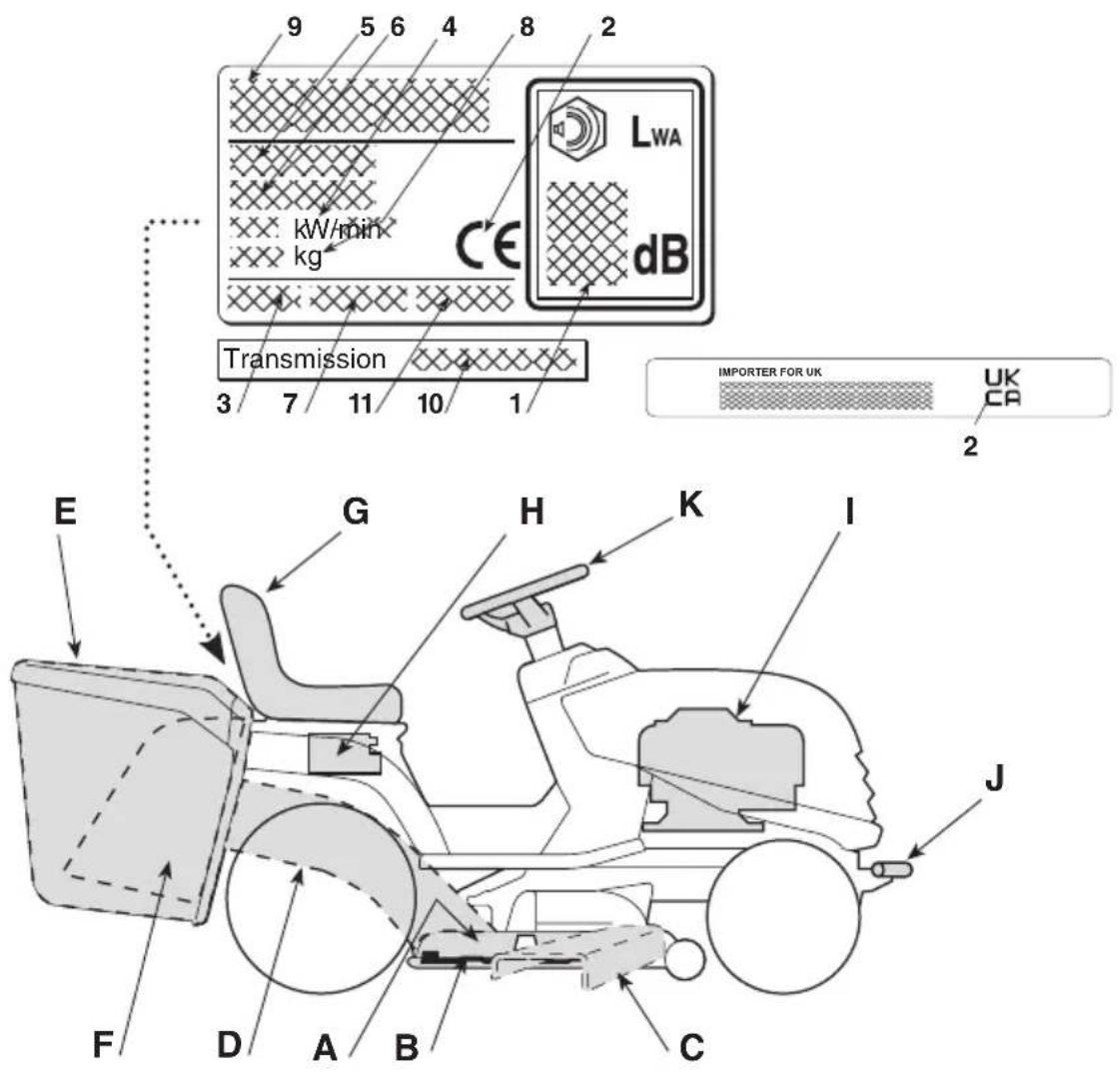
2.1. COMPONENTS OF THE MACHINE (FIG. 1)
A. Cutting means assembly
B. Cutting means
C. Side discharge chute:
D. Discharge chute
E. Grass catcher
F. Rear discharge guard (upon request)
G. Driving seat
H. Battery
I. Engine
J. Front bumper
K. Steering wheel
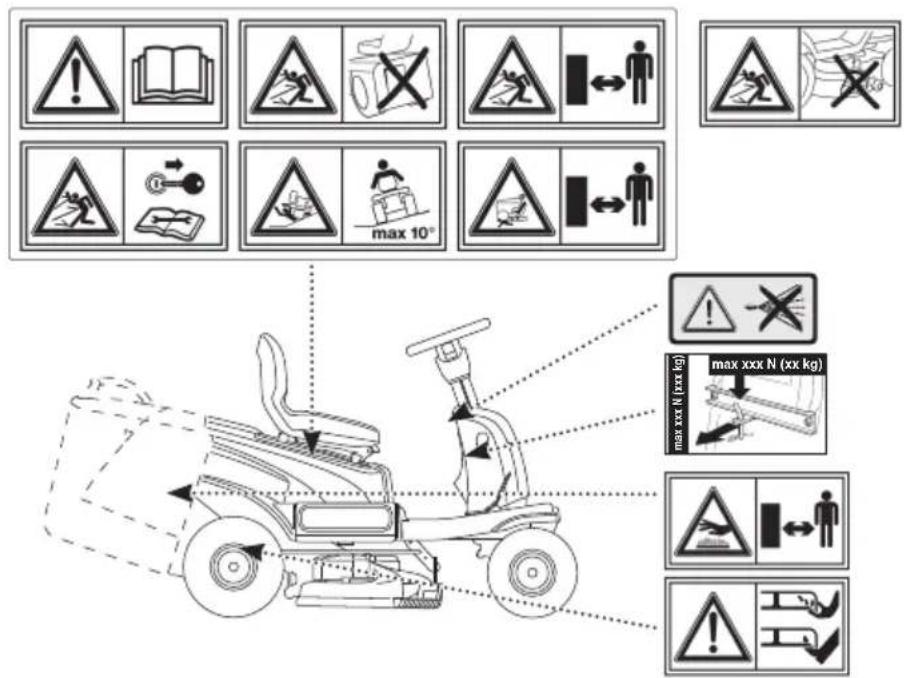
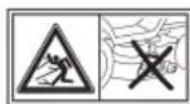
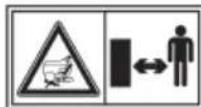
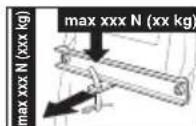
2.2.SAFETY SIGNS (FIG.2)

ATTENTION
Read the instructions before use.

ATTENTION
Remove the key and read the instructions before carrying out any maintenance or repair work.

HAZARD OF EJECTED OBJECTS
Do not operate without either the rear discharge guard or the grass catcher being in place.
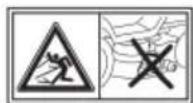
HAZARD OF EJECTED OBJECTS Do not work without having fitted the side discharge chute.

HAZARD OF EJECTED OBJECTS Keep all persons away and outside the work area during machine use.

RISK OF MACHINE ROLL-OVER Do not use the machine on gradients in excess of 10^

CRUSHING HAZARD
Make sure that children remain at a safe distance from the machine when the engine is running.

RISK OF CUTTING.
Cutting means in operation. Do not insert hands or feet into the cutting means housing

ATTENTION
Keep away from hot surfaces
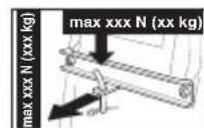
When using the towing kit, do not exceed the load limits indicated on the label, and respect the applicable safety regulations

ATTENTION
Never use pressure lances for washing the drive.
IMPORTANT Any damaged or illegible decals must be replaced. Order replacement decals from an Authorised Service Centre.
3. ASSEMBLY
IMPORTANT Unpacking and assembly operations should be performed on a flat and stable surface, with enough space for handling the machine and its packaging, using the proper tools.
3.1.UNPACKING
- Carefully open the packaging, paying attention not to lose components
- Consult the documentation in the box, including these instructions.
- Remove all the unassembled parts from the box.
-
Remove the machine from the packaging taking the following precautions:
-
move the cutting means assembly to its maximum height (par. 4) to protect it against damage when the machine is lifted off the base pallet;
- Move the front drive release lever to the released position (par. 4) (for models with hydrostatic drive).
- Lift the machine off the base pallet.
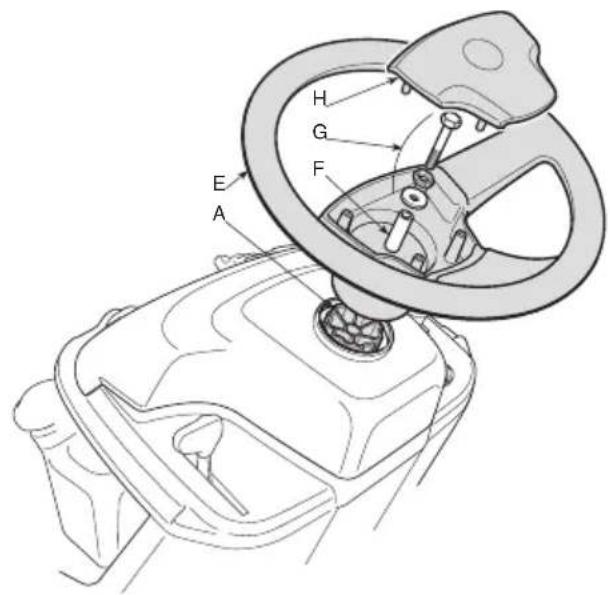
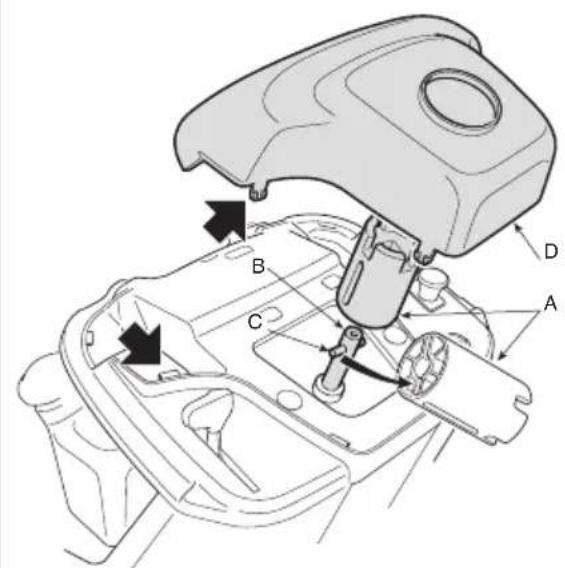
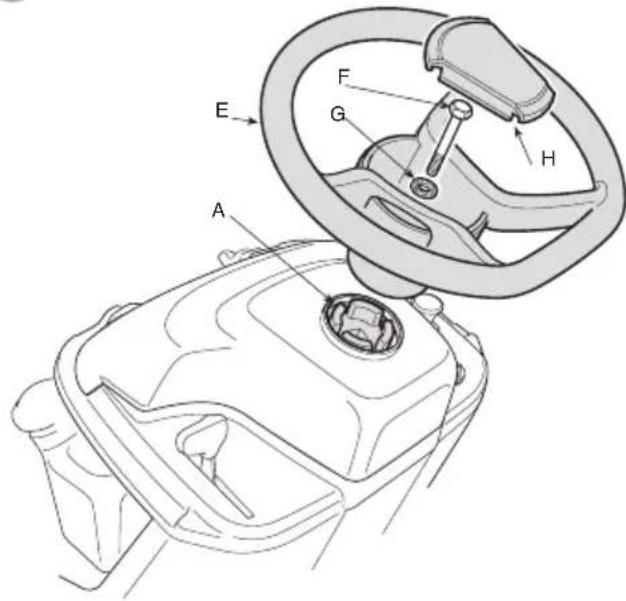
3.2. STEERING WHEEL ASSEMBLY
- Type "I" Steering Wheel
See figure 3-1. - Type "II" Steering Wheel
See figure 3-II.
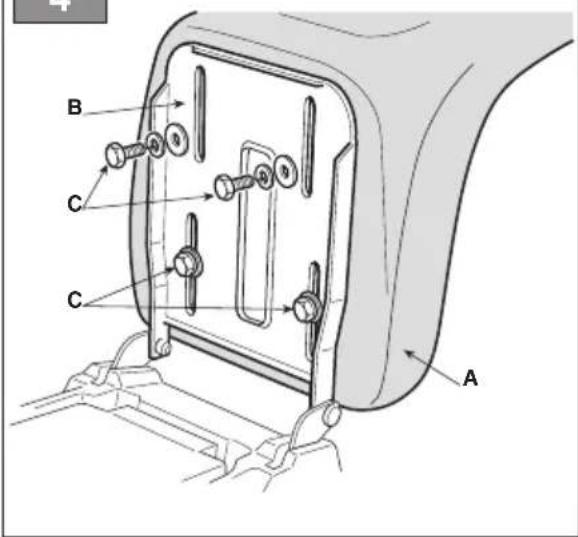
3.3. SEAT ASSEMBLY
See figure 4.
3.4. MOUNTING AND CONNECTING THE BATTERY
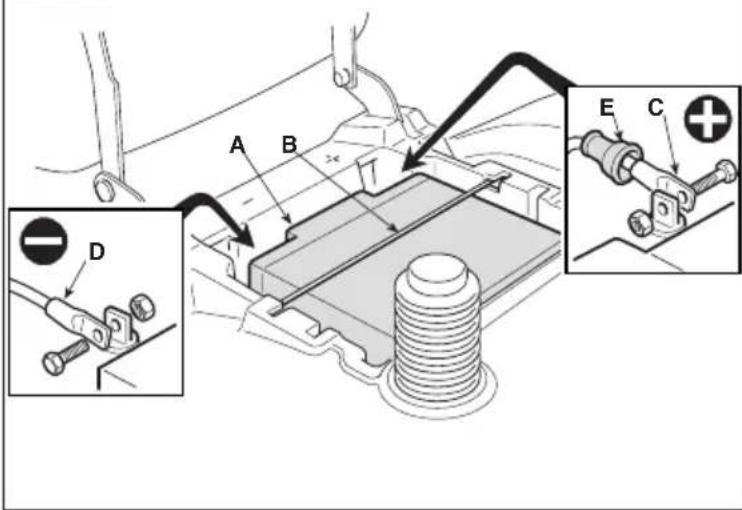
The battery (fig. 5.A) is housed under the seat and secured by a spring (fig. 5.B).
- First connect the red wire (fig. 5.C) to the positive pole (+) and then the black wire (fig. 5.D) to the negative pole (-) , using the screws supplied as shown.
- Coat the terminals with silicone grease and ensure that the red cable protection cap is correctly positioned (fig. 5.E).
IMPORTANT Always fully charge the battery according to the instructions in the battery booklet.
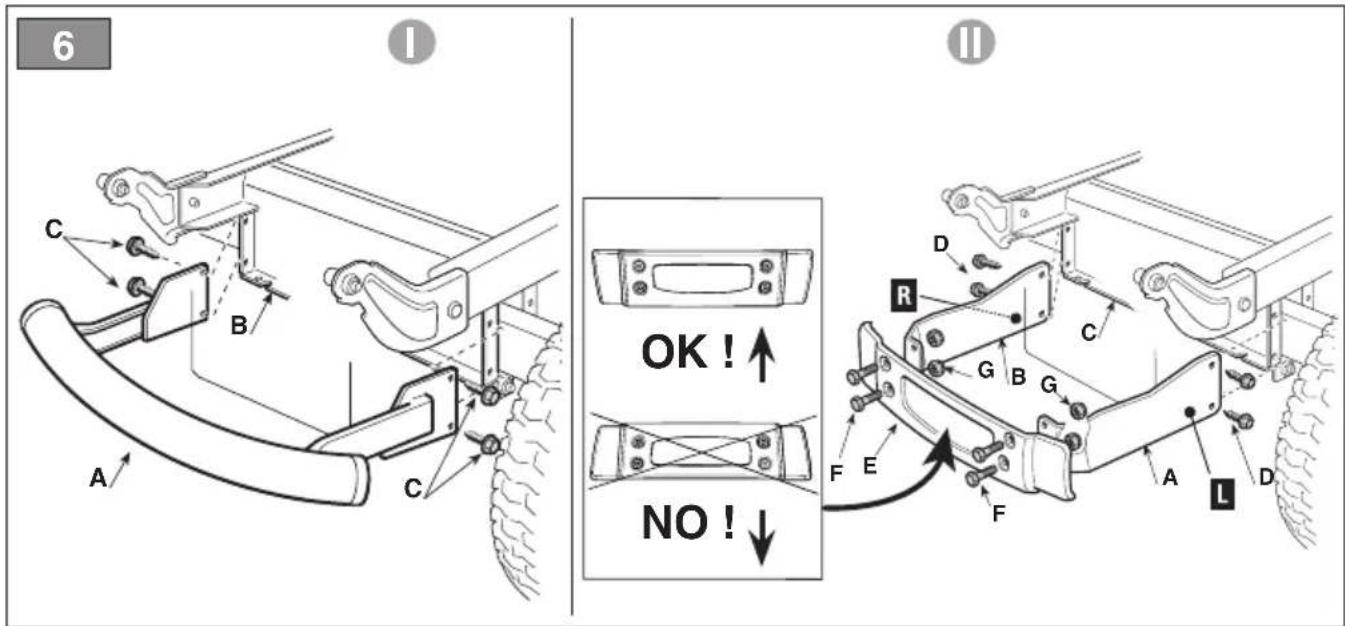
3.5. MOUNTING THE REAR BUMPER
- Type "I" bumper
See figure 6-1. - Type "II" bumper
See figure 6-II.
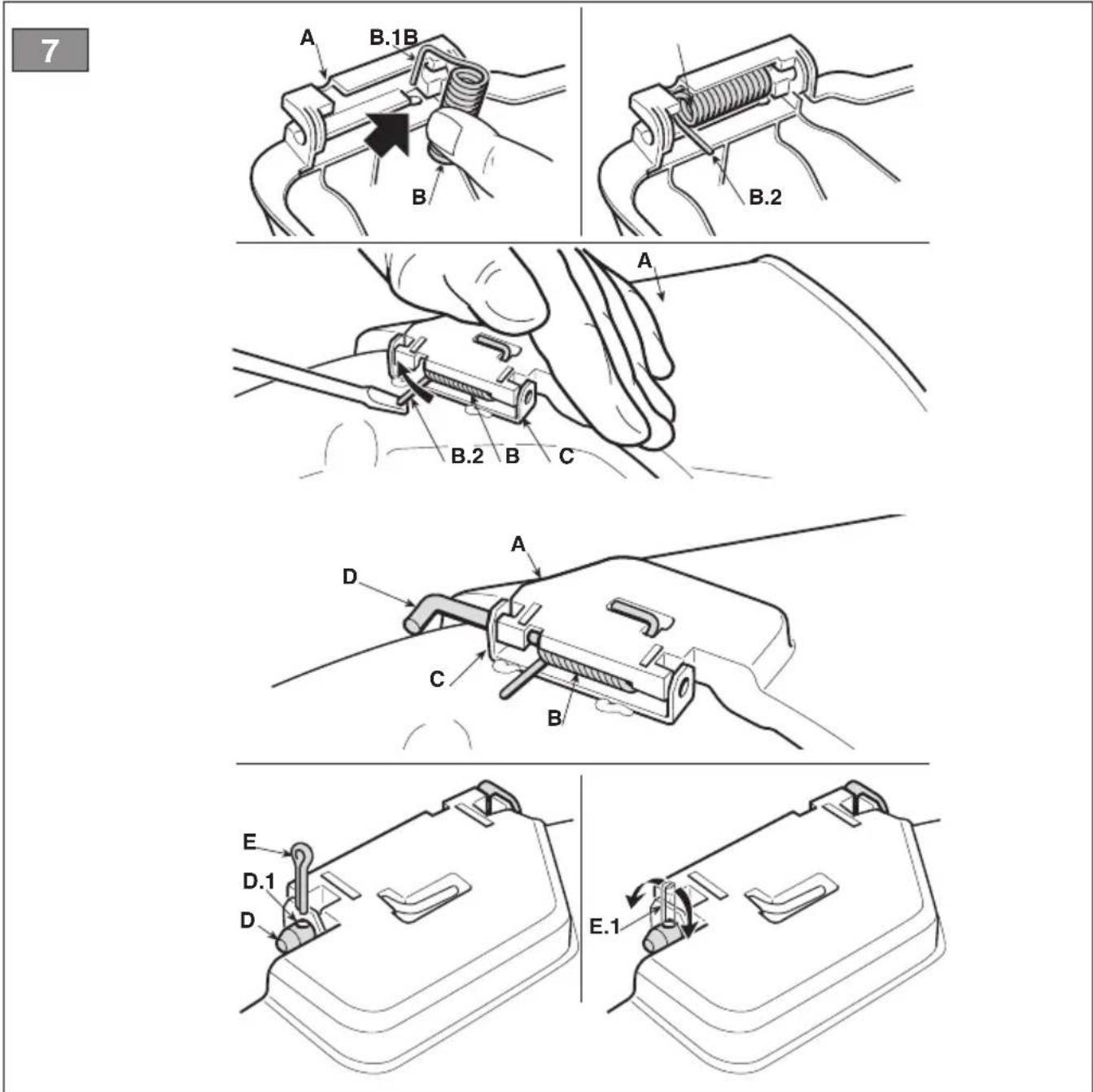
3.6. ASSEMBLY OF SIDE DISCHARGE CHUTE (if available)
See figure 7.
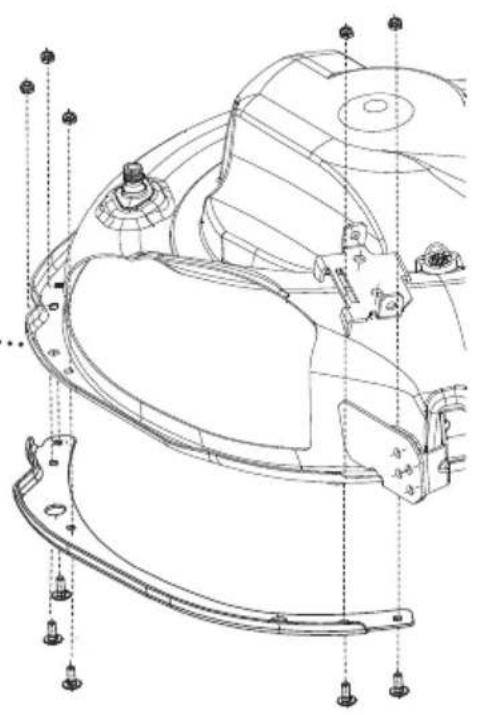
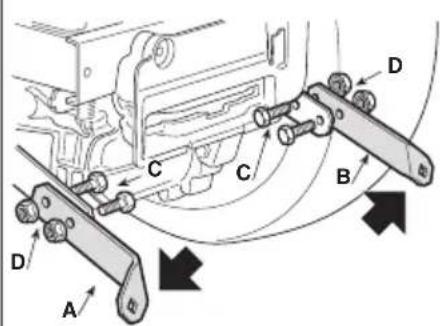
3.7. ASSEMBLY OF CUTTING MEANS ASSEMBLY SIDE STRENGTHENERS (if available)
See figure 8.
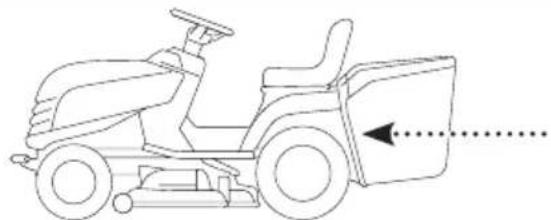
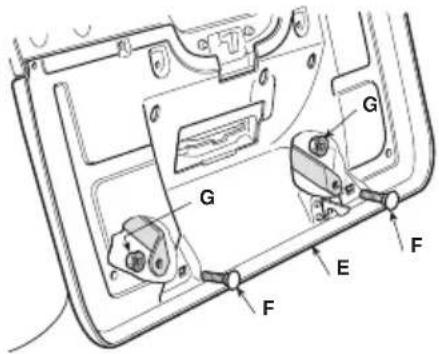
3.8. ASSEMBLY AND COMPLETION OF THE REAR PLATE (if available)
See figure 9.
4. CONTROLS
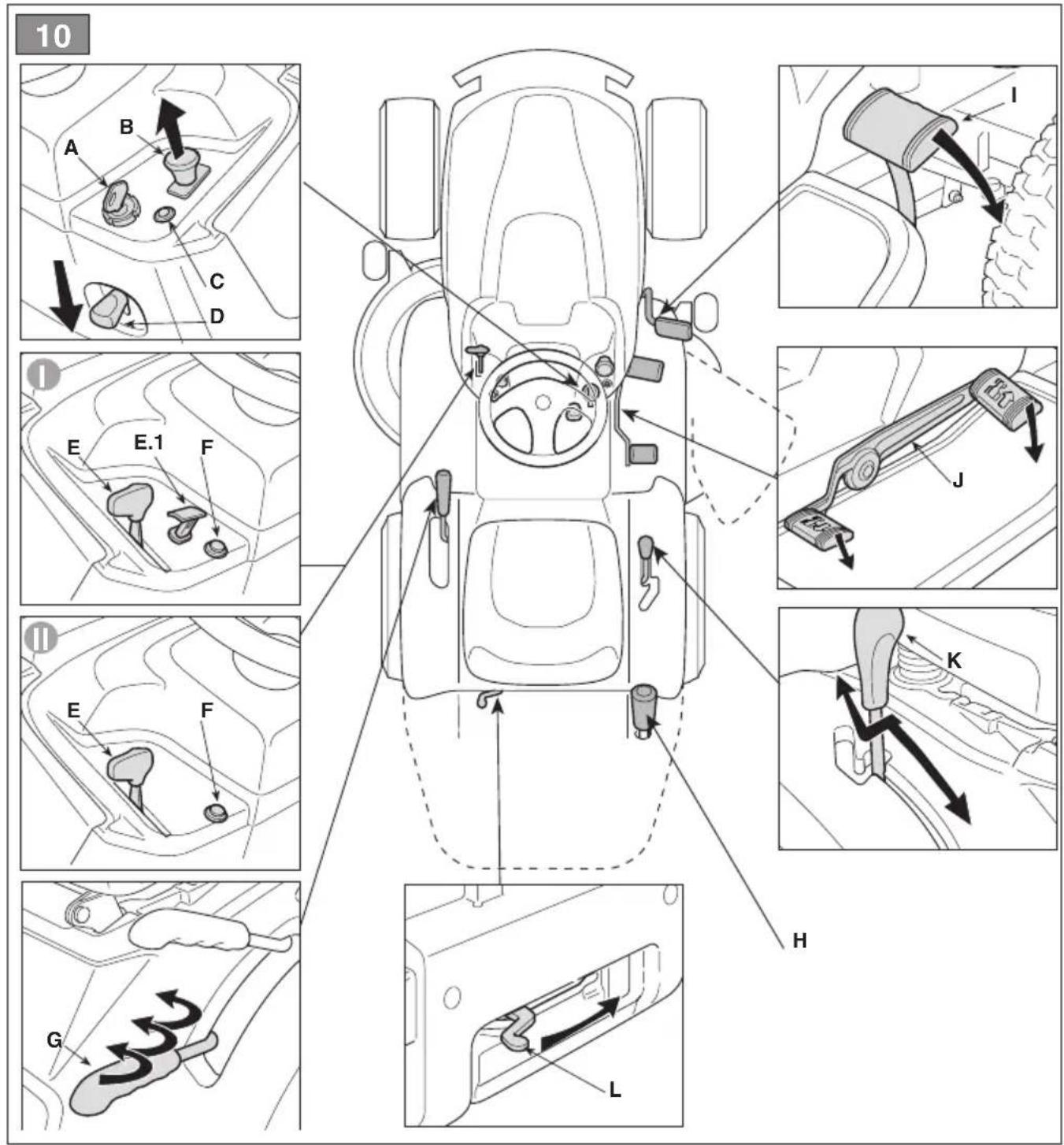
Key switch (Fig. 10.A)
The key enables/disables the machine and headlights ignition (if available).

Stop position.

Headlights ignition position (if available).

On position.
Start position.
IMPORTANT Remove the key whenever the machine is left unattended or not in use.
Throttle control (Fig. 10.E)
Regulates the engine's r.p.m.

Choke Command - Cold start.

Maximum engine speed.

Minimum engine speed.
- Parking brake lever (Fig. 10.D)

Brake not engaged.

Brake engaged.
- Clutch/brake pedal (mechanical drive) (Fig. 10.l)
In the first part of the stroke it acts as a clutch by engaging or disengaging the wheel drive. In the second part it acts as a brake, acting on the rear wheels
- Speed control lever (mechanical drive) (Fig. 10.K)
Five forward gears
The gear must only be engaged when the
machine has stopped.
4
5
N
Neutral position «N»
R
Reverse gear «R»
Reverse must only be engaged when the machine has stopped.
To shift from one gear to the other, press the pedal (Fig. 10.l) halfway down and move the lever according to the indications on the label.
- Brake pedal (hydrostatic drive) (Fig. 10.l)

This pedal operates the brakes on the rear wheels (fig. 10.l)
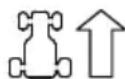
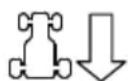
- Drive pedal (hydrostatic drive) (Fig. 10.J)

Forward drive gear
Parking

Reverse drive gear
IMPORTANT If the drive pedal is operated in both forward and reverse with the parking brake (fig. 10.D) engaged, the engine stops.
- Hydrostatic drive engagement / disengagement lever (Fig. 10.L)

Drive engaged :

Transmission disengaged:
IMPORTANT To avoid damaging the drive unit, this operation should only be carried out with the engine stopped, with the pedal (fig. 10.J) in neutral.
IMPORTANT The engagement/disengagement lever must never be in the intermediate position. This condition will cause overheating and damage the transmission.
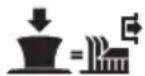
Cutting means engage and disengage command (Fig. 10.B)

Cutting means engaged. Pulled mushroom switch

Cutting means disengaged. Pressed mushroom switch
- Button for consent of reverse gear cutting (Fig. 10.F)

Press and hold the button to reverse while the cutting means are engaged, without causing the engine to stop
- Cutting height adjustment (Fig. 10.G)

To move from one position to another, the lever must be moved sideways and repositioned in one of the stop notches.


-
Indicator light and acoustic warning device (only for models with rear grass catcher)
-
The indicator light (Fig. 10.C) illuminates when the key (Fig. 10.A) is in the "RUN" position and remains lit during operation.
- When it flashes, it means that there is no engine start consent.
-
The acoustic signal warns that the grass catcher is full.
-
Tipping lever for grass catcher (if available, only for models with rear grass catcher)
This lever, removable from its seat, allows the grass catcher to be overturned for emptying, reducing the effort required by the operator (fig. 10.H).
5. USING THE MACHINE
5.1. PRELIMINARY OPERATIONS
- Filling with oil and fuel
IMPORTANT The machine is supplied without engine oil or fuel.
Check if there is fuel and check the oil level before using the machine. For methods and precautions on refuelling and topping up oil, follow the instructions in the engine handbook.
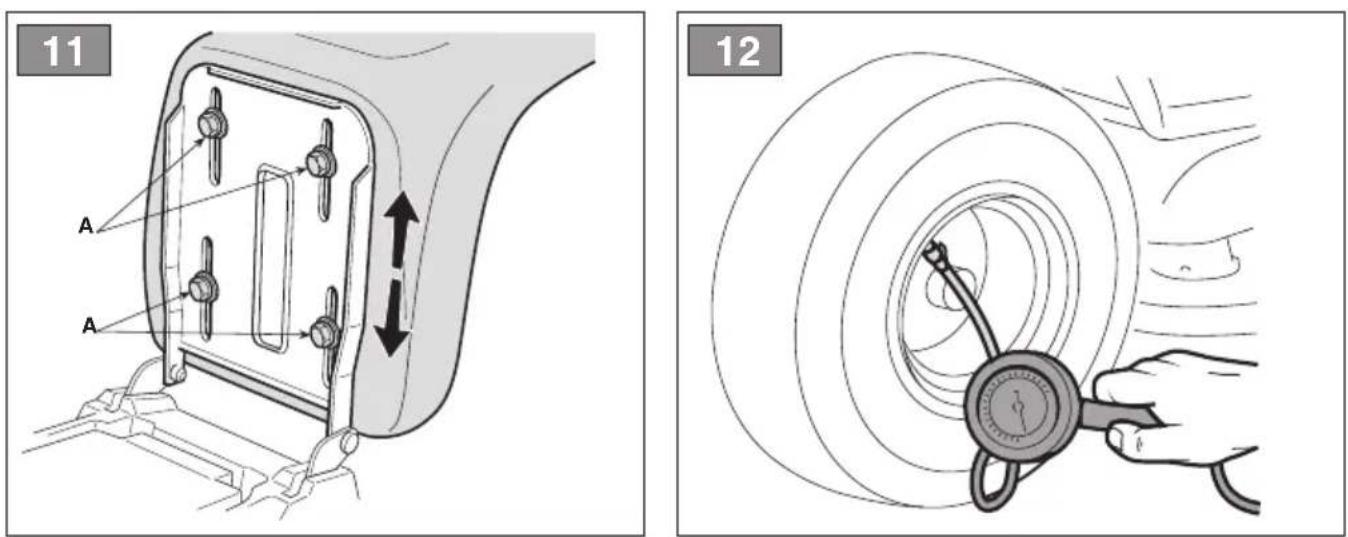
- Seat adjustment
See figure 11.
Tyre pressure
- Connect a compressed air gun with a pressure gauge to the wheel valve (fig. 12).
- Adjust the pressure according to the values indicated in the "Technical Data" chart.
- Preparing the machine before starting work
NOTE This machine can be used to mow lawns in a number of different ways; before starting, prepare the machine based on how the lawn is to be mowed.
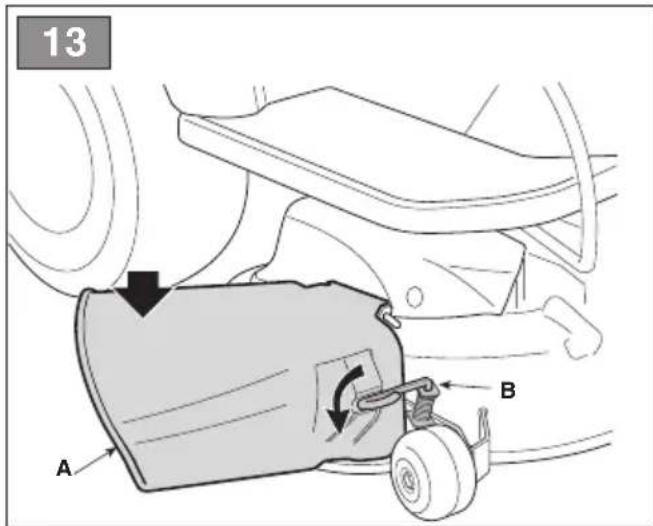
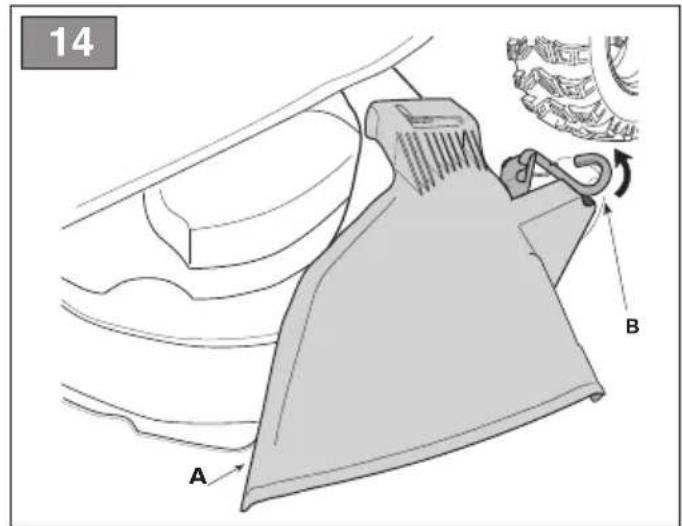
- Prepare the machine for cutting and lateral grass discharge (for models with side discharge only) (fig. 13-14).
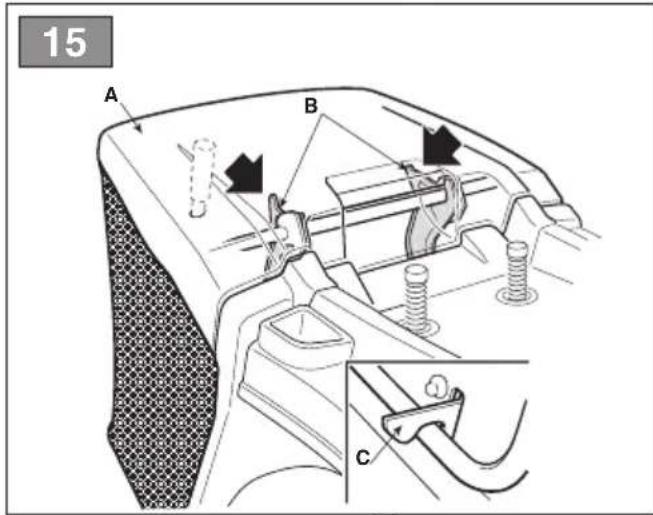
- Pre-set forcutting and chopping grass in the grass catcher (only for models with rear grass catcher) (fig. 15).
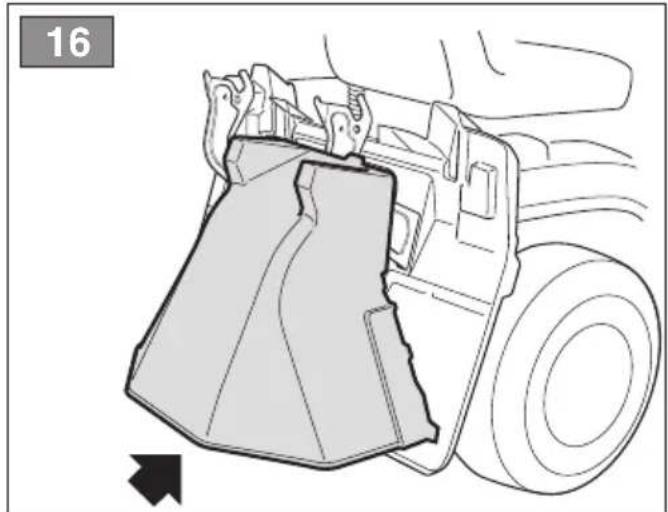
- Preparation for mowing and rear grass discharge (models with rear grass catcher only) (fig. 16)
-
Preparation for grass mowing and chopping (only with corresponding kit for "mulching").
-
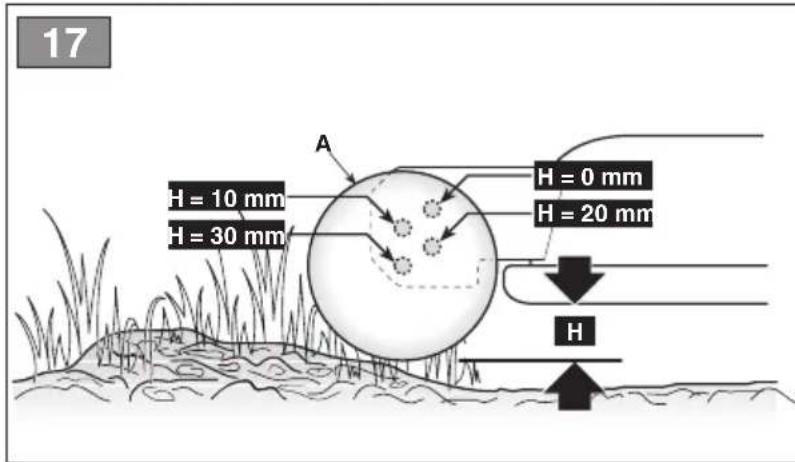
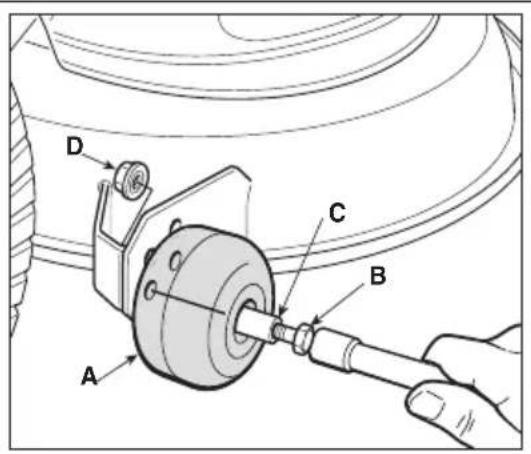
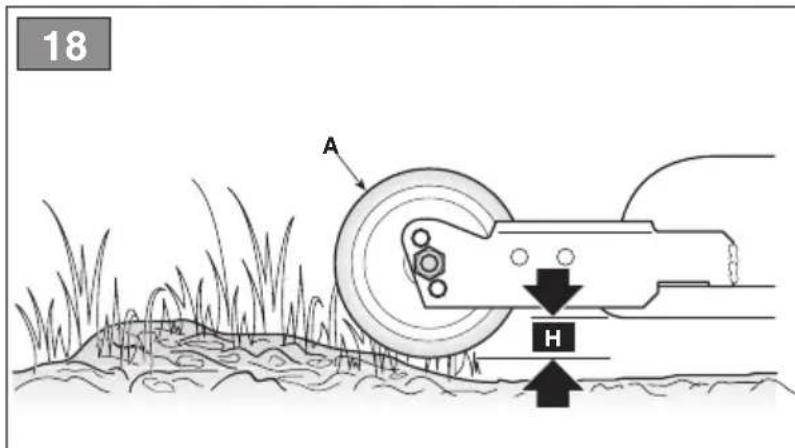
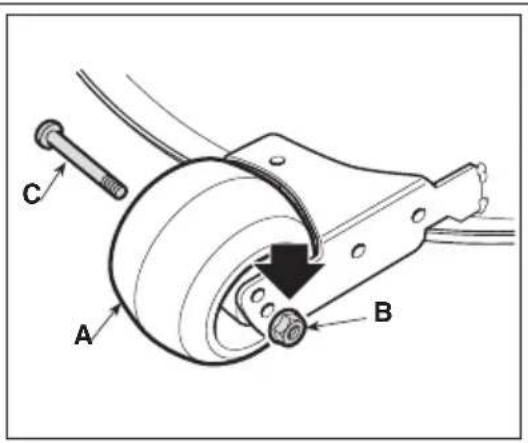
Positioning the anti-scalping wheels
-
For models with side discharge (fig. 17).
- For models with rear collection (fig. 18).
5.2.SAFETY CHECKS
- General safety checks
| Object Result | |
| Battery No damage to the casing,cover or terminals | |
| Rear discharge guard,grass catcher | Good condition. No damage. Properly installed. |
| Side discharge guard, suction grid | Good condition. No damage. Properly installed . |
| Fuel lines and connections | No leaks. |
| Electrical cables All insulation | intact.No mechanical damage. |
| Oil lines No leaks. | No damage. |
| Drive the machine forwards and backwards, shift to neutral /release the drive pedal (par. 4) | The machine slows down and stops. |
| Press the brake pedal (par. 4) | The machine stops. |
| Test driving No abnormal v | brations.No abnormal sound |
| Safety devices They operate | as described in the next paragraph. |
- Safety devices checks
| Action Result | |
| 1. gear in "neutral";2. cutting means disengaged;3. operator seated. | The engine starts |
| the operator leaves his seat The | engine stops |
| the grass catcher is lifted or the rear discharge guard removed without disengaging the cutting means (for rear collection models only) | The engine stops |
| the parking brake is engaged without disengaging the cutting means | The engine stops |
| The speed change is activated or the drive pedal with the parking brake engaged | The engine stops |
| The reverse gear is engaged with the cutting means engaged, without pressing the consent button (par. 4) | The engine stops |

If any of the results fail to match the indications provided in the tables, do not use the machine! Contact an Authorised Service Centre to have it checked and repaired if necessary.
5.3. USING ON SLOPES
Comply with the limits indicated in the "Technical Data" Tables as in "fig. 19" regardless of the mowing direction.
IMPORTANT Only for models with mechanical drive: Never drive downhill with the gear in neutral or the clutch disengaged! Always engage a low gear before leaving the machine stationary and unattended.
- Open the fuel tap (fig. 20.A) (if provided).
- Sit in the operator's position.
- Put the drive in neutral («N»).
- Disengage the cutting means.
- Engage the parking brake.
- Shift the throttle control to the maximum speed position "hare".
- If cold starting: Engage the choke command.
- Insert the ignition key and turn to On to make electrical contact, then turn it to Start to start the engine.
- Release the ignition key once the engine has started.
If cold starting: as soon as the engine ticks over:
- Deactivate the choke command setting the accelerator command to the maximum speed - "hare".
- Disengage the choke command.
NOTE Using the choke when the engine is already warm can foul the spark plugs and cause the engine to run erratically.
- When the engine has started, shift the throttle control to the minimum «tortoise» speed position.
NOTE If there are engine starting problems, do not persist as you can risk running the battery flat and flooding the engine. Turn the key to the Off position, wait for a few seconds and then repeat the operation. If the malfunction persists, refer to the engine owner's manual and chapter 8 in this manual.
- Forward gear and riding without mowing
- Disengage the cutting means.
- bring the cutting means assembly to the highest position.
- shift the throttle control to a point midway between the 'tortoise' and 'hare' speed positions.
Only for models with mechanical drive
- Depress the pedal fully and move the gear lever to the 1st gear position.
- While keeping the pedal depressed (fig.10.l), release the parking brake.
- Gradually release the pedal, which thus switches from the 'brake' to the 'clutch' function, actuating the rear wheels.
- Gradually reach the desired speed by acting on the accelerator and gearbox; Shifting from one gear to another requires acting on the clutch by depressing the pedal halfway.
Only for models with hydrostatic drive
- Release the parking brake by releasing the brake pedal.
- press the drive pedal in the "forward" direction and accelerate to the desired speed by applying pressure to the pedal and operating the throttle.

The release of the clutch or the engagement of the drive must be gradual in order to prevent too abrupt an engagement from causing wheelspin and loss of control of the vehicle.
- Braking
Reduce machine speed by decreasing the engine speed, then press the brake pedal to reduce the speed further, until bringing the machine to a standstill.
Only for models with hydrostatic drive The machine can be significantly slowed down by releasing the drive pedal.
- Reverse gear
IMPORTANT Reverse must be engaged when the machine has stopped.
IMPORTANT To proceed in reverse gear with the cutting means engaged, it is necessary to press and hold the consent button (par. 4) so as not to cause the engine to stop.
Only for models with mechanical drive:
- Press the pedal (par. 4) until the machine comes to a stop;
- Move the gear lever to reverse position 'R'.
- Gradually release the pedal to engage the clutch and start reverse gear.
Only for models with hydrostatic drive
- Press the pedal (par. 4) until the machine comes to a stop;
- Start reversing by pressing the drive pedal in the "R" direction (par. 4).
- Grass cutting
To use the machine proceed as follows:
- shift the throttle to the maximum speed position ("hare"); this position is always used when using the machine;
- bring the cutting means assembly to the highest position;
- engage the cutting means (par. 4) only on grass lawns; avoid engaging them on stony ground or when the grass
is very high;
- Adjust the speed and cutting height (par. 4) in relation to lawn conditions (grass height, density and humidity) and the amount of grass to be cut;
- When starting the movement, start off slowly and carefully, as described above;
Lower the speed whenever you note a drop in engine speed, since a forward speed that is too fast compared to the amount of grass being cut will never mow the grass well.
Disengage the cutting means and move the cutting means assembly to the highest position:
- When moving between work areas
- When driving on grass free surfaces
-
Every time it is necessary to overcome an obstacle.
-
Grass catcher emptying
IMPORTANT The grass catcher can only be emptied with the cutting means disengaged; otherwise the engine stops.
When the grass catcher is full you will hear a warning sound:
- disengage the cutting means and the audible signal will stop;
- shift the throttle control to minimum "tortoise" speed position
- stop moving forward and switch to neutral;
- engage the parking brake;
- stop the engine;
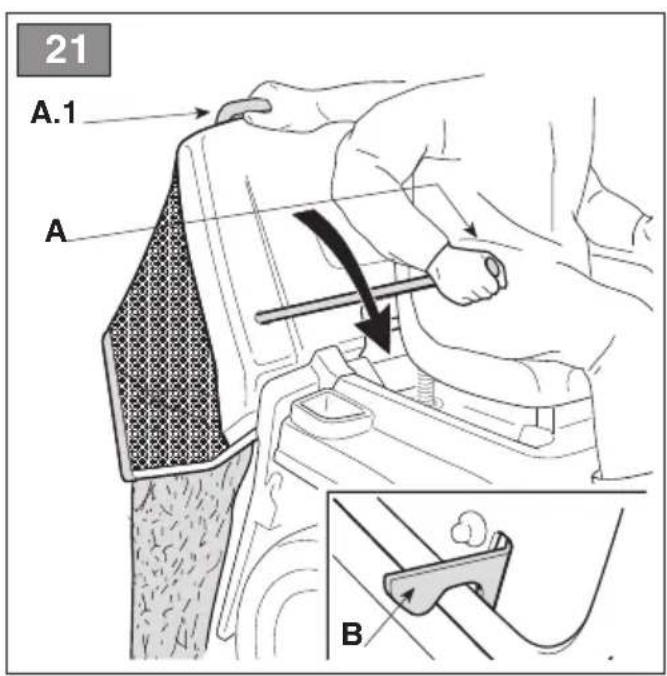
- Extract the lever (fig. 21.A - if available) or grasp the rear handle (fig. 21.A1) and overturn the grass catcher to empty it;
- Close the grass catcher again so that it remains coupled to the pawl (fig. 21.B).
5.5. STOP
To stop the machine:
- shift the throttle lever to minimum "tortoise" speed position

To avoid backfire, leave the throttle in the minimum "tortoise" speed position for 20 seconds before switching off the engine.
- switch off the engine by turning the ignition key to Off;
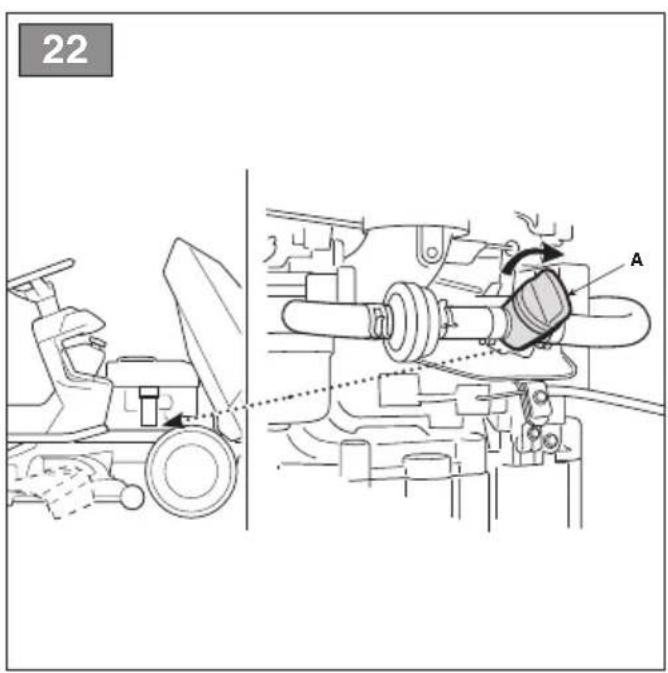
- with the engine turned off, close the fuel tap (fig. 22.A) (if provided);
- remove the key from the ignition
IMPORTANT To keep the battery charged, do not leave the ignition key in the «on» or «headlights on» position when the engine is not running.

The engine may be very warm immediately after it is shut off. Do not touch the exhaust or adjacent parts. This can cause burn injuries.
5.6. AFTER USE
- Allow the engine to cool before storing in an enclosed space.
Clean (par. 6.3).
whenever the machine is left unattended, the operator leaves the driving seat or parks the machine:
- Stop the machine.
- bring the cutting means assembly to the lowest height position.
- Make sure that all moving parts have come to a complete stop.
- Remove the ignition key (fig. 10.A).
6. MAINTENANCE
The safety regulations to be followed are described in chapter 1. Strictly comply with these instructions to avoid serious risks or hazards:
Before commencing any inspections, cleaning or maintenance/ adjustments on the machine:
- Disengage the cutting means.
- Stop the machine.
- Shift into neutral.
- Engage the parking brake.
- Stop the engine.
- Make sure that any moving component has stopped.
- Remove the ignition key.
- Use suitable clothing, protective gloves and goggles.
IMPORTANT Never leave the key inserted or within reach of children or unauthorized people.
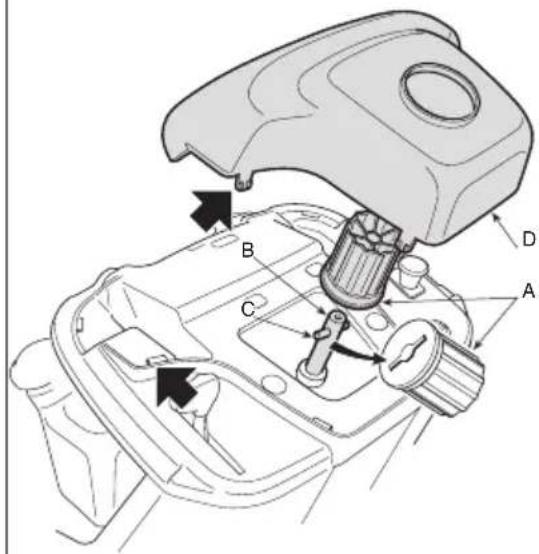
6.1. REFUELLING
To refuel:
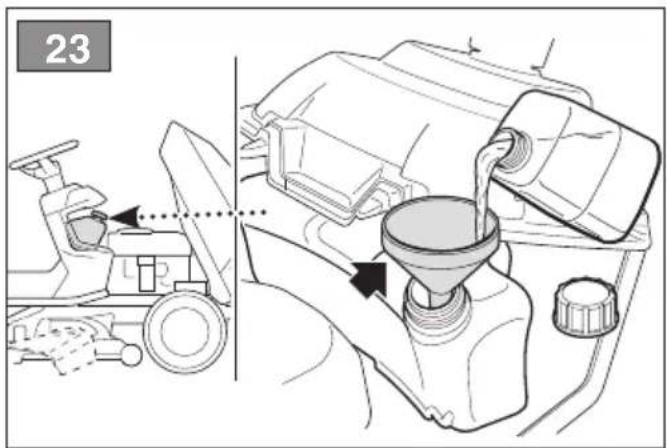
- Unscrew the fuel tank filler cap and remove it (fig. 23).
- Insert the funnel (fig. 23).
- Refuel being careful not to completely fill the tank.
- Remove the funnel.
- Close the fuel cap securely after refuelling and clean away any spills.
IMPORTANT Consult the engine owner's manual for the type of fuel to be used.
IMPORTANT Do not drip petrol onto the plastic parts to avoid ruining them. In the event of accidental leaks, rinse immediately with water. The warranty does not cover for damage to plastic parts of the bodywork or the engine caused by petrol.
6.2. CHECK AND TOP-UP ENGINE OIL
NOTE Consult the engine owner's manual for the type of oil to be used.
IMPORTANT Observe the precautions provided in the engine owner's manual.

Always check the oil level before use.
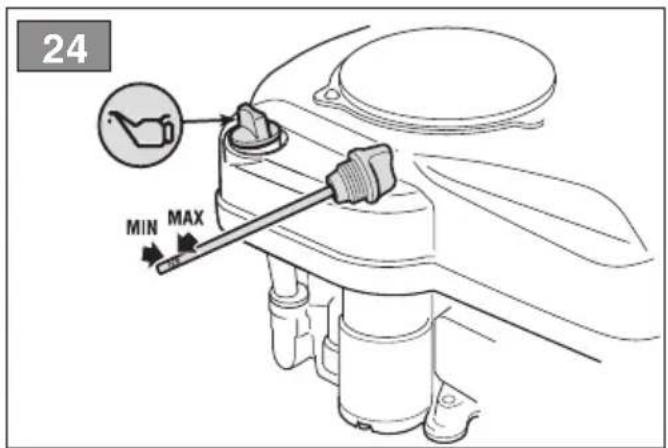
Check the oil level: according to the instructions in the engine manual, this must be between the MIN and MAX marks on the dipstick (fig. 24).
6.3. CLEANING
- General instructions
Before each use, clean thoroughly following the instructions below:
- Do not spray water onto the motor and electrical components and prevent them from getting wet.
- Remove grass debris and mud accumulated inside the chassis.
Always make sure the air intakes are free of debris. - Do not use aggressive liquids to clean the chassis.
- To reduce the risk of fire, keep the engine free of grass, leaves residues or excessive grease.
- Cleaning the cutting means assembly
IMPORTANT Washing the inside of the cutting means assembly and the discharge chute must be performed with the grass catcher mounted and the mulching cap inserted (if present) or with the rear discharge guard mounted.
- Place the machine on a flat, solid surface.
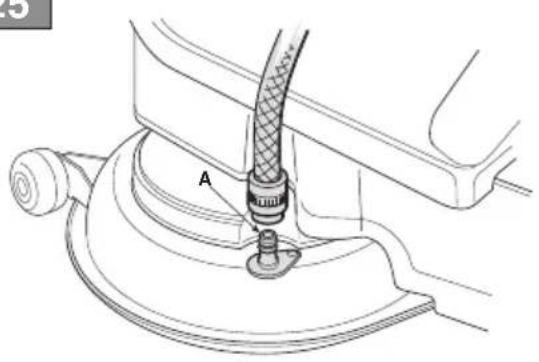
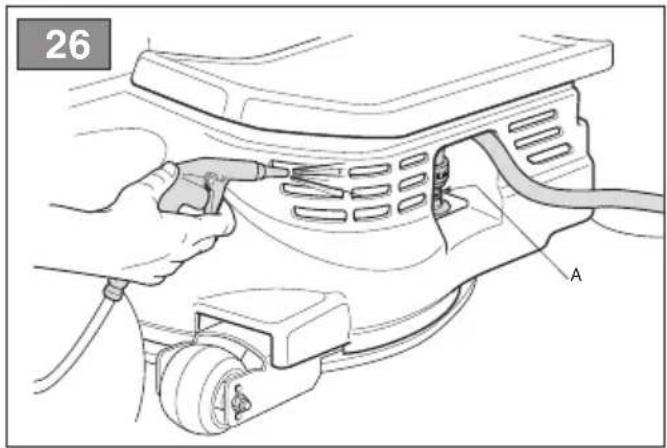
- Connect a water hose to one of the two specific couplings (fig. 25.A - fig. 26 A) and open the water supply.
- Sit in the driving seat and start the machine.
- Fully lower the cutting means and engage the cutting means.
- Let the water flow for a few minutes and then stop the machine.
- Turn off the water supply and disconnect the hose from the coupling.
- Repeat the procedure on the other coupling.
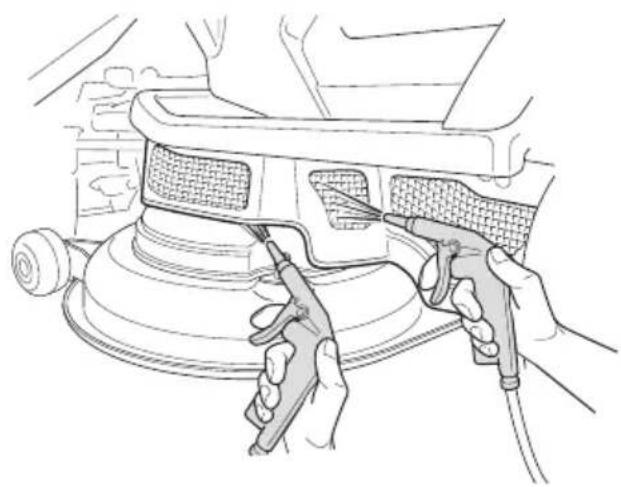
- Blow a jet of compressed air over the upper part of the assembly (fig. 25 - fig. 26).
6.4. BATTERY
Carefully read and observe the battery recharging instructions in the booklet provided with the battery. Failure in following the procedure or in charging the battery could permanently damage the battery elements. A flat battery must be recharged as soon as possible.
IMPORTANT Recharging must be done using a battery charger at constant voltage. Other recharging systems can irreversibly damage the battery.
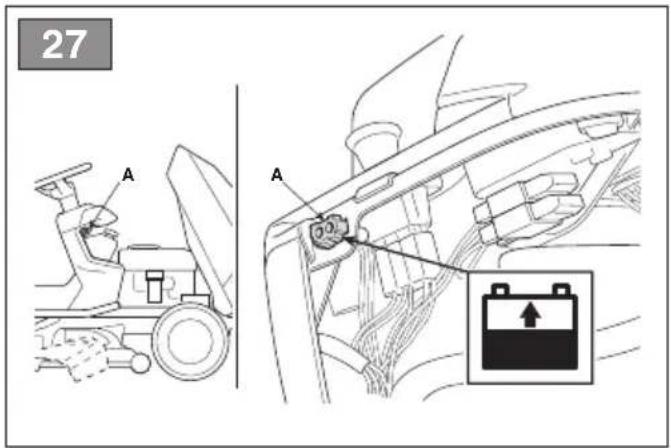
The machine comes with a connector (fig. 27.A) for recharging; this is connected to the corresponding connector for the special maintenance battery charger supplied (if available) or available on request.
IMPORTANT This connector must only be used for connection to the maintenance battery charger indicated by the Manufacturer. For its use:
- follow the instructions given in the relative instruction manual;
- follow the instructions in the battery manual.
6.5. CUTTING MEANS MAINTENANCE

Do not touch the cutting means until the ignition key has been removed and the cutting means is completely stationary. Be careful that the cutting means can move, even if the key has been removed (for battery-powered models).

All work on the cutting means (disassembly, sharpening, balancing, repairing, reassembly and/or replacing) are demanding jobs that require
special skills as well as special tools; For safety reasons, these jobs are best carried out at a Authorised Service Centre.

Always replace damaged, bent or worn cutting means, together with their nuts and bolts, in order to ensure they remain balanced.
IMPORTANT Always use original cutting means bearing the code indicated in the "Technical Data" table.
7. TRANSPORT, STORAGE AND DISPOSAL
7.1. TRANSPORT
When handling the machine, always:
- disengage the cutting means;
- bring the cutting means assembly to the highest position;
- switch off the machine and remove the ignition key
- disengage the drive (par.4).
When transporting the machine on a vehicle or trailer, always:
- use an access ramp of suitable strength, width and length;
- load the machine with the electric motor switched off, with the key removed from the ignition, without a driver and pushed by an adequate number of people;
close the fuel tap (if provided);
- lower the cutting means assembly;
- position it so that it does not cause a hazard to anyone;
- engage the drive (par.4);
- lock it firmly on the means of transport using ropes or chains to prevent it from tipping over and possible damage.
7.2. STORAGE
When you intend to put your machine away for more than 30 days:
- Wait for the engine to cool
- Disconnect the battery cables and store it in a cool and dry place.
- Empty the fuel tank and follow all the instructions in the engine manual.
- Clean the machine thoroughly.
- Check the machine for any damage. If necessary, contact the authorised service centre.
Store the machine:
with the cutting means assembly lowered;
- in a dry place;
- protected from inclement weather;
- covered with a sheet if possible;
- in a place out of children's reach;
- making sure that keys or tools used for maintenance are removed.
Before starting to use the machine again:
- check that there are no fuel leaks from the tubes, fuel stopcock or carburettor:
- prepare the machine as described in chapter "5 Use of the machine".
NOTE Ensure that the battery is fully charged at least once a month and always before use.
NOTE Store the machine so as to avoid any risk in the event of accidental contact with people, children or animals.
- TROUBLESHOOTING
| PROBLEM PROBABLE | CAUSE SOLUTION | |
| 1. With the key set to 'RUN', the indicator light remains off (only for models with rear grass catcher) | The safety device of the electronic circuit board has cut in due to: | Turn the ignition key to "STOP" position and look for the cause of the problem: |
| badly connected battery check the connections (par. 3.4) | ||
| battery terminals inverted check the connections (par. 3.4). | ||
| flat battery recharge the battery (par. 6.4) | ||
| fuse blown Replace the fuse (10 A). | ||
| wet circuit board dry using lukewarm air | ||
| 2. With the key set to 'START', the indicator light flashes and the starter motor does not turn (only for models with rear grass catcher) | no start-up consent check that all starting conditions are met (par. 5.2) | |
| 3. With the key set to 'START', the indicator light turns on and the starter motor does not turn (only for models with rear grass catcher) | insufficiently charged battery recharge the battery (par. 6.4) | |
| starter relay malfunction contact your Dealer | ||
| 4. With the key set to 'START', the starter motor does not turn (only for models with side discharge) | Turn the ignition key to "STOP" position and look for the cause of the problem: | |
| no start-up consent check that all starting conditions are met (par. 5.2) | ||
| badly connected battery check the connections (par. 3.4) | ||
| battery terminals inverted check the connections (par. 3.4) | ||
| flat battery recharge the battery (par. 6.4) | ||
| fuse blown replace fuse (10 A) | ||
| wet circuit board dry using lukewarm air | ||
| starter relay malfunction contact your Dealer | ||
| 5. With the key on "START" the starter motor runs but the engine does not start | insufficiently charged battery recharge the battery (par. 6.4) | |
| faulty fuel supply | check the level in the tank (par. 6.1) | |
| open the fuel tap (if available) | ||
| check the fuel filter | ||
| faulty ignition | check that the spark plug cap is securely fitted | |
| check that the electrodes are clean and have the correct gap | ||
| 6. Starting is difficult or the engine runs erratically | carburation problems clean or replace | the air filter |
| empty the fuel tank and refill with fresh fuel | ||
| check and replace the fuel filter if necessary | ||
| 7. Weak engine performance during cutting | forward speed too high in relation to cutting height | Reduce advancing speed and/or increase the cutting height. |
| 8. The motor shuts down whilst working | Safety devices intervention check that | all starting conditions are met (par. 5.2) |
| blown fuse due to short circuit or anomaly in the electrical system (only for models with side discharge) | Identify and eliminate the cause or causes of the fault in order to prevent subsequent interruptions | |
| Replace the fuse (10 A). If interruptions persist contact your dealer | ||
| 9. The engine stops during work and the indicator light goes out (only for models with rear grass catcher) | The safety device of the electronic circuit board has cut in due to: | Put the key in the 'STOP' position, wait a few seconds for the circuit to automatically reset and: |
| battery terminals inverted check the connections (par. 3.4) | ||
| anomalies in the operation of the battery charger | check the connections of the battery (par. 3.4) | |
| check the presence of the battery | ||
| short circuit contact your Dealer | ||
| 10. The cutting means do not engage or do not stop promptly when they are disengaged | problems with the coupling system contact your Dealer | |
| 11. Uneven mowing and insufficient collection (for rear collection models only) | cutting means assembly is not parallel to the ground | check the tyre pressure (par. 5.1) |
| reinstate the alignment of the cutting means assembly in relation to the ground. | ||
| inefficient cutting means contact your Dealer | ||
| forward speed too high compared to height of grass | Reduce advancing speed and/or increase the cutting means assembly. | |
| wait for the grass to dry | ||
| collector chute is blocked Remove the grass catcher and empty the chute | ||
| 12. Uneven mowing (only for models with side discharge) | cutting means assembly is not parallel to the ground | check the tyre pressure (par. 5.1) |
| reinstate the alignment of the cutting means assembly in relation to the ground | ||
| inefficient cutting means contact your Dealer | ||
| 13. Unusual vibrations while working | cutting means assembly is full of grass | clean the cutting means assembly (par. 6.3) |
| the cutting means are unbalanced or loose | contact your Dealer | |
| loose bolts and screws check and tighten all the engine and frame bolts | ||
| 14. Uncertain or ineffective braking | the brake is not adjusted correctly | contact your Dealer |
| 15. Erratic forward movement, poor drive when going uphill or if the machine has a tendency to rear up | problems with the belt or the engagement device | contact your Dealer |
| 16. When the engine is running, the machine remains stationary when the drive pedal is pressed (models with hydrostatic drive) | release lever in the gear disengagement position | return it to the drive engaged position |
| 17. The machine begins to vibrate abnormally and/ or has hit a foreign body | damaged or loose parts stop the machine | and remove the ignition key |
| inspect for damage | ||
| check for and tighten any loose parts | ||
| have all checks, repair work and replacements carried out by a Authorised Service Centre only. | ||
NOTE If problems persist after having performed the described operations, contact your dealer.
NOTE For further problems not listed in the table, contact an authorised service centre immediately.
Download full manual
stiga.com
Download full manual
stiga.com
VAROITUS: LUE TÄMÄ OPASKIRJA HUOLELLISESTI ENNEN LAITTEEN KÄYTTOÄ.
Sailyta myohempaa tarvetta varten.
Download full manual
stiga.com
ATTENTION : LIRE ATTENTIVEMENT CE MANUEL AVANT D'UTILISER LA MACHINE.
Download full manual
stiga.com
Download full manual
stiga.com
ADVARSEL: LES DENNE BRUKSANVISNINGEN NOYE FDR DU BRUKER MASKINEN.
6.1. ETTERFYLLING AV DRIVSTOFF
Download full manual
stiga.com
RZYKO WYWROCENIA MASZNY
Download full manual
stiga.com
ATENÇA: ANTES DE USAR A MAQUINA, LEIA ATENTAMENTE O PRESENTE MANUAL.
Regime maximal do motor.

Regime minimo do motor.
Download full manual
stiga.com
BHIMAHNE! IPEKDE YEM NOJIb3OBATbCRA MAUNHO, BHIMATEJIbHO IPOYTNTE DAHHOE PYKOBOCTBOIIO 3HCJIyATAUH.
CoxpaHnte ero 6yduzero nCnoJb3ObaHn.
PIMMEYAHNE Lelbno HactoJyero DOkymeHTA ABnEcTn PpeOCTaBHe NHE pOCTORIO NOHrTHORO pyKOBODCTBa No 6e3OnaCHO EKnLyatauN INTex HUeCKOMY OBCnyHBAnHO MaunHbI B ByMaXHOM FOpMaTe.
IINnoJyHnH6o0ee noJpObHOH HOpMaun 3arpy3He nolhie pyKOBODCTBaNo 3KnJyatauHN B uHpOBOm oPMAte.
1. ПРавILA БЕЗОПАСНОТИ
1.1.O6yueHNE

O3HaHOMbTecb c opraHamn ynpabIeHHn HaJdneKaaHm HcNoJIb3ObaHHeMaunHbI. HayuHTbc8 bictpo octaHaBnBaT bBnraTeIb. Heco6NIOJeHne MeP npedocToPOHHocTH n peKomeHdaaN MoHET npHBecTH n NOKapam N/INn cepbe3HbIM TpaBMam.
HnB KOem cnyae He pa3pewaiTe noIb3OBAIbC MaunHOIeTAM NINIinuam,HeIOCTaTOHNO XOpOHO 3HaKOMbIM C npabNIAmO6paueHnC Hei.MecTHoe 3aKoHOaTeJIbCTBO MOKeY yCTaHaBnBaTb MNHImaJIbHbI BO3pact NOIb3OBATeJIa.
HnKorda He nCnoJb3yIte MaunHy, ecnn noIb3oBaTeNb yCTaI, IIOxo Ce6ra YBCTByET NIN HAXOINTcN ION BO3deICTBHeM IeKapCTB, HApKOTIKOB, aIKOROIa NIN BeIeCTB, CHHKAIooX CKOPoCTb peFJIeKCOB HypoBeHBHIMMaHria.
- POMHHTe, YTO onepatoTOp HIN NOIb3ObaTeJIb Hecet OTBETCTBeHHOCt 3a HeCactThIbe CnyauH NIN yUep6, HaHeceHHbI DpyrHM IINAM ININ X IMyueCTBy. NoJIb3ObaTeJIb Hecet OTBETCTBeHHOCt 3a OueHcy NOTEHuaJIbHbIX pNCHOB Ha yAcTKe, HA KOTOPOM OH pa60TaET, KpOME TORO, OH DOJINHEnPiNnTb BCE Mepbl IpedeOCTopoKHOCTN, YTO6bl OBecneHTb CBOIO 6e3OanCHOCTb N 6e3OanCHOCTb OKpyKaUoXx, B OOCoBENHOCTn Ha cKIOHax, HEPOBHbIX, CKOJIb3HIX INI HEYCTOnuHBIX NOBepxHOCTx.
Ecln Bbl HamepeHb I nepeaTb NIN OOnJHHt MaunHy dpYrIM LIncaM, yIOCTOBepbTeCb, YTO OHN O3HaOMnIcB C yKa3aHnA MNo 3HCNIyatauIN, INIOKeHHbIMN B HAcToIeM pyKOBoDCTBE.
1.2.IPEDBAPHTeIbHbIE ONEPAUIN
CpeCTBa HnHbNHyaJbHo3aunTbI (CN3)
HaenebTe noxoyoJeHy npOhypoaOyO oSyBHa HeckoIb3aJeH noOoBHe nDnHHbIe 6pIOKn. He 3anyckaIte MaunHy BocnHOM HIN B OTKpbTbIX caHdAInax. HaenebTe HayuHNn Dna 3aunTbI opraHOB cnyxa.
Bo Bcex CnTyauqnx, rIe npncyTCTByet pnc IJr pyK, HaeBaTe 3aunTHbIe nepaTHN.
He naBeBaTe 7apphi, xanTbI, KOJIbe, 6paCJIeTbI, pa3BeBaIOUyIOcR OJENdy, a TaHKe OJEnDy CO IHHpyKAMn I raCTyKn, a TaHOke IIOBbie BNCaHne HIN IINI INPOHne akCECCyApbl, KOTOpBle MOYr 3AcTpRbB MaINHe HIN B PpeMetax n MaTePnaJax, HAXOJIAXxCRA Ha pa6Oyem MeCTe.
-ДолнньимобраимсберпгдИнньeBOLOcbI.
Pa6oynyuactok/Maunna
BHHmatelbno ocmotpnte paoboun yuactok n y6epnte BCE,TO MOKeT 6b1b BbIbpooHeo MaunHO, IINBO NOBpeDnTB peKyUee npncnoc6bnHe/BpaauaIOuuecraopraHb (kAMHN,BETKN, pOBOLOky, KOCTN T.D.).
BbnteHn BHTpeHHeRcropaHn:TOIINBO

TOnnBO JERHO BOCnJaMeHReTc.
XpaHnTe ToIINBO B CneuaJIbHbIX KaHnCTpax, CepTnHnUPOBaHHbIX IaI DaHHo CEIn, B 6e3OnaChOM MeCTe, BdaII NTcOHTNHOB TeIIa HOTKpbITOrO PImaMeHN.
He Kypnte Bo Bpem 3a npabn nn DoJIbKn TOnnBa, a TaKke BOO6pe npn o6paueHH C TOnnBOM.
3aIINBaIte ToIJIbO Yoep3 BOpOHky,ToJIbKO IOJ OTKpbITbIM He6OM.
He doabnIte TOnJIbO Hc ChImaTe np6ky 6aKa, KOrda DnRaTeJIb paobTaetnnKorDa OH ropAHy.
He np6JIHKaTe nIaMnK 3anpaBOHOMy OTBepCTHO 6aKa, YTO6bl npOBepNTb erO coepHXMOe.
HemeJeHNO yBepnte Bce cIebl TOJIINBa, KOToPoe npoiNIOcb Ha MaunHy HnHa 3emJIO.
Bcerda Bo3BaPaaJte Ha MeCTO IN PLOTHO 3aKpyuHbAte npo6Kn BaKa H KaHnCTpbI C TOnJIINBOM.
1.3. BO BPEM PAEOTbl
He BnHouaIte DnBraTeJIb B 3aKpbITOM npocTpaHCTBe, rde MoKeHTCKONITbcr OAnchbl yrapbl ra3. Opeauu 3anycka DoJHHbIpOBoDHTbcra H OTKpbITOM BO3dyXe HIN B XopoOIO npobetpNBaEMOM NOMEUeHNN. POMHNTe, TTO BbIXONHbIE Ra3bl TOKCHHbI.
BoBpem3anycKaMaHnHbHeHa npabIe rIyHnteN, cIeobateNbHO, BixIONhie Ra3bHaJIeKOBocTlAmEHIOUmeC MaTePnaHbI.
He IcnoIb3yIte MaunHy BO B3pbIBOOanChoI cpe,IO6JIIO3OCTn OT roIOHIX KINKOCTe,ra3a HIN PbIIN. 3JIeKTPnuECKne KOHTaKTbI INMexAHUeCKoe TpeHne MOrY O6pa3OBaTb NCKpbl, KOtOpBle MOrYT BOCJNaMeHNTb PbJIb HIN Napbl.
Pa6oTaIe TOnbko npn DHeBHom CBeTe Hnn npx XopoWe mCCHyCCTBeHHOM OCeBueHenn, BycIOBmX XopoWe BvIMOCTn.
Ha pa6oHem yuaCTHe He DOnHHO 6bIb B3PocnIb XIOe, DeTe HINBOTHbIX. Heo6xoJIMO, Yo6blpyroB 83Pocnbl YeJIOBeK CMOTpeJI 3a DeTbMI.
ИЗбегатЕ рабовиHA мOKрОТраве,пдdoЖдем ИИЕСЛ 6ЛИЗNTСЕгэза,OCOБEHHO ECIN BO3MOKHb MOJHIN.
- ObaaTe ocObe BHMaHHe Ha HepOBHOCTn NOyBbI (KoCHN, KaHaBbI), Ha yKIOH, Ha CHPbITbIE ONaCHOCTn HAJIHyE BO3MOHXbIX PpeYrTCTBNI, KOTOpBle MOrYT OrpaHHbTB BVIMMOCTb.
HaHakIOHHbIXra3OHax pa6oTaIe TBnopeyHOM HApPaJIeHNn Hn B KOEM Cnyae He BBepx/BHN3, 6yIbTe OcO6eHNO BHIMaTeJbHbI npn I3MeHENn HAnpaJIeHNn IBCERda IMeITe CO6CTBeHHyTOchky OnOpbl, a TaKHe CLEdNte, YTObI KOnEca He CTONHUYINcB c PpeYrTCTBnMn (KaMHN, BetKN, KopHn n T.d.), YTO MOHET PpNBECTN K 6OKOBOMy CKOLbHexHIO HIn NToPeKoHTPOJIa HaMaSHHOH.
MaunHy HeJIb3a HcN0JIb3OBAbTa Ha cKIOHax C yKIOHOM 6oJee 10° BHe 3aBNCIMOCTH OT HanpaBJIeHHa DnJIkeHHa.
OctahabnBaIe peJyuee npncoc6JeHne npn nepecehennyuactKOB 63 TpaBbl.
Bcerda depknte pynnn Hn Hn Ha pacctoarHn ot pekyuero npncno6bneHn KaH BO Bpem 3ayncKa, TaK n Bo Bpem paobTbHa MaunHe.
Bcerda depkntecb hapa cctoHHNOT OTBepctnnaIy bipoca.
He nCnoB3yIte MaunHy c NOpeKeHdeHHbIMn, OTCyTcTBUOuIMN HIN He npaBnIbHO paCNoLOXeHHbIMn 3aUHTbIMn npncnoc6neHnA M
(TpaBoc6OpHH, 3aunTa 3aHHeRo Bb6poca).
He OTKIOUaHTe, He BbIKIOUaHTe, He CHIMaHTe n He pa36npaHTe NMEIOUcECAuTHBIE YCTPOINCTBa/MHKPOBbIKIOUaTeJIN.
CobIouaTe ocToPOxHocTb Ha hAkoHbIX yAcThax, rKe cIeNyet paOtaTb oc6eHHo ocToPOxHIO, BO H36eKaHne OnpoHNdbiBaHHn IIN NOtePN KOHTPOJIHaMaWInHO.HNKe nepeuNCHeBIOCHOBHIE npuHHbI NOtePN KOHTPOJIa:
-
Heoctatoohoe cquenHeHne KOIE CpyHTOM.
-
CINHOM BbICOHa CHOPoCTb.
- Pe3ka Cmeha HnnpabJIeHn.
- Heoctatoohoe TopmoxheHe.
-Машина He COOTBETCTBYeT ZeIIN HcNoJIb3OBAHnA.
- He3haHne toro, KaK pa3JIuHbIe NOBepxHOCTN BInJIOr HA NOBeJeHne MaunHbl.
-3KcnpyataaMaunHbBaueCTBeTaraa.
Horda BblpaobTaTe Ha MaunHe pRdOM C npoe3Ke YacTbIO, yHTbIaBte NOTeHuaNbHoE npncyTCTBne TpaHCnOpTHbIX cpeCTB.
- OTKJIIOUHTe peJHyIee npICNOC6JIeHne, OCTaHOBNTe DBnRAtelb IN 3BJIeKNTe KJIIOU, y6eINIBuINCb, YTO BCE NOdBUNHbIe y3JIbI NOIHOCtBuO OCTaHOBNIINCb:
- BO Bpemr TpaHcnpTIpOBHN MaUNHbI;
- KaKdbpa3, KOrda MaShHaOCTaETc863 npncMOrTa;
- napeyuctpaeneHem npuHn 6loKupOBKn IIn ydaeneHem 3acopa n3 HeNo6a DnBb6poca;
- neped npobepkoJ, oucTkoJ nn BbIOnHeHem pa6oT B OTHOseHHMaunHbl;
- nocne ydapa o noctopohHn npedMeT. PpOBepbTe, He nobpeKeHa JIM MaunHa, N BblOJIHInTE Heo6xOaMbI peMOHT, ppeJde Yem NCIOJB30BaTb ee CHOba;
- pRn BO3HNKHOBENH aHOMaJIbHoB Bn6paunn MaunHbI: BblIOJIHNTe npOBepHy Ha npeMmT NOBpeXdHEN; npOBepTe HauNue Ocna6JeHHbIX DeTaJIeN 3aTaNHTe INX; o6paTlTeCb B cneuaJIN3npoBaHHbI cepBnCHbI ueHT PnOBepKn, ZameHbI N peMOHTa.
Bcerda depknte pykn n Horn Ha pacctoHn ot peKyuero npncnoc6nien kak BO Bpem 3anycka, Tak n Bo Bpem pa60tbi Ha maunHe.
BHHMaHHe! PeKyuun 3JemeH npoDoJIKaet BpaaTaBcB TeeHHe HeCKOJIbIKHX CeHyHn PocJe ERO BblKIOUeHn NIN PocJe BblKIOUeHn DBrIgATEJI.
БудTe octopoHbI npi paOte c peHyuMn y3IaMn, BHJIOaUcIMn 6oJIe oDHoro peHyuero npncnocO6leHn, noCohy BpaueHne OdHoro peHyuero npncnocO6leHn MOKeT Bb3BaTb BpaueHne DpyrN.
Bcerda depkntecb Ha paacctoHHN OT OTBepCTnIy Bb6poca.
- He npnKacatbca K DeTalm DnBraTeIa, KOtOpbE BO BpemHcnoJb3ObaHHaHpeBaIoTc. Pnck nIoUyeHn OxKOrOB.
YTO6bI He CO3daBaTb pNCK BO3HKnHOBeHnna IOnkapa,He OCTaBnIte HENoDBNkHyMoMnHy C BKNIOHcHHbIM DnRatJIeMa Ha yAcTHe CBbICOKO TpaBOI.

B clyaee noJOMOH hIN ABAPH N BO BPEMa pa6oTbI cNeayet He3aMeDInTeNbHO BbIKIOUHTb DBNrAteNb H y6paTb MaunHy, YTObI OHa HE HaHeCnA eue 6OJIbShu Iyep6; ecn npOn30weHecactThbI Cnyau n Onepatop Hn TpeTbn Iua NaNoLyn TpaBMbl, He3aMeDInTeNbHO npHHb MEPbl NO NOMOUn NoCTpAdABWHM, HAn6OJe e NODxJaune B KOHNPeTHoN CNTyaun, N ObpaTntbcB MeDnHcHoe UypeHdEHeN dIe HEO6XoDMORo LeueHn. TuaTeNbHO ydaJIte MaTePnaI, KOTOpBI MoHET HaHeCTN yUep6 HIN TpaBMbl IIOJAM N HHBOTHbIM, KOTOpBIE MOryt erO He 3aMetNTb.
1.4.TEXHNUECKOE OBCJLYKUBAHNE,XPAHEHNE I TPAHCNOPTNPOBHA
PerynphoeTexHuechoe 6cbnyKbBaHne n npabunbHoe xpaHeHne ABJIOCTc3aIorom 6e30anachocT MaHHbN noDnepKaHn e
3KcIyatauHnHHbIXKaYeCTB.
HnB KOem Cnyae He NcNoJIb3ObAaMbMaunHy Cn3HocNBImMnCnINIOBpeKJDeHHbIMN YactmN. IOBpeXJdEHbIe N3HocNBUnecr DeTaNBCERda Heo6xOJIMMo 3aMeHbT, OHn He NpIeKaT peMOHTy. NcNoJIb3yTeTOlbKO OpiRnHaJIbHbIe 3anaChIbe YactN.
BoBpemHaIaHmMaunHbHeo6xOJIMOpa6oTaB OeHb BnHMaTeJIbHO BO 36eKaHHe IOnaHaHnPaIbueB BJeB MeKdy DInKHyUIMCpeKyuIm PnncnocobJeHEm HEnoDbNkHbIMy3JaMn MaunHbI.
- TTo6bI yMeHbWntb pNCK noKapa, cLeNyET peryJrApoH npOBepaTb OTCYCTBNE yTeKN Macna N/NN TOnJIbA.

3haeHn yOBn IyMa n Bn6paun, YhazahnBie B NaactoIeM pyKOBODCTBe, ABJIOTcMaHCmMaJIbHbIMN pa6Oumn 3HaueHnMn Maunbl. HcnoJb3OBaHne He6baIahCnpoBaHoro peHyUeero 3JeMeHTA, CInuHOM BbICOKA CHOPoCTb, OTCyTCTBNE TexHnueCKOrO 06cLyHNBaHnCyUeCTBeHBO BnIaKOT Ha yPOBEHb WyMa n Bn6paHIO. CNeIOBaTeJBHO, Heo6XoDmO npHrTa NpOPhJaTHNueChne Mepbl DnYcTpAHHeHBO3MOHORO yIep6a, BblBaHORO BblCOkHM yPOBHeM Wyma n Bn6paOnOHbIMN Harpy3Am; BblONHtB o6cLyHNBaHne MaunHbI, HajeBaTb IpOTNbOWMHbIe HayUnHK, DeLaTb nepepbIBb BO Bpemra6oTbl.
He ctabte MaunHy CToNtBOM B 6aKe B NOMEeHne, rJe Hcnapenry TOnnBa MoryT BCTynITb KONTaKT C PnAmEhem, NCKpO NIN HCTOCHNOM CNbHOrTO TENJa.
-ДЯСИЖЕHINРSCaNoJapaHeOCTaBJIaTbKoHTeNHepbICOTXODAMNBOMESEHN.
1.5. OXPAHA OKPYHAAIOUEN CPEbI
Ctporo co6bIaIte MeCTHbIe HOpMbI NO yTnIIN3aIuyn ynaKOBKn, nobpeJdeHHbIX qacteH nn IIO6bIX 3JeMeHTOB CO 3HaHTeJIbHbIM BInraHHeM Ha OKpyKaIOUyO cpey; 3TN OTXoDbI He DoJIxHbI BbI6paBtBcR C 6bITOBbIM MyCopOM, a Co6bipaTcR OTJeNbHO n nepeDaBaTbC R CneuaJIbHbIe CEHTpbl C6opa OTXoDob, BblIOJIHIOUme Hx nepepa60Ty.
CTporo co6IHOaTb DeiCTBHyOuHne Ha MeCTHom ypOBHe npabnla no BBIO3y OTXoDB.
- Pocie 3aBepeHnna cpoHa CnyKbMaunHb He Bb6paCbBaIte ee C bTOBbIM MycOpom, a ObaPHTecb B cHTp C6opa OTxOIOB B COOTBETCTBNN C DeHCTByHOUIM MecTHbIM 3aHOHOdaTeJIbCTBOM.

Pa3dIbHbI C6Op IcN0lb3OBAHHbIX N3dEInn UyNAKOBOUHbIX MaTePnaIOB No3BOJAE TpepabaTbBaTb N NOBTOPO HcN0lb3OBAbTB MaTePnaIb. NOBTOHOcN0lb3OBAHne BTOPHNOpepaboTHbIX MaTePnaIOB NOMaET YMeHbWHTb 3aPr3HeHne OkpyKaIOe Cpebl IN CHINITb NOTpe6HOCTB BNEpBuHOM cbIpbe.
2. ONHCAHNE H3DEJNIA
DaanHaa MaunHa RbIaTeCn CaMOxOHO Ra3OHOKoNHO CnHeBem OepaTopa.
MaunHa Ochaueta TnIOBbIM DnIraTeIeM, HOTOpB npINBOIDT B DeIcTBnepeKyuee npncnOco6JIeHHe, 3auiuieHHoe Kopnycom, a TaKHe y3IOM TpaHCmNCCn, oecneHuBaUoMM nepemueHHe MaunHbI.
MaushHa oChaueHa 3aHnIM PnBODom.
OnepaTop BeTeMaHInHy n ynpabJIeT ee OCHOBbIMN oprahamn ynpaBHeHn, Bcerda CnJa Ha MeCTe BOITeJIa.
PepdoxpanHTeBHe yCtpoNCTBa, yCtAHOBLeHHbIe Ha MaUHHe BbIKIOaIOT DnRatel npexyuee npncnocO6JIeHne B TeeyHne HecKOLbKnx CeYHd (nyHKT 5.2).
PepdycmTopeHHoe HnHaJnEJaUeHcNoJIb3OBAHHe
3Ta MaunHa pa3pa6oTaha N 13roTOBHeHa DnA CkauuBaHn TpaBbI B caDax Hn Ra3oHax.
JIIO6oeIpyrOe npIMMeHHeMe MOKeT CO3aTb ONaCHOCTb I npuHHHTb yuepe6 IIOJAM N (NIN) IMyUeCTBy.
Bxodnt B noHrTne HnnpabunbHoro nCnoNb3ObaHnra (B KaueCTBe npimepa, HO He OrpaHHuBaBc 3TmM cIyaaM):
- TpahcnOpTnpoBkHa MaMunHe DpyuHx IIOeI, DeTeH NIN JXIBOTbHbIX;
- npimHeHnMaunHbI dIyKcnpOBKn HnnepeMeHnRpy3OB 6e3 nObl3OBaHn CnEuaHoro o6OpDobHn, PpeymOTpeHHoro dIy ByKcnpOBKn;
- npnBONDtB B DeHCTBnE peHyUee npncnocO6JIeHHe Ha HETpaBraHcTBix yHaCTkax;
- INOJIb3OBaTb MaIINHry IJRA C6OpA JNCTBeB HINOTXoOB;
IcnoIb3OBAHHe MaunHbHa HeCTaBnHbHom, KaMeHNCTOM HnH HepOBHOM rpyHTe, cKoJIb3KOu HnObleDeHeBWe NOBepxHOCTn, IIn npoxoJa no LyJam Hm 3a60NoeHHbIM MeCTAm.
BAKHHO HeHaJnEJaUeHcNoB3OBaHHe MaunHbI BneHc 3a cO6o ytpaTy CnJIr rapaHTmN CHIMaET C N3TOTOBITE RBC OTBTCTBEHOCtB, BO3Na-ra Ha NoB3OBaTeN rOBTCTBeHHOCtB 3a N3dePJKN B Cnyae NOPu NMyeCTBa, NOUYEHn TpABM Hn HAHeCEHn YuepeBa TpeMbI Nuaam.
BAKHHO MaHnHOJdoJIKeH yIpaBraTb ToJIbKO OINH YeNoBek.
BAKHHO MaHnHa He npedHa3NaeHa dI nepeBnKeHnro doporam o6ue-ro noB3OaHn. Ee nCnoB3ObaHne (cOrnacho npablanm dopoxHo rDnKeHn) pa3peSeHo ToIbKo Ha uactHO TeppntOpN, OTdelenHOn OT dopoxHo rDnKeHn.
2.1.KOMNOHEHTbl MAUINHbI (PNC.1)
A. Pēκγιπι μγελη
B. Pexkyuime npicncoc6leHnA
C.Бokoboiжеловдьвбраза:
D. BbIbOcHOn KaHaJI
E. TpaBoc6opHHK
F. 3aunita 3aHero BbIbPoca (noCTabJIeTcNo 3anipocy)
G. CnDHeBb BODHTeJIa
H. BaTapey
1.ДВИТALEЛ
J.Ipeepn6amnp
K.PyIb
2.2.3HAHNBE30NACHOCTN(PNC.2)

BHIMAHNE
PpOHTTE HNCTpyKcuH NpeH aHaJOM NCNoB3OBaHnMaHnHbl.

BHIMAHHE
IaBLeKHTe KIOUH INpOHTe HNCTpyuHIO nepeD BbIOJIHeHHem IIO6bIX DeIcTBn IO TexHueckOMy OBCnyKBAHIO nn peMOHTy.

ONACHOCTb BbIbPOCA INPEIMETOB
Hnkorda He pa6otaTe 6e3 yctahOBLeHHo 3aunTbI 3adHero BBipoca nn TpaBoc6OpHnKa.
ONACHOCTb BblBPOCA IPEdME-TOB
3anpeaetcpa60taTb,He yctahOBnB 6OKOBOJKeNoDnBb6poca.

ONACHOCTb BblBPOCA IPEIMETOB
Y6eHTecBOTCYTCTBNNIOCTOPOHNXIIODeBpaOCh3OHeBO BpEmHcNOb3OBaHnMaHNbl.

ONACHOCTb ONPOKnDbIBAHNA MAHHbl
He nCnoB3yIe MaunHy Ha cKnloHax 6oJIe 10°
ONACHOCTb PA3DABINBAHNA
He pa3peuAte DeTAM np6nHaTbcK MaunHe npa6oTaOeM DBratene.

ONACHOCTb NOPE3A.
DnKyuueepeKyuie npncnoc6neHn. He BBOHTe pykn HnHn BOTcKcpeKyuumnpncnoc6neHnAm

BHIMMAHNE
He np6bnkaTecb K ropqHm nOBepxHOCTM
PnHcnoJb3ObaHn6yKcnpoBOnHO KOMJIeKTHa NpeBbIaWte NpeDeJIbHyo Harpy3Ny, yKa3aHHyo Ha Ta6JIuHKe. Co6JIHOaTe HopMb6eONaCHOCTn.

BHIMMAHNE
HnB KOem Cnyae He CneJyET NcNoJIb-3OBaTb IuDpOMOHITOpbl DIA MOIKTNpaHCMIccHN.
BAHXHO NOBpeKdHbIe Hn HeuTaembIe HaKeIeHn HyJdaOTcB 3aMeHe.3aKaJHte HOBbIe HaKeIeKn B ATOpN3ObaHHOM CepBCHOM cHTpe.
3. MOHTAHK
BAKHHO PacnakOBHa mMOHTaK DoJIHHb BYINHHTbcra Ha TBepdo n POBHOI NOBEPXHOCTn, rge doCTaTOH MeCTa dnerpeMeueHn MaHNbI n ee yNaKOBHc, CNCIOb3OBAHHeM NDOxOoJnx npCNCOC6NeHn.
3.1.PACNAHOBHA
1.BChpbBaIteynakOBHyOCTOpOXHO,DeIcTByTAK,HTo6bHe NOTepeTb KOMIOHEHTbl
2. OshaKOMbTeCb CdoKymeHTAMN,JeKaUIMN B HOpO6Ke,B TOM YnCNe, C daHHbIM pyKOBODCTBOM.
3.ИЗВЕКИТЕ ИЗ KОРОБКИ BCE OTДELьНБLE KOMПОHEHTbl.
4. N3BJIeKHTe MaunHy n3 ynaKOBKn, co6IIOaJcNeIyUOJe MepeI npedocTOPOXHOCTN:
- yctaHOBNTe peKyIuN y3eB C aMoe BepXhee nIoJHHe (nyHKT 4), YTObI He NOBpeDHT bero npn cNyCHe MaunHbI c6a3oBO rnoNoHa;
- npBBeInTe pbyar pa36IOKnPOBKn 3aHHe TpaHCmCCnn B noLoKeHne pa36IOKnPOBKn (nyHKT 4) (dIra MoJeNe C rndpoCTaTneCKoTpaHCmCCne).
- cnyctnte MaunHy c 6a3oBOro noDOnHa.
3.2.MOHTAUXyI
PynbTnna "I"
Cm.pnc.3-1.
PynbTuna"II
CM.pnc.3-II.
3.3.MOHTAXCNDEHbA
CM.pnc.4.
3.4.YCTAHOBHA INIODOEINHEHNE BATAPEN
BaTapei (pnc. 5.A) pa3MeueHa nOc cndeHbem u ydepKnBaETc npyKnHOI (pnc. 5.B).
- PoiCoeHNHTe ChauJaI KpaChbI npoBOD (pnc. 5.C) K pIoJHOHtJIb HOMy pOIOcOy (+), a 3aTeM YepHb I npoBOD (pnc. 5.D) K oTpuaTeJIb HOMy pOIOcOy (-) npi NOMOu npiJaRaembIX 6oITOB, KaK nOKa3aHo Ha pncyHke.
2.CmaKbTe 3aHmbl CnJlnHOBOB CMA3KO Hy6eIHTecB npaBNbHOM nolOHeHN 3aUTHORO KOJINaHc Kpachoro Ka6eI (PNC.5.E).
BAHHO Bcerda BbInnHnIe Tne NnHyIO 3apdhy, cJeNy yKa3aHnM, n3no-KeHHbIM B INCTpyKcN K 6baTapee.
3.5. MOHTANIPEDEHEO BAMNEPA
I IaTb nepeadau dna DnHexnBnpe
BkIIOueHne nepeaun Heo6xoDnMo
OCyUeCTBJIaTb, KOrDa MaunHa CTOnT Ha MeCTe.


N PonoJxHHe HeItpaIbHoi nepeJaU N>
3aHnXoR
BkHouHeHn 3aHrO XoJa Heo6XoHMo OcUeCTBJIbT, KOrDa MaunHa CToNT Ha MecTe.
IЯпеклоченя c odHoi nepedaHn Ha pyryu Haxmte neaJIb Ha noIOBHy xOda (pnc. 10.l) npeMeCTHTe pbHar B COOTBetCTBn C yka3aHnIMn, npNBedeHHbIMn Ha TaBlinHe.
- PendaIb TopMo3a (HnpocTaTneChn TaPcHmHccn) (Pnc. 10.l)

HaHnA nEaIb npNBOuNT B DeIcTBHe TOPMo3 3aHnx KoeC (pnc.10.l)
- PendaIb xOJa (rHpaocTaTHueckar TpaHcMnccn) (pnc. 10.J)
Ipeednhi xo
OctaHObKa
3aDHHxoD
BAHHO Ecn neaIb XoHa HnHMaETcN Bnepe, n Ha3ad npn BkUoyenHOM cTOrHOvHOM TopMo3e (PNC.10.D), DBnraTeB ocTaHaBnBaETcN.
PyKoRtHa BKNIOUeHnBbIKIOUeHn rNpOcTaTHeCHO TpaHCmncnn (PNC.10.L)

TpaHcMnCCnBKnIOueHa:

TpaHcMMnCnBbIKIOueHa:
BAHHO Bo n36eKaHHe NOBpeHEnHn arpera TpaHcMnCCnn 3Ty onepaIIO CneJeT BbInNoHrTa TOnBIO npn OCTaHOBNeHHom DBrAtene, c NeJaIbIO (Pnc.10.J) B HeNtpaJIbHOM NoIOXeHNH.
BAHHO PyKoTka BKNIOeHnBbIKIOeHn HNkorda He DoJINHn HaxoNtbcra BnpomExyTOOHm NIOJOeHn. B TaKOM NIOJOeHn TpaHcMvccn nepepeBaetc n NobpeKJaTeC.
BbHIOUATEIb peHyux npncnoc6hen (pnc.10.B)

Pekyune npncnocoblenb BkIIOeHbI. OTnyeHHbI rpi6OBnHbI BbIKIOHaTeIb.
Pekyuine npncnocoblenn oTKIOueHbI. HaaTbI rpi6OBuHbI BbIKIOUaTeJIb.
- Khonha pa3peweHnna ChaunBaHnHa 3aHem xody (pnc.10.F)

YdepKnBary KhoNky BHaKaTOM NOLOKeHm,MOKHO DBnRaTbC3aDnHM XoDM C NODKJIQUeHHbIMPexyUIMnpNCNOcO6NeHnA MHe BBIsBaJ octaHOBKn DnRatela
- Pbyar peryynipobHN BbICOTb CHaunBaHn (pnc. 10.G)

Iy IepexoHa H3 ODHoro NIOJKeHnB DpyroE Heo6xOIMO nepemecTb pyKoAry B CTOPOHy I nepeCTaBtB B OdHO 3IKCnpOBaHHbIX NOJIOKeHn.


CnHaJIbHaI lamma n 3ByKOoe CnHaJIbHOe yCTpoIcTBO (ToIbHO Ia MoJeI c 3aHm c6opom)
1.CnHaJIbHaJ lamna (pnc. 10.C) 3aropaetcK, KOrda KIOUc (pnc. 10.A) HaxOaNTcB NIOLOKeHHN «XOD」, NOCTaEeTcBAJIIOUeHHo BO BpeMa pa60tbl.
2. Korda Oha Miraet, 3TO O3HaayeT, 4TO HET pa3peHEn Ha 3aynck Dniratela.
3. 3ByKOBoi CnHai npEynpeXHaeT O TOM, UTo TpaBoc6OpNH 3aOJIHeH.
- Pbyar nepebopauHbAHn TpaBoc6OpHnHa (pHn HauHn, ToIbKO dIy moJeIe c 3aHm C6Opom)
3TOTpbHar,IN3BLeKaembI IN3 COOTBeTCTByUoJero rHe3da,PO3BOJIaET nepeBopauBaTb TpaBoc6OpHN IIA ONOPOHHeHRA,ymeHbAra Tpe6yEmble OT onepaTopa ycHnna (pnc.10.H).
5.4.3ANYCH IN PABOTA
3anyck
- OTKpbTb KpaH IpaAaTH ToPnIbBa (pnc. 20.A) (ecn OH npedycMoTpeH).
- Cectb Ha BODHTeJIbCKoe MeCTO.
3.ПивдenteТрансмссиюВ полжение Нптравьонпередачи(«N») - OTKJIIOUHTe peKyuIe npCnOc6JIeHna.
- BkIIOHTe CToHOHbI TOpMo3.
- UctahOBHTe pyKoTky akceIepaTopa B NOLOKeHne peKIMa MaKCHMaJIbHbIX O6OpOTOB (3aA).
- B cnyuae xoIoudHoro 3anyca:BkIIOuHTe o6oRaTInTeIb.
- Bctabbte KIOUc B nepeHIOUoateIb, NOBEPHNTe erO b pa6oee noIOKeHne, YTObbl BKIOHTb 3JIeKTPnueCkyu cIeN, Nocle Yero NOBEPHNTe erO B noIOKeHne 3ayncHa, YTObbl 3aynCTb DBNrTaTeIb.
- NocIe TOrO KaK 3aynch npOn3oWeI, OTnycTne KIOU.
B clyuae xoiohoro 3anycka, KaK TOnbko Dniratelb HauHET paBHomephopap60taTb: -
BbHIOHTe 6ObaTnteIb, nepeBeda pyKoAthy aKepeApota B noLOXHeHE MAKcMmaJIbHbIX 6ObOpOTOB (3aU).
-
BbHIOUHTe 06oRaTHeIb.
NPMMEUHNE NcnoB3oBaHne pyuHn oObaTHeI npn pa3orpTeOM DBIraTeMe MoHET npNBecTH K 3aepa3HeHIO CBeH, YTO Bb13OBet HApUeHNA Bpa6oteDbirateJI. - Nocne 3anycka DBnrgateJe yCTaHOBHTe pyKoRrky akCenepaToPA B noLoXHeHne XoLoCToro XOJa "YepeNaXa".
IPMMEUHHE B Cnyae Bo3HHHOBHe HpydHcTe npn 3aYcHe, He depHHTe 3IeHTPuechN CTapTe PNTeHbOe BpEMR BNIIOyehHbIM, YTObIe HpeApaIHTb AHHMyJrTOp I He 3aJIbT ToINBOM CBEuy N cunIHDP DBIrataTe. IOBepHHTe HIOHOHHe OCTaHOb, NIOJOHNTE HeKoLbHO CeUYND N IOBOTOpTE OpeaHIO.EcIn 3Ta HeNCpabHocb He NcE3aET, ObpaITcE K INCTpyuHm rIabb8 DaHHORo pykoBOCTBa N pKyhoBOCTBy IIOKcnlyaTuAM DBrAteJIa.
BAHHO 4To6bI coXpaHntb 3apJd 6aTapeH, He octablanTe HIOUy B NOIOxeHHN "XOJa" HIN "BKNIOUeHnE HaP", eCNi DnIRaTeJIb He BKNIOUeH.

Cpa3y nocle BbIKIOUeHn IbBnIaTeIb MoHcT 6bITb OueHb
ropHm. He npHacaItecb H rIywnTeIO n npHJIeraIOUM H hemy cactm. CyueCTbYer onaCHOctb OKora.
5.6. NOCJIe 3KcJIyATAUIN
JaTeOCTbITbDnIaTeIIOpePeIpeMeueHemMaunHbIBKaKoeJINoNOMeueHne.
-ПовьадитЕ OсИСТУ (NYHKT 6.3).
KaHdbIpa3,pneJe cemOctaBnTbMaunHy63 npncmOTpa,poKHyTb BOINTEJbCKOE MECTO NIN NOCTaBnTb MaunHy HA CTORHHY:
- OctaHOBnTe MaLIHHy.
2.ПepeBénTe peHcyuŋy y3eB MaKcImaIbHo Hn3Koe noJIoJeHne. - yOCTOBepbTecb, YTO BCE NOBnHhIe y3JIb IIOHOCTbIO OCTaHOBNiNCb.
4.ИЗВЕКИТЕ КПОЧ ЗАИЦАΝΑ (pnc.10.A).
6. TEXHnueECHOE OBCJyKINBAHNE
Ppabnla 6e3oNaChocTH npBBeHb B rI.1.Ctporo co6JIaJaTe yHa3aHnI DnI npdeOTbpaueHncepe3hBix pncOB nOnachocTH:
Ipeed IIO6oI npOBepKoi, OOuCTKoi, TEXHnueckHM 06cLyXnBaHneM/ peryIupOBkO MaunHbI:
- OTKHIOHTe peJyuee npncnoc6JeHne.
OCTaHOBInTeMaWHy. - YcTaHOBInTe TpaHCMnCCnIO B HeINTpAlbHOe NOIoJHHeNIE.
BkIIOUHTe CTOHOUHbI TOpMo3. - OctaHOBnTe DnRatIb.
- Y6eIHTecb B OCTaHOBKe BCEx DBrNkUxHxCK KOMTOHeHToB.
ИЗВLEЧБКПОУЗАЖИГАHA. - Hadehthe pnoxodayuoy oedky,paoboyne nepaHTN 3aunTHbte ouKn.
BAKHHO HnKOrDa He OCTaJIaIe THeIOUc BCTaBJIeHHbIM NIN B MeCTe,DOCTyHOM DnA DeTe NIN NOCTOPOHHX NII.
6.1.3APABHA
JIN3aJIINBKNTOJIINBa:
- OTKpyTne IN CHIMMITE KpbIiHKy TOnJIINBHOro 6aKa (pnc.23).
- BcTaBbTe BOpOHky (pnc. 23).
- 3aJIeTe TOIINBO, CJIeIa 3a TEM, YTO6bI 6aK He 6bl 3aIOnJIHe Do KpaEB.
4.Y6epnte BOpOHky. - NocIe 3aIpaBKn IIOTHo 3aBnHTnte npO6ky 6aKa n BbITpTe npOJIINBWEecr TOnJIINBO.
BAHHO TIN npIMHeMOrO ToJIbBa yKa3aH B pyKOBoCTBe NO 3KcIyatauIN DnIraTeJIa.
BAKHO He npolBaHte 6eH3HH Ha nIaTMcaccBbIeTeaJI, YTObIe H noBpeHt bix; Ecln 6eH3HH BCE He npolNcH, HezamePiTeJIbHO npOMoIteUyactOK BOIOJ. IapAHTHHe paCnpocTaHReTcH Ra NobpeHKeHnIIaTMcaccOBbIX DeTanei Kopnyca NIN DBIRatTeJI, Bk3BaHbIe 6eH3HOM.
6.2. IPOBEPKA YPOBHA 3ANPABHA MOTOPHBIM MACJOM
PIMMEUHNE TnpimHeMOro Macna yKa3aH B pykoOCTBE NO 3KcIyatauIN DnraTeJI.
BAKHO Co6IIOdaIte BCE npEINcHnA, coedePkauneB pykoBOCTBE no 3KcNpyatauDnBaTaeJ.

PpOBepeIe ypoBeHb Macla KaHdbi pa3 nepeI NCNoIb3OBaHHeM MaunHbl.
IpoBepbTe ypOBeHb MOTOPHO Macla: coNlacoHToUHbIM YHa3aHnM, 13IOJKeHHbIM B pyKOBODCTBE NO 3KcNlNyatauIN DBrHrAteJIa, ypOBeHb DOJIKeH HaxoDntbcMeJe OTMeTHaMIM MIN N MAX Ha Uype DN I KHTPOJIa ypOBH MaCla (Pnc.24).
6.3. OYNCTHA
- 06üne yka3aHHN
Pocne KaHIORO NcIb3OBAHnY UcHTe MaIHy CoTnaCHO pNBeDeHHbIM
HINJEyka3aHnIaM:
He nCnoB3yIte cTpyu BODbI uN36eraIte nonaDaHnB ODbI Ha DnBraTeJIb HJekTpueckne y3bl.
- YdaJIte OCTaTKI TpaBbl, CKONIBUHnEe BHyTpI paMbI.
Bcerda npoBepaTe, yTo BeHTnlaUHOHbIe OTBepCTna He 3a6ntbIOTXoamn.
- He ncpnoJIb3yIte eKnke KnIOKoCTn IaI ONUCTKn WACCn.
- TTo6bI CHN3HtB pINCK IOHapa, OOnuAte DnBnAteJIb OT OCTaTKOB TpaBbl, JInCTbeB INI IN3JINIKOB Cm3KN.
OuHcTaPepnHyoeroy3na
BAHHO IpombIbKa BHTpeHHe qactn peHHyero y3la n BB6poCHoro KaHaJa doJIHHa BbIOINHrTcB C yCTaHOBJIeHHbIM TpaBOc6OpHNOM N BCTaBHeHHo3aRyUHoi dIy MyIbUPOBaHn (pN hAIuYnn) HnC yCTaHOBJIeHHo 3aunToi 3aHero BB6Oca.
- PacnoJIOKHe MaunHy Ha poBHOH N TBepDoN NOBepxHocTn.
2.ПОДСоЕДИНHTE WIANH TДЯ BODI K OДHOMY I3 DBYX CNEUHAHBIXФИTNHROB (pnc.25.A-pnc.26A)иOTKpoTteBoby. - 3aIMTe MeCTO onepaTopa N 3aNyCTHTe MaSHInHy.
4.Полhoeьо onyctteи в BhInouHTe peHnyiue npncnocoblenna.
5.Даite BOte CTeYb B TeeHHe HEckOJIbKIN MmHyT N OCTaHOBITE MaSHInHy. - BbIKHIOHTe BOyN OTOCoEINHInTe WlnaHr OTΦHTnHra.
- NobtopTe npoceDpy Dny dpyrO foHTnHa.
- IpoDyIte BepxHIOU yAcTb y3Ja (pnc. 25 - pnc. 26) cTpye CKaTaTOBO3dyxa.
6.4. BATAPER
IpoHTaTe H BnHMaTeNbHo CJeDyTe IpoUeDype 3apAKn,OnnCaHNo B HNCTpyuTcH, npInlaRaemK aKKymJrTOpY. B Tom cIyae ecIn npOeDypa He cobIOaTeCn HnAkkymJrTOp He 3apRJaIOT, eOro 3JIeMeHbI MoTy T NOUYtB Heo6paTmblE NOBpeKeHnA. Pa3pRKeHHbI aKKymJrTOp Heo6XoDIMO 3apAHTb KaK MoHHo ckopee
BAKHNO 3apAKn Heo6xOJMMIOHCN0Ib3OBaTb 3apAHOe yCTPOINCTBO NOCTOHHORO HAPRAHHeH.NpyrNE CNTEmbl 3apAKn MOrY THaHEcTN aKHyMyJIATOPy Heo6paTMBIe NOBpeKDeHn.
Maunha cna6keha pa3bemom (pnc.27.A) dla 3apnkn, kOTopbi Hne6xmo NOcOeHNHTK COOTBETCTBYIOeMy pa3bemy CNEuaHBOr OndepkNBAUoero 3apnHO YcTPOINCTBA, BXOaIeBO B KOMnJIeKT NocTabn (ecnn npdeymo HNO pnopeTaemoro OTdEhHO.
BAHHO 3ToTpa3bEm Heo6xoHmIO HcNoIb3OBaTb NcHIOUHTeBHO IJIPO CoeMHnI IOdepHXBaIoero 3aprHOrO yCTpOJCTBa, PpeyCMOTpeHHORO n3TOTOBtTeM. Ppuero HcNoIb3OBaHIN:
- CNeIOBaTb yka3aHnA M, n3NoXeHHbIM B COOTBETCTByIOUe NHTpyKuIN NO 3KcIyatauN;
- CJIeIOBaTb Yka3aHnM, I3IIOJHeHHbIM B INHCTpyKUm K 6atapee.
6.5. OBCJYKHBAHNE PEXHYUETO PPNCNOCOBENH

He npnacaiTecb H peHyuemy npncnoc6leHIO, noka He 6ydet H3Bleuen KIOU 3aHnraHn, I DO Tex NOP, noka peHyuee npncnoc6leHne NOHOCbIO He octaHOBTcR. Co6IIOaTe OCTopoHHocTb, TAH KaH peHyuee npncnoc6leHne MOHT DBnraTbC DaHE npn H3BleEHHom KIOUe (dIra MoJeE Ha 6baTapee).

Bce BbINOJIHReMbIe Ha peKHyux npucnocObeHNHX onepaun (dEmoHTan, 3atoHa, 6aJahncpOBHa, pmoHT,
MOHTAHIN3aMeHa) ABJIOTCNCIOHHbIMN IN Tpe6yIOT CNEUHbIX HABIKOB, NOMMO NcNoB3OBAHN COOTBETCTBYUoero INHCTpymeHTA; BceJx 6e3oNaCHOCTH, OHN DOJIHHb BCERda BblONHrTBcR B CNEUHn3HPOBAHOM cepBnCHOM ceHTpe.

Bcerda 3aMeHnTe NOBpeKdEHHoe, DeOpMnPOBaHHoe nIIN H3HOweHHoe peKyuee npncnoc6JeHne BmecTe c 6oTAMN, TTO6bl coxpaHTb 6aIaHcnpOBky.
BAHHO Bcerda nCnoJIb3yIte opRnHaJIbHbIe peJyUne npCnOc6NeHnI, IMeIOJIne KOD, yKa3aHHbI b TaBJIne «TexNHyeChne XapaHTepuCTNIKU».
7. TPAHCIOPTHPOBHA, XPAHEHNE I YTNJIIN3AUN
7.1.TPAHCIOPTNPOBHA
Pn npemepmeHm MaHnHb Heo6xOHNMO:
- OTKIIOUHTe peKyuuee npncnOc6JeHne;
- pepebeinte pekyuyn y3en B MaKcImaIbHO BbICOKOne NOLOXHeHc;
- OTKIQUHTe MaunHy N 3BLeKInTe KIOU 3aJnHaHIA;
- OTKJIIOUHTe TpaHCMNCCHH (NYHKT 4).
PnpeBcKe MaHbHa Na ABTOpaHcnpTe Nn pniueNe HeoXoHMo:
- noIb3ObaTbCnEuaJIbHbIMn IaTΦopMaMn C COOTBeTCTByIOuei rpy3oNoDbemHOCTbU, WInpHNO H dNHO;
NORpy3nB MaHHy 6e3 BoHnTeJIc BbIKIOueHHbIM 3JIeKTPoDBaRatEJIeM IN 3BLeueHHbIM N3 3AmKa KIOUOM 3aKINrAHH NCHIOHTeJIbHO TOIKAHNEM, INPbIEKeKa COOTBETCTByOuiee KOINHeCTBO IIOde;
3aKpbItb KpaH NoaChn TOnJIbA (ecnn npedcMOTpeH) - Onyctntb peKyuyn y3eJ;
- pacnoIoxHTb MaunHy TaKIM Oba3OM, YTo6bl OHa Hn DnRA KOrO He npedCTabJIa OnaCHOCTH;
BKNIOHTe TpaHCMNCCNIO (NYHKT4) - npOHO npKnpeNtB ee K TpaHcnpTHomy cpeIcTBy TpocAMn NINIePMA BO n36eKaHne OnpOKnDbIBaHH, KOToPOe MOKeT Bbl3BaTbNOBpeKdEHH.
7.2.XPAHEHNE
Bcnyae,ecnmaunha6ydtxpanntb6o0ee30dne,Hoe6xoymo:
- DAtb DnHrataTeJIO OCTbITb.
- OToeHNHTb npoOa aKKyMylTopa n NomeCTnTB erO Ha xpaHHeB npoxlaHoe n CyxoE MeTO.
OnopokHHb6ak OT TOnJIbBa nCleIOBaTb yKa3aHnM, n3JIOKeHHbIM BpyKOBOCTBe NO 3KcNlyatauIN DBrIaTeJI.
TtataTeIbHOIOHCTnTbMaSHINHy. - PIOBepntb, TTO MaunHa He IMeet NOBpeJdeHn. EcHn Heo6xOIMO, CBHXTECb C ATOpN3OBaHHbIM CEPBCHbIM UeHTpOM.
XpaHInTeMaSHINHy:
cOnyueHHbmy3JompeKyuJero npncnoc6JIeHnA;
B CYXOM NOMEIeHIN,
3aunuHOMOTIOGOnHOBO3dEChTBn
- NO BO3MOXHOCTH, HaKpOte MaLShHy YexlOM;
BHEOcRAeMOCTNTeT;
- yDcOToBepbTecb, yTO BBy y6paann KJIOnuH INHCTpyMeHT, nCNoJIb3OBAUWeCeA JIyKnBaHn.
BMOMeHT BO306HOBJIeHnRApa6OtblHaMaIiHHe:
yIOCTOBePbTEcB,HTOHa Tpy6kax,KpaHe N KApbiopaTope HET yTeueK 6EH3nHa
- NOДROTOВБTe MaUNHy, KaH ONHcAHO B rIaBe «5. ИспльзOBaHne MaUNHbI».
PnMMEyAHNE CnyET BbIOnHrTb NnHyIO 3apAky BaTApEN KaK MmHymM pa3B MeaCn I O63aTeMbHO nepe HauAnom pa60Tb.
INPIMEYAHNE Pa3MeCTHe MaunHy TaK, UTo6bI OHa He npEcdTabraJaOnaCHOCTn dJeIODeJ, DetEn HKBOTbIX daKe npClyuHOM KOHTaKe.
- BbIABJIeHHe HEnOJaDoH
PIMMEAHNE Ecnn noCne npimHeHHn ONCaHbIX CnoCobOB yCTpaHEnH HeNoJaKn He yCTpaHEnB, o6paTntecb K CBOemy nIcTpHbIepey.
PIMMEAHNE B cnyae dpyrnx npo6lem, He yKa3aHHbIX B Ta6nue, HemeJeHHO o6paTITecb BAETOpN3OBaHHbI CepBCHbI ueHTp.
Download full manual
stiga.com
UPOZORNENIE: PRED POUZITÍM STROJA SI POZORNE PRECÍTAJTE TENTO NÁVOD.
Uschovajte ho na akékol'vek d'alsie použitie.
5.4. UVEDENIE DO CINNOSTI A PRACOVNA CINNOST
Uvedenie do chinnosti
- Otvorte ventil privodu paliva (obr. 20.A) (ak je sučasťou).
- Sadnite si na miesto voda.
- Zaradte neutrál (N".
- Vyradte kosiace zariadenia.
- Zarad'te parkovaci brzdu.
- Presunte ovladaci prvok plynu do polohy maximalynch otacok, zajac".
- V pripade štartovania za studena: zapnite ovládac sýtiča.
- Zasunte kl'uc do prepinaça, otocte ho do polohy chodu, v ktorej dojde k zapnutiu elektroinstalacia. Potom ho Prepnite do polohy startupvania kvoli na'sartovaniu motora.
- Po uspesnom nastartovani kl'uc uvol'nite.
Len pre modely's mechanickou prevodovkou
Len pre modely s hydrostatickou prevodovkou:
Len pre modely's mechanickou prevodovkou:
- Zosliapnite pedal (ods. 4) až po zastavenie stroja;
- Presunte radiacu páku do polohy spiatocky „R".
- Postupnym uvol'novanim pedalu zarad'te spojku a zacnite cuvat.
Len pre modely s hydrostatickou prevodovkou:
- Zosliapnite pedal (ods. 4) až po zastavenie stroja;
- Zahajte spatny chod zošliapnutim pedála nahonu v smere spatného chodu (ods. 4).
Kosenie travy
Download full manual
stiga.com
VARNING: INNAN DU ANVÄNDER MASKINEN, LÄS DENNA INSTRUKTIONSBOK NOGGRANT.
Spara for framtida konsultation.
WARNING FÖR KROSSNING
D. Lgs.262/2002, ANNEX VI, proc. 1 (Italy)
UK DECLARATION OF CONFORMITY
(Supply of Machinery (Safety) Regulations 2008, S.I. 2008 No. 1597, Annex II, part A)
- The company: ST. S.p.A. - Via del Lavoro, 6-31033 Castelfranco Veneto (TV) - Italy
- Hereby declares under its own responsibility that the machine:
Ride-on lawnmower with seated operator (grass cutting)
a) Homologation type: MP84 - MP84 Hydro
c) Serial number: 22A•RON000001 ÷ 99L•RON999999
d) Engine: petrol
- Conforms to UK Regulations:
S.I. 2008/1597 - Supply of Machinery (Safety) Regulations 2008
S.I. 2001/1701 - Schedule 9 - Noise Emission in the Environment by Equipment for use Outdoors Regulations 2001
e) Notified body: N. 0197 - TÜV Rheinland LGA Products GmbH
Tillystrasse 2, 90431 Nurnberg - Germany
S.I. 2016/1091 - Electromagnetic Compatibility Regulations 2016
- S.I. 2012/3032 - The Restriction of the Use of Certain Hazardous Substances in Electrical and Electronic Equipment Regulations 2012
- Reference to harmonised standards:
EN ISO 5395-1:2013 + A1:2018
EN ISO 5395-3:2013 + A1:2017 + A2:2018
EN 55012:2007 + A1:2009
EN ISO 14982:2009
EN 63000:2018
g) Measured sound power level:
100 dB(A)
h) Guaranteed sound power level:
100 dB(A)
i) Cutting width:
83 cm
n) Person authorised to compile the technical file:
ST.S.p.A.
Via del Lavoro, 6
31033 Castelfranco Veneto (TV) - Italia
o) Castelfranco Veneto, 01/10/2022 CEO Stiga Group
Sean Robinson
UK Importer: STIGA LTD
Unit 8, Bluewater Estate Plympton,
Devon, PL7 4JH, England

D. Lgs.262/2002, ANNEX VI, proc. 1 (Italy)
e) Entecertificatore: N. 0197 - TÜV Rheinland LGA Products GmbH
Tillystrasse 2, 90431 Nurnberg - Germany
EMCD: 2014/30/EU
RoHS II: 2011/65/EU - 2015/863/EU
UK DECLARATION OF CONFORMITY
(Supply of Machinery (Safety) Regulations 2008, S.I. 2008 No. 1597, Annex II, part A)
- The company: ST. S.p.A. - Via del Lavoro, 6-31033 Castelfranco Veneto (TV) - Italy
- Hereby declares under its own responsibility that the machine:
Ride-on lawnmower with seated operator (grass cutting)
a) Homologation type: MP-98 - MP-98 Hydro - VMP 98 Hydro
c) Serial number: 22A••RON000001 ÷ 99L••RON999999
d) Engine: petrol
- Conforms to UK Regulations:
S.I. 2008/1597 - Supply of Machinery (Safety) Regulations 2008
S.I. 2001/1701 - Schedule 9 - Noise Emission in the Environment by Equipment for use Outdoors Regulations 2001
e) Notified body: N. 0197 - TÜV Rheinland LGA Products GmbH
Tillystrasse 2, 90431 Nurnberg - Germany
S.I. 2016/1091 - Electromagnetic Compatibility Regulations 2016
- S.I. 2012/3032 - The Restriction of the Use of Certain Hazardous Substances in Electrical and Electronic Equipment Regulations 2012
- Reference to harmonised standards:
EN ISO 5395-1:2013 + A1:2018
EN ISO 5395-3:2013 + A1:2017 + A2:2018
EN 55012:2007 + A1:2009
EN ISO 14982:2009
EN 63000:2018
g) Measured sound power level: 100 dB(A)
h) Guaranteed sound power level: 100 dB(A)
i) Cutting width: 97 cm
n) Person authorised to compile the technical file:
100 dB(A)
100 dB(A)
97 cm
n) Person authorised to compile the technical file:
ST.S.p.A.
Via del Lavoro, 6
31033 Castelfranco Veneto (TV) - Italia
o) Castelfranco Veneto, 01/10/2022 CEO Stiga Group
Sean Robinson
UK Importer: STIGA LTD
Unit 8, Bluewater Estate Plympton,
Devon, PL7 4JH, England

D. Lgs.262/2002, ANNEX VI, proc. 1 (Italy)
UK DECLARATION OF CONFORMITY
(Supply of Machinery (Safety) Regulations 2008, S.I. 2008 No. 1597, Annex II, part A)
- The company: ST. S.p.A. - Via del Lavoro, 6-31033 Castelfranco Veneto (TV) - Italy
- Hereby declares under its own responsibility that the machine:
Ride-on lawnmower with seated operator (grass cutting)
a) Homologation type: SD** 98 - SD** 98 Hydro - VSD 98 - VSD 98 Hydro
c) Serial number: 22A•RON000001 ÷ 99L•RON999999
d) Engine: petrol
- Conforms to UK Regulations:
S.I. 2008/1597 - Supply of Machinery (Safety) Regulations 2008
S.I. 2001/1701 - Schedule 9 - Noise Emission in the Environment by Equipment for use Outdoors Regulations 2001
e) Notified body: N. 0197 - TÜV Rheinland LGA Products GmbH
Tillystrasse 2, 90431 Nurnberg - Germany
S.I. 2016/1091 - Electromagnetic Compatibility Regulations 2016
- S.I. 2012/3032 - The Restriction of the Use of Certain Hazardous Substances in Electrical and Electronic Equipment Regulations 2012
- Reference to harmonised standards:
EN ISO 5395-1:2013 + A1:2018
EN ISO 5395-3:2013 + A1:2017 + A2:2018
EN 55012:2007 + A1:2009
EN ISO 14982:2009
EN 63000:2018
g) Measured sound power level: 99 dB(A)
h) Guaranteed sound power level: 100 dB(A)
i) Cutting width: 98 cm
n) Person authorised to compile the technical file:
ST.S.p.A.
Via del Lavoro, 6
31033 Castelfranco Veneto (TV) - Italia
o) Castelfranco Veneto, 01/10/2022 CEO Stiga Group
Sean Robinson
UK Importer: STIGA LTD
Unit 8, Bluewater Estate Plympton,
Devon, PL7 4JH, England

D. Lgs.262/2002, ANNEX VI, proc. 1 (Italy)
UK DECLARATION OF CONFORMITY
(Supply of Machinery (Safety) Regulations 2008, S.I. 2008 No. 1597, Annex II, part A)
- The company: ST. S.p.A. - Via del Lavoro, 6-31033 Castelfranco Veneto (TV) - Italy
- Hereby declares under its own responsibility that the machine:
Ride-on lawnmower with seated operator (grass cutting)
a) Homologation type: SD* 108 - SD* 108 Hydro - VSD 108 - VSD 108 Hydro
c) Serial number: 22A•RON000001 ÷ 99L•RON999999
d) Engine: petrol
- Conforms to UK Regulations:
S.I. 2008/1597 - Supply of Machinery (Safety) Regulations 2008
S.I. 2001/1701 - Schedule 9 - Noise Emission in the Environment by Equipment for use Outdoors Regulations 2001
e) Notified body: N. 0197 - TÜV Rheinland LGA Products GmbH
Tillystrasse 2, 90431 Nurnberg - Germany
S.I. 2016/1091 - Electromagnetic Compatibility Regulations 2016
- S.I. 2012/3032 - The Restriction of the Use of Certain Hazardous Substances in Electrical and Electronic Equipment Regulations 2012
- Reference to harmonised standards:
EN ISO 5395-1:2013 + A1:2018
EN ISO 5395-3:2013 + A1:2017 + A2:2018
EN 55012:2007 + A1:2009
EN ISO 14982:2009
EN 63000:2018
g) Measured sound power level: 99 dB(A)
h) Guaranteed sound power level: 100 dB(A)
i) Cutting width: 107 cm
n) Person authorised to compile the technical file:
ST.S.p.A.
Via del Lavoro, 6
31033 Castelfranco Veneto (TV) - Italia
o) Castelfranco Veneto, 01/10/2022 CEO Stiga Group
Sean Robinson
UK Importer: STIGA LTD
Unit 8, Bluewater Estate Plympton,
Devon, PL7 4JH, England

| FR (Traduction de la notice originale) | EN (Translation of the original instruction) | DE (Übersetzung der Originalbetriebsanleitung) |
| Déclaration CE de Conformité(Directive Machines 2006/42/CE, Annexe II,partie A)1a) La Société2. Déclaré sous sa propre responsabilité que la machine : Tondeuse à gazon à conducteur asiss/ coupe du gazon a) Type / Modèle de Basec) Série d) Moteur: moteur essence3. Est conforme aux prescriptions desdirectives :e) Organisme de certification4. Renvol aux Normes harmoniséesg) Niveau de puissance sonore mesureh) Niveau de puissance sonore garantilI) Largeur de coupen) Personnel habilitée à établier le Dossier Technique :o) Lieu et Date | EC Declaration of Conformity(Machine Directive 2006/42/EC, Annex II,part A)1. The Company2. Herby declares under its ownresponsibility that the machine: ride-onlawnmower with seated operator/ Grasscuttinga) Type / Base Modelc) Serial numberd) Motor: petrol3. Conforms to directive specifications:e) Certifying body4. Reference to harmonised Standardsg) Sound power level measuredh) Sound power level guaranteedi) Range of cutn) Person authorised to create theTechnical Folder:o) Place and Date | EG-Konformitätserklärung(Maschinenrichtlinie 2006/42/EG, AnhangII, Teil A)1. Die Gesellschaft2. Erkält auf eigene Verantwortung, dassdie Maschine: Aufsitzmärher / Rasenschnitta) Typ / Basismodelled) Seriennummerd) Motor: Verbrennungsmotor3. Den Anforderungen der folgendenRichtlinien entspricht:e) Zertifizierungsstelle4. Bezugnahme auf die harmonisiertenNormeng) Gemessener Schalleistungspegelh) Garantieter Schalleistungspegeli) Schnittbretn) Zur Verfassung der technischenUnterlagen befugte Person:o) Ort und Datum |
| NL (Vertaling van de oorspronkelijkegebruiksaanwijzing)EG-verklaring van overeenstemming(Richtlijn Machines 2006/42/CE, Bijlage II,deel A)1. Het bedrivif2. Verkaart onder+zijn eigenverantwoordelijkheid dat de machine:Grasmaier met zittende bediener /grasmaiaer a) Type / Basismodelc) Seriennummerd) Motor: benzinemotor3. Voldoet aan de specificaties van derrichtijnen:g) Certificate-instituut4. Verwijlzningaar de Geharmoniserdenormeng) Gemeneten niveau van geluidsvermögenh) Gegerandeerd niveau vangeluidsvermögeni) Snijbredsde n) Beveegd personoor het opstellenvan het Technisch Dossiero) Plaat en Datum | ES (Traducción del Manual Original)Declaración de Conformidad CE(Directiva Maquinas 2006/42/CE, Anexo II, parteA)1. La Empresa2. Declara bajo su propria responsabilitadque la maquina: Cortadora de pasto conconductor sentado/ Corte hierbaa) Tipo / Modelo Basec) Matriculad) Motor: motor de explosión3. Cumple con las specifications de lasdirectivas:e) Entre certificador4. Referência las Normas armonizadasg) Nivel de potencia sonora medidoh) Nivel de potencia sonora garantizadoi) Amplitud de corten) Persona autorizada a realizar el ManualTécico:o) Lugar y Fecha | PT (Traduição do manual original)Declaração CE de Conformidade(Diretica de Maquinas 2006/42/CE, AnexoII, parte A)1. A Empresa2. Declara sob a propria responsabilitadede que a maquina: Corta-relvas paraoperador sentado/ corte da relvaa) Tipo / ModeloBasec) Matriculad) Motor: motor a explosión3. É conforme às espécificações dasdirevías:e) Úrgão certificador4. Referência às Normas harmonizadasg) Nivel medido de potência sonorah) Nivel garantido de potência sonorai) Amplitudé corten) Pessoa autorizada a elaborar o CadernoTécicoo) Local e Data |
| NO (Oversettelese av original bruissanvisning)EF-Samsvarserklæring(Maskindirectiv 2006/42/EF, Vedlegg II, delA)1. Firmaet2. Erklaerer på eget ansvar at maskinen:Sittegressklipper / gressklippinga) Type / Modellc) Seriennummerd) Motor: forbränningsmotor3. Oppyler kravene i directivene:e) Sertifieringsorgan4. Henvisning til harmoniserte standarderg) Mål't lydefektnivah) Garanteriert lydefektniváI) Klipsebredden) Person som har fullmakt til à utferdigeteleknik dokumentasjon: o) Sted og dato | SV (Översättning av bruisanvisning i original)EG-försakran om overensstammelsee(Maskindirectiv 2006/42//EG, bilaga II, dela)1. Företaget2. Forsakrar på eget ansvar att maskinenÅgkräslippare / gräsklippninga) Typ / Basmodellc) Seriennummerd) Motor: förbränningsmotor3. Overensstämmer med foreskrifternia i directivet e) Intygson)_Anmäl torg4. Referens till harmoniserade standardergh) Uppmättl ljudeffektniváh) Garanteriad ljudeffektniváI) Skärbreddn) Auktoriserad person für upprättandetav den tekniska dokumentationen: o) Ort och datum | DA (Oversætelse af den originalebrugsanvisning)EF-overensstammelseserklärung(Maskindirectiv 2006/42/EF, bilag II, del A)1. Firmaet2. Erklaerer på eget ansvar, at maskinen:Havetraktor' klipnPnlag af græseta) Typ / Modellc) Serlenummerd) Motor: forbrändingsmotor3. Er l overensstemmelse demspecifikationerne ifelge direktiverne:e) Certificeringsorgan4. Henvisning til harmoniserede standarderg) Mål't lydefektniveauuH) Garanteret lydefektniveaui) Klipsebredden) Person, der har bemyndlgelse til atudarbejde det tekniske dossier: o) Sted og dato |
| FI (Alkuperäisten ohjeiden käännös) | CS (Překlad původniho námodu k použivány) | PL (Tlumaczenia instrukcji oryginalnej) |
| EY-VAATIMUSTENMUKAISUUSVAKUUTUS(Konedirektivi 2006/42/EY, Liite II, osa A)1. Yritys2. Vakuuttaa omalla vastuullaan, että kone: Päältäajettava ruohonleikkuri /ruohonleikkuuu a) Tyypi / Perusmalli c) Sarjanumero d) Moottori : rajähdysmоottori3. On yhdenmukainen seuraavien direktivien asettamien vaatimusten kanssa: e) Sertifiointiyrits4. Viittaus harmonisoituihin standardeihin g) Mitattu äänitehotaso h) Taattu äänitehotaso i) Leikkuuleveys n) Teknisten asiakirjojen laatimiseen valtuutettu henkilö: o) Paikka ja paivämärä | ES - Prohlášeni o shodé(Směrnice o Strojnich zařízenich 2006/42/ES, Priloha II,枣庄 A)1. Společnost2. Prohlášuje na vlastní odpovědnost, ze stroj: Sekáčka se sedici obsluhou/sekačka na trávu a) Typ / Základni model c) Vyrobní Čísló d) Motor: spalovaci motor3. Je ve shodě s nařizeními směrníć: e) Certifikacné organ 4. Odkazy na Harmonizované normy g) Naměřéná urovec Žukstického výkonu h) Zaručné urovec Žukstického výkonu i) Šífkařezáni n) Osoba autorizovaná pro vytrověnéni Technického spisu: o) Misto a Datum | Deklaracja zgodnosci WE(Dyrektywa maszynowa 2006/42/WE, Załacznik II, czȩść A)1. Spólka2. Oświadczna na wlasṇ odpowiedzialnosć, ze maszyna: Kosiarka z operatorem Jad⁺ćym, w poźyci siedźȩzej na maszynyie/ ciȩcie trawy a) Typ / Model podstawowy c) Numer seryjny d) Silnik: silnik o zapłonie iskrowym3. Spélnia podstawowe wymogi nastepujaciousch Dyrektyw: e) Jednostka certyfikacja 4. Odniesienie do Norm zharmonizowanych g) Zmierzyony poziom mocy akustycznej h) Gwarantowy广泛应用 mocy akustycznej i) Szerokość ciȩcia n) Osoba upoweaknióna do zredagowania Dokumentaci technicznej: o) Miejscowość i data |
| SK (Preklad pôvodného námodu na použitie)ES vyhlásenie o zhode(Smernica o Strojnéch zariadienich 2006/42/ES, Priloha II, čast'A)1. Spolocnost'2. Vyhlasuje na vlastné zodpovednost', ze stroj: Kosačka so sediacou obsluhou/kosačka na trávu a) Typ / Záklandné model c) Vyrobné Čísló d) Motor: spařovaci motor3. Je v zhode s nariadieniami smerníć: e) Certifikacné organ 4. Odkaz na Harmonizované normy g) Nameranova urovec Žukstického výkonu h) Zaručné urovec Žukstického výkonu i) Širka kosenia j) Čistyinstalovaný výkon n) Osoba autorizovaná na vytvorenie Technického spisu: o) Mesto a Datum | RU (ПеревOD opигинальхinhструкци)Декларцуca COOTBETCTBÍN HOPмМЕ(Dиректва о машени马上орудованьи 2006/42/EC,Пробожения II, часы A)1. Рedingриптуе2. Завлелет посбстvenую OTBETCTBENHOCTB,что машни:Езdoвая кослка с Bodителем /стпжka razoha a) Тин / Базовая мodyель c) Пасport d) Дiversati�: Дiversati� в Вунтейностор�у h) Состору ("Сostах:" "Сostах:" "Сostах:" "Сostах:" "Сostах:" "Сostах:" "Сostах:" "Сostах:" "Сostах:" "Сostах:" "Сostах:" "Сostах:" "Сostах:" "Сostах:" "Сostах:" "Сostах:" "Сostах:" "СostаХ:" "Сostах:" "Сostах:" "Сostах:" "Сostах:" "Сostах:" "Сostах:" "Сostах:" "Сostах:" "Сostах:" "Сostах:" "Сostах:" "Сostах:" "Сostах:" "Сostах:" "Сostах:" "Сostах:" "СOSTA" "COSTA" "COSTA" "COSTA" "COSTA" "COSTA" "COSTA" "COSTA" "COSTA" "COSTA" "COSTA" "COSTA" "COSTA" "COSTA" "COSTA" "COSTA" "COSTA" "COSTA" "COSTA" "COSTA" "COSTA" "OuşnoctnIg" "Озшон'tуда" "Ошон'tуда" "Ошон'tуда" "Ошон'tуда" "Ошон'tуда" "Ошон'tуда" "Ошон'tуда" "Ошон'tуда" "Ошон'tуда" "Ошон'tуда" "Ошон'tуда" "Ошон'tуда" "Ошон'tуда" "Ошон'tоювкуTekнескý doku'mentаги: o) Мосто и data |
EN · The content and images in this User Manual were produced expressly for ST. S.p.A. and are protected by copyright - any unauthorised reproduction or modification to the document, either partially or in full, is prohibited.
- USO DELLA MACCHINA
- OPERAZIONI PRELIMINARIO
- MONTERING AF SIDEUDKASTSKAERM (om forudset)
- MONTERING AF ROTORHUSETS SIDEFORSTAERKNINGER (om forudset)
- MONTERING OG FERDIGGÖRELSE AF BAGPLADEN (om forudset)
- BETJENINGSORGANER
- SAFETY REGULATIONS
- TRAINING
- PRELIMINARY OPERATIONS
- Personal Protective Equipment (PPE)
- Work / Machine Area
- Internal combustion engine: fuel
- DURING OPERATION
- MAINTENANCE, STORAGE AND TRANSPORT
- ENVIRONMENTAL PROTECTION
- 2.PRODUCT DESCRIPTION
- Intended use and misuse
- COMPONENTS OF THE MACHINE (FIG. 1)
- 2.2.SAFETY SIGNS (FIG.2)
- ATTENTION
- HAZARD OF EJECTED OBJECTS
- CRUSHING HAZARD
- RISK OF CUTTING.
- ASSEMBLY
- 3.1.UNPACKING
- STEERING WHEEL ASSEMBLY
- SEAT ASSEMBLY
- MOUNTING AND CONNECTING THE BATTERY
- MOUNTING THE REAR BUMPER
- ASSEMBLY OF SIDE DISCHARGE CHUTE (if available)
- ASSEMBLY OF CUTTING MEANS ASSEMBLY SIDE STRENGTHENERS (if available)
- ASSEMBLY AND COMPLETION OF THE REAR PLATE (if available)
- CONTROLS
- - Parking brake lever (Fig. 10.D)
- - Clutch/brake pedal (mechanical drive) (Fig. 10.l)
- - Speed control lever (mechanical drive) (Fig. 10.K)
- - Brake pedal (hydrostatic drive) (Fig. 10.l)
- - Drive pedal (hydrostatic drive) (Fig. 10.J)
- USING THE MACHINE
- PRELIMINARY OPERATIONS
- - Preparing the machine before starting work
- 5.2.SAFETY CHECKS
- USING ON SLOPES
- - Forward gear and riding without mowing
- Only for models with mechanical drive
- Only for models with hydrostatic drive
- - Braking
- - Reverse gear
- Only for models with mechanical drive:
- - Grass cutting
- STOP
- To avoid backfire, leave the throttle in the minimum "tortoise" speed position for 20 seconds before switching off the engine.
- The engine may be very warm immediately after it is shut off. Do not touch the exhaust or adjacent parts. This can cause burn injuries.
- AFTER USE
- MAINTENANCE
- REFUELLING
- CHECK AND TOP-UP ENGINE OIL
- Always check the oil level before use.
- CLEANING
- - General instructions
- - Cleaning the cutting means assembly
- BATTERY
- CUTTING MEANS MAINTENANCE
- TRANSPORT, STORAGE AND DISPOSAL
- TRANSPORT
- STORAGE
- ETTERFYLLING AV DRIVSTOFF
- RZYKO WYWROCENIA MASZNY
- ПРавILA БЕЗОПАСНОТИ
- 1.1.O6yueHNE
- 1.2.IPEDBAPHTeIbHbIE ONEPAUIN
- CpeCTBa HnHbNHyaJbHo3aunTbI (CN3)
- Pa6oynyuactok/Maunna
- BbnteHn BHTpeHHeRcropaHn:TOIINBO
- TOnnBO JERHO BOCnJaMeHReTc.
- BO BPEM PAEOTbl
- 1.4.TEXHNUECKOE OBCJLYKUBAHNE,XPAHEHNE I TPAHCNOPTNPOBHA
- OXPAHA OKPYHAAIOUEN CPEbI
- ONHCAHNE H3DEJNIA
- PepdycmTopeHHoe HnHaJnEJaUeHcNoJIb3OBAHHe
- 2.1.KOMNOHEHTbl MAUINHbI (PNC.1)
- 2.2.3HAHNBE30NACHOCTN(PNC.2)
- MOHTAHK
- 3.1.PACNAHOBHA
- 3.2.MOHTAUXyI
- 3.3.MOHTAXCNDEHbA
- 3.4.YCTAHOBHA INIODOEINHEHNE BATAPEN
- MOHTANIPEDEHEO BAMNEPA
- 5.4.3ANYCH IN PABOTA
- 3anyck
- ropHm. He npHacaItecb H rIywnTeIO n npHJIeraIOUM H hemy cactm. CyueCTbYer onaCHOctb OKora.
- NOCJIe 3KcJIyATAUIN
- TEXHnueECHOE OBCJyKINBAHNE
- 6.1.3APABHA
- IPOBEPKA YPOBHA 3ANPABHA MOTOPHBIM MACJOM
- OYNCTHA
- BATAPER
- OBCJYKHBAHNE PEXHYUETO PPNCNOCOBENH
- TPAHCIOPTHPOBHA, XPAHEHNE I YTNJIIN3AUN
- 7.1.TPAHCIOPTNPOBHA
- 7.2.XPAHEHNE
- UVEDENIE DO CINNOSTI A PRACOVNA CINNOST
- Uvedenie do chinnosti
- Kosenie travy
- UK DECLARATION OF CONFORMITY
Brand : Castelgarden
Model : XDC 180 HD
Category : Lawn mower