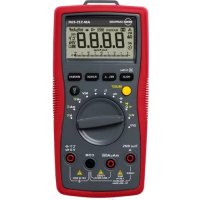
AM535 - Multimeter FLUKE - Free user manual and instructions
Find the device manual for free AM535 FLUKE in PDF.



| Product type | Digital multimeter |
| Brand | Fluke |
| Model | AM535 |
| Display | Backlit LCD 4000 counts with analog bar graph (41 segments) |
| Safety category | CAT III 600 V, double insulation |
| Measurements | AC/DC voltage up to 600 V, AC/DC current up to 20 A, resistance, capacitance, frequency, temperature, diode test, continuity beep |
| Non-contact voltage detection (NCV) | Yes, ≥90 V AC, distance ≤8 mm |
| Integrated flashlight | Yes |
| Range mode | Auto and manual |
| Special functions | Data hold (HOLD), MAX/MIN memory, relative zero (REL), backlight, auto power off (15 min) |
| Power supply | 1 9 V battery (6F22 or equivalent) |
| Weight | Approximately 354 g (with battery) |
| Operating temperature | 0°C to 40°C |
| Relative humidity | ≤75% at 30°C, ≤50% at 40°C |
| Fuses | F1 0.5 A H 1000 V (6.3x32 mm) for mA/µA; F2 11 A H 1000 V (10x38 mm) for 10 A |
| Maintenance and cleaning | Clean with a soft cloth and mild detergent solution; do not use solvents |
Frequently Asked Questions - AM535 FLUKE
User questions about AM535 FLUKE
0 question about this device. Answer the ones you know or ask your own.
Ask a new question about this device
Download the instructions for your Multimeter in PDF format for free! Find your manual AM535 - FLUKE and take your electronic device back in hand. On this page are published all the documents necessary for the use of your device. AM535 by FLUKE.
USER MANUAL AM535 FLUKE
AM-535-EUR Digital Multimeter
User Manual
Mode d'emploi
Bedienungshandbuch
Manuale d'uso
- Manual de uso
- Gebruikershandleiding
Podręcznik uzytkownikia
Användarhandbok
- Brukerhandbok
Käyttoohje
- Manual do utiliser
Brugervejledning
AM-535-EUR Digital Multimeter
User Manual
Limited Warranty and Limitation of Liability
Your Amprobe product will be free from defects in material and workmanship for one year from the date of purchase unless local laws require otherwise. This warranty does not cover fuses, disposable batteries or damage from accident, neglect, misuse, alteration, contamination, or abnormal conditions of operation or handling. Resellers are not authorized to extend any other warranty on the behalf of Amprobe. To obtain service during the warranty period, return the product with proof of purchase to an authorized Amprobe Service Center or to an Amprobe dealer or distributor. See Repair Section for details. THIS WARRANTY IS YOUR ONLY REMEDY. ALL OTHER WARRANTYES - WHETHER EXPRESS, IMPLIED OR STATUTORY - INCLUDING IMPLIED WARRANTYES OF FITNESS FOR A PARTICULAR PURPOSE OR MERCHANTABILITY, ARE HEREBY DISCLAIMED. MANUFACTURER SHALL NOT BE LIABLE FOR ANY SPECIAL, INDIRECT, INCIDENTAL OR CONSEQUENTIAL DAMAGES OR LOSSES, ARISING FROM ANY CAUSE OR THEORY. Since some states or countries do not allow the exclusion or limitation of an implied warranty or of incidental or consequential damages, this limitation of liability may not apply to you.
Repair
All Amprobe returned for warranty or non-warranty repair or for calibration should be accompanied by the following: your name, company's name, address, telephone number, and proof of purchase. Additionally, please include a brief description of the problem or the service requested and include the test leads with the meter. Non-warranty repair or replacement charges should be remitted in the form of a check, a money order, credit card with expiration date, or a purchase order made payable to Amprobe.
In-warranty Repairs and Replacement - All Countries
Please read the warranty statement and check your battery before requesting repair. During the warranty period, any defective test tool can be returned to your Amprobe distributor for an exchange for the same or like product. Please check the "Where to Buy" section on www.Amprobe.com for a list of distributors near you. Additionally, in the United States and Canada, in-warranty repair and replacement units can also be sent to an Amprobe Service Center (see address below).
Non-warranty Repairs and Replacement - United States and Canada
Non-warranty repairs in the United States and Canada should be sent to an Amprobe Service Center. Call Amprobe or inquire at your point of purchase for current repair and replacement rates.
USA: Canada:
Amprobe Amprobe
Everett, WA 98203 Mississauga, ON L4Z 1X9
Tel: 877-AMPROBE (267-7623) Tel: 905-890-7600
Non-warranty Repairs and Replacement - Europe
European non-warranty units can be replaced by your Amprobe distributor for a nominal charge. Please check the "Where to Buy" section on www.Beha-Amprobe.com for a list of distributors near you.
Amprobe Europe*
Beha-Amprobe
In den Engematten 14
79286 Glottertal, Germany
Tel.: +49 (0) 7684 8009 - 0
www.Beha-Amprobe.com
*Correspondence only - no repair or replacement available from this address. European customers please contact your distributor.)
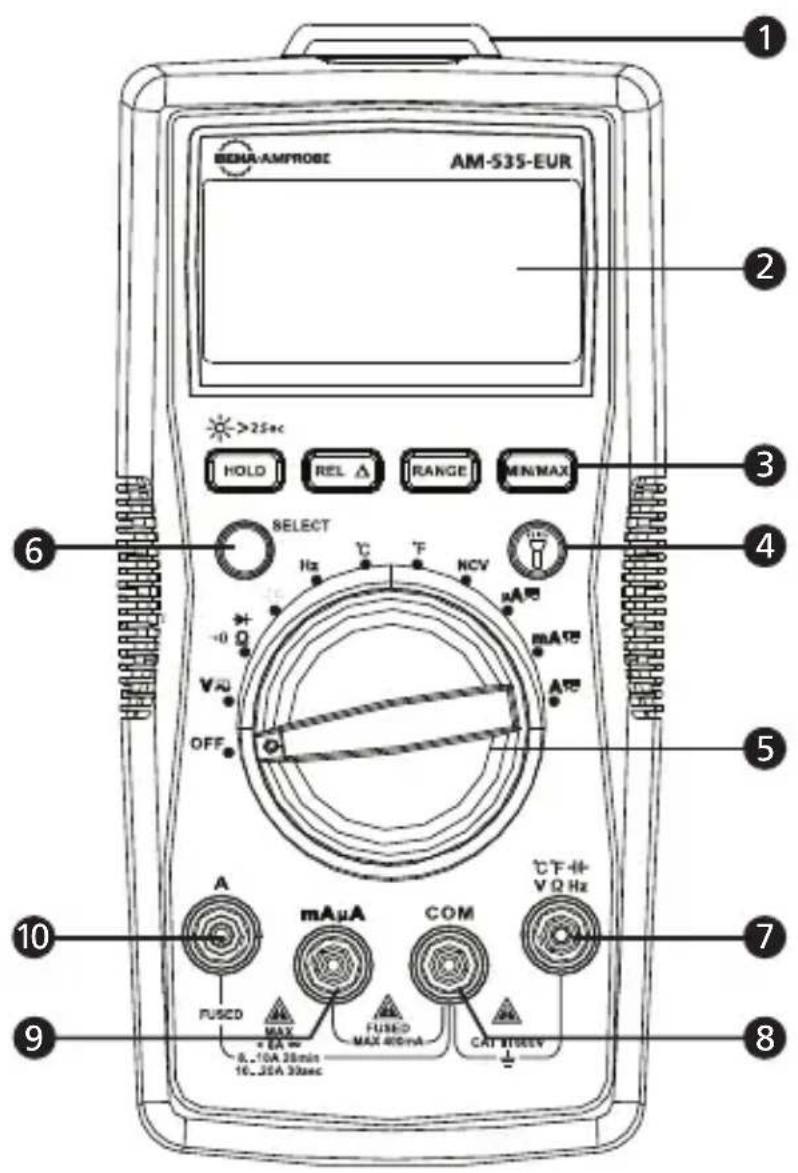
1 Flash light
4 Flash light Button
LC Display
5 Rotary Switch
3 Function Buttons
6 SELECT Button
Input Terminal for voltage, diode, capacitance, Resistance, continuity and temperature measurement
COM (return) terminal for all measurements
9 Input Terminal for AC/DC mA/uA measurement
10 Input Terminal for AC/DC A measurement up to 20A
Screen Display
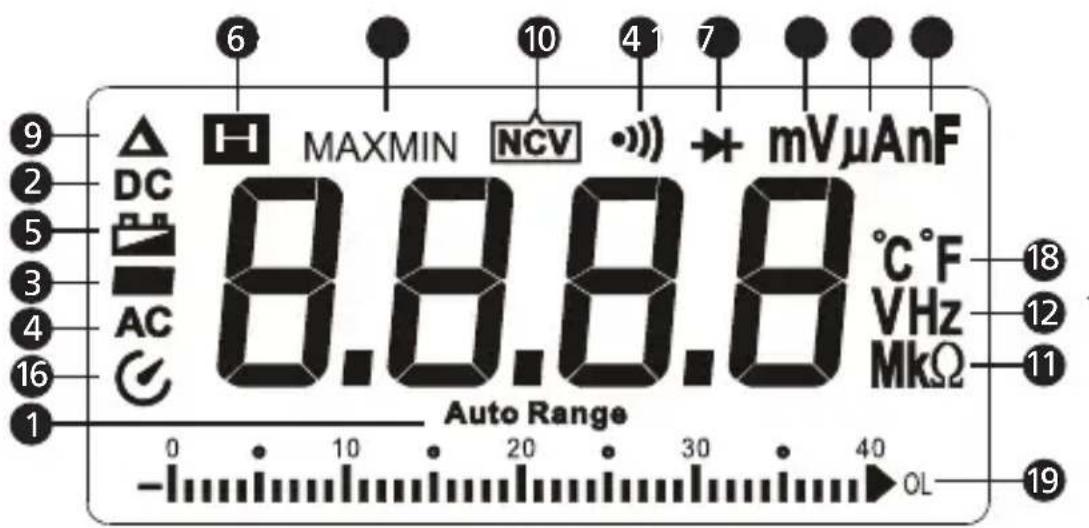
The Meter selects the range with best resolution
2 Direct Current
Negative reading
Alternate Current
Low battery indicator
Data hold
Diode test
8 Continuity test
9 Relative zero mode
10 Non-Contact Voltage
Measurement units for Resistance
Measurement units for Frequency
Measurement units for Voltage
Measurement units for Current
Measurement units for Capacitance
16 Auto Power Off
17 Maximum / minimum reading memory
Measurement unit for Temperature
19 Analog bar graph display
CONTENTS
SYMBOL 2
SAFETY INFORMATION 2
UNPACKING AND INSPECTION 3
FEATURES 4
MAKING MEASUREMENT 5
Measuring AC and DC Voltage. 6
Measuring AC and DC Current. 7
Measuring Resistance 8
Measuring Continuity 9
Measuring Diode 9
Measuring Capacitance 10
Measuring Frequency 10
Measuring Temperature ^ C / ^ F 11
Non-Contact Voltage Sensing 12
SPECIFICATION. 13
MAINTENANCE 16
BATTERY AND FUSE REPLACEMENT 17
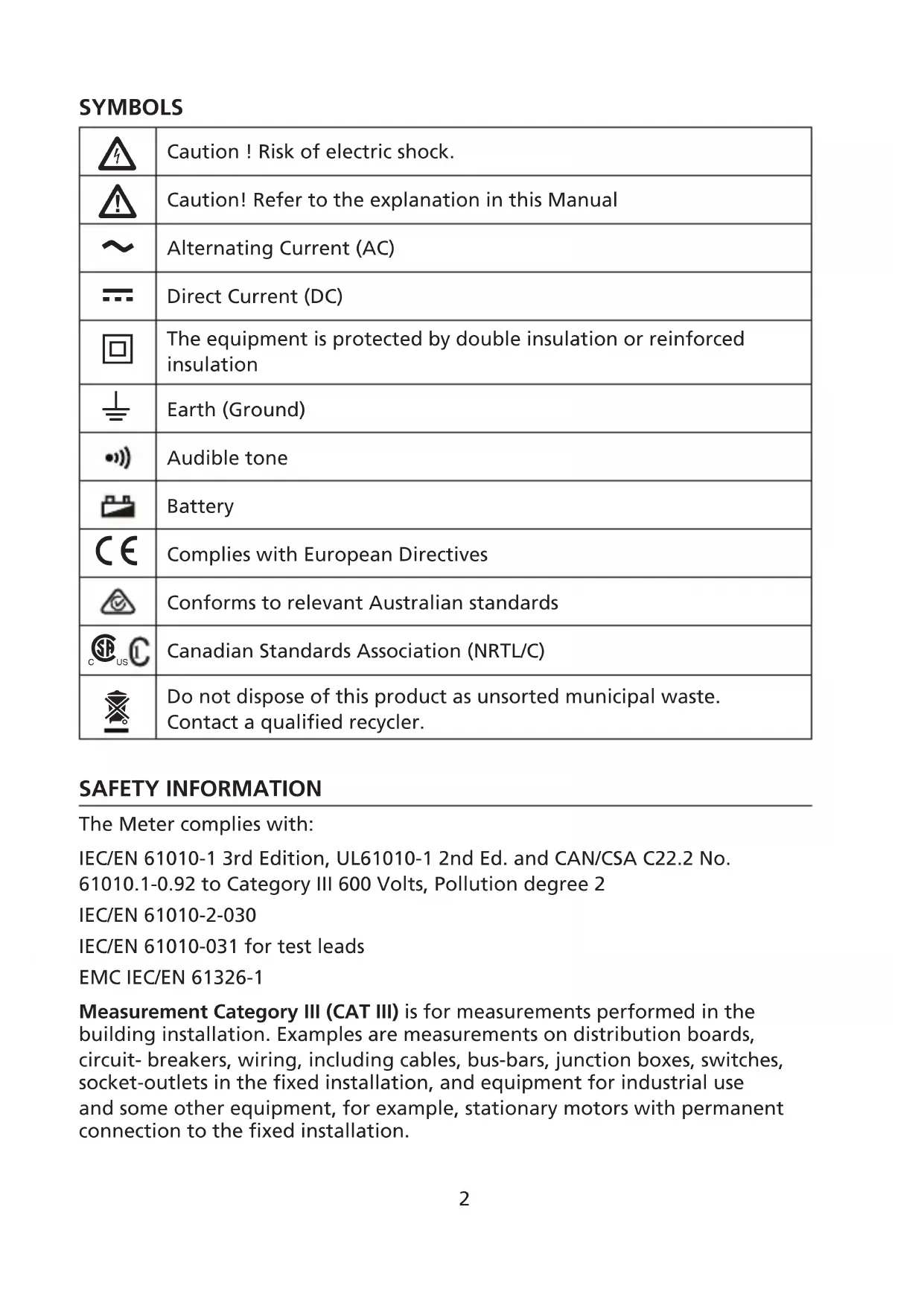
SYMBOLS
| 4 | Caution! Risk of electric shock. |
| 1 | Caution! Refer to the explanation in this Manual |
| ~ | Alternating Current (AC) |
| = | Direct Current (DC) |
| □ | The equipment is protected by double insulation or reinforced insulation |
| ⊥ | Earth (Ground) |
| ●● | Audible tone |
| Battery | |
| CE | Complies with European Directives |
| Conforms to relevant Australian standards | |
| US | Canadian Standards Association (NRTL/C) |
| × | Do not dispose of this product as unsorted municipal waste. Contact a qualified recycler. |
SAFETY INFORMATION
The Meter complies with:
IEC/EN 61010-1 3rd Edition, UL61010-1 2nd Ed. and CAN/CSA C22.2 No. 61010.1-0.92 to Category III 600 Volts, Pollution degree 2
IEC/EN 61010-2-030
IEC/EN 61010-031 for test leads
EMC IEC/EN 61326-1
Measurement Category III (CAT III) is for measurements performed in the building installation. Examples are measurements on distribution boards, circuit-breakers, wiring, including cables, bus-bars, junction boxes, switches, socket-outlets in the fixed installation, and equipment for industrial use and some other equipment, for example, stationary motors with permanent connection to the fixed installation.
Measurement Category II (CAT II) is for measurements performed on circuit directly connected to low voltage installation. Examples are measurements on household appliances, portable tools and similar equipments.
Warning: Read Before Using
- To avoid possible electrical shock or personal injury, follow these instructions and use the Meter only as specified in this manual.
- Do not use the Meter or test leads if they appear damaged, or if the Meter is not operating properly. If in doubt, have the Meter serviced.
- Always use the proper function and range for measurements.
- Before rotating the function range selection switch, disconnect test probe from circuit under test.
- Verify the Meter's operation by measuring on a known voltage source.
- Do not apply more than the rated voltage, as marked on the Meter, between the test probe or between any test probe and earth ground.
- Use the Meter with caution for voltages above 30 Vac rms, 42 Vac peak, or 60 Vdc. These voltages pose electrical shock hazards.
- Disconnect circuit power and discharge all high-voltage capacitors before testing resistance.
- Do not use the Meter around explosive gas or vapor.
- When using the test leads, keep your fingers behind the finger guards.
- Remove test leads from the Meter before opening the Meter case or battery door.
UNPACKING AND INSPECTION
Your shipping carton should include:
1 AM-535-EUR
1 Pair of test leads
1 Temperature probe
1 Velcro strap
1 9V (6F22) battery (installed)
1 User manual
1 Carrying case
If any of the items are damaged or missing, return the complete package to the place of purchase for an exchange.
AM-535-EUR is the fully-featured multimeter of choice for the professional electrical contractor. Measure and verify presence of voltage in order to connect equipment or to perform repairs, run new wiring, check continuity of electrical connections, identify blown fuses, troubleshoot motors or check transformers. The AM-535-EUR features Truerms sensing to accurately measure voltage on systems affected by harmonics, a built in flashlight to detect wire colors in the dark, a "third hand" probe holder and non-contact voltage detection. Safety rated to CAT III 600V.
- Measurements: Voltage up to 600VAC and 600VDC, AC/DC current, Resistance, Frequency, Capacitance, Temperature.
- Frequency, Capacitance, Duty Cycle for troubleshooting applications
-
Special Functions:
-
Non-contact Voltage Detection
- Audible continuity
-
Diode Test
-
Backlight LC Display with analog bar graph
Events: -
Data hold
-MAX/MINMemory - Relative zero mode
Built in work light (flashlight)
Built in test leads storage and "third hand holder"
- Auto and Manual ranging
- Auto power off
- Low battery warning
- Velcro strap to hang a meter
- Safety: CAT III 600V
MAKING MEASUREMENT
4 !
- Use the proper function and range for measurements.
-
To avoid possible electrical shock, personal injury or damages to the Meter, disconnect circuit power and discharge all high-voltage capacitors before testing resistance and diode.
-
Connecting test leads:
-
Connect the common (COM) test lead to the circuit before connecting the live lead
-
After measurement, remove live lead before removing the common (COM) test lead from the circuit
-
Symbol "OL" is displayed on LCD when the measurement is out of range.
Rotary Switch Positions
| Switch Position | Measurement Function |
| V∞ | AC or DC voltage measurement (use SELECT button for switching to AC or DC). |
| Ω | Resistance measurement |
| → | Voltage measurement of diode PN junction |
| ●) | Continuity measurement |
| +/- | Capacitance measurement |
| Hz Frequency | measurement |
| °C °F Temperature | measurement |
| NCV Non-contact voltage | |
| μA mA 源 | AC or DC current measurement (use SELECT button for switching to AC or DC). |
Function Buttons
| Button Meas | urement Function |
| SELECT | Switching AC or DC. Press the yellow SELECT button to select alternate measurement functions on the rotary switch. |
| HOLD / >2Sec | Display freezes present reading / press 2 sec to turn on LCD backlight. |
| RELΔ | Relative zero mode |
| RANGE | Manual or Auto range switching. The default setting is Auto ranging, press to switch to manual ranging (selectable resolutions). Press for 2 sec to return to auto ranging. |
| MAX/MIN Max | imum / minimum reading memory. |
| < img src=""> | Flash light |
Press enable the function when at relevant rotary switch function.
Auto Power OFF
Auto power off: approx. 15 minutes.
When the Meter is in auto power off mode, press any button to resume normal operation.
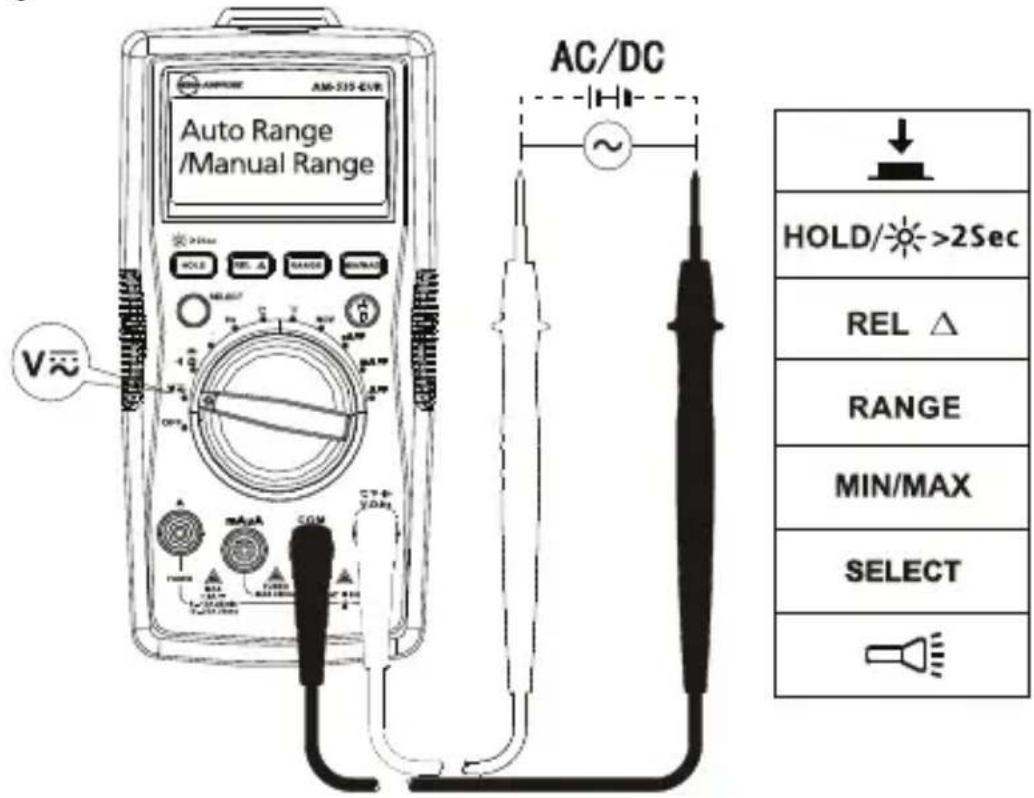
Measuring AC and DC Voltage
Press SELECT button to select AC/DC voltage measurement function.
To avoid personal injury or damage to the Meter, do not apply voltage higher than 600Vac and 600Vdc.
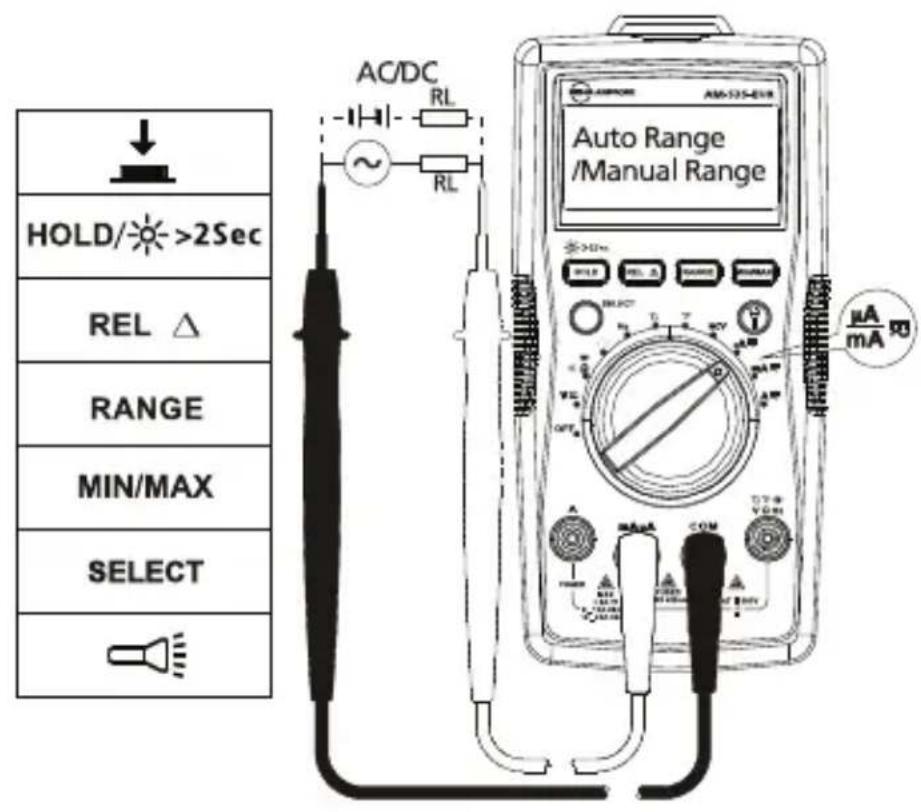
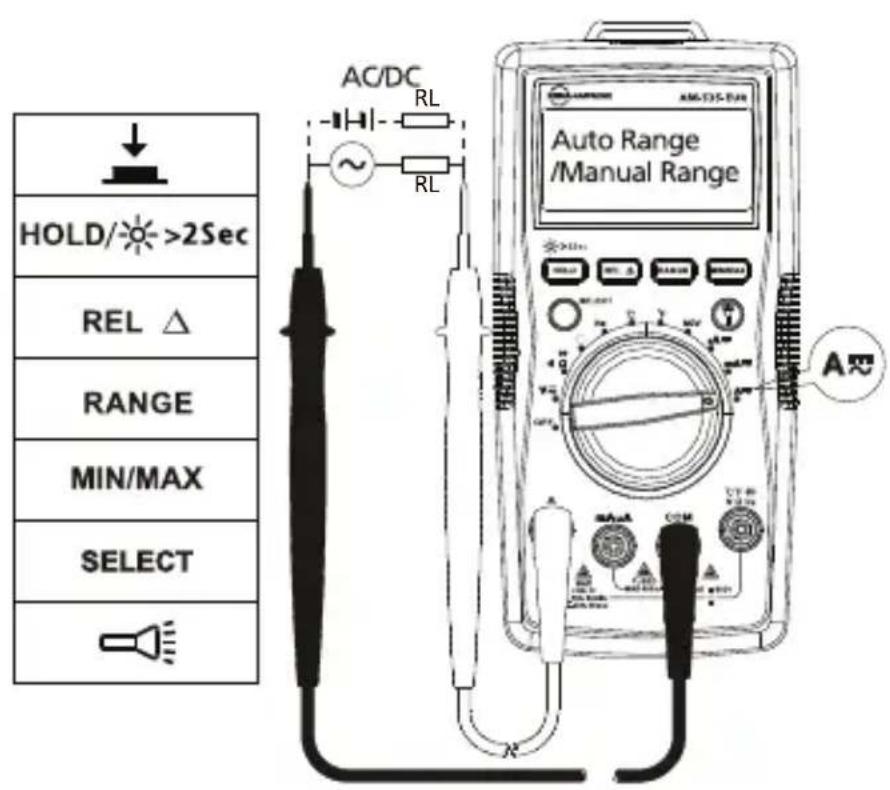
Measuring AC and DC Current
Press SELECT button to select AC or DC current measurement function.
To avoid personal injury or damage to the meter:
-
Do not attempt to make an in-circuit current measurement when the open-circuit potential to earth ground exceeding AC 600V or DC 600V
-
Switch to proper function and range for your measurement.
-
Do not place the test probe in parallel with a circuit when the test leads are connected to the current terminals.
-
Connect the test leads to the correct input A/mA A current terminal and to the circuit before powering the circuit under test.
-
For current range from 8-10A, do not measure current for more than 20 minutes. Wait for 10 minutes before taking another measurement
-
For current range from >10 - 20A , do not measure current for more than 30 seconds maximum. Wait for 10 minutes before taking another measurement
- After measurement, switching OFF the circuit's power before removing test leads from the circuit.
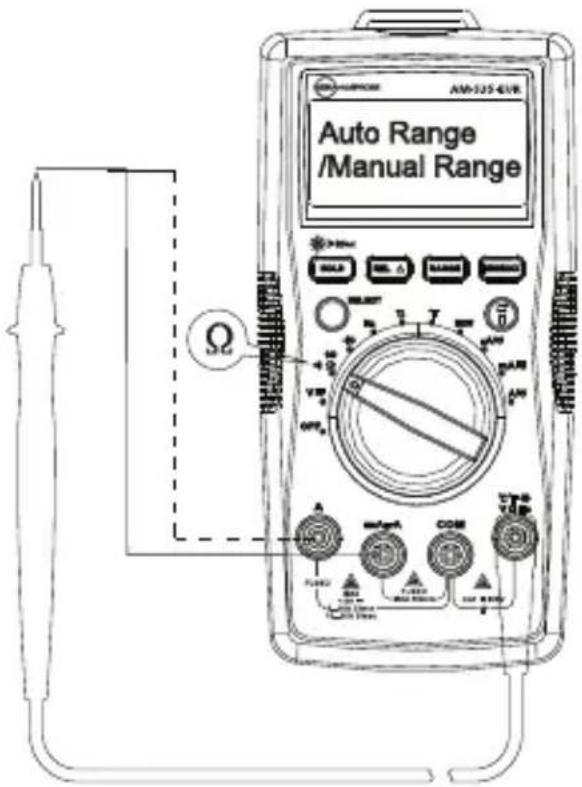
Measuring Resistance
Disconnect circuit power and discharge all high-voltage capacitors before testing resistance.

Note: On a higher resistance measurement (>1M) , the measurement may take a few seconds to get stable reading. Over range or open circuit indication: OL
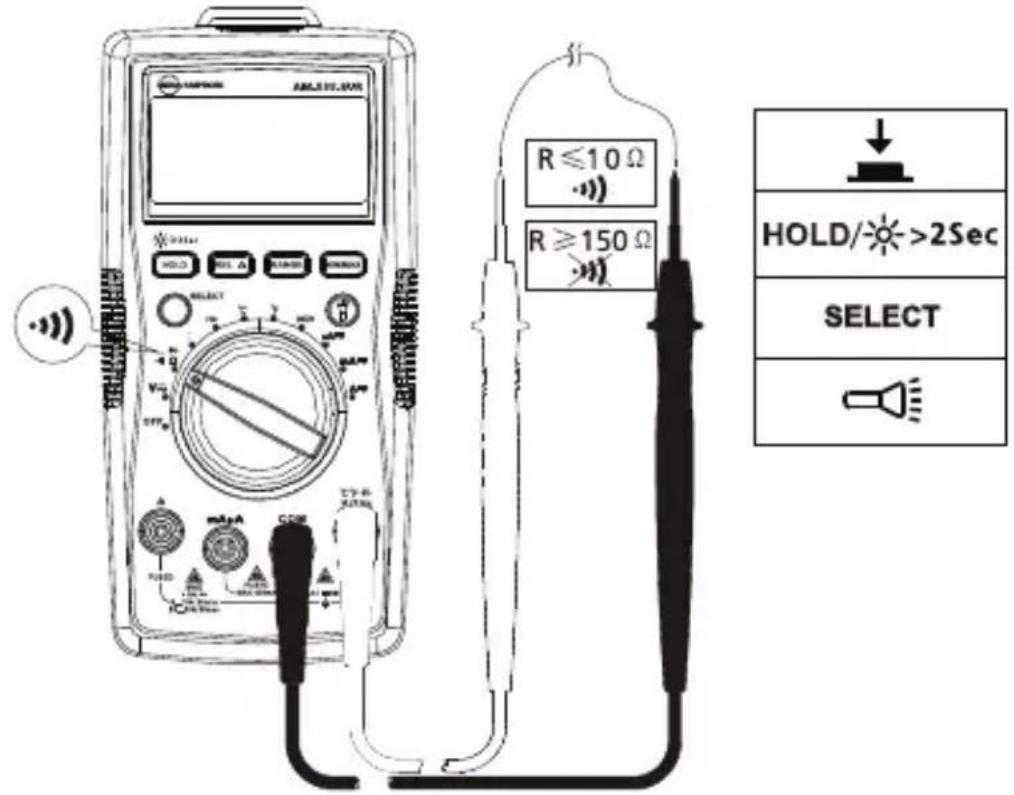
Measuring Continuity
Disconnect circuit power and discharge all high-voltage capacitors before testing continuity.
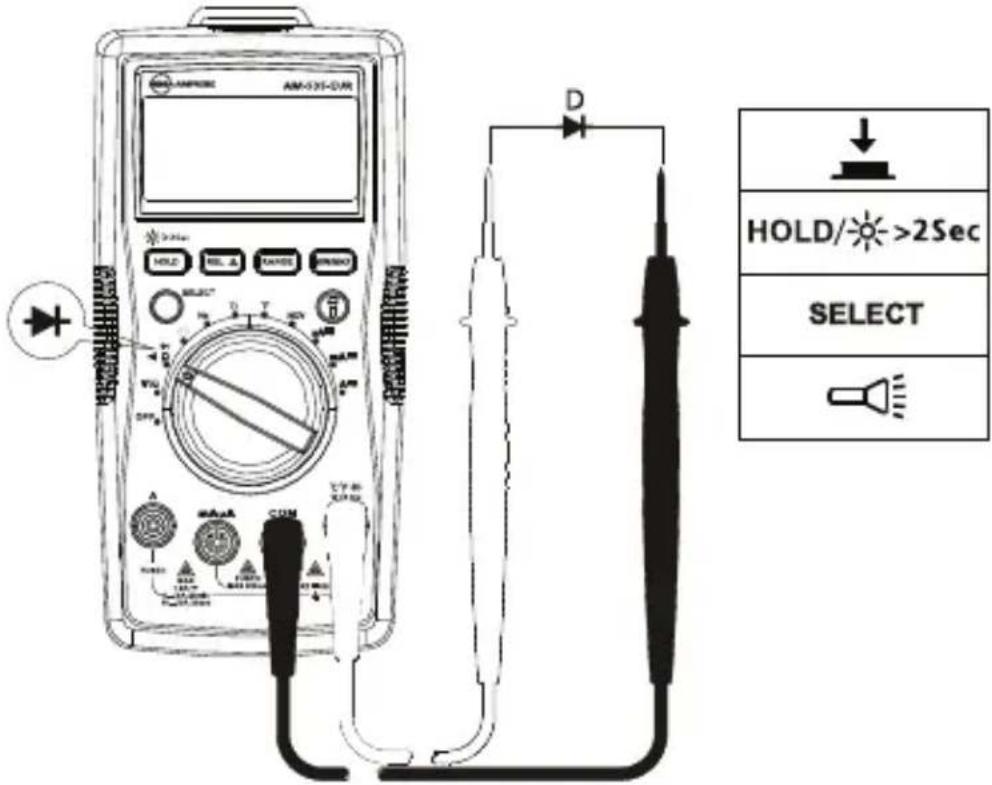
Measuring Diode
Disconnect circuit power and discharge all high-voltage capacitors before testing diode.
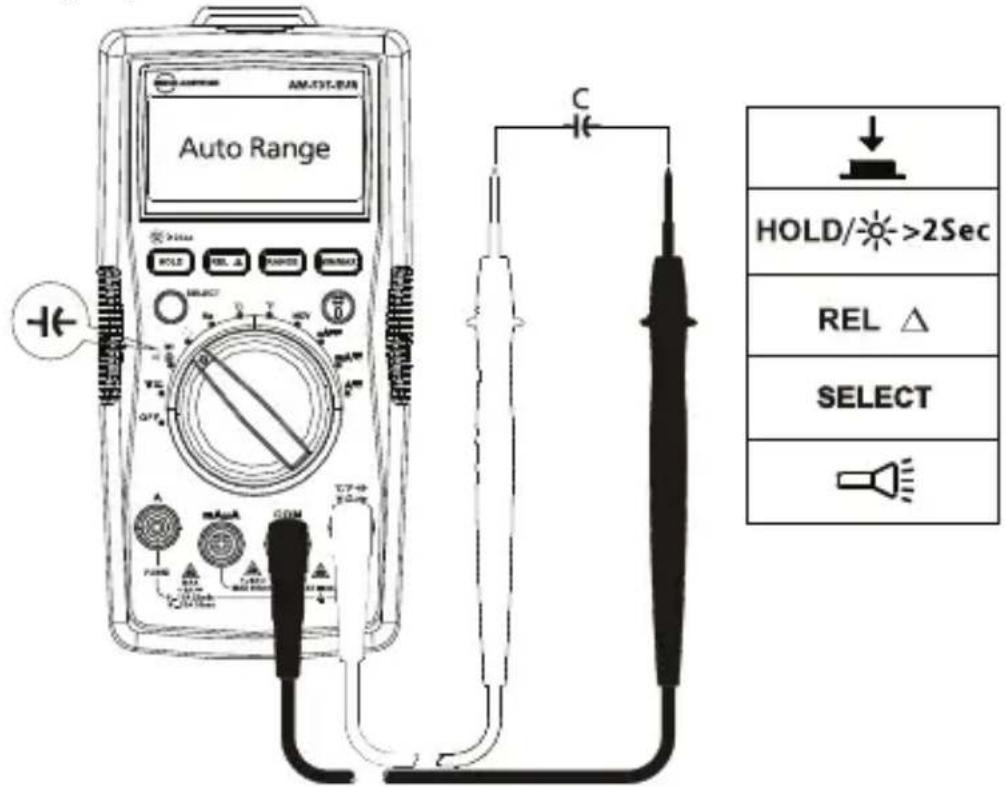
Measuring Capacitance
Disconnect circuit power and discharge all high-voltage capacitors before testing capacitance.
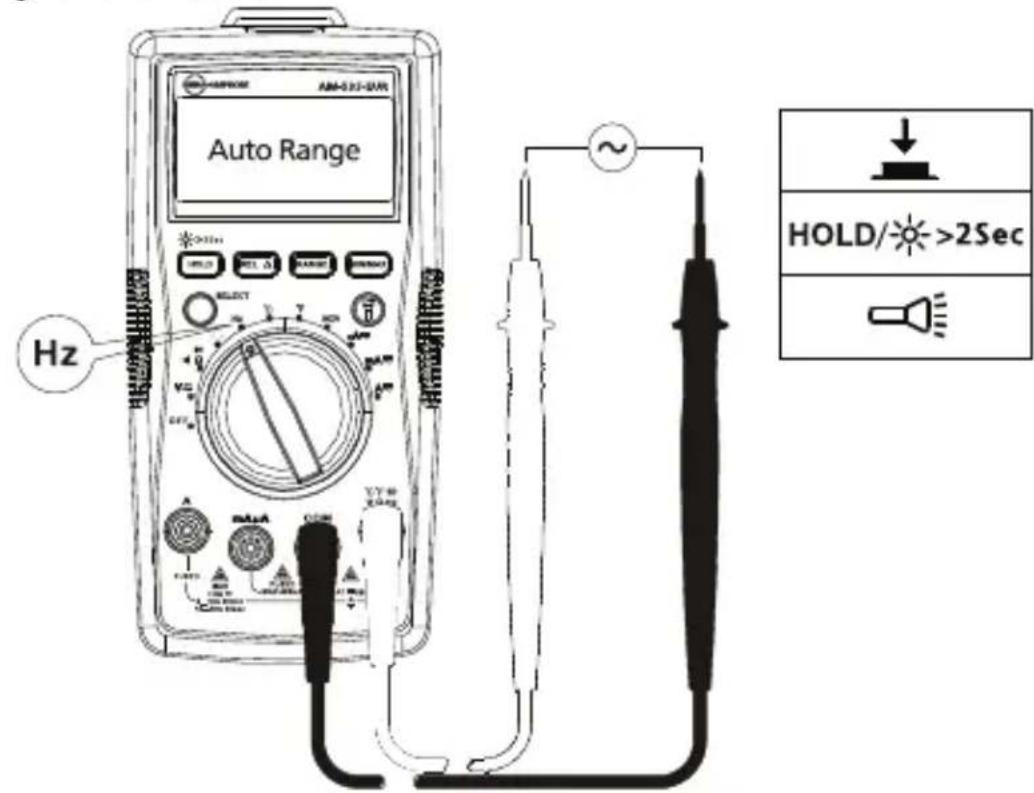
Measuring Frequency
To avoid personal injury or damage to the Meter, do not apply voltage higher than 600V.
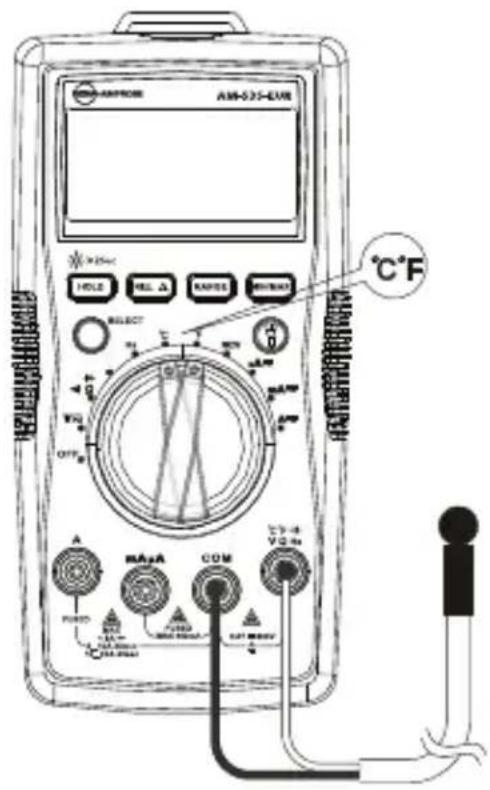
Measuring Temperature ^ C / ^ F
4 !
- To avoid personal injury or damage to the meter, do not apply the temperature probe to any live conductive parts.
- Temperature sensor K type (nickel-chromium/nichrosi) thermocouple is suitable for temperature measurement below 230^ (446^) .
Measurement steps:
Step 1: Turn the rotary switch to ^ C or ^ position. The display will show "OL".
Step 2: Connect the temperature probe (K type) to the meter and to the surface to be measured.
Non-Contact Voltage Sensing
- To avoid personal injury or damage to the meter, do not test on uninsulated wires.
- Buzzer will sound and screen will display "OL" when detecting ac Voltage above 90V ac.
- Do not test on hazardous live wires higher than AC 600V
- Before and after hazardous voltage measurements, test the Meter by approaching to a known source such as a line AC voltage or outlet to determine proper operation. See below figure.
- At NCV mode, no test lead connections are required for NCV measurement.
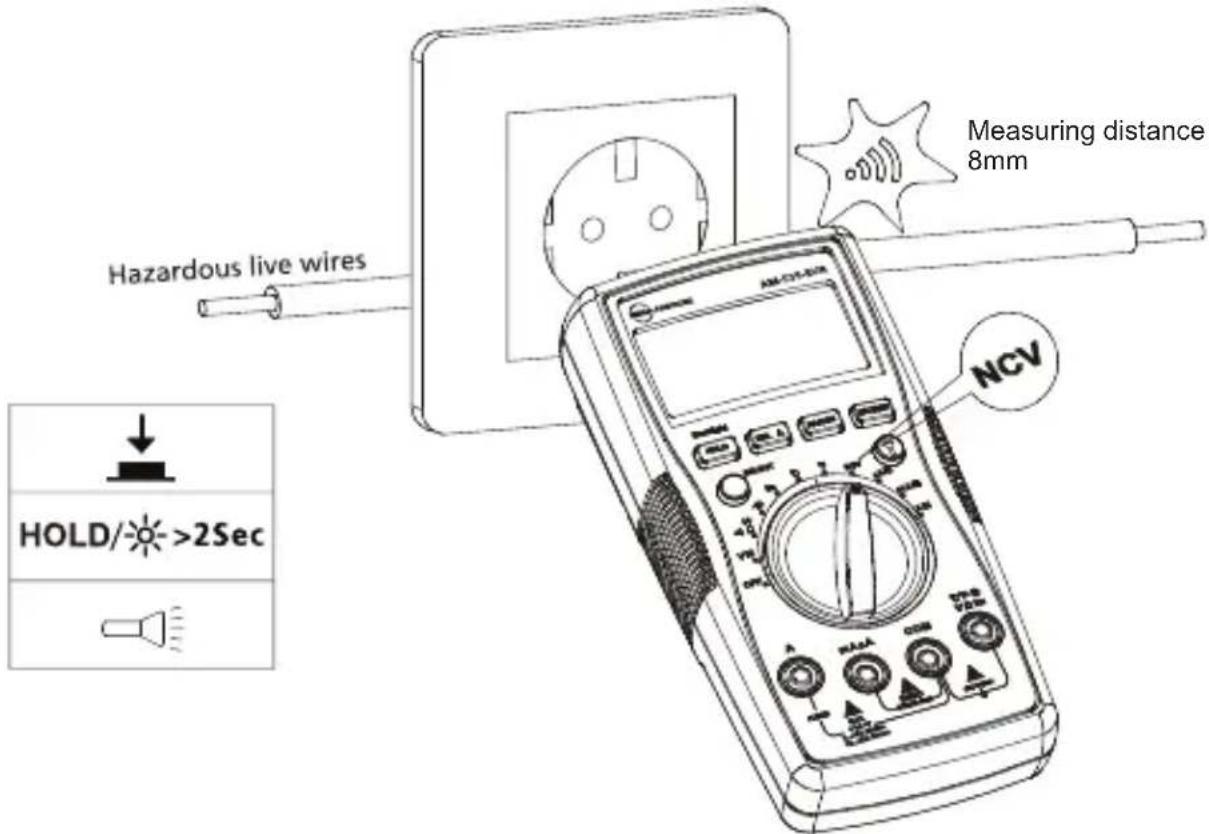
Buzzer will sound when the detected voltage is ≥ 90V , and the buzzer will be on. The distances between the wire and the meter should be ≤ 8mm .
The voltage indication in NCV mode is not sufficient to assure safety. This function is not suitable to test absence of voltage.
Ambient temperature: 73.4^ ± 9 ( 23^ ± 5^ ); Relative temperature: ≤ 75%
Accuracy: ± (% of reading ^+ digits)
Maximum voltage between input terminal and earth ground: AC 600Vrms or DC 600V
Fuse for mA μA input: F1 fuse, 0.5A H 1000V fast-fuse, (6.3x32)mm
Fuse for A input: F2 fuse, 11A H 1000V fast-fuse, (10× 38)mm
Maximum display: Digital 3999 counts, updates 3/sec. Frequency: 9999 counts.
Analog pointer display: 41 segments, updates 30 times/sec.
Over-range indication: OL
Range: Automatic and Manual
Altitude: Operating 2000m
Operating temperature: 0^ +40^ ( 32^ 104^ )
Relative humidity: 0^ +30^ (32^ 86^)≤ 75% ; + 30^ +40^ (86^ 104^)≤ 50%
Storage temperature: -10^ +50^ ( 14^ 122^ )
Electromagnetic compatibility: In an RF filed of 1V / m = Specified accuracy 5 %
Battery: 9V, 6F22, NEDA1604 or equivalent
Low battery indication:
Dimensions (L x W x H): 182 mm x 90 mm x 45 mm (7.2 in x 3.5 in x 1.8 in)
Weight: Approx. 354g (0.78lb) with batteries installed
1. DC Voltage Measurement
| Range Resolution | on Accuracy | |
| 400.0mV 0.1mV | ± (0.8%+3LSD) | |
| 4.000V 1mV | ± (0.8%+1LSD)40.00V 10mV | |
| 400.0V 100mV | ||
| 600V 1V ±(1.0%+3LSD) | ||
Input impedance: About 10M;
(Input impedance is ≤ 3G except DC 400mV range)
Overload protection: ± 600V
2. AC Voltage Measurement
| Range Resolution | Accuracy | |
| 400.0mV 0.1mV | ±(1.2%+3LSD) | |
| 4.000V 1mV | ±(1.0%+3LSD)40.00V 10mV | |
| 400.0V 100mV | ||
| 600V 1V ±(1.2%+3LSD) | ||
Note: Manual range only for 400.0mV range.
Input impedance: Around 10MΩ
Frequency response: 45Hz 400Hz
Overload protection: 600Vrms
3. Resistance Measurement
| Range Resolution | on Accuracy | |
| 400.0Ω 0.1Ω | ±(1.2%+2LSD) | |
| 4.000kΩ 1Ω | ±(1.0%+2LSD)40.00kΩ | |
| 400.0kΩ 100Ω | ||
| 4.000MΩ 1kΩ | ±(1.2%+2LSD) | |
| 40.00MΩ | 10kΩ | ±(1.5%+5LSD) |
400Ω range: Measured value = (Measured display value - Short-circuiting value of probe)
Open circuit voltage: Around 0.5V
Overload protection: 600Vrms
4. :Circuit ON/OFF Diode measurement
| Range | Resolution | Accuracy |
| ●●● | 0.1Ω | Open circuit voltage is around 0.5V. Resistance ≥150Ω, buzzer will not sound. Resistance ≤10Ω, buzzer will sound. |
| ▲+ | 1mV | Display range is 0V to 2.0V. Normal voltage is around 0.5V to 0.8V for silicon PN junction. |
Overload protection: 600V
5. Capacitance Measurement
| Range Resolution | Accuracy | |
| 40.00nF 10pF ±(3%+10LSD) under REL status | ||
| 400.0nF 100pF | ±(3%+5LSD) under REL status | |
| 4.000μF 1nF | ||
| 40.00μF 10nF ±(4%+5LSD) | ||
| 400.0μF 100nF ±(4%+5LSD) | ||
| 4000μF 1μF For reference only | ||
Overload protection: 600V
6. Frequency Measurement
| Range Resolution | Accuracy | |
| 10Hz~10MHz 0.01Hz~0.01MHz ±(0.1%)+4LSD) | ||
Overload protection: 600Vrms
7. DC Current Measurement
| Range Resolution | on Accuracy | ||
| μA | 400.0μA 0.1μA | ±(1.0%+2LSD) | |
| 4000μA 1μA | |||
| mA | 40.00mA 10μA | ||
| 400.0mA | 0.1mA | ||
| A | 4.000A 1mA | ±(1.2%+3LSD) | |
| 20.00A [1,2,3] | 10mA | ||
| Function | Overload Protection | Overload |
| mA /μA | F1 fuse, 0.5A H 1000V fast-fuse, (6.3×32)mm | N/A |
| A | F2 fuse, 11A H 1000V fast-fuse, (10×38)mm | 20 A overload for 30 seconds maximum, 10 minutes off minimum |
[1] 8 to 10 A up to 20 minutes, 10 minutes off minimum.
[2] >10 to 20 A overload for 30 seconds maximum, 10 minutes off minimum
[3] >10 to 20 A for 30 seconds accuracy ± (2.0% +3LSD)
- AC Current Measurement
| Range Resolution Accuracy | |||
| μA | 400.0μA[4] | 0.1μA | ±(1.2%+3LSD) |
| 4000μA[4] | 1μA | ||
| mA | 40.00mA[4] | 10μA | |
| 400.0mA[4] | 0.1mA | ||
| A | 4.000A[4] | 1mA | ±(1.5%+3LSD) |
| 20.00A[1,2,3,4] | 10mA | ||
| Function | Overload Protection Overload | |
| mA /μA | F1 fuse, 0.5A H 1000V fast-fuse, (6.3×32)mm | N/A |
| A | F2 fuse, 11A H 1000V fast-fuse, (10×38)mm | 20 A overload for 30 seconds maximum, 10 minutes off minimum |
[1] 8 to 10A up to 20 minutes, 10 minutes off minimum.
[2] >10 to 20 A overload for 30 seconds maximum, 10 minutes off minimum
[3] > 10 to 20 A for 30 seconds accuracy ±(4%+5LSD).
[4] Frequency response: 45Hz 400Hz
- Temperature Measurement
| Range Resolution | Accuracy | |
| -40 - 0°C | 0.1°C @ < 400°C 1°C @ ≥ 400°C 5%+2 LSD) | ±(10%+4 LSD) |
| >0 - 100°C ±(1.2%+3 LSD) | ||
| >100 - 1000°C ±(2.5%+2 LSD) | ||
| -40 - 32°F | 0.1°F @ < 752°F 1°F @ ≥ 752°F | ±(20%+6 LSD) |
| >32 - 212°F ±(1.8 | ||
| >212 - 1832°F ±(2.5%+4 LSD) |
Overload protection: 600V
K type (nickel-chromium/nichrosi) thermocouple must be used for temperature measurement.
If the meter fails to operate, check battery, test leads, other accessories, and replace as necessary.
Double check the followings:
- Replace the fuse or battery if the meter does not work.
- Review the operating instructions for possible mistakes in operating procedure.
Quick check on 0.5A FUSE:
Step 1: Turn the rotary switch to function.
Step 2: short-circuit +V / /Hz terminal and mA/μA terminal.
Resistance reading ≤ 1M : the fuse is OK
Resistance reading "OL": the fuse is open. Replace the fuse as specified.
Quick check on 10A FUSE:
Step 1: Turn the rotary switch to function.
Step 2: short-circuit + / V / /Hz terminal and A terminal.
Resistance reading ≤ 0.5 : the fuse is OK.
Resistance reading "OL": the fuse is open. Replace the fuse as specified.
| mA μA | ||
| ≤1M | ☐ | OK |
| OL | …… | ⑧ |
| A | ||
| ≤0.5Ω | ←→ | OK |
| OL | -←→ | @K |
Except for the replacement of the battery, repair of the meter should be performed only by a Factory Authorized Service Center or by other qualified instrument service personnel.
The front panel and case can be cleaned with a mild solution of detergent and water. Apply sparingly with a soft cloth and allow to dry completely before using. Do not use aromatic hydrocarbons, Gasoline or chlorinated solvents for cleaning.
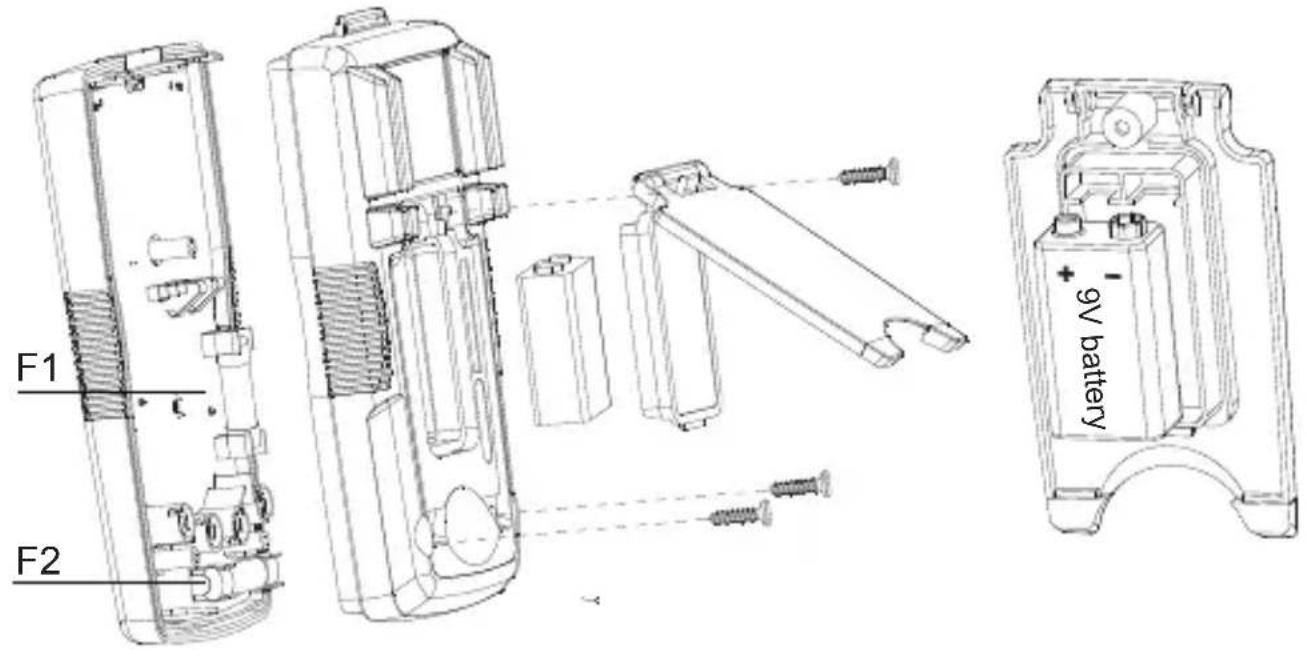
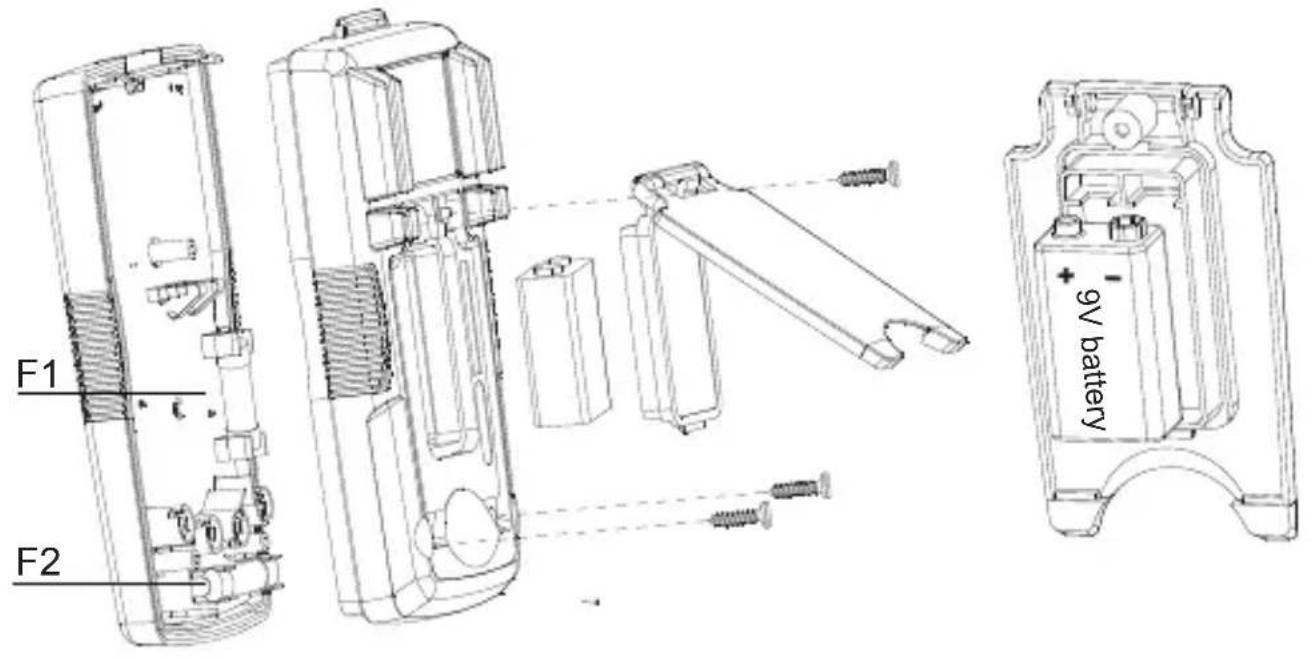
BATTERY AND FUSE REPLACEMENT
WARNING
To avoid shock, injury, or damage to the meter: Disconnect test leads before opening case. Use ONLY fuses with the amperage, interrupt, voltage, and speed ratings specified.
Replacing BATTERY follow below steps:
- Disconnect the test lead probe from measuring circuit.
- Turn the meter to OFF position.
- Remove the screws from the battery cover and open the battery cover
- Remove the batteries and replace with one 9V (6F22) or equivalent. The battery cover provides the correct polarity fitting construction design. Install the battery in the battery cover.
- Put the battery cover back and re-fasten the screw.
Battery: 9V (6F22) battery or equivalent
Replacing FUSE follow below steps:
- Disconnect the test lead probe from measuring circuit.
- Turn the meter to OFF position.
- Remove the screws from the enclosure and open the enclosure.
- Remove the broken fuse and replace with new specified fuse.
- Put the enclosure back and re-fasten the screw.
Fuse ratings:
mA /μA input terminal: F1 fuse, 0.5A H 1000V fast-fuse, (6.3×32)mm
10 A input terminal: F2 fuse, 11A H 1000V fast-fuse, (Φ10×38)mm
©2015 Amprobe Test Tools.
| A | ||
| ≤0.5Ω | ←→ | OK |
| OL | ←→- | OK |
| A | ||
| ≤0.5Ω | ←→ | OK |
| OL | ←--- | OK |
©2015 Amprobe Test Tools.
IEC/EN 61010-1 3rd Edition, UL61010-1 2nd Ed. e CAN/CSA C22.2
| A | ||
| ≤0.5Ω | ←→ | OK |
| OL | -←→ | @K |
©2015 Amprobe Test Tools.
©2015 Amprobe Test Tools.
©2015 Amprobe Test Tools.
©2015 Amprobe Test Tools.
Indikation for over omrade: OL
| A | ||
| ≤0.5Ω | ←→ | OK |
| OL | -←→ | @K |
©2015 Amprobe Test Tools.
Med enerett. Trykt i Kina
Begrenset garanti og ansvarsbegrensning
Amprobe-produktet skal vare uten defekter i materiale og utforelse i ett ar fra kjopsdatoen med minre lokale lover krever noe annet. Denne garantien dekker icke sikringer, engangsbatterier erer skader som skyldes uhell, vanskjotsel, misbruk, endring, forurensning, ell er unormale driftsforhold ell handtering. Forhandlere har icke rett til a forlenge garantier pa vegne av Amprobe. For a f service i garantiperioden ma du returnere produktet med kjopsbevis til et autorisert Amprobe-servicesenter erer til en Amprobe-forhandler erer -distributor. Se avsnittet Reparasjon for mer informasjon. DENNE GARANTIEN ER DITT ENESTE RETTSMIDDEL. ALLE ANDRE GARANTIER -ENTEN direkTE, INDIREKTE ELLER LOVBESTEMTE - INKLUDERT UNDERFORSTATTE GARANTIER OM EGNETHET FOR ET SPESIELT FORMAL ELLER SALGBARHET, FRASKRIVES HERVED. PRODUSENTEN SKAL IKKE VARE ANSVARLIG FOR SPESIELLE, INDIREKTE, TILFELDIGE SKADER ELLER FOLGESKADER ELLER TAP, UANSETT ARSAK ELLER TEORI. Siden noen stater erler land icke tillater fraskrivelse erer begrensning av en garanti erer av tilfeldige skader erer folgeskader, er det mulig at denne ansvarsbegrensningen icke gjelder for deg.
Reparasjon
| A | ||
| ≤0.5Ω | ←→ | OK |
| OL | ←←→ | @ |
©2015 Amprobe Test Tools.
| A | ||
| ≤0.5Ω | ←→ | OK |
| OL | ←--- | OK |
©2015 Amprobe Test Tools.
| A | ||
| ≤0.5Ω | ←→ | OK |
| OL | -←→ | OK |
©2015 Amprobe Test Tools.
Allerettigheder forbeholds. Trykt i Kina
| A | ||
| ≤0.5Ω | ←→ | OK |
| OL | ←→ | OK |
Specificationer for sikring:
mA/μA indgangsterminal: F1 sikring, 0,5 A H 1000 V hurtig sikring, ( ,3× 32) mm
10 A indgangsterminal: F2 sikring, 11 A H 1000 V hurtig sikring, (40 × 38) mm
Visit www.Beha-Amprobe.com for
- Catalog
Application notes
Product specifications - User manuals
Amprobe® Europe
Beha-Amprobe
In den Engematten 14
79286 Glottertal, Germany
Tel.: +49 (0) 7684 8009 - 0

Please
Recycle