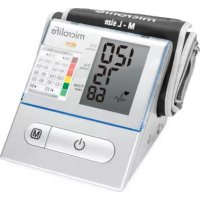
BP A10030 - Sphygmomanometer MICROLIFE - Free user manual and instructions
Find the device manual for free BP A10030 MICROLIFE in PDF.

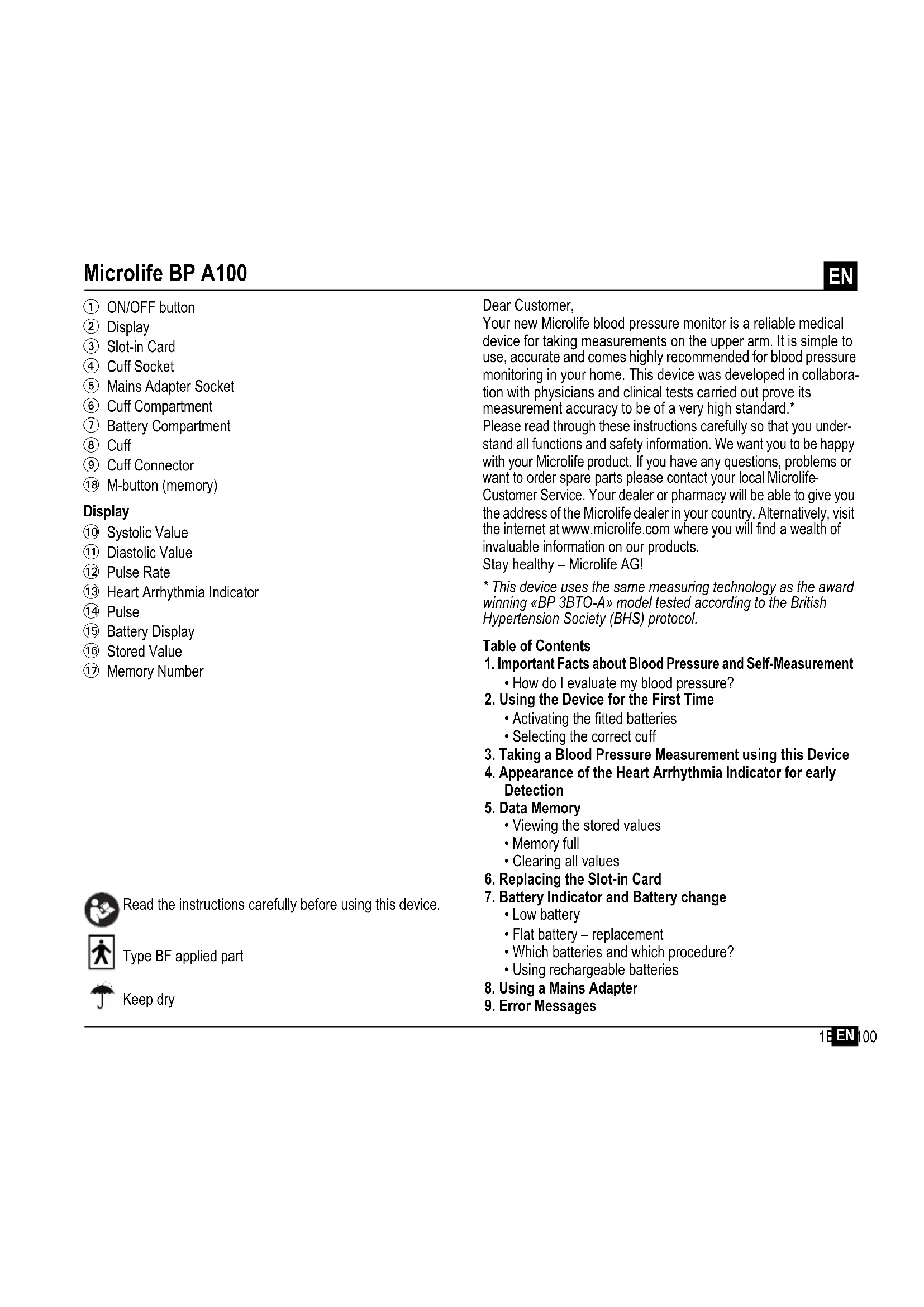


| Product type | Automatic upper arm blood pressure monitor |
| Brand | Microlife |
| Model | BP A10030 |
| Power supply | 4 AA 1.5V alkaline batteries; optional DC 6V 600mA power adapter |
| Battery life | About 920 measurements with new batteries |
| Measurement method | Oscillometric |
| Blood pressure measurement range | 20 - 280 mmHg |
| Pulse measurement range | 40 - 200 beats/min |
| Blood pressure accuracy | ± 3 mmHg |
| Pulse accuracy | ± 5% of the reading |
| Memory | 30 results |
| Arrhythmia indicator | Yes |
| Available cuff sizes | S (17-22 cm), M (22-32 cm), L (32-42 cm) |
| Operating conditions | 10 - 40 °C, relative humidity 15 - 95% |
| Storage conditions | -20 - +55 °C, relative humidity 15 - 95% |
| Maintenance | Clean with a dry, soft cloth; cuff cover machine washable at 30 °C |
| Safety | Do not open the device; keep more than 1 meter away from mobile phones or radio equipment |
| Spare parts / accessories | Cuffs of different sizes, Microlife power adapter |
| Warranty | 5 years (excluding batteries, cuff, and consumable parts) |
| Reparability | Have the accuracy checked every 2 years or after a drop; contact Microlife service |
| Standards | EN 1060-1/-3/-4; IEC 60601-1; IEC 60601-1-2; IEC 60601-1-11 |
| IP class | IP20 |
Frequently Asked Questions - BP A10030 MICROLIFE
User questions about BP A10030 MICROLIFE
0 question about this device. Answer the ones you know or ask your own.
Ask a new question about this device
Download the instructions for your Sphygmomanometer in PDF format for free! Find your manual BP A10030 - MICROLIFE and take your electronic device back in hand. On this page are published all the documents necessary for the use of your device. BP A10030 by MICROLIFE.
USER MANUAL BP A10030 MICROLIFE
Europe / Middle-East / Africa
Microlite AG
Espenstrasse 139
9443 Winneau / Switzerland
Tel.+41/71/23/030
Fax-41/71/27/039
Email admin@microlife.ch
www.ni-----life.com
Asia
Microlide Corporation.
9F, 431, RuiGang Road, NaiHu
Taipei, 114, Taiwan, R.O.C.
Tel. +B86 2 B797-1288
Fax -B86 2 E797-1283
Email service@microlife.com.tw
www.micralife.com
North / Central / South America
Micralia USA, Inc
1617 Gulf to Bay Blvd., 2nd Floor Ste A
Clearwater, FL 33755 / USA
1cl.+1 727 442 5363
Fax-1 727 442 5377
Email msa@microlifeusa.com
www.microlife.com
C€0044

Microlife BP A100
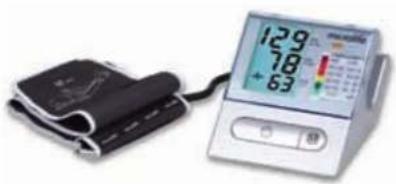
microlife
1BB A102-30V17-1 5215
Microlife BP A100
![graph TD A["Device 1: 100%"] --> B["Device 2: 75%"] A --> C["Device 3: 60%"] A --> D["Device 4: 50%"] A --> E["Device 5: 40%"] A --> F["Device 6: 30%"] A --> G["Device 7: 20%"] A --> H["Device 8: 10%"] A --> I["Device 9: 5%"] A --> J["Device 10: 0%"]](/content/2026/03/457992/images/2da7e14f1d2c75061aa0eb9ff75f0fabb48acce2f118868adfbee2b5c13b5df2.jpg)
microlife
Guarantee Card BP A100
Name of Purchaser / Nom de l'achetsur / Nombre del comprador / Nome do comprador / Name des Kälfers / Ф.И.О. покупателя / Imię i nazwisko nabywycy / Väsárto neve / Име на купувача / Numele cumpäratorului / Jméno kupujícího / Meno zákaznika / Ime in primek kupca / Alicinn Adi / Оворотмінуvu оворотні
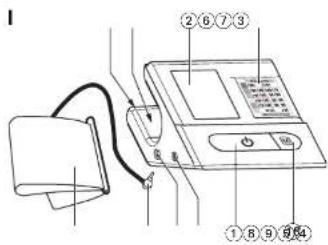
① ON/OFF button
② Display
③ Slot-in Card
④ Cuff Socket
⑤ Mains Adapter Socket
⑥ Cuff Compartment
⑦ Battery Compartment
⑧ Cuff
⑨ Cuff Connector
⑱ M-button (memory)
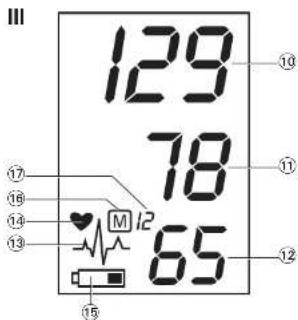
Display
⑩ Systolic Value
⑪ Diastolic Value
⑫ Pulse Rate
⑬ Heart Arrhythmia Indicator
⑭ Pulse
⑮ Battery Display
⑯ Stored Value
⑰ Memory Number

Read the instructions carefully before using this device.

Type BF applied part

Keep dry
Dear Customer,
Your new Microlife blood pressure monitor is a reliable medical device for taking measurements on the upper arm. It is simple to use, accurate and comes highly recommended for blood pressure monitoring in your home. This device was developed in collaboration with physicians and clinical tests carried out prove its measurement accuracy to be of a very high standard.*
Please read through these instructions carefully so that you understand all functions and safety information. We want you to be happy with your Microlife product. If you have any questions, problems or want to order spare parts please contact your local Microlife-Customer Service. Your dealer or pharmacy will be able to give you the address of the Microlife dealer in your country. Alternatively, visit the internet at www.microlife.com where you will find a wealth of invaluable information on our products.
Stay healthy – Microlife AG!
* This device uses the same measuring technology as the award winning «BP 3BTO-A» model tested according to the British Hypertension Society (BHS) protocol.
Table of Contents
- Important Facts about Blood Pressure and Self-Measurement
• How do I evaluate my blood pressure?
-
Using the Device for the First Time
-
Activating the fitted batteries
-
Selecting the correct cuff
-
Taking a Blood Pressure Measurement using this Device
- Appearance of the Heart Arrhythmia Indicator for early Detection
- Data Memory
• Viewing the stored values
- Memory full
- Clearing all values
-
Replacing the Slot-in Card
-
Battery Indicator and Battery change
-
Low battery
- Flat battery – replacement
-
Which batteries and which procedure?
• Using rechargeable batteries -
Using a Mains Adapter
-
Error Messages
10. Safety, Care, Accuracy Test and Disposal
- Safety and protection
- Device care
- Cleaning the cuff
- Accuracy test
- Disposal
11. Guarantee
12. Technical Specifications
Guarantee Card (see Back Cover)
1. Important Facts about Blood Pressure and Self-Measurement
- Blood pressure is the pressure of the blood flowing in the arteries generated by the pumping of the heart. Two values, the systolic (upper) value and the diastolic (lower) value, are always measured.
- The device indicates the pulse rate (the number of times the heart beats in a minute).
- Permanently high blood pressure values can damage your health and must be treated by your doctor!
- Always discuss your values with your doctor and tell him/her if you have noticed anything unusual or feel unsure. Never rely on single blood pressure readings.
- Enter your readings in the enclosed blood pressure diary. This will give your doctor a quick overview.
- There are many causes of excessively high blood pressure values. Your doctor will explain them in more detail and offer treatment where appropriate. Besides medication, relaxation techniques, weight loss and exercise can also lower your blood pressure.
- Under no circumstances should you alter the dosages of any drugs prescribed by your doctor!
- Depending on physical exertion and condition, blood pressure is subject to wide fluctuations as the day progresses. You should therefore take your measurements in the same quiet conditions and when you feel relaxed! Take at least two measurements per day, one in the morning and one in the evening.
- It is quite normal for two measurements taken in quick succession to produce significantly different results.
- Deviations between measurements taken by your doctor or in the pharmacy and those taken at home are quite normal, as these situations are completely different.
-
Several measurements provide a much clearer picture than just one single measurement.
-
Leave a small break of at least 15 seconds between two measurements.
- If you are pregnant, you should monitor your blood pressure very closely as it can change drastically during this time!
- If you suffer from an irregular heartbeat (arrhythmia, see «Section 4.»), measurements taken with this device should only be evaluated after consultation with your doctor.
- The pulse display is not suitable for checking the frequency of heart pacemakers!
How do I evaluate my blood pressure?
Table for classifying blood pressure values in adults in accordance with the World Health Organisation (WHO) in 2003. Data in mmHg.
| Range Systolic Diastolic | Recommendation | |||
| blood pressure too low | 100 | 60 | Consult your doctor | |
| 1. | blood pressure optimum | 100 - 120 | 60 - 80 | Self-check |
| 2. | blood pressure normal | 120 - 130 | 80 - 85 | Self-check |
| 3. | blood pressure slightly high | 130 - 140 | 85 - 90 | Consult your doctor |
| 4. | blood pressure too high | 140 - 160 | 90 - 100 | Seek medical advice |
| 5. | blood pressure far too high | 160 - 180 | 100 - 110 | Seek medical advice |
| 6. | blood pressure dangerously high | 180 | 110 | Urgently seek medical advice! |
The higher value is the one that determines the evaluation.
Example: a readout value between 150/85 or 120/98 mmHg indicates «blood pressure too high».
The slot-in card ③ on the front of the device shows ranges 1-6 in the Table.
2. Using the Device for the First Time
Activating the fitted batteries
Pull out the protective strip from the battery compartment ⑦.
Selecting the correct cuff
Microlife offers 3 different cuff sizes: S, M and L. Select the cuff size to match the circumference of your upper arms (measured by close fitting in the centre of the upper arm). M is the correct size for most people.
| Cuff size for circumference of upper arm |
| S 17 - 22 cm (6.75 - 8.75 inches) |
| M 22 - 32 cm (8.75 - 12.5 inches) |
| L 32 - 42 cm (12.5 - 16.5 inches) |
Only use Microlife cuffs.
▶ Contact your local Microlife Service if the enclosed cuff ⑧ does not fit.
Connect the cuff to the device by inserting the cuff connector ⑨ into the cuff socket ④ as far as it will go.
3. Taking a Blood Pressure Measurement using this Device
Checklist for taking a reliable measurement
- Avoid activity, eating or smoking immediately before the measurement.
- Sit down for at least 5 minutes before the measurement and relax.
- Always measure on the same arm (normally left).
-
Remove close-fitting garments from the upper arm. To avoid constriction, shirt sleeves should not be rolled up - they do not interfere with the cuff if they are laid flat.
-
Always ensure that the correct cuff size is used (marking on the cuff).
-
Fit the cuff closely, but not too tight.
- Make sure that the cuff is positioned 2 cm above the elbow.
- The artery mark located on the cuff (ca. 3 cm long bar) must lie over the artery which runs down the inner side of the arm.
●Support your arm so it is relaxed. -
Ensure that the cuff is at the same height as your heart.
-
Press the ON/OFF button ① to start the measurement.
-
The cuff will now pump up automatically. Relax, do not move and do not tense your arm muscles until the measurement result is displayed. Breathe normally and do not talk.
-
When the correct pressure is reached, the pumping stops and the pressure falls gradually. If the required pressure was not reached, the device will automatically pump some more air into the cuff.
-
During the measurement, the heart symbol ⑭ flashes in the display and a beep sounds every time a heartbeat is detected.
-
The result, comprising the systolic ⑩ and the diastolic ⑪ blood pressure and the pulse rate ⑫ is displayed and a long beep is heard. Note also the explanations on further display symbols in this booklet.
-
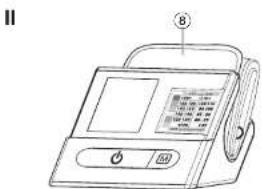
When the measurement has finished, remove the cuff and pack it into the device as shown in Fig. II.
-
Enter the result in the enclosed blood pressure pass and switch off the device. (The monitor does switch off automatically after approx. 1 min.).
You can stop the measurement at any time by pressing the ON/OFF button (e.g. if you feel uneasy or an unpleasant pressure sensation).
4. Appearance of the Heart Arrhythmia Indicator for early Detection
This symbol 13 indicates that certain pulse irregularities were detected during the measurement. In this case, the result may deviate from your normal blood pressure – repeat the measurement. In most cases, this is no cause for concern. However, if the symbol appears on a regular basis (e.g. several times a week with measurements taken daily) we advise you to tell your doctor. Please show your doctor the following explanation:
Information for the doctor on frequent appearance of the Arrhythmia indicator
This device is an oscillometric blood pressure monitor that also analyses pulse frequency during measurement. The device is clinically tested.
The arrhythmia symbol is displayed after the measurement, if pulse irregularities occur during measurement. If the symbol appears more frequently (e.g. several times per week on measurements performed daily) we recommend the patient to seek medical advice.
This device does not replace a cardiac examination, but serves to detect pulse irregularities at an early stage.
5. Data Memory
At the end of each measurement, this device automatically stores the result.
Viewing the stored values
Press the M-button ⑱ briefly, when the device is switched off. The display first shows the last stored result.
Pressing the M-button again displays the previous value. Pressing the M-button repeatedly enables you to move from one stored value to another.
Memory full
When the memory has stored 30 results, the memory is full From this point onwards, a new measured value is stored by overwriting the oldest value.
Clearing all values
All memory data are cleared when batteries are taken out of the device.
6. Replacing the Slot-in Card
You can replace the slot-in card ③ by pulling it out to the side, as shown in Fig. IV and replacing the paper insert.
It may be helpful to have your doctor note down the medication dosage or an emergency telephone number on the card. Extra cards are supplied with the device for this purpose.
7. Battery Indicator and Battery change
Low battery
When the batteries are approximately 3/4 empty the battery symbol ⑮ will flash as soon as the device is switched on (partly filled battery displayed). Although the device will continue to measure reliably, you should obtain replacement batteries.
Flat battery – replacement
When the batteries are flat, the battery symbol ⑮ will flash as soon as the device is switched on (flat battery displayed). You cannot take any further measurements and must replace the batteries.
- Open the battery compartment ⑦ at the back of the device by pushing inwards at the two arrows and pulling out the battery compartment cover.
- Replace the batteries – ensure correct polarity as shown by the symbols in the compartment.
Which batteries and which procedure?
Use 4 new, long-life 1.5 V, size AA alkaline batteries.
Do not use batteries beyond their date of expiry.
Remove batteries if the device is not going to be used for a prolonged period.
Using rechargeable batteries
You can also operate this device using rechargeable batteries.
Only use «NiMH» type reusable batteries.
Batteries must be removed and recharged when the flat battery symbol appears. They should not remain inside the device as they may become damaged (total discharge as a result of low use of the device, even when switched off).
Always remove the rechargeable batteries if you do not intend to use the device for a week or more.
Batteries cannot be charged in the blood pressure monitor. Recharge batteries in an external charger and observe the information regarding charging, care and durability.
8. Using a Mains Adapter
You can operate this device using the Microlife mains adapter (DC 6V, 600 mA).
Only use the Microlife mains adapter available as an original accessory appropriate for your supply voltage.
Ensure that neither the mains adapter nor the cable are damaged.
- Plug the adapter cable into the mains adapter socket ⑤ in the blood pressure monitor.
- Plug the adapter plug into the wall socket.
When the mains adapter is connected, no battery current is consumed.
9. Error Messages
If an error occurs during the measurement, the measurement is interrupted and an error message, e.g. «ERR 3», is displayed.
| Error | Description | Potential cause and remedy |
| «ERR 1» | Signal too weak | The pulse signals on the cuff are too weak. Re-position the cuff and repeat the measurement.* |
| «ERR 2» | Error signal During the measurement, error signals were detected by the cuff, caused for instance by movement or muscle tension. Repeat the measurement, keeping your arm still. | |
| «ERR 3» | No pressure in the cuff | An adequate pressure cannot be generated in the cuff. A leak may have occurred. Check that the cuff is correctly connected and is not too loose. Replace the batteries if necessary. Repeat the measurement. |
| «ERR 5» | Abnormal result | The measuring signals are inaccurate and no result can therefore be displayed. Read through the checklist for performing reliable measurements and then repeat the measurement.* |
| «HI» | Pulse or cuff pressure too high | The pressure in the cuff is too high (over 300 mmHg) OR the pulse is too high (over 200 beats per minute). Relax for 5 minutes and repeat the measurement.* |
| «LO» | Pulse too low | The pulse is too low (less than 40 beats per minute). Repeat the measurement.* |
* Please consult your doctor, if this or any other problem occurs repeatedly.
If you think the results are unusual, please read through the information in «Section 1.» carefully.
10. Safety, Care, Accuracy Test and Disposal

Safety and protection
- This device may only be used for the purposes described in these instructions. The manufacturer cannot be held liable for damage caused by incorrect application.
- This device comprises sensitive components and must be treated with caution. Observe the storage and operating conditions described in the «Technical Specifications» section.
- Protect it from:
- water and moisture
- extreme temperatures
- impact and dropping
- contamination and dust
- direct sunlight
-
heat and cold
-
The cuffs are sensitive and must be handled with care.
- Only pump up the cuff once fitted.
- The function of this device may be compromised when used close to strong electromagnetic fields such as mobile phones or radio installations and we recommend a distance of at least 1 m. In cases where you suspect this to be unavoidable, please verify if the device is working properly before use.
- Do not use this device if you think it is damaged or notice anything unusual.
- Never open this device.
- If the device is not going to be used for a prolonged period the batteries should be removed.
- Read the additional safety information provided within the individual sections of this instruction manual.

Ensure that children do not use this device unsupervised; some parts are small enough to be swallowed. Be aware of the risk of strangulation in case this device is supplied with cables or tubes.
Device care
Clean the device only with a soft, dry cloth.
Cleaning the cuff
You can machine wash the cuff cover at 30° C (do not iron!).

WARNING: Under no circumstances, however, may you wash the inner bladder! Always remove the sensitive bladder from the sleeve before washing and replace it carefully again afterwards.
Accuracy test
We recommend this device is tested for accuracy every 2 years or after mechanical impact (e.g. being dropped). Please contact your local Microlife-Service to arrange the test (see foreword).
Disposal

Batteries and electronic devices must be disposed of in accordance with the locally applicable regulations, not with domestic waste.
11.Guarantee
This device is covered by a 5 year guarantee from the date of purchase. The guarantee is valid only on presentation of the guarantee card completed by the dealer (see back) confirming date of purchase or the receipt.
- Batteries, cuff and parts that become worn with use are not included.
- Opening or altering the device invalidates the guarantee.
- The guarantee does not cover damage caused by improper handling, discharged batteries, accidents or non-compliance with the operating instructions.
Please contact your local Microlife-Service (see foreword).
12. Technical Specifications
Operating conditions: 10 - 40 °C / 50 - 104 °F 15 - 95 % relative maximum humidity
Storage conditions: -20 - +55 °C / -4 - +131 °F 15 - 95 % relative maximum humidity
Weight: 610 g (including batteries)
Dimensions: 160 x 125 x 98 mm
Measuring procedure: oscillometric, corresponding to Korotkoff method: Phase I systolic, Phase V diastolic
Measurement range: 20 - 280 mmHg – blood pressure 40 - 200 beats per minute – pulse
Cuff pressure display
range: 0 - 299 mmHg
Resolution: 1 mmHg
Static accuracy: pressure within ± 3 mmHg
Pulse accuracy: ± 5 % of the readout value
Voltage source: 4 x 1.5 V alkaline batteries; size AA Mains adapter DC 6V, 600 mA (optional)
Battery lifetime: approx. 920 measurements (using new batteries)
IP Class: IP20
Reference to standards: EN 1060-1 /-3 /-4; IEC 60601-1; IEC 60601-1-2 (EMC); IEC 60601-1-11
Expected service life: Device: 5 years or 10000 measurements Accessories: 2 years
This device complies with the requirements of the Medical Device Directive 93/42/EEC.
Technical alterations reserved.
Microlife BP A100
FR
Poids: 610 g (piles incluses)
Dimensions: 160 x 125 x 98 mm


- EUROPE / MIDDLE-EAST / AFRICA
- ASIA
- NORTH / CENTRAL / SOUTH AMERICA
- MICROLIFE BP A100
- GUARANTEE CARD BP A100
- DISPLAY
- DEAR CUSTOMER
- TABLE OF CONTENTS
- SAFETY, CARE, ACCURACY TEST AND DISPOSAL
- GUARANTEE
- TECHNICAL SPECIFICATIONS
- IMPORTANT FACTS ABOUT BLOOD PRESSURE AND SELF-MEASUREMENT
- HOW DO I EVALUATE MY BLOOD PRESSURE
- USING THE DEVICE FOR THE FIRST TIME
- ACTIVATING THE FITTED BATTERIES
- SELECTING THE CORRECT CUFF
- TAKING A BLOOD PRESSURE MEASUREMENT USING THIS DEVICE
- CHECKLIST FOR TAKING A RELIABLE MEASUREMENT
- APPEARANCE OF THE HEART ARRHYTHMIA INDICATOR FOR EARLY DETECTION
- INFORMATION FOR THE DOCTOR ON FREQUENT APPEARANCE OF THE ARRHYTHMIA INDICATOR
- DATA MEMORY
- VIEWING THE STORED VALUES
- MEMORY FULL
- CLEARING ALL VALUES
- REPLACING THE SLOT-IN CARD
- BATTERY INDICATOR AND BATTERY CHANGE
- LOW BATTERY
- FLAT BATTERY – REPLACEMENT
- WHICH BATTERIES AND WHICH PROCEDURE
- USING RECHARGEABLE BATTERIES
- USING A MAINS ADAPTER
- ERROR MESSAGES
- SAFETY AND PROTECTION
- DEVICE CARE
- CLEANING THE CUFF
- ACCURACY TEST
- DISPOSAL
- 11.GUARANTEE
- FR
Brand : MICROLIFE
Model : BP A10030
Category : Sphygmomanometer