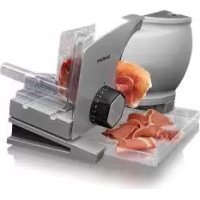
USER MANUAL SAS 120 C1 SILVERCREST
A. 100% of the expected cost of each unit is equal to the total expected cost of all units.
(3) KRAJALNICA ELEKTRACYNA ELEKTRICKY UNIVIERZAJ
nndy 1000
ELEKTRICKY, UNIVERZALNY KRAJAÇ CORTAFIAMBRES ELECTRICO
(2)
ELEKTRISK PALAEGSMASKINE AFFETTATTUCE ELETTRICA
Bnneepnneepnneepnneepnneepnneepnneepnneepnneepnneepnneepnneepnneepnneepnneepnneepnneepnneepnneepnneepnneepnneepnneepnneepnneepnneepnneepnneepnneepnneepnneepnneepnneepnneep
ELEKTROMOS SZELETELO ELEKTRICNI UNIVERZALNI
Kezilu ulmudis as bontnugui hnuwic REZALNIK
TAIGA GMSH
C
GERMANY
Stand der Informationen-Lost Information Update
https://www.targa.gmbh/downloads/conformity/390023_2201.pdf
- Intended use 24
- Package contents 25
- Technical specifications 26
3.1 Short-time duty 26
- Safety instructions 26
5.Copyright 32
6.Before you start 32
- Getting started 32
7.1 Cleaning 36
7.2 Maintenance 37
7.3 Storage 37
8.Troubleshooting 37
9. Environmental regulations and disposal information 38
10. Conformity notes 40
11. Warranty information 41
Congratulations!
By purchasing the SilverCrest SAS 120 D1 Food Slicer, hereinafter referred to as the food slicer, you have opted for a quality product.
Before first using it, familiarise yourself with the way the food slicer works and read these operating instructions through carefully. Be careful to follow the safety instructions and only use the food slicer as described in the operating instructions and for the applications given.
Keep these operating instructions in a safe place. If you pass the food slicer on to someone else, make sure to give them all the relevant documents with it.
1. Intended use
This food slicer is a household appliance which is used for cutting suitable foods such as bread, cheese and sausage. It may not be used outdoors or in tropical climates. It has not been designed for corporate or commercial applications. Use the food slicer in domestic environments for private applications only. Any other use does not correspond to the intended use. This food slicer fulfils all relevant norms and standards concerning CE conformity. In the event of any modification to the food slicer that was not approved by the manufacturer, compliance with these standards is no longer guaranteed. The manufacturer accepts no liability for any damage or malfunctions resulting from this. Only use accessories supplied with the device by the manufacturer.
Observe the regulations and laws in the country of use.
2. Package contents
Remove the food slicer and all the accessories from the packaging. Remove the packaging material and check that all components are complete and undamaged. If you find anything missing or damaged, please contact the manufacturer.
SAS 120 D1 food slicer
Supply carriage
Food holder
- Catcher plate
These operating instructions
On the inside of the cover is a diagram of the Food Slicer with all its accessories and control elements numbered. The meanings of the numbers are as follows:
1 Switch (I = continuous operation, O = off, II = short operation mode)
2 Blade
3 Blade lock
4 Food holder
5 Power cord store
6 Power cable
7 Device base
8 Catcher plate
9 Adjusting wheel (for slice thickness)
10 Supply carriage
11 Holding plate
3. Technical specifications
| Name SilverCrest SAS 120 D1 | |
| Power supply | 220-240 V~, 50/60 Hz |
| Power consumption 120 W | |
| Short-time duty 5 minutes | |
| Protection class | II ☐ |
| Slice thickness 0 mm up to approx. 20 mm | |
| Dimensions (W x H x D) approx. 34,5 x | 23,4 x 23,5 cm |
| Weight (without accessories) approx. 24 | 00 g |
| Operating temperature 5 °C to 35 °C | |
| Operating humidity max. 85 % rel. humidity | |
| Permissible storage conditions -10 °C to | +50 °C, max. 85 % rel. humidity |
The technical data and design may be changed without prior notice.
3.1 Short-time duty
The short-time duty (KB time) indicates how long the food slicer can be operated without the motor overheating and getting damaged. The short operating time for the food slicer is 5 minutes. After this time, the food slicer needs to be switched off until the motor has cooled down.
4. Safety instructions
Before you use this food slicer for the first time, please read the following notes and heed all warnings, even if you are familiar with handling electric appliances. Keep these operating instructions in a safe place for future reference. If you sell the food slicer or give it away, pass on the operating instructions at the same time. They are part of the product.

DANGER! This signal word indicates a danger with a high risk, which will lead to death or major injuries if not avoided.

WARNING! This signal word indicates a danger with a moderate risk, which can lead to death or major injuries if not avoided.

DANGER! This symbol denotes danger for human health and risk of death and/or risk of damage to property due to electric shock.

This symbol designates products whose physical and chemical composition has been tested and found to be non-hazardous to health when used in contact with food in accordance with the requirements of Regulation EU 1935/2004.

AC voltage

This symbol denotes further information on the topic.

Manufacturer's address
The food holder (4) and catcher plate (8) are dishwasher-safe.

DANGER! Personal safety
- This food slicer is not to be used by children.
- The appliance and its power cable should be kept out of the reach of children.
- This food slicer may be used by persons with reduced physical, sensory or mental capabilities and/or who have no experience in, or knowledge of, using such appliances providing they are supervised or have been instructed in how to use the appliance safely and have understood the associated risks.
- Do not allow children to play with the appliance.
- Small parts can represent choking hazards.
- Keep the packaging out of the reach of these people. There is a risk of suffocation.

DANGER! Power cable
- Always hold the power cable (6) by the mains plug and never pull on the power cable (6) itself.
- Never put heavy objects or furniture on the power cable (6) and make sure it does not get trapped, especially at the mains plug.
- To avoid damaging the power cable (6), never lead the power cable around hot or sharp objects or edges.
- Do not use adapters or extension cables which do not meet the applicable safety standards and do not attempt to modify the power cable (6) yourself!
- If the power cable (6) is damaged, it must be replaced by the manufacturer, its customer service or a similarly qualified person, in order to avoid any possible risks.
- Never tie knots in the power cord (6) and do not tie it to other cables. The power cable (6) should be positioned such that nobody can trip over it or be obstructed by it. There is a danger of injury.

DANGER! Maintenance/cleaning

- Repairs are required if the food slicer has been damaged in any way, for example, if liquid has entered the product, if the product has been exposed to rain or moisture, if the product does not work normally or if the product has been dropped.
-
If you notice any smoke, unusual noises or strange smells, immediately unplug the power cable (6) of the food slicer from the mains socket. If this occurs, the food slicer should not be used before it has been inspected by authorised service personnel.
-
All repair work must be carried out by qualified personnel. Never open the food slicer housing.
- Before cleaning the food slicer, always remove the mains plug from the mains socket.
- When cleaning the food slicer, never immerse it in water or hold it under running water.
- Be careful removing and cleaning the blade (2). The blade (2) is very sharp! There is a danger of injury.

DANGER! Operation
- Misuse could result in injury!
- No action is required by the user to set the product to 50 or 60 Hz. The product automatically adjusts to 50 and to 60 Hz.
- The food slicer must always be disconnected from the mains when left unsupervised and before assembly, disassembly or cleaning. There is a risk of injury.
- Before removing the blade (2), disconnect the food slicer from the mains.
- Before replacing accessories or additional parts which move when the device is running, the device must be switched off and disconnected from the mains.
- Only use it in conjunction with the accessories provided. There is a danger of injury.
- This unit must be used with the carriage and food holder in their normal positions, unless the size and shape of the food make it impossible to use them.
-
When using the food slicer, make sure that long hair, ties or loose clothing do not get caught up in the blade (2). There is a danger of injury.
-
Never put your hands near the rotating blade (2). There is a danger of injury.
- Never use your bare hands to hold bits of food near the blade (2) for cutting! Always use the food holder (4) provided. Risk of injury!
- Never operate the food slicer without the blade (2). Never attempt to slice packaged or frozen foods, ice cubes, foods with bones or large stones or nuts in their shells. This could damage the food slicer.
- After use, or when the food slicer is unattended, always remove the mains plug from the mains socket!
Operating environment
Position the food slicer on a stable, flat surface and do not place any objects on the food slicer. The food slicer is not for use in rooms with a high temperature or humidity (e.g. bathrooms), and must be kept free of excessive dust. Operating temperature and operating humidity: 5^ to 35^ , max. 85% rel. humidity

WARNING! Make sure that:
- no direct heat sources (e.g. heating) affect the food slicer;
- the food slicer is not exposed to direct sunlight or bright artificial light;
-
contact with spray and dripping water and abrasive liquids is avoided and the food slicer is never operated near water, and it must especially never be immersed. Do not place any recipients containing liquids, e.g. drinks or vases, onto or next to the food slicer;
-
there are no open fire sources (e.g. burning candles) on or near the food slicer;
- no foreign bodies are introduced into the device;
- the food slicer is not exposed to any extreme temperature fluctuations as this can lead to moisture through condensation and cause short-circuits. If the food slicer has been exposed to strong temperature variations, wait for it to reach the ambient temperature before switching it on (about 2 hours);
- the food slicer should not be subjected to excessive shocks and vibrations.
Storage when not in use
If you do not intend to use the food slicer for an extended period, disconnect it from the mains power. Also make sure that the storage temperature is maintained between -10^ and +50^ . Humidity must not exceed 85% RH.
5. Copyright
All the contents of this user manual are protected by copyright and provided to the reader for information only. Copying data and information without the prior explicit written consent of the author is strictly forbidden. This also applies to any commercial use of the contents and information. All texts and diagrams are up-to-date as of the date of printing. Subject to change without notice.
6. Before you start
Remove the food slicer and all accessories from the packaging and check that the package contents are complete. Remove all protective films. We recommend cleaning all accessories before first use. Place the food slicer on a firm, even surface near a mains socket.
7. Getting started







DANGER! Disconnect the food slicer from the mains before assembly. There is a danger of injury!
DANGER! Never touch the blade (2) when the food slicer is running. There is a danger of injury!
DANGER! Always use the supply carriage (10) in conjunction with the food holder (4).
Exception: The food is too big to use the food holder (4).
Always use the food holder (4) to guide remnants of food towards the blade (2).
WARNING! Only use the food slicer for cutting normal household foodstuffs and never for other purposes. The food slicer is not suitable for slicing packaged or frozen foods, ice cubes, foods with bones or large stones or nuts in their shells.
WARNING! For safety reasons, when you have finished using the food slicer, always use the adjusting wheel (9) to set the slicing thickness to "0" as far as it goes.
Soft foods:
Soft foods such as ham or cheese are easier to cut when they are cold. Gently push the supply carriage (10) against the blade (2) to achieve good slicing results.
Hard foods:
For hard foods, such as salami, bread or cabbage, you can push the supply carriage (10) against the blade (2) more quickly.
For best results with really thin slices, do not put pressure on the holding plate (11). Simply push the food gently forward against the rotating blade (2).
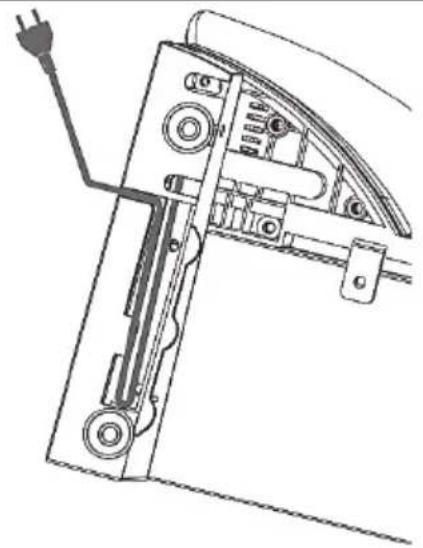
Unwind the length of power cable (6) you need and store the power cable (6) you do not need in the power cord store (5). Guide the power cable (6) through the gap in the device base (7) between the power cord store (5) and the outside.
Place the supply carriage (10) vertically into the guide grooves on the food slicer from the top. Push it into the guide groves and make sure that the supply carriage (10) clicks into place properly.
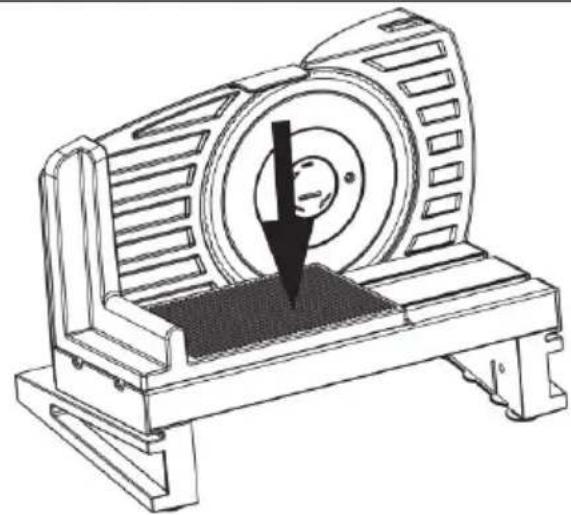
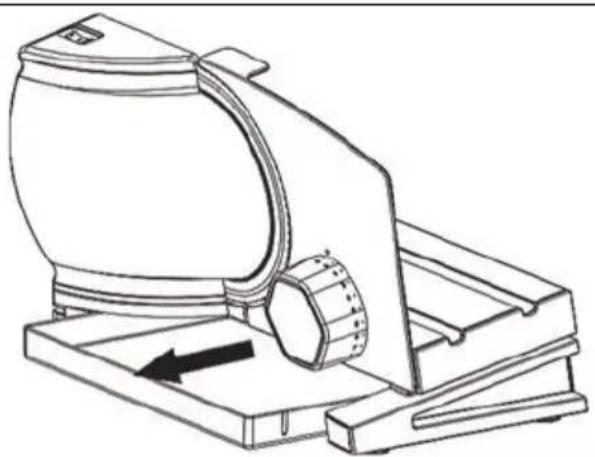
Place the food holder (4) onto the supply carriage (10). Now position the catcher plate (8) below the device base (7) so that it can catch the sliced food.
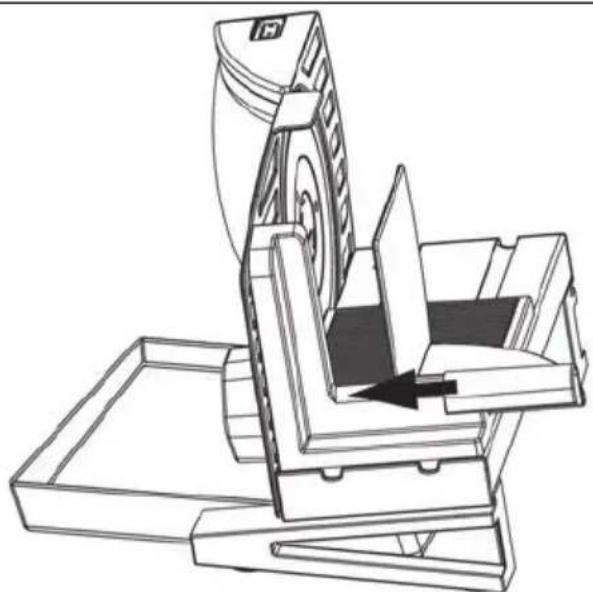
Now plug the mains plug into an easily accessible mains socket.
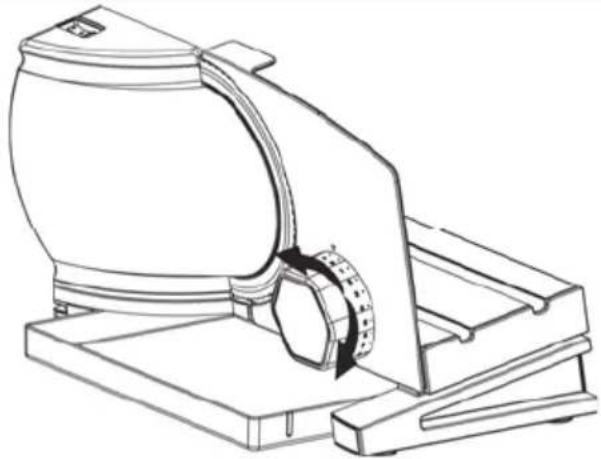
Use the adjusting wheel (9) to set the thickness you wish to slice your food.
Please note that the slice thickness scale is not calibrated in millimeters. It is intended for orientative purposes only. The maximum slice thickness is approx. 20mm
When you have finished using or are storing the food slicer, always use the adjusting wheel (9) to set the slicing thickness to "0" as far as it goes in order to avoid injuries caused by the blade (2). In this position, the blade (2) is covered by the holding plate (11) for safety reasons.
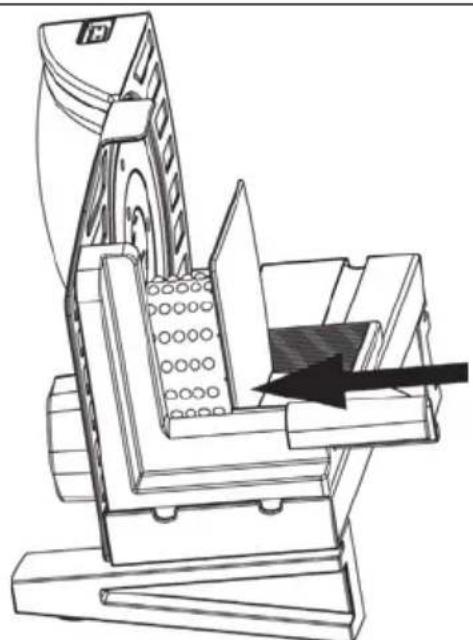
Place the food you wish to slice on the supply carriage (10) and use the food holder (4) to press it lightly against the holder plate (11).
Prevent injuries by always using the food holder (4), unless the food you wish to slice is very large.
Use the switch (1) to switch between two operating modes and "Off":
| Position I | Continuous operation: The blade (2) rotates without the switch (1) having to be depressed all the time. To stop the blade (2), move the switch (1) to the O position by briefly pressing II. |
| Position O | Off: The blade (2) does not turn. |
| Position II | Short operation: The blade (2) turns as long as you hold the switch (1) pressed down in this position. |
Switch on the food slicer using the switch (1).
Hold the supply carriage (10) containing your food lightly against the rotating blade (2) and gently push forward. Once you have cut one slice, pull the supply carriage (10) back and repeat the process until you have cut sufficient slices.
Switch the food slicer off using the switch (1) and wait for the blade (2) to stop turning.
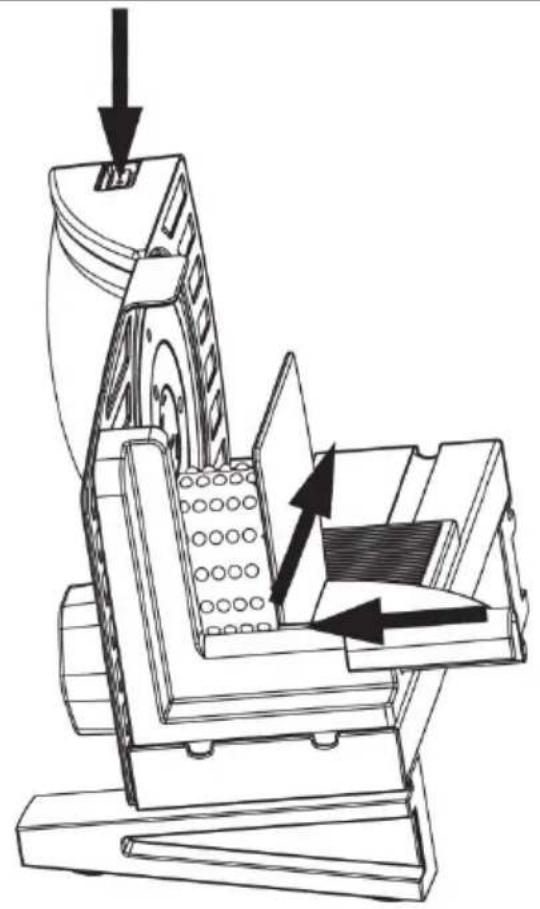

WARNING! For safety reasons, when you have finished using the food slicer, always use the adjusting wheel (9) to set the slicing thickness to "0" as far as it goes.
Remove the catcher plate (8) with the sliced food by pulling it out to the left under the device base (7).
7.1 Cleaning

DANGER! Always disconnect the mains plug before cleaning. Never immerse the food slicer in water and never clean it under running water as this could cause an electric shock!
DANGER! Be careful using and cleaning the blade (2). The blade (2) is very sharp. There is a danger of injury!
Do not use aggressive, abrasive or chemical detergents. This could irreparably damage the surface of the food slicer and its accessories.
-
Unplug the power cable (6) from the mains socket.
-
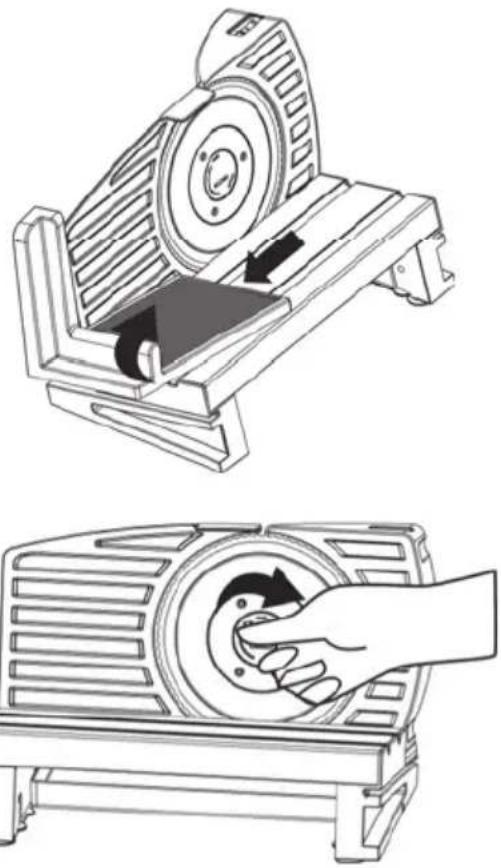
Remove the supply carriage (10), food holder (4) and catcher plate (8). These parts can be cleaned in a bowl of warm water and washing-up liquid. After cleaning, rinse the parts of with clean water and dry them carefully. Alternatively, the food holder (4) and catcher plate (8) can be cleaned in the dishwasher.
-
Remove the blade (2). To do this, use a suitable coin and put it into the slot on the blade lock (3). Now turn the blade lock (3) clockwise (direction of arrow) until you can remove it. Then grab the blade (2) in the centre and remove it.
-
Clean the blade (2) with warm washing-up water, but not in the dishwasher. Rinse with clean water and dry thoroughly. Grease the gear wheel on the blade (2) with a little Vaseline.
-
Clean the area behind the blade (2) with a brush or slightly damp cloth.
Once you have finished cleaning, refit the blade (2). Place it straight on the centre axis and tighten the blade lock (3) again by turning it anticlockwise.
The housing of the food slicer can also be cleaned with a damp cloth.

Cleaning intervals: We recommend cleaning the housing, plastic parts and the built-in blade (2) with a damp cloth after every use. It is worth cleaning all the plastic parts in the washing-up from time to time. The same applies to the blade (2).
Slicing some foods may require more frequent cleaning: depending on the foods sliced, it may be necessary to wash up all the plastic parts and the blade (2) immediately after use.
7.2 Maintenance
The food slicer is maintenance-free. To ensure the supply carriage (10) runs smoothly, we recommend greasing the guide with a little Vaseline occasionally.
The plastic adjustment screws on the bottom of the appliance are intended for adjustment during manufacturing.
7.3 Storage
If the food slicer is not to be used for an extended period, store it in a clean and dry place.
- Clean the food slicer and all accessories as described in the previous chapter.
- When you have finished using or are storing the food slicer, always use the adjusting wheel (9) to set the slicing thickness to "0" as far as it goes in order to avoid injuries caused by the blade (2). In this position, the blade (2) is covered by the holding plate (11) for safety reasons.
- Store the power cable (6) to in the power cord store (5).
8. Troubleshooting
The food slicer does not work.
- The mains plug is not plugged in. Insert the mains plug into a mains socket.
- The mains socket is defective. Test the food slicer in a different mains socket that you are certain is working.
- The food slicer is faulty. Contact customer service.
The food slicer holding plate (11) has backlash and can be moved.
-
There are two adjustment screws on the bottom of the food slicer. Tighten the screws by hand so that the holding plate (11) is fixed with no backlash but can still be moved using the adjusting wheel (9).
-
Environmental regulations and disposal information
| Devices marked with this symbol are subject to the European Union Directive 2012/19/EU. Electrical and electronic devices may not be put in the household waste, but must be disposed of via designated public disposal centres. By properly disposing of the old device, you can avoid environmental damage and hazards to health. Further information regarding proper disposal of the old device can be obtained from your local authority or the shop where you purchased the device. |
| The symbol of the crossed-out wheelie bin on conventional and rechargeable batteries indicates that they cannot be disposed of in normal domestic waste but must be disposed of separately.
Where batteries contain toxic materials, the chemical symbol of the toxic material is shown underneath the symbol, with meanings as follows:
- Pb: Battery contains lead
- Cd: Battery contains cadmium
- Hg: Battery contains mercury
You are obliged by law to return used batteries. Old batteries can contain toxic materials which can be damaging to health or the environment if not properly stored or disposed of. Batteries also contain important raw materials, such as iron, zinc, manganese and nickel, which can be reused.
After use, you can return the batteries to us or to a local collection point (e.g. in retail outlets or a local collection point) free of charge. Please note that batteries must be disposed of fully discharged at appropriate collection points for old batteries. If disposing of batteries which are not fully discharged, take precautions to prevent short circuits. |
| Dispose of all packaging in an environmentally friendly manner. Cardboard packaging can be taken to paper recycling centres or public collection points for recycling. Any film or plastic contained in the packaging should be taken to your public collection points for disposal. |
| Only relevant for France:
“Sorting made easy”
The product is recyclable, subject to advanced manufacturer responsibility and is sorted and collected separately. |
| a | Please note the markings on the packaging material when disposing of it, it is labelled with abbreviations (a) and numbers (b), the meanings of which are as follows:
1-7: plastic / 20-22: paper and cardboard / 80-98: composite materials. |
| Symbol Material | Contained in the following packaging elements for this product |
| 01
PET | Polyethylene terephthalate | - |
| 02
PE-HD | High density polyethylene | - |
| 03
PVC | Polyvinyl chloride | - |
| 04
PE-LD | Low density polyethylene | - |
| 05
PP | Polypropylene | - |
| 06
PS | Polystyrene | - |
| 07
O | Other plastics | - |
| 20
PAP | Corrugated cardboard | Packaging, inside box |
| 21
PAP | Other cardboard | - |
| 22
PAP | Paper Silk paper inside the sales packaging |
| 81
C/PAP | Paper/cardboard/ plastic | - |
| 84
C/PAP | Paper/cardboard/ plastic/aluminium | - |

The product complies with the requirements of the applicable European and national directives. Evidence of conformity has been provided. The manufacturer has the relevant declarations and documentation.

The product complies with the requirements of the applicable national directives of the Republic of Serbia.
The product complies with the requirements of the applicable national directives for Great Britain.
The complete EU Declaration of Conformity is available for download from this link:
https://www.targa.gmbh/downloads/conformity/390023_2201.pdf
Warranty of TARGA GmbH
Dear Customer,
This device is sold with three years warranty from the date of purchase. In the event of product defects, you have legal rights towards the seller. These statutory rights are not restricted by our warranty as described below.
Warranty conditions
The warranty period commences upon the date of purchase. Please keep the original receipt in a safe place as it is required as proof of purchase. If any material or manufacturing faults occur within three years of purchase of this product, we will repair or replace the product free of charge as we deem appropriate.
Warranty period and legal warranty rights
The warranty period is not extended in the event of a warranty claim. This also applies to replaced and repaired parts. Any damage or defects discovered upon purchase must be reported immediately when the product has been unpacked. Any repairs required after the warranty period will be subject to charge.
Scope of warranty
The device was carefully manufactured in compliance with stringent quality guidelines and subjected to thorough testing before it left the works. The warranty applies to material and manufacturing faults. This warranty does not cover product components which are subject to normal wear and which can therefore be regarded as wearing parts, or damage to fragile components such as switches, rechargeable batteries or components made of glass. This warranty is void if the product is damaged, incorrectly used or serviced. To ensure correct use of the product, always comply fully with all instructions contained in the user manual. The warnings and recommendations in the user manual regarding correct and incorrect use and handling of the product must always be observed and complied with. The product is solely designed for private use and is not suitable for commercial applications. The warranty is rendered void in the event of incorrect handling and misuse, if it is subjected to force, and also if any person other than our authorised service technicians interfere with the device. No new warranty period commences if the product is repaired or replaced.
Submitting warranty claims
To ensure speedy handling of your complaint, please note the following:
Before using your product for the first time, please read the enclosed documentation carefully. Should any problems arise which cannot be solved in this way, please call our hotline.
- Always have your receipt, the product article number as well as the serial number (if available) to hand as proof of purchase.
- If it is not possible to solve the problem on the phone, our hotline support staff will initiate further servicing procedures depending on the fault.
You can find this and many more manuals, product videos and installation software available for download at www.lidl-service.com. This QR code takes you directly to the LIDL service
page (www.lidl-service.com). There, you can enter the item number (IAN) to access your operating manual.


Service

Phone: 0800 404 7657
E-Mail: targa@lidl.co.uk

Phone: 1800
101010
E-Mail:
targa@lidl.ie

Phone: 800
62230
E-Mail:
targa@lidl.com.mt

Phone: 8009
4241
E-Mail:
targa@lidl.com.cy
IAN:390023_2201

Manufacturer
Please note that the following address is not a service address. First contact the service point stated above.
TARGA
GmbH
Coesterweg 45
59494 Soest
GERMANY
Table des matieres
https://www.targa.gmbh/downloads/conformity/390023_2201.pdf
Cher client, chere clientele,
Cher client, chere clientele,
https://www.targa.gmbh/downloads/conformity/390023_2201.pdf
11. Garantie
https://www.targa.gmbh/downloads/conformity/390023_2201.pdf
https://www.targa.gmbh/downloads/conformity/390023_2201.pdf
https://www.targa.gmbh/downloads/conformity/390023_2201.pdf
https://www.targa.gmbh/downloads/conformity/390023_2201.pdf
https://www.targa.gmbh/downloads/conformity/390023_2201.pdf
11. Garantioplysninger
TARGA GmbH - Garanti
Kaere kunde,
https://www.targa.gmbh/downloads/conformity/390023_2201.pdf
https://www.targa.gmbh/downloads/conformity/390023_2201.pdf
https://www.targa.gmbh/downloads/conformity/390023_2201.pdf