ManualGo.com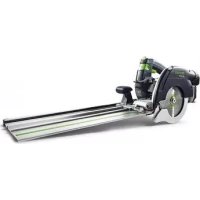
HKC 55 Li 5 2 EBPlusFS - Saw FESTOOL - Free user manual and instructions
Find the device manual for free HKC 55 Li 5 2 EBPlusFS FESTOOL in PDF.



Download the instructions for your Saw in PDF format for free! Find your manual HKC 55 Li 5 2 EBPlusFS - FESTOOL and take your electronic device back in hand. On this page are published all the documents necessary for the use of your device. HKC 55 Li 5 2 EBPlusFS by FESTOOL.
USER MANUAL HKC 55 Li 5 2 EBPlusFS FESTOOL
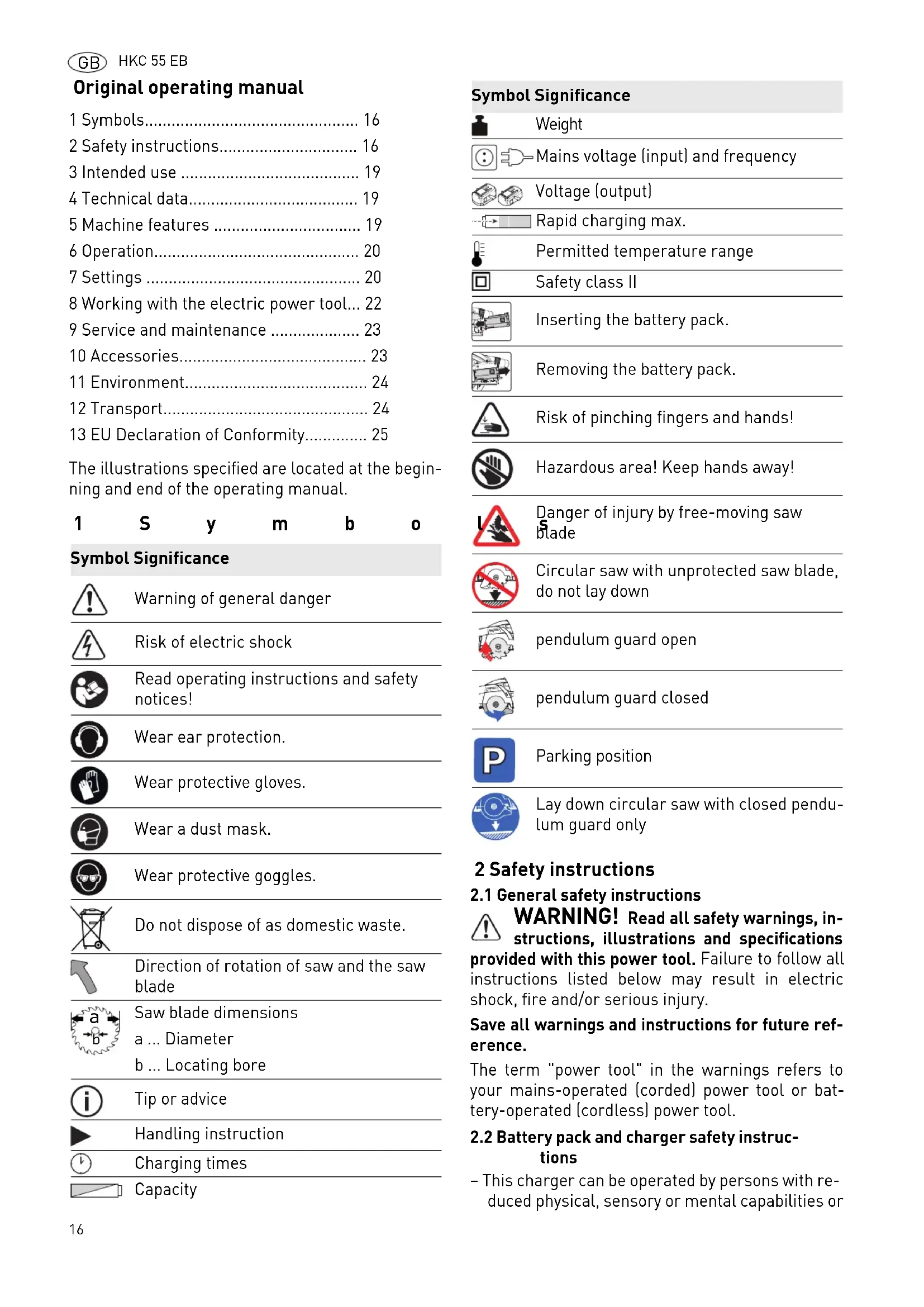
Original operating manual The illustrations specified are located at the begin- ning and end of the operating manual. 1Symbols 2 Safety instructions
2.1 General safety instructions
WARNING! Read all safety warnings, in- structions, illustrations and specifications provided with this power tool. Failure to follow all instructions listed below may result in electric shock, fire and/or serious injury. Save all warnings and instructions for future ref- erence. The term "power tool" in the warnings refers to your mains-operated (corded) power tool or bat- tery-operated (cordless) power tool.
2.2 Battery pack and charger safety instruc-
Weight Mains voltage (input) and frequency Voltage (output) Rapid charging max. Permitted temperature range Safety class II Inserting the battery pack. Removing the battery pack. Risk of pinching fingers and hands! Hazardous area! Keep hands away! Danger of injury by free-moving saw blade Circular saw with unprotected saw blade, do not lay down pendulum guard open pendulum guard closed Parking position Lay down circular saw with closed pendu- lum guard only Symbol Significance www.festool.com
a lack of practical experience and knowledge, provided they are supervised or have been in- structed to use the machine safely and under- stand the dangers of machine operation. Children are not allowed use or play with the ma- chine. – Do not open the battery pack or the charger! – Prevent metal parts (e.g. metal chips) or fluids from entering the charger!
Do not use power adapters or battery packs form other manufacturers to operate the cord- less power tool. Do not use any charger from other manufacturers for charging the battery pack. The use of impermissible accessories may result in electric shock and / or serious acci- dents! – Protect the battery pack from excessive heat > 50 °C or constant heat sources such as sunlight or naked flames! – Never use water to extinguish burning li-ion bat- tery packs! Use sand or a fire blanket. – Protect the machine from moisture. – Protect the cable from heat, oil and sharp edges. – Check the plug and the cable regularly and should either become damaged, in order to avoid a hazard, have them replaced by an authorised after-sales service workshop.
2.3 Safety instructions for specific circular
saws Cutting procedures
DANGER! Keep hands away from cut- ting area and the blade. Keep your second hand on auxiliary handle, or motor housing. If both hands are holding the saw, they cannot be cut by the blade.
Do not reach underneath the workpiece. The guard cannot protect you from the blade below the workpiece.
Adjust the cutting depth to the thickness of the workpiece. Less than a full tooth of the blade teeth should be visible below the workpiece.
Never hold the workpiece in your hands or across your leg while cutting. Secure the work- piece to a stable platform. It is important to sup- port the work properly to minimize body exposure, blade binding, or loss of control.
Hold the power tool by insulated gripping sur- faces, when performing an operation where the cutting tool may contact hidden wiring. Contact with a "live" wire will also make exposed metal parts of the power tool "live" and could give the operator an electric shock.
When ripping, always use a rip fence or straight edge guide. This improves the accuracy of cut and reduces the chance of blade binding.
Always use blades with correct size and shape (diamond versus round) of arbour holes. Blades that do not match the mounting hardware of the saw will run off-centre, causing loss of control.
Never use damaged or incorrect blade washers or bolt. The blade washers and bolt were spe- cially designed for your saw, for optimum perfor- mance and safety of operation. i.Wear suitable protective equip- ment such as ear protection, safety goggles, a dust mask for work which generates dust, and protective gloves when working with raw materials and when changing tools. Kickbacks causes and related warnings – kickback is a sudden reaction to a pinched, jammed or misaligned saw blade, causing an un- controlled saw to lift up and out of the workpiece toward the operator; – when the blade is pinched or jammed tightly by the kerf closing down, the blade stalls and the motor reaction drives the unit rapidly back to- ward the operator; – if the blade becomes twisted or misaligned in the cut, the teeth at the back edge of the blade can dig into the top surface of the wood causing the blade to climb out of the kerf and jump back to- ward the operator. Kickback is the result of saw misuse and/or incor- rect operating procedures or conditions and can be avoided by taking proper precautions as given be- low.
Maintain a firm grip with both hands on the saw and position your arms to resist kickback forc- es. Position your body to either side of the blade, but not in line with the blade. Kickback could cause the saw to jump backwards, but kickback forces can be controlled by the operator, if proper precautions are taken.
When blade is binding, or when interrupting a cut for any reason, release the trigger and hold the saw motionless in the material until the blade comes to a complete stop. Never attempt to remove the saw from the work or pull the saw backward while the blade is in motion or kick- back may occur. Investigate and take corrective actions to eliminate the cause of blade binding.
When restarting a saw in the workpiece, centre18 HKC 55 EB
the saw blade in the kerf so that the saw teeth are not engaged into the material. If a saw blade binds, it may walk up or kickback from the work- piece as the saw is restarted.
Support large panels to minimise the risk of blade pinching and kickback. Large panels tend to sag under their own weight. Supports must be placed under the panel on both sides, near the line of cut and near the edge of the panel.
Do not use dull or damaged blades. Unsharp- ened or improperly set blades produce narrow kerf causing excessive friction, blade binding and kickback.
Blade depth and bevel adjusting locking levers must be tight and secure before making the cut. If blade adjustment shifts while cutting, it may cause binding and kickback.
Use extra caution when sawing into existing walls or other blind areas. The protruding blade may cut objects that can cause kickback. Function of the lower guard
Before using the machine, check whether the lower guard closes correctly. Do not use the saw if the lower guard does not move freely or close immediately. Never clamp or secure the lower guard in an open position. If the saw is dropped or accidentally falls to the ground, the lower guard may become bent. Open the guard using the retraction lever and make sure that the guard can move freely and does not make contact with the saw blade or other components at every cut- ting angle and depth.
Check the function of the springs for the lower guard. If the lower guard or springs show any signs of a defect, have the saw serviced before using it again. Damaged parts, sticky deposits or accumulated chips may result in delayed opera- tion of the lower guard.
Open the lower guard by hand only for special cuts, such as plunge cuts and angled cuts. Open the lower guard using the retractor lever and release it as soon as the saw blade plunges into the workpiece. The lower guard should work au- tomatically for all other sawing work.
Make sure the lower guard is covering the saw blade before placing the saw on a worktop or on the ground. An unprotected, rotating saw blade placed on any surface will move the saw against the cutting direction and cut anything in its path. Therefore, always make sure the saw blade has stopped rotating. Function of the guide wedge [1-5]
Use the correct saw blade for the guide wedge, where possible. The function of the guide wedge is restricted if using saw blades with a thicker blade core. To ensure that the guide wedge func- tions properly, make sure the blade core of the saw blade is thinner than the guide wedge and that the tooth width is greater than the thickness of the guide wedge. Expect increased risk of kickback when using a thicker saw blade.
Do not operate the saw if the guide wedge is bent. Even the slightest problem can cause the guard to close more slowly. Further safety instructions
This electric power tool cannot be installed in a work bench. The electric power tool may become unsafe and cause serious accidents if installed in benches from other manufacturers or self-man- ufactured work benches.
Never place your hands into the chip ejector. You may injure yourself on rotating parts.
Use suitable detectors to determine if utility lines are hidden in the work area or call the lo- cal utility company for assistance. Contact with electric lines can lead to fire and electric shock. Damaging a gas line can lead to explosion. Pene- trating a water line causes property damage or may cause an electric shock.
Wait until the power tool stops completely until placing it down. The tool can become entangled and lead to a loss of control of the power tool. – Do not use the machine for overhead work.
Harmful/toxic dust may be produced during your work (e.g. paint containing lead, certain types of wood and metal). Inhaling or coming into contact with this dust may represent a haz- ard for operating personnel or persons in the vi- cinity. Comply with the safety regulations that apply in your country. Wear a P2 dust mask to protect your health.
In spite of compliance with all relevant design reg- ulations, hazzards while operating the machine still occur e.g.: – Touching the saw blade in the area of the front opening below the saw table, – Touching the parts of the saw blade that protrude below the saw table while cutting, – Touching rotating parts from left and right sides: saw blade, clamping flange, flange screw., – Kickback of machine due to jamming in the workpiece,HKC 55 EB
– Touching live parts when the casing is opened and the mains plug is in the socket, – the flying off of parts, – the flying off of machine parts from a damaged machine, – noise emission, –dust emission.
2.5 Aluminium processing
When sawing aluminium, the following mea- sures must be taken for safety reasons: –Connect the machine to a suitable dust ex- tractor. – Regularly remove dust deposits from the motor housing. – Use an aluminium saw blade. – Close the viewing window/chipguard. – When sawing panels, they must be lubricated with paraffin but thin-walled profiles (up to 3 mm) can be sawed without lubrication.
Levels determined in accordance with EN 60745 are typically: Vibration emission value a
(vector sum for three directions) and uncertainty K measured in accor- dance with EN 60745: The specified emission values (vibration, noise) – are used to compare machines. – They are also used for making preliminary esti- mates regarding vibration and noise loads during operation. – They represent the primary applications of the power tool. Increase possible for other applications, with other insertion tools or if not maintained adequately. Take note of idling and downtimes of machine! 3 Intended use Cordless circular saws are suitable for sawing – wooden materials and wood-based materials, – plaster- and cement-bonded fibres, –plastic materials, – aluminium (only with a special saw blade for alu- minium offered by Festool) Only saw blades with the following specifications can be used: saw blade diameter 160 mm; recom- mended cutting width 1,8 mm, max. 2.2 mm with restricted function of guide wedge; locating bore 20 mm; recommended steel blade thickness 1,5 mm, max. 1.8 mm; suitable for speeds up to 6800 rpm. Never use sanding discs in the machine. The machine is designed and approved for use by trained persons or specialists only. Charger TCL 3 suitable for – charging Festool battery packs: BP, BPS and BPC (NiMH, NiCd, li-ion are recognised automat- ically.) – indoor use only. The user is liable for improper or non-in- tended use. 4Technical data
Further technical data on the charger and the supplied battery pack can be found in images [2] and [3]
5 Machine features Wear protective goggles. Sound pressure level L
= 90 dB(A) Measuring uncertainty allow- ance K = 3 dB CAUTION Operating noise Damage to hearing
Use ear protection! Vibration emission level (3 directions) Cutting wood a
6.1 Changing the battery pack
The battery pack is delivered partially charged. Charge the battery pack completely before us- ing for the first time. Removing the battery pack [2 A] Inserting the battery pack [2 B]
6.2 Capacity display
The capacity display [1-16] automatically displays the charge state of the battery pack [1-7] when the ON/OFF switch is actuated:
Charging the battery pack [3] The LED [3-1] on the charger indicates the respec- tive operating status of the charger. Charger cable holder [3-2] Unwind the cable completely from the recess before using the charger. 7 Settings
Smooth start-up The electronically controlled smooth start-up en- sures that the machine starts up jolt-free. Constant speed The motor speed remains constant through elec- tronic control to ensure a uniform cutting speed even when under load. Current limiting Current limiting prevents excessive current con- sumption under extreme overload, which can lead to a decrease in the motor speed. The motor imme- diately restarts after the load is removed. Brake The HKC 55 EB is fitted with an electronic brake. When the saw is switched off, the saw blade slows to a stop electronically within approx. 2 seconds. Restart protection The integral restart protection prevents the electric power tool from automatically starting up again af- ter an interruption in power when the ON/OFF switch is pressed. In this case the electric power [1-4] Retractor lever for pendulum guard [1-5] Guide wedge [1-6] Pendulum guard [1-7] On/Off switch [1-8] Lever for plunge function [1-9] Split scale for cutting depth stop (with/ without guide rail) [1-10] Extractor connector [1-11] Angle scale [1-12] Knob for angle setting [1-13] Cutting depth adjuster [1-14] Battery pack [1-15] Adjustable jaws [1-16] Capacity display [1-17] Insulated gripping surfaces (grey shaded area) [4] Wall mount for charger
< 15 % Recommendation: Charge bat- tery pack before further use. LED yellow - lit continuously Charger is ready to use. LED green - flashing quickly Charging battery pack at maxi- mum rate. LED green - flashing slowly Charging battery pack with reduced current, begins at 90% battery level. LED green - lit continuously Charging process is complete or will not resume because the cur- rent battery level is above 90%. LED red - flashing General fault indication, e.g. incomplete contact, short circuit, defective battery pack, etc. LED red - lit continuously Battery temperature is outside the permitted range. WARNING Risk of injury
Always disconnect the battery pack before per- forming any type of work on the machine!HKC 55 EB
tool must be switched off and then switched back on again. Temperature cut-out When exceeding a certain engine temperature lev- el, the machine power supply and speed are capped. The power tool continues operating at re- duced power to allow the ventilator to cool the mo- tor rapidly. The power tool resumes to full perfor- mance automatically once the motor has cooled sufficiently.
7.2 Adjusting the cutting depth
The cutting depth can be set at 0 – 55 mm.
Press cutting depth adjustment [5-1]
Pull up or push down saw at main handle.
7.3 Adjusting the cutting angle
The saw table must be on an even surface when adjusting the cutting angle. between 0° and 50°:
Swivel sawing unit to the desired cutting angle [6-1]
Both positions (0° and 50°) are set at the factory and can be readjusted by the after-sales service team.
For angled cuts, the cutting depth is smaller than the value displayed on the cutting depth scale.
7.4 Adjust pendulum guard
Risk of injury! Sharp edges! The pendulum guard swings back quickly in the event of sudden release. The pendulum guard [1-6] must only be opened with the retractor lever [1-4].
7.5 Changing the saw blade
Swivel saw to 0° position before replacing the saw blade and set maximum cutting depth.
Position saw on motor cover when replacing [7-
Turn lever [7-4] as far as stop.
Hold the pendulum guard open [7-7] only with retractor lever [7-5]
Remove saw blade [7-9]
Insert new saw blade. The direction of rotation of the saw blade [7-10] and saw [7-6] must match.
Insert the outer flange [7-11] so that the pin en- gages in the recess on the inner flange.
Release retractor lever [7-5] and allow the pen- dulum guard to swivel back [7-7] to its final po- sition.
Reposition lever [7-4]
Independent extraction
Secure the connection piece [8-2] of the dust collection bag [8-3] at the extractor connector with a clockwise rotation [8-1]
the dust collection bag [8-3] from the extractor connector with an anti-clockwise rotation [8-1]
Festool mobile dust extractor A Festool mobile dust extractor with an extractor hose diameter of 27 mm or 36 mm (36 mm is rec- ommended due to the reduced risk of clogging) is connected to the extractor connector at the elbow [1-10]
Cutting depth without guide rail/cross cut- ting guide rail max. 55 mm Cutting depth with guide rail/cross cutting guide rail max. 51 mm WARNING Risk of injury
Always disconnect the battery pack before per- forming any type of work on the machine! +FS CAUTION Hot and sharp tools Risk of injury
Do not use insert tools that are blunt or defec- tive.
Dust can be hazardous to health. Always work with a dust extractor.
Always read applicable national regulations be- fore extracting hazardous dust.22 HKC 55 EB
– Static charge may occur if an anti-static suction hose is not used. The user may suffer an electric shock. 8 Working with the electric power tool Please observe all mentioned safety infor- mations and the following rules when work- ing: – Only guide the machine against the workpiece when it is switched on. – Check the function of the pendulum guard prior to use and do not use the electric power tool if it does not slide in and out easily. – Always secure the workpiece in such a manner that it cannot move while being processed. – Always hold the machine with two hands at the handles [1-1] when performing work. This re- duces the risk of injury and is a prerequisite for precise work. – Always push the saw forwards [10-9] , and never towards yourself. – Adapt the infeed speed to prevent the cutters on the saw blade from overheating and prevent plastic materials from melting during cutting. – Make sure that the knob [1-12] is tightened be- fore starting work.
Slide switch-on lock [1-2] upwards.
Press the ON/OFF switch [1-7]
Press = ON Release = OFF
8.2 Acoustic warning signal
Acoustic warning signals sound and the machine switches off in the following operating states:
Reduce the machine load
8.3 Sawing along the scribe mark
The cut indicators display the cutting sequence without a guide rail: 0° cuts: [9-1] 45° cuts: [9-2]
8.4 Cutting sections
Position the saw with the front part of the saw table on the workpiece, switch on saw and push forward in cutting direction.
8.5 Sawing cut-outs (plunge cuts)
In order to avoid kickbacks, the following in- structions must be observed without fail when plunge cutting: – Always position saw with the rear edge of the saw table against a fixed stop. – When working with the guide rail, place the saw against the kickback stop FS-RSP (accessories) [10-6] clamped to the guide rail. Caution! Danger of crushing! Always keep a firm grip on the machine with your free hand when adjusting plunge cuts. Never position your fingers behind or below the saw blade. Procedure
Adjusting cutting depth, see section 7.2
Press lever [10-1] down. Sawing unit swivels upwards to plunge-cut po- sition.
Hold retractor lever [10-2] downwards as far as stop. Pendulum guard [10-4] opens and the saw blade is exposed.
Position saw on workpiece and position against a stop (kickback stop).
Slowly press down saw to the set cutting depth until the saw engages, release retractor lever [10-2] and push forward in cutting direction [10-9]
The notch [10-3] indicates the absolute rear cutting point of the saw blade (Ø 160 mm) when using the saw at maximum cutting depth with the guide rail. 9 Service and maintenance Customer service and repair only through manufacturer or service workshops: Please find the nearest address at: www.festool.com/service Battery low or machine overloaded: peep WARNING Risk of injury, electric shock
Always disconnect the battery pack from the machine before any cleaning or maintenance!
All maintenance and repair work which requires the motor housing to be opened, must only be carried out by an authorised service workshop.HKC 55 EB
Only use original Festool spare parts! Order No. at: www.festool.com/service Regular cleaning of the machine, above all the adjustment devices and the guides, is an important safety factor. Observe the following instructions:
To ensure constant air circulation, always keep the cooling openings in the housing unobstruct- ed and air accessible.
Use an extractor on all openings of the power tool to remove chips and splinters.
The pendulum guard must always be able to move freely and close independently. Always keep the area around the pendulum guard clean. Clear from dust and chippings by blowing out with compressed air or using a brush.
Keep the contacts on the machine, charger and battery pack clean. Information on battery packs – Store in a cool, dry place at a temperature be- tween 5 °C and 25 °C. – Protect battery packs from moisture, water and heat. – Do not leave empty battery packs in a charger disconnected from the mains power supply for longer than one month. Danger of deep dis- charge! – If you intend to store li-ion battery packs for lon- ger periods without use, you should charge them to 40 % capacity (approx. 15 min charging time). 10 Accessories The order numbers of the accessories and tools can be found in the Festool catalogue or on the Internet under "www.festool.com". In addition to the accessories described, Festool also provides a comprehensive range of system ac- cessories that allow you to use your saw more ef- fectively and in diverse applications, e.g.:
- Parallel stop, extension table PA-HKC 55
- Kickback stop FS-RSP
- Parallel stop FS-PA and guide extension FS-PA-
- Side-mounted cover, false joint ABSA-TS 55
10.1 Saw blades, other accessories
In order to saw different materials quickly and cleanly, Festool offers saw blades for all applica- tions that are specially designed for your Festool portable circular saw.
The guide rail enables you to make clean, accurate cuts while simultaneously protecting the surface of the workpiece from damage. In conjunction with the extensive range of accesso- ries, exact angled cuts, mitre cuts and fitting work can be completed with the guide system. The option of attaching the guide rail securely using clamps [10-7] ensures safer working conditions.
Adjust the guide play between the saw table and the guide rail using the two adjustable jaws [10-
The splinterguard [10-5] requires breaking in be- fore first usage:
Position saw at the very end of the guide rail, so that the guide plate is level.
Swivel saw to 0° position and set to maximum cutting depth.
Slowly push saw along the entire length of the rail. The edge of the splinterguard now corresponds ex- actly to the cutting edge.
10.3 Cross cutting guide rail
The cross cutting guide rail's intended use is saw- ing wood and panel materials. It allows precise and clean cuts, especially angled cuts can be carried out easily and a high repeat ac- curacy. The saw retreats automatically into the ini- tal position.
The splinterguard must be broken in before first use, see chap. 10.2
Every time before use, check that the cross cutting guide rail is retracted correctly and have it repaired, if necessary. Never use if automatic retraction is not operating cor- rectly. Connect saw to the cross cutting guide rail
Slide saw onto the cross cutting guide rail in sawing direction. The saw engages in the sliding block [11-2]
The quick fastener [11-1] locks in behind the saw table. The saw is securely connected to the cross cutting guide rail. EKAT
Loosen saw from the cross cutting guide rail.
Push saw forward slightly in sawing direction.
Turn quick fastener [11-1] to the front.
Remove saw towards the rear against the saw- ing direction. Cutting with the compound mitre saw
Open knob at adjustable stop [12-2]
Adjust angle at the scale [12-4]
Close knob at adjustable stop [12-2]
Adjust depth and angle of the saw, see ch. 7.2 and 7.3
The saw’s play on the cross cutting guide rails can be set with the two setting jaws [12-3]
The saw must slide easily across the rail.
Place the adjustable stop [12-2] and the fixed stop against the work piece and position the cross cutting guide rail.
Push saw in direction of cutting. Pendulum guard opens. Sawing commences.
After cutting, switch off saw.
Pull back saw into initial position.
Remove cross cutting guide rail from work piece. Warning! Danger of injury! Saw blade exposed, do not lay down! If the saw or the pendulum guard does not retreat to initial position, interrupt sawing process and check functionality, possibly remove jammed woodchips. Parking position - pendu- lum guard closed! In park- ing position the saw can be laid down with the cross cutting guide rail. 11 Environment Do not dispose of the device in house- hold waste! Recycle devices, accesso- ries and packaging. Observe applica- ble national regulations. EU only: In accordance with European Directive on waste electrical and electronic equip- ment and implementation in national law, used electric power tools must be collected separately and handed in for environmentally friendly recy- cling. Return used or faulty battery packs to your local specialist retailer, Festool after-sales service or nearest public waste management facility (observe applicable regulations). Batteries must be dis- charged on return. Battery packs will then be recy- cled. EU only: In accordance with the European Directive on batteries and implementation in national law, defective or used battery packs/batteries must be collected separately and handed in for environmen- tally friendly recycling. Information on REACh: www.festool.com/reach 12 Transport The lithium-ion batteries are subject to the require- ments of the legislation on hazardous goods. A li- ion battery pack alone falls below the applicable limit value and certified as per UN manual ST/SG/ AC.10/11/rev. 3 part III, subsection 38.3. However, dangerous goods regulations may apply when sev- eral battery packs are transported For shipping by third parties (e.g. air transport or freight forward- ing company) special requirements with regard to packaging and labelling must be observed. For the preparation of the package an expert on hazardous goods must be consulted. Please observe any fur- ther national regulations. Only return the battery pack if the housing is un- damaged. Tape over the exposed contacts and wrap the battery pack so that it cannot move inside the packaging. 13 EU Declaration of Conformity We declare under sole responsibility that this prod- uct complies with all the relevant requirements in the following directives, standards and normative documents: WARNING Protruding rotating saw blade Risk of injury
Do not position hands near cutting area and saw blade.
Do not place hands below the work piece.
Do not hold the workpiece in hand or place it on your leg. www.festool.com
2006/42/EC, 2004/108/EC (until 19.04.2016), 2014/ 30/EU (from 20.04.2016), 2011/65/EU, EN 60745- 1:2009, EN 60745-2-5:2010, EN 55014-1:2006+ A2:2011, EN 55014-2:1997+ Corrigendum 1997+ A1:2001+ A2:2008. We declare under sole responsibility that this prod- uct complies with all the relevant requirements in the following directives, standards and normative documents: 2004/108/EC (until 19.04.2016), 2014/30/EU (from
Legg hendelen [7-4] helt ned.
7-2 7-1 7-3 7-4 7-5 7-6 7-7 7-8 7-9 7-10 7-11