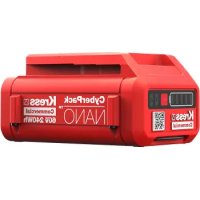
KAC800 - Battery KRESS - Free user manual and instructions
Find the device manual for free KAC800 KRESS in PDF.



| Product Type | Rechargeable Lithium-Ion Battery |
| Brand | Kress |
| Model | KAC800 |
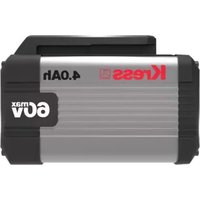
| Voltage | 60 V (max), 54 V nominal |
| Capacity | 4.0 Ah |
| Weight | 1.56 kg |
| Protection Rating | IPX5 |
| Bluetooth | Bands 2400-2483.5 MHz, power 8 dBm |
| Recommended Charging Temperature | 5 °C to 40 °C |
| Optimal Storage Temperature | 5 °C to 25 °C |
| Discharge Temperature | -20 °C to 45 °C |
| LED Indicators | Battery indicator (5 levels), Bluetooth indicator, fault indicator |
| Compatible Charger | KAC840/KAC841/KAC844 (or additional chargers as indicated) |
| Compatible Power Stations | KAC875E, KAC877E |
| Main Functions | Power Kress cordless tools, level indication, Bluetooth connection |
| Maintenance | Clean with a soft, clean, dry brush |
| Safety | Do not open, short-circuit, expose to fire or water; use only with specified chargers |
| Spare Parts and Repairability | No user-serviceable parts; contact an authorized Kress service center |
| General Information | Compliant with EU directives 2023/1542, 2014/53/EU, 2011/65/EU |
Frequently Asked Questions - KAC800 KRESS
User questions about KAC800 KRESS
0 question about this device. Answer the ones you know or ask your own.
Ask a new question about this device
Download the instructions for your Battery in PDF format for free! Find your manual KAC800 - KRESS and take your electronic device back in hand. On this page are published all the documents necessary for the use of your device. KAC800 by KRESS.
USER MANUAL KAC800 KRESS
Introduction. 4
Component List. 6
Safety Instructions 7
Operation Instructions 11
How to charge the battery 12
Storage 12
Transport 13
MaintenanceandService 13
Technical Data. 13
EnvironmentalProtection 14
Declaration of Conformity 14
INTRODUCTION
Dear Customer,
Thank you for buying this Kress Commercial product. We are dedicated to developing high quality products to meet your commercial landscaping requirements.
The Kress brand is synonymous with premium quality service. Over the years of your product's life, if you have any questions or concerns about your product, EN please contact your dealer or our Customer Service Team for assistance.
We are confident you will enjoy working with your Kress product for years to come.
EN
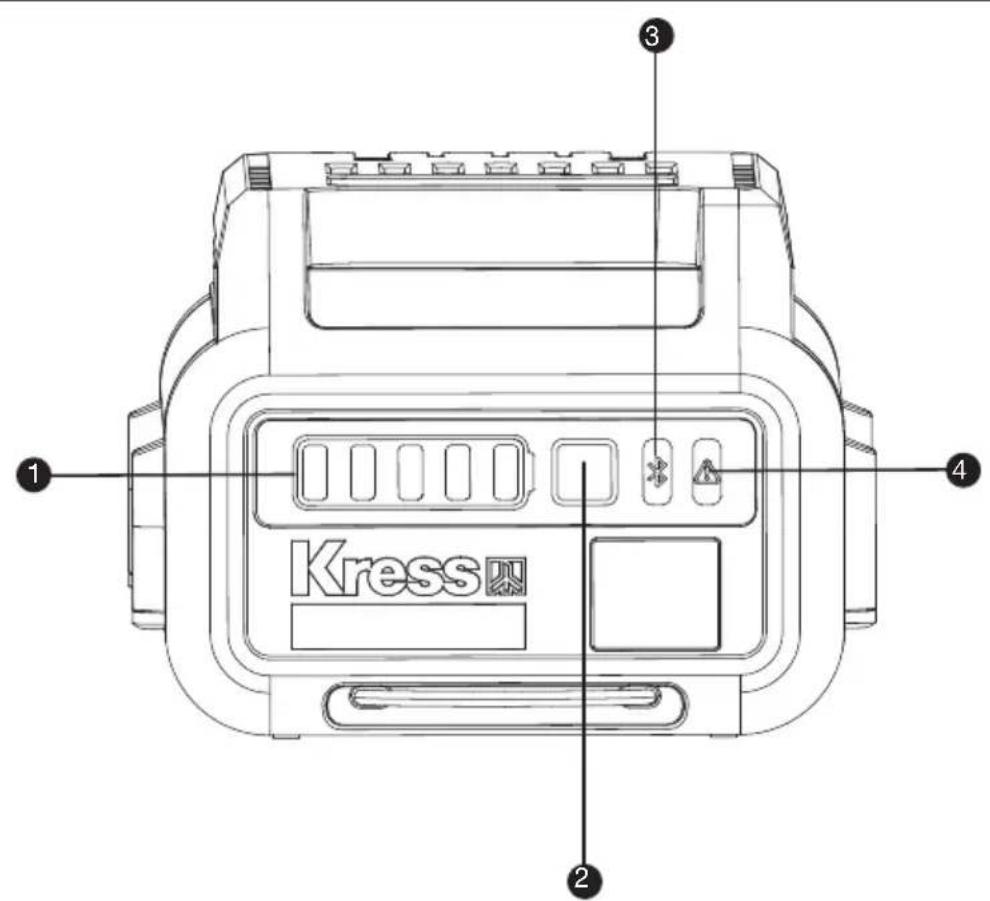
COMPONENT LIST
- BATTERY INDICATOR LIGHT
- POWER TEST BUTTON
- BLUETOOTH INDICATOR LIGHT
- FAULT INDICATOR LIGHT

PRODUCT SAFETY

WARNING Read all safety warnings and all instructions. Failure to follow the warnings
and instructions may result in electric shock, fire and/or serious injury.
Carefully read the instructions for the safe operation of the machine.
Save all warnings and instructions for future reference.
Use battery pack for Kress cordless products only. Refer to the marking label and instruction manual provided with product.
SAFETY WARNINGS FOR BATTERY PACK
a) Do not dismantle, open or shred cells or battery pack.
b) Do not short-circuit a battery pack. Do not store battery packs haphazardly in a box or drawer where they may short-circuit each other or be short-circuited by conductive materials. When battery pack is not in use, keep it away from other metal objects, like paper clips, coins, keys, nails, screws or other small metal objects, that can make a connection from one
terminal to another. Shorting the battery terminals together may cause burns or a fire.
c) Do not expose battery pack to heat or fire. Avoid storage in direct sunlight.
d) Do not subject battery pack to mechanical shock.
e) In the event of battery leaking, do not allow the liquid to come into contact with the skin or eyes. If contact has been made, wash the affected area with copious amounts of water and seek medical advice.
f) Keep battery pack clean and dry.
g) Wipe the battery pack terminals with a clean dry cloth if they become dirty.
h) Battery pack needs to be charged before use. Always refer to this instruction and use the correct charging procedure.
i) Do not maintain battery pack on charge when not in use.
j) After extended periods of storage, it may be necessary to charge and discharge the battery pack several times to obtain maximum performance.
k) Recharge only with the charger specified by Kress. Do not use any charger other than that specifically provided for use with the equipment.
I) Do not use any battery pack which is not designed for use with the equipment.
m) Keep battery pack out of the reach of children.
n) Retain the original product literature for future reference.
o) Remove the battery from the equipment when not in use.
p) Disposetheproperly.
q) Do not mix cells of different manufacture, capacity, size or type within a device.
r) Keep the battery away from microwaves and high pressure.
s) Warning! Do not use non-rechargeable batteries.
EN
ADDITIONAL SAFETY WARNING FOR COMMERCIAL BATTERY PACK
- Use the battery pack for Kress Commercial cordless products only.
- Use the battery pack only with KAC840/KAC841/ KAC844 battery charger or additional battery chargers listed in operator's manual.
-
Use the battery pack only with KAC875E and KAC877E power station or additional power station listed in operator's manual.
-
In order to obtain the best performance, please pay attention to the following ambient temperature range, do not charge, use, or store in the case of exceeding the following temperature range:
a) Charging temperature range: 5^ 40^
b) Discharge temperature range: -20^ 45^
c) Storage temperature range: 5^ - 25^
- To reduce the risk of electric shock, fire and explosion due to short circuits:
a) If the battery is exposed to rain during operation, please remove it from the product and let it dry indoors. Make sure it is completely dry before charging or re-using it.
b) Do not immerse the battery in water or other liquids.
c) Do not bridge battery terminals with wires or other metal objects.
d) The battery pack should be kept away from small conductive metal objects (such as paper clips, nails, coins, keys, etc.).
e) Store batteries indoors in a dry room.
f) Do not store the battery in a humid or corrosive environment, or in an environment that may cause its metal parts to corrode.
g) Protects batteries from exposure to corrosive substances such as gardening chemicals and deicing salts.
h) Never store batteries inside power tools.
i) When storing the battery, keep the battery with a charge between 40% to 60% (3 green lights illuminated).
j) If the battery pack needs to be shipped by air separately, the charge cannot exceed 30%
k) If storing the battery in the charger, disconnect the charger from the outlet.
I) Do not attempt to repair, open or disassemble the battery. There are no user-serviceable parts inside.
m) To reduce the risk of personal injury from accidental activation, always remove the battery before assembling, transporting, adjusting, cleaning, servicing, or storing the power tool.
- A battery fire is dangerous. To reduce the risk of serious personal injury and property damage in the event of a fire:
a) Evacuate the area. Fires can spread quickly. Keep away from any generated gas and fumes and keep a safe distance.
b) Contact the fire department.
c) While water can be used to extinguish battery fires, it is best to use a multi-purpose dry chemical fire extinguisher.
d) Please consult the fire department for proper disposal of burned batteries.
- Leaking battery fluid can cause skin and eye irritation or chemical burns.
a) Avoid contact with skin and eyes.
b) If liquid gets in eyes: Do not rub. Flush open eyes with water for at least 15 minutes, and seek medical advice.
c) In case of accidental contact, wash the contact area immediately and thoroughly with mild soap and water.
d) Use an inert absorbent such as sand on spilled liquid.
USER MANUAL REQUIREMENTS FOR WIRELESS PRODUCT
a) Operation of this device is subject to the following two conditions:
(1) This device may not cause harmful interference, and
(2) this device must accept any interference received, including interference that may cause undesired operation.
b) Caution: Changes or modifications to this unit not expressly approved by the party responsible for compliance could void the user's authority to operate the equipment.
c) NOTE: This equipment generates, uses and can radiate radio frequency energy and, if not installed and used in accordance with the
instructions, may cause harmful interference to radio communications. However, there is no guarantee that interference will not occur in a particular installation. If this equipment does cause harmful interference to radio or television reception, which can be determined by turning the equipment off and on, the user is encouraged to try to correct the interference by one or more of the following measures:
- Reorient or relocate the receiving antenna.
- Increase the separation between the equipment and receiver.
- Connect the equipment into an outlet on a circuit different from that to which the receiver is connected.
- Consult the dealer or an experienced radio/TV technician for help.
SYMBOLS

Read the operator's manual
| Li-ON Li-on battery This product has been marked with a symbol relating to 'separate collection' for all battery packs and battery pack. It will then be recycled or dismantled in order to reduce the impact on the environment. Battery packs can be hazardous for the environment and for human health since they contain hazardous substances. | Li-ON battery This product has been marked with a symbol relating to 'separate collection' for all battery packs and battery pack. It will then be recycled or dismantled in order to reduce the impact on the environment. Battery packs can be hazardous for the environment and for human health since they contain hazardous substances. |
| Environmentally friendly disposal Old electrical appliances must not be disposed of together with the residual waste, but have to be disposed of separately. The disposal at the communal collecting point via private persons is for free. The owner of old appliances is responsible to bring the appliances to these collecting points or to similar collection points. With this little personal effort, you contribute to recycle valuable raw materials and the treatment of toxic substances. | |
| Do not burn |

Batteries may enter water cycle if disposed improperly, which can be hazardous for ecosystem. Do not dispose of waste batteries as unsorted municipal waste.
OPERATION INSTRUCTIONS
Recommendations for optimal handling of the battery
Note:
- Your battery pack is partly charged and needs to be fully charged before first use. To ensure full capacity of the battery, completely charge the battery in the battery charger before using your battery in the power tool for the first time.
- A battery pack will slowly lose its charge when kept out of the charger or left in an unplugged charger for a long time. It may need to be recharged before use.
The CyberPack Nano can be used with a backpack, please refer to the backpack manual for details.
When over-discharge, over-charge, over-temperature and low-temperature faults occur while the battery pack is being charged on the charger or used on the
machine, the user will receive a fault prompt, and the charger or the machine will stop charging or working.
The Li-lon battery can be charged at any time without reducing its service life. Interrupting the charging procedure does not damage the battery.
Avoid dropping the device or battery. If the device or battery is dropped, especially on a hard surface, and the user suspects damage, take it to a service center for inspection.
The battery level can be determined from the battery indicator light by pressing the power test button. Before starting or after use, press the power test button on the battery pack to check the battery capacity.
| Remarks LED light Battery condition | ||
| Five green lights are illuminated. | 80% ≤ Power level ≤ 100% | |
| Four green lights are illuminated. | 60% ≤ Power level < 80% | |
| Three green lights are illuminated. | 40% ≤ Power level < 60% | |
| Two green lights are illuminated. | 20% ≤ Power level < 40% | |
| One green light is illuminated. | 10% ≤ Power level < 20% | |
| One green light is flashing. | 0% ≤ Power level < 10% |
You can see the relevant status of the battery through the status of the Bluetooth indicator light and the fault indicator light.
| Remarks Battery | condition |
| Bluetooth indicator light is illuminated. | Bluetooth is connected. |
| Bluetooth indicator light is not illuminated. | Bluetooth is not connected. |
| Fault indicator light is illuminated. | Battery failure, prohibit charging and discharging. |
| Fault indicator light is not illuminated. | It is normal. |
When the battery pack fails, the fault indicator will light up, and you can view the specific fault cause and solution through the APP.
HOW TO CHARGE THE BATTERY
Refer to the instruction manual for charger.
STORAGE
Store the battery only within a ambient temperature range between 5 25^
When kept out of the charger or left in an unplugged charger for a long time, the battery still reaches a relatively high level.
A significantly reduced working period after charging indicates that the battery is used and must be replaced.
TRANSPORT
The contained Li-ion batteries are subject to the dangerous goods legislation requirements. The user can transport the batteries by road without additional requirements.
Dispatch batteries only when the battery housing is undamaged. Pack up the batteries in such a manner that cannot move around in the packaging.
MAINTENANCE AND SERVICE
Occasionally clean the battery with a soft, clean and dry brush.
When the battery is no longer operative, please refer to an authorized after-sales service agent for Kress power tools.
TECHNICAL DATA
| KAC800 | |
| Rated voltage | 60 V --- MAX* |
| Battery capacity | 4.0 Ah |
| Recommended Ambient Temperature for Charging | 5~40°C |
| Optimum Storage Temperature in Use | 5~25°C |
| Battery Weight | 1.56 kg EN |
| Degree of protection | IPX5 |
| Frequency bands for Bluetooth | 2400-2483.5 MHz |
| Maximum Output Power for Bluetooth | 8 dBm |
- Voltage measured without workload. Initial battery voltage reaches maximum of 60 volts. Nominal voltage is 54 volts.
ENVIRONMENTAL PROTECTION
Waste electrical products must not be disposed of with household waste. Please recycle where facilities exist. Check with your local authorities or retailer for recycling advice.
DECLARATION OF CONFORMITY
EN
We,
Positec Germany GmbH
Postfach 680194, 50704 Cologne, Germany
Declare that the product,
Description Battery pack
Type KAC800
Function Provide energy for power tools, garden tools and similar products
Complies with the following Directives:
(EU)2023/1542, 2014/53/EU, 2011/65/EU & (EU) 2015/863
Standards conform to, EN 62133-2
ETSI EN 301 489-1 V2.2.3 (2019-11)
ETSI EN 301 489-17 V3.2.4 (2020-09)
EN IEC 62368-1:2020+A11:2020
EN IEC 63000
The person authorized to compile the technical file,
Name Marcel Filz
Address Positec Germany GmbH
Postfach 680194, 50704 Cologne, Germany


2024/01/06
Allen Ding
Deputy Chief Engineer Testing & Certification
Positec Technology (China) Co., Ltd
18, Dongwang Road, Suzhou Industrial
Park, Jiangsu 215123, P. R. China
DECLARATION OF CONFORMITY
We,
Positec (UK & Ireland) Ltd
PO Box 6242, Newbury, RG14 9LT, UK
Declare that the product,
Description Battery pack
Type KAC800
Function Provide energy for power tools, garden
tools and similar products
Complies with the following Regulations:
The Batteries and Accumulators (Placing on the Market) Regulations 2008 (as amended) and the Waste Batteries and Accumulators Regulations 2009 (as amended)
Radio Equipment Regulations 2017
The Restriction of the Use of Certain Hazardous
Substances in Electrical and Electronic Equipment
Regulations 2012
Standards conform to,
BS EN 62133-2,
BS ETSI EN 301 489-1 V2.2.3 (2019-11)
BS ETSI EN 301 489-17 V3.2.4 (2020-09)
BS ETSI EN 300 328 V2.2.2 (2019-07)
BS EN IEC 62311: 2020
BS EN IEC 62368-1:2020+A11:2020
BS EN IEC 63000
The person authorized to compile the technical file,
Name Jim Kirkwood
Address Positec (UK & Ireland) Ltd,
PO Box 6242, Newbury, RG14 9LT, UK

EN
2024/01/06
Allen Ding
Deputy Chief Engineer Testing & Certification
Positec Technology (China) Co., Ltd
18, Dongwang Road, Suzhou Industrial
Park, Jiangsu 215123, P. R. China
INHALTSVERZEICHNIS
Einführung 17
Koponenten 19
EN IEC 62368-1:2020+A11:2020
EN IEC 63000
18, Dongwang Road, Suzhou Industrial
Park, Jiangsu 215123, P. R. China
INDICE
EN IEC 62368-1:2020+A11:2020
ENIEC63000
Positec Technology (China) Co., Ltd 18, Dongwang Road, Suzhou Indust
Park, Jiangsu 215123, P. R. China
INDICE
Introducao 69
71
Manutencao e service. 79
MANUTENCAO E SERVICO
LEN IEC 62368-1:2020+A11:2020
ENIEC63000
18, Dongwang Road, Suzhou Industrial
Park, Jiangsu 215123, P. R. China
INHOUDSOPGAVE
EXTRA VEILIGHEIDSWAARSCHUWING VOOR COMMERCELE ACCU'S
EN IEC 62368-1:2020+A11:2020
EN IEC 63000
18, Dongwang Road, Suzhou Industrial
Park, Jiangsu 215123, P. R. China
TARTALOMJEGYZÉK
18, Dongwang Road, Suzhou Industrial
Park, Jiangsu 215123, P. R. China
CUPRINS
Positec Technology (China) Co., Ltd 18, Dongwang Road, Suzhou Indust
Park, Jiangsu 215123, P. R. China
SPIS TRESCI
EN IEC 62368-1:2020+A11:2020
ENIEC63000
18, Dongwang Road, Suzhou Industrial
Park, Jiangsu 215123, P. R. China
OBSAH
Uvod. 133
EN IEC 62368-1:2020+A11:2020
ENIEC63000
18, Dongwang Road, Suzhou Industrial
Park, Jiangsu 215123, P. R. China
OBSAH
Occasionally clean the battery with a soft, clean and dry brush.
Positec Technology (China) Co., Ltd 18, Dongwang Road, Suzhou Industrial Park, Jiangsu 215123, P. R. China
KAZALO VSEBINE
Uvod. 157
Sestavni deli 159
Varnost izdelka 160
Navodila za uporabo. 164
SL Polnjenje akumulatorja 166
Shranjevanje 166
Transport 166
Vzdrzevanje in servisiranje 166
Tehnični podatki 166
Varovanje okolja. 167
Izjava o skladnosti 167
UVOD
Spostovana stranka,
EN IEC 62368-1:2020+A11:2020
ENIEC63000
Oseba, ki je pooblašcena za skladnost tehnicihnekodumentacije,
Ime Marcel Filz
Naslov Positec Germany GmbH
Postfach 680194, 50704 Cologne, Germany


2024/01/06
Allen Ding
Deputy Chief Engineer Testing & Certification
Positec Technology (China) Co., Ltd
18, Dongwang Road, Suzhou Industrial
Park, Jiangsu 215123, P. R. China
SADRžAJ
Uvod 169
Popis componenti 171
Sigurnost proizvoda 172
Upute za upotrebu 176
HR Punjenje baterije 177
Skladištenje 177
Transport 178
Održavanje i servisiranje 178
Tehnicki podaci 178
Zašita okoliša 179
Deklaracija usklaedenosti 179
UVOD
Postovani,
EN IEC 62368-1:2020+A11:2020
ENIEC63000
Osoba ovlastena za sastavljanje tehnicke dokumentacije,
Ime Marcel Filz
Adresa Positec Germany GmbH
Postfach 680194, 50704 Cologne, Germany

2024/01/06
Allen Ding
Zamjenik šefa inženjeringa, Testiranje i certifikacija
Positec Technology (China) Co., Ltd
18, Dongwang Road, Suzhou Industrial
Park, Jiangsu 215123, P. R. China
INDHOLDSFORTEGNEALSE
EN IEC 62368-1:2020+A11:2020
ENIEC63000
18, Dongwang Road, Suzhou Industrial
Park, Jiangsu 215123, P. R. China
SISÄLLYSLUETTELO
Standards conform to,
EN 62133-2
ETSI EN 301 489-1 V2.2.3 (2019-11)
ETSI EN 301 489-17 V3.2.4 (2020-09)
18, Dongwang Road, Suzhou Industrial
Park, Jiangsu 215123, P. R. China
INNHOldFOrTEGNEsE
Introduksjon. 205
Koponentliste. 207
Produktikheret 208
Driftsinstrukser 212
Lading av batteripakken 213
Lagring 213
Transport 213
Service og vedlikehold 214
Tekniske data. 214
Miljoverntiltak. 214
Samsvarserklaring 215
INTRODUKSJON
Kjarekunde,
SERVICE OG VEDLIKEHOLD
EN IEC 62368-1:2020+A11:2020
EN IEC 63000
18, Dongwang Road, Suzhou Industrial
Park, Jiangsu 215123, P. R. China
INNEHÄLLSFORTECKNING
WARNING! LAs ALLA INSTRUKTIONER.
18, Dongwang Road, Suzhou Industrial
Park, Jiangsu 215123, P. R. China

Copyright © 2024, Positec. All Rights Reserved.
AR01749101

- INTRODUCTION
- COMPONENT LIST
- PRODUCT SAFETY
- SAFETY WARNINGS FOR BATTERY PACK
- EN
- ADDITIONAL SAFETY WARNING FOR COMMERCIAL BATTERY PACK
- USER MANUAL REQUIREMENTS FOR WIRELESS PRODUCT
- SYMBOLS
- OPERATION INSTRUCTIONS
- Recommendations for optimal handling of the battery
- Note:
- HOW TO CHARGE THE BATTERY
- STORAGE
- TRANSPORT
- MAINTENANCE AND SERVICE
- ENVIRONMENTAL PROTECTION
- DECLARATION OF CONFORMITY
- INHALTSVERZEICHNIS
- INDICE
- MANUTENCAO E SERVICO
- INHOUDSOPGAVE
- EXTRA VEILIGHEIDSWAARSCHUWING VOOR COMMERCELE ACCU'S
- TARTALOMJEGYZÉK
- CUPRINS
- SPIS TRESCI
- OBSAH
- KAZALO VSEBINE
- UVOD
- SADRžAJ
- INDHOLDSFORTEGNEALSE
- SISÄLLYSLUETTELO
- INNHOldFOrTEGNEsE
- INTRODUKSJON
- SERVICE OG VEDLIKEHOLD
- INNEHÄLLSFORTECKNING
- WARNING! LAs ALLA INSTRUKTIONER.
Brand : KRESS
Model : KAC800
Category : Battery