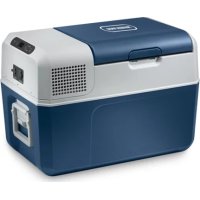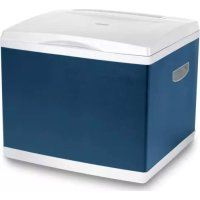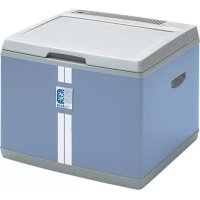
B40 ACDC - Refrigerator Mobicool - Free user manual and instructions
Find the device manual for free B40 ACDC Mobicool in PDF.



| Product type | Hybrid cooler (mobile refrigerator) |
| Brand | Mobicool |
| Model | B40 ACDC |
| Gross capacity | 40 L |
| Dimensions (L × D × H) | 520 × 510 × 450 mm |
| Weight | approx. 21 kg |
| Power supply | 12 V DC (cigarette lighter socket) or 220-240 V AC, 50 Hz |
| Power consumption | 47 W (12 V) / 65 W (230 V) |
| Cooling type | Thermoelectric (12 V) and compressor (230 V) |
| Temperature range (compressor) | +12 °C to -15 °C, continuously adjustable |
| Thermoelectric performance | Up to 20 °C below ambient temperature |
| Refrigerant | 38 g |
| Thermostat | Yes, with protective cover |
| Included parts | User manual, 12 V cable, 230 V cable |
| Optional accessory | 24/12 V DC/DC transformer (ref. Y24) |
| Intended use | Camping, travel, vehicles (car, boat, motorhome) |
| Maintenance and cleaning | Damp cloth, do not immerse, no abrasive products |
| Safety | Residual current device recommended on boat; 5 A fuse at 12 V |
Frequently Asked Questions - B40 ACDC Mobicool
User questions about B40 ACDC Mobicool
0 question about this device. Answer the ones you know or ask your own.
Ask a new question about this device
Download the instructions for your Refrigerator in PDF format for free! Find your manual B40 ACDC - Mobicool and take your electronic device back in hand. On this page are published all the documents necessary for the use of your device. B40 ACDC by Mobicool.
USER MANUAL B40 ACDC Mobicool
Our Name is our Mission
B40
DC/AC
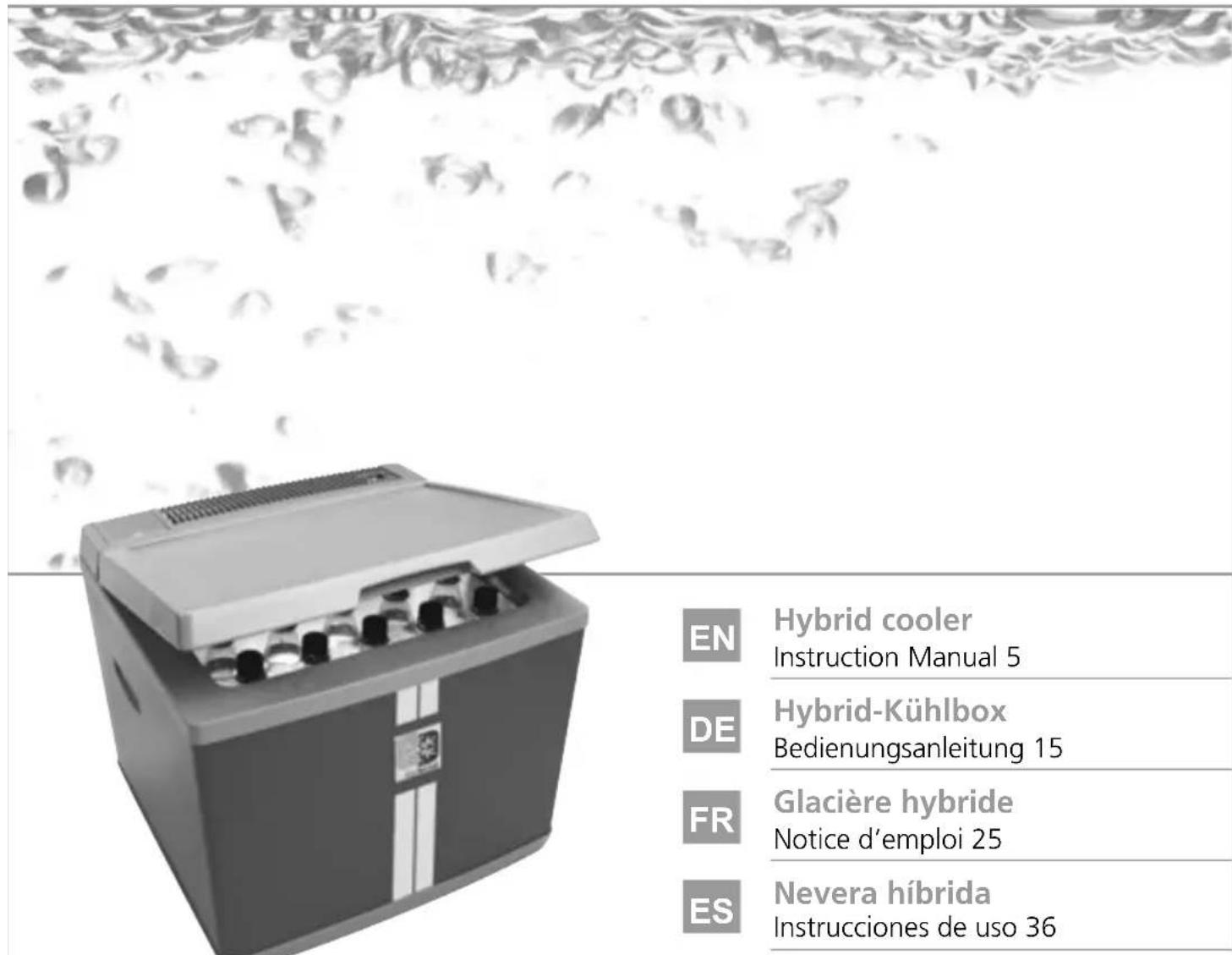
T Frigorifero ibrido
Please read this operating manual carefully before starting the device. Keep it in a safe place for future reference. If the device is resold, this operating manual must be handed over to the purchaser along with it.
The manufacturer cannot be held liable for damage resulting from improper usage or incorrect operation.
Contents
1 Notes on using the instruction manual. 5
2 Safety instructions 6
3 Intended use 8
4 Scope of delivery 8
5 Accessories 9
6 Technical description 9
7 Operation 10
8 Cleaning and maintenance 12
9 Troubleshooting 13
10 Disposal 13
11 Technical data 14
Please observe the following safety instructions.
1 Notes on using the instruction manual
The following symbols are used in this operating manual:

DANGER!
Safety instruction: Failure to observe this instruction will cause fatal or serious injury.

WARNING!
Safety instruction: Failure to observe this instruction can cause fatal or serious injury.

CAUTION!
Safety instruction: Failure to observe this instruction can lead to injury.

NOTICE!
Failure to observe this instruction can cause material damage and impair the function of the product.

NOTE
Supplementary information for operating the product.
Action: This symbol indicates that action is required on your part. The required action is described step-by-step.
This symbol describes the result of an action.
fig. 1 5, page 3: This refers to an element in an illustration. In this case, item 5 in figure 1 on page 3.
Please observe the following safety instructions.
2 Safety instructions
2.1 General safety

DANGER!
- On boats: If the appliance is powered by the mains, ensure that the power supply has a residual current circuit breaker.

WARNING!
- Do not operate the device if it is visibly damaged.
- This device may only be repaired by qualified personnel. Improper repairs can lead to considerable hazards.
- Persons whose physical sensory or mental capacities prevent them from using this device safely should not operate it without the supervision of a responsible adult.
- Electrical devices are not toys.
Always keep and use the device out of the reach of children.
Children must be supervised to ensure that they do not play with the device.
- If this device's power cable is damaged, it must be replaced by the manufacturer, customer service or a similarly qualified person in order to prevent safety hazards.

CAUTION!
-
Disconnect the device from the mains
-
before cleaning and maintenance
-
a f t e r u s e
-
Food may only be stored in its original packaging or in suitable containers.

NOTICE!
- Only connect the device as follows:
- With the 12V cable to a 12V plug socket in the vehicle (e. g. cigarette lighter)
- Or with the 230 V connection cable to the 230 V AC mains supply
- Check that the voltage specification on the type plate corresponds to that of the energy supply.
- The cooling device is not suitable for transporting caustic materials or materials containing solvents.
- Never pull the plug out of the socket by the cable.
- If the cooler is connected to the 12V socket: Disconnect the cooler and other power consuming devices from the battery before connecting the quick charging device.
- If the cooler is connected to the 12V socket: Disconnect the cooler or switch it off when you turn off the engine. Otherwise, you may discharge the battery.
2.2 Operating the device safely

DANGER!
- Do not touch exposed cables with your bare hands. This especially applies when operating the device with an AC mains power supply.

CAUTION!
- Before starting the device, ensure that the power supply line and the plug are dry.

NOTICE!
-
Do not use electrical devices inside the cooler unless they are recommended by the manufacturer for the purpose.
-
Do not place the device near naked flames or other heat sources (heaters, direct sunlight, gas ovens etc.).
Danger of overheating!
Ensure at all times that there is sufficient ventilation so that the heat that arises during operation does not build up. Make sure that the device is sufficiently far away from walls and other objects so that the air can circulate.
- Ensure that the ventilation slots are not covered.
- Do not fill the inner container with ice or fluid.
- Never immerse the device in water.
- Protect the device and the cable against heat and moisture.
3 Intended use
In compressor mode the cooler is suitable for cooling and deep freezing foodstuffs. In thermoelectric mode the cooler is only suitable for cooling foodstuffs.
The device is designed for use with:
- a 12 V vehicle electrics socket of a car (such as a cigarette lighter), boat or caravan (see voltage specification on the type plate)
a 230 V AC mains supply
The appliance may also be used for camping use. The appliance shall not to be exposed to rain.

CAUTION! Health hazard!
If you wish to cool medicines, please check if the cooling capacity of the device is suitable for the medicine in question.
4 Scope of delivery
No. in Quantity Description
1.1 Cooling device
-1 Instruction manual
5 Accessories
Designation Description
Y24 24/12 DC/DC converter
for connecting 12-V--- cooling device to 24 V---
6 Technical description
The hybrid cooler is suitable for portable use. It is equipped with two separate cooling systems. The device features a Peltier cooling system with heat discharged by a fan, as well as a compressor cooling system. The cooling system is non-wearing.
In thermoelectric mode (connection to 12V = ), it can cool goods down to max. 20^ below ambient temperature and keep them cool. In compressor mode (connection to 230V ), it can cool goods down to -15^ and keep them cool.
In compressor mode, you can use the continuously variable thermostat to set the temperature within a range from +12^ to -15^ .
6.1 Description of the device
No. in
fig. 2, page 3
Description
1 Handle
2 Ventilation slots
3 Thermostat
7 Operation

CAUTION! Health hazard!
Food may only be stored in its original packaging or in suitable containers.

NOTE
- Before starting your new cooling device for the first time, you should clean it inside and outside with a damp cloth for hygienic reasons (please also refer to the chapter "Cleaning and maintenance" on page 12).
- A few water drops may form inside the cooler if it has been cooling for a lengthy period. This is normal because the moisture in the air condenses to water when the temperature in the cooler falls. The cooler is not defective. Wipe it out with a dry cloth if necessary.
7.1 Energy saving tips
- Choose a well ventilated installation location which is protected against direct sunlight.
- Allow warm food to cool down first before placing it in the device to keep cool.
- Do not open the cooling device more often than necessary.
- Do not leave the cooler unit open for longer than necessary.
7.2 Using the cooler

NOTICE! Risk of damage
- Only operate the device from a single energy source.
Simultaneous use of the thermoelectric cooling system and the compressor is not permitted.
- Ensure that the objects or goods placed in the cooling device are suitable for cooling to the selected temperature.
- Ensure that food or liquids in glass containers are not excessively refrigerated. Liquids expand when they freeze and can therefore destroy glass containers.
- Ensure that your cooler is well ventilated so that any heat created can dissipate. Otherwise proper functioning cannot be ensured. It is especially important not to cover the air vents.
Place the cooler on a firm base.
Connecting the cooler to 12 V (thermoelectric mode)

NOTE
In thermoelectric mode, the thermostat has no function and the device cannot deep freeze.
Make sure the cable between the cooler and the battery is protected by a fuse (maximum 5 A).
Plug the 12-V connection cable (fig. 1 2, page 3) into the cigarette lighter socket or a 12-V socket in the vehicle.
✓The cooler starts cooling the interior.
To switch off the cooler:
- Disconnect the plug.
- Wind the cable around the two holders on the back of the device for storage.

NOTE
Disconnect the cooler from the battery when the engine is not running, as otherwise the battery will run down.
Connecting the cooler to 230 V (compressor mode)
Connect the 230-V connection cable (fig. 1 3, page 3) to the 230-V AC mains supply.
Open the lid of the thermostat (fig. 2 3, page 3) by pressing down on it.

NOTE
Press down on the lid again to close it.
Turn the thermostat (fig. 2 3, page 3) clockwise to the required position.

NOTE
The further you turn the thermostat towards "MAX", the lower the refrigerating temperature.
√The cooler starts cooling the interior.
To switch off the cooler:
- Turn the thermostat (fig. 2 3, page 3) anti-clockwise to "0".
- Disconnect the plug.
- Wind the cable around the two holders on the back of the device for storage.
7.3 Connecting to the cigarette lighter

NOTE
If you connect the cooler to the cigarette lighter, remember that the ignition must be turned on to supply it with power.
8 Cleaning and maintenance

WARNING!
Always disconnect the device from the mains before you clean and service it.

NOTICE! Risk of damage
- Never clean the cooler under running water or in dish water.
- Do not use abrasive cleaning agents or hard objects during cleaning as these can damage the cooler.
Occasionally clean the device interior and exterior with a damp cloth.
9 Troubleshooting
| Problem Possible cause Suggested remedy | ||
| Your device is not working (plug is inserted). | There is no voltage flowing from the DC socket (cigarette lighter) in your vehicle. | The ignition must be switched on in most vehicles to supply current to the cigarette lighter. |
| No voltage present in the AC voltage socket. | Try using another plug socket. | |
| The inner fan or the cooling element or the compressor is defective. | This can only be repaired by an authorised repair centre. | |
| When operating from the DC socket (cigarette lighter): The ignition is on and the cooler is not working. | The fuse of the DC plug is dirty. This results in a poor electrical contact. | If the plug of your cooler becomes very warm in the DC socket fitting, either the fitting must be cleaned or the plug has not been assembled correctly. |
| The fuse of the DC plug has blown. | Replace the fuse of the DC plug with one of the same rating (fig. 31, page 4). | |
| The vehicle fuse has blown. | Replace the vehicle's DC socket fuse (usually 15 A). Please refer to the operating manual of your vehicle. | |
10 Disposal
Place the packaging material in the appropriate recycling waste bins wherever possible.
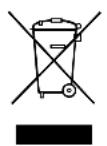
If you wish to finally dispose of the product, ask your local recycling centre or specialist dealer for details about how to do this in accordance with the applicable disposal regulations.
11 Technical data
| B40 DC/AC | |
| Gross capacity: 40 litres | |
| Voltage: 12 V=220-240 V~, 50 Hz | |
| Power consumption: DC: 47 W | AC: 65 W |
| Cooling capacity: Thermoelectric mode (12 V): Compressor mode (230 V): | max. 20 °C under ambient temperature continuously variable from +12 °C to -15 °C |
| Amount of coolant: 38 g | |
| Weight: approx. 21 kg | |
| Dimensions (mm): | 520 x 510 x 450 |
| Inspection/certification: | CE Ε4 TUV GS |
Versions, technical modifications and delivery options reserved.