USER MANUAL XP4020 KRUPS
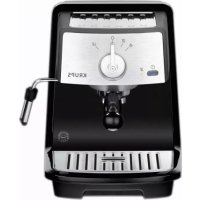
a Tank lid
b Removable water tank
C Warming plate for cups
d Steam / coffee selector
e Start/Stop switch with indicator light (blue)
f Temperature control light (orange)
g Brewing head
h Steam nozzle
i Cappuccino accessory
j Drip tray grid
k Drip tray
I Filter holder
m Filter for one or two cups (ground coffee)
n ESE filter
Storage for filter sieves
p «Claris - Aqua Filter System» water filter F088 (accessory not provided)
q Measuring spoon
Safety recommendations

It complies with the requirements of the EEC Directive (89/336/EEC).
- Never put your espresso on a hot surface (electric warming plate, for example) or close to a flame. Place on a flat, stable, heat resistant surface;
- Never remove the filter holder containing the coffee grounds while water is being passed through, since the appliance is under pressure at this time.
- Never use the appliance if the drip tray and the grid are not in position.
- Disconnect the electricity if there is any problem while the coffee is brewing or prior to cleaning your appliance.
-
Never unplug the appliance by pulling on the cord and never lay the cord across a sharp edge or the corner of an item of furniture.
-
Do not allow the cable or your hands to come into contact with the hot parts of the appliance (cup warming plate, filter holder, steam nozzle, cappucino accessory).
- Never immerse the appliance in water.
- Keep away from children and do not allow the cord to hang down.
- Follow the instructions given for descaling.
- Never start the machine if it is damaged or if the cord is in poor condition.
- If the cord or any other specific part becomes defective, these can only be replaced by a Krups approved service centre. You must never, under any circumstances, open the appliance yourself.
- Check that the filter holder is pushed well down before starting the coffee and reset the selector to 0 before releasing the filter holder.
- Do not leave the appliance in the reach of unsupervised children - young children and severely handicapped persons must only use the appliance under the supervision of a responsible adult.
- This appliance has been designed for domestic use only. Any commercial use, inappropriate use or failure to comply with the instructions, the manufacturer accepts no responsibility and the guarantee will not apply.
Espresso coffee
Espresso coffee is richer in aroma and stronger than normal coffee. It is drunk from small preheated espresso cups. Hot water is passed through the ground coffee to obtain this delicious black coffee, which has an invigorating effect.
You can recognise an espresso by its characteristic aroma and its typical froth. But this requires high pressure and an excellent espresso coffee which has been well roasted and correctly ground. If you cannot buy espresso ground coffee, use a coffee grinder to grind the beans. The coffee must not be ground too fine. It must be slightly granulated. If it is too fine, you risk blocking the grid of the brewing head and the filter.
To obtain sufficient froth with a good colour, it is normal that the flow rate of the coffee is slower than with a filter coffee machine.
To guarantee complete success for your.
espresso, you must also use freshly-drawn tap water (so that it has not had time to stagnate in the air), without any chlorine odour and at a fairly cold temperature.
Only use espresso ground coffe. Do not use any other type of coffee eg. distant, filter, cafetière.
Before first using your machine
Before using your appliance for the first time, clean the water heating system, without coffee in the filter holder, filling the water tank once or twice, as follows:
- Open the lid and lift out the water tank using the handle (1). Fill with water (2).
- Replace the tank, positioning it firmly to ensure that water can enter, and close the lid (3).
- Switch the appliance on by pressing button (e) (4). The pump will work for 2 seconds to fill the system with hot water for a cup a hot coffee from the start.
- Your espresso maker is equipped with three filters designed for 1 cup, or for 2 cups of espresso using ground coffee, or for E.S.E. (Easy Serving Espresso) pods. The first comes in the filter holder (l), the other two are found in the appliance's transport packaging.
- Choose the filter you wish to use and place it in the filter holder (5). Put the other two away in the tank lid (a).
-
To ensure that the filter holder is in the correct position, turn the handle so it points to the left (6), place the filter holder flat against the brewing head, then turn the handle towards the right (7) as far as it can go. Ensure it is properly engaged. Please note that the filter holder does not have to be in a central position as long as it is being held firmly in place.
-
Place a container, as large as possible, beneath the filter holder (8).
- As soon as the orange indicator light goes off, turn the selector to the setting (9) and allow all the water in the water tank to run through.
- If necessary, you can stop the operation by turning the selector to the O setting to empty the container, then resume the operation.
As accessories, there is a filter cartridge (N° art. F088 not delivered with the appliance).
Using the various functions of your espresso machine
1. ESPRESSO FUNCTION
The appliance will pre-brew the coffee before making each cup in order to bring out the full flavour for a satisfying cup of coffee. The pump will work for 3 seconds, stop for 3 seconds, then continue with the cycle until the end of the process.
WITH GROUND COFFEE
For best results, we recommend that you first pre-heat the accessories (filter holder, filter and cups) without putting in ground coffee. To do this:
- Fill the water tank (1) (2) (3) and start the appliance (4).
- Put the filter holder in place (6) (7), and place the espresso cups underneath.
As soon as the appliance reaches the correct temperature the orange indicator light will go out.
- Turn selector to the setting (10). Take the pre-brewing into account.
- When the cups are full of hot water, reset the selector to the O setting.
Once the appliance is hot, the espresso cups can then be pre-heated on the cup warming plate.
. Preparing an espresso :
- Fill the water tank (1) (2) (3) and start the appliance (4).
- Put the filter for one or two cups into the filter holder (5).
- Put one or two measures of ground coffee into the filter with the measuring spoon and tamp down using the measuring spoon (11) (12).
- Remove any ground coffee which is lying around the filter (13).
- Replace the filter holder (6) (7).
- Place one or two espresso cups beneath the filter holder.
As soon as the appliance reaches the correct temperature the orange indicator light will go out.
- Then turn the selector to the setting (9) (10). Take the pre-brewing into account.
- When the cups are full, reset the selector to the O setting.
- Remove the filter holder and the filter from the machine, and take out the coffee grounds (14).
The filter can be refilled to make more.
espressos.
. WITH THE SPECIAL "ESE" FILTER
The E.S.E. system was designed for making Italian-style "espresso ristreto" (squeezed). The amount of coffee is 35ml and the water should take 20 seconds to run through. ESE , which stands for "Easy Serving Espresso", is a selected measure of coffee, ground and pressed between two filter papers making it ready for use. This system makes it easy for you to prepare your espresso because you avoid the measurement and tamping down operations and it also makes it easier for you to clean the appliance.
We do not intend, or recommend, that the ESE servings are used for making a long coffee.
We recommend that you take care, when handling and storing the ESE servings, that they do not become deformed.
For best results, we recommend that you preheat the accessories (filter holder, filter and cups) without any coffee. To do this, make as above espresso function.
. Preparing an espresso:
- Fill the water tank (1) (2) (3) and start the appliance (4).
- Place the ESE serving in the ESE filter (18).
Tear excess paper from pod at perforated edge. Place the ESE pod with the RED MARKING FACE DOWN (bend the paper corners down).
- Take care to put all the paper inside the filter or you will have some drips.
Placing the ESE pod correctly will create a richer, thicker crema.
- Put the filter holder in place (6) (7) (8) by pressing it firmly to the right.
- Once the appliance reaches the correct temperature, the orange temperature control light will go out.
- Then turn the selector to the setting (9). Take the pre-brewing into account.
- When the recommended quantity of coffee has been reached (35 ml) turn the selector to the O position.
- Remove the filter holder from the brewing head and throw away the used measure.
2. STEAM FUNCTION
The tapping noise which occurs while steam is being produced comes from the intermittent regulation of the pump and has no effect on the proper working of the appliance.
If you wish to make an espresso immediately after steam, the appliance must first be allowed to cool down in order to achieve the correct temperature for preparing an espresso.
- When you turn the selector to the O setting, the appliance automatically cools down, launching 3 pumping cycles. The cold water pumped in this way cools down the heating system. During the pumping cycles, the excess steam contained in the heating system is released along with hot water into the drip tray. The release of steam and
the accompanying noise are required for the appliance to cool down.
Beware: during and after use of the machine, the metallic parts of the cappuccino accessory can become very hot.
1. Using the cappuccino accessory
The cappuccino accessory makes it easy to produce frothy milk for making a cappuccino.
- Fill the water tank (1) (2) (3) and start the appliance (4).
- Move the cappucino accessory to the exterior of the appliance.
- Pour about 100ml (3 oz) of very fresh, very cold milk into a small, narrow container with a capacity of about 0.5 litres which will fit under the cappuccino accessory. The milk and its container must be well chilled (so it is not advisable to run the container under hot water before frothing the milk).
If you do not achieve a good froth it is worth experimenting with different brands of milk as some milk brands will froth better than others. UHT milk will always give a very good froth.
- Turn the selector to the MW setting (16).
Once the appliance reaches the right temperature, the orange temperature control light will go out.
- Place a container under the steam nozzle and turn the steam tap to max position.
- Let the water flow until steam appears, then turn the tap back to position 0.
You can now start to prepare frothy milk.
- Hold the container under the cappuccino accessory in such a way that the tip is immersed in the milk.
- Turn the selector to the setting (17). Keep the container straight during this operation. Do not allow the tip of the cappuccino accessory to touch the bottom of the container because this could obstruct the passage of the steam.
- Once the froth has been produced, turn the selector to the nutting (16) for the following cleaning operation in order to
prevent the milk from drying on the cappuccino accessory:
- remove the container.
- place a container with water under the cappuccino accessory.
- select the setting again (17) to remove the milk residue.
- turn the selector to the O setting.
- clean the cappuccino accessory with a damp cloth.
For more thorough cleaning of the cappuccino accessory, please refer to the paragraph on maintenance.
. Heating liquids
- Fill the water tank (1) (2) (3) and start the appliance (4).
- Move the cappuccino accessory to the exterior of the appliance.
- Turn the selector to the NW setting (16).
Once the appliance reaches the correct temperature, the orange temperature control light will go out.
- Immerse the cappuccino accessory in the container holding the liquid to be heated.
- Then turn the selector to the setting (17) until the liquid is hot enough, then reset the selector to the O setting and remove the container.
- For liquids other than water, turn the selector to the setting (16) for the following cleaning operation in order to prevent any blockage of the opening of the cappuccino accessory:
- place a container with water below the cappuccino accessory.
- select the setting again (17) to remove the residue of the liquid.
- turn the selector to the setting O.
- Clean the cappuccino accessory with a damp cloth.
- For more thorough cleaning of the cappuccino accessory, please refer to the paragraph on maintenance.
Maintenance
- Never wash your espresso machine accessories in the dishwasher.
After use, the water tank must be emptied.
. Drip tray
This must be emptied after using the appliance after taking off the grid (19). If several espressos are being prepared one after the other, the drip tray should be emptied from time to time (about once every 7 - 8 espressos). The presence of water is normal and does not signify a leak. If necessary, clean the drip tray and its grid with water and a little non-abrasive washing-up liquid, rinse and dry. When reassembling the machine, ensure that the plastic lining is in the right place (20).
. The brewing head, the filter and the filter holder
These must be cleaned after each use. All you need to do is wipe a damp cloth over the brewing head of your appliance and to wash the other accessories in water and a little non-abrasive washing-up liquid, rinse and dry.
If the brewing head is heavily clogged up, unscrew the grid using a coin, clean it and refit it, pressing down firmly (21).
When your espresso is not being used, do not leave the filter holder on the appliance to prevent wear on the gasket.
. The cup warming plate: remove this to clean it with water and a little non-abrasive washing-up liquid, rinse and dry.
. The cappuccino accessory
For more thorough cleaning the cappuccino accessory can be dismantled from the appliance.
Dscaling
- Descaling of your espresso should be done fairly frequently with citric or tartaric acid.
- Use caution when descending your espresso machine as the acid substance within the descending poweder may damage countertops or any other surface it comes in conatct with.
- The guarantee does not include espresso machines which do not function, or do not function properly, because descaling has not been carried out.
However, we would advise you to use the Krups descaling accessory, reference F054, which is available from Krups after-sales service centres. This accessory includes, apart from two descaling doses, a testing strip for water hardness to assess the frequency of descaling of your appliance in normal use. Descaling depends on the hardness of the water, but also on the use cycle. The frequently of descaling indicated by the F054 accessory is thus given by way of indication only.
- Then follow the following method:
- Unscrew the grid from the brewing head of the appliance and clean it (21).
- Dissolve a sachet of KRUPS descaling accessory, reference F054, in half a litre of lukewarm water and pour the whole lot into the empty water tank.
- Place a container under the brewing head. Run through about 1/3 of the liquid immediately, setting the selector to the position (9).
- Stop the appliance, leaving the position (9) engaged and wait for 10 - 15 minutes to allow the descaler to take effect.
- Next, start the machine again and allow the rest of the liquid to run through.
- Then rinse with two water tanks of fresh water, clean the brewing head and replace the grid on the head of the appliance (see paragraph on maintenance).
Problems, probable causes and how to correct them
| Problems Pro | bable causes Corrective actions |
| Espresso not hot C enough filter holder | ups, filter and Preheat or accessories (cups, are cold. filter, filter | at the holder) See paragraph "Preparing an espresso". |
| Coffee leaks The fi around the filter is holder correctly or | ter holder See parag not mounted "Prepa has espresso". not been tightened sufficiently. | aph ring an |
| There are coffee Clear grounds on the filter edge of the filter gasket. | an around the and the kemet. |
| The brewing head gasket is dirty. | Clean the gasket with a damp cloth. |
| The brewing head gasket is defective. | Contact an approved Krups service centre. |
| Pump is very noisy | No water in the water tank. | Fill the water tank. |
| Water tank incor- Rectly mounted. | ess firmly down on the water tank. |
| Coffee grounds too old or very dry and the pump can-not produce pressure. | Use fresh coffee. |
| Water does not run through | No water in the water tank. Water tank incor- on rectly mounted. | Fill the water tank. Press firmly down on the water tank. |
| The filter is blocked, the coffee grounds are too fine or head tamped down too hard. | Clean the filter and the grid on the See the paragraph "Maintenance" and try a coarser coffee. |
| Brewing head Put the grid is encrusted | the grid to soak in descending solution See paragraph "Maintenance". |
| Appliance needs descaling. | See paragraph "Descaling". |
| Water runs through too quickly | Coffee grounds too coarse | Try a finer coffee |
| Quantity of ground coffee is insufficient. | Use the spoon provided to measure out the coffee. |
| Coffee grounds not tamped down firmly enough | Tamp down the coffee again. |
| The espresso has no froth (froth on coffee) | Coffee grounds too coarse | Try a finer-ground coffe |
| Coffee grounds not tamped. | Tamp down the coffee again. |
| Coffee grounds stale or too dry. | Use fresh coffee. |
| The milk is not very frothy. | Cappuccino acces-sory blocked. | See paragraph "Maintenance". |
| Milk not fresh. | Use very fresh milk. |
| Milk is lukewarm. Put milk in refrigerator. | |
| Milk not suitable. Try another brand of milk. | |
| Lots of water on the coffee grounds. | Grounds not properly tamped down. | Tamp down the grounds. |
| Insufficient quantity of ground coffee. | Increase the quantity of ground coffee. |
Advice :
0845 602 14 54 - UK
(01) 47 51 947 - Ireland
or consult our website
www.krups.com.uk
Recipes
Savour your espresso just as you like it: when you want to relax or to round off a good meal.
Here are a few recipes which you will be able to create with your espresso machine.
. Original espresso
Take one measuring spoonful of good quality well roasted espresso coffee, and run it directly into the pre-heated cup.
If you use good, finely ground coffee, the cup will be crowned by a fine head of froth.
- Add sugar if desired and treat yourself. Original espresso is drunk without milk but plenty of sugar.
Cappuccino
For a state of the art cappuccino, the ideal quantities are as follows: 1/3 coffee, 1/3 hot milk, 1/3 frothy milk. The quantity of hot milk + froth obtained should be about double the amount of coffee prepared.
- Use large cups which have been pre-heated.
- Fill them with coffee to the equivalent of one cup of espresso and top up with milk which has been frothed up using the cappuccino accessory.
- Lastly, sprinkle with drinking chocolate powder.
Café crème
- Prepare a classic espresso in a large cup.
- Add a cloud of cream to make an espresso with milk.
You can also replace the cream with hot milk.
. Caffe correto*
- Prepare a cup of espresso in the normal way.
- Then slightly 'correct' the taste by adding 1/4 or 1/2 a glass of cognac.
You can also use anisette, grappa, Sambuco, Kirsch or Cointreau for the same effect.
. Coffee Liqueur*
- Mix in an empty 0.75 litre bottle: 3 cups of espresso, 250g brown cane sugar, 1/2 litre cognac or Kirsch.
- Leave the mixture to soak for at least 2 weeks.
You will then have a delicious liqueur, especially for coffee lovers.
4 vanilla ice cubes, 2 cups of cold sugared.
espresso, 1/8 litre milk, fresh cream, grated
chocolate.
- Mix the cold espresso with milk.
- Distribute the ice cubes among the glasses, pour the coffee over them and decorate with fresh cream and grated chocolate.
Friesian coffee*
- Add a small glass of rum to a sugared cup of espresso.
- Decorate with a good layer of fresh cream and serve.
. Espresso flambé*
2 cups of espresso, 2 small glasses of cognac, 2 teaspoonfuls of brown sugar, fresh cream.
- Pour the cognac into heat-resistant glasses, heat and flame.
- Add sugar, mix, pour the coffee and decorate with fresh cream.
If you like, the espresso can also be diluted with a little boiling water.
. Perfect espresso*
2 cups of espresso, 6 egg yolks, 200g sugar, 1/8 litre sugared fresh cream, 1 small glass of orange liqueur.
- Beat the egg yolks with the sugar until it forms a thick foamy mass.
- Add the cold espresso and orange liqueur.
- Then mix in the fresh whipped cream.
- Pour the mixture into cups or glasses.
- Put the cups into the freezer.
(*: The abuse of alcohol is dangerous to your health).
Environment protection first!
① Your appliance contains valuable materials which can be recovered or recycled.
- Leave it at a local civic waste collection point.
Français
Description
j Rist for drypp-plate
k Drypp-plate
Filterholder
m Filter for en uller to kopper (malt kaffe)
n ESE-filter
p Espressofilter «CLARIS - Aqua Filter System F088» (tilbehør, følger ikke med)
q Maleskje
Sikkerhetsinstrukser

1. ESPRESSON VALMISTUS
. O biokoc oulloyns otayovwv
MeTαaTOKaθεXpHON TpEeIva aδεiaζεTe Tn OuaKεuçσaç aφou aφaipéoεTe Tn oxapα
(19). Av Δ TIOAouc KaedeEcs espresso Tov eva µ α Tov aALo, TpETe i va Tov aOeiaZTe TOTE -TOTE (TepiTou KAthe 7 e 8 KaeECS).Av xpeiaotei, kaapioTe to bioko ouAoync OTayovwV KAI Tn OXapa Tou ME Vepo KAI Aiyo EAAppu Uypo YIA ta TIATA. ETTAUVE TOV KAI OTeyWOTe Tov. Kat a Tnv ETTAVATOTTOETNON BEBaiWThetaIe OTI n TAAOTIKN ETVouon Bpioketai OTN EtOn TNS (20).