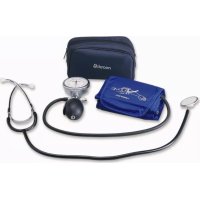
BP AG140 - Blood pressure monitor MICROLIFE - Free user manual and instructions
Find the device manual for free BP AG140 MICROLIFE in PDF.



| Product type | Mechanical aneroid blood pressure monitor |
| Brand | Microlife |
| Model | BP AG140 |
| Dimensions | 175 × 70 × 103 mm |
| Weight | 500 g |
| Measuring range | 0 – 300 mmHg |
| Resolution | 2 mmHg |
| Static accuracy | ±3 mmHg |
| Recommended deflation rate | 2-3 mmHg/s |
| Air leak | < ±4 mmHg/min |
| Included accessories | Cuff (25.4-40.6 cm), bulb, valve, stethoscope, soft case |
| Power supply | None (mechanical instrument) |
| Operating conditions | 10 – 40 °C |
| Storage conditions | -20 – 70 °C |
| Maintenance and cleaning | Clean with a dry, soft cloth; cuff can be cleaned with a damp cloth and soapy water (do not machine wash) |
| Warranty | 2 years |
| Safety | CE medical device (0044), type BF applied part, keep out of reach of children aged 0 to 3 years |
| Spare parts and repairability | Cuff, bulb, valve and stethoscope are wear parts; contact Microlife customer service for repairs |
| Standards | EN ISO 81060-1, ANSI/AAMI SP09, directive 93/42/EEC |
| Recommended calibration | Every 2 years or after a mechanical shock |
Frequently Asked Questions - BP AG140 MICROLIFE
User questions about BP AG140 MICROLIFE
0 question about this device. Answer the ones you know or ask your own.
Ask a new question about this device
Download the instructions for your Blood pressure monitor in PDF format for free! Find your manual BP AG140 - MICROLIFE and take your electronic device back in hand. On this page are published all the documents necessary for the use of your device. BP AG140 by MICROLIFE.
USER MANUAL BP AG140 MICROLIFE
monotone colletotetrahedral n -quasifuchsian submanifolds P is a regular triangulation of order three on the space of all n -dimensional subspaces.
C∈0044
15AG140S8E-V15D724End Date: 02/15- 07
microlife
Microlife BP AG1-40 BP AG1-40Guarantee Card
microlife
Name of Purchaser / Nom de tachelour / Nom de l riveidore / 9V.O. noxmaryen / line i prezine kappa / ime i prezine kappa / Ime ha krymazya / Numelle comparaturiol / Jmrokyo lujoio / Meno zakazika / Vassido ne / Alcinni ad / s
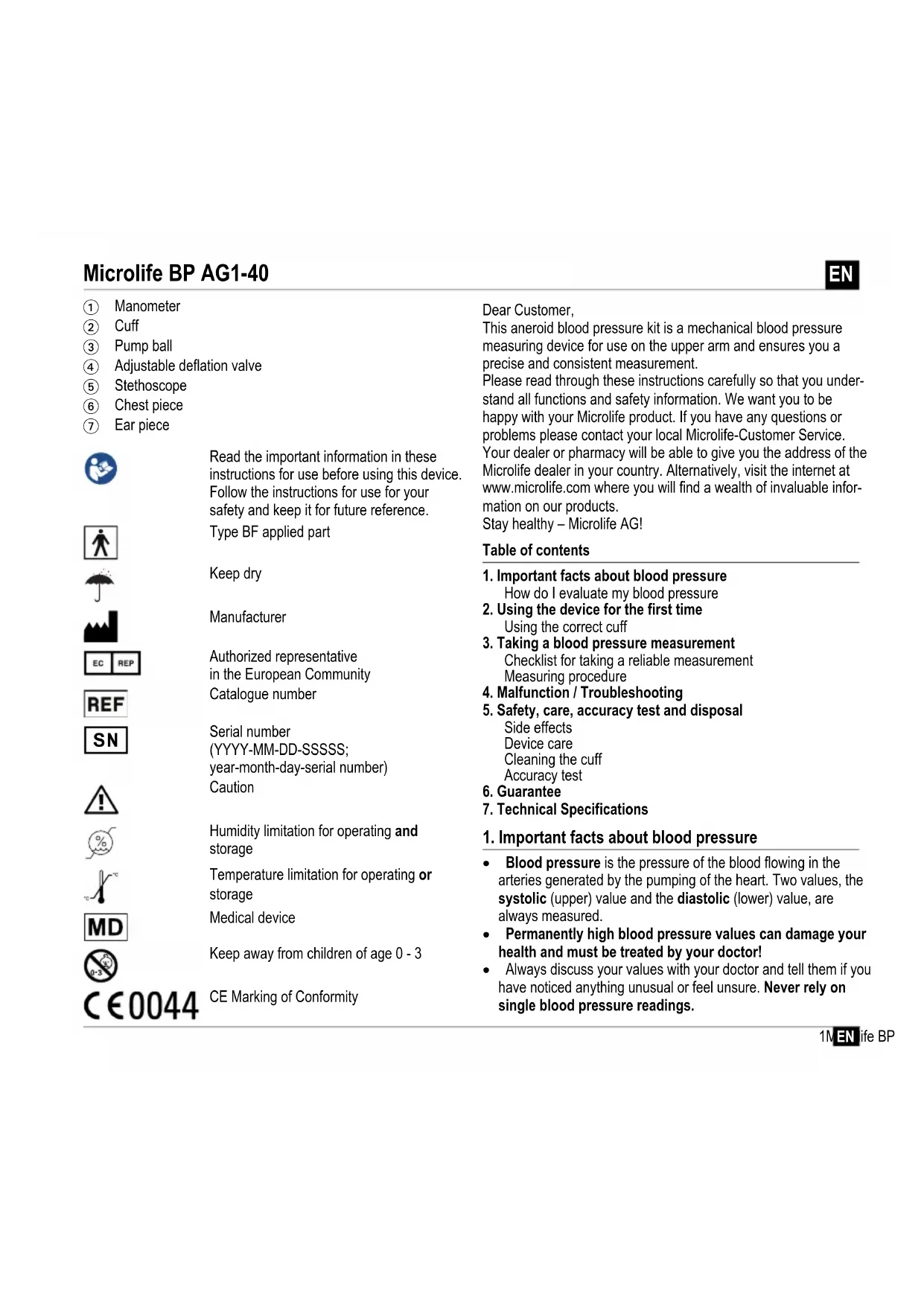
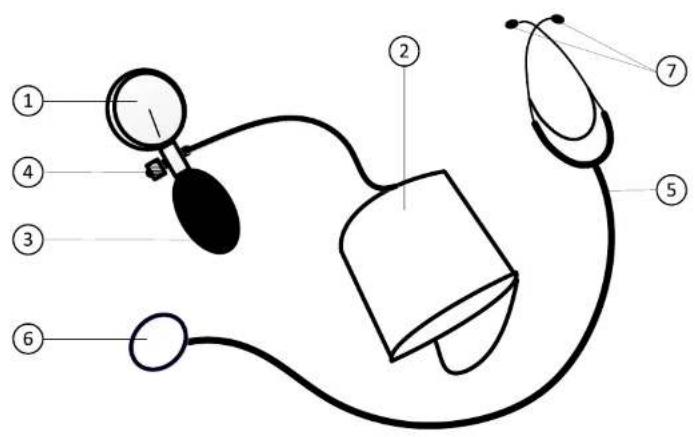
① Manometer
② Cuff
③ Pump ball
4 Adjustable deflation valve
(5) Stethoscope
⑥ Chest piece
⑦ Ear piece

Read the important information in these instructions for use before using this device. Follow the instructions for use for your safety and keep it for future reference. Type BF applied part

Keep dry

Manufacturer

Authorized representative in the European Community Catalogue number

Serial number (YYYY-MM-DD-SSSsS; year-month-day-serial number) Caution


Humidity limitation for operating and storage

Temperature limitation for operating or storage


Medical device

Keep away from children of age 0 - 3
C∈0044
CE Marking of Conformity
Dear Customer,
This aneroid blood pressure kit is a mechanical blood pressure measuring device for use on the upper arm and ensures you a precise and consistent measurement.
Please read through these instructions carefully so that you understand all functions and safety information. We want you to be happy with your Microlife product. If you have any questions or problems please contact your local Microlife-Customer Service.
Your dealer or pharmacy will be able to give you the address of the Microlife dealer in your country. Alternatively, visit the internet at www.microlife.com where you will find a wealth of invaluable information on our products. Stay healthy - Microlife AG!
Table of contents
- Important facts about blood pressure How do I evaluate my blood pressure
- Using the device for the first time Using the correct cuff
- Taking a blood pressure measurement Checklist for taking a reliable measurement Measuring procedure
- Malfunction / Troubleshooting
- Safety, care, accuracy test and disposal
Side effects Device care Cleaning the cuff Accuracy test
-
Guarantee
-
Technical Specifications
1. Important facts about blood pressure
- Blood pressure is the pressure of the blood flowing in the arteries generated by the pumping of the heart. Two values, the systolic (upper) value and the diastolic (lower) value, are always measured.
- Permanently high blood pressure values can damage your health and must be treated by your doctor!
-
Always discuss your values with your doctor and tell them if you have noticed anything unusual or feel unsure. Never rely on single blood pressure readings.
-
There are several causes of excessively high blood pressure values. Your doctor will explain them in more detail and offer treatment where appropriate.
- Under no circumstances should you alter the dosages of drugs or initiate a treatment without consulting your doctor.
- Depending on physical exertion and condition, blood pressure is subject to wide fluctuations as the day progresses. You should therefore take your measurements in the same quiet conditions and when you feel relaxed! Take at least two readings every time (in the morning: before taking medications and eating / in the evening: before going to bed, bathing or taking medication) and average the measurements.
- It is quite normal for two measurements taken in quick succession to produce significantly different results.
- Deviations between measurements taken by your doctor or in the pharmacy and those taken at home are quite normal, as these situations are completely different.
- Several measurements provide much more reliable information about your blood pressure than just one single measurement.
- Leave a small break of 5 minutes between two measurements.
- If you are pregnant, you should monitor your blood pressure regularly as it can change drastically during this time.
How do I evaluate my blood pressure
Table for classifying home blood pressure values in adults in accordance with the international Guidelines (ESH, ESC, JSH). Data in mmHg.
| Range Systolic Diastolic Recommendation | ||
| 1. blood pressure normal | < 120 < 74 | Self-check |
| 2. blood pressure optimum | 120 - 129 | 74 - 79 Self-check |
| 3. blood pressure elevated | 130 - 134 | 80 - 84 Self-check |
| 4. blood pressure too high | 135 - 159 | 85 - 99 Seek medical advice |
| 5. blood pressure dangerously high | ≥ 160 ≥ 100 | Urgently Urgently seek medical advice! |
The higher value is the one that determines the evaluation. Example: a blood pressure value of 140/80 mmHg or a value of 130/90 mmHg indicates «blood pressure too high».
2. Using the device for the first time
Using the correct cuff
When choosing the correct size cuff the arm circumference should be measured at the centre of the upper arm. 25.4-40.6 cm (10-16 inches) should be the correct size for the majority of people.
Only use Microlife cuffs.
Contact your local Microlife Service if the enclosed cuff 2 does not fit.
3. Taking a blood pressure measurement
Checklist for taking a reliable measurement
- Avoid activity, eating or smoking immediately before the measurement.
- Sit down on a back-supported chair and relax for 5 minutes. Keep your feet flat on the floor and do not cross your legs.
- Always measure on the same arm (normally left). It is recommended that doctors perform double arm measurements on a patients first visit in order to determine which arm to measure in the future. The arm with the higher blood pressure should be measured.
- Remove close-fitting garments from the upper arm. To avoid constriction, shirt sleeves should not be rolled up - they do not interfere with the cuff if they are laid flat.
-
Always ensure that the correct cuff size is used (marking on the cuff).
-
Fit the cuff closely, but not too tight.
- Make sure that the cuff is positioned 2cm above the elbow.
- The artery mark on the cuff (ca.3 cm long bar) must lie over the artery which runs down the inner side of the arm.
Support your arm so it is relaxed. -
Ensure that the cuff is at the same height as your heart.
-
Any improper setup or damage to the stethoscope will cause distorted sound or poor sound transmission causing inaccurate readings.
-
Proper deflation rate is essential for an accurate reading. Practice and master a recommended deflation rate of 2-3 mmHg per second or a drop of 1-2 marks on the manometer (1) for each heartbeat.
Measuring procedure
- Place the chest piece ⑥ underneath the cuff ② or 1-2 cm below it. Make sure the chest piece is in contact with the skin and lies on the brachial artery.
- Plug in the ear piece ⑦ and check, if the chest piece is placed correctly, so that the Korotkoff sounds appear the loudest.
- Close the valve 4 on the pump ball 3 by turning the screw clockwise. Do not over-tighten.
-
Take the pump ball ③ in your free hand (the arm you are not using to measure) and pump up the cuff. Watch the pressure indicator on the manometer ① and pump up to approx. 40mmHg higher than the expected systolic value (the upper value).
-
Inflate to 200mmHg if you are not sure about the expected value.
-
Open the valve 4 slowly by turning the screw counter clockwise whilst holding the stethoscope chest piece 6 on the brachial artery. Listen carefully as the cuff begins to deflate. Note the reading on the manometer 1 as soon as you hear a faint, rhythmic tapping or thumping sounds. This is the systolic blood pressure reading.
- Allow the pressure to continue dropping at the same deflation rate. Note the reading on the manometer 1 as soon as the thumping sound stops. This is the diastolic blood pressure reading.
- Deflate the cuff completely.
- Repeat the measurement at least two further times and record your values, date and time immediately after finishing the measurements.
- Remove the cuff and the stethoscope.
4. Malfunction / Troubleshooting
If problems occur when using the device, the following points should be checked and if necessary, the corresponding measures are to be taken:
| Description Potential cause and remedy | |
| The sound transmission is poor, distorted or there is extraneous noise. | Check the ear pieces if they are dirty or cracked. If not, make sure you wear them properly. Check the tube if it is broken or twisted. Check the chest piece if there is any damage. Make sure the chest piece is in contact with the skin and lies on the brachial artery. Clean or replace any defective parts if found to avoid inaccurate reading. |
| The pressure does not rise although the pump ball ③ is pumping. | Make sure that the valve is closed. Make sure the cuff is properly connected to bulb and manometer. Check if the cuff, tube and/or bulb is leaking. Replace the defective parts if any. |
| The deflation rate cannot be set to 2-3 mmHg/sec. by adjusting the valve ④. | Disassemble the valve from pump ball to check if there is any blockage in the airway of the valve. Clean the blockage and try again. If it still does not work, replace it to avoid inaccurate readings. |
| The manometer needle is not at 0 ± 3 mmHg at rest. | Make sure that the valve is completely open for zero check. If still more than 3 mmHg deviation, contact your dealer to recalibrate the manometer. |
If you think the results are unusual, please read through the information in «Section 1.» carefully.
5. Safety, care, accuracy test and disposal
Safety and protection
-
Follow instructions for use. This document provides important product operation and safety information regarding this device. Please read this document thoroughly before using the device and keep for future reference.
-
This device may only be used for the purposes described in these instructions. The manufacturer cannot be held liable for damage caused by incorrect application.
- This device comprises sensitive components and must be treated with caution. Observe the storage and operating conditions described in the «Technical Specifications» section.
- The cuffs are sensitive and must be handled with care.
- Only pump up the cuff once fitted.
- Never inflate beyond 300mmHg .
Always deflate the cuff completely before storage. - Do not use this device if you think it is damaged or notice anything unusual.
- Read the additional safety information provided within the individual sections of this instruction manual.
- The measurement results given by this device is not a diagnosis. It is not replacing the need for the consultation of a physician, especially if not matching the patient's symptoms. Do not rely on the measurement result only, always consider other potentially occurring symptoms and the patient's feedback. Calling a doctor or an ambulance is advised if needed.

Ensure that children do not use this device unsupervised; some parts are small enough to be swallowed. Be aware of the risk of strangulation in case this device is supplied with cables or tubes.

Contra-indications
Do not use this device if the patient's condition meets the following contra-indications, to avoid inaccurate measurements or injuries.
- Do not use this device in a moving vehicle (for example in a car or on an aircraft).
- Contraindicated for neonate use. Do not use with neonatal cuffs or neonate patients.
- The aneroid sphygmomanometer requires frequent recalibration (at least every 6 months).
- Expertise and retraining required to avoid observer error.
- It helps the user detect the Korotkoff sounds through a stethoscope for auscultation. The measurements and readings might be interfered by the noise around.
- Requires manual dexterity to ensure proper cuff deflation rate.
- Excellent hearing and vision are required for accurate measurements.
Side effects
Use of the device may be accompanied by minor side effects.
- A device can lose calibration (become inaccurate) when it is jostled or bumped, leading to false readings.
- Observers might have bias and terminal digit preference which lead to inaccurate readings.
Device care
Clean the device only with a soft, dry cloth.
Cleaning the cuff
Carefully remove spots on the cuff with a damp cloth and soap-suds.

WARNING: Do not wash the cuff in a washing machine or
dishwasher!
Accuracy test
We recommend this device is tested for accuracy every 2 years or after mechanical impact (e.g. being dropped). Please contact your local Microlife-Service to arrange the test (see foreword).
6. Guarantee
This device is covered by a 2 year guarantee from the date of purchase. During this guarantee period, at our discretion, Microlife will repair or replace the defective product free of charge. Opening or altering the device invalidates the guarantee.
The following items are excluded from the guarantee:
- Transport costs and risks of transport.
- Damage caused by incorrect application or non-compliance with the instructions for use.
- Damage caused by accident or misuse.
- Packaging/storage material and instructions for use.
- Regular checks and maintenance (calibration).
- Accessories and wearing parts: Tubes, pumping ball, cuff. Should guarantee service be required, please contact the dealer from where the product was purchased, or your local Microlife service. You may contact your local Microlife service through our website: www.microlife.com/support
Compensation is limited to the value of the product. The guarantee will be granted if the complete product is returned with the original invoice. Repair or replacement within guarantee does not prolong or renew the guarantee period. The legal claims and rights of consumers are not limited by this guarantee.
7. Technical Specifications
Weight: 500g
Dimensions: 175 × 70 × 103 ~mm
Storage conditions: -20 +70 °C
15~85% relative maximum humidity
Operating
10-40°C
conditions:
Measurement range: 0 - 300mmHg
Resolution: 2 mmHg
Static accuracy: within ± 3mmHg
Pressure reduction 2-3 mmHg/sec.
rate:
Air leakage: < ± 4 mmHg/min
Included accesso- Cuff (25.4-40.6 cm), pump ball, valve,
ries: stethoscope, softbag
Reference to EN ISO 81060-1 ANSI / AAMI SP09
standards:
This device complies with the requirements of the Medical Device Directive 93/42/EEC.
Technical alterations reserved.
Microlife BP AG1-40

stockage: Humidite relative 15~85% max.
www.microlife.com/support
Octopokno ydaNte nTHe c MaHKeTbI C NOMOuB BnaXHOITpIKn MblbHOB OdbI.

PNEpyPExEHNHe:He CnpaTb MaHKeTy B CTnpaJIbHOH NIN NocydomoeHou MaunHe!
ПоберкatoTOHOCTHI
Mby peKOMeHnyem npOBepaTb TOnHocTb np6opka KaXdbie 2 roda
IIOBO nOcNE MexAHnueckoro Bo3deNCTBnA (HaNPmEp, NaDeHn).
IIra npOBeHnRA TeCTa o6paTnTECb B MeCThBi CepBnCHBi CEHTp Microlife (cm. BBeHeHne).
6.Гараантуя
Ha npnbop paccnpocptpahreTc rapaHTnB TeueHne 2 net c daTbI npno6peTHeN.B TeueHne 3toro rapaHTnHO nepNoDa, no Hauwemy ycmOTpeHHO, Microlife 6ecnnatoHO OTPeMOHTnpyET nIN 3ameHNT HeNCnPabHbI npOdyKT.
BckpbTne nnnn 3mHeHne yctpoCTBa aHHyInpye rapaHTnIO. CneyuOnne nyKtBi NCKJIouCheHb n3 rapaHTnI:
- TpaHCnOpTHbIe IOBpeKdEHHa N pUCKN, CBra3aHHbIe C TpaHCnOPTOM.
IobpexKeHn, Bb3BaHHbIe HnnpaBnBhIM npmHeHnEM nHn HecO6JIIOdeHnEM IHCTpyKcNn No npmHeHIO. - NobpeKeJdeHn, BbI3BaHHbIe HeCuaCTHbIM CnyuAem ININ HEnpaBnJIbHbIM NcNoIb3OBAHHeM.
- YnakOBka n HNCTpyKcnn No npimHeHnIO.
- Pernyapnbie npOBepkn n 06cnykBaHne (KaIb6pOBAka).
- AkceccyapbI n3HaunBaIOUmeCyaCTn: Tpy6Ka (n), HargetaTeJIb BO3dyXa (pe3HOBa rpyu), MaHKeTa.
Ecni Tpe6yeTcra paANTnHoe o6cnyKuBaHne o6paTntecb B MeCTHyO cnyK6y nOpDepkKn Microlife. Bbl MoKeTe C8r3aTbc C MeCTbIM cepBcOM Microlife uee3 haW caHT: www.microlife.ru/ support
IpaANTn6ydtnpoocTabneHa,ecnTOBap 6ydt BO3BpaueH CEJINKOM COpUNHaJIbHbIM YekOM INIraPHTNHBIM TaHOHOM.
Pemont nnn 3aMeHa B pamkax rapaHTn He npoDJIeBaet n He BOCCTaHabJInBaET cHauAna rapaHTnHbI cpoK. OpduNueckne npTeH3nn n npaba notpe6nteNe H e orpaHneHbI 3ToI rapaHTnei.
7. TexHueckne xapaKTePncTnKn
Macca: 500r
Pa3Mepbl: 175× 70× 103 MM
YcnoBnaXpaHeHHn-20-+70°C
TpaHcnpTIpOBKn: 15~85% MaKcMaJIbHa OTHOCTeJIbHa BnaJXHOCTb
YcNoBn 10-40°C
npuMeHenHa:
Диана3OH 0-300 MM pT.CT. n3MepenH:
MnHmMaJIbHbI War 2 MM pT.CT. HNdkaCnn:
Ctatauecka B npedeJax ± 3 mm Hg TOUHOCTb: (MM pT.CT.)
CkopoocTb BblnycKa 2-3 MM pT. CT./c. BO3dyxa:
YTeUka BO3dyxa: <±4 MM pT. CT./MnH
ПинадnexKocTN:MaHKeTa(25.4-40.6cm),HaHHeTaTeNb cKJIanaHOM,CTeTOckON,CymKa-ExON
CoOTBeTcTBne EN ISO 81060-1 ANSI / AAMI SP09 cTaHdApTaM:
AnHHbI np60 cop COOTBeTCTByeT Tpe6oBaHm DnpeKTHBbI EC o MeDnHcKOM 6opOyOBAHm 93/42/EEC.
IpaBO Ha BHeCHeNc TEXHnueeCKNX N3MeHeHn COxpaHReTcra 3a IpnON3BOdnteJIem.
Microlife BP AG1-40
SR
① Manometar
② Manzetna
③ Balon za naduvavanje
④ Podesivi vazdušni ventil
⑤ Stetoskop
⑥ Deo za grudi
⑦ Slušalice

Procitajte važne informacije iz uputstva za upotrebu pre upotrebe sredstva. Radi svoje bezbednosti pridržavajte se uputstva za upotrebu i sačuvajte ga za buduću upotrebu.
Tip BF

Cuvatina suvom
Proizvodac

CepneH Homep (TITMM-Ⅱ-CCCCC; roHa-Meceu- DeH-cePneH Homep)
BHHMaHHe
TpaHnucn Ha BnaXHoCT npn pa6oTa n CbXpaHeHne
TemnepaTypho orpaHnueHne 3a pa60Ta nn cxbxpaHHeHne
MeiunHcNO n3deJIne

Ia3eTe daJeu ot deua Ha Bb3pact 0-3 IodHH
C∈0044
CE MapknpoBka 3a CbOTBeTCTBne
Ybaxaemn nTope6nteIIO,
To3n ahepone anapaTe mExaHmHo yctpoiCTBO 3a n3MepBaHe Ha KpbBHO To HJraHe B ropHaT a cT Ha pKaTa N Bu rapaHTnpa IIO-TOUHO INOCLEDOBATEJIHO n3MepBaHe.
MOn, npOyTeTe BnHMaTeJHo Te3n yKa3aHn, 3a da MoKTe da pa36epete BCnKn FyHKuHn Ha anapaTa n HNΦopMaunrTa 3a 6e3oNaCHO My no3BaHe. NcKame Da Cte DOBONn OT Baun Microlife npOdyk. Ako Imate Bbnpocn nn npoBnemn, moJa cBbpxKeTe ce C MeCTHn npedctabuTet Ha Microlife-KnneHTckn ycnyr. Baunr DnCTpuyTop nn anTekap MoKe Da Bn daDe aDpeca Ha nCtprbyTopa Ha Microlife BB BaWata cTpaHa. Dpyra Bb3MOxHOCT e Da nocETnTE VHtepHET Ha www.microlife.bg, KbdeTo MoKTe Da HamePnte N3KNIOHTeHNo Ione3Ha INΦopMaunr 3a npOdyKTnte Hn.
Бьдete здрави - Microlife AG!
CbDpKaHne
- BaxnФaktna KpbBHOTo HAnraHe KaK da onpeDena KpbBHOTo MHaHraHa?
2.ИЗнOL3ВанеHa anapata 3a nbpBN nBtИЗнOL3ВанeHa noДхODЯш MaHWEr
3.ИЗмepBaHe Ha KpbBHOTo HAnraHe CnncbK C BbIpocn, rapaHTnpaU, n3BbPWBaHe Ha NaDeJxHOn I3MepBaHe IpoeDypa Ha I3MepBaHe - He3nnpaBHOCTu/OTcpaHbAbe Ha npo6IeMn
- Tect 3a 6e3oNacHocT, rpnka, touHocT n denoHnpaHe CtpaHnHn epeKTu
rpnka 3a anapata
IOuHCTBaHe Ha MaHweta
Tect 3a TOUHOCT
6.Гаранця - TexHHueckn cneunpkaun




1. BaxhN ΦakTN 3a KpbBHOTo HnraHe
KpbBHO Hnrahe Hapuame HaIraHeTo HA KpbBtA, npemHabaua Ipe3 apTePnITE, KOeTo ce o6pa3yBa OT NOMHeHata DeHocT Ha Cbpueto. BnHaN CE n3mepBat DBe CTOHOCTH, CnCTOHa (BnCoka) cToHocT IN dnaCToHa (HnCKa) cToHocT.
Ako nocToaHNO mATE BncoKo KpbBHO HAnraHe,TOBa MoKe Da yBpeN 3dpBeTo BN N Tp6Ba Da ce o6bPhe 3a NOMOu KbM Jekapr cN!
BnHaN O6cbKdAaTe CToHocHTe C Baun Jekap My CbO6- 7aBaIte, aKO 3abeJeXnTe HeUo HeoBuauHO nIu Ce NoCyBCTBaTe HecrpyHn. Hkora He pa3uTaIte Ha eDnHOKpaTHO n3MepeHIne CToHocTn.
CbueCTByBat HAKOJIPO npuHn 3a npeKaIeHOBcOKn CTOnHoCTn Ha KpbBHOTo HAJraHe. Baunr nekap ng o6rCHn no-noPboHo n 9e npdIOKn JneHene, Korato e Heo6xOIMo.
- Pn HnKaBn 06cTOrTeJCTBa He Tp8Ba Da npomehrTe D03npOBkata Ha JekapCTBaTa Cn Nn Da 3anOyBaTe neeHne 6e3 KOHCyttaunC Baunn Jekap.
B 3abucnmoCT OT Φи3uueckOTO HaTOBapBaHe n cbctOHaHne KpbBHO To HAJIraHe TbPNI rOJEMN KOJIe6aHnB PAMKHTe Ha DeHn. CneobateNo Tp86Ba Da npabnte N3MepBaHnTa cn npn eDHN HcBxu Tnxu ycNoBnN u KOrato Ce YyBCTBaTe cnoKoHn! PpaBeTe NOhe DBe OTUHTaHn BCEKN pT (cyTpNH: npdi npiem Ha IekapCTBa n XpaHe/Beuep: npdi JraHe, KbnaHe nI npiem Ha IekapCTBa) n ocpeHraBaTe N3MepBaHnTa.
HopmaJHHe 13Be H3MepBaHHa, HnpaBHeH cKOpO eHOb CneI Dpyro, Da NOKaKaT DOCTa pa3NnHn pe3yntAtn.
- OTKJIOHeHHB CTOHOCHTNe Ha N3MepBaHHa, HAnpaBeHHOT JeKapR Bn Nm B aNTeKaTa, N Te3N HApPaBeHH Bkbu Ca HanbJIHO HopMaJIHN, TbN KaTO yCIOBnRA, PpN KOnTO ca HApPaBeHH, Ca HanbJIHO pa3JIuHn.
HkoIko n3MepBaHHN OCNpyBaT MHOrO NO-HaJeKdHa HΦopMaζη 3a BaSeTo KpbBHO HaJraHe, OTKOJIKOTo cMo eHNO eINMHNo n3MepBaHe.
- HanpaBeMaIka nay3a 5 MInHyTu MExkDy DBe N3MepBaHn.
Ako cTe 6peMeHHa, Tp8Ba peoBHO da n3MepBaTe KpbBHOTo cn HaIraHe, TbK KaTO TO MOKe Da ce IpomEna DpaCTuHOppe3 To3n NepNOd.
Kak Da onpeJeI KpbBHOTo Mn HaJIraHe?
Ta6nua 3a KnaCmHnpuHa Ha n3MepeHnte B DomaHn YcIOBnA CToHocTn Ha KpbBHOTo HAIraHe PnBb3paCTn, B CbOTBeTCTBne C MeJxHyapOHNte MeTOOnueckn IpenOpBKn (ESH, ESC, JSH). DaHHnte ca b mmHg.
3n03BaTe cmo Microlife mHaWeT!
Cbpxe ce c MeCTHnI ppeCTaBnteHa Microlife-Ycnyr, aKO npINOxKeHHMaHwET ② He e noXOJa.
www.microlife.com/support
KOMnEhcaunraTe o rpaHnueHa Do cToHocTt Ha npOdykTa.
IrapaunraTa 6bDe npedocTabeHa, aKo ceJIrr npOdyKT 6bDe BbpHAT C opRnHaHnata cakTypa. PemOHrT nIN NOmHaTb B pAMKHe Ha rapaunraTa He yDbJxaba Hn NODHOBA rapaHnOHHn nepnoD. OpduNuecknte npTeHcHn n npabTa Ha NotpeBnTeHnTe He ca orpaHnueHn ot Ta3n rapaHnq.
7. Texnueckn cneuФнkaци
Terno: 500 r
T6apuTu: 175 x 70 x 103 MM
YcNoBnHa -20-+70°C
cxbxpaHHe: 15-85%OTHOCTeJIHa MaKcIMaJIHa BnaXHOCT
Pa6oTHn ycNoBna: 10-40°C
06XbaT Ha 0-300 MM KINBaueH CTbJI6 n3MepBaHe:
Pa3dJIHTeHa 2MMKINBaueHCTbJ6 cnoc6HoCT:
CtataHbTOUHOc:paMKTeHa±3mmHg
Ckopoct Ha 2-3 MM KnuBaueH CTbI6/c.
n3nyckahe Ha
Bb3dyxa:
N3TuHaHe Ha <±4MMKINBaueHCTbJI6/MNH. Bb3Dyxa:
BknueH mAnweT (25.4-40.6 cm), nomna, knanaH, akcecoapn: CTeTOCKO, MeKa yHaHTa
PpenpaTka KbM EN ISO 81060-1 ANSI / AAMI SP09 cTaHdaptN:
ToBa n3dJIneI OTOBapra Ha n3NCKBaHnTa Ha NpeKTHBaT a 3a MeDnUHcKn n3dEInna 93/42/EEC.
PpOu3BODHTeTnT Cn 3aNa3Ba IpaBOTo Da BHaCra TeHNueCKn npOMeHn.
www.microlife.com/support