1977056 - Deep fryer RUSSELL HOBBS - Free user manual and instructions
Find the device manual for free 1977056 RUSSELL HOBBS in PDF.



| Product Type | Electric oil fryer |
| Brand | Russell Hobbs |
| Model | 1977056 |
| Oil Capacity | 2.7 L (MIN) to 3.2 L (MAX) |
| Thermostat Setting | 130 °C to 190 °C |
| Power Indicator | Stays on as long as the appliance is plugged in |
| Thermostat Indicator | Turns on and off to maintain temperature |
| Safety - Safety Switch | Prevents operation if the control unit is incorrectly positioned |
| Safety - Thermal Cutout | Prevents overheating of the element, resettable with the provided tool |
| Basket | With folding handle and support for draining on the rim |
| Lid | With handle, removable |
| Tank (oil container) | Removable, with MIN and MAX marks |
| Carrying Handles | On the main body |
| Power Cord | Detachable, length not specified |
| Materials | Plastic outer body, metal oil tank (likely stainless steel) |
| Cleaning - Dishwasher safe parts | Main body, lid, basket, oil tank (careful with finish) |
| Cleaning - Control unit | Wipe with a damp cloth, never immerse |
| Usage | Household use only |
| Included Accessories | Basket, lid, reset tool, instruction manual |
| Cooking Guide | Tables for fish, meat, poultry, fries, vegetables, and donuts |
Frequently Asked Questions - 1977056 RUSSELL HOBBS
User questions about 1977056 RUSSELL HOBBS
0 question about this device. Answer the ones you know or ask your own.
Ask a new question about this device
Download the instructions for your Deep fryer in PDF format for free! Find your manual 1977056 - RUSSELL HOBBS and take your electronic device back in hand. On this page are published all the documents necessary for the use of your device. 1977056 by RUSSELL HOBBS.
USER MANUAL 1977056 RUSSELL HOBBS
natural_image
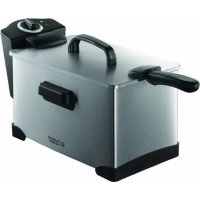
Exterior view of a stainless steel French drier with black handle and control knob (no text or symbols on body)instructions 2
pokyny (Slovenčina) 80
instrukcja 86
upute 92
navodila 98
οδηγίες 104
utasítások 110
talimatlar 116
instructiuni 122
Read the instructions, keep them safe, pass them on if you pass the appliance on. Remove all packaging before use.

IMPORTANT SAFEGUARDS
Follow basic safety precautions, including:
1 This appliance must only be used by or under the supervision of a responsible adult. Use and store the appliance out of reach of children.
2 Don't put the heating/control unit in liquid, don't use it in a bathroom, near water, or outdoors.
3 The heating/control unit is fitted with a safety switch, to prevent the element operating unless the heating/control unit is properly in place.
4 Don't carry or pass anything through the space over or near the appliance – if anything drops into the appliance, hot oil will splash out.
5 Don't leave the appliance unattended while plugged in.
6 Don't move the appliance when it contains hot oil.
7 Don't use the appliance near or below curtains or other combustible materials, and watch it while in use.
8 Don't cover the appliance or put anything on top of it.
9 Unwind the cable fully before use.
10 Unplug the appliance when not in use.
11 Carry the appliance only by the carrying handles.
12 Don't use accessories or attachments other than those we supply.
13 Don't use the appliance for any purpose other than those described in these instructions.

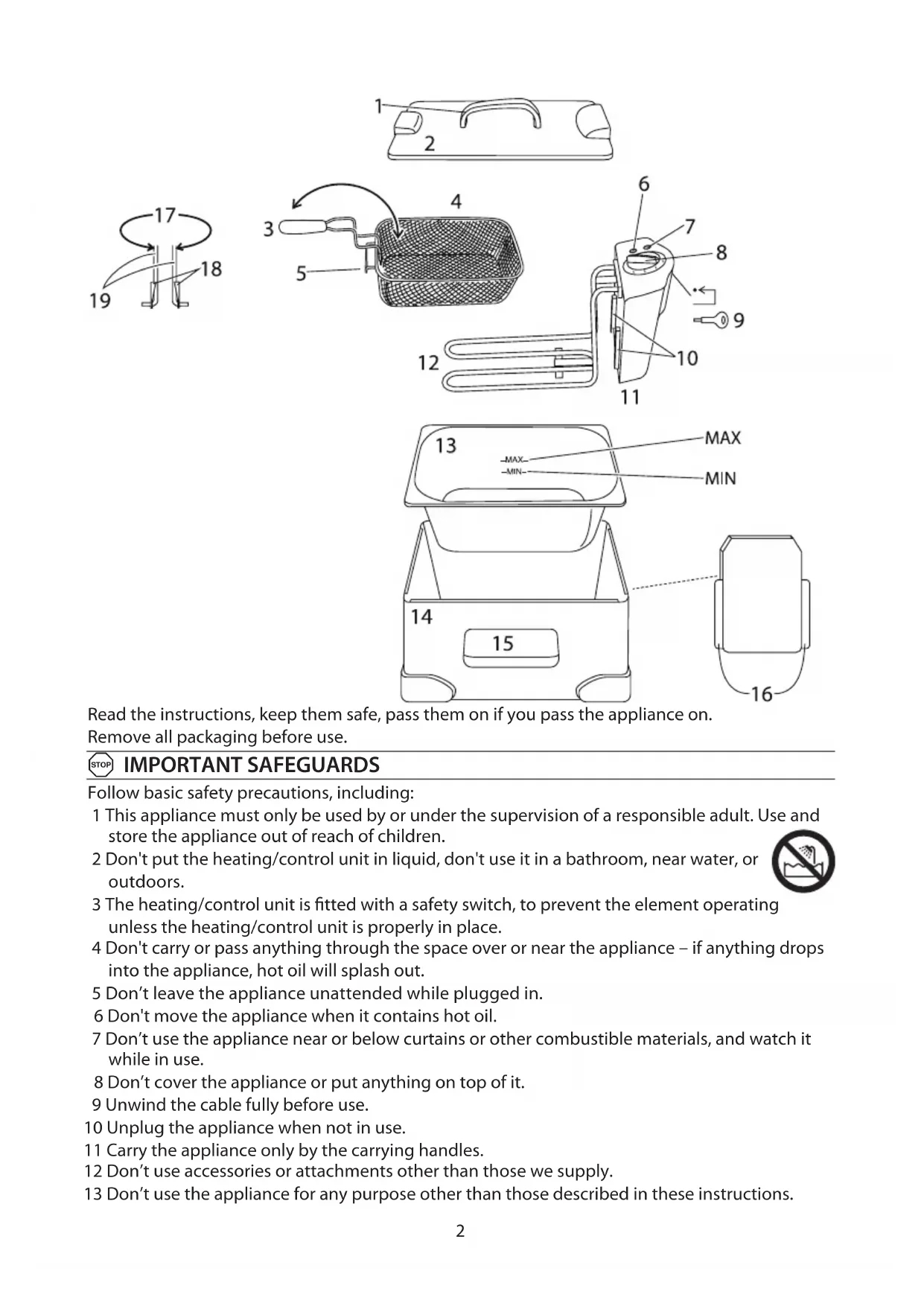
| diagrams | 7 thermostat light | 13 bowl |
| 1 lid handle | 8 temperature control | 14 body |
| 2 lid | ← reset button | 15 carrying handle |
| 3 handle | 9 reset tool | 16 guides |
| 4 basket | 10 grooves | 17 squeeze here |
| 5 basket rest | 11 heating/control unit | 18 clips |
| 6 power light | 12 element | 19 uprights |
14 This appliance must not be operated by an external timer or remote control system.
15 Don't use the appliance if it's damaged or malfunctions.
16 If the cable is damaged, it must be replaced by the manufacturer, its service agent, or someone similarly qualified, in order to avoid hazard.
household use only
PREPARATION
1 Sit the appliance on a stable, level, heat-resistant surface.
2 Leave a space of at least 50mm all round the appliance.
3 Position the appliance so that the basket handle doesn't extend up to or over the edge of the work surface, where it is likely to be caught accidentally when passing.
4 Use the lid handle to remove the lid.
5 Unfold the basket handle and push the uprights over the latch above the hinge.
6 Line a colander with kitchen paper, to drain the food after it's cooked.
FILLING
7 Fill the bowl with good quality liquid cooking oil to between the MIN (2.7 litres) and MAX (3,2 litres) marks on the side of the bowl.
8 Don't use solid cooking oil, fat, butter or margarine.
9 Don't mix oils of different types, as they will have different temperature characteristics.
10 Replace the lid.
HEATING THE OIL
11 Set the temperature control to the required temperature (130-190°C).
12 Put the plug into the power socket.
13 The power light will glow as long as the appliance is connected to the electricity supply.
14 The thermostat light will glow, then cycle on and off as the thermostat maintains the temperature.
15 Wait till the light goes out before cooking.
PREPARATION
16 Cut food into uniformly sized pieces.
17 Coat wet foods (e.g. fish, pineapple) with flour, breadcrumbs, batter, etc.
18 Don't use the appliance to defrost food. Any food other than pre-cooked, quick-frozen foods must be fully defrosted before putting into the appliance.
19 When cooking pre-packed foods, follow any guidelines on the package or label.
20 When cooking raw vegetables (e.g. potato chips or slices), dry the pieces off with kitchen paper or a tea towel.
LOADING THE BASKET
21 Put the prepared food pieces in the basket.
22 Try not to put more than two layers of food in the basket. If you need to cook more, do it in batches.
23 Using the oven glove, hold the basket by the handle and lower the basket slowly and gently into the oil.
24 The oil will foam as it comes into contact with water from the food. As long as the foam doesn't threaten to overflow the bowl, this should not be a cause for alarm.
25 If the foam threatens to overflow the bowl, remove the basket, set it back on the kitchen paper, then see the "problems" section.
COOKING THE FOOD
26 Wait till the food has cooked.
REMOVE THE FOOD
27 Check it's cooked. If you're in doubt, cook it a bit more.
28 Using the oven glove, lift the basket by the handle, hook the basket rest over the rim of the bowl, and let it drain.
29 Empty the food into the colander, to drain further before serving.
30 Return the empty basket to the the rim of the bowl.
FINISHED?
31 Unplug the appliance.
MORE?
32 If you want to cook another batch of food, check the oil level and top up as necessary.
COOKING GUIDE
33 Adding food to the oil reduces the temperature of the oil.
34 If you add a little food, the temperature will recover quickly, and the food will be cooked properly.
35 When you put food into the appliance, you should see bubbles given off.
36 This is steam, formed when the moisture inside the food heats up.
37 The steam coming out of the food prevents oil from soaking into the food.
38 The food cooks uniformly – firm and crisp.
39 If you add too much food, the temperature will not recover, and your food will absorb oil.
COATINGS
40 Coat all foods, except those high in starch, like potatoes and doughnuts. The coating protects the food, helps prevent juices leaking into the oil, and gives a crisp tasty result. Generally, coatings won't stick to frozen foods.
seasoned flour
41 Thicker coatings don't stick well to wet/damp foods, so coat them first in seasoned flour. Use on its own to coat small whole oily fish like whitebait.
egg and breadcrumbs
42 Popular on fish, chicken, and scotch eggs, it gives an attractive, crisp, crunchy exterior. Ideal for foods that are to be served cold, as it stays crisp for hours.
- Coat in seasoned flour, to dry the food. Dip in beaten egg, then breadcrumbs, repeat till fully coated, press well, then shake off any excess.
- Fresh breadcrumbs give a rough appearance. Make dry breadcrumbs or raspings by baking scraps of bread till golden, then crush or process to a fine crumb.
$$ \begin{array}{l} \text {g = grams} \ \text {ml = millilitres} \ \text {5 = teaspoon (5ml)} \ \text {15 = tablespoon (15ml)} \ \text {70 = egg, large (63 - 73g)} \ \text {pinch} \end{array} $$
basic batter
100g self raising flour 1 🔍 salt water
Sift the flour into a bowl. Add the salt. Just before it's needed, stir in enough water to form a smooth batter.
basic fritter batter
100g self raising flour water
1 5 vegetable oil
1 salt
Sift the flour into a bowl. Add the salt. Beat in the oil. Just before it's needed, stir in enough water to form a smooth batter.
posh fritter batter
100g plain flour 150ml liquid 1 15 vegetable oil
1 salt 1⑥0
The liquid can be water, milk, beer, sparkling water, etc.
Separate the egg. Sift the flour into a bowl. Add the salt. Stir in the egg yolk, then the liquid. Beat in the oil. Just before it's needed, whisk the egg white and fold into the batter.
crispy Chinese batter
75g cornflour
1 5 vegetable oil
2 5 baking powder
1 ⑦ 1 salt water
Mix the egg, cornflour, salt and oil with enough cold water to form a creamy base on which to add either egg and breadcrumbs or batter.
cooking times & food safety
Use these times purely as a guide.
Cook meat, poultry, and derivatives (mince, burgers, etc.) till the juices run clear. Cook fish till the flesh is opaque throughout. Chips (french fries) and other vegetables should be crisp.
chips (french fries)
Use a chipping potato, like King Edward, Cara, Maris Piper, Romano or Desirée.
- Peel, cut, rinse, drain, and dry thoroughly. Don't put more than two layers of chips in the basket at a time. For best results, cook in two stages:
stage 1 – fry for 5-10 minutes (depending on quantity) at 170^ C. When the chips reach pale gold, and the outside is firm, lift the basket out of the oil, and leave the chips to drain and cool
stage 2 – fry for 2-4 minutes at 190^ C. When golden brown and crisp, remove from the oil, and drain in a colander lined with kitchen towel.
frozen chips (french fries)
These don't usually need two-stages. Follow the instructions on the package.
other vegetables
Many vegetables may be deep fried – onion rings, mushrooms, cauliflower florets. They can be cooked from fresh or frozen, and should be coated.
frozen food
- Frozen food cools oil quickly, so fry a single layer at a time.
- Shake off excess ice or water before adding the food to the oil.
- Keep the pieces apart, or they'll stick together.
- Use the highest temperature setting, and lower the basket slowly into the oil to reduce foaming.
- When cooking pre-packed foods, follow any guidelines on the package or label.
fish – fresh temperature (°C) time (minutes)
Fish has a high water content. Dry with kitchen towel, and coat before cooking. Use whole, or cut into fillets, cutlets or goujons.
| fillets, goujons, scampi | 190 | 3-4 |
| fish cakes | 190 | 3-4 |
| whitebait | 190 | 1-2 |
fish – frozen temperature (°C) time (minutes)
Pre-coated fish may be cooked from frozen. Follow the instructions on the package
plaice 190 5-6
fillets 170 10-15
goujons 190 3
scampi 170 3-5
fish cakes – small 170 3
fish cakes – medium/large 170 4-5
whitebait 190 2-3
meat temperature (°C) time (minutes)
Only deep fry fresh or thawed meat. Coat in egg and breadcrumbs or batter.
goujons 190 3
| chops, cutlets – small/large | 170 | 10/15 |
| scotch eggs | 170 10 | |
| rissoles, meat balls | 190 6 | |
| Wiener schnitzel (depending on thickness) | 170 | 3-8 |
poultry temperature (°C) time (minutes)
Only deep fry fresh or thawed poultry. Coat in egg and breadcrumbs or batter. Remove the skin first for better results. Allow time for poultry to cook to the centre. A crisp golden exterior doesn't necessarily denote this, so test before serving.
goujons 1704
drumsticks 170 14-15
croquettes 190 2-3
chicken in crumbs – small 170 15-20
chicken in crumbs – large 170 20-30
| bread, cakes, fritters | temperature (°C) | time (minutes) |
| ring doughnuts | 190 2 | |
| pineapple, banana or apple fritters | 190 | 2-3 |
| croutons (diced bread) | 190 1 |
PROBLEMS
43 If the oil foams and threatens to overflow, there's too much food in the basket (take some out), the food is too moist (dry it a bit and try again), or the oil is old or contaminated (replace it).
44 Every time oil is heated, it deteriorates.
45 Every time food is put into it, moisture, particles of food and fat, flour and spices from coatings, water from frozen foods, cause further deterioration.
46 Particles blacken, burn, and stick to the next batch of food, altering its look and taste. Filtering can alleviate this a bit.
47 Even filtered oil will be past its best after 10 to 12 uses.
48 Pre-cooked and oven chips have a coating of oil from the pre-cooking process. This will thicken or discolour the oil in your fryer.
49 If you cook coated foods regularly, it might be worth keeping two lots of oil, one for coated foods and one for "oil-friendly" foods.
50 As a rough guide, if you notice a marked improvement in flavour after changing the oil, you should have changed it earlier.
51 Your Local Authority will have a depot where old oil can be taken for recycling or environmentally friendly disposal.
•← THERMAL CUT-OUT
52 The cut-out operates to protect the element from overheating.
53 If your fryer stops working:
54 Switch off, unplug, and let it cool down.
55 Check the oil level.
56 If the oil level is below the MIN mark, reset the cut-out.
If the oil level isn't too low, and the cut-out has operated for some other reason, ring Customer Service.
57 Use the reset tool to press the reset button and reset the cut-out.
58 The excess heat will have spoiled the oil, so clean out the bowl and refill with fresh oil.
CARE AND MAINTENANCE
59 Unplug the appliance and let it cool down before cleaning or storing away.
normal cleaning
60 Wipe outer surfaces with a damp cloth.
61 Put the lid on top of the bowl, to keep dust, etc. out of the oil.
full cleaning (after every few uses)
62 Cover the work surface with at least 3 layers of kitchen paper.
63 You'll need a 5 litre container and a wide necked funnel.
64 If you want to filter the oil, use a sieve lined with muslin or filter paper.
65 Remove the lid and basket.
66 Lift the heating/control unit off.
67 Pour the oil into the funnel.
68 Clean the heating/control unit with a clean damp cloth.
69 Wash the body, lid, basket, and bowl in warm soapy water and dry thoroughly.
70 You may wash these parts in a dishwasher.
71 If you use a dishwasher, the harsh environment inside the dishwasher will affect the surface finishes.
72 The damage should be cosmetic only, and should not affect the operation of the appliance.
73 If residue builds up on the element, clean it with detergent, and clean more often.
74 Remove all trace of detergent and dry before reassembling.
reassembly
75 Put the bowl into the body of the fryer.
76 Engage the grooves on the control unit with the guides on the rear of the body, and slide the control unit into place.
77 Put the basket inside the bowl.
78 Pull the basket handle wires apart a little, to pass the latch, and swing the handle down into the basket.
79 Replace the lid.
discolouration
80 With use, the basket, element, thermostats, and control wires will discolour. This is inevitable, harmless, and won't affect the operation of the appliance.
ENVIRONMENTAL PROTECTION
To avoid environmental and health problems due to hazardous substances in electrical and electronic goods, appliances marked with this symbol mustn't be disposed of with unsorted municipal waste, but recovered, reused, or recycled.

STELL OG VEDLIKEHOLD
5 surveys interesting to 5 letters and questions about the English.
22Two 22.22.22.23.24.25.26.27.28.29.30.31.32.33.34.35.36.37.38.39.40.41.42.43.44.45.46.47.48.49.50.51.52.53.54.55.56.57.58.59.60.61.62.63.64.65.66.67.68.69.70.71.72.73.74.75.76.77.78.79.80.81.82.83.84.85.86.87.88.89.90.91.92.93.94.95.96.97.98.99.100

- IMPORTANT SAFEGUARDS
- household use only
- PREPARATION
- FILLING
- HEATING THE OIL
- LOADING THE BASKET
- COOKING THE FOOD
- REMOVE THE FOOD
- FINISHED?
- MORE?
- COOKING GUIDE
- COATINGS
- seasoned flour
- egg and breadcrumbs
- basic batter
- basic fritter batter
- posh fritter batter
- crispy Chinese batter
- cooking times & food safety
- chips (french fries)
- frozen chips (french fries)
- other vegetables
- frozen food
- fish – fresh temperature (°C) time (minutes)
- fish – frozen temperature (°C) time (minutes)
- meat temperature (°C) time (minutes)
- poultry temperature (°C) time (minutes)
- PROBLEMS
- •← THERMAL CUT-OUT
- CARE AND MAINTENANCE
- normal cleaning
- full cleaning (after every few uses)
- reassembly
- discolouration
- ENVIRONMENTAL PROTECTION
- STELL OG VEDLIKEHOLD
Brand : RUSSELL HOBBS
Model : 1977056
Category : Deep fryer