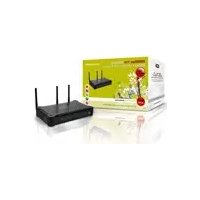
150N WL - Router CONCEPTRONIC - Free user manual and instructions
Find the device manual for free 150N WL CONCEPTRONIC in PDF.



| Product Type | 150N Wireless Router |
| Brand | Conceptronic |
| Model | 150N WL (C150BRS4) |
| Wi-Fi Standard | 802.11n (up to 150 Mbps) |
| LAN Ports | 4 RJ-45 10/100 Mbps ports |
| WAN Port | 1 RJ-45 10/100 Mbps port |
| Power Supply | 12 V DC, 1 A |
| Wireless Security | WPA-PSK/WPA2-PSK, WPS |
| Antennas | 2 fixed internal antennas |
| Main Features | Internet connection sharing, DHCP server, NAT firewall, virtual server, DMZ |
| Configuration | Web interface (192.168.0.1), default login: admin/admin |
| Maintenance | Clean with a soft dry cloth. Do not use abrasive products. |
| Spare Parts | Power adapter included. Ethernet cable included. |
| Included Accessories | CD-ROM with user manual, quick installation guide, network cable |
Frequently Asked Questions - 150N WL CONCEPTRONIC
User questions about 150N WL CONCEPTRONIC
0 question about this device. Answer the ones you know or ask your own.
Ask a new question about this device
Download the instructions for your Router in PDF format for free! Find your manual 150N WL - CONCEPTRONIC and take your electronic device back in hand. On this page are published all the documents necessary for the use of your device. 150N WL by CONCEPTRONIC.
USER MANUAL 150N WL CONCEPTRONIC
Conceptronic C150BRS4
Snelstartgids
Save settings successfully!
Please press Apply button to restart the system to make the changes take effect.
APPLY
You can configure the Wireless Router as a Virtual Server so that remote users accessing services such as the Web or FTP at your local site via Public IP Addresses can be automatically redirected to local servers configured with Private IP Addresses. In other words, depending on the requested service (TCP/UDP) port number, the Wireless Router redirects the external service request to the appropriate internal server (located at one of your LAN's Private IP Address).
Enable Virtual Server

- Current Virtual Server Table

Conceptronic C150BRS4
Quick Installation Guide
Congratulations on the purchase of your Conceptronic 150N Wireless Router
This quick installation guide gives you a step-by-step explanation of how to install and use the Conceptronic C150BRS4.
When you need more information or support for your product, we advise you to visit our Service & Support website at www.conceptronic.net/support and select one of the following options:
- FAQ : Frequently Asked Questions database
- Downloads : Manuals, Drivers, Firmware and more downloads
- Contact : Contact Conceptronic Support
For general information about Conceptronic products visit the Conceptronic website at www.conceptronic.net.
The information in this quick installation guide is based on Windows 7 and Vista, but can differ from your computer when you are using a different operating system.
Note: This quick installation guide only explains the basic steps to get the C150BRS4 up and running. For more info about the various functions of the C150BRS4, please refer to the user manual (English only) on the included product CD-ROM. Wait for the autorun menu to appear and select 'View User Manual'.
Table of contents
-
Package contents
-
The C150BRS4 explained
2.1. Front panel
2.2. Back panel
- Connecting the cables
3.1. WAN port
3.2. LAN port(s)
- Configuring the computer
4.1. Configuring the IP address
4.2. Checking the connection
- Configuring the C150BRS4
5.1. Logging in
5.2. Quick setup wizard
5.3. Advanced settings
- Connecting to the wireless network
6.1. Connecting manually in Windows 7
6.2. Connecting manually in Windows Vista
6.3. Connecting automatically using WPS
- Port mapping
1. Package contents
The following items are present in the package of the Conceptronic 150N Wireless Router:
- Conceptronic C150BRS4 - 150 N Wireless Router
Power supply 12V DC, 1A
Network (LAN) cable
Product CD-ROM - This multi language quick installation guide
- Warranty card & CE declaration booklet
2. The C150BRS4 explained
2.1 Front panel
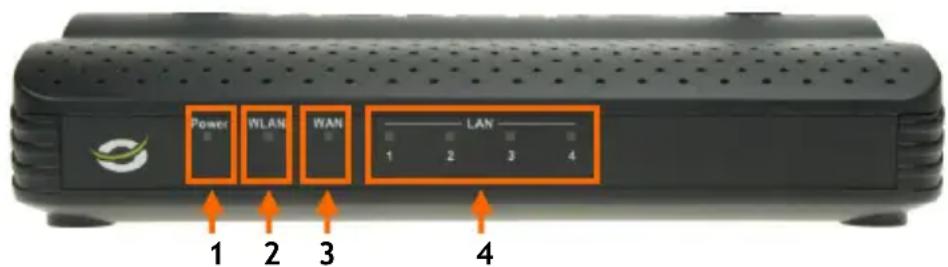
| Nr | Description | Status | Status | Explanation |
| 1 | Power LED | OFF | The device is switched off | |
| ON | The device is switched on | |||
| 2 | WLAN/WPS LED | OFF | Wireless network is switched off | |
| ON - STEADY | Wireless WPS function is enabled | |||
| ON - FLASHING | Wireless network activity (sending or receiving data) | |||
| 3 | WAN LED | OFF | WAN port is not connected | |
| ON - STEADY | WAN port is connected | |||
| ON - FLASHING | WAN port activity (sending or receiving data) | |||
| 4 | LAN LEDs | OFF | LAN port is not connected | |
| (1, 2, 3, 4) | ON - STEADY | LAN port is connected | ||
| ON - FLASHING | LAN port activity (sending or receiving data) |
ENGLISH
2.2 Back panel
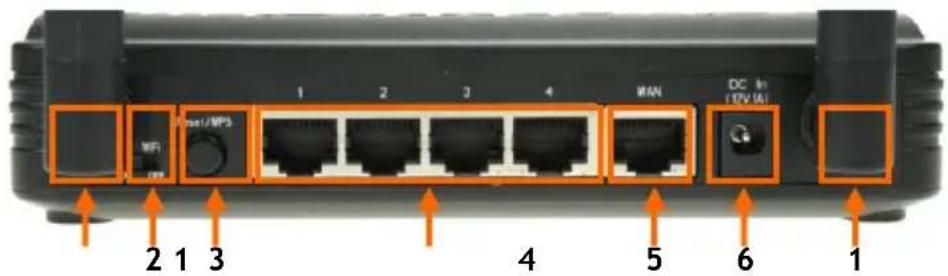
Nr Description
Explanation
1 Wireless antennas (2x)
Two fixed antennas for wireless broadcasting
2 Radio ON/OFF switch Turn the wireless radio on or off
3 Reset/WPS button Activate WPS function (short press) or perform a reset (hold)
4 LAN ports (1 - 4) Connect your computer(s)/network device(s) to the router
5 WAN port Connect your broadband connection to the router
6 Power connection Connect the power supply to the router
3. Connecting the cables
Connect the power supply to the power connection on the back of the C150BRS4 and to an available wall socket. The power LED on the front of the C150BRS4 will lit up.
3.1 WAN port
Use a network (LAN) cable to connect the C150BRS4 to your broadband modem. The WAN LED on the front of the C150BRS4 will lit up.
Note: If the WAN LED on the front does not lit up, make sure that:
- The C150BRS4 is powered on (the power LED should burn).
- The broadband modem is turned on.
- The network (LAN) cable between both devices is connected correctly.
3.2 LAN port(s)
Connect the network (LAN) cable to 1 of the 4 LAN ports on the back panel of the C150BRS4 and to the network card of your computer. The LAN LED of the used LAN port will lit up, indicating that the computer is connected. (Your computer must be switched on and the LAN connection must be enabled).
4. Configuring the computer
4.1 Configuring the IP address
The C150BRS4 is equipped with a built-in DHCP server. The DHCP server will automatically assign an IP address to each connected computer if the connected computer is configured to automatically obtain an IP address.
Most computers are by default configured to automatically obtain an IP address. Should this not be the case, you will need to configure your computer to obtain an IP address automatically by following the instructions below.
A. Click on 'Start', go to 'All Programs', 'Accessories' and choose 'Run'.
B. Enter the command 'NCPA.CPL' and click on OK.
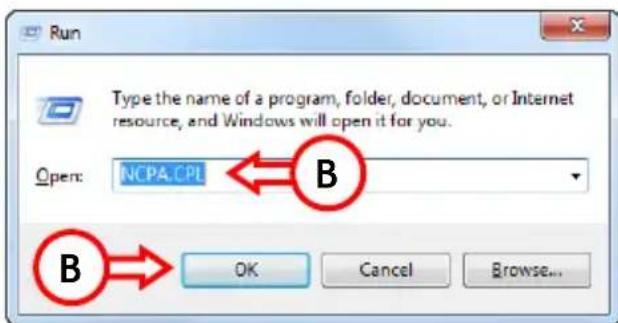
The "Network Connections" window will appear.
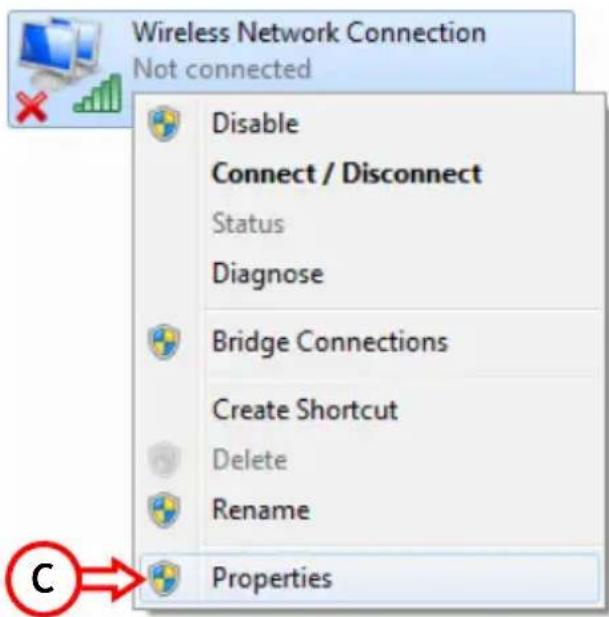
C. Right click on 'Local Area Connection' or 'Wireless Network Connection' (depending on the connection you use) and select 'Properties'.
ENGLISH
The properties window of your Local Area Connection or Wireless Network Connection will appear.
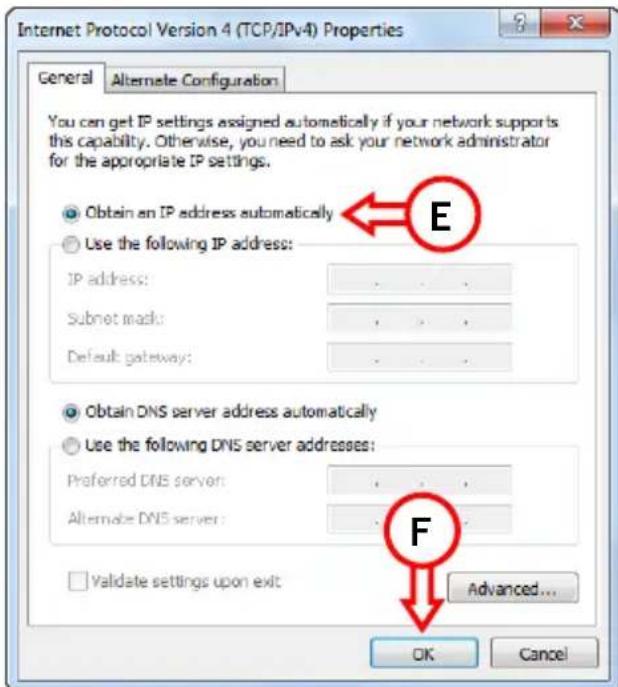
D. Select 'Internet Protocol Version 4 (TCP/IPv4)' and click on 'Properties'.
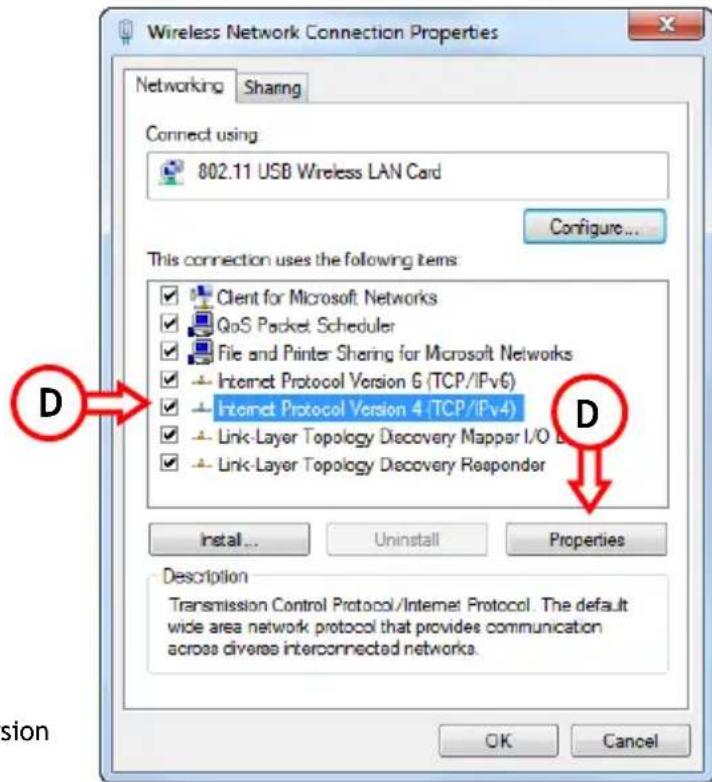
The properties window of Internet Protocol Version 4 (TCP/IPv4) will appear.
E. Set the properties to 'Obtain an IP address automatically' and click on 'OK' to save the settings.
F. Click on 'OK' in the Internet Protocol Version 4 (TCP/IPv4) Properties window to save the settings.
4.2 Checking the connection
With the 'Command Prompt' of Windows you can verify if you have received a correct IP address on your Local Area Connection or Wireless Network Connection. This example is based on Windows 7 and Vista with Service Pack 1. Windows 7 and Vista need administrative rights to perform the steps below, which are explained in the following steps.
A. Click on 'Start', 'All Programs', 'Accessories', right click on 'Command Prompt' and select 'Run as administrator'.
You might get a warning message, which you will need to accept by clicking 'Continue' or 'Yes'.
The Command Prompt window will appear. Make sure the 'Command Prompt' title bar mentions "Administrator: Command Prompt". When "Administrator" is not mentioned, you do not have the necessary administrative rights for these steps and you will need to perform step A again.
B. Enter the command 'IPCONFIG' and press 'ENTER' on your keyboard.
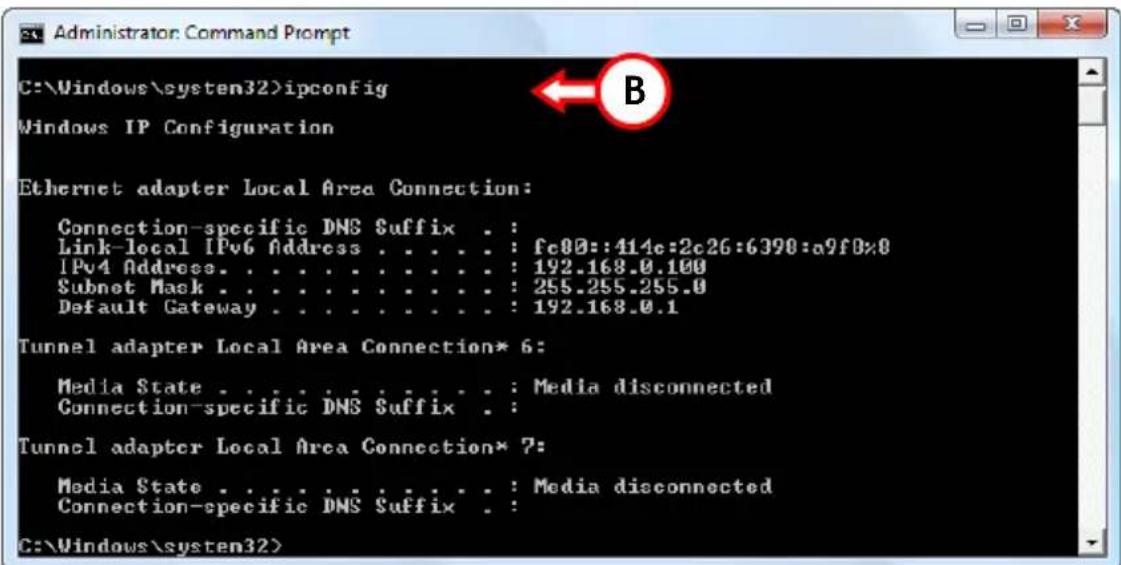
You should see the following information:
IPv4 Address : 192.168.0.xxx (where xxx can vary between 100 - 199).
Subnet Mask : 255.255.255.0
Default Gateway : 192.168.0.1
If the information above matches your configuration you can continue configuring the router in chapter 5.
If the information shown above does not match your configuration (i.e. your IP address is 169.254.xxx.xxx) you will need to take the following steps:
ENGLISH
- Disconnect and reconnect the power of the router.
- Disconnect and reconnect the network cable to the router and to your computer.
-
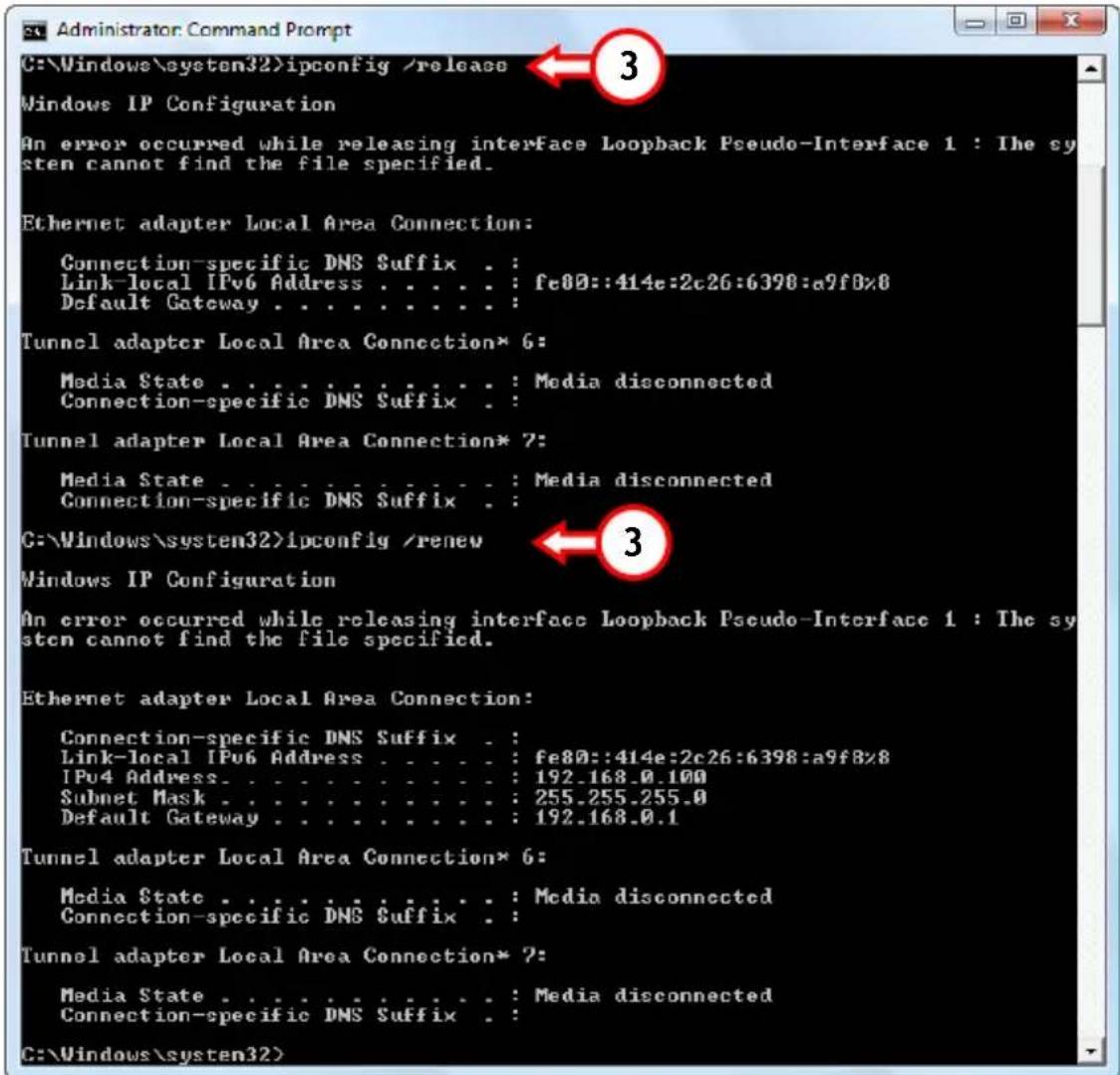
Renew the IP address of your computer with the following commands:
-
'IPCONFIG /RELEASE' : this will release the incorrect IP address
- 'IPCONFIG /RENEW': this will renew the IP address
If above steps do not solve the IP address issue, you can reset the device to the factory default settings with the reset button on the back of the device.
Press and hold the reset button until the power LED starts to flash (about 10 seconds). This will reboot the router and load the factory default settings into the router. When the power LED burns steady again, repeat step B to renew the IP address.
Note: If the problem remains, check if all cables are connected in the correct way. The WAN port should be connected to the modem and the LAN port to the computer. Connecting them in the wrong way will also result in an incorrect IP address.
5. Configuring the C150BRS4
This chapter describes how to configure the C150BRS4 using the built-in setup wizard. After completing the steps in this chapter your router has been set up for its primary functions.
5.1 Logging in
For configuration of the C150BRS4 a web based interface is being used. This means you are able to configure the C150BRS4 on any computer with a web browser which is connected to the C150BRS4.
Note: It is strongly advised not to use a wireless connection while configuring the C150BRS4, since its connection could be lost when adjusting certain settings. Therefore it is highly recommended to use a computer that is connected to the C150BRS4 with a network cable.
To log in to the C150BRS4, follow these steps:
A. Start your web browser (like: Internet Explorer, Firefox, Safari or Chrome).
B. Enter the IP address of the router in the address bar of your web browser. By default: http://192.168.0.1/
A pop-up window will be shown asking you for the user name and password.
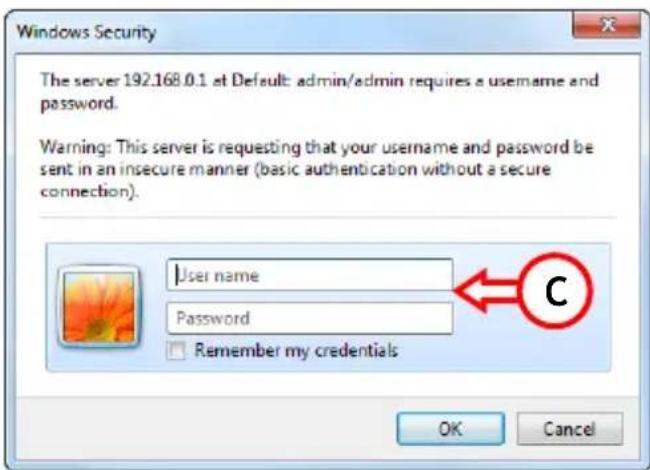
C. Enter the user name and password and click on 'OK' to enter the web based configuration. Default user name : admin Default password : admin
ENGLISH
When the user name and password are correct the router will show the main page:
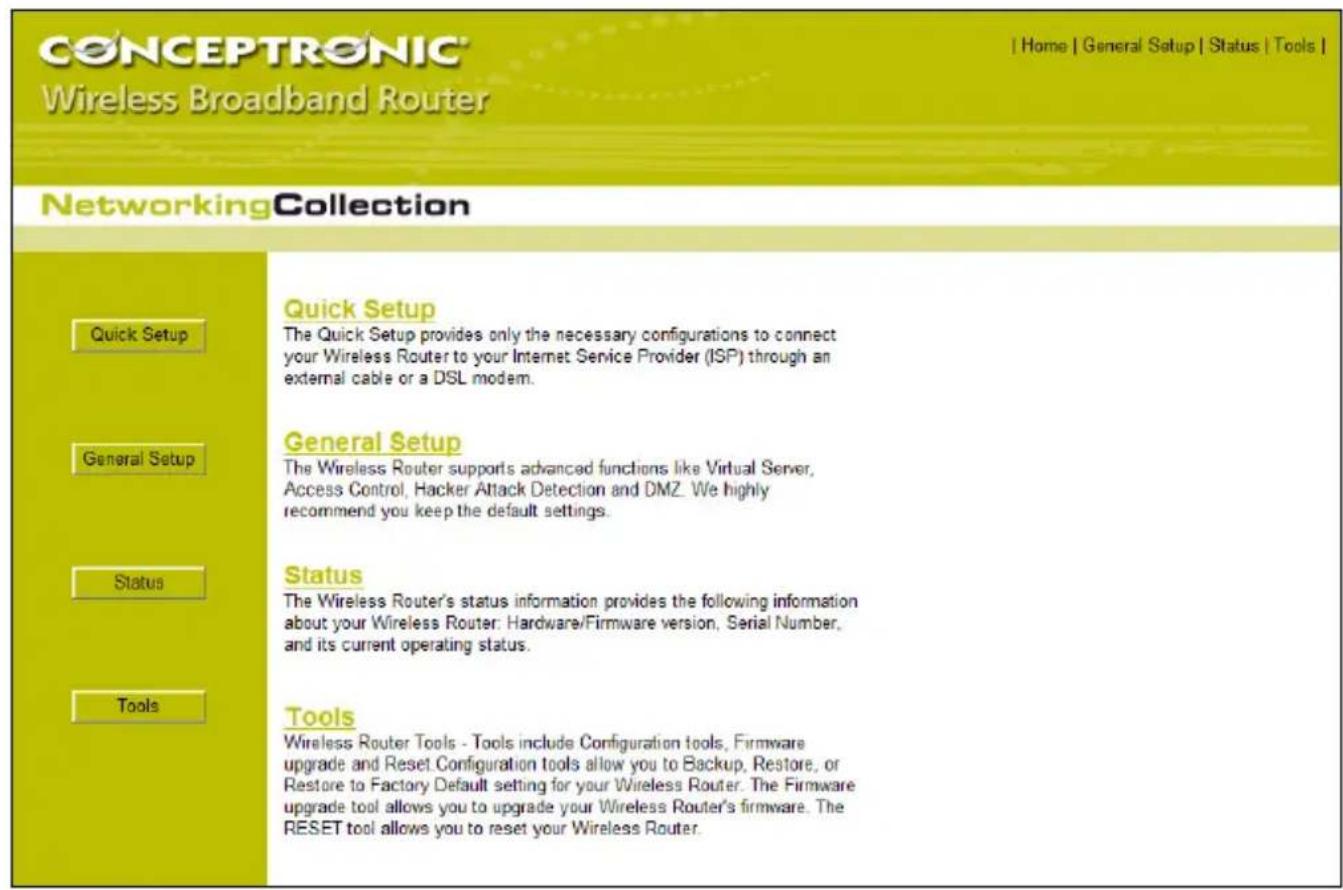
From the main page you can easily choose one of the four major options in the C150BRS4 web configuration:
- Quick Setup : Quickly set up the C150BRS4 for first use (explained in chapter 5.2)
- General Setup : Change advanced options (explained in chapter 5.3)
- Status : Check the status of the router, connected clients and log files
- Tools : Back up the configuration, upgrade the firmware or reboot the router
Note: It is at all times possible to choose one of the major options (except Quick Setup) from the four options in the top right of the page. You can also go back to the main page by clicking 'Home'.
5.2 Quick setup wizard
The 'Quick Setup' wizard will guide you step-by-step through the basic settings of the C150BRS4.
Note: Before starting the 'Quick Setup' wizard, make sure you have all information about your internet connection available.
For example: connection type, account information, etc.
Note: Throughout this chapter the following applies: If you do not know which option to choose or do not have the necessary information available, you should either refer to the documentation of your internet connection or contact your internet service provider (from now on called ISP).
A. Click on 'Quick Setup' on the main page.
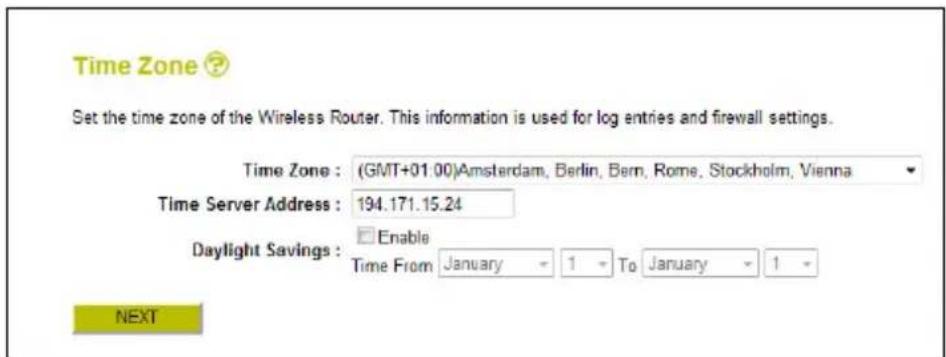
B. For system management purposes, a correct time setting is critical to have accurate time stamps in the system logs.
Select the correct time zone and optionally change the time server address and/or enable daylight savings time.
When done, click on the 'Next' button to continue.
ENGLISH
C. Select the WAN Type that corresponds with the settings from your ISP.
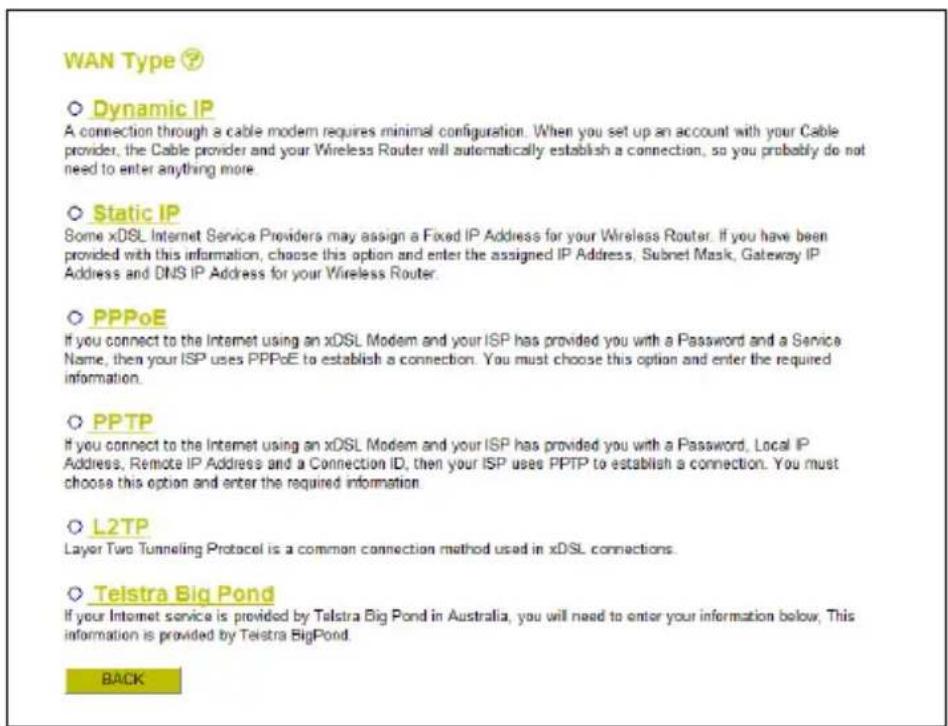
1. Dynamic IP
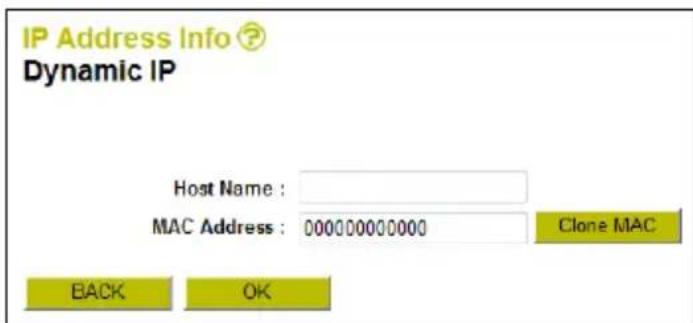
Some ISPs require a specific host name for their connections. If this applies to your connection, you should enter the host name here.
Some ISPs only allow one specific MAC address to connect to the internet. In that case you can either clone the MAC address of the computer you used to connect to the internet by clicking on the 'Clone MAC' button or enter the MAC address manually.
When done, click on the 'OK' button to continue.
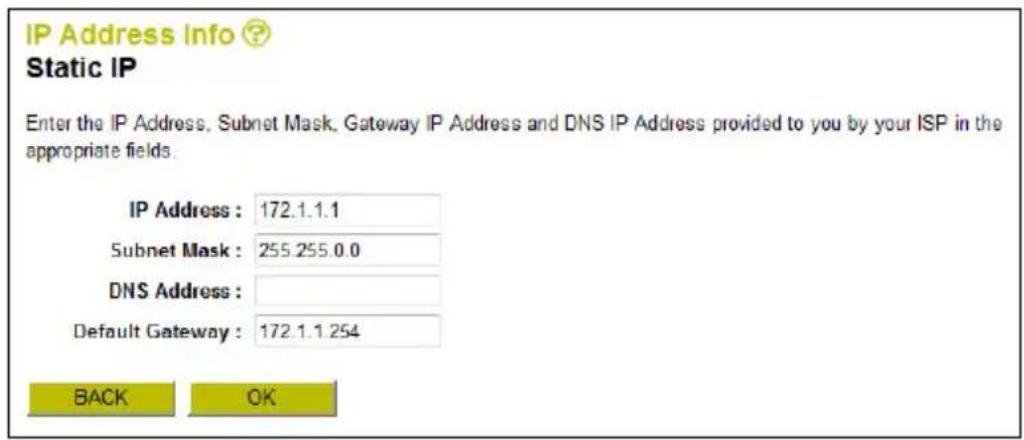
2. Static IP
Enter the Static IP settings as given by your ISP into the corresponding fields.
When done, click on the 'OK' button to continue.
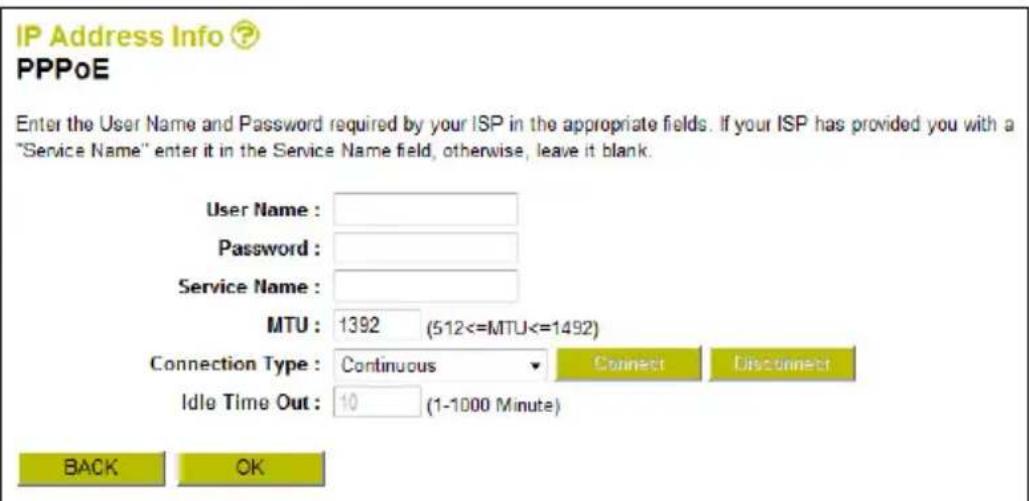
3. PPPoE
Enter the PPPoE settings as given by your ISP into the corresponding fields.
When done, click on the 'OK' button to continue.
ENGLISH
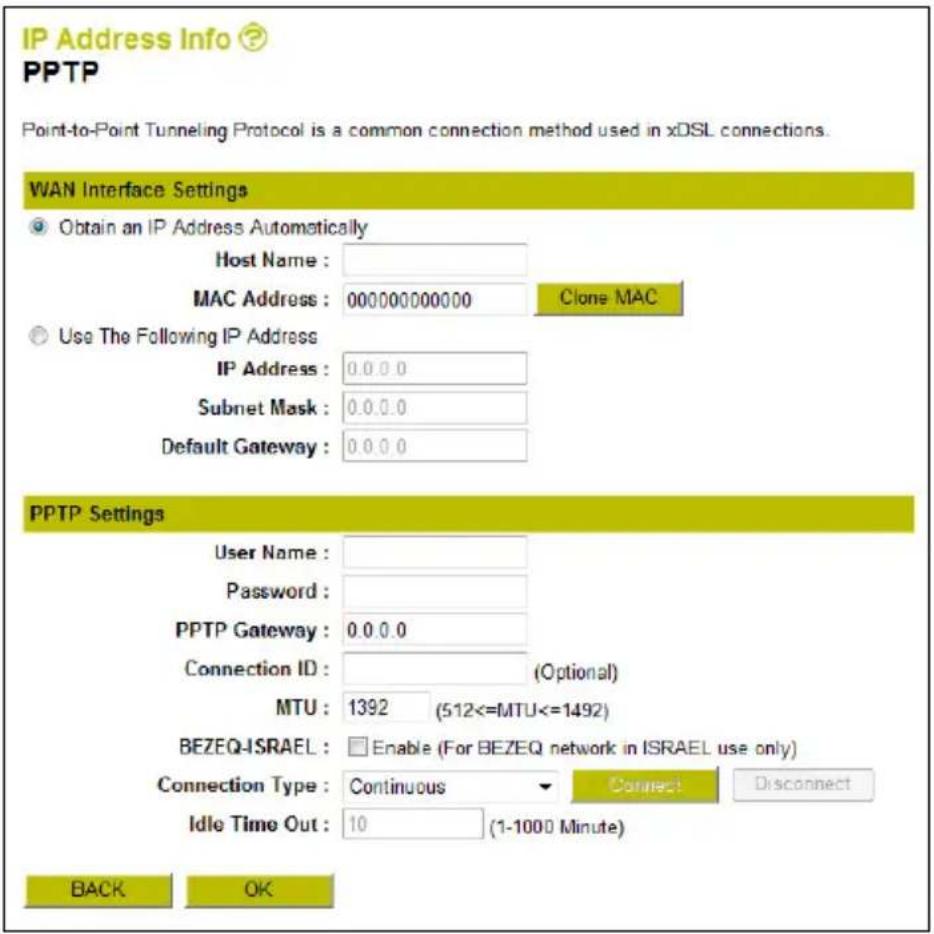
4. PPTP
Enter the PPTP settings as given by your ISP into the corresponding fields.
When done, click on the 'OK' button to continue.
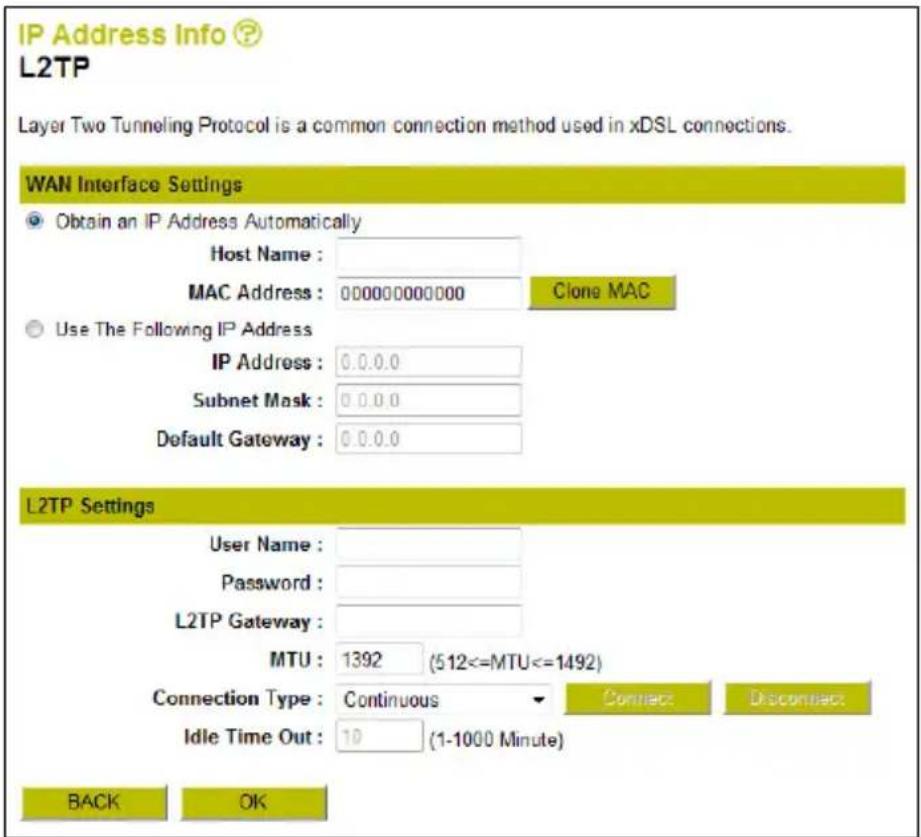
5. L2TP
Enter the L2TP settings as given by your ISP into the corresponding fields.
When done, click on the 'OK' button to continue.
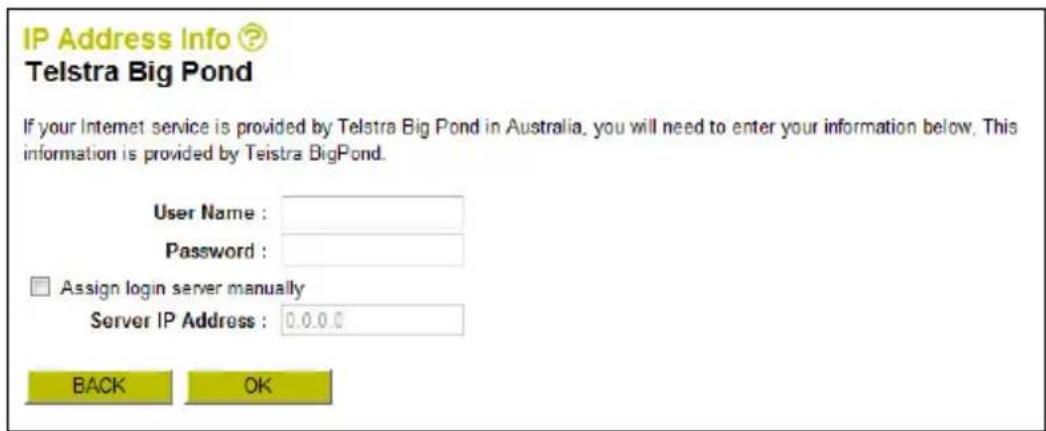
6. Telstra Big Pond
Enter the user name and password and, when needed, manually assign a server IP address.
When done, click on the 'OK' button to continue.
ENGLISH
D. The settings will automatically be saved.
Click on the 'Apply' button to restart the router.
Note: When changing settings in the configuration of the C150BRS4 you will always be asked to choose between two options:
- Continue : Continue to make changes (the changes are not yet saved).
- Apply : Apply all changes by saving them to the configuration and restarting the router.
Save settings successfully!
Please press Apply button to restart the system to make the changes take effect.
APPLY
Note: By default, the wireless network of the C150BRS4 is secured with WPA-PSK/WPA2-PSK (mixed mode) encryption. This means you will not have to manually secure the wireless network. Refer to chapter 5.3 if you want to manually change the security settings of the C150BRS4.
5.4 Advanced settings
This quick installation guide explains the basic settings to get your C150BRS4 up and running. For advanced settings or a more detailed explanation, please refer to the user manual (English only) on the included product CD-ROM.
Place the product CD-ROM into your optical drive, wait for the autorun menu to appear and select 'View User Manual'.
Note: In order to view the user manual, you will have to have Adobe Reader installed. If you do not have this installed on your computer, you can select 'Install Adobe Reader' from the autorun menu (Windows only).
Your Conceptronic 150N Wireless Router is now ready to use!
6. Connecting to the wireless network
There are two different ways of wirelessly connecting to the C150BRS4:
- Manually.
- Automatically using the WPS function.
! IMPORTANT NOTE !
The C150BRS4 is secured with WPA-PSK/WPA2-PSK (mixed mode) encryption by default. The unique WPA passphrase can be found on the product sticker at the bottom of your C150BRS4.
Almost every brand/type wireless card uses a different client application. Please refer to the manual of your wireless network card for information on how to create a connection with a wireless network.
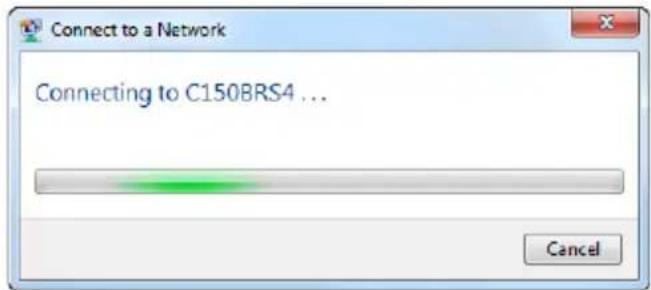
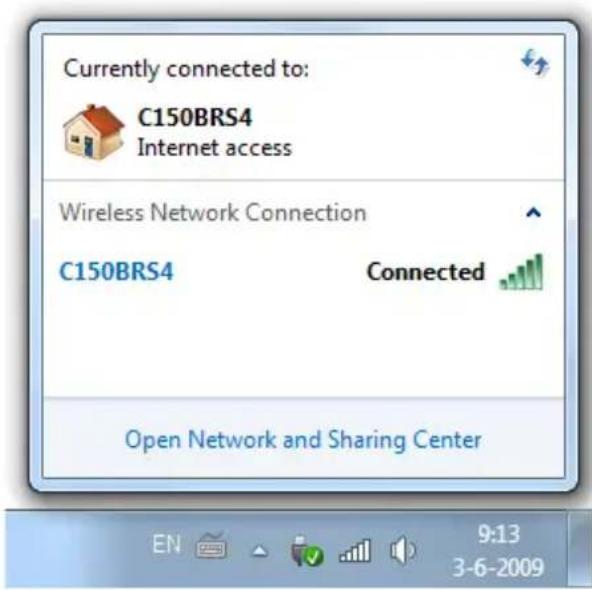
6.1 Connecting manually in Windows 7
In the following example the integrated "Connect to a Network" option from Windows 7 is used.
A Click on the Network' icon in the taskbar to view the list of available wireless network connections.
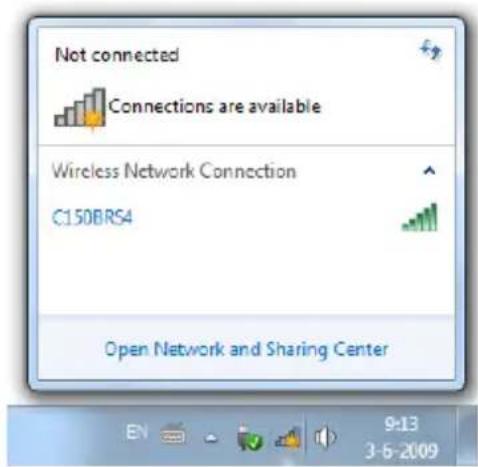
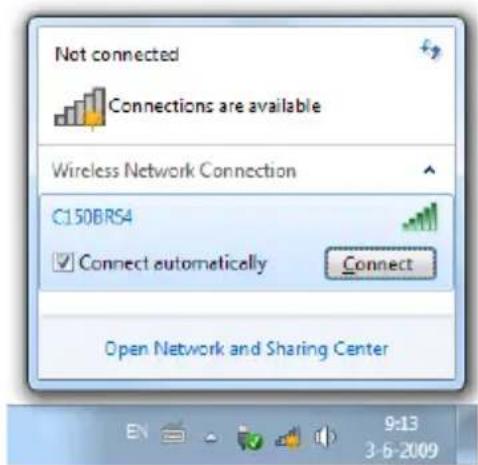
B Select the network "C150BRS4" from the list and click on 'Connect'.
By default the option "Connect automatically" is selected. This makes sure the connection is automatically started each time your computer is turned on. If you do not want this, you can unselect this option before clicking on 'Connect'.
ENGLISH
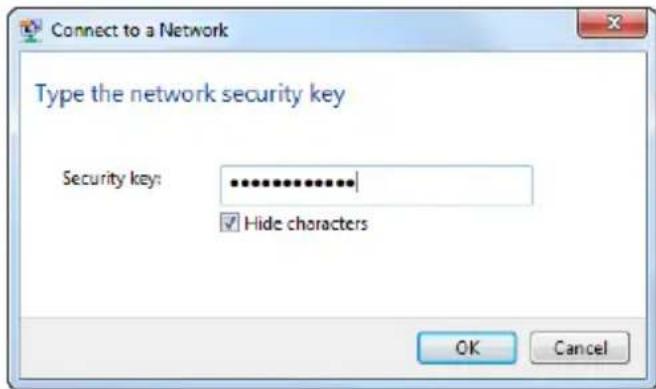
C Enter the default WPA passphrase (which is mentioned on the bottom of the C150BRS4) in the "Security key" field and click on 'OK'.
D The client will now start connecting to the wireless network.
E To check the status of the wireless connection, you can click on the 'Network' icon in the taskbar. You will see which network you are currently connected to, the access you have and the signal strength of the connection.
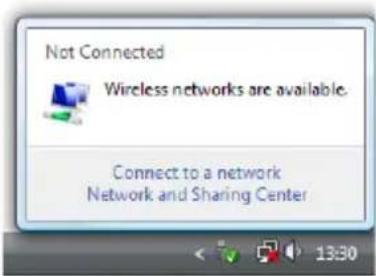
6.2 Connecting manually in Windows Vista
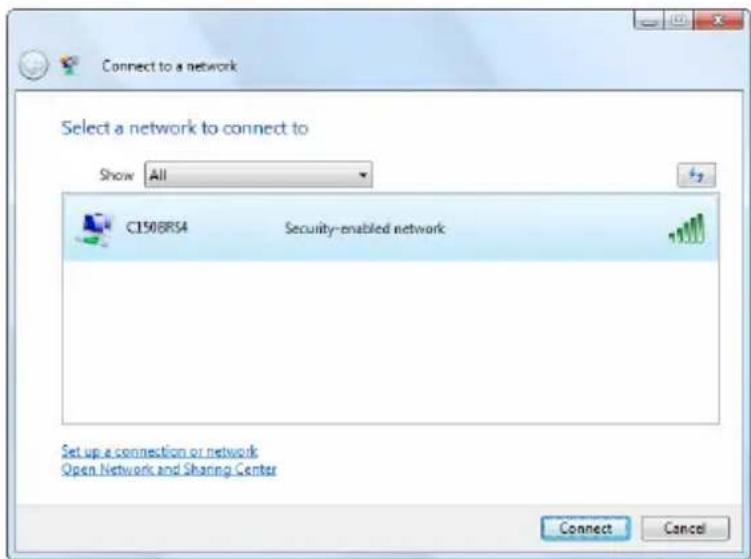
In the following example the integrated "Connect to a Network" option from Windows Vista with Service Pack 1 is used.
A Click on the 'Network' icon in the system tray and click on "Wireless networks are available".
B Select the network "C150BRS4" from the list and click on 'Connect'.
ENGLISH
C Enter the default WPA
passphrase (which is mentioned on the bottom of the C150BRS4) in the "Security key or passphrase" field and click on 'Connect'.
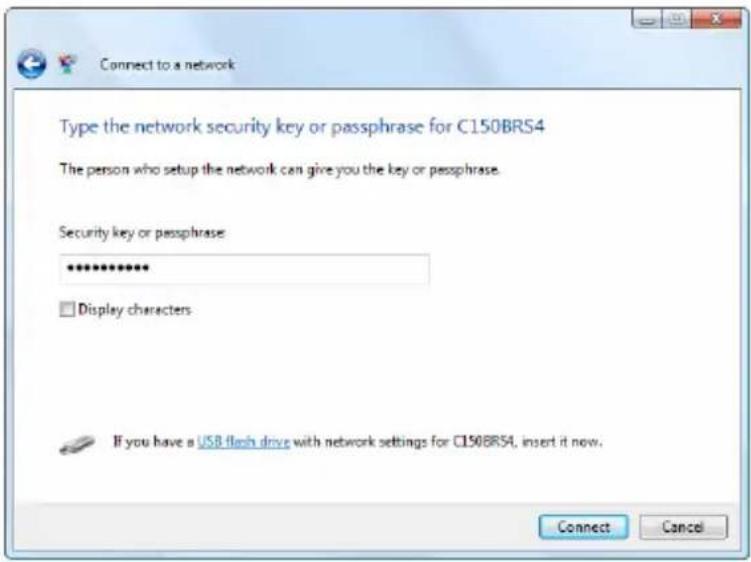
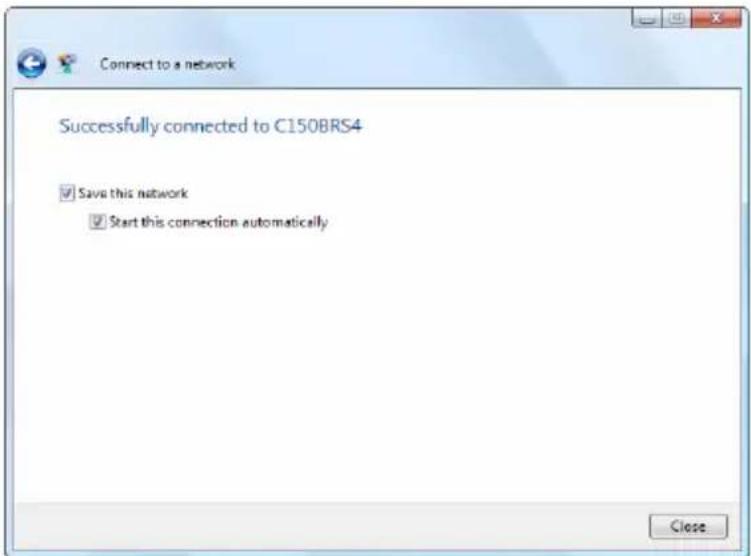
D When the connection has been established, you can choose to save the network and have it start automatically each time your computer is turned on. Click on 'Close' to exit the connection wizard.
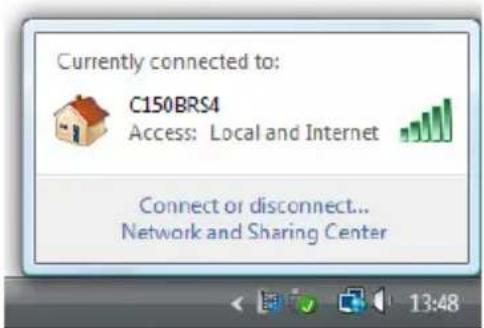
E To check the status of the
wireless connection, you can click on the 'Network' icon in the system tray. You will see which network you are currently connected to, the access you have and the signal strength of the connection.
6.3 Connecting automatically using WPS
The Conceptronic C150BRS4 supports WPS (Wi-Fi Protected Setup). WPS is a standard for easy and secure establishment of a wireless network. With WPS you can setup and protect your wireless network in just a few easy steps.
Note: To use WPS with the C150BRS4, you need to have a wireless client that supports WPS. If you have one or more wireless clients without WPS support, it is advised to manually connect to the C150BRS4 using the preconfigured WPA key as mentioned on the bottom. Refer to chapter 6.1 or 6.2 on how to manually connect to the wireless network.
Note: For more (technical) information about WPS, refer to the following website: http://en.wikipedia.org/wiki/Wi-Fi_Protected_Setup
The C150BRS4 supports two ways of activating and establishing a WPS connection:
- Push Button technology
PIN Code technology
WPS - Push Button technology
The WPS Push Button technology requires a (virtual) button on the wireless client to establish a connection between the C150BRS4 and the wireless client. Some wireless clients use an actual button for activating the WPS Push Button technology; other wireless clients use a virtual button in their software.
Follow the steps below to activate and establish a WPS connection with the Push Button technology:
A. Press the WPS button on the back of the C150BRS4, the WLAN/WPS LED will burn steady indicating that WPS authentication has started.
B. Press the WPS button on the wireless client. This can be either a hardware button or a virtual button in the software of the wireless client.
Note: The C150BRS4 will keep the WPS authentication active for 120 seconds. During this process, the WLAN/WPS LED will burn steady. If there is no WPS connection established within 120 seconds, the LED will return to its original state and WPS authentication will be stopped.
If the WPS authentication is successful, the WLAN/WPS LED will return to its original state.
The wireless client is now connected to the secured wireless network of the C150BRS4. You can add more wireless clients without losing the connection to previously connected wireless clients. If you want to add more wireless clients, you will need to repeat step A and B.
ENGLISH
WPS - PIN Code technology
If your wireless client supports WPS but does not have a (virtual) Push button, you can use the PIN Code technology to establish a WPS connection.
Note: To activate the WPS PIN Code function, you need a computer with a wired connection to the C150BRS4.
A. Login to the web interface as explained in chapter 5.1.
B. First select 'General Setup', then 'Wireless' and finally 'WPS'.
The WPS configuration page will be shown.
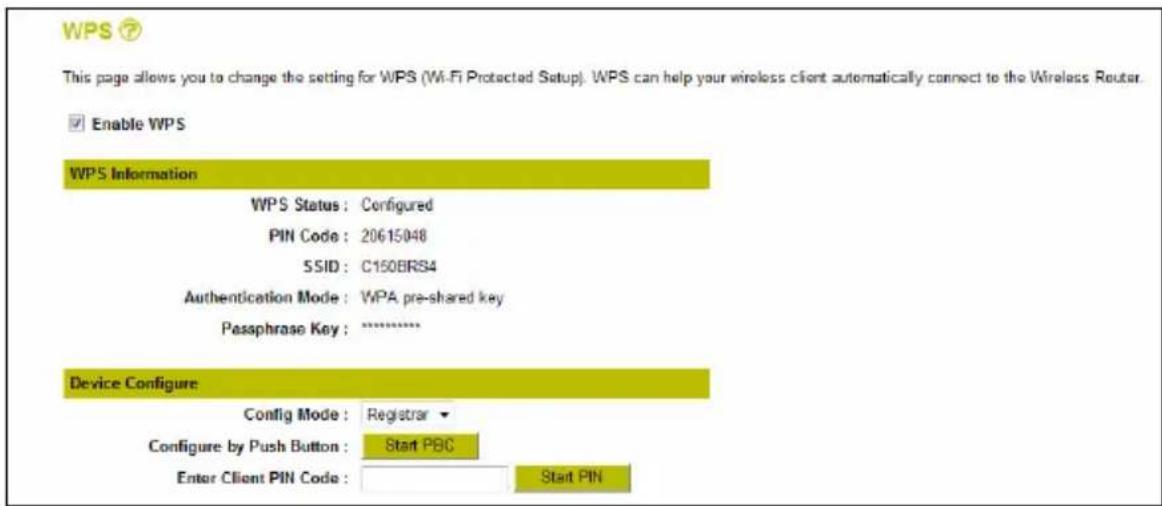
In the WPS configuration page, you can trigger the virtual 'Push Button' or the 'PIN Code' authentication. The 'PIN Code' authentication can be initiated in 2 different ways:
- The wireless client will provide the PIN code, which will be entered in the router. In this situation, the wireless client will be the 'Enrollee' and the router will be the 'Registrar'.
A. Start the wireless client and search for the provided PIN code, like shown in below example:
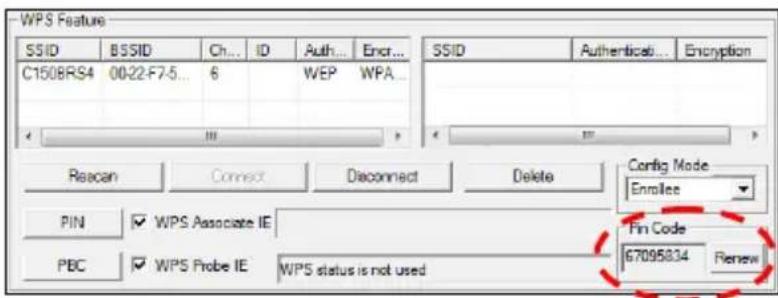
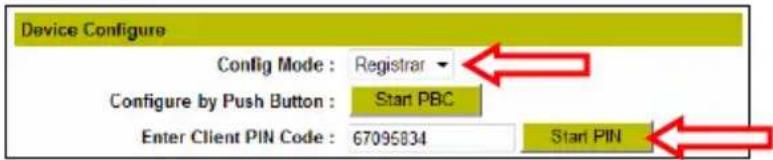
B. Make sure the "Config Mode" at the WPS configuration page is set to 'Registrar'.
C. Enter the PIN Code given by your wireless client in the "Enter Client PIN Code" field.
D. Click the 'Start PIN' button.
The C150BRS4 will keep the WPS authentication for incoming connections with the given PIN code active for 120 seconds.
E. Initiate the PIN code connection on your wireless client.
Your wireless client will now connect to the secured wireless network of the C150BRS4. When the connection is established, the C150BRS4 will stop the WPS authentication check and the WPS Status in the WPS configuration page will be set to "Configured".

If you want to add more Wireless Clients with the WPS feature, repeat steps A to E.
- The router will provide the PIN code, which will be entered in the wireless client. In this situation, the router will be the 'Enrollee' and the wireless client will be the 'Registrar'.
A. Set the option "Config Mode" in the WPS configuration page to 'Enrollee' and write down the PIN code mentioned at the section "PIN Code".
B. Click the 'Start PIN' button.
The C150BRS4 will keep the WPS authentication for incoming connections with the generated PIN code active for 120 seconds.
C. Enter the PIN code provided by the C150BRS4 in your wireless client software, set the wireless client software to 'Registrar' and initiate the PIN code connection.
Your wireless client will now connect to the secured wireless network of the C150BRS4. When the connection is established, the C150BRS4 will stop the WPS authentication check and the WPS Status in the WPS configuration page will be set to "Configured".

If you want to add more Wireless Clients with the WPS feature, repeat steps A to C.
7. Port mapping
The Conceptronic C150BRS4 is equipped with a built-in firewall to prevent attacks from the internet on your network. This firewall automatically blocks all incoming traffic on unused ports. When a blocked port is needed for a service or application (for example: a FTP or Web server) you can create a Virtual Server Rule in the configuration pages to forward the traffic.
The C150BRS4 also supports UPnP port mapping, allowing local UPnP applications to automatically add port mappings to the router's configuration. This means that if you are using an UPnP capable application there is no need to manually create a Virtual Server rule in the C150BRS4 for that application.
In the situation that UPnP is not available or a Virtual Server rule needs to be added for any other reason, it is advised to configure the computer(s) and/or network device(s) with a fixed IP address instead of a dynamic IP address.
Below you will find a list of some common used ports and their corresponding application:
| Port | Application | Port | Application |
| 20 | FTP data (FTP server) | 80 | HTTP (Web server) |
| 21 | FTP data (FTP server) | 110 | |
| 22 | SSH (Secure shell) | 2000 | |
| 23 | Telnet 5800 VNC | ||
| 25 | SMTP (Mail server - outgoing) | 5900 | |
| VNC |
For more ports and their corresponding applications, see http://portforward.com/cports.htm.
Note: For detailed information about the virtual server and DMZ options, refer to the user manual (English only) on the product CD-ROM. Select "View User Manual" from the autorun menu.
A. Login to the web interface as explained in chapter 5.1.
B. Select 'General Setup', 'NAT' and 'Virtual Server' to open the virtual server configuration page.
C. Enable the virtual server by ticking the checkbox in front of 'Enable Virtual Server'.
D. Enter the information needed for the virtual server rule in the following fields:
- Private IP : Enter the local IP address of the computer/device.
- Private Port : Enter the desired local port for the computer/device.
- Type : Select the type of type of network traffic that should be passed through.
- Public Port : Enter the port which must be visible on the outside of your internet connection.
Comment :Optionally you can add a name to easily recognize the virtual server rule.
Note: When the computer/device is connected to the router you can also select its name from the drop down list under 'Computer Name' and press the << button to automatically add its IP address.
E. Click on the 'Add' button to add the virtual server rule to the virtual server table.
Note: In the picture below you will see an example of a virtual server configuration.
Virtual Server
You can configure the Wireless Router as a Virtual Server so that remote users accessing services such as the Web or FTP at your local site via Public IP Addresses can be automatically redirected to local servers configured with Private IP Addresses. In other words, depending on the requested service (TCP/UDP) port number, the Wireless Router redirects the external service request to the appropriate internal server (located at one of your LAN's Private IP Address).
Enable Virtual Server

Current Virtual Server Table

Note: If you do not know which protocol ('Type') you need to select for your virtual server rule, select 'Both'. This option will pass both TCP and UDP traffic through to the configured IP address.
F. When you are finished adding virtual server rules, click on the 'APPLY' button to save the settings. On the next page, click on 'APPLY' again to restart the router.
After the router has been restarted, all settings are taken into affect and the virtual server rules will be applied.
The defined virtual server rules are ready to use
Note: For a more detailed explanation of the features and settings available for the C150BRS4, please refer to the user manual (English only) on the included product CD-ROM. Select "View User Manual" from the autorun menu.
C150BRS4 de Conceptronic
Guía de instalación
Save settings successfully!
Please press Apply button to restart the system to make the changes take effect.
APPLY
You can configure the Wireless Router as a Virtual Server so that remote users accessing services such as the Web or FTP at your local site via Public IP Addresses can be automatically redirected to local servers configured with Private IP Addresses. In other words, depending on the requested service (TCP/UDP) port number, the Wireless Router redirects the external service request to the appropriate internal server (located at one of your LAN's Private IP Address).
Enable Virtual Server

- Current Virtual Server Table

Conceptronic C150BRS4
Save settings successfully!
Please press Apply button to restart the system to make the changes take effect.
APPLY
,Wireless networks are
You can configure the Wireless Router as a Virtual Server so that remote users accessing services such as the Web or FTP at your local site via Public IP Addresses can be automatically redirected to local servers configured with Private IP Addresses. In other words, depending on the requested service (TCP/UDP) port number, the Wireless Router redirects the external service request to the appropriate internal server (located at one of your LAN's Private IP Address).
Enable Virtual Server

Current Virtual Server Table


6. Telstra - Big-Pond
Save settings successfully!
Please press Apply button to restart the system to make the changes take effect.
APPLY
You can configure the Wireless Router as a Virtual Server so that remote users accessing services such as the Web or FTP at your local site via Public IP Addresses can be automatically redirected to local servers configured with Private IP Addresses. In other words, depending on the requested service (TCP/UDP) port number, the Wireless Router redirects the external service request to the appropriate internal server (located at one of your LAN's Private IP Address).
Enable Virtual Server

- Current Virtual Server Table

Conceptronic C150BRS4
Save settings successfully!
Please press Apply button to restart the system to make the changes take effect.
APPLY
You can configure the Wireless Router as a Virtual Server so that remote users accessing services such as the Web or FTP at your local site via Public IP Addresses can be automatically redirected to local servers configured with Private IP Addresses. In other words, depending on the requested service (TCP/UDP) port number, the Wireless Router redirects the external service request to the appropriate internal server (located at one of your LAN's Private IP Address).
Enable Virtual Server

- Current Virtual Server Table

Conceptronic C150BRS4
Save settings successfully!
Please press Apply button to restart the system to make the changes take effect.
APPLY
You can configure the Wireless Router as a Virtual Server so that remote users accessing services such as the Web or FTP at your local site via Public IP Addresses can be automatically redirected to local servers configured with Private IP Addresses. In other words, depending on the requested service (TCP/UDP) port number, the Wireless Router redirects the external service request to the appropriate internal server (located at one of your LAN's Private IP Address).


Conceptronic C150BRS4
Save settings successfully!
Please press Apply button to restart the system to make the changes take effect.
APPLY
Conceptronic C150BRS4
Hizli Kurulum Kialavuzu
2.1. On panel
2.2. Arka panel
- Kablo baglantilarinin yapilmasi
3.1. WAN baglanti noktası
3.2. LAN baglanti noktası (noktaları)
Save settings successfully!
Please press Apply button to restart the system to make the changes take effect.
APPLY
This Conceptronic product C300BRS4A includes copyrighted third-party software licensed under the terms of the GNU General Public License.
Please see The GNU General Public License for the exact terms and conditions of this license.
All used software packages are copyright by their respective authors. Please see the source code for detailed information.
Availability of source code
Conceptronic. has exposed the full source code of the GPL licensed software, including any scripts to control compilation and installation of the object code. All future firmware updates will also be accompanied with their respective source code. For more information on how you can obtain our open source code, please visit our web site.
GNU GENERAL PUBLIC LICENSE
Version 2, June 1991
Copyright (C) 1989, 1991 Free Software Foundation, Inc.
Temple Place, Suite 330, Boston, MA 02111-1307 USA
Everyone is permitted to copy and distribute verbatim copies
of this license document, but changing it is not allowed.
Preamble
The licenses for most software are designed to take away your freedom to share and change it. By contrast, the GNU General Public License is intended to guarantee your freedom to share and change free software--to make sure the software is free for all its users. This General Public License applies to most of the Free Software Foundation's software and to any other program whose authors commit to using it. (Some other Free Software Foundation software is covered by the GNU Library General Public License instead.) You can apply it to your programs, too.
When we speak of free software, we are referring to freedom, not price. Our General Public Licenses are designed to make sure that you have the freedom to distribute copies of free software (and charge for this service if you wish), that you receive source code or can get it if you want it, that you can change the software or use pieces of it in new free programs; and that you know you can do these things.
To protect your rights, we need to make restrictions that forbid anyone to deny you these rights or to ask you to surrender the rights. These restrictions translate to certain responsibilities for you if you distribute copies of the software, or if you modify it.
For example, if you distribute copies of such a program, whether gratis or for a fee, you must give the recipients all the rights that you have. You must make sure that they, too, receive or can get the source code. And you must show them these terms so they know their rights.
We protect your rights with two steps: (1) copyright the software, and (2) offer you this license which gives you legal permission to copy, distribute and/or modify the software.
Also, for each author's protection and ours, we want to make certain that everyone understands that there is no warranty for this free software. If the software is modified by someone else and passed on, we want its recipients to know that what they have is not the original, so that any problems introduced by others will not reflect on the original authors' reputations.
Finally, any free program is threatened constantly by software patents. We wish to avoid the danger that redistributors of a free program will individually obtain patent licenses, in effect making the program proprietary. To prevent this, we have made it clear that any patent must be licensed for everyone's free use or not licensed at all.
The precise terms and conditions for copying, distribution and modification follow.
GNU GENERAL PUBLIC LICENSE TERMS AND CONDITIONS FOR COPYING, DISTRIBUTION AND MODIFICATION
- This License applies to any program or other work which contains a notice placed by the copyright holder saying it may be distributed under the terms of this General Public License. The "Program", below, refers to any such program or work, and a "work based on the Program" means either the Program or any derivative work under copyright law: that is to say, a work containing the Program or a portion of it, either verbatim or with modifications and/or translated into another language. (Hereinafter, translation is included without limitation in the term "modification".) Each licensee is addressed as "you".
Activities other than copying, distribution and modification are not covered by this License; they are outside its scope. The act of running the Program is not restricted, and the output from the Program is covered only if its contents constitute a work based on the Program (independent of having been made by running the Program). Whether that is true depends on what the Program does.
- You may copy and distribute verbatim copies of the Program's source code as you receive it, in any medium, provided that you conspicuously and appropriately publish on each copy an appropriate copyright notice and disclaimer of warranty; keep intact all the notices that refer to this License and to the absence of any warranty; and give any other recipients of the Program a copy of this License along with the Program.
You may charge a fee for the physical act of transferring a copy, and you may at your option offer warranty protection in exchange for a fee.
- You may modify your copy or copies of the Program or any portion of it, thus forming a work based on the Program, and copy and distribute such modifications or work under the terms of Section 1 above, provided that you also meet all of these conditions:
a) You must cause the modified files to carry prominent notices stating that you changed the files and the date of any change.
b) You must cause any work that you distribute or publish, that in whole or in part contains or is derived from the Program or any part thereof, to be licensed as a whole at no charge to all third parties under the terms of this License.
c) If the modified program normally reads commands interactively when run, you must cause it, when started running for such interactive use in the most ordinary way, to print or display an announcement including an appropriate copyright notice and a notice that there is no warranty (or else, saying that you provide a warranty) and that users may redistribute the program under these conditions, and telling the user how to view a copy of this License. (Exception: if the Program itself is interactive but does not normally print such an announcement, your work based on the Program is not required to print an announcement.)
These requirements apply to the modified work as a whole. If identifiable sections of that work are not derived from the Program, and can be reasonably considered independent and separate works in themselves, then this License, and its terms, do not apply to those sections when you distribute them as separate works. But when you distribute the same sections as part of a whole which is a work based on the Program, the distribution of the whole must be on the terms of this License, whose permissions for other licensees extend to the entire whole, and thus to each and every part regardless of who wrote it.
Thus, it is not the intent of this section to claim rights or contest your rights to work written entirely by you; rather, the intent is to exercise the right to control the distribution of derivative or collective works based on the Program.
In addition, mere aggregation of another work not based on the Program with the Program (or with a work based on the Program) on a volume of a storage or distribution medium does not bring the other work under the scope of this License.
- You may copy and distribute the Program (or a work based on it, under Section 2) in object code or executable form under the terms of Sections 1 and 2 above provided that you also do one of the following:
a) Accompany it with the complete corresponding machine-readable source code, which must be distributed under the terms of Sections 1 and 2 above on a medium customarily used for software interchange; or,
LICENSING INFORMATION
b) Accompany it with a written offer, valid for at least three years, to give any third party, for a charge no more than your cost of physically performing source distribution, a complete machine-readable copy of the corresponding source code, to be distributed under the terms of Sections 1 and 2 above on a medium customarily used for software interchange; or,
c) Accompany it with the information you received as to the offer to distribute corresponding source code. (This alternative is allowed only for noncommercial distribution and only if you received the program in object code or executable form with such an offer, in accord with Subsection b above.)
The source code for a work means the preferred form of the work for making modifications to it. For an executable work, complete source code means all the source code for all modules it contains, plus any associated interface definition files, plus the scripts used to control compilation and installation of the executable. However, as a special exception, the source code distributed need not include anything that is normally distributed (in either source or binary form) with the major components (compiler, kernel, and so on) of the operating system on which the executable runs, unless that component itself accompanies the executable.
If distribution of executable or object code is made by offering access to copy from a designated place, then offering equivalent access to copy the source code from the same place counts as distribution of the source code, even though third parties are not compelled to copy the source along with the object code.
- You may not copy, modify, sublicense, or distribute the Program except as expressly provided under this License. Any attempt otherwise to copy, modify, sublicense or distribute the Program is void, and will automatically terminate your rights under this License. However, parties who have received copies, or rights, from you under this License will not have their licenses terminated so long as such parties remain in full compliance.
- You are not required to accept this License, since you have not signed it. However, nothing else grants you permission to modify or distribute the Program or its derivative works. These actions are prohibited by law if you do not accept this License. Therefore, by modifying or distributing the Program (or any work based on the Program), you indicate your acceptance of this License to do so, and all its terms and conditions for copying, distributing or modifying the Program or works based on it.
- Each time you redistribute the Program (or any work based on the Program), the recipient automatically receives a license from the original licensor to copy, distribute or modify the Program subject to these terms and conditions. You may not impose any further restrictions on the recipients' exercise of the rights granted herein. You are not responsible for enforcing compliance by third parties to this License.
- If, as a consequence of a court judgment or allegation of patent infringement or for any other reason (not limited to patent issues), conditions are imposed on you (whether by court order, agreement or otherwise) that contradict the conditions of this License, they do not excuse you from the conditions of this License. If you cannot distribute so as to satisfy simultaneously your obligations under this License and any other pertinent obligations, then as a consequence you may not distribute the Program at all. For example, if a patent license would not permit royalty-free redistribution of the Program by all those who receive copies directly or indirectly through you, then the only way you could satisfy both it and this License would be to refrain entirely from distribution of the Program.
If any portion of this section is held invalid or unenforceable under any particular circumstance, the balance of the section is intended to apply and the section as a whole is intended to apply in other circumstances. It is not the purpose of this section to induce you to infringe any patents or other property right claims or to contest validity of any such claims; this section has the sole purpose of protecting the integrity of the free software distribution system, which is implemented by public license practices. Many people have made generous contributions to the wide range of software distributed through that system in reliance on consistent application of that system; it is up to the author/donor to decide if he or she is willing to distribute software through any other system and a licensee cannot impose that choice.
This section is intended to make thoroughly clear what is believed to be a consequence of the rest of this License.
-
If the distribution and/or use of the Program is restricted in certain countries either by patents or by copyrighted interfaces, the original copyright holder who places the Program under this License may add an explicit geographical distribution limitation excluding those countries, so that distribution is permitted only in or among countries not thus excluded. In such case, this License incorporates the limitation as if written in the body of this License.
-
The Free Software Foundation may publish revised and/or new versions of the General Public License from time to time. Such new versions will be similar in spirit to the present version, but may differ in detail to address new problems or concerns.
Each version is given a distinguishing version number. If the Program specifies a version number of this License which applies to it and "any later version", you have the option of following the terms and conditions either of that version or of any later version published by the Free Software Foundation. If the Program does not specify a version number of this License, you may choose any version ever published by the Free Software Foundation.
- If you wish to incorporate parts of the Program into other free programs whose distribution conditions are different, write to the author to ask for permission. For software which is copyrighted by the Free Software Foundation, write to the Free Software Foundation; we sometimes make exceptions for this. Our decision will be guided by the two goals of preserving the free status of all derivatives of our free software and of promoting the sharing and reuse of software generally.
NO WARRANTY
- BECAUSE THE PROGRAM IS LICENSED FREE OF CHARGE, THERE IS NO WARRANTY FOR THE PROGRAM, TO THE EXTENT PERMITTED BY APPLICABLE LAW. EXCEPT WHEN OTHERWISE STATED IN WRITING THE COPYRIGHT HOLDERS AND/OR OTHER PARTIES PROVIDE THE PROGRAM "AS IS" WITHOUT WARRANTY OF ANY KIND, EITHER EXPRESSED OR IMPLIED, INCLUDING, BUT NOT LIMITED TO, THE IMPLIED WARRANTYES OF MERCHANTABILITY AND FITNESS FOR A PARTICULAR PURPOSE. THE ENTIRE RISK AS TO THE QUALITY AND PERFORMANCE OF THE PROGRAM IS WITH YOU. SHOULD THE PROGRAM PROVE DEFECTIVE, YOU ASSUME THE COST OF ALL NECESSARY SERVICING, REPAIR OR CORRECTION.
- IN NO EVENT UNLESS REQUIRED BY APPLICABLE LAW OR AGREED TO IN WRITING WILL ANY COPYRIGHT HOLDER, OR ANY OTHER PARTY WHO MAY MODIFY AND/OR REDISTRIBUTE THE PROGRAM AS PERMITTED ABOVE, BE LIABLE TO YOU FOR DAMAGES, INCLUDING ANY GENERAL, SPECIAL, INCIDENTAL OR CONSEQUENTIAL DAMAGES ARISING OUT OF THE USE OR INABILITY TO USE THE PROGRAM (INCLUDING BUT NOT LIMITED TO LOSS OF DATA OR DATA BEING RENDERED INACCURATE OR LOSSES SUSTAINED BY YOU OR THIRD PARTIES OR A FAILURE OF THE PROGRAM TO OPERATE WITH ANY OTHER PROGRAMS), EVEN IF SUCH HOLDER OR OTHER PARTY HAS BEEN ADVISED OF THE POSSIBILITY OF SUCH DAMAGES.
END OF TERMS AND CONDITIONS
How to Apply These Terms to Your New Programs
If you develop a new program, and you want it to be of the greatest possible use to the public, the best way to achieve this is to make it free software which everyone can redistribute and change under these terms.
To do so, attach the following notices to the program. It is safest to attach them to the start of each source file to most effectively convey the exclusion of warranty; and each file should have at least the "copyright" line and a pointer to where the full notice is found.
1 April 1989
Ty Coon, President of Vice
This General Public License does not permit incorporating your program into proprietary programs. If your program is a subroutine library, you may consider it more useful to permit linking proprietary applications with the library. If this is what you want to do, use the GNU Library General Public License instead of this License.
LICENSING INFORMATION
GNU LESSER GENERAL PUBLIC LICENSE
Version 2.1, February 1999
Copyright (C) 1991, 1999 Free Software Foundation, Inc. 51 Franklin Street, Fifth Floor, Boston, MA 02110-1301 USA
Everyone is permitted to copy and distribute verbatim copies of this license document, but changing it is not allowed.
[This is the first released version of the Lesser GPL. It also counts as the successor of the GNU Library Public License, version 2, hence the version number 2.1.]
Preamble
The licenses for most software are designed to take away your freedom to share and change it. By contrast, the GNU General Public Licenses are intended to guarantee your freedom to share and change free software--to make sure the software is free for all its users.
This license, the Lesser General Public License, applies to some specially designated software packages--typically libraries-of the Free Software Foundation and other authors who decide to use it. You can use it too, but we suggest you first think carefully about whether this license or the ordinary General Public License is the better strategy to use in any particular case, based on the explanations below.
When we speak of free software, we are referring to freedom of use, not price. Our General Public Licenses are designed to make sure that you have the freedom to distribute copies of free software (and charge for this service if you wish); that you receive source code or can get it if you want it; that you can change the software and use pieces of it in new free programs; and that you are informed that you can do these things.
To protect your rights, we need to make restrictions that forbid distributors to deny you these rights or to ask you to surrender these rights. These restrictions translate to certain responsibilities for you if you distribute copies of the library or if you modify it.
For example, if you distribute copies of the library, whether gratis or for a fee, you must give the recipients all the rights that we gave you. You must make sure that they, too, receive or can get the source code. If you link other code with the library, you must provide complete object files to the recipients, so that they can relink them with the library after making changes to the library and recompiling it. And you must show them these terms so they know their rights.
We protect your rights with a two-step method: (1) we copyright the library, and (2) we offer you this license, which gives you legal permission to copy, distribute and/or modify the library.
To protect each distributor, we want to make it very clear that there is no warranty for the free library. Also, if the library is modified by someone else and passed on, the recipients should know that what they have is not the original version, so that the original author's reputation will not be affected by problems that might be introduced by others.
Finally, software patents pose a constant threat to the existence of any free program. We wish to make sure that a company cannot effectively restrict the users of a free program by obtaining a restrictive license from a patent holder. Therefore, we insist that any patent license obtained for a version of the library must be consistent with the full freedom of use specified in this license.
Most GNU software, including some libraries, is covered by the ordinary GNU General Public License. This license, the GNU Lesser General Public License, applies to certain designated libraries, and is quite different from the ordinary General Public License. We use this license for certain libraries in order to permit linking those libraries into non-free programs.
When a program is linked with a library, whether statically or using a shared library, the combination of the two is legally speaking a combined work, a derivative of the original library. The ordinary General Public License therefore permits such linking only if the entire combination fits its criteria of freedom. The Lesser General Public License permits more lax criteria for linking other code with the library.
We call this license the "Lesser" General Public License because it does Less to protect the user's freedom than the ordinary General Public License. It also provides other free software developers Less of an advantage over competing non-free programs. These disadvantages are the reason we use the ordinary General Public License for many libraries. However, the Lesser license provides advantages in certain special circumstances.
For example, on rare occasions, there may be a special need to encourage the widest possible use of a certain library, so that it becomes a de-facto standard. To achieve this, non-free programs must be allowed to use the library. A more frequent case is that a free library does the same job as widely used non-free libraries. In this case, there is little to gain by limiting the free library to free software only, so we use the Lesser General Public License.
In other cases, permission to use a particular library in non-free programs enables a greater number of people to use a large body of free software. For example, permission to use the GNU C Library in non-free programs enables many more people to use the whole GNU operating system, as well as its variant, the GNU/Linux operating system.
Although the Lesser General Public License is Less protective of the users' freedom, it does ensure that the user of a program that is linked with the Library has the freedom and the wherewithal to run that program using a modified version of the Library.
The precise terms and conditions for copying, distribution and modification follow. Pay close attention to the difference between a "work based on the library" and a "work that uses the library". The former contains code derived from the library, whereas the latter must be combined with the library in order to run.
GNU LESSER GENERAL PUBLIC LICENSE TERMS AND CONDITIONS FOR COPYING, DISTRIBUTION AND MODIFICATION
- This License Agreement applies to any software library or other program which contains a notice placed by the copyright holder or other authorized party saying it may be distributed under the terms of this Lesser General Public License (also called "this License"). Each licensee is addressed as "you".
A "library" means a collection of software functions and/or data prepared so as to be conveniently linked with application programs (which use some of those functions and data) to form executables.
The "Library", below, refers to any such software library or work which has been distributed under these terms. A "work based on the Library" means either the Library or any derivative work under copyright law: that is to say, a work containing the Library or a portion of it, either verbatim or with modifications and/or translated straightforwardly into another language. (Hereinafter, translation is included without limitation in the term "modification".)
"Source code" for a work means the preferred form of the work for making modifications to it. For a library, complete source code means all the source code for all modules it contains, plus any associated interface definition files, plus the scripts used to control compilation and installation of the library.
Activities other than copying, distribution and modification are not covered by this License; they are outside its scope. The act of running a program using the Library is not restricted, and output from such a program is covered only if its contents constitute a work based on the Library (independent of the use of the Library in a tool for writing it). Whether that is true depends on what the Library does and what the program that uses the Library does.
- You may copy and distribute verbatim copies of the Library's complete source code as you receive it, in any medium, provided that you conspicuously and appropriately publish on each copy an appropriate copyright notice and disclaimer of warranty; keep intact all the notices that refer to this License and to the absence of any warranty; and distribute a copy of this License along with the Library.
You may charge a fee for the physical act of transferring a copy, and you may at your option offer warranty protection in exchange for a fee.
LICENSING INFORMATION
- You may modify your copy or copies of the Library or any portion of it, thus forming a work based on the Library, and copy and distribute such modifications or work under the terms of Section 1 above, provided that you also meet all of these conditions:
a) The modified work must itself be a software library.
b) You must cause the files modified to carry prominent notices stating that you changed the files and the date of any change.
c) You must cause the whole of the work to be licensed at no charge to all third parties under the terms of this License.
d) If a facility in the modified Library refers to a function or a table of data to be supplied by an application program that uses the facility, other than as an argument passed when the facility is invoked, then you must make a good faith effort to ensure that, in the event an application does not supply such function or table, the facility still operates, and performs whatever part of its purpose remains meaningful.
(For example, a function in a library to compute square roots has a purpose that is entirely well-defined independent of the application. Therefore, Subsection 2d requires that any application-supplied function or table used by this function must be optional: if the application does not supply it, the square root function must still compute square roots.)
These requirements apply to the modified work as a whole. If identifiable sections of that work are not derived from the Library, and can be reasonably considered independent and separate works in themselves, then this License, and its terms, do not apply to those sections when you distribute them as separate works. But when you distribute the same sections as part of a whole which is a work based on the Library, the distribution of the whole must be on the terms of this License, whose permissions for other licensees extend to the entire whole, and thus to each and every part regardless of who wrote it.
Thus, it is not the intent of this section to claim rights or contest your rights to work written entirely by you; rather, the intent is to exercise the right to control the distribution of derivative or collective works based on the Library.
In addition, mere aggregation of another work not based on the Library with the Library (or with a work based on the Library) on a volume of a storage or distribution medium does not bring the other work under the scope of this License.
- You may opt to apply the terms of the ordinary GNU General Public License instead of this License to a given copy of the Library. To do this, you must alter all the notices that refer to this License, so that they refer to the ordinary GNU General Public License, version 2, instead of to this License. (If a newer version than version 2 of the ordinary GNU General Public License has appeared, then you can specify that version instead if you wish.) Do not make any other change in these notices.
Once this change is made in a given copy, it is irreversible for that copy, so the ordinary GNU General Public License applies to all subsequent copies and derivative works made from that copy.
This option is useful when you wish to copy part of the code of the Library into a program that is not a library.
- You may copy and distribute the Library (or a portion or derivative of it, under Section 2) in object code or executable form under the terms of Sections 1 and 2 above provided that you accompany it with the complete corresponding machine-readable source code, which must be distributed under the terms of Sections 1 and 2 above on a medium customarily used for software interchange.
If distribution of object code is made by offering access to copy from a designated place, then offering equivalent access to copy the source code from the same place satisfies the requirement to distribute the source code, even though third parties are not compelled to copy the source along with the object code.
- A program that contains no derivative of any portion of the Library, but is designed to work with the Library by being compiled or linked with it, is called a "work that uses the Library". Such a work, in isolation, is not a derivative work of the Library, and therefore falls outside the scope of this License.
However, linking a "work that uses the Library" with the Library creates an executable that is a derivative of the Library (because it contains portions of the Library), rather than a "work that uses the library". The executable is therefore covered by this License.Section 6 states terms for distribution of such executables.
When a "work that uses the Library" uses material from a header file that is part of the Library, the object code for the work may be a derivative work of the Library even though the source code is not. Whether this is true is especially significant if the work can be linked without the Library, or if the work is itself a library. The threshold for this to be true is not precisely defined by law.
If such an object file uses only numerical parameters, data structure layouts and accessors, and small macros and small inline functions (ten lines or less in length), then the use of the object file is unrestricted, regardless of whether it is legally a derivative work. (Executables containing this object code plus portions of the Library will still fall under Section 6.)
Otherwise, if the work is a derivative of the Library, you may distribute the object code for the work under the terms of Section 6. Any executables containing that work also fall under Section 6, whether or not they are linked directly with the Library itself.
- As an exception to the Sections above, you may also combine or link a "work that uses the Library" with the Library to produce a work containing portions of the Library, and distribute that work under terms of your choice, provided that the terms permit modification of the work for the customer's own use and reverse engineering for debugging such modifications.
You must give prominent notice with each copy of the work that the Library is used in it and that the Library and its use are covered by this License. You must supply a copy of this License. If the work during execution displays copyright notices, you must include the copyright notice for the Library among them, as well as a reference directing the user to the copy of this License. Also, you must do one of these things:
a) Accompany the work with the complete corresponding machine-readable source code for the Library including whatever changes were used in the work (which must be distributed under Sections 1 and 2 above); and, if the work is an executable linked with the Library, with the complete machine-readable "work that uses the Library", as object code and/or source code, so that the user can modify the Library and then relink to produce a modified executable containing the modified Library. (It is understood that the user who changes the contents of definitions files in the Library will not necessarily be able to recompile the application to use the modified definitions.)
b) Use a suitable shared library mechanism for linking with the Library. A suitable mechanism is one that (1) uses at run time a copy of the library already present on the user's computer system, rather than copying library functions into the executable, and (2) will operate properly with a modified version of the library, if the user installs one, as long as the modified version is interface-compatible with the version that the work was made with.
c) Accompany the work with a written offer, valid for at least three years, to give the same user the materials specified in Subsection 6a, above, for a charge no more than the cost of performing this distribution.
d) If distribution of the work is made by offering access to copy from a designated place, offer equivalent access to copy the above specified materials from the same place.
e) Verify that the user has already received a copy of these materials or that you have already sent this user a copy.
For an executable, the required form of the "work that uses the Library" must include any data and utility programs needed for reproducing the executable from it. However, as a special exception, the materials to be distributed need not include anything that is normally distributed (in either source or binary form) with the major components (compiler, kernel, and so on) of the operating system on which the executable runs, unless that component itself accompanies the executable.
LICENSING INFORMATION
It may happen that this requirement contradicts the license restrictions of other proprietary libraries that do not normally accompany the operating system. Such a contradiction means you cannot use both them and the Library together in an executable that you distribute.
- You may place library facilities that are a work based on the Library side-by-side in a single library together with other library facilities not covered by this License, and distribute such a combined library, provided that the separate distribution of the work based on the Library and of the other library facilities is otherwise permitted, and provided that you do these two things:
a) Accompany the combined library with a copy of the same work based on the Library, uncombined with any other library facilities. This must be distributed under the terms of the Sections above.
b) Give prominent notice with the combined library of the fact that part of it is a work based on the Library, and explaining where to find the accompanying uncombined form of the same work.
-
You may not copy, modify, sublicense, link with, or distribute the Library except as expressly provided under this License. Any attempt otherwise to copy, modify, sublicense, link with, or distribute the Library is void, and will automatically terminate your rights under this License. However, parties who have received copies, or rights, from you under this License will not have their licenses terminated so long as such parties remain in full compliance.
-
You are not required to accept this License, since you have not signed it. However, nothing else grants you permission to modify or distribute the Library or its derivative works. These actions are prohibited by law if you do not accept this License. Therefore, by modifying or distributing the Library (or any work based on the Library), you indicate your acceptance of this License to do so, and all its terms and conditions for copying, distributing or modifying the Library or works based on it.
-
Each time you redistribute the Library (or any work based on the Library), the recipient automatically receives a license from the original licensor to copy, distribute, link with or modify the Library subject to these terms and conditions. You may not impose any further restrictions on the recipients' exercise of the rights granted herein. You are not responsible for enforcing compliance by third parties with this License.
-
If, as a consequence of a court judgment or allegation of patent infringement or for any other reason (not limited to patent issues), conditions are imposed on you (whether by court order, agreement or otherwise) that contradict the conditions of this License, they do not excuse you from the conditions of this License. If you cannot distribute so as to satisfy simultaneously your obligations under this License and any other pertinent obligations, then as a consequence you may not distribute the Library at all. For example, if a patent license would not permit royalty-free redistribution of the Library by all those who receive copies directly or indirectly through you, then the only way you could satisfy both it and this License would be to refrain entirely from distribution of the Library.
If any portion of this section is held invalid or unenforceable under any particular circumstance, the balance of the section is intended to apply, and the section as a whole is intended to apply in other circumstances.
It is not the purpose of this section to induce you to infringe any patents or other property right claims or to contest validity of any such claims; this section has the sole purpose of protecting the integrity of the free software distribution system which is implemented by public license practices. Many people have made generous contributions to the wide range of software distributed through that system in reliance on consistent application of that system; it is up to the author/donor to decide if he or she is willing to distribute software through any other system and a licensee cannot impose that choice.
This section is intended to make thoroughly clear what is believed to be a consequence of the rest of this License.
-
If the distribution and/or use of the Library is restricted in certain countries either by patents or by copyrighted interfaces, the original copyright holder who places the Library under this License may add an explicit geographical distribution limitation excluding those countries, so that distribution is permitted only in or among countries not thus excluded. In such case, this License incorporates the limitation as if written in the body of this License.
-
The Free Software Foundation may publish revised and/or new versions of the Lesser General Public License from time to time. Such new versions will be similar in spirit to the present version, but may differ in detail to address new problems or concerns.
Each version is given a distinguishing version number. If the Library specifies a version number of this License which applies to it and "any later version", you have the option of following the terms and conditions either of that version or of any later version published by the Free Software Foundation. If the Library does not specify a license version number, you may choose any version ever published by the Free Software Foundation.
- If you wish to incorporate parts of the Library into other free programs whose distribution conditions are incompatible with these, write to the author to ask for permission. For software which is copyrighted by the Free Software Foundation, write to the Free Software Foundation; we sometimes make exceptions for this. Our decision will be guided by the two goals of preserving the free status of all derivatives of our free software and of promoting the sharing and reuse of software generally.
NO WARRANTY
-
BECAUSE THE LIBRARY IS LICENSED FREE OF CHARGE, THERE IS NO WARRANTY FOR THE LIBRARY, TO THE EXTENT PERMITTED BY APPLICABLE LAW. EXCEPT WHEN OTHERWISE STATED IN WRITING THE COPYRIGHT HOLDERS AND/OR OTHER PARTIES PROVIDE THE LIBRARY "AS IS" WITHOUT WARRANTY OF ANY KIND, EITHER EXPRESSED OR IMPLIED, INCLUDING, BUT NOT LIMITED TO, THE IMPLIED WARRANTY OF MERCHANTABILITY AND FITNESS FOR A PARTICULAR PURPOSE. THE ENTIRE RISK AS TO THE QUALITY AND PERFORMANCE OF THE LIBRARY IS WITH YOU. SHOULD THE LIBRARY PROVE DEFECTIVE, YOU ASSUME THE COST OF ALL NECESSARY SERVICING, REPAIR OR CORRECTION.
-
IN NO EVENT UNLESS REQUIRED BY APPLICABLE LAW OR AGREED TO IN WRITING WILL ANY COPYRIGHT HOLDER, OR ANY OTHER PARTY WHO MAY MODIFY AND/OR REDISTRIBUTE THE LIBRARY AS PERMITTED ABOVE, BE LIABLE TO YOU FOR DAMAGES, INCLUDING ANY GENERAL, SPECIAL, INCIDENTAL OR CONSEQUENTIAL DAMAGES ARISING OUT OF THE USE OR INABILITY TO USE THE LIBRARY (INCLUDING BUT NOT LIMITED TO LOSS OF DATA OR DATA BEING RENDERED INACCURATE OR LOSSES SUSTAINED BY YOU OR THIRD PARTIES OR A FAILURE OF THE LIBRARY TO OPERATE WITH ANY OTHER SOFTWARE), EVEN IF SUCH HOLDER OR OTHER PARTY HAS BEEN ADVISED OF THE POSSIBILITY OF SUCH DAMAGES.
END OF TERMS AND CONDITIONS
LICENSING INFORMATION
BSD LICENSE
Redistribution and use in source and binary forms, with or without modification, are permitted provided that the following conditions are met:
- Redistributions of source code must retain the above copyright notice, this list of conditions and the following disclaimer.
- Redistributions in binary form must reproduce the above copyright notice, this list of conditions and the following disclaimer in the documentation and/or other materials provided with the distribution.
- Neither the name of Conceptronic nor the names of its contributors may be used to endorse or promote products derived from this software without specific prior written permission.
THIS SOFTWARE IS PROVIDED BY CONCEPTRONIC "AS IS" AND ANY EXPRESS OR IMPLIED WARRANTY, INCLUDING, BUT NOT LIMITED TO, THE IMPLIED WARRANTYES OF MERCHANTABILITY AND FITNESS FOR A PARTICULAR PURPOSE ARE DISCLAIMED. IN NO EVENT SHALL CONCEPTRONIC BE LIABLE FOR ANY DIRECT, INDIRECT, INCIDENTAL, SPECIAL, EXEMPLARY, OR CONSEQUENTIAL DAMAGES INCLUDING, BUT NOT LIMITED TO, PROCEDURE OF SUBSTITUTE GOODS OR SERVICES; LOSS OF USE, DATA, OR PROFITS; OR BUSINESS INTERRUPTION) HOWEVER CAUSED AND ON ANY THEORY OF LIABILITY, WHETHER IN CONTRACT, STRICT LIABILITY, OR TORT (INCLUDING NEGLIGENCE OR OTHERWISE) ARISING IN ANY WAY OUT OF THE USE OF THIS SOFTWARE, EVEN IF ADVISED OF THE POSSIBILITY OF SUCH DAMAGE.
REVISED BSD LICENSE
Redistribution and use in source and binary forms, with or without modification, are permitted provided that the following conditions are met:
- Redistributions of source code must retain the above copyright notice, this list of conditions and the following disclaimer.
- Redistributions in binary form must reproduce the above copyright notice, this list of conditions and the following disclaimer in the documentation and/or other materials provided with the distribution.
- Neither the name of Conceptronic nor the names of its contributors may be used to endorse or promote products derived from this software without specific prior written permission.
THIS SOFTWARE IS PROVIDED BY CONCEPTRONIC 'AS IS' AND ANY EXPRESS OR IMPLIED WARRANTY, INCLUDING, BUT NOT LIMITED TO, THE IMPLIED WARRANTYES OF MERCHANTABILITY AND FITNESS FOR A PARTICULAR PURPOSE ARE DISCLAIMED. IN NO EVENT SHALL CONCEPTRONIC BE LIABLE FOR ANY DIRECT, INDIRECT, INCIDENTAL, SPECIAL, EXEMPLARY, OR CONSEQUENTIAL DAMAGES (INCLUDING, BUT NOT LIMITED TO, PROCEDURE OF SUBSTITUTE GOODS OR SERVICES; LOSS OF USE, DATA, OR PROFITS; OR BUSINESS INTERRUsION) HOWEVER CAUSED AND ON ANY THEORY OF LIABILITY, WHETHER IN CONTRACT, STRICT LIABILITY, OR TORT (INCLUDING NEGLIGENCE OR OTHERWISE) ARISING IN ANY WAY OUT OF THE USE OF THIS SOFTWARE, EVEN IF ADVISED OF THE POSSIBILITY OF SUCH DAMAGE.