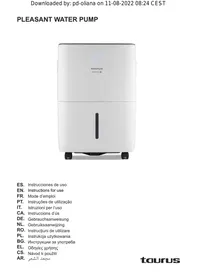
DH300 - Dehumidifier TAURUS - Free user manual and instructions
Find the device manual for free DH300 TAURUS in PDF.

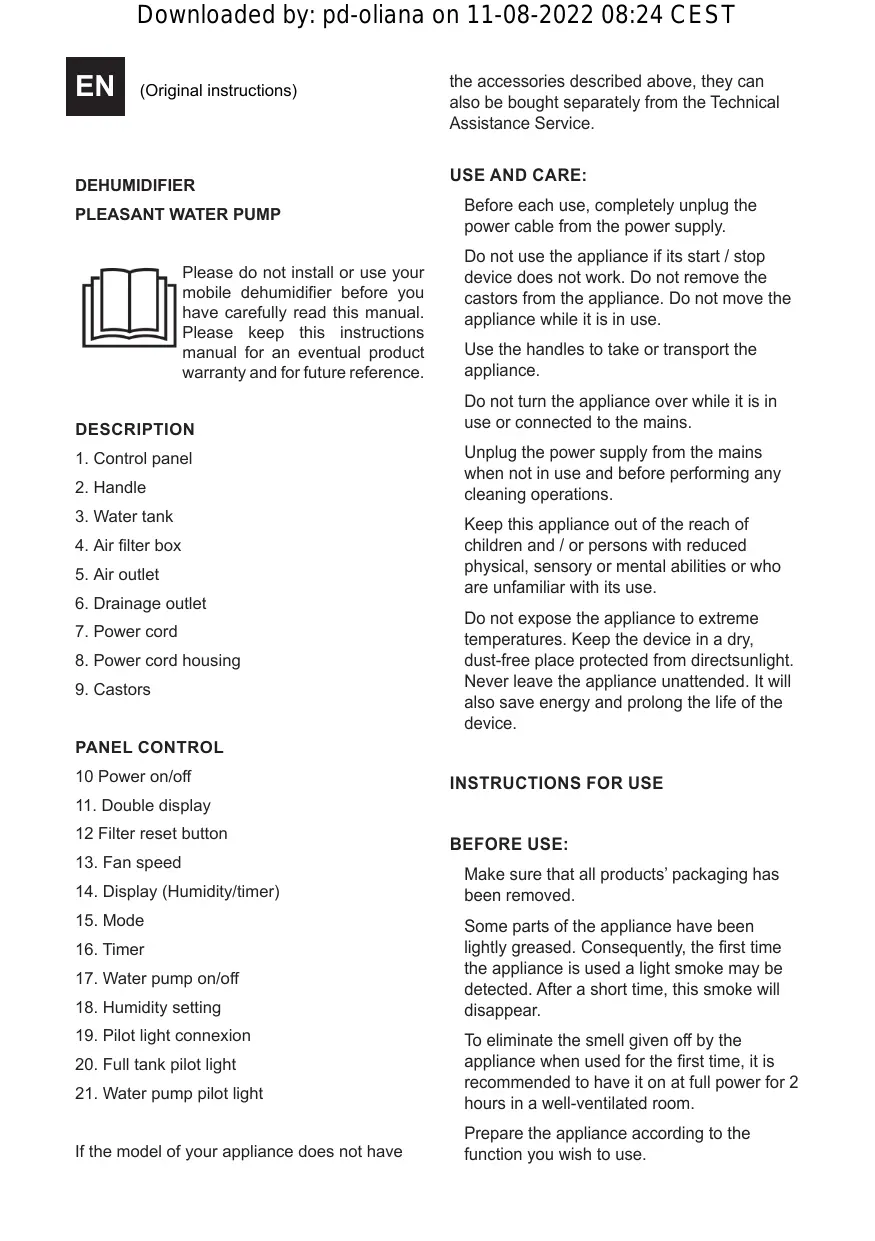


| Product type | Portable dehumidifier |
| Brand | TAURUS |
| Model | DH300 |
| Power supply | 220-240 V ~ 50 Hz |
| Adjustable humidity range | 35% to 80% RH |
| Default humidity | 55% |
| Programmable timer | From 0.5 to 24 hours |
| Fan speeds | 3 speeds (low, medium, high) |
| Integrated water pump | Yes, max height 3 m |
| Continuous drainage | Possible via supplied hose |
| Refrigerant | R290 (flammable) |
| Filter maintenance | Every 2 weeks, wash with warm water |
| Safety | Overheat protection, full tank stop, thermal safety |
| Transport | Handles and 4 casters |
| Warranty | Compliant with current legislation |
Frequently Asked Questions - DH300 TAURUS
User questions about DH300 TAURUS
0 question about this device. Answer the ones you know or ask your own.
Ask a new question about this device
Download the instructions for your Dehumidifier in PDF format for free! Find your manual DH300 - TAURUS and take your electronic device back in hand. On this page are published all the documents necessary for the use of your device. DH300 by TAURUS.
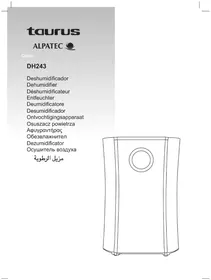
USER MANUAL DH300 TAURUS
DRENAJE (DRENAJE CONTINUO): (Fig 2.1)
(Original instructions)
the accessories described above, they can also be bought separately from the Technical Assistance Service.
DEHUMIDIFIER
PLEASANT WATER PUMP

Please do not install or use your mobile dehumidifier before you have carefully read this manual. Please keep this instructions manual for an eventual product warranty and for future reference.
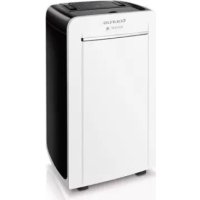
DESCRIPTION
- Control panel
- Handle
- Water tank
- Air filter box
- Air outlet
- Drainage outlet
- Power cord
- Power cord housing
- Castors
PANEL CONTROL
10 Power on/off
11. Double display
12 Filter reset button
13. Fan speed
14. Display (Humidity/timer)
15.Mode
16. Timer
17. Water pump on/off
18. Humidity setting
19. Pilot light connexion
20. Full tank pilot light
21. Water pump pilot light
If the model of your appliance does not have
USE AND CARE:
Before each use, completely unplug the power cable from the power supply.
Do not use the appliance if its start / stop device does not work. Do not remove the castors from the appliance. Do not move the appliance while it is in use.
Use the handles to take or transport the appliance.
Do not turn the appliance over while it is in use or connected to the mains.
Unplug the power supply from the mains when not in use and before performing any cleaning operations.
Keep this appliance out of the reach of children and / or persons with reduced physical, sensory or mental abilities or who are unfamiliar with its use.
Do not expose the appliance to extreme temperatures. Keep the device in a dry, dust-free place protected from direct sunlight. Never leave the appliance unattended. It will also save energy and prolong the life of the device.
INSTRUCTIONS FOR USE
BEFORE USE:
Make sure that all products' packaging has been removed.
Some parts of the appliance have been lightly greased. Consequently, the first time the appliance is used a light smoke may be detected. After a short time, this smoke will disappear.
To eliminate the smell given off by the appliance when used for the first time, it is recommended to have it on at full power for 2 hours in a well-ventilated room.
Prepare the appliance according to the function you wish to use.
Display will show the ambient and selected humidity. When the ambient humidity is lower than 20% or higher than 80% , it will show.
USE:
Extend the power cord completely before plugging in.
Plug the appliance into the mains.
Turn the appliance on, by using the power button (10)
The pilot light comes on. (19)
Select the desired fan speed (13)
To avoid a fierce start-up of the fan, it is advisable to start off from the lowest speed position and, once the fan has been switched on, progressively increase the speed to the desired position.
Press the humidity setting buttons (18) to select the desired humidity. The display indicator above will start flashing.
FAN MODE:
Select the desired fan speed (high, medium or low) by pressing the fan speed button.
The pilot light will indicate selected speed.
HUMIDITY SETTING FUNCTION:
Press the humidity setting buttons (18) to select the desired humidity. The display indicator above will start flashing.
The humidity range is 35% to 80% . And the default level is 50% .
Press the arrows (18) to adjust the desired humidity level. For every press the humidity % will be adjusted by 5% .
Once you have reached the desired humidity % stop pressing the buttons for 3 seconds. The light indicator above will stop flashing and the display (14) will show the ambient humidity again.
TIMER FUNCTION:
The appliance's operating time can be controlled.
When the dehumidifier is off, it can be programmed to automatically turn on after the set time.
When the dehumidifier is on, the running time of the compressor can be programmed.
In standby mode, press the timer button (16) to inciicate this function. The display screen (14) will show the time that is selected. Adjust the desired time by pressing the arrows (18) as many times as hours needed (0,5-10h).
Every press adjusts half an hour until to 10h. From 10h to 24h every press adjusts an hour. The time programmed or remaining time will appear on the display (14).
Once you reach the desired time, stop pressing the button. After 3 seconds, the set time is confirmed.
The light indicator above will turn on.
DRAINAGE (WATER TANK): (Fig 1)
When the water tank is full, the full tank light indicator (20) will turn on. The appliance also emits a buzzing sound to alert the user.
When the water tank is full, the operation will stop.
Proceed to remove the water tank. Place one hand on each side of the depression areas to gently remove the water tank.
Pour the water out.
Proceed to place the tank back into the appliance to restart the dehumidifier (be careful with the water pump filter, put it correctly)
DRAINAGE (CONTINUOUS DRAINAGE): (Fig 2.1)
If you do not want to empty the water tank every time it gets full, you can connect the drainage pipe provided to the drainage outlet to drain the water continuously. (6)
The low end of the water pipe must be more than 10cm lower than the height of the water outlet.
The end of the pipe cannot remain in water. It is highly recommended to install it on a place that allows the water to drain constantly.
The water pipe must be kept smooth,
otherwise the water may not be drained properly.
WATER PUMP FUNCTION: (Fig 2.2)
If you do not want to empty the water tank every time it gets full, you can connect the drainage pipe provided to the drainage outlet to drain the water.
The water pump drains to an overhead room located at a maximum 3 meters up.
When the deshumidifier is on, press the water pump button (17) to inciicate this function. The pilot light comes on (21).
When the tank water is to be filled, the pump water function is activated.
The water pump cycles for 2 minutes with period of 1 minute between each cycle.
The water pipe must be kept smooth, otherwise the water may not be drained properly.
The end of the pipe cannot remain in water. It is highly recommended to install it on a place that allows the water to drain constantly.
ONCE THE APPLIANCE HAS BEEN USED:
Stop the appliance using the Power button.
Unplug the appliance from the mains.
Put the power cord back in the power cord housing.
Clean the appliance.
CABLE COMPARTMENT:
This appliance has a power cord housing situated on its posterior.
CARRY HANDLE/S AND CASTORS:
This appliance has two handles on the side of the body, which facilitates comfortable transport.
There are also four castors to facilitate the transportation of the appliance and avoid injuries.
SAFETY THERMAL PROTECTOR:
The appliance has a safety device, which protects the appliance from overheating.
If the appliance turns itself off and does not switch itself on again, disconnect it from the mains supply, and wait for approximately 15 minutes before reconnecting. If the machine does not start again seek authorised technical assistance.
CLEANING
Disconnect the dehumidifier from the mains and allow it to cool before undertaking any cleaning task.
Clean the electrical equipment and the mains connection with a damp cloth and dry. DO NOT IMMERSE IN WATER OR ANY OTHER LIQUID.
Clean the equipment with a damp cloth with a few drops of washing-up liquid and then dry.
Do not use solvents, or products with an acid or base pH such as bleach, or abrasive products, for cleaning the appliance.
Do not let water or any other liquid get into the air vents to avoid damage to the inner parts of the appliance.
Never submerge the appliance in water or any other liquid or place it under running water.
If the appliance is not in good condition of cleanliness, its surface may degrade and inexorably affect the duration of the appliance's useful life and could become unsafe to use.
Then dry all parts before its assembly and storage.
CLEANING THE AIR FILTER (FIG 3)
Clean the air filters every 2 weeks. If the air filter is blocked with dust, its effectiveness will be reduced.
Open the inlet grill and washing the air filters by submerging them carefully in warm water with a neutral detergent, rinse them off and let them dry completely in a shady place.
Install the filters carefully after having them cleaned.
ANOMALIES AND REPAIR
TIf any anomaly is detected, check the following table:
| Anomalies | Cause | Solution |
| E2 | Coil temperature sensor abnormal | Check coil temperature sensor and related circuit |
| EH | Humidity sensor anomaly | Check humidity sensor and related circuit |
| E5 | Water pump failure | Check water pump motor and related circuit |

The appliance contains flammable refrigerant
INSTRUCTIONS FOR REPAIRING APPLIANCES CONTAINING R290
GENERAL INSTRUCTIONS
CHECKS TO THE AREA
- Prior to beginning work on systems containing flammable refrigerants, safety checks are necessary to ensure that the risk of ignition is minimised. For repair to the refrigerating system, the following precautions shall be complied with prior to con-ducting work on the system.
WORK PROCEDURE
- Work shall be undertaken under a controlled procedure so as to minimise the risk of a flammable gas or vapour being present while the work is being performed.
GENERAL WORK AREA
- All maintenance staff and others working in the local area shall be instructed on the nature of work being carried out. Work in confined spaces shall be avoided. The area around the workspace shall be sectioned off. Ensure that the conditions within the area have been made safe by control of flammable material.
CHECKING FOR PRESENCE OF REFRIGERANT
- The area shall be checked with an appropriate refrigerant detector prior to and during work, to ensure the technician is aware of potentially flammable atmospheres. Ensure that the leak detection equipment being used is suitable for use with flammable refrigerants, i.e. nonsparking, adequately sealed or intrinsically safe.
PRESENCE OF FIRE EXTINGUISHER
- If any hot work is to be conducted on the refrigeration equipment or any associated parts, appropriate fire extinguishing equipment shall be available to hand. Have a dry powder or CO 2 fire extinguisher adjacent to the charging area.
NO IGNITION SOURCES
- No person carrying out work in relation to a refrigeration system which involves exposing any pipe work that contains or has contained
flammable refrigerant shall use any sources of ignition in such a manner that it may lead to the risk of fire or explosion. All possible ignition sources, including igarette smoking, should be kept sufficiently far away from the site of installation, repairing, removing and disposal, during which flammable refrigerant can possibly be released to the surrounding space. Prior to work taking place, the area around the equipment is to be surveyed to make sure that there are no flammable hazards or ignition risks. "No Smoking" signs shall be displayed.
VENTILATED AREA
- Ensure that the area is in the open or that it is adequately ventilated before breaking into the system or conducting any hot work. A degree of ventilation shall continue during the period that the work is carried out. The ventilation should safely disperse any released refrigerant and preferably expel it externally into the atmosphere.
CHECKS TO THE REFRIGERATION EQUIPMENT
- Where electrical components are being changed, they shall be fit for the purpose and to the correct specification. At all times the manufacturer's maintenance and service guidelines shall be followed. If in doubt consult the manufacturer's technical department for assistance. The following checks shall be applied to installations using flammable refrigerants: the charge size is in accordance with the room size within which the refrigerant containing parts are installed; the ventilation machinery and outlets are operating adequately and are not obstructed; if an indirect refrigerating circuit is being used, the secondary circuit shall be checked for the presence of refrigerant; marking to the equipment continues to be visible and legible. Markings and signs that are illegible shall be corrected; refrigeration pipe or components are installed in a position where they are unlikely to be exposed to any substance which may corrode refrigerant containing components, unless the components are constructed of materials which are inherently resistant to being corroded or are suitably protected against being so corroded.
CHECKS TO ELECTRICAL DEVICES
- Repair and maintenance to electrical compo
nents shall include initial safety checks and component inspection procedures. If a fault exists that could compromise safety, then no electrical supply shall be connected to the circuit until it is satisfactorily dealt with. If the fault cannot be corrected immediately but it is necessary to continue operation, an adequate temporary solution shall be used. This shall be reported to the owner of the equipment so all parties are advised.
- Initial safety checks shall include: that capacitors are discharged; this shall be done in a safe manner to avoid possibility of sparking; that there no live electrical components and wiring are exposed while charging, recovering or purging the system; that there is continuity of earth bonding.
REPAIRS TO SEALED COMPONENTS
- During repairs to sealed components, all electrical supplies shall be disconnected from the equipment being worked upon prior to any removal of sealed covers, etc. If it is absolutely necessary to have an electrical supply to equipment during servicing, then a permanently operating form of leak detection shall be located at the most critical point to warn of a potentially hazardous situation.
- Particular attention shall be paid to the following to ensure that by working on electrical components, the casing is not altered in such a way that the level of protection is affected.
- This shall include damage to cables, excessive number of connections, terminals not made to original specification, damage to seals, incorrect fitting of glands, etc. Ensure that apparatus is mounted securely. Ensure that seals or sealing materials have not degraded such that they no longer serve the purpose of preventing the ingress of flammable atmospheres. Replacement parts shall be in accordance with the manufacturer's specifications.
- NOTE The use of silicon sealant may inhibit the effectiveness of some types of leak detection equipment. Intrinsically safe components do not have to be isolated prior to working on them.
REPAIR TO INTRINSICALLY SAFE COMPONENTS
- Do not apply any permanent inductive or capacitance loads to the circuit without ensuring that this will not exceed the permissible voltage and current permitted for the equipment in use. Intrinsically safe components are the only
types that can be worked on while live in the presence of a flammable atmosphere. The test apparatus shall be at the correct rating. Replace components only with parts specified by the manufacturer. Other parts may result in the ignition of refrigerant in the atmosphere from a leak.
CABLING
- Check that cabling will not be subject to wear, corrosion, excessive pressure, vibration, sharp edges or any other adverse environmental effects. The check shall also take into account the effects of aging or continual vibration from sources such as compressors or fans.
DETECTION OF FLAMMABLE REFRIGERANTS
- Under no circumstances shall potential sources of ignition be used in the searching for or detection of refrigerant leaks. A halide torch (or any other detector using a naked flame) shall not be used.
LEAK DETECTION METHODS
- The following leak detection methods are deemed acceptable for systems containing flammable refrigerants. Electronic leak detectors shall be used to detect flammable refrigerants, but the sensitivity may not be adequate, or may need recalibration. (Detection equipment shall be calibrated in a refrigerant-free area.) Ensure that the detector is not a potential source of ignition and is suitable for the refrigerant used. Leak detection equipment shall be set at a percentage of the LFL of the refrigerant and shall be calibrated to the refrigerant employed and the appropriate percentage of gas (25% maximum) is confirmed. Leak detection fluids are suitable for use with most refrigerants but the use of detergents containing chlorine shall be avoided as the chlorine may react with the refrigerant and corrode the copper pipe-work. If a leak is suspected, all naked flames shall be removed/extinguished. If a leakage of refrigerant is found which requires brazing, all of the refrigerant shall be recovered from the system, or isolated (by means of shut off valves) in a part of the system remote from the leak. Oxygen free nitrogen (OFN) shall then be purged through the system both before and during the brazing process.
REMOVAL AND EVACUATION
- When breaking into the refrigerant circuit to make repairs – or for any other purpose – conventional procedures shall be used. However, it is important that best practice is followed since flammability is a consideration. The following procedure shall be adhered to: remove refrigerant; purge the circuit with inert gas; evacuate; purge again with inert gas; open the circuit by cutting or brazing. The refrigerant charge shall be recovered into the correct recovery cylinders. The system shall be "flushed" with OFN to render the unit safe. This process may need to be repeated several times. Compressed air or oxygen shall not be used for this task. Flushing shall be achieved by breaking the vacuum in the system with OFN and continuing to fill until the working pressure is achieved, then venting to atmosphere, and finally pulling down to a vacuum. This process shall be repeated until no refrigerant is within the system. When the final OFN charge is used, the system shall be vented down to atmospheric pressure to enable work to take place. This operation is absolutely vital if brazing operations on the pipework are to take place.
- Ensure that the outlet for the vacuum pump is not close to any ignition sources and there is ventilation available.
CHARGING PROCEDURES
- In addition to conventional charging procedures, the following requirements shall be followed.
- Ensure that contamination of different refrigerants does not occur when using charging equipment. Hoses or lines shall be as short as possible to minimise the amount of refrigerant contained in them.
- Cylinders shall be kept upright.
- Ensure that the refrigeration system is earthed prior to charging the system with refrigerant.
- Label the system when charging is complete (if not already).
- Extreme care shall be taken not to overfill the refrigeration system.
- Prior to recharging the system, it shall be pressure tested with OFN. The system shall be leak tested on completion of charging but prior to commissioning. A follow up leak test shall be carried out prior to leaving the site.
DECOMMISSIONING
- Before carrying out this procedure, it is essential that the technician is completely familiar with the equipment and all its detail. It is recommended good practice that all refrigerants are recovered safely. Prior to the task being carried out, an oil and refrigerant sample shall be taken in case analysis is required prior to re-use of reclaimed refrigerant. It is essential that electrical power is available before the task is commenced.
a) Become familiar with the equipment and its operation.
b) Isolate system electrically.
c) Before attempting the procedure ensure that: mechanical handling equipment is available, if required, for handling refrigerant cylinders; all personal protective equipment is available and being used correctly; the recovery process is supervised at all times by a competent person; recovery equipment and cylinders conform to the appropriate standards.
d) Pump down refrigerant system, if possible.
e) If a vacuum is not possible, make a manifold so that refrigerant can be removed from various parts of the system.
f) Make sure that cylinder is situated on the scales before recovery takes place.
g) Start the recovery machine and operate in accordance with manufacturer's instructions.
h) Do not overfill cylinders. (No more than 80% volume liquid charge).
i) Do not exceed the maximum working pressure of the cylinder, even temporarily.
j) When the cylinders have been filled correctly and the process completed, make sure that the cylinders and the equipment are removed from site promptly and all isolation valves on the equipment are closed off.
k) Recovered refrigerant shall not be charged into another refrigeration system unless it has been cleaned and checked.
LABELLING
Equipment shall be labelled stating that it has been de-commissioned and emptied of refrigerant. The label shall be dated and signed.
- Ensure that there are labels on the equipment stating the equipment contains flammable refrigerant.
RECOVERY
- When removing refrigerant from a system, either for servicing or decommissioning, it is recommended good practice that all refrigerants are removed safely. When transferring refrigerant into cylinders, ensure that only appropriate refrigerant recovery cylinders are employed. Ensure that the correct number of cylinders for holding the total system charge are available. All cylinders to be used are designated for the recovered refrigerant and labelled for that refrigerant (i.e. special cylinders for the recovery of refrigerant). Cylinders shall be complete with pressure relief valve and associated shut-off valves in good working order. Empty recovery cylinders are evacuated and, if possible, cooled before recovery occurs.
- The recovery equipment shall be in good working order with a set of instructions concerning the equipment that is at hand and shall be suitable for the recovery of flammable refrigerants. In addition, a set of calibrated weighing scales shall be available and in good working order. Hoses shall be complete with leak-free disconnect couplings and in good condition. Before using the recovery machine, check that it is in satisfactory working order, has been properly maintained and that any associated electrical components are sealed to prevent ignition in the event of a refrigerant release. Consult manufacturer if in doubt.
- The recovered refrigerant shall be returned to the refrigerant supplier in the correct recovery cylinder, and the relevant Waste Transfer Note arranged. Do not mix refrigerants in recovery units and especially not in cylinders. If compressors or compressor oils are to be removed, ensure that they have been evacuated to an acceptable level to make certain that flammable refrigerant does not remain within the lubricant. The evacuation process shall be carried out prior to returning the compressor to the suppliers. Only electric heating to the compressor body shall be employed to accelerate this process. When oil is drained from a system, it shall be carried out safely.
COMPETENCE OF SERVICE PERSONNEL
GENERAL
- Special training additional to usual refrigerating equipment repair procedures is required when equipment with flammable refrigerants is
affected.
- In many countries, this training is carried out by national training organisations that are accredited to teach the relevant national competency standards that may be set in legislation.
- The achieved competence should be documented by a certificate.
TRAINING
- The training should include the substance of the following:
- Information about the explosion potential of flammable refrigerants to show that flammables may be dangerous when handled without care.
- Information about potential ignition sources, especially those that are not obvious, such as lighters, light switches, vacuum cleaners, electric heaters.
- Information about the different safety concepts:
- Unventilated - (see Clause GG.2) Safety of the appliance does not depend on ventilation of
- the housing. Switching off the appliance or opening of the housing has no significant effect on the safety. Nevertheless, it is possible that leaking refrigerant may accumulate inside the enclosure and flammable atmosphere will be released when the enclosure is opened.
- Ventilated enclosure - (see Clause GG.4) Safety of the appliance depends on ventilation of
- the housing. Switching off the appliance or opening of the enclosure has a significant effect
- on the safety. Care should be taken to ensure a sufficient ventilation before.
- Ventilated room - (see Clause GG.5) Safety of the appliance depends on the ventilation of
- the room. Switching off the appliance or opening of the housing has no significant effect on
- the safety. The ventilation of the room shall not be switched off during repair procedures.
- Information about the concept of sealed components and sealed enclosures according to IEC 60079-15:2010.
- Information about the correct working procedures:
COMMISSIONING
- Ensure that the floor area is sufficient for the refrigerant charge or that the ventilation duct is assembled in a correct manner.
-
Connect the pipes and carry out a leak test before charging with refrigerant.
-
Check safety equipment before putting into service.
MAINTENANCE
- Portable equipment shall be repaired outside or in a workshop specially equipped for servicing units with flammable refrigerants.
- Ensure sufficient ventilation at the repair place.
- Be aware that malfunction of the equipment may be caused by refrigerant loss and a refrigerant leak is possible.
- Discharge capacitors in a way that won't cause any spark. The standard procedure to short circuit the capacitor terminals usually creates sparks.
- Reassemble sealed enclosures accurately. If seals are worn, replace them.
- Check safety equipment before putting into service.
REPAIR
- Portable equipment shall be repaired outside or in a workshop specially equipped for servicing units with flammable refrigerants.
- Ensure sufficient ventilation at the repair place.
- Be aware that malfunction of the equipment may be caused by refrigerant loss and a refrigerant leak is possible.
- Discharge capacitors in a way that won't cause any spark.
- When brazing is required, the following procedures shall be carried out in the right order:
- Remove the refrigerant. If the recovery is not required by national regulations, drain
- the refrigerant to the outside. Take care that the drained refrigerant will not cause any danger. In doubt, one person should guard the outlet. Take special care that drained refrigerant will not float back into the building.
Evacuate the refrigerant circuit. - Purge the refrigerant circuit with nitrogen for 5 min.
Evacuate again. - Remove parts to be replaced by cutting, not by flame.
- Purge the braze point with nitrogen during the brazing procedure.
- Carry out a leak test before charging with refrigerant.
-
Reassemble sealed enclosures accurately. If seals are worn, replace them.
-
Check safety equipment before putting into service.
DECOMMISSIONING
- If the safety is affected when the equipment is put out of service, the refrigerant charge shall be removed before decommissioning.
- Ensure sufficient ventilation at the equipment location.
- Be aware that malfunction of the equipment may be caused by refrigerant loss and a refrigerant leak is possible.
- Discharge capacitors in a way that won't cause any spark.
- Remove the refrigerant. If the recovery is not required by national regulations, drain the refrigerant to the outside. Take care that the drained refrigerant will not cause any danger. In doubt, one person should guard the outlet. Take special care that drained refrigerant will not float back into the building.
Evacuate the refrigerant circuit. - Purge the refrigerant circuit with nitrogen for 5 min.
Evacuate again. - Fill with nitrogen up to atmospheric pressure.
- Put a label on the equipment that the refrigerant is removed.
DISPOSAL
- Ensure sufficient ventilation at the working place.
- Remove the refrigerant. If the recovery is not required by national regulations, drain the refrigerant to the outside. Take care that the drained refrigerant will not cause any danger. In doubt, one person should guard the outlet. Take special care that drained refrigerant will not float back into the building.
Evacuate the refrigerant circuit. - Purge the refrigerant circuit with nitrogen for 5 min.
Evacuate again. - Cut out the compressor and drain the oil.
TRANSPORTATION, MARKING AND STORAGE FOR UNITS THAT EMPLOY FLAMMABLE REFRIGERANTS
TRANSPORT OF EQUIPMENT CONTAINING FLAMMABLE REFRIGERANTS
- Attention is drawn to the fact that additional
transportation regulations may exist with respect to equipment containing flammable gas. The maximum number of pieces of equipment or the configuration of the equipment, permitted to be transported together will be determined by the applicable transport regulations.
MARKING OF EQUIPMENT USING SIGNS
Signs for similar appliances used in a work area generally are addressed by local regulations and give the minimum requirements for the provision of safety and/or health signs for a work location.
- All required signs are to be maintained and employers should ensure that employees receive suitable and sufficient instruction and training on the meaning of appropriate safety signs and the actions that need to be taken in connection with these signs.
- The effectiveness of signs should not be diminished by too many signs being placed together.
- Any pictograms used should be as simple as possible and contain only essential details.
DISPOSAL OF EQUIPMENT USING FLAMMABLE REFRIGERANTS
- See national regulations.
STORAGE OF EQUIPMENT/APPLIANCES
- The storage of equipment should be in accordance with the manufacturer's instructions.
- Storage of packed (unsold) equipment
- Storage package protection should be constructed such that mechanical damage to the equipment inside the package will not cause a leak of the refrigerant charge.
- The maximum number of pieces of equipment permitted to be stored together will be determined by local regulations.
FR
EXTRACAO E EVACUACAO
WATERAFVOER (WATERRESERVOIR): (FIG. 1)
WATERAFVOER (CONTINU): (FIG. 2.1)
WERKING VAN DE WATERPOMP: (FIG. 2.2)
NIEPRAWIDŁOWOŚCI I NAPRAWA
ELIMINAREA $I EVACUAREA
YNOTPEBA INI OIDPbXKA:
Преи BCЯka ynoTpe6a, pa3BnIte DoKpaia 3axpaHbAaun Ka6e n Ha ypeHa.
He n3noJ3BaIte ypeJa npi noBpeJeH 6Iok 3a «BKn./n3KJI». He OTCpaHЯBaIte KoIeIaTaHa ypeJa. He npemecTbaTe ypeJa,doKaTo pa6OtN.
I3no3BaTe pboKoXBaTKiTe 3a 3axBaUaHe n npehacrHe Ha ypea.
He o6pbuaTe HaO6paTHo ypeda, DOKaTo pa60Tu INI DOKaTo e BKNIOueH BeJIeKTPnueCKaTa MPeka.
I3KnHcyTe ypeDa oT MpeKgata, KOraTo He IOnIOn3BaTe, a CbIo I npEiN I3BbPbBaHe KaKBnTO n Da 6nIO DeHocTn IO NOuNCtBaHe.
CbxaHbAaTe ypeDa daJeU OT Docera Ha deua n/nnxopa C hAmaneHn fns3nueckn, ceH3OpHN nINy mCTBeHn Bb3MOXHOCTn, nIN TaKInBa 6e3 OINT N 3HaHnIa 3a 6opabHe cypeda.
He n3naraIte ypeDa Ha KpaHb BncoKa TemnepaTpya. CbXpaHraBaIte ypeDa Ha cyxo MЯcTo, 6e3 HaNChne Ha npax i HaJaIeY O TcBnHuYeBaTa CBeTnHa. HNKoRa He ocTabraIte ypeDa 6e3 HaN3Op. Po To3n HauNtSe cIecTnTe eHeprJy, a cbIoo n Ie yDbJIkNte JxIBota Ha eJypeDa.
YKA3AHNIA PABOTAC YPEDA
IPEDNI DA I3NIOJ3BATE YPEDA:
YBepeTe ce,Ye CTe OTCpaHnPi N3zraIO onaKOBkata Ha ypeJa..
HЯkon yactn ot ypeda ca jeko cma3aHn cbc cma3ka. BcnecdTbne Ha TOBa, npi BKNUOVAhe Ha ypeDa 3a nbpBn NT MOKe da ce OTeJIn JeK dM. Ckopo cNeT TOBa, dIMbT ue n3Ye3Ba.
3a da npemaxheTe MmPnImMaTa, oTdEJIa
ce pnp nbpBbTa ynoTpe6a Ha ypeda, npenopbUba Ce da ro noDnbpKtaTe BkIIOueH Na MaKcIMMaHa MoUHOCT B npOdbJXKeHne 2 Yaca, B doBe npOBeTpEHO NOMEuHne.
IoiroTBeTe ypeDa B 3aBncmocT OJKeJaanHn peXIM.
Ha ekpaHaZe ce n3nIe ne36paHaTa BlaJxHocT Ha OKoHaTa cpeJa. Ipn BlaJxHocT Ha OKoHaTa cpeJa IO-HnCKa OT 20% nIIN HAdBnIaBaAa 80%, ToBa Ze ce n3nIe.
YNOTPEBA:
Ipeyn ynoTpe6a,pa3BnTe HanbIHO 3axpaHbAaun Ka6eHa ypea.
BkIIOUeTe ypeDa B eJIeKTpIueckaTa MpeKa.
BkIIOUeTe ypeDa nOcpeIcTBOM 6yToHa 3a BkIIOUBaHe (10)
BkJIIOUba ce cBeTNIHaTa Ha INdIkaTopa. (19)
I36peTe XeJHaHaTa CkOpoc Ha BeHTnlaucia (13)
Czeln36yraHe p3KOTOBKNIOUbaHe HaBeHTnIaTopa, npenopbYBa ce da ce 3anOue He OT Hau-NHcKaTa cKOpocN, BeHNbX CJIe KaTO BeHTnIaTopbT ce e 3aJeicTBaI, NocTepeHHo Da ce yBelenuab CKOpocTTa.
3a Da n36epeTe JeknaHaTa BnJaXHoCT, HATNCHeTe 6yToHInTe 3a NaCtpoIka Ha BnJaXHoCTTa (18). INdNkAtOpbT Ha rOpHnE ekpaH 3aNoUBa Da npIMMrgBa.
PEXIM“BEHTNJATOP”
I36peTe XeNaHaTa CkOpocT Ha
BHTnIaTopoA (BvCoKa, CpeHa Nm Hncka)
KATO HAtncHeTe 6yToHa 3a CkOpocT Ha
BHTnIaTopoA.
CbeTnAIIy INDnKaTOP yKa3Ba N36paHaTaCKOpocT.
ФУHKUЯ „HACTPOИKA HA BЛАЖHOCTTA"
HaTnCHTe 6yToHnTe 3a HacTpOka Ha BlaJxHoCTTa (18), 3a Da n3BepeTe JekFaHaTa BlaJxHoCT. TOpHnT ekPaHeN INDnKaTop 3aOnuBa Da npMmRBa.
OxbaTbHaBnJxHocTteoT 35% 80%.
ПпсдариTeJNo 3aJaIeHnIr ПpoIeHT e 50 %.
HaTnchHeTe cTpeJIknte (18), 3a da HacTpOte Ha JeklaHaTa BnaxHocT. Pnp BCsKO HaTnCKaHe Ha 6yToHa, IpOceHTbT Ha BnaxHocTt Ce HacTpOuBa C 5 %
При достигане на щжелною paВишие на Влajхноct, оТпс悔te 6уToHa 3a 3 сeКУнДи. CBetПинняг.TИнДикатОп пестанеда npIMnRBA и на ekpaHa (14) OTHOBо�ce ce n3ПишЕ OKOLHATA Влajхноct.
PABOTA HA TEMNOPN3ATOPA:
To3n peXmBnNo3B0JyBa Da hAcTpoNTe BpeMeTo 3a pa6oTa Ha ypeJa.
Прии n3клJOчЕн o6e3ВлЯЖнTeJ MОжTe Да NaHACTpOte CbIuRТ Да с eВКЛочИ OT Camo ce6e cn CJIeД n3TNUaHe Ha yCTaHOBeHOT OВрeme.
Прив BKЛюун obe3BlaЖнITEи e Bb3MOxHNo Да ce погрампа Врето 3a pa6oTa ha КOMпесора.
Ппр реким "ИЗчakва", HaTиснеTe 6уToHa HA Temnopin3aTopa (16), 3a Да 3адeйСТВаTe ta3n Фуннкця. Ha ekранa (14) ИЗпсВа ИЗбрань чac. Habстpoite ЛжалоTO Врeme, HATNCKaIKI CTpeJIKnTe (18) TОЛКOBa ПБТи, OT KОЛКOTO YacObe ca BИ HeOxbODIMn (0,5-10h). BCЯно HAtNiSCaHе HabстpoBa c noLOBInH quac, до 10h. Ot 10hdo 24h BCЯko HATNCKaHE HabstpoBa.edIN quac. Ha ekранa (14) ce NOЯВЯBA 3ада徳HOTo Врeme ИП ocTabaSToTO Bpeme.
CneI DoCTnraHe Ha JeHaHTo BpeMe, OCBo6OJeTe 6yToHa. CneI 3 cekyn ce nOTBbPjDaBa U3bpaHTo BpeMe.
TopnIATCBETNIHEn INDINKAtop CBETBa.
I3TOUBAHE (ДРЕHЖ) HA BOIDOXYPAHINIIUETO: (FIG 1)
Припьлно ВОДОХРANИПие (20) CBETBa CBETПINHМТ ИДИКАТО,УКAZВАТTOBA OБСТОТЕЛСТВ.СьЮТаК,урдьTЦЕ ИЗДАDE 3ВYКOB CmHAn,IpeDyPpEДaВaIKI NO TO3N HauIN NOn3BaUTo UpeDA ПИЗ.
PnPiNbIHO BDOxpaHnIiue npocecbT cnipa.
I3BaTe BoHnpe3epBoap.3a
I3BaXdaHe HbOdoxpaHnIINuTeTo, IocTaBeTe DBeTe Cn Pbue OT DBeTe CTpaHn Ha BOdoxpaHnIINuTeTO - TaM, KbJeTO IM BdIb6HaTInH. HanpaBeTe TOba 6aBHO IN BHIMaTeNo.
I3neTe BOData.
3aДаЗадeИCTBaTe OВлжнтелЯ OTHOBO, BbPHeTe BOIOxpaHnI\PuTeTo BуpeDA.БbIeTe BHNMaTeJIHc CФиNTbPaHa BOdHaTa NOMNa - Hero cIeJbДа nOCTaBnTE npaBnIHo.
ДЕРЕХА (HENPEKbCHATO OTBEXДАНЕ HA BOДATA): (FIG 2.1)
B cnyaui, ye kenaeTe da n3npa3BaTe BOIOxpaHnINIeTo PnIP BCsKaHO HAnbIbHaNe, MOKe Da CBpKxeTe DpeHaNKHaTa Tpb6a Ha n3XoJa Ha dpeHaxa. ITO To3N HauHH Ue MOKeTe Da OTBeJdaTe NocTOrHNO BoaTa. (6)
HEN3IIPABHOCTN I PEMOHTH HA YPEDA
Ako 3a6eJIeKInTe HEn3IpaBHOCT, MoJr
HnpaBeTe cnpaBkCa cbc cNeHaTa Ta6nla:
| Héni3npaBnOCTn | Причина | Справая с поблесma |
| E2 | Сенизор небостесвена temпература на бобинatable | Проберete сбстониeto на сенизora на temпература на бобинatable и свьрзанatable Верига. |
| eh | Аномаляв сенизORA влajхнoct. | Проберete сбстониeto на сенизora ЗА Влajхнocт и свьрзанatable Верига. |
| E5 | Ненизравна вODна пOMпа. | Проберete сбстониeto на моторa на Bodинatable помпа и прилжewschaftа Верига. |

YpeBt CbDpKa 3anaJIMa OXJaNTeHnA TeHOCT.
YKA3AHNIA 3A NOPABKA HA EJEKTPO- YPEEN, CbIbPJAUN R290 OBUH YKA3AHNIA
KOHTOJIHN DEHIOCTN B IPOCTPAHCTBOTO, KbDETO E IOCTABEA CNTTEMATA
- C ueI rapaHTnpaHe Ha MNHmMaJIeH pIck O T 3anaIbAHe, npei Da 3aIOuHHeTe pa6Ota CbC cNCTeMn, CbIbPxaUe 3anaIIMn OXlaIITeNc Ce N3NCBa N3BbPbWAHeTo HA KOHTpOJHn DeIHOCTNs. 3a NonpaBAHa OXlaIITeJHnTa CnCTeMa, npei N3BbPbWAHe Ha DeIHOCTN B HeI CNeDBa Da ce npeIpneMaT CJeIHNTe npEdoxpaHITeJHm MepKn.
HAUYH HAPABOTA
- CцeI CBexJaHe Do MmHmym Ha pncka ot HauNueTo Ha 3anaJIMn ra3 nnn npapa, pa6oTa cNeDbA da ce N3BbPwBa npu KOHTpOPIpaHa npoceDypa.
ПОСТРАСТВО 3A OБЦА PAБOTA
-Персонлт по подрьжka и дугпе Лиca, paBOTeша на ор dedелено пocstpaHCTBO cneДBA DA NOЛЧУСТ YKAZAHЯ 3a ecteCTBOTo HA mBbPbUbAsaTe ce paBOTa.ИЗБЯВaIte paBOTa B 3aTBopeHn NOMeSUHЯ.МяСТOTO OKONO paBOTHOTO pOCSTpAHCTBO cNeДBA da ce OTuEN.УВЕРETe ce, Ye yCNoBnYaHa paBOTHOTO MЯСTO CA 6e3OPlaCHN, KATO pPOKOH- TpONIPAte 3anaJIIMMa MaTePnAJI.
ПОВЕРКА 3A HAJIИЧЕ HA OXЛАДИТЕЛ
(Metapaaon anto tic npwotutte oyniec)
AΦYΓPANTHPA
PLEASANT WATER PUMP

Mny EykaIoiTaE OUTE VA xpnaioioite Tov Fopnto aquypavtnpa 0ac, TpoTuO diaBaeTe TPOeKTiKa To TApov Exyeiipio. Na quAaoeTe To TApov Exyeiipio oOniyiw
TIIaVn Eyyunon Tou TpoiovToC kai yia va to oumboualeueote oTo eAov.
NEPIPAAH
MEOAOI ANIXNETYESH IAPPOQN
- Oi akolouoeg meo ooi avixveua ng diappowv
(\theta \epsilon \omega p o u v t a i t o b e d e c s y i a t a o u t n u mata t t o u
tpeixovu eupkcta yukktia meoa. PpTei va xpnaiotioiuovtai nektpovikoi avixveutc
diappowv yia tvn avixveuaon eupkctuw
yuktkiwv meawv, aalna n euaiotnoia mtopei
va mnu evai katalaanl n mtopei va attaitei
ettavaiaikpiw on. (H oukeun avixveuong
tpttei va utokeiitai odeltakipwn o ie ia
tpeioxh wipc yuktko meoo. Bebaiweite
oti o avixveutc dev ouviota thavn thyn
avaplexnc kai otivai katalaanloac vi to
yuktko meo tonx npoiotoiieiTai. H ouakeun
avixveuaoc diappowv tpaaopmuoczai o eva
TTOOTo Tou LFL Tou yuktkou meou kai
UTOKeITai biakpiwo n te yuktko meoo va
exei xpniotoinhei, alla kai etiBepaiwvetai
to katallnlo TTOOTo Tou aeipou (meiyoto
tou 25%). Ta upa avixveuaoc diappowv
evdeikuvvrai xaonmuotiouVTai OTV
TIAEIOUqia twv yuktkiwv meowv, oomega TPETTEI
VAATOPeuuyeta h xphon antoppuattavikw Tou
tpeixouvXwpo, ETEIDOn TO Xwpo MTOpei va
avtbpaei ME TO yuktko uypo kai v diaBPWoei
tous xakivouc aywuouc. Av utapxei utrovoia
via diappo, oaes oiyuves pfoyec TIPTEI va
ekleivou / aBnoouv. Av suavntnoe Tdappo
yuktkou meou tou attaiei suykolann
ev thepaw, oto tyuktko meo TPETIEVa
avaktnbei atto to ouatma n va attoovwnei
(ue baibicdisikotinpcns) e eva tu na
tou ouotnmuato, jaepia atto tn diappo. To
attnllayveo oguyovou azwto (OFN) TpTei
va kaabiciataiaeaueou Tou ouatnmuatoC
TPIV KAI KA TA N DIAPKEIA TNS DIAKAsiac ts
suykollnnogc ev thepaw.
AΦAIPEESH KAI EKKENΩEH
- Otav diakottei to kukwma tou yuktkou moue oKOTIO TnV EITKEUN yia OTOIOBHTOTE aALo loyo, tpettei va xpnaiuOIOUVTaoumbatikeg cdiikaoiec. Bébaia, eivai onuavtko va akolouboovtai oi kautepec duvatec tpaKTke c TEIOI n avapLxiOJNTa eivai evEVDexóveo. Ppéttei va tneitai n akolouθn diadikaaia: diatheon Tou yuktkou moukαpatioos Tou kukwatoC esuyevc aepio ek vou KaopiaoC esuyevc aepio avoiyma Tou kukwatoC kobovtac to n oukyokawvTAC TO. H φoption Tou yuktkou moua avaktnei OTous wtouc kulivopouc avaktnoC. To ouotna «kathetaicetai» eOFN wTe n movda va eivai aospalnc. Autn n diadiikaia mtopei va xpeiaotei
va eTavaalpgei apkec fopec. PPETIE va xnpoiotioeitai yia autov tokoti TIEOevoac aepac n ouyovo.H EkTTluan pTeTIe va eTIteuxei diakottovtac to kevo 0to ouotnma ue OFN kai otuouvexia yemizovtac mexip va eTIteuxei n tieon epyaoc, metaekluetai otnv atoospaipa kai TEIAKTEPIopiCETAI 0TO KEVO. Autn n diaikacia ETVAAUABAVetai mexip va mnu UTAPXei uuktiKO eo oTo ouotnma. OtaV npoiotioeitai n teIKn foption tou OFN TO SUOTnla TPETIE VA aTIOPOPTICETAI OTNV atuoopaipkn atuoopaipawaote v ETITPETeai n dEvpeyia twv epyaow. Autn n diaikacota eivai aTOLTuwavaykaia av tpokeiitai va yivouv diaikaciae suvkoallno6ev 0epmu OTous aywous.CBbetaWteIOn I eOdo ts nct avtiae KEVouDv Bpioketai KovTa OE katoia TTyn avapalengs kai otuTAPxei diaheoioc eaepiouc.
IAIKAZIAΦOPTIeH
oeisll jno no wus, julll
Lgaiia jiejuee jie jieell caiyao Juaei Jusdai aee
i j 5j g jg jbjg jjg jjg jjg jjg
Jlll ci Jlsa
1
Cuiyiu yie jie gai
1 1
aol all jia all jia bai
.
Joo Joooo ool joll 0o o o o
kiyyi 1
(2)
(1.2) : (jaiial all) jaiial
gai jao jg aol jia gai jzj Ck
i 1
(6).
j 1
01 005
y
y
clll 1
.
(2.2)
1
i j 1
3ElaJIgIgIgIgIgIgIgIgIgIgIgIgIgIgIgIgIgIgIgIgIgIgIgIgIgIgIgIgIgIgIgIgIgIgIg
.
jjb biaiul jbiu 1j0j0j0j0j0j0j0j0j0j0j0j0j0j0j0j0j0j0j0j0j0j0j0j0j0j0j0j0j0j0j0j0j0j0j0j0j0j0j0
joll claa aagai adi jol oia (71) cll aia
.(12)
a jz gai aai ball dlal bai jka jia jia jia
.
e 1
a a a a a a a a a a a a a a a a a a a
y
aBbll 81) aBbll bbl bbl bbl
aagaaal ggl aal algaaal
:
(aiaiaia jaiw siojaiic) aiall aaj jall
aegaaeae
ooaal aol all yolall cnaa
:a
aabjj 81) aabjj baa jglb
aagaaal ggl aal alal alal
s#.08%53 1
.05
JSL. yllall ay jlll s ssus buiol (81) pssu lgl buil
5 % 1
jie 1
11 1111111111111111111
abaaal aabla 141
:
jlll jll lll
0 0 0 0 0 0 0 0 0 0 0 0 0 0 0 0 0 0
.
cjjjbjjwglbllgbl
Jauuulalll jyjnl cijl kui wii gill llogu jn jaoaogwagl Jaii
Jauuulalaiiluiiuijle gssg jll Jai
Jg 1 1 1 1 1 1 1 1 1 1 1 1 1 1 1 1 1 1 1 1 1 1 1 1
LgJgalei Jaijglaggao
100
g aalll calee ggt tlll bttl jno 3d lall ggt aalb ggt gaaal ggt uo no ple Jaua Jaua aiaia aiaia aiaia aiaia aiaia aiaia aiaia aiaia aiaia aiaia aiaia aiaia aiaia aiaia aiaia aiaia aiaia aiaia aiaia aiaia aiaia aiaia aiaia aiaia aiaia aiaia aiaia aiaia aiaia aiaia aiaia aiaia aiaia aiaia
.
aalg aal gaaal aal alal alal alal alal alal alal alal alal alal alal alal alal alal alal alal alal alal alal
.100000000000000000000000000000000000000
100 000 000 000 000 000 000 000 000
aaii iiaai iie iie iie iie iie iie
Jauuulall lalll 1jll puiu wll o jauo
aBglgglggl
auiyjul ayjubj 1 / uusbj j
aaii ai iiaai iai
(ae)
j j 10000000000000000000000000000000000000000000
1.00 100
yolalalalalalalalalalalalalalalalalalalalalalalalalalalalalalalalalalal
.102jwllg l dLo 102jy a y:Sal 101g. ad jall 102jwll g 101g bghl .
aalayygl aal yall aylll cllj 1s3jwyl aewio jg j w gwl al gwl glwl jagel lal alal al al al al al
J 1
315b! 110 110 110 110 110 110 110 110 110 110 110 110 110
. 1111111111111111111111
jlll jlll jlll jlll jlll jlll jlll jlll jlll jlll jlll jlll jlll jlll jlll jlll jlll jlll jlll jlll jlll jlll jlll jlll jlll jlll jlll jlll
- 1.1.1.2. 3. a. b. c.
J 153
aaii iiaii aie jie pblj no cjjll gilw yloic laellall Jk 130 130 130 130 130 130 130 130 130 130 130 130 130 130 130
aolulgabgo oLs
aolal
a a a a a a a a a a a a a a a a a a a a a a a a a a a a a a a a
g 1000000000000000000000000000000000000000000000000
.0000 100000000000000000000000000000
J
jlo jgao zjdl jj
jogg jggd 10000000000000000000000000000000000000000000000000000000
aillglllglllgllgllgllgllgllgllgllgllgllgllgllgllgllg
:alidikaiyaiyaiyaiyaijxulogao
j5e 1 j 1 j 1 j 1 j 1 j 1 j 1 j 1 j 1 j 1 j 1 j 1 j 1 j 1 j 1 j 1 j 1 j 1 j 1 j 1 j 1 j 1 j 1 j 1 j 1 j 1 j 1 j 1 j 1 j 1 j 1 j 1 j 1 j
.0000 100000000000000000000000000000
aill aai jai jai ygi ayaiu uie guiy i jgl qgul gai jglqgul gai (E.GG gai) - aagll aia
.
a 1 a 1 a 1 a 1 a 1 a 1 a 1 a 1 a 1 a 1 a 1 a 1 a 1 a 1 a 1 a 1 a 1 a 1 a 1 a 1 a 1 a 1 a 1 a 1 a 1 a 1 a 1 a 1 a 1 a 1 a 1 a 1 a 1 a 1 a
y
.1·V:01-9V…7 CEJI JagogizbI cIalabIg ogizbl GlsB I gao zc
:aaal Jusll Ujol UgUugla
山
aannall aaybll aygill gaa yj gl yj jgl jyj j j j
a a a a a a a a a a a a a a a a a a a a a a a a a a a a
a1 = 2,a2 = - 4
jz jz jz jz jz jz jz jz jz jz jz jz jz jz jz jz jz jz jz jz jz jz jz jz jz jz jz jz jz jz
a aaaeee aee aee eae ee eee
Juaaill Jda aalwll jlae jao zao
2
a a a a a a a a a a a a a a a a a a a a a a a a a a a a
S_ OBC = 12 · CD · BC = 12 × 5 × 3
aill lgl wll gysd gwl lgl aag
y 1
aal l jlll llll llll llll llll llll llll
y 1111111111111111111111111111111
j 1000000000000000000000000000000000000000000
J 15
a 0 a b 0 0 0 0 0 0 0 0 0 0 0 0 0 0 0 0 0
- a3 = a2 + 3d a_3 = 32
yj j 100000000000000000000000000000000000000000
JLW
Juaaui Jia yjie jie de gao jiaqiu jia jia jia jia jia jia jia jia jia jia jia
1
aalaaal aalaaal alaaal aaalaaal aalaaal
9RRde goo jil aji baiy jyj 0jz y Jy
aolal
abibibla bulgals
e 1
111111111111111111
Joo
Jauu Jauu Jauu Jauu Jauu Jauu Jauu Jauu Jauu Jauu Jauu Jauu Jauu Jauu
aolal jaoiiaabio
y 100g .aaall jSlal jLalll gaiig .oiai iayi gial lal all aabj jia cai ai alal baih jgao aag aal gabg qa
Jaiai aiai alal gai i 90aii jyj ie aiai caiai aaiii Joi oji oji 1oai ao Loo aai bai
j 1
J 10000000000000000000000000000000000000000000000
Jyagjol Jgulu gia gai jaiu uaiu uuiu
y 2aabg
a a a a a a a a a a a a a a a a a a a a a a a a a a a a a a a a a a
j 1 j 1 j 1 j 1 j 1 j 1 j 1 j 1 j 1 j 1 j 1 j 1 j 1 j 1 j 1 j 1 j 1 j 1 j 1 j 1 j 1 j 1 j 1 j 1 j 1 j 1 j 1 j 1 j 1 j 1 j 1 j 1 j 1 j 1 j
1.
dssssssssssssssssssssssssssssssssssssssssssssssssssssssssssssssssssssssssssssssssss
jglg jolal j j o 5t jol jolal c t jol 5t g . 0s l log pjlqul qauall x y Jyauu uolal aag aalgl cl aolgl bag agaalgl g
aaiabai aalolg lagglall gbi jy Jyaiu w alll agy I yd Jy
Lae Jellal 132gjz jgjz jy 1011 1011 1011 1011 1011 1011 1011 1011
yogao 2051 UgSb1 ylo!
This product enjoys the recognition and protection of the legal guarantee in accordance with current legislation. To enforce your rights or interests you must go to any of our official technical assistance services.
You can find the closest one by accessing the following web link: http://taurus-home.com/
You can also request related information by contacting us.
You can download this instruction manual and its updates at http://taurus-home.com/
François
GARANTIE ET ASSISTANCE TECHNIQUE
- DRENAJE (DRENAJE CONTINUO): (Fig 2.1)
- (Original instructions)
- DEHUMIDIFIER
- PLEASANT WATER PUMP
- DESCRIPTION
- PANEL CONTROL
- USE AND CARE:
- INSTRUCTIONS FOR USE
- BEFORE USE:
- USE:
- FAN MODE:
- HUMIDITY SETTING FUNCTION:
- TIMER FUNCTION:
- DRAINAGE (WATER TANK): (Fig 1)
- DRAINAGE (CONTINUOUS DRAINAGE): (Fig 2.1)
- WATER PUMP FUNCTION: (Fig 2.2)
- ONCE THE APPLIANCE HAS BEEN USED:
- CABLE COMPARTMENT:
- CARRY HANDLE/S AND CASTORS:
- SAFETY THERMAL PROTECTOR:
- CLEANING
- CLEANING THE AIR FILTER (FIG 3)
- ANOMALIES AND REPAIR
- INSTRUCTIONS FOR REPAIRING APPLIANCES CONTAINING R290
- WORK PROCEDURE
- GENERAL WORK AREA
- CHECKING FOR PRESENCE OF REFRIGERANT
- PRESENCE OF FIRE EXTINGUISHER
- NO IGNITION SOURCES
- VENTILATED AREA
- CHECKS TO THE REFRIGERATION EQUIPMENT
- CHECKS TO ELECTRICAL DEVICES
- REPAIRS TO SEALED COMPONENTS
- REPAIR TO INTRINSICALLY SAFE COMPONENTS
- CABLING
- DETECTION OF FLAMMABLE REFRIGERANTS
- LEAK DETECTION METHODS
- REMOVAL AND EVACUATION
- CHARGING PROCEDURES
- DECOMMISSIONING
- LABELLING
- RECOVERY
- COMPETENCE OF SERVICE PERSONNEL
- GENERAL
- TRAINING
- COMMISSIONING
- MAINTENANCE
- REPAIR
- DISPOSAL
- TRANSPORTATION, MARKING AND STORAGE FOR UNITS THAT EMPLOY FLAMMABLE REFRIGERANTS
- TRANSPORT OF EQUIPMENT CONTAINING FLAMMABLE REFRIGERANTS
- MARKING OF EQUIPMENT USING SIGNS
- DISPOSAL OF EQUIPMENT USING FLAMMABLE REFRIGERANTS
- STORAGE OF EQUIPMENT/APPLIANCES
- FR
- EXTRACAO E EVACUACAO
- WATERAFVOER (WATERRESERVOIR): (FIG. 1)
- WATERAFVOER (CONTINU): (FIG. 2.1)
- WERKING VAN DE WATERPOMP: (FIG. 2.2)
- NIEPRAWIDŁOWOŚCI I NAPRAWA
- ELIMINAREA $I EVACUAREA
- YNOTPEBA INI OIDPbXKA:
- YKA3AHNIA PABOTAC YPEDA
- IPEDNI DA I3NIOJ3BATE YPEDA:
- YNOTPEBA:
- PEXIM“BEHTNJATOP”
- ФУHKUЯ „HACTPOИKA HA BЛАЖHOCTTA"
- PABOTA HA TEMNOPN3ATOPA:
- I3TOUBAHE (ДРЕHЖ) HA BOIDOXYPAHINIIUETO: (FIG 1)
- ДЕРЕХА (HENPEKbCHATO OTBEXДАНЕ HA BOДATA): (FIG 2.1)
- HEN3IIPABHOCTN I PEMOHTH HA YPEDA
- YKA3AHNIA 3A NOPABKA HA EJEKTPO- YPEEN, CbIbPJAUN R290 OBUH YKA3AHNIA
- KOHTOJIHN DEHIOCTN B IPOCTPAHCTBOTO, KbDETO E IOCTABEA CNTTEMATA
- HAUYH HAPABOTA
- ПОСТРАСТВО 3A OБЦА PAБOTA
- ПОВЕРКА 3A HAJIИЧЕ HA OXЛАДИТЕЛ
- AΦYΓPANTHPA
- NEPIPAAH
- MEOAOI ANIXNETYESH IAPPOQN
- AΦAIPEESH KAI EKKENΩEH
- IAIKAZIAΦOPTIeH
- (1.2) : (jaiial all) jaiial
- (2.2)
- :
- :a
- :
- .
- 100
- auiyjul ayjubj 1 / uusbj j
- (ae)
- François
- GARANTIE ET ASSISTANCE TECHNIQUE
Brand : TAURUS
Model : DH300
Category : Dehumidifier