Sigma HF 60 - 07PA4900 - Air-conditioner BEST - Free user manual and instructions
Find the device manual for free Sigma HF 60 - 07PA4900 BEST in PDF.



| Product type | Range hood |
| Brand | BEST |
| Model | Sigma HF 60 - 07PA4900 |
| Width | 60 cm |
| Estimated weight | 10 kg |
| Power supply | 220-240 V ~ 50 Hz |
| Number of speeds | 4 (including an intensive speed of 5 min) |
| Lighting | LED |
| Grease filters | Washable metal (every 2 months) |
| Charcoal filter | Optional, to be replaced every 6 months |
| Timer function | Automatic shut-off after 5 minutes |
| Automatic function | With smoke/odour sensor |
| Automatic safety shut-off | After 10 hours without intervention |
| Key lock | Yes (for cleaning) |
| Filter maintenance alarm | 30 h (grease) and 120 h (charcoal) |
| Installation | By a professional |
| Evacuation | Diameter 150 mm, extractor or recirculating version |
| Spare parts | Filters, bulbs, remote control (optional) |
Frequently Asked Questions - Sigma HF 60 - 07PA4900 BEST
User questions about Sigma HF 60 - 07PA4900 BEST
0 question about this device. Answer the ones you know or ask your own.
Ask a new question about this device
Download the instructions for your Air-conditioner in PDF format for free! Find your manual Sigma HF 60 - 07PA4900 - BEST and take your electronic device back in hand. On this page are published all the documents necessary for the use of your device. Sigma HF 60 - 07PA4900 by BEST.
USER MANUAL Sigma HF 60 - 07PA4900 BEST
Instructions for use
Betriebsanleitung
Mode d'emploi
! The appliance must be installed by a qualified person in compliance with the instructions provided.

Wear gloves when carrying out installation and maintenance
operations.
If the supply cord is damaged, it must be replaced by the manufacturer, its service agent or similarly qualified persons in order to avoid a hazard.
Warning: Failure to install the screws or fixing device in accordance with these instructions may result in electrical hazards.
The hood can look different to that illustrated in the drawings in this booklet. The instructions for use, maintenance and installation, however, remain the same.
AIRVENT
(for ducting versions)
! Prepare the hole and the air vent duct (150 mm diameter).
! Use a duct of the minimum indispensable length.
! Use a duct with as few elbows as possible (maximum elbow angle: 90^ ).
! Avoid drastic changes in the duct cross-section.
! Use a duct with an as smooth as possible inside.
! The duct must be made of certified material.
! Do not connect the hood to smoke exhaust ducts for the products of combustion (boilers, fireplaces, stoves, etc).
! For the air vents comply with the provisions laid down by the competent authorities.
In addition, the air must not be evacuated through a hole in the wall unless specifically intended for this purpose.
! Fit air intakes in the room to prevent the hood from creating a negative pressure in the room (which must not exceed 0.04 mbar); if the hood is used at the same time as non-electrical equipment (gas-, oil- and charcoal-fired stoves, etc.) the exhaust gas may be sucked in by the heat source.
FILTERING OR DUCTING VERSION?
The hood may be in filtering or in ducting version. Decide from the outset which type is to be installed.
For better efficiency, we recommend installing the hood in the ducting version (if possible).

Ducting version
The hood purifies the air and evacuates it to the outside through an exhaust duct (diameter 150~mm ).

Filtering version
The hood purifies the air and recycles the clean air back into the room. For this version, the following are required: 1 air baffle, 1 reducer, 1 charcoal filter. The upper flue air evacuation slots must be positioned at the top.
Only for hoods equipped with electronic control:
The 4th speed (intensive) is automatically lowered to 3rd speed after 5 minutes of operation to optimise energy consumption; in hoods with voltage 120V / 60Hz this function is not active and the 4th speed is indicated by the letter b (Booster).
- If the hood is left on (lights and/or motor), after 10 hours in the absence of commands from the user, it will automatically switch to OFF condition with all services switched off. In hoods with voltage 120V / 60Hz this function is not active.
- The Buzzer emits a "beep" each time that a command is set from the keyboard or remote control (optional).
- In the event of interruption of power during the hood, if you restore the hood in the OFF state, then the engine must be reactivate manually.
Only for hoods equipped with infrared sensor controls: The unit is equipped with infrared sensor controls that, if exposed to direct sunlight may not work properly; use curtains or other devices to shield the sunlight.
CONTROLS
Controls of Fig. 33
A) Turns the LIGHTS off.
B) Turns the LIGHTS on.
C) Decreases speed down to minimum speed. If pressed for 2^ the motor is turned off.
D) Activates the motor (calling the last speed used) and increases the speed until reaching maximum.
E) FILTER ALARM/TIMER RESET: when pressing the key during display of the filter alarm (motor off) its reset the hour counter. When pressing the key when the motor is running, the TIMER is activated and the hood will automatically be switched off after 5 minutes.
L1) The 4 green LEDs indicate the running speed.
L2) When the LED is red (motor off) it indicates the FILTER ALARM. When the LED is green (flashing) it indicates that the TIMER has been activated with the key E.
FILTERALARM:
After 30h of operation, the LED L2 turns RED. It indicates that the grease filters need to be cleaned.
After 120h of operation, the LED L2 turns RED and flashes; It indicates that the grease filters need to be cleaned and the charcoal filters replaced. After cleaning the grease filters (and/or replacing the charcoal filters), restart the hour counter (RESET) by pressing the key E during display of the filter alarm.
Controls of Fig. 34
A) Lights OFF: If pressed, lights go off.
B) Lights ON: If pressed, lights go on.
C) OFF/- Motor: Speed drop until minimum speed is reached. If pressed for
2", motor switches off. If pressed for 2" with FILTER RESET on HOUR count reset.
D) ON/+ Motor: Starts motor and increases motor speed until top speed is reached
E) ON/OFF: Switches Sensor off and on( AUTOMATIC or MANUAL mode).In Automatic mode, LED L2 is on and L1 shows operating speed In Manual mode, LED L2 is off.
L1) 4 LEDs 4 GREEN LEDs. Indicate set speed
L2) 4 LEDs GREEN indicates AUTOMATIC mode OFF indicates MANUAL mode RED indicates Filter Reset.
FILTER RESET: shown with Motor Off for 30^ : After 30h the LED L2 becomes steady RED. After 120h LED L2 becomes flashing RED Reset by means of C.
SENSITIVITY: In manual mode, by pressing E and D together, sensitivity mode is entered. The set sensitivity is indicated by the 4 green LEDs. By means of buttons C(-) and D(+) the desired sensitivity is set. By pressing P5 the sensitivity can be stored, with return to manual mode.
Attention: To prevent damaging the sensor, do not use silicone products near the hood!
Controls of Fig. 35
Key A: light switch
Key B: first speed motor ON/OFF switch.
Key C: second speed switch.
Key D: third speed switch.
Controls of Fig. 36
Key A: light switch.
Key B: first speed motor ON/OFF switch.
Key C: second speed motor ON/OFF button.
Key D: third speed motor ON/OFF button.
E: motor on light.
Controls of Fig. 37-38-39
Button A = turns the lights on/off.
Button B = turns the TIMER on/off: press once to turn the timer on, therefore, after 5 minutes, the motor cuts out (at the same time the selected speed blinks on the display); the timer remains on if the motor speed is changed.
Display C = - indicates the selected motor speed (from 1 to 4); - indicates Timer On when the number blinks; - indicates Filter Alarm when the central segments is on or blinking.
Button D = makes the motor work; pushing the button again, the speeds of the motor are sequentially selected from 1 to 4; keeping this button pressed for about 2 seconds shuts down the motor.
Button R = resets the grease filters or charcoal filters; when the filter alarm appears (i.e. when the central segment on the display goes on), the grease filters must be cleaned (30 hours of operation); when the central segment starts blinking, the grease filters must be cleaned and the charcoal filters replaced (120 hours of operation). Obviously, if the hood is not a filtering model and does not have a charcoal filter, clean the grease filters both when the central segment goes on and when it starts blinking. The filter alarm can be seen when the motor is off and for about 30 seconds. To reset the hour counter, keep the button pressed for 2 seconds while the
alarm can be seen.
Controls of Fig. 40
AUTOMATIC OPERATION WITH SENSOR:
Key A: switches the lights on/off.
Key B: enables/disables "Automatic" function. When this function is selected, an "A" appears on the display C, and the speed of the motor increases or decreases depending on the smoke, odours and gas present in the kitchen.
Display C: - indicates the automatic operation of the sensor (the letter "A" appears);- indicates the motor speed selected automatically by the sensor; indicates the filter alarm whenever the central segment is illuminated or flashing.
Key D : decreases motor speed / Reset; decreases motor speed to zero (stopping); in any case however, after approximately 1 minute, the hood resumes automatic operation at the speed set by the sensor. Whenever the key is pressed during the display of filter alarms, a RESET occurs, and the counting of the hours resumes again.
Key E : increases motor speed; in any case however, after approximately 1 minute, the hood resumes automatic operation at the speed set by the sensor.
Modification of sensor sensitivity: sensor sensitivity can be modified by operating as follows:
- stop the hood by pressing key B. - Simultaneously press keys D and E (the sensor's sensitivity index will appear on the display) - Pressing keys D or E, the sensor's sensitivity will either increase or decrease (1: minimum sensitivity / 9: maximum sensitivity). - whenever the power supply is interrupted, the sensor will resume operation with a sensitivity index of 5. Warning: in order to avoid damaging the sensor, never use silicone products near the hood!
Controls of Fig. 41
Key L: light switch.
Key 1 : B = Motor ON/OFF switch - Speed I
Key 2: B = Motor ON/OFF switch - Speed II
Key 3: B = Motor ON/OFF switch - Speed III
Key 4: B = Motor ON/OFF switch - Speed IV
Filter alarm: after about 30 hours of operation, with the motor off, the speed keys (keys 1, 2, 3 and 4) flash for 30 seconds to indicate the grease filters need cleaning. After cleaning the grease filters (and/or replacing the charcoal filters), restart the hour counter (RESET) by pressing key C during filter alarm display.
Timer 5; the timer can be started (switch-off delayed by 5 minutes) by pressing one of the speed keys for 2 seconds(key 1, 2, 3 or 4) when the motor is running; the selected speed key starts flashing.
Controls of Fig. 42
Key_L: light switch.
Key 1: activates/deactivates the sensor (AUTOMATIC or MANUAL mode). In Automatic mode the sensor is active and the speed of the motor increases or decreases depending on the smoke.- signals the filter alarm (with motor off)
Key 2: Motor ON/OFF switch - Speed I
Key 3: Motor ON/OFF switch - Speed II
Key 4: Motor ON/OFF switch - Speed III
Filter alarm: after about 30 hours of operation, with the motor off, the speed keys (keys 1, 2, 3 and 4) flash for 30 seconds to indicate the antigrease filters need cleaning. After cleaning the anti-grease filters (and/or replacing the charcoal filters), restart the hour counter (RESET) by pressing one of the speed keys for 2 seconds during filter alarm display.
SENSOR SENSITIVITY: When the sensor is on, the hood automatically starts working when any smell, vapour, smoke or heat is detected during cooking. The sensor sensitivi-ty can be changed according to need. For example: very sensitive when using an electric hob or little sensitive when using a gas hob. Change thesensitivity by simultaneously pressing key L and key 1. The sensitivity selected will be set. Using the keys 2,3,4 you can set the desired sensitivity. Store the new sensitivity by pressing key1. Attention: To prevent damaging the sensor, do not use silicone products near the hood!
Controls of Fig. 43
Button A: Turns the lights on/off. If held down for about 2^ when the filter alarm is active, it resets the hour counter.
Button B: Activates/deactivates the "Automatic" function.
Light S - Filter alarm: When the light comes on, it indicates that 30 h of use have elapsed; it remains on for 30". When the light S flashes, it means that about 120 h of operation have elapsed. The filter reset is indicated only when the motor is off, both in manual and automatic mode.
Automatic operation with sensor: when the button B is pressed, the automatic function is activated. This is indicated by the corresponding LED coming on. When the LED B flashes, it means that the sensor is waiting for data.
Modifying sensor sensitivity: while in manual mode and with the motor off, simultaneously press the buttons B and C. At this point, the set sensitivity is indicated by the LED C, D or E coming on. To set the desired sensitivity press one of the buttons C, Dor E (min, med, max). Press B again to store
it. Press button B once again to go to manual mode.
Operation as traditional hood: if in automatic mode, press the button B to change to manual mode; the LED B goes off. Press one of the buttons C, D or E to start the motor in 1st, 2nd or 3rd speed, respectively. Hold the same button down for 2^ to turn off the motor.
Controls of Fig. 44
P1: It turns on an off the light.
P2: It starts the engine setting it to the first speed (the icon is highlighted). Other speed icons remain inactive.
P3: It starts the engine setting it to the second speed (the icon is highlighted). Other speed icons remain inactive.
P4: It starts the engine setting it to the third speed (the icon is highlighted). Other speed icons remain inactive.
P5: It starts the engine setting it to the fourth speed (the icon is blinking). Other speed icons remain inactive. The maximum speed is set to be maintained for maximum 5 minutes, after this time the speed will be automatically adjusted to the third speed.
P6: It starts the timer (the icon is highlighted). By running the timer (5 minutes), the engine stops automatically after 5 minutes.
P7: FILTER ALARM. After 30 hours of operation the icon is highlighted to indicate that the filter should be cleaned.
After 120 hours of operation the icon is highlighted to indicate that the grease filter should be cleaned and the charcoal filters - replaced. To RESET the alarm, press the icon while it is highlighted (or while it is blinking).
It can be varied on your keyboard (for cleaning) with a long press of the buttons P1 and P7 simultaneously. When the cleaning mode is active, the keys P1 and P7 remain lit. To exit cleaning is necessary to activate the buttons again P1 and P7 pressed simultaneously (long), or wait for 5 minutes.
Controls of Fig. 45-46
Button TC1 (Lights): Switches main light ON/OFF When the main light is on, BL1 changes colour and becomes active. When the button is pressed for more than a second, it switches the courtesy lights (optional) on/off.
Button TC2 (Motor-V1): Motor ON/OFF - Activates the motor at 1st speed.
Button TC3 (Motor-V2)Activates the motor at 2nd speed.
Button TC4 (Motor-V3)Activates the motor at 3rd speed.
Button TC5 (Motor-V4) Activates the motor at 4th speed. Maximum speed is timed at a maximum of 5 minutes, after which 3rd speed is set automatically. When the motor is active, the LED of the last selected button (TC2-TC5) active to signal which speed has been set.
Button TC6 (TIMER auto power off 5 min.) Activates the TIMER function at the speed that has already been selected if the motor is NOT active, it switches on the motor at the 1st speed and activates the TIMER function. When the TIMER function is active, BL6 becomes active.
30h filter ALARM: after 30 hours of operation, an alarm switches on to signal the need for anti-grease filter cleaning. The filter alarm, when active, is displayed for 30 sec each time the motor is deactiva-ted:BL6 remains ON.During this period, it is possible to reset the alarm by pressing the TC6 button for longer than a second.
120h filter ALARM: after 120 hours of operation, an alarm switches on to signal the need for active carbon filter (optional) replacement. The filter alarm, when active, is displayed for 30 sec each time the motor is deactiva-ted:BL6 lighting blinking.During this period, it is possible to reset the alarm by pressing the TC6 button for longer than a second.
It can be varied on your keyboard (for cleaning) with a long press of the buttons TC1 and TC6 simultaneously. When the cleaning mode is active, the keys TC1 and TC6 remain lit. To exit cleaning is necessary to activate the buttons again TC1 and TC6 pressed simultaneously (long), or wait for 5 minutes.
Work Time Limit: if the hood is left on (lights and/or motor), after 10 hours in the absence of commands from the user, it will automatically switch to OFF condition with all services switched off.
Buzzer: the Buzzer emits a "beep" each time that a command is set from the keyboard or remote control (optional).
Controls of Fig. 47-48
Button TC1 (Lights): Switches main light ON/OFF When the main light is on, BL1 changes colour and becomes active. When the button is pressed for more than a second, it switches the courtesy lights (optional) on/off.
Button TC2 (Motor-V1)Motor ON/OFF - Activates the motor at 1st speed.
Button TC3 (Motor-V2) Activates the motor at 2nd speed.
Button TC4 (Motor-V3)Activates the motor at 3rd speed.
Button TC5 (Motor-V4) Activates the motor at 4th speed. Maximum speed is timed at a maximum of 5 minutes, after which 3rd speed is set automatically. When the motor is active, the LED of the last selected button (TC2-TC5) active to signal which speed has been set.
Button TC6 (Auto ASC) Activates/deactivates the automatic ASC function. In this mode, motor speed increases or decreases depending on the quantity of smoke and odours being produced under the hood. When the function is active, BL6 becomes active. Each time that the motor changes speed, either automatically or forced by the user, BL6 lighting blinking for a few seconds.
30h filter ALARM: After 30 hours of operation, an alarm switches on to signal the need for anti-grease filter cleaning. The filter alarm, when active, is displayed for 30 sec each time the motor is deactivated: BL6 remains ON. During this period, it is possible to reset the alarm by pressing the TC6 button for longer than a second.
120h filter ALARM: After 120 hours of operation, an alarm switches on to signal the need for active carbon filter (optional) replacement. The filter alarm, when active, is displayed for 30 sec each time the motor is deactivated: BL6 lighting blinking. During this period, it is possible to reset the alarm by pressing the TC6 button for longer than a second. Buttons TC5 + TC6 (ASC sensitivity): ASC odour sensor sensitivity can be varied on 4 different levels as needed by pressing buttons TC5 and TCS simultaneously for more than 1 second. The motor must be OFF and automatic function NOT active. When sensitivity setting function is activated: all BL switch OFF (no display) then BL6 activates FIX. After 1 second, the BL2-BL5 LEDs will show the set sensitivity value, BL2 for lower sensitivity up to BL5 which indicates higher sensitivity. You can set a different value using corresponding keys TC2, TC3, TC4 or TC5. To save the new sensitivity, press TC6 or wait until the function deactivates automatically.
It can be varied on your keyboard (for cleaning) with a long press of the buttons TC1 and TC6 simultaneously. When the cleaning mode is active, the keys TC1 and TC6 remain lit. To exit cleaning is necessary to activate the buttons again TC1 and TC6 pressed simultaneously (long), or wait for 5 minutes.
Work Time Limit: if the hood is left on (lights and/or motor), after 10 hours in the absence of commands from the user, it will automatically switch to OFF condition with all services switched off.
Buzzer: the Buzzer emits a "beep" each time that a command is set from the keyboard or remote control (optional).
Controls of Fig. 49
Key A: light switch; - position 0: light off; - position 1: light on.
Key B: motor switch; - position 0: motor off; - position 1-2-3: motor first, second and thrid speed motor on.
MAINTENANCE
! Before cleaning or maintenance cut the power.
Cleaning the hood
WHEN TO CLEAN IT: clean it at least every 2 months to prevent the risk of fire.
EXTERNAL CLEANING: use a cloth moistened in lukewarm water and neutral detergent (for painted hoods); use specific products for steel, copper or brass hoods.
INTERNAL CLEANING: use a cloth (or brush) soaked in denatured ethyl alcohol.
WHAT NOT TO DO: do not use abrasive or corrosive products (e.g. metal sponges, brushes, too hard brushes, very aggressive detergents, etc.)
Cleaning the grease filters
WHEN TO CLEAN IT: clean it at least every 2 months to prevent the risk of fire, in according to use.
HOW TO REMOVE THE FILTERS: push the catch near the handle towards the rear of the hood and pull the filter downwards
HOW TO CLEAN THE FILTERS: hand wash or in the dishwasher using a neutral detergent. If washing in the dishwasher, possible discoloration of the filters does not in any way compromise their functioning.
Replacing the charcoal filter
(for filtering version only)
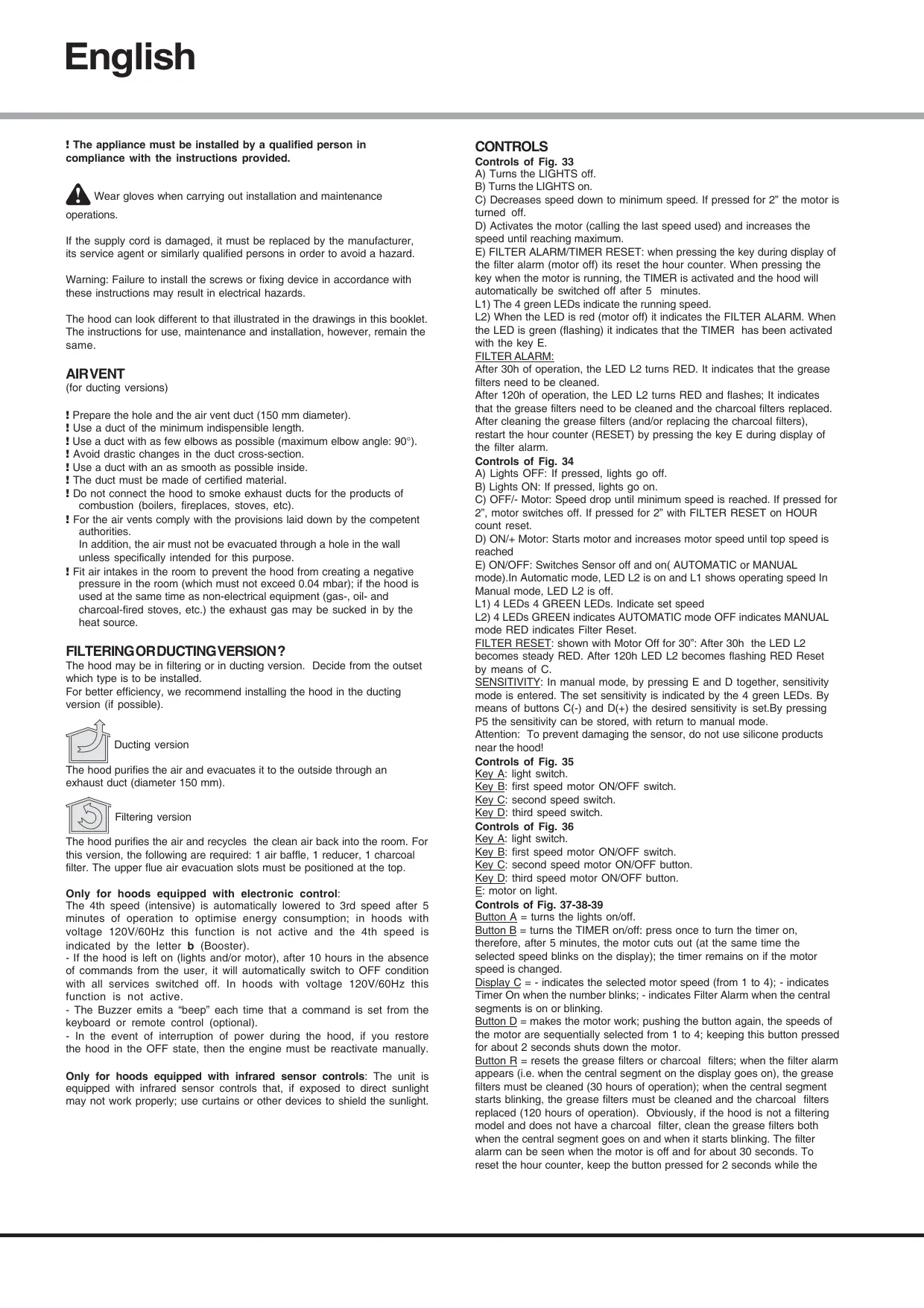
WHEN TO REPLACE IT: replace it at least every 6 months, in according to use.
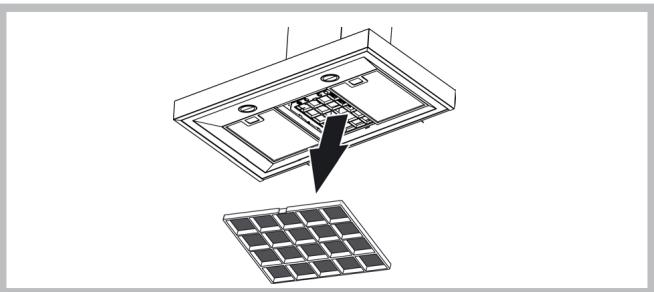
HOW TO REMOVE IT: If using the hood in the filtering version, the charcoal filter will have to be replaced. To switch off, pull the latch inward and rotate the filter downwards.
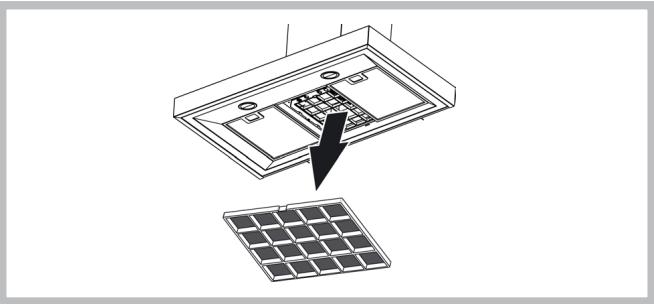
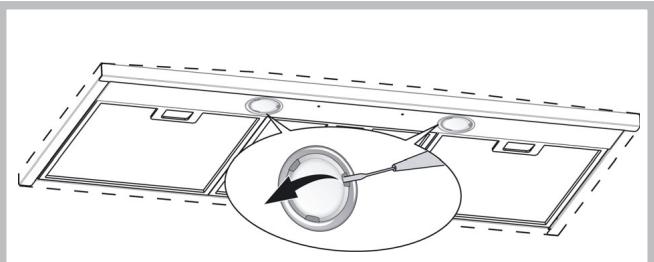
Lighting
Replace it with lamps of the same type; if a lamp is not listed in the table shown in the "Warning" worksheet, please contact the support center.
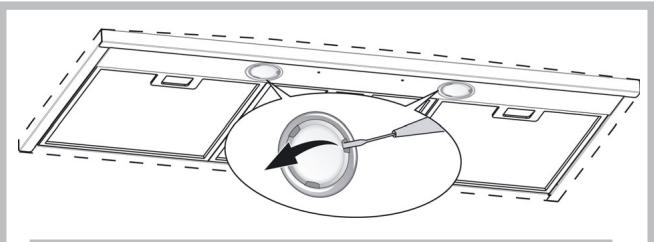
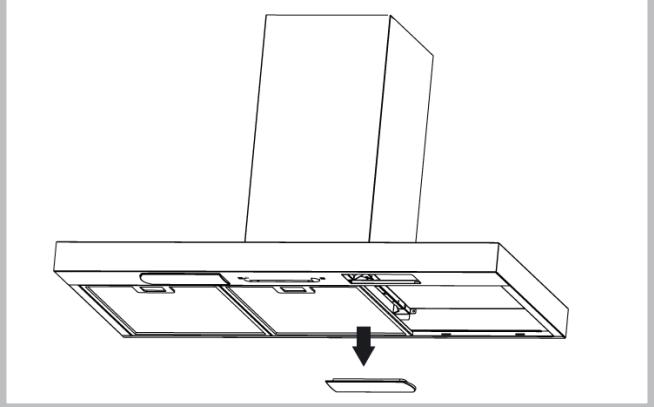
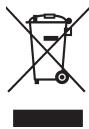
This appliance is marked according to the European directive 2002/96/EC on Waste Electrical and Electronic Equipment (WEEE). By ensuring this product is disposed of correctly, you will help prevent potential negative consequences for the environment and human health, which could otherwise be caused by inappropriate waste handling of this product. The symbol on the product indicates that this product may not be treated as household waste. Instead it shall be handed over to the applicable collection point for the recycling of electrical and electronic equipment. Disposal must be carried out in accordance with local environmental regulations for waste disposal. For more detailed information about treatment, recovery and recycling of this product, please contact your local city office, your household waste disposal service or the shop where you purchased the product.
MALFUNCTIONS
If something appears not to be working properly, do the following simple checks before calling Technical Service:
The hood is not working
Possible cause (1): Power cord not securely plugged in.
Correction: The hood was never electrically connected by the installer.
Call the electrician/installer.
Possible cause (2): A speed has not been selected.
Correction: Select a speed in the control panel.
If the hood has turned off during normal functioning, check that the power has not been disconnected and that the omnipolar disconnection device has not tripped.
- The blower does not work but the lights do
Possible cause: The blower motor connector is not plugged.
Correction: Locate the blower motor connector and plug it. Check to see if the fan now works. If the problem persists, call Technical Service.
The hood is not operating effectively
Possible cause: Dirty filters/baffles.
Correction: Check to be sure the filter is clean.
For ducting hood and hood with an external motor
Possible cause (1). Ducting requirements inadequate. If your duct length exceeds the manufacturer's requirements, hood performance will suffer.
Air-flow will also be reduced if the house duct work is too small or there are too many elbows in the system.
Comply with the official instructions provided by the competent authorities in merit when installing the disposal duct (example, the air collected must not be conveyed into a duct already used to central heatings systems, thermosphons, etc.). The room contains air taps. Contact your installer.
Possible cause (2): Obstruction in duct work.
Correction: make sure nothing is blocking the vent (bird nests or kinks in the duct work).
Possible cause (3): Damper blade may not be opening.
Correction: Make sure the tape is removed from the damper blades and that it swings open freely.
For filtering hood
Possible cause: the charcoal filter/s is saturated.
Correction: replace the charcoal filter/s.
- The lamp does not work
Light spot (LED)
If a lamp is not listed in the table shown in the "Warning" worksheet, please contact Technical Service.
Incandescent lamps:
Possible cause: The lamp or socket may be defective or a wire could be disconnected.
Correction: place the lamp in another socket; if the lamp is not working, replace with lamp of the same type; if the lamp works, the original socket may be defective or a wire may be disconnected. Call Technical Service.
Halogen lamps:
Possible cause: The lamp or socket may be defective or a wire could be disconnected.
Correction: replace with lamp of the same type. If the problem persists, call Technical Service.
- Remote control not working (where present)
Possible cause (1): Link lost between the remote control and the hood.
Correction: Check to see if the hood works with the control on the hood. Remove power from the hood at the circuit breaker then reapply power Relink the remote control to the hood, following the instructions supplied with the remote control.
Possible cause (2): Remote battery dead.
Correction: Change the battery.
Vertical telescopic trolley is locked (where present)
If all LEDs flashing, the telescopic trolley is locked. Wait 30^ and press the Up/Down button to release the trolley.
If Up/down button flashing, the grease filter is not positioned correctly. Reposition properly.
If the trolley is locked, check that the cable connector is not disconnected. If the problem persists, call Technical Service.
Cause possible : Filtres / compartments sales
"Attention", contacter le service technique.
P1: Liga e desliga as LUZES
Oplossing: Controller of de filter schoon is.
KhonkaA = BKJIIOyaeT/BbIKJIIOyaeT CBET.
KhONka B = BkNIOaET/BbIKNIOaET TAIMEP: npNe ee ODHOKpaTHOM HaxaTIN AKTINBIPyETc TaIMEp, pRn 3TOM uepe3 5 MNHT DBNrAteNB OCTaHABNBAeTCR (OHDOBPeMENHO C 3TNM Ha DCNJIee MIRAE THomeP BbI6pAHON CHKOPOCTN); TaIeMOPCTAcTINHBbIM, ECNI N3MeHReTc CCKOPOCTb DBNrAteNJ.
Ducnnei C =
-
yka3bIBaet BbIbpaHHyO ckopoCTb DBrIaTeJIa (OT 1do4);
-
yka3bIbaeT aKTHBaunTo TaMepa, KOrda HOMep HaUNHaET MnraTb;
-
yka3bIbaet CnHan TpeBOrn fNJIbTpoB, KOrda ueHTpaJIbHbI cerMeHT BKNIOaehcra nn Miraet.
KhONka D = npnBodnt B DeiCTBne DnBraTeJIb; npn HaxaTm KhONk CHOBA, BBIOpaETcckOPOCT bDnBraTeJIaOT 1 Do 4 nocneDobATEbHbIM 06pa3OM; npn yapedXaHHN KhONk HaxaToI B TeYeHne npImpeH2 cekyHd, DnBraTeJIb OCTaHaBnBaTeC.
Khonka R = yctahOBKa B nCxOxDHe noloxeHne npotnBOxNPOBbIX
ΦnIbTpoB u yOrlbHbIX ΦnIbTpoB; KOrda NoaBnETCa HrHan TpeBor
ΦnIbTpoB (TO eCTb Ha dncnnee BKIOuAeTc ZeHTpaBHBn CERMeT),
HyXHO npOuCnTb npOTnBOxNPOBbIEyΦnIbTpb1 (nocTe 30 cacob pa60bI);
a ECNI cTeHpTaBbHbCerMeT MIRaET, HyXHO npOuCnTb npOTnBOxNPOBbIE
ΦnIbTpb1 u 3aMeHNTyOrlbHbMΦnIbTp (nocTe 120 cacob pa60bI).
EcNI konnak He ΦnIbTpYIOUeMOnnФmKaun, n CNeObaTeNbHo He
Imeet yOrlbHoro ΦnIbTpa, Heo6XoDIMO 6yDet ToIbKO npOuCnTb
npOTnBOxNPOBbIE ΦnIbTpb1, ecNI cTeHpTaBbHb CERMeT 6yDet IIN
BKIOUeHHbIM, IIN MmraOuOM. CnHAn TpeBor ΦnIbTpoB NOBnETCa
Pn BkIKNoHem DBirateNe I BuENe OKOn 30 ckyHd. YTo6bl
pe93anyCTnb ChEtTHK YAcOB, DePxaTB hAxatoN KHONKY B TeHene 2
CEyHN BO BVPMA OTOpBXeHNN CInHaT a TpeBor.
OPRAHbIyTPABJIENHJFur.40
ABTOMATUHECKOE ΦYHKLIOHINPOBAHNE C DATYHKOM
KnaBnuaA:BkIIOaet/BbIKIOaET NOcBETKy.
KlaBnua B:BkIooaet /OTKIOOaETФyHKUHO "ABOMATueckmpeJIM". PnB KIOUeHn 3ToTfynKUIN,Ha INdNkAtope C NOBBLAE Tc6yKBa"A", aCnsO o6oPobTOB 3JeKtPOdBnAteTeY yBeMnHbAEcTcN mN yMeHbSaEaTcR ABOTOMaTEeCKN B COOTBEcTBn C HAcBIsHEHOCTbO KyXHn DbIMOM,3aNaXAMn nRa3OM.
HnDkaTOp C: noka3bIbAet abTomatUeckyU pa6Oty daTUnka (C oTO6paxeHHeM 6yKBbl "A"); - noka3bIbAET CKOPoCTb BpaueHnA 3JNEKTPoDBIrATeJIa, ABtOMaTHueCKN 3aDaBaEMyHO daTUnKOM; -noka3bIbAET abApInHoe CoCToRHe NfNbTpoB, KOrda UeHTpaJbHbI CeMeHT 3aXnIRaTeCn HnMIraTe.
KnaBnua D: yMeHbAaet CKOpocTb 3JekTpOdBnAratela/C6poc: yMeHbAaet CKOpocTb do Hynla (cton), Ondako no nCTeueHHN 1 MmHytbl Bo3o6OBHnTCa BAtOMATnueeckaa FyHKnur pa6Otbl CO CKOpocTbHO, 3aDaEBMOI dATNHKOM. Haxkatne KNaBnui npri OTobpaXeHHN ABAPINHORO cCtOTHN HnIbTOPB BbI3OBET C5POC CcETnka Ntem cambl NobTOBpHbI NOcChET YacOB. KnaBnua E: yBeJIuNBAet CKOpocTb 3JekTpOdBnAratela; Ondako, no nCTeueHHN 1 MmHytbl BO3o6OBHnTCa ABOTMaTHueckn peXnM pa6Otbl BbITRAKK Co CKOpocTbHO, 3aDaBAEMOn DA7NHKOM.
HactpoiKa DaTUnKa: Bbl MOXeTe N3MeHnTb YyBCTBnTEJbHOCTb DaTUnKa CNeDyUoMmO6pa30m:
- octahOBNTe BbITJxKBy HaxaTne M KJIaBmN B.-HaxMnte OndOBpeMeHHO KJIaBmN D E (Ha INdInKaTope 6yDet OTOp6paxen NOKa3aTeIb yVBCTBnteIbHOCTn DaTHnka)-HaxaTne KJIaBmNeD NIIe E OTPyIpyte yVBCTBNTeIbHOCTb DaTHnka B PIIIOCOBYU ININ MNHyCobyIO CTOPOHY (1:MHNIMAbhHa /9:MAKcImAmbHaay YVBCTBNTeIbHOCTb). -B Cnuyae npepbBAHnI 3NEkTpONHTAHn, DaTHN k6yDet NOBtOPO pa6oTaTb C yVBCTBNTeIbHOCTbIO 5.
BHIMAHNE! YTObI HE IIOBPEINITb DATYIK, IN3EEXAITE MCNOJIb3OBAHNE CNIJKHOBOBIX CPEIDCTB BENIN3N OT BBITJKKN.
OPRAHbIyYPABJIeHnФnr.44
P1):BkIIOaEt N BbIKIOHaueCTCBET
P2):3anyckaet DbratateIbn npn nepBoi ckopocT (IOKHOa noCDBeheHa). OctaJIbHbIeIKOHKnCKOpOCTNBbIKNIOHeHbI.
P3):3anyckaet DbratateB npn BtopoN ckopOtn (NKOHka noCDcBeHa). OctaJIbHbIeIKOHKnCKOpOtn BBkIIIOHeHbl.
P4):3anyckaet DbratateIb npn TpeTbe CkOPOCT (IKOHKA noCDBeHeHa). OctaHbHbIeIKOHKICCKOPOCTNBbIKIOUeHbI.
P5):3anyckaet Dniratelnpn TEBeptoK ckocOCTN (IKOHKa MepuaET). OctanbHbe NKOKHNCKOCPOCTB BkIIOUeHb. MakcImaNbHa CKocOCTb yctAHOBHeHa MaKcMnAbHo 5 MnHTy. Nt HcTeueHHN 3TOro BpeMeHN ABOTAMUHECN YCTAHABINBaTcRA TpeTBckocOCTb.
P6):3anyck KJIaBnIa TIMER (mKoHka nOcBceHe).Pnp BkHIOeHH mHyKuIM Timer (5MnHyT) DbIraTeJIb ABOMATNeCKn 3aedePkNBAeTcno 5MnHyTaX.
P7):CINHAI ΦNIIbTPOB. Iocne 30 YacOB Baapooem peXnme NIOKHOI NOcDEuBaETcR yKa3bYBaEHa HEo6xOIMOCtB OHTCTKNIPTNOBOXHQPOBOrO dHJIbTra.
Iocne 120 YacOB Bpa6OeMpeXIME NOKHKA NOcBceuHbAeTcN yKa3bIBaEaT Ha Heo6xoJIMOCTB OCHCTKn IpoTtBOxMOBORO fHbTpa N 3aMeHbI yOrJIbHbIX dHbTPOB.
C cIbAHHUINPOBAHNA cnHaJa, cJeDeYeT hKaTaB NkOHy BO BpeM e
IQDCBETKIN (IIIN BO Bpemr MepcaHn).
Moxho 3a6IoknpoBaT knaBnAtpy (dIy ONUCTK) oDNHOBeMeHHbIM HauatneH ydePKBAHmE KHONOK P1 n P7. EcIn pexmO uCTK BKNUOH, KONIK P1 P7 BKUHeYb. IJN P7 BbIXoDa N3 fynHKmN ONUCTK CNeDyET ONIBy BKIOHTb KONIK P1.7, ODNHOBpeMeHHO npXkMaM Jx (DNIeJIbHoE HauKATne) nn NOdoXdaTb 5 MNHyT.
OPTAHbIyIPABJIeHnIqur.45-46
Khoika TC1 (OcebeuHHe): BkIIOUeHHe / bBkIOUeHHe rnaHBoro OcBeuHnON/Off.Korda rnaBHOeOCBeueHHe BKIOUeHo,BL1 MEHReT CBET IN BkIIOUaTeC.
OgpanHueHneBpeMeHHpa60TbI
EcInB TceHHe 10 cAcOB He MeHReTcY npaBnEHHe BkHIOueHHo KxOHHO BtIKKoB (BKNIOUHO OCSueHHe NmIIN POCDBeTKa),TO BCE fHyHKuIN ABToMaTHneCKN OTKIOUHOHTcN bBtIKKxa NepExOdNTB COCTOHNE OFF (BbIKL.).
3BykoBoCnHaI
KaKdbI pa3, KOrda BbJaTaC KOMaHda C KlaBnAtypbI INI INyIbTa
DInCTAHUONHO FynPABNeHn (OnUINOHaNbIbBapMaHT), Cpa6bTaIBaET
ФyHKJIPOITDBeRkDeHn BbIINONHeHn KOMaHDbI 3ByKObMbIM CmHrHanOM
"6mN".
OPRAHbIyIPABJIENHqur.49
A = BbIKHouaTeIb NOcBETKn: NIO-KeHne 0 = NODCBETKa BbIKHoueHa; NIOJKeHne 1 = NODCBETKa BKHoueHa.
B= BbIKNoCHateIb 3JIeKtPOdBnRatIeIa: NOIOXeHne 0 = 3JIeKtPOdBnRatIeIb BbIKNoCHe; NIOXeHne 1-2-3 = 3JIeKtPOdBnRatIeB BKIOUeH ha 1-oi, 2-oi M 3-ei ckOocSt.
TEXHINHECKOE05CJTYKUBAHNE
I Ipeed uicSTKo HIN PIOBedeHnem TEXHnueckOro 06cnykBaHnry OTKJIOHTb HaprjKeHne.
YHCTKa BBITDKKK
KOrla IPOU3BOUHTb YIcTky: UcNtNb He pexe, cem pa3 B 2 Meca, To6bIu36eKaTb PnCKa BO3rOpahna.
HAPYKHAR YNCTKA: HcnoIb3ObaT Tprkny, CMOeHHyB TteIIO Bode CHeITpAIBHIM MOOHIM CpeDCTBOM (JINr OKpaUeHHbIX BbITRAKek); HcnoIb3ObaT CpeMaJIbHbIe CpeDCTBa IJr BbITRAKEK IN3 CTaJIi, MeIN INIIN NaTyHN.
BHTPEHHRA YNCTKA: nCnoJIb3ObaTb TprIky (nJIn KnctOnky), CMOHeHHyIO B DeHaTpyPiPoBAHHom 3TNIIOBOM CnIPTe.
HTO HEL3B4 DEIATb; He NCN0JIb3OBAbTa b6pa3aINBbIe HIN Koppo3MnHbIe cpeCTDa (HanpIMeP, MetaJIIMcECKHe ryOki, CNIJIKOM XeCTKHe 1eTkn, OChEh arpeCCNBbBe MOUOpme CpeCTDa, n T. d).
Ynctka XnpoylaBnBaIOxX pHJIbTpOB
KoIJIa IPOU3BOJNTb UcIcTKy; OuHCTNtB CB83n CnCNOJIb3OBAHHeM, NO KpaIHe Mpe, KaXdbie 2 MecaIa, YTO6ExaTb PnCKa BO3HMKHOBeHIn Noxapara.
KAK BblHyTb ΦIIbTPbl: B MecTe paCnoIoxeHn pyuKn IpOToJIkyTb CTOnOp no HapraBHeHIO K3aDHeN cAHTn BblTgKKn I NOTAHyTb φIIbTp BBepx.
KAKYNCTNTbΦNtBTPbI:MbITbHeHtpaNbHbIMMOUHcpeDcTBOM BpyuhyoIINB NOcydOmoeUHO MAuHne.B cnyaie HcnoTbOBAHHN NOcydOMoEHO MAuHbI BO3MOXHO ObecueBuHaBHnΦNJtPoB, KOTOpoe HE BnHET HaNXФyHKUHOHaHoCTb.
3aMeHa yrolbHOrO qnlbTpTa
(ToJIbKOdIaФmJIbTpYIOUeBbITRAKKN)
KORIIA IPOU3BOUHTb 3AMEHY: 3aMeHeHbI IO KpaHne Mepe, KaXdbIe 6 MEcJIeB 3aBnCmOCTN OT NcIOJIb3OBAHn.
KAKBbIHyTbΦNtBTP: npnCnObl3OBaHmBblITRkMnΦNtBtpUyUeBO Tn na 0ebxOIMO pno3BDoNTb 3aMeHy yrToLbHO rHbIbTa nI dHcTnA rHbIbTa pOtniHTb 3aueJENy BHyTp nOBepHybΦNtBtp NO HapraBHeHHo BHN3.
Iopcbetka
3aMeHbHaIaMbI TORO Xe TnA;ecIaMna He yka3aHa B Ta6IuCe JInCTa "IPINMEUAHNE", o6paTHe, noXaanyctA, B CEHTp NoDepKKn.


JaHHOe3dJIeNHeMEeTMapKINPOBkyBCOOTBCTCBNCEBpOeIckOJINpeKTbBOI 2002/96/ECKaCateNBtHOOTXODoB3NeKTPnueCKORIO3NeKTPOHOROobOpyDobAHN (WEEE).ObecneuBNpABInbHyOytINb3aUHDOhAHOrO3dJIeN, BInOMOXeTe npedOTBpaNTb NOteHuaJIbHO HerATINBHeI NOcNECTBNI BO3dEChTBNI HA OKpyKaHOuYHcpeDyH3dOpOBBeIJODe,KOTOpBEMOYrTO3HNKHTyBcNECTBNI HnepaNBtHO yTNi3aUHm DaHHORO h3dJIeM MapKINPOBka Hn3dJIeN NOKa3bBAeT, YTO C DAHbIM I3dJIeNMe HEnb3a ObpaUaTcB KAC C O6bUHbIM 6bITOBbIMn OTXdAMn. HanpoTINB,ero HyKHO cdaTb B COOTBETCTBYUcI pyHKT c6oba OTxODoB 3NeKTPnueCKORIO 3NeKTPOHORO obOpyDobAHN. UToNIAzA DOnKHa6bITbPON3BedeHABCOOTBCTBNC MeCTbIM3aKOHOdAteJBCTBOOMNO 3aUnTE OkpyKaUoSe CpeDb KaCateNBtHO yTNi3aUHm OTXdOB.ДЯ BoJeE detaJIbHOINHfOpMaunIOBOcCTaHOBJeHIO,IOBTOPHOMYNCnOJIb3OBAHNO 6OpaUeHIO C n3dJIeNEM CB8KHTeCb C MeCTHOJ aDMNHCTpaUeH,nyHKTom yTNi3aUHm OTXdOB INI C MAra3IHOM, B KOTOPOM Bbl pino6bpEN daHoe H3dJIeN.
ABAPINHbIE CJTYAH
EcnnyTO-To He pa6oTaET npaBnIbHo, Npeed BblOBoM TExHnueckoRo 0cbNyBaIooJIero NepcoHaJIpocmBblIOJNHT IpocTbe KOHTpoJIbHbIe DeIeTHBIA, ONINCAHHBe HIXe:
- BbItjxka He pa6oTaet
Bo3MOxHnA npuHa (1): PpOBoI nHTaHnI He NpOcOeDnH eN IJI INoDCoeDnH eNipaBnJIbHO.
Bo3MOxHnA npuHnA (2): He BbI6paHa ckOpocTb.
PeueHHe: BbIepeIte cKOpocTb Ha naHeJI ynpaBJIeHnA.
Ecnn BbITRkKa OTKIIOUaTcB BO BPMAHbHO pa6ObTI,TO CLEyET npOBepnB,He OTCOEAnHENo IIN TpAHne H N BKIIIOUHcN LIM OMHNIOJIbHn (MHOORONIOHcHbI) p3aBeDNIHTeN.
- BeHTnIaTOp He DeIeCTbYeT, Ho OcBeUeHne pa6OtaE
Bo3MOxHnApuHnHa:Ka6eIbDnBraTeNBeHTnTOpaHeNoDcoEHNHe. PeueHMe:OnpeDeIInTe MeToHaxOxDeHne Ka6eIbDnBraTeIe BHTnTOpa nNoCoEHNtEero.IpOBepbTe,pa6oTaet LN BeHTnTOp T eTepb.Ecnn np6bIeMa He yctpaHena, Bb13OBnTe TexHnueckn 06cynBaHOoi nepcoHaN.
- BbItjXkHe pa6oTaet npabunbHo
B03MOxHnA pnnHnA: 3aqrpa3HeNbI cInnbTpbI/pepeoROpDn.
PeueHne: PIOBepBte, YcCTbI nn FInbTp.
B Cnpyae BbITJKeK C CNTeMoN KaHaNoB N BbITJKeK C BHeuHm
DbriAtelem
Bo3MOXHNA pRNUHA (1): CnCTeMa KaHAnOB He BbIIOJIHeHa COOTBETCTBEHO Tpe6OBAHNMA. EcNl DnHn KaHAna IpeBbIaAet Tpe6OBAHNpON3BOIDNTEL, BbITRAKKA MOKeT he paBOTaB ONTHMaJIbHO. EcnI cueHNE KAHANCA CNIJKOM MAIO NII B CnCTeMe CNIJKOM MHORO n3rI6OB, TO TAKKE 6yDet 3AmEJNeH NOTOK BO3dyxa.
Bo Bpem MoTaxa OTBODHO KAHAna CnEpyet npIepxmbatcbc
OfpuuAhlbIX INCHETPKU, KOTOpBIE ppeoCTabHebl COOTBETCTBYUOUMN
opraHAMn (HaNPmEp, BbITrMaEBmB BO3dY He MOKeT 6bITb HApBaJIeH
BA KaHJ, KOTOpByue NcONlB3yETcB BpaMKX IHCTaIIaI
UEHTPaNbHO OTOPTNeHry, TepMOcHPOHO nT.D.).B NOMeUeHN
HAxoDJaTcB BEHTINLIzIOHhbie OTBepCTNI.
Cneyet o6paTntbca K MOHTepy.
Bo3MOxHa npruHa (2): KaHaN 3aKpbI.
PeSeHHe: npOBeRnTb, HnUero IIn He 6IokpyET BeHTnJIaIIOHHbI KaHAn (rHe3da PtTIu nn y3IbI).
Bo3MOKNaHnepuHa (3): DpocCeIbHa 3acLOHka He OTKpbIbAeTcN. PeSeHHe: He6xoJMo npoBepntb, bIla nn yctpaHena IeHTa n3 dOpcEhBnO 3acLOHKn IN CBO6DoHn N OHA DBVraTeC.
Bcnyae BbITJXeK CΦnIbTpOM
Bo3MOxHa npUHHa: yroJIbHbI ΦnJIbTp nOJHoCTbIo npOniTah.
PeueHHe:3aMeHHTb yIoglbHyΦnIbTp.
- Lamna he pa6oTaE
PecnekTopbl(LED):
EcIJI NaMbIb 3TOrO TnIIa He HAXoJITcB B HIXePINBEdHn To6NIue Ha cTpaHnue C "PpIMeAHaHe", Ipocm IbpaTtbc K TexHnueckomy OcbNyBaIOSeMy nepcohany.
JaMnblcJaMnoQkAmN:
Bo3MOxHnA npuHa: lamnoUka nIcBcTnIbNk HeNCnpaBbI IIO6 OTOeINHJSC npoBOd nITAHn.
PeSiHHe: yCTaHOBbTb lamNoOyK b DpyroB cBeTnIbHnK; ecN lamNoOyKa he paObaTe, to 3aMeHTb ee dpyroTakoro Xe Tnna; ecN paObaTe, 3NaHTb HeNCpTaBbYbCBTeNbHnK INo OTCoEOHNICr npBoD nITAHnR. BbIOBte TeXtHuCckKn o6cnykBaUoOni nePcohan.
TanoreHHbIeJaMnbl:
Bo3MOxHnA npuHa: lamnoUka nIcBETnIbNk HeNCnPabHbI IIN60 OTOeDnHJcnpoBOd nITaHn.
PeuHHe: 3aMeHnTb lamNoKy dpyroTo takoro Xe TnHa. Ecn npo6Iema He yctpaHena, Bbl3OBtte TexHuecckn obcnykBaOuoi nepcoHan.
-Пильт дuctahiонногу упразелега He pa6oTaET (ecm OH 6blДобавлEN B KOMЛNeKT)
Bo3MOxHnA npuHa (1): OTCyTCTBnE coeDInHeHnMexKdy NylbTom n BblrKoN.
PeSeHne: PpOBepnTb, npaBunbHo IIN paOtaHT KhoNKn ynpaBHeHna, KOtOpbIe yCTaHOBHeHb Ha BbITJxKke.
BbIKIyHHTb NITAHHe BbITRkKc NOMOuHbO 3eKtpnueckoro npdeOxpaHHTenla; nocne Yero OIrrb Iero NOcOeHNHbT. CHBa BOIINHbT CoeDNHEHe MEXdy nIbTom N BbITRkKo, Co6NoHaNCTpykuHIO, npnIOKeHHy K npIyTb. Bo3MOXHnA npnuHna (2): Otra6oTaHnHa batapeKa B npIyTe.
PeueHHe:3aMeHHTb 6aTapeKy HOBOI.
EcnI NtOToK 3a6IokuropoBaH, HynXHO npOBeRptb, He 6bl JIn OTcOeDmHeN npOBoD nPiTaHn. EcnI npOBeLema He yctpaheHa, Bbl3OBtte TexHueckn 06cbnykBaOoum nepcoan.

KOMIOHEHTbI, He BXODJIune B KOMJIeKT
HVORNÁR SKAL DEN RENGÖRES: rengör mindst hvr,anden maned for at undgå brandfare.
UDVENDIG RENGORG: anvend en fugting klud opvredet i lunkent vand med et neutral rengoringsmiddel (til lakerede emhaetter). Anvend specialprodukti tl emhaetter i stål, kobber ell erer messing.
INDVENDIG RENGÖRING: anvend en klud (eller en pensel) dyppet i husholdningssprit.
Kolla in teknik service.
Halogenlampor:
TnV TEPITIWon aTTOPPOPNTHPW Ue PIAItpo
Krmilni system Fig.33
A) Izklopi OSVETLITEV
B) Vklopi OSVETLITEV.
Krmilni system Fig.43
Krmilni system Fig.47-48
Tipka TC1 (Luč): vklopi / izklopiglavno luč ON/OFF, kadar je glavna luč vklopljena, BL1 sperimenti bovarno in sekvlopi. Poz pritisku in pridržanje pritiskavklopi / izklopipomovne luč (opcjisko).
Tipka TC2 (Motor - V1) ON/OFF Motor - Vklopimotors prvohitrostjo
Tipka TC3 (Motor - V2): vklopimotor z drugo hitrostjo
Tipka TC4 (Motor - V3): vklopimotor s pretjo hitrostjo