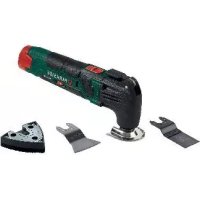
PEC 200 SE 10 - Power Tools PARKSIDE - Free user manual and instructions
Find the device manual for free PEC 200 SE 10 PARKSIDE in PDF.


| Product type | Random orbit sander |
| Brand | PARKSIDE |
| Model | PEC 200 SE 10 |
| Dimensions (L x W x H) | 250 x 120 x 130 mm |
| Weight | 1.5 kg |
| Supply voltage | 230 V ~ 50 Hz |
| Rated power | 200 W |
| No-load speed | 6,000 - 12,000 min⁻¹ |
| Platen diameter | 125 mm |
| Abrasive paper attachment type | Velcro (hook-and-loop) |
| Sanding stroke | 2 mm |
| Sound pressure level | 82 dB(A) |
| Sound power level | 93 dB(A) |
| Vibration | 5.5 m/s² |
| Protection class | II |
| Power cable | 2 m |
| Main functions | Sanding flat surfaces, roughing, finishing |
| Maintenance and cleaning | Clean ventilation slots, replace worn sanding disc |
| Safety | Wear goggles and a mask, unplug before maintenance |
| Spare parts and repairability | Abrasive discs available, replacement pads |
| General information | Household use only |
Frequently Asked Questions - PEC 200 SE 10 PARKSIDE
User questions about PEC 200 SE 10 PARKSIDE
0 question about this device. Answer the ones you know or ask your own.
Ask a new question about this device
Download the instructions for your Power Tools in PDF format for free! Find your manual PEC 200 SE 10 - PARKSIDE and take your electronic device back in hand. On this page are published all the documents necessary for the use of your device. PEC 200 SE 10 by PARKSIDE.
USER MANUAL PEC 200 SE 10 PARKSIDE
44867 Bochum (Germany)
Last Information Update - Tietojen tila - Informationsstatus
Tilstand of information · Opplysningenes gyldighet
General safety advice for electrical power tools
1.Workplace safety
2. Electrical safety.. 7
3. Personal safety.. 8
4. Careful handling and use of electrical po wer tools.. Page 8
Safety advice for electric scraper / carver. Page 9
Original ancillaries/accessories. 9
Understood everything? Page 9
Before taking tool into use
Attachment tools.. Page 10
Changing attachments.. Page 10
Commissioning
Working Notices.
Switching on/off. Page 10
Selecting the stroke rate.. Page 10
Resharpening the attachment tools.. Page 11
Maintenance and cleaning
Disposal
Information
Service centre . Page 11
Declaration of Conformity/Manufacturer Page 12
| The following pictograms are used in these operating instructions/ on the device: | |||
| Read instruction manual! | Safety class II | ||
| Observe caution and safety notes! | Wear hearing protection, dust protection mask, protective glasses and protective gloves. | ||
| Caution - electric shock! Danger to life! | Keep children away from electrical power tools! | ||
| Explosive material! | Protect electrical power tools from moisture! | ||
| n0 | Nominal stroke rate | Check that the device, mains lead and plug are in good condition! | |
| V~ | Volt (AC) | Dispose packaging and appliance in an environmentally-friendly way! | |
| W | Watts (Effective power) | ||
Electric scraper PEC 200 SE
Introduction

Please make sure you familiarise yourself fully with the way the device works before you use it for the first time and
that you understand how to handle electrical power tools correctly. To help you do this please read the accompanying operating instructions. Keep these instructions in a safe place. If you pass the device on to anyone else, please ensure that you also pass on all the documentation.
The appliance is suitable for the removal and abrasion of coverings such as carpets, felts, cork sheets and plaster on small areas. It is also intended for removing residues of adhesives, paints and fillers, for the smoothing of coarse surfaces as well as for carvings on soft woods. Any other use of, and
modification to, the appliance is deemed to be improper usage and may result in serious physical injury. The manufacturer declines to accept responsibility for damage(s) arising out of usage contrary to the instructions specified below.
The appliance is not intended for commercial application.
Fittings
1 ON/OFF switch/Stroke rate preselector
2 Tool arrester
3 Tool receptor
4 Tool attachment
Knife/Scaper attachment (offset)
Knife/Scaper attachment (straight)
7 Spatula attachment
8 Chisel attachment
- Items supplied
1 Electric Scaper PEC 200 SE
1 Knife/Scaper attachment (offset)
1 Knife/Scaper attachment (straight)
1 Spatula attachment
1 Chisel attachment
1 Operating manual
1 "Warranty and Service" manual
Technical Data
Rated voltage: 230V 50Hz
Nominal power consumption: 200W
Nominal stroke rate: Level I: n_0 6.500 min^-1
Level II: n_07.500min^-1
Level III: n_0 8.500 min^-1
Stroke: ca. 2 mm
Protection class: II/回
Noise and vibration data:
Values determined in accordance with EN 60745. The sound pressure level (A-weighted) of the device is typically 78dB(A) Uncertainty K = 3dB The sound level while working can exceed 85 dB A.

Wear ear protection!
Evaluated acceleration, typical:
Hand/arm vibration a_h = 8m / s^2
Uncertainty K = 1,5m / s^2
WARNING! The vibration level given in these instructions has been measured in accordance with a standardised measurement procedure specified in EN 60745 and can be used to compare devices. Different uses of the device give rise to different vibration levels and in many cases they may exceed the values given in these instructions. It is easy to underestimate the vibration load if the electrical power tool is used regularly in particular circumstances.
Note: If you wish to make an accurate assessment of the vibration loads experienced during a particu
lar period of working, you should also take into account the intervening periods of time when the device is switched off or is running but is not actually in use. This can result in a much lower vibration load over the whole of the period of working.

General safety advice for electrical power tools
WARNING! Read all the safety advice and instructions!
Failure to observe the safety advice and instructions may result in electric shock, fire and/or serious injury.
KEEP ALL THE SAFETY ADVICE AND INSTRUCTIONS IN A SAFE PLACE FOR FUTURE REFERENCE!
1. Workplace safety
a) Keep your working area clean and well lit. Untidy or poorly lit working areas can lead to accidents.
b) Do not work with the device in potentially explosive environments in which there are inflammable liquids, gases or dusts. Electrical power tools create sparks, which can ignite dusts or fumes.
c) Keep children and other people away while you are operating the electrical tool. Distractions can cause you to lose control of the device.
2. Electrical safety

To avoid danger to life from electric shock:
a) The mains plug on the device must match the mains socket. The plug must not be modified in any way. Do not use an adapter plug with devices fitted with a protective earth. Unmodified
plugs and matching sockets reduce the risk of electric shock.
b) Avoid touching earthed surfaces such as pipes, radiators, ovens and refrigerators with any part of your body. There is an increased risk of electric shock if your body is earthed.
c)

Keep the device away from rain or moisture. Water entering an electrical device increases the tric shock.
d)

Do not use the mains lead for any purpose for which it was not intended, e.g. to carry the so hang up the device or to pull as plug out of the mains socket. The mains lead away from heat, edges or moving parts of the Damaged or tangled mains leads the risk of electric shock.
e) When working outdoors with an electrical power tool always use extension cables that are also approved for use outdoors. The use of an extension cable suitable for outdoor use reduces the risk of electric shock.
f) Use a residual current device (RCD) for protection if operating the electrical power tool in a moist environment is unavoidable. The use of an RCD reduces the risk of electric shock.
3. Personal safety
a) Remain alert at all times, watch what you are doing and always proceed with caution. Do not use the device if you are tired or under the influence of drugs, alcohol or medication. One moment of carelessness when using the device can lead to serious injury.
b)

Wear personal protective equipment and always wear safety glasses. The wearing of
personal protective equipment such as dust masks, non-slip safety shoes, safety helmets or ear protectors, appropriate to the type of elec
trical power tool used and work undertaken, reduces the risk of injury.
c) Avoid unintentional operation of the device. Check that the electrical power tool is switched off before you connect it to the mains, pick it up or carry it. Accidents can happen if you carry the device with your finger on the ON/OFF switch or with the device switched on.
d) Remove any setting tools or spanners before you switch the device on. A tool or spanner left attached to a rotating part of a device can lead to injury.
e) Avoid placing your body in an unnatural position. Keep proper footing and balance at all times. By doing this you will be in a better position to control the device in unforeseen circumstances.
f) Wear suitable clothing. Do not wear loose clothing or jewellery. Keep your hair, clothing and gloves clear of moving parts. Loose clothing, jewellery or long hair can become trapped in moving parts.
g) If vacuum dust extraction and collection devices are fitted do not forget to check that they are properly connected and correctly used. The use of these devices reduces the hazard presented by dust.
4. Careful handling and use of electrical power tools
a) Do not overload the device. Always use an electrical power tool that is intended for the task you are undertaking. By using the right electrical power tool for the job you will work more safely and achieve a better result.
b) Do not use an electrical power tool if its switch is defective. An electrical power tool that can no longer be switched on and off is dangerous and must be repaired.
c) Pull the mains plug out of the socket before you make any adjustments to the device, change accessories or
when the device is put away. This precaution is intended to prevent you from unintentionally starting the device.
d) When not in use always ensure that electrical power tools are kept out of reach of children. Do not let anyone use the device if he or she is not familiar with it or has not read the instructions and advice. Electrical power tools are dangerous when they are used by inexperienced people.
e) Look after the device carefully. Check that moving parts are working properly and move freely. Check for any parts that are broken or damaged enough to detrimentally affect the functioning of the device. Have damaged parts repaired before you use the device. Many accidents have their origins in poorly maintained electrical power tools.
f) Keep cutting tools clean and sharp. Carefully maintained cutting tools with sharp cutting edges are less likely to jam and are easier to control.
g) Use the electrical power tool, accessories, inserted tools etc. in accordance with these instructions and advice, and the stipulations drawn up for this particular type of device. In doing this, take into account the working conditions and the task in hand. The use of electrical power tools for purposes other than those intended can lead to dangerous situations.

Safety advice for electric scraper / carver
Avoiding the danger of injury, fire and damage to your health:
- Securely support the workpiece. Use clamps or a vice to grip the workpiece firmly. This is much safer than holding it in your hand.
Wear protective glasses! Pieces of material may split off the workpiece and become projectiles. This could cause injury.
Wear a dust mask! A dust mask must be worn for prolonged work on wood or when working on materials that give rise to hazardous dusts.
- Do not soak the materials or the area to be worked with liquids containing solvents. Unhealthy/poisonous gases may develop from the heat generated by scraping.
Materials containing asbestos may not be worked. Asbestos is considered to be a carcinogen.
Under no circumstances should you place your hands next to or in front of the appliance or on the area to be worked, you could be seriously injured if you slip or stumble.
Always have the cable leading away to the rear of the appliance.
In the event of danger, immediately remove the plug from the power socket.
- Original ancillaries/accessories
Use only the ancillaries and accessories that are detailed in the operating instructions. The use of ancillaries and accessories other than those recommended in the operating instructions could lead to an increased risk of personal injury for you.
- Understand everything?
When you have made yourself familiar with these general safety instructions for electrical hand tool, then you can start with the work. You will work at your safest when taking note of the manufacturer's declarations and instructions.
- Before taking tool into use
- Attachment tools
The choice of the correct attachment tool is dependent on the job to be done.
The supplied accessories are suitable for the most widespread areas of application (see Figs. C, D, E and F).
Knife/Scaper attachment (offset)
Knife/Scaper attachment (straight),e.g.for removing carpets, felts,cork sheets as well as plaster and adhesive residues see Fig.C,E
7 Spatula attachment (flat), e.g. for removing paint residues, silicon and foams (see Fig. D)
Chisel attachment (flat), e.g. for carving soft woods (see Fig. F)
- Changing attachments

Wear suitable protective gloves when inserting and testing attachments.
Notice: The curve / working edge of the attachment tool 4 must always point downwards.
Inserting a tool attachment:
Push the tool lock 2 forwards to "UNLOCK".
Insert the attachment tool as far as it will go in the tool receptor 3 (see Fig. A).
Push the tool lock 2 backwards to "LOCK" - the tool attachment is locked.
Removing a tool attachment:
Push the tool lock 2 forwards to "UNLOCK".
Remove the inserted tool attachment from the tool receptor 3.
Commissioning
The voltage of the power source must tally with the details given on the rating plate of the appliance.
Appliances requiring 230V can also be run on 220V .
- Working Notices
Always work away from the body.
Hold the appliance with both hands.
- Introduce the attachment tool to the material or the area to be worked with the appliance switched on. In that the working motion of the appliance first takes place on contact with the material, you will achieve a much more accurate positioning of the attachment tool.
- Switching on/off
Notice: The working motion of the appliance first takes place on material contact.
Switching on:
Push the ON/OFF switch/Stroke rate prese-lector 1 forwards.
Switching off:
ON/OFF switch/Stroke rate preselector 1 backwards.
- Selecting the stroke rate
Note: The optimal stroke rate is dependant on the material or the surface to be worked. It is best determined by simple trial and error. Always start off with the lowest setting. Should the removal be too slight, increase the stroke rate level for level.
- Slide the ON/OFF switch/Stroke rate preselector 1 to the front to increase the stroke rate.
Level 1: low stroke rate for precision work
Level 2: moderate stroke rate
Level 3: highest stroke rate for fast removal
- Slide the ON/OFF switch/Stroke rate preselector to the rear to decrease the stroke rate.
- Resharpening the attachment tools
The best work results are only achieved with sharp attachment tools. You should thus reshape them in good time.
A WARNING! RISK OF INJURY! Remove
the plug from the power socket before beginning to sharpen the tools.
Place the attachment tool to be sharpened into the Electric Scaper (see section on "Changing attachments").
On a belt sander (e.g. Parkside PEBS 900 see Fig. G):
Appropriately fasten the belt sander into/onto a suitable stationary facility.
Pay attention to the running direction of the belt on the belt sander when resharpening.
- Maintenance and cleaning
WARNING! Before you clean or maintain the device always pull the mains lead out of the mains socket.
Always keep the device clean, dry and free of oil or grease.
Regularly clean the tool receptor 3
Clean the attachment tools of all remains of adhesives and other grime.
Liquids may not be permitted to permeate into the appliance.
Use a soft, fluff-free cloth to clean the housing.
- Never use fuel, solvents or aggressive cleansers that could damage plastic.
Disposal

The packaging is wholly composed of environmentally-friendly materials that can be disposed of at a local recycling centre.

Do not dispose of electrical power tools with the household rubbish!
In accordance with European Directive 2002/96/EC (covering waste electrical and electronic equipment) and its transposition into national legislation, worn out electrical power tools must be collected separately and taken for environmentally compatible recycling.
Contact your local refuse disposal authority for more details of how to dispose of your worn out electrical devices.
Information
Service centre
The service centre for your country is shown in the warranty documentation.
WARNING! Have your device repaired only by qualified specialist personnel using original manufacturer parts only. This will ensure that your device remains safe to use.
WARNING! If the plug or mains lead needs to be replaced, always have the replacement carried out by the manufacturer or its service centre. This will ensure that your device remains safe to use.
Declaration of Conformity/ Manufacturer C
We, Komperna GmbH, Burgstr. 21, 44867 Bochum, Germany, declare that this product complies with the following EU directives:
Machinery Directive (98/37/EC)
EU Low Voltage Directive (2006/95/EC)
Electromagnetic Compatibility (2004/108/EC)
Type/Device description: Parkside Electric scraper PEC 200 SE
Bochum, 30.04.2008

Hans Kompernaß - Managing Director -
We reserve the right to make technical modifications in the course of product development.
Aluksi
Epyaia xpiog 50
Avikataaon oet .50
Oeon oE λεitoupyia
Yno8eiEic epyaiaac. 51
Evepyotoiogn/antevepyotoiogn. 51
Pioeiiloyn apoiou eioiaouv .51
Akovioqa epyaaleiw xpiogc. 51
Suvtnpnon kai kaapiooos ... 51
Anoupon 52
PAnpophiic
I A Y A E T E O E T I Y O E I E I A E I A K A I T I O H I E A MEAANTIKH XPHSH!
Osnya pnXavnparwv (98/37/EC):
Odbnyia περι xαμηλής τὰοῦς EK (2006/95/EC)