EURO 24 - Air compressor EINHELL - Free user manual and instructions
Find the device manual for free EURO 24 EINHELL in PDF.



User questions about EURO 24 EINHELL
0 question about this device. Answer the ones you know or ask your own.
Ask a new question about this device
Download the instructions for your Air compressor in PDF format for free! Find your manual EURO 24 - EINHELL and take your electronic device back in hand. On this page are published all the documents necessary for the use of your device. EURO 24 by EINHELL.
USER MANUAL EURO 24 EINHELL
Note the directions for use:
Beware of hot surfaces
Attention aux surfaces brulantes
General safety instructions
Important! The following basic safety precautions have to be taken when using this compressor in order to guard against the risk of electric shock, injury and fire. Read and note these instructions before you use the compressor.
- Keep your work area tidy - There is a higher risk of accident in an untidy work area.
- Make allowance for environmental conditions - Never leave the compressor in the rain. Never use the compressor in damp or wet conditions. Provide good lighting. Never use the compressor near combustible liquids or gases.
- Protect yourself from electric shocks - Avoid physical contact with earthed parts, e.g. pipes, radiators, cookers, refrigerators.
- Keep children away! - Do not allow other persons to touch the compressor or its cable. Keep them out of your work area.
- Keep your compressor in a safe place - When the compressor is not being used it should be kept in a dry, locked room out of the reach of the children.
- Do not overload your compressor
- It is better and safer to work within the quoted power range.
-
Wear suitable work clothes - Do not wear loose garments or jewellery. There is a risk of them catching on moving parts. Rubber gloves and non-slip shoes are recommended when working outdoors. Put on a hair net if you have long hair.
-
Wear goggles - Wear a breathing mask when working in dusty conditions
- Never use the cable for any purpose other than that intended Never tow the compressor by its cable and never pull the power plug out of the socket by the cable. Protect the cable from heat, oil and sharp edges.
- Do not overreach
- Avoid abnormal postures.
- Stand squarely and keep your balance at all times.
- Look after your compressor - Keep your compressor clean so that it works well and reliably. Follow the maintenance instructions. Check the power plug and cable regularly and have them replaced by a specialist if you discover any damage. Check any extension cables regularly and replace if damaged.
- Pull out the power plug - Whenever the compressor is not being used and before carrying out any maintenance work
- Do not leave any tools on the compressor - Before you switch on the compressor, make sure that all wrenches and setting tools have been removed.
- Avoid accidental starts -Make sure that the switch is turned to OFF before you connect the compressor to the power supply.
- Extension cables for outdoor use - Use extension cables outdoors only if they are approved and marked accordingly.
- Concentrate at all times - Watch your work. Be sensible. Do not use the compressor if your mind is not on your work.
- Examine your compressor for signs of damage - Before you use the compressor again, carefully check its safety devices or any slightly damaged parts to make sure that they are
working properly and as intended. Check moving parts to make sure that they are in good working order and are not jammed or damaged. All parts have to be properly fitted in order to be sure of meeting all the machine's requirements.
Damaged safety devices and parts have to be repaired or replaced by a customer service workshop unless otherwise stated in this manual. Damaged switches have to be replaced by a customer service workshop. Do not use any tools with a switch that cannot be turned on and off.
18. Important!
- For your own safety, use only such accessories and auxiliary equipment as are listed in this manual or which are recommended and specified by the manufacturer. There is a high risk of suffering a serious accident if you use tools or accessories which are not listed in this manual or in the catalogue of recommended tools and accessories.
19. Have an electrician carry out repairs
- Repairs are to be carried out only by a qualified electrician. If not, the user may suffer serious accidents.
20. Connect a dust extraction system
- If there are facilities for connecting a dust extraction system, check that the system is indeed connected and being used.
- Noise The machine noise may exceed 85 dB(A) at the workplace. In this case, noise protection measures need to be introduced for the user. Keep these safety instructions in a safe place.
Read this manual carefully before putting the compressor into operation!
| Technical data | |
| Power supply | 230 V ~ 50 Hz |
| Motor rating in kW/h.p. | 1,5 / 2 |
| Compressor speed in rpm | 2850 |
| Operating pressure in bar | 8 |
| Pressure vessel volume in litre | 24 |
| Theoretical intake rate in l/min. | 210 |
| Sound power level LWA in dB(A) | 97 |
| Sound pressure level LPA in dB(A) | 87 |
| Protection type | IP 20 |
| Machine weight in kg | 31 |
Points to note when setting up the compressor
- Examine the machine for signs of transit damage. Report any damage immediately to the company which delivered the compressor.
Before you put the compressor into operation, check the oil
level in the compressor pump.
The compressor should be set up near the working consumer. - Avoid long air lines and long supply lines (extensions).
- Make sure the intake air is dry and dust-free.
- Do not set up the compressor in damp or wet rooms.
- The compressor may only be used in suitable rooms (with good ventilation and an ambient temperature from +5^ to +40^ ). There must be no dust, acids, vapors, explosive gases or inflammable gases in the room.
- The compressor is designed to be used in dry rooms. It is prohibited to use the compressor in areas where work is conducted with sprayed water.
Safety instructions for working with compressed air and paint sprayers
Important! Note the pertinent accident prevent regulations in force in your area!
Compressors and lines reach high temperatures during operation. Avoid contact! Risk of burns!
Gases or vapours drawn in by the compressor have to be kept free of constituents that may cause fire or explosions inside the compressor.
When you disconnect the hose coupling, hold the coupling element in your hand to prevent injury from the whiplashing hose
Wear goggles when working with the blow-out gun. Injuries may easily result from foreign bodies and blasted parts.
Never point the blow-out gun at other persons and never use it to clean clothes that are still being worn.
Note the safety instructions for paint spraying!
Important! Note the pertinent accident prevent regulations in force in your area!
- Never process paints or solvents with a flash point below 21^ .
- Never heat paints or solvents.
It is imperative to use filtering equipment (face masks) when processing harmful liquids. Note also the information concerning safety precautions published by the manufacturers of these liquids.
Smoking is prohibited during the spraying operation and in the work room. Paint vapours are highly flammable.
Make sure there are no open fires or open lights in the work room. Sparking machines are not to be used. - Do not keep or consume food and drink in the work room. Paint vapours are harmful.
The details and designations of the Ordinance on Hazardous Substances, which are displayed on the outer packaging of the processed material, must be observed. Additional protective measures are to be undertaken if
GB
necessary, particularly the wearing of suitable clothing and masks.
The work room has to be bigger than 30m^3 and have sufficient ventilation for spraying and drying. Never spray into the wind. It is always imperative to observe the regulations of your local police authorities when spraying combustible or hazardous substances.
- Never process media such as white petroleum spirit, butyl alcohol and methylene chloride with the PVC pressure hose (reduced life span).
Operation of pressure vessels in accordance with the pertinent pressure vessel regulations
- An operator of a pressure vessel is required to keep the pressure vessel in good working order, to operate it properly, to supervise its use, to carry out essential maintenance and repair work immediately, and to introduce essential safety measures according to requirements.
- The supervisory authorities may order essential safeguards from case to case.
- A pressure vessel may not be operated if it has any defects which constitute a danger to employees or third parties.
- The pressure vessel must be regularly inspected for damage, e.g. rust. If you discover any damage, then please contact the customer service workshop.
Putting the compressor into operation
Assembling the wheels (1): Fit the wheels as shown in Figure 1.
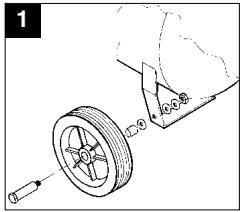
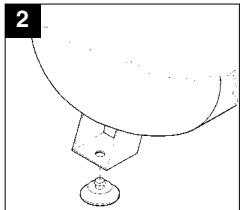
Assembling the rubber buffer Fit the supplied rubber buffer to the support foot as shown in Figure 2.
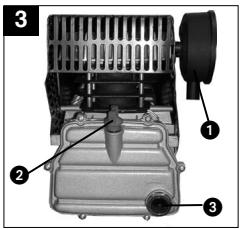
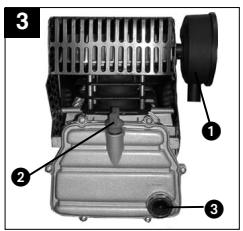
Replacing the oil filter and installing the air filter (fig. 3) Use a screwdriver to remove the oil filler plug and insert the supplied stopper (2) in the opening. Important! Check the oil level. Screw the air filter (1) into the hole in the side of the compressor pump.
Connecting to the power supply:
The compressor is equipped with a power cable and an earthing-pin plug for connection to any 230 V
50Hz earthing-contact socket outlet with a 16 A fuse. Long supply lines, extensions, cable reels and similar cause voltage dips and may prevent the motor from starting. Sluggishness makes starting difficult at low temperatures under freezing point (0^)
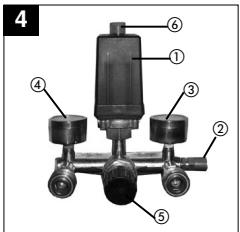
Explanation of the compressed air fittings
1 Pressure switch
2 Safety valve
3 Pressure gauge (to indicate the vessel pressure)
4 Pressure gauge (to indicate the set pressure)
5 Pressure reducing valve (pressure setting)
6 On/Off switch
Maintenance and cleaning
- Condensation water
Let out the condensation water daily by opening the drain valve (bottom of the pressure vessel).
Safety valve
The safety valve is set to the maximum pressure of the pressure vessel. It is prohibited to adjust the safety valve or to remove its lead seal.
- Regular oil level checks
The level of oil has to be visible in the sight-glass between the red check-point mark and the upper edge of the sight-glass. Changing the oil:
Recommended grade SAE 15W/40 or equivalent.
The first oil change should be carried out after 100 operating hours. Thereafter you should drain the oil and replace it with new oil at intervals of 500 operating hours.
- Changing the oil
Switch off the motor and pull the power plug out of the socket-outlet. After letting off any air pressure you can remove the oil drain plug from the compressor pump by unscrewing. To prevent the oil escaping out of control, hold a small piece of metal guttering underneath the drain plug to direct the oil into a container. If any oil still remains inside, tilt the compressor a little.
Take the old oil to an official old oil disposal station.
When the old oil has run out, screw the oil drain plug/sight-glass back in place.
Use a screwdriver to remove the cap of the oil filler plug and fill in oil until the level of oil in the sight-glass reaches the red mark.
Then put the cap back on the oil filler plug.
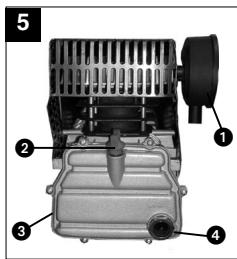
1 Filter
2 Oil filler plug
3 Oil drain plug
4 sight-glass
- Cleaning the intake filter
The intake filter prevents dust and dirt being drawn into the machine. This filter has to be cleaned at intervals of no longer than 300 operating hours. A clogged intake filter has a considerable negative effect on the compressor's power.
The filter can be removed as shown in Figure 3. Wash out the filter with petroleum ether and reinsert.
Caution! Wait until the compressor has cooled completely!
Risk of burns!
Setting the pressure switch
The pressure switch is set at the factory.
Switch-on pressure 5 bar
Switch-off pressure 8 bar
Possible causes of machine failure
Overloading of the motor and hence triggering of the overload circuit-breaker may result from:
An excessively high mains
voltage
- Excessively high ambient temperatures and an insufficient air supply
Defective compressor valves or
a leaking non-return valve
A low level of oil, sluggish connecting rod bearings
Leave a.c. motors enough time to cool off before switching on again. Avoid touching hot components and pipe lines.
Ordering replacement parts
Please quote the following data when ordering replacement parts:
- Type of machine
Article number of the machine - Identification number of the machine
Replacement part number of the part required

Consignes generales de securite
Replacing the oil filter and installing the air filter(3)
Use a screwdriver to remove the oil filler plug and insert the supplied stopper (2) in the opening.
Important! Check the oil level. Screw the air filter (1) into the hole in the side of the compressor pump.
The product described in these instructions comes with a 2 year warranty covering defects. This 2-year warranty period begins with the passing of risk or defect.
For warranty claims to be accepted, the product has to receive the correct maintenance and be put to the proper use as described in the operating manual.
Your statutory rights of warranty are naturally unaffected during these 2 years.
This warranty applies in Germany, or in the respective country of the manufacturer's main regional sales partner, as a supplement to local regulations. Please note the details for contacting the customer service center responsible for your region or the service address listed below.
NOK GARANTIBEVIS
1 Ittaifae, at, a vort studique skulle veare febhefert, yedei 21 s ragesa patier da se 1 voijelhenges nevne pristice. Garapienpero 5p a 2 bejarredn, na risikovore 3e 1000
Eschenstraße 6 - D-94405 Landau/Isar (Germany)
Info-Tel. 0180-5 120 509 • Telefax 0180-5 835 830
The reprinting or reproduction by any other means, in whole or in part, of documentation and papers accompanying products is permitted only with the express consent of ISC GmbH.
F
Unit 5 Morneth Wharf
Twelve Quays
Birkenhead, Wirral
CH 41.1NG
Tel.01516491500Fox01516491501
Tel:01316491500,Pax 0131-6
F ARC EN CIEL ELECTRONIOL
ZABP16
F-89000 ST GEORGES/Baulche
Resp.SAV:Oliver DEMEALIX
Resp: GAV: Oliver DEMEAUX
Riannes détagaches: Michel BODIER
Tol:0386481189Fox 0386483958
Tel: 03 60 48 11 59, Fax: 03 60 48 39 58
man: acc.e @ w
NL Einhell Benelu:
Veldsteen 4
NL-4815 PK Breda
Tel.0765986470,Fax 0765986478
⑤CommercialFiberglass 2A
Comercial Einell, S.A.
Travesia Villa Ester, 9 B
Poligono Industrial El Nogal
E-28119 Alg
Eifachl Pntuoll Udo
Erlonne Portugal Aortado 2100
Investitions: Baugesellschaft
Christof Stefanidi
Christof Oelandner Belinskii-102
Beltskij-102 KZ-486008 st. Chimkent
K2-400008st.Chinleng 电话:(023)82259214
Tel./Fax 021-83675499
RO Einhell Distribution SRL
Dramul Odaij 26, A
Otoneni, Ulfow
RO-075100.5
Tel.0212664302Fax0212664313
161.0212
Poker Plus S.R.O.
Areal yu Bechovic
Budaya 10 B
CZ-19011 Probe - Bechovice 911
Tel.0257910204Fax0257910204
101.62579
BG Slav GmbH
Mihail Koloni str. 18 W
BG-9000 Varna
Tel.052601653
H
Einhell Croatia d.o.o. Hildes
Velika Ves 2
HR-49224 Lepajci
Tel 049342444,Fax 049342392
GMA-Elektromechanika d.o.o.
GMA-Elektronichika 4.0.0 Cesta Andreja Bitenca 115
Cesta Andreja Biterno SLQ 1000 Ljubljana
SEO 1000 Ljubljana, Tl. 01/583201, Fxa
Tel 01758
An. Mavrofidopoulos S.A.
Technical & Commercial Company
- Panastratou & Askliniou Str.
GB 18545 Pirius
Tel.02104136155Fax:02104137693
0210
BUS Bermas, Moscow
Altufyevskoe shosse, 2A
BUS-127273 Moscow
Tel.0955401750 (central office)
Tel.0958033761 (Repair center Moscow)
Tel. 053-3685761 (Hepair Center Moscow) Tel. 813-2240544 (Repair center St. Petersburg)
Tel. 612 2240344 (Repair Center St. Peter)
Dirbita
Metalo str. 23
LT-02190Vijnius
Tel.052395769Fax052395770
107-6526
EST AS Baltoil
Roi alev
Haaslavyald
EE-62102Tarti
Tel.07301700.Fax 07301701
m = 311 ;
UAE Halai Trading Co. LLC
POB 9282, Nakheel Rd. Deira, Shop No. 15
UAE-Dub
Tel.042279554.Fax 042217686
Alborz Abzar Co. Ltd.
No. 111, Bastan Passage, Imam Khomeini Ave.
IR-11146 Teheran
Tel 0216716072,Fax 0216727177
BHNFichollDihd
Einell BII 8.0.20
Poslovni Center 9
BA-72250Vitez
Tel 030 717250,Fax 030 717255
Euracia Industrial and Automotive Supply
24 Eurasia Industrial and Automotive Supply 3. Recomers St
3, Besseme
Dregeville
Duncanville
ZA-Vereeniging 1939
Tel 0164555712,Fax 0164555716
Suvz Promis
Svyaz PromInvest Ltd. #207 11, Skariny, SV
207-11:Skhanya
BY-22023 MInsk
Tel: 017-20410777
Tel 0172642777,Fax 0172642591
EH 10/2004