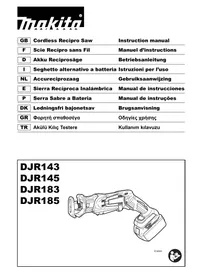
BJR141 - Reciprocating saw MAKITA - Free user manual and instructions
Find the device manual for free BJR141 MAKITA in PDF.




| Brand | Makita |
| Model | BJR141 |
| Product type | Reciprocating saw |
| Rated voltage | 14.4 V DC |
| Stroke length | 23 mm |
| No-load speed | 0 – 2,700 min⁻¹ |
| Max. cutting capacity (tube) | 90 mm |
| Max. cutting capacity (wood) | 90 mm |
| Overall length | 466 mm |
| Net weight | 3.1 kg |
| Power source | 14.4 V Li-ion battery (not included) |
| Applications | Sawing wood, plastic and ferrous materials |
| Variable speed trigger | Yes, progressive pressure |
| Safety button | Yes, prevents accidental starts |
| Adjustable shoe | Yes, tool-less (lever release) |
| Blade change | Tool-less, via rotating collar |
| Removable brush holders | Yes, replacement with screwdriver |
| Sound pressure level | 81 dB(A) (uncertainty 3 dB(A)) |
| Vibration (quadratic value) | 7 m/s² (according to EN60745) |
| Recommended accessories | Reciprocating saw blades, authentic Makita batteries and chargers, plastic case |
Frequently Asked Questions - BJR141 MAKITA
User questions about BJR141 MAKITA
0 question about this device. Answer the ones you know or ask your own.
Ask a new question about this device
Download the instructions for your Reciprocating saw in PDF format for free! Find your manual BJR141 - MAKITA and take your electronic device back in hand. On this page are published all the documents necessary for the use of your device. BJR141 by MAKITA.
USER MANUAL BJR141 MAKITA
Explanation of general view
-
Red part
-
Lock-off button
-
Blade
-
Button
-
Switch trigger
-
Limit mark
-
Battery cartridge
-
Blade clamp sleeve
-
Brush holder cap
-
Lever
-
Released position
-
Screwdriver
-
Shoe
-
Fixed position
SPECIFICATIONS
| Model | BJR141 | |
| Length of stroke | 23 mm | |
| Strokes per minute (min-1) | 0 - 2,700 | |
| Max. cutting capacities | Pipe | 90 mm |
| Wood | 90 mm | |
| Overall length | 466 mm | |
| Net weight | 3.1 kg | |
| Rated voltage | D.C. 14.4 V | |
- Due to our continuing program of research and development, the specifications herein are subject to change without notice.
Note: Specifications may differ from country to country.
Intended use
ENE020-1
The tool is intended for sawing wood, plastic and ferrous materials.
SPECIFIC SAFETY RULES
GEB008-2
DO NOT let comfort or familiarity with product (gained from repeated use) replace strict adherence to reciproc saw safety rules. If you use this tool unsafely or incorrectly, you can suffer serious personal injury.
- Hold power tool by insulated gripping surfaces when performing an operation where the cutting tool may contact hidden wiring or its own cord. Contact with a "live" wire will make exposed metal parts of the tool "live" and shock the operator.
- Use clamps or another practical way to secure and support the workpiece to a stable platform. Holding the work by hand or against your body leaves it unstable and may lead to loss of control.
- Always use safety glasses or goggles. Ordinary eye or sun glasses are NOT safety glasses.
- Avoid cutting nails. Inspect workpiece for any nails and remove them before operation.
- Do not cut oversize workpiece.
- Check for the proper clearance beyond the workpiece before cutting so that the blade will not strike the floor, workbench, etc.
- Hold the tool firmly.
- Make sure the blade is not contacting the workpiece before the switch is turned on.
- Keep hands away from moving parts.
-
Do not leave the tool running. Operate the tool only when hand-held.
-
Always switch off and wait for the blade to come to a complete stop before removing the blade from the workpiece.
- Do not touch the blade or the workpiece immediately after operation; they may be extremely hot and could burn your skin.
- Do not operate the tool at no-load unnecessarily.
- Always use the correct dust mask/respirator for the material and application you are working with.
- Some material contains chemicals which may be toxic. Take caution to prevent dust inhalation and skin contact. Follow material supplier safety data.
SAVE THESE INSTRUCTIONS
WARNING:
MISUSE or failure to follow the safety rules stated in this instruction manual may cause serious personal injury.
IMPORTANT SAFETY INSTRUCTIONS
ENC007-2
FOR BATTERY CARTRIDGE
- Before using battery cartridge, read all instructions and cautionary markings on (1) battery charger, (2) battery, and (3) product using battery.
- Do not disassemble battery cartridge.
-
If operating time has become excessively shorter, stop operating immediately. It may result in a risk of overheating, possible burns and even an explosion.
-
If electrolyte gets into your eyes, rinse them out with clear water and seek medical attention right away. It may result in loss of your eyesight.
- Do not short the battery cartridge:
(1) Do not touch the terminals with any conductive material.
(2) Avoid storing battery cartridge in a container with other metal objects such as nails, coins, etc.
(3) Do not expose battery cartridge to water or rain.
A battery short can cause a large current flow, overheating, possible burns and even a breakdown.
- Do not store the tool and battery cartridge in locations where the temperature may reach or exceed 50^ (122^) .
- Do not incinerate the battery cartridge even if it is severely damaged or is completely worn out. The battery cartridge can explode in a fire.
- Be careful not to drop or strike battery.
SAVE THESE INSTRUCTIONS.
Tips for maintaining maximum battery life
- Charge the battery cartridge before completely discharged. Always stop tool operation and charge the battery cartridge when you notice less tool power.
- Never recharge a fully charged battery cartridge. Overcharging shortens the battery service life.
- Charge the battery cartridge with room temperature at 10^ - 40^ (50^ - 104^) . Let a hot battery cartridge cool down before charging it.
FUNCTIONAL DESCRIPTION
CAUTION:
- Always be sure that the tool is switched off and the battery cartridge is removed before adjusting or checking function on the tool.
Installing or removing battery cartridge (Fig. 1)
- Always switch off the tool before insertion or removal of the battery cartridge.
- To remove the battery cartridge, withdraw it from the tool while sliding the button on the front of the cartridge.
- To insert the battery cartridge, align the tongue on the battery cartridge with the groove in the housing and slip it into place. Always insert it all the way until it locks in place with a little click. If you can see the red part on the upper side of the button, it is not locked completely. Insert it fully until the red part cannot be seen. If not, it may accidentally fall out of the tool, causing injury to you or someone around you.
- Do not use force when inserting the battery cartridge. If the cartridge does not slide in easily, it is not being inserted correctly.
Adjusting the shoe (Fig. 2)
When the blade loses its cutting efficiency in one place along its cutting edge, reposition the shoe to utilize a sharp, unused portion of its cutting edge. This will help to lengthen the life of the blade. To reposition the shoe, loosen the lever counterclockwise and slide the shoe forward or back to the desired position. Then tighten the lever clockwise to firmly secure the shoe.
Switch action (Fig. 3)
CAUTION:
- Before inserting the battery cartridge into the tool, always check to see that the switch trigger actuates properly and returns to the "OFF" position when released.
- When not operating the tool, depress the lock-off button from A side to lock the switch trigger in the OFF position.
To prevent the switch trigger from accidentally pulled, the lock-off button is provided.
To start the tool, depress the lock-off button from B side and pull the switch trigger.
Tool speed is increased by increasing pressure on the switch trigger. Release the switch trigger to stop. After use, always press in the lock-off button from A side.
ASSEMBLY
CAUTION:
- Always be sure that the tool is switched off and the battery cartridge is removed before carrying out any work on the tool.
Installing or removing the saw blade
CAUTION:
Always clean out all chips or foreign matter adhering to the blade, blade clamp and/or slider. Failure to do so may cause insufficient tightening of the blade, resulting in a serious injury.
To install the saw blade, always make sure that the blade clamp sleeve is in released position before inserting the saw blade. If the blade clamp sleeve is in fixed position, rotate the sleeve to the released position. (Fig. 4)
Insert the saw blade into the blade clamp as far as it will go. The blade clamp sleeve rotates and the saw blade is fixed. Make sure that the saw blade cannot be extracted even though you try to pull it out. (Fig. 5)
NOTE:
- If you do not insert the saw blade deep enough, the saw blade may be ejected unexpectedly during operation. This can be extremely dangerous.
To remove the saw blade, rotate the blade clamp sleeve in the direction of the arrow fully. The saw blade is removed and the blade clamp sleeve is fixed at the released position. (Fig. 6)
NOTE:
- If you remove the saw blade without rotating the blade clamp sleeve fully, the sleeve may not be fixed. In this
case, rotate the blade clamp sleeve fully, then make the sleeve fixed at the released position.
OPERATION (Fig. 7)
CAUTION:
Always press the shoe firmly against the workpiece during operation. If the shoe is held away from the workpiece during operation, strong vibration and/or twisting will be produced, causing the blade to snap dangerously.
Always wear gloves to protect your hands from hot flying chips when cutting metal.
- Be sure to always wear suitable eye protection which conforms with current national standards.
Always use a suitable coolant (cutting oil) when cutting metal. Failure to do so will cause premature blade wear.
- If the tool is operated continuously until the battery cartridge has discharged, allow the tool to rest for 15 minutes before proceeding with a fresh battery.
Press the shoe firmly against the workpiece. Do not allow the tool to bounce. Bring the blade into light contact with the workpiece. First, make a pilot groove using a slower speed. Then use a faster speed to continue cutting.
NOTE:
- If the tool is operated continuously until the battery cartridge has discharged, allow the tool to rest for 15 minutes before proceeding with a fresh battery.
MAINTENANCE
CAUTION:
- Always be sure that the tool is switched off and the battery cartridge is removed before attempting to perform inspection or maintenance.
Replacing carbon brushes (Fig. 8 & 9)
Remove and check the carbon brushes regularly.
Replace when they wear down to the limit mark. Keep the carbon brushes clean and free to slip in the holders.
Both carbon brushes should be replaced at the same time. Use only identical carbon brushes.
Use a screwdriver to remove the brush holder caps.
Take out the worn carbon brushes, insert the new ones and secure the brush holder caps.
To maintain product SAFETY and RELIABILITY, repairs, any other maintenance or adjustment should be performed by Makita Authorized Service Centers, always using Makita replacement parts.
ACCESSORIES
CAUTION:
- These accessories or attachments are recommended for use with your Makita tool specified in this manual. The use of any other accessories or attachments might present a risk of injury to persons. Only use accessory or attachment for its stated purpose.
If you need any assistance for more details regarding these accessories, ask your local Makita Service Center.
Recipro saw blades
- Various type of Makita genuine batteries and chargers
- Plastic carrying case
Descriptif
EC-DECLARATION OF CONFORMITY
We declare under our sole responsibility that this product is in compliance with the following standards of standardized documents, EN60745, EN55014 in accordance with Council Directives, 89/336/EEC, 98/37/EC.
FRANÇAIS
DECLARATION DE CONFORMITE CE
Michigan Drive, Tongwell, Milton Keynes,
Bucks MK15 8JD, ENGLAND
Responsible manufacturer:
Fabricant responsible :
EU-DEKLARATION OM KONFORMITET
Michigan Drive, Tongwell, Milton Keynes,
Bucks MK15 8JD, ENGLAND
Fabricante responsavel:
For European countries only Noise and Vibration
The typical A-weighted sound pressure level is 81 dB (A).
Uncertainty is 3 dB (A).
The noise level under working may exceed 85 dB (A).
- Wear ear protection.-
The typical weighted root mean square acceleration value is 7m / s^2
These values have been obtained according to EN60745.
FRANÇAIS
Michigan Drive, Tongwell, Milton Keynes,
Bucks MK15 8JD, ENGLAND
Responsible manufacturer:
Fabricant responsible :
Michigan Drive, Tongwell, Milton Keynes,
Bucks MK15 8JD, ENGLAND
Fabricante responsavel: