
SPEEDLIGHT SB-400 - External Flash NIKON - Free user manual and instructions
Find the device manual for free SPEEDLIGHT SB-400 NIKON in PDF.



| Product type | External flash for Nikon camera |
| Brand | Nikon |
| Model | Speedlight SB-400 |
| Dimensions (W x H x D) | Approx. 66 x 56.5 x 80 mm |
| Weight (without batteries) | Approx. 127 g |
| Power source | 2 AA batteries (alkaline, lithium, oxyride, Ni-MH) |
| Recycling time (alkaline batteries) | Approx. 3.9 s |
| Number of flashes (alkaline, full power) | Approx. 140 |
| Guide number (ISO 200) | 30 (m) |
| Coverage angle | 18 mm (DX format), 27 mm (FX format) |
| Flash range | 0.6 m to 20 m (depending on ISO and aperture) |
| Flash modes | i-TTL, manual (only with D40) |
| Main functions | Bounce flash (tilt head up to 90°), slow sync, red-eye reduction, FV lock |
| Maintenance and cleaning | Clean with a soft, dry cloth. Avoid solvents. |
| Safety | Do not disassemble, avoid contact with water, do not use in explosive atmosphere |
| Spare parts and accessories | Soft case SS-400 included, TTL extension cable SC-29/28/17 available |
| Repairability | Have it serviced at an authorized Nikon center. Inspection recommended every 2 years. |
| Device compatibility | Nikon cameras compatible with CLS (D3, D2, D300, D200, D80, D70, D50, D40, F6, Coolpix 8400, 8800, P5000, P5100) |
| Operating temperature | Avoid extreme temperatures. Use between approx. 0°C and 40°C. |
| Battery life | Varies by type and usage. Battery life reduced in cold. |
Frequently Asked Questions - SPEEDLIGHT SB-400 NIKON
User questions about SPEEDLIGHT SB-400 NIKON
0 question about this device. Answer the ones you know or ask your own.
Ask a new question about this device
Download the instructions for your External Flash in PDF format for free! Find your manual SPEEDLIGHT SB-400 - NIKON and take your electronic device back in hand. On this page are published all the documents necessary for the use of your device. SPEEDLIGHT SB-400 by NIKON.
USER MANUAL SPEEDLIGHT SB-400 NIKON
For your safety 2
Foreword 8
- Confirm receipt. 8
Compatible cameras. 10
·Speedlight parts 10
- Installing the batteries 10
Basic operation
- Attach the SB-400 to the camera 12
- Adjust the flash head 12
- Setting the camera's mode 13
- Flash shooting distance range. 13
Available flash modes
- Slow-sync flash/Red-eye reduction/Red-eye reduction with slow-sync flash mode/Rear-curtain sync/FV (Flash Value) Lock/Exposure compensation and flash output level compensation/Manual mode. 14
Effective usage of Speedlight
- Bounce flash 15
Notes on bounce flash. 16
Reference information
- Optional accessories 18
- Tips on Speedlight care 18
Notes on handling batteries. 19
Notes on continuous flash shooting. 20 - Troubleshooting 21
- Specifications 22
For your safety
En
Before using your product, please read the following safety precautions carefully and thoroughly to ensure correct and safe use and to help prevent damage to your Nikon product or injury to yourself or others.
For quick reference by those who use the product, please keep these safety instructions near the product.
In this manual, safety instructions are indicated with these symbols:

WARNING
Disregarding instructions marked with this symbol could result in personal injury, or death and property damage.

CAUTION
Disregarding instructions marked with this symbol could result in property damage.

WARNINGs for Speedlights
1 If corrosive liquids seep from the batteries and get in your eyes, immediately wash your eyes with running water and consult with a doctor. Your eyes could be seriously damaged if they are not treated quickly.
2 Never attempt to disassemble or repair the flash unit by yourself, as this could result in you receiving an electric shock and could also cause the unit to malfunction; such malfunction could lead to personal injury.
3 If corrosive liquids seep from the batteries and come in contact with your skin or clothes, wash immediately with running water. Prolonged contact could injure your skin.
4 If the flash unit is dropped and damaged, do not touch any exposed interior metal parts. Such parts, especially the speedlight's capacitor and associated parts, could be in a high-charge state and if touched could cause an electric shock. Disconnect the power or remove the batteries and be sure that you do not touch any of the product's electrical components, and then bring the flash unit to your local Nikon dealer or authorized service center for repair.
5 If you detect heat, smoke or notice a burning smell, immediately stop operation and remove the batteries to prevent the unit from catching on fire or melting. Allow the flash unit to cool down so that you can safely touch it and remove the batteries. Then bring the unit to your local Nikon dealer or authorized service center for repair.
6 The flash unit should never be submerged in liquid or exposed to rain, saltwater or moisture unless it is properly protected from the liquids and moisture. Underwater use requires a certified underwater housing. If water or moisture gets inside the unit, this could cause the unit to catch on fire or cause an electric shock. In such instances you should immediately remove the batteries from the speedlight and then bring the unit to your local Nikon dealer or authorized service center for repair.
Note: electronic devices that are penetrated by water or moisture are often not economically repairable.
7 Do not use the unit in the presence of flammable or explosive gas. If the flash unit is operated in areas where there is a flammable gas, including propane, gasoline and dust, it could cause an explosion or fire.
8 Do not fire the flash unit directly at the driver of a moving car, as this could temporarily impair the driver's vision and cause an accident.
9 Do not fire the flash unit directly into the eyes of someone that is at close range, as it could damage their eyes' retinas. Never fire the flash unit closer than 1 meter from infants.
10 Do not fire the unit while the flash head is touching a person or object. Such use can result in the person being burned, and/or their clothes igniting from the heat of the flash's firing.
11 Keep small accessories out of the reach of children to avoid the possibility of the accessory being swallowed. If an accessory is accidentally swallowed, immediately consult with a doctor.
12 Use only the batteries specified in this instruction manual.
Batteries other than those specified could leak corrosive liquids, explode or catch on fire or otherwise not perform satisfactorily.
13 Do not mix battery types, brands or old and new batteries, as the batteries could leak corrosive liquids, explode or catch on fire.
When using more than one battery in a product, always use identical batteries that were purchased at the same time.
14 Non-rechargeable batteries such as manganese, alkalinemanganese and lithium batteries should never be charged in a battery charger because they could leak corrosive liquids, explode or catch on fire.
15 When using standard size (AA, AAA, C, D) or other common rechargeable batteries such as NiCd and Ni-MH battery types, or when recharging them, be sure to use only the battery charger specified by the battery maker and read the instructions thoroughly. Do not recharge these batteries with their terminals reversed in the charger or before the batteries have cooled off sufficiently because they could leak corrosive liquids, explode or catch on fire. The same caution also applies to using the rechargeable batteries that may be supplied by the photo product's manufacturer.

CAUTIONS for Speedlights
1 Do not touch the flash unit with wet hands, as this could cause an electric shock.
2 Keep the flash unit away from children to prevent them from putting the unit in or near their mouth, or otherwise touching a dangerous part of the product; as such contact could cause an electric shock.
3 Do not apply strong physical shocks to the unit, as this could cause a malfunction that could cause the unit to explode or catch on fire.
4 Never use active agents that contain flammable substances such as paint thinner, benzene or paint remover to clean the unit, never spray any insect deterrent spray on the unit, and never store the unit in locations containing chemicals such as camphor and naphthalene, as this could damage the plastic case, cause a fire or cause an electric shock.
5 Remove any batteries from the unit before storing the unit for a long time to prevent the unit from catching on fire or leaking corrosive liquids.

WARNINGs for Batteries
1 Never heat or throw batteries into a fire, as this could cause the batteries to leak corrosive liquids, generate heat or explode.
2 Do not short-circuit or disassemble the batteries because this could cause the batteries to leak corrosive liquids, generate heat or explode.
3 Do not mix battery types, brands or old and new batteries, as this could cause the batteries to leak corrosive liquids, generate heat or explode.
4 Do not install batteries in the reverse direction as this could cause the batteries to leak corrosive liquids, generate heat or explode. Even if only one battery is installed in reverse it will cause the speedlight to malfunction.
5 Be sure to use the battery charger specified by the battery maker to avoid the possibility of batteries leaking corrosive liquids, generating heat or exploding
6 Do not carry or store batteries along with metallic materials such as necklaces and hair pins because such materials could cause the batteries to short-circuit, leading to battery leakage, heat generation or an explosion. In addition, specially when carrying a quantity of batteries, place them carefully in a storage case that prevents the battery terminals from touching another battery's terminals because if they touch in reverse order it could also cause the batteries to short-circuit, leading to battery leakage, heat generation or an explosion.
7 If corrosive liquids seep from the batteries and get in your eyes, immediately wash your eyes with running water and consult with a doctor. Your eyes could be seriously damaged if they are not treated quickly.
8 Always follow the warnings and instructions printed on the batteries to avoid activities that could cause the batteries to leak corrosive liquids, generate heat or catch on fire.
9 Be sure to use only batteries specified in this instruction manual, to avoid the possibility of batteries leaking corrosive liquids, generating heat or exploding.
10 Never open the casing surrounding batteries or use batteries whose casing has been breached as such batteries could leak corrosive liquids, generate heat or explode.
11 Keep batteries out of the reach of children to help avoid the possibility of them being swallowed. If a battery is accidentally swallowed, immediately consult with a doctor.
12 Batteries should not be submerged in water, exposed to rain, moisture or saltwater unless they are properly protected from the wet environment. If water or moisture gets inside the batteries, this could cause them to leak corrosive liquids or generate heat.
13 Do not use any battery that appears abnormal in any way, including a change in color or shape. Such batteries could leak corrosive liquids or generate heat.
14 Stop recharging rechargeable batteries if you notice that recharging is not completed within the specified time to help prevent the possibility of the battery leaking corrosive liquids or generating heat.
15 If corrosive liquids seep from the batteries and come in contact with your skin or clothes, wash immediately with running water. Prolonged contact could injure your skin.
16 When recycling or disposing of batteries, be sure to insulate their terminals with tape. If the battery's positive and negative terminals short-circuit after coming into contact with metallic objects, it could cause fire, heat generation or an explosion. Dispose of used batteries in accordance with local government regulations.
17 Non-rechargeable batteries should never be charged in a battery charger because they could leak corrosive liquids or generate heat.
18 Remove dead batteries from your equipment immediately, leak corrosive liquids, generate heat or explode.

CAUTION for Batteries
1 Do not throw or apply strong physical shocks to the batteries as this could cause batteries to leak corrosive liquids, generate heat or explode.
Symbol for separate collection applicable in European countries
This symbol indicates that this product is to be collected separately. The following apply only to users in European countries.
- This product is designated for separate collection at an appropriate collection point. Do not dispose of as household waste.
- For more information, contact the retailer or the local authorities in charge of waste management.
Foreword
Thank you for purchasing the Nikon Speedlight SB-400. To get the most out of your Speedlight, please read this instruction manual thoroughly before use. In addition, keep your camera instruction manual handy for quick reference.
Confirm receipt
Confirm receipt of contents in your kit
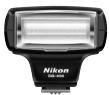
SB-400

Soft Case
Nikon
Instruction manual
Instruction manual
Nikon
Warranty card
Warranty card
Using your Speedlight correctly
The Nikon Speedlight's performance has been optimized for use with Nikon brand cameras and accessories, including lenses.
Camera and accessories made by other manufacturers might not meet Nikon's specification criteria, and nonconforming cameras and accessories could damage the Speedlight's components. Nikon cannot guarantee the Speedlight's performance when used with non-Nikon products.
Take trial shots
Take test photos before photographing important events, such as weddings and graduations.
Have Nikon regularly spot-check your Speedlight
Nikon recommends that you have your Speedlight serviced by an authorized dealer or service center at least once every two years.
Life-long learning
As part of Nikon's "Life-long learning" commitment to ongoing product support and education, continually updated information is available online at the following sites:
For users in the U.S.A.: http://www.nikonusa.com/
For users in Europe and Africa: http://www.europe-nikon.com/support/
- For users in Asia, Oceania and the Middle East: http://www.nikon-asia.com/ Visit these sites to keep up-to-date with the latest product information, tips, answers to frequently asked questions, and to receive general advice on digital imaging and photography. Additional information may be available from the Nikon representative in your area. See the URL below for contact information:
http://nikonimaging.com/
Compatible cameras
This Speedlight, which features the Nikon Creative Lighting System (CLS), provides i-TTL flash operations in combination with CLS-compatible cameras. Manual mode is also available with the D40-Series camera.
| Cameras compatible with CLS | D3, D2-Series, D300, D200, D80*, D70-Series*, D50*, D40-Series*, F6, COOLPIX 8400, COOLPIX 8800*, COOLPIX P5000, COOLPIX P5100 |
*When using the SB-400 with these cameras, the SB-400 must be turned on.
Speedlight parts
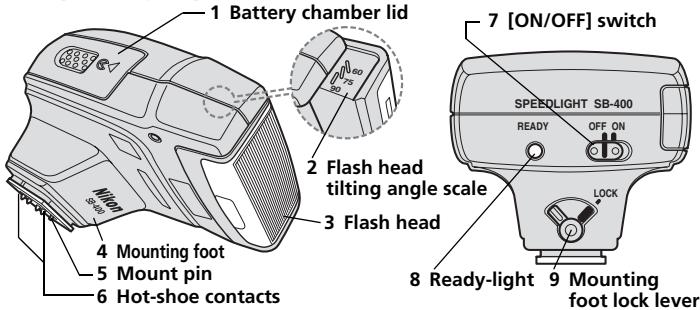
Installing the batteriesL
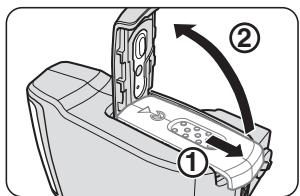
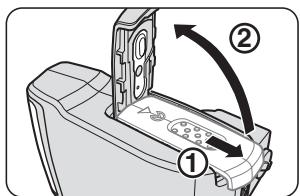
1 Slide open the battery chamber lid in the direction of the arrow.
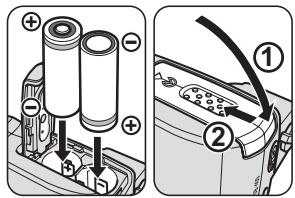
2 Install the batteries following the and marks as shown. Then close the battery chamber lid by sliding it into place while pressing down.
Usable batteries
Install two AA-type penlight batteries (1.5V or lower) of any of these types: Alkaline-manganese (1.5V), Lithium (1.5V), Oxyride (1.5V), Ni-MH [Nickel Metal Hydride (rechargeable), (1.2V)]
- When replacing batteries, replace both with fresh ones of the same brand.
- High-power manganese batteries are not recommended for use with the SB-400.
- Depending on battery specifications, when the Lithium batteries become hot, the safety circuits are activated, cutting off power. This often occurs when the flash unit is operated in the repeating flash mode. Battery power will recover when the temperature returns to normal.
Replacing/recharging the batteries
When the battery power becomes low, the Ready-light blinks at 2 Hz (twice in a second) for approx. 40 seconds. Replace or recharge batteries.
Standby function to conserve battery power
- If the SB-400 and the camera are not used for more than 40 seconds, the standby function activates and automatically turns the SB-400 off to conserve battery power (it goes into the standby mode).
- When the SB-400 is mounted on a camera, the SB-400 automatically turns off when the camera goes into standby mode after the camera's exposure meter is switched off.
- When in the standby mode, the SB-400 turns back on again when the [ON/OFF] switch is [ON], or the camera's shutter release button is lightly pressed.

En
Attach the SB-400 to the camera
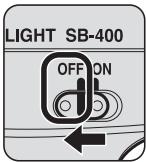
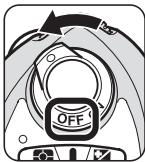
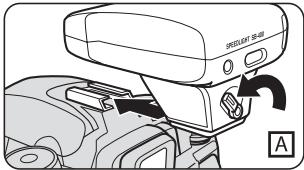
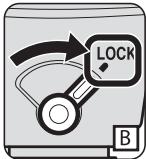
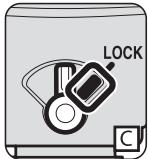
1 Make sure the SB-400 and the camera body are turned off.
2 Rotate the mounting foot lock lever to the left, slide the SB-400's mounting foot into the camera's accessory shoe and turn the lock lever to the right. (illustr. A and B)
- In case the mounting foot lock lever does not stay to the right and a red line appears (illustr. C), the mounting foot lock lever is not fully rotated to its right position. Re-attach the SB-400 to the camera again with the same process above.

Adjust the flash head
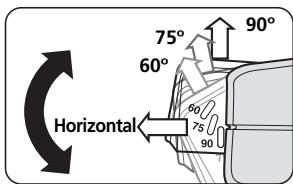
1 Adjust the flash head to the horizontal position.
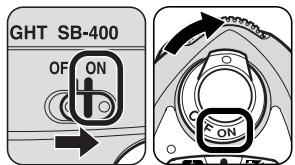
2 Turn the SB-400 and the camera body on.

Setting the camera's mode
1 Setting the camera's exposure mode and metering mode
- For more details, see your camera instruction manual.
2 Check the ready-light on the SB-400 or in the camera's viewfinder, then start shooting.
Flash shooting distance range
The SB-400's usable flash shooting distance range is 0.6m to 20m (2 to 66 ft.) and varies, depending on the camera's ISO sensitivity and lens aperture in use.
| ISO sensitivity | Aperture | ||||||||||
| 1600 | 4 | 5.6 | 8 | 11 | 16 | 22 | 32 | — | — | — | — |
| 800 | 2.8 | 4 | 5.6 | 8 | 11 | 16 | 22 | 32 | — | — | — |
| 400 | 2 | 2.8 | 4 | 5.6 | 8 | 11 | 16 | 22 | 32 | — | — |
| 200 | 1.4 | 2 | 2.8 | 4 | 5.6 | 8 | 11 | 16 | 22 | 32 | — |
| 100 | — | 1.4 | 2 | 2.8 | 4 | 5.6 | 8 | 11 | 16 | 22 | 32 |
| Usable flash shooting distance range (m/ft.) | 1.9-20/6.2-65.0 | 1.4-14.8/4.6-49.0 | 1.0-10.5/3.3-34.0 | 0.7-7.4/2.3-24.3 | 0.6-5.2/2.0-17.0 | 0.6-3.7/2.0-12.1 | 0.6-2.6/2.0-8.5 | 0.6-1.8/2.0-5.9 | 0.6-1.3/2.0-4.3 | 0.6-0.9/2.0-2.3 | 0.6/2.0 |
Available flash modes
The SB-400's available flash modes vary, depending on the cameras and lenses in use or the camera's exposure mode.
- Each mode should be set on the camera body, since it cannot be set through the SB-400. For details, see you camera instruction manual.
- For shooting with slow shutter speeds, use of a tripod is recommended.
Slow-sync flash
The flash is controlled at a slow shutter speed to obtain the correct exposure for both the main subject and background in low-light situations or at night.
Red-eye reduction
To prevent the center of your subject's eyes from appearing red in color pictures, the SB-400 fires three flashes at reduced output just before the picture is taken.
Red-eye reduction with slow-sync flash mode
In this mode, red-eye reduction is combined with slow-sync.
Rear-curtain sync
Rear-curtain flash sync creates a picture in which the blur or a moving subject appears behind the subject and not in front.
FV (Flash Value) Lock
Flash Value, or "FV", is the amount of flash exposure for the subject. Using FV Lock you can lock in the appropriate flash exposure for the main subject.
Exposure compensation and flash output level compensation
Exposure compensation allows you to take well-balanced pictures by intentionally modifying the flash exposure. This is useful when a subject of extremely high or low reflectivity is included in the scene or when you want to create flash photographs to match your creative preferences.
- Use the camera's exposure compensation function to modify both the SB-400's flash output level and the background exposure.
- With cameras that have the flash output level compensation function, the SB-400's flash output level can be adjusted to make exposure compensation for a flash illuminated main subject without affecting the background exposure.
Manual mode (only with D40-Series camera)
Manual flash operation is possible with the camera's custom setting.
Effective usage of Speedlight
With the SB-400 mounted on your camera's hot shoe, you can tilt the flash head in four steps (horizontal, 60^ , 75^ and 90^ ) to bounce the light off the ceiling.

Tilt the flash head 90^ upper

Horizontal
Bounce flash
Shooting using the light bounced off the ceiling or other surfaces by tilting the flash head is called the bounce flash operation.
This technique offers following advantages:
- Eliminates Red Eye
- Creates soft shadows
- Prevents hair or clothes appearing to shine.
Notes on bounce flash
En
For a simple bounce flash technique, tilt the flash head upward and bounce the flash light off the ceiling. Note that the flash should not directly illuminate the subject.
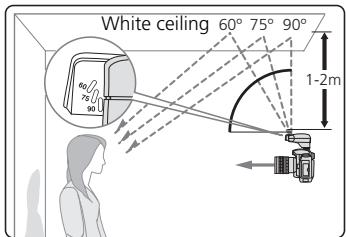
- The recommended distance between the flash head and reflective surface (ex. ceiling) is 1 to 2m (3.3-6.6 ft.).
Note to prevent the flash light directly illuminating the subject. - In color photography, select white or highly reflective surfaces to bounce the light off. Otherwise, your pictures will come out with an unnatural color cast similar to that of the reflecting surface.
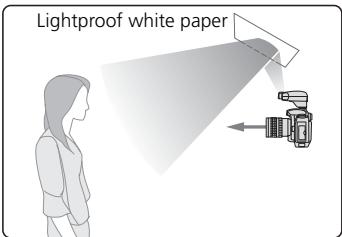
- When the distance between the flash head and reflective surfaces is long, use some A4-size white paper to bounce the light off. Check that the bounced light rightly illuminates the subject.
When the subject has a mottled appearance with the flash light, raise the tilting degree of the flash head.
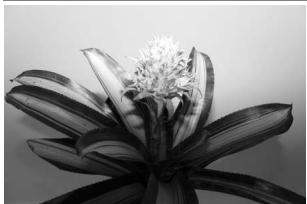
Illuminated subject in a mottled tone
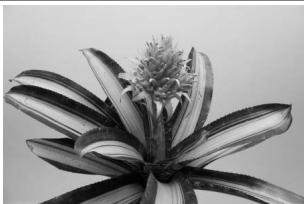
Shooting with the flash head tilted up 90^
Depending on the lens' focal length and tilting degree of the flash head, the bounced light may illuminate the subject in a mottled tone.
- Tilt the flash head 90^ and take the shot.
In case the light is not enough

When the flash light is insufficient

Shooting with higher ISO sensitivity
When the reflective surface is too far away, the light from Speedlight may be not enough to illuminate the subject.
- When taking photograph with digital cameras, set the ISO sensitivity higher than in normal shooting.
- For bounce flash shooting, set the lens' aperture larger (f/3.5, f/4.5 or f/5.6) than for normal shooting.
- Reduce the distance between the reflective surface and the Speedlight.
Optional accessories
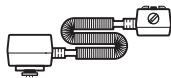
TTL Remote Cord SC-28/17 (1.5m)
TTL Remote Cords SC-28/17 provide TTL auto flash operation when the SB-400 is used off-camera. Their flash shoes come with one tripod socket.
Tips on Speedlight care

WARNING
Never use thinner, benzene, or other active agents for cleaning the Speedlight, as this may damage the Speedlight or cause it to catch fire. Using these agents may also impair your health.
Cleaning
- Use a blower brush to remove dirt and dust from the Speedlight and clean it with a soft, clean cloth. After using the Speedlight near saltwater, wipe the flash unit with a soft, clean cloth moistened slightly with tap water to remove the salt, then dry it with a dry cloth.
- Do not drop the Speedlight or knock it on a hard surface, as this may damage its precision mechanisms.
Storage
- Store the Speedlight in a cool, dry place to prevent malfunctions due to high humidity, as well as the growth of mold or mildew.
- Keep the Speedlight away from chemicals such as camphor or naphthalene. Avoid exposing the Speedlight to magnetic waves from televisions or radios.
- Do not use or leave the Speedlight in locations subject to high temperatures such as near a heater or stove, as this may cause damage.
-
When not using the Speedlight for more than two weeks, be sure to remove the batteries to prevent damage due to battery leakage.
-
Take the Speedlight out once a month, insert the batteries, and fire the unit several times to reform the capacitor.
- When the Speedlight is stored together with a desiccant, renew the desiccant occasionally.
Operating location
- An extreme temperature change can cause condensation to form inside the Speedlight. When exposing the Speedlight to high temperatures from very low temperatures, or vice versa, place it inside an airtight container such as a plastic bag. Leave it inside the container for a while before gradually exposing the Speedlight to the outside temperature.
- Avoid exposing the Speedlight to strong magnetic or radio waves from televisions or high voltage power transmission towers, as this may cause it to malfunction.
Notes on handling batteries
- Because flash consumes a large amount of battery power, rechargeable batteries may not operate properly before reaching the end of their stated lifespan or the number of charging/discharging as specified by the battery manufacturer.
- If the battery terminals become soiled, remove dirt and smudges before use, as this may cause a malfunction.
- Battery power tends to weaken as the temperature drops. It also gradually decreases when batteries are not used for a long time and recovers after a short break following intensive use. Be sure to check battery power and replace the batteries with fresh ones, if you notice any delays in the recycling time.
- Do not store batteries in locations subject to high temperatures and high humidity.

Ni-MH
Recycling rechargeable batteries
To protect the earth's environment, do not dispose of used rechargeable batteries yourself. Instead, take these batteries to your nearest recycling center.
Notes on continuous flash shooting

Do not exceed the maximum number of continuous firings
You should allow the 5B-400 to cool off for at least 10 minutes after the maximum number of continuous firings are performed as shown in the table below:
Max. number of continuous firings
| Flash mode | Max. number of continuous firings |
| i-TTL auto flash | 15 |
| Manual flash (Flash output level: M1/1, M1/2) | |
| Manual flash (Flash output level: M1/4 to M1/128) | 40 |
Notes when using the SB-400 with D80, D70-Series, D50, D40-Series and COOLPIX 8800 cameras
When using the SB-400 with D80, D70-Series, D50, D40-Series or COOLPIX 8800 cameras, the SB-400 must be turned on.
- If the SB-400 is turned off while mounted on any of the above cameras, and the camera's "Auto flash" function is on, the camera's built-in flash will automatically pop up when shooting in poor light, coming into contact with the SB-400.
- It is recommended that the SB-400 be detached from the camera when flash is not required.
A note on microcomputer-controlled Speedlights
The Speedlight incorporates a microcomputer to control flash operations. In rare cases, the Speedlight may not work properly even after a fresh battery is properly installed. If this happens, replace the battery while the Speedlight's power is turned on.
Troubleshooting
If a warning indication appears on the SB-400's ready-light or inside the camera's viewfinder, use the following chart to determine the cause of the problem before you take your Speedlight to a Nikon service center for repair.
Warning indication inside the camera's viewfinder
| Warning indication | Cause | Procedure |
| The ready-light in the viewfinder blinks for 3 sec. after firing. | Underexposure may have occurred. | • Shorten the shooting distance. • Set camera's aperture to a larger (f/3.5, f/4.5 or f/5.6). • Set the camera's ISO sensitivity higher. |
| When mounted to the D40, ◆ blinks in the camera's viewfinder. | Lens' focal length is set shorter than 18mm. | • Set the focal length longer than 18mm. |
| When mounted to the D40, ◆ blinks in the camera's viewfinder. | The flash head of the SB-400 is not set to the horizontal position. | • For bounce flash shooting, take the picture without any change. • For standard flash shooting, tilt the flash head to the horizontal position. |
When the ready-light on the SB-400 blinks
| Ready-light blinks | Cause | Procedure |
| The ready-light blinks for 3 sec. at 4 Hz. | Underexposure may have occurred. | • Shorten the shooting distance. • Set camera's aperture to a larger (f/3.5, f/4.5 or f/5.6). • Set camera's the ISO sensitivity higher. |
| The ready-light blinks for 40 sec. at 2 Hz. | Battery power is not enough. | • Replace or recharge batteries. |
| The ready-light blinks at interval of 0.5 sec. at 8 Hz. | The SB-400 is mounted to a camera which is not compatible with CLS (SB-400 is usable only with cameras compatible with CLS). | |
| The ready-light blinks at 1 Hz. | The body temperature becomes high because of repeating flash or other cause. | • Wait until the body temperature drops and ready-light turns on again. |
- Hz (frequency) is blinking time per second.
Specifications
| Electronic construction | Automatic Insulated Gate Bipolar Transistor (IGBT) and series circuitry |
| Guide number (20°C/68°F) | 30/98.4 (ISO 200, m/ft), 21/69 (ISO 100, m/ft) |
| Angle of coverage | Light distribution covers an 18mm lens when mounted on a Nikon DX format camera, and a 27mm lens when mounted on an F6 |
| Flash shooting distance range | 0.6m to 20m (2 to 66 ft.) (varies depending on the ISO sensitivity, angle of the flash head, and lens aperture in use) |
| Flash mode | i-TTL, M (manual, only with the D40-Series) |
| Compatible cameras | All cameras compatible with CLS |
| Flash exposure control set on the camera | Slow-sync, Red-eye reduction, Red-eye reduction in slow-sync, Rear-curtain sync flash, FV Lock flash, manual flash |
| Bounce capability | Flash head tilts up to 90° with click-stops at 0°, 60°, 75°, 90° |
| ON/OFF switch | Turn the SB-400 on and off using the ON/OFF switch |
Warning
- Batteries should not be exposed to excessive heat such as strong sunshine, a fire, or the like.
- Dry batteries should never be recharged in a battery charger.
- Do not expose the SB-400 to water as this may result in an electric shock or cause the unit to catch on fire.
| Power source / min. recycling time / no. of flashes (at full output) | Two AA-type penlight batteries (1.5V or lower) of any types: | ||
| Batteries | Min. recycling time (approx.) | Min. number of flashes* / interval between full flash output and ready light on | |
| With fresh batteries (These data may vary depending on battery condition) | Alkaline-manganese (1.5V) | 3.9 sec. | 140/3.9-30 sec. |
| Lithium (1.5V) | 4.2 sec. | 250/4.2-30 sec. | |
| Oxyride (1.5V) | 3.1 sec. | 150/3.1-30 sec. | |
| Ni-MH (2600 mAh) (rechargeable) (1.2V) | 2.5 sec. | 210/2.5-30 sec. | |
| * When firing the Speedlight at full output once every 30 seconds (120 seconds with lithium batteries). | |||
| Ready-light | • Lights up when the SB-400 is recharged and ready to fire. • Blinks to indicate: insufficient light / insufficient battery power / incompatibility of camera with SB-400 /overheating | ||
| Flash duration (approx.) | 1/1300 sec. at full output | ||
| Mounting foot lever lock | Provides secure attachment of SB-400 to camera's accessory shoe using mount pin to prevent accidental detachment | ||
| Dimensions (W x H x D) | Approx. 66 x 56.5 x 80mm (2.6 x 2.2 x 3.1 in.) | ||
| Weight (without batteries) | Approx. 127g (4.5 oz.) | ||
| Included accessories | SS-400 Soft Case | ||
- These performance specifications are applicable when fresh batteries are used at normal temperature (20^ / 68^) .
- Specifications and design are subject to change without notice.
Oxyride Battery is a registered trademark of Matsushita Electric Industrial Co., Ltd. Products and brand names are trademarks or registered trademarks of their respective companies.
Blitzgerät
SB-400
Bedienungsanleitung
Vorbereitung
TootheTOn Twv mataipiW
No reproduction in any form of this manual, in whole or in part (except for brief quotation in critical articles or reviews), may be made without written authorization from NIKON CORPORATION.