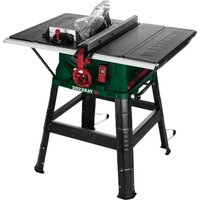
PTKS 2200 A1 - Saw PARKSIDE - Free user manual and instructions
Find the device manual for free PTKS 2200 A1 PARKSIDE in PDF.


User questions about PTKS 2200 A1 PARKSIDE
0 question about this device. Answer the ones you know or ask your own.
Ask a new question about this device
Download the instructions for your Saw in PDF format for free! Find your manual PTKS 2200 A1 - PARKSIDE and take your electronic device back in hand. On this page are published all the documents necessary for the use of your device. PTKS 2200 A1 by PARKSIDE.
USER MANUAL PTKS 2200 A1 PARKSIDE
natural_image
Line drawing of a three-legged machine with labeled components (no readable text or symbols)
text_image
QR code image with a central logo, likely linking to a digital resource or website.PDF ONLINE
parkside-diy.com
TABLE SAW - PTKS 2200 A1
TISCHKREISSÄGE - PTKS 2200 A1
SCIE CIRCULAIRE DE TABLE - PTKS 2200 A1
GB IE NI CY MT
TABLE SAW
Operating and Safety Instructions.
Translation of Original Operating Manual.
FR BE CH
SCIE CIRCULAIRE DE TABLE
Before reading, unfold the page with the illustrations and then familiarise yourself with all the functions of the product.
DE AT CH
text_image
15 5 6 5 6 6b 6b 6c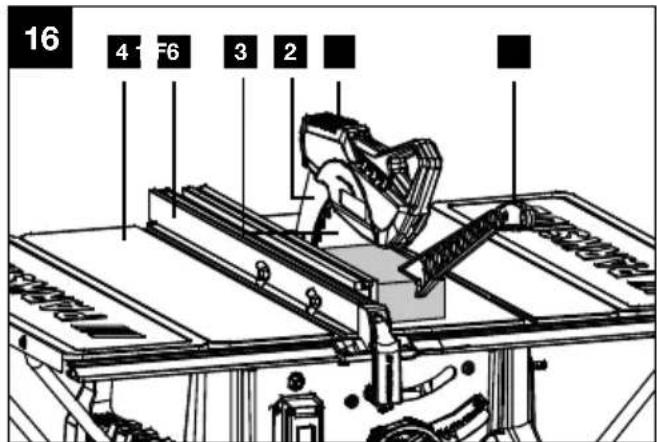
text_image
16 4 F6 3 2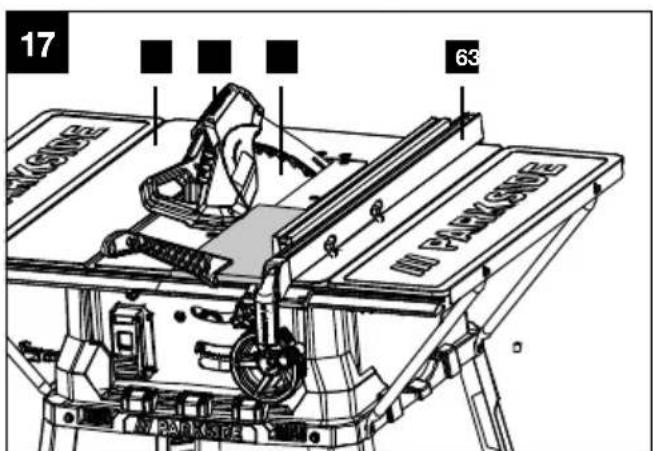
text_image
17 63 PARKSODE PARKSODE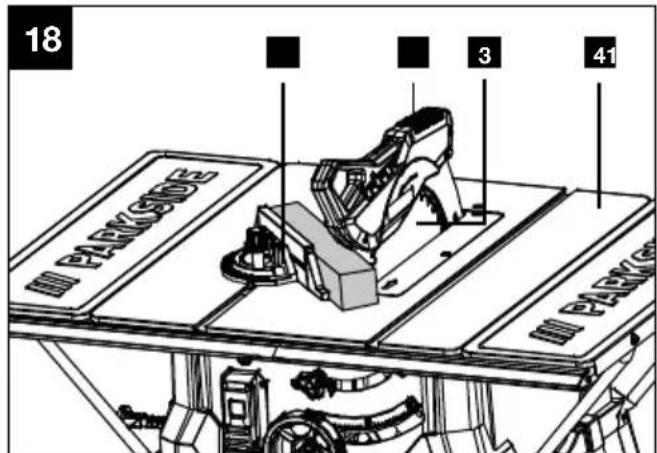
text_image
18 III PARK GENDER III PARK GENDER 3 41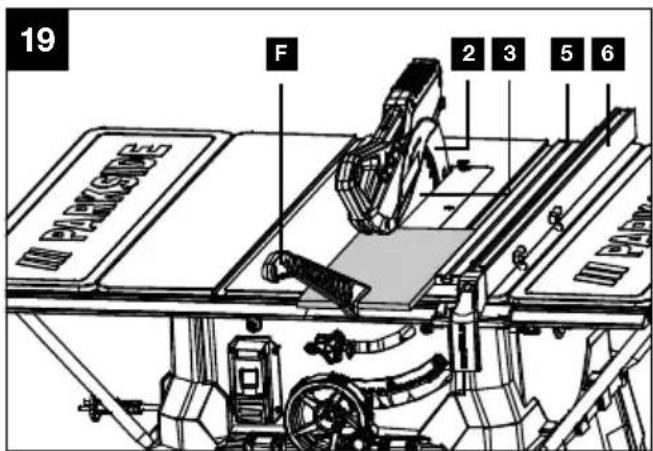
text_image
19 F 2 3 5 6 PARKSIDE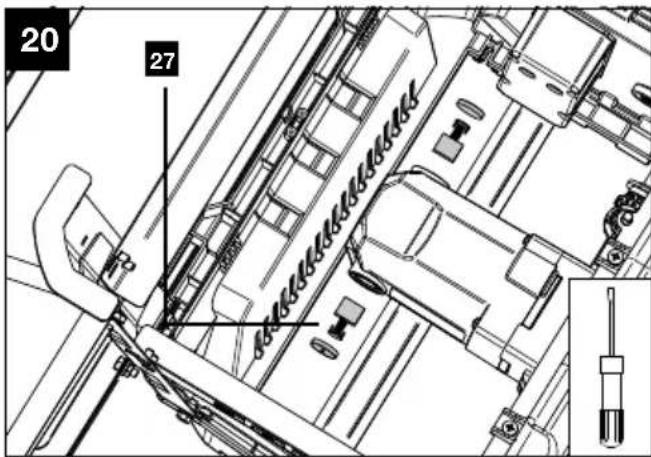
text_image
20 27Table of contents: Page:
- Explanation of the symbols on the product 2
- Introduction 3
- Description of the product .... 3
- Scope of delivery....3
- Proper use....4
- Safety instructions.... 5
- Technical data 10
- Unpacking 11
- Layout.... 11
- Before commissioning.... 13
- Operation.... 14
- Sawing.... 15
- Cleaning 17
- Transport 17
- Maintenance.... 17
- Repair & ordering spare parts 19
- Storage.... 19
- Electrical connection....20
- Disposal and recycling 20
- Troubleshooting....22
- Warranty certificate 23
- Exploded view 279
- Declaration of conformity....280
1. Explanation of the symbols on the product
 | Before commissioning, read and observe the operating manual and safety instructions. |
 | Wear safety goggles. |
 | Wear hearing protection. |
 | Wear dust protection mask. |
 | ATTENTION: Danger of injury! Do not reach into saw blade while it is running. |
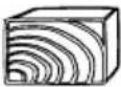 | Cutting height at 90°: 85 mm |
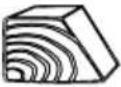 | Cutting height at 45°: 63 mm |
 | Riving knife thickness: 2.5 mm |
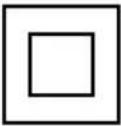 | Protection class II (double insulation) |
 | The product complies with the applicable European directives. |
2. Introduction
Manufacturer:
Scheppach GmbH
Günzburger Str. 69
D-89335 Ichenhausen
Dear Customer,
We hope your new product brings you much enjoyment and success.
Exclusion of liability
In accordance with the applicable product liability laws, the manufacturer of this product assumes no liability for damage to the product or caused by the product arising from:
- Improper handling,
- Failure to comply with the operating manual,
- Repairs carried out by third parties, unauthorised specialists,
• Installing and replacing non-original spare parts, - Application other than specified.
- Failures of the electrical system in the event of the electrical regulations and VDE provisions 0100, DIN 57113 / 0113 not being observed.
Note:
The operating manual is part of this product.
It includes important instructions for the safe, proper and economic operation of the product, for avoiding danger, for minimising repair costs and downtimes and for increasing the reliability and extending the service life of the product. In addition to the safety instructions in this operating manual, you must also observe the regulations applicable to the operation of the product in your country.
Familiarise yourself with all operating and safety instructions before using the product. Only operate the product as described and for the specified areas of application. Keep the operating manual in a good place and hand over all documents when passing the product on to third parties.
3. Description of the product
- Saw blade guard
1a. Locking pin
2. Riving knife
2a. Fixing screw
- Saw blade
3a. Inner flange
3b. Outer flange
3c. Flange screw - Saw table
- Stop rail
- Parallel stop
6a. Sight glass
6b. Wing nuts
6c. Washer
6d. Coach bolt
6e. Wing nut - Table width extension
- Cross member table width extension
- Right-hand parallel stop guide (incl. scale)
- Reset button
- Angle adjustment clamp
- Hand wheel
- On/off switch
- STOP switch
- Machine stand leg
- Cross member, machine stand (short) (B)
16a. Cross member, machine stand (long) (A) - Anti-tip bar
- Rubber foot
- Parallel stop clamp
- Left-hand parallel stop guide (incl. scale)
- Transverse cutting gauge
21a. Locking handle
21b. Stop rail
21c. Wing nut - Left clamping rail
- Right clamping rail
- Suction port
- Table inlay
25a. Philips screws - Saw blade bearing + ring spanner
- Carbon brushes
- Mitre gauge storage
4. Scope of delivery
| Item | Quantity | Designation |
| 1 | 1x | Saw blade guard |
| 5 | 1x | Stop rail |
| 6 | 1x | Parallel stop |
| 6b 2x Wing nut | ||
| 6c 2x Washer | ||
| 6d 2x Carriage bolt (M6x40) | ||
| 7 2x Table width extension | ||
| 8 | 4x | Cross member table width extension |
| 9 | 1x | Right-hand parallel stop guide (incl. scale) |
| 15 4x Machine stand leg | ||
| 16 2x | Cross member, machine stand (short) (B) | |
| 16 a 2x | Cross member, machine stand (long) (A) | |
| 17 2x Anti-tip bar | ||
| 18 4x Rubber foot | ||
| 20 1x | Left-hand parallel stop guide (incl. scale) | |
| 21 1x Transverse cutting gauge | ||
| 22 1x Left clamping rail | ||
| 23 1x Right clamping rail | ||
| A 48x Locking nut | ||
| B 16x Hexagon head screw (M6x12) | ||
| C 32x Carriage bolt (M6x12) | ||
| D | 1x | Open-end/ring spanner (10 mm/13 mm) |
| E 1x Ring spanner (10 mm / 22 mm) | ||
| F 1x Push stick | ||
| 1x Operating manual | ||
5. Proper use
The circular table saw is used for the longitudinal and transverse cutting (only with the mitre gauge) of all types of timbers and plastic, in accordance with the machine size. It is not permitted to cut any type of round timber.
Only suitable saw blades (HM or CV saw blades) may be used for the machine.
The use of any type of HSS saw blades or cutting wheels is prohibited.
Notes:
Compliance with the regulations, safety instructions, descriptions and notes in this operating manual are part of proper use.
The safety, operating and maintenance specifications of the manufacturer, as well as the dimensions specified in the operating manual, must be observed.
Working on or with the product may only be carried out as described in this operating manual. All other maintenance and repair work not described in these operating instructions must be carried out by a customer service centre.
Please note that our equipment was not designed with the intention of use for commercial or industrial purposes. We assume no guarantee if the device is used in commercial or industrial applications, or for equivalent work.
Other general occupational health and safety-related rules and regulations must be observed.
ATTENTION
When using the product, several safety warnings must be observed to prevent injuries and damage. For this reason, please carefully read the operating manual and the safety instructions. Store this manual in a safe place so that the information is available at any time. If the product is handed over to another person, hand over the operating manual and the safety instructions with it. We accept no liability for accidents or damage that occur due to a failure to observe this operating manual and the safety instructions.
The liability of the manufacturer and resulting damages are excluded in the event of modifications of the machine.
Despite use as intended, specific risk factors cannot be entirely eliminated. Due to the design and layout of the machine, the following risks remain:
- Contact with the saw blade in the exposed sawing area.
- Reaching into the running saw blade (cutting injury)
- Kick-back of workpieces and workpiece parts
- Saw blade breakage
-
Ejection of faulty carbide parts of the saw blade
-
Hearing damage when the necessary hearing protection is not used.
- Harmful emissions of wood dusts during use in enclosed areas.
Explanation of the signal words in the operating manual
| DANGER | Signal word to indicate an imminently hazardous situation which, if not avoided, will result in death or serious injury. |
| WARNING | Signal word to indicate a potentially hazardous situation which, if not avoided, could result in death or serious injury. |
| CAUTION | Signal word to indicate a potentially hazardous situation which, if not avoided, could result in minor or moderate injury. |
| ATTENTION | Signal word to indicate a potentially hazardous situation which, if not avoided, could result in product or property damage. |
| NOTE | Signal word to indicate a potentially hazardous situation which, if not avoided, could result in product or property damage. |
6. Safety instructions
General safety information for electric tools
⚠ WARNING: Read all safety warnings, instructions, illustrations and specifications provided with this power tool.
Failure to follow all instructions listed below may result in electric shock, fire and/or serious injury.
Save all warnings and instructions for future reference.
The term “power tool” in the warnings refers to your mains-operated (corded) power tool or battery-operated (cordless) power tool.
- Work area safety
a) Keep your work area clean and well-lit. Cluttered or dark areas invite accidents.
b) Do not operate power tools in explosive atmospheres, such as in the presence of flammable liquids, gases or dust. Power tools create sparks which may ignite the dust or fumes.
c) Keep children and bystanders away while operating a power tool. Distractions can cause you to lose control.
- Electrical safety
a) Power tool plugs must match the outlet. Never modify the plug in any way. Do not use any adapter plugs with earthed (grounded) power tools. Unmodified plugs and matching outlets will reduce risk of electric shock.
b) Avoid body contact with earthed or grounded surfaces, such as pipes, radiators, ranges and refrigerators. There is an increased risk of electric shock if your body is earthed or grounded.
c) Do not expose power tools to rain or wet conditions. Water entering a power tool will increase the risk of electric shock.
d) Do not abuse the cord. Never use the cord for carrying, pulling or unplugging the power tool. Keep cord away from heat, oil, sharp edges or moving parts. Damaged or entangled cords increase the risk of electric shock.
e) When operating a power tool outdoors, use an extension cord suitable for outdoor use. Use of a cord suitable for outdoor use reduces the risk of electric shock.
f) If operating a power tool in a damp location is unavoidable, use a residual current device (RCD) protected supply. Use of an RCD reduces the risk of electric shock.
- Personal safety
a) Stay alert, watch what you are doing and use common sense when operating a power tool. Do not use a power tool while you are tired or under the influence of drugs, alcohol or medication. A moment of inattention while operating power tools may result in serious personal injury.
b) Wear personal protective equipment and always safety goggles. Protective equipment such as a dust mask, non-skid safety shoes, safety helmet or hearing protection used for appropriate conditions will reduce personal injuries.
c) Prevent unintentional starting. Ensure the switch is in the off-position before connecting to power source and/or rechargeable battery, picking up or carrying the tool. Carrying power tools with your finger on the switch or energising power tools that have the switch on invites accidents.
d) Remove any adjusting tools or spanners/keys before turning the power tool on. A wrench or a key left attached to a rotating part of the power tool may result in personal injury.
e) Avoid abnormal postures. Keep proper footing and balance at all times. This enables better control of the power tool in unexpected situations.
f) Wear suitable clothing. Do not wear loose clothing or jewellery. Keep your hair and clothing away from moving parts. Loose clothes, jewellery or long hair can be caught in moving parts.
g) If devices are provided for the connection of dust extraction and collection facilities, ensure these are connected and properly used. Use of dust extraction can reduce dust-related hazards.
h) Do not let familiarity gained from frequent use of tools allow you to become complacent and ignore tool safety principles. A careless action can cause severe injury within a fraction of a second.
4. Using and handling the electric tool
a) Do not force the power tool. Use the correct power tool for your application. The correct power tool will do the job better and safer at the rate for which it was designed.
b) Do not use the power tool if the switch does not turn it on and off. Any power tool that cannot be controlled with the switch is dangerous and must be repaired.
c) Disconnect the plug from the power source and/or remove the battery pack, if detachable, from the power tool before making any adjustments, changing accessories, or storing power tools. Such precautionary measures reduce the risk of starting the power tool accidentally.
d) Store idle power tools out of the reach of children and do not allow persons unfamiliar with the power tool or these instructions to operate the power tool. Power tools are dangerous in the hands of untrained users.
e) Maintain power tools and attachments. Check for misalignment or binding of moving parts, breakage of parts and any other condition that may affect the power tool's operation. If damaged, have the power tool repaired before use. Many accidents are caused by poorly maintained power tools.
f) Keep cutting tools sharp and clean. Properly maintained cutting tools with sharp cutting edges are less likely to bind and are easier to control.
g) Use the power tool, tool attachments and tool bits etc. in accordance with these instructions. Take into account the working conditions and the work to be performed.
Use of the power tool for operations different from those intended could result in a hazardous situation.
h) Keep handles and grasping surfaces dry, clean and free from oil and grease. Slippery handles and grasping surfaces do not allow for safe handling and control of the tool in unexpected situations.
5. Service
a) Have your power tool serviced by a qualified repair person using only identical replacement parts. This will ensure that the safety of the power tool is maintained.
⚠ WARNING
Danger due to electromagnetic field
This power tool generates an electromagnetic field during operation. This field can impair active or passive medical implants under certain circumstances.
- In order to prevent the risk of serious or deadly injuries, we recommend that persons with medical implants consult with their physician and the manufacturer of the medical implant prior to operating the power tool.
Safety instructions for table saws
Guarding related warnings
a) Keep guards in place. Guards must be in working order and be properly mounted. A guard that is loose, damaged, or is not functioning correctly must be repaired or replaced.
b) Always use saw blade guard and riving knife for every through-cutting operation. For through-cutting operations where the saw blade cuts completely through the thickness of the workpiece, the guard and other safety devices help reduce the risk of injury.
c) After completing concealed cuts, e.g. notching, separating by changing over or cutting grooves, secure the riving knife in its uppermost end position again. Set the protective cover while the riving knife is in its uppermost end position. The guard and riving knife help to reduce the risk of injury.
d) Make sure the saw blade is not contacting the guard, riving knife or the workpiece before the switch is turned on. Inadvertent contact of these items with the saw blade could cause a hazardous condition.
e) Adjust the riving knife as described in this instruction manual. Incorrect spacing, positioning and alignment can make the riving knife ineffective in reducing the likelihood of kickback.
f) For the riving knife to work, it must be in the sawing gap. The riving knife is ineffective when cutting workpieces that are too short to be engaged with the riving knife. Under these conditions a kickback cannot be prevented by the riving knife.
g) Use the appropriate saw blade for the riving knife. For the riving knife to function properly, the saw blade diameter must match the appropriate riving knife and the body of the saw blade must be thinner than the thickness of the riving knife and the cutting width of the saw blade must be wider than the thickness of the riving knife.
Cutting procedures warnings
a) △ DANGER: Never place your fingers or hands in the vicinity of the saw blade or in the sawing area. A moment of inattention or a slip could direct your hand towards the saw blade and result in serious personal injury.
b) Feed the workpiece into the saw blade or cutter only against the direction of rotation.
Feeding the workpiece in the same direction that the saw blade is rotating above the table may result in the workpiece, and your hand, being pulled into the saw blade.
c) Never use the mitre gauge to feed the workpiece when ripping and do not use the rip fence as a length stop when cross cutting with the mitre gauge.
Guiding the workpiece with the rip fence and the mitre gauge at the same time increases the likelihood of saw blade binding and kickback.
d) When making longitudinal cuts, always keep the workpiece in full contact with the stop rail and always apply the feed force to the workpiece between the stop rail and the saw blade. Use a push stick when the distance between the fence and the saw blade is less than 150 mm, and use a push block when this distance is less than 50 mm. "Work helping" devices will keep your hand at a safe distance from the saw blade.
e) Use only the push stick provided by the manufacturer or constructed in accordance with the instructions. This push stick provides sufficient distance of the hand from the saw blade.
f) Never use a damaged or cut push stick. A damaged or cut push stick may break causing your hand to slip into the saw blade.
g) Do not perform any operation "freehand". Always use either the parallel stop or the mitre gauge to position and guide the workpiece. "Freehand" means using your hands to support or guide the workpiece, in lieu of a parallel stop or mitre gauge. Freehand sawing leads to misalignment, binding and kickback.
h) Never reach around or over a rotating saw blade. Reaching for a workpiece may lead to accidental contact with the moving saw blade.
i) Provide auxiliary workpiece support to the rear and/or sides of the saw table for long and/or wide workpieces to keep them level. A long and/or wide workpiece has a tendency to pivot on the table's edge, causing loss of control, saw blade binding and kickback.
j) Feed workpiece at an even pace. Do not bend, twist or move the workpiece sideways. If jamming occurs, turn the tool off immediately, unplug the tool then clear the jam. Jamming the saw blade by the workpiece can cause kickback or stall the motor.
k) Do not remove pieces of cut-off material while the saw is running. The material may become trapped between the fence or inside the saw blade guard and the saw blade pulling your fingers into the saw blade. Turn the saw off and wait until the saw blade stops before removing material.
I) Use an auxiliary fence in contact with the table top when ripping workpieces less than 2 mm thick. A thin workpiece may wedge under the rip fence and create a kickback.
Kickback – causes and related warnings
Kickback is a sudden reaction of the workpiece due to a pinched, jammed saw blade or misaligned line of cut in the workpiece with respect to the saw blade or when a part of the workpiece binds between the saw blade and the parallel stop or other fixed object.
Most frequently during kickback, the workpiece is lifted from the saw table by the rear portion of the saw blade and is propelled towards the operator. Kickback is the result of incorrect or faulty use of the circular table saw. And can be avoided by taking proper precautions as given below.
a) Never stand directly in line with the saw blade. Always position your body on the same side of the saw blade as the fence. Kickback may propel the workpiece at high velocity towards anyone standing in front and in line with the saw blade.
b) Never reach over or in back of the saw blade to pull or to support the workpiece. Accidental contact with the saw blade may occur or kickback may drag your fingers into the saw blade.
c) Never hold and press the workpiece that is being cut off against the rotating saw blade. Pressing the workpiece being cut off against the saw blade will create a binding condition and kickback.
d) Align the fence to be parallel with the saw blade. A misaligned fence will pinch the workpiece against the saw blade and create kickback.
e) Use a featherboard to guide the workpiece against the table and fence when making non-through cuts such as rabbeting, dado-ing or resawing cuts. A featherboard helps to control the workpiece in the event of a kickback.
f) Use extra caution when making a cut into blind areas of assembled workpieces. The protruding saw blade may cut objects that can cause kickback.
g) Support large panels to minimise the risk of saw blade pinching and kickback. Large panels tend to sag under their own weight. Support(s) must be placed under all portions of the panel overhanging the table top.
h) Use extra caution when cutting a workpiece that is twisted, knotted, warped or does not have a straight edge to guide it with a mitre gauge or along the fence. A warped, knotted, or twisted workpiece is unstable and causes misalignment of the kerf with the saw blade, binding and kickback.
i) Never cut more than one workpiece, stacked vertically or horizontally. The saw blade could pick up one or more pieces and cause kickback.
j) When restarting the saw with the saw blade in the workpiece, centre the saw blade in the kerf so that the saw teeth are not engaged in the material. If the saw blade binds, it may lift up the workpiece and cause kickback when the saw is restarted.
k) Keep saw blades clean, sharp, and with sufficient set. Never use warped saw blades or saw blades with cracked or broken teeth. Sharp and properly set saw blades minimise binding, stalling and kickback.
Table saw operating procedure warnings
a) Turn off the table saw and disconnect the power cord when removing the table insert, changing the saw blade or making adjustments to the riving knife or saw blade guard, and when the machine is left unattended. Precautionary measures will avoid accidents.
b) Never leave the table saw running unattended. Turn it off and don't leave the tool until it comes to a complete stop. An unattended running saw is an uncontrolled hazard.
c) Locate the table saw in a well-lit and level area where you can maintain good footing and balance. It should be installed in an area that provides enough room to easily handle the size of your workpiece. Cramped, dark areas, and uneven slippery floors invite accidents.
d) Frequently clean and remove sawdust from under the saw table and/or the dust collection device. Accumulated sawdust is combustible and may self-ignite.
e) The table saw must be secured. A table saw that is not properly secured may move or tip over.
f) Remove tools, wood scraps, etc. from the table before the table saw is turned on. Distraction or a potential jam can be dangerous.
g) Always use saw blades with correct size and shape (diamond versus round) of ar-bour holes. Saw blades that do not match the mounting hardware of the saw will run off-centre, causing loss of control.
h) Never use damaged or incorrect saw blade mounting means such as flanges, saw blade washers, bolts or nuts. These mounting means were specially designed for your saw, for safe operation and optimum performance.
i) Never stand on the table saw, do not use it as a stepping stool. Serious injury could occur if the tool is tipped or if the cutting tool is accidentally contacted.
j) Make sure that the saw blade is installed to rotate in the proper direction. Do not use grinding wheels, wire brushes, or abrasive wheels on a circular table saw.
Improper saw blade installation or use of accessories not recommended may cause serious injury.
Safety instructions for the use of saw blades
-
Only use insertion tools if you have mastered their use.
-
Observe the maximum speed. The maximum speed specified on the insertion tool may not be exceeded. If specified, observe the speed range.
-
Observe the motor / saw blade direction of rotation.
-
Do not use any insertion tools with cracks. Sort out cracked insertion tools. Repairs are not permitted.
-
Clean dirt, grease, oil and water off of the clamping surfaces.
-
Do not use any loose reducing rings or bushes to reduce holes on circular saw blades.
-
Make sure that fixed reducer rings for securing the insertion tool have the same diameter and have at least 1/3 of the cutting diameter.
-
Make sure that fixed reducer rings are parallel to each other.
-
Handle insertion tool with caution. They are ideally stored in the originally package or special containers. Wear protective gloves in order to improve grip and to further reduce the risk of injury.
-
Prior to the use of insertion tools, make sure that all protective devices are properly fastened.
-
Prior to use, make sure that the insertion tool meets the technical requirements of this electric tool and is properly fastened.
-
Only use the supplied saw blade for cutting wood, never for the processing of metals.
-
Use the correct saw blade for the material to be processed.
-
Use only a saw blade with a diameter that matches the specifications on the saw.
-
Use only saw blades that are marked with an equal or higher rotational speed than that marked on the electric tool.
-
Use only saw blades recommended by the manufacturer which conform to EN 847-1, if intended for cutting wood or similar materials.
-
Wear suitable personal protective equipment, such as:
- Hearing protection;
- Protective gloves when handling saw blades.
- Only use saw blades recommended by the manufacturer which conform to EN 847-1. Warning! When changing the saw blade, ensure that the cutting width is not smaller and the width of the saw blade disc is not greater than the thickness of the riving knife!
- When sawing wood and plastics, avoid the saw teeth overheating. Reduce the feed speed in order to avoid the plastic melting.
- Please note that complicated concealing cuts and cutting of bevels/wedges are not permitted.
- Do not carry out longitudinal cuts with a slope on the side towards which the slope is being made.
- When installing or adjusting the parallel stop, ensure that the parallel stop is aligned parallel to the saw blade.
7. Technical data
AC motor.... 220–240 V\~ 50 Hz
Power consumption
5000 rpm....2000 W (S1*)
2200 W (S6 25%**)
Idle speed n_0 .....5300 rpm
Carbide saw blade ....∅ 254 x ∅ 30 x 2.6 mm
Saw blade body thickness....1.6 mm
Number of teeth.... 24
Riving knife thickness....2.5 mm
Min. size of workpiece W x L x H .....10 x 50 x 1 mm
Table size 630 x 545 mm
Table width extension left/right.....630 x 935 mm
Cutting height max. 45°....63 mm
Cutting height max. 0°....85 mm
Tilting saw blade....from 0 to 45° left
Extraction connection....ø 35 mm
Protection class ...... II
Protection class.....IPX0
Weight ...... ca. 22 kg
*S1: Continuous operation with constant load
**S6 25%:
Continuous duty with intermittent loading (operating time 10 min.)
In order to avoid impermissible overheating of the motor, the motor should be driven for only 25% of the operating time with the stipulated nominal power and must then continue to run with no load for the remaining 75% of the operating time.
Noise
The noise levels have been determined in accordance with EN 62841.
Sound pressure level L_pA 93.6 dB
Uncertainty K_pA .....3 dB
Sound power level L_WA 106.6 dB
Uncertainty K_WA .....3 dB
⚠ WARNING
Excessive and frequent exposure to noise can lead to hearing damage or hearing loss.
- Wear hearing protection.
- Take breaks.
Total vibration emission values (vector sum of three directions) determined per EN 62841.
Vibration parameter:
Vibration ah: ≤ 2.5 m/s²
NOTE: The specified device emissions values have been measured in accordance with a standardised test procedure and can be used for comparison of one electric tool with another.
The specified device emissions values can also be used for an initial estimation of the load.
WARNING: The noise emission values can vary from the specified values during the actual use of the power tool, depending on the type and the manner in which the electric tool is used, and in particular the type of workpiece being processed.
Implement measures to protect against noise nuisance.
In doing so, take into account the complete working process, including the times when the power tool is working without load or switched off. Suitable measures include regular maintenance and care of the power tool and the insertion tools, regular breaks as well as proper planning of the working process.
8. Unpacking
⚠️ DANGER
Danger of choking or suffocating
The packaging material, packaging and transport safety devices are not children's toys. Plastic bags, film and small parts can be swallowed and lead choking.
- Keep packaging material, packaging and transport safety devices away from children.
- Open the packaging and carefully remove the product.
- Remove the packaging material, packaging and transport safety devices (if applicable).
- Check the completeness of the scope of delivery. Customer service must be notified immediately of any complaints. Later claims will not be recognised.
- Check all of the delivered items for transport damage. The transport company must be notified immediately of any complaints. Later claims will not be recognised.
- Keep the packaging until the end of the warranty period.
- Read through the operating manual completely.
- Only use original spare parts and accessories. Original spare parts or accessories can be obtained from your specialist dealer.
- Check that the data on the type plate matches with the mains power data.
9. Layout
⚠ WARNING: Remove the mains plug before any maintenance, modification or assembly work on the circular table saw.
⚠ Attention!
Always make sure the device is fully assembled before commissioning!
You require the following for assembly:
1x Open-end/ring spanner (10 mm / 13 mm) (D)
1x Ring spanner (10 mm / 22 mm) (E)
1x Phillips screwdriver (not included in the scope of delivery)
- Place all supplied parts on a flat surface.
- Group identical parts.
NOTE:
- If connections are secured with a screw (round head/or hexagon), hexagonal nuts and washer, the washer must be placed under the nut.
- Insert screws from the outside to the inside and secure connections with nuts from the inside.
to • During assembly, tighten the nuts and bolts only to the extent that they cannot fall off. If you tighten the nuts and screws fully before final assembly, the final assembly cannot be carried out.
9.1 Assembling the machine stand (Fig. 2, 3)
- Place the circular table saw upside down (i.e. on the saw table) on a flat surface.
- Insert the four machine stand legs (15) into the intended recesses in the machine housing.
- Screw them together with a hexagon head screw (B) and a locking nut (A). Use the 10 mm open-end/ring spanner (D) and the 10 mm ring spanner (E) for this.
- Place one machine stand cross member (short) (16) and one machine stand cross member (long) (16a) between the machine stand legs (15) on the inside. Make sure that the long side is positioned to the front and the short side to the side.
- Fasten the machine stand cross members (short) (16) and machine stand cross members (long) (16a) to the machine stand legs (15) using four carriage bolts (C) and four locking nuts (A) each. Use the enclosed 10 mm open-end/ring spanner (D) to tighten them.
- Push one rubber foot (18) onto each machine stand leg (15)
- Mount an anti-tipping bar (17) onto each of the rear machine stand legs (15). Use two carriage bolts (C) and two locking nuts (A) for each. Tighten them using the 10 mm open-end/ring spanner (D) supplied.
9.2 Fitting the table width extensions (Fig. 4)
-
Screw the two table width extensions (7) to the saw table (4) using two hexagon head screws (B) and two locking nuts (A). Note the corresponding drilled holes on the saw table (4). Use the 10 mm open-end/ring spanner (D) and the 10 mm ring spanner (E) for this.
-
Note: During this step, ensure that the table width extensions (7) are correctly aligned with the saw table (4).
9.3 Installing the cross members (Fig. 3, 4, 5)
- Remove the hexagon head screws (B) and locking nuts (A) on the side.
- Position the cross members (8) on the inside of the table width extensions.
- Fix the table width extensions (7) and the machine stand legs (15) with the previously removed hexagon head screws (B) and locking nuts (A).
- Attach four cross members (8) to the table width extensions (7) each with a hexagon head screw (B) and a locking nut (A).
- Finally, tighten all hexagon head screws (B) using the supplied 10 mm open-end/ring spanner (D) and the 10 mm ring spanner (E).
- Carefully turn the product over and place it on the floor.
9.4 Mount the parallel stop (incl. scale) left/right (9 + 20) (Fig. 6)
- Insert both parallel stop guides (9 + 20) into each other.
- Insert six carriage bolts (C) from the outside through the front holes and fasten them loosely with a locking nut (A).
- Slide the left/right parallel stop guide (incl. scale) (9 + 20) over the heads of the carriage bolts (C) until it is centred in relation to the saw table (4).
- Then tighten the locking nuts (A) using the 10 mm ring spanner (E).
Note:
Hereafter, the two assembled guides are referred to as the parallel stop (9 + 20) guide rail.
9.5 Fitting the left/right clamping rails (22 + 23) (Fig. 6)
- Insert both clamping rails (22 + 23) into each other.
-
Insert six carriage bolts (C) from the outside through the rear holes and fasten them loosely with a locking nut (A).
-
Slide the inserted clamping rail (22 + 23) over the heads of the carriage bolts (C) until it is centred in relation to the saw table (4).
- Then tighten the locking nuts (A) using the 10 mm ring spanner (E).
9.6 Saw blade guard
9.6.1 Removing the table inlay (Fig. 7, 8)
- Set the saw blade (3) to the max. cutting depth, move to the 0^ position and lock in place (see 11.2 and 11.3).
- Loosen the two Phillips screws (25a) with a Phillips screwdriver.
- Remove the table inlay (25) from the saw table (4).
9.6.2 Insert and adjust the riving knife (Fig. 8) Note:
The riving knife (2) must be adjusted before using the machine for the first time.
- Undo the fixing screw (2a). Use the 10 mm open-end/ring spanner (D) for this.
- Push the riving knife (2) into the bracket. NOTE: This step can be omitted if the riving knife (2) has already been inserted.
-
Align the riving knife (2) so that
a) the distance between the saw blade (3) and the riving knife (2) is max. 3 - 8 mm (Fig. 8) and
b) The saw blade (3) is parallel to the riving knife (2).
c) The recesses in the riving knife (2) engage in the pins of the riving knife holder. -
Re-tighten the fixing screw (2a). Use the 10 mm open-end/ring spanner (D) for this.
9.6.3 Inserting the table inlay (Fig. 7)
- Place the table inlay (25) in the recess.
- Screw the Phillips head screws (25a) into place using a Phillips screwdriver.
9.6.4 Fitting the saw blade guard (1) (Fig. 1, 8)
- Drive the saw blade (3) up as far as it will go by turning the hand wheel (12) clockwise until it reaches the stop.
-
Press the locking pin (1a) on the saw blade guard (1).
-
Insert the pressed locking pin (1a) into the groove of the riving knife (2) and release it.
- Ensure that the saw blade guard (1) can move freely.
- Disassembly takes place in reverse order.
⚠ WARNING
Danger of injury due to incorrectly mounted saw blade guard
- Before starting sawing, ensure that the saw blade guard (1) lowers automatically onto the material to be sawn.
9.6.5 Check the saw blade guard (Fig. 1, 8)
After fitting, check that the saw blade guard (1) is functioning properly.
- Lift the saw blade guard (1) and then release it.
- The saw blade guard (1) should move back to its starting position automatically.
9.7 Positioning the parallel stop (Fig. 11, 13)
- Place the parallel stop (6) with the parallel stop clamp (19) open onto the guide rail parallel stop guide left/right (incl. scale) (9 + 20) on the saw table, which has been assembled in 9.4 (4).
- To change the position of the parallel stop (6), slide the parallel stop (6) with an opened parallel stop clamp (19) along the guide rail.
- In order to fix the parallel stop (6) in the desired position, press the parallel stop clamp (19) all the way down and adjust the tension using the wing nut (6e) if necessary.
9.8 Fitting the mitre gauge (Fig. 1)
- Insert the mitre gauge (21) into the groove of the saw table (4).
- Loosen the locking handle (21a) by turning it anti-clockwise.
- Turn the mitre gauge (21) until the arrow points to the required angle.
- Secure this position by turning the locking handle (21a) clockwise.
9.9 Connecting the chip extraction system (Fig. 10)
⚠ WARNING
Risk of eye injury from swirling chips
- Wear safety goggles.
- Only operate the product with a suitable chip extraction system. Do not use household vacuum cleaners.
- Connect a suitable chip extraction system (not included in the scope of delivery) to the suction port (24).
- Connect the suction hose of a suitable chip extraction system (e.g. a multi-purpose suction device) to the suction port (24).
ATTENTION
Check and clean the suction channels at regular intervals.
10. Before commissioning
10.1 General information
- Check that the product is fully assembled.
- Check that the protective covers are present, installed and functional.
- Check that the switches work as intended.
- Check that the product is on a firm footing.
- Check that the stickers on the product are present and legible. Missing or damaged stickers must be replaced or exchanged.
- Check that the mains voltage and the operating voltage match, see technical data.
- Check that the supply cables, extensions, cable reel etc. are not too long. Otherwise there may be a voltage drop or delayed motor start-up.
- Check that the ambient temperature is observed.
10.2 Product-specific information
- The machine must be securely installed.
- The saw blade (3) must be able to run freely.
- In case of previously machined wood, be aware of any foreign bodies, such as nails or screws, etc.
- Before pressing the ON/OFF switch (13), make sure that the saw blade (3) is fitted correctly, and that moving parts run smoothly.
- Only connect the machine to a correctly installed protective contact socket, with fuse protection of at least 16A.
11. Operation
11.1 Switch (Fig. 1)
11.1.1 On/off switch and STOP switch
- To switch on the saw, press the "I" button on the on/off switch (13). Wait until the saw blade has reached its maximum speed before starting sawing.
- To switch off the saw, press the STOP switch (14) or lift the cover cap and press the "0" button on the on/off switch (13).
11.1.2 Overload protection (Fig. 1)
In the event of overloading, the motor will switch itself off. After a cool-down period (time varies) the motor can be switched back on again.
- Allow the product to cool.
- Press the reset button (10).
- Switch the machine back on as described in 11.1.1.
11.2 Setting the cutting depth (Fig. 1)
The saw blade (3) can be adjusted to the required cutting depth by turning the hand wheel (12).
- Clockwise: Greater cutting depth
- Counter-clockwise: Smaller cutting depth
Check the setting with a test cut.
11.3 Setting the cutting angle (Fig. 14, 17, 18)
Angled cuts of 0^ to 45^ to the left of the parallel stop (6) can be carried out with the circular table saw.
△ Before making every cut, check that no collision can occur between the parallel stop (6), mitre gauge (21) and the saw blade (3).
- Release the angle adjustment clamp (11).
- Push the hand wheel (12) and turn it at the same time to set the required angle on the scale.
- Lock the angle adjustment clamp (11) in the required angle position.
11.4 Using the parallel stop
11.4.1 Stop height (Fig. 15)
- The stop rail (5) of the parallel stop (6) has two guide surfaces at different heights.
- Depending on the thickness of the material to be cut, the stop rail (5) must be used for thick material (workpiece thickness exceeding 25 mm) and thin material (workpiece thickness below 25 mm).
11.4.2 Adjusting the stop rail (Fig. 11, 15)
(3) 1. In order to move the stop rail (5) to the lower guide surface, loosen the two wing nuts (6b) to release the stop rail (5) from the parallel stop (6).
2. Pull the stop rail (5) along the groove and out.
3. Turn the stop rail (5) and insert the sliding blocks along the second groove.
4. Shifting to the higher guide surface must be carried out in the same way.
11.4.3 Changing the side of the parallel stop (Fig. 11, 15)
- Unscrew the wing nuts (6b) fully.
- Remove the stop rail (5) and reinsert the carriage bolts (6d) on the opposite side of the parallel stop (6).
- Replace the washers (6c) and the wing nuts (6b) and screw them tight.
11.4.4 Check the sight glass (6a) and scale (Fig. 6, 11)
- There is a scale on the guide rail at the front of the saw table (4).
To set the parallel stop (6) to a specific dimension, proceed as follows:
- Release the parallel stop clamp (19).
- Move the parallel stop (6) until the desired dimension is visible on the scale of the guide rail in the sight glass (6a).
- Push the parallel stop clamp (19) completely down to fix it.
- Make a test cut and measure the sawn-off workpiece.
- If the measurement does not match the scale, proceed as follows.
- Release the parallel stop clamp (19).
- Loosen the locking nuts (A) behind the guide rail on the saw table (4).
- Hold the parallel stop (6) firmly and move the guide rail until the sight glass (6a) on the scale shows the dimension of the workpiece that has just been sawn off.
- Then retighten the locking nuts (A).
11.4.5 Setting the cutting width (Fig. 11)
- The parallel stop (6) must be used when cutting sections of wood lengthways.
- The parallel stop (6) can be mounted on both sides of the saw table (4).
- There is a scale on the guide rail at the front of the saw table (4).
To set the parallel stop (6) to a specific dimension, proceed as follows:
- Release the parallel stop clamp (19).
- Move the parallel stop (6) until the desired dimension is visible on the scale of the guide rail in the sight glass (6a).
- Push the parallel stop clamp (19) completely down to fix it.
11.5 Using the mitre gauge (21) (Fig. 1, 12)
Do not slide the stop rail (21b) too far towards the saw blade (3). The distance between the stop rail (21b) and the saw blade (3) needs to be approx. 2 cm.
11.5.1 Adjusting the mitre gauge (Fig. 1, 12)
- Fix the stop rail (21b) to the mitre gauge (21) by tightening the wing nut (21c).
- Slide the mitre gauge (21) into one of the two guide grooves of the saw table (4).
- Loosen the locking handle (21a) and turn the mi-tre gauge (21) until the desired angle has been set.
- Turn the locking handle (21a) tight again.
12. Sawing
⚠ WARNING
Danger of injury due to incorrect mounting
- Check that the product is properly assembled.
- Check the saw blade for mobility and moving parts for ease of movement.
ATTENTION
After switching on the saw, you must wait until the saw blade (3) has reached its maximum speed before making the cut.
12.1 Working instructions
⚠ WARNING
Danger of injury!
Improper handling may result in serious injury.
- Observe and follow the safety and working instructions.
- When making longitudinal cuts, do not stand in front of the circular table saw, but position yourself at an angle to the cutting path.
• Always use the parallel stop for angled cuts. - Use a push rod or wooden push stick in order to guide the workpiece past the saw blade. Replace a damaged or worn push stick immediately.
- Secure long workpieces against tilting at the end of the cutting process. Use a roller stand, for example.
- After switching on the circular table saw, wait until the saw blade has reached its maximum speed before making the cut.
- Only operate the circular table saw with a chip extraction system.
- Carry out a test cut after each new adjustment to check the dimensions set.
- Check and clean the suction channels at regular intervals.
12.2 Carrying out longitudinal cuts (Fig. 16)
DANGER!
Saw rectangular workpieces only with the long side on the parallel stop. Never use the short side! Risk of kick-back!
With a longitudinal cut, you cut a workpiece in its longitudinal direction. Hold the edge of the workpiece against the parallel stop (6), whilst the flat side lies on the saw table (4).
- Adjust the parallel stop (6) according to the height of the workpiece and the required width (see 11.4).
- When sawing, the saw blade guard (1) is pushed up and away from the workpiece.
- First switch on the chip extraction system and then the circular table saw.
- Place your hands flat on the workpiece with your fingers closed and slide it along the parallel stop (6) into the saw blade (3).
-
Guide the workpiece laterally by holding it tight with the left hand only up to the front edge of the saw blade guard (1).
-
Always slide the workpiece to the end of the riv- ing knife (2) using the push stick (F).
12.2.1 Carrying out angled cuts (Fig. 17)
Angled cuts are always carried out using the parallel stop (6). The parallel stop (6) must always be fitted to the right of the saw blade (3). Otherwise, workpieces may become jammed between the parallel stop (6) and the saw blade (3) during sawing, and be ejected at speed.
- Set the saw blade (3) to the required angle (see 11.3).
- Adjust the parallel stop (6) according to the width and height of the workpiece (see 11.4).
- Lower the saw blade guard (1) onto the saw table (4).
- Carry out the cut in accordance with the workpiece width (see 12.2).
12.3 Carrying out cross cuts (Fig. 18) ⚠ WARNING
Risk of injury from rotating parts and sharp edges
- Hold the guided workpiece firmly.
-
Use the mitre gauge to push the workpiece forwards until it is completely cut through.
-
Set the mitre gauge (21) as required (see 11.5.1). If the saw blade (3) should also be tilted, push the mitre gauge (21) into the right-hand guide groove. This prevents either your hand or the mitre gauge (21) from coming into contact with the saw blade guard (1).
- Lower the saw blade guard (1) onto the saw table (4). When sawing, the saw blade guard (1) is pushed up and away from the workpiece.
- Press the workpiece tight against the mitre gauge (21).
- Switch on the chip extraction system and then the circular table saw.
- In order to carry out the cut, push the mitre gauge (21) and the workpiece towards the saw blade (3).
12.4 Cutting narrow workpieces (Fig. 19)
Longitudinal cuts of workpieces with a width of less than 120 mm must always be made with the aid of a push stick (F).
For short workpieces, the push stick (F) must be used as soon as you start cutting.
- Adjust the parallel stop (6) according to the height of the workpiece and the required width (see 11.4).
- Place your hands flat on the workpiece with your fingers closed and slide it along the parallel stop (6) into the saw blade (3).
- Always slide the workpiece to the end of the riv- ing knife (2) using the push stick (F).
12.5 Cutting very narrow workpieces (Fig. 19)
A wooden push block must always be used for longitudinal cuts of very narrow workpieces with a width 50 mm and less. The wooden push block is not included in the scope of delivery! (Available from specialised dealers)
Replace a worn wooden push block in good time.
During sawing, workpieces may become jammed between the parallel stop (6) and the saw blade (3), caught by the saw blade (3) and then ejected at speed. For this reason, the lower guide surface of the parallel stop (6) should be favoured (see Fig. 15). Shift the stop rail (5) if required (see 11.4.2).
- Adjust the parallel stop (6) according to the height of the workpiece and the required width (see 11.4).
- Use the wooden push block to push the workpiece against the stop rail (5) and use the push stick (F) to push the workpiece through to the end of the riving knife (2).
12.6 Cutting chipboard
To prevent the cutting edges breaking when cutting chipboard, proceed as follows:
The saw blade (3) must not be set higher than 5 mm above the workpiece thickness (see also 11.2).
12.7 After sawing
- Switch off the circular table saw first and then the chip extraction system. The saw blade continues to run for a longer time.
- Disconnect the circular table saw from the mains by pulling the mains plug out of the power socket.
- Do not remove the cut waste on the saw table until the saw blade has returned to its resting position.
- Allow the circular table saw to cool down completely.
12.8 Removing trapped material
⚠ WARNING
Risk of injury to fingers and hands due to sharp edges
- Wear protective gloves.
- If the saw blade is jammed in the workpiece or other blockages occur, proceed as follows: Switch the circular table saw off immediately and remove the mains plug from the socket.
- Use protective gloves and do not touch the saw blade with your bare hands.
13. Cleaning
⚠️ DANGER
Risk of electric shock due to water entering the interior of the device
- Do not splash the product with water.
⚠ WARNING
Risk of injury due to unexpected start-up of the machine
- Remove the mains plug from the socket.
13.1 Clean the product and saw blade guard ATTENTION
Product damage due to inadequate cleaning
- Clean the product thoroughly after each use.
ATTENTION
Product damage due to aggressive solvents or cleaning agents
- Remove coarse dirt with a brush.
-
Clean the product with a damp, clean, lint-free cloth and a little soft soap.
-
Remove dust and chips with a brush after each operation.
-
Clean the ventilation openings carefully with a lint-free cloth.
13.2 Clean product with compressed air ATTENTION
Product damage due to the use of excessive pressure on the compressed air device
Cleaning the product with high pressure from the compressed air device can damage electrical components.
- Use a compressed air device with a low pressure of max. 2 bar.
- Ensure a suitable distance from the product.
- Remove heavy soiling with a compressed air device (max. 2 bar).
13.3 Cleaning the chip extraction system
The chip extraction system is not included in the scope of delivery. To clean your chip extraction system properly, follow the operating instructions of the respective manufacturer.
14. Transport
⚠ WARNING
Risk of injury due to unexpected start-up of the machine
- Remove the mains plug from the socket.
14.1 General information
- Do not carry the product by the table width extensions (7), but by the saw table itself (4).
- Pack the product to avoid damage during transport. Use the original packaging.
- Protect the product from vibrations and shocks, in particular during vehicular transport.
- Ensure adequate load securing when transporting in a vehicle.
14.2 Product-specific information
- When lifting the product, note its weight (see technical data).
- Always switch off the electrical tool before transport and disconnect it from the power supply.
- Always carry the electric tool with at least one other person, do not carry by the table width extensions. To transport the power tool, lift it by the machine housing.
- Protect the electrical tool from impacts, shocks and severe vibrations, e.g. during vehicular transport.
- Secure the electric tool against toppling and slipping.
- Never use protective devices for handling or transport.
15. Maintenance
WARNING
Risk of injury due to unexpected start-up of the machine
- Remove the mains plug from the socket.
⚠ WARNING
Warning of unforeseeable hazards and product damage
- Never carry out unauthorised modifications or repairs to the product that are not described in the operating instructions.
- Do not carry out work described for a specialist workshop.
15.1 General information
- Check the product for loose, worn or damaged components.
- Check the nuts, pins and screws for firm seating.
- Check the covers and protective equipment for damage and correct seating.
- Check the electrical connections. Repair work on the electrical connections may only be carried out by a specialist workshop.
15.2 Oiling the product
- Oil the rotating parts once monthly to extend the life of the tool.
- Do not oil the motor.
15.3 Check and maintain carbon brushes (Fig. 20)
If the machine is new, check the carbon brushes after the first 50 operating hours or if a new brush has been mounted. After the initial check, check every 10 operating hours.
If the carbon is worn down to a length of 6 mm, or the spring or the shunt wire is burnt or damaged, both brushes must be replaced. If the brushes are found to be usable after removal, they can be reinstalled.
- Place the circular table saw on its side on a flat surface.
- Open the lock (as shown in Fig. 20) anti-clockwise using a slotted screwdriver (not included in the scope of delivery).
- Then remove the carbon brushes (27).
- Check the carbon brushes (27) as described above.
- Re-insert the carbon brushes (27) in reverse order.
15.4 Replacing the saw blade
⚠ WARNING
Danger of injury! Improper handling of the circular table saw may result in serious injury.
⚠ WARNING
Risk of injury due to unexpected start-up of the machine
- Remove the mains plug from the socket.
⚠ WARNING
Risk of injury to fingers and hands due to sharp edges - Wear protective gloves.
15.4.1 Removing the saw blade guard and the table inlay (Fig. 7, 8)
- Press the locking pin (1a) on the saw blade guard (1).
- Hold down the locking pin (1a) and remove the saw blade guard (1) from the groove of the riv-ing knife (2).
- Set the saw blade (3) to the max. cutting depth, move to the 0^ position and lock in place (see 11.3).
- Loosen the two Phillips screws (25a) with a Phillips screwdriver.
- Remove the table inlay (25) from the saw table (4).
15.4.2 Removing the saw blade (Fig. 7, 8, 9)
PREREQUISITE: The saw blade (3) has been set to the maximum cutting depth (see 11.2).
- Place the 22 mm ring spanner (E) on the outer flange (3b) and thus fix the drive shaft.
- Turn the flange screw (3c) anti-clockwise with the 13 mm open-end/ring spanner (D) to open the flange screw (3c).
- Hold the saw blade (3) carefully with one hand.
- Remove the flange screw (3c) and the outer flange (3b) from the drive shaft.
- Now remove the saw blade (3) from the drive shaft and carefully draw it up and out of the saw table (4).
15.4.3 Inserting saw blade (Fig. 9)
-
Clean the outer flange (3b) carefully, before fitting a new saw blade (3).
-
Clean the inner flange (3a) and reinsert it.
-
Place a new saw blade (3) on the drive shaft. Observe the direction of rotation: The cutting angle of the teeth must point in the running direction (forwards). The running direction is usually also marked on the saw blade (3).
- Fit the outer flange (3b) back on the drive shaft. Ensure the correct alignment of the outer flange (3b).
- Tighten the flange screw (3c) on the drive shaft by hand.
- Turn the saw blade (3) carefully in the running direction: It must be precisely centred and must not "wobble". Check that the saw blade (3) and outer flange (3b) are seated correctly. Align the parts once more, if the sawblade is not precisely centred.
⚠ WARNING
Warning of unforeseeable hazards and product damage.
- Check the setting of the saw blade after every saw blade replacement.
- Hold the outer flange (3b) in place with the 22 mm ring spanner (E).
- Tighten the flange screw (3c) clockwise with the 13 mm open-end/ring spanner (D).
- Mount the table inlay (25) and the saw blade guard (1) (see 9.6.3 and 9.6.4).
- Check that the riving knife (2) is set correctly (see 9.6.2).
16. Repair & ordering spare parts
After repairs or maintenance, make sure that all safety-related parts are installed and are in perfect condition. All parts which may cause injury must be kept where they are inaccessible to children or others.
Attention: According to the German Product Liability Act, no liability is accepted for damage caused by improper repairs or by not using original spare parts. Such work should be performed by a customer service centre or an authorised specialist. The same applies to accessory parts.
Connections and repairs
Connections and repair work on the electrical equipment may only be carried out by electricians.
Please provide the following information in the event of any queries:
• Type of current for the motor
• Machine data - type plate
- Motor data - type plate
16.1 Ordering spare parts
Please provide the following information when ordering spare parts:
- Model designation
- Item number
- Type plate data
Spare parts / accessories
Saw blade - Article no. 7901301604
Table inlay - Article no....5901313036
Push stick - Article no. 5901313021
Carbon brushes - Article no....5901308021
16.2 Service information
With this product, it is necessary to note that the following parts are subject to natural or usage-related wear, or that the following parts are required as consumables.
Wearing parts*: carbon brushes, table inlay, push stick, saw blade
* may not be included in the scope of delivery!
17. Storage
⚠ WARNING
Risk of injury due to unexpected start-up of the machine
- Remove the mains plug from the socket.
ATTENTION
Product damage due to incorrect storage
- Store the product protected against dirt, dust and moisture.
-
Store the product in the original packaging.
-
Store the product in a dark, dry and frost-free place that is inaccessible to unauthorised persons.
- The optimum storage temperature lies between 5^ C and 30^ C.
-
Store the operating manual with the product.
-
Drive the saw blade (3) down as far as it will go by turning the hand wheel (12) counter-clockwise until it reaches the stop (see Fig. 1).
- Spare saw blades and the supplied ring spanners (E + D) can be stored in the saw blade + ring spanner storage device (26) provided for this (see Fig. 6).
- The mitre gauge (21) can be stored in the holder provided (mitre gauge storage) (28) (see Fig. 10).
18. Electrical connection
The electrical motor installed is connected and ready for operation. The connection complies with the applicable VDE and DIN provisions. The customer's mains connection as well as the extension cables used must also comply with these regulations.
- The product fulfils the requirements of EN 61000-3-11 and is subject to special connection requirements. This means that use at any freely selectable connection points is not permitted.
- The product can cause temporary voltage fluctuations in unfavourable mains conditions.
- The product is only intended for use at connection points that a) do not exceed a maximum permissible mains impedance “Z” (Zmax. = 0.292 Ω), or b) have a mains constant current carrying capacity of at least 100 A per phase.
- As the user, you are required to ensure that the connection point at which you wish to operate the product fulfils one of the requirements mentioned, a) or b). If necessary, consult with your energy supplier in this regard.
18.1 Damaged electrical connection cable
The insulation on electrical connection cables is often damaged.
This may have the following causes:
- Pressure points, where connection cables are passed through windows or doors
- Kinks where the connection cable has been improperly fastened or routed
-
Places where the connection cables have been cut due to being driven over
-
Insulation damage due to being ripped out of the wall socket
- Cracks due to the insulation ageing
Such damaged electrical connection cables must not be used and are life-threatening due to the insulation damage.
Check the electrical connection cables for damage regularly. Ensure that the connection cables are dis-connected from electrical power when checking for damage.
Electrical connection cables must comply with the applicable VDE and DIN provisions. Only use connection cables of the same designation.
The printing of the type designation on the connection cable is mandatory.
Connections and repair work on the electrical equipment may only be carried out by electricians.
18.2 AC motor
- The mains voltage must be 220 - 240 V\~.
- Extension leads up to 25 m long must have a cross-section of 1.5 mm ^2 .
- Extension leads over 25 m long must have a cross-section of 2.5 mm ^4 .
Connection type Y
If it is necessary to replace the mains connection cable, this must be done by the manufacturer or their representative to avoid safety hazards.
19. Disposal and recycling
Notes for packaging


The packaging materials are recyclable. Please dispose of packaging in an environmentally friendly manner.
Notes on the electrical and electronic equipment act (ElektroG)
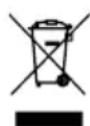
Waste electrical and electronic equipment does not belong in household waste, but must be collected and disposed of separately!
- Used batteries or rechargeable batteries that are not installed permanently in the old device must be removed non-destructively before disposal! Their disposal is regulated by the battery act.
- Owners or users of electrical and electronic devices are legally obliged to return them after use.
- The end user is responsible for deleting their personal data from the old device being disposed of!
- The symbol of the crossed-out dustbin means that waste electrical and electronic equipment must not be disposed of with household waste.
- Waste electrical and electronic equipment can be handed in free of charge at the following places:
- Public disposal or collection points (e.g. municipal works yards)
- LIDL offers you return options directly in the shops and markets. Return and disposal are free of charge.
- Up to three waste electrical devices per type of device, with an edge length of no more than 25 centimetres, can be returned free of charge to the manufacturer without prior purchase of a new device from the manufacturer or taken to another authorised collection point in your vicinity.
- Further supplementary take-back conditions of the manufacturers and distributors can be obtained from the respective customer service.
- If the manufacturer delivers a new electrical device to a private household, the manufacturer can arrange for the free collection of the old electrical device upon request from the end user. Please contact the manufacturer's customer service for this.
- These statements only apply to devices installed and sold in the countries of the European Union and which are subject to the European Directive 2012/19/EU. In countries outside the European Union, different regulations may apply to the disposal of waste electrical and electronic equipment.
20. Troubleshooting
| Fault Possible cause Remedy | ||
| Saw blade is loose after the motor is switched off | Fixing nut not tight enough Tighten fastening nut, right-hand thread | |
| Engine does not start | Mains fuse blown Check mains fuse | |
| Extension lead defective Replace the extension lead | ||
| Connection to the engine or switch not OK | Have this checked by an electrician | |
| Engine or switch faulty Have this checked by an electrician | ||
| Motor not sup-plying power, fuse tripping | Cross section of the extension cable insufficient | see “Electrical connection” |
| Overload due to blunt saw blade | Replacing the saw blade | |
| Burnt areas on the cutting surface | Blunt saw blade Have an authorised sharpening service sharpen the saw blade or replace it | |
| Incorrect saw blade Replace saw blade | ||
| Motor wrong Direction of rotation | Capacitor defective Have this checked by an electrician | |
| Incorrect connection Have an electrician transpose the wall socket poles | ||
21. Warranty certificate
Dear Customer,
All of our products undergo strict quality checks to ensure that they reach you in perfect condition. In the unlikely event that your device develops a fault, please contact our service department at the address shown on this guarantee card. Of course, if you would prefer to call us then we are also happy to offer our assistance under the service number printed below. Please note the following terms under which guarantee claims can be made:
- These guarantee terms cover additional guarantee rights and do not affect your statutory warranty rights. We do not charge you for this guarantee.
- Our guarantee only covers problems caused by material or manufacturing defects, and it is restricted to the rectification of these defects or replacement of the device. Please note that our devices have not been designed for use in commercial, trade or industrial applications. Consequently, the guarantee is invalidated if the equipment is used in commercial, trade or industrial applications or for other equivalent activities. The following are also excluded from our guarantee: compensation for transport damage, damage caused by failure to comply with the installation/assembly instructions or damage caused by unprofessional installation, failure to comply with the operating instructions (e.g. connection to the wrong mains voltage or current type), misuse or inappropriate use (such as overloading of the device or use of non-approved tools or accessories), failure to comply with the maintenance and safety regulations, ingress of foreign bodies into the device (e.g. sand, stones or dust), effects of force or external influences (e.g. damage caused by the device being dropped) and normal wear resulting from proper operation of the device.
- The guarantee is rendered null and void if any attempt is made to tamper with the device.
- The guarantee is valid for a period of 3 years starting from the purchase date of the device. Guarantee claims should be submitted before the end of the guarantee period within two weeks of the defect being noticed. No guarantee claims will be accepted after the end of the guarantee period. The original guarantee period remains applicable to the device even if repairs are carried out or parts are replaced. In such cases, the work performed or parts fitted will not result in an extension of the guarantee period, and no new guarantee will become active for the work performed or parts fitted. This also applies when an on-site service is used.
- In order to assert your guarantee claim, please contact the service partner shown below. If the complaint is within the guarantee period, we will provide you with a return slip, with which you can return your defective device free of charge to us. It would help us if you could describe the nature of the problem in as much detail as possible. If the defect is covered by our guarantee then your device will either be repaired immediately and returned to you, or we will send you a new device.
Of course, we are also happy offer a chargeable repair service for any defects which are not covered by the scope of this guarantee or for units which are no longer covered. To take advantage of this service, please send the device to our service address.
21.1 Processing of warranty claims
To ensure that your request is processed quickly, please follow the instructions below:
- Please have the receipt and article number (e.g. IAN 480679_2410) ready as proof of purchase for all enquiries.
- Please refer to the type plate on the product, an engraving on the product, the title page of your instructions (bottom left) or the sticker on the back or underside of the product for the article number.
- If functional faults or other defects occur, first contact the service department named below by telephone or e-mail.
- You can then send a product recorded as defective to the service address provided to you free of charge, enclosing the proof of purchase (receipt) and stating what the defect is and when it occurred.
- You can view and download these and many other manuals at parkside-diy.com. This QR code will take you directly to parkside-diy.com. Select your country and use the search mask to search for the operating instructions. Enter the article number (IAN) 480679_2410 to access the operating instructions for your article.
Service contact (GB):
Name: Forest Park & Garden Coed Court, Taffsmead Road Treforest, Ind. Estate, Pontypridd CF375SW
Tel: 00800 4003 4003
E-Mail: service.GB@scheppach.com
Location: Great Britain
Service contact (NI):
Name: Forest Park & Garden Coed Court, Taffsmead Road Treforest, Ind. Estate, Pontypridd CF375SW
Tel: 00800 4003 4003
E-Mail: service.NI@scheppach.com
Location: Great Britain
Service contact (IT):
Service contact (IE):
Name: Forest Park & Garden Coed Court, Taffsmead Road Treforest, Ind. Estate, Pontypridd CF375SW
Tel: 00800 4003 4003
E-Mail: service.IE@scheppach.com
Location: Great Britain
Service contact (CY):
Name: GEORGE C SOLOMONIDES & SON LTD PO.BOX 56236 / 169, LEONTIOS A' GR - 3022 LIMASSOL/CYPRUS
Tel: 00800 4003 4003
E-Mail: service.CY@scheppach.com
Location: Cyprus

text_image
PDF ONLINE parkside-diy.comtext_image
QR code image containing encoded data, with a central logo or watermark symbolPDF ONLINE
parkside-diy.com
Table des matières: Page:
11.1.2 Overbelastingsbeveiligings (afb. 1)
11.3 Zaaghoek instellen (afb. 14, 17, 18)
Servicecontact (NL):
Naam:TeleMarComEuropean
Services GmbH
Am Ziegelweiher 24
DE - 61130 Nidderau
Telefoon: 00800 4003 4003
E-mail: service.NL@scheppach.com
text_image
QR code image with a central logo, likely linking to a digital resource or website.PDF ONLINE
parkside-diy.com
text_image
Technical diagram of a mechanical assembly with numbered components and exploded views
text_image
161 162 163 164 165 166 167 168 169 198 174 172 170 171 173 175 176 177 178 179 183 184 185 186 187 188 189 190 191 192 193 197 164 184 195 196
text_image
109 110 111 112 113 114 PARKSIDEStandard references:
EN 62841-1:2015/A11:2022; EN 62841-3-1:2014/A12:2021; EN IEC 55014-1:2021; EN IEC 55014-2:2021; EN IEC 61000-3-2:2019/A1:2021; EN IEC 61000-3-11:2019 Die alleinige Verantwortung für die Ausstellung dieser Konformitätserklärung trägt der Hersteller. This declaration of conformity is issued under the sole responsibility of the manufacturer. Le fabricant assume seul la responsabilité d'établir la présente déclaration de conformité. \* Der oben beschriebene Gegenstand der Erklärung erfüllt die Vorschriften der Richtlinie 2011/65/EU des Europäischen Parlaments und des Rates vom 8. Juni 2011 zur Beschränkung der Verwendung bestimmter gefährlicher Stoffe in Elektro- und Elektronikgeräten. \* The object of the declaration described above fulfils the regulations of the directive 2011/65/EU of the European Parliament and Council from 8th June 2011, on the restriction of the use of certain hazardous substances in electrical and electronic equipment. \* L'appareil décrit ci-dessus dans la déclaration est conforme aux réglementations de la directive 2011/65/EU du Parlement Européen et du Conseil du 8 juin 2011 visant à limiter l'utilisation de substances dangereuses dans la fabrication des appareils électriques et électroniques. Ichenhausen, 10.12.2024 Signature / Andreas Pecher / Head of Project Management First CE: 2023 Subject to change without notice Documents registrar: Tobias Ihle Günzburger Str. 69, D-89335 Ichenhausen 
text_image
FR ©CE SCHEPPACH GMBH Günzburger Str. 69 D-89335 Ichenhausen 
text_image
FSC www.fsc.org MIX Papier aus ver- antwortungsvolten Quellen FSC® C 160858
text_image
FSC www.fsc.org MIX Paper from responsible sources FSC® C 160858
text_image
FSC www.fsc.org MIXTE Papier issu de sources responsables FSC® C160858Last Information Update · Stand der Informationen · Version des informations · Stand van de informatie · Estado de las informaciones · Versione delle informazioni · Stav informací · Stav informácií · Információk állása · Stan informacji · Tilstand af information Update: 12 / 2024 · Ident.-No.: 480679\_2410\_39013399915