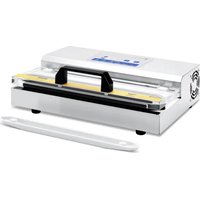
RCVG-40 - Vacuum packaging machines Royal Catering - Free user manual and instructions
Find the device manual for free RCVG-40 Royal Catering in PDF.


| Brand | Royal Catering |
| Model | RCVG-40 |
| Product type | Food vacuum packaging machine |
| Power supply | 230 V / 50 Hz |
| Rated power | 475 W |
| Protection class | I |
| Dimensions (L x D x H) | 275 x 390 x 130 mm |
| Weight | 6.3 kg |
| Maximum vacuum pressure | -942 mbar (dual pump) |
| Maximum film/bag width | 310 mm |
| Main functions | Automatic packaging, sealing, pulse mode, marinating, accessory vacuuming, standard sealing |
| Control panel | Start, Seal, Pulse, Marinate, Accessory, ON/OFF buttons, sealing time adjustment |
| Display | Progress indicator and sealing time |
| Vacuum chamber | With sealing gasket and sealing bar |
| Maintenance and cleaning | Clean with a soft cloth and mild soap; do not immerse; do not use abrasive products |
| Sealing tape replacement | Possible with high-temperature adhesive tape, tweezers, and thickness gauge |
| Safety | Shock protection, hot surface, crushing; automatic shut-off after 10 minutes of inactivity |
| Recommended ambient temperature | Up to 40°C, max humidity 85% |
| Compatible accessories | Vacuum bags, film rolls, vacuum boxes, bottle stoppers |
| Warranty and repairability | Repairs by manufacturer after-sales service only; original spare parts |
Frequently Asked Questions - RCVG-40 Royal Catering
User questions about RCVG-40 Royal Catering
0 question about this device. Answer the ones you know or ask your own.
Ask a new question about this device
Download the instructions for your Vacuum packaging machines in PDF format for free! Find your manual RCVG-40 - Royal Catering and take your electronic device back in hand. On this page are published all the documents necessary for the use of your device. RCVG-40 by Royal Catering.
USER MANUAL RCVG-40 Royal Catering
natural_image
Silhouette of a lion-like creature on a blue background (no text or symbols)| Deutsch | 3 |
| English | 11 |
| Polski | 18 |
| Česky | 26 |
| Français | 34 |
| Italiano | 42 |
| Español | 50 |
| Magyar | 58 |
| Dansk | 65 |
| PRODUKTNAME | VAKUUMIERGERÄT |
| PRODUCT NAME | VACIUM PACKING MACHINE |
| NAZWA PRODUKTU | PAKOWARKA PRÓZNIOWA LISTWOWA |
| NÁZEV VÝROBKU | VAKUOVAČKA |
| NOM DU PRODUIT | MACHINE SOUS VIDE ALIMENTAIRE |
| NOME DEL PRODOTTO | MACCHINA PER SOTTOVUCIO |
| NOMBRE DEL PRODUCTO | MÁQUINA DE ENVASADO AL VACÍO |
| TERMÉK NEVE VÁKUUMOS CSOMAGOLÓGEP | |
| PRODUKTNAVN | VAKUUMPAKKER |
| MODELL | |
| PRODUCT MODEL | |
| MODEL PRODUKTU | |
| MODEL VÝROBKU | RCVG-40 |
| MODELE | RCVG-41 |
| MODELLO | |
| MODELO | |
| MODELL | |
| MODEL | |
| HERSTELLER | |
| MANUFACTURER | |
| PRODUCENT | |
| VÝROBCE | |
| FABRICANT | EXPONDO POLSKA SP. Z O.O. SP. K. |
| PRODUTTORE | |
| FABRICANTE | |
| TERMELÓ | |
| PRODUCENT | |
| ANSCHRIFT DES HERSTELLERS | |
| MANUFACTURER ADDRESS | |
| ADRES PRODUCENTA | |
| ADRESA VÝROBCE | |
| ADRESSE DU FABRICANT | LIL NOWY KISIELIN INNOWACYJNA 7, 86002 ZIELONA GÓRA | POLAND, EU |
| INDIRIZZO DEL PRODLUTTORE | |
| DIRECCIÓN DEL FABRICANTE | |
| A GYÁRTÓ CÍME | |
| PRODUCENTENS ADRESSE | |
TECHNISCHE DATEN
natural_image
Close-up of a mechanical component with layered structure and a black oval base (no visible text or symbols)natural_image
Close-up of a white electronic device with black components, possibly a battery or scanner (no visible text or symbols)3.6. FEHLERBEHEBUNG
| Parameter description | Parameter value | |
| Name of the product | VACUUM PACKING MACHINE | |
| Model RCVG-40 RCVG-41 | ||
| Supply voltage (V-/J/Frequency [Hz]) | 230/50 | |
| Rated power (W) 475 | ||
| Protection class 1 | ||
| Dimensions (Width x Length x Height; mm) | 275x390x130 | |
| Weight (kg) 6.3 | ||
| Vacuum pressure (mbar) | -942 (double vacuum pump with motor) | -968 (double vacuum pump with motor) |
| Maximum roll/foil/ seal width (mm) | 310 | |
- GENERAL DESCRIPTION
These instructions are intended to assist you in safe and reliable use. The product is designed and manufactured strictly according to technical specifications using the latest technology and components and maintaining the highest quality standards.
READ THE INSTRUCTIONS CAREFULLY AND UNDERSTAND THEM BEFORE USE.
To ensure long and reliable operation of the device, care should be taken to operate and maintain the device correctly in accordance with the instructions. The technical data and specifications contained in these instructions are up to date. The manufacturer reserves the right to make changes for the purpose of quality improvement. Taking technological progress and the possibility to reduce noise into account, the device is designed and built so that risks resulting from noise emissions are reduced to the lowest possible level.
EXPLANATION OF SYMBOLS
CE The product meets the requirements of relevant safety standards.
Read the instructions before use
Recyclable product
CAUTION! or WARNING! or REMEMBER! describing a given situation (general warning sign).
CAUTION! Risk of electric shock!
For indoor use only
CAUTION! Risk of crushing hands!
Caution! Touching hot surfaces may lead to burns!


A protection class I device.
CAUTION! The illustrations in this manual are for illustrative purposes only and may differ in some details from the actual product appearance.
The original version of the instructions is the German version. Other language versions are translations from German.
2. SAFE USE
CAUTION! Read all safety warnings and all instructions. Failure to follow the warnings and instructions may result in electric shock, fire and/or serious injury or death.
The term "device" or "product" in the warnings and instructions refers to the vacuum packing machine.
2.1.ELECTRICAL SAFETY
a) The device plug must fit into the socket. Do not modify the plug in any way. Original plugs and matching sockets reduce the risk of electric shock.
b) Avoid touching earthed items such as tubes, radiators, heaters and refrigerators. There is an increased risk of electric shock if your body is earthed and touches the device exposed to direct rain, wet floor and humid environment. If water penetrates into the device, there is an increased risk of damage to the device and electric shock.
c) Do not touch the device with wet or clamp hands.
d) Do not use the cable in a wrong way. Never use it to carry the device or to pull the plug out of the socket. Keep the cable away from heat sources, oil, sharp edges or moving parts. Damaged or tangled cables increase the risk of electric shock.
e) If you cannot avoid using the device in a wet environment, use a residual current device (RCD). Using an RCD reduces the risk of electric shock.
f) Do not use the device if the power cable is damaged or shows clear signs of wear. A damaged power cable should be replaced by a qualified electrician or the manufacturer's service.
g) CAUTION - DANGER TO LIFE! When cleaning or using the device, never immerse it in water or other liquids.
2.2. SAFETY IN THE WORK AREA
a) Keep the work area tidy and well lit. Disorder or poor lighting can lead to accidents. Be careful, watch what you are doing and use common sense when working with the device.
b) If in doubt as to whether the device is working properly, contact the manufacturer's service.
c) Repairs to the device may only be carried out by the manufacturer's service. Do not carry out repairs yourself!
d) In the event of fire or fire, use only powder or snow (CO2) extinguishers to extinguish fire in the device where there is voltage.
c) No children under the age of 8 or unauthorised persons are allowed in the work area. Children over 8 years of age should be under constant adult supervision when using the device.
Check the condition of the safety stickers regularly. Replace them if they are illegible.
g) Keep these instructions for future reference. If the device is to be passed on to third parties, the instructions for use must be handed over together with the device.
h) Keep packaging parts and small assembly parts out of the reach of children.
i) Keep the device away from children and animals j) When using this device together with other devices,
REMEMBER! Keep children and other bystanders safe while operating the device.
2.3. PERSONAL SAFETY
a) Do not operate the device if you are tired, ill or under the influence of alcohol, drugs or medication which might impair your ability to operate the device.
b) The device may only be operated by persons who are physically fit, capable of handling the device and who have been adequately trained, who have read these instructions and have received training in health and safety.
c) b). The device is not intended to be used by persons (including children) with reduced mental, sensory or intellectual functions or lack of experience and/or knowledge, unless they are supervised by a person responsible for their safety or have been given instructions by them on how to operate the device.
d) Be careful and use common sense when operating the device. A short moment of distraction during operation may lead to serious personal injury.
e) The device is not a toy. Children should be supervised to ensure that they do not play with the device.
f) Do not put your hands or objects inside the working device!
2.4. SAFE USE OF THE DEVICE
a) Do not use the device if the ON/OFF switch does not function properly (does not switch on and off). Devices that cannot be controlled by the switch are dangerous, must not be operated and must be repaired.
b) The device must be disconnected from the power supply before adjustment, cleaning and maintenance. This preventive measure reduces the risk of accidental activation.
c) Keep unused devices out of the reach of children and anyone not familiar with the device or these instructions. Devices are dangerous in the hands of inexperienced users.
d) Keep the device in good working order.
e) Keep the device out of the reach of children. f) Repair and maintenance of the device should be carried out by qualified persons using only original space parts. This will ensure a safe use of the device.
g) To ensure the designed operational integrity of the device, do not remove factory installed covers or loosen any screws.
h) Do not move, shift or rotate the device during operation.
i) Do not leave the switched on device unattended.
j) Clean the device regularly to prevent the permanent accumulation of dirt.
k) Do not work with two objects at the same time,
1) The device is not a toy. Cleaning and maintenance must not be performed by children without adult supervision.
m) It is forbidden to tamper with the device in order to change its parameters or construction.
n) Keep the device away from sources of fire and heat.
o) Do not cover the vents of the device!
p) Before consuming a vacuum packed food check if it is not spoiled despite the packaging.
q) Safe food storage takes place in low temperatures (recommended storage temperature <40C). For long-term storage food must be frozen after packaging.
1) Do not pack using vacuum and store out of date food.
s) The device shall be connected only to grounded power supply sources. Do not use extension cords to connect the device.
t) Use bags and accessories intended for vacuum packing.
u) Products with short shelf life should be frozen, it is not recommended to vacuum pack them.
v) It is recommended to make 20-second breaks between each use of the device.
w) Do not touch the sealing strip! Take special caution during inserting/removing a vacuum bag.
x) In order to avoid hand burns, press the "seal" button. The device does not get hot in this mode.
y) Do not open the cover with force. If resistance is encountered when attempting to open the lid, wait for the pressure to stabilize.
CAUTIONI Although the device has been designed to be safe and has been equipped with adequate safeguards, and despite the use of additional safety measures, there is still a small risk of accident or injury when operating the device. Caution and common sense are advised when using the device.
3. RULES OF USE
The device is intended for vacuum packing food by means of air suction from a tight bag and after its sealing.
The user is responsible for any damage caused by improper use.
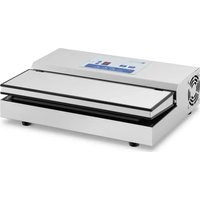
3.1. DESCRIPTION OF THE DEVICE
RCVG-40
1. control panel
2. handle
3. cover
4. leg
5. tan
6. tightening strip
7. vacuum chamber gasket
B. vacuum chamber
9. sealing strip
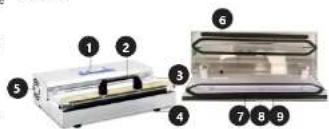
CONTROL PANEL
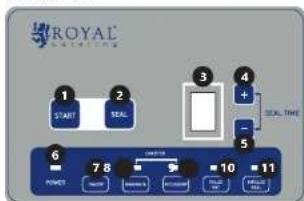
-
automatic vacuum packaging
-
bag sealing
-
process progress display
-
sealing time increase
-
sealing time decrease
-
operation signalling light
-
ON/OFF button
-
marination mode
-
air suction from accessories
-
pulsation packing mode
-
Normal sealing mode
RCVG 41
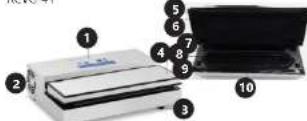
-
control panel
-
fan
-
leg
-
cover
-
tightening strip
-
clasp
-
vacuum chamber gasket
-
vacuum chamber
-
clasp socket
-
scaling strip
CONTROL PANEL
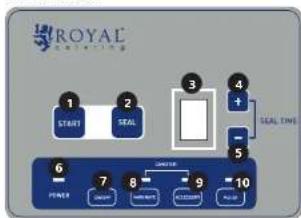
flowchart
graph TD
    A["1 START"] --> B["2 SEAL"]
    B --> C["3 SEAL TIME"]
    C --> D["4 + SEAL TIME"]
    D --> E["5 SEAL TIME"]
    E --> F["6 FORCE"]
    F --> G["7 CHINE"]
    G --> H["8 WM FIN"]
    H --> I["9 ACCESSORIES"]
    I --> J["10 NO."]
-
automatic vacuum packaging
-
bag sealing
-
process progress display
-
sealing time increase
-
sealing time decrease
-
operation signalling light
-
ON/OFF button
-
marination mode
-
air suction from accessories
-
pulsation packing mode
3.2. PREPARATION FOR WORK
3.2.1. LOCATION OF THE DEVICE
The ambient temperature should not exceed 40°C and the relative humidity should not exceed 85%. Position the device in a way that allows for good air circulation. Maintain a minimum distance of 10 cm from any wall. Keep the device away from any hot surfaces. Always operate the device on a level, stable, clean, fireproof and dry surface and out of the reach of children and persons with reduced mental, sensory and intellectual abilities. Position the device in such a way that the power supply plug can be reached at any time. Make sure that the device's power supply corresponds to the data on the rating plate!
3.2.2. SCALDING
Vegetables should be scalded prior to vacuum packing. This process stops the effect of the enzymes affecting the loss of flavour, colour and texture.
Scalding:
-
Put the vegetables in boiling water or in a microwave oven until they are cooked but still crunchy.
-
Immersive the vegetables in cold water to stop the cooking process.
-
Dry the vegetables (e.g. with a paper towel) prior to vacuum packing.
-
Cabbage vegetables (broccoli, sprouts, cabbage, cauliflower, kale, turnips) naturally emit gases during storage. That is why after scalding they must be stored only in a freezer.
3.3. WORKING WITH THE DEVICE
3.3.1. STARTING THE DEVICE
- Connect the power supply cord
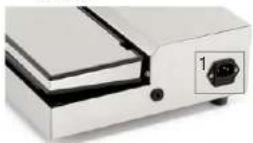
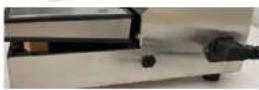
a) Remove film from the cord. b) Insert the 3 Pin end in the socket on the side of the device [1].
EN
EN
- Connect the device to the power supply.
a) Insert the power supply cord in a socket
-
7 Press the ON/OFF button. The last saved sealing time will be displayed. Fan will start. After 10 minutes of idle operation the display will switch off, and the fan will stop working.
-
Select the desired function.
3.3.2. DEVICE FUNCTIONS
3.3.2.1. VACUUM PACKING WITH FOIL:
a) Select a roll with foil with appropriate width.
b) Place the beginning of the foil along the sealing strip
and close the cove
c) Push the "Seal" button. The device will count stages
from 9 to 0, where 0 means sealing is completed. d) Push the ON/OFF button, to stop the process (if necessary).
c) After the process is completed the cover will open automatically. Then remove the foil roll and check the scal quality.
f) If the seal is correct, adjust the foil size to the product
to be packed. Leave 4.5 cm free space and cut the foil.
g) After placing the product in the foil, proc
3.3.2.2. VACUUM PACKING WITH VACUUM BAGS:
a) Select appropriate vacuum bag.
b) Place the product in a bag.
c) Leave 4.5 cm free space inside the bag.
d) Place one end of the bag along the vacuum chamber gasket.
e) Close the cover.
f) Press the "Start" button. The device will start vacuum packing cycle. The display will start counting stages from 9 to 0, where 0 means end of the process.
g) After the process is complete, the device will start scaling cycle automatically.
h): After completion the cover will open. Then, remove the bag and check the seal quality. Repeat the sealing cycle (with the "Seal" button) if still necessary.
3.3.2.3. PULSATION VACUUM PACKING FUNCTION. Vacuum packing and high pressure can lead to destruction of delicate products. For such products, pulsation vacuum packing function is recommended, because it allows to control the time and vacuum value, preventing product crushing. This function can be used to pack juicy products to prevent squeezing the liquids and drying of the product.
a) Select appropriate vacuum bag.
b) Place the product in a bag.
c) Leave 4.5 cm free space inside the bag.
d) Place one end of the bag along the vacuum chamber seal.
c) Close the cover.
f) Press the "Pulse" button. The device will start vacuum packing cycle.
g) Press the "Pulse" button again to stop the cycle, which will enable underpressure reduction and will slow down the process. Press the "Pulse" button again to restore operation. Repeat until desired effect is obtained. The more delicate the product, the more frequent process stop and restoration is required.
h) After the desired effect is obtained, press the "Seal" button to seal the bag.
1) After completion the cover will open. Then, remove the bag and check the seal quality. Repeat the sealing cycle if still necessary.
3.3.2.4. VACUUM PACKING IN CONTAINERS
a) Place the product in the vacuum bag.
b) Make sure that the lid of the container is dry and that the slots in the lid and on the top of the container do not contain any crumbs or debris. Close the container.
c) A knob is located on the container lid. Tum it to the
position for air removal (varies between containers).
b) Connect an additional hose from the socket in the device [1] to the socket in the container.
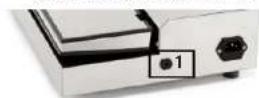
c) Push the "Accessory" button. Press the container lid
gently. The device will start air removal.
d) After the process is complete, the device will move to standby mode automatically.
c) Turn the knob on the container lid to the position responsible for blocking the air inlet/outlet.
e) Disconnect the hose.
f) Keep the container in a refrigerator
g) In order to open the container, turn the knob on the container cover to the position responsible for opening.
CAUTION! Clean the container thoroughly after emptying it of the product. A clean vacuum container can be used again many times.
3.3.2.5 MARINATING MODE
The food product marinating mode with the help of a vacuum container is carried out in two cycles: quick marinating (15 min.) and normal marinating (27 min.). The function consists in alternately repeating the air suction cycle and then releasing air into the container, thus ensuring the optimal level of marinade saturation in the shortest possible time.
a) Place the product in the vacuum bag.
b) Make sure that the lid of the container is dry and that the slots in the lid and on the top of the container do not contain any crumbs or debris. Close the container.
c) A knob is located on the container lid. Turn it to the
position responsible for opening the air inlet.
d) Connect an additional hose from the socket in the device [1] to the socket in the container.
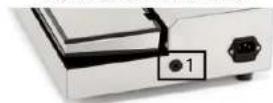
c) Press the "Marinate" button. Select the desired cycle: fast (press the button only once), normal (press the button twice). The selected cycle will appear on the display: 1 - fast marinating, 2 - normal marinating.
f) Press the 'Start' button. Press the container lid gently.
g) The device will start counting stages from 5 to 0, where 0 means end of the process. Suction will end after 4 minutes in the case of fast marinating cycle, and after 8 min. in the case of normal marinating cycle.
h) After the suction is completed, the air sucked out in the form of marinate infusion will enter the container. The display will start counting stages from 5 to 1. It will finish after 30 s.
i) The device will restart air suction.
j) The cycles described above will be repeated until the marinating mode is completed.
k) After marinating is completed, the display will show value 0.
(i) Turn the knob on the lid of the container to the position responsible for closing the air inlet/outlet.
(m) Disconnect the hose.
3.3.2.6. CLOSING OPEN BOTTLES WITH VACUUM CAP A function useful for open bottles with wine, edible oil, juice
a) Close the bottle with the vacuum cap. Leave a minimum space of 2.5 cm between the bottom of the cap and the surface of the liquid in the bottle.
b) Connect an additional hose from the socket in the device (1) to the socket in the cap.
c) Push the 'Accessory' button. The device will start air removal from the bottle.
d) After the process is complete the device will move to standby mode automatically.
c) Disconnect the hose.
f) Store the bottle in vertical position. Make sure that the liquid in the bottle does not come into contact with the cap.
g) To open the bottle, remove the cap.
3.3.2.7. NORMAL SEALING
Function useful when vacuum sealing is not necessary.
a) Set the scaling time using 1 and
b) Press the "Impulse scal" button.
c) Place the end of the bag along the sealing strip.
d) Close the cover and press gently
c) The device will start sealing automatically. The display will start counting down the time from the beginning to 0, which means the end of the process.
f) Open the cover and check the seal quality.
g) Press the ON/OFF button, to exit the normal scaling mode.
NOTE: In the case of a large number of sealing bags, it is recommended to set the sealing time as short as possible to prevent the bag from overheating or melting.
3.3.3. INFORMATION ON VACUUM ACCESORIES
3.3.3.1. VACUUM CONTAINERS
a) Only containers intended for operation in underpressure are allowed. Other incompatible containers can be damaged.
b) Coal the product before placing it in the container.
c) Do not freeze containers with contents. The lowest recommended temperature of food storage in a vacuum container is -180°C.
d) A few seconds before starting to draw air from the container, gently press down on the container lid for better effect.
c) Container lid cannot be placed in a microwave oven or in a dishwasher. It must be washed manually. The container itself can be washed in a dishwasher and placed in a microwave oven if the set temperature does not exceed 100°C.
f) If liquid or product crumbs enter the connecting hose with the vacuum packer, rinse it with warm water. Before cleaning make sure that the hose is not connected to the device or the container.
g) Powdered or granular products should be covered with a paper towel prior to suction to prevent product particles from entering the system.
h) Do not use a vacuum container for product canning.
3.3.3.2 VACUUM BAGS:
a) Products intended for packing into vacuum bags should be as fresh as possible.
b) Delicate and products humid products should be frozen prior to vacuum packing. Products such as meat, berries or bread can be frozen 24 hours prior packing. It is recommended that the product is hard before it is vacuum packed.
c) Unfrozen meat should be placed in a paper towel prior packing. This will prevent product drying.
d) Liquid products, such as soups, goulash or stew meals should be cooled and freeze slightly in a bowl or on an ice cube tray prior to packing.
c) Sharp edged products such as bones, rice and pasta should be wrapped in a paper towel before packing to prevent holes in the bag.
f) Vacuum bags are reusable products. They can be placed in boiling water or in a microwave oven, but such bags should no longer be used for vacuum repackaging, as are bags that have been used to store fish or slippery and oily products.
g) Remember to scald vegetables prior to vacuum packing.
3.34. FOOD STORAGE
| Product | Storage of vacuum packed product in a freezer | Storage of vacuum packed product in a refrigerator | Normal storage |
| Beef and veal | 1-3 years | 1 month | 1-2 weeks |
| Minced meat | 1 year | ||
| Pork | 2-3 years 2-4 weeks | 1 week | |
| Fish | 2 years | 2 weeks | 3-4 days |
| Poultry | 2-3 years 2-4 weeks | 1 week | |
| Smoked meat | 3 years | 6-12 weeks | 2-4 weeks |
| Fresh sealed products | 2-3 years | 2-4 weeks | 1-2 weeks |
| Fruit | 2-3 years | 2 weeks | 3-4 days |
| Hard cheese | 6 months | 6-12 weeks | 2-4 days |
| Cold cuts | Not recommended | 6-12 weeks | 1-2 weeks |
| Pasta | 6 months | 2-3 weeks | 1 week |
3.3.5. OTHER APPLICATIONS OF VACUUM PACKAGING MACHINE
3.3.5.1, COOL COMPRESS
a) Fill vacuum bag half with water.
b) Add several spions of alrabal.
c) Seal the bag (withal d). Place in the frame
a) Place in the freezer.
b) Alcohol prevents water freezing. As a result, when removed from the freezer, you can get a flexible cooling compress for painful injuries.
13.5.2. ORGANIZER
Small items such as screws, covers etc. can also be vacuum packed, which will enable keeping order e.g. in the garage and prevent losing small parts.
1.3.5.3. PREVENTS OXIDATION
This feature will keep silver, such as vacuum-packed jewellery, in good condition and prevent tarnish.
3.3.5.4. Traveller's companion
Before going on a longer trip, you can pack ready-made take-out meals, as well as small useful items such as matches or a map, which will not get wet when vacuum-packed.
1.4. CLEANING AND MAINTENANCE
a) Before cleaning and when the device is not in use, pull the power supply plug.
b) Use only non-corrosive agents for cleaning the surface.
c) Only mild cleaning agents designed for cleaning surfaces which came into contact with food may be used to clean the device.
d) Store the device in a dry and cool place protected from moisture and direct sunlight.
e) Do not spray the device with a stream of water and do not immerse it in water.
1) Ensure that no water enters through the ventilation openings in the housing.
g) Regularly inspect the device for technical failure and damage.
h) Use a soft cloth and mild soap for cleaning.
i) Do not use sharp and/or metal objects for cleaning (e.g., a wire brush or metal scraper) as these may damage the surface of the device.
j) Do not clean the unit with acidic substances, medical products, thinners, fuel, oil or other chemicals as they may damage it.
k) In the case of the RCVG-41 model, it is possible to remove the gasket next to the chamber in order to wipe away liquids and residues that may have escaped from the vacuum bag during packing.
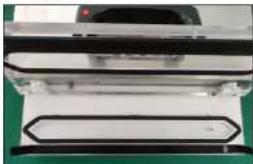
3.5. REPLACING THE TAPE ON THE SEALING BAR Tools needed for replacement: high-temperature tape, tweezers, a 0.8-mm-thick sheet of metal, or a slitting gauge.
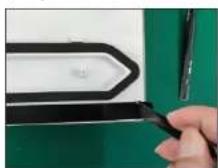
a) Use tweezers to lift the tape at one end.
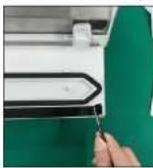
b) Completely remove the tape.
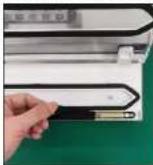
c) Check if there is any glue left on the place where the tape was located. If necessary, clean the adhesive, for example, with a cloth soaked in alcohol.
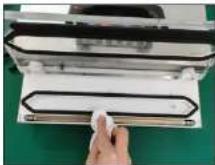
d) Glue the new tape so that it adheres to the welding strip and smooth the place where the heating wire is located. The ends of the tape do not need to be glued tightly. Leave about 10-15 mm of loose tape at both ends.
natural_image
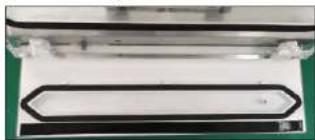
Close-up of a mechanical device with layered components and a green background (no visible text or symbols)c) Use a thin sheet of metal or a slotted gauge 0.8 mm thick and 10 mm wide to insert the tape into the slots at both ends of the heating cable. Be careful not to use too much force, as this may cause the tape to puncture.
f) Smooth out all the tape to get rid of air bubbles, and make sure the tape is well attached.
natural_image
Close-up of a mechanical component with a black rectangular end and transparent casing (no visible text or symbols)3.6. TROUBLESHOOTING
| PROBLEM | POSSIBLE CADSE | ACTION |
| The display shows "E" ("F2" or "F3" for RCVG-41 model) | Device over-heated | Switch the device and unplug from the power supply: Wait at least 20 min, before resorting the device. |
| The device does not turn on | No connection to power source or damaged power cord | Check the condition and connection of the power card. Tighten the plug or replace the cable, depending on the fault. |
| The machine leaves a lot of air in the vacuum bag | Vacuum bag end is not in vacuum chamber or is not overly placed, dirty device or bag. | Make sure the bag is inserted correctly; clean the device or replace the bag. |
| Bag not tight | Sharp edges of the product could perforate the bag | Replace the bag and repeat vacuum packing process. |
| Fruit/vegetables are spoiled | Food not scaled or frozen properly (producing gas) | Open the bag and consume the products if they are suitable for consumption, or dispose of the products. Do not pack them again. |
| The device does not withdraw air from vacuum containers | • erroneous hose connection; • erroneous setting of the knob in the container lid; • no free space in the container; • damaged container lid | • check hose connection and press in if necessary; • set the knob in the correct position; • empty the container until the necessary free space is obtained; • replace the container lid |
DANE TECHNICZNE
natural_image
Close-up of a transparent electronic device with a black outline and green base (no visible text or symbols)natural_image
Close-up of a white electronic component with a black rectangular outline, placed on a green surface (no visible text or symbols)3.2. PREPARATION AU FONCTIONNEMENT
3.2.1. EMPLACEMENT DE L'APPAREIL
natural_image
Close-up of three stacked electronic components with black outlines, no visible text or symbolsnatural_image
Close-up of a mechanical component with a rectangular end and transparent casing (no visible text or symbols)- panel de control
2 ventilador
-
pata
-
tape
-
correa de sellado
b. cieme de clic
b) Completely remove the tape
natural_image
Close-up of a mechanical device with transparent casing and black components, no visible text or symbolsnatural_image
Close-up of a mechanical component with a black oval shape and transparent casing, no visible text or symbols3.6. PROBLÉMAMEGOLDAS
HIBA LEHETSEGES OK ELHÁRÍTAS
natural_image
Close-up of a mechanical device with transparent plates and a black bracket, no visible text or symbolsnatural_image
Close-up of a transparent plastic enclosure with a black rectangular object on the lower side, against a green background (no text or symbols visible)3.6.PROBLEML∅SNING
For the disposal of the device please consider and act according to the national and local rules and regulations.
CONTACT
expondo Polska sp. z o.o. sp. k.
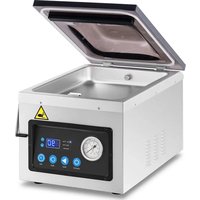
Brand : Royal Catering
Model : RCVG-40
Category : Vacuum packaging machines