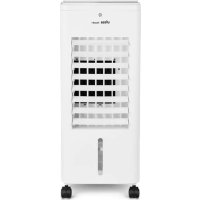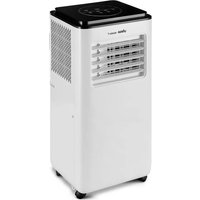
Alaska 7 - Air Conditioning UFESA - Free user manual and instructions
Find the device manual for free Alaska 7 UFESA in PDF.


| Product type | Monoblock mobile air conditioner |
| Brand | Ufesa |
| Model | Alaska 7 (PAC A7) |
| Dimensions (body) L x D x H | 330 x 280 x 704 mm |
| Net weight | 20 kg |
| Voltage / Frequency | 220-240 V ~ 50 Hz |
| Cooling power | 2000 W |
| Power consumption | 750 W |
| Current | 3.4 A |
| Refrigerant | R290 (90 g) |
| Noise level | 64 dB(A) |
| Energy class | A |
| Recommended area | 10-15 m² |
| Nominal EER | 2.7 |
| Fuse | T or F 3.15 A / 250 V |
| Functions | Auto, Cool, Dehumidifier, Fan |
| Fan speeds | Slow, Fast |
| Timer | 1 to 24 hours |
| Drainage | Manual or automatic (hose not included) |
| Air filter | Washable, clean every 100 hours |
| Remote control | Yes, CR2025 battery included |
| Remote control power | Lithium battery 3 V CR2025 |
| Safety | Thermal protection, 3 min stop, full tank |
| Warranty | According to applicable legislation (parts and labor) |
Frequently Asked Questions - Alaska 7 UFESA
User questions about Alaska 7 UFESA
0 question about this device. Answer the ones you know or ask your own.
Ask a new question about this device
Download the instructions for your Air Conditioning in PDF format for free! Find your manual Alaska 7 - UFESA and take your electronic device back in hand. On this page are published all the documents necessary for the use of your device. Alaska 7 by UFESA.
USER MANUAL Alaska 7 UFESA
WE WOULD LIKE TO THANK YOU FOR CHOOSING UFESA. WE WISH THE PRODUCT PERFORMS TO YOUR SATISFACTION AND PLEASURE.
WARNING
PLEASE READ THE INSTRUCTIONS FOR USE CAREFULLY PRIOR USING THE PRODUCT. STORE THESE IN A SAFE PLACE FOR FUTURE REFERENCE.
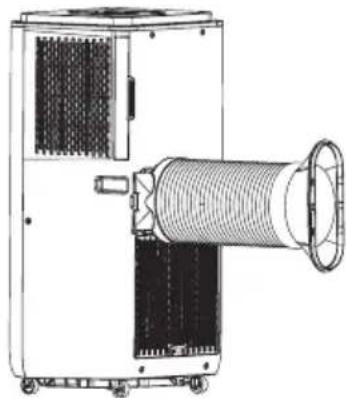
DESCRIPTION
- Control panel
- Signal receptor
- Cold air outlet
- Remote controller
- Transport handle
- Evaporator air intake
- Air exhaust duct
- Primary drain port
ACCESSIONS
- Air exhaust duct
- Connector of air exhaust duct
- Window adapter for exhaust duct
- Remote controller
- Baffle Plate
CONTROL PANEL
- Power button
- Sleep mode button
- Timer button
- Mode button
- Speed button
- Increase temperature/time
- Decrease temperature/time
- Sleep mode light
- Timer light
- Fan mode light
- Cool mode light
- Slow speed light
- Fast speed light
- Dehumidifier mode light
- Automatic mode light
REMOTE CONTROL
- Power button
- Mode button
- Speed button
- Increase temperature/time button
- Decrease temperature/time button
- Sleep mode button
- Timer button
SAFETY INSTRUCTIONS
This appliance can be used by children aged from 8 years and above and persons with reduced physical, sensory or mental capabilities or lack of experience and knowledge if they have been given supervision or instruction concerning use of the appliance in a safe way and understand the hazards involved.
Children shall not play with the appliance.
Cleaning and user maintenance shall not be made by children without supervision.
If the supply cord is damaged it must be replaced by the manufacturer, its service agent, or similarly qualified persons in order to avoid a hazard.
Appliance shall be installed in accordance with national wiring regulations.
Minimum permissible distance for top and back part of the appliance to adjacent structures is 50 cm. Appliance uses T or F type fuse rated at 250V voltage and 3,15 A current.
WARNING
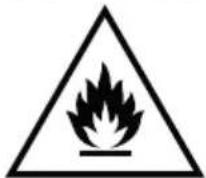
-
Do not use means to accelerate the defrosting process or to clean, other than those recommended by the manufacturer.
-
The appliance shall be stored in a room that does not contain any continuously running ignition sources (for example: open flames, an operating gas appliance or an operating electric heater).
-
Do not pierce or burn.
-
Be aware that refrigerants may not contain an odour.
-
Appliance shall be installed, operated and stored in a room with a floor area larger than 4 ~m^2 . And the room should be higher than 2.2 ~m .
Maximum refrigerant R290 charge amount: 90 g. Dispose of the refrigerant based on local regulations in order to have it processed properly.
Servicing shall be performed only as recommended by the manufacturer.
WARNING: Keep ventilation openings clear of obstruction.
WARNING: Appliance shall be stored in a well-ventilated area where the room size corresponds to the room area as specified for operation.
WARNING: The appliance shall be stored in a room that does not contain any continuously running open flames (for example an operating gas appliance) and ignition sources (for example an operating electric heater).
The appliance shall be stored so as to prevent any mechanical damage from occurring.
Any person who is involved with working on or intervening into a refrigerant circuit should hold a current valid certificate from an industry-accredited assessment authority, which authorizes their competence to handle refrigerants safely in accordance with an industry-recognized assessment specification.
Servicing shall only be performed as recommended by the equipment manufacturer. Maintenance and repair requiring the assistance of other skilled personnel shall be carried out under the supervision of the person competent in the use of flammable refrigerants.
This device is designed for use at maximum altitude up to 2000m above sea level.
IMPORTANT WARNINGS
This appliance is designed for home use and should never be used for commercial or industrial purposes under any circumstances. Any incorrect use or improper handling of the product shall render the warranty null and void. Prior to plugging in the product, check that your mains voltage is the same as the one indicated on the product label. The mains connection cable must not be tangled or wrapped around the product during use. Do not use the device or connect and disconnect to the supply mains with the hands and / or feet wet. Do not pull on the power cord in order to unplug it or do not use it as
a handle. Never attempt to turn off the appliance by disconnecting the plug. To avoid risk of fire or explosion, do not spray anything onto the appliance. Do not put any inflammables or chemicals near the unit. To prevent plastic parts from melting or catching on fire, do not place the appliance near heating appliances. Moving and hot parts: Do not operate unit with back cover removed. The appliance must be used on a level and stable surface. Do not use outdoors. Be careful that a heating appliance is not exposed to the wind from the appliance. Do not cover the unit with washed clothes or similar items. Unplug the product immediately from the mains in the event of any breakdown or damage and contact an official technical support service. In order to prevent any risk of danger, do not open the device. Only qualified technical personnel from the brand's Official technical support service may carry out repairs or procedures on the device.
B&B TRENDS SL. disclaims all liability for damages that may occur to people, animals or objects, for the non-observation of these warnings.
BEFORE INITIATION
Be sure to remove any packing material from the inside of the appliance.
To avoid damage, place the unit in an upright position for at least 24 hours before initial start.
Make sure that the air outlet and air inlet are never blocked.
Only operate the unit on a horizontal surface to ensure no water leaks out.
INSTALLATION
A) Location and installation of the accessories
- The portable air conditioner must be placed beside a window or a door.
- To avoid over-heating of your appliance, a minimum distance of 60cm must be kept between the back of the appliance and the wall, or any bulky object.
Advice for water drainage set-up
Water is produced during cooling and dehumidifying. Therefore, you need to set up a drainage system. You can either choose to set up an automatic (continuous) drainage system or drain the water manually.
1. Automatic Drainage
Water drainage is continuous if you use the upper drainage port (secondary drainage port) with a drainage pipe. For instructions on set-up, please refer to MAINTENANCE AND CLEANING.
2. Manual Drainage
Water fills up an internal recycling tank during operation, and when the tank is full, the alarm will sound and the compressor will stop working, indicating that the water tank should be emptied.
For how to manually empty water from the tank to resume operation, please refer to MAINTENANCE AND CLEANING.
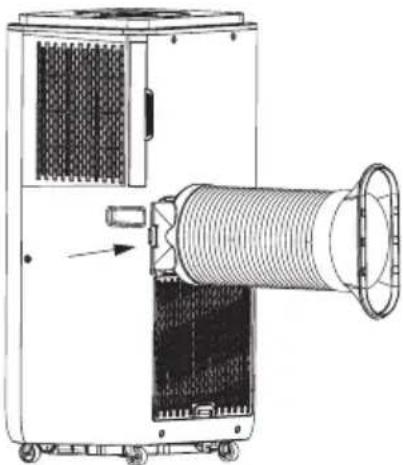
B) Installation of the air exhaust hose and the window adapter
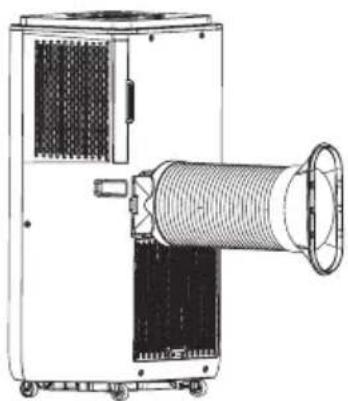
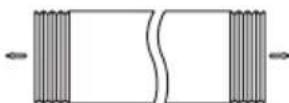
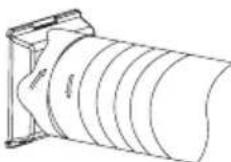
- Extend the air exhaust duct by pulling out the two ends of the duct.
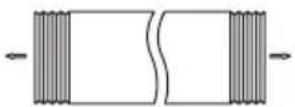
- Screw the air exhaust duct into the connector of the air exhaust duct.
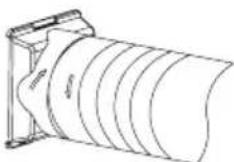
- Connect the exhaust duct to the unit.
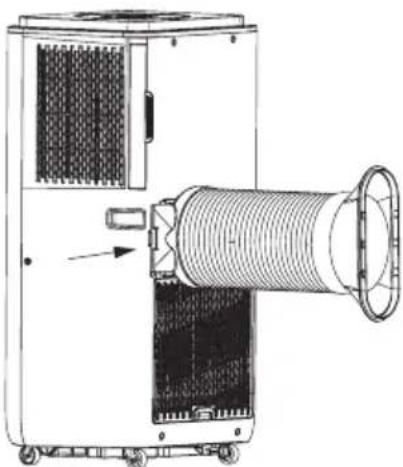
- Never obstruct the air outlet.

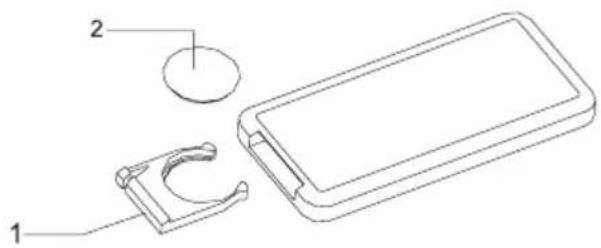
C) Installation of the battery (Remote control)
Compatible with a CR2025 (3V lithium battery)
- Slide the cover to open the compartment.
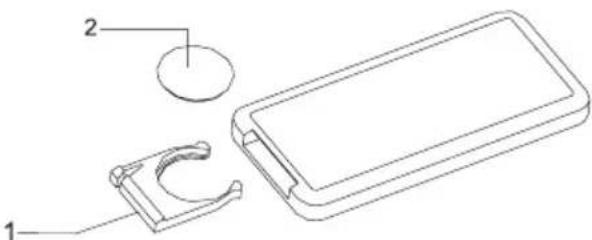
- Place the battery in the slot respecting the poles (anode and cathode)
- Put the cover back.
If you do not use the remote control for prolonged period of time, remove the battery from the remote control.
HOW TO USE THE APPLIANCE
A. Use of the control panel
- Starting the appliance and selecting a mode: To put the appliance into operation, connect the power cord to a wall outlet. The appliance will then emit a beep sound.
Press the POWER button (1) to turn on the device, and another deep sound will be emitted. Then press the MODE button (4) to choose one of the available operation modes:
Automatic mode (15):
When the Automatic mode is selected, the temperature sensor automatically operates and selects the operation mode Cool (11) or Fan (10) depending on the room temperature.
- If the room temperature is the same as or above 24^ C , the appliance will run in Cool mode.
- If the room temperature is under 24^ C , the appliance will run in Fan mode.
Cool mode (11)
When the room temperature is higher than the set temperature, the compressor will start to run. When the room temperature is lower than the set temperature, the compressor will stop.
Dehumidifier mode (14):
The compressor will work for 8 minutes then stop for 6 minutes. It will resume functioning automatically afterwards and repeat the cycle.
Remarks:
The fan above will work at a slow speed in Dehumidifier mode (slow by default). Fast speed is not supported in this mode.
The setting of temperature is not supported in this mode.
Fan mode: (10)
In this operation mode, the selection of temperature is disabled. The fan functions at the preset temperature. The compressor will not function.
Touch the MODE button (4) to change from one mode to another.

Press on the POWER button (1) again to turn off the appliance.
- Setting the temperature: The temperature can be set, each time by 1^ by pressing the + (6) or - (7) button, between the range of 15^ to 31^ .
Press the + (6) or - (7) button to increase or decrease the temperature by 1^ . The LED display shows the set temperature for 5 seconds, then displays the room temperature.
- Setting the speed of the fan: Press the SPEED button (5) to select one of the available fan speeds (slow or fast)

- Activating the sleep function: The appliance can be put to Sleep function only when it is in COOL mode (11). Press the Sleep mode button (2) to activate this function. The upper fan will function in slow speed. The set temperature will increase by 1^ after one hour of functioning and by 2^ after two hours. After six hours, the appliance will stop.
Remarks:
The main control board has a memory function. The main control board records the previous operation mode before the appliance is put to Sleep function. Consequently, as you restart the appliance, it will work in the previous operation mode. It doesn't need to be reprogrammed. This function is not available if the previous operation mode is Automatic (15).
Windows should be kept closed when the air conditioner is in COOL mode (11) or DEHUMIDIFER mode (14). Otherwise, the water tank will fill up quickly.
5. Timer:
The timer (3) can be set between 1 to 24 hours. Press the button + or - to increase or decrease the duration. Each press increases or decreases the time by one hour.
-
Automatic OFF: when the appliance is running, press the timer button (3) and set the desired duration after which the appliance will be switched off. Number of hours will flash on the LED display flashes for a few seconds until the timer indicator light on the left illuminates. Afterwards, the LED display will resume displaying the set temperature.
-
Automatic ON: when the appliance is connected to electricity but not turned on, press the timer button (3), set the desired duration after which the appliance will be turned on. Number of hours will flash on the LED display for a few seconds until the LED display goes off, and the timer indicator light on the left remains illuminating.
HOW TO USE THE REMOTE CONTROL
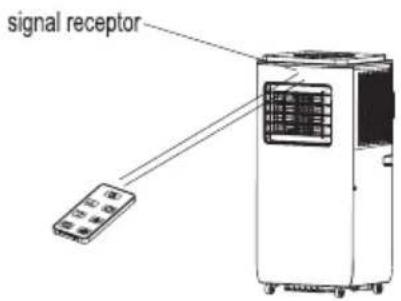
To operate the air conditioner with the remote control, point the remote control at the signal receptor located at the front of your appliance.
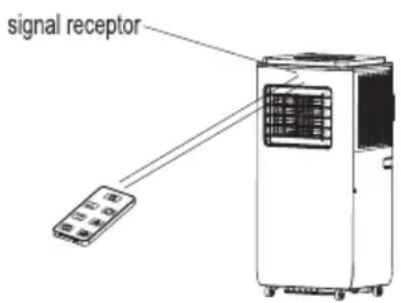
The remote control operates the portable air conditioner only if it is used within 5 meters.
- Power button: The appliance will start or stop when this button is pressed .
- Mode button: Allows you to select one of the following operation modes: Automatic, Cool, Dehumidifier or Fan.
- Speed button: Allows you to select the speed of fan (Slow or Fast).
4 and 5: Buttons to change the temperature and the time. - Sleep mode button: Allows you to activate or cancel Sleep Mode.
- Timer button: Allows you to set the automatic switch-on or switch-off by the timer.
Emergency stop and protection:
The appliance is equipped with a protection device to stop the appliance from running in case of emergency. The device can be triggered in the following cases:
In COOL mode (11) if:
room temperature is above 43^
room temperature is below 15^
In DEHUMIDIFIER mode (14) if:
room temperature is below 15^
Remarks:
3 minutes should be allowed for before the appliance is restarted, or before operation mode is changed from one to another.
The appliance will be put to original operation mode after replugging. Timer will need to be reset.
RECOMMENDATIONS IN CASE THE APPLIANCE IS
NOT USED
- If the appliance is not used for prolonged periods, make sure that it is safely unplugged. Otherwise, electric shock or fire may occur.
- Drain out all the water and use a soft cloth to clean the water bucket.
- Clean the air filter.
- Cover the appliance to prevent dust build-up. Store the appliance vertically in a cool and dry place.
CLEANING AND MAINTENANCE
Caution: turn off the appliance before disconnecting from power supply.
Appliance maintenance
- Cut off the power supply.
- Wipe the appliance with a soft and dry cloth. Use lukewarm water to clean if the appliance is very dirty.
- Never use volatile substances such as gasoline or polishing powder to clean the appliance.
- Never sprinkle or pour water directly onto the main unit.
Air filter maintenance
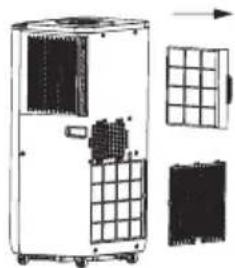
It is necessary to clean the air filter after using it for about 100 hours. Clean it as follows:
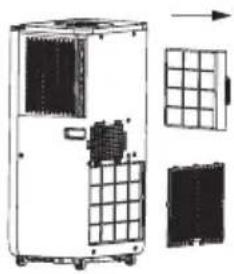
- Switch off the appliance and cut the power supply. Remove the air filter located at the back of the air conditioner.
- Clean and reinstall the air filter in the dedicated compartment.
If it is really dirty, wash the filter with a solution of detergent in lukewarm water. After cleaning, dry it in a shaded and cool place, then reinstall it.
Clean the air filter every two weeks if the air conditioner operates in an extremely dusty environment.
Water Drainage
During the cooling and dehumidifying process, the appliance extracts humidity from the atmosphere and keeps the condensed water in an internal recycling tank inside the appliance. When the water tank is full, the appliance will:
display an "E4" code
- stop operating until the water is emptied from the tank
Water can be drained in the following ways:
1. Automatic drainage
This allows water to continuously get drained out while the appliance is operating. There is no need to turn it off in order to drain. But the following connection work should be performed at installation, before the appliance is turned on.
-
P lease remove the plug of the drainage port.
-
Connect the opening to a 10mm diameter drainage pipe (not provided)
-
Extend the pipe to a bucket or a drainage ditch
-
Switch the appliance on
With this setup in place, all water produced during operation will be drained out continuously. No manual drainage work is needed after use.
If automatic drainage is not employed, please ensure to secure the secondary drainage port with the plug provided.
2. Manual drainage via (primary drainage port)
This manual procedure is needed if automatic drainage detailed above is not employed.
- Place the appliance near a drainage ditch
- Remove the plug of the primary drainage port
- Tilt the appliance slightly to pour water out
- Re-plug the primary drainage port after drainage
Appliance not in use
- Perform water drainage as instructed above.
- Turn on the fan for a few hours to dry the inside of the appliance. It dehumidifies the
inside of the appliance, and thus prevents the formation of any mould.
- Stop the appliance and take the power supply plug out. Then take out the battery of the remote control and store the appliance properly.
- Clean the air filter and reinstall it.
- Remove the air hoses, store them properly, and cover the holes tightly.
Warning:
Keep the appliance at least 1 meter away from your television or radios to avoid electromagnetic interference.
Do not expose the unit under direct sunlight to avoid surface colour fading. Do not tilt the unit for more than 35^ or place it upside-down during transportation. Place the unit on a flat surface with less than 5^ inclination.
Empty the condensation drainage pan before putting the unit in storage at the end of the season, to prolong the lifetime of the appliance.
Do not use chemical solvents (e.g. Benzene, alcohol- glazer) to clean the unit to avoid scratching or damaging the surface.
Make sure to cut off the power before disassembling or installing the air-inlet fence.
Please empty the water from the water tank if you want to move the machine. The battery must be removed from the remote controller before it is disposed of.
The battery is to be disposed of safely.
The plug must be removed before cleaning, maintaining or charging the appliance.
TECHNICAL CHARACTERISTICS
| Model: PAC Alaska 7 / PAC A7 | ||
| Cooling capacity: 2000W | ||
| Rated voltage / frequency: 220-240V~ 50Hz | ||
| Cooling input power / current: 750W / 3.4A | ||
| Refrigerant: R290 / 90g | ||
| Discharge Side Pressure: 2.5MPa | ||
| Suction Side Pressure: 1.2MPa | ||
| Sound Power Level: 64dB(A) | ||
| Net Weight: 20Kg | ||
| Rated EER: 2.7 | ||
| Energy Class: A | ||
| Applying Space (m2): 10-15 m2 | ||
| Fuse: 3.15A, 250VAC | ||
| Dimensions W x D x H | Body (mm) 3 | 30X280X704mm |
| Package (mm) | 373X318X880mm | |
| Global Warming Potential (GWP): 3 | ||
| Refrigerant leakage contributes to climate change. Refrigerant with lower global warming potential (GWP) would contribute less to global warming than a refrigerant with higher GWP, if leaked to the atmosphere. This appliance contains a refrigerant fluid with a GW equal to 3. This means that if 1 Kg of this refrigerant fluid would be leaked to the atmosphere, the impact on global warming would be 3 times higher than 1 Kg of C02, over a period of 100 years. Never try to interfere with the refrigerant circuit yourself or disassemble the product yourself and always ask a professional. | ||
Energy consumption is 0.8kW / h for 60 minutes, based on the results of standard tests. The actual energy consumption will depend on the mode of operation of the appliance and its location.
ENVIRONMENTAL PROTECTION
This warranty does not cover
- Damage or problems resulting from transport, improper use or negligence.
- Replacement of any bulbs or removable parts made of plastic or glass.
- Equipment declared to be used in a commercial environment, plus those that are subject to rental.
- The worn parts of the product, nor the problems or damage resulting from:
(1) surface deterioration due to normal wear and tear of the product;
(2) defects or deterioration due to contact with food or liquids and corrosion caused by rust;
(3) any unauthorised incident, abuse, misuse, modification, disassembly or repair;
(4) improper maintenance, improper use of the product or incorrect voltage connection;
(5) any use of accessories not provided or approved by Oceanic.
The guarantee will be cancelled if the rating label and / or serial number of the product are removed.
ENVIRONMENTAL PROTECTION - DIRECTIVE 2012/19/EU
This product complies with European Directive 2012/19/EU on electrical and electronic devices, known as WEEE (Waste Electrical and Electronic Equipment), provides the legal framework applicable in the European Union for the disposal and reuse of waste electronic and electrical devices. Do not dispose of this product in the bin, instead deliver it to the electrical and electronic waste collection centre closest to your home.
The product may contain batteries. Remove them before disposing of the product and dispose in special containers approved for this purpose.
For more information, you can contact your local or regional administration. Electronic products that have not been selectively sorted are potentially a human health and/or an environment hazard due to the presence of dangerous substances.
Fluorinated refrigerants:
This device contains R290. It is a mixture of flammable fluorinated gases that has an impact on global warming in the event of a leak.
Never attempt to open the appliance or pierce the cooling circuit. Any intervention must be performed by a qualified technician.
At the end of the life of the appliance, it must be disposed of in an appropriate place, capable of recycling appliances containing refrigerants. For this contact the authorities where you live.
Under no circumstances should you throw this appliance on public roads.
TROUBLE SHOOTING
| Problems Possible causes Solutions | ||
| The appliance works but does not cool the temperature down. | - Verify if the set temperature is higher than the room temperature. | - Lower the set temperature. (Please refer to section "How to use the appliance".) |
| - Verify if a window or a door is closed. | - Close the window or door to stop hot air from entering. | |
| - Verify if any heater or lamp is producing heat. | - Switch the(se) appliance(s) off. | |
| - Verify if the air filter is dirty. | - Clean the filter. (Please refer to section "Cleaning and maintenance".) | |
| - Verify if the air outlet is blocked by any bulky object. | - Remove the obstacles. | |
| Water leaks out during transport. | -- The water tank is full. - Drain the tank. | |
| -The appliance is lying down or the ground is not level. | - Always move the device horizontally. | |
| Error code "E2" is displayed on LED display. | - The room temperature sensor does not work or is damaged. | - Replace the room temperature sensor. |
| Error code "E3" is displayed on LED display. | - The evaporator oil pipe sensor may be damaged. Please contact your after-sales service. | - Replace the evaporator oil pipe sensor. |
| Error code "E4" is displayed on LED display. | - Water-tank-full warning. | - Drain the water tank. |
When your air conditioner seems to be out-of-order, please check the suggestions below before contacting after-sales service.
| Problems Possible causes Solutions | |
| The appliance does not work. | - Verify if the appliance is plugged in properly. |
| - Verify if the power cord or socket is damaged. | |
| - Verify if the fuse is broken. | |
| - If you are using a remote control, verify if the battery is exhausted. | |
| - The appliance has entered safety mode. | |
| The appliance works only for a while and then it stops automatically. | - Verify if the air outlet is blocked by any bulky object. |
| - The timer has been activated. |
DECLARATION OF CONFORMITY
- The refrigerant gas is contained in a hermetically sealed system (R290, GWP 3).
Explanation of symbols displayed unit.
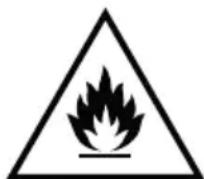
| WARNING | This symbol shows that this appliance uses a flammable refrigerant. If the refrigerant is leaked and exposed to an external ignition source, there is a risk of fire | |
| CAUTION | This symbol shows that the instruction manual should be read carefully | |
| CAUTION | This symbol shows that a service personnel should be handling this equipment with reference to the installation manual | |
| CAUTION | This symbol shows that information is available such as the instruction manual or installation manual |
INFORMATION ON SERVICING
Check to the area
Prior to beginning work on systems containing flammable refrigerants, safety checks are necessary to ensure that the risk of ignition is minimised. For repair to the refrigerating system, the following precautions shall be complied with prior to conducting work on the system.
Work procedure
Work shall be undertaken under a controlled procedure as to minimise the risk of a flam
mable gas or vapour being present while the work is being performed.
General work area
All maintenance staff and others working in the local area shall be instructed on the nature of work being carried out. Work in confined spaces shall be avoided. The area around the workspace shall be sectioned off. Ensure that the conditions within the area have been made safe by control of flammable material.
Checking for presence of refrigerant
The area shall be checked with an appropriate refrigerant detector prior to and during work, to ensure the technician is aware of potentially flammable atmospheres. Ensure that the leak detection equipment being used is suitable for use with flammable refrigerants, i.e. non-sparking, adequately sealed and intrinsically safe.
Presence of fire extinguisher
If any hot work is to be conducted on the refrigeration equipment or any associated parts, appropriate fire extinguishing equipment shall be available at hand. Have a dry powder or C02 fire extinguisher adjacent to the charging area.
No ignition sources
No person carrying out work in relation to a refrigeration system which involves exposing any pipe work that contains or has contained flammable refrigerant shall use any sources of ignition in such a manner that it may lead to the risk of fire or explosion. All possible ignition sources, including cigarette smoking, should be kept sufficiently far away from the site of installation, repairing, removing and disposal, during which flammable refrigerant can possibly be released to the surrounding space. Prior to work taking place, the area around the equipment is to be surveyed to make sure that there are no flammable hazards or ignition risks. "No Smoking" signs shall be displayed.
Ventilated area
Ensure that the area is in the open or that it is adequately ventilated before breaking into the system or conducting any hot work. A degree of ventilation shall continue during the period that the work is carried out. The ventilation should safely disperse any released refrigerant and preferably expel it externally into the atmosphere.
Checks to the refrigeration equipment
Where electrical components are being changed, they shall be fit for the purpose and to the correct specification. At all times the manufacturer's maintenance and service guidelines shall be followed. If in doubt consult the manufacturer's technical department for assistance.
The following checks shall be applied to installations using flammable refrigerants:
- the actual refrigerant charge is in accordance with the room size within which the refrigerant containing parts are installed;
- the ventilation machinery and outlets are operating adequately and are not obstructed;
- if an indirect refrigerating circuit is being used, the secondary circuit shall be checked for the presence of refrigerant;
- markings on the equipment continues to be visible and legible. Markings and signs that are illegible shall be corrected;
- refrigeration pipe or components are installed in a position where they are unlikely to be exposed to any substance which may corrode refrigerant containing components,
unless the components are constructed of materials which are inherently resistant or suitably protected against being corroded.
Checks to electrical devices
Repair and maintenance to electrical components shall include initial safety checks and component inspection procedures. If a fault exists that could compromise safety, then no electrical supply shall be connected to the circuit until it is satisfactorily dealt with. If the fault cannot be corrected immediately but it is necessary to continue operation, an adequate temporary solution shall be used. This shall be reported to the owner of the equipment so all parties are advised.
Initial safety checks shall include:
- that capacitors are discharged. This shall be done in a safe manner to avoid possibility of sparking;
- that no live electrical components and wiring are exposed while charging, recovering or purging the system;
- that there is continuity of earth bonding.
Repairs to sealed components
During repairs to sealed components, all electrical supplies shall be disconnected from the equipment being worked upon prior to any removal of sealed covers, etc. If it is absolutely necessary to have an electrical supply to equipment during servicing, then a permanently operating form of leak detection shall be located at the most critical point to warn of a potentially hazardous situation.
Particular attention shall be paid to the following to ensure that by working on electrical components, the casing is not altered in such a way that the level of protection is affected. This shall include damage to cables, excessive number of connections, terminals not made to original specification, damage to seals, incorrect fitting of glands, etc.
Ensure that apparatus is mounted securely.
Ensure that seals or sealing materials have not degraded such that they no longer serve the purpose of preventing the ingress of flammable atmospheres. Replacement parts shall be in accordance with the manufacturer's specifications.
Repair to intrinsically safe components
Do not apply any permanent inductive or capacitance loads to the circuit without ensuring that this will not exceed the permissible voltage and current permitted for the equipment in use.
Intrinsically safe components are the only types that can be worked on while live in the presence of a flammable atmosphere. The test apparatus shall be at the correct rating.
Replace components only with parts specified by the manufacturer. Other parts may result in the ignition of refrigerant in the atmosphere from a leak.
Cabling
Check that cabling will not be subject to wear, corrosion, excessive pressure, vibration, sharp edges or any other adverse environmental effects. The check shall also take into account the effects of ageing or continual vibration from sources such as compressors or fans.
Detection of flammable refrigerants
Under no circumstances shall potentially sources of ignition be used in the searching for or detection of refrigerant leaks. A halide torch (or any other detector using a naked flame) shall not be used.
Leak detection method
The following leak detection methods are deemed acceptable for systems containing flammable refrigerants.
Electronic leak detectors shall be used to detect flammable refrigerants, but the sensitivity may not be adequate, or may need re-calibration. (Detection equipment shall be calibrated in a refrigerant-free area.) Ensure that the detector is not a potential source of ignition and is suitable for the refrigerant used.
Leak detection equipment shall be set at a percentage of the lower flammability limit (LFL) of the refrigerant and shall be calibrated to the refrigerant employed and the appropriate percentage of gas (25 % maximum) is confirmed.
Leak detection fluids are suitable for use with most refrigerants but the use of detergents containing chlorine shall be avoided as the chlorine may react with the refrigerant and corrode the copper pipe-work.
If a leak is suspected, all naked flames shall be removed/extinguished.
If a leakage of refrigerant is found which requires brazing, all of the refrigerant shall be recovered from the system, or isolated (by means of shut off valves) in a part of the system remote from the leak.
Oxygen free nitrogen (OFN) shall then be purged through the system both before and during the brazing process.
Removal and evacuation
When intervening into the refrigerant circuit to make repairs- or for any other purpose-conventional procedures should be used. However, for flammable refrigerants it is important that best practice is followed since flammability is a consideration. The following procedure shall be adhered to:
- remove refrigerant;
- purge the circuit with inert gas;
- evacuate;
purge with inert gas; - open the circuit by cutting or brazing.
The refrigerant charge shall be recovered into the correct recovery cylinders. For appliances containing flammable refrigerants the system shall be purged with oxygen-free nitrogen to render the appliance safe for flammable refrigerants. This process may need to be repeated several times. Compressed air or oxygen shall not be used for purging refrigerant systems.
For appliances containing flammable refrigerants, refrigerants purging shall be achieved by breaking the vacuum in the system with oxygen-free nitrogen and continuing to fill until the working pressure is achieved, then venting to atmosphere, and finally pulling down to a vacuum. This process shall be repeated until no refrigerant remains within the system. When the final oxygen-free nitrogen charge is used, the system shall be vented down to atmospheric pressure to enable work to take place. This operation is absolutely vital if brazing operations on the pipe-work are to be realized.
Ensure that the outlet for the vacuum pump is not close to any potential ignition sources and that ventilation is available.
Charging procedures
In addition to conventional charging procedures, the following requirements shall be followed.
- Ensure that contamination of different refrigerants does not occur when using charging equipment.
Hoses or lines shall be as short as possible to minimise the amount of refrigerant contained in them.
- Cylinders shall be kept upright.
- Ensure that the refrigeration system is earthed prior to charging the system with refrigerant.
- Label the system when charging is complete (if not already).
- Extreme care shall be taken not to overfill the refrigeration system.
Prior to recharging the system, it shall be pressure tested with the appropriate purging gas. The system shall be leak tested on completion of charging but prior to commissioning. A follow up leak test shall be carried out prior to leaving the site.
Decommissioning
Before carrying out this procedure, it is essential that the technician is completely familiar with the equipment and all its detail. It is a recommended good practice that all refrigerants are recovered safely.
Prior to the task being carried out, an oil and refrigerant sample shall be taken in case analysis is required prior to re-use of reclaimed refrigerant. It is essential that electrical power is available before the task is commenced.
a) Become familiar with the equipment and its operation.
b) Isolate system electrically.
c) Before attempting the procedure ensure that:
-
mechanical handling equipment is available, if required, for handling refrigerant cylinders;
-
all personal protective equipment is available and being used correctly;
-
the recovery process is supervised at all times by a competent person;
-
recovery equipment and cylinders conform to the appropriate standards.
d) Pump down refrigerant system, if possible.
e) If a vacuum is not possible, make a manifold so that refrigerant can be removed from various parts of the system.
f) Make sure that cylinder is situated on the scales before recovery takes place.
g) Start the recovery machine and operate in accordance with manufacturer's instructions.
h) Do not overfill cylinders. (No more than 80% volume liquid charge).
i) Do not exceed the maximum working pressure of the cylinder, even temporarily.
j) When the cylinders have been filled correctly and the process completed, make sure that the cylinders and the equipment are removed from site promptly and all isolation valves on the equipment are closed off.
k) Recovered refrigerant shall not be charged into another refrigeration system unless it has been cleaned and checked.
Labelling
Equipment shall be labelled stating that it has been de-commissioned and emptied of refrigerant. The label shall be dated and signed. For appliances containing flammable refrigerants, ensure that there are labels on the equipment stating the equipment contains flammable refrigerant.
Recovery
When removing refrigerant from a system, either for servicing or decommissioning, it is a recommended good practice that all refrigerants are removed safely.
When transferring refrigerant into cylinders, ensure that only appropriate refrigerant recovery cylinders are employed. Ensure that the correct number of cylinders for holding the total system charge is available.
All cylinders to be used are designated for the recovered refrigerant and labelled for that refrigerant (i.e. special cylinders for the recovery of refrigerant). Cylinders shall be complete with pressure relief valve and associated shut-off valves in good working order. Empty recovery cylinders are evacuated and, if possible, cooled before recovery occurs.
The recovery equipment shall be in good working order with a set of instructions concerning the equipment that is at hand and shall be suitable for the recovery of flammable refrigerants. In addition, a set of calibrated weighing scales shall be available and in good working order. Hoses shall be complete with leak-free disconnection couplings and in good condition. Before using the recovery machine, check that it is in satisfactory working order, has been properly maintained and that any associated electrical components are sealed to prevent ignition in the event of a refrigerant release. Consult manufacturer if in doubt.
The recovered refrigerant shall be returned to the refrigerant supplier in the correct recovery cylinder, and the relevant Waste Transfer Note arranged. Do not mix refrigerants in recovery units and especially not in cylinders.
If compressors or compressor oils are to be removed, ensure that they have been evacuated to an acceptable level to make certain that flammable refrigerant does not remain within the lubricant. The evacuation process shall be carried out prior to returning the compressor to the suppliers. Only electric heating to the compressor body shall be employed to accelerate this process. When oil is drained from a system, it shall be carried out safely.
FRANÇAIS
NOUS VOUS REMERCIONS D'AVoir CHOISI UFESA. NOUS ESPÉRONS QUE CE PRODUIT RÉPOND À VOS BESOINS ET À VOS GÔTS.
AVENTISSEMENT
VEUILLEZ LIRE ATTENTIVEMENT LE MODE D'EMPLOI AVANT D'UTILISER LE PRODUIT. CONSERVEZ-LE DANS UN ENDROIT SÜR POUR POUVOIR LE CONSULTER ULTERIEUREMENT.
DESCRIPTION
He npo6oxdaIte n He n3rapaIte.
-
Имайтейпразовд, чь Хладильнисте areHTN можда не сбдьржат миризma.
-
Upeьт Трябва Дa ce моHTира, ekсплоатира N CBхpaHЯВ B ПОмeшени С пОва пLOИ, пО- Толяма ot 4m2. A StaЯТа Трябва Дa e NO-BиСOKa OT 2,2 M.
MaKcImaJIHo KoIInueCTBo Ha 3apeJdaHe Ha xlaIINnA areHT R290: 90 rp.
I3xBbpyTe XlaadinHna areHT B cboTBcTbne C MeCTHnTe pa3npope6n, 3a da ro o6pa6OTnTe npabnHo. O6cnykBaHeTo ce n3BbprwBa camo cbIacHO npenopbKnTe Ha npOn3BOdnteJra.
ПРЕДУПЕЖДECHИЕ: ПОДьржайт eВeHTиla-цноHHITE OTBOPN CBO6OdHn OT ПpeЯTCTBЯ.
ПРЕДУПЕЖDEHNE: Урет Тра вда се
cbyxpanya Ha do6pe npoBeTpnuBO macto, KbdeTo pa3mepbT Ha nomeeeneTo cboTBetCTBa Ha ploxta Ha nomeeeneTo, onpeJeHa 3a ekcnloatauia.
ПРЕДУПЕЖDEHNE: Урет Тгябва за ce сьхранява в помшени, в koetо Няма постонно Deистваши OTКрптп пламьци (Hаразимер pa6OTEц ra3OB урет) и n3TOUHnци на Запалвае (Наразимер pa6OTEц eilektrponuecke нагревател).
UpeiBt Tp6Ba Da Ce CbXpaHЯBa TaKa, Ye Da Ce IpeIOTBpaTn IOBaTa Ha MexaHnUHn IOBpeDi. BcAko Liue, Koeto e Cbbp3aHo C pa6Ota nIi Hameca B XlaIINHa BepnGa, Tp6Ba Da npITeKaBa aKTyalEn BaIInden cepTnΦnKaT OT akpeIHTnpaH B 6paHsa Opran 3a OceHka, KoTo yDocTObepraBa HeROBaTa KOMPeTeHTHOCT 3a 6e3OpacHa pa6Ota C XlaIINn aReHTN B B CbOTBeTCTBVe C npIn3HaTa OT INdUcTpna TcneuΦnKaZn 3a OceHka.
O6cIyKBaHTo Ce n3BbRbBa cAmo cIbIaCHO npenopbKInTe Ha npOn3BoInteIe. PoIdpbXkaTaN peMOHTbT, n3NcKBaUu NOMOUsTa Ha dpYr KBaIIΦnUpaH nepcoHa, ce n3BbRbBaT NOd HAd3Opa Ha IInZe, KOMPeTeHTHO No OTHoUeHne Ha n3PON3BaHTo Ha 3aPAnIMxJaIINn aReHTn. To3n ypeJe npoeKtupan 3a ynpOTpe6a Ha makCImaJIHa NaDMOpcka BnCoUnHa Do 2000 m NaMOPCKOTO paBVnIe.
BAJKHIN PEPDyPPEKDEHNA
To3n ype de npedHa3NaueH 3a domaHa ynoTe6a n npn HnKaKbN o6ctOteJCTBa He Tp8Ba Da ce n3No13Ba 3a TbproBckn nn npomuIeHn ceni. Bcka HnpabunHa ynoTe6a nn HnnpabunHo 6opabeHe CypeDa BoDn Do anyIupaHe Ha rapaHcIeta. Ppei Da BVKnOChte ypeDa BV KOnTaKT, npOBepTe daNN MpeXOBOTo HnpeXeHne e CbUTo KaTO NocOueHTo Ha etNKeTa Ha ypeDa. Ka6bT 3a CbP3BaHe KbM 3axpaHBAHeTo He Tp8Ba Da 6bDe 3anLeTeH nn yBNT OKoLo ypeDa No BpeMe Ha ynoTe6a. He n3No13BaIte ypeDa Hn Ro BVKnIOuBaIte nn N3KnIOuBaIte OT aXpaHBAaTa MPexa C MOKpn PbCe I/nn Kpaka. He DbpnaTe 3axpaHbaSsra Ka6el, 3a Da To n3KnIOchte, n He ro n3No13BaIte KaTO pBkoXBatka. Hnkora He onntBaIte Da n3KnIOchte ypeDa Ypez n3BaXdaHe Na UenCena. 3a Da ce n3BeHer pNCK ot noxap nn EKCnlo3n, He npbckaiTe KInMaTnka. He NOCTaBnTe 3anaIIIM MaTePnAI nn XmIKaII 6nI3o Do ypeDa. 3a Da npedeTbPaTite CTOnRAVe nn 3anaLBaHe Na INaCTMacOBtte qactn, He NoCTaBnTe ypeDa 6nI3o Do OTONlnteHN ypeDen. DvNxEeNe Ce n ropeeQuactn: He pa6oTe c uCTpoiCTBOTo, Korato 3adHnT Kanak e CbaleH. PpOdykTbT Tp8Ba Da ce n3No13Ba BVbpxrIaJaN ca NcStBnHa NobByPxHocT. He n3No13BaIte HABh. BdTe BnImateJIHn Da He n3laRatE OTONlnteH ne ypeHa Bb3duXa OT ypeDa. He npokBaIte yCTPOiCTBOTo C n3npaHn dpeXn nn DpyrN PoDo6Hn npedMetn. N3KnIOchte ypeDa He3abABHO ot eJeKtpnueckata MpeXa B cnUayA Ha nobPeDa n ce CBpKxeTe C ophiuaJIHa Clyj6a 3a TexHnuecka NODpbXkA. 3a Da npedOTbPaTite pNCK OT OnacHocT, He OTBpaYte ypeDa. Camo KBaIIΦniCuPAH TexHnueckn nepcoHAn OT ophiuaJIHaTc Lyj6a 3a TexHnuecka NODpbXkA 3a CbOTBeTHaTa MapKa MOKe Da n3BbPbWA peMOHT nn npoceDypn no ypeDa.
B&B TRENDS SL. He Hocn OTROBOPHOCT 3a 7eTN, HaHeceHN Ha Xopa, XNBOTH NIN npedMeTn, nopadN HeCna3BaHe Ha Te3N npedynpeKdEHHa.
ПЕДИ CTAPТИРАНЕ
OTcTaHeTe onaKOBbHnTe MaTePnaIOn TBTpEShOCTTa Ha ypeJa.
3a da n36erHeTe nobpeDa, noCTaBeTe ypeDa B n3npaBeHo noLoXeHne 3a noHe 24 caca npedn cTapTnpaHe.
IorpnkTe ce HnKora da He 6loKnpaTe n3XoJauny n BxoJauny Bb3dyxOponpoBOD.
Pa6oTe c ypeda camo Bbpxy Xopn30HTaJHa NOBbpxHocT, 3a da n36eHHeTe n3TuHaHe Ha Boda.
MOHTAX
A) Pa3noIoxKeHne n MoHTaX Ha akcecoapnTe
- PpeHocmMnT KImMaTnK Tp6Ba Da ce noCTaBn Do npo3opeu, BpaTa nn npo3opeu.
3a da ce n36erHe nperepBaHe Ha ypeDa, MeKdy 3aHaTa qacT Ha ypeDa n CTeHaTa nn KaKbBTo I da e o6emnCT npedMeT Tpr6Ba da NMa MNHmAlHo pa3ctOraHne ot 60 cm.
CbBETn 3a HacTpoiKa Ha dpEHaKa Ha BOnaTa
Ipn oxlaXdaHTo n 3CyUbaHaTeO ce OTdJIeB ODa. 3aTOBa e Heo6xOIMo da Cb3daTe DpeHaxHa cncTeMa. MoKeTe Da n36epTe da HacTpOnTe aBTOMaTnUHa (HepeKbcHata) CNCTema 3a n3TOUbaHe nII da n3TOUBAte BOdTa pBuHO.
1. ABTomaTnUHO OTBODnBaHe
OTTuHaTeTo Ha BODaTa e HenpeKbChaTo, aKO n3NoJ3BaTe rOpHnO OTBOP 3a OTTuHaHe
(BTOpHueH OTBOP 3a OTINuHaHe) C dpeHaxKa Tpb6a. 3a INCTpyKcHn OTHOcH OACTPOiKaTa, MoJIa, BIXTe pa3dIe IIOIIbPXAHE I IOUHCTBAHE.
2. PbyeHpehaX
IIO BpeMe Ha pa6oTa BOdaTa Ce NbLNH BvB BvTpEWeH pe3epBoap 3a peuKlnpaHe i KOraTo pe3epBoapbT ce HnblHN, aIapMaTa ce 3aJeCTBa n KomnpecOpbT cnpa da pa60Tu, Koeto noka3Ba, ye pe3epBoapbT 3a BOda Tp86Ba Da ce I3npa3HN.
3a TOBA KAK pBHyNo Da n3npa3HnTe BOaTa OT pe3epBOapa, 3a Da Bb306HOBnTe pa6oTata, BIXKTe pa3dIe IIOIDbPXAHE I IOUHCTBAHE.
B) MoHTaJx Ha Mapkyua 3a OTBeKdAne Ha Bb3dyxa n aDaanTepa 3a npo3opeca
- Pa3shnPte Bb3dUxOpBOda, kaTo n3IbPnATE DbaTa My kpa.
- 3aBnHTeTe Bb3dyxONpOBOda B CbeHNHTeHa Bb3dyxONpOBOda.
- CbbypkeTe n3nyckaTeHHna KaHaJI KbM ypeJa.
- Hnkora He 3anyuBaIte n3XoJa 3a Bb3dYx.

C) MoHTnpaHe Ha 6aTePnraTa (AnctaHcNoHNo ynpaBHeHne)
CbBmecTm c CR2025 (3V JntneBa 6aTepn)
1.ПьзHTeKaNaka,3aДa OTBOpTe OTeJeHneTo.
-
NocTaBeTe 6aTePnra T B rHe3doTo, KaTo cna3BaTe nolHcnte (ahOu KaToD).
-
NocTaBeTe 06paTHo Kanaka.
Ako He u3no3BaTe dntaHcNOHHOTynpaBHeHne npoDbJxNtEHLHO BpeMe, u3BaTe 6bATErTa OT dntaHcNOHHOTynpaBHeHne.
KAK CEИЗПОЛЗВАУРЕДА
A.Уnotpe6aHa KOHTPOJHnnaHeI
- Ctraptnpahe Ha ypeDa n n36op Ha peKIM: 3a Da pncHeTe ypeDa B deiCTBne, CBbpxKeTe 3axpaHbAun Ka6eI KbM cTeHeN KOHTaKT. CJeI TOBa ypeDbT Ue n3daJe 3ByKO BnHaJ.
HaTnCHeTe 6yToHa 3AXPAHBAHE (1), 3a da BkJIIOHTe yCTpOietBOTo, n ige 6bJe n3daen Hpyr dbl6ok 3ByK. CneI TOBa HaTnCHeTe 6yToHa PEXIM (4), 3a da n36epTe eHN OT HaInuHIne peXIMn Ha pa60Ta:
ABTomatnueh pexim (15):
Korato e n36paH aBTOMaTnueH pexuM, TeMnepaTyprHnT ceH3Op pa6OTn aBTOMaTnUHO n n36npa pexuM Ha oxlaJdahe (11) nn pexuM Ha BeHTnlaTOp (10) B 3abucmocT OT Tempepatypata B NOMeueHneTo.
-
Ako TemnepaTypaT B NOMeUeHneTo e paBHa NII NO-BuCoka ot 24 °C, ypeDbT Ue pa60Tu BbB XlaJeH peKIM.
-
Ako TempepaTpaTa B nOmeueHneTo e noD 24 °C, ypeDbT ue pa6oTu B peKIm Ha BeHTnlaTop.
PekmHa oxlaKdane (11)
Korato TemnepaTypa T B NOMeUeHHeTo e NO-BuCoka OT 3aJaDeHaT, KOMnpecOpbT 3aNoUHe Da pa6oTn. Korato cTaHata TemnepaTypa e No-HnCKa OT 3aJaDeHaT, KOMnpecOpbT 3e cnpe.
Pexim Ha n3cuynten (14):
KomnpecopbT ige pa60Tu B npOdbIxKeHne Ha 8 MNHyTu, cIeD KOeTo ige cnpe 3a 6 MNHyTu. CLeD TOBa Toi ige npOdbIxN Da yHKcIOHnpa aBTOMaTHUHO I ige NOBTOPI Kbla.
3a6eJekn:
BeHTnlaTOpbT no-rope ige pa6oTu Ha 6aBHa ckopoCT B peXIM Ha n3CyuHtEn (6aBHa no npda3bnpaHe). BbP3ata ckopoCT He ce noDlbpKa B To3n peXIM.
3aDaBaHeTo Ha TemnepaTpya He ce NODbPka B To3n peKIM.
Pexim Ha BeHTnlaTOp: (10)
B To3n peKIM Ha pa60Ta n36OpbT Ha TeMnepaTypa e 3a6paHeH. BeHTnlaTopbT pa60Tu npi ppeBaPnteHNo 3aJaDeHaTa TempePaTypa. KompecopbT Hma da pa60Tu.
ДokocheTe 6yToHa PEXKIM (4), 3a da npemHHeTe OT eDn H peKIM B dpyr.

HaTnchTe OTHO6yToHa 3AXPAHBAHE (1), 3a da n3KJIOUHTe ypeDa.
- HactpoKa Ha TemnepaTypa: TempepaTpaTa MoKe Da ce HacTpOuBa BceKn nTc 1°C C haTnCKaHe Ha 6yToHa + (6) nn - (7) B dnaNa3OHa ot 15°C do 31°C.
HaTnCHeTe 6yToHa + (6) nnn - (7), 3a da yBelenuTe nnn HamaJIte TempePaTypaTa c 1^ LED nncnreT noka3Ba 3aadaeHata TempepaTypa 3a 5 cekyn, cIeD Koeto noka3Ba CTaHaTa TempepaTypa.
- HactpoKa Ha ckOpocTtHa BeHTnlaTopa: HaTncHeTe 6yToHa CKOPOCT (5), 3a da n36epeTe eHa OT HaJIuHnTe cKOpocTn Ha BeHTnlaTopa (6abHa nn 6bp3a).

- AkTnBupaHe Ha fynKcIyra 3a 3acnBaHe: ypebT moxe da 6bDe BkIoueH BvB fynKcIyra CbH cAmo KOraTo e B pexm OxJaXdaHe (11). HATncHeTe 6yToHa Pexm Ha 3acnBaHe (2), 3a da akTnBupaTe Ta3n fynKcIyra. TOpHnT BeHTnlaTop ue pa60Tu Ha 6abHa ckopocr. 3aJaDeHaTa TempepaTypa Ue ce yBeJIuHu c 1 ^ C CneEeH uac pa60Tu n c 2 ^ C CneD Da Yaaca. CneD WeecT Yaca ypebT Ue cnpe.
3a6eJekn:
OchOBHOTO KOHTpOJHO Ta6I0 nMa yHKcIy 3a naMeT. IlaBHOTo KOHTpOJHO Ta6I0 3aIncBa npEiUHnIpeKIM Ha pa6Ota, npEiN ypeBt Da npEmiHe BbB yHKcIy CbH. CteIOBaTeJIHo, KOraTO pectapTpIape UpeDa, ToI ue pa6OTn B npEiUHnIpeKIM Ha pa6Ota. He e Heo6xOdImo Da ce npEinporpaMnpa. Ta3n yHKcIy He e HAnuHa, aKO npEiUHnIrT peKIM Ha pa6Ota e ABTOMATnueH (15).
Прозорцптгябва да 6ьдат 3аТВОЕн, когаTO KЛIMMaTикьт eВ ржим OXЛAJXДАНЕ (11) плв ржим HAMAJRAHAЕ HA BЛAJXHOCCTTA (14).В потувен с lyчай peЗервоарьт 3а ВODа Уе се HaNBЛИN 6ьрз0.
5. Taumep:
TaNMePbT (3) Moxe da ce Hactpon Mexdy 1 n 24 yaca. HaTnChTe 6yToHa + nIn -, 3a da yBeJIuHte nIn HaMaJIte npOdbJxKtEnHocCTTa. BcAko HATnCKaHe yBelenuBa nIn HaMaJIra BA BpeMeTO c eINH yac.
-
ABTomatnuen peKm N3KJIIOUeH: KOraTo ypeBbT pa60Tu, HaTncHeTe 6yToHa Ha TaMepa (3) n 3aJaTe XeJHaHata npOdbJXnTEInHOCT, CLeD KOrTo ypeBbT ige Ce n3KJIIOuH. BpoRt Ha YacOBete ige Mira Ha LED dncnEe B npOdbJxKeHne Ha HraKOJIko ceKynDi, DOkato CBETHe INdIKaTOpBbT Ha TaMepa BIABO. CLeD TOBa LED dncnEeT OTHOBo ige POKaKe 3aJaDeHaTa TemnepaTypa.
-
ABTomatnueh pexkm BKIOUeyH: KOraTo ypeBt e CBbp3aH KbM eIeKtpnueckaTa MpeXa, Ho He e BKIOUeyH, HATNCHeTe 6yTOHa Ha TaIMepa (3), 3aDaIte XeJalaHata npOdbJIxNTEJIHOCT, CLeD KOrTo ypeBt 7e Ce BKLIOuH. BpOrt Ha YacOBete 7e Mira Ha LED dinCnIeR 3a HraKoLKO cekyn, DOKato LED dinCnIeYrache, a INdIkAToPbT Ha TaIMepa BIABO 7e npOdbJIxN Da CBeTI.
KAK DA I3PONBATE INCTAHUNHHTO UINPABJIENHE
3a da ynpablaBaTe KInMaTnKa C nCTaHcNoHHOTo ynpabJeHne, HacOyTe DnCTaHcNoHHOTo ynpabJeHne KbM npNeMHnKa Ha cnHaJa, pa3noJoxeH B npEdHaTa Yact Ha ypeDa.
CTaHata Tempepatya e noD 15^
3a6eJekn:
Tp6Ba da ce n3aKa 3 MnHyTu, npEi ypeBbTa da 6bDe pectapTupan nn npEi da ce cMeHn peKIMbT Ha pa6Ota OT eINH Ha dpyr.
Cnei noBtOHO BkHouBaHe ypeBt ige Ce BbpHe B nbpBOHaJHnA cn peXm Ha pa6ota. TaImeBt ige Tp6Ba da ce Hynpa.
ПЕПОРьКИВСЛУЧА,ЧЕУРДТHECEИЗПОЛ3BA
- Ako ypeDbT He ce n3noJ3Ba npOdbJxKInTeJHObBpeMe, yBepTe ce, ye Toi e 6e3oNaCHO n3KnUoyen OT eJeKtpnueckaTa MpeXa. B npOTnBeH cIyauM MoKe da Bb3HNKHe TOKOB ydap nn IIOkap.
2.ИЗлелу сялata BODa n NOUncTeTe KoΦaTa C MeKa KbPna. - NocnteTe Bb3dyuHnna fNtbp.
- Покриte урета, за за пешотьрази-te NaTPynBaHTo Ha npax. Сьхсанытей урета Вертукално на Хладно И сухо място.
yCTpoICTBOTO Bbpxy paBHa NOBbpxHOCT CHaKIOH IO-MaJIbK OT 5^
Ipei Da npiepeTe yepa Ha cKlaB KpaHa ce30Ha, n3npa3HeTe pe3epBoapa 3a OTnueHa KOHdeH3a, 3a Da yDbJXnte XNBOTa Ha ypeHa.
He n3noJ3BaIte xHmNueckn pa3TBOpnteIi (Ha np. 6eH3oI, aKoxOJI) 3a noUncTbaHe Ha yCTpoIcTBOTo, 3a da He HAppackaTe IIN NOBpeIITe NOBbpxHOCTTa.
YBepete ce, ye cTe npekbchann 3axpaHbaHeTo, npedn da demoHTnpate nn MOHTnpate orpadaTa Ha Bb3dUnn BxOd.
Ako nckaTe da npemecnte MaunHaT, n3npa3He Te BOaTa OT pe3epBoapa 3a BOda. BaTepeyraTa Tp6Ba Da ce n3BaAn OTo DNCTaHcUOHHOto, npedn da ce n3XbPIn.
BaTepeRyTa Tp86Ba Da ce n3XbBpIn no 6e3oNaCeH aUH.
UeencelbT Tp6Ba Da ce n3BaAn npedi nouictBaHe, noaepbXka nn 3apeKdaHe Ha ypeDa.
TEXHINUeCKN XAPAKTEPNUCTUKN
| Мо德尔: PAC Alaska 7 / PAC A7 | ||
| Кашитей на олajданe: 2000 W | ||
| Номнално наразжения / чесота: 220-240V~50Hz | ||
| Вхаяша мошист / тok на олajданe: 750W /3.4A | ||
| Хадиелен arent: R290 / 90g | ||
| Наягане от сTRAнatingа на разоварванe: 2.5MPa | ||
| Наягане от сTRAнatinga на BCмукванe: 1.2MPa | ||
| НИВо на звекова мошист 64dB(A) | ||
| Нетно тerg: 20Kr. | ||
| Номнален EER: 2.7 | ||
| Еnéг范围内: A | ||
| Пробожения постранстwo (M2): | 10-15 M2 | |
| Прedingent: | 3.15A, 250VAC | |
| Разmersи W x D x H | Тяlio (MM) | 330X280X704MM |
| Опakовka (MM) | 373X318X880MM | |
| ПOTенцал за гюбално затол�е (GWP): | 3 | |
I3TuHaHeTo Ha XlaIIneH areHT DoOpnHacr 3a N3MeHHeTo Ha KImMaTa. XlaIIneH areHT c No-HncbK NoteHcuaJ 3a rlo6aJHo 3aToPJIHe (GWP) 6n DoOpnHeCbI No-MaJIko 3a rlo6aJHoTO 3aToPJIHe, OTKOLKO To XlaIIneH aReHT C No-BuCoK GWP, ako n3Teue B aTMocΦepaTa. To3n ypeJcBbpxKa XlaIIneH φLynd C GW, paBeH Ha 3. Toba o3NaUaBa, ye ako 1 Kr ot To3n XlaIIneH aReHT n3Teue B aTMocΦepaTa, Bb3dEiCTBnEto Bbpxy rlo6aJHoTO 3aToPJIHe ige 6bJe 3 nbTn no- roJMyo OT ToBa Ha 1 Kr CO2 3a nepnoD ot 100 roJHH. Hnkora He ce onNTbaIte camn Da ce HameCbate B Kpbra Ha XlaIInHia reHT nII da pa3rIo6BaTe npOdykTa camn, a BINarN ce o6pbuataKe bM npoΦecNoHaJInst.
KoHcyMaunraHa eHepnnae 0,8 kW/h 3a 60 MNHyTN, Bb3 OCHOBa Ha pe3yJrTaTnte OT cTaHdapThnTe TectOBe. DeiCTBNTeJIHATA KOHCmaunna Ha eHepnna 3aBnCn OT pexkma Ha pa6ota Ha ypeDa n HeROBOTo MecToNOJoxEHe.
ОпАЗВАЕ HA OKОЛHATA CРEDA
Ta3n rapaHcIy He nokpIbA
J 1 J 1 J 1 J 1 J 1 J 1 J 1 J 1 J 1 J 1 J 1 J 1 J 1 J 1 J 1 J 1 J 1 J 1 J 1 J 1 J 1 J 1 J 1 J 1 J 1 J 1 J 1 J 1 J 1 J 1 J 1 J 1 J 1 J 1 J
10jw
. j 100000000000000000000000000000000000000000000000000000000000000000000000000000000000000
AeKbIgEgIgIgIgIgIgIgIgIgIgIgIgIgIgIgIgIgIgIgIgIgIgIgIgIgIgIgIgIgIgIgIgIgIgIgIgIgIgIgIgIgIgIgIgIgIgIgIgIgIgIg
J 15
J 1
.0g 1 g 100000000000000000000000000000000000000
J
.
J 1
1g 00000000000000000000000000000000000000000000
a 2000 g 8g 1111111111
J 1
.(JJIJI JIJI pJ)JJIJI JUSSI IIS PJIJI PwJp
J 1
a 1
.
山
gogl lalwrolb1 no. dolai j5 g jajlll lola lolo ynngy rgrr al no y
1
pduuoydlo 1o 10 10 10 10 10 10 10 10 10 10 10 10
.aaal 1
alzjg jgljIy Ido 5 (1
Lj5pJzJzI ()
:j j 51. u bbl 1y y i 1
: dii iil iilglwia jllp j l l k j lglbl
: 2000 Jk bIgolw pJg aow wll lgl .
: 1
.4wulblruea aabbo cllgbsyI g syyI cdo jgki j
.150 15 1
j 1 j 1 1 1 1 1 1 1 1 1 1 1 1 1 1 1 1 1 1 1 1
p152
.05eWyI yLcJgCwI LjKo 3 aGgo 1j gBwI j Jn o S
.(
.(JlLwI aow poo no % .A no j5j wJ).cJlglbwoy1 o Jg jy
Lg 15 g 20 21g2u 100
1g jg 1000
jJjJlloLoo J5 1
a a 1
141s 3 3 3 3 3 3 3 3 3 3 3 3 3 3 3 3 3 3
Jg j 1 1 1 1 1 1 1 1 1 1 1 1 1 1 1 1 1 1 1 1 1 1 1 1 1 1 1 1 1 1 1
JU 1 Jg j g 8 8 8 8 8 8 8 8 8 8 8 8 8 8 8 8 8 8 8 8 8 8
a
J 1 J 1 J 1 J 1 J 1 J 1 J 1 J 1 J 1 J 1 J 1 J 1 J 1
.
山
J (LFL) JzU UaU dU 1000000000000000000000000000000000000000000
(05 05 %0) jolj no aawlib dgybl yllg pdo ydlgo lrylo
y
a
.
j) d j g a l b i j n o s d 1 k Jd s d s s s s s s s s s s s s s s s s s s s s s s s s s s
. 1
a a a a a a a a a a a a a a a a a a a a a a a a a a a a a a a
g
aag aalallll jyj y - jy - yg - yd y d y d y d y d y d y d y d y d y d y d y d y d y d y d y d y d y d y d y d y d y d y d y d y d y d y d y d y d y
:JU
.
Juaa aia 100000000000000000000000000000000000000000
j j 1. Jxu u u u u u u u u u u u u u u u u u u u u u u u u u u u u u u u u u
.
J 1 J 1 J 1 J 1 J 1 J 1 J 1 J 1 J 1 J 1 J 1 J 1 J 1 J 1 J 1 J 1 J 1 J 1 J 1 J 1 J 1 J 1 J 1 J 1 J 1
.《g
aagai aiaaia
J 1 J 1 J 1 J 1 J 1 J 1 J 1 J 1 J 1 J 1 J 1 J 1 J 1 J 1 J 1 J 1 J 1 J 1 J 1 J 1 J 1 J 1 J 1 J 1 J 1 J 1 J 1 J 1
.
y
:Jaaa aalalalalalalalalalalalalalalalalalalalalalalalal
1 1
: 15
: 10gjgl a gjgl l 11 11 11 11 11 11 11 11 11 11 11
: 0g j g j yj y j j j j j j j j j j j j j j j j j j j j j j j j j j j j j j j j j j j j j j j j j j j j j j j j j
g 15000000000000000000000000000000000000000
J 1 J 1
aIbJU JU U U
1 1 1 1 1 1 1 1 1 1 1 1 1 1 1 1 1 1 1 1 1 1 1 1 1 1 1 1 1 1 1 1 1 1 1 1 1
.1bIgJoo 1000 1000 1000
ylo ygll 0xll llogj J
y 1
: 0yabj g ddoa wgl plzil jn aai sllg gaae So ywag aybys clogso jgssy
.
a50b1 bglal 1o1o!
LdLdLdLdLdLdLdLdLdLdLdLdLdLdLdLdLdLdLdLdLdLdLdLdLdLdLdLdLdLdLdLdLdLdLdLdLdLdLdLdLdLdLdLdLdLdLdLdLdLdL
.
j 1 j 1 j 1 j 1 j 1 j 1 j 1 j 1 j 1 j 1 j 1 j 1 j 1 j 1 j 1 j 1 j 1 j 1 j 1 j 1 j 1 j 1 j 1 j
a aab! aaa a a a a a a a a a a a a a a a a a a a a a a a a a a a a a a a a a a a a a a a a
Jusai jolao Jgjy
Jx Jx Jx Jx Jx Jx Jx Jx Jx Jx Jx Jx Jx Jx Jx Jx Jx Jx Jx Jx Jx Jx Jx Jx Jx Jx Jx Jx Jx Jx Jx Jx Jx Jx Jx Jx Jx Jx Jx Jx Jx Jx Jx Jx Jx Jx Jx Jx Jx Jx
.4gog jjll lssaaa aal
j4
Jy y. y. y. y. y. y. y. y. y. y. y. y. y. y. y. y. y. y. y. y. y. y. y. y. y. y. y. y. y. y. y. y. y. y. y. y. y. y. y. y. y. y.
.
(w)
.0x1 J2a|y| 1y | 1r| p| 1u| u| 1s| s| g|g|g|g|g|g|
-
wJl jn Jn nn nnnn
2
aal y 1
aouuui 1
.0d0d0g00000000000000000000
jglj jz jz jz jz jz jz jz jz jz jz jz jz jz jz jz jz
S APQ = S AQP + S_ PQR
ai = 12,bj = 14,c_k = 18
p50g 1
:
a + b = 1
a a a b 1 o g a b 1 d s j d g 1 g 1 g 1 g 1 g
J 15
olub
1 1
:JyLg jIgaaW. llll oIbI jzj gky laie . jIgJyB JgD
E
jol jol jol jol jol jol jol jol jol jol jol jol jol jol jol jol jol jol jol jol jol jol jol jol jol jol jol jol jol jol jol jol
:aa a b b b b b b b b b b b b b b
1
J 1 J 1
Jgll Jc 100000000000000000000000000000000000000
.
()00·10b2g yyjy jy
-
()cgljg 1.000000000000000000000000000000000000000000000000000000
#
+jlll jiei jie iie 1 jiae o o j5 .0aJrJrJrJrJrJrJrJrJrJrJrJrJrJrJrJrJr
.4g 14 14 4g 01 (V) - g(7)
1 1 1 1 1 1 1 1 1 1 1 1 1 1 1 1 1 1 1 1
. 0 0 0 0 0 0 0 0 0
(4g) 0g0g0g0g0g0g0g0g0g0g0g0g0g0g0g0g0g0g0g0g0g0g0g0g0g0g0g0g0g0g0g0g0g0g0g0g0g0g0g0g0g0g0

b2.11) 100g g jg k lue b 0jg k wll aag g ie jgwl b:0gwl aagb g
.
Joo 1000000000000000000000000000000000000000000000
jIeJl eGgW, CLeL W Cw Dz. Jxclw yag Gdo 1uag JooJI
周期
jglgog jlll lglg gssss s0sll 0g Jg .slll aabg LJL aas
y. 1111 1111 1111 1111 1111 1111 1111
.(01) 1 J 1
J 1 J 1 J 1 J 1 J 1 J 1 J 1 J 1 J 1 J 1 J 1 J 1 J 1 J 1 J 1
.1jJgJn JgJL 100000000000000000000000000000000000000000000000
Jg 10000000000000000000000000000000000000000000
J 1
JJIJI JIJI JIJI JIJI JIJI JIJI JIJI JIJI JIJI JIJI JIJI JIJI JIJI JIJI JIJI JIJI JIJI JIJI JIJI JIJI JIJI JIJI JIJI JIJI JIJI JIJI JIJI JIJI JIJI JIJI JIJI JIJI JIJI JIJI JIWI
eLg pue aee e 1 g 1 1 1 1 1 1 1 1 1 1 1 1 1 1 1 1 1 1 1 1 1 1 1 1 1 1 1 1 1 1 1 1 1 1 1 1 1
.
山
.1jJl J0 no dduo 1go sI aI j! no S
J 1 J 1 J 1 J 1 J 1 J 1 J 1 J 1 J 1 J 1 J 1 J 1 J 1 J 1 J 1 J 1 J 1 J 1 J 1 J 1 J 1 J 1 J 1 J 1 J 1 J 1 J 1 J 1 J 1
J 15
.01bl 1
Lg g 1 (A
.
#
u2 = 12,u3 = 2,u_4 = 3
80g11JJ.
aJj.1
G/0rJzJzJz
a0j 0
jgswllg jj .7
a8bjj.v
aallll
gI gI gI gI gI gI gI gI gI gI gI gI gI gI gI gI gI gI gI gI gI gI gI gI gI gI gI gI gI gI gI gI gI gI gI gI gI gI gI gI gI gI gI gI gI gI gI gI gI gI gI
.4olab
JJIJI JLLIJIaBJSZaa
J 1
a 15g g aiaabla abwul bduu w
J 1
.
JlJI JI JIJI JIJI JIJI JIJI JIJI JIJI JIJI JIJI JIJI JIJI JIJI JIJI JIJI JIJI JIJI JIJI JIJI JIJI JIJI JIJI JIJI JIJI JIJI JIJI JIJI JIJI JIJI JIJI JIJI JIJI JIJI JIJI JIJI JIJI
= 0 go
01, r jg .0r afo T gill no cys o jglj
.
yoo
y
.
e) jraa y Jaa Jlaa Jda a 1e gaa y a r g jlaa jn
J111
.4g 4.
.
g. 10 2
. jio r, r no JcI aJrJ 1
19R 200
J 1
aaii i 1
.1
yoo
1 1
.
#
( x - ) = 1 x( x > 0 < x)
8JyI Jaa .
JJI 1
a1 = 2 b1 = - 32
Jaii 0
S OBC = S AOB + S_ BOC
algai polar oli .V
wJl dJzio.A
#
alg.1 polc ol'ii.1
1.3.2.3( 1) ,2.1.1
jgwlzogjj.
.0gblj.
gjjj
aJUJJJ0
a_ij = 1 - 12
aJ/0jA14oJUla.J
g^ ( x) = - 1x + 12x + ·s + 1x + 12x
= 855
a0 = 1,b0 = 2
山
d( ab) = d( a) - d( b)
aJell aJgJg .
4gjJz0g.
151 g0g 0.01
INFORME DE GARANTÍA
B&B TRENDS, SL. guarantees compliance of this product, for the use for which it is, during the period established by the legislation in force in the country of sale. In the case of breakdown during the term of this warranty, users are entitled to repair or else the replacement of the product at no charge if the former is unavailable, unless one of these options proves impossible to fulfil or is disproportionate. In this case, you can then opt for a reduction in price or cancellation of the sale, which must be dealt with directly with the sales vendor. This also covers replacement of spare parts provided that the product has been used according to the recommendations specified in this manual for both cases, and has not been tampered with by any third party that is not authorised by B & B TRENDS, SL. The warranty will not cover any parts subject to wear and tear. This warranty does not affect your rights as a consumer in accordance with the provisions in Directive 1999/44/EC for member states of the European Union.
USE OF WARRANTY
Customers must contact a B&B TRENDS, SL., authorised Technical Service for repair of the product. Since any tampering of the same by anyone not authorised by B&B TRENDS, SL., or the careless or improper use of the same shall render this warranty null and void. You must keep the purchase invoice, receipt or delivery docket in order to exercise your warranty rights. For technical service and after-sales care outside the Spanish territory, please submit your query to the point of sale where you purchased the item.
BON DE GARANTIE
J 1 J 1 J 1 J 1 J 1 J 1 J 1 J 1 J 1 J 1 J 1 J 1 J 1 J 1 J 1 J 1 J 1 J 1 J 1 J 1 J 1 J 1 J 1 J 1 J 1 J 1 J 1 J 1 J 1 J 1 J 1 J 1 J 1 J 1 J
B&B TRENS, S.L. Jolal Jn Jn Jn Jn Jn Jn
aaii iiaai. jao aagaae aae ae aee aee eae
gab lqio c yj g uag a b q j 11 11 11 11 11 11 11 11 11 11 11 11 11 11 11 11
ufesa
SERVICIOS DE ATENCION TECNICA (SAT)
TECHNICAL ASSISTANCE SERVICE (TAS), SERVICO DE ATENCAO TECNICA (SAT)
SERVICE TECHNIQUE (ST), SERVIZIO DI ASSISTENZA TECHNICA (SDAT)
(+34) 935606705
sat@bbtrends.es
B&B TRENDS, S.L.
C.Cataluna,24
P.I. Ca N'Oller 08130
Santa Perpètua de Mogoda (Barcelona) España
C.I.F. B-86880473
www.bbtrends.es
Encuentra tu servicios专业技术 más cercano en https://sat.ufesa.com/ Check out your nearest service station at https://sat.ufesa.com/
ufesa
B&B TRENDS, S.L. · C.I.F. B-86880473