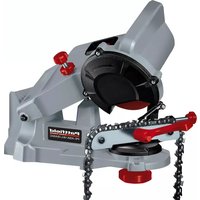
PE-ASK 18 Li Basic - Sharpener Pattfield - Free user manual and instructions
Find the device manual for free PE-ASK 18 Li Basic Pattfield in PDF.


| Product type | Cordless chain sharpener |
| Brand | Pattfield |
| Model | PE-ASK 18 Li Basic |
| Rated voltage | 18 V |
| No-load speed | 6500 /min |
| Max. grinding wheel outer diameter | 108 mm |
| Shaft diameter | 23 mm |
| Grinding wheel thickness | 3,2 mm |
| Upper blade angle adjustment | +35° to -35° |
| Compatible chain types | 1/4", 0.325", 3/8", 0.404" |
| Net weight | 1,75 kg |
| Sound pressure level | 54,1 dB(A) |
| Sound power level | 67,1 dB(A) |
| Max. vibration emissions | < 2,5 m/s² |
| Power supply | Lithium-ion battery 18 V (not included) |
| Main functions | Sharpening of saw chains, interchangeable grinding wheel, precise angle adjustment |
| Maintenance and cleaning | Clean with a soft damp cloth; lubricate parts regularly; replace grinding wheel if worn |
| Safety | Wear goggles, hearing protection, dust mask and gloves |
| Spare parts and repairability | Spare grinding wheel available; repair by HORNBACH customer service |
| Warranty | 3 years |
| Use | Domestic |
Frequently Asked Questions - PE-ASK 18 Li Basic Pattfield
User questions about PE-ASK 18 Li Basic Pattfield
0 question about this device. Answer the ones you know or ask your own.
Ask a new question about this device
Download the instructions for your Sharpener in PDF format for free! Find your manual PE-ASK 18 Li Basic - Pattfield and take your electronic device back in hand. On this page are published all the documents necessary for the use of your device. PE-ASK 18 Li Basic by Pattfield.
USER MANUAL PE-ASK 18 Li Basic Pattfield
Directive machines 2006/42/CE : Directive RoHS 2011/65/UE Directive CEM 2014/30/UE
RoHS Directive 2011/65/EU
Machinevoorbereiding
Sågkedjeparametrar
Maskinförberedelse
PE-ASK 18 batterikedjeslip
tillverkad för
Viečko utiahnite rukou.
We are convinced that this machine will exceed your expectations and wish you joy while using it.
Please read this user manual completely and observe the safety instructions.
Scope of delivery
1x Chain sharpener
1x Vise
If any parts are missing or damaged, please contact your HORNBACH Store.
Table of contents
Scope of Delivery 129
Symbols 129
Safety Instructions 130
Saw chain parameters 134
Machine preparation 135
Battery 135
Product Overview 136
Intended Use 136
Using the machine 136
Grinding wheel replacement 138
Care & Maintenance 139
Troubleshooting 140
Technical Data 141
Noise & Vibration 141
Declaration of conformity 142
Warranty 143
Disposal 144
Symbols

Please read this user manual carefully and keep it for further reference.

Warning of accident and injury to persons and serious damage to property.

Wear safety glasses for protection of your eyes.


Wear hearing protection for protection of your ears.

Wear dust mask for protection of your respiratory tract.

Wear protective gloves for protection of your hands.

Safety instructions
GENERAL POWER TOOL SAFETY WARNINGS

WARNING! When using electric tools basic safety precautions should al-be followed to reduce the risk of fire, sic shock and personal injury includ- e following.
Read all these instructions before attempting to operate this product and safe these instructions.
Safe operation
- Keep work area clear.
- Cluttered work areas and benches invite injuries.
Consider work area environment
- Do not expose tools to rain.
- Do not use tools in damp or wet locations.
- Keep work area well lit.
- Do not use tools in the presence of flammable liquids or gases.
Guard against electric shock
- Avoid body contact with earthed or grounded surfaces (e.g. pipes, radiators, ranges, refrigerators).
Keep other persons away
- Do not let persons, especially children, not involved in the work touch the tool or the extension cord and keep them way from the work area.
Store idle tools
- When not in use, tools should be stored in a dry locked-up place, out of the reach of children.
Do not force the tool
- It will do the job better and safer at the rate for which it was intended.
Use the right tool
- Do not force small tools to do the job of a heavy duty tool.
- Do not use tools for purposes not intended; for example do not use circular saws to cut free limbs or logs.
Dress properly
- Do not wear loos clothing or jewellery, they can be caught in moving parts.
• Non skid footwear is recommended when working outdoors - Wear protective hair covering to contain long hair.
Use protective equipment
- Use safety glasses.
- Use face or dust mask if working operations create dust.
Connect dust extraction equipment
- If the tool is provided for the connection of dust extraction and collection equipment, ensure these are connected and properly used.
Do not abuse the cord
- Never yank the cord to disconnect it from the socket. Keep the cord away from heat, oil and sharp edges.
Secure Workpiece
- When possible use clamps or a vice to hold the work. It is safer than using your hand.
Do not overreach
- Keep proper tooting and balance at all times.
Maintain tools with care
- Keep cutting tools sharp and clean for better and safer performance.
- Follow instruction for lubricating an cleaning accessories.
- Inspect tool cords periodically and if damaged have them repaired by an authorized service facility.
- Inspect extension cords periodically and replace if damaged.
- Keep handles dry, clean and free from oil and grease.
Disconnect tools
- When not in use, before servicing and when cleaning accessories such as blades, bits and cutters, disconnect tools from the power supply.
Remove adjusting keys and wrenches
- Form the habit of checking to see that keys and adjusting wrenches are removed from the tool before turning it on.
Avoid unintentional starting
- Ensure switch is in „off“ position when plugging in.
Use outdoor extension leads
- When the tool is used outdoors, use only extension cords intended for outdoor use and so marked.
Stay alert
- Watch what your are doing, use common sense and do not operate the tool when you are tired.
Check damaged parts
- Check the tool and its protective equipment prior to further use to determine that it will operate properly and perform its intended function.
- Check for alignment of moving parts, binding of moving parts, breakage of parts, mounting and any other conditions that may affect its operation.
- A guard or other part that is damaged should be properly repaired or replaced by an authorized service centre unless otherwise indicated in this instruction manual.
- Have defective switches replaced by an authorized service centre.
- Do not use the tool if the switch does not turn it on and off.
Warning
- The use of any accessory or attachment other than one recommended in this in-
struction manual may present a risk a personal injury.
Have your tool repaired by a qualified person
- The electric tool complies with the relevant safety rules. Repairs should only be carried out by qualified persons using original spare parts. Otherwise this may result in considerable danger to the user.
SAFETY WARNINGS FOR CHAIN SHARPENERS
a) Make sure the speed indicated on the grinding wheel is the same or faster, than the rated speed of the tool.
b) Make sure that the dimensions of the grinding wheel are identical to the rated dimensions of the tool.
c) Grinding wheels must always be installed, used and stored according to the instructions of the manufacturer.
d) Always check the grinding wheel before use. Never use damaged, cracked or aged grinding wheels.
e) Make sure to use the backing layers if they are provided with the grinding wheel.
f) Make sure the grinding wheel is installed according to the instructions.
g) Before using the tool, let the wheel run idle for approx. 30 sec. Stop the tool immediately if the tool vibrates heavily or other faults become apparent.
h) Do not use separate reducer sleeves or adapters to make grinding wheels with larger holes fit properly.
i) Ensure that the tool is securely fastened to a workbench.
j) Take care that the sparks generated during use do not cause any danger, e.g. by hitting persons or igniting inflammable material.
k) The tool runs on after it has been switched off. Wait for the complete stop of the grinding wheel before leaving the tool.
I) Disconnect tool from mains supply. Switch off and wait for the tool to come to a complete standstill before leaving it un-
attended. Unplug the tool when not in use, before servicing or changing accessories.
m) Always use proper accessories and attachments with this tool. The use of any accessory or attachment or performance of any operation with this tool, other than those recommended in this instruction manual may present a risk of personal injury.
n) Check for damaged parts. Before using the tool, carefully check it for damage to ensure that it will operate properly and perform its intended function. Check for misalignment and seizure of moving parts, breakage of parts and any other conditions that may affect its operation. Have damaged guards or other defective parts repaired or replaced as instructed.
o) Never transport or run the tool without all guards in place and in perfect working condition. Guards ensure that the tool can be operated in its most safe condition.
p) Keep your hands well clear off the grinding wheel. The grinding wheel is sharp. Coming in contact with it may cause serious injury.
q) Always use the chain clamp. A secured chain prevents slipping and provides better results.
RESIDUAL RISKS
In spite of the application of the relevant safety regulations and the implementation of safety devices, certain residual risks cannot be avoided. These are:
- Impairment of hearing if not wearing hearing protection.
- Risk of accidents caused by the uncovered parts of the rotating grinding wheel.
- Risk of thrown parts from damaged grinding wheels.
- Risk of thrown workpieces and parts of the workpiece.
- Health hazards caused by breathing in dusts developed during work.
ADDITIONAL SAFETY INSTRUCTIONS ON RISKS DUE TO VIBRATION
a) The declared vibration data represents the
main applications of the appliance, but different uses of the appliance or poor maintenance can result in different vibration data. This may significantly increase the vibration level over the total working period.
b) Additional safety measure shall be taken to protect the user from effects of vibration. Maintain the appliance and its accessories, keep hands warm and organize work patterns and periods.
FOR USE OF BATTERIES
a) Do not open, dismantle, shred or short-circuit batteries. Danger of explosion.
b) Batteries (battery pack or batteries installed) shall not be exposed to excessive heat such as sunshine, fire or the like. Protect from mechanical shock. Keep dry and clean. Keep away from children.
c) Dispose of properly. Pay attention to environmental aspects of battery disposal. Do not dispose of in household waste.
d) Remove batteries when not using the tool for a longer period of time.
e) In case of battery leakage, remove the batteries and clean the battery compartment thoroughly. Avoid contact with eyes and skin.
f) In case of damage and improper use of the battery, Vapours may be emitted. Provide for fresh air and seek medical help in case of complaints. The vapours can irritate the respiratory system.
For safety instructions for the battery charger please refer to the manual of the charger.
For safety instructions for Li-ion batteries please refer to the manual of the battery.

Saw chain parameters
A saw chain is made of repeating segments. A complete segment is shown below, it consists of a left cutter followed by a link and a right cutter followed by a link. Each cutter or link is linked to a guiding element, that keeps the chain on the blade:
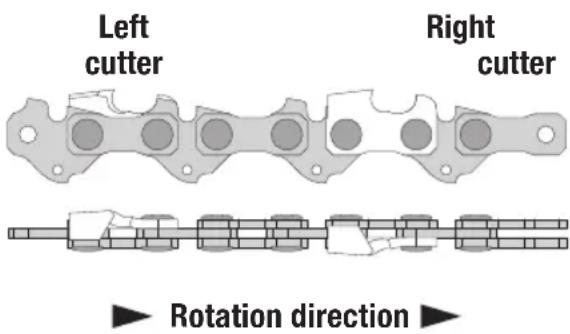
Each cutter consists of a cutting angle A and a top plate angle B. Both of these angles can be sharpened on the chain sharpener. The depth gauge C is filed by hand.
Left cutter
A

Cutting angle Cutting angle
B

Top plate angle Vise angle
C
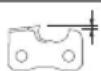
Depth gauge Filed by hand
Right cutter
A

Cutting angle Cutting angle
B

Top plate angle Vise angle
C

Depth gauge Filed by hand

Check the user manual of your chain, saw or saw chain in order to figure the correct grinding angles.
For most chains, the cutting angle A should be between 50°-60° . On this sharpener, the cutting angle is fixed to 60° . The top plate angle B (set on the vise angle scale 10), should be between 30°-35° .
Depth gauge
After the cutters have been sharpened, ensure that the depth gauge is respected. The depth gauge has to be lower than the cutters. Check the depth gauge of your chain in the saw chain specifications. If necessary, file the depth gauge using a file with file guide (not included).
For most chains, the depth gauge C is 0.025" - 0.050" or 0.64 mm - 1.28 mm.
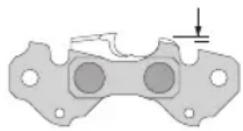
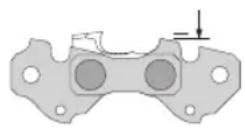
The saw chain is worn out and cannot be sharpened if the depth gauge C is at the same level as the indicator on the guiding element:
Sharpable NOT sharpable
Machine preparation
Check if an undamaged and round profiled grinding wheel is installed. If necessary, use a trimming stone (not included) to give the grinding wheel a smooth round shape.
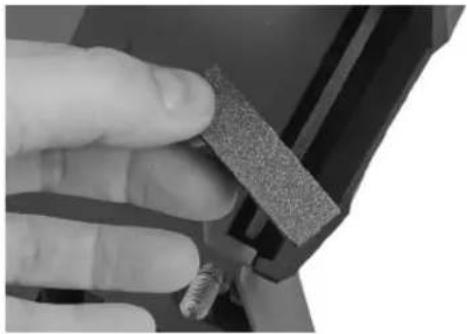
If an other grinding wheel needs to be installed, follow the instructions given in 'Grinding wheel replacement'.
Battery (not included)
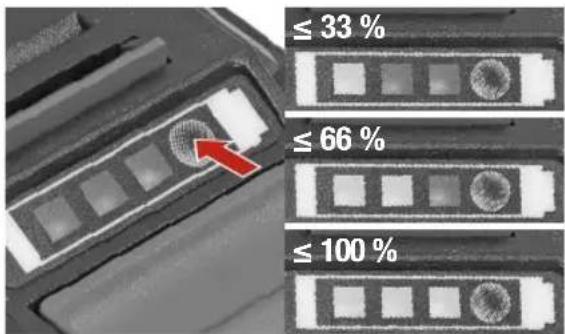
STATE OF CHARGE
Press the button to check the state of charge on LED indicator. To charge consult the user manual of the charger.
Product overview
1 Handle
2 Machine head
3 Guard
4 Grinding wheel
5 Chain stopper screw
6 Chain stopper
7 Chain lock lever
8 Chain bar
9 Vise
10 Vise angle scale
11 Vise lock knob
12 ON/OFF Switch
13 Cutting depth screw
14 Battery slot
15 Machine base
16 Table mount
Intended use
The machine is intended for sharpening chain-saw chains specified in technical data.
Any other use or modification to the machine is considered as improper use and could cause considerable dangers.
The tool is not intended for commercial use.
Using the machine

Caution! Make sure the grinding wheel has a smooth round shape.
- Take the steps S1-S8.
- Raise the machine head 2.
- Turn the ON/OFF switch 12 to I (on) to switch on the tool.
- Wait until the grinding wheel has reached full speed.
- Slowly lower the machine head 2 and sharpen the first right cutter.
- Raise the machine head 2.
- Loosen the chain lock lever 7 and pull the chain until the next right cutter appears (every two cutters).
- Pull the chain to the left against the chain stopper 6 and tighten the chain lock lever 7. Slowly lower the machine head 2 and sharpen the remaining right cutters with this adjustment.
- Once all right cutters are sharpened, press the ON/OFF switch 12 to 0 (off) to switch the machine off.
- To sharpen the left cutters, take the steps S3-S8, but set the top plate angle B on the vise in the opposite direction.
- Take the steps 2.-9. from these instructions in order to sharpen the left cutters.
ASSEMBLY
1 Install the machine base 15 to a level and stable work surface, using suitable screws and washers (not included).
2 Install the vise 9 to the machine base 15, removing and reinstalling the vise lock knob 11.

Loosen vise knob
S1 To set the required vise angle, loosen the vise lock knob 11.
Caution! Make sure the appliance is switched off and the battery is re-
S3 Raise the chain stopper 6 of the machine vise 9.
Raise chain stopper
S2 Set the desired top plate angle at the vise angle scale 10. Tighten the vise lock knob 11.
S4 Insert the saw chain into the chain bar 8. The rotation direction is from left to right.
Caution! The saw chain is sharp, make sure to wear protective gloves.
Lower chain stopper
S5 Lower the chain stopper 6 and pull the saw chain to the right until a right cutter is centric on the vise 9. Pull the saw chain to the left until the cutter engages at the chain stopper 6.
Lock chain
S6 Carefully lower the grinding wheel 4 behind a right cutter. Use the chain stopper screw 5 to set the required distance between cutter and grinding wheel 4.
If the proper distance is set on the chain stopper screw 5 lock it with the counter nut. Tighten the chain lock lever 7 to lock the chain in place.
S8 With the grinding wheel still lowered, set the required cutting depth on the cutting depth screw 13 and lock it with the counter nut.
3 Insert a charged battery (not included) into the battery slot 14 until it clicks into place.
To remove the battery, press its release button and pull it out.
Set top plate angle / B
Grinding wheel replacement

Warning! Make sure the appliance is switched off and the battery is removed.

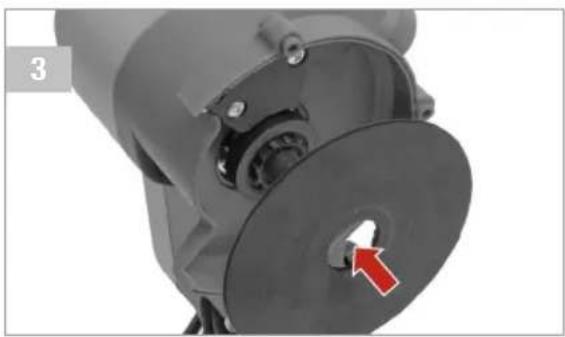
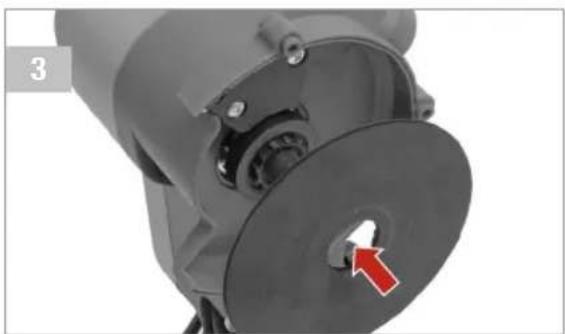
Use a screwdriver to remove the three screws holding the guard and remove the guard.
Reinstall the cap to hold the grinding wheel in place.
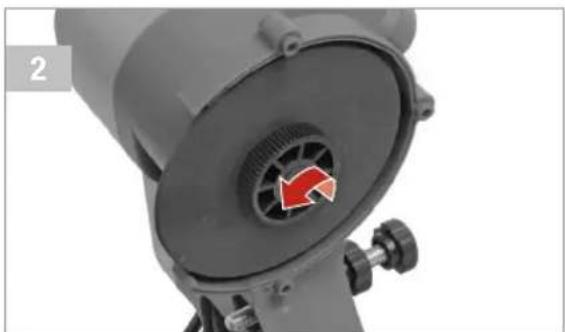
Remove the cap holding the grinding wheel and remove the grinding wheel.
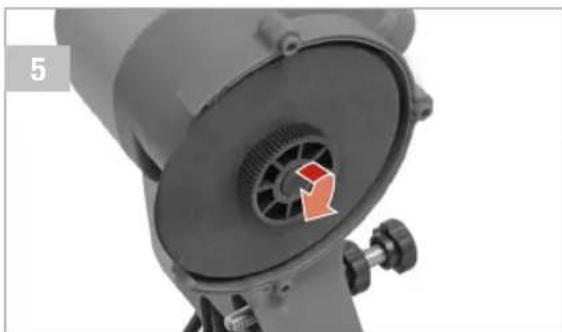
Hand tighten the cap.
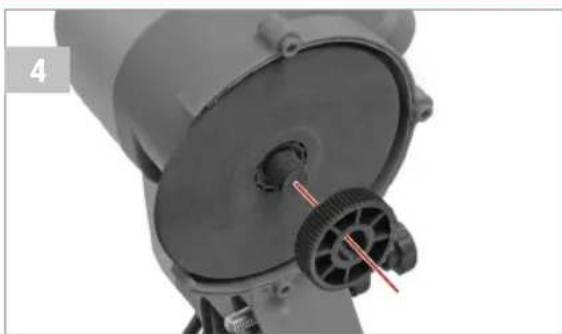
Place a new grinding wheel on the spindle of the chain sharpener.
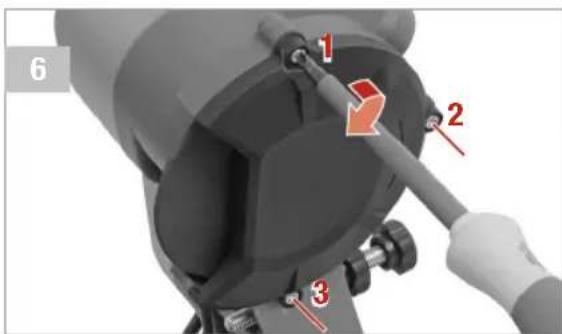
Use a screwdriver to reinstall the guard at its three mounting positions.
Care & Maintenance

Warning! Make sure the appliance is switched off and the battery is re-
moved.
- Always keep the machine clean, dry and free of oil or grease.
- Wear safety glasses and gloves to protect your eyes and hands whilst cleaning.
- For safe and proper working, always keep the machine and ventilation slots clean.
- Regularly check for obvious defects and/or damaged components.
- Periodically check all fixings. These could become loose with time due to vibration.
- The most used part is the grinding wheel. Inspect the grinding wheel regularly. If the grinding wheel is worn or blunt, it must be replaced immediately.
- Replace any worn or damaged parts.
- If the body of the machine needs cleaning, wipe it with a brush or a soft damp cloth. A mild detergent can be used but nothing like alcohol, petrol or other cleaning agent.
- Never use caustic agents to clean plastic parts.
- Lubricate all moving parts at regular intervals by use of the grease.
- Store the machine in a dry place and out of the reach of children.
Troubleshooting

Warning! Make sure the appliance is switched off and the battery is removed. Always wear protective gloves.
Problem Possible cause Remedy
| Motor does not run The battery is empty Recharge the battery | ||
| Power turned off Turn power on | ||
| Strong vibration of the machine | The sharpener is not properly installed | Properly install the sharpener to a level and stable surface |
| The vise is not properly installed to the machine base | Properly install the vise to the machine base | |
| The grinding wheel is not properly installed | Properly install the grinding wheel | |
Technical Data
Type Chain sharpener
Nominal voltage 18 V
No-load speed ( n0 ) 6500/min
Grinding wheel arbour ø 23 mm
Grinding wheel outer ∅ max. 108 mm
Grinding wheel thickness 3.2 mm
Top blade angle adjustment + 35° to - 35°
Chain types suitable for sharpening 1/4" - 0.325" - 3/8" - 0.404"
Net weight 1.75 kg
Sound pressure level ( LpA ) 54.1 dB(A) /
Uncertainty K = 3 dB(A)
Measured sound power level ( LWA ) 67.1 dB(A) /
Uncertainty K = 3 dB(A)
Max. vibration emission ( ah ) < 2.5 m/s 2 Uncertainty K = 1.5 m/s 2
Please observe the article number on the type plate of the machine. The trade names of the individual machine may vary.
Noise & Vibration
The values given in these instructions have been measured in accordance with a standardized measurement procedure specified in EN 61029 and can be used to compare tools. The declared vibration total value may also be used in a preliminary assessment of exposure.
Try to keep vibration stress to a minimum. Measures to reduce vibrations including wearing gloves when using the tool and limiting the working time. In this process, all segments of the operating cycle must be taken into account (for instance times during which the electric tool has been switched off as well as periods during which it is on, but not running under load).

Warning! The vibration emission during actual use can differ from the ed total value depending on the use machine.
Declaration of Conformity
CE We declare, that the products described in Technical Data:

PE-ASK 18 Battery Chain Sharpener
manufactured for:
is in conformity with the following directives:
Machinery Directive 2006/42/EC: RoHS Directive 2011/65/EU EMC Directive 2014/30/EU
and in accordance to the following applicable harmonized standards:
EN 61029-1:2009+A11 EN ISO 12100:2010 EN 55014-1:2006+A1+A2 EN 55014-2:1997+A1+A2 EN 61000-3-2:2014 EN 61000-3-3:2014
A. Judas Faulk
Andreas Back Head of Quality Management, environment & CSR Person authorised to compile the technical file
This Pattfield item has been produced according to state-of-the-art production methods and is subject to ongoing strict quality control. Hornbach Baumarkt AG, Hornbachstrasse 11, 76879 Bornheim, Germany, guarantees the quality of the machines according to the following terms and conditions.
1. Warranty Period
The warranty period is 3 years. The warranty period starts on the date of purchase. Please retain the original receipt or invoice in order to be able to furnish evidence of the date of purchase.
2. Warranty Scope
The warranty applies exclusively to production or material defects. The warranty applies only in the case of private use of the item.
The warranty does not apply to defects resulting from
- misuse or improper use,
- use of force or external influences,
- damage due to failure to observe the installation instructions or instructions for use,
- connecting to an incorrect grid voltage or current type,
• unprofessional installation,
• overloading the device, - use of non-approved attachments or accessories,
- failure to observe the maintenance and safety instructions,
- entry of foreign matter into the device,
- wear and tear due to normal use or
- commercial use.
Furthermore, the warranty does not cover damage to parts subject to wear and tear, which is caused by normal wear and tear. The warranty does not comprise any collateral or consequential damage or possible installation and dismantling costs in the event of a warranty incident.
3. Warranty Services
During the warranty period, the warrantor will inspect the defective item in order to determine whether a warranty incident is on hand. If a warranty incident is on hand, the warrantor will repair or replace the item at his own expense. If the item is no longer available at the time of the warranty incident, the warrantor may replace the item with a similar product. The replaced item or part shall become property of the warrantor.
Warranty services (repair or replacement) do not extend the warranty period. Warranty services do not result in any new warranty.
4. Warranty Claims
For warranty claims, please contact the nearest HORNBACH DIY store.
You can find it at www.hornbach.com.
Warranty claims will only be accepted if the original receipt or invoice is produced.
5. Statutory Rights
The warranty does not restrict your statutory rights regarding warranty and product liability.
Waste disposal
The crossed-out wheeled bin logo requires the separate collection of waste electric and electronic equipment (WEEE). Such equipment may contain dangerous and hazardous substances. These tools must be returned to a designated collection point for the recycling of WEEE and must not be disposed as unsorted municipal waste. In this way, you contribute to protection of resources and the environment. Contact your local authorities for more information.
Children must not play with plastic bags and packaging material, due to possible injury or danger of suffocation. Store such material safely or dispose of environmentally friendly.
Remove used batteries from the device and correctly dispose of them. Battery selling stores and municipal collection points offer special containers for battery disposal.




- MACHINEVOORBEREIDING
- SÅGKEDJEPARAMETRAR
- MASKINFÖRBEREDELSE
- SCOPE OF DELIVERY
- TABLE OF CONTENTS
- SYMBOLS
- SAFETY INSTRUCTIONS
- GENERAL POWER TOOL SAFETY WARNINGS
- SAFE OPERATION
- CONSIDER WORK AREA ENVIRONMENT
- GUARD AGAINST ELECTRIC SHOCK
- KEEP OTHER PERSONS AWAY
- STORE IDLE TOOLS
- DO NOT FORCE THE TOOL
- USE THE RIGHT TOOL
- DRESS PROPERLY
- USE PROTECTIVE EQUIPMENT
- CONNECT DUST EXTRACTION EQUIPMENT
- DO NOT ABUSE THE CORD
- SECURE WORKPIECE
- DO NOT OVERREACH
- MAINTAIN TOOLS WITH CARE
- DISCONNECT TOOLS
- REMOVE ADJUSTING KEYS AND WRENCHES
- AVOID UNINTENTIONAL STARTING
- USE OUTDOOR EXTENSION LEADS
- STAY ALERT
- CHECK DAMAGED PARTS
- WARNING
- HAVE YOUR TOOL REPAIRED BY A QUALIFIED PERSON
- SAFETY WARNINGS FOR CHAIN SHARPENERS
- RESIDUAL RISKS
- ADDITIONAL SAFETY INSTRUCTIONS ON RISKS DUE TO VIBRATION
- FOR USE OF BATTERIES
- FOR SAFETY INSTRUCTIONS FOR THE BATTERY CHARGER PLEASE REFER TO THE MANUAL OF THE CHARGER
- SAW CHAIN PARAMETERS
- LEFT CUTTER
- RIGHT CUTTER
- DEPTH GAUGE
- SHARPABLE NOT SHARPABLE
- MACHINE PREPARATION
- BATTERY (NOT INCLUDED)
- STATE OF CHARGE
- PRODUCT OVERVIEW
- INTENDED USE
- USING THE MACHINE
- ASSEMBLY
- LOOSEN VISE KNOB
- RAISE CHAIN STOPPER
- LOWER CHAIN STOPPER
- LOCK CHAIN
- SET TOP PLATE ANGLE / B
- GRINDING WHEEL REPLACEMENT
- CARE & MAINTENANCE
- TROUBLESHOOTING
- TECHNICAL DATA
- NOISE & VIBRATION
- DECLARATION OF CONFORMITY
- WARRANTY PERIOD
- WARRANTY SCOPE
- WARRANTY SERVICES
- WARRANTY CLAIMS
- STATUTORY RIGHTS
- WASTE DISPOSAL
Brand : Pattfield
Model : PE-ASK 18 Li Basic
Category : Sharpener