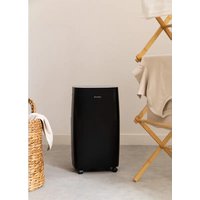
Dryplus XL-Spiral - Dehumidifier Create - Free user manual and instructions
Find the device manual for free Dryplus XL-Spiral Create in PDF.


| Product Type | Dehumidifier |
| Brand | Create |
| Model | Dryplus XL-Spiral |
| Refrigerant | R290 (flammable) |
| Dehumidification Power | Set at 30°C and 80% RH |
| Operating Temperature Range | 7 °C to 35 °C |
| Maximum Relative Humidity | 80% |
| Hygrometer Setting | 40% to 80% in 5% steps |
| Timer | 1 to 12 hours (automatic on/off) |
| Fan Speed | High and low (adjustable in dry mode) |
| Operating Modes | Dehumidification and dry |
| Special Functions | Auto defrost, sleep mode, child lock, continuous drain possible |
| Tank Capacity | Not specified (with tank full sensor) |
| Maintenance | Clean the air filter regularly, clean the housing with a soft damp cloth |
| Safety Precautions | Indoor use only, avoid heat sources, minimum distance of 20 cm around the unit, do not obstruct grilles |
| Main Spare Parts | Top panel, control panel, water tank, air filter, swivel casters |
| Power Supply | Plug-in power cord (details not provided) |
Frequently Asked Questions - Dryplus XL-Spiral Create
User questions about Dryplus XL-Spiral Create
0 question about this device. Answer the ones you know or ask your own.
Ask a new question about this device
Download the instructions for your Dehumidifier in PDF format for free! Find your manual Dryplus XL-Spiral - Create and take your electronic device back in hand. On this page are published all the documents necessary for the use of your device. Dryplus XL-Spiral by Create.
USER MANUAL Dryplus XL-Spiral Create
Security instructions 6
Features 8
Parts list 8
Control panel 9
Operating instructions 9
Draining the collected water 10
Emptying the drainage tank 10
Continuous water drainage 11
Maintenance and cleaning 11
Storing the dehumidifier 11
Clearance 12
Note for maintenance work 12
Troubleshooting 17
PORTUGUES
Thank you for choosing our dehumidifier. Before using the appliance, and to ensure the best use, carefully read these instructions.
The safety precautions enclosed herein reduce the risk of death, injury and electrical shock when correctly adhered to. Keep the manual in a safe place for future reference, along with the completed warranty card, purchase receipt and package. If applicable, pass these instructions on to the next owner of the appliance. Always follow basic safety precautions and accident-prevention measures when using an electrical appliance. We assume no liability for customer failing to comply with these requirements.
SECURITY INSTRUCTIONS
When using any electrical appliance, basic safety precautions should always be observed.
- Unplug the power supply cord before cleaning or storage.
- The appliances can be used indoor but not in laundry rooms.
- Do not set the unit close to heat-generating devices or near flammable and dangerous materials.
- Never put your fingers or objects into the intake or discharge ducts.
- Do not sit or stand on the unit.
- Discard water that has collected in the tank as required.
- Do not operate the dehumidifier in a closed area such as inside a closet, as it may cause a fire.
- Do not use the unit near edible items, objects of art, or scientific materials.
- Install drain piping at a downhill grade to make sure that condensed water can be drained continuously.
- If the power supply cord is damaged it must be replaced by the manufacture or a similarly qualified person in order to avoid a hazard.
- The appliance must be positioned so that the plug is accessible.
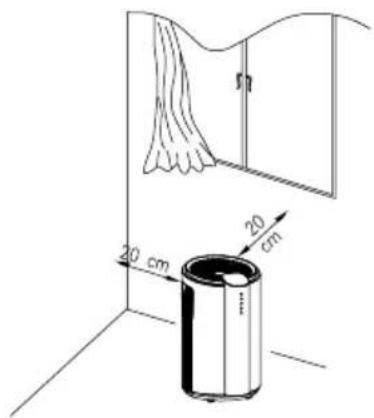
- Please keep a distance 20cm around the unit and the wall or other objects to ensure air circulation.
- The appliance shall be installed in accordance with local national wire regulations.
- The appliance can not be used in public transportation.
- This appliance can be used by children aged from 8 years and above and persons with reduced physical, sensory or mental capabilities or lack of experience and knowledge if they have been given supervision or instruction concerning use of the appliance in a safe way and understand the hazards involved. Children shall not play with the appliance. Cleaning and user maintenance shall not be made by children without supervision.
- Children should be supervised to ensure that they do not play with the appliance.
-
Appliances that are obviously damaged must not be operated.
-
Do not use means to accelerate the defrosting process or other than those recommended by the manufacturer.
- The appliance shall be stored in a room without continuously operating ignition sources (for example: open flames, an operating gas appliance or an operating electric heater).
- Do not pierce or burn.
- Be aware that refrigerants may not contain an odour.
- Appliance shall be installed, operated and stored in a room with a floor area larger than 5m^2
- The appliance shall be in compliance with national gas regulations.
Servicing shall be performed only as recommended by the manufacturer. - The appliance shall be stored so as to prevent mechanical damage from occurring.
- Any person who is involved with working on or breaking into a refrigerant circuit should hold a current valid certificate from an industry-accredited assessment authority, which authorises their competence to handle refrigerants safely in accordance with an industry recognised assessment specification.
- Servicing shall only be performed as recommended by the equipment manufacturer. Maintenance and repair requiring the assistance of other skilled personnel shall be carried out under the supervision of the person competent in the use of flammable refrigerants.
- Appliance is filled with flammable gas R290.
- Any repairs you need, contact the nearest authorized Service Centre and strictly follow manufacturer's instruction only.
- It is prohibited to dispose of this appliance in domestic household waste. For disposal there are several possibilities:
- Do not dispose this product as unsorted municipal waste. Collection of such waste separately for special treatment is necessary.
- The municipality has established collection systems, where electronic waste can be disposed of at least free of charge to the user.
- The manufacturer will take back the old appliance for disposal at least free of charge to the user.
- Wild disposal of waste in forests and landscapes endangers your health when hazardous substances leak into the ground or water and find their way into the food chain.
The dehumidification capacity is rated at a room temperature of 30^ with a relative humidity of 80% . - The operational temperature is in the range of 7^ to 35^ and max relative humidity of 80% . If the room temperature is outside of this range, the unit will not operate normally. GWP value of R290 gas refrigerant is 3.
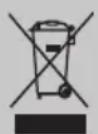
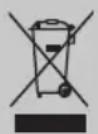
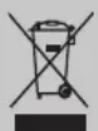
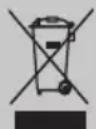
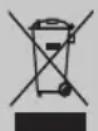
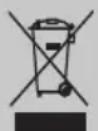
Meaning of crossed out wheeled dustbin: Do not dispose of electrical appliances as unsorted municipal waste,use separate collection f lilies(contact you local government for information regarding the col- lection systems available.If electrical appliances are disposed of in landfills of dumps. Hazardous substances can leak into the groundwater and get into the foodchain,damaging your health and well-being. This marking indicates that this product should not be disposed with other household wastes throughout the EU. To prevent possible harm to the environment or human health from uncontrolled waste disposal, recycle it responsibly to promote the sustainable reuse of material resources. To return your used device, please use the return and collection systems or contact the retailer where the product was purchased. They can take this product for environmental safe recycling.
FEATURES
- Powerful Dehumidifying Capability: Taking advantage of refrigeration technology, the dehumidifier powerfully removes moisture from the air to decrease the humidity level of the room and keep the indoor air dry and comfortable.
- Lightweight Portable Design: The dehumidifier is built to be compact and lightweight. The casters on the bottom of the unit make it easy to move from room to room.
- Low Temperature Operation with Automatic Defrost: When the unit is running in a room temp. between 5^ and 12^ , it will be stop to defrost for every 30 minutes. When the unit is running in a room temp between 12^ and 20^ , it will be stop to defrost for every 45 minutes.
- Adjustable Humidistat: Adjust the desired humidity level by the humidistat.
- Timer On/Off: Program the unit to turn on and off automatically.
- Quiet Operation: The dehumidifier operates with a low noise level.
- Energy Efficient: The power consumption of the unit is low.
PARTS LIST
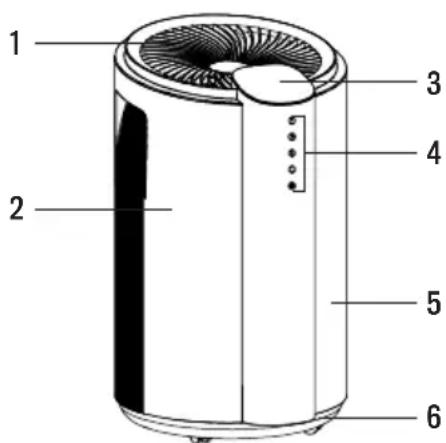
- Top panel
2.Left shell - Display screen
-
Control panel
-
Right shell
- Base plate
- Power cord
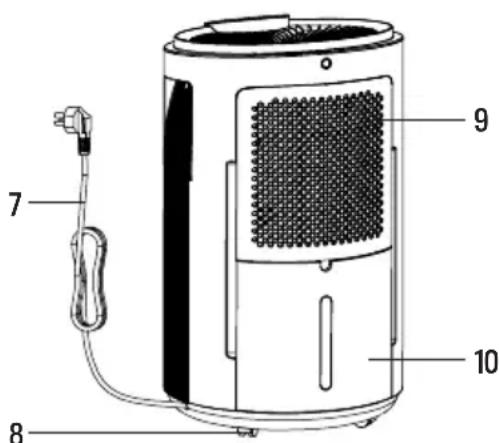
- Caster wheels
9.Filter box -
Water tank
-
Power
- Timer
- Humidity settings
- Mode settings
- Fan speed
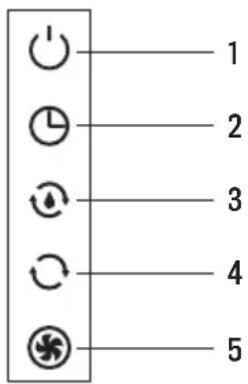
Humidity level and timer display
The indicator features 3 functions:
- When the unit is plugged in, it will indicate the room humidity level for 3 seconds.
- When you set the humidity, it will indicate the humidity that you have selected.
-
When you programme the time for the unit to turn on and off, it will show the time.
-
When the environment humidity is lower than 35% , the display will show 35.
- When the environment humidity is higher than 95% , the display will show 95.
Automatic defrost function
- The defrost indicator will automatically turn orange when the defrost function is activated. After this function is finished, the indicator will turn off.
OPERATING INSTRUCTIONS
- The buzzer will alarm when the unit starts, the display will show the room humidity for 3 seconds, then the display will automatically switch off.
- Press the power button once to start operation. Press it again to stop it. The unit is set into Dehumidifying mode
- Press the power button for 3-5 seconds and the Child-Protection Key Lamp will switch on. All the other buttons will not work then. Press the power button for 3-5 seconds again and then the child-protection key will switch off.
- Press the fan speed button to set it on high / low, and the fan speed lamp will turn on. Press the fan speed button for 3-5 seconds to set the sleep mode. The fan speed will change to low. The display will show the sleep lamp only after 10 seconds.
- The sleep function can only be set under the dehumidifying mode, the humidity can be set between 55-60-65%.
- The fan speed can be adjusted under the dry mode, when the room humidity is more than 55% . The fan speed will be set in high speed. If the room humidity is under 50% , the fan speed is set low.
- Between 50-55%, the fan speed will be adjusted into high / low automatically.
- Press the humidity settings button to adjust the humidity. The default humidity is set as 40% in the dehumidifying mode.
-
Press the humidity settings button to adjust the humidity from 40 to 80% , every setting is 5% , the display will show the humidity setting when adjusting.
-
After a period of working, when the environment humidity is lower than the selected humidity by 2% , the compressor will stop. When the environment humidity is equal to or higher than the selected humidity by 2% , the compressor will restart once the 3-minute compressor protection time is over.
- The humidity can not be adjusted in dry mode, the programmed humidity set is 30% under dry mode.
- Press the timer button to set the auto turn-on time when the unit is in stand-by mode and switched on, the display will show the time set from 1 to 12 hours, so the unit will auto turn on after the time set.
- Press the timer button to set the auto turn-off time when the unit is in working function, the display will show the time set from 1 to 12 hours, so the unit will auto turn off after the time set.
- If the unit is turned on or off manually or it is under water tank full mode, then the auto turn on / off function will be cancelled.
- Press the mode setting button to adjust the working mode between the dehumidifying and dry mode.
DRAINING THE COLLECTED WATER
When the drainage tank is full, the water full tank indicator light will blink and the compressor will stop working and becomes fan only. The buzzer will beep to alert the user that the water needs to be emptied from the drainage tank.
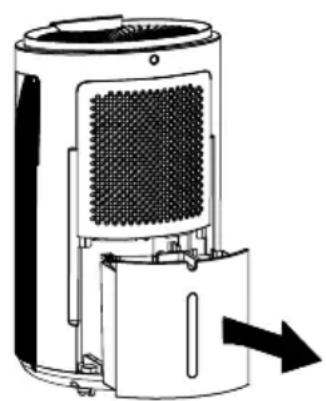
EMPTYING THE DRAINAGE TANK
- Lightly press on the sides of the tank with both hands and pull the tank out gently.
- Discard the collected water.
NOTE:
- Do not remove the float from the water tank. The water full sensor will no longer be able to detect the water level correctly without the float and water may leak from the water tank.
- If the drainage tank is dirty, wash it with cold or lukewarm water. Do not use detergent, scouring pads, chemically treated dust cloths, gasoline, benzene, thinner, or other solvents, as these can scratch and damage the tank and cause water leakage.
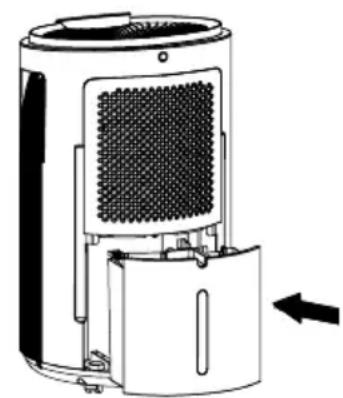
- When replacing the drainage tank, press the tank firmly into place with both hands. If the tank is not positioned properly, the "water tank full" sensor will be activated, and the dehumidifier will not work.
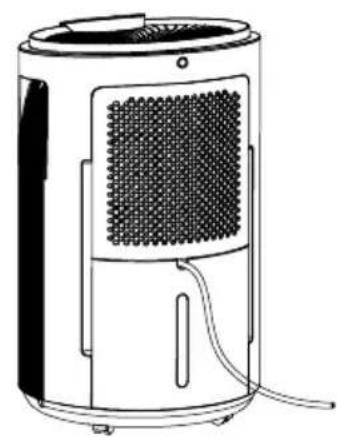
CONTINUOUS WATER DRAINAGE
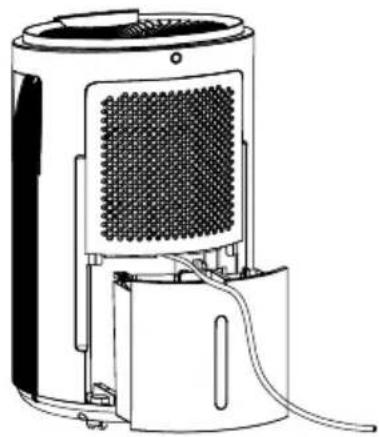
- The unit features a continuous drainage port. Using a plastic pipe (with an inner diameter of 10mm ) insert it into the drain hole (on intermediate plate), reach out from the side of the water tank, install it in place, and arrange the drain pipe.
- The water in the drainage tank can be continuously drained out from the continuous port on the unit.
MAINTENANCE AND CLEANING
To clean the Body:
- Wipe it with a soft damp cloth.
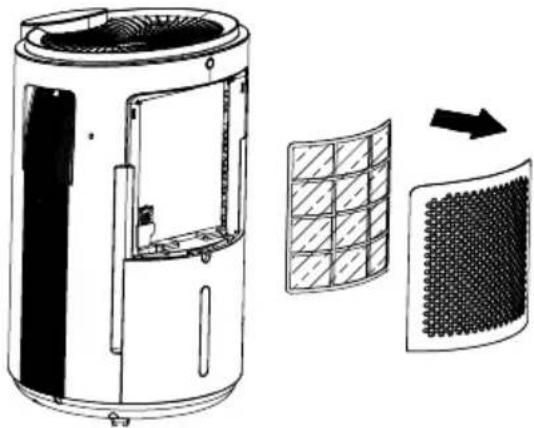
To Clean the Air Filter:
- Open the inlet grill firstly and remove the air filter.
- Run a vacuum cleaner lightly over the surface of the air filter to remove dirt. If the air filter is exceptionally dirty, wash it with warm water and a mild cleanser and dry thoroughly.
- Insert the filter into the grill smoothly, and place the inlet grill into right place.
STORING THE DEHUMIDIFIER
When the unit is not being used for a long period of time and you want to store it note the following steps:
- Empty any water left in the drainage tank.
- Fold up the power supply cord and put it in the water tank.
- Clean the air filter
- Store in a cool and dry place.
CLEARANCE
Maintain a minimum clearance space around the dehumidifier when the unit is working as shown in the following drawing:
NOTE FOR MAINTENANCE WORK
1. CHECKS TO THE AREA
Prior to beginning work on systems containing flammable refrigerants, safety checks are necessary to ensure that the risk of ignition is minimised. For repair to the refrigerating system, the following precautions shall be complied with prior to conducting work on the system.
Work procedure: Work shall be undertaken under a controlled procedure so as to minimise the risk of a flammable gas or vapour being present while the work is being performed.
2. GENERAL WORK AREA
All maintenance staff and others working in the local area shall be instructed on the nature of work being carried out. Work in confined spaces shall be avoided. The area around the workspace shall be sectioned off. Ensure that the conditions within the area have been made safe by control of flammable material.
3.CHECKING FOR PRESENCE OF REFRIGERANT
The area shall be checked with an appropriate refrigerant detector prior to and during work, to ensure the technician is aware of potentially flammable atmospheres. Ensure that the leak detection equipment being used is suitable for use with flammable refrigerant, i.e.nonsparking, adequately sealed or intrinsically safe.
4.PRESENCE OF FIRE EXTINGUISHER
If any hot work is to be conducted on the refrigeration equipment or any associated parts, appropriate fire extinguishing equipment shall be available to hand. Have a dry powder or CO2 fire extinguisher adjacent to the charging area.
5.NO IGNITION SOURCES
No person carrying out work in relation to a refrigerant system which involves exposing any pipe work that contains or has contained flammable refrigerant shall use any sources of ignition in such a manner that it may lead to the risk of fire or explosion. All possible ignition sources, including cigarette smoking, should be kept sufficiently far away from the site of installation, repairing, removing and disposal, during which flammable refrigerant can possibly be released to the surrounding space. Prior to work taking place, the area around the equipment is to be surveyed to make sure that there are no flammable hazards or ignition risks."No Smoking"signs shall be displayed.
6.VENTILATED AREA
Ensure that the area is in the open or that it is adequately ventilated before breaking into the system or conducting any hot wok. A degree of ventilation shall continue during the period that the work is carried out. The ventilation should safely disperse any released refrigerant and preferably expel it externally into the atmosphere.
7.CHECKS TO THE REFRIGERATION EQUIPMENT
Where electrical components are being changed, they shall be fit for the purpose and to the correct specification. At all times the manufacturer's maintenance and service guidelines shall be followed. If in doubt consult the manufacturer's technical department for assistance.
The following checks shall be applied to installations using flammable refrigerants:
- The charge size in accordance with the room size within which the refrigerant containing parts are installed;
- The ventilation machinery and outlets are operating adequately and are not obstructed.
8.CHEKS TO ELECTRICAL DEVICES
Repair and maintenance to electrical components shall include initial safety checks and components inspection procedures. If a fault exists that could compromise safety, then no electrical supply shall be connected to the circuit until it is satisfactorily dealt with. If the fault cannot be corrected immediately but it is necessary to continue operation, an adequate temporary solution shall be used. This shall be reported to the owner of the equipment so all parties are advised.
Initial safety checks shall include:
- That capacitors are discharged: this shall be done in a safe manner to avoid possibility of sparking:
- That there no live electrical components and wiring are exposed while charging, recovering or purging the system:
- That there is continuity of earth bonding
9.REPAIRS TO SEALED COMPONENTS
During repairs to sealed components, all electrical supplies shall be disconnected from the equipment being worked upon prior to any removal of sealed covers,etc.
If it is absolutely necessary to have an electrical supply to equipment during servicing, then a permanently operating form of leak detection shall be located at the most critical point to warn of a potentially hazardous situation.
Particular attention shall be paid to the following to ensure that by working on electrical components, the casing is not altered in such a way that the level of protection is affected. This shall include damage to cables, excessive number of connections, terminals not made to original specification, damage to seals, incorrect fitting of glands,etc.
Ensure that apparatus is mounted securely.
Ensure that seals or sealing materials have not degraded such that they no longer serve the purpose of preventing the ingress of flammable atmospheres, Replacement parts shall be in accordance with the manufacturer's specifications.
NOTE: The use of silicon sealant may inhibit the effectiveness of some types of leak detection equipment. Intrinsically safe components do not have to be isolated prior to working on them.
10.REPAIR TO INTRINSICALLY SAFE COMPONENTS
Do not apply any permanent inductive or capacitance loads to the circuit without ensuring that this will not exceed the permissible voltage and current permitted for the equipment in use.
Intrinsically components are the only types that can be worked on while live in the presence of a flammable atmosphere. The test apparatus shall be at the correct rating.
Replace components only with parts specified by manufacturer. Other parts may result in the ignition of refrigerant in the atmosphere from a leak.
11.CABLING
Check that cabling will not be subject to wear, corrosion, excessive pressure, vibration, sharp edges or any other adverse environmental effects. The check shall also take into account the effects of aging or continual vibration from sources such as compressors or fans.
12.LEAKAGE DETECTION FOR FLAMMABLE REFRIGERANTS
Under no circumstances shall potential sources of ignition be used in the searching for or detection of refrigerant leaks. A halide torch (or any other detector using a naked flame) shall not be used.
13.LEAK DETECTION METHODS
The following leak detection methods are acceptable for systems containing flammable refrigerant.
Electronic leak detectors shall be used to detect flammable refrigerants, but the sensitivity may not be adequate, or may need recalibration (Detection equipment shall be calibrated in a refrigerant-free area.) Ensure that detector is not a potential source of ignition and is suitable for the refrigerant used.
Leak detection fluids are suitable for use with most refrigerants but the use of detergents containing chlorine shall be avoided as the chlorine may react with the refrigerant and corrode the copper pipe-work.
If a leak is suspected, all naked flames shall be removed/extinguished.
If a leak of refrigerant is found which requires brazing, all of the refrigerant shall be recovered from the system. Oxygen free nitrogen (OFN) shall then be purged through the system both before and during the brazing process.
14.REMOVAL AND EVACUATION
When breaking into the refrigerant circuit to make repairs-or for any other purpose-conventional procedures shall be used. However, it is important that best practice is followed since Flammability is a consideration. The following procedure shall be adhered to:
- Remove refrigerant;
- Purge the circuit with inert gas;
Evacuate; - Purge again with inert gas;
- Open the circuit by cutting or brazing.
The refrigerant charge shall be recovered into the correct recovery cylinders. The system shall be "flushed" with OFN to render the unit safe. This process may need to be repeated several times. Compressed air or oxygen shall not be used for this task.
Flushing shall be achieved by breaking the vacuum in the system with OFN and continuing to fill until the working pressure is achieved, then venting to atmosphere, and finally pulling down to a vacuum. This process shall be repeated until no refrigerant is within the system.
When the final OFN charge is used, the system shall be vented down to atmospheric pressure to enable work to take place.
This operation is absolutely vital if brazing operations on the pipe-work are to take place. Ensure that the outlet for the vacuum pump is not close to any ignition sources and there is ventilation available.
15.REFRIGERANT CHARGING PROCEDURES
In addition to conventional charging procedures, the following requirements shall be followed.
Ensure that contamination of different refrigerants does not occur when using charging equipment. Hoses or lines shall be as short as possible to minimise the amount of refrigerant contained in them.
- Cylinders shall be kept upright.
- Ensure that the refrigeration system is earthed prior to charging the system with refrigerant.
- Label the system when charging is complete (if not already).
- Extreme care shall be taken not to overfill the refrigeration system.
Prior to recharging the system it shall be pressure tested with OFN. The system shall be leak tested on completion of charging but prior commissioning. A follow up leak test shall be carried out prior to leaving the site.
16.DECOMMISSIONING
Before carrying out this procedure, it is essential that technician is completely familiar with the equipment and all its detail. It is recommended good practice that all refrigerants are recovered safely. Prior to the task being carried out, an oil and refrigerant sample shall be taken in case analysis is required prior to reuse of reclaimed refrigerant. It is essential that electrical power is available before the task is commenced.
- Become familiar with the equipment and its operation.
- Isolate system electrically.
- Before attempting the procedure ensure that: mechanical handling equipment is available, if repaired, for handling refrigerant cylinders; all personal protective equipment is available and being used correctly; the recovery process is supervised at all times by a competent person; recovery equipment and cylinders conform to the appropriate standards.
- Pump down refrigerant system, if possible.
- If a vacuum is not possible, make a manifold so that refrigerant can be removed from various parts of the system.
- Make sure that cylinder is situated on the scales before recovery takes place.
- Start the recovery machine and operate in accordance with manufacturer's instructions.
- Do not overfill cylinders (No more than 80% volume liquid charge).
- Do not exceed the maximum working pressure of the cylinder, even temporarily.
- When the cylinders have been filled correctly and the process completed, make sure that the cylinders and the equipment are removed from site promptly and all isolation valves on the equipment are closed off.
- Recovered refrigerant shall not be charged into another refrigeration system unless it has been cleaned and checked.
17.LABELING
Equipment shall be labeled stating that it has been decommissioned and emptied of refrigerant. The label shall be dated and signed. Ensure that there are labels on the equipment stating the equipment contains flammable refrigerant.
18.RECOVERY
When removing refrigerant from a system, either for servicing or decommissioning, it is recommended good practice that all refrigerants are removed safely.
When transferring refrigerant into cylinders, ensure that only appropriate refrigerant recovery cylinders are employed. Ensure that the correct number of cylinders for holding the total system charge are available. All cylinders to be used are designed for the recovered refrigerant and labeled for that refrigerant (i.e. special cylinders for the recovery of refrigerant). Cylinders shall be complete with pressure relief value and associated shut-off values in good working order. Empty recovery cylinders are evacuated and, if possible, cooled before recovery occurs.
The recovery equipment shall be in good working order with a set of instructions concerning the equipment that is at hand and shall be suitable for the recovery of flammable refrigerants.
In addition, a set of calibrated weighing scales shall be available and in good work order. Hoses shall be complete with leak-free disconnect couplings and in good condition.
Before using the recovery machine, check that it is in satisfactory working order, has been properly maintained and that any associated electrical components are sealed to prevent ignition in the event of a refrigerant release. Consult manufacturer if in doubt.
The recovered refrigerant shall be returned to the refrigerant supplier in the correct recovery cylinder, and the relevant Waste Transfer Note arranged. Do not mix refrigerants in recovery units and especially not in cylinders.
If compressors or compressor oils are to be removed, ensure that they have been evacuated to an acceptable level to make certain that flammable refrigerant does not remain within the lubricant. The evacuation process shall be carried out prior to returning the compressor to the suppliers. Only electric heating to the compressor body shall be employed to accelerate this process. When oil is drained from a system, it shall be carried out safely.
19.TRANSPORT OF EQUIPMENT CONTAINING FLAMMABLE REFRIGERANTS
Determined by local regulations.
20.DISCARDED APPLIANCES SUPPLIES FLAMMABLE REFRIGERANTS
See National Regulations.
21.STORAGE PACKAGE (UNSOLD) EQUIPMENT
Storage package protection should be constructed such that mechanical damage to the equipment inside the package will not cause a leak of the refrigerant charge.
The maximum number of pieces of equipment permitted to be stored together will be determined by local regulations.
If a condition listed below occurs, please check the following items before calling customer service.
| PROBLEM POSSIBLE CAUSE SOLUTION | ||
| The unit doesn't operate. | Has the power cord been disconnected? | Plug the power cord into the outlet. |
| Is the tank full indication lamp blinking? (The tank is full or in a wrong position.) | Empty the water in the drainage tank and then reposition the tank. | |
| Is the temperature of the room above 35 °C or below 5 °C? | The protection device is activated and the unit cannot be started. | |
| The dehumidifying function doesn't work. | Is the air filter clogged? | Clean the air filter as instructed under "Cleaning the dehumidifier". |
| Is the intake duct or discharge duct obstructed? | Remove the obstruction from the discharge duct or intake duct. | |
| No air is discharged. Is the air filter clogged? | Clean the air filter as instructed under "Cleaning the dehumidifier". | |
| Operation is noisy. | Is the unit tilted or unsteady? | Move the unit to a stable, sturdy location. |
| Is the air filter clogged? | Clean the air filter as instructed under "Cleaning the dehumidifier". | |
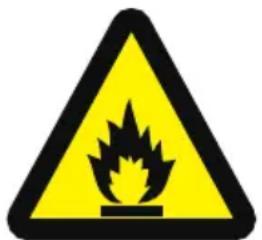
Caution, risk of fire

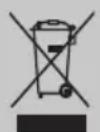
In compliance with Directives: 2012/19/EU and 2015/863/EU on the restriction of the use of dangerous substances in electric and electronic equipment as well as their waste disposal. The symbol with the crossed dustbin shown on the package indicates that the product at the end of its service life shall be collected as separate waste. Therefore, any products that have reached the end of their useful life must be given to waste disposal centres specialising in separate collection of waste electrical and electronic equipment, or given back to the retailer at the time of purchasing new similar equipment, on a one for one basis. The adequate separate collection for the subsequent start-up of the equipment sent to be recycled, treated and disposed of in an environmentally compatible way contributes to preventing possible negative effects on the environment and health and optimises the recycling and reuse of components making up the apparatus. Abusive disposal of the product by the user involves application of the administrative sanctions according to the laws.
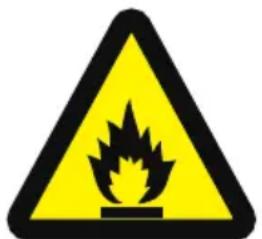
Caution, risk of fire


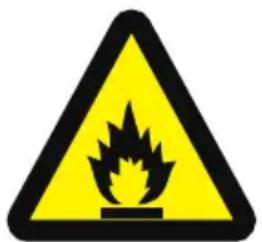
Caution, risk of fire

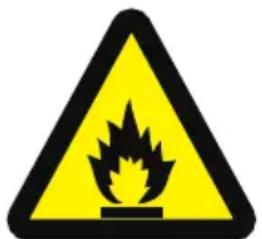
Caution, risk of fire

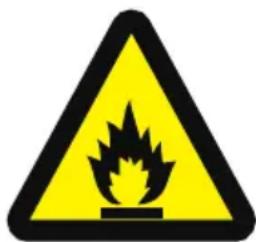
Caution, risk of fire

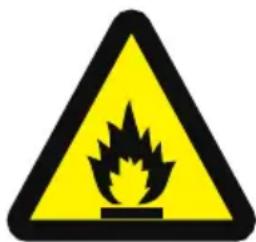
Caution, risk of fire

CONTINUE WATERAFVOER
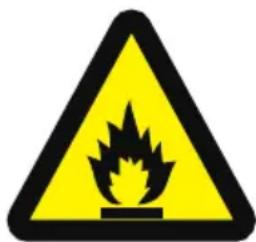
Caution, risk of fire

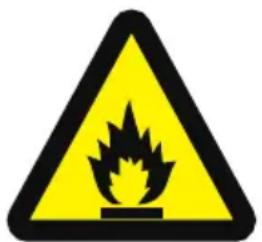
Caution, risk of fire