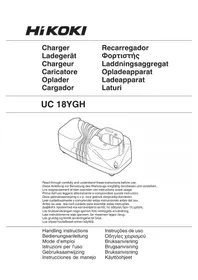
UC18YGH - Battery charger HiKOKI - Free user manual and instructions
Find the device manual for free UC18YGH HiKOKI in PDF.


| Product Type | Battery Charger |
| Brand | HiKOKI |
| Model | UC18YGH |
| Charging Voltage | 7.2–18 V |
| Charging Time | Approx. 30 to 70 minutes |
| Weight | 0.35 kg |
| Power Supply | Mains (standard plug) |
| Charging Temperature Range | 0–40 °C (ideal 20–25 °C) |
| Compatible Batteries | HiKOKI Ni-Cd and Ni-MH (OB/EB/BCH series) 7.2 to 18 V |
| Main Functions | Fast charging, overheat detection, automatic shut-off at end of charge |
| Indicator Light | Red LED: flashing (standby), steady (charging), fast flashing (complete), slow flashing (overheat) |
| Maintenance and Cleaning | Wipe with a dry cloth or a cloth moistened with soapy water. Do not use solvents. |
| Safety | Do not expose to rain or humidity; use only indoors; unplug before maintenance. |
| Spare Parts and Repairability | Use only genuine HiKOKI parts; have any repairs carried out by an authorized service center. |
| General Information | Instructions available in several languages; comply with local legislation on waste electrical equipment. |
Frequently Asked Questions - UC18YGH HiKOKI
User questions about UC18YGH HiKOKI
0 question about this device. Answer the ones you know or ask your own.
Ask a new question about this device
Download the instructions for your Battery charger in PDF format for free! Find your manual UC18YGH - HiKOKI and take your electronic device back in hand. On this page are published all the documents necessary for the use of your device. UC18YGH by HiKOKI.
USER MANUAL UC18YGH HiKOKI
natural_image
Line drawing of a mechanical device casing with internal components and mounting holes (no text or symbols)Read through carefully and understand these instructions before use.
- This appliance is not intended for use by persons (including children) with reduced physical, sensory or mental capabilities, or lack of experience and knowledge, unless they have been given supervision or instruction concerning use of the appliance by a person responsible for their safety.
- Children should be supervised to ensure that they do not play with the appliance.
- Keep work area clean. Cluttered areas and benches invite accidents.
- Avoid dangerous environment. Don't expose power tools and charger to rain. Don't use power tools and charger in damp or wet locations. And keep work area well lit.
Never use power tools and charger near flammable or explosive materials.
Do not use tool and charger in presence of flammable liquids or gases.
- The appliance is not intended for use by young children or infirm persons without supervision. Young children should be supervised to ensure that they do not play with the appliance. All visitors should be kept safe distance from work area.
- Store idle tools and charger. When not in use, tools and charger should be stored in dry, high or locked-up place — out of reach or children. Store tools and charger in a place in which the temperature is less than 40^ C.
- Don't abuse cord. Never carry charger by cord or yank it to disconnect from receptacle. Keep cord from heat, oil and sharp edges.
- When the charger is not in use or when being maintained and inspected, disconnect the power cord of the charger from the receptacle.
- To avoid danger, always use only the specified charger.
- Use only genuine HiKOKI replacement parts.
- Do not use power tools and charger for applications other than those specified in the Handling Instructions.
- To avoid personal injury, use only the accessories or attachment recommended in these handling instructions or in the HiKOKI catalog.
- If the supply cord is damaged, it must be replaced by the manufacture or its service agent or a similarly qualified person in order to avoid a hazard.
Let only the authorized service center do the repairing. The Manufacture will not be responsible for any damages or injuries caused by repair by the unauthorized persons or by mishandling of the tool.
- To ensure the designed operational integrity of power tools and charger, do not remove installed covers or screws.
- Always use the charger at the voltage specified on the nameplate.
- Always charge the battery before use.
- Never use a battery other than that specified. Do not connect a usual dry cell, a rechargeable battery other than that specified or a car battery to the power tool.
- Do not use a transformer containing a booster.
- Do not charge the battery from an engine electric generator or DC power supply.
- Always charge indoors. Because the charger and battery heat slightly during charging, charge the battery in a place not exposed to direct sunlight; where the humidity is low and the ventilation is good.
- Use the exploded assembly drawing on this handling instructions only for authorized servicing.
PRECAUTIONS FOR CHARGER
- Always charge the battery at an ambient temperature of 0–40°C. A temperature of less than 0°C will result in over charging which is dangerous. The battery cannot be charged at a temperature greater than 40°C.
The most suitable temperature for charging is that of 20–25°C. - Do not use the charger continuously.
When one charging is completed, leave the charger for about 15 minutes before the next charging of battery.
- Do not allow foreign matter to enter the hole for connecting the rechargeable battery.
- Never disassemble the rechargeable battery or charger.
- Never short-circuit the rechargeable battery.
Short-circuiting the battery will cause a great electric current and overheat. It results in burn or damage to the battery.
- Do not dispose of the battery in fire.
If the battery is burnt, it may explode. - Using an exhausted battery will damage the charger.
- Bring the battery to the shop from which it was purchased as soon as the post-charging battery life becomes too short for practical use. Do not dispose of the exhausted battery.
- Do not insert objects into the air ventilation slots of the charger.
Inserting metal objects or flammable into the charger air ventilation slots will result in an electrical shock hazard or damage to the charger.
SPECIFICATION
CHARGER
| Charging time Approx. 30 – 70 minutes | |
| Charging voltage 7.2–18 V | |
| Weight 0.35 kg |
APPLICATION
For charging the HiKOKI BATTERY
OB712S, EB7S, EB714S, FEB7S, EB7B, EB912S, EB9S, EB914S, EB914, FEB9S, EB9B, EB924, EB926H, EB930H, EB933X, EB1212S, EB12S, EB1214S, EB1214L, FEB12S, EB12B, EB1220BL, EB1224, EB1226HL, EB1230H, BCH1220, EB1230HL, EB1230X, EB1233X EB1412S, EB1414S, EB1414, EB14B, EB1424, EB1426H, EB1430H, EB1430X, EB1433X, BCH1420, EB1812S, EB1814SL, EB18B EB1820, EB1820L, EB1824L, EB1826HL, EB1830H, EB1830HL, EB1830X, EB1833X, BCH1820
CHARGING
Before using the power tool, charge the battery as follows.
- Connect the charger's power cord to the receptacle.
When connecting the plug of the charger to a receptacle, the pilot lamp will blink in red (At 1-second intervals).
- Insert the battery into the charger.
Firmly insert the battery into the charger till it contacts the bottom of the charger and checking the polarities as shown in Fig. 1.
CAUTION
☐ If the batteries are inserted in the reverse direction, not only recharging will become impossible, but it may also cause problems in the charger such as a deformed recharging terminal.
3. Charging
When inserting a battery in the charger, the pilot lamp will light up continuously in red. When the battery becomes fully recharged, the pilot lamp will blink in red (At 1-second intervals). (See Table 1)
(1) Pilot lamp indication
The indications of the pilot lamp will be as shown in Table 1, according to the condition of the charger or the rechargeable battery.
Table 1
| Indications of the pilot lamp | ||||
| Pilot lamp(red) | Beforecharging | Blinks | Lights for 0.5 seconds. Does not light chargingfor 0.5 seconds. (off for 0.5 seconds) | |
| Whilecharging | Lights | Lights continuously | ||
| Chargingcomplete | Blinks | Lights for 0.5 seconds. Does not light for0.5 seconds. (off for 0.5 seconds) | ||
| Overheatstandby | Blinks | Lights for 1 second. Does not light for0.5 seconds. (off for 0.5 seconds) | Battery overheated. Unableto charge. (Charging willcommence when batterycools) | |
(2) Regarding the temperature of the rechargeable battery.
The temperatures for rechargeable batteries are as shown in the table below, and batteries that have become hot should be cooled for a while before being recharged.
Table 2
| Rechargeable batteries Temperatures at which the battery can be recharged | |
| EB712S, EB7S, EB714S, FEB7S, EB7B, EB912S, EB9S, EB914S, EB914, FEB9S, EB9B, EB924, EB1212S, EB12S, EB1214S, EB1214L, FEB12S, EB12B, EB1220BL, EB1224, EB1412S, EB1414S, EB1414, EB14B, EB1424, EB1812S, EB1814SL, EB18B, EB1820, EB1820L, EB1824L | -5°C - 55°C |
| EB926H, EB930H, EB933X, EB1226HL, EB1230H, EB1230HL, EB1230X, EB1233X, EB1426H, EB1430H, EB1430X, EB1433X, EB1826HL, EB1830H, EB1830HL, EB1830X, EB1833X, BCH1220, BCH1420, BCH1820 | -5°C - 50°C |
(3) Regarding recharging time
Table 3 shows the recharging time required according to the type of battery.
Table 3 Recharging time (approx. min.) at 20°C
| Battery capacity (Ah) | ||||||||||||||
| Battery Voltage (V) | Ni-Cd BATTERY Ni-MH BATTERY | |||||||||||||
| 1.2-1.4 Ah 2.0 | Ah 2.4 Ah 2.0 Ah | h 2.6 Ah 3.0 Ah | 3.3 Ah | |||||||||||
| 7.2V | EB712SEB7SEB714SFEB7S(6 cells) | 30min. | EB7B(6 cells) | 50min. | —— | —— | —— | |||||||
| 9.6V | EB912SEB914SEB9SEB914FEB9S(8 cells) | 30min. | EB9B(8 cells) | 50min. | EB924(8 cells) | 55min. | —— | EB926H(8 cells) | 60min. | EB930H(8 cells) | 70min. | EB933X(8 cells) | 70min. | |
| 12V | EB12SEB1212SEB1214SEB1214LFEB12S(10 cells) | 30min. | EB12BEB1220BL(10 cells) | 50min. | EB1224(10 cells) | 55min. | BCH1220(10 cells) | 50min. | EB1226HL(10 cells) | 60min. | EB1230HEB1230HLEB1230X(10 cells) | 70min. | EB1233X(10 cells) | 70min. |
| 14.4V | EB1412SEB1414SEB1414(12 cells) | 30min. | EB14B(12 cells) | 50min. | EB1424(12 cells) | 55min. | BCH1420(12 cells) | 50min. | EB1426HL(12 cells) | 60min. | EB1430HEB1430X(12 cells) | 70min. | EB1433X(12 cells) | 70min. |
| 18V | EB1812SEB1814SL(15 cells) | 30min. | EB18BEB1820LEB1820(15 cells) | 50min. | EB1824L(15 cells) | 55min. | BCH1820(15 cells) | 50min. | EB1826HL(15 cells) | 60min. | EB1830HEB1830HLEB1830X(15 cells) | 70min. | EB1833X(15 cells) | 70min. |
NOTE: The recharging time may vary according to the ambient temperature.
-
Disconnect the charger's power cord from the receptacle.
-
Hold the charger firmly and pull out the battery.
NOTE
Be sure to pull out the battery from the charger after use, and then keep it.
Regarding electric discharge in case of new batteries, etc.
As the internal chemical substance of new batteries and batteries that have not been used for an extended period is not activated, the electric discharge might be low when using them the first and second time. This is a temporary phenomenon, and normal time required for recharging will be restored by recharging the batteries 2–3 times.
How to make the batteries perform longer.
(1) Recharge the batteries before they become completely exhausted.
When you feel that the power of the tool becomes weaker, stop using the tool and recharge its battery. If you continue to use the tool and exhaust the electric current, the battery may be damaged and its life will become shorter.
(2) Avoid recharging at high temperatures.
A rechargeable battery will be hot immediately after use. If such a battery is recharged immediately after use, its internal chemical substance will deteriorate, and the battery life will be shortened. Leave the battery and recharge it after it has cooled for a while.
CAUTION
☐ If the battery is charged while it is heated because it has been left for a long time in a location subject to direct sunlight or because the battery has just been used, the pilot lamp of the charger lights for 1 second, does not light for 0.5 seconds (off for 0.5 seconds). In such a case, first let the battery cool, then start charging.
○ Since the built-in micro computer takes about 3 seconds to confirm that the battery being charged with UC18YGH is taken out, wait for a minimum of 3 seconds before reinserting it to continue charging. If the battery is reinserted within 3 seconds, the battery may not be properly charged.
MAINTENANCE AND INSPECTION
1. Inspecting the mounting screws:
Regularly inspect all mounting screws and ensure that they are properly tightened. Should any of the screws be loose, retighten them immediately. Failure to do so could result in serious hazard.
2. Cleaning of the charger
When the charger is stained, wipe with a soft dry cloth or a cloth moistened with soapy water. Do not use chloric solvents, gasoline or paint thinner, for they melt plastics.
3. Store idle charger
When not in use, the charger should be stored in dry, high or locked-up place — out of reach of children.
CAUTION
In the operation and maintenance of power tools, the safety regulations and standards prescribed in each country must be observed.
NOTE
Due to HiKOKI's continuing program of research and development, the specifications herein are subject to change without prior notice.
VEDLIKEHOLD OG INSPEKSJON
natural_image
Line drawing of a quill pen in an inkwell (no text or symbols)
natural_image
Line drawing of a quill pen in an inkwell (no text or symbols)Siemensring 34, 47877 willich, Germany
Tel: +49 2154 49930
Fax: +49 2154 499350
URL: http://www.hikoki-powertools.de
Hikoki Power Tools Netherlands B.V.
Brabanthaven 11, 3433 PJ Nieuwegein, The Netherlands
Tel: +31 30 6084040
Fax: +31 30 6067266
URL: http://www.hikoki-powertools.nl
Hikoki Power Tools (U.K.) Ltd.
Precedent Drive, Rooksley, Milton Keynes, MK 13, 8PJ,
United Kingdom
Tel: +44 1908 660663
Fax: +44 1908 606642
URL: http://www.hikoki-powertools.uk
Hikoki Power Tools France S.A.S.
Hikoki Power Tools Belgium N.V./S.A.
Koningin Astridlaan 51, B-1780 Wemmel, Belgium
Tel: +32 2 460 1720
Fax: +32 2 460 2542
URL http://www.hikoki-powertools.be
Hikoki Power Tools Italia S.p.A
Via Piave 35, 36077, Altavilla Vicentina (VI), Italy
Tel: +39 0444 548111
Fax: +39 0444 548110
URL: http://www.hikoki-powertools.it
Hikoki Power Tools Ibérica, S.A.
C/ Puigbarral, 26-28, Pol. Ind. Can Petit, 08227 Terrassa
(Barcelona), Spain
Tel: +34 93 735 6722
Fax: +34 93 735 7442
URL: http://www.hikoki-powertools.es
Kjeller Vest 7, N-2007 Kjeller, Norway
Tel: (+47) 6692 6600
Fax: (+47) 6692 6650
URL: http://www.hikoki-powertools.no
Hikoki Power Tools Sweden AB
Rotebergsvagen 2B SE-192 78 Sollentuna, Sweden
Tel: (+46) 8 598 999 00
Fax: (+46) 8 598 999 40
URL: http://www.hikoki-powertools.se
Hikoki Power Tools Denmark
A/S Lillebaeltsvej 90, 6715 Esbjerg N, Denmark
Tel: (+45) 75 14 32 00
Fax: (+45) 75 14 36 66
URL: http://www.hikoki-powertools.dk
Hikoki Power Tools Finland Oy
Tupalankatu 9, 15680 Lahti, Finland
Tel: (+358) 20 7431 530
Fax: (+358) 20 7431 531
URL: http://www.hikoki-powertools.fi
| English Português | ||
| EC DECLARATION OF CONFORMITYWe declare under our sole responsibility that Charger, identified by type and specific identification code *1), is in conformity with all relevant requirements of the directives *2) and standards *3). Technical file at *4) – See below. The European Standard Manager at the representative office in Europe is authorized to compile the technical file.The declaration is applicable to the product affixed CE marking. | DECLARAÇÃO DE CONFORMIDADE CEDeclaramos, sob nossa única e inteira responsabilidade, que Recarregador, identificado por tipo e código de identificação específico *1), está em conformidade com todos os requerimentos relevantes das diretivas *2) e normas *3). Ficheiro técnico em *4)–Consulte abaixo.O Gestor de Normas Europeias no escritório de representação na Europa está autorizado a compilar o ficheiro técnico.A declaração aplica-se aos produtos com marca CE. | |
| Deutsch Ελλήνικά | ||
| EG-KONFORMITÄTSERKLÄRUNGWir erklären in alleiniger Verantwortung, dass das durch den Typ und den spezifischen Identifizierungscode *1) identifizierte Ladegerät allen einschlägigen Bestimmungen der Richtlinien *2) und Normen *3) entspricht. Technische Unterlagen unter *4) – Siehe unten.Die Leitung der repräsentativen Behörde für europäische Normen und Richtlinien ist berechtigt, die technischen Unterlagen zusammenzustellen. Die Erklärung gilt für die an dem Produkt angebrachte CE-Kennzeichnung. | ΕΚ ΔΗΛΩΣΗ ΕΝΑΡΜΟΝΙΣΜΟΥΔηλώνουμε με αποκλεστική μας ευθύνη ότι ο Φορτιστής. ο οποίος προσδιοριζεται από τον τύπο και ειδικό αναγνωριστικό κωδικό *1), είναι σύμφωνος με όλες τις σχετικές απαιτήσεις των Οδηγιών *2) και τα σχετικό πρότυπα *3). Τεχνικό Αρχείο στο *4) – Déite παρακάτω.Ο Διαχειριστής Ευρωπαϊκών Προτύπων στο γραφείο εκπροσώπησης στην Ευρώπη είναι εξουσιοδοτημένος για τη σύνταξη του τεχνικού φακέλου.Η δήλωση ισχύει μόνο για το προϊόν που είναι τοποθετημένη σήμανση CE | |
| Français Sveńska | ||
| DECLARATION DE CONFORMITE CENous déclarons sous notre entière responsabilité que le chargeur, identifié par le type et le code d'identification spécifique *1) est en conformité avec toutes les exigences applicables des directives *2) et des normes *3). Dossier technique en *4) - Voir ci-dessous.Le Gestionnaire des normes européennes du bureau de représentation en Europe est autorisé à constituer le dossier technique.Cette déclaration s'applique aux produits désignés CE. | EG-DEKLARATION BETRÄFFANDE LIKFORMIGHETVi förklarar på eget ansvar att detta laddningsaggregat, identifierat enligt typ och särskild identifikationskod *1), överensstämmer med alla relevanta krav i direktiven *2) och standarderna *3). Teknisk fil enligt *4) – Se nedan.Den europeiska standardansvariga på representationskontoret i Europa är auktoriserad att sammanställa den tekniska filen.Denna försäkran gäller för produkten med tillhörande CE-märkning. | |
| Italiano Dansk | ||
| DICHIARAZIONE DI CONFORMITÀ CEDichiariamo sotto la nostra esclusiva responsabilità che il caricatore, identificato dal tipo e dal codice identificativo spécifique *1), è conforme a tutti i requisiti delle direttive *2) e degli standard *3). Documentazione tecnica presso *4) – Vedere sotto.Il gestore delle norme europee presso l'ufficio di rappresentanza in Europa è autorizzato a compilare il fascicolo tecnico.La dichiarazione è applicabile ai prodotti cui sono applicati i marchi CE. | EF-OVERENSSTEMMELSESERKLÆRINGVi erklærer os fuldstændige ansvarlige for, at opladeapparatet, identificeret ved type og specifik identifikationskode *1), er i overensstemmelse med alle relevante krav i direktiverne *2) og standarderne *3). Teknisk fil i *4) – Se nedenfor.Lederen af europæiske standarder på repræsentationskontoret i Europa er bemyndiget til af kompilere den tekniske fili.Erklæringen gælder produktet, der er mærket med CE. | |
| Nederlands Norsk | ||
| EC VERKLARING VAN CONFORMITEITWij verklaren onder onze eigen verantwoordelijkheid dat Oplader, geidentificeerd door het type en de specifieke identificatiecode*1), voldoet aan alle relevante bepalingen van de richtlijnen*2) en normen*3). Technische documentatie bij*4) – zie onder.De Europese Normen Manager bij de vertegenwoordiging in Europa is gemachtigd om het technisch dossier samen te stellen.Deze verklaring is van toepassing op producten voorzien van de CE-markeringen. | EF'S ERKLÆRING OM OVERENSSTEMMELSEVi erklærer på eget ansvar at ladeapparat, identifisert etter type og spesifikk identifikasjonskode *1), er i samsvar med alle relevante krav i direktiver *2) og standarder *3). Teknisk fil under *4) - Se nedenfor.Styreren for europeiske standarder ved representantkontoret i Europa er autorisert til å kompilere den tekniske filen.Erklæringen gjelder for CE-merket på produktet. | |
| Español SuorhiDECLARACIÓN DE CONFORMIDAD DE LA CEDeclaramos bajo nuestra única responsabilidad que el Cargador, identificado por tipo y por código de identificación específico *1), está en conformidad con todas las disposiciones correspondientes de las directivas *2) y de las normas *3). Documentación técnica en *4) – Ver a continuación.El Director de Normas Europeas en la oficina de representación en Europa está autorizado para elaborar el expediente técnico.La declaración se aplica al producto con marcas de la CE. | EY-ILMOITUS YHDENMUKAISUUDESTAVakuutamme yksinomaisella vastuullamme, että laturi, joka identifioidaan typin ja erityisen tunnistuskoodin *1) perusteella, on kaikkien direktivien *2) ja standardien *3) asiaankuuluvien vaatimusten mukainen. Tekninen tiedosto kohdassa *4) – katso alta.Eurooppalaisten standardien hallintaelin Euroopan edustustossa on valtuutettu kokoamaan teknisen tiedoston.Ilmoitus on sovellettavissa tuotteeseen kiinnitettyyn CE-merkintään. | |
| *1) UC18YGH C349761R*2) 2014/35/EU, 2014/30/EU, 2011/65/EU*3) EN60335-1:2012+A11:2014EN60335-2:29:2004+A2:2010EN55014-1:2006+A1:2009+A2:2011EN55014-2:1997+A1:2001+A2:2008EN61000-3-2:2014EN61000-3-3:2013 | ||
| *4) Representative office in EuropeHikoki Power Tools Deutschland GmbHSiemensring 34, 47877 Willich, GermanyHead office in JapanKoki Holdings Co., Ltd.Shinagawa Intercity Tower A, 15-1, Konan 2-chome,Minato-ku, Tokyo, Japan | 31. 5. 2019Naoto YamashiroEuropean Standard Manager31. 5. 2019A. NakagawaCorporate Officer | |
- PRECAUTIONS FOR CHARGER
- SPECIFICATION
- APPLICATION
- CHARGING
- CAUTION
- Charging
- Regarding the temperature of the rechargeable battery.
- Regarding recharging time
- NOTE
- How to make the batteries perform longer.
- MAINTENANCE AND INSPECTION
- Inspecting the mounting screws:
- Cleaning of the charger
- Store idle charger
- VEDLIKEHOLD OG INSPEKSJON
- Hikoki Power Tools Netherlands B.V.
- Hikoki Power Tools (U.K.) Ltd.
- Hikoki Power Tools France S.A.S.
- Hikoki Power Tools Belgium N.V./S.A.
- Hikoki Power Tools Italia S.p.A
- Hikoki Power Tools Ibérica, S.A.
- Hikoki Power Tools Sweden AB
- Hikoki Power Tools Denmark
- Hikoki Power Tools Finland Oy
Brand : HiKOKI
Model : UC18YGH
Category : Battery charger