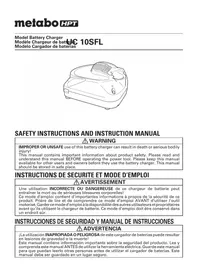
UC10SFL - Battery charger HiKOKI - Free user manual and instructions
Find the device manual for free UC10SFL HiKOKI in PDF.



| Product type | Battery charger |
| Brand | HiKOKI |
| Model | UC10SFL |
| Weight | 0.35 kg (0.8 lb) |
| Power supply | Single-phase, AC 120 V, 60 Hz |
| Charging voltage | DC 10.8 V |
| Charging current | DC 2.0 A |
| Charging time (battery BCL1015) | Approximately 40 minutes |
| Compatible battery | Metabo HPT BCL1015 (10.8 V, 1.5 Ah) |
| Battery type | Rechargeable lithium-ion |
| Charge indicator | Red LED (flashing according to status) |
| Overheating protection | Yes (temporary stop if battery is too hot) |
| Overvoltage protection | Yes (do not use beyond 120 V) |
| Permissible charging temperature | 0 °C to 50 °C (32 °F to 122 °F) |
| Storage temperature | Below 40 °C (104 °F) |
| Intended use | Recharging Metabo HPT BCL1015 batteries |
| Maintenance | Clean with a soft cloth or dampened with soapy water |
| Repairs | Entrust exclusively to a Metabo HPT authorized service center |
| Safety instructions | Do not expose to rain or snow; use only with the specified battery; disconnect before maintenance |
| Included accessories | No additional accessories (charger only) |
Frequently Asked Questions - UC10SFL HiKOKI
User questions about UC10SFL HiKOKI
0 question about this device. Answer the ones you know or ask your own.
Ask a new question about this device
Download the instructions for your Battery charger in PDF format for free! Find your manual UC10SFL - HiKOKI and take your electronic device back in hand. On this page are published all the documents necessary for the use of your device. UC10SFL by HiKOKI.
USER MANUAL UC10SFL HiKOKI
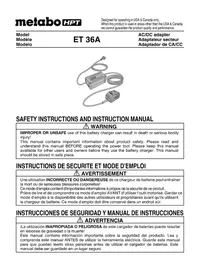
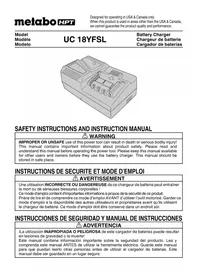
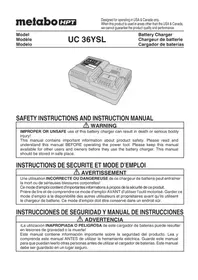
SAFETY INSTRUCTIONS AND INSTRUCTION MANUAL
WARNING
IMPROPER OR UNSAFE use of this battery charger can result in death or serious bodily injury!
This manual contains important information about product safety. Please read and understand this manual BEFORE operating the power tool. Please keep this manual available for other users and owners before they use the battery charger. This manual should be stored in safe place.
INSTRUCTIONS DE SECURITE ET MODE D'EMPLOI
A VERTISSEMENT
SERVICE AND REPAIRS 12
PARTS LIST 33
Français
Page
Page
INFORMATIONS IMPORTANTES DE SECURITE 13
SIGNIFICATION DES MOTS D'AVERTISSEMENT 13
SECURITE
UTILISATION ET ENTRETIEN
NOM DES PARTIES 17
SPECIFICATIONS 18
UTILISATIONS 18
METHODE DE RECHARGE 18
AVANT L'UTILISATION 21
ENTRETIEN ET INSPECTION 21
RANGEMENT 22
SERVICE APRES-VENTE ET RÉPARATIONS ... 22
LISTEDESPIECES 33
MISE AU REBUT D'UNE BATTERIE USEE .... 16
INDICE
Espanol
Pagina
Pagina
IMPORTANT SAFETY INFORMATION
Read and understand all of the safety precautions, warnings and operating instructions in the Instruction Manual before operating or maintaining this battery charger.
Most accidents that result from battery charger operation and maintenance are caused by the failure to observe basic safety rules or precautions. An accident can often be avoided by recognizing a potentially hazardous situation before it occurs, and by observing appropriate safety procedures.
Basic safety precautions are outlined in the "SAFETY" section of this Instruction Manual and in the sections which contain the operation and maintenance instructions.
Hazards that must be avoided to prevent bodily injury or machine damage are identified by WARNINGS on the battery charger and in this Instruction Manual.
NEVER use this battery charger in a manner that has not been specifically recommended by metabo HPT.
MEANINGS OF SIGNAL WORDS
WARNING indicates a potentially hazardous situations which, if ignored, could result in death or serious injury.
CAUTION indicates a potentially hazardous situations which, if not avoided, may result in minor or moderate injury, or may cause machine damage.
NOTE emphasizes essential information.
SAFETY
IMPORTANT SAFETY INSTRUCTIONS FOR BATTERY CHARGER
WARNING: Death or serious bodily injury could result from improper or unsafe use of battery chargers. To avoid these risks, follow these basic safety instructions:
READ ALL INSTRUCTIONS
- This manual contains important safety and operating instructions for battery charger Model UC10SFL.
- Before using battery charger, read all instructions and cautionary markings on (1) battery charger, (2) battery, and (3) product using battery.
- To reduce risk of injury, charge metabo HPT rechargeable battery type BCL1015.
Other type of batteries may burst causing personal injury and damage.
- Do not expose battery charger to rain or snow.
- Use of an attachment not recommended or sold by the battery charger manufacturer may result in a risk of fire, electric shock, or injury to persons.
- To reduce risk of damage to electric plug and cord, pull by plug when disconnecting battery charger.
- Make sure cord is located so that it will not be stepped on, tripped over, or otherwise subjected to damage or stress.
- An extension cord should not be used unless absolutely necessary. Use of improper extension cord could result in a risk of fire and electric shock.
If extension cord must be used make sure:
a. That blades of extension cord are the same number, size, and shape as those of plug on battery charger:
b. That extension cord is properly wired and in good electrical condition; and
c. That wire size is large enough for AC ampere rating of battery charger as specified in Table 1.
Table 1
RECOMMENDED MINIMUM AWG SIZE FOR
EXTENTION CORDS FOR BATTERY CHARGERS
| AC Input Rating Amperes* AWG Size of Cord | |||||
| Equal to or but less Length of Cord, Feet (Meter) greater than 25 (7.5) 50 (15) 100 (30) 150 (45) | |||||
| 0 | 2 | 18 | 18 | 18 | 16 |
| 2 | 3 | 18 | 18 | 16 | 14 |
| 3 | 4 | 18 | 18 | 16 | 14 |
- If the input rating of a battery charger is given in watts rather than in amperes, the corresponding ampere rating is to be determined by dividing the wattage rating by the voltage rating-for example:
$$ \frac {1 , 2 5 0 \text {w a t t s}}{1 2 5 \text {v o l t s}} = 1 0 \text {a m p e r e s} $$
- Do not operate battery charger with damaged cord or plug-replace them immediately.
- Do not opera te battery charger if it has received a sharp blow, been dropped, or otherwise damaged in any way; take it to a qualified serviceman.
- Do not disassemble battery charger; take it to a qualified serviceman when service or repair is required. Incorrect reassembly may result in a risk of electric shock or fire.
- To reduce risk of electric shock, unplug charger from receptacle before attempting any maintenance or cleaning. Removing the battery will not reduce this risk.
- This battery charger might be attached to metabo HPT battery operated tools as a standard accessory. In this case, please confirm Instruction Manual of the metabo HPT battery operated tools before using the battery charger.
IMPORTANT SAFETY INSTRUCTIONS FOR USE OF THE BATTERY AND BATTERY CHARGER
You must charge the battery before you can use the power tool. Before using the model UC10SFL battery charger, be sure to read all instructions and cautionary statements on it, the battery and in this manual.
REMEMBER: USE ONLY metabo HPT BATTERY TYPE BCL1015. OTHER TYPES OF BATTERIES MAY BURST AND CAUSE INJURY!
Follow these instructions to avoid the risk of injury:

WARNING: Improper use of the battery or battery charger can lead to serious injury. To avoid these injuries:
- NEVER disassemble the battery.
- NEVER incinerate the battery, even if it is damaged or is completely worn out. The battery can explode in a fire.
- NEVER short-circuit the battery.
- NEVER insert any objects into the battery charger's air vents. Electric shock or damage to the battery charger may result.
- NEVER charge outdoors. Keep the battery away from direct sunlight and use only where there is low humidity and good ventilation.
- NEVER charge when the temperature is below 32^ (0^) or above 104^ (40^) . Charging the battery at temperatures outside the range of 32^ - 104^ (0^ - 40^) may prevent proper charging and reduce battery life.
- NEVER connect two battery chargers together.
- NEVER insert foreign objects into the hole for the battery or the battery charger.
- NEVER use a booster transformer when charging.
- NEVER use an engine generator or DC power to charge.
-
NEVER store the battery or battery charger in places where the temperature may reach or exceed 104^ (40^) .
-
ALWAYS operate charger on standard household electrical power (120 volts). Using the charger on any other voltage may overheat and damage the charger.
- ALWAYS wait at least 15 minutes between charges to avoid overheating the charger.
- ALWAYS disconnect the power cord from its receptacle when the charger is not in use.
DISPOSAL OF THE EXHAUSTED BATTERY
WARNING:
Do not dispose of the exhausted battery. The battery must explode if it is incinerated. The product that you have purchased contains a rechargeable battery. The battery is recyclable. At the end of it's useful life, under various state and local laws, it may be illegal to dispose of this battery into the municipal waste stream. Check with your local solid waste officials for details in your area for recycling options or proper disposal.
SAVE THESE INSTRUCTIONS
AND
MAKE THEM AVAILABLE TO
OTHER USERS
AND
OWNERS OF THIS TOOL!
The information contained in this Instruction Manual is designed to assist you in the safe operation and maintenance of the battery charger.
NEVER operate, or attempt any maintenance on the battery charger unless you have first read and understood all safety instructions contained in this manual.
Some illustrations in this Instruction Manual may show details or attachments that differ from those on your own battery charger.
NAME OF PARTS
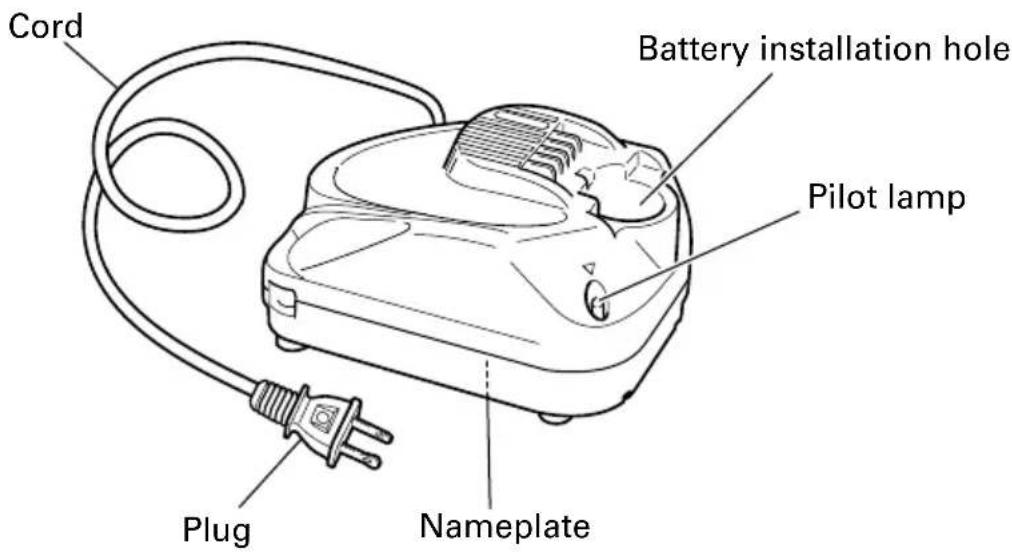
Fig. 1
SPECIFICATIONS
| Input power source Single phase: AC120V 60Hz | |
| Charging time Approx. 40 minutes ......... BCL1015 | |
| Charger | Charging voltage ......... DC 10.8 V Charging current ......... DC 2.0 A |
| Weight 0.8 lbs (0.35 kg) | |
APPLICATIONS
For charging the metabo HPT batteries type BCL1015.
CHARGING METHOD
NOTE: Before plugging into the receptacle, make sure the following points.
The power source voltage is stated on the nameplate.
The cord is not damaged.

WARNING: Do not charge at voltage higher than indicated on the nameplate. If charged at voltage higher than indicated on the nameplate, the charger will burn up.
- Insert the plug of battery charger into the receptacle.
When the plug of battery charger has been inserted into the receptacle, pilot lamp will blink in red. (At 1-second intervals)

WARNING:
Do not use the electrical cord if damaged. Have it repaired immediately.
-
Insert the battery to the battery charger. Insert the battery into the battery charger as shown in Fig. 2.
-
Charging
When the battery is connected to the battery charger, charging will commence and the pilot lamp will light in red. (See Table 2)
NOTE: If the pilot lamp does not light or blink in red, pull out the plug from the receptacle and check if the battery is properly mounted.
When the battery is fully charged, the pilot lamp will blink in red slowly. (At 1-second intervals) (See Table 2)
NOTE: The battery charging time becomes longer when a temperature is low or the voltage of the power source is too low.
When the pilot lamp does not blink in red (At 1-second intervals) (See Table 2) even if more than four hour has passed after start of the charging, stop the charging and contact your metabo HPT AUTHORIZD SERVICE CENTER.
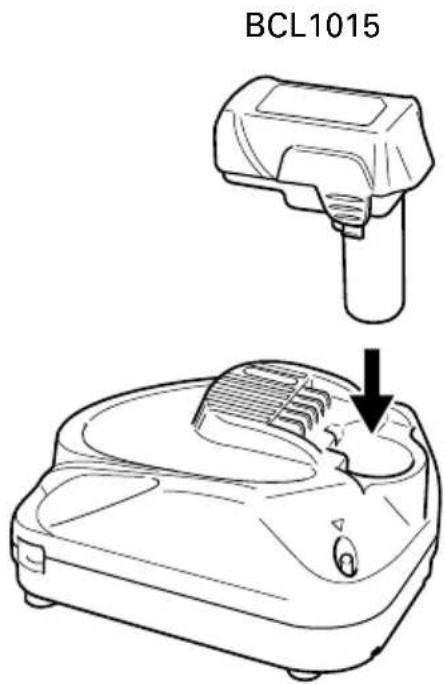
Fig. 2
Table 2
| Indications of the pilot lamp | |||
| Pilot lamp(red) | Before charging | Lights for 0.5 seconds. Does not light Blinks for 0.5 seconds. (off for 0.5 seconds) | |
| While charging | Lights continuously | ||
| Charging complete | Lights for 0.5 seconds. Does not light Blinks for 0.5 seconds. (off for 0.5 seconds) | ||
| Overheat standby | Lights for 1 second. Does not light for 0.5 seconds. (off for 0.5 seconds) | Battery overheated. Unable to charge. (Charging will commence when battery cools) | |
| Charging impossible | Lights for 0.1 seconds. Does not light for 0.1 seconds. (off for 0.1 seconds) | Malfunction in the battery or the charger | |
Regarding the temperature of the rechargeable battery.
The temperatures for rechargeable batteries are as shown in the table below, and batteries that have become hot should be cooled for a while before being recharged.
Table 3
| Rechargeable batteries | Temperature at which the battery can be recharged |
| BCL1015 | 32°F — 122°F (0°C — 50°C) |
Regarding recharging time
Table 4 shows the recharging time required according to the type of battery.
Table 4 Recharging time (approx. min.) at 20^
| Battery voltage (V) | Battery capacity (Ah) | |
| 1.5 Ah | ||
| 10.8 BCL1015 40 min. | ||
NOTE: The recharging time may vary according to the ambient temperature and the power supply voltage.
- Disconnect battery charger from the receptacle.

CAUTION:
Do not pull the plug out of the receptacle by pulling on the cord.
Make sure to grasp the plug when removing from receptacle to avoid damaging cord.
- Remove the battery from the battery charger.
Supporting the battery charger with hand, pull out the battery from the battery charger.
Regarding electric discharge in case of new batteries, etc.
As the internal chemical substance of new batteries and batteries that have not been used for an extended period is not activated, the electric discharge might be low when using them the first and second time. This is a temporary phenomenon, and normal time required for recharging will be restored by recharging the batteries 2 - 3 times.
How to make the batteries perform longer.
Recharge the batteries before they become completely exhausted.
When you feel that the power of the tool becomes weaker, stop using the tool and recharge its battery. If you continue to use the tool and exhaust the electric current, the battery may be damaged and its life will become shorter.
Avoid recharging at high temperatures.
A rechargeable battery will be hot immediately after use. If such a battery is recharged immediately after use, its internal chemical substance will deteriorate, and the battery life will be shortened. Leave the battery and recharge it after it has cooled for a while.
CAUTION:
- When the battery charger has been continuously used, the battery charger will be heated, thus constituting the cause of the failures. Once the charging has been completed, give 15 minutes rest until the next charging.
- If the battery is charged while it is heated because it has been left for a long time in a location subject to direct sunlight or because the battery has just been used, the pilot lamp of the charger lights for 1 second, does not light for 0.5 seconds (off for 0.5 seconds). In such a case, first let the battery cool, then start charging.
- When the pilot lamp flickers (at 0.2-second intervals), check for and take out any foreign objects in the charger's battery installation hole. If there are no foreign objects, it is probable that the battery or charger is malfunctioning. Take it to your authorized Service Center.
- If the battery charger does not work while the battery is mounted correctly, it is probable that the battery or charger is malfunctioning. Take it to your authorized Service Center.
BEFORE USE
Check the work area to make sure that it is clear of debris and clutter.
Clear the area of unnecessary personnel. Ensure that lighting and ventilation is adequate.
MAINTENANCE AND INSPECTION
CAUTION: Pull out battery before doing any inspection or maintenance.
- Check the Screws
Loose screws are dangerous. Regularly inspect them and make sure they are tight.
CAUTION: Using this battery charger with loosened screws is extremely dangerous.
- Check for Dust
Dust may be removed with a soft cloth or a cloth dampened with soapy water.
Do not use bleach, chlorine, gasoline or thinner, for they may damage the plastics.
- Service parts list
CAUTION:
Repair, modification and inspection of metabo HPT Power Tools must be carried out by an metabo HPT Authorized Service Center.
This Parts List will be helpful if presented with the tool to the metabo HPT Authorized Service Center when requesting repair or other maintenance. In the operation and maintenance of power tools, the safety regulations and standards prescribed in each country must be observed.
MODIFICATIONS:
metabo HPT Power Tools are constantly being improved and modified to incorporate the latest technological advancements.
Accordingly, some parts may be changed without prior notice.
STORAGE
Storing in a place below 104^ (40^) and out of the reach of children.
SERVICE AND REPAIRS
All quality power tools will eventually require servicing or replacement of parts because of wear from normal use. To assure that only authorized replacement parts will be used, all service and repairs must be performed by a metabo HPT AUTHIZED SERVICE CENTER, ONLY.
NOTE: Specifications are subject to change without any obligation on the part of the metabo HPT.
INFORMATIONS IMPORTANTES DE SECURITE
Please contact Koki Holdings America Ltd. at 1-800-59-TOOLS (toll free), or metabo HPT AUTHORIZATION POWER TOOL SERVICE CENTER regarding COLLECTION.

Pour le RAMASSAGE,contacter Koki Holdings America Ltd. au 1-800-59-TOOLS (appel)..ou UN SERVICE APRES-VENTE D'OUTILS ELECTRIQUE AGREE PAR metabo HPT.

Con respectfully a la RECOLECCION de baterias,pongase en contacto con Koki Holdings America Ltd. numero 1-800-59-TOOLS (llamada Gratis),o con metabo HPT AUTHORIZED POWER TOOL SERVICE CENTER.
Issued by
Koki Holdings Co., Ltd.
Shinagawa Intercity Tower A, 15-1, Konan 2-chome, Minato-ku, Tokyo 108-6020, Japan
Distributed by
Koki Holdings America Ltd.
1111 Broadway Ave, Braselton, Georgia, 30517
Koki Holdings America Ltd. Canadian Branch
3405 American Drive, Units 9-10, Mississauga, ON, L4V 1T6
- SAFETY INSTRUCTIONS AND INSTRUCTION MANUAL
- WARNING
- INSTRUCTIONS DE SECURITE ET MODE D'EMPLOI
- A VERTISSEMENT
- Français
- SECURITE
- UTILISATION ET ENTRETIEN
- INDICE
- Espanol
- IMPORTANT SAFETY INFORMATION
- MEANINGS OF SIGNAL WORDS
- SAFETY
- IMPORTANT SAFETY INSTRUCTIONS FOR BATTERY CHARGER
- READ ALL INSTRUCTIONS
- Table 1
- RECOMMENDED MINIMUM AWG SIZE FOR
- EXTENTION CORDS FOR BATTERY CHARGERS
- IMPORTANT SAFETY INSTRUCTIONS FOR USE OF THE BATTERY AND BATTERY CHARGER
- WARNING: Improper use of the battery or battery charger can lead to serious injury. To avoid these injuries:
- DISPOSAL OF THE EXHAUSTED BATTERY
- WARNING:
- SAVE THESE INSTRUCTIONS
- AND
- MAKE THEM AVAILABLE TO
- OTHER USERS
- OWNERS OF THIS TOOL!
- NAME OF PARTS
- APPLICATIONS
- CHARGING METHOD
- WARNING:
- CAUTION:
- Regarding electric discharge in case of new batteries, etc.
- How to make the batteries perform longer.
- BEFORE USE
- MAINTENANCE AND INSPECTION
- CAUTION: Pull out battery before doing any inspection or maintenance.
- CAUTION: Using this battery charger with loosened screws is extremely dangerous.
- MODIFICATIONS:
- STORAGE
- SERVICE AND REPAIRS
- INFORMATIONS IMPORTANTES DE SECURITE
- Koki Holdings Co., Ltd.
- Koki Holdings America Ltd.
- Koki Holdings America Ltd. Canadian Branch
Brand : HiKOKI
Model : UC10SFL
Category : Battery charger