Maximus MPXR Series2 - Surveillance Camera Videotec - Free user manual and instructions
Find the device manual for free Maximus MPXR Series2 Videotec in PDF.


| Product type | PTZ camera for explosive atmospheres |
| Brand | Videotec |
| Model | Maximus MPXR Series2 (and variants MPXHD, MPXT, MPXL) |
| Category | Surveillance camera |
| Housing material | Electropolished AISI 316L stainless steel |
| Weight (depending on version) | 26.5 kg (MPXHD, MPXR) or 31 kg (MPXT, MPXL) |
| Power supply (available voltages) | 24 Vac, 100 Vac, 120 Vac, 220 Vac, 230 Vac |
| Maximum power consumption | 120 W |
| Day/night camera resolution | Full HD 1080p (1920x1080) |
| Optical zoom | 30x (digital zoom up to 360x or 480x depending on model) |
| Thermal sensor type (MPXR, MPXT versions) | Uncooled VOx microbolometer, 336x256 or 640x512 pixels |
| Horizontal/vertical rotation | 360° continuous / -90° to +90° |
| Rotation speed | 0.1°/s to 100°/s (h and v) |
| Preset recall accuracy | 0.02° |
| Number of presets | 250 |
| Inputs/outputs | 1 alarm input, 1 reset input, 2 relay outputs (1A, 30Vac/60Vdc max) |
| Network connectivity | RJ45 10/100BASE-T, SFP slot 100BASE-FX |
| Supported protocols | ONVIF (Profiles Q, S, T) |
| Explosion-proof certifications | ATEX, IECEx, EAC Ex, KCs, UK Ex, cULus (depending on version) |
| IP protection rating | IP66 / IP67 / IP68 / IP69 |
| Operating temperature | -40°C to +80°C (depending on version and temperature class) |
| Optical windows | Extra-clear tempered glass 12 mm (visible) / Germanium 8 mm with DLC coating (thermal) |
| LED illuminator (MPXL version) | IR (850 nm) or white light, range 200 m, two groups (spot and wide) |
| Integrated wiper | Yes (except thermal version MPXR) |
Frequently Asked Questions - Maximus MPXR Series2 Videotec
User questions about Maximus MPXR Series2 Videotec
0 question about this device. Answer the ones you know or ask your own.
Ask a new question about this device
Download the instructions for your Surveillance Camera in PDF format for free! Find your manual Maximus MPXR Series2 - Videotec and take your electronic device back in hand. On this page are published all the documents necessary for the use of your device. Maximus MPXR Series2 by Videotec.
USER MANUAL Maximus MPXR Series2 Videotec
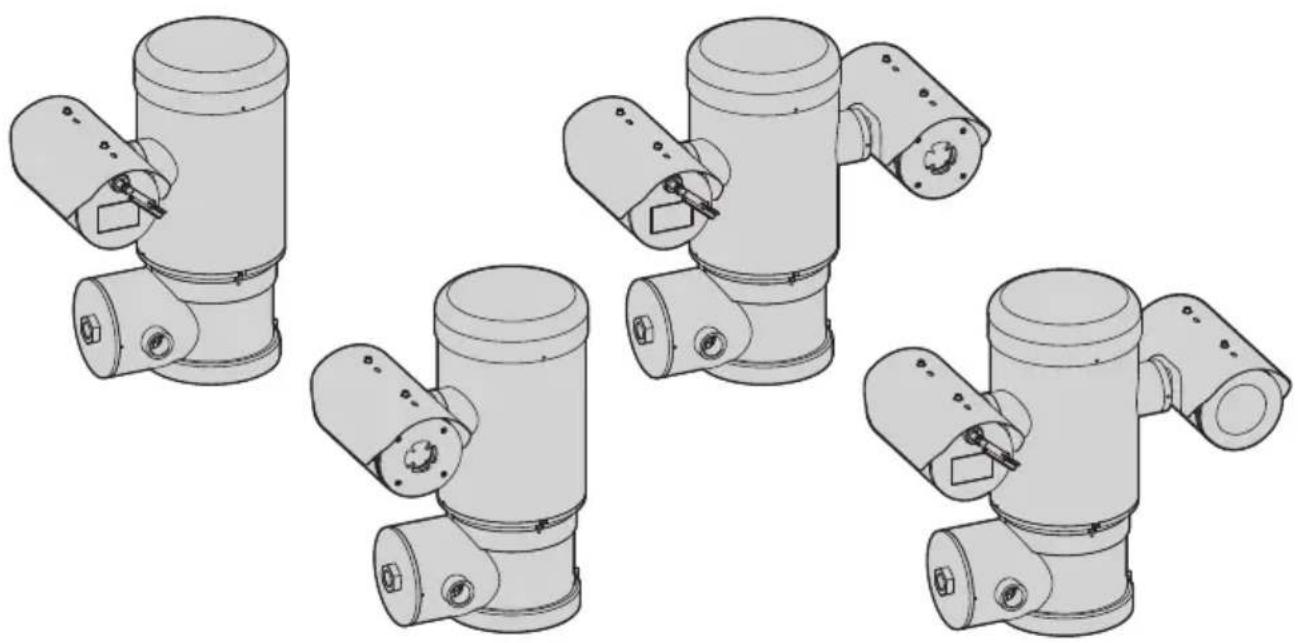
MAXIMUS MPX SERIES2 (MPXHD) MAXIMUS MPXR SERIES2 (MPXR) MAXIMUS MPXT SERIES2 (MPXT) MAXIMUS MPXL SERIES2 (MPXL)
Flameproof PTZ camera
natural_image
Four identical line drawings of a mechanical T-joint valve assembly, shown from different angles (no text or symbols present)EN English - Instruction manual
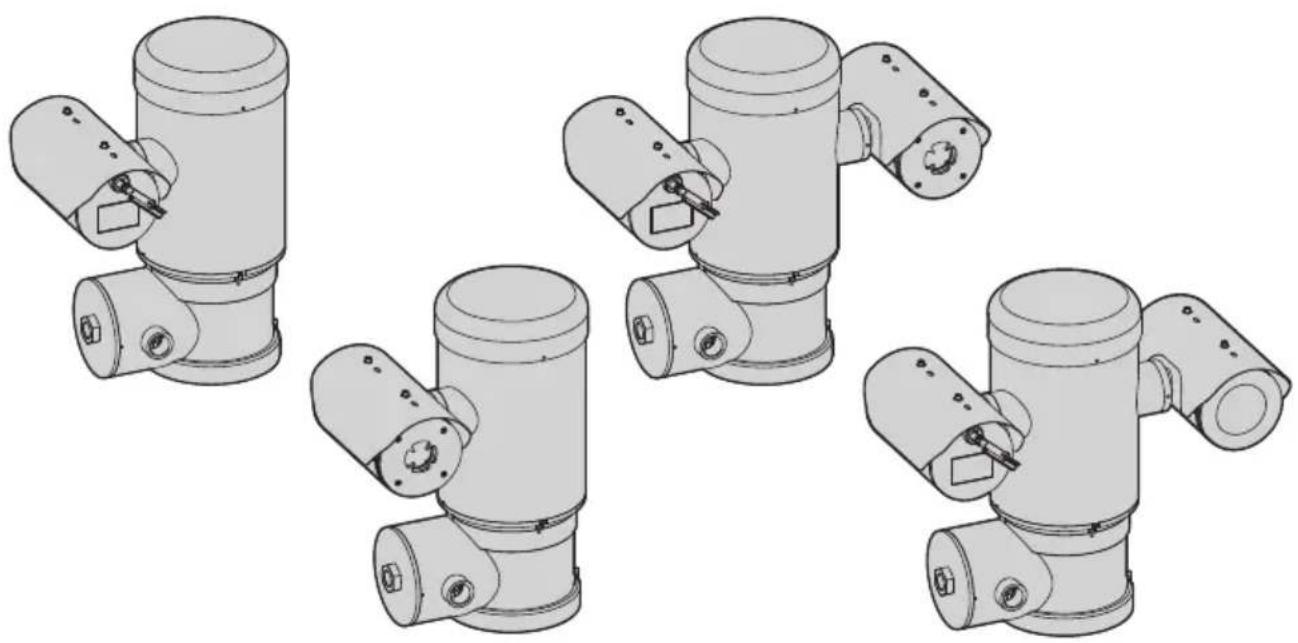
Flameproof PTZ camera
natural_image
Four identical line drawings of a mechanical T-joint connector assembly (no text or symbols)Contents
1 About this manual....6
1.1 Typographical conventions....6
2 Notes on copyright and information on trademarks....6
3 Safety rules 6
4 Product description and type designation....10
4.1 Range of use....10
4.2 Specific use conditions 10
4.3 Gas Group, Dust Group and Temperatures....10
4.4 Characteristics of installable devices....10
4.5 Cable entry 11
4.5.1 Stopping plug....11
4.6 Product marking....12
4.7 For UL/CSA standard reference only....13
4.8 Model identification....15
4.8.1 Day/Night camera....15
4.8.2 Thermal camera....18
4.8.3 Dual Vision with Day/Night and thermal camera....20
4.8.4 Day/Night camera with LED illuminator 22
5 Preparing the product for use....25
5.1 Unpacking....25
5.2 Contents 25
5.3 Safely disposing of packaging material....25
6 Installation....25
6.1 Installation options....25
6.1.1 Fixing to parapet or ceiling mount 26
6.1.2 Bracket mounting....26
6.1.3 Fastening with corner adaptor module or pole 27
6.1.4 Sunshield mounting....27
6.2 Opening of the connections compartment....28
6.3 Connector board description....28
6.4 Ground connection....29
6.4.1 Earthing equipotential connection....29
6.4.2 Connection of the safety earthing....29
6.5 Connecting the power supply 29
6.6 Connecting alarms, remote reset and relays 30
6.6.1 Connecting an alarm with dry contact 31
6.6.2 Connecting the remote reset....31
6.6.3 Relays connection....31
6.7 Ethernet connection....31
6.7.1 Connection via RJ45 31
6.7.2 Connection via SFP 31
6.8 Installations according to UL/CSA standards 32
6.9 Connection compartment closing 33
7 Switching on 34
8 Configuration....34
8.1 Default IP address 34
8.2 Web interface 34
8.2.1 First access to the web pages....34
9 Instructions for normal operation....35
9.1 Enabling the LED illuminator 35
10 Maintenance 35
10.1 Routine maintenance 35
10.1.1 Inspecting the cables....35
10.1.2 Replacing the gasket....35
10.1.3 Replacement of the wiper blade....36
10.2 Extraordinary maintenance 36
10.2.1 Fuse replacement....36
10.2.2 Factory Default....37
11 Cleaning 37
11.1 Routine cleaning....37
11.1.1 Cleaning the glass window 37
11.1.2 Cleaning the germanium window 37
11.1.3 Cleaning the product....38
12 Information on disposal and recycling 38
13 Troubleshooting....38
14 Technical data....39
14.1 MAXIMUS MPX SERIES2 (MPXHD) 39
14.1.1 General 39
14.1.2 Mechanical....39
14.1.3 Electrical....39
14.1.4 Network....39
14.1.5 I/O interface....39
14.1.6 Cameras 40
14.1.7 Environment....41
14.1.8 Certifications....41
14.1.9 Certifications - Explosion-proof applications....41
14.1.10 Certifications - Marine applications 41
14.2 MAXIMUS MPXR SERIES2 (MPXR) 42
14.2.1 General 42
14.2.2 Mechanical 42
14.2.3 Housing's window 42
14.2.4 Electrical 42
14.2.5 Network....42
14.2.6 I/O interface 42
14.2.7 Thermal Cameras....43
14.2.8 Environment....45
14.2.9 Certifications....45
14.2.10 Certifications - Explosion-proof applications 45
14.2.11 Certifications - Marine applications....45
14.3 MAXIMUS MPXT SERIES2 (MPXT) 46
14.3.1 General....46
14.3.2 Mechanical 46
14.3.3 Housing's window 46
14.3.4 Electrical 46
14.3.5 Network....47
14.3.6 I/O interface 47
14.3.7 Day/Night cameras....47
14.3.8 Thermal Cameras....48
14.3.9 Environment 50
14.3.10 Certifications....50
14.3.11 Certifications - Explosion-proof applications ....50
14.3.12 Certifications - Marine applications....50
14.4 MAXIMUS MPXL SERIES2 (MPXL) 51
14.4.1 General....51
14.4.2 Mechanical 51
14.4.3 Electrical 51
14.4.4 Network....51
14.4.5 I/O interface 51
14.4.6 Cameras....52
14.4.7 Illuminators 52
14.4.8 Environment 52
14.4.9 Certifications....53
14.4.10 Certifications - Explosion-proof applications 53
14.4.11 Certifications - Marine applications....53
15 Technical drawings....54
1 About this manual
Read all the documentation supplied carefully before installing and using this product. Keep the manual in a convenient place for future reference.
1.1 Typographical conventions

DANGER!
Explosion hazard.
Read carefully to avoid danger of explosion.

DANGER!
High level hazard.
Risk of electric shock. Disconnect the power supply before proceeding with any operation, unless indicated otherwise.

DANGER!
Mechanical hazard.
Risk of crushing or shearing.

DANGER!
Hot surface.
Avoid contact. Surfaces are hot and may cause personal injury if touched.

DANGER!
Emission of visible light or infrared.
Can be harmful for eyes. Pay attention to the provided indications.

CAUTION!
Medium level hazard.
This operation is very important for the system to function properly. Please read the procedure described very carefully and carry it out as instructed.

INFO
Description of system specifications.
We recommend reading this part carefully in order to understand the subsequent stages.
Underlined titles
Information is subject to certifications.
2 Notes on copyright and information on trademarks
The mentioned names of products or companies are trademarks or registered trademarks.
3 Safety rules

DANGER!
Explosion hazard.
Read carefully to avoid danger of explosion.
- Installation and maintenance of the appliance must be carried out by specialist technical staff in compliance with the applicable reference standard EN/IEC 60079-14, EN/IEC 60079-17 and national standards.
- Do not open the device when powered and in explosive atmosphere.
- Use appropriate tools for the installation. The particular nature of the site where the device is to be installed may mean special tools are required for installation.
- Make all connections, installation and maintenance work in a non-explosive atmosphere.
- The equipotential connection is mandatory to avoid the risk of ignition of products installed in potentially explosive environments.
-
This device must be connected to an earth conductor (protective earth). This connection must only be performed through the power line connector. External equipotential bonding connections must also be performed but only for supplementary bonding connection to earth, and required by local codes or authority.
-
Before powering the product in an explosive atmosphere, ensure the cover is closed correctly.
- The temperature of the surfaces of the device is increased by exposure to direct sunlight. The surface temperature class of the device was determined only with ambient ambient temperature, without taking into consideration direct sunlight.
- Make sure that all the equipment are certified for the application and for the environment in which they will be installed.
- Any change that is not expressly approved by the manufacturer will invalidate the guarantee.

DANGER! High level hazard.
Risk of electric shock. Disconnect the power supply before proceeding with any operation, unless indicated otherwise.
- Make sure that the power is off when installing or carrying out maintenance, with the circuit-breaker open.
- A power disconnect device must be included in the electrical installation, and it must be very quickly recognizable and operated if needed.
- The electrical system to which the unit is connected must be equipped with a 16A max automatic bipolar circuit breaker. The minimum distance between the circuit breaker contacts must be 3mm (0.1in). The circuit breaker must be provided with protection against the fault current towards the ground (differential) and the overcurrent (magnetothermal).
- The device can only be considered to be switched off when the power supply has been disconnected and the connection cables to other devices have been removed.
-
Be careful not to use cables that seem worn or old.
-
All the cables must comply with IEC60332-1-2, IEC 60332-1-3 and IEC/EN60079-14.
- When commencing installation make sure that the specifications for the power supply for the installation correspond with those required by the device.
- For continued protection against risk of fire, replace only with same type and rating of fuse. Fuses must be replaced only by service personnel.
- This equipment is not suitable for use in locations where children are likely to be present.

DANGER!
Mechanical hazard.
Risk of crushing or shearing.
- Hazardous moving parts. Keep fingers and other body parts away.

DANGER!
Hot surface.
Avoid contact. Surfaces are hot and may cause personal injury if touched.
- During normal operation the surface of the illuminator can reach high temperatures. Do not allow direct contact and position the appliance where it is inaccessible to unauthorised persons. Before touching, switch off the illuminator and allow to cool for a minimum period of 10 minutes.

DANGER!
Emission of visible light or infrared. Can be harmful for eyes. Pay attention to the provided indications.
- Do not stare at the lamp when on. Can be harmful for eyes.
- CAUTION! The infrared LED illuminator emits high-intensity visible light. In compliance with standard EN62471/IEC62471, the photobiological safety assessment has classified the device in Risk Group 2, where it exceeds the values of the Exempt Group. The risk linked to the observer depends on how the product has been installed and is used. For installation, follow the instructions in this manual. Do not look directly at the illuminator using optical lenses. Exposure hazard values (EHV): 30.1s. Hazard distances (HD): 200mm.
- CAUTION! The white LED illuminator emits visible high intensity light. In compliance with standard EN62471/IEC62471, the photobiological safety assessment has classified the device in Risk Group 2, where it exceeds the values of the Exempt Group. The risk linked to the observer depends on how the product has been installed and is used. For installation, follow the instructions in this manual. Do not look directly at the illuminator using optical lenses. Exposure hazard values (EHV): 33.3s. Hazard distances (HD): 200mm.

CAUTION!
Medium level hazard.
This operation is very important for the system to function properly. Please read the procedure described very carefully and carry it out as instructed.
- Make sure that the installation complies with local regulations and specifications.
- Make connections and tests in the laboratory before carrying out installation on site.
- Check that the power supply socket and cable are adequately dimensioned.
- Use suitable cables that can withstand the operating temperatures.
- All disconnected cables must be electrically isolated.
- The system can be installed only in a standard or inverted position (ceiling mount).
- Make sure the product is to be secured to building before operation.
- At start up the system makes some automatic calibration movements: do not stand near the device when it is powered.
- The manufacturer declines all liability for damage to any of the apparatus mentioned in this handbook, when resulting from tampering, use of non-original spare parts, installation, maintenance and repairs performed by non-authorised, non-skilled personnel.
- For technical services, consult only and exclusively authorized technicians.
- This product must only be repaired by suitably trained personnel or under the supervision of VIDEOTEC personnel in accordance with the foreseen terms and conditions: IEC/EN60079-19.
- Only use original VIDEOTEC spare parts. Strictly adhere to the maintenance instructions attached to each replacement kit.

INFO Description of system specifications. We recommend reading this part carefully in order to understand the subsequent stages.
- Given the considerable weight of the system, use an appropriate transport and handling system. The staff must carry out the handling of the product in compliance with the common accident prevention standards.
- Before proceeding with installation, check the supplied material to make sure it corresponds to the order specification by examining the identification labels.
- Equipment is intended for installation in restricted access area.
- The manufacturer declines all responsibility for any damage caused by an improper use of the appliances mentioned in this manual. Furthermore, the manufacturer reserves the right to modify its contents without any prior notice. The documentation contained in this manual has been collected and verified with great care. The manufacturer, however, cannot take any liability for its use. The same thing can be said for any person or company involved in the creation and production of this manual.
- Since the user is responsible for choosing the surface to which the unit is to be anchored, we do not supply the fixing devices for attaching the unit firmly to the particular surface. The installer is responsible for choosing fixing devices suitable for the specific purpose on hand. Use methods and materials capable of supporting at least 4 times the weight of the device.
- Contact the manufacturer for information on the dimensions of the explosion proof joint.
- For all maintenance interventions, we recommend you return the product to the laboratory that will perform all required operations.
- This device is remotely controlled and may change position at any time. It should be installed so that no one can be hit by moving parts. It should be installed so that moving parts cannot hit other objects and create hazardous situations.
- This is a Class A product. In a domestic environment this product may cause radio interference. In this case the user may be required to take adequate measures.
- To comply with the main supply voltage dips and short interruption requirements, use a suitable Uninterruptible Power Supply (UPS) to power the unit.
- This device was designed to be permanently secured and connected on a building or on a suitable structure. The device must be permanently secured and connected before any operation.
4 Product description and type designation
The MAXIMUS MPX series is a range of electropolished AISI316L steel PTZ cameras that can be installed in potentially explosive environments. The MAXIMUS MPX series is equipped with a NPT or metric cables entry according to the model.
The MAXIMUS MPX series has an IP66/IP68/IP69 degree of protection and can be installed in environments with temperatures from -40^ to +80^ (check the marking for each model available).
Versions are available with: visible camera, thermal camera, visual and thermal camera, visible camera with LED illuminator (IR or visible light).
4.1 Range of use
The unit is designed for use in a fixed location, for surveillance of areas classified as zone 1-21 and zone 2-22 with potentially explosive atmospheres.
The unit has been built and certified in compliance with directive 2014/34/UE and with the international standards IECEX, which define its range of application and minimum safety requirements.
4.2 Specific use conditions
Contact the manufacturer for information on the dimensions of the explosion proof joint.
Ambient temperature and Surface temperature – see instructions.
Care shall be taken to prevent accumulation of electrostatic charges. See installation instructions.
The unit can be only installed in standard or inverted position.
4.3 Gas Group, Dust Group and Temperatures
The device is certified for the IIC group (Gas) and the IIIC group (dust).
The temperature class, the maximum surface temperature and the temperature of the cables entry depend on the characteristics of the installable devices (dissipated power, Watt) and the ambient temperature.
The features are specified for each model in its specific chapters.
4.4 Characteristics of installable devices
All the internal components must be installed inside by the manufacturer.
4.5 Cable entry
The product is supplied with plastic caps for cable entry protection. They cannot be used for installation.
Unused cable entries must be closed using appropriate Ex certified locking devices with "db" and "tb" explosion protection, suitable for the use conditions and installed correctly.
All cable glands shall be Ex certified, as appropriate, with protection type "db" and "tb", suitable for the conditions of use and installed correctly.
When conduit is used, a suitable Ex certified stopping box shall be used, as appropriate, with protection type "db" and "tb", suitable for the conditions of use and installed correctly.
The stopping box must be fitted within 50mm (1.97in) from the enclosure entry.
The cable entry temperatures are specified in the marking.
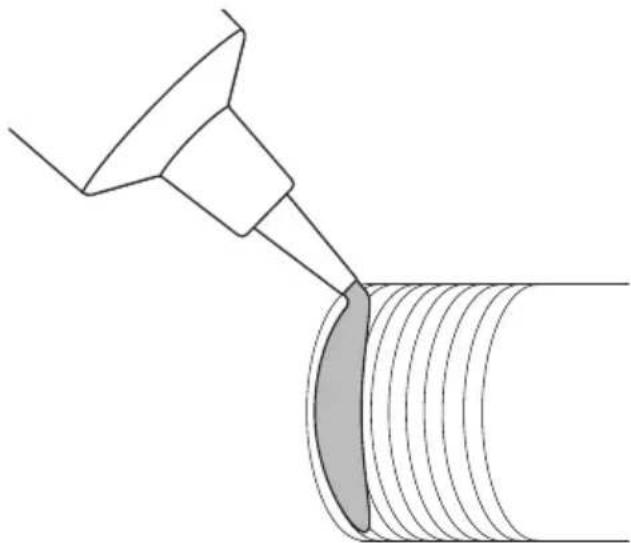
To maintain the IP level of product use cable glands with appropriate IP level and apply to threads a sealant compliant with standard IEC/EN60079-14.
4.5.1 Stopping plug

The stopping plug supplied is not KCs certified.
With the product, an Ex certified stopping plug is supplied with "db" and "tb" explosion-proof type protection. Thread sealant is also supplied, in compliance with IEC/EN60079-14, the use ensure the IP degree.
The stopping plug installation instructions are available on https://peppers.co.uk.
natural_image
Diagram of a tool interacting with a cylindrical object, showing a curved surface and a pointed tip (no text or symbols)Fig. 1
4.6 Product marking
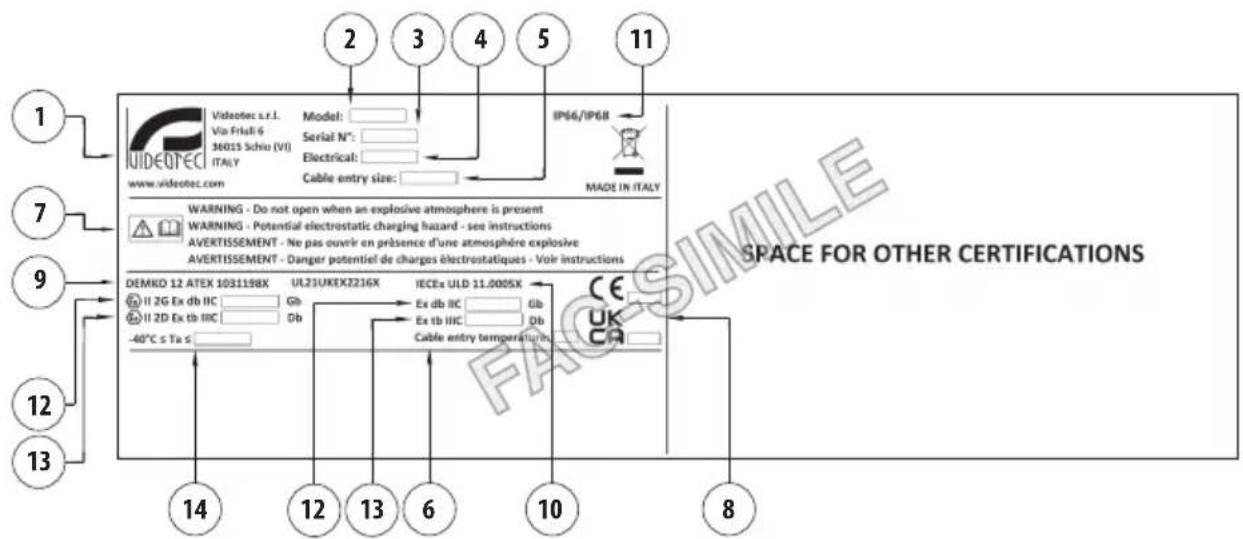
Fig. 2
- Manufacturer's name and address.
- Model.
- The serial number consists in 12 numeric characters, the second and third digits define the last two numbers of the year of manufacture.
- Electrical characteristics (voltage V, frequency Hz, current A, power W).
- Number, dimension and type of cable entries.
- Cable entry temperature.
- Warnings.
-
The number of the accredited body that provides the quality assessment.
-
ATEX marking. The Class temperature depends on the electronics installed inside and the ambient temperature.
- IECEx marking. The Class temperature depends on the electronics installed inside and the ambient temperature.
- IP protection degree.
- T Class (Tx or Tx...Tx).
- Maximum surface temperature (Tx°C or Tx°C... Tx°C).
- Ambient temperature ( -40^ ≤ Ta ≤ +TX^ , -40^ ≤ Ta ≤ TX^ or TX^ , -40^ ≤ Ta ≤ TX^ or TX^ or TX^ ).
Example of marking:
| EXAMPLE DATA | ||||
| Dissipated power in housing (W) | T Class Maximum surface temperature | Cable entry temperature Ambient temperature | ||
| 7 | T4 | T135°C | 90°C | -40°C ≤ Ta ≤ 80°C |
| T6...T5 | T85°C...T100°C | 80°C | -40°C ≤ Ta ≤ 60°C or 70°C | |
| T6...T4 | T85°C...T135°C | 90°C | -40°C ≤ Ta ≤ 60°C or 70°C or 80°C | |
Tab. 1
4.7 For UL/CSA standard reference only.

The flameproof joints are not intended to be repaired.

CAUTION! Hazardous moving parts. Keep fingers and other body parts away.

The appliance includes moving parts. Make sure that the unit is positioned where it is inaccessible under normal operating conditions. Attach the warning label supplied with the appliance, placing it near the unit so that it can be seen easily.
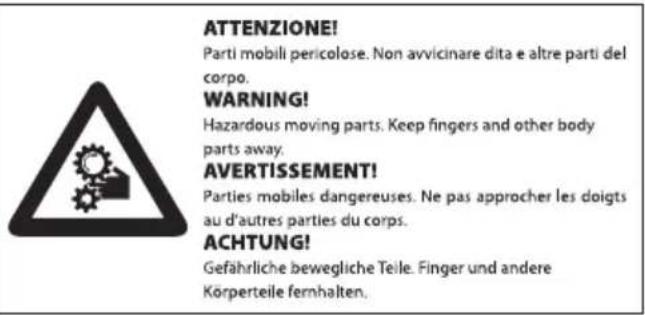
Fig. 3

In the USA, the National Electrical Code (NEC) and in Canada the Canadian Electrical Code (CEC) apply to electrical equipment used on hazardous industrial premises.
Important safety instructions
WARNING: DO NOT OPEN WHEN AN EXPLOSIVE ATMOSPHERE IS PRESENT.
AVERTISSEMENT: NE PAS OUVRIR EN PRÈSENCE D'UNE ATMOSPHÉRE EXPLOSIVE.
WARNING: POTENTIAL ELECTROSTATIC CHARGING HAZARD - SEE INSTRUCTIONS.
AVERTISSEMENT: DANGER POTENTIEL DE CHARGES ÉLECTROSTATIQUES - VOIR INSTRUCTIONS.
WARNING: A SEAL SHALL BE INSTALLED WITHIN 50MM OF THE ENCLOSURE.
AVERTISSEMENT: UN SCELLEMENT DOIT ÊTRE INSTALLÉ À MOINS DE 50MM DU BOÎTIER.
In installations according to UL/CSA standards, installation is compulsory of the separator provided as indicated in the relevant chapter (6.8 Installations according to UL/CSA standards, page 32).
natural_image
Technical diagram of a mechanical assembly with internal components and a highlighted section (no text or labels)Fig. 4
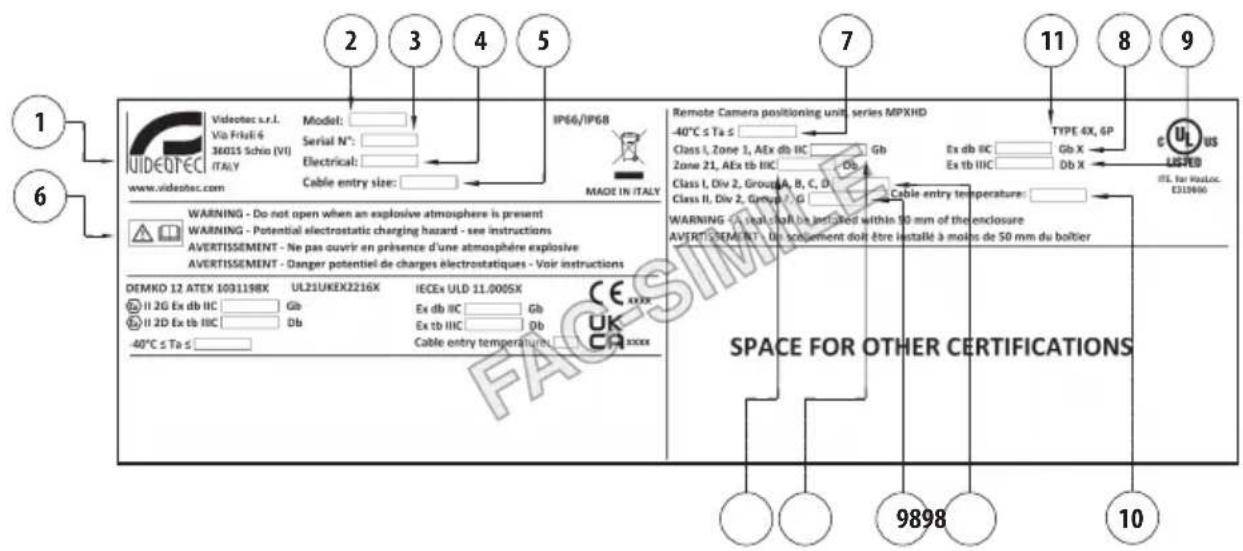
Fig. 5
- Manufacturer's name and address.
- Model.
- The serial number consists in 12 numeric characters, the second and third digits define the last two numbers of the year of manufacture.
- Electrical characteristics (voltage V, frequency Hz, current A, power W).
- Number, dimension and type of cable entries.
-
Warnings.
-
Ambient temperature ( -40^ ≤ Ta ≤ +TX^ , -40^ ≤ Ta ≤ TX^ or TX^ , -40^ ≤ Ta ≤ TX^ or TX^ or TX^ ).
- T Class (Tx or Tx...Tx).
- Maximum surface temperature (Tx°C or Tx°C... Tx°C).
- Cable entry temperature.
- Level of protection Type.
Connections

The choice of connection must comply with local legislation in force.
Cable glands: select a cable gland in compliance with UL2225 with the following protection AEx db IIC and/or AEx tb IIIC and C22.2 with the following protection Ex db IIC and/or Ex tb IIIC in compliance with the marking of the product. Conduit: it is necessary to install a sealing device within 50mm of the product input when the conduit is used.
Regulation references:
UL 60079-0, 7th Edition, Explosive Atmospheres - Part 0: Equipment – General requirements UL 60079-1, 7th Edition, Explosive Atmospheres - Part 1: Equipment Protection by Flameproof Enclosures "d" UL 60079-31, 2nd Edition, Explosive Atmospheres - Part 31: Equipment Dust Ignition Protection by Enclosure "t" CSA C22.2 No. 60079-0:19, Explosive Atmospheres - Part 0: Equipment - General requirements CSA C22.2 No. 60079-1:16, Explosive Atmospheres - Part 1: Equipment Protection by Flameproof Enclosures "d" CSA C22.2 No. 60079-31:15, Explosive Atmospheres - Part 31: Equipment Dust Ignition Protection by Enclosure "t"
4.8 Model identification
4.8.1 Day/Night camera
| MAXIMUS MPX SERIES2 - CONFIGURATION OPTIONS | ||||||
| Voltage | Camera | Temperature class and ambient temperature | Video analytics | ONVIF Profiles | ||
| MPXHD | 1 230Vac | 1 Super low-light Day/Night camera, FULL HD 1080p, 30x, with DELUX techno -logy | A T6...T5 -40°C/+60°C or +70°C 0 Without integrated | video analytics (without VIDEO-TEC ANALYTICS) | 00 Complies with ONVIF, Profile Q, Profile S and Profile T | C |
| 2 24Vac | 2 SONY FCB-EV7520 camera, FULL HD 1080p, 30x | D T4 -40°C/+80°C | V With integrated video analytics (VIDEOTEC ANALYTICS) | 01 Complies with ONVIF, Profile S and Profile T | ||
| 3 120Vac | C ATEX - IECEx - INMETRO - EAC Ex - KCs T5...T4 -40°C/+50°C or +60°C cULus T5...T4 -40°C/+50°C or +55°C | |||||
| 5 220Vac | ||||||
| 6 100Vac | ||||||
Tab. 2 MAXIMUS MPX SERIES2 (MPXHD)
| MAXIMUS MPX SERIES2 WITHOUT VIDEOTEC ANALYTICS - CERTIFICATIONS AND MARKINGS | ||||
| Part number | Certification | Marking | Ambient temperature | Cable entry temperature |
| MPXHD1*A0**C, MPXHD2*A0**C, MPXHD3*A0**C, MPXHD5*A0**C | ATEX II 2 G Ex db | IIC T6...T5 GbII 2D Ex tb IIIC T85°C...T100°C Db | -40°C ≤ Ta ≤ +60°C or +70°C +80°C | |
| IECEx Ex db IIC T6...T5 GbEx tb IIIC T85°C...T100°C Db | ||||
| EAC Ex 1Ex db IIC T6...T5 Gb XEx tb IIIC T85°C...T100°C Db X | ||||
| INMETRO Ex db | IC T6...T5 GbEx tb IIIC T85°C...T100°C Db | |||
| KCs Ex db IIC T6...T5 GbEx tb IIIC T85°C...T100°C Db | ||||
| UK Ex | II 2 G Ex db IIC T6...T5 GbII 2D Ex tb IIIC T85°C...T100°C Db | |||
| UL Hazardous Location America | Class I, Zone 1, AEx db IIC T6...T5 GbZone 21, AEx tb IIIC T85°C...T100°C DbClass I, Div 2, Group A, B, C, D T6...T5Class II, Div 2, Group F, G T6...T5 | +80°C with Ta ≤ 69°C+81°C with Ta ≤ 70°C | ||
| UL Hazardous Location Canada | Ex db IIC T6...T5 Gb XEx tb IIIC T85°C...T100°C Db XClass I, Div 2, Group A, B, C, D T6...T5Class II, Div 2, Group F, G T6...T5 | |||
| MPXHD6*A0**C ATEX | II 2 G Ex db IIC T6...T5 GbII 2D Ex tb IIIC T85°C...T100°C Db | -40°C ≤ Ta ≤ +60°C or +70°C +80°C | ||
| IECEx Ex db IIC T6...T5 GbEx tb IIIC T85°C...T100°C Db | ||||
| EAC Ex 1Ex db IIC T3...T5 Gb XEx tb IIIC T85°C...T100°C Db X | ||||
| INMETRO Ex db | IC T6...T5 GbEx tb IIIC T85°C...T100°C Db | |||
| KCs Ex db IIC T6...T5 GbEx tb IIIC T85°C...T100°C Db | ||||
| JK Ex | II 2 G Ex db IIC T6...T5 GbII 2D Ex tb IIIC T85°C...T100°C Db | |||
| MPXHD1*D0**C, MPXHD2*D0**C, MPXHD3*D0**C, MPXHD5*D0**C, MPXHD6*D0**C | ATEX II 2G Ex db | IIC T4 GbII 2D Ex tb IIIC T135°C Db | -40°C ≤ Ta ≤ +80°C | +90°C |
| IECEx Ex db IIC T4 GbEx tb IIIC T135°C Db | ||||
| EAC Ex 1Ex db IIC T4 Gb XEx tb IIIC T135°C Db X | ||||
| INMETRO Ex db | IC T4 GbEx tb IIIC T135°C Db | |||
| KCs Ex db IIC T4 GbEx tb IIIC T135°C Db | ||||
| UK Ex | II 2G Ex db IIC T4 GbII 2D Ex tb IIIC T135°C Db | |||
Tab. 3 MAXIMUS MPX SERIES2 (MPXHD) without VIDEOTEC ANALYTICS
| MAXIMUS MPX SERIES2 WITH VIDEOTEC ANALYTICS - CERTIFICATIONS AND MARKINGS | ||||
| Part number | Certification | Marking | Ambient temperature | Cable entry temperature |
| MPXHD1*CV**C, MPXHD2*CV**C, MPXHD3*CV**C, MPXHD5*CV**C | ATEX II 2 G Ex db | IIC T5...T4 GbII 2D Ex tb IIIC T100°C...T135°C Db | -40°C ≤ Ta ≤ +50°C or +60°C +80°C | |
| IECEx Ex db IIC T5...T4 GbEx tb IIIC T100°C...T135°C Db | ||||
| EAC Ex 1Ex db IIC T5...T4 Gb XEx tb IIIC T100°C...T135°C Db X | ||||
| INMETRO Ex db | IC T5...T4 GbEx tb IIIC T100°C...T135°C Db | |||
| KCs Ex db IIC T5...T4 GbEx tb IIIC T100°C...T135°C Db | ||||
| UK Ex | II 2 G Ex db IIC T5...T4 GbII 2D Ex tb IIIC T100°C...T135°C Db | |||
| UL Hazardous Location America | Class I, Zone 1, AEx db IIC T5...T4 GbZone 21, AEx tb IIIC T100°C...T135°C DbClass I, Div 2, Group A, B, C, D T5...T4Class II, Div 2, Group F, G T5...T4 | -40°C ≤ Ta ≤ +50°C or +55°C | ||
| UL Hazardous Location Canada | Ex db IIC T5...T4 Gb XEx tb IIIC T100°C...T135°C Db XClass I, Div 2, Group A, B, C, D T5...T4Class II, Div 2, Group F, G T5...T4 | |||
| MPXHD6*CV**C | ATEX | II 2 G Ex db IIC T5...T4 GbII 2D Ex tb IIIC T100°C...T135°C Db | -40°C ≤ Ta ≤ +50°C or +60°C | |
| IECEx Ex db IIC T5...T4 GbEx tb IIIC T100°C...T135°C Db | ||||
| EAC Ex 1Ex db IIC T5...T4 Gb XEx tb IIIC T100°C...T135°C Db X | ||||
| INMETRO Ex db | IC T5...T4 GbEx tb IIIG T100°C...T135°C Db | |||
| KCs Ex db IIC T5...T4 GbEx tb IIIC T100°C...T135°C Db | ||||
| UK Ex | II 2 G Ex db IIC T5...T4 GbII 2D Ex tb IIIC T100°C...T135°C Db | |||
Tab. 4 MAXIMUS MPX SERIES2 (MPXHD) with VIDEOTEC ANALYTICS
4.8.2 Thermal camera
EN - English - Instruction manual
| MAXIMUS MPXR SERIES2 - CONFIGURATION OPTIONS | ||||||||
| Voltage Thermal Camera Temperature class and ambient temperature | Radiometry ONVIF Profiles | Frequency | ||||||
| MPXR | 1 230Vac | A 9.3° HFOV, Thermal camera 35mm, 336x256 | A T6...T5 -40°C/+60°C or +70°C | 00 Thermal camera with radiometric functions | 0 Complies with ONVIF, Profile Q, Profile S and Profile T | C- | 7.5Hz | |
| 2 24Vac B 13" HFOV, Thermal camera 25mm, 336x256 | D T4 -40°C/+80°C | OR Thermal camera with advanced radiometric functions | 1 Complies with ONVIF, Profile S and Profile T | H 30Hz | ||||
| 3 120Vac | V 17° HFOV, Thermal camera 19mm, 336x256 | |||||||
| 5 220Vac F 25° HFOV, Thermal camera 13mm, 336x256 | ||||||||
| 6 100Vac C 35° HFOV, Thermal camera 9mm, 336x256 | ||||||||
| D 18° HFOV, Thermal camera 35mm, 640x512 | ||||||||
| E 25° HFOV, Thermal camera 25mm, 640x512 | ||||||||
| U 32" HFOV, Thermal camera 19mm, 640x512 | ||||||||
Tab. 5 MAXIMUS MPXR SERIES2 (MPXR)
| MAXIMUS MPXR SERIES2 - CERTIFICATIONS AND MARKINGS | ||||
| Part number | Certification | Marking | Ambient temperature | Cable entry temperature |
| MPXR1*A0**C*,MPXR2*A0**C*,MPXR3*A0**C*,MPXR5*A0**C* | ATEX II 2 G Ex db | IIC T6...T5 GbII 2D Ex tb IIIC T85°C...T100°C Db | -40°C ≤ Ta ≤ +60°C or +70°C +80°C | |
| IECEx Ex db IIC T6...T5 GbEx tb IIIC T85°C...T100°C Db | ||||
| EAC Ex 1Ex db IIC T6...T5 Gb XEx tb IIIC T85°C...T100°C Db X | ||||
| INMETRO Ex db | IC T6...T5 GbEx tb IIIC T85°C...T100°C Db | |||
| KCs Ex db IIC T6.. | .T5 GbEx tb IIIC T85°C...T100°C Db | |||
| UK Ex | II 2 G Ex db IIC T6...T5 GbII 2D Ex tb IIIC T85°C...T100°C Db | |||
| UL Hazardous Location America | Class I, Zone 1, AEx db IIC T6...T5 GbZone 21, AEx tb IIIC T85°C...T100°C DbClass I, Div 2, Group A, B, C, D T6...T5Class II, Div 2, Group F, G T6...T5 | +80°C with Ta ≤ +69°C+81°C with Ta ≤ +70°C | ||
| UL Hazardous Location Canada | Ex db IIC T6...T5 Gb XEx tb IIIC T85°C...T100°C Db XClass I, Div 2, Group A, B, C, D T6...T5Class II, Div 2, Group F, G T6...T5 | |||
| MPXR6*A0**C* | ATEX | II 2 G Ex db IIC T6...T5 GbII 2D Ex tb IIIC T85°C...T100°C Db | -40°C ≤ Ta ≤ +60°C or +70°C +80°C | |
| IECEx Ex db IIC T6...T5 GbEx tb IIIC T85°C...T100°C Db | ||||
| EAC Ex 1Ex db IIC T3...T5 Gb XEx tb IIIC T85°C...T100°C Db X | ||||
| INMETRO Ex db | IC T6...T5 GbEx tb IIIC T85°C...T100°C Db | |||
| KCs Ex db IIC T6.. | .T5 GbEx tb IIIC T85°C...T100°C Db | |||
| UK Ex | II 2 G Ex db IIC T6...T5 GbII 2D Ex tb IIIC T85°C...T100°C Db | |||
| MPXR1*D0**C*,MPXR2*D0**C*,MPXR3*D0**C*,MPXR5*D0**C*,MPXR6*D0**C* | ATEX II 2G Ex db | IIC T4 GbII 2D Ex tb IIIC T135°C Db | -40°C ≤ Ta ≤ +80°C | +90°C |
| IECEx Ex db IIC T4 GbEx tb IIIC T135°C Db | ||||
| EAC Ex 1Ex db IIC T4 Gb XEx tb IIIC T135°C Db X | ||||
| INMETRO Ex db | IC T4 GbEx tb IIIC T135°C Db | |||
| KCs Ex db IIC T4 GbEx tb IIIC T135°C Db | ||||
| UK Ex | II 2G Ex db IIC T4 GbII 2D Ex tb IIIC T135°C Db | |||
Tab. 6 MAXIMUS MPXR SERIES2 (MPXR)
4.8.3 Dual Vision with Day/Night and thermal camera
EN - English - Instruction manual
| MAXIMUS MPXT SERIES2 - CONFIGURATION OPTIONS | ||||||||
| Voltage | Day/Night camera | Thermal Camera | Temperature class and ambient temperature | Radiometry ONVIF Profiles | Frequency | |||
| MPXT | 1 230Vac | 2 SONY FCB-EV7520 camera, FULL HD 1080p, 30x | A 9.3° HFOV, Thermal camera 35mm, 336x256 | A T6...T5 -40°C/+60°C or +70°C | 00 Thermal camera with radiometric functions | 0 Complies with ONVIF, Profile Q, Profile S and Profile T | C- | 7.5Hz |
| 2 24Vac | B 13° HFOV, Thermal camera 25mm, 336x256 | D T4-40°C/+80°C | 0R Thermal camera with advanced radiometric functions | 1 Complies with ONVIF, Profile S and Profile T | H 30Hz | |||
| 3 120Vac | V 17° HFOV, Thermal camera 19mm, 336x256 | |||||||
| 5 220Vac | F 25° HFOV, Thermal camera 13mm, 336x256 | |||||||
| 6 100Vac | C 35° HFOV, Thermal camera 9mm, 336x256 | |||||||
| D 18° HFOV, Thermal camera 35mm, 640x512 | ||||||||
| E 25° HFOV, Thermal camera 25mm, 640x512 | ||||||||
| U 32° HFOV, Thermal camera 19mm, 640x512 | ||||||||
Tab. 7 MAXIMUS MPXT SERIES2 (MPXT)
| MAXIMUS MPXT SERIES2 - CERTIFICATIONS AND MARKINGS | ||||
| Part number | Certification | Marking | Ambient temperature | Cable entry temperature |
| MPXT1*A0**C,MPXT2*A0**C,MPXT3*A0**C,MPXT5*A0**C | ATEX II 2 G Ex db | IIC T6...T5 GbII 2D Ex tb IIIC T85°C...T100°C Db | -40°C ≤ Ta ≤ +60°C or +70°C +80°C | |
| IECEx Ex db IIC T6...T5 GbEx tb IIIC T85°C...T100°C Db | ||||
| EAC Ex 1Ex db IIC T6...T5 Gb XEx tb IIIC T85°C...T100°C Db X | ||||
| INMETRO Ex db | IC T6...T5 GbEx tb IIIC T85°C...T100°C Db | |||
| KCs Ex db IIC T6.. | .T5 GbEx tb IIIC T85°C...T100°C Db | |||
| UK Ex | II 2 G Ex db IIC T6...T5 GbII 2D Ex tb IIIC T85°C...T100°C Db | |||
| UL Hazardous Location America | Class I, Zone 1, AEx db IIC T6...T5 GbZone 21, AEx tb IIIC T85°C...T100°C DbClass I, Div 2, Group A, B, C, D T6...T5Class II, Div 2, Group F, G T6...T5 | +80°C with Ta ≤ +69°C+81°C with Ta ≤ +70°C | ||
| UL Hazardous Location Canada | Ex db IIC T6...T5 Gb XEx tb IIIC T85°C...T100°C Db XClass I, Div 2, Group A, B, C, D T6...T5Class II, Div 2, Group F, G T6...T5 | |||
| MPXT6*A0**C ATEX | II 2 G Ex db IIC T6...T5 GbII 2D Ex tb IIIC T85°C...T100°C Db | -40°C ≤ Ta ≤ +60°C or +70°C +80°C | ||
| IECEx Ex db IIC T6...T5 GbEx tb IIIC T85°C...T100°C Db | ||||
| EAC Ex 1Ex db IIC T3...T5 Gb XEx tb IIIC T85°C...T100°C Db X | ||||
| INMETRO Ex db | IC T6...T5 GbEx tb IIIC T85°C...T100°C Db | |||
| KCs Ex db IIC T6.. | .T5 GbEx tb IIIC T85°C...T100°C Db | |||
| UK Ex | II 2 G Ex db IIC T6...T5 GbII 2D Ex tb IIIC T85°C...T100°C Db | |||
| MPXT1*D0**C,MPXT2*D0**C,MPXT3*D0**C,MPXT5*D0**C,MPXT6*D0**C | ATEX II 2G Ex db | IIC T4 GbII 2D Ex tb IIIC T135°C Db | -40°C ≤ Ta ≤ +80°C | +90°C |
| IECEx Ex db IIC T4 GbEx tb IIIC T135°C Db | ||||
| EAC Ex 1Ex db IIC T4 Gb XEx tb IIIC T135°C Db X | ||||
| INMETRO Ex db | IC T4 GbEx tb IIIC T135°C Db | |||
| KCs Ex db IIC T4 GbEx tb IIIC T135°C Gb | ||||
| UK Ex | II 2G Ex db IIC T4 GbII 2D Ex tb IIIC T135°C Db | |||
Tab. 8 MAXIMUS MPXT SERIES2 (MPXT)
4.8.4 Day/Night camera with LED illuminator
EN - English - Instruction manual
| MAXIMUS MPXL SERIES2 - CONFIGURATION OPTIONS | ||||||||
| Voltage | Day/Night camera | Illuminator | Lens | Temperature class and ambient temperature | Video analytics ONVIF Profiles | |||
| MPXL 1 | from 220Vac up to 230Vac | 2 SONY FCB-EV7520 camera, FULL HD 1080p, 30x | 8 850nm | 2 Spot, Wide | F ATEX - IECEx - INMETRO - EAC Ex - KCs T6...T4 -40°C/+50°C or +60°C or +70°C cULus T5...T4 -40°C/+40°C or +60°C | 0 Without integrated video analytics (without VIDEOTEC ANALYTICS) | 00 Complies with ON-VIF, Profile Q, Profile S and Profile T | C |
| 2 24Vac | W white light | G ATEX - IECEx - INMETRO - EAC Ex - KCs T6...T4 -40°C/+40°C or +50°C or +60°C cULus T5...T4 -40°C/+40°C or +55°C | V With integrated video analytics (VI-DEOTEC ANALYTICS) | 01 Complies with ONVIF, Profile S and Profile T | ||||
| 3 120Vac | ||||||||
| 6 100Vac | ||||||||
Tab. 9 MAXMIUS MPXL SERIES2 (MPXL)
| MAXIMUS MPXL SERIES2 (WITHOUT VIDEOTEC ANALYTICS)- CERTIFICATIONS AND MARKINGS | ||||
| Part number | Certification | Marking | Ambient temperature | Cable entry temperature |
| MPXL1282F0**C, MPXL2282F0**C, MPXL3282F0**C | ATEX | II 2G Ex db IIC T6...T4 GbII 2D Ex tb IIIC T85°C...T135°C Db | -40°C ≤ Ta ≤ +50°C or +60°C or +70°C(T6/T85°C with Ta ≤ +50°C)(T5/T100°C with Ta ≤ +60°C)(T4/T135°C with Ta ≤ +70°C) | +80°C with Ta ≤ +60°C+90°C with Ta ≤ +70°C |
| IECEx Ex db IIC T6...T4 GbEx tb IIIC T85°C...T135°C Db | ||||
| EAC Ex 1Ex db IIC T6...T4 Gb XEx tb IIIC T85°C...T135°C Db X | ||||
| INMETRO Ex db IC T6...T4 GbEx tb IIIC T85°C...T135°C Db | ||||
| KCs Ex db IIC T6...T4 GbEx tb IIIC T85°C...T135°C Db | ||||
| UK Ex | II 2G Ex db IIC T6...T4 GbII 2D Ex tb IIIC T85°C...T135°C Db | |||
| UL Hazardous Location America | Class I, Zone 1, AEx db IIC T5...T4 GbZone 21, AEx tb IIIC T100°C...T135°C DbClass I, Div 2, Group A, B, C, D T5...T4Class II, Div 2, Group F, G T5...T4 | -40°C ≤ Ta ≤ +40°C or +60°C(T5/T100°C with Ta ≤ +40°C)(T4/T135°C with Ta ≤ +60°C) | +80°C | |
| UL Hazardous Location Canada | Ex db IIC T5...T4 Gb XEx tb IIIC T100°C...T135°C Db XClass I, Div 2, Group A, B, C, D T5...T4Class II, Div 2, Group F, G T5...T4 | |||
| MPXL6282F0**C ATEX | II 2G Ex db IIC T6...T4 GbII 2D Ex tb IIIC T85°C...T135°C Db | -40°C ≤ Ta ≤ +50°C or +60°C or +70°C(T6/T85°C with Ta ≤ +50°C)(T5/T100°C with Ta ≤ +60°C)(T4/T135°C with Ta ≤ +70°C) | +80°C with Ta ≤ +60°C+90°C with Ta ≤ +70°C | |
| IECEx Ex db IIC T6...T4 GbEx tb IIIC T85°C...T135°C Db | ||||
| EAC Ex 1Ex db IIC T6...T4 Gb XEx tb IIIC T85°C...T135°C Db X | ||||
| INMETRO Ex db IC T6...T4 GbEx tb IIIC T85°C...T135°C Db | ||||
| KCs Ex db IIC T6...T4 GbEx tb IIIC T85°C...T135°C Db | ||||
| UK Ex | II 2G Ex db IIC T6...T4 GbII 2D Ex tb IIic T85°C...T135°C Db | |||
Tab. 10 MAXMIUS MPXL SERIES2 (MPXL) without VIDEOTEC ANALYTICS
| MAXIMUS MPXL SERIES2 (WITH VIDEOTEC ANALYTICS)- CERTIFICATIONS AND MARKINGS | ||||
| Part number | Certification | Marking | Ambient temperature | Cable entry temperature |
| MPXL1282GV**C, MPXL2282GV**C, MPXL3282GV**C | ATEX | II 2G Ex db IIC T6...T4 GbII 2D Ex tb IIIC T85°C...T135°C Db | -40°C ≤ Ta ≤ +40°C or +50°C or +60°C(T6/T85°C with Ta ≤ +40°C)(T5/T100°C with Ta ≤ +50°C)(T4/T135°C with Ta ≤ +60°C) | +80°C |
| IECEx Ex db IIC T6...T4 GbEx tb IIIC T85°C...T135°C Db | ||||
| EAC Ex 1Ex db IIC T6...T4 Gb XEx tb IIIC T85°C...T135°C Db X | ||||
| INMETRO Ex db IIC T6...T4 GbEx tb IIIC T85°C...T135°C Db | ||||
| KCs Ex db IIC T6...T4 GbEx tb IIIC T85°C...T135°C Db | ||||
| UK Ex | II 2G Ex db IIC T6...T4 GbII 2D Ex tb IIIC T85°C...T135°C Db | |||
| UL Hazardous Location America | Class I, Zone 1, AEx db IIC T5...T4 GbZone 21, AEx tb IIIC T100°C...T135°C DbClass I, Div 2, Group A, B, C, D T5...T4Class II, Div 2, Group F, G T5...T4 | -40°C ≤ Ta ≤ +40°C or +55°C(T5/T100°C with Ta ≤ +40°C)(T4/T135°C with Ta ≤ +55°C) | ||
| UL Hazardous Location Canada | Ex db IIC T5...T4 Gb XEx tb IIIC T100°C...T135°C Db XClass I, Div 2, Group A, B, C, D T5...T4Class II, Div 2, Group F, G T5...T4 | |||
| MPXL6282GV**C ATEX | II 2G Ex db IIC T6...T4 GbII 2D Ex tb IIIC T85°C...T135°C Db | -40°C ≤ Ta ≤ +40°C or +50°C or +60°C(T6/T85°C with Ta ≤ +40°C)(T5/T100°C with Ta ≤ +50°C)(T4/T135°C with Ta ≤ +60°C) | ||
| IECEx Ex db IIC T6...T4 GbEx tb IIIC T85°C...T135°C Db | ||||
| EAC Ex 1Ex db IIC T6...T4 Gb XEx tb IIIC T85°C...T135°C Db X | ||||
| INMETRO Ex db IIC T6...T4 GbEx tb IIIC T135°C DB | ||||
| KCs Ex db IIC T6...T4 GbEx tb IIIC T85°C...T135°C Db | ||||
| UK Ex | II 2G Ex db IIC T6...T4 GbII 2D Ex tb IIIC T85°C...T135°C Db | |||
Tab. 11 MAXMIUS MPXL SERIES2 (MPXL) with VIDEOTEC ANALYTICS
5 Preparing the product for use

Before carrying out any type of maintenance, read the "Safety rules" chapter carefully in the product manual.
5.1 Unpacking
When the product is delivered, make sure that the package is intact and that there are no signs that it has been dropped or scratched.
If there are obvious signs of damage, contact the supplier immediately.
When returning a faulty product we recommend using the original packaging for shipping.
Keep the packaging in case you need to send the product for repairs.
5.2 Contents
Check the contents to make sure they correspond with the list of materials as below:
- Flameproof PTZ camera
• Sunshield (2 for MPXT and MPXL) - Silicone sheath
- O-ring replacement part kit, hexagon socket set screws
- Stopping plug
- Sealant
- Cable ties
- Separation barrier for installations according to UL/CSA standards
- Instruction manual
5.3 Safely disposing of packaging material
The packaging material can all be recycled. The installer technician will be responsible for separating the material for disposal, and in any case for compliance with the legislation in force where the device is to be used.
6 Installation

Before carrying out any type of maintenance, read the "Safety rules" chapter carefully in the product manual.
VIDEOTEC strongly recommend to test the device configuration and performance before putting it in the final installation site.
6.1 Installation options
It is possible to install the unit with several brackets.
We strongly recommend using only approved brackets and accessories during installation.
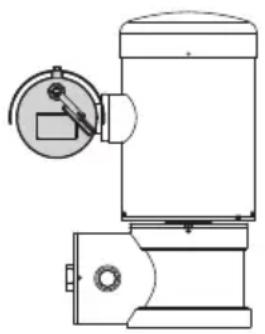
The system can be installed only in a standard or inverted position (ceiling mount). When installed for inverted operation, the camera orientation and controller functions are reconfigured for normal operation through the system's software.
Hardware adjustment is not required for inverted operation.
natural_image
Technical line drawing of a mechanical device with a dial indicator (no text or symbols)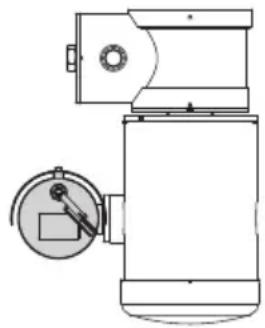
natural_image
Technical line drawing of a mechanical device with a circular component and housing (no text or symbols)Fig. 6
6.1.1 Fixing to parapet or ceiling mount
Fix the adaptor (01) to the bottom of the unit using the 4 flat countersunk screws (02) with hexagonal socket M10x20mm in stainless steel (A4 class 70) supplied.
Make sure the thread are free of dirt and debris.
Apply a generous amount of thread locking compound (Loctite 270) into the threaded holes in the base of the device.

Pay attention to the fixing. Tightening torque: 35Nm.
The thread compound must cure for one hour, allow for this period prior to completing the installation.
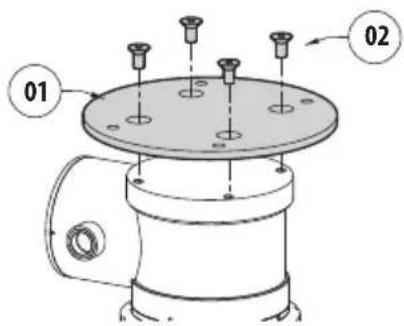
Fig. 7
Use the external holes in the adapter to fix the assembled unit to the parapet or to the ceiling. Use screws that can bear at least 4 times the weight of the unit.
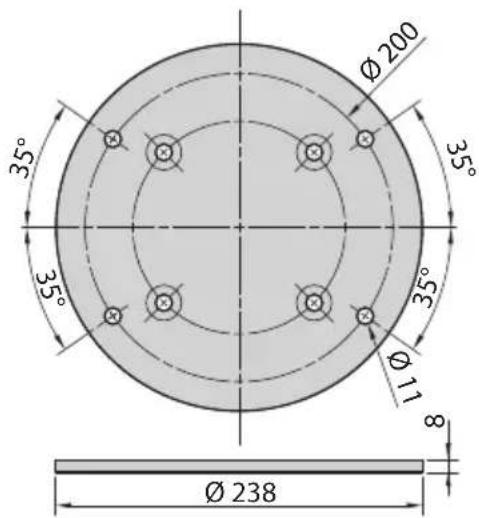
Fig. 8
6.1.2 Bracket mounting
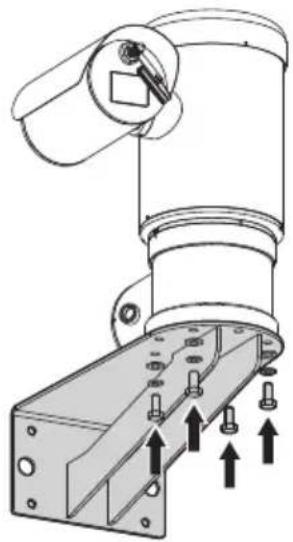
The bracket can be fixed to the vertical wall. Use screws and wall fixing devices that can bear at least four times the weight of the unit.
Then, fix the device to the bracket using the 4 flat washers, the 4 spring washers in stainless steel and the 4 hexagonal head screws in stainless steel (A4 class 70) supplied (M10x20mm).
natural_image
Technical diagram of a mechanical assembly with mounting bracket and directional arrows indicating force or movement (no text or symbols)Fig. 9
Make sure the thread are free of dirt and debris.
Apply a generous amount of thread locking compound (Loctite 270) on the 4 screws.
Tighten the screws.

Pay attention to the fixing. Tightening torque: 35Nm.
The thread compound must cure for one hour, allow for this period prior to completing the installation.
6.1.3 Fastening with corner adaptor module or pole
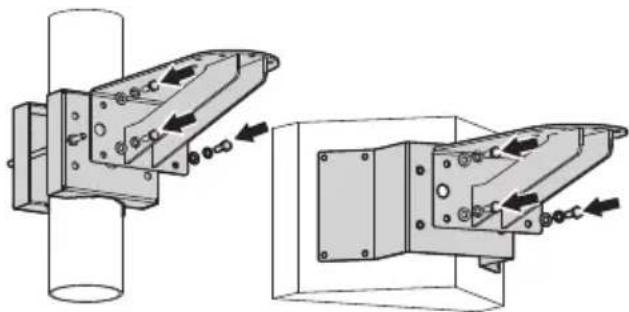
To install the product on the corner adaptor module or pole, first of all fasten the support bracket.
natural_image
Technical illustration of two mechanical components with arrows indicating motion or assembly (no text or symbols present)Fig. 10
To fasten the support bracket, use the 4 flat washers, the 4 elastic washers in stainless steel and the 4 hexagonal head screws in stainless steel (A4 class 70) M10x30mm supplied.
Make sure the thread are free of dirt and debris.
Apply a generous amount of threadlocker (Loctite 270) on the 4 threaded holes on the adaptor module. Tighten the screws.

Pay attention to the fixing. Tightening torque: 35Nm.
The thread compound must cure for one hour, allow for this period prior to completing the installation.
To fix the device to the bracket, consult the relevant chapter (6.1.2 Bracket mounting, page 26).
6.1.4 Sunshield mounting

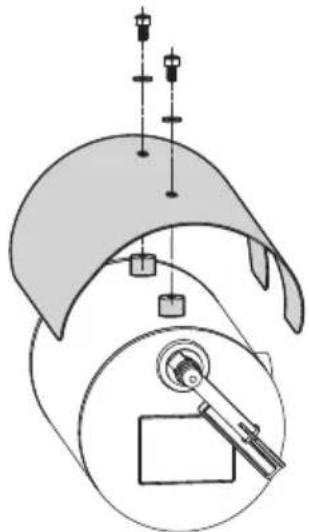
Remove the protective film before the sunshield installation (if present).
Apply a generous amount of thread locking compound (Loctite 270) into the threaded holes in the base of the device.
Fix the sunshield to the housing using the screws and washers screwed into the upper body of the housing.
The thread compound must cure for one hour, allow for this period prior to completing the installation.
natural_image
Technical diagram of a mechanical assembly with no visible text or symbolsFig. 11

Pay attention to the fixing. Tightening torque: 2Nm.
6.2 Opening of the connections compartment

The safety grub screw is used to prevent the unscrewing of the threaded cover from the connection compartment. Remove the security grub screw before unscrewing the threaded cover.
The bottom of the unit has no.2 3/4" NPT cable entries (or M25 special version).
To install the connections, remove the safety grub screw (01) using a male 1.5mm hex key, the threaded cover (02) (30mm hex nut) and the plastic plugs (03).
The plastic plugs are only used for shipping purposes and should not be used during operation.
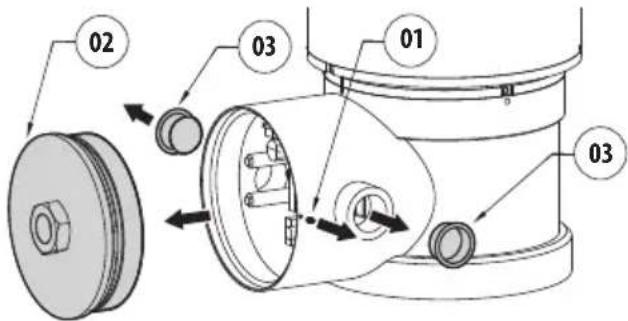
Fig. 12
By unscrewing the threaded lid, the connectors are accessed.
6.3 Connector board description
| BOARD DESCRIPTION | ||
| Connector Function | Terminals - Nominal section of the cables used | |
| J1 Power supply line from 0.2mm ^2 | (24AWG) up to 2.5mm ^2 (13AWG) | |
| J6 Alarms, Remote | reset and serial line | from 0.2mm ^2 (24AWG) up to 1.0mm ^2 (17AWG) |
| J8 Relay from 0.2mm ^2 | (24AWG) up to 1.0mm ^2 (17AWG) | |
| F1 Fuse – | ||
| F2 Fuse – | ||
| P1 Reset push-button – | ||
| RJ45 Ethernet Connector – | ||
| SFP SFP connector – | ||
Tab. 12
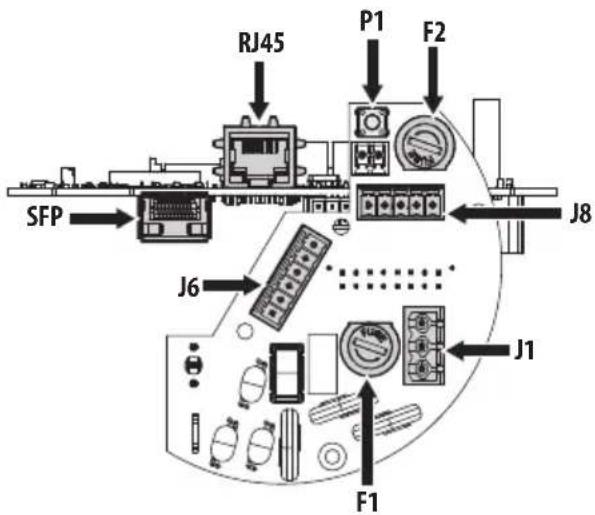
flowchart
graph TD
    A["SFP"] --> B["Device"]
    B --> C["RJ45"]
    C --> D["P1"]
    D --> E["F2"]
    E --> F["J8"]
    G["J6"] --> H["Control Panel"]
    I["J1"] --> J["Analog System"]
    K["F1"] --> L["Display Interface"]
Fig. 13
6.4 Ground connection
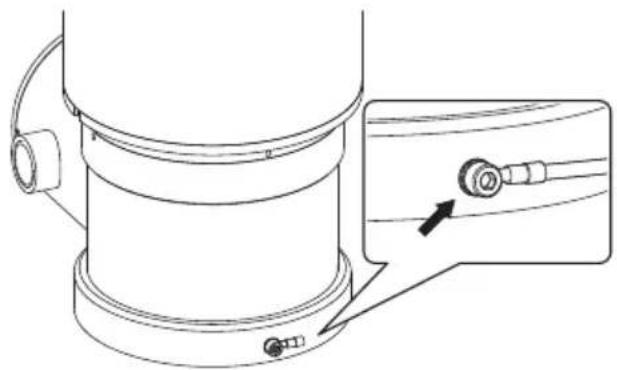
6.4.1 Earthing equipotential connection
The equipotential connection must be carried out using an external cable with a minimum 4mm^2 section (11AWG).
Connect the cable for the earthing equipotential connection with the eyelet terminal supplied (suitable for cables with 4mm^2(11AWG) up to 6mm^2(9AWG) section).
Fasten the eyelet using the M5 screw and lock washer supplied.
Characteristics of the M5 screw:
- Material: A4 Class 70
- Screw head: ISO 4762
- Length: 8mm (0.3in)
natural_image
Technical line drawing of a mechanical component with a magnified inset showing a connector detail (no text or symbols)Fig. 14
6.4.2 Connection of the safety earthing
The earthing cable must be connected to the internal connector (J1, 6.3 Connector board description, page 28).
6.5 Connecting the power supply
Depending on the version, the device can be provided with different power supply voltages. The power supply voltage is indicated on the product identification label.

Earth cable should be about 10mm longer than the other two, so that it will not be disconnected accidentally if pulled.

The ground conductor should be equal or greater in section than the section of the power supply cables.

The power supply cable must be covered by the silicone sheath (01) supplied. The silicone sheath must be fastened with the corresponding cable tie (02). For installations according to UL/CSA standards, pass the power supply cable through the cables input on the left (03), as indicated in the figure.

If using the VIDEOTEC multipolar cable and a fibre optic cable, you are advised to use the left cables input (03) for the multipolar cable and the right cables input (04) for the fibre optic.
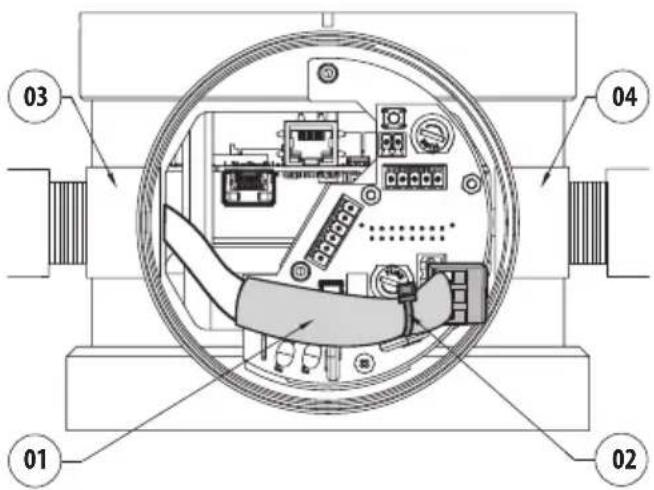
Fig. 15
Extract the removable power line connector from the connector board (J1, 6.3 Connector board description, page 28).
Connect the electrical power cables as indicated in the relevant table (Tab. 13, page 30).
| CONNECTING THE POWER SUPPLY | |
| Cable colour Terminals | |
| Power supply 24Vac | |
| Defined by the installer ~/24Vac | |
| Defined by the installer ~/24Vac | |
| Yellow/Green | |
| Power supply 100Vac, 120Vac, 220Vac, 230Vac | |
| Blue (N) Neutral | |
| Brown (L) Phase | |
| Yellow/Green | |
Tab. 13
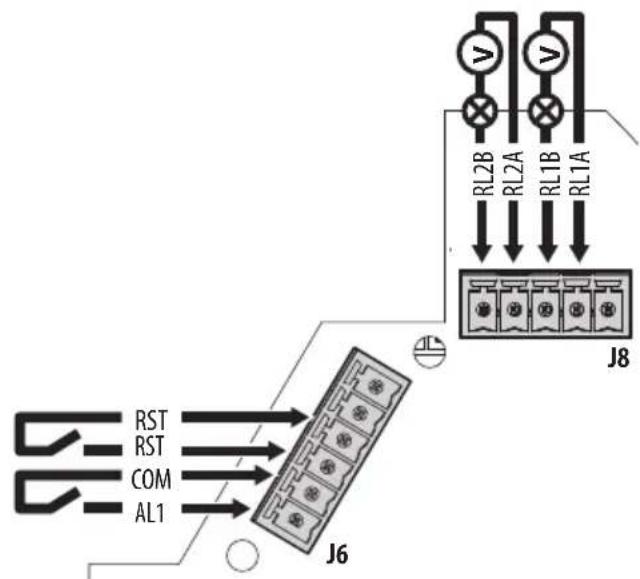
6.6 Connecting alarms, remote reset and relays

All signal cables must be grouped together by means of a cable tie.
| CONNECTION OF THE ALARM INPUTS AND RELAYS | ||
| Connectors Terminals Description | ||
| J6 AL1, COM Self-powered alarm input | fitted in the common terminal | |
| RST, RST Remote reset | ||
| J8 RL1A, RL1B Dry output contacts, can | be activated by alarm or by user control | |
Tab. 14
flowchart
graph TD
    A["Terminal RST"] --> B["J6"]
    C["Terminal COM"] --> B
    D["Terminal AL1"] --> B
    B --> E["RL1A"]
    B --> F["RL1B"]
    B --> G["RL2A"]
    B --> H["RL2B"]
Fig. 16
6.6.1 Connecting an alarm with dry contact
Connect terminals AL1 and COM to connector J6 as shown in the image (Fig. 16, page 30).
Maximum length of the alarm cables: 200m (656ft).
Use a shielded cable to carry out the connection.
6.6.2 Connecting the remote reset
Connect the two RST terminals on connector J6 as illustrated in the figure (Fig. 16, page 30).
Maximum cable length: 200m (656ft).
Read the Factory Default chapter to find out how to use the remote reset (10.2.2 Factory Default, page 37).
6.6.3 Relays connection

Maximum relay voltage and current: read the technical data in the relevant chapter (14 Technical data, page 39).
Connect terminals RL1A, RL1B, RL2A, RL2B to connector J8 as shown in the image (Fig. 16, page 30).
The device can be equipped with a washing system. Use the terminals RL2A and RL2B to control the wash system.
6.7 Ethernet connection
The product is equipped with an integrated Ethernet switch that manages a RJ45 port and a slot for SFP modules.
6.7.1 Connection via RJ45

Make connections in accordance with the TIA/EIA-568-B standard.
Connect the Ethernet cable to port RJ45 (6.3 Connector board description, page 28).
Use of Ethernet cables with the following characteristics is highly recommended:
- STP (isolated)
• Category 5E or category 6
Use a shielded RJ45 connector on both ends of the cable. The Ethernet cable shield (user side) must always be earthed via the connector.
6.7.2 Connection via SFP

The optical modules compliant with the SFP (Small Form Factor Pluggable) standard are conversion devices of the electrical to optical signal and the optical to electrical signal.
The SFP module is used for the optical fiber connection. The SFP module should be suitable for the installation system.
Consult the SFP module manual for the relevant specifications.

The SFP module (not supplied by VIDEOTEC) must meet the following requirements:
- Laser: Class 1, complies with EN60825-1
- UL/IEC 60950-1 or UL/IEC 62368-1 Certification

The user switch, connected via the SFP module, must work at a speed of 100Mbps. Check the settings of the switch to which the product is connected.

VIDEOTEC has tested various types of SFP modules. For further information please contact the VIDEOTEC service center.
Insert the SFP module (not supplied) in the SFP slot (6.3 Connector board description, page 28).
6.8 Installations according to UL/CSA standards

Pay attention not to damage the conductors and the boards.
For installations according to UL/CSA standards, the cables for Ethernet, reset, alarms, relays and fibre optics should be inserted in the right cables entry (01) as indicated in the following figure (Fig. 17, page 32).
For installations according to UL/CSA standards, pass the power supply cable through the cables input on the left (02), as indicated in the figure (Fig. 17, page 32).
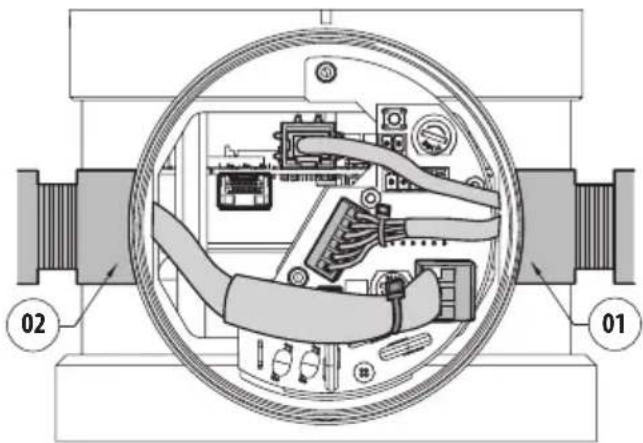
Fig. 17
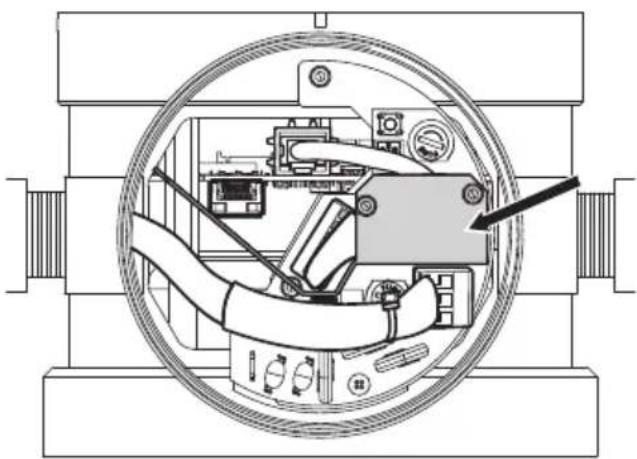
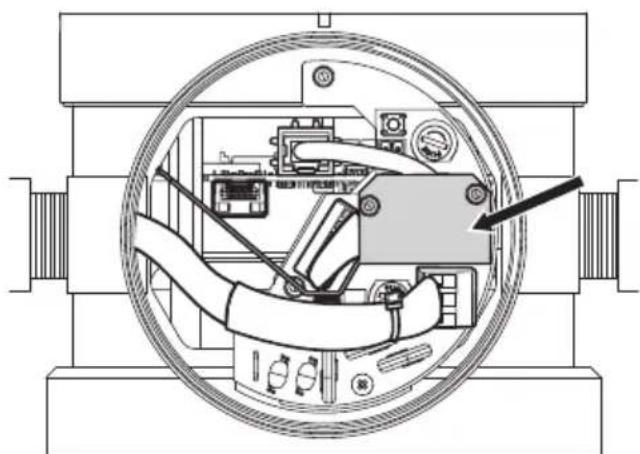
In installations according to UL/CSA standards, installation is compulsory of the separation barrier provided.
Having inserted all the connectors and before powering the device, install the separation barrier supplied.
Fasten the barrier (01) using the specific screws and washers (02) to the prepared spacers (03) (Fig. 18, page 32 and Fig. 19, page 32).
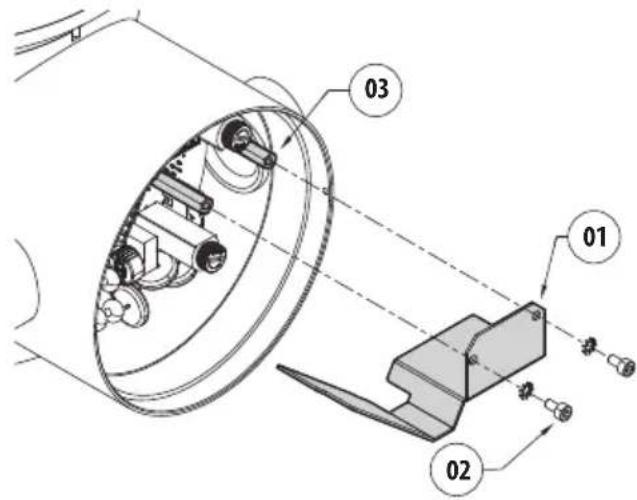
Fig. 18
natural_image
Technical diagram of a mechanical assembly with internal components and a highlighted section (no text or labels)Fig. 19
6.9 Connection compartment closing

If you can't turn by hand the threaded lid before the OR reaches the tube of the connection compartment this means that there are debris\dirt on the threads or that the lid is misaligned. In this case there's a serious danger of threads damaging. Unscrew the lid and check the alignment and/or clean the threads.

Never force the rotation of threaded lid before the OR reaches the connection compartment, otherwise thread damage could occur.

If you suspect that any kind of thread damaging has occurred, suspend the installation. The device could be no longer safe for the installation on a potentially explosive atmosphere. In this case contact VIDEOTEC technical support.

Before closing the cover, check the integrity of the O-ring gasket. If the gasket is damaged, replace it with the one supplied (10.1.2 Replacing the gasket, page 35).
Verify that there is no dirt or debris.
Lubricate the threads with grease compliant with IEC/EN60079-14 to facilitate screwing the cover on.
Arrange the cables so that there is no interference when closing the threaded lid of the connection compartment.
Screw by hand the threaded lid of the connection compartment till the OR gasket reaches the tube.
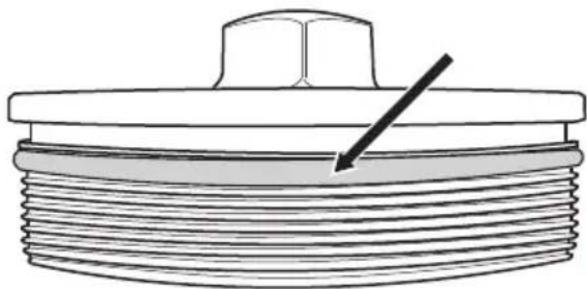
natural_image
Diagram of a mechanical component with a threaded base and central hub, showing a diagonal arrow pointing to a feature (no text or symbols present)Fig. 20
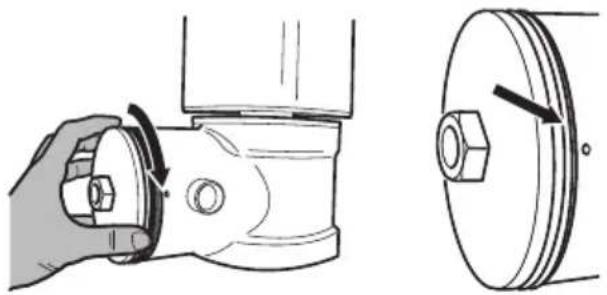
natural_image
Technical illustration of a hand operating a pipe fitting with a magnified view showing the wheel and nut assembly (no text or symbols)Fig. 21
Use a 30mm wrench for closing the threaded lid of the connection compartment. Make sure that there's no gap between the threaded cap and the junction box tube after tightening the cap.
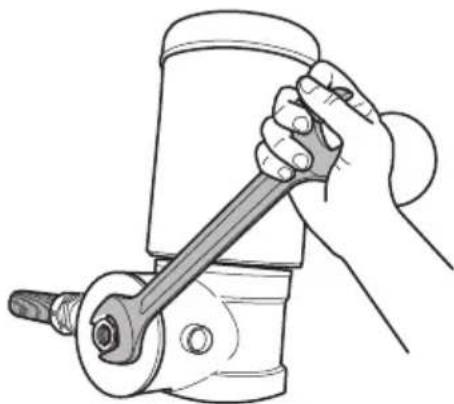
natural_image
Illustration of a hand using a wrench to adjust the engine cylinder (no text or symbols present)Fig. 22
Fixing the safety grub screw is necessary to complete product closure, to prevent unwanted unscrewing of the threaded plug.
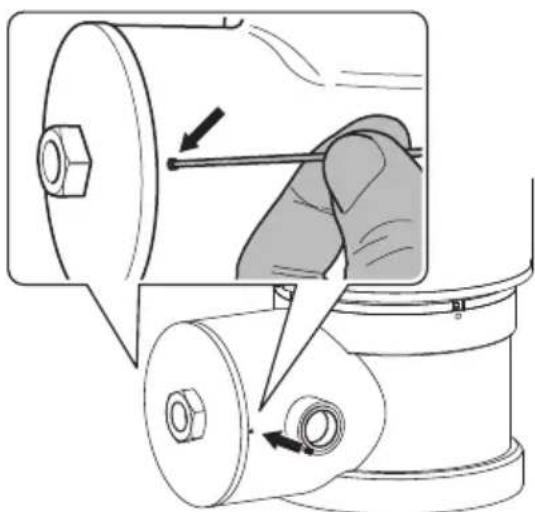
natural_image
Technical illustration of a mechanical assembly with a hand holding a tool, showing no text or symbols.Fig. 23
7 Switching on

Before carrying out any type of maintenance, read the "Safety rules" chapter carefully in the product manual.

The automatic pre-heating (De-Ice) process could be started whenever the device is switched on and the ambient temperature is below -10^ (+14^) . The procedure is necessary to guarantee correct operation of the devices even at low temperatures. The duration ranges depending on environmental conditions (from 60 minutes up to 120 minutes).
The unit is switched on by connecting the power supply.
It takes a few minutes for the unit to become fully operational after it is switched on.
To switch off the unit disconnect the power.
8 Configuration
8.1 Default IP address

The unit is configured to obtain an IP address from a DHCP server.
The IP address acquired via DHCP is visible in the DHCP server log file.
If the DHCP server is not available, the unit automatically configures itself with a self-generated IP address in the 169.254.x.x/16 subnet. Configuring the IP address of the PC as belonging to the same subnet (example: IP address: 169.254.1.1, subnet mask: 255.255.0.0).
Use an ONVIF compliant VMS or a network sniffer to find the IP address of the device (IP scan utility).
8.2 Web interface
8.2.1 First access to the web pages
The first operation in configuring the device consists in connecting to the web interface.
To access the web interface of the product, simply use a browser to connect to http://ip_address.
On first access, the Home page will be displayed.
To configure the web interface, consult the manual relating to the firmware version installed, available on the product web page of the website www.videotec.com.
9 Instructions for normal operation

Before carrying out any type of maintenance, read the "Safety rules" chapter carefully in the product manual.

Do not use the wiper if the ambient temperature is under 0^ C or if there is ice.

If it is left on, the wiper automatically disables itself.
The device control can be performed through different modes:
- Through the user's controls of the web interface (8.2 Web interface, page 34).
• Through Video Management Software (VMS) that supports the ONVIF protocol. In this case the special controls are implemented using the auxiliary commands of the ONVIF protocol. - Through PTZ Assistant software (the PTZ Assistant software is available to download on the product web page of the website: www.videotec.com).
9.1 Enabling the LED illuminator
MPXL is equipped with a LED illuminator. The illuminator is composed of two groups of LEDs called SPOT and WIDE. The operating parameters of the illuminator are set using the web interface of the PTZ unit.
10 Maintenance

Before carrying out any type of intervention, read the "Safety rules" chapter carefully in the product manual.
When contacting VIDEOTEC for assistance please provide the serial number and the identification code of the model.
Use only VIDEOTEC original spare parts.
10.1 Routine maintenance
10.1.1 Inspecting the cables
The cables should not show signs of damage or wear, which could generate hazardous situations. In this case extraordinary maintenance is necessary.
10.1.2 Replacing the gasket
Replace the connection compartment cover seal using the one supplied.
Open and close the connection compartment as described in the previous chapters.
Replace the gasket, paying attention to position it correctly.
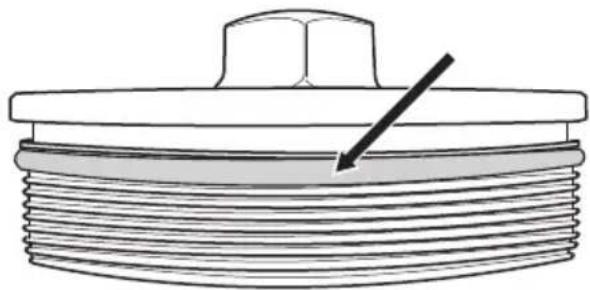
natural_image
Diagram of a mechanical component with threaded base and central hub, no text or symbols presentFig. 24
10.1.3 Replacement of the wiper blade
In models equipped with a wiper, the worn blades can be replaced.
Unscrew the rivet nut fastening the blade and remove it with the washers. Replace the worn blade with a new one. Apply a good quantity of threadlocker (Loctite 270), reposition the rivet nut and the washers by adjusting fastening until the blade correctly tits to the glass. Activate the wiper to check the blade is correctly adjusted.
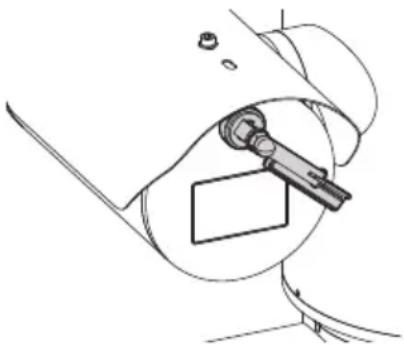
natural_image
Line drawing of a mechanical component with a lever and rectangular block (no text or symbols)Fig. 25
10.2 Extraordinary maintenance
10.2.1 Fuse replacement

CAUTION! To ensure protection against the risk of fire, replace the fuse with one the same type and value. The fuse must only be replaced by qualified staff.
If necessary, replace the fuses illustrated in figure (6.3 Connector board description, page 28).
| FUSES REPLACEMENT MPXHD, MPXR, MPXT | ||
| Supply voltage Fuse | (F1) Fuse (F2) | |
| 24Vac, 50/60Hz T 4A H | 250V 5x20 T 4A H 250V 5x20 | |
| 120Vac, 50/60Hz T 2A | H 250V 5x20 T 4A H 250V 5x20 | |
| 230Vac, 50/60Hz T 2A | H 250V 5x20 T 4A H 250V 5x20 | |
| 220Vac, 50/60Hz T 2A | H 250V 5x20 T 4A H 250V 5x20 | |
| 100Vac, 50/60Hz T 2A | H 250V 5x20 T 4A H 250V 5x20 | |
Tab. 15
| FUSES REPLACEMENT MPXL | ||
| Supply voltage Fuse | (F1) Fuse (F2) | |
| 24Vac, 50/60Hz T 5A H | 250V 5x20 T 5A H 250V 5x20 | |
| 120Vac, 50/60Hz T 2A | H 250V 5x20 T 5A H 250V 5x20 | |
| 220Vac/230Vac, 50/60Hz | T 2A H 250V 5x20 T 5A H 250V 5x20 | |
| 100Vac, 50/60Hz T 2A | H 250V 5x20 T 5A H 250V 5x20 | |
Tab. 16
10.2.2 Factory Default

If the access password is no longer available, follow the procedure to reset to default factory settings.
The effect of the Factory Default procedure is the same as restoring the factory default settings through the web interface (Hard Reset button).
To restore the factory settings relative to the network, user access and camera configuration follow this procedure:
- Switch off the unit.
- Open the connection compartment.
- Press and hold the reset button (P1, 6.3 Connector board description, page 28).
- Power the unit.
- Wait 30 seconds.
- Release the reset button.
- Wait for 2 minutes.
- Switch off the unit.
- Close the connections compartment.
- Power the unit.
It is also possible to perform the reset in remote mode. Follow the procedure below:
- Switch off the unit.
- Connect the RST contacts of connector J6 (6.3 Connector board description, page 28).
- Power the unit.
- Wait 30 seconds.
- Disconnect the RST contacts.
- Wait for 2 minutes.
- Switch off the unit.
- Power the unit.

Once the factory default procedure has finished, you need to configure the unit as described in chapter: 8.1 Default IP address, page 34.
11 Cleaning

Before carrying out any type of maintenance, read the "Safety rules" chapter carefully in the product manual.

Frequency will depend on the type of environment in which the product is used.
11.1 Routine cleaning
11.1.1 Cleaning the glass window
Cleaning should be done with mild soap diluted with water.
11.1.2 Cleaning the germanium window

When cleaning the window, take care not to scratch or damage the outer surface treated with carbon coating. Damage to this coating could also interfere with the transparency of the surface to infrared light.
Cleaning should be done with mild soap diluted with water.
Remove the protective grate and the spacer, unscrewing the countersunk screws on the front of the housing, using a 2mm spark-proof hexagonal wrench.
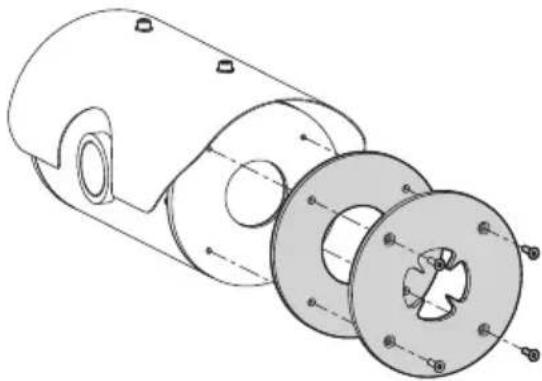
natural_image
Technical line drawing of a mechanical assembly with two flanges and internal components (no text or symbols)Fig. 26
Once done cleaning, reassemble the spacer and the protection grid.

Pay attention to the fixing. Tightening torque: 1Nm.
11.1.3 Cleaning the product

The outside surface of the product must never be covered in more than 5 mm of dust.

The cleaning of the product should be carried out according to the instructions in this chapter in order to prevent accumulation of electrostatic charges.
The device should be cleaned using a damp cloth; compressed air must not be used.
12 Information on disposal and recycling
The European Directive 2012/19/EU on Waste Electrical and Electronic Equipment (WEEE) mandates that these devices should not be disposed of in the normal flow of municipal solid waste, but they should be collected separately in order to optimize the recovery stream and recycling of the materials that they contain and to reduce the impact on human health and the environment due to the presence of potentially hazardous substances.
The symbol of the crossed out bin is marked on all products to remember this.
The waste may be delivered to appropriate collection centers, or may be delivered free of charge to the distributor where you purchased the equipment at the time of purchase of a new equivalent or without obligation to a new purchase for equipment with size smaller than 25cm (9.8in).
For more information on proper disposal of these devices, you can contact the responsible public service.
13 Troubleshooting

Before carrying out any type of maintenance, read the "Safety rules" chapter carefully in the product manual.

Contact an authorised support centre if the problems persist or you have any other issues that are not described here.
PROBLEM The product does not go on.
CAUSE Wiring error, blown fuse.
SOLUTION Make sure the connections are correct. Check the continuity of the fuses and replace them with the indicated models should they fail.
PROBLEM The shooting area do not correspond to the selected preset position.
CAUSE Loss of absolute position reference point.
SOLUTION Reset the equipment by switching off and on again.
PROBLEM The device does not move during the start-up phase.
CAUSE The ambient temperature is too low.
SOLUTION Wait until the end of the pre-heating procedure. The following message is displayed on the web page: De-Ice procedure in progress.
PROBLEM The illuminator reduces in intensity or switches off.
CAUSE In high ambient temperatures, the illuminator automatically reduces the brightness flow.
SOLUTION Do not intervene. To reduce the temperature, the system will automatically restart the illuminator.
14 Technical data
14.1 MAXIMUS MPX SERIES2 (MPXHD)
14.1.1 General
AISI 316L stainless steel construction
External surfaces micro-shot peened and electropolished
Dynamic positioning control system
Maximum number of presets: 250
14.1.2 Mechanical
Cable inputs: 2 x 3/4" NPT
Zero backlash
Horizontal rotation: 360°, continuous rotation
Vertical rotation: from -90^ up to +90^
Horizontal speed (variable): from 0.1°/s up to 100°/s
Tilt speed (variable): from 0.1°/s up to 100°/s
Accuracy of preset positions: 0.02°
Integrated wiper
Window with extra clear tempered glass
- Thick: 12mm (0.47in)
Unit weight: 26.5kg (58lb)
14.1.3 Electrical
Supply voltage/Current consumption:
• 230Vac ±10%, 0.5A, 50/60Hz
• 24Vac ±10%, 5A, 50/60Hz
• 120Vac ±10%, 1A, 50/60Hz
• 220Vac ±10%, 0.54A, 50/60Hz
• 100Vac ±10%, 1.2A, 50/60Hz
Power consumption:
- 120W max
14.1.4 Network
RJ45 port
- Ethernet connection: 10BASE-T/100BASE-T
Slot SFP (SMALL FORM FACTOR PLUGGABLE)
- Ethernet connection:100BASE-FX
• Supply voltage: 3.3V - Standard: MSA compliant
The SFP module (not supplied by VIDEOTEC) must meet the following requirements:
- Laser: Class 1, complies with EN60825-1
• Certification: UL/IEC 60950-1 or UL/IEC 62368-1
14.1.5 I/O interface
Input for remote reset: 1
Alarm inputs: 1
Relay outputs: 1+1 (1A, 30Vac/60Vdc max, one relay reserved for washer pump and one configurable)
14.1.6 Cameras
Day/Night Full HD 30x DELUX
Resolution: Full HD 1080p (1920x1080)
Image Sensor: 1/2.8" Exmor™ R CMOS sensor
Effective Pixels: approx. 2.38 Megapixels
Minimum Illumination:
• Colour: 0.006lx (F1.6, 30 IRE)
• B/W: 0.0006lx (F1.6, 30 IRE)
Focal length: from 4.5mm (wide) up to 135mm (tele)
Zoom: 30x (480x with digital zoom)
Iris: from F1.6 up to F9.6 (Auto, Manual)
Horizontal Viewing Angle: from 61.60° (wide end) up to 2.50° (tele end)
Vertical Viewing Angle: from 37.07^ (wide end) up to 1.44^ (tele end)
Shutter speed: from 1/1s up to 1/10000s (Auto, Manual)
White balance: Auto, Manual
Gain: from 0dB up to 100dB (Auto, Manual)
Wide Dynamic Range: 120dB
Focus System: Auto, Manual, Trigger
Picture Effects: E-flip, Colour enhancement
Noise removal: 2D (3 levels), 3D (3 levels)
Exposure Control: Auto, Manual, Priority (Iris Priority, Shutter Priority), Brightness, Custom
De-fog: On/Off
Privacy zones masking: maximum 8 settable masks
Indoor Flicker Reduction
Auto Slowshutter: Off, On (from 1/30s up to 1/1s)
Exposure compensation: Off, On (from level 0 up to level 14)
Sharpness: from level 0 up to level 3
SONY FCB-EV7520 Day/Night Full HD 30x
Resolution: Full HD 1080p (1920x1080)
Image Sensor: 1/2.8" Exmor™ R CMOS sensor
Effective Pixels: approx. 2.13 Megapixels
Minimum Illumination:
• Colour: 0.0013lx (50 IRE, High sensitivity on)
• B/W: 0.0008lx (30 IRE, High sensitivity on)
Focal length: from 4.3mm (wide) up to 129mm (tele)
Zoom: 30x (360x with digital zoom)
Iris: from F1.6 up to F14 (Auto, Manual)
Horizontal Viewing Angle: from 63.7° (wide end) up to 2.3° (tele end)
Vertical Viewing Angle: from 38.5^ (wide end) up to 1.3^ (tele end)
Shutter speed: from 1/1s up to 1/10000s (Auto, Manual)
White balance: Auto, Auto Tracing, Indoor, Outdoor, Manual, Outdoor Auto, Sodium Lamp (Fix/Auto/Outdoor Auto)
Gain: from 0dB up to 50.0dB (Auto, Manual)
Wide Dynamic Range: 120dB
Focus System: Auto (PTZ Trigger, Full Auto), Manual Picture Effects: E-flip
Noise removal (2D, 3D): Off, On (from level 1 up to level 5)
Exposure Control: Auto, Manual, Priority (Shutter priority, Iris priority, Brightness priority)
De-fog: Off, Low, Mid, High
Dynamic masking of privacy zones: maximum 24 masks settable, maximum 8 simultaneously displayable
Indoor Flicker Reduction
Gain Limit: from 10.7dB up to 50dB
High sensitivity: On/Off
Backlight Compensation: On/Off
Auto Slowshutter: On/Off
Exposure compensation: Off, On (from -10.5dB up to +10.5dB)
Sharpness: from level 0 up to level 15
High Light Compensation (HLC): Off, Low, Mid, High, Masking Level (Off, On, from level 1 up to level 15)
Digital image stabilization: On/Off
14.1.7 Environment
For indoors and outdoors installation
Certification temperature: from -40°C (-40°F) up to +80°C (+176°F)
Operating temperature:
- Continuous functioning: from -40^ (-40°F) up to +65^ (149°F) (up to +50^ (122°F) for versions with integrated video analysis, VIDEOTEC ANALYTICS)
- Temperature test complies with NEMA-TS 2-2003 (R2008) par. 2.1.5.1, test profile fig. 2-1 (from -34°C (-29.2°F) to +74°C (165.2°F)) (not valid for versions with integrated video analysis, VIDEOTEC ANALYTICS)
- De-icing function intervention (cold start): from -40^ (-40°F) up to -10^ (14°F)
Wind resistance
• PTZ static: 230km/h (143mph) max.
- PTZ operational at the maximum speed: 210km/h (130.5mph) max.
Relative humidity: from 5% up to 95%
14.1.8 Certifications
Electrical safety (CE): EN60950-1, IEC60950-1, EN62368-1, IEC62368-1
Electromagnetic compatibility (CE): EN50130-4, EN55032 (Class A), EN61000-6-4, EN61000-3-2, EN61000-3-3
RoHS (CE): EN IEC 63000
Outdoor installation (CE): EN60950-22, IEC60950-22
Vibration test: EN50130-5, EN60068-2-6
UL certification (UL60950-1, CAN/CSA C22.2 No. 60950-1-07) (not available for 100Vac versions): cULus Listed
UL certification (UL62368-1, CAN/CSA C22.2 No. 62368-1-14) (not available for 100Vac versions): cULus Listed
Electromagnetic compatibility (North America) (not available for 100Vac versions): FCC part 15 (Class A), ICES-003 (Class A)
IP protection degree (EN/IEC60529): IP66, IP67, IP68, IP69
Level of protection Type (UL50E) (not available for 100Vac versions): 4X, 6P
RCM (Australian and New Zealand Regulatory Compliance Mark)
KC certification (certification only valid for the codes: MPXHD51A001C, MPXHD31A001C)
BIS certification (certification only valid for the code: MPXHD22A000C)
14.1.9 Certifications - Explosion-proof applications
ATEX (EN IEC 60079-0, EN 60079-1, EN 60079-31)
IECEX (IEC 60079-0, IEC 60079-1, IEC 60079-31)
UL listed for USA (UL 60079-0, UL 60079-1, UL 60079-31) (not available for 100Vac versions)
UL listed for Canada (CAN/CSA-C22.2 NO. 60079-0, CAN/CSA-C22.2 NO. 60079-1, CAN/CSA-C22.2 NO. 60079-31) (not available for 100Vac versions)
EAC Ex (TR CU 012/2011)
INMETRO (ABNT NBR IEC 60079-0, ABNT NBR IEC 60079-1, ABNT NBR IEC 60079-31)
KCs (Employment and labor department 2021-22)
UK Ex (EN IEC 60079-0, EN 60079-1, EN 60079-31)
14.1.10 Certifications - Marine applications
Lloyd's Register Marine Type Approval certification (with MAXIMUS MBX communication box or with FM1010 filter):
Test Specification Number 1 (ENV1, ENV2, ENV3, ENV5)
Electromagnetic compatibility: EN60945
Salty fog resistance: EN60068-2-52
14.2 MAXIMUS MPXR SERIES2 (MPXR)
14.2.1 General
AISI 316L stainless steel construction
External surfaces micro-shot peened and electropolished
Dynamic positioning control system
Maximum number of presets: 250
Radiometric analysis:
- on the 4 central pixels, if the thermal camera has radiometric functions
- definition of a specific area, if the thermal camera has advanced radiometric functions
Radiometric alarm activation: if the temperature is over the threshold set, under the threshold set, between two thresholds set or outside the two thresholds set.
Actions on alarm: activation of digital output, preset tour recall, home position recall, preset position recall and http get request.
14.2.2 Mechanical
Cable inputs: 2 x 3/4" NPT
Zero backlash
Horizontal rotation: 360^ , continuous rotation
Vertical rotation: from -90^ up to +90^
Horizontal speed (variable): from 0.1°/s to 100°/s
Tilt speed (variable): from 0.1°/s to 100°/s
Accuracy of preset positions: 0.02°
Unit weight: 26.5kg (58lb)
14.2.3 Housing's window
Germanium window
- Thick: 8mm (0.3in)
- External treatment: antiscratch (Hard Carbon Coating - DLC), antireflection
- Internal treatment: antireflection
• Spectral range: from 7.5μm up to 14μm
• Medium transmittance (from 7.5μm up to 11.5μm): 87.5%
• Medium transmittance (from 11.5μm up to 14μm): 72.1%
14.2.4 Electrical
Supply voltage/Current consumption:
• 230Vac ±10%, 0.5A, 50/60Hz
• 24Vac ±10%, 5A, 50/60Hz
• 120Vac ±10%, 1A, 50/60Hz
- 220Vac ±10%, 0.54A, 50/60Hz
• 100Vac ±10%, 1.2A, 50/60Hz
Power consumption:
- 120W max
14.2.5 Network
RJ45 port
- Ethernet connection: 10BASE-T/100BASE-T
Slot SFP (SMALL FORM FACTOR PLUGGABLE)
- Ethernet connection:100BASE-FX
• Supply voltage: 3.3V
• Standard: MSA compliant
The SFP module (not supplied by VIDEOTEC) must meet the following requirements:
- Laser: Class 1, complies with EN60825-1
• Certification: UL/IEC 60950-1 or UL/IEC 62368-1
14.2.6 I/O interface
Input for remote reset: 1
Alarm inputs: 1
Relay outputs: 1+1 (1A, 30Vac/60Vdc max, one relay reserved for washer pump and one configurable)
14.2.7 Thermal Cameras
| THERMAL CAMERAS (RESOLUTION 336X256) | |||||
| Lens | 9mm | 13mm | 19mm | 25mm | 35mm |
| VOx microbolometer sensor not cooled | √ √ √ √ √ | ||||
| Interpolated resolution 720x480 720x480 720x480 720x480 720x480 720x480 720x480 720x480 720x480 720x480 720x480 720x480 720x480 72 | 720x480 720x480 | ||||
| Pixel dimensions 17μm 17μm 17μm 17μm 17μm | |||||
| Spectral response - long wave infrared (LWIR) from 7.5μm to 13.5μm | from 7.5μm to 13.5μm | from 7.5μm to 13.5μm | from 7.5μm to 13.5μm | from 7.5μm to 13.5μm | from 7.5μm to 13.5μm |
| Internal shutter (only for sensor compensation) | Video stop <1s | Video stop <1s | Video stop <1s | Video stop <1s | Video stop <1s |
| Digital Detail Enhancement (DDE) | √ √ √ √ √ | ||||
| Digital Zoom | 2x, 4x | 2x, 4x | 2x, 4x | 2x, 4x | 2x, 4x |
| Image updating frequency | 7.5fps | 7.5fps | 7.5fps | 7.5fps | 7.5fps |
| Image updating high frequency | 30fps | 30fps | 30fps | 30fps | 30fps |
| Scene range (High Gain) | -40°C ÷ +160°C(-40°F ÷+320°F) | -40°C ÷ +160°C(-40°F ÷+320°F) | -40°C ÷ +160°C(-40°F ÷+320°F) | -40°C ÷ +160°C(-40°F ÷+320°F) | -40°C ÷ +160°C(-40°F ÷+320°F) |
| Scene range (Low Gain) | -40°C ÷ +550°C(-40°F ÷+1022°F) | -40°C ÷ +550°C(-40°F ÷+1022°F) | -40°C ÷ +550°C(-40°F ÷+1022°F) | -40°C ÷ +550°C(-40°F ÷+1022°F) | -40°C ÷ +550°C(-40°F ÷+1022°F) |
| Horizontal field of view (HFOV) | 35° | 25° | 17° | 13° | 9.3° |
| Vertical field of view (VFOV) | 27° | 19° | 13° | 10° | 7.1° |
| f-number | f/1.25 | f/1.25 | f/1.25 | f/1.1 | f/1.2 |
| Thermal sensitivity (NETD), thermal camera with radiometric functions | <50mK at f/1.0 | <50mK at f/1.0 | <50mK at f/1.0 | <50mK at f/1.0 | <50mK at f/1.0 |
| Thermal sensitivity (NETD), thermal camera with advanced radiometric functions | <30mK at f/1.0 | <30mK at f/1.0 | <30mK at f/1.0 | <30mK at f/1.0 | <30mK at f/1.0 |
| Person (detection / recognition / identification) | 285m / 71m / 36m (935ft / 233ft / 118ft) | 440m / 112m / 56m (1443ft / 2368ft / 183ft) | 640m / 160m / 80m (2099ft / 524ft / 262ft) | 930m / 230m / 116m (3051ft / 754ft / 380ft) | 1280m / 320m / 160m (4199ft / 1050ft / 525ft) |
| Car (detection / recognition / identification) | 880m / 220m / 108m (2887ft / 722ft / 354ft) | 1340m / 340m / 170m (4396ft / 1115ft / 557ft) | 1950m / 500m / 250m (6397ft/ 1640ft/ 820ft) | 2800m / 710m / 360m (9186ft / 2329ft / 1181ft) | 3850m / 950m / 295m (12631ft / 3116ft / 967ft) |
Tab. 17
THERMAL CAMERAS (RESOLUTION 640X512)
| Lens | 9mm | 13mm | 19mm | 25mm | 35mm |
| VOx microbolometer sensor not cooled | √ √ √ √ √ | ||||
| Interpolated resolution 720x480 720x480 720x480 720x480 720x480 720x480 720x480 720x480 720x480 720x480 720x480 720x480 720x480 72 | 720x480 720x480 | ||||
| Pixel dimensions 17μm 17μm 17μm 17μm 17μm | |||||
| Spectral response - long wave infrared (LWIR) from 7.5μm to 13.5μm | from 7.5μm to 13.5μm | from 7.5μm to 13.5μm | from 7.5μm to 13.5μm | from 7.5μm to 13.5μm | from 7.5μm to 13.5μm |
| Internal shutter (only for sensor compensation) | Video stop <1s | Video stop <1s | Video stop <1s | Video stop <1s | Video stop <1s |
| Digital Detail Enhancement (DDE) | √ √ √ √ √ | ||||
| Digital Zoom | 2x, 4x, 8x | 2x, 4x, 8x | 2x, 4x, 8x | 2x, 4x, 8x | 2x, 4x, 8x |
| Image updating frequency | 7.5fps | 7.5fps | 7.5fps | 7.5fps | 7.5fps |
| Image updating high frequency | 30fps | 30fps | 30fps | 30fps | 30fps |
| Scene range (High Gain) | -40°C ÷ +160°C(-40°F ÷+320°F) | -40°C ÷ +160°C(-40°F ÷+320°F) | -40°C ÷ +160°C(-40°F ÷+320°F) | -40°C ÷ +160°C(-40°F ÷+320°F) | -40°C ÷ +160°C(-40°F ÷+320°F) |
| Scene range (Low Gain) | -40°C ÷ +550°C(-40°F ÷+1022°F) | -40°C ÷ +550°C(-40°F ÷+1022°F) | -40°C ÷ +550°C(-40°F ÷+1022°F) | -40°C ÷ +550°C(-40°F ÷+1022°F) | -40°C ÷ +550°C(-40°F ÷+1022°F) |
| Horizontal field of view (HFOV) | 69° | 45° | 32° | 25° | 18° |
| Vertical field of view (VFOV) | 56° | 37° | 26° | 20° | 14° |
| f-number | f/1.4 | f/1.25 | f/1.25 | f/1.1 | f/1.2 |
| Thermal sensitivity (NETD), thermal camera with radiometric functions | <50mK at f/1.0 | <50mK at f/1.0 | <50mK at f/1.0 | <50mK at f/1.0 | <50mK at f/1.0 |
| Thermal sensitivity (NETD), thermal camera with advanced radiometric functions | <30mK at f/1.0 | <30mK at f/1.0 | <30mK at f/1.0 | <30mK at f/1.0 | <30mK at f/1.0 |
| Person (detection / recognition / identification) 250m / 63m /31m (820ft /207ft / 102ft) | 390m / 95m /47m (1280ft /312ft / 154ft) | 570m / 144m/ 72m (1870 /472 / 236ft) | 820m / 210m /104m (2690ft /689ft / 341ft) | 1140m / 280m/ 142m (3740ft/ 919ft / 466ft) | |
| Car (detection / recognition / identification) | 720m / 175m/88m (2362 /574 / 289ft) | 1080m / 275m/ 140m (3543ft/ 902ft / 459ft) | 1550m / 400m/ 200m (5085ft/ 1312ft / 656ft) | 2200m / 580m/ 290m (7218ft/ 1903ft /951ft) | 3000m / 800m/ 200m (9843ft/ 2625ft /656ft) |
Tab. 18
14.2.8 Environment
For indoors and outdoors installation
Certification temperature: from -40°C (-40°F) up to +80°C (+176°F)
Operating temperature:
- Continuous functioning: from -40^ (-40°F) up to +65^ (149°F)
- Temperature test complies with NEMA-TS 2-2003 (R2008) par. 2.1.5.1, test profile fig. 2-1 (from -34°C (-29.2°F) to +74°C (165.2°F))
- De-icing function intervention (cold start): from -40^ (-40°F) up to -10^ (14°F)
Wind resistance
• PTZ static: 230km/h (143mph) max.
- PTZ operational at the maximum speed: 210km/h (130.5mph) max.
Relative humidity: from 5% up to 95%
14.2.9 Certifications
Electrical safety (CE): EN60950-1, IEC60950-1, EN62368-1, IEC62368-1
Electromagnetic compatibility (CE): EN50130-4, EN55032 (Class A), EN61000-6-4, EN61000-3-2, EN61000-3-3
RoHS (CE): EN IEC 63000
Outdoor installation (CE): EN60950-22, IEC60950-22
Vibration test: EN50130-5, EN60068-2-6
UL certification (UL60950-1, CAN/CSA C22.2 No. 60950-1-07) (not available for 100Vac versions): cULus Listed
UL certification (UL62368-1, CAN/CSA C22.2 No. 62368-1-14) (not available for 100Vac versions): cULus Listed
Electromagnetic compatibility (North America) (not available for 100Vac versions): FCC part 15 (Class A), ICES-003 (Class A)
IP protection degree (EN/IEC60529): IP66, IP67, IP68, IP69
Level of protection Type (UL50E) (not available for 100Vac versions): 4X, 6P
RCM (Australian and New Zealand Regulatory Compliance Mark)
KC certification (certification only valid for the code: MPXT32UA0R1CH)
14.2.10 Certifications - Explosion-proof applications
ATEX (EN IEC 60079-0, EN 60079-1, EN 60079-31)
IECEX (IEC 60079-0, IEC 60079-1, IEC 60079-31)
UL listed for USA (UL 60079-0, UL 60079-1, UL 60079-31) (not available for 100Vac versions)
UL listed for Canada (CAN/CSA-C22.2 NO. 60079-0, CAN/CSA-C22.2 NO. 60079-1, CAN/CSA-C22.2 NO. 60079-31) (not available for 100Vac versions)
EAC Ex (TR CU 012/2011)
INMETRO (ABNT NBR IEC 60079-0, ABNT NBR IEC 60079-1, ABNT NBR IEC 60079-31)
KCs (Employment and labor department 2021-22)
UK Ex (EN IEC 60079-0, EN 60079-1, EN 60079-31)
14.2.11 Certifications - Marine applications
Lloyd's Register Marine Type Approval certification (with MAXIMUS MBX communication box or with FM1010 filter):
Test Specification Number 1 (ENV1, ENV2, ENV3, ENV5)
Electromagnetic compatibility: EN60945
Salty fog resistance: EN60068-2-52
14.3 MAXIMUS MPXT SERIES2 (MPXT)
14.3.1 General
AISI 316L stainless steel construction
External surfaces micro-shot peened and electropolished
Dynamic positioning control system
Maximum number of presets: 250
Radiometric analysis:
- on the 4 central pixels, if the thermal camera has radiometric functions
- definition of a specific area, if the thermal camera has advanced radiometric functions
Radiometric alarm activation: if the temperature is over the threshold set, under the threshold set, between two thresholds set or outside the two thresholds set.
Actions on alarm: activation of digital output, preset tour recall, home position recall, preset position recall and http get request.
14.3.2 Mechanical
Cable inputs: 2 x 3/4" NPT
Zero backlash
Horizontal rotation: 360^ , continuous rotation
Vertical rotation: from -90^ up to +90^
Horizontal speed (variable): from 0.1°/s to 100°/s
Tilt speed (variable): from 0.1°/s to 100°/s
Accuracy of preset positions: 0.02°
Integrated wiper
Unit weight: 31kg (68lb)
14.3.3 Housing's window
Window with extra clear tempered glass
- Thick: 12mm (0.47in)
Germanium window
- Thick: 8mm (0.3in)
- External treatment: antiscratch (Hard Carbon Coating - DLC), antireflection
- Internal treatment: antireflection
• Spectral range: from 7.5μm up to 14μm
• Medium transmittance (from 7.5μm up to 11.5μm): 87.5%
• Medium transmittance (from 11.5μm up to 14μm): 72.1%
14.3.4 Electrical
Supply voltage/Current consumption:
• 230Vac ±10%, 0.5A, 50/60Hz
• 24Vac ±10%, 5A, 50/60Hz
• 120Vac ±10%, 1A, 50/60Hz
• 220Vac ±10%, 0.54A, 50/60Hz
• 100Vac ±10%, 1.2A, 50/60Hz
Power consumption:
- 120W max
14.3.5 Network
RJ45 port
- Ethernet connection: 10BASE-T/100BASE-T
Slot SFP (SMALL FORM FACTOR PLUGGABLE)
- Ethernet connection:100BASE-FX
• Supply voltage: 3.3V
• Standard: MSA compliant
The SFP module (not supplied by VIDEOTEC) must meet the following requirements:
- Laser: Class 1, complies with EN60825-1
• Certification: UL/IEC 60950-1 or UL/IEC 62368-1
14.3.6 I/O interface
Input for remote reset: 1
Alarm inputs: 1
Relay outputs: 1+1 (1A, 30Vac/60Vdc max, one relay reserved for washer pump and one configurable)
14.3.7 Day/Night cameras
SONY FCB-EV7520 Day/Night Full HD 30x
Resolution: Full HD 1080p (1920x1080)
Image Sensor: 1/2.8" Exmor™ R CMOS sensor
Effective Pixels: approx. 2.13 Megapixels
Minimum Illumination:
• Colour: 0.0013lx (50 IRE, High sensitivity on)
• B/W: 0.0008lx (30 IRE, High sensitivity on)
Focal length: from 4.3mm (wide) up to 129mm (tele)
Zoom: 30x (360x with digital zoom)
Iris: from F1.6 up to F14 (Auto, Manual)
Horizontal Viewing Angle: from 63.7° (wide end) up to 2.3° (tele end)
Vertical Viewing Angle: from 38.5° (wide end) up to 1.3° (tele end)
Shutter speed: from 1/1s up to 1/10000s (Auto, Manual)
White balance: Auto, Auto Tracing, Indoor, Outdoor, Manual, Outdoor Auto, Sodium Lamp (Fix/Auto/Outdoor Auto)
Gain: from 0dB up to 50.0dB (Auto, Manual)
Wide Dynamic Range: 120dB
Focus System: Auto (PTZ Trigger, Full Auto), Manual
Picture Effects: E-flip
Noise removal (2D, 3D): Off, On (from level 1 up to level 5)
Exposure Control: Auto, Manual, Priority (Shutter priority, Iris priority, Brightness priority)
De-fog: Off, Low, Mid, High
Dynamic masking of privacy zones: maximum 24 masks settable, maximum 8 simultaneously displayable
Indoor Flicker Reduction
Gain Limit: from 10.7dB up to 50dB
High sensitivity: On/Off
Backlight Compensation: On/Off
Auto Slowshutter: On/Off
Exposure compensation: Off, On (from -10.5dB up to +10.5dB)
Sharpness: from level 0 up to level 15
High Light Compensation (HLC): Off, Low, Mid, High, Masking Level (Off, On, from level 1 up to level 15)
Digital image stabilization: On/Off
14.3.8 Thermal Cameras
THERMAL CAMERAS (RESOLUTION 336X256)
| Lens | 9mm | 13mm | 19mm | 25mm | 35mm |
| VOx microbolometer sensor not cooled | √ √ √ √ √ | ||||
| Interpolated resolution 720x480 720x480 720x480 720x480 720x480 720x480 720x480 720x480 720x480 720x480 720x480 720x480 720x480 72 | 720x480 720x480 | ||||
| Pixel dimensions 17μm 17μm 17μm 17μm 17μm | |||||
| Spectral response - long wave infrared (LWIR) from 7.5μm to 13.5μm | from 7.5μm to 13.5μm | from 7.5μm to 13.5μm | from 7.5μm to 13.5μm | from 7.5μm to 13.5μm | from 7.5μm to 13.5μm |
| Internal shutter (only for sensor compensation) | Video stop <1s | Video stop <1s | Video stop <1s | Video stop <1s | Video stop <1s |
| Digital Detail Enhancement (DDE) | √ √ √ √ √ | ||||
| Digital Zoom | 2x, 4x | 2x, 4x | 2x, 4x | 2x, 4x | 2x, 4x |
| Image updating frequency | 7.5fps | 7.5fps | 7.5fps | 7.5fps | 7.5fps |
| Image updating high frequency | 30fps | 30fps | 30fps | 30fps | 30fps |
| Scene range (High Gain) | -40°C ÷ +160°C (-40°F ÷ +320°F) | -40°C ÷ +160°C (-40°F ÷ +320°F) | -40°C ÷ +160°C (-40°F ÷ +320°F) | -40°C ÷ +160°C (-40°F ÷ +320°F) | -40°C ÷ +160°C (-40°F ÷ +320°F) |
| Scene range (Low Gain) | -40°C ÷ +550°C (-40°F ÷ +1022°F) | -40°C ÷ +550°C (-40°F ÷ +1022°F) | -40°C ÷ +550°C (-40°F ÷ +1022°F) | -40°C ÷ +550°C (-40°F ÷ +1022°F) | -40°C ÷ +550°C (-40°F ÷ +1022°F) |
| Horizontal field of view (HFOV) | 35° | 25° | 17° | 13° | 9.3° |
| Vertical field of view (VFOV) | 27° | 19° | 13° | 10° | 7.1° |
| f-number | f/1.25 | f/1.25 | f/1.25 | f/1.1 | f/1.2 |
| Thermal sensitivity (NETD), thermal camera with radiometric functions | <50mK at f/1.0 | <50mK at f/1.0 | <50mK at f/1.0 | <50mK at f/1.0 | <50mK at f/1.0 |
| Thermal sensitivity (NETD), thermal camera with advanced radiometric functions | <30mK at f/1.0 | <30mK at f/1.0 | <30mK at f/1.0 | <30mK at f/1.0 | <30mK at f/1.0 |
| Person (detection / recognition / identification) | 285m / 71m / 36m (935ft / 233ft / 118ft) | 440m / 112m / 56m (1443ft / 2368ft / 183ft) | 640m / 160m / 80m (2099ft / 524ft / 262ft) | 930m / 230m / 116m (3051ft / 754ft / 380ft) | 1280m / 320m / 160m (4199ft / 1050ft / 525ft) |
| Car (detection / recognition / identification) | 880m / 220m / 108m (2887ft / 722ft / 354ft) | 1340m / 340m / 170m (4396ft / 1115ft / 557ft) | 1950m / 500m / 250m (6397ft/ 1640ft/ 820ft) | 2800m / 710m / 360m (9186ft / 2329ft / 1181ft) | 3850m / 950m / 295m (12631ft / 3116ft / 967ft) |
Tab. 19
| THERMAL CAMERAS (RESOLUTION 640X512) | |||||
| Lens | 9mm | 13mm | 19mm | 25mm | 35mm |
| VOx microbolometer sensor not cooled | √ √ √ √ √ | ||||
| Interpolated resolution 720x480 720x480 720x480 720x480 720x480 720x480 720x480 720x480 720x480 720x480 720x480 720x480 720x480 72 | 720x480 720x480 | ||||
| Pixel dimensions 17μm 17μm 17μm 17μm 17μm | |||||
| Spectral response - long wave infrared (LWIR) from 7.5μm to 13.5μm | from 7.5μm to 13.5μm | from 7.5μm to 13.5μm | from 7.5μm to 13.5μm | from 7.5μm to 13.5μm | from 7.5μm to 13.5μm |
| Internal shutter (only for sensor compensation) | Video stop <1s | Video stop <1s | Video stop <1s | Video stop <1s | Video stop <1s |
| Digital Detail Enhancement (DDE) | √ √ √ √ √ | ||||
| Digital Zoom | 2x, 4x, 8x | 2x, 4x, 8x | 2x, 4x, 8x | 2x, 4x, 8x | 2x, 4x, 8x |
| Image updating frequency | 7.5fps | 7.5fps | 7.5fps | 7.5fps | 7.5fps |
| Image updating high frequency | 30fps | 30fps | 30fps | 30fps | 30fps |
| Scene range (High Gain) | -40°C ÷ +160°C (-40°F ÷ +320°F) | -40°C ÷ +160°C (-40°F ÷ +320°F) | -40°C ÷ +160°C (-40°F ÷ +320°F) | -40°C ÷ +160°C (-40°F ÷ +320°F) | -40°C ÷ +160°C (-40°F ÷ +320°F) |
| Scene range (Low Gain) | -40°C ÷ +550°C (-40°F ÷ +1022°F) | -40°C ÷ +550°C (-40°F ÷ +1022°F) | -40°C ÷ +550°C (-40°F ÷ +1022°F) | -40°C ÷ +550°C (-40°F ÷ +1022°F) | -40°C ÷ +550°C (-40°F ÷ +1022°F) |
| Horizontal field of view (HFOV) | 69° | 45° | 32° | 25° | 18° |
| Vertical field of view (VFOV) | 56° | 37° | 26° | 20° | 14° |
| f-number | f/1.4 | f/1.25 | f/1.25 | f/1.1 | f/1.2 |
| Thermal sensitivity (NETD), thermal camera with radiometric functions | <50mK at f/1.0 | <50mK at f/1.0 | <50mK at f/1.0 | <50mK at f/1.0 | <50mK at f/1.0 |
| Thermal sensitivity (NETD), thermal camera with advanced radiometric functions | <30mK at f/1.0 | <30mK at f/1.0 | <30mK at f/1.0 | <30mK at f/1.0 | <30mK at f/1.0 |
| Person (detection / recognition / identification) 250m / 63m / 31m (820ft / 207ft / 102ft) | 390m / 95m / 47m (1280ft / 312ft / 154ft) | 570m / 144m / 72m (1870 / 472 / 236ft) | 820m / 210m / 104m (2690ft / 689ft / 341ft) | 1140m / 280m / 142m (3740ft / 919ft / 466ft) | |
| Car (detection / recognition / identification) | 720m / 175m / 88m (2362 / 574 / 289ft) | 1080m / 275m / 140m (3543ft / 902ft / 459ft) | 1550m / 400m / 200m (5085ft / 1312ft / 656ft) | 2200m / 580m / 290m (7218ft / 1903ft / 951ft) | 3000m / 800m / 200m (9843ft / 2625ft / 656ft) |
Tab. 20
14.3.9 Environment
For indoors and outdoors installation
Certification temperature: from -40^ ( -40^ ) up to +80^ ( +176^ )
Operating temperature:
- Continuous functioning: from -40^ (-40°F) up to +65^ (149°F)
- Temperature test complies with NEMA-TS 2-2003 (R2008) par. 2.1.5.1, test profile fig. 2-1 (from -34°C (-29.2°F) to +74°C (165.2°F))
- De-icing function intervention (cold start): from -40^ (-40°F) up to -10^ (14°F)
Wind resistance
• PTZ static: 230km/h (143mph) max.
- PTZ operational at the maximum speed: 210km/h (130.5mph) max.
Relative humidity: from 5% up to 95%
14.3.10 Certifications
Electrical safety (CE): EN60950-1, IEC60950-1, EN62368-1, IEC62368-1
Electromagnetic compatibility (CE): EN50130-4, EN55032 (Class A), EN61000-6-4, EN61000-3-2, EN61000-3-3
RoHS (CE): EN IEC 63000
Outdoor installation (CE): EN60950-22, IEC60950-22
Vibration test: EN50130-5, EN60068-2-6
UL certification (UL60950-1, CAN/CSA C22.2 No. 60950-1-07) (not available for 100Vac versions): cULus Listed
UL certification (UL62368-1, CAN/CSA C22.2 No. 62368-1-14) (not available for 100Vac versions): cULus Listed
Electromagnetic compatibility (North America) (not available for 100Vac versions): FCC part 15 (Class A), ICES-003 (Class A)
IP protection degree (EN/IEC60529): IP66, IP67, IP68, IP69
Level of protection Type (UL50E) (not available for 100Vac versions): 4X, 6P
RCM (Australian and New Zealand Regulatory Compliance Mark)
KC certification (certification only valid for the code: MPXT32UA0R1CH)
14.3.11 Certifications - Explosion-proof applications
ATEX (EN IEC 60079-0, EN 60079-1, EN 60079-31)
IECEX (IEC 60079-0, IEC 60079-1, IEC 60079-31)
UL listed for USA (UL 60079-0, UL 60079-1, UL 60079-31) (not available for 100Vac versions)
UL listed for Canada (CAN/CSA-C22.2 NO. 60079-0, CAN/CSA-C22.2 NO. 60079-1, CAN/CSA-C22.2 NO. 60079-31) (not available for 100Vac versions)
EAC Ex (TR CU 012/2011)
INMETRO (ABNT NBR IEC 60079-0, ABNT NBR IEC 60079-1, ABNT NBR IEC 60079-31)
KCs (Employment and labor department 2021-22)
UK Ex (EN IEC 60079-0, EN 60079-1, EN 60079-31)
14.3.12 Certifications - Marine applications
Lloyd's Register Marine Type Approval certification (with MAXIMUS MBX communication box or with FM1010 filter):
Test Specification Number 1 (ENV1, ENV2, ENV3, ENV5)
Electromagnetic compatibility: EN60945
Salty fog resistance: EN60068-2-52
14.4 MAXIMUS MPXL SERIES2 (MPXL)
14.4.1 General
AISI 316L stainless steel construction
External surfaces micro-shot peened and electropolished
Dynamic positioning control system
Maximum number of presets: 250
14.4.2 Mechanical
Cable inputs: 2 x 3/4" NPT
Zero backlash
Horizontal rotation: 360°, continuous rotation
Vertical rotation: from -90^ up to +90^
Horizontal speed (variable): from 0.1°/s to 100°/s
Tilt speed (variable): from 0.1°/s to 100°/s
Accuracy of preset positions: 0.02°
Integrated wiper
Window with extra clear tempered glass
- Thick: 12mm (0.47in)
Unit weight: 31kg (68lb)
14.4.3 Electrical
Supply voltage/Current consumption:
• from 220Vac up to 230Vac ±10%, 0.54A, 50/60Hz
• 24Vac ±10%, 5A, 50/60Hz
- 120Vac ±10%, 1A, 50/60Hz
• 100Vac ±10%, 1.2A, 50/60Hz
Power consumption:
- 120W max
14.4.4 Network
RJ45 port
- Ethernet connection: 10BASE-T/100BASE-T
Slot SFP (SMALL FORM FACTOR PLUGGABLE)
- Ethernet connection:100BASE-FX
• Supply voltage: 3.3V - Standard: MSA compliant
The SFP module (not supplied by VIDEOTEC) must meet the following requirements:
- Laser: Class 1, complies with EN60825-1
• Certification: UL/IEC 60950-1 or UL/IEC 62368-1
14.4.5 I/O interface
Input for remote reset: 1
Alarm inputs: 1
Relay outputs: 1+1 (1A, 30Vac/60Vdc max, one relay reserved for washer pump and one configurable)
14.4.6 Cameras
SONY FCB-EV7520 Day/Night Full HD 30x
Resolution: Full HD 1080p (1920x1080)
Image Sensor: 1/2.8" Exmor™ R CMOS sensor
Effective Pixels: approx. 2.13 Megapixels
Minimum Illumination:
• Colour: 0.0013lx (50 IRE, High sensitivity on)
• B/W: 0.0008lx (30 IRE, High sensitivity on)
Focal length: from 4.3mm (wide) up to 129mm (tele)
Zoom: 30x (360x with digital zoom)
Iris: from F1.6 up to F14 (Auto, Manual)
Horizontal Viewing Angle: from 63.7° (wide end) up to 2.3° (tele end)
Vertical Viewing Angle: from 38.5° (wide end) up to 1.3° (tele end)
Shutter speed: from 1/1s up to 1/10000s (Auto, Manual)
White balance: Auto, Auto Tracing, Indoor, Outdoor, Manual, Outdoor Auto, Sodium Lamp (Fix/Auto/Outdoor Auto)
Gain: from 0dB up to 50.0dB (Auto, Manual)
Wide Dynamic Range: 120dB
Focus System: Auto (PTZ Trigger, Full Auto), Manual
Picture Effects: E-flip
Noise removal (2D, 3D): Off, On (from level 1 up to level 5)
Exposure Control: Auto, Manual, Priority (Shutter priority, Iris priority, Brightness priority)
De-fog: Off, Low, Mid, High
Dynamic masking of privacy zones: maximum 24 masks settable, maximum 8 simultaneously displayable
Indoor Flicker Reduction
Gain Limit: from10.7dB up to 50dB
High sensitivity: On/Off
Backlight Compensation: On/Off
Auto Slowshutter: On/Off
Exposure compensation: Off, On (from -10.5dB up to +10.5dB)
Sharpness: from level 0 up to level 15
High Light Compensation (HLC): Off, Low, Mid, High, Masking Level (Off, On, from level 1 up to level 15)
Digital image stabilization: On/Off
14.4.7 Illuminators
The illuminator with IR or white LED
Number of LED groups selectable:2 (spot, wide)
Wide beam angle of dispersion: 40^ (horizontal), 16^ (vertical)
Spot beam angle of dispersion: 13^ (horizontal), 13^ (vertical)
Maximum viewing distance: 200m
Illuminator activation: configurable by software, can be activated via presets, can be activated according to the zoom factor, based on the scene brightness, from alarm input or manually
Illuminator with IR type LED
• Wavelength: 850nm
• Number of LEDs: 11
Illuminator with white light LED
• Light color temperature: 6500K
• Number of LEDs: 10
14.4.8 Environment
For indoors and outdoors installation
Certification temperature: from -40°C (-40°F) up to +70°C (158°F)
Operating temperature:
- Continuous functioning: from -40^ (-40°F) up to +65^ (149°F) (up to +50^ (122°F) for versions with integrated video analysis, VIDEOTEC ANALYTICS)
- Temperature test complies with NEMA-TS 2-2003 (R2008) par. 2.1.5.1, test profile fig. 2-1 (from -34°C (-29.2°F) to +74°C (165.2°F)) (not valid for versions with integrated video analysis, VIDEOTEC ANALYTICS)
- De-icing function intervention (cold start): from -40^ (-40°F) up to -10^ (14°F)
Wind resistance
- PTZ static: 230km/h (143mph) max.
- PTZ operational at the maximum speed: 210km/h (130.5mph) max.
Relative humidity: from 5% up to 95%
14.4.9 Certifications
Electrical safety (CE): EN60950-1, IEC60950-1, EN62368-1, IEC62368-1
Electromagnetic compatibility (CE): EN50130-4, EN55032 (Class A), EN61000-6-4, EN61000-3-2, EN61000-3-3
RoHS (CE): EN IEC 63000
Outdoor installation (CE): EN60950-22, IEC60950-22
Photobiological safety (CE): EN62471, IEC62471
Vibration test: EN50130-5, EN60068-2-6
UL certification (UL62368-1, CAN/CSA C22.2 No. 62368-1-14) (not available for 100Vac versions): cULus Listed
Electromagnetic compatibility (North America) (not available for 100Vac versions): FCC part 15 (Class A), ICES-003 (Class A)
IP protection degree (EN/IEC60529): IP66, IP67, IP68, IP69
Level of protection Type (UL50E) (not available for 100Vac versions): 4X, 6P
RCM (Australian and New Zealand Regulatory Compliance Mark)
NDAA-compliant
14.4.10 Certifications - Explosion-proof applications
ATEX (EN IEC 60079-0, EN 60079-1, EN 60079-31)
IECEX (IEC 60079-0, IEC 60079-1, IEC 60079-31)
UL listed for USA (UL 60079-0, UL 60079-1, UL 60079-31) (not available for 100Vac versions)
UL listed for Canada (CAN/CSA-C22.2 NO. 60079-0, CAN/CSA-C22.2 NO. 60079-1, CAN/CSA-C22.2 NO. 60079-31) (not available for 100Vac versions)
EAC Ex (TR CU 012/2011) (pending)
INMETRO (ABNT NBR IEC 60079-0, ABNT NBR IEC 60079-1, ABNT NBR IEC 60079-31)
KCs (Employment and labor department 2021-22)
UK Ex (EN IEC 60079-0, EN 60079-1, EN 60079-31)
14.4.11 Certifications - Marine applications
Lloyd's Register Marine Type Approval certification (with MAXIMUS MBX communication box or with FM1010 filter):
Test Specification Number 1 (ENV1, ENV2, ENV3, ENV5)
Electromagnetic compatibility: EN60945
Salty fog resistance: EN60068-2-52
15 Technical drawings

The indicated measurements are expressed in millimetres.
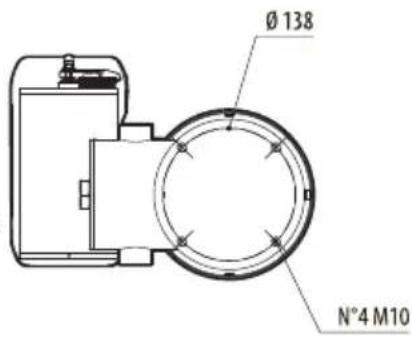
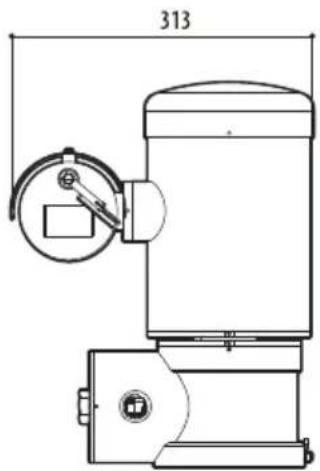
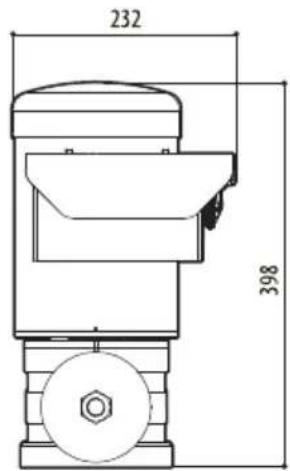
Fig. 27 MAXIMUS MPX SERIES2 (MPXHD).
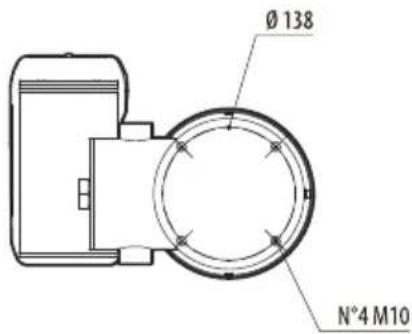
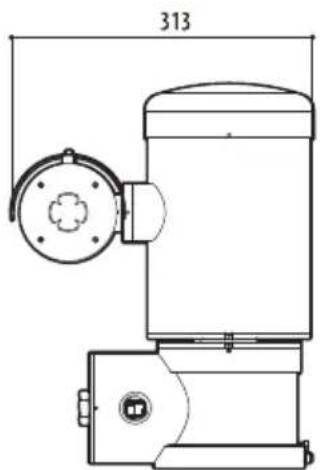
natural_image
Technical line drawing of a mechanical device with no visible text or symbols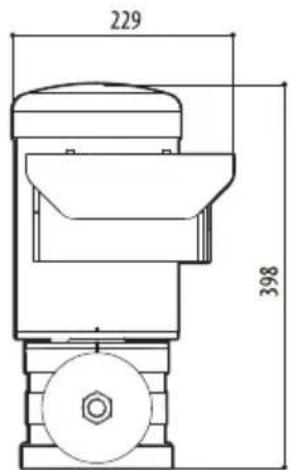
Fig. 28 MAXIMUS MPXR SERIES2 (MPXR).
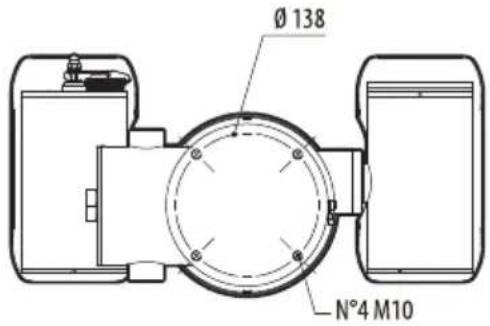
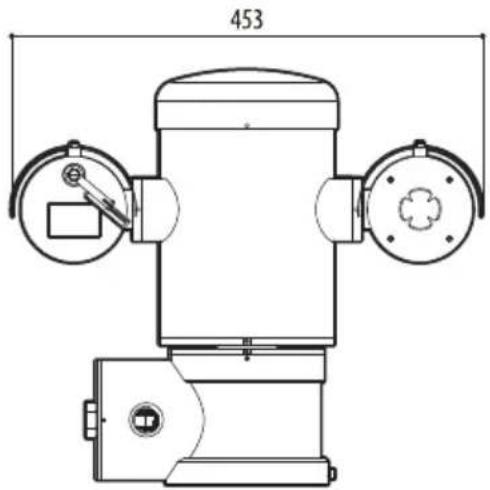
Fig. 29 MAXIMUS MPXT SERIES2 (MPXT).
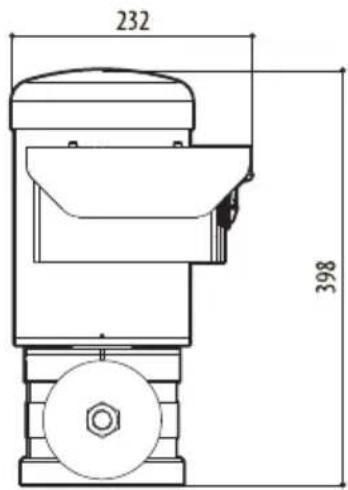
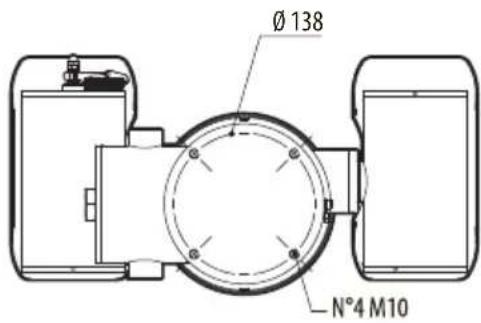
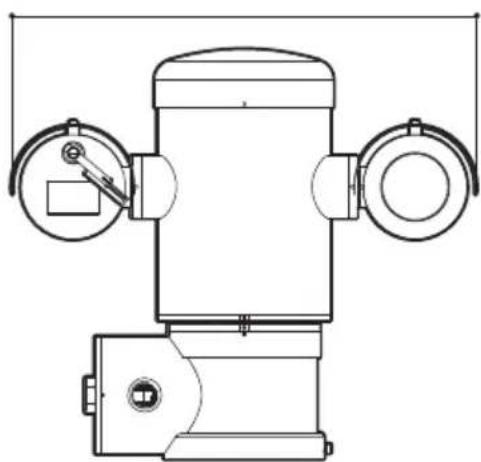
natural_image
Technical line drawing of a mechanical device with two circular components and a central housing (no text or symbols)Fig. 30 MAXIMUS MPXL SERIES2 (MPXL).
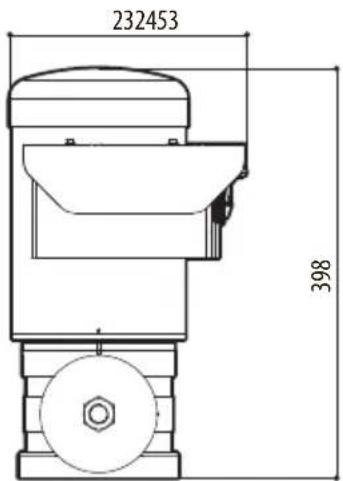
MAXIMUS MPX SERIES2 (MPXHD) MAXIMUS MPXR SERIES2 (MPXR) MAXIMUS MPXT SERIES2 (MPXT) MAXIMUS MPXL SERIES2 (MPXL)
Telecamera PTZ flameproof
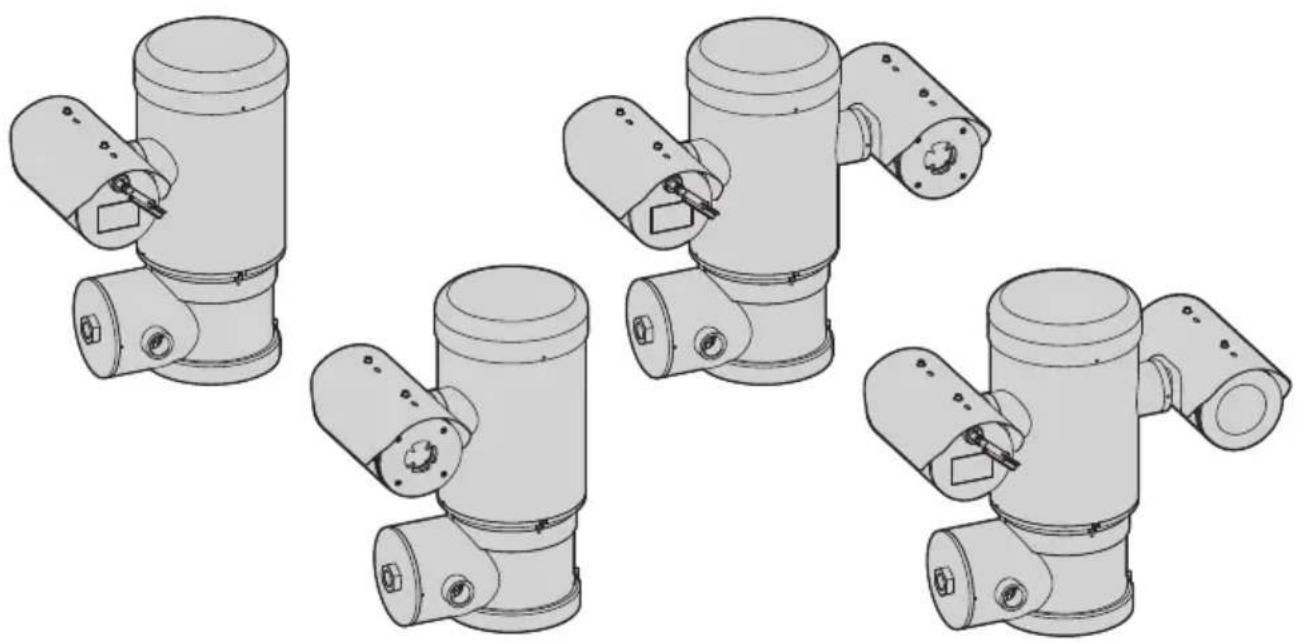
natural_image
Four identical line drawings of a mechanical T-joint connector assembly (no text or symbols)Sommario
4.8.1 Telecamera Day/Night....15
4.8.2 Telecamera termica....18
4.8.3 Dual Vision con telecamera Day/Night e termica 20
4.8.4 Telecamera Day/Night con illuminatore a led 22
14.1.6 Telecamere....40
14.1.7 Ambiente 41
14.3.7 Telecamere Day/Night 47
14.3.8 Telecamere Termiche 48
14.3.9 Ambiente ....50
14.4.6 Telecamere ....52
14.4.7 Illuminatori 52
14.4.8 Ambiente ....52
natural_image
Diagram of a tool interacting with a coiled cable or wire (no text or symbols present)Fig. 1
WARNING: DO NOT OPEN WHEN AN EXPLOSIVE ATMOSPHERE IS PRESENT.
AVERTISSEMENT: NE PAS OUVRIR EN PRÈSENCE D'UNE ATMOSPHÉRE EXPLOSIVE.
WARNING: POTENTIAL ELECTROSTATIC CHARGING HAZARD - SEE INSTRUCTIONS.
AVERTISSEMENT: DANGER POTENTIEL DE CHARGES ÉLECTROSTATIQUES - VOIR INSTRUCTIONS.
WARNING: A SEAL SHALL BE INSTALLED WITHIN 50MM OF THE ENCLOSURE.
AVERTISSEMENT: UN SCELLEMENT DOIT ÊTRE INSTALLÉ À MOINS DE 50MM DU BOÎTIER.
natural_image
Technical diagram of a mechanical assembly with internal components and a labeled arrow (no text or symbols present)Fig. 4
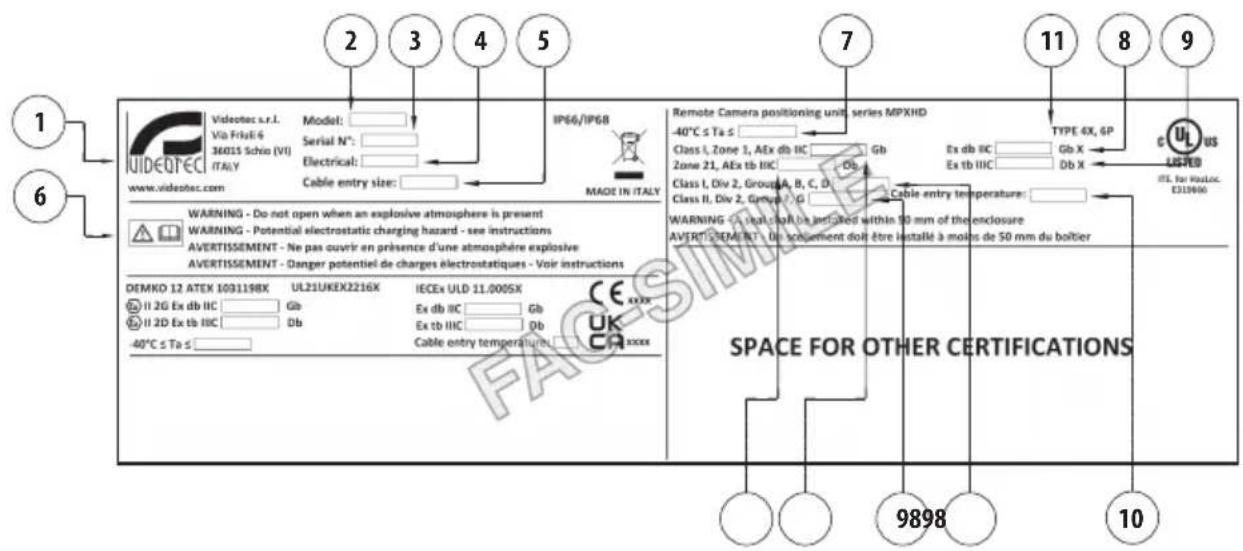
Fig. 5
UL 60079-0, 7th Edition, Explosive Atmospheres - Part 0: Equipment – General requirements
UL 60079-1, 7th Edition, Explosive Atmospheres - Part 1: Equipment Protection by Flameproof Enclosures "d"
UL 60079-31, 2nd Edition, Explosive Atmospheres - Part 31: Equipment Dust Ignition Protection by Enclosure "t"
CSA C22.2 No. 60079-0:19, Explosive Atmospheres - Part 0: Equipment - General requirements
CSA C22.2 No. 60079-1:16, Explosive Atmospheres - Part 1: Equipment Protection by Flameproof Enclosures "d"
CSA C22.2 No. 60079-31:15, Explosive Atmospheres - Part 31: Equipment Dust Ignition Protection by Enclosure "t"
4.8.1 Telecamera Day/Night
| MAXIMUS MPX SERIES2 - OPZIONI DI CONFIGURAZIONE | ||||||
| Voltaggio | Telecamera | Classe di temperatura e temperatura ambiente | Video analisi | Profili ONVIF | ||
| MPXHD | 1 230Vac | 1 Telecamera super low-light Day/Night, FULL HD 1080p, 30x, con tecnologia DELUX | A T6...T5 -40°C/+60°C or +70°C 0 Senza funzioni di video analisi integrate (senza VIDEOTEC ANALYTICS) | video analisi integrate (senza VIDEOTEC ANALYTICS) | 00 Conforme ONVIF, Profilo Q, Profilo S e Profilo T | C |
| 2 24Vac | 2 Telecamera SONY FCB-EV7520, FULL HD 1080p, 30x | D T4 -40°C/+80°C | V Con funzioni di video analisi integrate (VIDEOTEC ANALYTICS) | 01 Conforme ONVIF, Profilo S e Profilo T | ||
| 3 120Vac | C ATEX - IECEx - INMETRO - EAC Ex - KCs T5...T4 -40°C/+50°C or +60°C cULus T5...T4 -40°C/+50°C or +55°C | |||||
| 5 220Vac | ||||||
| 6 100Vac | ||||||
Tab. 2 MAXIMUS MPX SERIES2 (MPXHD)
| MAXIMUS MPX SERIES2 SENZA VIDEOTEC ANALYTICS - CERTIFICAZIONI E MARCATURE | |||
| Codice prodotto Certifica-zione | Marcatura Temperatura ambiente Temperature di | ingresso dei cavi | |
| MPXHD1*A0**C, MPXHD2*A0**C, MPXHD3*A0**C, MPXHD5*A0**C | ATEX II 2 G Ex db | IIC T6...T5 GbII 2D Ex tb IIIC T85°C...T100°C Db | -40°C ≤ Ta ≤ +60°C or +70°C +80°C |
| IECEx Ex db IIC T6...T5 GbEx tb IIIC T85°C...T100°C Db | |||
| EAC Ex 1Ex db IIC T6...T5 Gb XEx tb IIIC T85°C...T100°C Db X | |||
| INMETRO Ex db | IC T6...T5 GbEx tb IIIC T85°C...T100°C Db | ||
| KCs Ex db IIC T6...T5 GbEx tb IIIC T85°C...T100°C Db | |||
| UK Ex | II 2 G Ex db IIC T6...T5 GbII 2D Ex tb IIIC T85°C...T100°C Db | ||
| UL Hazardous Location America | Class I, Zone 1, AEx db IIC T6...T5 GbZone 21, AEx tb IIIC T85°C...T100°C DbClass I, Div 2, Group A, B, C, D T6...T5Class II, Div 2, Group F, G T6...T5 | ||
| UL Hazardous Location Canada | Ex db IIC T6...T5 Gb XEx tb IIIC T85°C...T100°C Db XClass I, Div 2, Group A, B, C, D T6...T5Class II, Div 2, Group F, G T6...T5 | ||
| MPXHD6*A0**C ATEX | II 2 G Ex db IIC T6...T5 GbII 2D Ex tb IIIC T85°C...T100°C Db | -40°C ≤ Ta ≤ +60°C or +70°C +80°C | |
| IECEx Ex db IIC T6...T5 GbEx tb IIIC T85°C...T100°C Db | |||
| EAC Ex 1Ex db IIC T6...S5 Gb XEx tb IIIC T85°C...T100°C Db X | |||
| INMETRO Ex db | IC T6...T5 GbEx tb IIIC T85°C...T100°C Db | ||
| KCs Ex db IIC T6...T5 GbEx tb IIIC T85°C...T100°C Db | |||
| UK Ex | II 12 G Ex db IIC T6...T5 GbII 2D Ex tb IIIC T85°C...T100°C Db | ||
| MPXHD1*D0**C, MPXHD2*D0**C, MPXHD3*D0**C, MPXHD5*D0**C, MPXHD6*D0**C | ATEX II 2G Ex db | IIC T4 GbII 2D Ex tb IIIC T135°C Db | -40°C ≤ Ta ≤ +80°C +90°C |
| IECEx Ex db IIC T4 GbEx tb IIIC T135°C Db | |||
| EAC Ex 1Ex db IIC T4 Gb XEx tb IIIC T135°C Db X | |||
| INMETRO Ex db | IC T4 GbEx tb IIIC T135°C Db | ||
| KCs Ex db IIC T4 GbEx tb IIIC T135°C Db | |||
| UK Ex | II 2G Ex db IIC T4 GbII 2D Ex tb IIIC T135°C Db | ||
Tab. 3 MAXIMUS MPX SERIES2 (MPXHD) senza VIDEOTEC ANALYTICS
| MAXIMUS MPX SERIES2 CON VIDEOTEC ANALYTICS - CERTIFICAZIONI E MARCATURE | ||||
| Codice prodotto Certifica-zione | Marcatura Temperatura ambiente Temperatura diingresso dei cavi | |||
| MPXHD1*CV**C, MPXHD2*CV**C, MPXHD3*CV**C, MPXHD5*CV**C | ATEX II 2 G Ex db | IIC T5...T4 GbII 2D Ex tb IIIC T100°C...T135°C Db | -40°C ≤ Ta ≤ +50°C or +60°C +80°C | |
| IECEx Ex db IIC T5...T4 GbEx tb IIIC T100°C...T135°C Db | ||||
| EAC Ex 1Ex db IIC T5...T4 Gb XEx tb IIIC T100°C...T135°C Db X | ||||
| INMETRO Ex db | IC T5...T4 GbEx tb IIIC T100°C...T135°C Db | |||
| KCs Ex db IIC T5...T4 GbEx tb IIIC T100°C...T135°C Db | ||||
| UK Ex | II 2 G Ex db IIC T5...T4 GbII 2D Ex tb IIIC T100°C...T135°C Db | |||
| UL Hazardous Location America | Class I, Zone 1, AEx db IIC T5...T4 GbZone 21, AEx tb IIIC T100°C...T135°C DbClass I, Div 2, Group A, B, C, D T5...T4Class II, Div 2, Group F, G T5...T4 | -40°C ≤ Ta ≤ +50°C or +55°C | ||
| UL Hazardous Location Canada | Ex db IIC T5...T4 Gb XEx tb IIIC T100°C...T135°C Db XClass I, Div 2, Group A, B, C, D T5...T4Class II, Div 2, Group F, G T5...T4 | |||
| MPXHD6*CV**C ATEX | II 2 G Ex db IIC T5...T4 GbII 2D Ex tb IIIC T100°C...T135°C Db | -40°C ≤ Ta ≤ +50°C or +60°C | ||
| IECEx Ex db IIC T5...T4 GbEx tb IIIC T100°C...T135°C Db | ||||
| EAC Ex 1Ex db IIC T5...T4 Gb XEx tb IIIC T100°C...T135°C Db X | ||||
| INMETRO Ex db | IC T5...T4 GbEx tb IIIG T100°C...T135°C Db | |||
| KCs Ex db IIC T5...T4 GbEx tb IIIC T100°C...T135°C Db | ||||
| UK Ex | II 2 G Ex db IIC T5...T4 GbII 2D Ex tb IIIC T100°C...T135°C Db | |||
Tab. 4 MAXIMUS MPX SERIES2 (MPXHD) con VIDEOTEC ANALYTICS
4.8.2 Telecamera termica
| MAXIMUS MPXR SERIES2 - OPZIONI DI CONFIGURAZIONE | ||||||||
| Voltaggio Telecamera | Termica Classe di temperatura e temperatura ambiente | Radiometria Profili ONVIF | Frequenza | |||||
| MPXR | 1 | 230Vac | A 9.3° HFOV, Telecamera termica 35mm, 336x256 | A T6...T5 -40°C/+60°C or +70°C | 00 Telecamera termica con funzioni radiometriche | 0 Conforme ONVIF, Profilo Q, Profilo S e Profilo T | C- | 7.5Hz |
| 2 | 24Vac B 13° HFOV, Telecamera termica 25mm, 336x256 | D T4 -40°C/+80°C | OR Telecamera termica con funzioni radiometriche avanzate | 1 Conforme ONVIF, Profilo S e Profilo T | H 30Hz | |||
| 3 | 120Vac | V 17° HFOV, Telecamera termica 19mm, 336x256 | ||||||
| 5 | 220Vac F 25° HFOV, Telecamera termica 13mm, 336x256 | |||||||
| 6 | 100Vac C 35° HFOV, Telecamera termica 9mm, 336x256 | |||||||
| D 18° HFOV, Telecamera termica 35mm, 640x512 | ||||||||
| E 25° HFOV, Telecamera termica 25mm, 640x512 | ||||||||
| U 32° HFOV, Telecamera termica 19mm, 640x512 | ||||||||
Tab. 5 MAXIMUS MPXR SERIES2 (MPXR)
| MAXIMUS MPXR SERIES2 - CERTIFICAZIONI E MARCATURE | ||||
| Codice prodotto Certifica-zione | Marcatura Temperatura ambiente Temperatura di | ingresso dei cavi | ||
| MPXR1*A0**C*,MPXR2*A0**C*,MPXR3*A0**C*,MPXR5*A0**C* | ATEX II 2 G Ex db | IIC T6...T5 GbII 2D Ex tb IIIC T85°C...T100°C Db | -40°C ≤ Ta ≤ +60°C or +70°C +80°C | |
| IECEx Ex db IIC T6...T5 GbEx tb IIIC T85°C...T100°C Db | ||||
| EAC Ex 1Ex db IIC T6...T5 Gb XEx tb IIIC T85°C...T100°C Db X | ||||
| INMETRO Ex db | IC T6...T5 GbEx tb IIIC T85°C...T100°C Db | |||
| KCs Ex db IIC T6.. | .T5 GbEx tb IIIC T85°C...T100°C Db | |||
| UK Ex | II 2 G Ex db IIC T6...T5 GbII 2D Ex tb IIIC T85°C...T100°C Db | |||
| UL Hazardous Location America | Class I, Zone 1, AEx db IIC T6...T5 GbZone 21, AEx tb IIIC T85°C...T100°C DbClass I, Div 2, Group A, B, C, D T6...T5Class II, Div 2, Group F, G T6...T5 | +80°C con Ta ≤ +69°C+81°C con Ta ≤ +70°C | ||
| UL Hazardous Location Canada | Ex db IIC T6...T5 Gb XEx tb IIIC T85°C...T100°C Db XClass I, Div 2, Group A, B, C, D T6...T5Class II, Div 2, Group F, G T6...T5 | |||
| MPXR6*A0**C* ATEX | II 2 G Ex db IIC T6...T5 GbII 2D Ex tb IIIC T85°C...T100°C Db | -40°C ≤ Ta ≤ +60°C or +70°C +80°C | ||
| IECEx Ex db IIC T6...T5 GbEx tb IIIC T85°C...T100°C Db | ||||
| EAC Ex 1Ex db IIC T3...T5 Gb XEx tb IIIC T85°C...T100°C Db X | ||||
| INMETRO Ex db | IC T6...T5 GbEx tb IIIC T85°C...T100°C Db | |||
| KCs Ex db IIC T6.. | .T5 GbEx tb IIIC T85°C...T100°C Db | |||
| UK Ex | II 2 G Ex db IIC T6...T5 GbII 2D Ex tb IIIC T85°C...T100°C Db | |||
| MPXR1*D0**C*,MPXR2*D0**C*,MPXR3*D0**C*,MPXR5*D0**C*,MPXR6*D0**C* | ATEX II 2G Ex db | IIC T4 GbII 2D Ex tb IIIC T135°C Db | -40°C ≤ Ta ≤ +80°C | +90°C |
| IECEx Ex db IIC T4 GbEx tb IIIC T135°C Db | ||||
| EAC Ex 1Ex db IIC T4 Gb XEx tb IIIC T135°C Db X | ||||
| INMETRO Ex db | IC T4 GbEx tb IIIC T135°C Db | |||
| KCs Ex db IIC T4 GbEx tb IIIC T135°C Db | ||||
| UK Ex | II 2G Ex db IIC T4 GbII 2D Ex tb IIIC T135°C Db | |||
Tab. 6 MAXIMUS MPXR SERIES2 (MPXR)
4.8.3 Dual Vision con telecamera Day/Night e termica
natural_image
Technical line drawing of a mechanical device with a circular dial indicator (no text or symbols)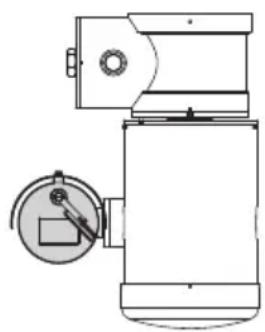
natural_image
Technical line drawing of a mechanical device with a circular component and cylindrical housing (no text or symbols)Fig. 6
natural_image
Technical diagram of a mechanical assembly with mounting brackets and directional arrows (no text or symbols)Fig. 9
natural_image
Technical illustration of two mechanical components with directional arrows indicating movement or force (no text or symbols present)Fig. 10
natural_image
Technical line drawing of a mechanical assembly with no visible text or symbolsFig. 11

natural_image
Technical line drawing of a mechanical component with a magnified inset showing a pipe fitting (no text or symbols)Fig. 14
- Laser: Class 1, conforme a EN60825-1
Fig. 17
Fig. 18
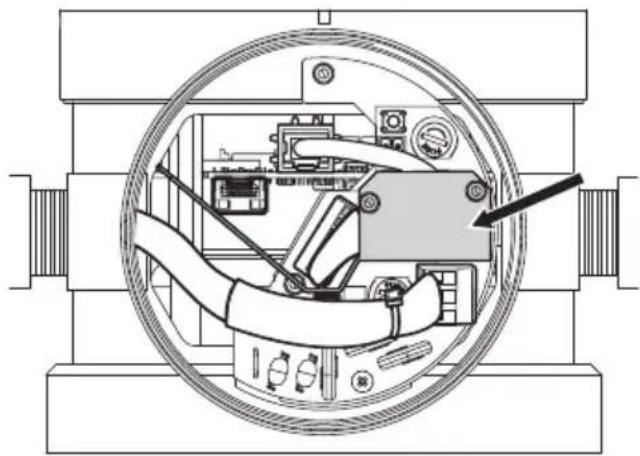
natural_image
Technical diagram of a mechanical assembly with internal components and a highlighted section (no text or labels)Fig. 19
natural_image
Diagram of a mechanical component with a threaded base and central hub, showing a diagonal arrow pointing to a feature (no text or symbols present)Fig. 20
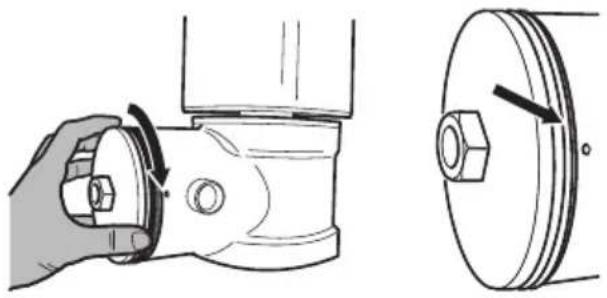
natural_image
Technical illustration of a hand operating a pipe fitting with a separate close-up view showing a bolt and nut assembly (no text or symbols)Fig. 21
natural_image
Line drawing of a hand using a wrench to adjust a mechanical component (no text or symbols)Fig. 22
natural_image
Technical illustration of a mechanical assembly with a hand adjusting a bolt and nut (no text or symbols present)Fig. 23
7 Accensione

natural_image
Diagram of a mechanical component with threaded base and central hub, showing a directional arrow (no text or symbols)Fig. 24
natural_image
Line drawing of a mechanical component with a lever and base, no text or symbols presentFig. 25
natural_image
Technical line drawing of a mechanical assembly with two flanges and internal components (no text or symbols)Fig. 26
Indoor Flicker Reduction
Auto Slowshutter: Off, On (da 1/30s fino a 1/1s)
• Colore: 0.0013lx (50 IRE, High sensitivity on)
• B/W: 0.0008lx (30 IRE, High sensitivity on)
Indoor Flicker Reduction
High sensitivity: On/Off
Auto Slowshutter: On/Off
RCM (Australian and New Zealand Regulatory Compliance Mark)
KCs (Employment and labor department 2021-22)
UK Ex (EN IEC 60079-0, EN 60079-1, EN 60079-31)
RCM (Australian and New Zealand Regulatory Compliance Mark)
KCs (Employment and labor department 2021-22
)UK Ex (EN IEC 60079-0, EN 60079-1, EN 60079-31)
14.3.7 Telecamere Day/Night
SONY FCB-EV7520 Day/Night Full HD 30x
Indoor Flicker Reduction
High sensitivity: On/Off
Auto Slowshutter: On/Off
RCM (Australian and New Zealand Regulatory Compliance Mark)
KCs (Employment and labor department 2021-22)
UK Ex (EN IEC 60079-0, EN 60079-1, EN 60079-31)
Indoor Flicker Reduction
High sensitivity: On/Off
Auto Slowshutter: On/Off
RCM (Australian and New Zealand Regulatory Compliance Mark)
Conforme NDAA
KCs (Employment and labor department 2021-22)
UK Ex (EN IEC 60079-0, EN 60079-1, EN 60079-31)
natural_image
Technical line drawing of a mechanical device with no visible text or symbols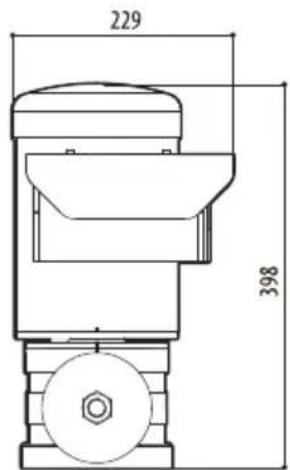
Fig. 28 MAXIMUS MPXR SERIES2 (MPXR).
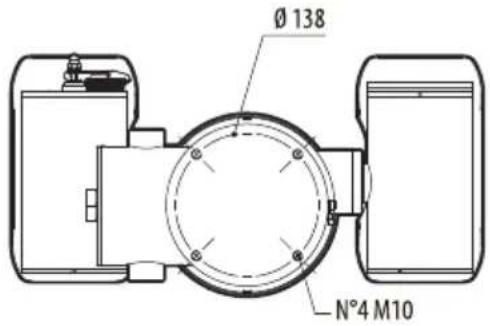
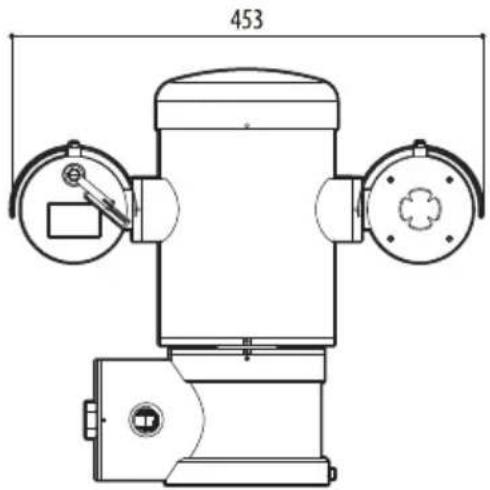
Fig. 29 MAXIMUS MPXT SERIES2 (MPXT).
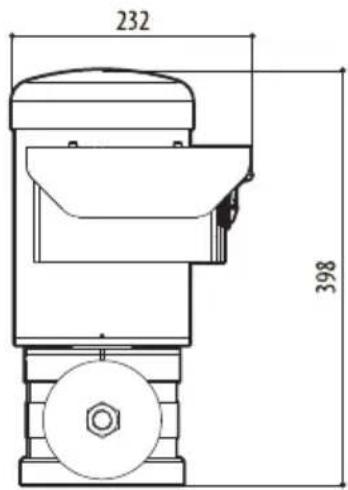
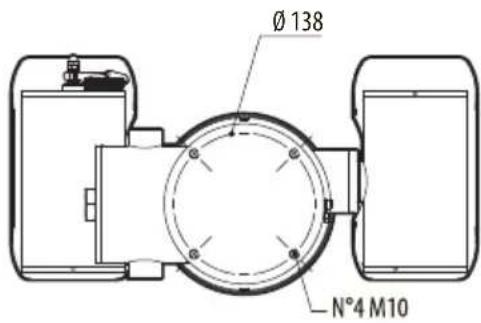
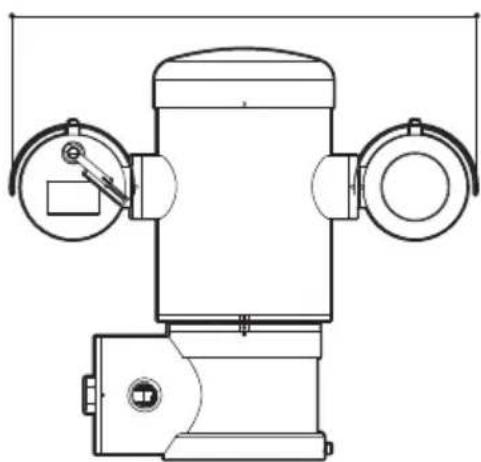
natural_image
Technical line drawing of a mechanical device with two circular components and a central housing (no text or symbols)Fig. 30 MAXIMUS MPXL SERIES2 (MPXL).
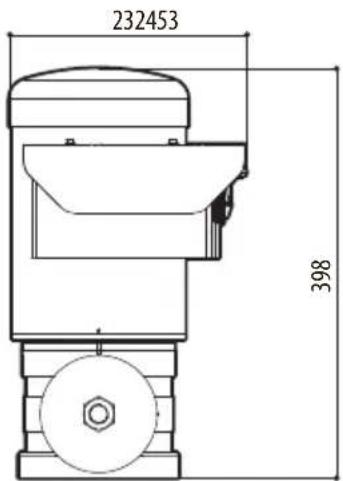
MAXIMUS MPX SERIES2 (MPXHD) MAXIMUS MPXR SERIES2 (MPXR) MAXIMUS MPXT SERIES2 (MPXT) MAXIMUS MPXL SERIES2 (MPXL)
Caméra PTZ flameproof
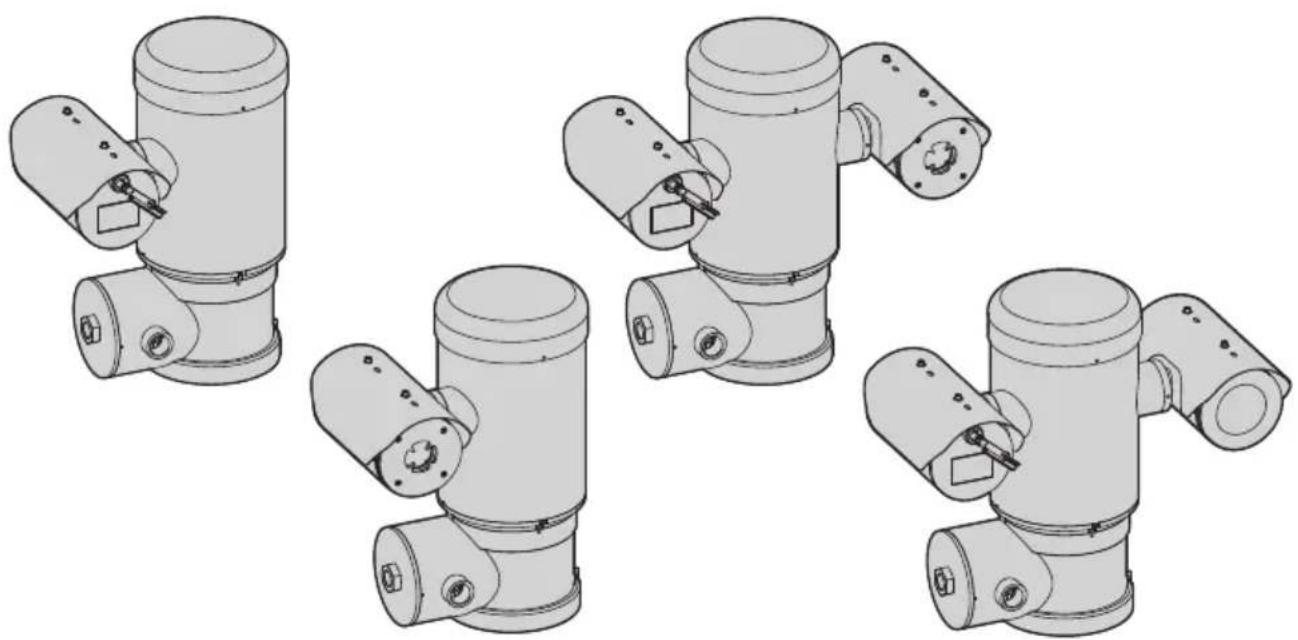
natural_image
Four identical line drawings of a mechanical T-joint connector assembly (no text or symbols)Sommaire
6 Installation....25
6.1 Options d'installation....25
14.2.9 Certifications....45
14.2.10 Certifications - Applications anti-déflagrations....45
14.2.11 Certifications - Applications marines 45
14.3 MAXIMUS MPXT SERIES2 (MPXT) 46
14.4.11 Certifications - Applications marines ....53
15 Dessins techniques....54
natural_image
Diagram of a tool interacting with a coiled cable or wire (no text or symbols present)Fig. 1
WARNING: DO NOT OPEN WHEN AN EXPLOSIVE ATMOSPHERE IS PRESENT.
AVERTISSEMENT: NE PAS OUVRIR EN PRÈSENCE D'UNE ATMOSPHÉRE EXPLOSIVE.
WARNING: POTENTIAL ELECTROSTATIC CHARGING HAZARD - SEE INSTRUCTIONS.
AVERTISSEMENT: DANGER POTENTIEL DE CHARGES ÉLECTROSTATIQUES - VOIR INSTRUCTIONS.
WARNING: A SEAL SHALL BE INSTALLED WITHIN 50MM OF THE ENCLOSURE.
AVERTISSEMENT: UN SCELLEMENT DOIT ÊTRE INSTALLÉ À MOINS DE 50MM DU BOÎTIER.
natural_image
Technical diagram of a mechanical assembly with internal components and a highlighted section (no text or labels)Fig. 4
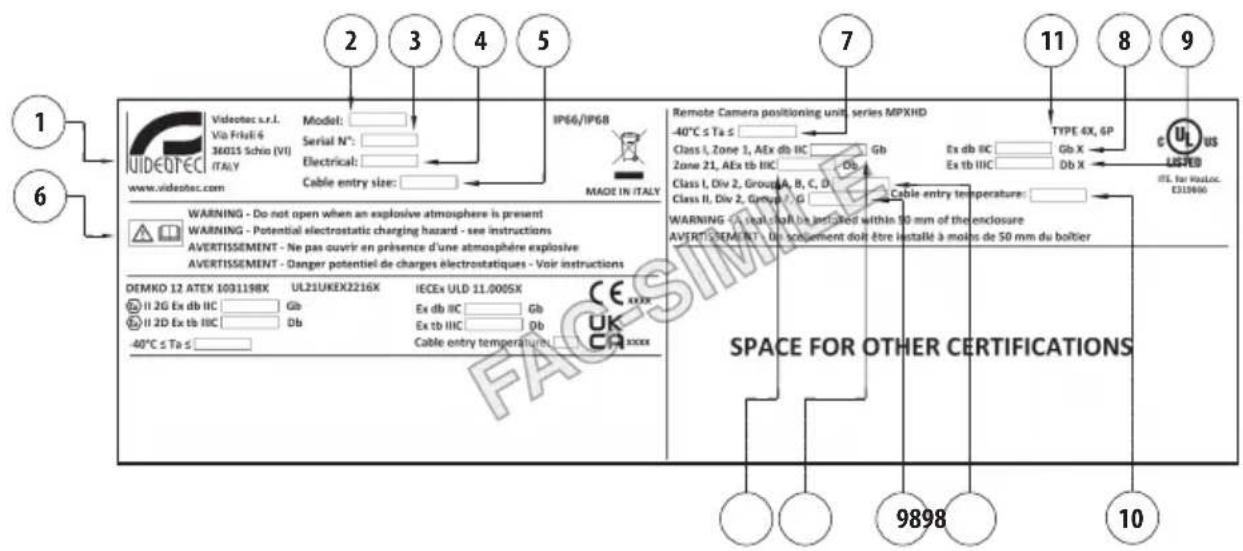
Fig. 5
UL 60079-0, 7th Edition, Explosive Atmospheres - Part 0: Equipment – General requirements UL 60079-1, 7th Edition, Explosive Atmospheres - Part 1: Equipment Protection by Flameproof Enclosures "d" UL 60079-31, 2nd Edition, Explosive Atmospheres - Part 31: Equipment Dust Ignition Protection by Enclosure "t"
CSA C22.2 No. 60079-0:19, Explosive Atmospheres - Part 0: Equipment - General requirements CSA C22.2 No. 60079-1:16, Explosive Atmospheres - Part 1: Equipment Protection by Flameproof Enclosures "d" CSA C22.2 No. 60079-31:15, Explosive Atmospheres - Part 31: Equipment Dust Ignition Protection by Enclosure "t"
natural_image
Technical line drawing of a mechanical device with a circular component and mounting bracket (no text or symbols)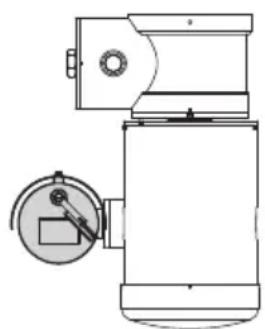
natural_image
Technical line drawing of a mechanical device with a circular component and cylindrical housing (no text or symbols)Fig. 6
natural_image
Technical diagram of a mechanical assembly with mounting holes and directional arrows (no text or labels)Fig. 9
natural_image
Technical illustration of two mechanical components with directional arrows indicating movement or force (no text or symbols present)Fig. 10
natural_image
Technical diagram of a mechanical assembly with no visible text or symbolsFig. 11

natural_image
Technical line drawing of a mechanical component with a magnified inset showing a connector detail (no text or symbols)Fig. 14
Fig. 17
Fig. 18
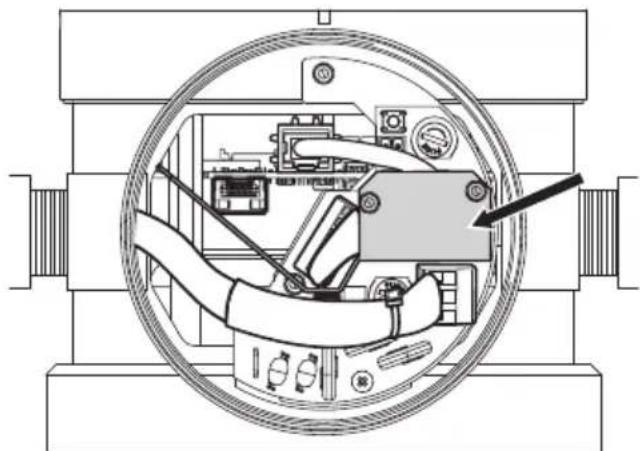
natural_image
Technical diagram of a mechanical assembly with internal components and a labeled arrow (no readable text or symbols)Fig. 19
natural_image
Diagram of a mechanical component with threaded base and central hub, no text or symbols presentFig. 20
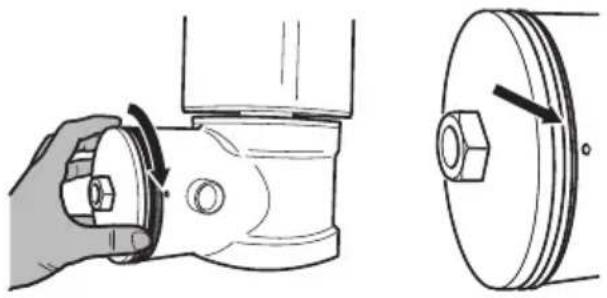
natural_image
Technical illustration of a hand fastening a pipe fitting with a separate view showing the wheel and nut assembly (no text or symbols)Fig. 21
natural_image
Line drawing of a hand using a wrench to adjust the engine cylinder (no text or symbols present)Fig. 22
natural_image
Technical illustration of a mechanical assembly with a hand holding a bolt and a separate view showing a pin inserted into a cylindrical component (no text or symbols present)Fig. 23
7 Allumage

natural_image
Diagram of a mechanical component with threaded base and central hub, no text or symbols presentFig. 24
natural_image
Line drawing of a mechanical component with a lever and rectangular block (no text or symbols)Fig. 25
10.2 Entretien extraordinaire
natural_image
Technical line drawing of a mechanical assembly with flanges and housing (no text or symbols)Fig. 26
Indoor Flicker Reduction
Indoor Flicker Reduction
High sensitivity: On/Off
Compensation Backlight: On/Off
Auto Slowshutter: On/Off
RCM (Australian and New Zealand Regulatory Compliance Mark)
KCs (Employment and labor department 2021-22)
UK Ex (EN IEC 60079-0, EN 60079-1, EN 60079-31)
14.1.10 Certifications - Applications marines
14.2.9 Certifications
RCM (Australian and New Zealand Regulatory Compliance Mark)
KCs (Employment and labor department 2021-22)
UK Ex (EN IEC 60079-0, EN 60079-1, EN 60079-31)
14.2.11 Certifications - Applications marines
Indoor Flicker Reduction
High sensitivity: On/Off
Compensation Backlight: On/Off
Auto Slowshutter: On/Off
RCM (Australian and New Zealand Regulatory Compliance Mark)
KCs (Employment and labor department 2021-22)
UK Ex (EN IEC 60079-0, EN 60079-1, EN 60079-31)
14.3.12 Certifications - Applications marines
Indoor Flicker Reduction
High sensitivity: On/Off
Compensation Backlight: On/Off
Auto Slowshutter: On/Off
RCM (Australian and New Zealand Regulatory Compliance Mark)
Conforme à NDAA
14.4.10 Certifications - Applications anti-déflagrations
ATEX (EN IEC 60079-0, EN 60079-1, EN 60079-31)
IECEX (IEC 60079-0, IEC 60079-1, IEC 60079-31)
KCs (Employment and labor department 2021-22)
UK Ex (EN IEC 60079-0, EN 60079-1, EN 60079-31)
14.4.11 Certifications - Applications marines
natural_image
Technical line drawing of a mechanical device with no visible text or symbols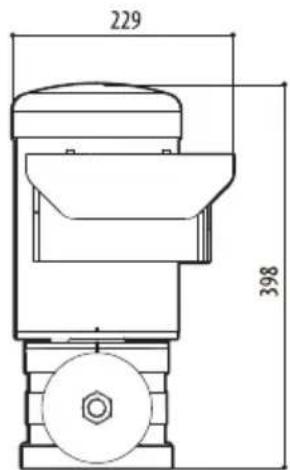
Fig. 28 MAXIMUS MPXR SERIES2 (MPXR).
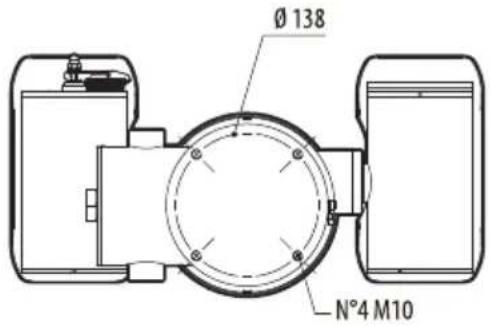
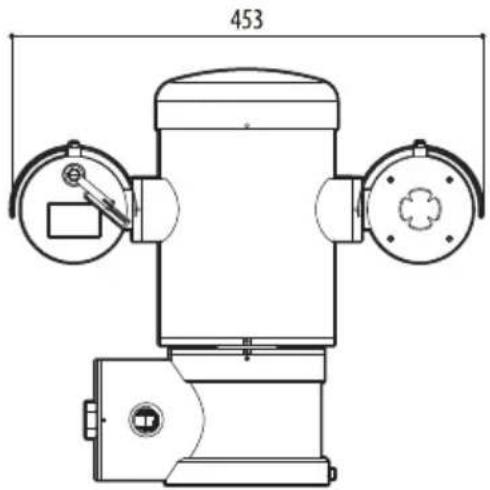
Fig. 29 MAXIMUS MPXT SERIES2 (MPXT).
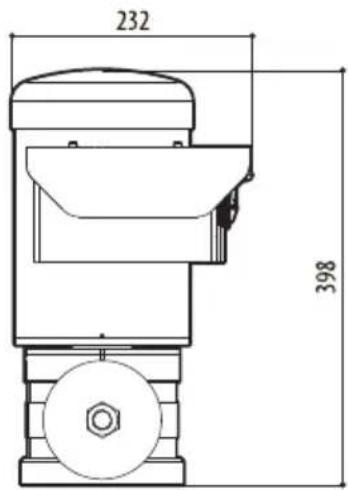
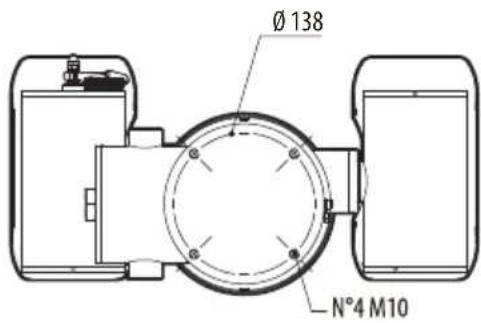
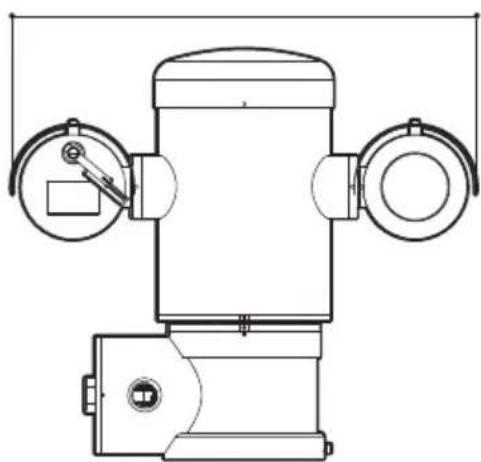
natural_image
Technical line drawing of a mechanical device with two circular components and a central hub (no text or symbols)Fig. 30 MAXIMUS MPXL SERIES2 (MPXL).
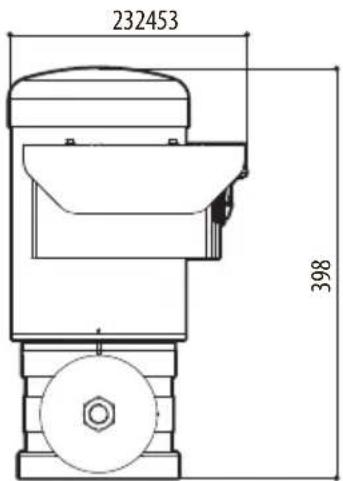
MAXIMUS MPX SERIES2 (MPXHD) MAXIMUS MPXR SERIES2 (MPXR) MAXIMUS MPXT SERIES2 (MPXT) MAXIMUS MPXL SERIES2 (MPXL)
Flameproof PTZ Kamera
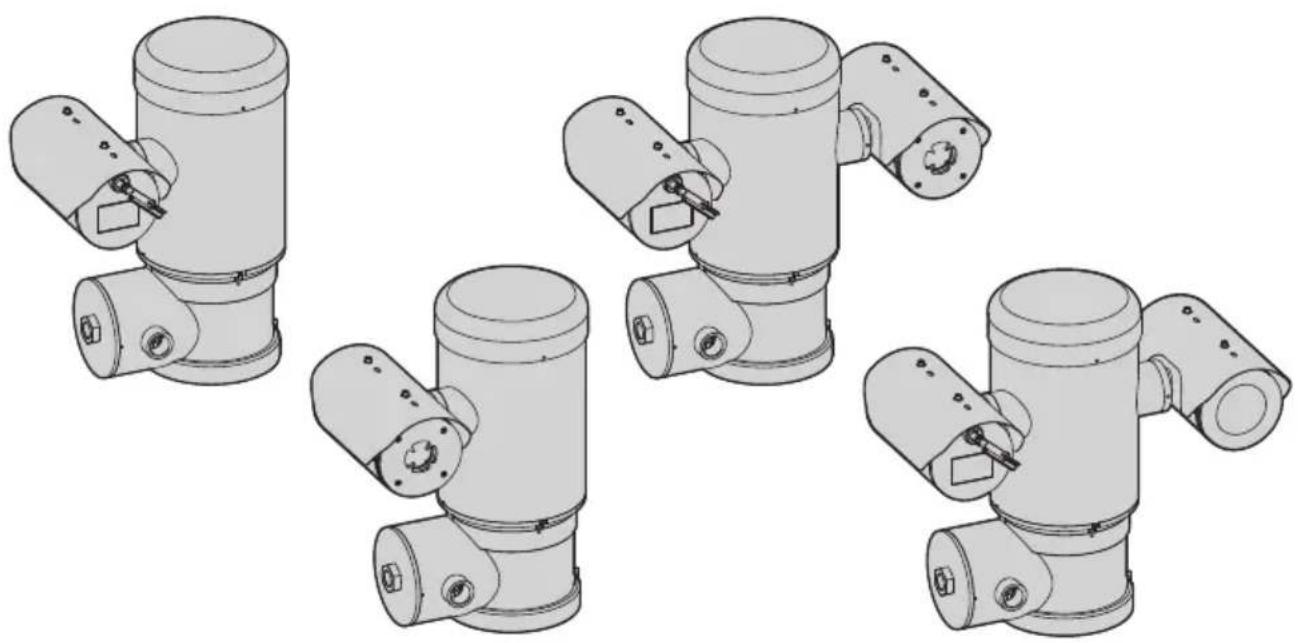
natural_image
Four identical line drawings of a mechanical T-joint connector assembly (no text or symbols)Inhaltsverzeichnis
1 Allgemeines....6
6 Installation....25
6.1 Montageoptionen....25
natural_image
Diagram of a tool interacting with a cylindrical object, showing a curved surface and a pointed tip (no text or symbols)Abb. 1
Hazardous moving parts. Keep fingers and other body parts away.
AVERTISSEMENT!
WARNING: DO NOT OPEN WHEN AN EXPLOSIVE ATMOSPHERE IS PRESENT.
AVERTISSEMENT: NE PAS OUVRIR EN PRÈSENCE D'UNE ATMOSPHÉRE EXPLOSIVE.
WARNING: POTENTIAL ELECTROSTATIC CHARGING HAZARD - SEE INSTRUCTIONS.
AVERTISSEMENT: DANGER POTENTIEL DE CHARGES ÉLECTROSTATIQUES - VOIR INSTRUCTIONS.
WARNING: A SEAL SHALL BE INSTALLED WITHIN 50MM OF THE ENCLOSURE.
AVERTISSEMENT: UN SCELLEMENT DOIT ÊTRE INSTALLÉ À MOINS DE 50MM DU BOÎTIER.
natural_image
Technical diagram of a mechanical assembly with internal components and a highlighted section (no text or labels)Abb. 4
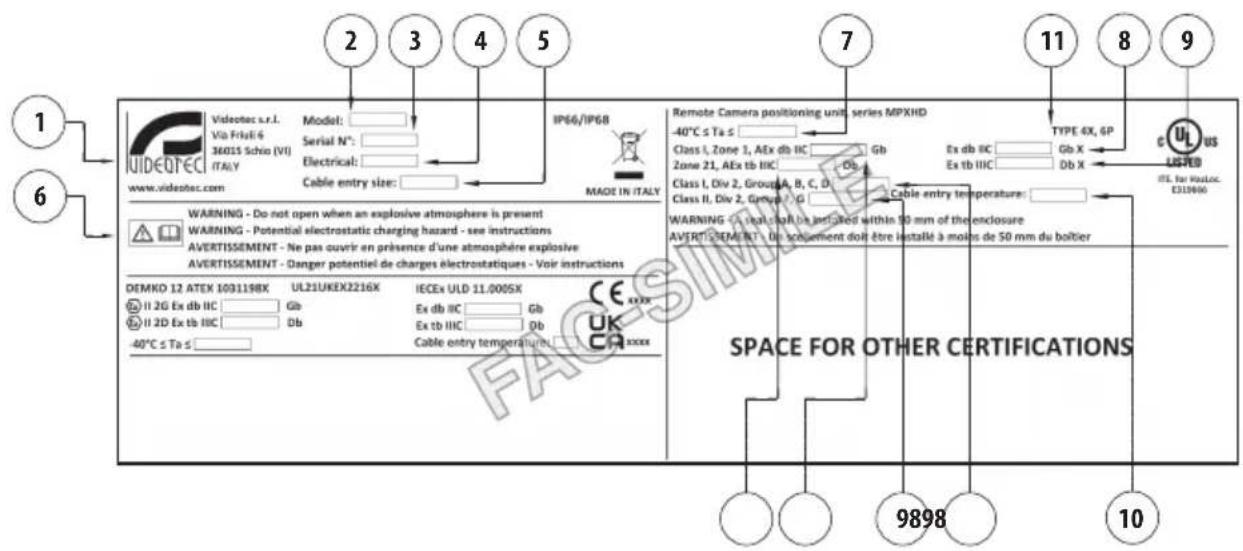
Abb. 5
UL 60079-0, 7th Edition, Explosive Atmospheres - Part 0: Equipment – General requirements
UL 60079-1, 7th Edition, Explosive Atmospheres - Part 1: Equipment Protection by Flameproof Enclosures "d"
UL 60079-31, 2nd Edition, Explosive Atmospheres - Part 31: Equipment Dust Ignition Protection by Enclosure "t"
CSA C22.2 No. 60079-0:19, Explosive Atmospheres - Part 0: Equipment - General requirements
CSA C22.2 No. 60079-1:16, Explosive Atmospheres - Part 1: Equipment Protection by Flameproof Enclosures "d"
CSA C22.2 No. 60079-31:15, Explosive Atmospheres - Part 31: Equipment Dust Ignition Protection by Enclosure "t"
natural_image
Technical line drawing of a mechanical pump or motor assembly (no text or symbols)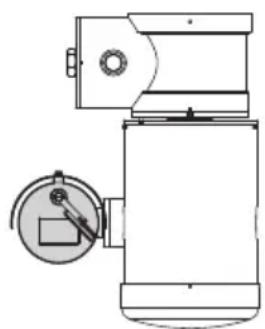
natural_image
Technical line drawing of a mechanical device with a circular component and pointer (no text or symbols)Abb. 6
natural_image
Technical diagram of a mechanical assembly with mounting holes and directional arrows (no text or labels)Abb. 9
natural_image
Technical illustration of two mechanical components with arrows indicating motion or assembly (no text or symbols present)Abb. 10
natural_image
Diagram of a mechanical device with a central gear and surrounding components (no text or symbols)Abb. 11

natural_image
Technical line drawing of a mechanical component with a close-up inset showing a connector detail (no text or symbols)Abb. 14
Abb. 16
Abb. 17
Abb. 18
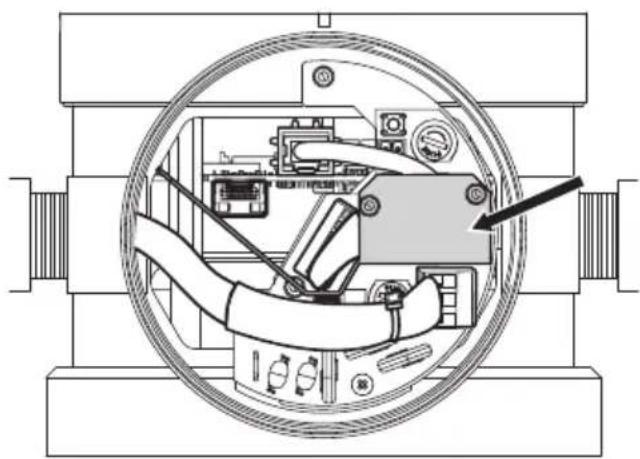
natural_image
Technical diagram of a mechanical assembly with internal components and a highlighted section (no text or labels)Abb. 19
natural_image
Diagram of a mechanical component with threaded base and central hub, no text or symbols presentAbb. 20
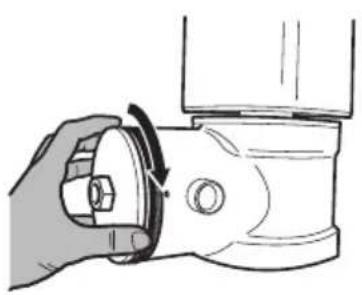
natural_image
Hand holding a mechanical switch with a rotating knob (no text or symbols visible)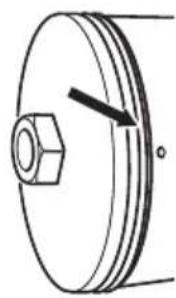
natural_image
Technical line drawing of a pulley and nut assembly (no text or symbols)Abb. 21
natural_image
Line drawing of a hand using a wrench to adjust the engine cylinder (no text or symbols present)Abb. 22
natural_image
Technical illustration of a mechanical assembly with a hand holding a bolt and a separate view showing a component being inserted (no text or symbols present)Abb. 23
7 Einschaltung

natural_image
Diagram of a mechanical component with threaded base and central hub, showing a cross-section with an arrow pointing to a feature (no text or symbols present)Abb. 24
natural_image
Line drawing of a mechanical component with a lever and rectangular block (no text or symbols)Abb. 25
natural_image
Technical line drawing of a mechanical assembly with flanges and housing (no text or symbols)Abb. 26
Indoor Flicker Reduction
Indoor Flicker Reduction
High sensitivity: On/Off
Backlight-Kompensation: On/Off
Auto Slowshutter: On/Off
RCM (Australian and New Zealand Regulatory Compliance Mark)
KCs (Employment and labor department 2021-22)
UK Ex (EN IEC 60079-0, EN 60079-1, EN 60079-31)
RCM (Australian and New Zealand Regulatory Compliance Mark)
KCs (Employment and labor department 2021-22)
UK Ex (EN IEC 60079-0, EN 60079-1, EN 60079-31)
Outdoor, Manuell, Outdoor Auto, Sodium Lamp (Fix/Auto/Outdoor Auto)
Indoor Flicker Reduction
High sensitivity: On/Off
Backlight-Kompensation: On/Off
Auto Slowshutter: On/Off
RCM (Australian and New Zealand Regulatory Compliance Mark)
KCs (Employment and labor department 2021-22)
UK Ex (EN IEC 60079-0, EN 60079-1, EN 60079-31)
Indoor Flicker Reduction
High sensitivity: On/Off
Backlight-Kompensation: On/Off
Auto Slowshutter: On/Off
RCM (Australian and New Zealand Regulatory Compliance Mark)
NDAA-konform
KCs (Employment and labor department 2021-22)
UK Ex (EN IEC 60079-0, EN 60079-1, EN 60079-31)
natural_image
Technical line drawing of a mechanical device with no visible text or symbols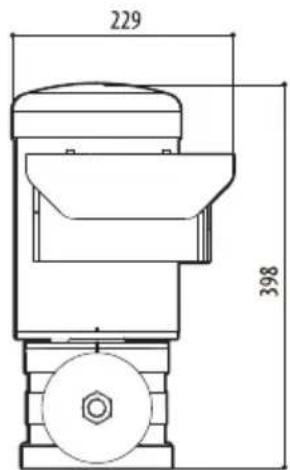
Abb. 28 MAXIMUS MPXR SERIES2 (MPXR).
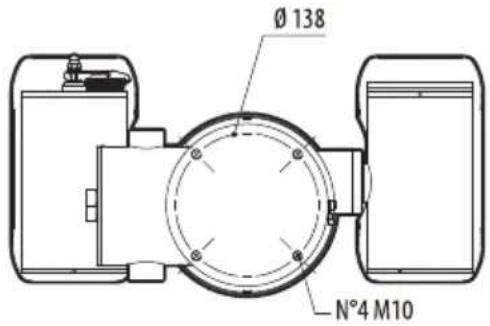
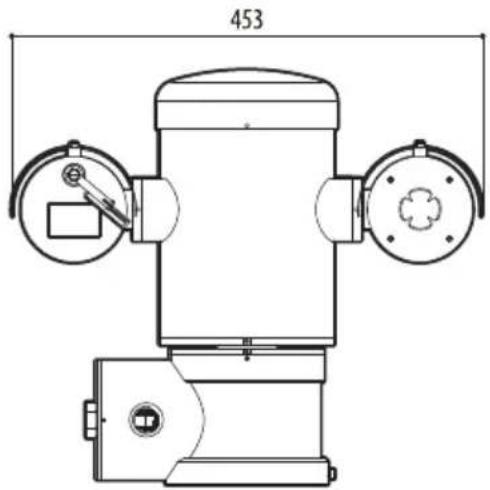
Abb. 29 MAXIMUS MPXT SERIES2 (MPXT).
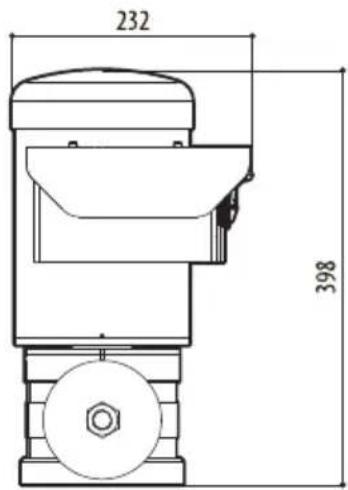
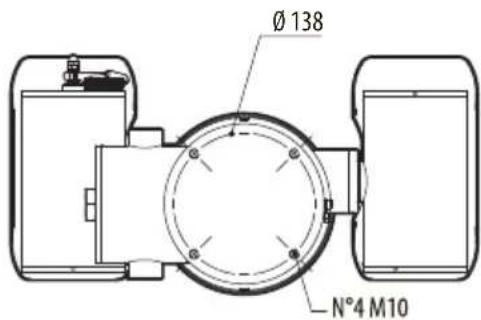
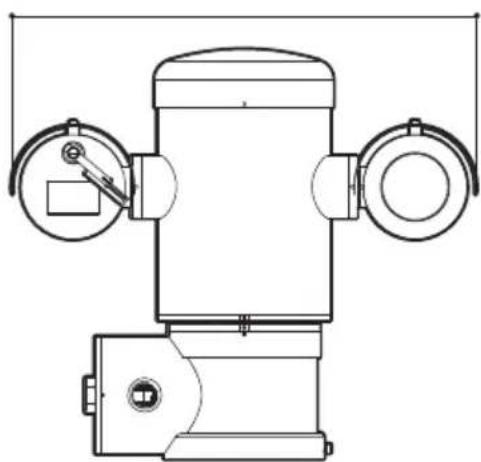
natural_image
Technical line drawing of a mechanical device with two circular components and a central hub (no text or symbols)Abb. 30 MAXIMUS MPXL SERIES2 (MPXL).
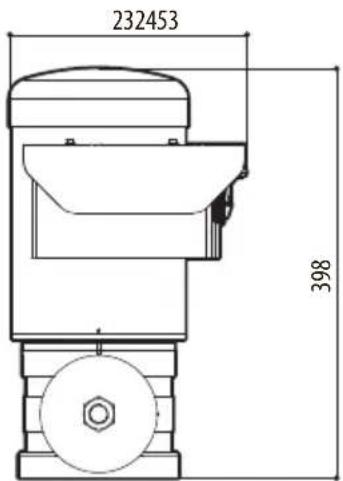
MAXIMUS MPX SERIES2 (MPXHD) MAXIMUS MPXR SERIES2 (MPXR) MAXIMUS MPXT SERIES2 (MPXT) MAXIMUS MPXL SERIES2 (MPXL)
Flameproof PTZ-камера
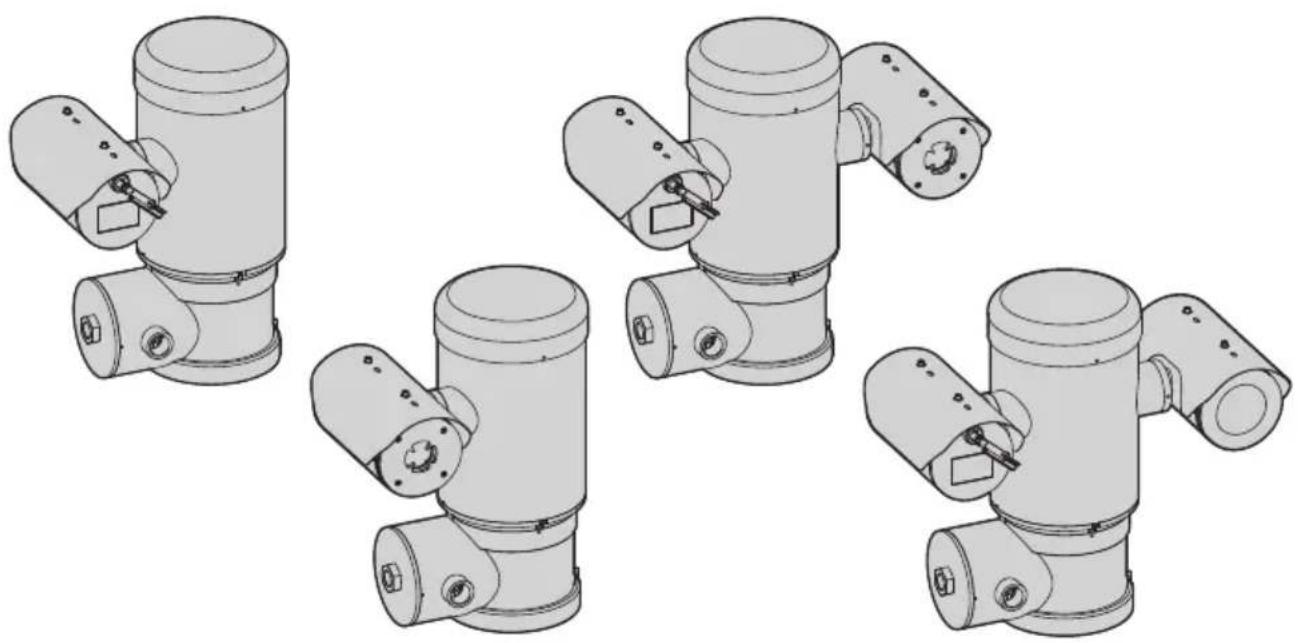
natural_image
Four identical line drawings of a mechanical T-joint connector assembly (no text or symbols)natural_image
Diagram of a tool interacting with a curved object, showing a mechanical component (no text or symbols present)Fig. 1
Hazardous moving parts. Keep fingers and other body parts away.
AVERTISSEMENT!
WARNING: DO NOT OPEN WHEN AN EXPLOSIVE ATMOSPHERE IS PRESENT.
AVERTISSEMENT: NE PAS OUVRIR EN PRÈSENCE D'UNE ATMOSPHÉRE EXPLOSIVE.
WARNING: POTENTIAL ELECTROSTATIC CHARGING HAZARD - SEE INSTRUCTIONS.
AVERTISSEMENT: DANGER POTENTIEL DE CHARGES ÉLECTROSTATIQUES - VOIR INSTRUCTIONS.
WARNING: A SEAL SHALL BE INSTALLED WITHIN 50MM OF THE ENCLOSURE.
AVERTISSEMENT: UN SCELLEMENT DOIT ÊTRE INSTALLÉ À MOINS DE 50MM DU BOÎTIER.
natural_image
Technical diagram of a mechanical assembly with internal components and a highlighted section (no text or symbols)Fig. 4
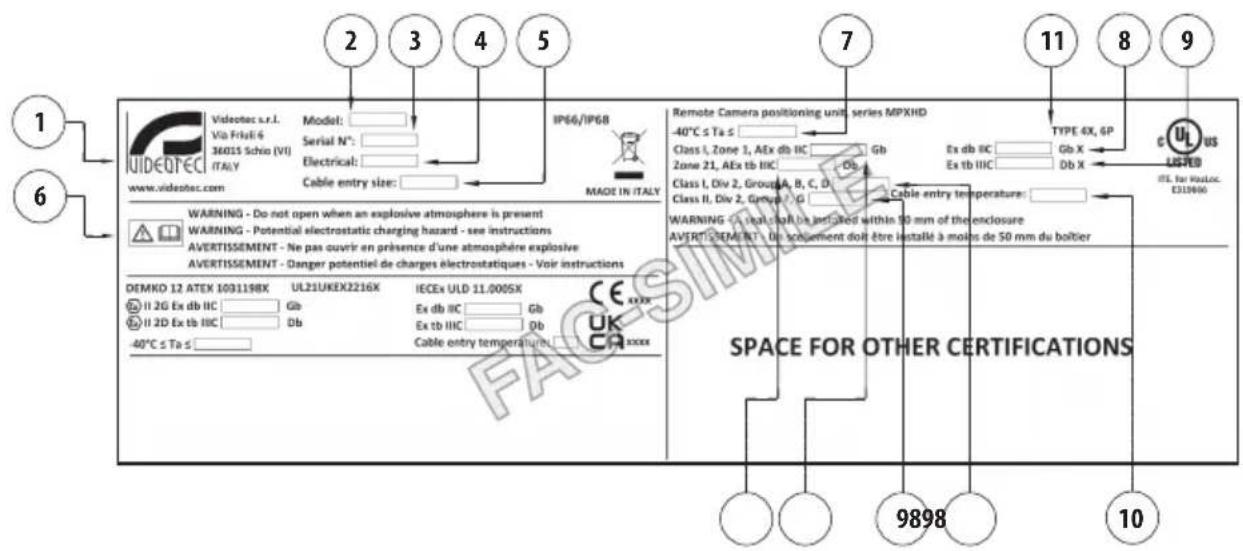
Fig. 5
UL 60079-0, 7th Edition, Explosive Atmospheres - Part 0: Equipment – General requirements
UL 60079-1, 7th Edition, Explosive Atmospheres - Part 1: Equipment Protection by Flameproof Enclosures "d"
UL 60079-31, 2nd Edition, Explosive Atmospheres - Part 31: Equipment Dust Ignition Protection by Enclosure "t"
CSA C22.2 No. 60079-0:19, Explosive Atmospheres - Part 0: Equipment - General requirements
CSA C22.2 No. 60079-1:16, Explosive Atmospheres - Part 1: Equipment Protection by Flameproof Enclosures "d"
CSA C22.2 No. 60079-31:15, Explosive Atmospheres - Part 31: Equipment Dust Ignition Protection by Enclosure "t"
natural_image
Technical line drawing of a mechanical device with a circular dial indicator (no text or symbols)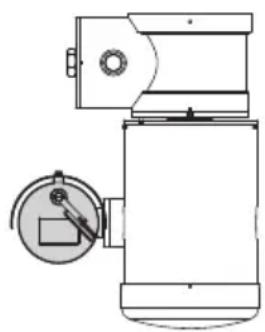
natural_image
Technical line drawing of a mechanical device with a circular component and cylindrical housing (no text or symbols)Fig. 6
Fig. 7
natural_image
Technical diagram of a mechanical assembly with mounting bracket and cylindrical component (no text or symbols)Fig. 9
natural_image
Technical illustration of two mechanical components with arrows indicating motion or assembly (no text or symbols present)Fig. 10
natural_image
Technical diagram of a mechanical assembly with no visible text or symbolsFig. 11

natural_image
Technical line drawing of a mechanical component with a magnified inset showing a pipe fitting (no text or symbols)Fig. 14
Fig. 15
Fig. 17
natural_image
Technical diagram of a mechanical assembly with internal components and a highlighted section (no text or labels)Fig. 19
natural_image
Diagram of a mechanical component with threaded base and central hub, no text or symbols presentFig. 20
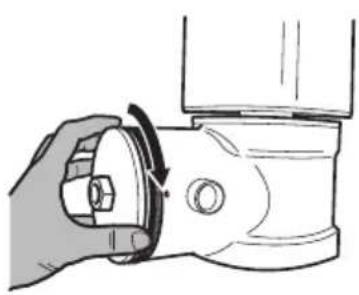
natural_image
Hand holding a mechanical component with a rotating knob (no text or symbols visible)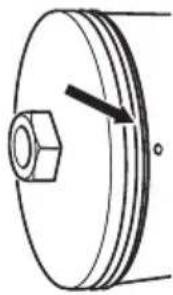
natural_image
Technical line drawing of a pulley and screw (no text or symbols)Fig. 21
natural_image
Line drawing of a hand using a wrench to adjust a mechanical component (no text or symbols)Fig. 22
natural_image
Technical illustration of a mechanical assembly with a hand holding a bolt and a separate view showing a cylindrical component (no text or symbols present)Fig. 23
7 Включение

natural_image
Diagram of a mechanical component with threaded base and central hub, no text or symbols presentFig. 24
natural_image
Line drawing of a mechanical component with a lever and base, no text or symbols presentFig. 25
natural_image
Technical line drawing of a mechanical assembly with flanges and housing (no text or symbols)Fig. 26
Indoor Flicker Reduction
Indoor Flicker Reduction
RCM (Australian and New Zealand Regulatory Compliance Mark)
UL listed for Canada (CAN/CSA-C22.2 NO. 60079-0, CAN/
CSA-C22.2 NO. 60079-1, CAN/CSA-C22.2 NO. 60079-31) (не доступно для 100Vac переменного тока)
EAC Ex (TR CU 012/2011)
INMETRO (ABNT NBR IEC 60079-0, ABNT NBR IEC 60079-1, ABNT NBR IEC 60079-31)
KCs (Employment and labor department 2021-22)
UK Ex (EN IEC 60079-0, EN 60079-1, EN 60079-31)
RCM (Australian and New Zealand Regulatory Compliance Mark)
UL listed for Canada (CAN/CSA-C22.2 NO. 60079-0, CAN/
CSA-C22.2 NO. 60079-1, CAN/CSA-C22.2 NO. 60079-31) (не доступно для 100Vac переменного тока)
EAC Ex (TR CU 012/2011)
INMETRO (ABNT NBR IEC 60079-0, ABNT NBR IEC 60079-1, ABNT NBR IEC 60079-31)
KCs (Employment and labor department 2021-22)
UK Ex (EN IEC 60079-0, EN 60079-1, EN 60079-31)
Indoor Flicker Reduction
RCM (Australian and New Zealand Regulatory Compliance Mark)
UL listed for Canada (CAN/CSA-C22.2 NO. 60079-0, CAN/
CSA-C22.2 NO. 60079-1, CAN/CSA-C22.2 NO. 60079-31) (не доступно для 100Vac переменного тока)
EAC Ex (TR CU 012/2011)
INMETRO (ABNT NBR IEC 60079-0, ABNT NBR IEC 60079-1, ABNT NBR IEC 60079-31)
KCs (Employment and labor department 2021-22)
UK Ex (EN IEC 60079-0, EN 60079-1, EN 60079-31)
Indoor Flicker Reduction
RCM (Australian and New Zealand Regulatory Compliance Mark)
Соответствует NDAA
UL listed for Canada (CAN/CSA-C22.2 NO. 60079-0, CAN/
CSA-C22.2 NO. 60079-1, CAN/CSA-C22.2 NO. 60079-31) (не доступно для 100Vac переменного тока)
KCs (Employment and labor department 2021-22)
UK Ex (EN IEC 60079-0, EN 60079-1, EN 60079-31)
natural_image
Technical line drawing of a mechanical device with no visible text or symbols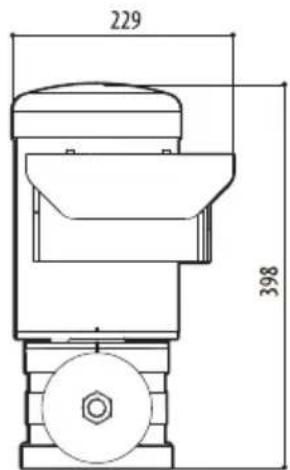
Fig. 28 MAXIMUS MPXR SERIES2 (MPXR).
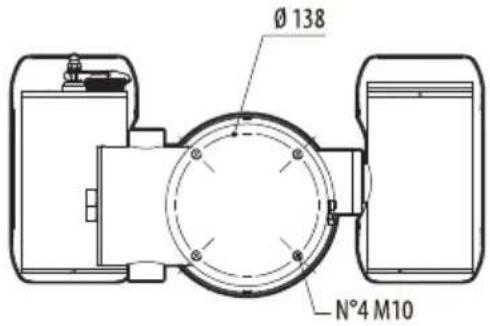
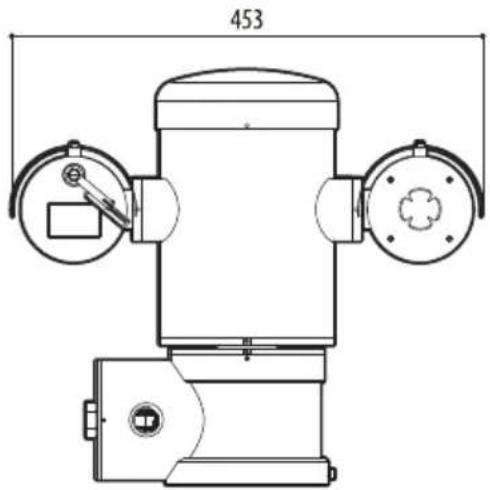
Fig. 29 MAXIMUS MPXT SERIES2 (MPXT).
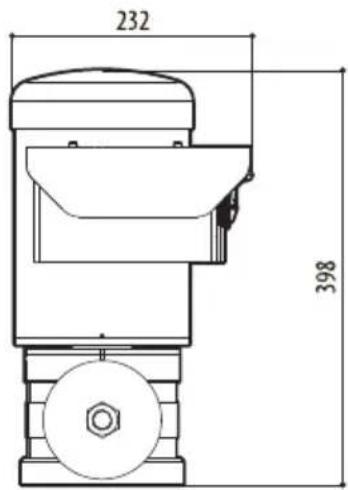
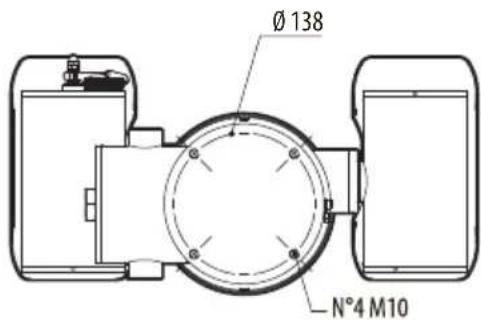
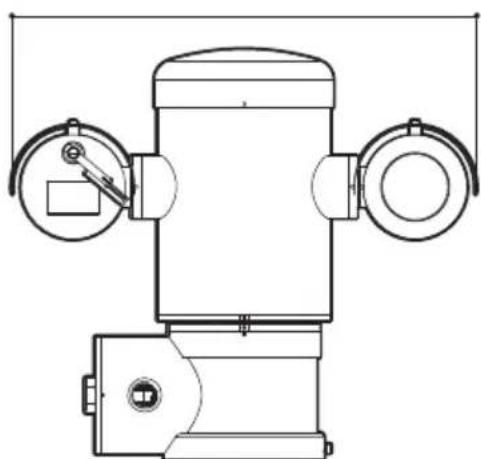
natural_image
Technical line drawing of a mechanical device with two circular components and a central housing (no text or symbols)Fig. 30 MAXIMUS MPXL SERIES2 (MPXL).
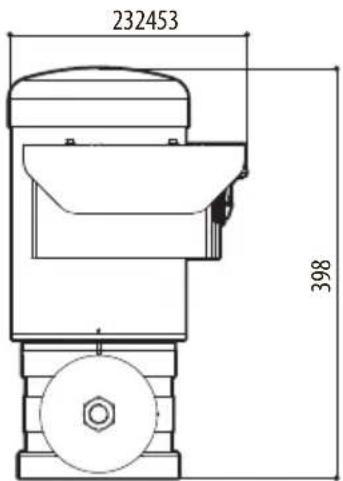
MAXIMUS MPX SERIES2 (MPXHD) MAXIMUS MPXR SERIES2 (MPXR) MAXIMUS MPXT SERIES2 (MPXT) MAXIMUS MPXL SERIES2 (MPXL)
natural_image
Four identical line drawings of a mechanical T-joint connector assembly (no text or symbols)Sumário
natural_image
Diagram of a tool interacting with a cylindrical object, showing a curved surface and a pointed tip (no text or symbols)Fig. 1
WARNING: DO NOT OPEN WHEN AN EXPLOSIVE ATMOSPHERE IS PRESENT.
AVERTISSEMENT: NE PAS OUVRIR EN PRÈSENCE D'UNE ATMOSPHÉRE EXPLOSIVE.
WARNING: POTENTIAL ELECTROSTATIC CHARGING HAZARD - SEE INSTRUCTIONS.
AVERTISSEMENT: DANGER POTENTIEL DE CHARGES ÉLECTROSTATIQUES - VOIR INSTRUCTIONS.
WARNING: A SEAL SHALL BE INSTALLED WITHIN 50MM OF THE ENCLOSURE.
AVERTISSEMENT: UN SCELLEMENT DOIT ÊTRE INSTALLÉ À MOINS DE 50MM DU BOÎTIER.
natural_image
Technical diagram of a mechanical assembly with internal components and a labeled arrow (no text or symbols present)Fig. 4
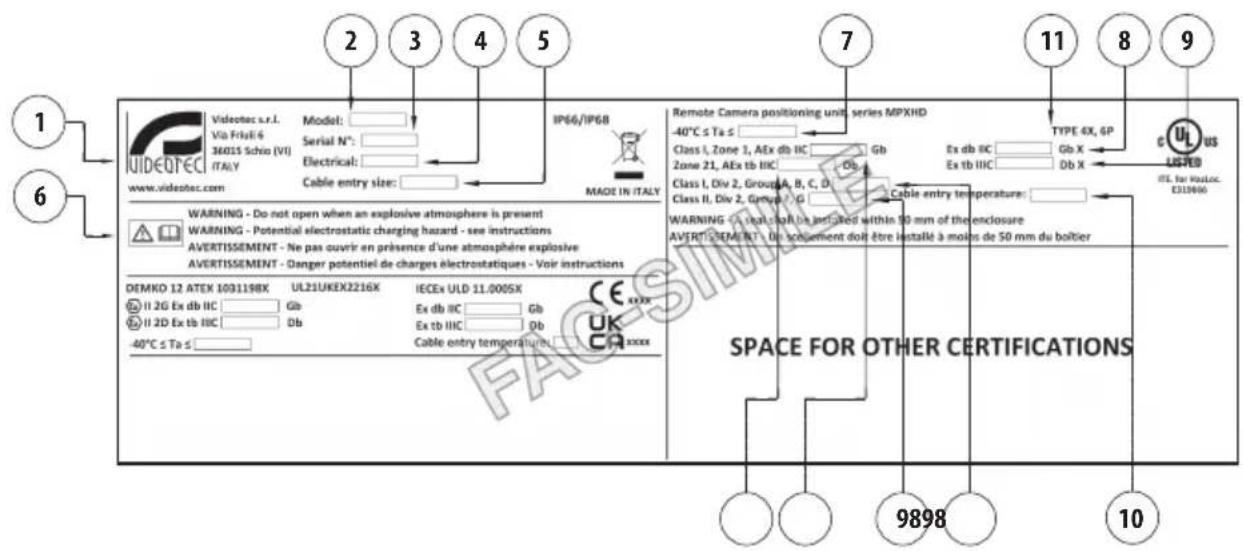
Fig. 5
UL 60079-0, 7th Edition, Explosive Atmospheres - Part 0: Equipment – General requirements
UL 60079-1, 7th Edition, Explosive Atmospheres - Part 1: Equipment Protection by Flameproof Enclosures "d"
UL 60079-31, 2nd Edition, Explosive Atmospheres - Part 31: Equipment Dust Ignition Protection by Enclosure "t"
CSA C22.2 No. 60079-0:19, Explosive Atmospheres - Part 0: Equipment - General requirements
CSA C22.2 No. 60079-1:16, Explosive Atmospheres - Part 1: Equipment Protection by Flameproof Enclosures "d"
CSA C22.2 No. 60079-31:15, Explosive Atmospheres - Part 31: Equipment Dust Ignition Protection by Enclosure "t"
natural_image
Technical line drawing of a mechanical device with a circular component and mounting bracket (no text or symbols)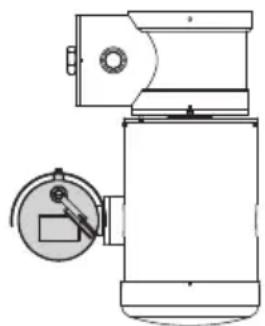
natural_image
Technical line drawing of a mechanical device with a circular component and cylindrical housing (no text or symbols)Fig. 6
natural_image
Technical diagram of a mechanical assembly with mounting holes and directional arrows (no text or labels)Fig. 9
natural_image
Technical illustration of two mechanical components with arrows indicating motion or assembly (no text or symbols present)Fig. 10
natural_image
Technical diagram of a mechanical assembly with no visible text or symbolsFig. 11

natural_image
Technical line drawing of a mechanical component with a magnified inset showing a connector detail (no text or symbols)Fig. 14
- Laser: Class 1, conforme a EN60825-1
Fig. 17
Fig. 18
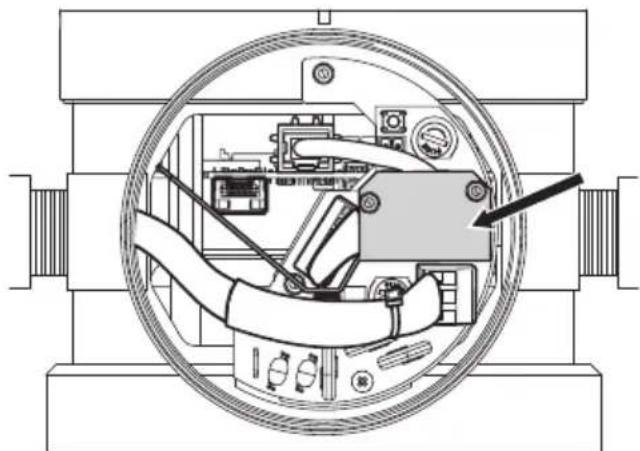
natural_image
Technical diagram of a mechanical assembly with internal components and a labeled arrow (no readable text or symbols)Fig. 19
natural_image
Diagram of a mechanical component with threaded base and central hub, no text or symbols presentFig. 20
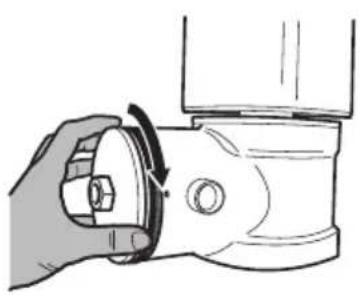
natural_image
Hand holding a mechanical component with a rotating knob (no text or symbols visible)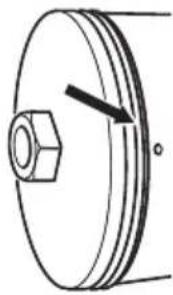
natural_image
Technical line drawing of a pulley and screw (no text or symbols)Fig. 21
natural_image
Line drawing of a hand using a wrench to adjust the engine cylinder (no text or symbols present)Fig. 22
natural_image
Technical illustration of a mechanical assembly with a hand holding a tool, showing no text or symbols.Fig. 23
7 Acendimento

natural_image
Diagram of a mechanical component with a threaded base and central hub, showing a cross-section with an arrow pointing to a feature (no text or symbols present)Fig. 24
natural_image
Technical line drawing of a mechanical assembly with a tool inserted into a component (no text or symbols)Fig. 25
natural_image
Technical line drawing of a mechanical assembly with two flanges and internal components (no text or symbols)Fig. 26
- Laser: Class 1, conforme a EN60825-1
• Certificado: UL/IEC 60950-1 ou UL/IEC 62368-1
14.1.5 Interface I/O
Entrada para reset remoto: 1
Entradas alarme: 1
Indoor Flicker Reduction
Auto Slowshutter: Off, On (de 1/30s até 1/1s)
Indoor Flicker Reduction
High sensitivity: On/Off
Auto Slowshutter: On/Off
RCM (Australian and New Zealand Regulatory Compliance Mark)
KCs (Employment and labor department 2021-22)
UK Ex (EN IEC 60079-0, EN 60079-1, EN 60079-31)
RCM (Australian and New Zealand Regulatory Compliance Mark)
KCs (Employment and labor department 2021-22)
UK Ex (EN IEC 60079-0, EN 60079-1, EN 60079-31)
Indoor Flicker Reduction
High sensitivity: On/Off
Auto Slowshutter: On/Off
RCM (Australian and New Zealand Regulatory Compliance Mark)
KCs (Employment and labor department 2021-22)
UK Ex (EN IEC 60079-0, EN 60079-1, EN 60079-31)
Indoor Flicker Reduction
High sensitivity: On/Off
Auto Slowshutter: On/Off
RCM (Australian and New Zealand Regulatory Compliance Mark)
Conforme NDAA
KCs (Employment and labor department 2021-22)
UK Ex (EN IEC 60079-0, EN 60079-1, EN 60079-31)
natural_image
Technical line drawing of a mechanical device with no visible text or symbols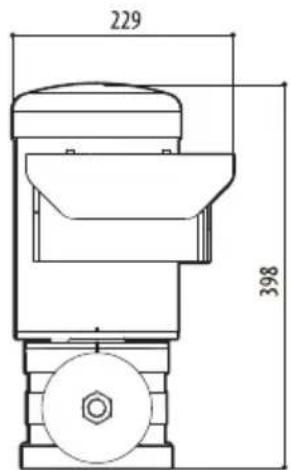
Fig. 28 MAXIMUS MPXR SERIES2 (MPXR).
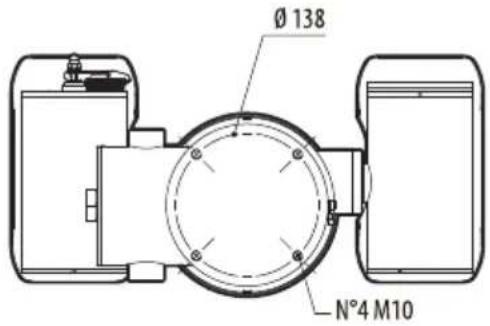
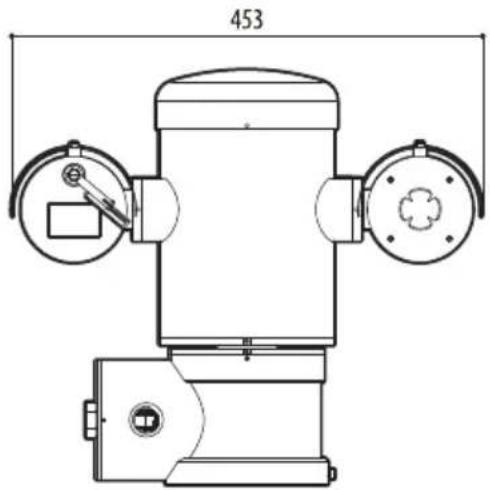
Fig. 29 MAXIMUS MPXT SERIES2 (MPXT).
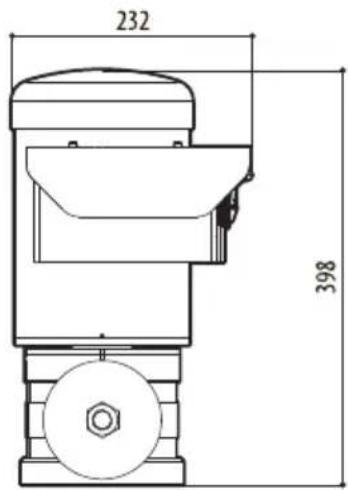
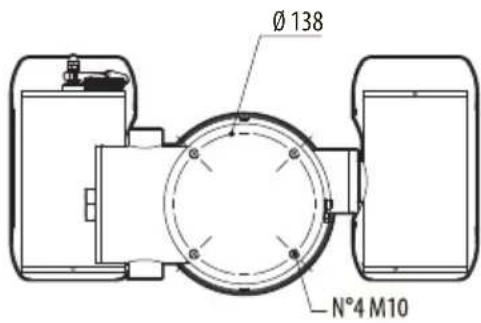
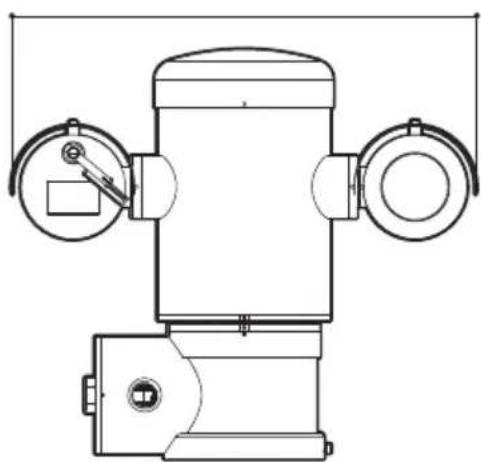
natural_image
Technical line drawing of a mechanical device with two circular components and a central housing (no text or symbols)Fig. 30 MAXIMUS MPXL SERIES2 (MPXL).
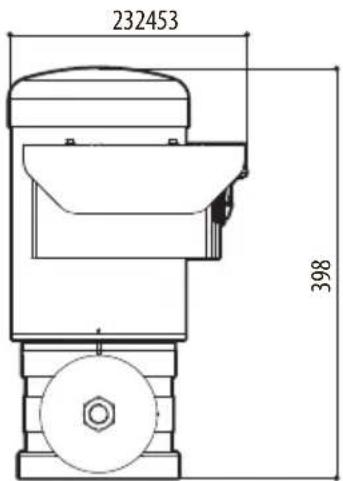
MAXIMUS MPX SERIES2 (MPXHD)
MAXIMUS MPXR SERIES2 (MPXR)
MAXIMUS MPXT SERIES2 (MPXT)
MAXIMUS MPXL SERIES2 (MPXL)
방폭형 PTZ 카메라
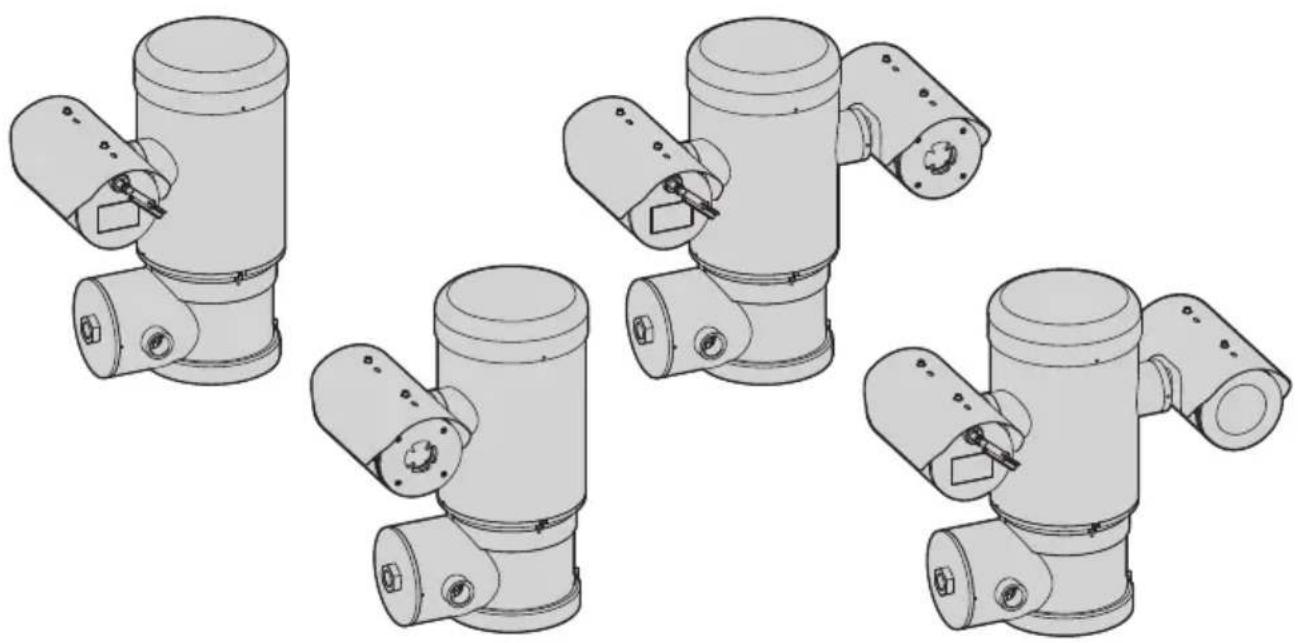
natural_image
Four identical line drawings of a mechanical T-joint connector assembly (no text or symbols)요약
1 설명서에 있는 정보들 6
1.1 인쇄합의 6
13 Troubleshooting....38
14 기술 데이터 39
14.1 MAXIMUS MPX SERIES2 (MPXHD) 39
14.1.1 일반 39
14.1.2 기계 39
14.1.3 전기 39
14.1.4 네트워크 39
14.1.5 I/O 인터페이스 39
14.1.6 카메라 40
14.1.7 환경....41
14.1.8 인증서 41
14.2 MAXIMUS MPXR SERIES2 (MPXR)....42
14.2.1 일반 42
14.2.2 기계 42
14.2.3하우징 창 42
14.2.4 전기 42
14.2.5 네트워크 42
14.2.6 I/O 인터페이스 42
14.2.7 열 카메라 43
14.2.8 환경 45
14.2.9 인증서 45
natural_image
Diagram of a tool interacting with a curved object, possibly a mechanical or electrical component (no text or symbols present)Fig. 1
4.6 제품의 검인
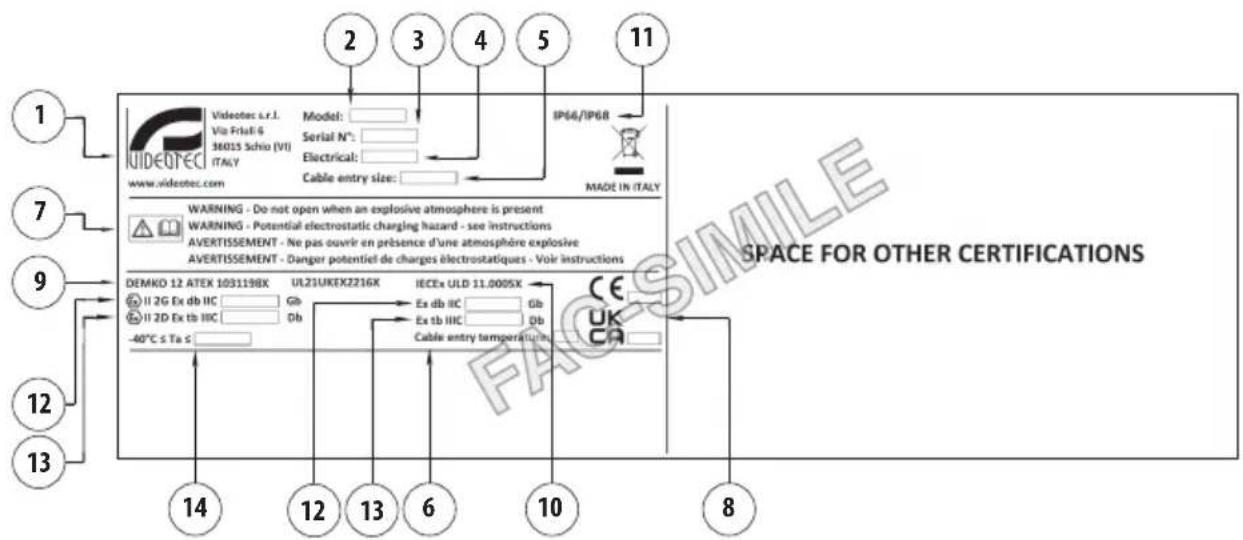
Fig. 2
Hazardous moving parts. Keep fingers and other body parts away.
AVERTISSEMENT!
WARNING: DO NOT OPEN WHEN AN EXPLOSIVE ATMOSPHERE IS PRESENT.
AVERTISSEMENT: NE PAS OUVRIR EN PRÈSENCE D'UNE ATMOSPHÉRE EXPLOSIVE.
WARNING: POTENTIAL ELECTROSTATIC CHARGING HAZARD - SEE INSTRUCTIONS.
AVERTISSEMENT: DANGER POTENTIEL DE CHARGES ÉLECTROSTATIQUES - VOIR INSTRUCTIONS.
WARNING: A SEAL SHALL BE INSTALLED WITHIN 50MM OF THE ENCLOSURE.
AVERTISSEMENT: UN SCELLEMENT DOIT ÊTRE INSTALLÉ À MOINS DE 50MM DU BOÎTIER.
natural_image
Technical diagram of a mechanical assembly with internal components and a hand pointing to a component (no text or labels visible)Fig. 4
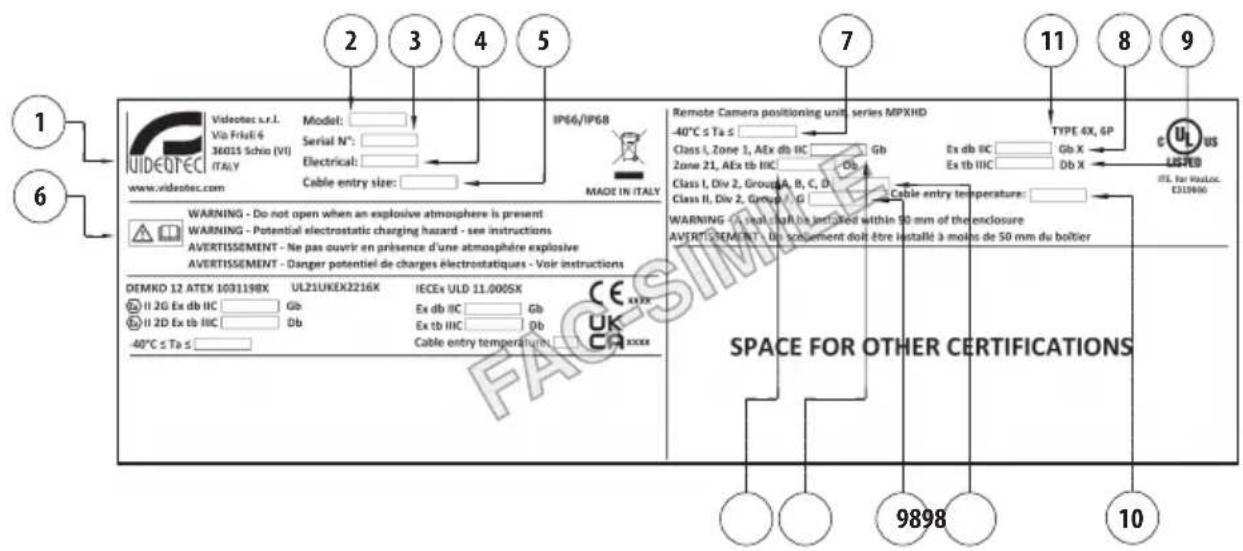
Fig. 5
UL 60079-0, 7th Edition, Explosive Atmospheres - Part 0: Equipment – General requirements
UL 60079-1, 7th Edition, Explosive Atmospheres - Part 1: Equipment Protection by Flameproof Enclosures "d"
UL 60079-31, 2nd Edition, Explosive Atmospheres - Part 31: Equipment Dust Ignition Protection by Enclosure “t”
CSA C22.2 No. 60079-0:19, Explosive Atmospheres - Part 0: Equipment - General requirements
CSA C22.2 No. 60079-1:16, Explosive Atmospheres - Part 1: Equipment Protection by Flameproof Enclosures “d”
CSA C22.2 No. 60079-31:15, Explosive Atmospheres - Part 31: Equipment Dust Ignition Protection by Enclosure “t”
4.8 모델 식별 코드
4.8.1 Day/Night camera
natural_image
Technical line drawing of a mechanical device with a dial indicator (no text or symbols)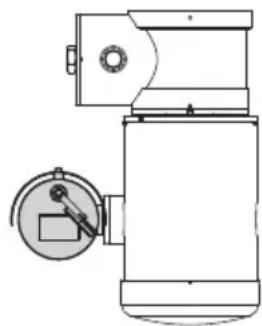
natural_image
Technical line drawing of a mechanical device with a circular component and cylindrical housing (no text or symbols)Fig. 6
natural_image
Technical line drawing of a mechanical assembly with mounting brackets and a cylindrical component (no text or symbols)Fig. 9
natural_image
Technical illustration of two mechanical components with arrows indicating motion or assembly (no text or symbols present)Fig. 10
natural_image
Diagram of a mechanical device with a central gear and surrounding components (no text or symbols)Fig. 11

natural_image
Technical line drawing of a mechanical component with a close-up inset showing a pipe fitting (no text or symbols)Fig. 14
6.4.2 안전 접지의 접속
Fig. 17
natural_image
Technical diagram of a mechanical assembly with internal components and a highlighted section (no text or labels)Fig. 19
6.9 접속함 닫기

natural_image
Diagram of a mechanical component with threaded base and central hub, no text or symbols presentFig. 20
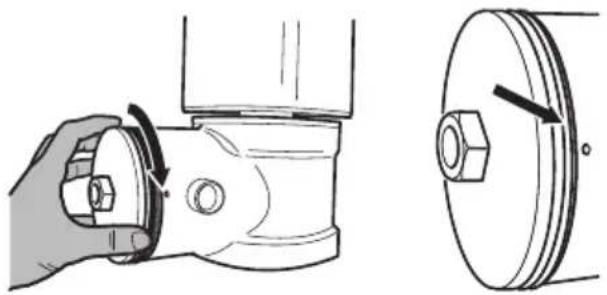
natural_image
Technical illustration of a hand operating a pipe fitting with a close-up view of the wheel (no text or symbols)Fig. 21
natural_image
Line drawing of a hand using a wrench to adjust a mechanical component (no text or symbols)Fig. 22
natural_image
Technical illustration of a mechanical assembly with a hand holding a tool, showing no text or symbols.Fig. 23
7켜짐

natural_image
Diagram of a mechanical component with a threaded base and central hub, showing a diagonal arrow pointing to a feature (no text or symbols present)Fig. 24
10.1.3 와이퍼 블레이드 교체
natural_image
Line drawing of a mechanical component with a lever and rectangular block (no text or symbols)Fig. 25
10.2 각별한 유지관리가
10.2.1 퓨즈 교체

natural_image
Technical line drawing of a mechanical assembly with two flanges and internal components (no text or symbols)Fig. 26
유효화소:approx.2.38 Megapixels
최소 밝기:
- 색: 0.006lx (F1.6, 30 IRE)
• B/W: 0.0006lx (F1.6, 30 IRE)
Indoor Flicker Reduction
Auto Slowshutter: Off, On (\~로부터 1/30s 까지 1/1s)
유효화소:approx.2.13 Megapixels
최소 밝기:
- 색: 0.0013lx (50 IRE, High sensitivity on)
• B/W: 0.0008lx (30 IRE, High sensitivity on)
Indoor Flicker Reduction
High sensitivity: On/Off
역광 보정: On/Off
Auto Slowshutter: On/Off
RCM (Australian and New Zealand Regulatory Compliance Mark)
KCs (Employment and labor department 2021-22)
UK Ex (EN IEC 60079-0, EN 60079-1, EN 60079-31)
14.1.10 인증서 - 해양 기기
RCM (Australian and New Zealand Regulatory Compliance Mark)
KCs (Employment and labor department 2021-22)
UK Ex (EN IEC 60079-0, EN 60079-1, EN 60079-31)
14.2.11 인증서 - 해양 기기
유효화소: approx. 2.13 Megapixels
최소 밝기:
- 색: 0.0013lx (50 IRE, High sensitivity on)
• B/W: 0.0008lx (30 IRE, High sensitivity on)
Indoor Flicker Reduction
High sensitivity: On/Off
역광 보정: On/Off
Auto Slowshutter: On/Off
RCM (Australian and New Zealand Regulatory Compliance Mark)
KCs (Employment and labor department 2021-22)
UK Ex (EN IEC 60079-0, EN 60079-1, EN 60079-31)
14.3.12 인증서 - 해양 기기
유효화소:approx.2.13 Megapixels
최소 밞기:
- 색: 0.0013lx (50 IRE, High sensitivity on)
• B/W: 0.0008lx (30 IRE, High sensitivity on)
Indoor Flicker Reduction
High sensitivity: On/Off
역광 보정: On/Off
Auto Slowshutter: On/Off
natural_image
Technical line drawing of a mechanical device with dimension label 313 (no text or symbols on the diagram itself)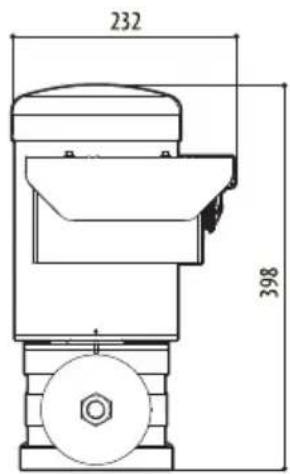
Fig. 27 MAXIMUS MPX SERIES2 (MPXHD).
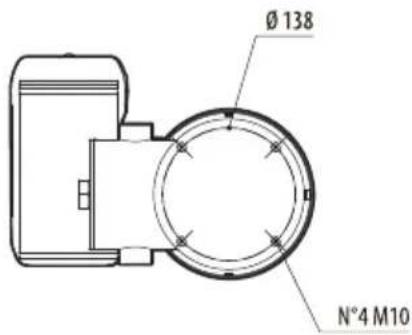
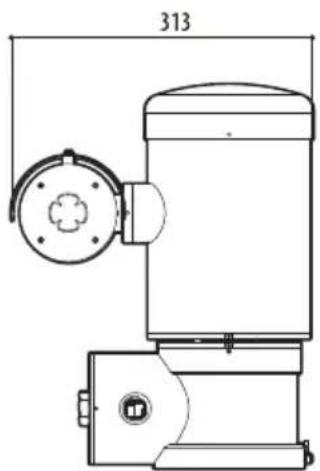
natural_image
Technical line drawing of a mechanical device with no visible text or symbols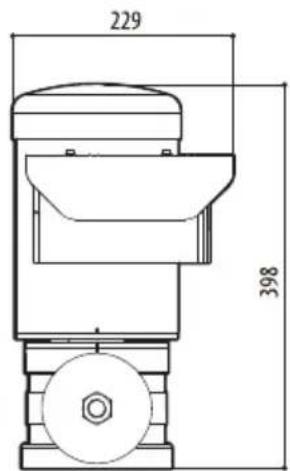
Fig. 28 MAXIMUS MPXR SERIES2 (MPXR).
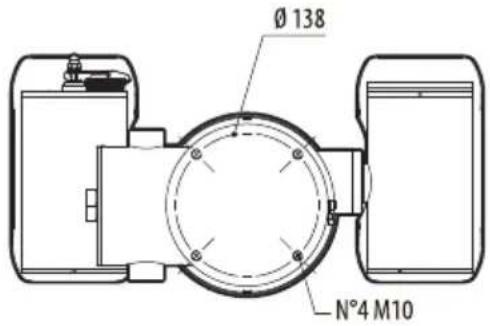
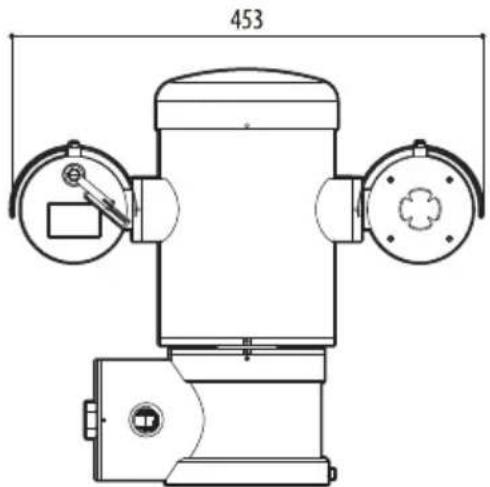
Fig. 29 MAXIMUS MPXT SERIES2 (MPXT).
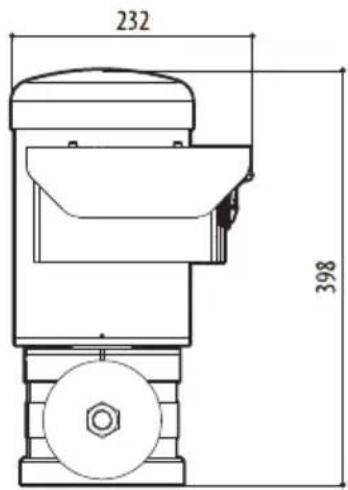
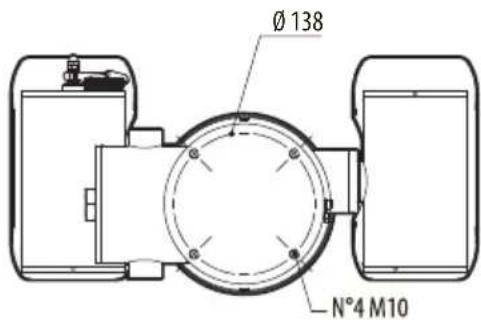
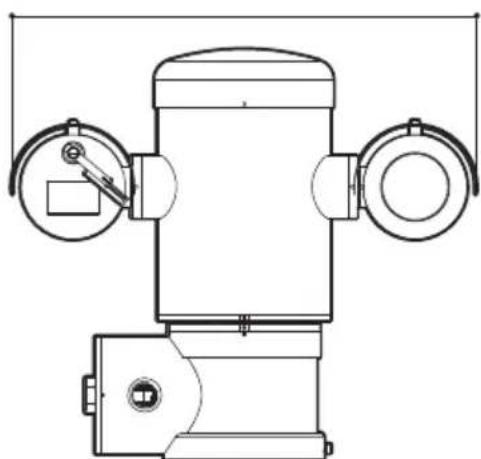
natural_image
Technical line drawing of a mechanical device with two circular components and a central housing (no text or symbols)Fig. 30 MAXIMUS MPXL SERIES2 (MPXL).
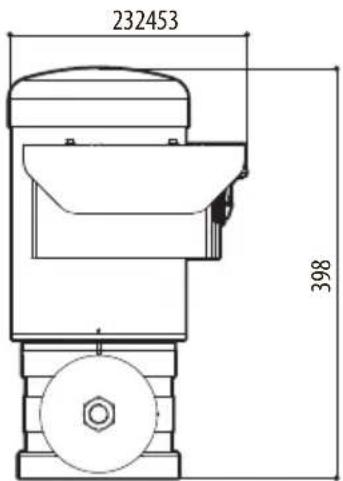


Headquarters Italy VIDEOTEC s.r.l.
Via Friuli, 6 - I-36015 Schio (VI) - Italy
Tel. +39 0445 697411 - Fax +39 0445 697414
Email: info@videotec.com
www.videotec.com