E8636 - Thermometer Emos - Free user manual and instructions
Find the device manual for free E8636 Emos in PDF.



| Product type | Wireless thermometer with clock and alarm |
| Brand | Emos |
| Model | E8636 |
| Indoor temperature | 0 °C to +50 °C (resolution 0.1 °C) |
| Outdoor temperature | -30 °C to +60 °C (resolution 0.1 °C) |
| Accuracy | ±1 °C (0 to +50 °C), ±2 °C (-20 to 0 °C), ±4 °C (-30 to -20 °C) |
| Temperature units | °C / °F (selectable) |
| Sensor range | 50 m in open space |
| Radio frequency | 433 MHz, 10 mW e.r.p. |
| Max. number of sensors | 3 |
| Thermometer power supply | 2 x AAA 1.5 V batteries |
| Sensor power supply | 2 x AAA 1.5 V batteries |
| Clock | Quartz, 12/24 h format |
| Alarm | With snooze function (5 min) |
| Backlight | Yes, 5 seconds via SNZ/LIGHT button |
| Value memory | Indoor and outdoor max/min temperatures |
| Sensor display | Automatic or manual rotation (3 channels) |
| Low battery indicator | Yes (icon on screen) |
| Maintenance and cleaning | Soft slightly damp cloth; do not use solvent |
| Safety | Do not expose to water, flames, shocks; do not open |
Frequently Asked Questions - E8636 Emos
User questions about E8636 Emos
0 question about this device. Answer the ones you know or ask your own.
Ask a new question about this device
Download the instructions for your Thermometer in PDF format for free! Find your manual E8636 - Emos and take your electronic device back in hand. On this page are published all the documents necessary for the use of your device. E8636 by Emos.
USER MANUAL E8636 Emos
natural_image
Technical line drawing of a rectangular device with internal components and a labeled dimension '17' (no text or symbols beyond the label)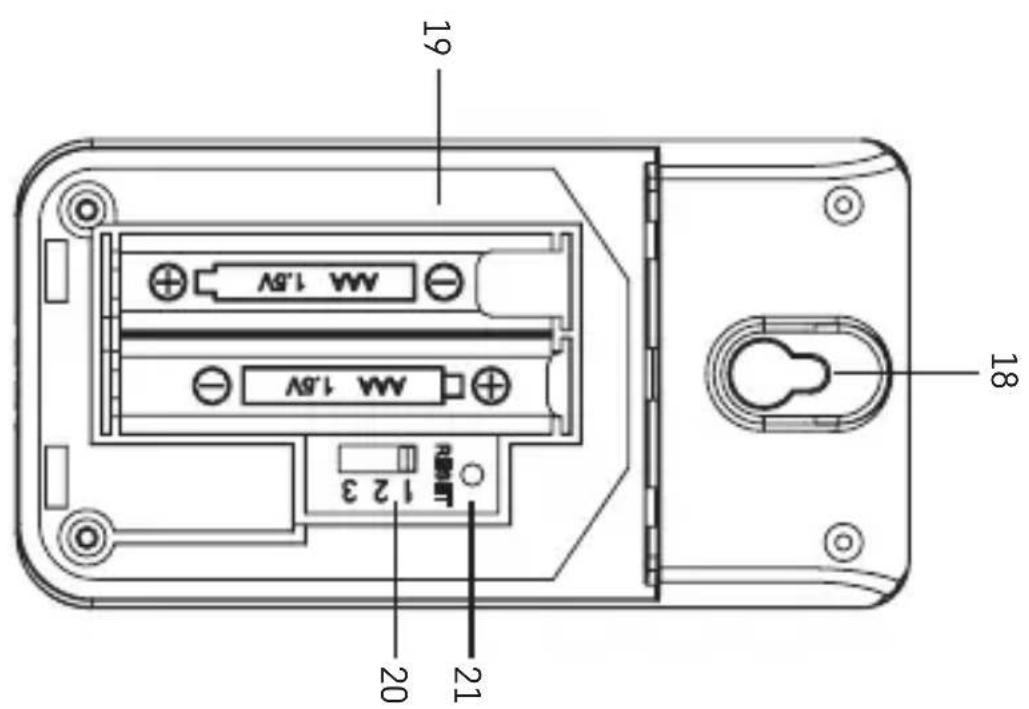
2
GB | Wireless Thermometer
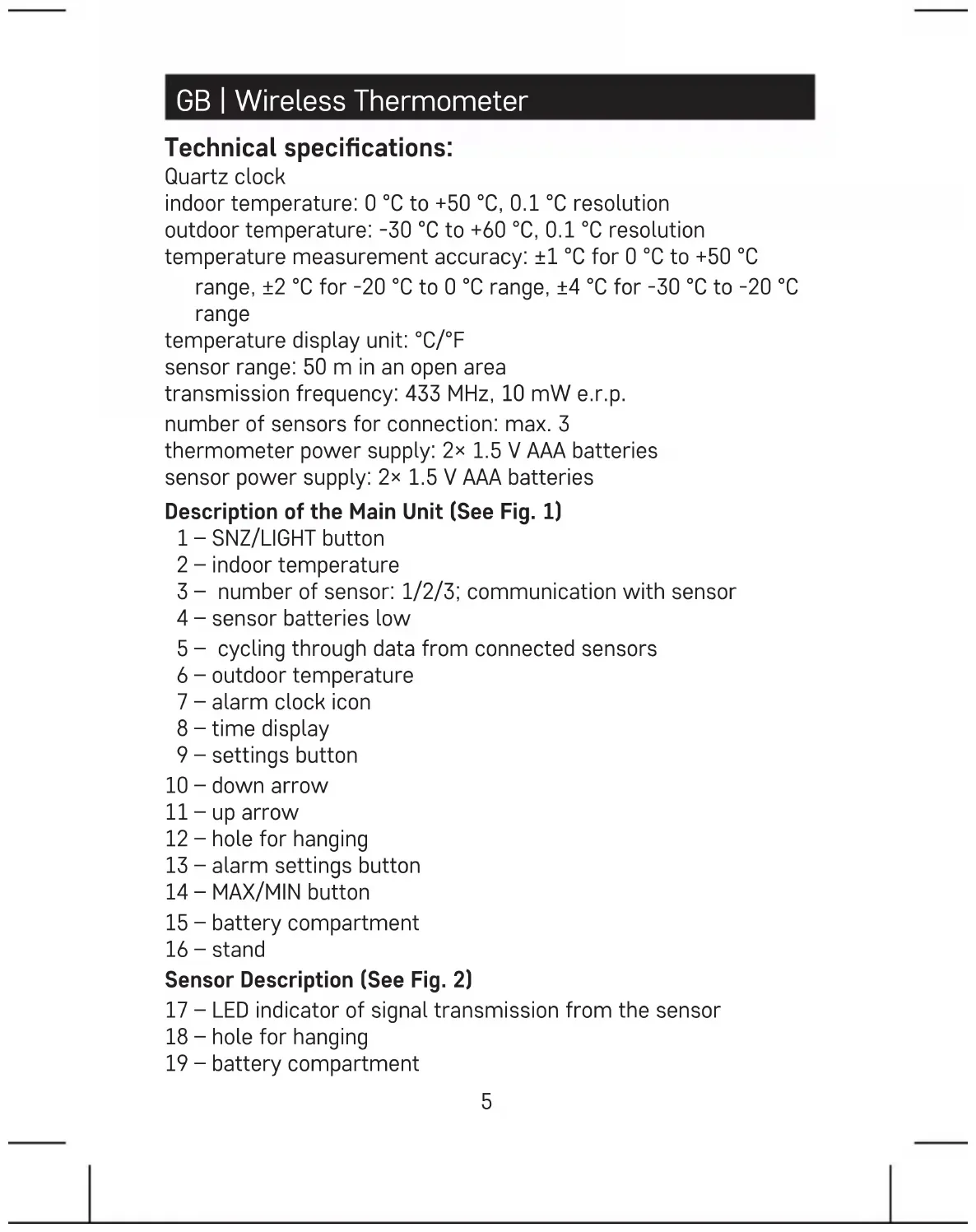
Technical specifications:
Quartz clock
indoor temperature: 0 °C to +50 °C, 0.1 °C resolution
outdoor temperature: -30 °C to +60 °C, 0.1 °C resolution
temperature measurement accuracy: ±1 °C for 0 °C to +50 °C
range, ±2 °C for -20 °C to 0 °C range, ±4 °C for -30 °C to -20 °C range
temperature display unit: ^ C/ ^ F
sensor range: 50 m in an open area
transmission frequency: 433 MHz, 10 mW e.r.p.
number of sensors for connection: max. 3
thermometer power supply: 2× 1.5 V AAA batteries
sensor power supply: 2× 1.5 V AAA batteries
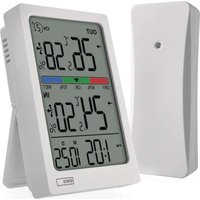
Description of the Main Unit (See Fig. 1)
1 - SNZ/LIGHT button
2 – indoor temperature
3 – number of sensor: 1/2/3; communication with sensor
4 - sensor batteries low
5 - cycling through data from connected sensors
6 – outdoor temperature
7 - alarm clock icon
8 - time display
9 - settings button
10 - down arrow
11-up arrow
12 – hole for hanging
13 – alarm settings button
14 - MAX/MIN button
15 – battery compartment
16 - stand
Sensor Description (See Fig. 2)
17 - LED indicator of signal transmission from the sensor
18 – hole for hanging
19 – battery compartment
20 - sensor channel number 1/2/3 setting
21 - RESET button
Getting Started
- Place the two units next to each other.
- Insert batteries first into the thermometer and then into the wireless sensor.
- When inserting the batteries, make sure the polarity is correct to avoid damaging the thermometer or sensor. Only use 1.5 V alkaline batteries of the same type; do not use rechargeable 1.2 V batteries.
- The icon will start flashing. The thermometer will automatically detect sensor signal within 3 minutes. If sensor signal is not detected, press and hold the button to repeat the search.
- We recommend placing the sensor on the north side of the house. The range of the sensor may decrease substantially in areas with a large number of obstacles.
- The sensor is resistant to dripping water; however, it should not be continuously exposed to rain.
- Do not place the sensor onto metal objects; doing so will reduce the transmission range.
- If the low battery icon ☐ appears, replace batteries in the sensor.
- If the screen is hard to read or poorly backlit, replace the batteries in the thermometer.
Switching Channels and Connecting Additional Sensors
-
Repeatedly press the up arrow on the thermometer to select the channel of choice - 1, 2 or 3. Then, long-press the button; the icon will start flashing.
-
Remove the cover of the battery compartment on the back of the sensor and set the sensor switch to the chosen sensor channel number (1, 2, 3), then insert batteries (2× 1.5 V AAA). Data from the sensor will be loaded within 3 minutes.
-
If the sensor's signal is not found, remove batteries from it and repeat steps 1 and 2 or use a thin object (e.g. a pencil or paper clip) to push the RESET button on the sensor.
Displaying Data from Multiple Sensors, Automatic Cycling through Values from Connected Sensors
Press the button repeatedly to display data from all connected sensors on the thermometer, one by one. You can also activate automatic cycling through data from all connected sensors:
1. Turning on cycling
Repeatedly press the ▲ button until the display shows the icon. Data from all connected sensors will be shown automatically and repeatedly one after another.
2. Turning off cycling
Press the ▲ button; the icon will disappear.
Setting Time
- Long press the button on the back of the thermometer.
- Use the arrow buttons to set hours and minutes.
- Use the button to navigate between the values.
- Hold the up or down arrow to adjust values faster.
Setting 12/24 Hour Time Format
Repeatedly pressing the 🎨 button switches between 12/24 h time format.
Switching °C/°F Units of Temperature
Repeatedly pressing the down arrow switches between ^ C and ^ F units.
Setting an Alarm
Long-press the button and use / to se alarm time.
Navigate between the values using the button.
Once the hours and minutes are set, press the button again.
The alarm icon on the screen indicates the alarm is active.
To deactivate the alarm, press the button again. The icon will disappear.
To return to standard time display, wait 20 seconds or press

Snooze and Display Backlight Functions
Press the SNZ/LIGHT button when the alarm is ringing to postpone the alarm by 5 minutes. 📁con will be flashing on the screen. To cancel the snooze function, press any button other than SNZ/LIGHT.
If you do not want to use the snooze function, press any button other than SNZ/LIGHT when the alarm is ringing; the alarm will trigger again the next day.
If you do not press any button while the alarm is ringing, the alarm will be active for 2 minutes and will then trigger the next day.
Press the SNZ/LIGHT button while in standard mode to activate display backlight for 5 seconds.
Memory for Measured Values
Press the button repeatedly to display the maximum and minimum readings of indoor and outdoor temperatures.
To erase the memory, long-press the button.
Safety Instructions and Warnings
Read the user manual before using the device. Follow the safety instructions provided in the manual. The product is designed to serve reliably for many years if used properly.
- Read the manual carefully before using this product.
- Do not expose the product to direct sunlight, extreme cold or humidity, and sudden changes in temperature.
- Do not place the product in locations prone to vibration and shocks – may cause damage.
- Do not subject the product to excessive force, impacts, dust, high temperatures or humidity – doing so may cause malfunction, shorten battery life, damage the batteries or deform the plastic parts.
- Do not expose the product to rain or moisture if it is not designed for outdoor use.
- Do not place any open flame sources on the product, e.g. a lit candle, etc.
- Do not put the product in places with inadequate air flow.
- Do not insert any objects in the product's vents.
- Do not tamper with the internal electric circuits of the product – doing so may damage the product and will automatically void the warranty.
-
To clean the product, use a slightly moistened soft cloth. Do not use solvents or cleaning agents – they could scratch the plastic parts and cause corrosion of the electric circuits.
-
Do not submerse the product in water or other liquids or expose it to dripping or splashing water.
- If the product becomes damaged or defective, do not perform any repairs yourself; bring it for repair to the store where you bought it.
- This device is not intended for use by persons (including children) whose physical, sensory or mental disability or lack of experience and expertise prevents safe use, unless they are supervised or instructed in the use of the appliance by a person responsible for their safety.
Do not dispose with domestic waste. Use special collection points for sorted waste. Contact local authorities for information about collection points. If the electronic devices would be disposed on landfill, dangerous substances may reach groundwater and subsequently food chain, where it could affect human health.
Hereby, EMOS spol. s r. o. declares that the radio equipment type E8636 is in compliance with Directive 2014/53/EU. The full text of the EU declaration of conformity is available at the following internet address: http://www.emos.eu/download.
Izbira enote temperature °C/°F
Z večkratnim pritiskom na tipko navzdol častavite želeno enoto temperature °C/°F.
Nastavitev budilke
Pritisnite in držite tipko 🚗s tipkama / ▲a nīstavite čas budilke.
Med vrednostmi se premikate s pritiskom na tipko