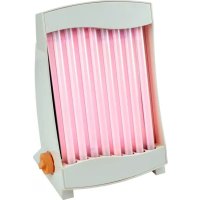
SC GB 838 IR - Face cleansing Efbe-Schott - Free user manual and instructions
Find the device manual for free SC GB 838 IR Efbe-Schott in PDF.



User questions about SC GB 838 IR Efbe-Schott
0 question about this device. Answer the ones you know or ask your own.
Ask a new question about this device
Download the instructions for your Face cleansing in PDF format for free! Find your manual SC GB 838 IR - Efbe-Schott and take your electronic device back in hand. On this page are published all the documents necessary for the use of your device. SC GB 838 IR by Efbe-Schott.
USER MANUAL SC GB 838 IR Efbe-Schott
service@efbe-schott.de
www.efbeschott.de
GB User Instruction
Before the utilization, read the instruction careful, act accordingly and store it! When you pass the appliance then enclose the User Instruction.
IMPORTANT INFORMATION
- This appliance can be used by persons of 8 years of age or more and people with reduced physical, sensory or mental capacities or with a lack of experience or knowledge if they have been given supervision or instructions concerning the safe use of the appliance and the risks involved.
- Cleaning and user maintenance shall not be made by persons under the age of 18.
Children shall not play with the appliance. - Check that your mains voltage corresponds to that stated on the appliance.
- Never leave the appliance unsupervised when in use.
- From time to time check the appliance for damages. Never use the appliance if cord or appliance shows any signs of damage. In that case, repairs should be made by a competent qualified electrician ^() . Should the cord be damaged, it must be replaced by a competent qualified electrician ^() in order to avoid all danger.
- Only use the appliance for domestic purposes and in the way indicated in these instructions.
- Do not cover the vent slots at the back of the appliance while in use.
- Never immerse the appliance in water or any other liquid for any reason whatsoever. Never place it into the dishwasher.
- Do not use the appliance near water (e.g. in the Bathroom, near the shower or a sink.
Never use the appliance near hot surfaces.
- Before cleaning, always unplug the appliance from the power supply.
-
Never use the appliance outside and always place it in a dry environment.
-
Never use accessories that are not recommended by the producer. They could constitute a danger to the user and risk to damage the appliance.
- Never move the appliance by pulling the cord. Make sure the cord cannot get caught in any way. Do not wind the cord around the appliance and do not bend it.
- In order to avoid any possible damage due to the normal temperatures of the appliance in use, please respect the following installation instructions:
- place the back side as close to the wall as possible
- leave at least 10cm of free space on each side and above the appliance.
- As a general rule, make sure there is enough ventilation in the room around this appliance during operation. Stand the appliance on a stable heat-resistant surface (not a varnished table or a table cloth).
- Make sure the appliance has cooled down before cleaning and storing it.
- Make sure the cord never comes into contact with the hot parts of the appliance.
- The temperature of the accessible surfaces, such as the light bulbs, may be very high when the appliance is in use. Never touch those surfaces during use nor before the appliance has totally cooled down, and only handle the knobs.
- Make sure the hot parts of the appliance never come into contact with inflammable materials, such as curtains, cloth, etc. when it is in use, as a fire might occur. Also make sure not to cover the appliance and do not put anything on top of it. Make sure nothing comes into contact with the heating element of the appliance.
- Your appliance must never be switched on through an external timer or any kind of separate remote control system.
- Do not use the appliance with a defect timer.
- Do not use the appliance in an explosion-hazard area.
-
Unplug the appliance after use.
-
Only keep the appliance after it has cooled down (cooling period ca. 15 minutes)
- Certain materials that change colour in sunlight (e.g. paintings) should not be exposed to the UV radiation of the tanning system for a prolonged time.
- Non-user, especially children, should not be present when the appliance is in use.
UV appliance should not be used by:
People under 18
People whit natural red hair colour
People with atypically decolorized skin areas
People who have more than 16 moles (2 mm diameter or bigger) on their body
People who have atypical moles (atypical moles are described as asymmetric moles with a diameter that is bigger than 5 mm with different pigmentation and irregular borders)
People who suffer from sunburn
People who cannot tan at all or who cannot tan without getting sunburn when they are exposed to the sun
People who sunburn easily when they are exposed to the sun
People who have had a history of repeated, heavy sunburns during childhood
People who suffer or suffered from skin cancer or who are predisposed to it
People whose relatives of the first degree have had black skin cancer (melanoma)
People who are in medical treatment because of suffering that comes along with photosensitivity
People who get photosensitizing medication -
The exposures should not exceed the personal minimal erythemal dose (MED), i.e. the minimal UV dose that causes perceptible reddening of the skin. If an erythema (reddening of the skin) occurs hours after an exposure, no further exposures should take place. After a week the exposures can be taken up again starting from the beginning of the exposure plan.
-
If unexpected effects occur, such as itching within 48h after the first exposure, ask your doctor for advice before further exposures
- Ultraviolet radiation of the sun or frim artificial light sources can cause skin or eye damage. The biological effect depends on the type and amount of irradiation and on the sensitivity of the skin exposed to it.
- Excessive irradiation can cause sunburn. Overly frequent exposure to ultraviolet radiation of the sun or an artificial light source can lead to early ageing of the skin and increased risk of skin tumors. These risks increase according to the accumulated UV radiation. Exposure at a young age increases the skin damage later in life.
- The surface of the unprotected eye can be inflamed and in certain cases excessive exposure to radiation can cause retinal damage. Cataract can be the consequence of many repeated irradiation exposures.
- In case of pronounced individual sensitivity or allergic reactions to ultraviolet radiation, ask your doctor for advice before the start of the exposure.
- The following precautionary measures must be respected:
Always use the supplied safety goggles, contact lenses and sunglasses are no surrogate for the safety goggles
o Remove cosmetics before exposure and do not use any sun protecting agents or self-tanning
Certain medical conditions or side effects of medication can be heightened because of ultraviolet radiation. In case of doubt, consult your doctor.
o Let an interval of at least 48 hours between the first two exposures
。When using the appliance, do not sunbath the same day
Follow the recommended exposure time, exposure intervals and keep the recommended distance to the tubes
Consult your doctor if your skin starts swelling, wounds or pigmented spots appear
Sensitive skin areas such as scars, tattoos and private parts need to be protected before
O
(*) Competent qualified electrician: after-sales department of the producer or importer or any person who is qualified, approved and competent to perform this kind of repairs in order to avoid all danger. In case of need you should return the appliance to this electrician.
What you should know about skin tanning
The sun
The sun is the source of life on earth. Everyone knows from the change of seasons and personal experience during vacations that the light and heat of the sun affect our health and well-being in general. If your skin in bronzed, you look more attractive and healthy and feel better. Skin tan also had a biological function in that it protects your skin from sunburn, e.g. before you go on a sun vacation.
Tanning
The tanning is caused by a certain part of light spectrum. Tanning does not depend on whether the light is natural sunlight or artificial light.
The radiation of the sun contains a visible portion, which we perceive as light and an invisible portion, which we perceive, for example, as heal. The light also contains radiation that makes the skin turn red or even burns it. Radiation that gives the skin a tan is invisible radiation, ultraviolet (UV) radiation consisting of UVA, UVB and UVC radiation. Intensive UVA radiation with a very low proportion of UVB and no UVA are required for a optimal tan. UVC rays from the sun are far away from the Earth's atmosphere, while UVB and UVA rays can brown the skin. However, the relatively high UVB content of solar radiation very quickly causes excessive irritation, redness and sunburn on pale skin.
The UVA tanning system
It has better proportions of UVA and UVB radiation than natural light. The intensity of the tanning UVA radiation is much higher than in the sunshine, and at the same time the harmful UVB content is reduced to a fraction of the sun's share. In comparison to the natural sun, you usually become faster and without sunburn. The achievable skin tone is similar to the natural tan.
The reaction of the skin to sunbeams is different for each individual.
Skin type and exposure time
We all know how our skin responds when it is exposed to direct sunlight. A similar reaction can be expected from exposure to artificial light. Those whose skin can stand much sunlight will bronze quickly; those whose skin is not tanned by the sun will not profit much from the UVA tanning system.
Skin type by reaction of the unexposed skin to natural sunlight
| Skin Type | Skin reaction and ethnic affiliation |
| I | Always gets sunburn quickly, hardly any or only little tan, even after repeated exposure (Celtic type) |
| II | Gets sunburn almost always; moderate tan after repeated exposures (fair-skinned, European type) |
| III | Gets sunburn moderately often; progressing tanning after repeated exposures (dark-skinned, European type) |
| IV | Gets sunburn rarely; quick and strong tan (Mediterranean type) |
The use of at tanning system is only recommended to persons fitting the description of skin type II, III, IV. Skin-type I persons are unable to develop a normal tan either from the sun or exposure to artificial light.
The following exposure sequences are recommended for the various skin types.
SC GB 834 IR - Radiation distance: 5cm (minimum)
Exposure schedule
| Skin type | II | III | IV | ||
| 1st exposure | The time between the exposures must be 48 hours minimum | 9 | 9 | 9 min. | |
| 2nd exposure | 9 | 14 | 18 | min. | |
| 3rd exposure | 9 | 14 | 18 | min. | |
| 4th exposure | 9 | 18 | 27 | min. | |
| 5th exposure | 9 | 18 | 27 | min. | |
| 6th exposure | 9 | 23 | 32 | min. | |
| 7th exposure | 9 | 23 | 32 | min. | |
| 8th exposure | 9 | 23 | 32 | min. | |
| 9th exposure | 9 | 32 | 41 | min. | |
| 10th exposure | 9 | 32 | 41 | min. | |
| First exposure period:Initial dose | 9100 | 9100 100 | 9 min.J/㎡ | ||
| Maximum period of exposures:Final dose | 9100 | 32350 450 | 41J/㎡ | min. | |
| Maximum number of exposures per year:Yearly dose | 505000 | 4214700 | 3314850 | J/㎡ | |
If the radiation period is to long (when the skin tenses or becomes sensitive) than reduce the radiation time, e.g. for 25% .
SC GB 836 IR - Radiation distance: 10cm (minimum)
Exposure schedule
| Skin type | II | III | IV | ||
| 1st exposure | The time between the exposures must be 48 hours minimum | 10 | 10 | 10 | min. |
| 2nd exposure | 10 | 14 | 19 | min. | |
| 3rd exposure | 10 | 14 | 19 | min. | |
| 4th exposure | 10 | 19 | 29 | min. | |
| 5th exposure | 10 | 19 | 29 | min. | |
| 6th exposure | 10 | 24 | 34 | min. | |
| 7th exposure | 10 | 24 | 34 | min. | |
| 8th exposure | 10 | 24 | 34 | min. | |
| 9th exposure | 10 | 34 | 43 | min. | |
| 10th exposure | 10 | 34 | 43 | min. | |
| First exposure period:Initial dose | 10100 100 | 10100 | 10J/m2 | min. | |
| Maximum period of exposures:Final dose | 10100 350 | 34450 | 43J/m2 | min. | |
| Maximum number of exposures per year:Yearly dose | 505000 | 4214700 | 3314850 | J/m2 | |
If the radiation period is to long (when the skin tenses or becomes sensitive) than reduce the radiation time, e.g. for 25% .
SC GB 838 IR - Radiation distance: 20cm (minimum)
Exposure schedule
| Skin type | II | III | IV | ||
| 1st exposure | The time between the exposures must be 48 hours minimum | 11 | 11 | 11 | Min. |
| 2nd exposure | 11 | 17 | 22 | Min. | |
| 3rd exposure | 11 | 17 | 22 | Min. | |
| 4th exposure | 11 | 22 | 33 | Min. | |
| 5th exposure | 11 | 22 | 33 | Min. | |
| 6th exposure | 11 | 28 | 39 | Min. | |
| 7th exposure | 11 | 28 | 39 | Min. | |
| 8th exposure | 11 | 28 | 39 | Min. | |
| 9th exposure | 11 | 39 | 50 | Min. | |
| 10th exposure | 11 | 39 | 50 | Min. | |
| First exposure period:Initial dose | 11100 100 100 | 11100 | 11J/㎡ | Min. | |
| Maximum period of exposures:Final dose 100 350 450 J/㎡ | 11 | 39 | 50 | Min. | |
| Maximum number of exposures per year:Yearly dose | 505000 | 4214700 | 3314850 | J/㎡ | |
If the radiation period is to long (when the skin tenses or becomes sensitive) than reduce the radiation time, e.g. for 25% .
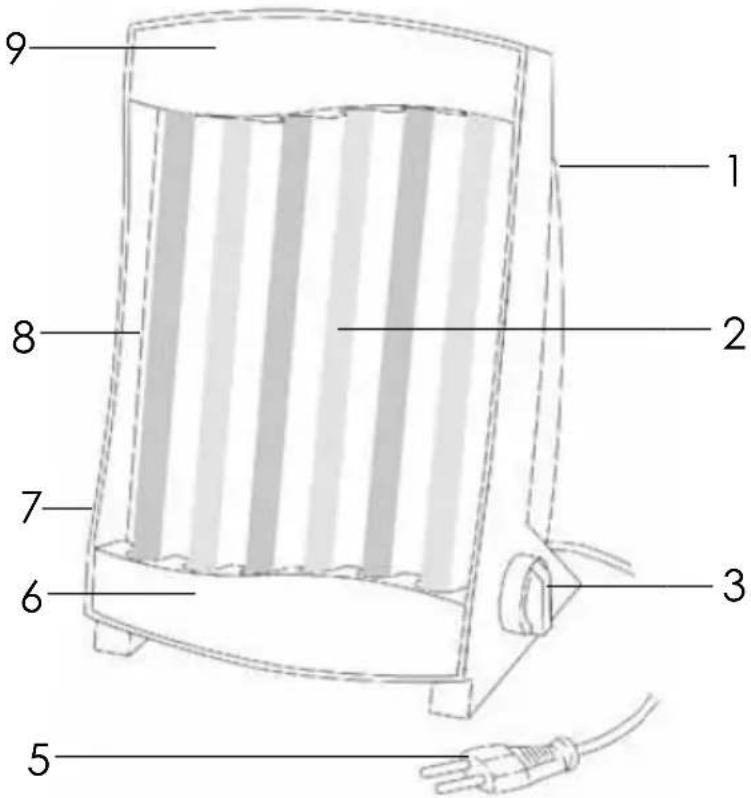
Components and control elements
(1) Carrying handle in the back wall
(2) UVA lamps
834 4 pcs.
836 6 pcs.
838 8 pcs.
(3) Timer
(4) Safety glasses
(5) Power supply cable
(6) Lower tube cover
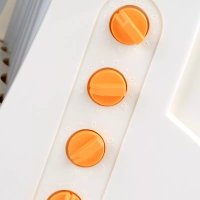
(7) Memo buttons 4 pcs.
(8) reflector
(9) Upper tube cover
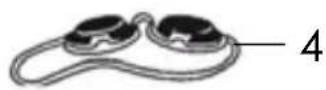
Always use the supplied safety goggles. Contact lenses and sunglasses are not a substitute for goggles.
Operation of the appliance
Operating position
Set the appliance on a flat and non-slip base in a suitable high.
Starting the tanning system
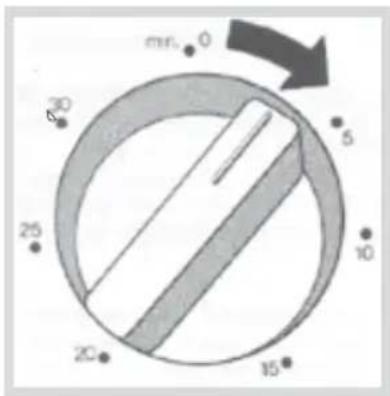
Make the main connection. Turn the timer knob clockwise to set the exposure time. This starts the UVA tanning system and the timer. The system stops automatically at the end of the exposure time.
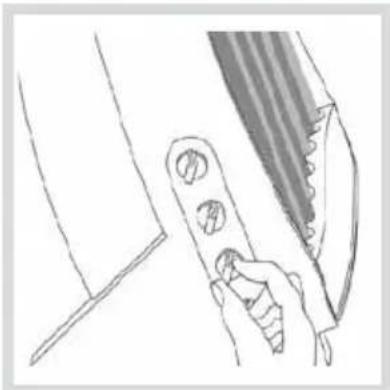
The tanning program can be adjust by setting the memo slide.
Each user uses his own memo slide. Starting at 1, the slide is set to the next number at the end of each exposure.
Hints for the exposure
For the exposure of the face or the upper body, the height of the seat should be chosen so that the head is located approximately in the upper half of the irradiation zone. The lamps are only moderately hot and can be safely touched even during operation.
Turning your head slightly to the left and right promotes a uniform tan.
Cleaning and care
Disconnect the main plug before working on the appliance
Bulb replacement
The replacement of the lamps is carried out as follows:
Unscrew the fastening screws at the rear of the device upwards.
Remove the irises.
Turn lamps 90^ so that it can be removed from the socket.
Tubes replacement
| SC GB 834 NR | 4 pieces UV-A lamps | Cosmedico Cosmofit |
| SC GB 836 IR | 6 pieces UV-A lamps | Rubino 15W T5 |
| SC GB 838 NR | 8 pieces UV-A lamps | 15-0-11/7,4 |
UVA lamps may only be replaced by identical types
Radiation bulbs contain like all fluorescent bulbs specific admixturs. They don't be thrown in the household waste. Defected radiation bulbs are disposed like hazardous waste.
Changing the starters
The starter are at the back wall of the appliance.
Unlock the starter by turning into left and remove it upwards.
Insert the new starter
Snap the starter by a short turning into right.
Repair instructions
- If the lamps do not shine after being turned on, turned the lamps slightly back and forth
- Returns of workable items with non-shining, but functional bulbs do not fall under the right of warranty.
- We are not liable for glass breakage also in a new appliance, as well for transport damage from repair equipment, which were sent with insufficiently packaging.
We recommend to keep the complete original packaging. - Repairs, including replacements of the connecting cable, may only be carried out by the manufacturer or his customer service or a similar skilled person in order to avoid hazards
PROTECTION OF THE ENVIRONMENT - DIRECTIVE 2012/19/EU
In order to preserve our environment and protect human health, the waste electrical and electronic equipment should be disposed of in accordance with specific rules with the implication of both suppliers and users.
For this reason, as indicated by the symbol on the rating label or on the packaging, your appliance should not be disposed of as unsorted municipal waste. The user has the right to bring it to a municipal collection point performing waste recovery by means of reuse, recycling or use for other applications in accordance with the directive.
WARRANTY CONDITIONS
The legal provisions regarding warranty apply for all our products. Within this time, defects caused by failures of material or production will be rectified. This does not include damages of fragile parts, damages caused by excessive or incorrect use or maintenance as well as negligence of the user manual, and regular wear. Furthermore, the warranty expires with unauthorised interference. In this case, the seller will assume no liability for any damages.
Please return the complete appliance to the whole seller or point of sale when discovering a defect. Warranty claims apply only with the related receipt or a copy of the repair invoice that must be presented with the utilisation of the service.
You could also send the cleaned appliance with a short, readable description of the defect and the related receipt to our customer service in Bad Blankenburg, Germany, at your own expense.
AFTER THE LEGAL WARRANTY PERIOD
Repairs can be made by a qualified technician or service at the owner's expense.
Spare parts and customer service available in Germany:
Manufacturer and Customer Service
Efbe Elektrogeraete GmbH
service@efbe-schott.de
www.efbe-schott.de
CONDITIONS DE GARANTIE
Manufacturer and Customer Service
Efbe Elektrogeraete GmbH
service@efbe-schott.de
www.efbbe-schott.de
Manufacturer and Customer Service
Efbe Elektrogeraete GmbH
service@efbe-schott.de
www.efbeschott.de
SP MANUAL DE INSTRUCCIONES
Manufacturer and Customer Service
Efbe Elektrogeraete GmbH
service@efbe-schott.de
www.efbe-schott.de
PO OKRESIE GWARANCYJNYM PRAWNYM
Manufacturer and Customer Service
Efbe Elektrogeraete GmbH
service@efbe-schott.de
www.efbeschott.de
Nakod na obsluhu
service@efbe-schott.de
www.efbe-schott.de