
B200 Li - Saw AL-KO - Free user manual and instructions
Find the device manual for free B200 Li AL-KO in PDF.



| Product type | Cordless chainsaw |
| Brand | AL-KO |
| Model | B200 Li |
| Power supply | Lithium-ion battery 36 V (42 V max.), 7.5 Ah |
| Charger | 230 V AC, 50 Hz, output 42 V DC |
| Weight (with guide bar and chain) | 3.80 kg |
| Available guide bar length | 25 cm (10\"), 30 cm (12\"), 35 cm (14\") |
| Cutting length (depending on bar) | 17 cm to 27 cm |
| Chain oil tank capacity | 250 ml |
| Chain speed at idle | 15 – 20 m/s |
| Sound power level (LwA) | 108 dB(A) |
| Sound pressure level (LpA) | 88 dB(A), K=3 dB(A) |
| Vibration value (hand-arm) | 2.5 m/s², K=1.5 m/s² |
| Chain brake | Manual, trigger activated by hand guard |
| Overload protection | Yes (automatic shutdown + cooling) |
| Power functions | Eco mode / Power mode (adjustable) |
| Battery charge indicator | Motion Detection (shake battery to display) |
| Delivery contents | Chainsaw, guide bar, chain, chain guard, manual |
Frequently Asked Questions - B200 Li AL-KO
User questions about B200 Li AL-KO
0 question about this device. Answer the ones you know or ask your own.
Ask a new question about this device
Download the instructions for your Saw in PDF format for free! Find your manual B200 Li - AL-KO and take your electronic device back in hand. On this page are published all the documents necessary for the use of your device. B200 Li by AL-KO.
USER MANUAL B200 Li AL-KO
natural_image
Line drawing of a chain-linking tool with handle and gear (no text or symbols)





Inhaltsverzeichnis
Deutsch 8
English....31
Nederlands 52
Français....75
Español 98
Italiano....121
Slovenščina 143
Hrvatski....164
Polski 185
Česky 208
Slovenská 229
Magyarul....251
Dansk 273
Svensk 293
Norsk 313
Suomi 333
Latviešu 354
Lietuvių 375
Русский 396
Україна 420
© 2022
AL-KO KOBER GROUP Kötz, Germany
This documentation or excerpts therefrom may not be reproduced or disclosed to third parties without the express permission of the AL-KO KOBER GROUP.
flowchart
graph TD
    A["Process Unit"] --> B["Stage 1"]
    A --> C["Stage 2"]
    A --> D["Stage 3"]
natural_image
Line drawing of a person wearing a full-body safety harness and carrying a box, shown from two different angles (no text or symbols)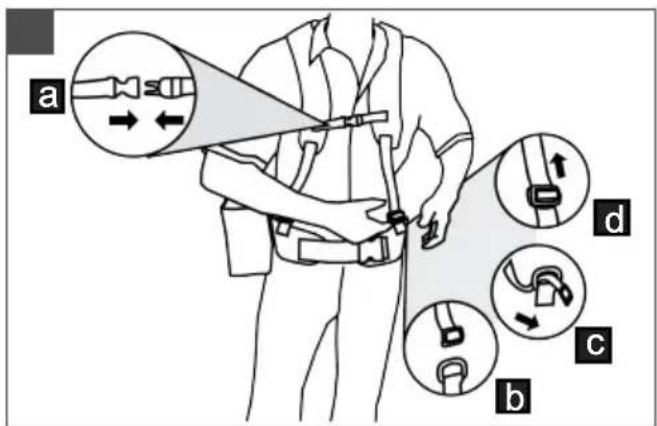
natural_image
Line drawing of a person using a power tool in a forest, with a tree stump nearby (no text or symbols)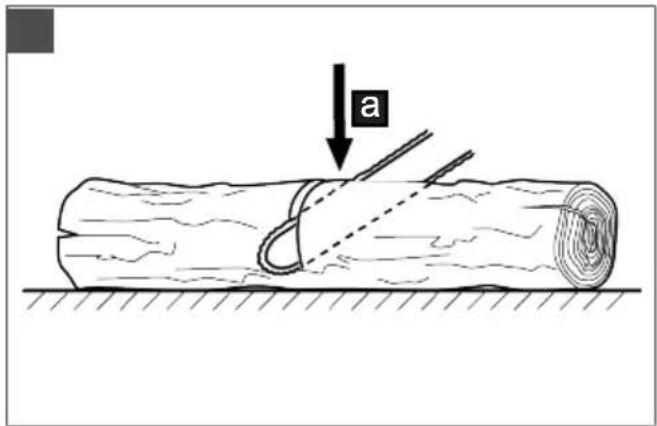
flowchart
graph TD
    A["1"] --> B["3"]
    C["2"] --> D["45°"]
    B --> E["4"]
    D --> F["4"]
    style A fill:#f9f,stroke:#333
    style C fill:#f9f,stroke:#333
    style B fill:#ccf,stroke:#333
    style D fill:#ccf,stroke:#333
    style E fill:#cfc,stroke:#333
    style F fill:#cfc,stroke:#333
Nr. Bauteil
1 Akku-Kettensäge
Nr. Bauteil
2 Führungsschiene
3 Kettenschutz
4 Sägekette
5 Betriebsanleitung
1 About these operating instructions ..... 32
1.1 Symbols on the title page.... 32
1.2 Legends and signal words ...... 32
2 Product description 32
2.1 Designated use 32
2.2 Possible foreseeable misuse .... 33
2.3 Residual risks.... 33
2.4 Safety and protective devices ..... 33
2.4.1 Switch-on protection.... 33
2.4.2 Chain brake/chain brake bracket. 33
2.4.3 Overload protection 33
2.5 Symbols on the appliance 33
2.6 Scope of supply.... 33
2.7 Product overview (01) 34
3 Safety instructions .... 34
3.1 General Power Tool Safety Warnings 34
3.1.1 Work area safety 34
3.1.2 Electrical safety 35
3.1.3 Personal safety.... 35
3.1.4 Power tool use and care.... 35
3.1.5 Battery tool use and care.... 36
3.1.6 Service.... 36
3.2 Chain saw safety warnings ..... 36
3.3 Causes and operator prevention of kickback 37
3.4 Safety notes for rechargeable battery and charger 37
3.5 Safety information when working ..... 37
3.5.1 Operator 37
3.5.2 Operating times 37
3.5.3 Vibration load.... 37
3.5.4 Noise pollution 38
3.5.5 Working with the chain saw ..... 38
4 Installation.... 39
4.1 Installing the guide rail (02, 03) ..... 39
4.2 Installing the saw chain (02, 03)...... 39
4.3 Tightening the saw chain (04, 05) ..... 39
5 Start-up.... 39
5.1 Charging the rechargeable battery (06, 07) 40
5.2 Filling saw chain oil (08) 40
5.3 Function test of the chain brake ..... 40
5.3.1 Testing the chain brake with motor switched off (09) 41
5.3.2 Testing the chain brake with motor switched on (09) 41
6 Operation.... 41
6.1 Check the saw chain oil...... 41
6.2 Putting on the rechargeable battery belt system (10) to (13).... 41
6.3 Inserting/removing the battery (14)..... 41
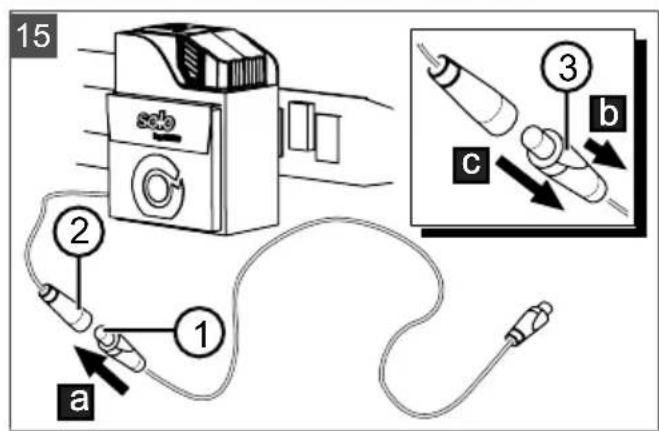
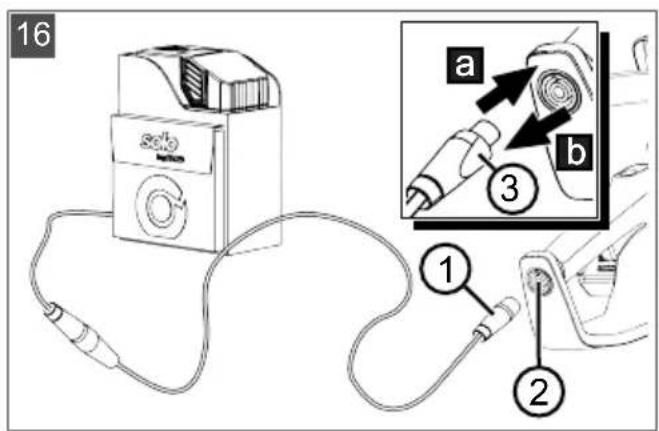
6.4 Connecting the voltage supply (15, 16) 42
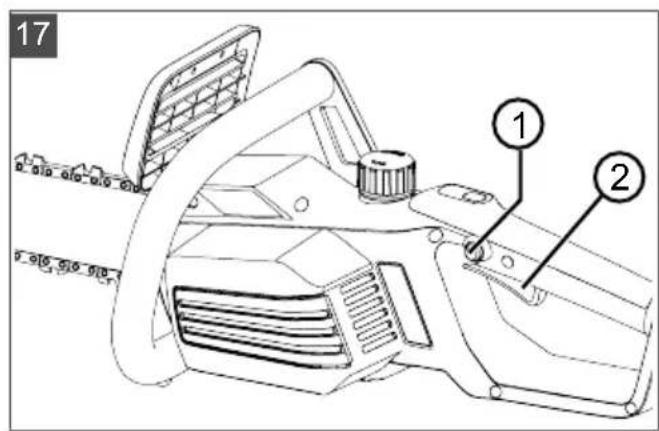
6.5 Switching the motor ON and OFF (17) 42
6.6 Testing the chain brake 42
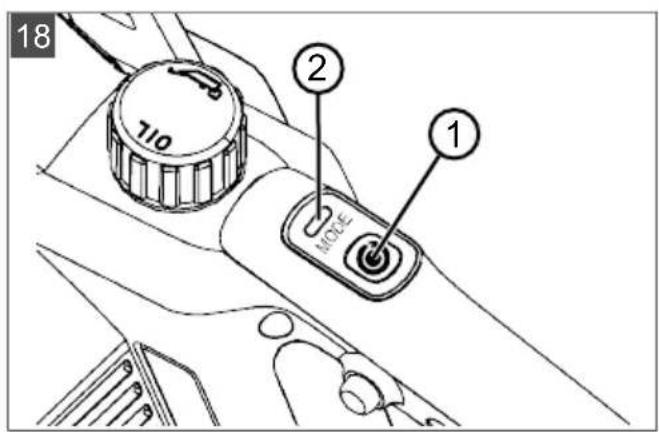
6.7 Increase/decrease speed of saw chain [Eco-Mode/Power-Mode Function] (18) 42
6.8 Checking the charge status of the rechargeable battery, "Motion Detection" (07) 42
7 Working behaviour and working technique.... 43
7.1 Felling trees (19, 20).... 43
7.2 Delimbing (21) 44
7.3 Cross-cutting (22 - 25) 44
7.4 Cutting converted timber 45
8 Maintenance and care.... 45
8.1 Checking the chain tension 45
8.2 Sharpening the saw chain (26)...... 46
8.3 Cleaning the chain sprocket interior ... 46
8.4 Changing over the quick-tension chain wheel (27) 46
8.5 Checking, turning and greasing the guide rail (28, 29).... 46
8.6 Chain maintenance table.... 47
9 Help in case of malfunction...... 47
10 Transport 48
11 Storing the appliance 49
12 Disposal 49
13 Technical data .... 50
14 After-Sales/Service 51
15 Guarantee.... 51
1 ABOUT THESE OPERATING INSTRUCTIONS
The German version is the original operating instructions. All additional language versions are translations of the original operating instructions.
■ Always safeguard these operating instructions so that they can be consulted if you need any information about the appliance.
■ Only pass on the appliance to other persons together with these operating instructions.
■ Comply with the safety and warning information in these operating instructions.
1.1 Symbols on the title page
Symbol Meaning

It is essential to read through these operating instructions carefully before start-up. This is essential for safe working and trouble-free handling.

Operating instructions

Handle Li-Ion rechargeable batteries with care! In particular, observe the notes on transport, storage and disposal in these operating instructions!
1.2 Legends and signal words
⚠️ DANGER! Denotes an imminently dangerous situation which will result in fatal or serious injury if not avoided.
WARNING! Denotes a potentially dangerous situation which can result in fatal or serious injury if not avoided.
CAUTION! Denotes a potentially dangerous situation which can result in minor or moderate injury if not avoided.
IMPORTANT! Denotes a situation which can result in material damage if not avoided.
NOTE Special instructions for ease of understanding and handling.
2 PRODUCT DESCRIPTION
These operating instructions describe a hand-operated electric chain saw that is operated with a rechargeable battery.
2.1 Designated use
The chain saw is exclusively designed for domestic, DIY and gardening applications. In this sector, the chain saw can be used for light wood sawing work, e.g. for:
- Cutting up timber
Pruning hedgerows
■ Sawing firewood
Because of the electrical drive, the rechargeable battery-chain saw can be used not only on open ground but also in closed rooms for sawing wood. Any application not in accordance with the application described here shall be regarded as misuse.
The rechargeable battery-chain must only be used with the following components:
■ Rechargeable battery belt system BTA 42 – Item no. 127442
Lithium-ion rechargeable batteries – Item no. 127390
- Charging unit – C150 Li, Item no. 127391
This trailer is intended solely for use in non-commercial applications. Any other use (as well as unauthorised conversions or add-ons) are regarded as contrary to the intended use and will result in exclusion of the warranty as well as loss of conformity (CE mark); the manufacturer will thus decline any responsibility for damage and/or injury suffered by the user or third parties.
CAUTION! Danger of injury due to non-designated use! If wood or other substances embedded with foreign bodies are sawn with the chain saw, injury can result.
■ Only use the chain saw for light wood sawing work.
■ Before sawing wood, check for foreign bodies, e.g. nails, screws, fittings.
2.2 Possible foreseeable misuse
- Do not saw off any branches that are directly or at an acute angle above the user or other persons.
■ Do not use old oil or mineral oil for lubrication of the saw chain.
■ Do not use the tool in a potentially explosive atmosphere.
2.3 Residual risks
Even when using the appliance as intended, there is always a certain residual risk that cannot be excluded. The following hazards cannot be ruled out due to the nature and design of the appliance.
■ Contact with the exposed teeth of the chain (risk of cutting)
■ Access to the moving chain (risk of cutting)
■ Sudden and unexpected movement of the bar (risk of cutting)
■ Detachment of parts of the chain (risk of cutting/injury)
■ Detachment of parts of the wood being worked on
■ Impairment of hearing during work if ear defenders are not used
2.4 Safety and protective devices
WARNING! Danger of serious injury from manipulated safety and protective devices. As a result of manipulated safety and protective devices, serious injury can occur when working with the chain saw.
■ Never deactivate safety and protective devices.
■ Only work with the chain saw if all safety and protective devices function correctly.
2.4.1 Switch-on protection
If the operator applies the throttle quickly several times in succession, the chain saw switches off for a few seconds to protect the electronics and the saw chain. In this case, wait until the chain saw can be switched on again.
2.4.2 Chain brake/chain brake bracket
The chain saw has a manual chain brake that is triggered by the chain brake bracket, for example if kickback occurs. If the chain brake is tripped, saw chain and motor are stopped immediately.
2.4.3 Overload protection
The chain saw is equipped with an overload protection which switches off in case of overload.
After a cooling-down phase, the chain saw can be switched on again.
2.5 Symbols on the appliance
| Symbol | Meaning |
 | Pay special attention when handling this product. |
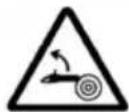 | Danger of kickback! |
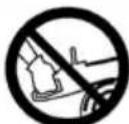 | Do not operate the chain saw with one hand! |
 | Do not use in the rain! Protect against moisture! |
 | Wear a protective helmet, ear defenders and eye protection! |
 | Wear protective gloves! |
 | Wear sturdy shoes! |
 | Read the operating instructions before starting operation. |
 | Always operate the chain saw with both hands! |
2.6 Scope of supply
The battery chain saw trimmer is designed for operation with the PowerFlex lithium ion battery (Art. No. 127390). The charger for PowerFlex
batteries (Art. No. 127391) is required for charging the battery.
IMPORTANT! Danger of damage to the appliance and battery. If the appliance is operated with an unsuitable battery, both the device and the battery may be damaged.
■ Only operate the appliance with the specified rechargeable battery.
NOTE Rechargeable battery, charger and belt are not included in the scope of supply and must therefore be purchased separately.
After unpacking, check that all the parts have been delivered.
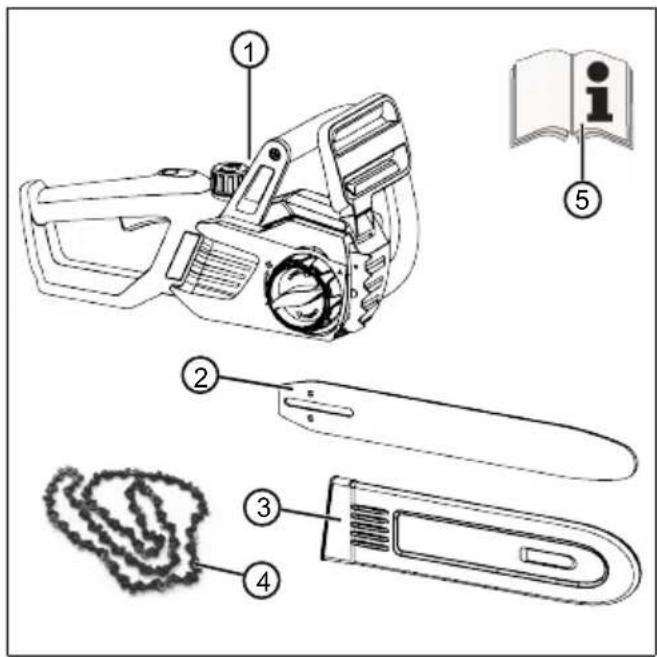
No. Component
| 1 Battery chain saw |
| 2 Chain bar |
| 3 Chain guard |
| 4 Saw chain |
| 5 Operating instructions |
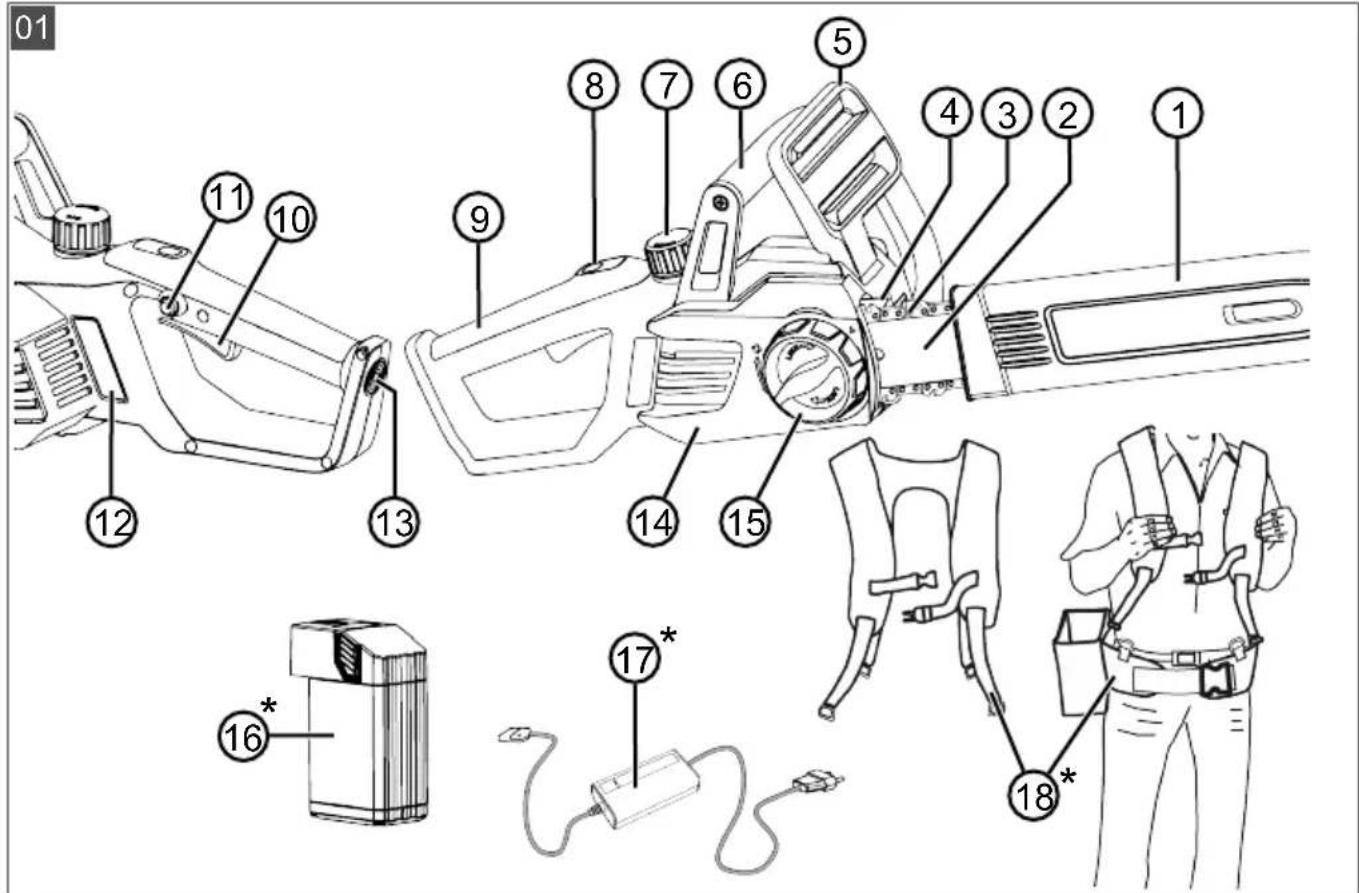
2.7 Product overview (01)
| No. Component |
| 1 Chain guard |
| 2 Chain bar |
| 3 Saw chain |
| 4 Bumper spike |
No. Component
| 5 Chain brake bracket |
| 6 Handle |
| 7 Cap of the chain oil tank |
| 8 Eco Mode / Power Mode control panel |
| 9 Rear handle |
| 10 Throttle lever |
| 11 Throttle lever locking knob |
| 12 Viewing aperture of the chain oil tank |
| 13 Socket for battery connecting cable |
| 14 Cover for chain sprocket |
| 15 Quick-tension chain wheel with central lock and rotating ring |
| 16 Rechargeable battery* |
| 17 Charger* |
| 18 Rechargeable battery belt system with connecting cable* |
*: *Not included in the scope of supply, but can be purchased under the following item numbers:
■ Rechargeable battery belt system BTA 42 – Item no. 127442
■ Lithium-ion rechargeable batteries – Item no. 127390
- Charging unit – C150 Li – Item no. 127391
3 SAFETY INSTRUCTIONS
3.1 General Power Tool Safety Warnings
WARNING! Read all safety warnings and all instructions. Failure to follow the warnings and instructions may result in electric shock, fire and/or serious injury.
■ Save all warnings and instructions for future reference.
The term "power tool" in the warnings refers to your mains-operated (corded) power tool or battery-operated (cordless) power tool.
3.1.1 Work area safety
- Keep work area clean and well lit. Cluttered and dark areas invite accidents.
- Do not operate power tools in explosive atmospheres, such as in the presence of flammable liquids, gases or dust. Power tools create sparks which may ignite the dust or fumes.
- Keep children and bystanders away while operating a power tool. Distractions can cause you to lose control.
3.1.2 Electrical safety
■ Power tool plugs must match the outlet. Never modify the plug in any way. Do not use any adapter plugs with earthed (grounded) power tools. Unmodified plugs and matching outlets will reduce risk of electric shock.
- Avoid body contact with earthed or grounded surfaces such as pipes, radiators, ranges and refrigerators. There is an increased risk of electric shock if your body is earthed or grounded.
- Do not expose power tools to rain or wet conditions. Water entering a power tool will increase the risk of electric shock.
Do not abuse the cord. Never use the cord for carrying, pulling or unplugging the power tool. Keep cord away from heat, oil, sharp edges or moving parts. Damaged or entangled cords increase the risk of electric shock.
- When operating a power tool outdoors, use an extension cord suitable for outdoor use. Use of a cord suitable for outdoor use reduces the risk of electric shock.
If operating a power tools in a damp location is unavoidable, use a residual current device (RCD) protected supply. Use of an RCD reduces the risk of electric shock.
3.1.3 Personal safety
■ Stay alert, watch what you are doing and use common sense when operating a power tool. Do not use a power tool while you are tired or under the influence of drugs, alcohol or medication. A moment of inattention while operating power tools may result in serious personal injury.
Use personal protective equipment. Always wear eye protection. Protective equipment such as a dust mask, non-skid safety shoes, hard hat, or hearing protection used for appropriate conditions will reduce personal injuries.
■ Prevent unintentional starting. Ensure the switch is in the off-position before connecting to power source and/or battery pack, picking up or carrying the tool. Carrying power tools with your finger on the
switch or energizing power tools that have the switch on invites accidents.
■ Remove any adjusting key or wrench before turning the power tool on. A wrench or a key left attached to a rotating part of the power tool may result in personal injury.
- Do not overreach. Keep proper footing and balance at all times. This enables better control of the power tool in unexpected situations.
■ Dress properly. Do not wear loose clothing or jewellery. Keep your hair, clothing and gloves away from moving parts.
Loose clothes, jewellery or long hair can be caught in moving parts.
If devices are provided for the connection of dust extraction and collection facilities, ensure these are connected and properly used. Use of these devices can reduce dust-related hazards.
3.1.4 Power tool use and care
Do not force the power tool. Use the correct power tool for your application. The correct power tool will do the job better and safer at the rate for which it was designed.
■ Do not use the power tool if the switch does not turn it on and off. Any power tool that cannot be controlled with the switch is dangerous and must be repaired.
■ Disconnect the plug from the power source and/or the battery pack from the power tool before making any adjustments, changing accessories, or storing power tools. Such preventive safety measures reduce the risk of starting the power tool accidentally.
■ Store idle power tools out of the reach of children and do not allow persons unfamiliar with the power tool or these instructions to operate the power tool. Power tools are dangerous in the hands of untrained users.
- Maintain power tools. Check for misalignment or binding of moving parts, breakage of parts and any other condition that may affect the power tool's operation. If damaged, have the power tool repaired before use. Many accidents are caused by poorly maintained power tools.
- Keep cutting tools sharp and clean. Properly maintained cutting tools with sharp cut-
ting edges are less likely to bind and are easier to control.
Use the power tool, accessories and tool bits etc. in accordance with these instructions, taking into account the working conditions and the work to be performed. Use of the power tool for operations different from those intended could result in a hazardous situation.
3.1.5 Battery tool use and care
■ Recharge only with the charger specified by the manufacturer. A charter that is suitable for one type of battery pack may create a risk of fire when used with another battery pack.
■ Use power tools only with specifically designated battery packs. Use of any other battery packs may create a risk of injury and fire.
- When battery pack is not in use, keep it away from other metal objects, lie paper-clips, coins, keys, nails, screws or other small metal objects, that can make a connection from one terminal to another. Shorting the battery terminals together may cause burns or a fire.
■ Under abusive conditions, liquid may be ejected from the battery; avoid contact. If contact accidentally occurs, flush with water. If liquid contacts eyes, additionally seek medical help. Liquid ejected form the battery may cause irritation or burns.
3.1.6 Service
■ Have your power tool serviced by a qualified repair person using only identical replacement parts. This will ensure that the safety of the power tool is maintained.
3.2 Chain saw safety warnings
- Keep all parts of the body away from the saw chain when the chain saw is operating. Before you start the chain saw, make sure the saw chain is not contacting anything. A moment of inattention while operating chain saws may cause entanglement of your clothing or body with the saw chain.
■ Always hold the chain saw with your right hand on the rear handle and your left hand on the front handle. Holding the chain saw with a reversed hand configuration increases the risk of personal injury and should never be done.
- Hold the power tool by insulated gripping surfaces only, because the saw chain may contact hidden wiring. Saw chains contacting a "live" wire may make exposed metal parts of the power tool "live" and could give the operator an electric shock.
■ Wear safety glasses and hearing protection. Further protective equipment for head, hands, legs and feet is recommended. Adequate protective clothing will reduce personal injury by flying debris or accidental contact with the saw chain.
- Do not operate a chain saw in a tree. Operation of a chain saw while up in a tree may result in personal injury.
■ Always keep proper footing and operate the chain saw only when standing on fixed, secure and level surface. Slippery or unstable surfaces such as ladders may cause a loss of balance or control of the chain saw.
- When cutting a limb that is under tension be alert for spring back. When the tension in the wood fibres is released the spring loaded limb may strike the operator and/or throw the chain saw out of control.
■ Use extreme caution when cutting brush and saplings. The slender material may catch the saw chain and be whipped toward you or pull you off balance.
- Carry the chain saw by the front handle with the chain saw switched off and away from your body. When transporting or storing the chain saw always fit the guide bar cover. Proper handling of the chain saw will reduce the likelihood of accidental contact with the moving saw chain.
■ Follow instructions for lubricating, chain tensioning and changing accessories. Improperly tensioned or lubricated chain may either break or increase the chance for kick-back.
- Keep handles dry, clean, and free from oil and grease. Greasy, oily handles are slippery causing loss of control.
- Cut wood only. Do not use chain saw for purposes not intended. For example: do not use chain saw for cutting plastic, masonry or non-wood building materials Use of the chain saw for operations different than intended could result in a hazardous situation.
3.3 Causes and operator prevention of kickback
Kickback may occur when the nose or tip of the guide bar touches an object, or when the wood closes in and pinches the saw chain in the cut.
Tip contact in some cases may cause a sudden reverse reaction, kicking the guide bar up and back towards the operator.
Pinching the saw chain along the top of the guide bar may push the guide bar rapidly back towards the operator.
Either of these reactions may cause you to lose control of the saw which could result in serious personal injury. Do not rely exclusively upon the safety devices built into your saw. As a chain saw user, you should take several steps to keep your cutting jobs free from accident or injury.
Kickback is the result of tool misuse and/or incorrect operating procedures or conditions and can be avoided by taking proper precautions as given below:
- Maintain a firm grip, with thumbs and fingers encircling the chain saw handles, with both hands on the saw and position your body and arm to allow you to resist kickback forces. Kickback forces can be controlled by the operator, if proper precautions are taken. Do not let go of the chain saw.
Do not overreach and do not cut above shoulder height. This helps prevent unintended tip contact and enables better control of the chain saw in unexpected situations.
■ Only use replacement bars and chains specified by the manufacturer. Incorrect replacement bars and chains may cause chain breakage and/or kickback.
Follow the manufacturer's sharpening and maintenance instructions for the saw chain. Decreasing the depth gauge height can lead to increased kickback.
3.4 Safety notes for rechargeable battery and charger
Heed the safety instructions for the rechargeable battery and for the charging unit in the separate operating instructions.
See:
■ Operating instructions 442031 Li-Ion rechargeable battery 42 V / 7.5 Ah
■ Operating instructions 442032 Charger LiBC-10s-120W for Li-Ion rechargeable battery 42 V
3.5 Safety information when working
■ Heed the country-specific safety regulations, e.g. from the relevant trade associations, social security systems, authorities for industrial safety.
■ Only work in sufficient daylight or artificial lighting.
- Keep the working area free from objects (e.g. off-cuts) – danger of stumbling.
■ The user is responsible for accidents involving other people and their property.
If you are working with a chain saw for the first time:
- Have the salesperson or another expert explain the operation of the chain saw, or attend a course.
Prior to the first use, at the very least practice cutting round wood on a saw frame or stand.
3.5.1 Operator
■ Young people under 16 years of age and people who do not know the operating instructions are not allowed to use the tool.
To operate the chain saw, you must be rest-ed and in good physical and mental health. If you must not exert yourself for health reasons, ask your doctor whether it is possible to work with a chain saw.
3.5.2 Operating times
Heed the country-specific regulations for the operating times of chain saws. The operating times of chain saws can be limited by national and local regulations.
3.5.3 Vibration load
■ Danger due to vibration
The actual magnitude of the vibration emissions during the use of the appliance may deviate from that stated by the manufacturer.
Observe the following influencing factors before or during use:
Is the appliance being used as intended?
Is the material being cut or processed in the proper manner?
Is the appliance in a proper condition of use?
Is the cutting tool properly sharpened or is the correct cutting tool installed?
Are the handle grips and any optional vibration grips mounted, and are they firmly attached to the appliance?
■ Only operate the tool at the motor speed required for the respective work. Avoid using the maximum speed in order to reduce noise and vibrations.
The noise and vibrations of the tool may increase due to improper use and maintenance. This leads to health damage. In this case, immediately switch off the tool and have it repaired by an authorised service workshop.
The degree of stress due to vibration depends on the work to be performed or on the use of the tool. Estimate the stress and plan appropriate work breaks. This considerably reduces stress due to vibration over the entire working time.
■ Extensive use of the tool exposes the operator to vibrations, which can lead to circulatory issues ("white fingers"). To avoid this risk, wear gloves and keep your hands warm. If any symptoms of "white fingers" occur, immediately consult a physician. These symptoms include: Numbness, loss of feeling, tingling, itching, pain, reduced muscular strength, changes in the colour or condition of the skin. Normally these conditions affect the fingers, hands or pulse. The risk increases at low temperatures.
Take long breaks during your working day so you can recover from the noise and the vibrations. Plan your work in such a way that the use of appliances that generate strong vibrations is spread over several days.
If you notice an unpleasant sensation or discoloration of the skin on your hands when using the tool, stop work immediately. Take sufficient work breaks. Without sufficient breaks, a hand/arm vibration syndrome can occur.
- Minimise your risk of being exposed to vibrations. Maintain the tool according to the instructions in the operating instructions.
If the tool is used frequently, contact your dealer to purchase anti-vibration accessories (e.g. handles).
- Avoid working with the tool at temperatures below 10 °C. Define how the vibration load can be limited in a work plan.
3.5.4 Noise pollution
A certain level of noise exposure from this appliance is inevitable. Carry out noisy work at approved and specified time periods. Observe rest periods as necessary and restrict the duration of the work to a minimum. For your personal protection and protection of persons in the vicinity, appropriate hearing protection must be worn.
3.5.5 Working with the chain saw
WARNING! Danger of serious injury. If an incompletely mounted chain saw is used, serious injury can be caused.
■ Only use the chain saw when it has been fully mounted.
Before each use, perform a visual inspection in order to check that the chain saw is complete and does not contain damaged or worn components. Safety and protective devices must be intact.
WARNING! Risk of injury due to chain saw being started inadvertently. A chain saw that is started inadvertently can lead to serious injury. Therefore, remove the rechargeable battery during:
■ Testing, adjustment work and cleaning work
■ Work on the cutting equipment
■ Leaving the chain saw
Transport
Storage
■ Maintenance and repair work
Danger
■ Never work alone.
■ Always keep a first-aid kit to hand in case of accidents.
- Avoid touching metal objects in the ground or which are conductively connected to the ground.
■ The personal protective equipment comprises:
- Protective helmet
■ Hearing protection (e.g. ear defenders, especially when working for than 2.5 hours a day)
■ Protective glasses or face visor incorporated in the protective helmet
■ Protective trousers with cut protection in-lay
■ Sturdy working gloves
Safety boots with high-grip sole and steel toe caps
- Do not use the chain saw above shoulder height, since safe handling is no longer possible in this way.
■ When changing position, switch off the engine and put on the chain guard.
- When chain saws are not in use, always put on the chain guard and remove the rechargeable battery.
■ Switch the chain saw off before putting it down.
■ Do not use the chain saw for levering or moving wood.
■ Only specialist personnel are allowed to saw trunks that are thicker than the length of the chain bar.
■ Only start the cut once the saw chain is running, never switch on the chain saw already in the kerf.
■ Make sure that no saw chain oil gets onto the ground.
■ Do not undertake sawing work in the rain, snow or stormy weather.
■ Never disable safety and protective devices.
4 INSTALLATION
WARNING! Danger of serious injury. If an incompletely mounted chain saw is used, serious injury can be caused.
■ Only use the chain saw when it has been fully mounted.
■ Before each use, perform a visual inspection in order to check that the chain saw is complete and does not contain damaged or worn components. Safety and protective devices must be intact.
CAUTION! Danger of laceration injuries.
The sharp edges of the saw chain can cause laceration injuries when assembling.
■ Before installation, remove the rechargeable battery.
■ Wear safety gloves when installing the saw chain and the guide rail.
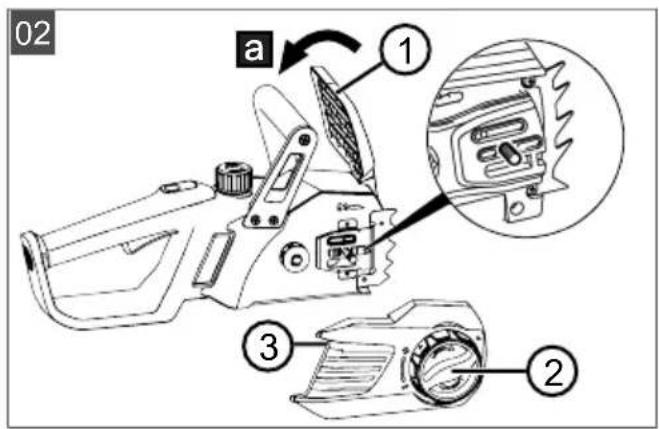
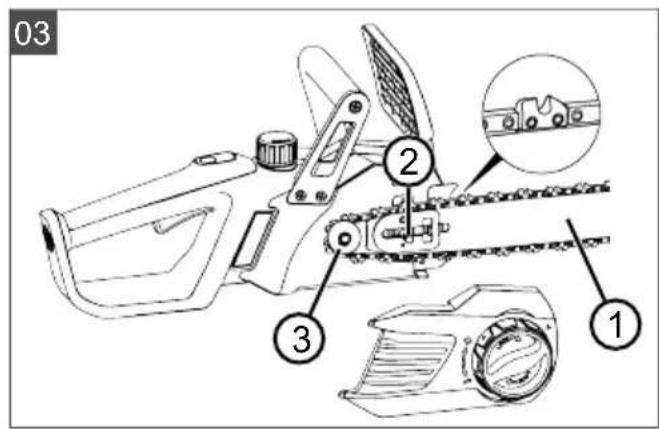
4.1 Installing the guide rail (02, 03)
- Pull chain brake bracket (02/1) in the direction of bow handle (02/A) in order to release the chain brake.
- Turn central lock (02/2) anti clockwise and remove together with cover (02/3).
- Set guide rail (03/1) on guide pin (03/2) and push so far back that the saw chain can be mounted.
4.2 Installing the saw chain (02, 03)
- Place the saw chain on chain sprocket (03/3) and in the groove of guide rail (03/1).
- Guide the saw chain around the reversing sprocket of the guide rail. The saw chain must hang down slightly on the underside of the guide rail.
- Fit cover (02/3) and tighten central lock (02/2) slightly.
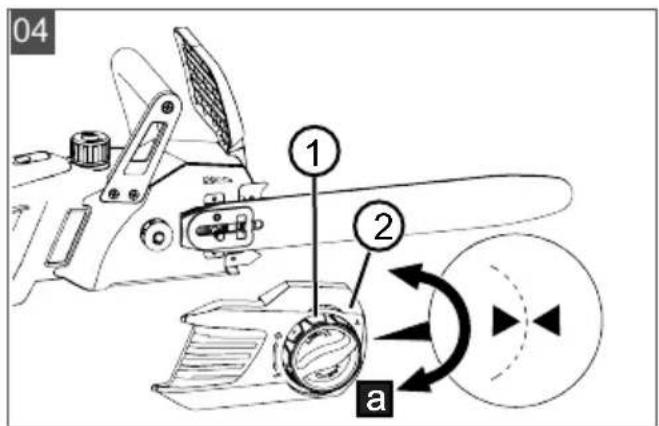
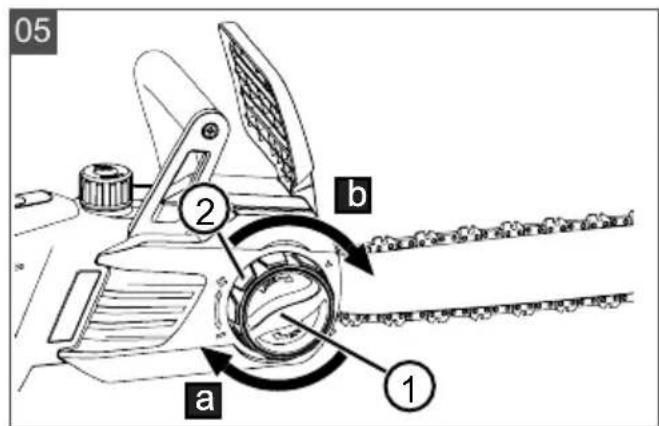
4.3 Tightening the saw chain (04, 05)
NOTE The saw chain has been tensioned correctly when:
It is in contact with the underside of the guide rail and can be pulled through by hand
It can be lifted by 3 – 4 mm in the middle of the guide rail
- Check the seat of the saw chain so that it sits correctly on the chain sprocket and in the guide rail.
- Turn rotating ring (04/1) towards cover (04/2) so that the two triangles are facing one other (04/a).
- Turn central lock (05/1) in clockwise direction (05/a). Do not tighten the central lock fully or turn back by one turn.
- Turn rotating ring (05/2) in clockwise direction until the saw chain has been tensioned correctly as described above (05/b).
- Turn the central lock (05/1) in clockwise direction until it is fixed in place.
5 START-UP
DANGER! Danger of fatal injury and danger of extremely severe injury. Lack of knowledge of the safety instructions and operating instructions can lead to extremely serious and even fatal injury.
- Read and follow all safety instructions and instructions for use in these operating instructions as well the operating instructions which are referred to before you start using the chain saw.
WARNING! Danger of serious injury. Serious injury can be caused if there are damaged components on the chain saw.
Before each use, perform a visual inspection in order to check that the chain saw is complete and does not contain damaged or worn components. Safety and protective devices must be intact.
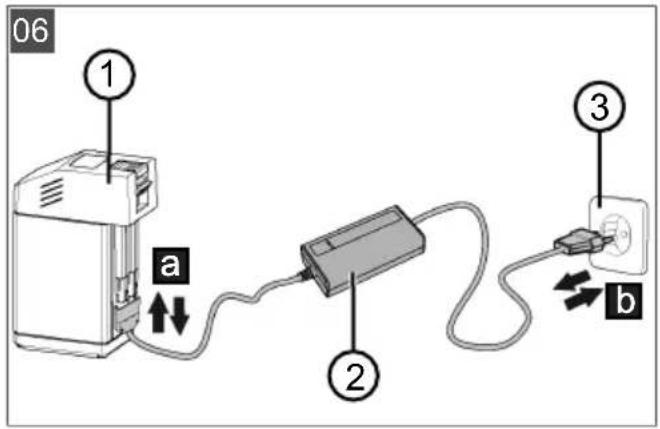
5.1 Charging the rechargeable battery (06, 07)
CAUTION! Danger of fire during
charging! Due to heating of the charger, there is a danger of fire if it is placed on an inflammable surface and is not adequately ventilated.
■ Always use the charger on a non-inflammable surface or in a non-combustible environment.
If available: Keep the ventilation slots free.
NOTE Fully charge the rechargeable battery before using it for the first time. The rechargeable battery can be charged in any charge status. Interrupting charging does not damage the rechargeable battery.
NOTE When charging, the rechargeable battery is protected from overcharging due to automatic detection of the charge status and thus can remain connected to the charging unit for some time, but not permanently.
NOTE Heed the separate operating instructions for the rechargeable battery and for the charging unit.
-
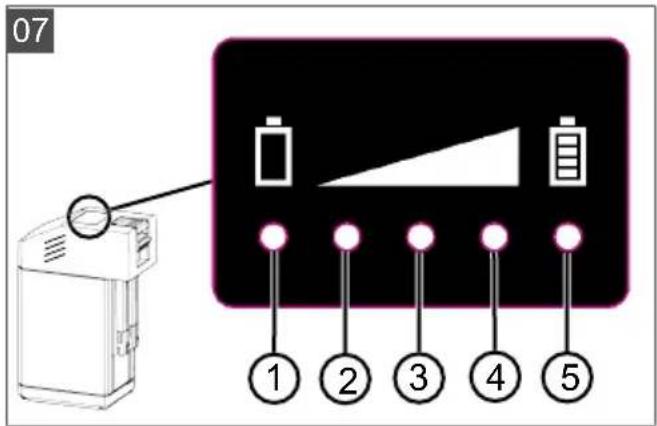
Connect rechargeable battery (06/1) to charger (06/2, 06/a), and charger (06/3, 06/b) to the mains voltage. The charging process begins. The LED on the charging unit lights green, the charge status is displayed on the rechargeable battery.
-
Observe the charge status displays on the rechargeable battery (07). The charging process takes approx. 2.5 hours until fully charged. The charging process ends automatically when the rechargeable battery is fully charged.
-
Disconnect the rechargeable battery from charger (06/a) and the charger from the mains voltage (06/b).
5.2 Filling saw chain oil (08)
IMPORTANT! Danger of damaging the chain saw. The chain saw will be severely damaged if there is too little or even no saw chain oil in the tank or if it has dried/is sticky. Dried/sticky saw chain oil can lead to damage to oil-channelling components and the oil pump. Damage also occurs if used oil is used. The use of used oil leads to environmental damage!
■ For start-up work, fill saw chain oil into the tank.
■ Do not use any used oil!
■ Each time before changing the rechargeable battery at the latest, fill the tank with saw chain oil again.
The saw chain and the guide rail are continuously supplied with oil during operation by means of an automatic oiler system. The saw chain oil protects against corrosion and premature wear.
There must always be sufficient saw chain oil in the tank to lubricate the saw chain sufficiently.
Use only environmentally friendly, biodegradable, high-quality saw chain oil for lubrication of the saw chain and guide rail. This oil must be transported and stored in approved and appropriately labelled containers.
Each time before starting work or changing the rechargeable battery, check the oil level and replenish the saw chain oil if necessary:
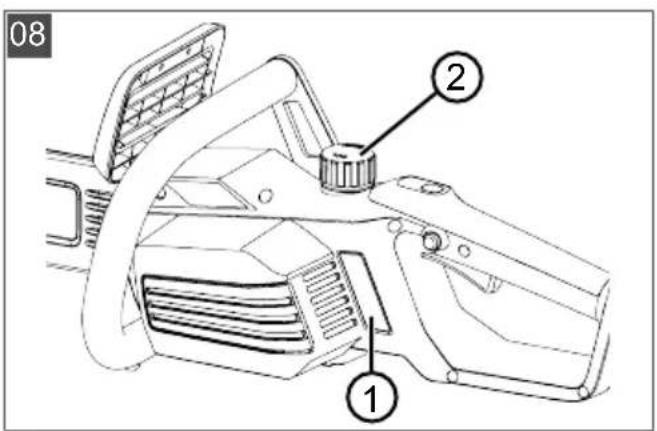
- Check the oil level in the viewing aperture of the tank (08/1). It must always be possible to see oil. The minimum and the maximum oil level must not be exceeded.
- Refill saw chain oil via filler neck (08/2) if necessary.
5.3 Function test of the chain brake
The chain saw has a manual chain brake that is triggered by the chain brake bracket, for example if kickback occurs.
If the chain brake is tripped, saw chain and motor are stopped immediately.
⚠️ DANGER! Danger of fatal injury as a result of negligent handling! Extremely serious injury and even fatal injury can be caused as a result of careless and unexpected movements of the chain saw.
■ Pay attention to safety and work with a high level of concentration when using the chain saw.
- Do not press any switch when releasing the chain brake.
WARNING! Danger of fatal injury and danger of extremely severe injury due to a defective chain brake. Extremely serious injury and even fatal injury of the operator can be caused if the chain brake does not function, e.g. due to kickback by the running saw chain.
- Check the chain brake each time before starting work.
- Do not switch the chain saw on if the chain brake is defective. in this case, have the chain saw checked in a customer service workshop.
5.3.1 Testing the chain brake with motor switched off (09)
- Pull out the rechargeable battery (see chapter 6.3 "Inserting/removing the battery (14)", page 41).
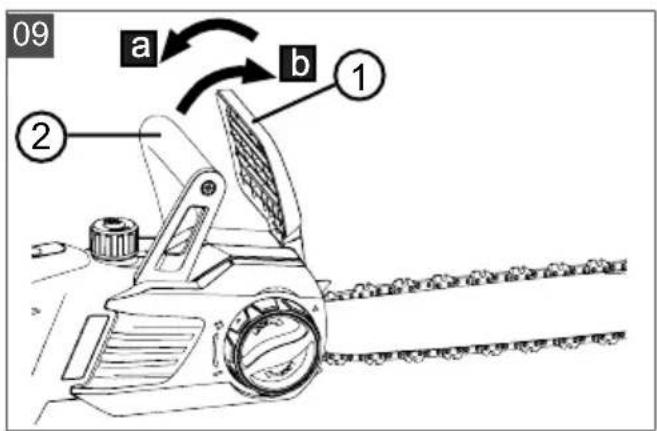
- To release the chain brake, pull chain brake bracket (09/1) in the direction of bow handle (09/2) (09/A). The saw chain can be pulled through by hand.
- Push chain brake bracket (09/1) forwards (09/B) to engage the chain brake. It must not be possible to pull the saw chain through.
5.3.2 Testing the chain brake with motor switched on (09)
i NOTE Release the chain brake each time before switching on the chain saw.
- Hold the chain saw securely and firmly at the bow handle and rear handle.
- Pull chain brake bracket (09/1) in the direction of bow handle (09/2) (09/a) to release the chain brake.
- Switch on the motor.
- Push chain brake bracket (09/1) forwards (09/b). Saw chain and motor must stop immediately.
6 OPERATION
⚠️ DANGER! Danger of fatal injury and danger of extremely severe injury. Lack of knowledge of the safety instructions and operating instructions can lead to extremely serious and even fatal injury.
Read and follow all safety instructions and instructions for use in these operating instructions as well the operating instructions which are referred to before you start using the chain saw.
■ Comply with working time regulations in force in your country.
Grip the rear handle firmly with your right hand and the bow handle with your left hand, and hold them tightly.
■ Do not release the handles as long as the motor is running.
■ Do not use the chain saw if you are:
Tired
Unwell
■ Under the influence of alcohol, medicines and drugs
6.1 Check the saw chain oil
Procedure see chapter 5.2 "Filling saw chain oil (08)", page 40.
IMPORTANT! Danger of damaging the chain saw. The chain saw will be severely damaged if there is too little or even no saw chain oil in the tank or if it has dried/is sticky. Dried/sticky saw chain oil can lead to damage to oil-channelling components and the oil pump. Damage also occurs if used oil is used. The use of used oil leads to environmental damage!
■ Each time before starting work, check that enough saw chain oil is present in the tank.
If the oil level is low, refill saw chain oil.
Do not use any used oil!
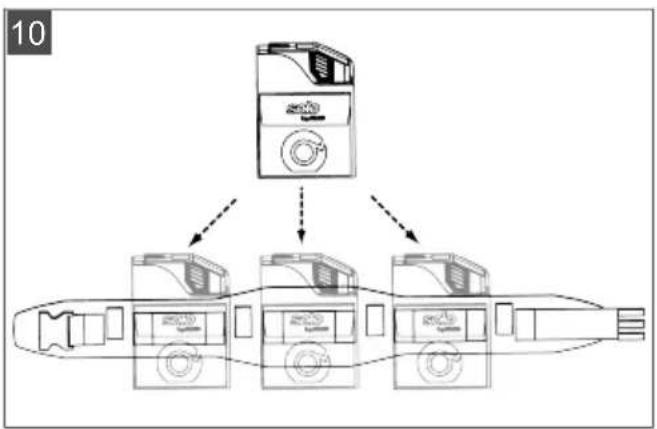
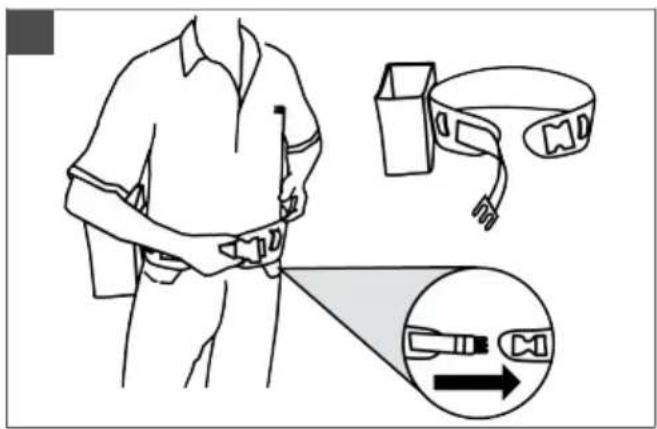
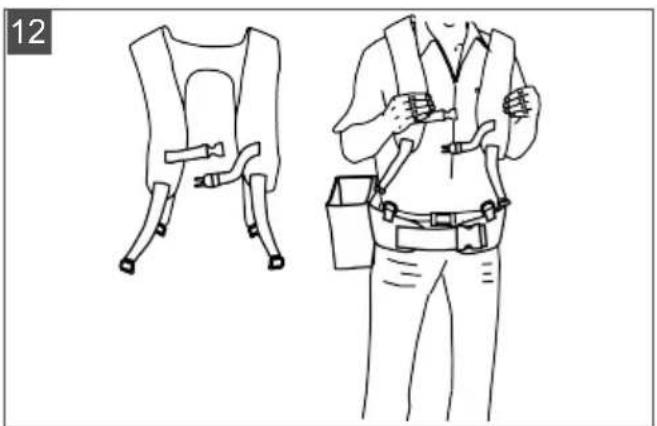
6.2 Putting on the rechargeable battery belt system (10) to (13)
Put on the rechargeable battery belt system as shown in Figures (10) to (13).
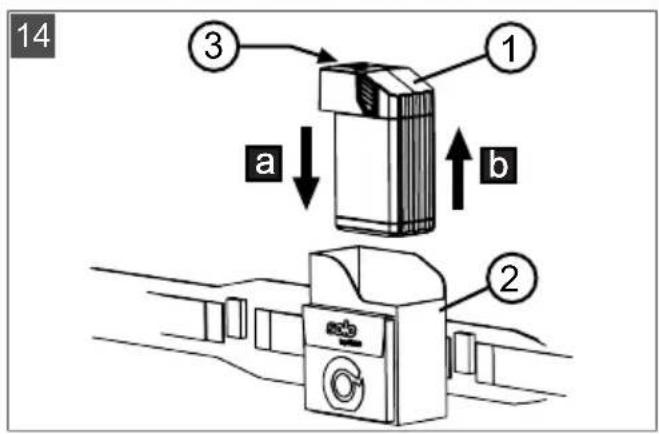
6.3 Inserting/removing the battery (14)
Inserting the battery
- Push in (14/a) the rechargeable battery (14/1) into the rechargeable battery belt system (14/2) until it locks.
Pull out the rechargeable battery
-
Press and hold the unlock button (14/3) on the rechargeable battery (14/1).
-
Pull out (14/b) the rechargeable battery (14/1).
6.4 Connecting the voltage supply (15, 16)
Mounting the connecting cable
- Align the first connector of the connecting cables (15/1) to the guiding pin and guide slot of the rechargeable battery belt system connector (15/2), join, and turn slightly clockwise until the locking and unlocking switch (15/3) audibly engages.
- Align the second connector of connecting cable (16/1) with the guiding pin and guide slot of connection socket (16/2) of the tool, push (16/a) into connection socket (16/2), and turn slightly clockwise until the locking and unlocking switch (16/3) audibly engages.
Dismounting the connecting cable
-
Pull locking and unlocking switch (15/3) backwards (15/b), turn the connector slightly to the left and pull out (15/c).
-
Pull locking and unlocking switch (16/3) backwards, turn the connector slightly to the left and pull out (16/b) of the connection socket of the tool (16/2).
6.5 Switching the motor ON and OFF (17)
CAUTION! Danger of hearing impairment! The operation of the chain saw causes intense noise that can cause hearing impairment.
■ During work with the chain saw, wear ear defenders.
i NOTE Release the chain brake each time before switching on the chain saw.
Switching on the motor:
- Release the chain brake.
- Press and hold locking button (17/1) with your thumb.
- Press and hold throttle lever (17/2).
- Release locking button (17/1). It is not necessary to keep the locking button pressed once the chain saw has started. The locking button is intended to prevent inadvertent starting of the chain saw.
Switching off the motor:
- Release throttle lever (17/2).
6.6 Testing the chain brake
Procedure Function test of the chain brake.
WARNING! Danger of fatal injury and danger of extremely severe injury due to a defective chain brake. Extremely serious injury and even fatal injury of the operator can be caused if the chain brake does not function, e.g. due to kickback by the running saw chain.
- Check the chain brake each time before starting work.
- Do not switch the chain saw on if the chain brake is defective. in this case, have the chain saw checked in a customer service workshop.
6.7 Increase/decrease speed of saw chain [Eco-Mode/Power-Mode Function] (18)
The Eco Mode/Power Mode function allows you to increase or decrease the speed of the saw chain at random. At higher speed (Power Mode), the operating time of the battery is reduced.
- Press button (18/1). LED (18/2) lights up when Power Mode is selected.
- Press button (18/1) again to deactivate Power Mode.
If the tool is switched off and then switched on again, it starts with the previously selected setting.
6.8 Checking the charge status of the rechargeable battery, "Motion Detection" (07)
A charge status indicator is located on the top of the rechargeable battery. This activates automatically for a few seconds if the rechargeable battery is gently shaken.
- Shake the rechargeable battery. The LEDs of the charge status indicator light according to the charge status of the rechargeable battery.
2. To identify the charge status, see:
Charge status displays on the rechargeable battery
LEDs Displays
| Red (07/1) | Lights: Rechargeable battery is completely discharged. |
| ■ Flashes repeatedly 1x: Correctable error, e.g. too high or low temperature. | |
| ■ Flashes repeatedly 2x: Hardware error, e.g. rechargeable battery is defective. | |
| Green (07/2) | Lights: Rechargeable battery is charged to >0 %. |
| Green (07/3) | Lights: Rechargeable battery is charged to >25 %. |
| Green (07/4) | Lights: Rechargeable battery is charged to >50 %. |
| Green (07/5) | Lights: Rechargeable battery is charged to >75 %. |
The green LED for the current charge status flashes during charging. The green LEDs for the low charge states light permanently.
Operating time of the rechargeable battery
If the operating time of the rechargeable battery is reduced in spite of it being fully charged, the rechargeable battery is at the end of its service life and must be replaced by a new original rechargeable battery.
7 WORKING BEHAVIOUR AND WORKING TECHNIQUE
i NOTE Courses in the use of chain saws and techniques for felling trees are regularly held by various forestry organisations.
⚠️ DANGER! Danger of fatal injury due to inadequate technical knowledge! Inadequate technical knowledge can result in extremely serious up to fatal injury!
■ Only trained and experienced people are allowed to fell trees and lop branches.
DANGER! Danger of fatal injury from splintered wood! Wood chips caught up in the chain can cause extremely serious and even fatal injury!
■ Remove loose chips and wood splinters from the part to be sawn.
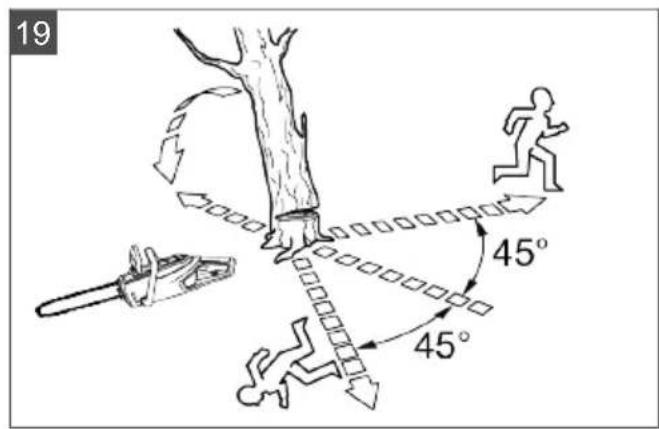
7.1 Felling trees (19, 20)
Observe the following points before and during felling operations:
When felling trees, care must be taken to ensure that other persons are not exposed to danger, that no supply lines are connected and that no damage to property is caused. If a tree comes into contact with a supply line, the utility company must be informed immediately.
Also pay attention to other people's property, animals or objects. These must not be in the danger zone. Immediately notify the owner in case of damage.
■ The safe distance from other workplaces or objects should be at least 212 tree lengths.
■ Judge the falling direction of the tree.
Factors influencing the falling direction of the tree:
Natural lean of the tree
The position of larger branches
Height of the tree
■ Branches growing on one side
Level ground or slope
■ Asymmetrical growth, wood damage
■ Wind direction and wind speed
Snow load
■ When working on a slope, always work uphill of the tree to be felled.
■ Establish your escape route in advance, and make sure that there are no obstacles in the way. The escape route should be at an angle of approx. 45^ backwards from the falling direction (19).
The trunk must be free from growth, branches and foreign bodies (e.g. dirt, stones, loose bark, nails, staples, wire, etc.).
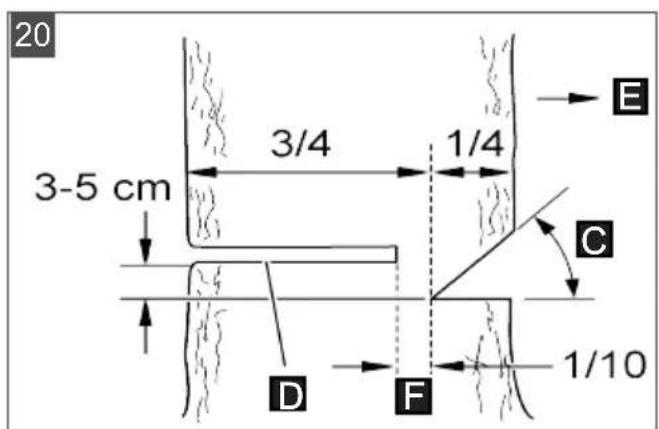
Make two undercuts and one back cut in order to fell a tree.
-
During back cuts and cross-cuts, place the bumper spike firmly against the wood to be cut.
-
Saw the first undercut (20/C) horizontally, then the second undercut at an angle of at least 45^ from above. This prevents the chain saw becoming trapped when you make the second undercut. The undercut must be as close as possible to the ground and in the required felling direction (20/E). The depth of the undercut should be about 1/4 of the diameter of the trunk.
- Cut the back cut (20/D) exactly horizontally opposite to the undercut. The back cut must be made 3-5 cm above the horizontal undercut.
-
Saw in the back cut (20/D) sufficiently deep so that a bridge (20/F) of at least 1/10 the trunk diameter remains between the undercut (20/C) and the back cut (20/D). This bridge prevents the tree from twisting and falling in the wrong direction. The tree should start to fall when the back cut (20/D) approaches the bridge (20/F). Do not saw through the bridge! If the tree falls whilst you are sawing:
-
Interrupt the back cut if the tree does fall in the wrong direction or leans back and traps the chain saw. To open the cut and fell the tree, drive in wedges made of wood, plastic or aluminium in the direction of the required felling line.
-
Immediately pull the chain saw from the cut, switch it off and put it down.
■ Walk away in the direction of the escape route.
■ Watch out for falling branches and twigs. -
If the tree remains standing, drive wedges into the back cut in order to cause it to fall in a controlled way.
Note: Use only wedges made of wood, plastic or aluminium.
- At the end of sawing work, immediately remove your ear defenders and listen out for signals or warning calls.
Only experienced or trained people should make plunge cuts, longitudinal cuts and boring cuts (20).
⚠️ DANGER! Danger of fatal injury from a falling tree! Having no escape route when felling a tree represents a danger of serious and even fatal injury!
- Do not start the felling work until you are sure there is an unobstructed escape route away from the tree to be felled.
⚠️ DANGER! Danger of fatal injury from an uncontrollably falling tree! Uncontrolled falling trees can lead to extremely serious and even fatal injury!
In order to guarantee controlled felling of a tree, leave a bridge between the undercut and the back cut. The length of this bridge should be approx. 1/10 of the trunk diameter.
- Do not carry out any felling work in windy conditions.
7.2 Delimbing (21)
Delimbing is the separation of branches from the felled tree. Observe the following points:
■ Support the chain saw against the tree trunk with the bumper spike during the work.
Leave larger, downward-pointing branches supporting the tree standing at first.
- Cut off smaller branches with one cut.
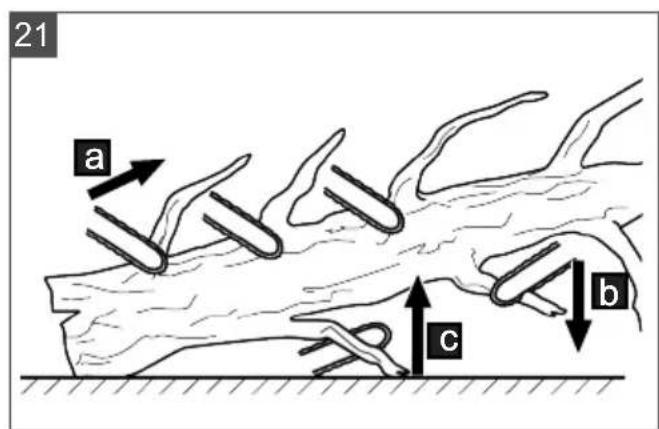
■ Saw off branches systematically and sequentially from the tree (21/a). First, saw off any branches that might hinder you. Then cut off the branches that create tension. Finally saw off the main branch at the base.
■ Saw off free-hanging branches from above (21/b), but not from below.
■ Pay attention to branches under tension, and saw through these from underneath upwards (21/c) in order to avoid the chain saw becoming trapped.
7.3 Cross-cutting (22 - 25)
Cutting to length means dividing the felled tree into sections. Observe the following points:
■ Ensure that your feet are stable and that your body weight is evenly distributed over both feet. If possible, the trunk should be backed
and supported by branches, beams of wedges.
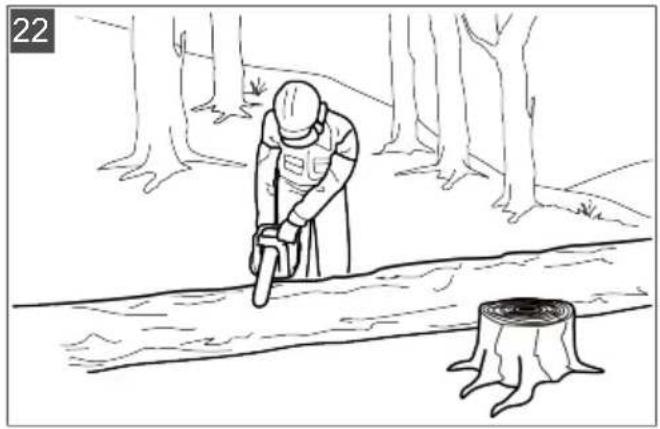
- When working on a slope, always stand uphill from the tree trunk, because it could roll away (22).
- Guide the chain saw so that there is no part of your body in the extended sweep arc of the saw chain.
■ Position the bumper spike directly adjacent to the cut edge and allow the chain saw to pivot about this point. Do not exert any pressure at the end of the cut.
In order to maintain full control of the chain-saw at the moment of sawing, reduce the contact pressure towards the end of the cut
without releasing the tight hold on the chain-saw handles.
■ Make sure that the saw chain does not touch the ground.
At the end of the cut, wait for the saw chain to come to a halt before you remove the chain saw.
■ Always switch off the motor of the chain saw before you go to the next tree.
The entire length of the tree trunk is in contact with the ground:
■ Saw through the tree trunk from above (23/a), without cutting into the ground.
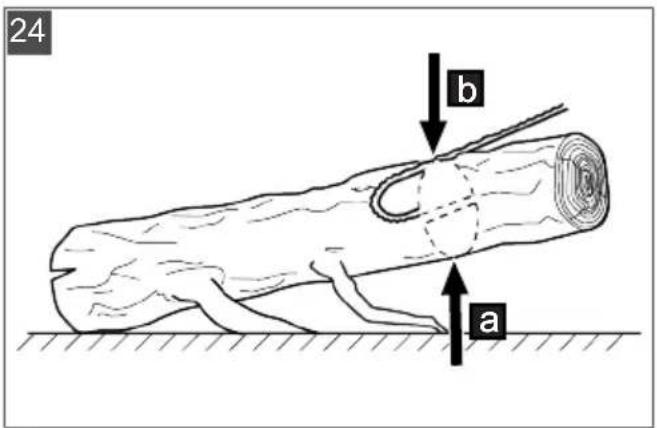
Tree trunk is lying raised at one end:
To prevent the chain saw becoming trapped and the wood splintering, first saw through 1/3 of the trunk diameter from below (24/a), then saw through the remainder from above, down as far as the cut made from underneath (24/b).
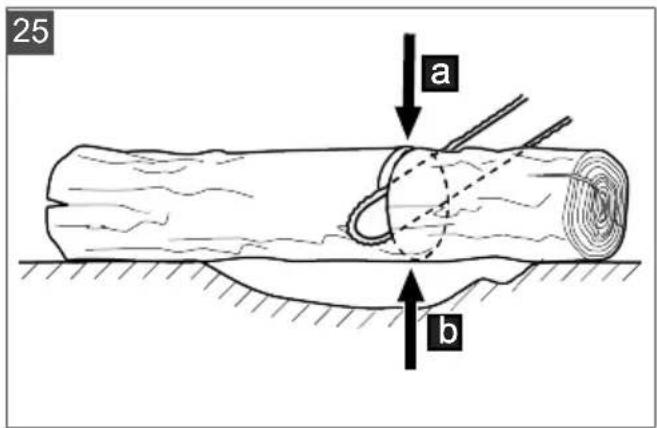
Tree trunk is lying raised at both ends:
To prevent the chain saw becoming trapped and the wood splintering, first saw through 1/3 of the trunk diameter from above (25/a), then saw through the remainder from underneath, up as far as the cut made from above (25/b).
DANGER! Danger of fatal injury due to kickback! The operator can be fatally injured by kickback of the appliance.
It is essential to comply with the measures in order to avoid any kickback.
7.4 Cutting converted timber
Heed the following points during this work:
■ Use a secure cutting surface (sawing trestle, wedges, beams).
■ Make sure you are standing securely and that your bodyweight is evenly distributed.
- Secure logs to prevent them twisting.
■ Only start the cut once the saw chain is running. Never switch on the chain saw already in the kerf.
■ Do not secure the wood with your foot and do not get another person to hold it.
8 MAINTENANCE AND CARE
WARNING! Danger of cuts and lacerations. Danger of cuts and lacerations when reaching into sharp-edged, moving appliance parts and into cutting tools.
■ Before maintenance, care and cleaning work, always switch off the appliance. Remove the rechargeable battery.
■ Always wear protective gloves during maintenance, care and cleaning work.
The chain saw complies with all relevant safety standards. Repairs are only allowed to be performed by qualified specialists, and with the exclusive use of genuine spare parts.
■ After each use, check the chain saw for wear and renew any damaged components.
- Do not get the machine wet or expose it to moisture. Clean plastic parts with a cloth and do not use any cleaning agents or solvents.
■ Clean the cooling air slots if they are blocked.
■ Do not spray the chain saw not with water and do not use a high-pressure cleaner.
■ Only use spare parts specified by the manufacturer.
8.1 Checking the chain tension
Frequently check the chain tension, because new saw chains stretch.
At operating temperature, the saw chain stretches and hangs down.
NOTE The saw chain has been tensioned correctly when:
It is in contact with the underside of the guide rail and can be pulled through by hand
It can be lifted by 3 – 4 mm in the middle of the guide rail
CAUTION! Danger of injury due to the saw chain jumping off! An insufficiently tensioned saw chain can jump off during operation and lead to injury.
■ Frequently check the chain tension. The chain tension is too low if the drive links come out of the groove on the underside of the chain bar.
■ Re-tension the saw chain properly if the chain tension is too low.
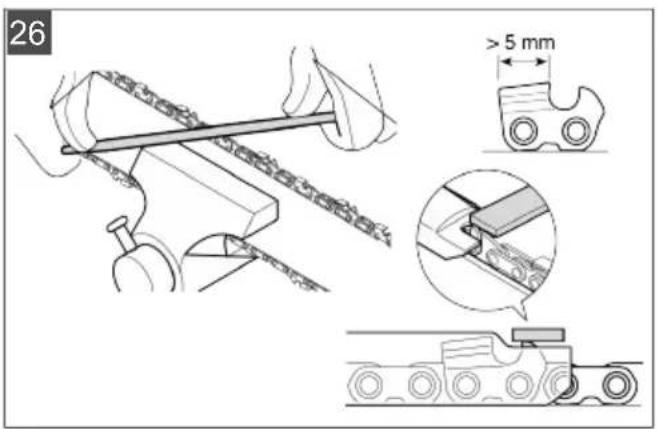
8.2 Sharpening the saw chain (26)
⚠️ DANGER! Danger of fatal injury due to kickback! The operator can be fatally injured by kickback of the chain saw.
■ Sharpen the saw chain properly.
NOTE Inexperienced chain saw operators are recommended to have the saw chain sharpened by a specialist at the customer service.
The saw chain must always be well-sharpened for reasons of safety and efficiency.
Sharpening is required if:
■ The saw chips are like sawdust.
■ Greater force is necessary for cutting.
■ The cut is not straight.
■ Vibration increases.
If you get trained customer service personnel to sharpen the chain for you, they will be able to do this with the appropriate tools for a minimum of material removal and even sharpening of all teeth.
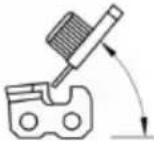
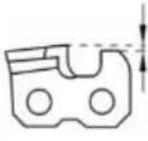
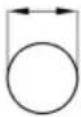
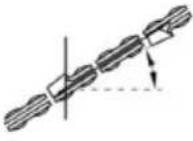
You can sharpen the saw chain yourself using special round files whose diameters are adapted to the specific chain type (see chapter 8.6 "Chain maintenance table", page 47). A certain amount of skill and experience is necessary to avoid damage to the teeth.
To sharpen the saw chain:
- Switch off the chain saw and remove the rechargeable battery.
- Release the chain brake.
- Clamp the guide rail with fitted saw chain in a suitable vice, taking care that the saw chain can move freely.
-
Tension the chain if it is slack.
-
Place the file in the corresponding guide and then guide the file through the opening of the tooth making sure that you keep an even angle according to the tooth profile.
-
Only perform a few strokes of the file and exclusively in the forwards direction, then repeat the working step on all teeth in the same orientation (right or left).
-
Reverse the position of the guide rail in the vice and repeat the working step on the remaining teeth.
-
Check that the limit tooth does not project beyond the checking tool, and file off any projection using a flat file, then round down the profile.
-
After sharpening, clean away all filings and dust, then lubricate the saw chain in an oil bath.
The chain must be renewed if:
■ The length of the teeth is less than 5 mm;
■ Where applicable: The mark on the teeth of the cutting elements is exceeded;
■ The play on the links at the chain rivets is excessive.
8.3 Cleaning the chain sprocket interior
Thoroughly clean the chain saw after each use.
- Remove the rechargeable battery and place the chain saw on a stable base.
- Unbolt the cover of the chain sprocket.
- Clean the inside with a suitable brush.
- Remove the saw chain and take out the guide rail.
- Clean the groove in the rail and the oil inlet bore.
8.4 Changing over the quick-tension chain wheel (27)
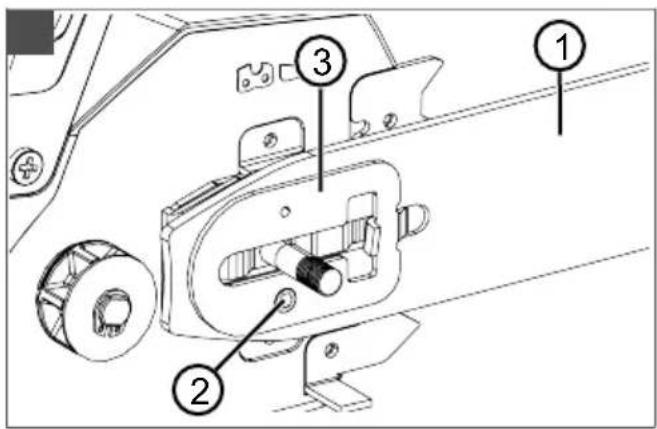
- Remove guide rail (27/1). Remove screw (27/2) and release the adapter sheet metal from the guide rail with the tensioning hook (27/3).
- Turn the guide rail around the longitudinal axis.
- Attach the adapter sheet metal to the guide rail with the tensioning hook again and fix in place with the Phillips screw again.
- Install the guide rail again, see chapter 4.1 "Installing the guide rail (02, 03)", page 39.
8.5 Checking, turning and greasing the guide rail (28, 29)
Checking the guide rail
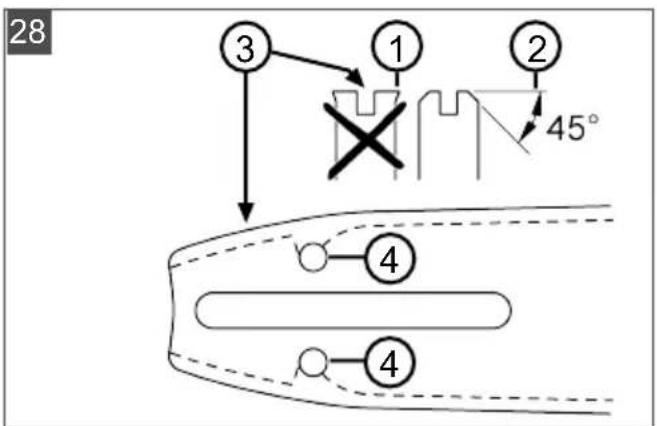
Regularly check the guide rail for damage. If necessary, remove protruding burrs (28/1), i.e. file off at an angle of 45^ (28/2).
Turning the guide rail
The guide rail must be turned over after each chain sharpening and chain change in order to avoid one-sided wear.
- Change over the quick-tension chain wheel on the guide rail, see chapter 8.4 "Changing over the quick-tension chain wheel (27)", page 46.
- Turn the guide rail.
Greasing the guide rail
- Carefully clean groove in rail (28/3) and oil inlet bores (28/4).
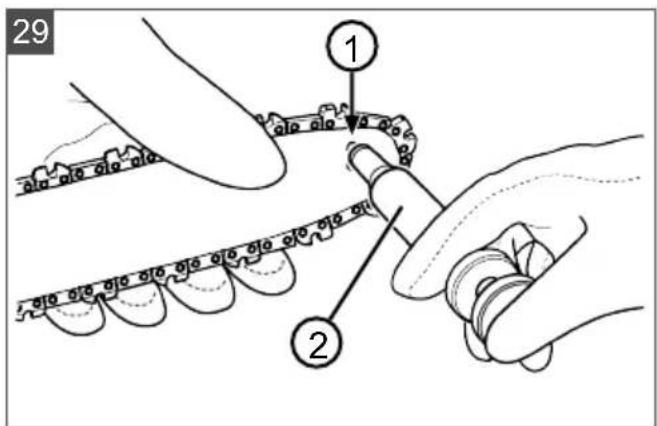
- Carefully clean lubricating hole (29/1) from both sides.
- Use a grease gun (29/2) to pump in sufficient grease on both sides until the grease emerg-
es evenly at the tips of the sprocket. Keep turning the sprocket when doing this.
8.6 Chain maintenance table
WARNING! Danger of serious injury. Use of an unapproved saw chain or guide rail on the chain saw can result in serious injuries.
■ Use only approved saw chains and guide rails.
| Saw chain (guide rail) | File diameter Top plate an-gle | Down angle Head tilt angle (55°) | Depth gauge set-ting | ||
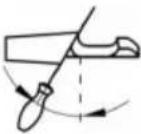 | 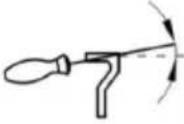 |  |  | ||
 | Rotational an-gle of the tool | Inclination an-gle of the tool | Side plate angle | ||
 | 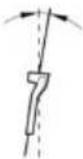 | 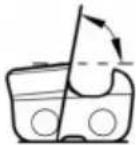 | |||
| 90PX040X (104MLEA041) | 4.5 mm 30° 0° 75° 0.025" | ||||
| 91P045X (120SDEA041) | 5/32" 30° 0° 85° 0.025" | ||||
| 91PX052X (140SDEA041) | 5/32" 30° 0° 85° 0.025" | ||||
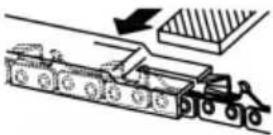 Depth gauge setting File Depth gauge setting File | 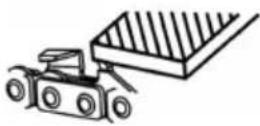 | ||||
9 HELP IN CASE OF MALFUNCTION
CAUTION! Risk of injury. Sharp-edged and moving appliance parts can lead to injury.
■ Always wear protective gloves during maintenance, care and cleaning work.
■ Switch off the appliance and remove the rechargeable battery.
NOTE For malfunctions that are not listed in this table or that you cannot resolve yourself, please contact our customer service.
| Malfunction Cause Remedy | ||
| Engine does not start. No battery voltage present. Have the power supply checked by a qualified electrician. | ||
| Overload protection has switched off. | Wart until the overload protection re-establishes the power supply. | |
| Chain brake engaged. Release the chain brake. | ||
| The chain bar and saw chain become hot when running. Generation of smoke. | The saw chain is tensioned too tightly. | Reduce chain tension. |
| Oil tank is empty. Replenish the saw chain oil. Check the oil tank for damage. | ||
| The oil entry hole and/or groove of the chain bar are dirty. | Clean the oil entry hole and groove of the chain bar. | |
| Engine running, but the saw chain does not move. | The saw chain is tensioned too tightly. | Reduce chain tension. |
| Appliance errors Contact a service centre of the manufacturer. | ||
| Only sawdust is thrown out, rather than wood chips. The chain saw has to be pushed through the wood. | The saw chain is blunt. Sharpen the saw chain or contact one of the manufacturer's service centres. | |
| Appliance vibrates unusually. | Appliance errors Contact a service centre of the manufacturer. | |
10 TRANSPORT
WARNING! Danger of fatal injury and danger of extremely severe injury. During transport, a running saw chain can lead to extremely serious and even fatal injury.
■ Never carry and transport the chain saw with the saw chain running.
■ Before transporting, carry out the measures mentioned above.
Before transporting, carry out the following measures:
- Switch off the chain saw and remove the rechargeable battery.
- Fit the chain guard.
- Carry the chain saw only at the bow handle. Guide rail and saw chain should be facing to the rear.
- In vehicles: Secure the chain saw against tipping over, damage and leakage of chain oil.
i NOTE The nominal energy of the rechargeable battery is more than 100 Wh. Therefore, observe the following transport instructions.
The li-ion rechargeable battery contained in the appliance is subject to the hazardous goods law, but can be transported under simplified conditions:
The rechargeable battery can be transported on public roads by the private user without further conditions provided it is packaged for retail sale and the transport serves personal purposes.
■ Commercial users who carry out the transport in connection with their main activity (e.g. delivery from and to building sites, or demonstrations) can also take advantage of this simplification.
In both cases, it is essential to take the mandatory precautions mentioned above to prevent any leakage of the contents. In other cases, it is essential to comply with the regulations of the hazardous goods law. In the case of non-compli-
ance, severe penalties can be imposed on the sender and possibly the transporter.
Additional notes on transport and shipment
■ Only transport or send the li-ion rechargeable battery in an undamaged condition.
For transporting the rechargeable battery, only use the original cardboard box or a suitable hazardous goods cardboard box (not required for rechargeable batteries with a nominal energy less than 100 Wh).
■ Tape off exposed rechargeable battery contacts to avoid a short circuit.
- Secure the rechargeable battery against shifting in the packaging to avoid damage to the rechargeable battery.
■ Ensure the correct marking and documentation of the shipment for transport or shipping (e.g. by parcel service or freight forwarding).
- Check in advance that transport with the selected service provider is possible and indicate the shipment.
We recommend involving a hazardous goods specialist in preparation of the shipment. Also heed any further national regulations.
11 STORING THE APPLIANCE
■ Remove the rechargeable battery from the appliance after every use.
■ Thoroughly clean the appliance and – if present – attach all covers.
■ Store the appliance in a dry, lockable place out of the reach of children.
Carry out the following jobs before intervals in work lasting for longer than 30 days:
■ Empty the oil tank for the saw chain oil.
■ Remove the saw chain and chain bar, clean and spray with corrosion protection oil.
IMPORTANT! Danger of damage to the appliance. Dried/sticky saw chain oil can lead to damage to oil-channelling components or the oil pump after lengthy storage.
■ Remove the saw chain oil from the chain saw before each extended period of storage.
12 DISPOSAL
Information on the German Electrical and Electronic Equipment Act (ElectroG)

■ Electrical and electronic appliances do not belong in household waste, but should be collected and disposed of separately.
■ Used batteries or rechargeable batteries that are not installed permanently in the old appliance must be removed before disposal. Their disposal is regulated by the battery law.
- Owners or users of electrical and electronic appliances are obliged by law to return them after use.
■ The end user bears personal responsibility for deleting his personal data from the old appliance to be disposed of.
The symbol of the crossed-through rubbish bin means that electrical and electronic appliances may not be disposed of in the household rubbish.
Electrical and electronic appliances can be handed in at the following places at no charge:
■ Public service disposal or collection points (e.g. municipal building yards)
■ Points of sale of electrical appliances (stationary and online) provided traders are obliged to take them back or offer this voluntarily.
These statements only apply to appliances that are installed and sold in the countries of the European Union and are subject to European Directive 2012/19/EU. Different provisions may apply to the disposal of electrical and electronic appliances in countries outside the European Union.
Information on the German Battery Act (BattG)

■ Used batteries and rechargeable batteries do not belong in household waste, but should be collected and disposed of separately.
For safe removal of batteries or rechargeable batteries from the electrical appliance and for information on their type or chemical system, follow the further information within the operating or installation instructions.
Owners or users of batteries and rechargeable batteries are obliged by law to return them after use. Return is limited to the handover of customary household quantities.
Used batteries can contain harmful substances or heavy metals that can cause damage to the environment and human health. Reuse of the used batteries and use of the resources contained therein contributes to the protection of these two essential commodities.
The symbol of the crossed-through rubbish bin means that batteries and rechargeable batteries may not be disposed of in household rubbish.
In addition, if the symbol Hg, Cd or Pb appears under the rubbish bin, this stands for the following:
■ Hg: Battery contains more than 0.0005 % mercury
Cd: Battery contains more than 0.002 % cadmium
■ Pb: Battery contains more than 0.004 % lead
Rechargeable batteries and batteries can be handed in at the following places at no charge:
■ Public service disposal or collection points (e.g. municipal building yards)
■ Points of sale of batteries and rechargeable batteries
■ Disposal points of the common take-back system for the used batteries of appliances
■ Disposal point of the manufacturer (if not a member of the common take-back system)
These statements apply only to rechargeable batteries and batteries that are sold in the countries of the European Union and that are subject to European Directive 2006/66/EU. Different provisions can apply to the disposal of rechargeable batteries and batteries in countries outside the European Union.
13 TECHNICAL DATA
| Chain saw CS 4235 | |
| Item no. 113616 | |
| Idling speed 15 – 20 m/s | |
| Operating speed 7 – 20 m/s | |
| Chain sprocket pitch 3/8” | |
| Chain brake Yes (electrical, PCB and | brake rod) |
| Chain run-on time (DIN EN 60745-2-13 – 19.107) Max. 0.15 s | |
| Chain run-on time (DIN EN 50144-2-13:2001 – 18.104) Max. 2 s | |
| Activation of the chain Twofold | |
| Chain oil tank volume 250 ml | |
| Weight with guide rail and saw chain 3.80 kg | |
| Weight without guide rail and saw chain 3.15 kg | |
| Overload protection No | |
| Sound power level LwA (DIN EN ISO 3744) 108 dB(A) | |
| Sound pressure level LpA | 88 dB(A)K = 3.0 dB(A) |
| Vibration value (DIN EN 28662-1)* | 2.5 m/s2K = 1.5 m/s2 |
| Saw chain | 90PX040X | 91PX045X | 91PX052X |
| Drive link thickness | 1.1 mm | 1.27 mm | 1.27 mm |
| Chain bar 104MLEA041 120SDEA041 140SDEA041 | ||
| Length of the guide rail 10" / 25 cm 12" / 30 cm 14" / 35 cm | ||
| Cutting length 17 cm 22 cm 27 cm |
\* Notes:
The vibration emission value given has been measured according to a standardised test method and can be used to compare one power tool with another.
The vibration emission value can also be used for an initial assessment of the exposure (vibration exposure degree).
The vibration emission value may differ from the given value during actual use of the pow-
er tool, depending on how the power tool is used.
Try to keep the vibration load as low as possible. Exemplary measures to reduce vibration are the wearing of gloves when using the tool and the limitation of working time. All parts of the operating cycle must be taken into account (e.g. times when the power tool is switched off and those in which it is switched on but runs without load).
| Battery 127390 | |
| Rated voltage 36 V / 42 V max. | |
| Rated capacity 7.5 Ah | |
| Charging duration Approx. 150 min |
| Charging unit 127391 | |
| Mains voltage 230 V (AC) | |
| Mains frequency 50 Hz | |
| Output voltage 42 V (DC) | |
| Operating temperature range 0 °C – +40°C |
14 AFTER-SALES/SERVICE
In the event of questions of warranty, repair or spare parts, please contact your nearest AL-
KO Service Centre. These can be found on the Internet at: www.al-ko.com/service-contacts
15 GUARANTEE
We will resolve any material or manufacturing faults on the appliance during the legal warranty period for claims relating to faults, in accordance with our choice either to repair or replace. The legal warranty period is determined by the legislation of the country in which the appliance was purchased.
Our warranty promise applies only if:
■ These operating instructions are heeded
■ The appliance is handled correctly
■ Original spare parts have been used
The warranty becomes void in the case of:
■ Unauthorised repair attempts
■ Unauthorised technical modifications
Non-intended use
The guarantee excludes:
■ Paint damage that can be attributed to normal wear and tear
■ Wear parts that are marked with a frame xxxxxx (x) on the spare parts card
The guarantee period commences with purchase by the first end user. The date on the proof of purchase is decisive. In the event of a guarantee claim, please take this guarantee declaration and the original proof of purchase, and contact your dealer or the nearest authorised customer service centre. This statement does not affect the purchaser's statutory claims for defects against the vendor.
VERTALING VAN DE ORIGINELE GEBRUIKERSHANDLEIDING
Inhoudsopgave
2 PRODUCTOMSCHRIJVING
Nr. Component
N° Pièce
N.° Componente
N. Componente
1 Batteria motosega
N. Componente
2 Barra di guida
3 Protezione catena
4 Catena tagliente
Št. Sestavni del
1 Akumulatorska verižna žaga
2 Meč
3 Ščitnik verige
4 Veriga
14 SERVISNA SLUŽBA/SERVIS
www.al-ko.com/service-contacts
15 GARANCIJA
Br. Dio
1 Akumulatorska lančana pila
2 Vodilica
3 Zaštita lanca
4 Lanac pile
5 Upute za uporabu
2.7 Pregled proizvoda (01)
Br. Dio
1 Zaštita lanca
2 Vodilica
3 Lanac pile
4 Šiljati graničnik
5 Stega kočnice lanca
Br. Dio
6 Rukohvat
7 Zatvarač spremnika ulja za lanac
8 Upravljačka ploča za ekološki način rada / električni način rada
9 Stražnja ručka
10 Poluga za gas
11 Zaporni gumb za polugu gasa
12 Kontrolni prozorčić spremnika ulja za lanac
www.al-ko.com/service-contacts
15 JAMSTVO
Možebitne greške u materijalu ili proizvodnji na uređaju uklonit ćemo tijekom zakonskoga roka zastare za jamstvo na nedostatke prema vlastitom izboru popravljanjem ili zamjenskom dostavom. Rok zastare određuje se prema pravu države u kojoj je uređaj kupljen.
Nr elementu
Č. Součást
www.al-ko.com/service-contacts
15 ZÁRUKA
www.al-ko.com/service-contacts
15 ZÁRUKA
Sz. Alkatrész
- A gázkart (17/2) engedje el.
Nr. Komponent
Nr. Komponent
| 1 Batteridriven kedjesåg |
| 2 Styrskena |
| 3 Kedjeskydd |
| 4 Sågkedja |
| 5 Bruksanvisning |
5 Igangsetting....321
5.1 Lade batteriet (06, 07) ......321
14 Kundeservice/service.... 332
15 Garanti 332
1 OM DENNE BRUKSANVISNINGEN
Nr. Komponent
7 ARBEIDSFREMTREDEN OG ARBEIDSTEKNIKK
8 VEDLIKEHOLD OG PLEIE
www.al-ko.com/service-contacts
15 GARANTI
Nro Osa
www.al-ko.com/service-contacts
15 TAKUU JA TUOTEVASTUU
Nr. Detala
1 Akumulatora kēdes zāğis
2 Vadsliede
3 Kēdes aizsargs
4 Zāga kēde
5 Lietošanas instrukcija
www.al-ko.com/service-contacts
15 GARANTIJA
www.al-ko.com/service-contacts
15 GARANTIJA
Ho- мер
компонента
www.al-ko.com/service-contacts
15 ГАРАНТИЯ
Imported by: AL-KO Gardentech UK Ltd, Murray way, Wincanton, Somerset, BA9 9RS / UK | +44 (0) 1963
828055
shop.uk@al-ko.com | www.alko-garden.uk
AL-KO Service: www.al-ko.com/service-contacts



- Inhaltsverzeichnis
- Nr. Bauteil
- ABOUT THESE OPERATING INSTRUCTIONS
- Symbols on the title page
- Symbol Meaning
- Legends and signal words
- PRODUCT DESCRIPTION
- Designated use
- Possible foreseeable misuse
- Residual risks
- Safety and protective devices
- Switch-on protection
- Chain brake/chain brake bracket
- Overload protection
- Symbols on the appliance
- Scope of supply
- Product overview (01)
- SAFETY INSTRUCTIONS
- General Power Tool Safety Warnings
- Work area safety
- Electrical safety
- Personal safety
- Power tool use and care
- Battery tool use and care
- Service
- Chain saw safety warnings
- Causes and operator prevention of kickback
- Safety notes for rechargeable battery and charger
- Safety information when working
- Operator
- Operating times
- Vibration load
- ■ Danger due to vibration
- Noise pollution
- Working with the chain saw
- INSTALLATION
- Installing the guide rail (02, 03)
- Installing the saw chain (02, 03)
- Tightening the saw chain (04, 05)
- START-UP
- Charging the rechargeable battery (06, 07)
- CAUTION! Danger of fire during
- Filling saw chain oil (08)
- Function test of the chain brake
- Testing the chain brake with motor switched off (09)
- Testing the chain brake with motor switched on (09)
- OPERATION
- Check the saw chain oil
- Putting on the rechargeable battery belt system (10) to (13)
- Inserting/removing the battery (14)
- Inserting the battery
- Pull out the rechargeable battery
- Connecting the voltage supply (15, 16)
- Mounting the connecting cable
- Dismounting the connecting cable
- Switching the motor ON and OFF (17)
- Testing the chain brake
- Increase/decrease speed of saw chain [Eco-Mode/Power-Mode Function] (18)
- Checking the charge status of the rechargeable battery, "Motion Detection" (07)
- To identify the charge status, see:
- Charge status displays on the rechargeable battery
- Operating time of the rechargeable battery
- WORKING BEHAVIOUR AND WORKING TECHNIQUE
- Felling trees (19, 20)
- Delimbing (21)
- Cross-cutting (22 - 25)
- Cutting converted timber
- MAINTENANCE AND CARE
- Checking the chain tension
- Sharpening the saw chain (26)
- Cleaning the chain sprocket interior
- Changing over the quick-tension chain wheel (27)
- Checking, turning and greasing the guide rail (28, 29)
- Checking the guide rail
- Turning the guide rail
- Greasing the guide rail
- Chain maintenance table
- HELP IN CASE OF MALFUNCTION
- TRANSPORT
- Additional notes on transport and shipment
- STORING THE APPLIANCE
- DISPOSAL
- Information on the German Electrical and Electronic Equipment Act (ElectroG)
- Information on the German Battery Act (BattG)
- \* Notes:
- AFTER-SALES/SERVICE
- GUARANTEE
- VERTALING VAN DE ORIGINELE GEBRUIKERSHANDLEIDING
- Inhoudsopgave
- PRODUCTOMSCHRIJVING
- Nr. Component
- N° Pièce
- N.° Componente
- Componente
- Št. Sestavni del
- SERVISNA SLUŽBA/SERVIS
- GARANCIJA
- Br. Dio
- Pregled proizvoda (01)
- JAMSTVO
- Č. Součást
- ZÁRUKA
- Sz. Alkatrész
- OM DENNE BRUKSANVISNINGEN
- ARBEIDSFREMTREDEN OG ARBEIDSTEKNIKK
- VEDLIKEHOLD OG PLEIE
- GARANTI
- TAKUU JA TUOTEVASTUU
- Nr. Detala
- GARANTIJA
- Ho- мер
- компонента
- ГАРАНТИЯ
Brand : AL-KO
Model : B200 Li
Category : Saw