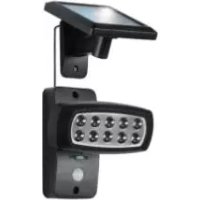
IAN 109613 - Lighting Livarno Lux - Free user manual and instructions
Find the device manual for free IAN 109613 Livarno Lux in PDF.

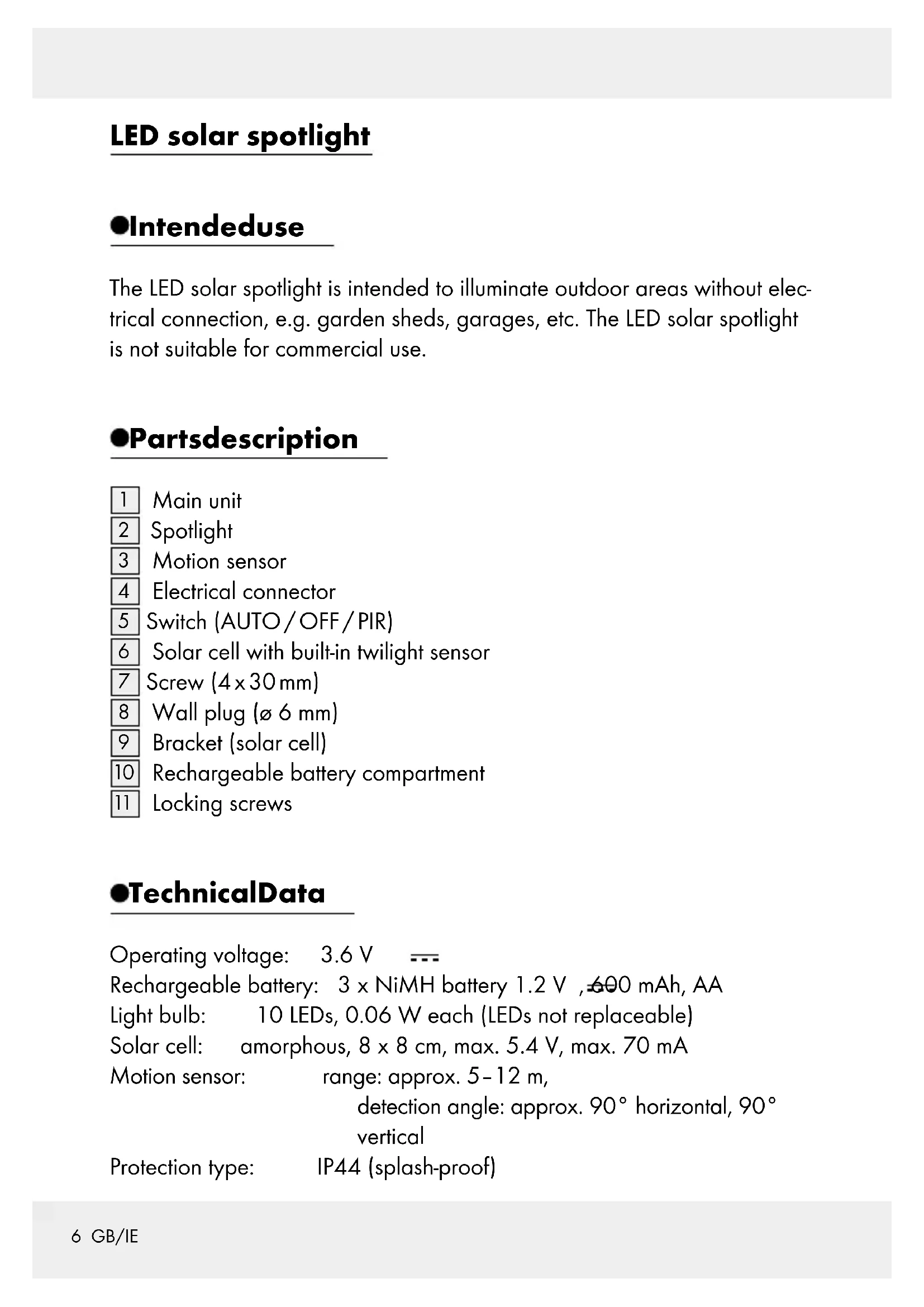


| Brand | Livarno Lux |
| Model | IAN 109613 |
| Product type | Solar LED projector |
| Power supply | 3 rechargeable NiMH AA batteries (1.2 V, 600 mAh) |
| Operating voltage | 3.6 V |
| Solar cell | Amorphous, 8 × 8 cm, max. 5.4 V, max. 70 mA |
| Number of LEDs | 10 LEDs of 0.06 W each (non-replaceable) |
| Motion detector | Range: approx. 5-12 m, detection angle: 90° horizontal and 90° vertical |
| Protection type | IP44 (splash-proof) |
| Switch functions | OFF (charge only), AUTO (dusk to dawn lighting, reduced power ~25%), PIR (light on motion detection, full power) |
| Autonomy in AUTO mode | Approximately 8 hours (fully charged batteries) |
| Autonomy in PIR mode | Approximately 2 hours total (cycles of 1.5 min per detection) |
| Package contents | Main unit with projector, detector and integrated batteries, solar cell with 2.5 m cable, 4 screws (4×30 mm), 4 wall plugs (Ø6 mm), manual |
| Recommended mounting height | 1.80 m - 2.00 m (for motion detector) |
| Optimal solar cell orientation | Facing south, without shade |
| Replaceable batteries | Yes, by 3 NiMH AA batteries |
| Replaceable LEDs | No |
| Warranty | 3 years from purchase date |
| Cleaning and maintenance | Clean detector and solar cell regularly with a damp cloth and mild detergent |
| Intended use | Lighting outdoor spaces without electricity supply (gardens, garages, etc.) |
Frequently Asked Questions - IAN 109613 Livarno Lux
User questions about IAN 109613 Livarno Lux
0 question about this device. Answer the ones you know or ask your own.
Ask a new question about this device
Download the instructions for your Lighting in PDF format for free! Find your manual IAN 109613 - Livarno Lux and take your electronic device back in hand. On this page are published all the documents necessary for the use of your device. IAN 109613 by Livarno Lux.
USER MANUAL IAN 109613 Livarno Lux
Assembly, operating and safety instructions
F
AURINKOKÄYTTÖINEN LED-VALAISIN
GB/IEAssembly,operating and safety instructionsPage 5
Scope of delivery.. Page 7
General safety instructions.. 7
Safety instructions for rechargeable batteries. Page 8
Function
Before use
Charging the rechargeable batteries.. Page 9
Assembly
Mounting the spotlight.. Page 9
Mounting the solar cell.. Page 10
Connecting the solar cell to the main unit.. Page 10
Start-up Page 11
Maintenance/changing batteries.. Page 12
Winter-time use. Page 12
Cleaning and Care
Troubleshooting
Disposal
Warranty.. Page 15
LED solar spotlight
Intendeduse
The LED solar spotlight is intended to illuminate outdoor areas without electrical connection, e.g. garden sheds, garages, etc. The LED solar spotlight is not suitable for commercial use.
- Partsdescription
1 Main unit
2 Spotlight
3 Motion sensor
4 Electrical connector
5 Switch (AUTO/OFF/PIR)
6 Solar cell with built-in twilight sensor
7 Screw (4× 30mm)
8 Wall plug (6 mm)
9 Bracket (solar cell)
10 Rechargeable battery compartment
11 Locking screws
-TechnicalData
Operating voltage: 3.6 V
Rechargeable battery: 3 × NiMH battery 1.2 V, 600 mAh, AA
Light bulb: 10 LEDs, 0.06 W each (LEDs not replaceable)
Solar cell: amorphous, 8 × 8 ~cm , max. 5.4 ~V , max. 70 ~mA
Motion sensor: range: approx. 5-12 m,
detection angle: approx. 90^ horizontal, 90^ vertical
Protection type: IP44 (splash-proof)
- Scope of delivery
Check immediately after unpacking that the parts are complete and that the product is in proper condition.
1 Main unit (consisting of spotlight with 10 LEDs, motion sensor, mounting bracket with built-in batteries and built-in control)
1 Solar cell (8 cm × 8 cm) (incl. approx. 2.5 m power cable)
4 Screws (4× 30mm)
4 Wall plugs (0 6 mm)
1 Instructions for assembly and use

General safety instructions
Before using the product, please familiarise yourself with all of the safety information and instructions for use! When passing this product on to others, please also include all the documents!
This appliance can be used by children aged from 8 years and above and persons with reduced physical, sensory or mental capabilities or lack of experience and knowledge if they have been given supervision or instruction concerning use of the appliance in a safe way and understand the hazards involved. Children shall not play with the appliance. Cleaning and user maintenance shall not be made by children without supervision.
- Never leave children unsupervised with the packaging material. The packaging material represents a danger of suffocation. Children frequently underestimate the dangers.
- Keep children out of the area you are working in. A large number of screws and other small parts are included with delivery. These may prove life-threatening if swallowed or inhaled.
Do not use this article if you notice any damage!

Safety instructions for rechargeable batteries
WARNING! DANGER TO LIFE! Keep rechargeable batteries away from children. If accidentally swallowed seek immediate medical attention!
CAUTION! EXPLOSION HAZARD!
Never throw rechargeable batteries into fire or water!
Do not exert mechanical loads to batteries!
Do not use single-use batteries.
- Never short-circuit or open rechargeable batteries.
Risk of property damage
Only use the specified battery type!
- When inserting the battery ensure that it is inserted the right way round! This is shown in the battery compartment!
If necessary, clean the battery and device contacts before inserting the battery!
- Function
The solar cell 6 converts energy from sunlight into electricity. This recharges the battery inside the battery compartment 10 via the power cable.
These batteries store the electricity fed by the solar cell. Fully charged batteries will provide about 2 hours of light on the "PIR" setting, and about 8 hours on "AUTO".
In summer completely drained batteries take about 2 to 4 days to fully recharge in constant sunlight. The batteries must be charged prior to initial use (see „Charging rechargeable batteries”).
Before use
- Charging the rechargeable batteries
Note: The rechargeable batteries inside the main unit 1 are fully charged at delivery. However, they may already have lost charge during transport from the manufacturer to the retail location. Therefore charge the batteries prior to use. During summer, initial charging will take at least one day in constant sunlight.
Set the switch 5 to the "OFF" position.
Note: In constant sunlight (depending on the season) drained batteries should take two to ten days to charge.
Note: the built-in charging controller of the LED solar spotlight prevents the rechargeable batteries from overcharging.
Replace the rechargeable batteries if the light output does not improve after charging (Fig. E).
Assembly
Note: Before mounting, decide where you want to mount the solar cell 6 and the main unit 1. Please remember the cord between the solar cell and the main unit is approx. 2.5m long.
- Mounting the spotlight
Please remember when selecting the location for mounting the main unit 1
-
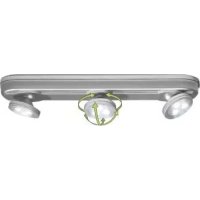
The connection between the spotlight 2 and the main unit is flexible and should be able to illuminate the selected area. Please remember to slightly loosen the swivel screw before moving the spotlight. Tighten the swivel screw afterwards (see Fig. F).
-
Depending on the mounting height (ideally between 1.80m - 2.00m ) the sensor has a detection range of max. 12m with a detection angle of 90^ horizontally and 90^ vertically.
-
Be sure the sensor is not illuminated by street lighting at night. This can influence its functioning.
-
Secure the main unit 1 using two of the enclosed wall plugs 8 (Ø 6 mm) and two of the enclosed screws 7 (4 x 30 mm) (see Fig. B). Note: The enclosed mounting material is suitable for ordinary masonry construction. Other wall substrates may require other fastening materials. Seek specialist advice when in doubt.
After mounting, check that the main unit is fitted securely.
- Mounting the solar cell
The solar cell requires direct sunlight when possible. Ideally, the solar cell surface will be directed to the south. The enclosed mounting base will ensure the solar cell is mounted horizontally.
Mount the bracket 9 of the solar cell 6 to a vertical wall using the enclosed screws 7 (4 x 30 mm) and the enclosed wall plugs 8 (Ø 6 mm) (see Fig. C).
Note: The enclosed mounting material is suitable for ordinary masonry construction. Other wall substrates may require other fastening materials. Seek specialist advice when in doubt.
After mounting, verify the solar cell is fitted securely.
Then attach the solar cell as shown in Fig. C.
Next adjust the solar cell to face south.
- Connecting the solar cell to the main unit
After mounting the two operating units (main unit 1 and solar cell 6) run the cable so it is not subjected to mechanical stress. Use typical installation
material such as cable clamps or conduit to fasten the cable, to prevent damage to the insulation.
Connect the plug connector 4 from the main unit cable and the solar cell (see Fig. D).
- Start-up
Note:
Connect the main station 1 to the solar cell 6 before using for the first time. The solar cell 6 also works as a twilight sensor, while the motion sensor 3 only responds to movement.
- When selecting the setup location for the solar cell 6 be sure the solar cell, just as the twilight sensor, are not affected by other light sources, e.g. street lighting.
The switch 5 on the main unit 1 (Fig. A) features the following functions:
Position,OFF":Sensor 3 and spotlight 2 are off. In direct sunlight the rechargeable batteries are charged by the solar cell 6.Use this setting to charge drained batteries (see "Charging the rechargeable batteries").
Position „AUTO": The spotlight automatically switches on or off once the solar cell 6 detects dusk or dawn. To ensure a long life the LEDs will not be fully powered in this setting, but only provide approx. 25% of their full light power (eco mode). When fully charged, the batteries will provide approx. 8 hours of light in this setting.
Position „PIR“: The solar cell charges the batteries in sunlight. The solar cell 6 automatically switches the spotlight on in twilight or the dark when the motion sensor 3 detects movement. The light ON time is preset to approx. 1.5 minutes. If additional movement is detected
during these 1.5 minutes, the light ON time will reset. In this setting the LEDs will be fully powered. With the batteries fully charged the charge on this setting will provide light for a total of approx. 2 hours.
- Maintenance/changing batteries
To ensure good solar cell performance the solar cell must be cleaned regularly (see „Cleaning and care").
Change the batteries as follows:
Slide the switch 5 to the "OFF" position.
Loosen the cover screws [1] the back of the main unit [1] using a cross-tip screwdriver (see Fig. E).
Remove the back of the main unit.
Remove the batteries from the battery compartment [10] and replace with new rechargeable batteries with the same technical data. Be sure to insert the batteries in the correct direction. The correct polarity is shown inside the battery compartment.
Close the back of the main unit and secure the cover screws.
Winter-time use
The low amount of sunlight may reduce the light ON time at night depending on the on-time. Due to the low position of the sun please also verify the solar cell 6 is out of shade throughout the day in winter and remove ice and snow as necessary.
If the light ON time is inadequate due to the weather, recharge or replace the batteries (see „Charging the rechargeable batteries" or „changing batteries").
- Cleaning and Care
Switch off the LED solar spotlight before cleaning.
Use a slightly dampened, lint-free cloth and mild cleaning agent to clean.
Regular check the sensor 3 and solar cell 6 particularly for dirt.
Regularly clean the sensor and solar cell to ensure proper functionality.
Especially keep the solar cell free of snow and ice in winter.
Troubleshooting
= Problem
Cause
O = Solution
Light doesn't come on.
Switch 5 set to OFF" position.
Set switch to "AUTO" / "PIR" position.
Dirty sensor 3.
Clean motion detector.
Batteries are drained.
Charge batteries (see "Charging the rechargeable batteries").
- Spotlight is flickering.
Batteries are almost drained.
Charge batteries (see "Charging the rechargeable batteries").
- Battery quickly loses its charge.
The solar cell is dirty.
Clean the solar cell.
Solar cell is positioned incorrectly.
Reposition solar cell (see „Mounting the solar cell").
Poor weather conditions.
See "Winter-time use".
Defective batteries.
Replace batteries (see "Maintenance/changing batteries").
Disposal

The packaging is made of environmentally friendly materials, which may be disposed of through your local recycling facilities.
Contact your local community or municipal administration for more details on how to dispose your worn-out product.

To help protect the environment, please dispose of the product properly, and not in household waste, when it has reached the end of its useful life. Please contact your local authority for information on collection points and their opening hours.
Faulty or used rechargeable batteries must be recycled in accordance with Directive 2006 / 66 / EC. Return rechargeable batteries and / or the appliance using the recycling facilities provided.
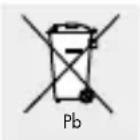
Environmental damage through incorrect disposal of the rechargeable batteries!
Rechargeable batteries may not be disposed of with the usual domestic waste. Therefore dispose of used batteries through your municipal collection site.
Warranty
The device has been manufactured to strict quality guidelines and meticulously examined before delivery. In the event of product defects you have legal rights against the retailer of this product. Your legal rights are not limited in any way by our warranty detailed below.
The warranty for this device is 3 years from the date of purchase. Should this device show any fault in materials or manufacture within three years from the date of purchase, we will repair or replace it - at our choice - free of charge to you.
The warranty period begins on the date of purchase. Please keep the original sales receipt in a safe location. This document is required as your proof of purchase. This warranty becomes void if the device has been damaged or improperly used or maintained.
The warranty applies to faults in material or manufacture. This warranty does not cover product parts subject to normal wear, thus possibly considered consumables (e.g. batteries) or for damage to fragile parts, e.g. switches, rechargeable batteries or glass parts.
CE IP44
- Montering of spotlampen

- Before use
- Assembly
- LED solar spotlight
- Intendeduse
- - Partsdescription
- -TechnicalData
- - Scope of delivery
- General safety instructions
- Safety instructions for rechargeable batteries
- Risk of property damage
- - Function
- - Charging the rechargeable batteries
- - Mounting the spotlight
- - Mounting the solar cell
- - Connecting the solar cell to the main unit
- - Start-up
- Note:
- - Maintenance/changing batteries
- Winter-time use
- - Cleaning and Care
- Troubleshooting
- Disposal
- Environmental damage through incorrect disposal of the rechargeable batteries!
- Warranty
- CE IP44
- - Montering of spotlampen
Brand : Livarno Lux
Model : IAN 109613
Category : Lighting