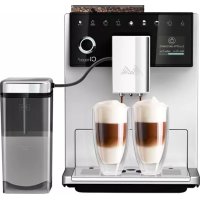
CI Touch F630101 - Coffee machine MELITTA - Free user manual and instructions
Find the device manual for free CI Touch F630101 MELITTA in PDF.



| Product type | Automatic coffee machine with grinder |
| Brand | Melitta |
| Model | CI Touch F630101 |
| Dimensions (W × H × D) | 255 × 340 × 470 mm |
| Weight (empty) | 9.25 kg |
| Power supply | 220-240 V, 50 Hz, 1400 W max |
| Pump pressure | 15 bar (static max) |
| Water tank capacity | 1.8 liters |
| Bean hopper capacity | 2 × 135 g (double compartment) |
| Milk system | Milk container or milk tube, automatic cleaning Easy Cleaning |
| Main functions | Espresso, long coffee, cappuccino, latte macchiato, milk foam, hot milk, hot water |
| Control panel | Touchscreen + rotary knob, direct preparation buttons |
| Customizable functions | My Coffee (4 user profiles), intensity, quantity, temperature settings |
| Grinder | Double hopper with Bean Select switch, grind adjustment (lever) |
| Dispensing spout | Height-adjustable, cup lighting, 2 coffee spouts, 2 milk spouts, 1 hot water |
| Maintenance programs | Easy Cleaning, milk cycle cleaning, coffee cycle cleaning, descaling |
| Water filter | Compatible with Melitta filter, screwed into water tank |
| Safety | Auto shut-off, energy-saving mode, burn protection, electrical safety |
| Cleaning the brewing chamber | Removable, weekly cleaning recommended under running water |
| Descaling | Dedicated program (approx. 25 min) with Melitta ANTI CALC descaler |
| Transport / storage | Purging required before transport, avoid temperatures < 0 °C |
| Ambient operating temperature | 10 °C to 32 °C |
| Adjustable water hardness | Yes, via supplied test strip, ranges: soft, medium, hard, very hard |
Frequently Asked Questions - CI Touch F630101 MELITTA
User questions about CI Touch F630101 MELITTA
0 question about this device. Answer the ones you know or ask your own.
Ask a new question about this device
Download the instructions for your Coffee machine in PDF format for free! Find your manual CI Touch F630101 - MELITTA and take your electronic device back in hand. On this page are published all the documents necessary for the use of your device. CI Touch F630101 by MELITTA.
USER MANUAL CI Touch F630101 MELITTA
natural_image
Line drawing of a portable coffee machine with control panel and display screen (no text or symbols)1 Overview of the appliance....31
1.1 The appliance at a glance....31
1.2 The control panel at a glance....32
2 For your safety....33
2.1 Proper use....33
2.2 Danger from electric current....33
2.3 Risk of burns and scalds....33
2.4 General safety....34
3 First steps....34
3.1 Unpacking the appliance....34
3.2 Checking the delivery contents....34
3.3 Installing the appliance....34
3.4 Connecting the appliance....35
3.5 Switching on the appliance for the first time....35
4 Basic operation 35
4.1 Switching the appliance on and off 35
4.2 Using the control panel 36
4.3 Navigating in the menu....36
4.4 Filling with coffee beans and using Bean Select....37
4.5 Using ground coffee....37
4.6 Filling with water....38
4.7 Adjusting the outlet....38
4.8 Using milk 38
4.9 Emptying the drip tray and coffee grounds container....38
5 Preparing beverages 39
5.1 Preparing espresso and café crème....39
5.2 Preparing cappuccino and latte macchiato....40
5.3 Preparing milk froth and warm milk 40
5.4 Preparing hot water 40
5.5 Preparing beverages with recipes....40
5.6 Changing beverage settings before and during preparation......40
5.7 Stopping beverage preparation 41
5.8 Preparing two beverages simultaneously....41
6 Permanently changing beverage settings....41
6.1 Changing default settings....41
7 Personal settings – "My Coffee" 42
7.1 Editing personal user profiles....42
7.2 Selecting/changing personal settings....42
7.3 Preparing beverages with personal settings....42
8 Changing basic settings....43
8.1 Setting the language 43
8.2 Setting the time....43
8.3 Setting energy save mode....43
8.4 Setting Auto OFF 43
8.5 Activating/deactivating rinsing 44
8.6 Resetting the appliance to the factory settings....44
8.7 Statistics and System menu....44
8.8 Setting the grinding fineness 45
9 Care and maintenance....45
9.1 General cleaning....45
9.2 Rinsing the coffee system 45
9.3 Cleaning the brewing unit....46
9.4 "Easy Cleaning" programme....46
9.5 "Cleaning milk system" programme....47
9.6 "Cleaning coffee system" programme....48
9.7 "Descaling" programme....48
9.8 Setting the water hardness....49
9.9 Using a water filter....49
10 Transport, storage and disposal 50
10.1 Venting the appliance ....50
10.2 Transporting the appliance ....51
10.3 Disposing of the appliance....51
11 Technical data....51
12 Troubleshooting....52
1 Overview of the appliance
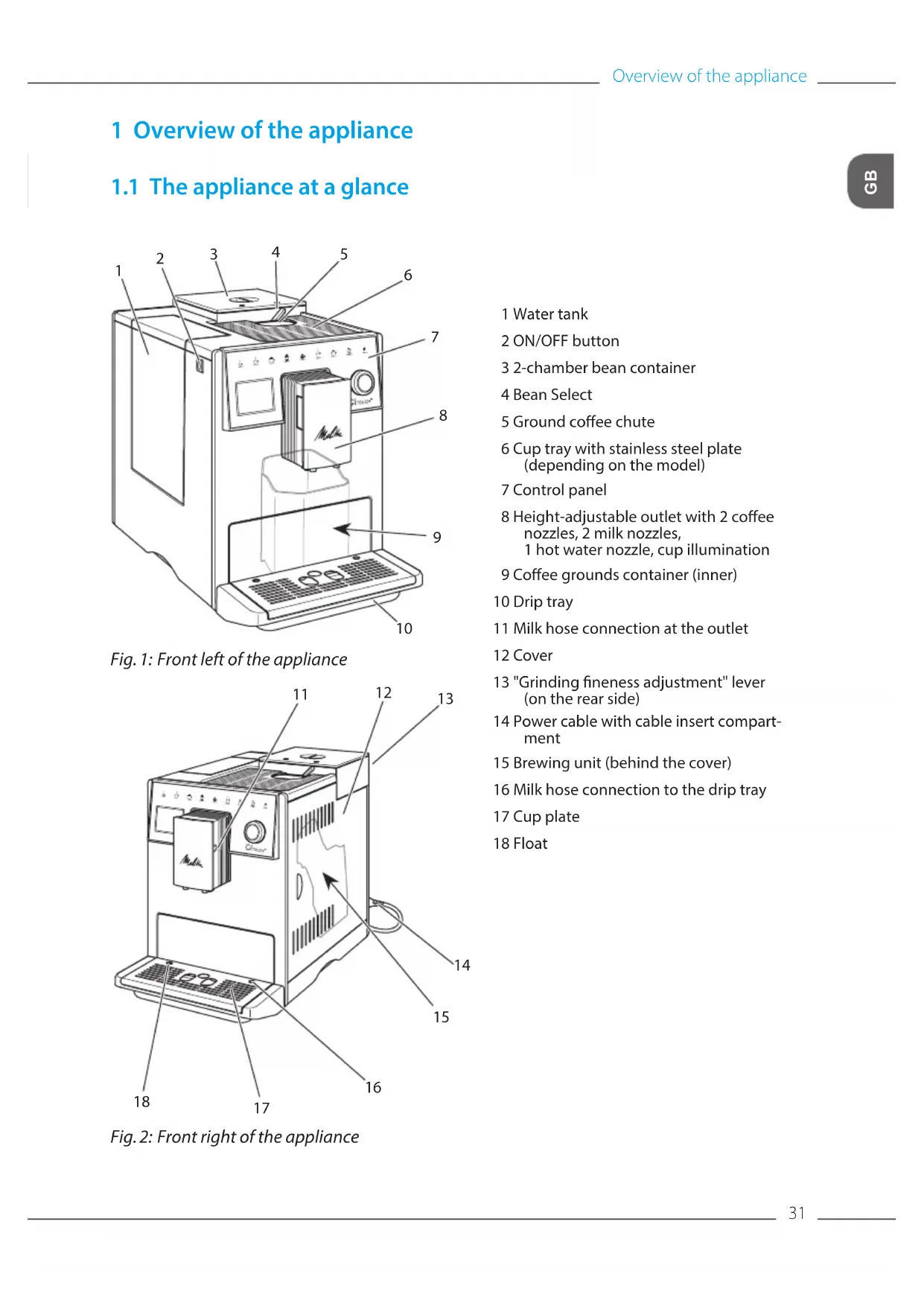
1.1 The appliance at a glance
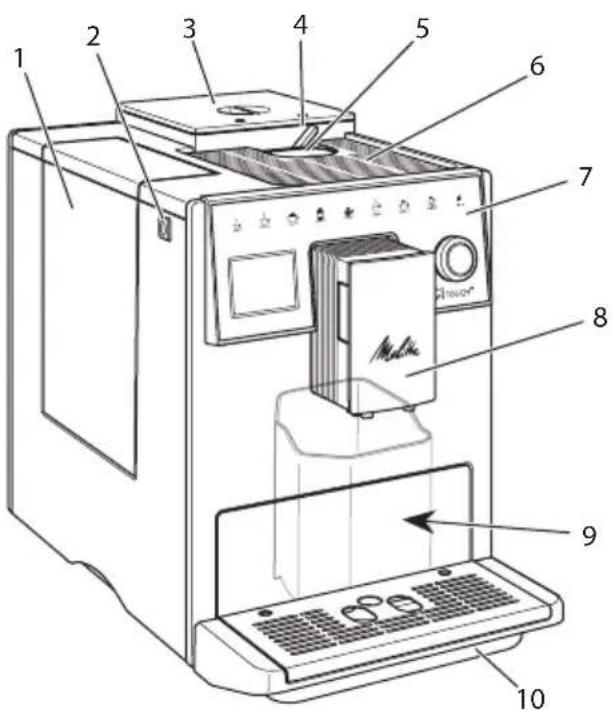
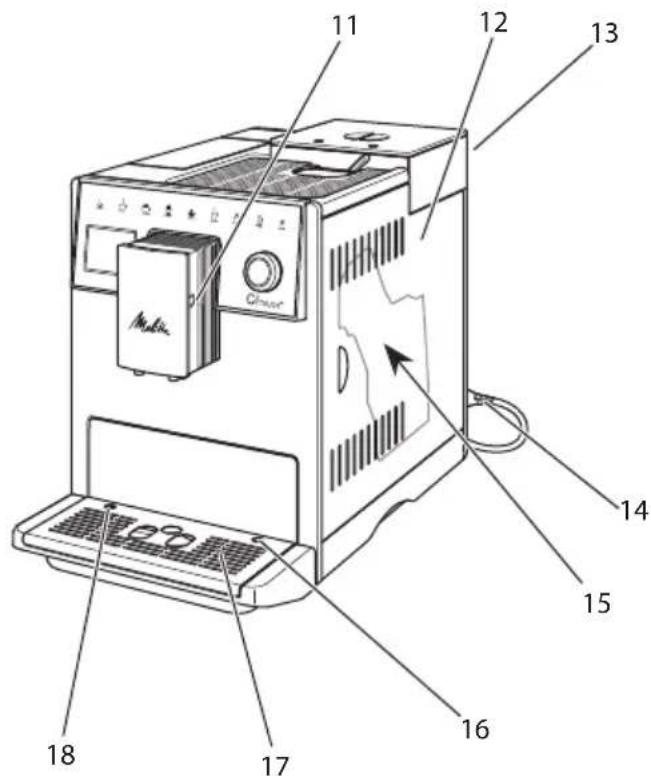
Fig. 1: Front left of the appliance
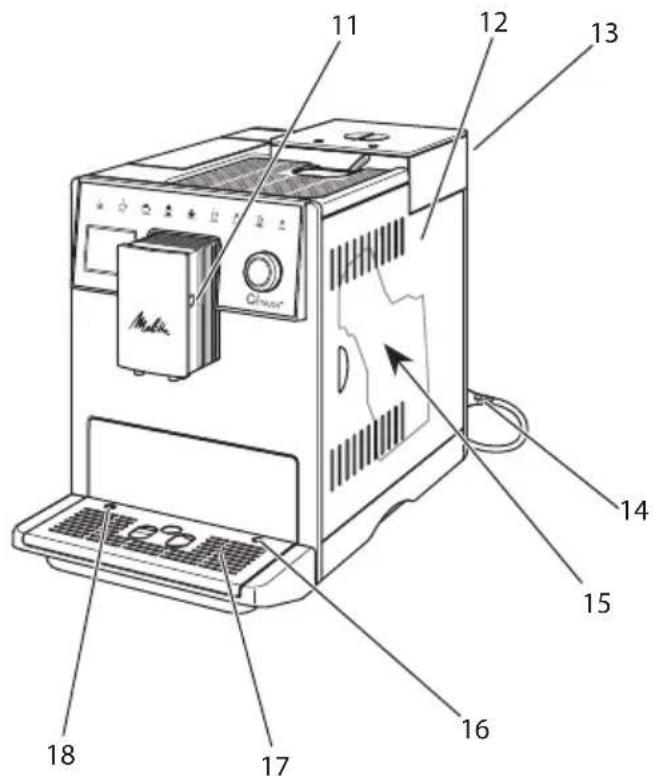
Fig. 2: Front right of the appliance
1 Water tank
2 ON/OFF button
3 2-chamber bean container
4 Bean Select
5 Ground coffee chute
6 Cup tray with stainless steel plate (depending on the model)
7 Control panel
8 Height-adjustable outlet with 2 coffee nozzles, 2 milk nozzles, 1 hot water nozzle, cup illumination
9 Coffee grounds container (inner)
10 Drip tray
11 Milk hose connection at the outlet
12 Cover
13 "Grinding fineness adjustment" lever (on the rear side)
14 Power cable with cable insert compartment
15 Brewing unit (behind the cover)
16 Milk hose connection to the drip tray
17 Cup plate
18 Float
1.2 The control panel at a glance
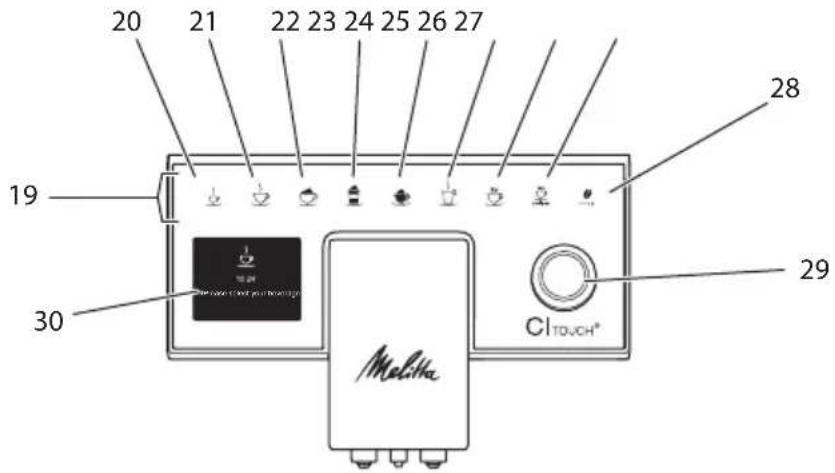
Fig. 3: Control panel
Item Designation Function
19 Direct keys Preparing beverages
22 Cappuccino Preparing cappuccino
24 Milk froth/Warm milk Preparing milk froth or warm milk
25 Hot water Preparing hot water
26 2 cups Two-cup dispensing
27 my recipes Selecting personal settings for beverages or preparing beverages with recipes
28 Coffee strength Setting the coffee strength
29 Rotary switch Calling up the menu or confirming inputs. Navigating up and down in the menu or set the STANDARD coffee flavour.
30 Display Display of current menus and messages Example: Ready symbol
Dear Customer,
Thank you for purchasing the CI Touch® fully automatic coffee maker.
The operating instructions will help you discover the diverse options offered by the appliance and enjoy your coffee to the full.
Read through the operating instructions carefully. This helps avoid personal injury and material damage. Store the operating instructions carefully. If you pass on the appliance, include the operating instructions with it.
Melitta accepts no liability for damage caused by failure to observe the operating instructions.
If you require further information or have any questions on the appliance, contact Melitta or visit our website at:
www.international.melitta.de/
We hope you enjoy using your appliance.
2 For your safety
CE The appliance conforms to the relevant European directives and has been manufactured using the latest technology. Nevertheless, some residual dangers remain.
Observe the safety instructions to avoid dangers. Melitta accepts no liability for damage caused by failure to observe the safety instructions.
2.1 Proper use
The appliance is used to prepare coffee beverages made from coffee beans or ground coffee, and to heat milk and water.
The appliance is intended for use in private households.
Any other use is regarded as improper and may lead to personal injury and material damage.
2.2 Danger from electric current
If the appliance or the power cable is damaged, there is a risk of fatal electric shock.
To avoid danger from electric current:
ū Do not use a damaged power cable.
ū A damaged power cable may only be replaced by the manufacturer or its customer service or service partner.
ū Do not open any covers firmly screwed onto the appliance housing.
ū Only use the appliance when it is in a technically flawless condition.
ū A defective appliance may only be repaired by an authorised workshop. Do not repair the appliance yourself.
ū Do not make any changes to the appliance, its components or its accessories.
ū Do not immerse the appliance in water.
ū Do not let the power cable come into contact with water.
2.3 Risk of burns and scalds
Escaping fluids and steam may be very hot. Parts of the appliance can also become very hot.
To avoid scalds and burns:
ū Avoid escaping fluids and steam coming into contact with the skin.
ū Do not touch any nozzles on the outlet during operation.
2.4 General safety
To avoid personal injury and material damage:
ū Do not operate the appliance in a cabinet or similar.
ū Do not reach into the interior of the appliance during operation.
ū Keep the appliance and its power cable out of the reach of children under 8 years of age.
ū This appliance may be used by children over 8 years of age and by persons with reduced physical, sensory or mental capabilities or a lack of experience and knowledge if they are supervised or have been instructed in using the appliance safely and understand the resulting risks.
ū Children must not play with the appliance. Cleaning and maintenance must not be undertaken by children younger than 8 years of age. Children over 8 years of age must be supervised during cleaning and maintenance.
ū Disconnect the appliance from the power supply when left unsupervised for a long time.
ū The appliance must not be operated at altitudes over 2000 m.
ū Please observe the instructions in the corresponding section when cleaning the appliance and its components („Care and maintenance“ on page 45).
3 First steps
This chapter describes how to prepare your appliance for use.
3.1 Unpacking the appliance
- Unpack the appliance. Remove the packaging material, the adhesive strips and the protective films from the appliance.
- Keep the packaging material for transport and any return shipments.
Information
The appliance may contain traces of coffee and water. The appliance has been tested in the factory to ensure that it functions perfectly.
3.2 Checking the delivery contents
Check the completeness of delivery using the following list. If parts are missing, contact your retailer.
ū Coffee spoon with screw-in aid for the water filter
ū Plastic milk container or thermal milk container each with milk hose
ū Water filter
ū Test strip for determining the water hardness.
3.3 Installing the appliance
Observe the following instructions:
ū Do not install the appliance in damp rooms.
ū Install the appliance on a stable, flat and dry surface.
ū Do not install the appliance in the vicinity of sinks or the like.
ū Do not install the appliance on hot surfaces.
ū Install the appliance at a sufficient distance (approx. 10 cm) from the wall
and other objects. The space above the appliance should be at least 20 cm. ū Route the power cable so it cannot be damaged by edges or hot surfaces.
3.4 Connecting the appliance
Observe the following instructions:
ü Check that the supply voltage matches the operating voltage specified in the technical data (see section 11, page 51).
ū Only connect the appliance to a properly installed earthing contact socket. If in doubt, consult a specialist electrician. ū The socket must have a fuse of at least 10 A.
3.5 Switching on the appliance for the first time
During initial start-up, the language, the time and the water hardness can be set. The settings can be changed at a later point in time (see chapter 8, page 43 and section 9.8, page 49).
Use the enclosed test strip to determine the water hardness. Observe the instructions on the test strip packaging and the table in section 11, page 51.
Information
We recommend pouring away the first two cups of coffee after initial start-up.
Requirement: The appliance has been installed and connected.
- Place a vessel beneath the outlet.
- Switch on the appliance with the ON/OFF button.
» The welcome display appears on the appliance.
» The request to carry out setup appears on the display: Please set up the machine.
- Confirm setup with the "rotary switch".
» The Language menu appears.
- Select your language with the "rotary switch". Confirm your selection.
» The Clock menu appears.
- Select the hour and the minutes with the "rotary switch". Confirm your settings.
» The Water hardness menu appears.
- Select the determined water hardness range with the "rotary switch" or confirm the default value.
» The request Please refill and insert water tank appears.
- Remove the water tank. Rinse out the water tank with clean water. Insert the new water filter (see section „Switching on the appliance“ on page 36). Fill the water tank with fresh water and insert it.
» The appliance heats up and performs automatic rinsing.
» The ready symbol and the request Fill beans appear on the display.
- Fill coffee beans into the bean container. To do this, read section 4.4, page 37.
4 Basic operation
This chapter describes basic operating steps for using the appliance on a daily basis.
4.1 Switching the appliance on and off
Before switching on after starting up the appliance for the first time, read section 3.5.
Information
ū When switched on and off, the appliance performs automatic rinsing.
ū During rinsing, rinsing water is also conducted into the drip tray.
ū The automatic switch-off rinsing can be switched on or off in the Settings menu.
Switching on the appliance
- Place a vessel beneath the outlet.
- Press the ON/OFF button.
» The welcome display appears on the appliance.
» The appliance heats up and performs automatic rinsing.
» The appliance is ready for operation.
Switching off the appliance
- Place a vessel beneath the outlet.
- Press the ON/OFF button for 1-2 seconds.
» If switch-off rinsing is activated, the appliance performs automatic rinsing.
» The appliance switches off.
Information
ū The appliance switches off automatically when it is not operated for a long time. Automatic rinsing is also carried out in this case.
ū The off time can be set in the Auto OFF menu, see section 8.4, page 43.
ū If no beverage has been prepared since switching on or if the water tank is empty, no rinsing takes place.
4.2 Using the control panel
The essential functions can be accessed using the control panel and the "rotary switch".
Press the button with a fingertip. The control panel does not react when touched with a pen or other objects.
Only those buttons that can be used in the appliance's current status light up.
4.3 Navigating in the menu
To set individual beverages or for maintenance and care, the appliance must display the ready symbol. You must then call up the corresponding menu and navigate in it.
On successful completion of all processes, the ready symbol is shown on the display. Observe the instructions on the display.
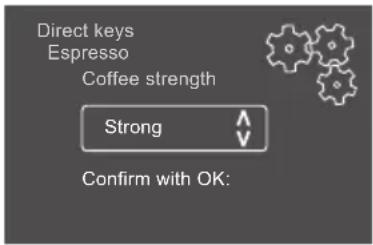
Fig. 6: Example: display
Use the following options to navigate in the menu:
Calling up the menu and confirming the selection
Press the "rotary switch" for longer than 2 seconds to call up the menu.
Press the "rotary switch" briefly to confirm your selection.
Navigating in the menu
Turn the "rotary switch" to navigate down or up in the menu.
Exiting a menu
Select the Exit command with the "rotary switch" and confirm your selection to exit a menu.
Exit submenus that only display information and where no settings are made by pressing briefly.
Calling up submenus
Some of the appliance's functions are reached by calling up several submenus in succession.
Submenus are always called up in a similar way. Navigation to the Descaling programme is described here as an example.
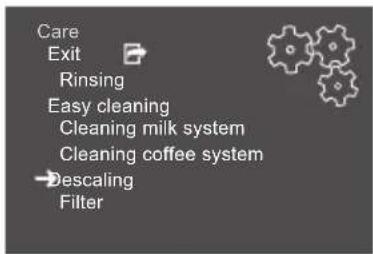
Fig. 7: Navigating to the Descaling programme
- Press the "rotary switch" for 2 seconds. » The menu appears on the display.
- Select the Care menu by turning the "rotary switch" and confirm your selection.
- Select the Descaling menu by turning the "rotary switch" and confirm your selection.
The selection of functions is always shown in shortened form in these operating instructions:
- Navigate to the Care > Descaling menu.
4.4 Filling with coffee beans and using Bean Select
Roasted coffee beans lose their aroma. Only fill the bean container with as many coffee beans as will be consumed over the next 3–4 days.
CAUTION
When switching bean chambers, a residual amount of coffee beans remains in the grinder. The first two coffee beverages after switching to decaffeinated beans may still contain caffeinated coffee. This may affect the health of people with caffeine intolerance.
- Persons with caffeine intolerance should only consume the third coffee beverage after switching over.
ATTENTION
The use of unsuitable types of coffee can lead to clogging of the grinder.
- Do not use freeze-dried or caramelised coffee beans.
- Do not pour ground coffee into the bean container.
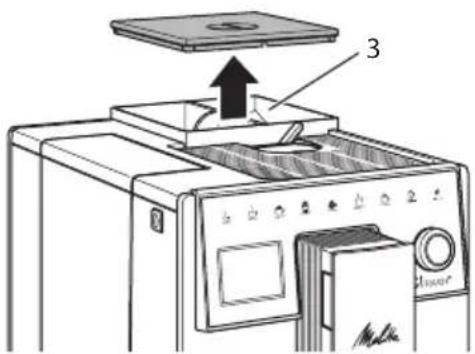
Fig. 8: 2-chamber bean container
The 2-chamber bean container (3) enables the use of two different types of coffee. For example, fill one chamber with espresso beans and the other with café crème beans.
- Open the lid of the 2-chamber bean container.
- Fill coffee beans into the bean chambers.
- Close the lid of the 2-chamber bean container.
4.5 Using ground coffee
Ground coffee may also be used to prepare coffee beverages.
ATTENTION
The use of unsuitable types of coffee can lead to clogging of the brewing unit.
-
Do not use any instant products.
Fill a maximum of one coffee spoon of ground coffee into the ground coffee chute. -
Open the lid of the ground coffee chute.
- Use the enclosed coffee spoon for dosing.
Fill a maximum of one coffee spoon of ground coffee into the ground coffee chute. - Close the lid of the ground coffee chute.
- Proceed as described in sections 5 to 7.
Information
ū Two-cup dispensing is not possible when using ground coffee. ū If no coffee is prepared within 3 minutes of opening the ground coffee chute, the appliance switches to operation with coffee beans and the ground coffee is discharged into the coffee grounds container.
4.6 Filling with water
Only use fresh, cold water without carbon dioxide for optimum coffee enjoyment. Change the water daily.
Information
The quality of the water largely determines the flavour of the coffee. Therefore, use a water filter (see section 9.8, page 49 and section 9.9, page 49).
- Open the lid of the water tank and pull the water tank upwards out of the appliance by the handle.
- Fill the water tank with water. Note the maximum capacity of 1.8 litres.
- Insert the water tank into the appliance from above and close the lid.
4.7 Adjusting the outlet
The spout is height-adjustable. Set the greatest possible distance between the outlet and the vessel. Depending on the vessel, push the outlet up or down.
4.8 Using milk
Use cooled milk for optimum coffee enjoyment.
Depending on the model, the enclosed milk container or the milk hose and conventional milk packs can be used.
Connecting the milk container
Only fill as much milk into the milk container as will be used immediately.
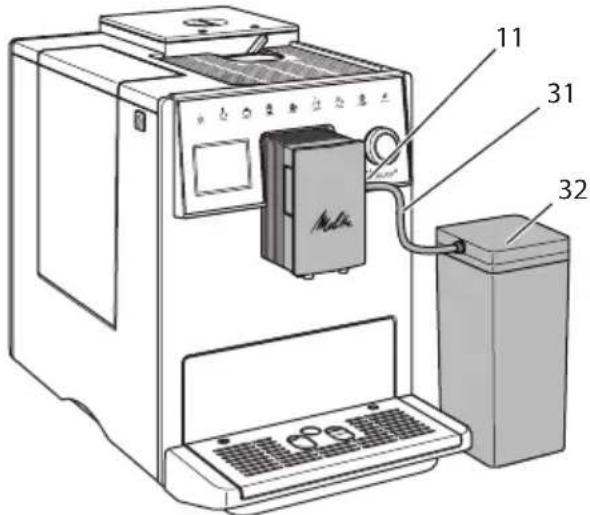
Fig. 9: Connecting the milk container to the appliance
- Fill the desired amount of milk into the milk container (32).
- Connect the milk hose (31) to the milk container and the connection (11) at the spout or insert the milk hose into a conventional milk pack.
Information
Store the filled milk container in the refrigerator.
4.9 Emptying the drip tray and coffee grounds container
When the drip tray (10) and the coffee grounds container (9) are full, the appliance requests you to empty them. The projecting float (18) also indicates that the drip tray is full. Always empty both containers.
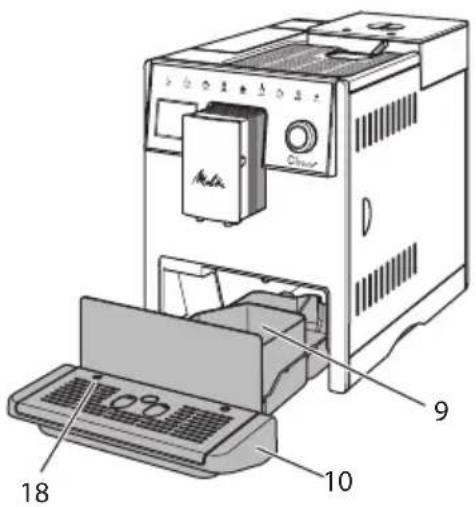
Fig. 10: Drip tray, coffee grounds container and float
- Pull the drip tray (10) forwards out of the appliance.
- Remove the coffee grounds container (9) and empty it.
- Empty the drip tray.
- Insert the coffee grounds container.
- Push the drip tray into the appliance up to the stop.
Information
The appliance requests you to empty the drip tray and the coffee grounds container after a defined number of beverages have been dispensed. If the containers are emptied while the appliance is switched off, it does not register this process. Therefore, it is possible that you are requested to empty the containers although the drip tray and the coffee grounds container are not yet full.
5 Preparing beverages
There are three options for preparing beverages:
ū Standard dispensing with direct keys and beverage preparation with recipes as described below
ū Preparation with modified beverage settings (see chapter 6, page 41)
ū Use of personal settings with the My Coffee function (see section 7, page 42).
Standard dispensing is described in this section.
Please note:
ū The storage containers should contain sufficient amounts of coffee and water. If the filling level is too low, the appliance requests you to refill it.
ū The appliance does not indicate a lack of milk.
ū When selecting a beverage with milk, connect the milk container or a commercially available milk pack.
ū The vessels for the beverages should be sufficiently large.
ū For beverage preparation, the display must show the ready for use display.
ū Beverage dispensing is ended automatically.
ū After beverage preparation with milk, the appliance automatically outputs a prompt for the Easy Cleaning programme.
5.1 Preparing espresso and café crème


- Place a vessel beneath the outlet.
- Press the "Espresso" or "Café Crème" button.
» Beverage dispensing is carried out and ends automatically. - Remove the vessel.


5.2 Preparing cappuccino and latte macchiato


Requirement: Milk is connected.
- Place a vessel beneath the outlet.
- Press the "Cappuccino" or "Latte Macchiato" button.
» Beverage dispensing is carried out and ends automatically.
» Easy Cleaning? appears on the display.
- Remove the vessel.
- Run the Easy Cleaning programme or prepare further beverages and run the Easy Cleaning programme later, see section 9.4.
5.3 Preparing milk froth and warm milk
The preparation of milk froth and warm milk is similar.

Requirement: Milk is connected.
-
Place a vessel beneath the outlet.
-
Press the "Milk froth/milk" button.
a) Milk froth = briefly press button
b) Warm milk = press the button for longer (2 seconds)
» Milk dispensing is carried out and is ended automatically.
- Remove the vessel.
» Easy Cleaning? appears on the display.
- Run the Easy Cleaning programme or prepare further beverages and run the Easy Cleaning programme later, see section 9.4.
5.4 Preparing hot water

- Place a vessel beneath the outlet.
- Press the "Hot water" button.
» Hot water dispensing is carried out and is ended automatically.
- Remove the vessel.
5.5 Preparing beverages with recipes
In addition to standard dispensing, you can select further beverage specialities in the Recipes menu.
Information
When selecting a recipe with milk, connect the milk container or a commercially available milk pack (depending on the model).

- Place a vessel beneath the outlet.
- Press the "rotary switch" and navigate to the Recipes menu or press the "my recipes" button for a long time.
» The recipe selection appears on the display.
-
Select a beverage recipe and confirm your selection.
» Beverage dispensing is carried out and ends automatically. -
Remove the vessel.
5.6 Changing beverage settings before and during preparation
Beverage settings can be changed before and during beverage preparation.
Information
These settings only apply to current beverage preparation.
Changing beverage settings before preparation
The bean type can be changed before selecting a beverage.
Before selecting a beverage, set the desired bean chamber with the "BEAN SELECT" slider.
» The selected bean type is used to prepare the beverage.
Changing beverage settings during preparation
The beverage quantity and the coffee strength can be changed during beverage preparation.
Requirement: The appliance is ready for operation.

During beverage dispensing (coffee or milk), use the "rotary switch" to be respective beverage quantity.

During the grinding process, use the "Coffee strength" button to set the e strength.
5.7 Stopping beverage preparation
To stop beverage preparation prematurely, press the selected direct key again.
5.8 Preparing two beverages simultaneously

The "2 cups" button is used to prepare two beverages.
Information
Two-cup dispensing is not possible for beverages mixed with hot water (americano), for milk froth, warm milk or hot water.
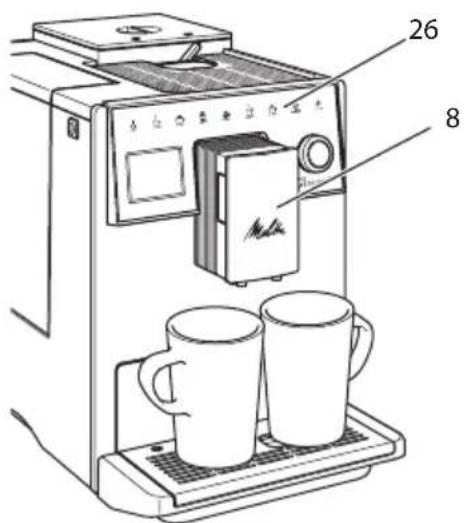
Fig. 11: Two-cup dispensing
- Place two vessels beneath the outlet (8).
- Press the "2 cups" button (26).
- Continue as described for the relevant beverage preparation.
Information
ü This setting only applies to the next beverage preparation.
ū If a beverage is not prepared within 1 minute, the appliance switches to single-cup dispensing.
6 Permanently changing beverage settings
The appliance offers further options for preparing coffee specialities.
6.1 Changing default settings
Depending on the beverage, the following default settings can be changed: Coffee amount, amount of froth, milk amount, hot water amount, coffee strength and temperature.
Changing the beverage settings is similar for all beverages. Changing the coffee strength for an Espresso is described here as an example.
- Press the "rotary switch" for 2 seconds. » The menu appears on the display.
- Navigate to the Direct keys > Espresso > Coffee strength menu.
- Select the desired coffee strength and confirm your selection.
- Select the Exit command to exit the menu.
» The selected coffee strength is used the next time an espresso is prepared.
Information
The default settings remain valid until they are changed again.
7 Personal settings – "My Coffee"
The "My Coffee" function lets you to save personal beverage settings and assign them to a user.
7.1 Editing personal user profiles
Up to four user profiles can be used.
Changing the name of a user profile
The names of the user profiles can be changed.
- Press the "rotary switch" for 2 seconds.
» The menu appears on the display. - Navigate to the My Coffee menu.
- Select a user and confirm your selection.
- Select Change name and confirm your selection.
» The menu for selecting individual characters appears. - Select individual characters by turning the "rotary switch" and confirm each of them.
- Repeatedly select the Exit command to exit the menu.
Activating/deactivating a user profile
Only users whose profile is activated can be used.
Requirement: The appliance is ready for operation.
- Press the "rotary switch" for 2 seconds.
» The menu appears on the display. - Navigate to the My Coffee menu.
- Select a user and confirm your selection.
- Select Enabled/disabled and confirm your selection.
- Select Enabled or Disabled and confirm your selection again.
- Select the Exit command to exit the menu.
7.2 Selecting/changing personal settings
Depending on the beverage, the following settings can be assigned to a user:
Recipes, coffee amount, amount of froth, milk amount, hot water amount, coffee strength and temperature.
The assignment of personal settings to a user is always similar. Setting the coffee amount for a Cappuccino is described here as an example.
- Press the "rotary switch" for 2 seconds.
» The menu appears on the display. - Navigate to the My Coffee menu.
- Select a user and confirm your selection.
- Navigate to the Cappuccino > Coffee amount menu.
- Select an amount and confirm your selection.
- Select the Exit command to exit the menu.
» The next time a cappuccino is prepared by the user, the selected amount of coffee is used.
7.3 Preparing beverages with personal settings

The preparation of beverages using the "My Coffee" function is similar
for all beverages. The preparation of a cap- puccino is described here as an example.
- Place a vessel beneath the outlet.
- Press the "my recipes" button until the desired user is shown on the display.
- Press the "Cappuccino" button.
» Beverage dispensing is carried out and ends automatically. - Remove the vessel.
» Easy Cleaning? appears on the display. (Press rotary switch to start). - Run the Easy Cleaning programme or prepare further beverages and run the Easy Cleaning programme later, see section 9.4.
Information
ū To exit the My Coffee function, press the "my recipes" button until the ready symbol appears.
ū If a beverage is not prepared within 3 minutes, the appliance automatically switches to the ready symbol.
8 Changing basic settings
Operating steps that change the appliance's basic settings are described in this chapter.
8.1 Setting the language
The display text language can be set.
Requirement: The appliance is ready for operation.
- Press the "rotary switch" for 2 seconds. » The menu appears on the display.
- Navigate to the Language menu.
- Select a language and confirm your selection.
- Exit the menu with the Exit command.
8.2 Setting the time
The time shown on the display can be set.
Requirement: The appliance is ready for operation.
- Press the "rotary switch" for 2 seconds. » The menu appears on the display.
- Navigate to the Clock menu.
- Select the hour and the minutes. Confirm each of your settings.
- Exit the menu with the Exit command.
Information
To prevent the time being shown on the display, set the time to 00:00.
8.3 Setting energy save mode
Energy save mode lowers the heating temperature and switches off the illumination on the control panel.
If the appliance is not operated for a long time, it automatically switches to energy save mode after a specified time. The period of time until energy save mode is activated is set in the Energy save mode menu.
Requirement: The appliance is ready for operation.
- Press the "rotary switch" for 2 seconds. » The menu appears on the display.
- Navigate to the Energy save mode menu.
- Select a period of time and confirm your selection.
- Exit the menu with the Exit command.
Information
ū Energy save mode cannot be deactivated completely. After 4 hours without being operated at the latest, the appliance switches to energy save mode.
8.4 Setting Auto OFF
If the appliance is not operated for a long time, it switches off automatically after a specified time. Set the duration until the appliance switches off in the Auto OFF menu. A specific point in time can also be defined.
Information
If the duration and point in time are activated simultaneously, the appliance switches off after the event that occurs first.
Setting the duration for Auto OFF
Requirement: The appliance is ready for operation.
- Press the "rotary switch" for 2 seconds. » The menu appears on the display.
- Navigate to the Auto OFF > OFF after... menu.
- Select a time and confirm your selection.
- Repeatedly select the Exit command to exit the menu.
Information
Auto OFF cannot be deactivated completely. After 8 hours without being operated at the latest, the appliance switches off.
Setting the point in time for Auto OFF
The OFF time point is deactivated as default in the factory.
Requirement: The appliance is ready for operation.
- Press the "rotary switch" for 2 seconds. » The menu appears on the display.
- Navigate to the Auto OFF > OFF at... menu.
- Select the hours and the minutes. Confirm each of your settings.
- Repeatedly select the Exit command to exit the menu.
Information
To deactivate Auto OFF, set the OFF time point to 00:00.
8.5 Activating/deactivating rinsing
Rinsing is always carried out immediately after switching on the coffee system. Only the Off rinsing can be activated/deactivated. If this is activated, rinsing is carried out after switching off the coffee system.
Permanent deactivation is not recommended.
Activating/deactivating switch-off rinsing
Requirement: The appliance is ready for operation.
- Press the "rotary switch" for 2 seconds. » The menu appears on the display.
- Navigate to the Settings >Switch-off rinsing menu.
- Select Enabled or Disabled and confirm your selection.
- Select the Exit command to exit the menu.
» The appliance is ready for operation.
8.6 Resetting the appliance to the factory settings
The appliance can be reset to the factory settings.
Information
If the appliance is reset to the factory settings, all personal settings are lost, including the settings in the My Coffee menu.
Requirement: The appliance is ready for operation.
- Press the "rotary switch" for 2 seconds. » The menu appears on the display.
- Navigate to the Settings > Factory settings menu.
- Select Reset and confirm your selection.
- Select the Exit command to exit the menu.
8.7 Statistics and System menu
Statistics
The Statistics menu provides information on the number of beverages dispensed and for maintenance.
System
The System menu provides information on the software version and access to the venting function, see section 10.1, page 50.
8.8 Setting the grinding fineness
The grinding fineness of the coffee beans influences the flavour of the coffee. The grinding fineness has been optimally set prior to delivery.
natural_image
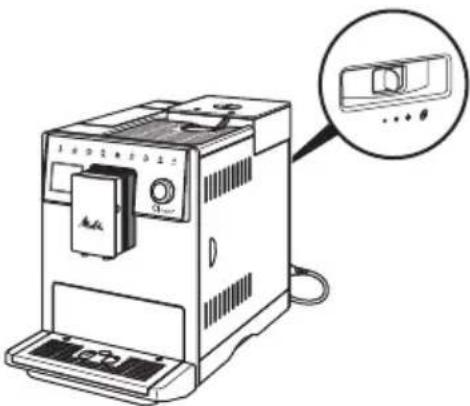
Line drawing of a coffee maker with a close-up inset showing its front panel (no text or symbols)Fig. 12: Grinding fineness setting
Use the lever on the rear side to set the grinding fineness.
- Move the lever:
ū To the right = grinding fineness coarser
ū To the left = grinding fineness finer
Information
ū If the grinding fineness is set finer, the coffee flavour is stronger.
ū The grinding fineness is optimally set when the coffee flows evenly out of the outlet and a fine, dense crema appears.
9 Care and maintenance
Regular cleaning and maintenance ensure the consistent high quality of your beverages.
9.1 General cleaning
Clean the appliance regularly. Immediately remove external soiling caused by milk and coffee.
ATTENTION
The use of unsuitable cleaning agents can lead to scratched surfaces.
- Do not use any abrasive cloths, sponges or cleaning agents.
Requirement: The appliance is switched off.
- Clean the outside of the appliance with a soft, damp cloth and normal washing-up liquid.
- Rinse the drip tray and the coffee grounds container with a soft, damp cloth and normal washing-up liquid.
- Clean the bean container with a soft, dry cloth.
9.2 Rinsing the coffee system
During rinsing, the nozzles at the outlet and the internal parts of the coffee system are rinsed. As a result, rinsing water from the interior enters the drip tray.
If switch-off rinsing is not deactivated, the appliance rinses the coffee system when switching on and off.
Rinsing can also be carried out manually.
Requirement: The appliance is ready for operation.
- Place a vessel beneath the outlet.
- Press the "rotary switch" for 2 seconds.
» The menu appears on the display. - Navigate to the Care > Rinsing menu.
- Select Start and confirm your selection.
» The coffee system is rinsed.
9.3 Cleaning the brewing unit
To avoid damage to the appliance, we recommend cleaning the brewing unit once a week.
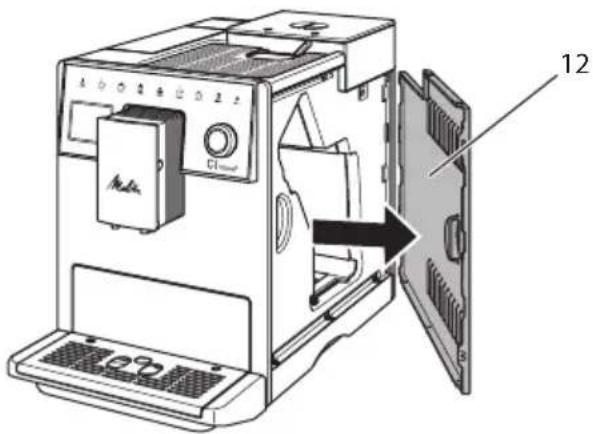
Fig. 13: Removing the side panel
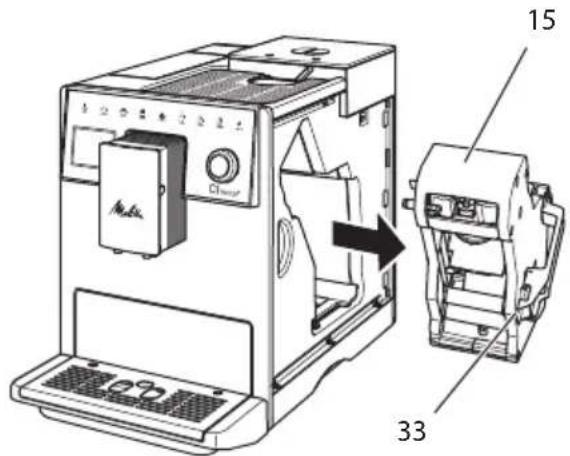
Fig. 14: Removing the brewing unit
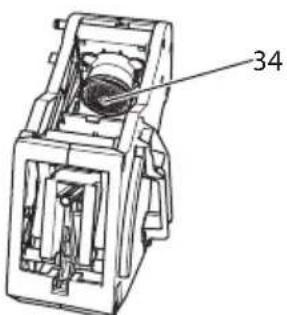
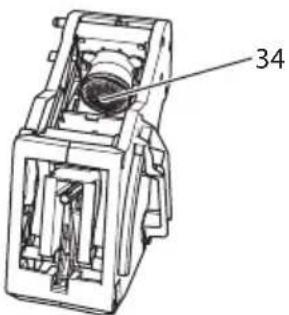
Fig. 15: Cleaning the brewing unit
Requirement: The appliance is switched off.
- Open the cover (12). To do this, reach into the recess on the right of the appliance and pull the cover off sideways.
- Press and hold the red lever (33) on the brewing unit handle (15) and turn the handle clockwise until it engages at the stop.
- Pull the brewing unit out of the appliance by the handle.
- Rinse the entire brewing unit thoroughly from all sides under running water. In particular, make sure that coffee residues are removed from the sieve (34).
- Allow the brewing unit to drip dry.
- Use a soft, dry cloth to remove coffee residues from the surfaces inside the appliance.
- Insert the brewing unit into the appliance. Press and hold the red lever on the handle of the brewing unit and turn the handle counter anticlockwise until it engages at the stop.
- To do this, insert the cover sideways until it engages.
9.4 "Easy Cleaning" programme
The milk system is rinsed using the Easy Cleaning programme.
Each time after a beverage has been prepared with milk, the appliance requests you to run the Easy Cleaning programme.
The Easy Cleaning programme can also be run manually.
Requirement: The appliance is ready for operation.
- Place a vessel beneath the outlet.
- Press the "rotary switch" for 2 seconds. » The menu appears on the display.
- Navigate to the Care > Easy Cleaning menu.
- Select Start and confirm your selection.
- Follow the further instructions on the display up to the end of the Easy Cleaning programme.
9.5 "Cleaning milk system" programme
This programme is used to clean the milk system with the aid of a milk system cleaning agent.
To maintain hygiene and avoid damage to the appliance, we recommend carrying out the cleaning programme once a week.
The cleaning programme takes approximately 3 minutes and should not be interrupted.
ATTENTION
The use of unsuitable milk system cleaning agents can damage the appliance.
- Only use Melitta® PERFECT CLEAN milk system cleaning agent for fully automatic coffee makers.
- Observe the processing instructions on the packaging of the milk system cleaning agent.
Requirement: The appliance is ready for operation.
- Place a container (0.7 l) beneath the coffee spout (e.g. the coffee grounds container).
- Press the "rotary switch" for 2 seconds. » The menu appears on the display.
- Navigate to the Care > Cleaning milk system menu.
- Select Start and confirm your selection.
- Follow the further instructions on the display up to the end of the Cleaning milk system programme.
Cleaning the milk unit
In addition, we recommend cleaning the milk unit, the milk hose and the milk container regularly.
Information
ū The plastic milk container, without lid and riser pipe, is dishwasher-safe.
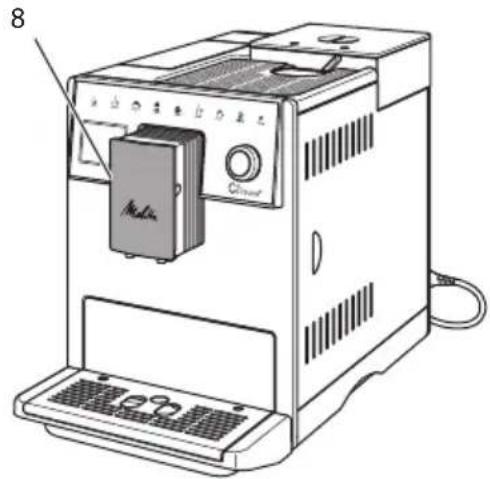
Fig. 16: Access to the milk unit
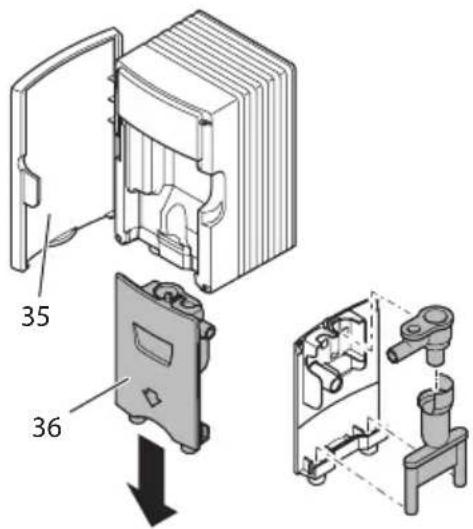
Fig. 17: Removing the milk unit
- Pull the milk hose off the appliance.
- Open the door of the spout (8).
- Pull the milk unit (36) off downwards.
- Clean the individual parts with warm water. Use a soft, damp cloth and normal washing up liquid for this.
Installation is carried out as described in reverse order.
Information
Make sure that the milk unit is pushed upwards to the end stop.
9.6 "Cleaning coffee system" programme
This cleaning programme is used to remove residues and coffee oil residues with the aid of coffee machine cleaning agents.
To avoid damage to the appliance, we recommend carrying out the cleaning programme every 2 months or as requested by the appliance.
Before starting the cleaning programme, clean the brewing unit and the interior (see section 9.3, page 46).
The cleaning programme takes approximately 15 minutes and should not be interrupted.

CAUTION
Contact with coffee machine cleaning agent may lead to eye and skin irritation.
- Observe the processing instructions on the packaging of the coffee machine cleaning agent.
ATTENTION
The use of unsuitable coffee machine cleaning agents can damage the appliance.
- Only use Melitta® PERFECT CLEAN cleaning tabs for fully automatic coffee makers.
Requirement: The appliance is ready for operation.
- Press the "rotary switch" for 2 seconds.
» The menu appears on the display. - Navigate to the Care > Cleaning coffee system menu.
- Select Start and confirm your selection.
- Follow the further instructions on the display up to the end of the cleaning programme.
9.7 "Descaling" programme
The descaling programme is used to remove limescale deposits in the interior of the appliance with coffee machine descaling agents.
To avoid damage to the appliance, we recommend carrying out the descaling programme every 3 months if a water filter is not used. On use of a water filter, perform descaling only when requested by the appliance.
The descaling programme takes approximately 25 minutes and should not be interrupted.

CAUTION
Contact with descaling agent may lead to eye and skin irritation.
- Observe the processing instructions on the packaging of the descaling agent.
ATTENTION
Use of unsuitable descaling agent may damage the appliance.
- Only use Melitta® ANTI CALC liquid descaling agent for fully automatic coffee makers.
- Observe the processing instructions on the packaging of the descaling agent.
ATTENTION
A water filter may be damaged if it is screwed in during the descaling programme.
■ Remove the water filter when the appliance requests you to do so (see Fig. 18).
- Place the water filter into a vessel filled with tap water during the descaling programme.
- The water filter can be reinserted and reused when the descaling programme is complete.
Requirements:
ū The appliance is ready for operation.
ū A container (0.7 l) is placed beneath the spout.
- Press the "rotary switch" for 2 seconds. » The menu appears on the display.
- Navigate to the Care > Descaling menu.
- Select Start and confirm your selection.
- Follow the further instructions on the display up to the end of the descaling programme.
9.8 Setting the water hardness
The set water hardness influences the frequency of descaling. The harder the water, the more frequently the appliance has to be descaled.
Information
The water hardness cannot be set if you use a water filter.
Determine the water hardness with the enclosed test strip. Observe the instructions on the test strip packaging and table 11, page 51.
Requirement: The appliance is ready for operation.
- Press the "rotary switch" for 2 seconds.
» The menu appears on the display. - Navigate to the Settings > Water hardness menu.
- Select the water hardness range and confirm your selection.
9.9 Using a water filter
The use of a water filter extends the service life of the appliance and the appliance has to be descaled less frequently. The water filter contained in the scope of delivery filters calcium and other pollutants out of the water.
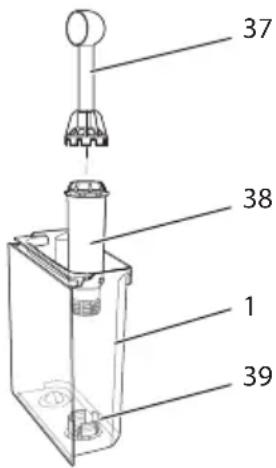
Fig. 18: Screwing/unscrewing the water filter
The water filter (38) is screwed into and unscrewed from the thread (37) on the base of the water tank (39) using the screwing aid at the end of the enclosed coffee spoon (1).
Inserting the water filter
Information
Place the water filter into a vessel filled with fresh tap water for a few minutes before inserting it.
Requirements:
ū The appliance is ready for operation. ū A container (0.7 l) is placed beneath the spout.
-
Press the "rotary switch" for 2 seconds. » The menu appears on the display.
-
Navigate to the Care > Filter > Insert filter menu.
-
Select Start and confirm your selection.
-
Follow the further instructions on the display.
» The water hardness is automatically adjusted on the water filter by the appliance.
» The appliance is ready for operation.
Changing the water filter
Change the water filter when the appliance requests you to do so.
Requirement:
ū The appliance is ready for operation.
ū A container (0.7 l) is placed beneath the spout.
-
Press the "rotary switch" for 2 seconds.
» The menu appears on the display. -
Navigate to the Care > Filter > Change filter menu.
-
Select Start and confirm your selection.
-
Follow the further instructions on the display.
Removing the water filter
The water filter should not be left standing dry for a long period of time. When it is not used for a long time, we recommend storing the water filter in a vessel filled with tap water in the refrigerator.
Requirement: The appliance is ready for operation.
-
Press the "rotary switch" for 2 seconds. » The menu appears on the display.
-
Navigate to the Care > Filter > Remove filter menu.
-
Select Start and confirm your selection.
-
Follow the further instructions on the display.
» The water hardness is automatically reset to the previous setting.
» The appliance is ready for operation.
10 Transport, storage and disposal
10.1 Venting the appliance
We recommend venting the appliance when it is not used for a long period, prior to transport and when there is a risk of frost.
During venting, residual water is removed from the appliance.
Requirements:
ū The water filter is removed.
ū The appliance is ready for operation.
- Place a vessel beneath the outlet.
- Press the "rotary switch" for 2 seconds.
» The menu appears on the display. - Navigate to the System > Venting menu.
- Select Start and confirm your selection.
- Follow the further instructions on the display.
» The appliance heats up.
» The appliance is vented and then switches off completely.
10.2 Transporting the appliance
ATTENTION
Freezing residual water can damage the appliance.
- Prevent the appliance from being exposed to temperatures below 0 °C.
Information
Transport the appliance in the original packaging. This avoids damage in transit.
Before transporting the appliance, carry out the following activities:
- Vent the appliance (see section 10.1, page 50).
- Empty the drip tray and the coffee grounds container.
- Empty the water tank.
- Empty the bean container.
- Clean the appliance (see section 9.1, page 45).
- Secure loose parts (cup plate, etc.) with suitable adhesive tape.
- Package the appliance.
11 Technical data
| Technical data | |
| Operating voltage 220 V to 240 V, 50 Hz | |
| Power consumption Max. 1400 W | |
| Pump pressure Static, max. 15 bar | |
| Dimensions | |
| Width | 255 mm |
| Height | 340 mm |
| Depth | 470 mm |
| Capacity | |
| Bean container | 2 × 135 g |
| Water tank | 1.8 l |
| Weight (empty) 9.25 kg | |
| Ambient conditions | |
| Temperature | 10 °C to 32 °C |
| Relative humidity | 30 % to 80 %(non-condensing) |
| Water hardness range | °d °e °f | ||
| Soft | 0 to 10 | 0 to 13 | 0 to 18 |
| Medium | 10 to 15 | 13 to 19 | 18 to 27 |
| Hard | 15 to 20 | 19 to 25 | 27 to 36 |
| Very hard | >20 | >25 | >36 |
10.3 Disposing of the appliance
Appliances marked with this symbol are subject to the European Directive 2002/96/ECforWEEE (Waste Electrical and Electronic Equipment).
Electrical appliances do not
belong in domestic waste.
- Dispose of the appliance in an environmentally friendly manner via suitable collection systems.
12 Troubleshooting
If the actions listed below fail to rectify the problems or other problems not listed here occur, contact our hotline (local rate).
The service number can be found on the lid of the water tank or in the Service area of our website.
| ProblemCauseAction | ||
| Coffee only emerges from the outlet in drips. | Grinding fineness too fine. | Set a coarser grinding fineness (see section 8.8). |
| Appliance soiled. | Clean the brewing unit (see section 9.3).Run the cleaning programme (see section 9.6). | |
| Appliance is covered inside with limescale. | Descale the appliance (see section 9.7). | |
| Coffee does not flow through. | Water tank not filled or inserted incorrectly. | Fill the water tank and ensure it is positioned correctly (see section 4.6). |
| Brewing unit clogged. | Clean the brewing unit (see section 9.3). | |
| Grinder does not grind coffee beans. | Beans do not drop into the grinder.Tilt lever is positioned vertically.Coffee beans too oily.Foreign object in the grinder. | Tap lightly on the bean container.Clean the bean container.Move the tilt lever to the left or right.Use different coffee beans.Contact the hotline. |
| Fill beans display flashes although the bean con-tainer is full. | Beans do not drop into the grinder. Insufficient ground beans in the brewing chamber. | Press button for cup dispensing. |
| Loud grinder noise. Foreign object in the grinder. | Contact the hotline. | |
| Brewing unit cannot be inserted after removing. | Brewing unit is not cor-rectly locked. | Check that the handle for the brewing unit locking mechanism is correctly engaged (see section 9.3). |
| Drive is not in the correct position. | Press and hold the "Coffee strength" button. Also press the ON/OFF button. The appliance initialises. Release the buttons again. | |
| System error appears on the display. | Display software prob-lem. | Switch the appliance off and on again (see section 4.1).Contact the hotline. |
Sommaire
natural_image
Line drawing of a coffee maker with a close-up inset showing its front panel (no text or symbols present)Fig. 12: Réglage de la mouture
natural_image
Line drawing of a coffee maker with control panel and keyboard (no text or symbols)www.melitta.nl of www.melitta.be
Afb. 8: 2-vaks-bonenreservoir
8.5 Spoeling activeren/deactiveren
natural_image
Line drawing of a coffee machine with a close-up inset showing its internal components (no text or symbols)Afb. 12: Maalgraadinstelling
natural_image
Line drawing of a coffee maker with control panel and buttons, shown with an inset close-up of the device (no text or symbols present)9.4 Programma "Easy Cleaning"
natural_image
Line drawing of a coffee maker with a close-up inset showing its front panel (no text or symbols)Fig. 12: Ajuste del grado de molienda
9.4 Programa "Easy Cleaning"
Fig. 1: Maskinen set forfra, venstre side
Åbning af undermenuer
» Viser displayet Easy Cleaning?
natural_image
Line drawing of a coffee machine with a magnified inset showing its internal components (no text or symbols present)Fig. 12: Malingsgradindstilling
Indstil malingsgraden med armen på bagsiden.
- Indstilling af armen: ū mod højre = grovere malingsgrad ū mod venstre = finere malingsgrad
Information
natural_image
Line drawing of a mechanical device with a magnified inset showing a close-up view of its internal components (no text or symbols present)Bild 14: Demontera bryggenheten
9.4 Programmet "Easy Cleaning"
Med programmet Easy Cleaning spolas mjölksystemet.
natural_image
Line drawing of a coffee machine with control panel and speaker (no text or symbols)natural_image
Line drawing of a coffee maker with control panel and buttons, shown with an inset close-up of its screen (no text or symbols visible)Fig. 14: Demontere kokegruppe
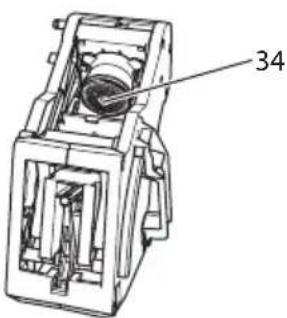
Fig. 17: Demontere melkeenheten
Sette inn vannfilter
Informasjon
natural_image
Line drawing of a portable electronic device with a close-up inset showing a small component (no text or symbols visible)Electrical and Electronic Equipment).
natural_image
Line drawing of a portable electronic device with control panel and buttons, shown with an inset magnified view (no text or symbols)natural_image
Illustration of a desktop computer with a close-up inset showing a device (no text or symbols visible)natural_image
Line drawing of a coffee maker with control panel and keyboard (no text or symbols)natural_image
Line drawing of a coffee machine with a magnified inset showing its internal components (no text or symbols present)9.4 "Easy Cleaning" program
Pav. 9: Pieno talpyklos prijungimas prie jrenginio
natural_image
Line drawing of a coffee machine with a magnified inset showing its front panel (no text or symbols present)Pav. 12: Malimo smulkumo nustatymas
Joon. 8: 2-kambriline kohviubade mahuti
natural_image
Line drawing of a coffee machine with a magnified inset showing its front panel (no text or symbols visible)Joon. 12: Jahvatusastme seadistamine
Seadistage jahvatusaste hoovaga aparaadi tagaküljel.
1. Liigutage hooba:
ū Paremale = jahvatamine on jäme-dam
ū Vasakule = jahvatamine on peenem
i Teave
Att. 8: Divkameru kafijas pupinu tvertne
natural_image
Line drawing of a desktop computer with a close-up inset showing a small component (no text or symbols)natural_image
Line drawing of a coffee machine with control panel and display screen (no text or symbols)natural_image
Line drawing of a coffee machine with control panel and keyboard (no text or symbols)图 1: 左前侧视图
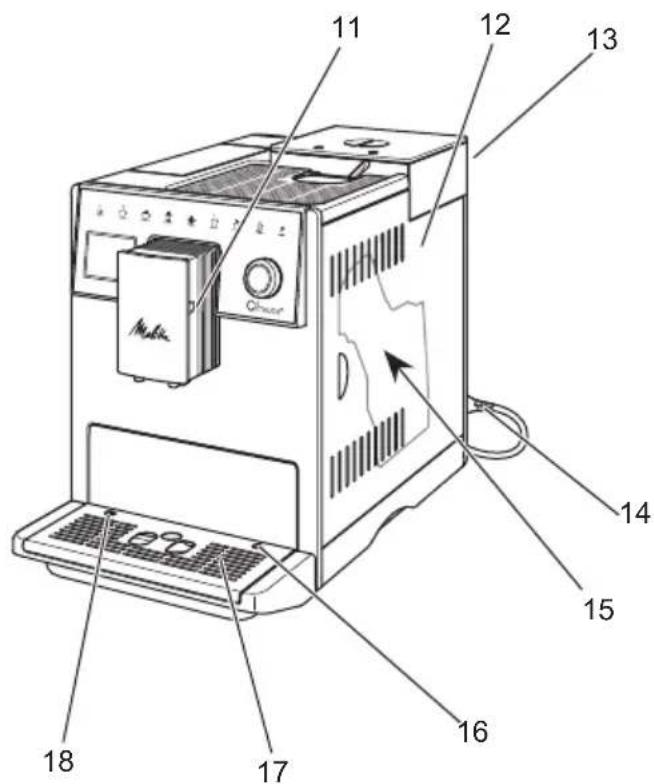
图 2: 右前侧视图
图 6: 分体式咖啡豆盒
图 7: 将奶缸连接到咖啡机上
图 8: 接水盘、咖啡粉盛接盒和浮标
图 9: 双杯制备
natural_image
Line drawing of a mechanical device with a close-up inset showing a component (no text or symbols visible)图 10: 研磨度设置
调整咖啡机后侧的手柄设置研磨度。
- 调整手柄:
ū 向右 = 研磨度变粗
向左 = 研磨度变细
信息
图 12: 拆卸滤煮器
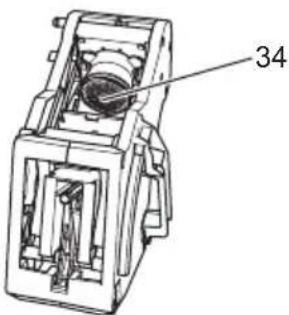
图 13: 清洗滤煮器
前提条件:咖啡机已关机。
natural_image
Line drawing of a coffee maker with control panel and keyboard (no text or symbols)图 14: 打开出奶装置
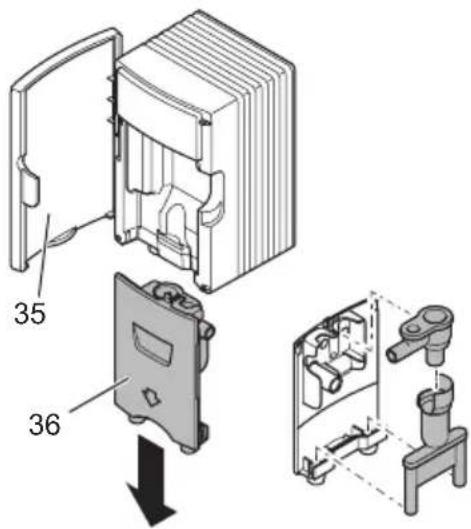
图 15: 拆卸出奶装置
The People's Republic of China released a regulation called „Management Methods for the Restriction of the Use of Hazardous Substances in Electrical and Electronic Products” or commonly referred to as China RoHS. All products which are produced and sold for China market have to meet this regulation.
名称和产品中有害物质的含量
Name and content of hazardous substances in products
| 组件名称Component Name | 有害物质Hazardous substance | |||||
| 铅Lead (Pb) | 汞Mercury (Hg) | 镉Cadmium (Cd) | 六价铬Hexavalent chromium (Cr (VI)) | 多溴联苯Polybrominated biphenyls (PBB) | 多溴二苯醚Polybrominated diphenyl ethers (PBDE) | |
| 塑料外壳和底盘Plastic enclosure and chassis | ○○○○○○ | |||||
| 印刷电路板组装Printed Circuit Board Assembly | X○○○○○ | |||||
| 电机、阀门Motors, valves | X○○○○○ | |||||
| 电缆和电线Cable and wiring | X○○○○○ | |||||
| 金属零件Metall parts | X○○○○○ | |||||
| 此表编制 SJ/T 11364 年规定。This table is prepared in accordance with the provisions of SJ/T 11364.O: 中所有均质材料中的这类组件这种有害物质的含量是下文要求 GB/T 26572 的极限值。O: The content of such hazardous substance in all homogeneous materials of such component is below the limit required by GB/T 26572.X: 这种有害物质在某些均质材料中这种组件的内容是超出 GB/T 26572 要求的极限值。X: The content of such hazardous substance in a certain homogeneous material of such component is beyond the limit required by GB/T 26572. | ||||||
此产品的环境友好使用期是:
The Environment Friendly Using Period for this product is:

목차
1 제품 개요.... 449
그림. 1: 커피 머신의 전면 왼쪽
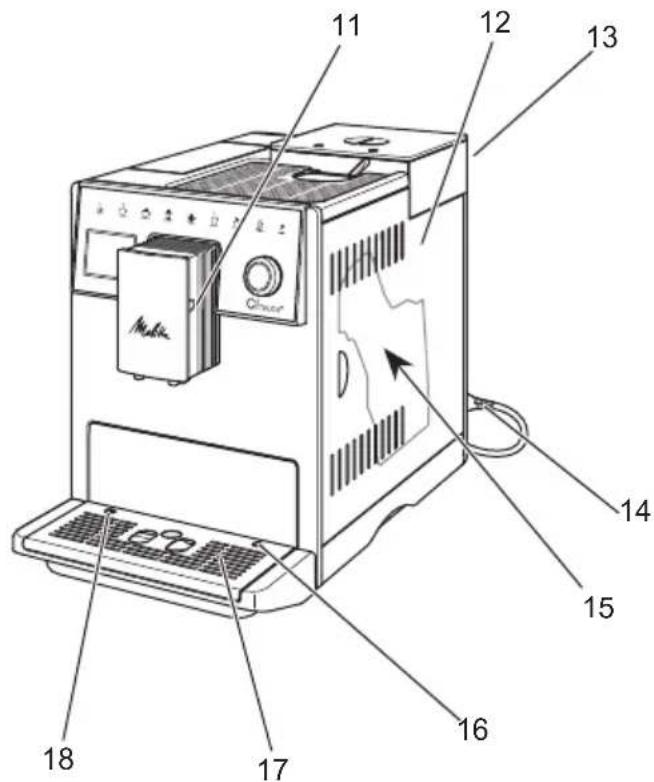
그림.2:커피 머신의 전면 오른쪽
그림.8:2칸식 원두 용기
그림.11:2잔 만들기
natural_image
Line drawing of a mechanical device with a close-up inset showing a component detail (no text or symbols)그림.12:분쇄 강도 설정
그림.13:사이드 패널 데어내기
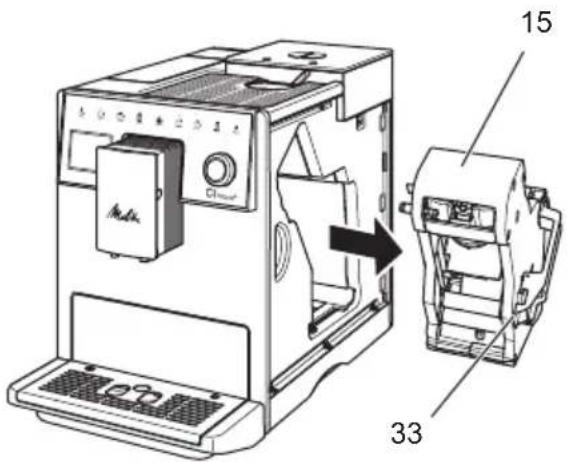
그림.14:추출장치 분리하기
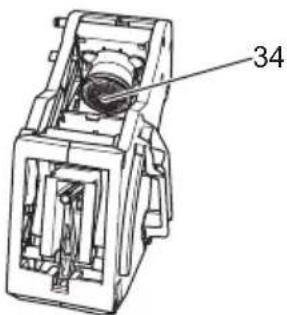
그림.15:추출장치 세척하기
natural_image
Line drawing of a coffee machine with control panel and keyboard (no text or symbols)그림.16:밀크 유닛으로 이동
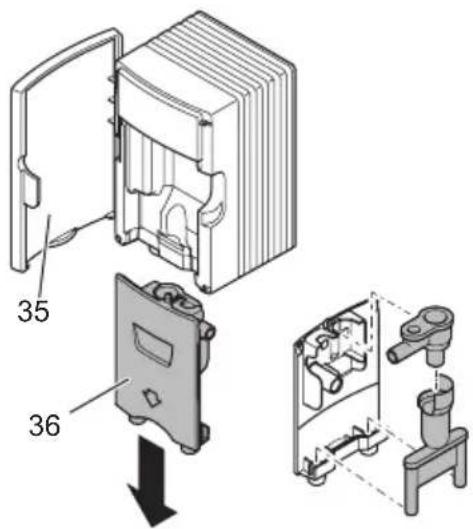
그림.17:밀크 유닛 분리하기
Division Household Products
Ringstr. 99
D-32427 Minden
Germany
www.melitta.de
Editorial department:
ZINDEL AG
www.zindel.de

- Overview of the appliance....31
- For your safety....33
- First steps....34
- Basic operation 35
- Preparing beverages 39
- Permanently changing beverage settings....41
- Personal settings – "My Coffee" 42
- Changing basic settings....43
- Care and maintenance....45
- Transport, storage and disposal 50
- Technical data....51
- Troubleshooting....52
- Overview of the appliance
- The appliance at a glance
- The control panel at a glance
- Item Designation Function
- Dear Customer,
- For your safety
- Proper use
- Danger from electric current
- Risk of burns and scalds
- General safety
- First steps
- Unpacking the appliance
- Information
- Checking the delivery contents
- Installing the appliance
- Connecting the appliance
- Switching on the appliance for the first time
- Basic operation
- Switching the appliance on and off
- Switching on the appliance
- Switching off the appliance
- Using the control panel
- Navigating in the menu
- Calling up the menu and confirming the selection
- Navigating in the menu
- Exiting a menu
- Calling up submenus
- Filling with coffee beans and using Bean Select
- CAUTION
- ATTENTION
- Using ground coffee
- Filling with water
- Adjusting the outlet
- Using milk
- Connecting the milk container
- Emptying the drip tray and coffee grounds container
- Preparing beverages
- Please note:
- Preparing espresso and café crème
- Preparing cappuccino and latte macchiato
- Preparing milk froth and warm milk
- Preparing hot water
- Preparing beverages with recipes
- Changing beverage settings before and during preparation
- Changing beverage settings before preparation
- Changing beverage settings during preparation
- Stopping beverage preparation
- Preparing two beverages simultaneously
- Permanently changing beverage settings
- Changing default settings
- Personal settings – "My Coffee"
- Editing personal user profiles
- Changing the name of a user profile
- Activating/deactivating a user profile
- Selecting/changing personal settings
- Preparing beverages with personal settings
- Changing basic settings
- Setting the language
- Setting the time
- Setting energy save mode
- Setting Auto OFF
- Setting the duration for Auto OFF
- Setting the point in time for Auto OFF
- Activating/deactivating rinsing
- Activating/deactivating switch-off rinsing
- Resetting the appliance to the factory settings
- Statistics and System menu
- Statistics
- System
- Setting the grinding fineness
- Care and maintenance
- General cleaning
- Rinsing the coffee system
- Cleaning the brewing unit
- "Easy Cleaning" programme
- "Cleaning milk system" programme
- The use of unsuitable milk system cleaning agents can damage the appliance.
- Requirement: The appliance is ready for operation.
- Cleaning the milk unit
- Fig. 17: Removing the milk unit
- "Cleaning coffee system" programme
- "Descaling" programme
- Requirements:
- Setting the water hardness
- Using a water filter
- Inserting the water filter
- Changing the water filter
- Requirement:
- Removing the water filter
- Transport, storage and disposal
- Venting the appliance
- Transporting the appliance
- Freezing residual water can damage the appliance.
- Technical data
- Disposing of the appliance
- Troubleshooting
- Sommaire
- Spoeling activeren/deactiveren
- Programma "Easy Cleaning"
- Programa "Easy Cleaning"
- Åbning af undermenuer
- Programmet "Easy Cleaning"
- Sette inn vannfilter
- Informasjon
- "Easy Cleaning" program
- Liigutage hooba:
- i Teave
- 信息
- 名称和产品中有害物质的含量
- 목차
- 제품 개요.... 449
Brand : MELITTA
Model : CI Touch F630101
Category : Coffee machine